EP1860695A2 - Système et procédé de refroidissement par projection de jet sur des surfaces étendues - Google Patents
Système et procédé de refroidissement par projection de jet sur des surfaces étendues Download PDFInfo
- Publication number
- EP1860695A2 EP1860695A2 EP07251481A EP07251481A EP1860695A2 EP 1860695 A2 EP1860695 A2 EP 1860695A2 EP 07251481 A EP07251481 A EP 07251481A EP 07251481 A EP07251481 A EP 07251481A EP 1860695 A2 EP1860695 A2 EP 1860695A2
- Authority
- EP
- European Patent Office
- Prior art keywords
- fluid
- cooling system
- channel
- fluid coolant
- heat
- Prior art date
- Legal status (The legal status is an assumption and is not a legal conclusion. Google has not performed a legal analysis and makes no representation as to the accuracy of the status listed.)
- Withdrawn
Links
Images


Classifications
-
- F—MECHANICAL ENGINEERING; LIGHTING; HEATING; WEAPONS; BLASTING
- F25—REFRIGERATION OR COOLING; COMBINED HEATING AND REFRIGERATION SYSTEMS; HEAT PUMP SYSTEMS; MANUFACTURE OR STORAGE OF ICE; LIQUEFACTION SOLIDIFICATION OF GASES
- F25B—REFRIGERATION MACHINES, PLANTS OR SYSTEMS; COMBINED HEATING AND REFRIGERATION SYSTEMS; HEAT PUMP SYSTEMS
- F25B23/00—Machines, plants or systems, with a single mode of operation not covered by groups F25B1/00 - F25B21/00, e.g. using selective radiation effect
-
- H—ELECTRICITY
- H10—SEMICONDUCTOR DEVICES; ELECTRIC SOLID-STATE DEVICES NOT OTHERWISE PROVIDED FOR
- H10W—GENERIC PACKAGES, INTERCONNECTIONS, CONNECTORS OR OTHER CONSTRUCTIONAL DETAILS OF DEVICES COVERED BY CLASS H10
- H10W40/00—Arrangements for thermal protection or thermal control
- H10W40/40—Arrangements for thermal protection or thermal control involving heat exchange by flowing fluids
- H10W40/47—Arrangements for thermal protection or thermal control involving heat exchange by flowing fluids by flowing liquids, e.g. forced water cooling
- H10W40/475—Arrangements for thermal protection or thermal control involving heat exchange by flowing fluids by flowing liquids, e.g. forced water cooling using jet impingement
-
- F—MECHANICAL ENGINEERING; LIGHTING; HEATING; WEAPONS; BLASTING
- F25—REFRIGERATION OR COOLING; COMBINED HEATING AND REFRIGERATION SYSTEMS; HEAT PUMP SYSTEMS; MANUFACTURE OR STORAGE OF ICE; LIQUEFACTION SOLIDIFICATION OF GASES
- F25B—REFRIGERATION MACHINES, PLANTS OR SYSTEMS; COMBINED HEATING AND REFRIGERATION SYSTEMS; HEAT PUMP SYSTEMS
- F25B2339/00—Details of evaporators; Details of condensers
- F25B2339/02—Details of evaporators
- F25B2339/021—Evaporators in which refrigerant is sprayed on a surface to be cooled
Definitions
- This invention relates generally to the field of cooling systems and, more particularly, to a system and method of jet impingement cooling with extended surfaces.
- a variety of different types of structures can generate heat or thermal energy in operation.
- a variety of different types of cooling systems may be utilized to dissipate the thermal energy.
- a variety of different types of coolants may be utilized.
- a cooling system for a heat-generating structure comprises a channel, a surface enhancing structure, and a fluid dispenser.
- the channel has an inlet and an exit.
- the inlet is operable to receive a fluid coolant into the channel substantially in the form of a liquid.
- the exit is operable to dispense of the fluid coolant out of the channel at least partially in the form of a vapor.
- the surface enhancing structure extends into the channel and is operable to receive thermal energy from the heat generating structure and transfer at least a portion of the thermal energy to the fluid coolant.
- the thermal energy from the heat-generating structure causes at least a portion of the fluid coolant substantially in the form of a liquid to boil and vaporize in the channel upon contact with the surface enhancing structure.
- the fluid dispenser is operable to deposit fluid coolant onto the surface enhancing structure.
- a technical advantage of one embodiment may include the capability to enhance heat transfer in a coolant stream.
- Other technical advantages of other embodiments may include the capability to utilize pin fin configurations to alter the heat transfer phenomenology and thereby enhance the transfer of thermal energy.
- Yet other technical advantages of other embodiments may include the capability to utilize a surface enhancement structure in conjunction with a fluid dispenser to enhance the transfer of thermal energy.
- micro-fins, microchannels, and micro-heat pipes have been proposed.
- a surface enhancement device such as pin fins can be used in conjunction with a fluid dispenser to enhance the transfer of heat or thermal energy.
- FIGURE 1 is a block diagram of an embodiment of a cooling system 10 that may be utilized in conjunction with other embodiments disclosed herein, namely surface enhancement and fluid dispenser embodiments described with reference to FIGURES 2A-5C. Although the details of one cooling system will be described below, it should be expressly understood that other cooling systems may be used in conjunction with embodiments of the invention.
- the cooling system 10 of FIGURE 1 is shown cooling a structure 12 that is exposed to or generates thermal energy.
- the structure 12 may be any of variety of structure, including, but not limited to, electronic components and circuits. Because the structure 12 can vary greatly, the details of structure 12 are not illustrated and described.
- the cooling system 10 of FIGURE 1 includes channels 23 and 24, pump 46, inlet orifices 47 and 48, a condenser heat exchanger 41, an expansion reservoir 42, and a pressure controller 51.
- the structure 12 may be arranged and designed to conduct heat or thermal energy to the channels 23, 24.
- the channels 23, 24 may be disposed on an edge of the structure 12 or may extend through portions of the structure 12, for example, through a thermal plane of structure 12.
- the channels 23, 24 may extend up to the components of the structure 12, directly receiving thermal energy from the components.
- two channels 23, 24 are shown in the cooling system 10 of FIGURE 1, one channel or more than two channels may be used to cool the structure 12 in other cooling systems.
- a fluid coolant flows through each of the channels 23, 24.
- this fluid coolant may be a two-phase fluid coolant, which enters inlet conduits 25 of channels 23, 24 in liquid form. Absorption of heat from the structure 12 causes part or all of the liquid coolant to boil and vaporize such that some or all of the fluid coolant leaves the exit conduits 27 of channels 23, 24 in a vapor phase.
- the channels 23, 24 may be lined with pin fins or other similar surface enhancement devices which, among other things, increase surface contact between the fluid coolant and walls of the channels 23, 24.
- the fluid coolant may dispensed into the channels 23,24 using a jet dispenser or spray dispenser to ensure fluid contact between the fluid coolant and the walls of the channels 23, 24 (and any surface enhancement devices, including pin fins). Further details of the surface enhancement/fluid dispenser embodiments are described below with reference to FIGURE 2A-5C.
- the fluid coolant departs the exit conduits 27 and flows through the condenser heat exchanger 41, the expansion reservoir 42, a pump 46, and a respective one of two orifices 47 and 48, in order to again to reach the inlet conduits 25 of the channels 23, 24.
- the pump 46 may cause the fluid coolant to circulate around the loop shown in FIGURE 1.
- the pump 46 may use magnetic drives so there are no shaft seals that can wear or leak with time.
- the orifices 47 and 48 in particular embodiments may facilitate proper partitioning of the fluid coolant among the respective channels 23, 24 , and may also help to create a large pressure drop between the output of the pump 46 and the channels 23, 24 in which the fluid coolant vaporizes.
- the orifices 47 and 48 may have the same size, or may have different sizes in order to partition the coolant in a proportional manner which facilitates a desired cooling profile.
- a flow 56 of fluid may be forced to flow through the condenser heat exchanger 41, for example by a fan (not shown) or other suitable device.
- the flow 56 of fluid may be ambient fluid.
- the condenser heat exchanger 41 transfers heat from the fluid coolant to the flow 56 of ambient fluid, thereby causing any portion of the fluid coolant which is in the vapor phase to condense back into a liquid phase.
- a liquid bypass 49 may be provided for liquid fluid coolant that either may have exited the channels 23, 24 or that may have condensed from vapor fluid coolant during travel to the condenser heat exchanger 41.
- the liquid fluid coolant exiting the condenser heat exchanger 41 may be supplied to the expansion reservoir 42. Since fluids typically take up more volume in their vapor phase than in their liquid phase, the expansion reservoir 42 may be provided in order to take up the volume of liquid fluid coolant that is displaced when some or all of the coolant in the system changes from its liquid phase to its vapor phase.
- the amount of the fluid coolant which is in its vapor phase can vary over time, due in part to the fact that the amount of heat or thermal energy being produced by the structure 12 will vary over time, as the structure 12 system operates in various operational modes.
- one highly efficient technique for removing heat from a surface is to boil and vaporize a liquid which is in contact with a surface. As the liquid vaporizes in this process, it inherently absorbs heat to effectuate such vaporization.
- the amount of heat that can be absorbed per unit volume of a liquid is commonly known as the latent heat of vaporization of the liquid. The higher the latent heat of vaporization, the larger the amount of heat that can be absorbed per unit volume of liquid being vaporized.
- the fluid coolant used in the embodiment of FIGURE 1 may include, but is not limited to mixtures of antifreeze and water.
- the antifreeze may be ethylene glycol, propylene glycol, methanol, or other suitable antifreeze.
- the mixture may also include fluoroinert.
- the fluid coolant may absorb a substantial amount of heat as it vaporizes, and thus may have a very high latent heat of vaporization.
- the fluid coolant's boiling temperature may be reduced to between 55-65°C by subjecting the fluid coolant to a subambient pressure of about 2-3 psia.
- the orifices 47 and 48 may permit the pressure of the fluid coolant downstream from them to be substantially less than the fluid coolant pressure between the pump 46 and the orifices 47 and 48, which in this embodiment is shown as approximately 12 psia.
- the pressure controller 51 maintains the coolant at a pressure of approximately 2-3 psia along the portion of the loop which extends from the orifices 47 and 48 to the pump 46, in particular through the channels 23 and 24, the condenser heat exchanger 41, and the expansion reservoir 42.
- a metal bellows may be used in the expansion reservoir 42, connected to the loop using brazed joints.
- the pressure controller 51 may control loop pressure by using a motor driven linear actuator that is part of the metal bellows of the expansion reservoir 42 or by using small gear pump to evacuate the loop to the desired pressure level.
- the fluid coolant removed may be stored in the metal bellows whose fluid connects are brazed.
- the pressure controller 51 may utilize other suitable devices capable of controlling pressure.
- the fluid coolant flowing from the pump 46 to the orifices 47 and 48 may have a temperature of approximately 55°C to 65°C and a pressure of approximately 12 psia as referenced above. After passing through the orifices 47 and 48, the fluid coolant may still have a temperature of approximately 55°C to 65°C, but may also have a lower pressure in the range about 2 psia to 3 psia. Due to this reduced pressure, some or all of the fluid coolant will boil or vaporize as it passes through and absorbs heat from the channels 23 and 24.
- the subambient coolant vapor travels to the condenser heat exchanger 41 where heat or thermal energy can be transferred from the subambient fluid coolant to the flow 56 of fluid.
- the flow 56 of fluid in particular embodiments may have a temperature of less than 50°C. In other embodiments, the flow 56 may have a temperature of less than 40°C.
- any portion of the fluid which is in its vapor phase will condense such that substantially all of the fluid coolant will be in liquid form when it exits the condenser heat exchanger 41.
- the fluid coolant may have a temperature of approximately 55°C to 65°C and a subambient pressure of approximately 2 psia to 3 psia.
- the fluid coolant may then flow to pump 46, which in particular embodiments 46 may increase the pressure of the fluid coolant to a value in the range of approximately 12 psia, as mentioned earlier.
- pump 46 Prior to the pump 46, there may be a fluid connection to an expansion reservoir 42 which, when used in conjunction with the pressure controller 51, can control the pressure within the cooling loop.
- FIGURE 1 may operate without a refrigeration system.
- electronic circuitry such as may be utilized in the structure 12
- the absence of a refrigeration system can result in a significant reduction in the size, weight, and power consumption of the structure provided to cool the circuit components of the structure 12.
- cooling system 10 can include more, less, or different component parts.
- a coolant fill port and/or a coolant bleed port may be utilized with metal-to-metal caps to seal them.
- all or a portion of the joints between various components may be brazed, soldered or welded using metal-to-metal seal caps.
- FIGURE 2A is an isolated perspective view of a pin fin configuration 110A and FIGURE 2B is a side cross-sectional view of a pin fin configuration 110B that may be utilized in embodiments of the invention.
- the pin fin configurations 110A, 110B may be disposed within the channels 23, 24 described with reference to FIGURE 1.
- the pin fin configurations 110A, 110B may be disposed in other heat transfer structures.
- the pin fin configurations 110A, 110B will be described as being disposed in a channel operable to receive fluid.
- the pin fin configurations 110A, 110B of FIGURES 2A and 2B are examples of surface enhancements that may be utilized to enhance the transfer of thermal energy from a heat generating structure to a fluid stream.
- Other types of surface enhancements that may be utilized with other embodiments of the invention include, but are not limited to, conductive foam and conductive fibers. As described below with reference to FIGURES 4A and 4B, these surface enhancements may be used in conjunction with fluid dispensers.
- a plurality of pin fins 113, 115 protrude from channel walls 125 and are arranged in pin fin configurations 110A, 110B.
- Pin fin configuration 110A shows a staggered arrangement and pin fin configuration 110B shows an inline arrangement.
- FIGURE 2B additionally shows a channel 120 with a fluid flow towards the pin fin configuration 110B, indicated by arrow 132, and a fluid flow away from the pin fin configuration 110B, indicated by arrow 134.
- thermal energy is transferred to the pin fins 113, 115 (e.g., from the channel wall 125 to the pin fins 113, 115) and to a fluid traveling through the channel, for example, channel 120.
- the pin fin configurations 110A, 110B may be utilized to enhance boiling heat transfer.
- liquid fluid coolant e.g., traveling in direction of arrow 132 towards the pin fins 113, 115
- the vaporized fluid coolant e.g., traveling away from the pin fins in direction of arrow 134 inherently contains the thermal energy transferred from the pin fins 113, 115 to the fluid coolant during vaporization.
- a portion or all of the fluid flow of the cross-flowing fluid coolant stream can be created by fluid dispensers that are described in greater detail with reference to FIGURES 4A-5C.
- pin fins configurations such as pin fin configurations 110A, 110B
- pin fin configurations 110A, 110B can be utilized in cross-flowing coolant streams to alter the heat transfer phenomenology and thereby enhance heat transfer.
- the cross flowing coolant creates jet-impingement-like flows of coolant that impact the surfaces of the plurality of pin fins 113, 115.
- the velocity of the coolant increases, which further increases the impacting velocity of the cross flowing coolant on the pin fins 113, 115.
- the effusing vapor also causes a near chaotic flow of vapor with embedded liquid coolant that impacts the pins fins 113, 115.
- the pin fin configurations 110A, 110B allow a cross flowing coolant to be used while taking advantage of the attributes of jet impingement and spray cooling, which are provided by the chaotic cross flowing liquid impacting the pins.
- the pin fins 113, 115 may be made of a variety of materials and may take on a variety of sizes and shapes.
- the pin fins are made of a nickel plated copper and vary in size from 0.04 inches high to 0.1675 inches high.
- the pin fins 113, 115 are shown with a columnar shape.
- the pin fins 113, 115 may be made of other materials, may have heights less than 0.04 inches, may have heights greater than 0.1675 inches, and may have shapes other than columnar shapes.
- the pin fins 113, 115 may be arranged in configurations other than inline or staggered configurations.
- the pin fins may be made of a conductive foam or conductive fiber.
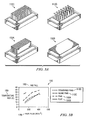
- FIGURE 3A shows pin fin configurations 110C, 110D, according to embodiments of the invention.
- Pin fin configuration 110C is an inline configuration and pin fin configuration 110D is a staggered configuration.
- the pin configurations 110C and 110D may operate in a similar manner, may have similar or different shapes and sizes, and may be made from similar or different materials than the pin fin configurations 110A, 110B described with reference to FIGURES 2A and 2B.
- the pin fin configurations 110C, 110D are shown alongside a conventional fin stock configuration 150A and a conventional flat heat transfer configuration 150B.
- FIGURE 3B shows a graph 190 comparing performance of the pin fin configurations 110C, 110D against the conventional fin stock configuration 150A and the conventional flat heat transfer configuration 150B.
- the graph 190 shows measured results of heat flux 170 against temperature rise 160 for a 0.105 inch size 180 for the pin fin configurations 110C, 110D and the conventional fin stock configuration 150A.
- the graph shows that the amount of wall super heat is significantly less for the pin fin configurations 110C, 110D than the conventional fin stock configuration 150A and the conventional flat heat transfer configuration 150B.
- the flat heat transfer configuration 150B was not tested because it transitioned to film boiling.
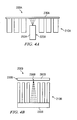
- FIGURES 4A and 4B shows pin fin/fluid dispenser configurations 200A, 200B, according to embodiments of the invention.
- the pin fin/fluid dispenser configurations 200A, 200B of FIGURES 4A and 4B include pin fin configurations 210A, 210B and fluid dispensers 220A, 220B.
- the pin fin configurations 210A, 210B may be similar or different to the pin fin configurations 110A, 110B, 110C, and 110D described with reference to FIGURES 2A, 2B, and 3A, including pin fins 210A, 210B that extend from a channel surface 230A, 230B.
- the pin fin/fluid dispenser configurations 200A, 200B may be used within the channels 23, 24 described with reference to FIGURE 1. In other embodiments, the pin fin/fluid dispenser configuration s200A, 200B may be disposed in other heat transfer structures.
- the fluid dispensers 220A, 220B may generally include any structure capable of projecting or depositing a fluid onto one or both of the channel surface 230A, 230B and the pin fin configurations 210A, 210B.
- the fluid dispensers 220A, 220B may be jet dispensers operable to create jet flows of fluid.
- the fluid dispensers 220A, 220B may be spray dispensers operable to create a spray of fluid.
- the fluid dispensers 220A, 220B may be a combination of jet dispensers and spray dispensers.
- the fluid dispenser 220A of FIGURE 4A is a nozzle 250A.
- the fluid dispenser 220A of FIGURE 4B is an orifice plate 260B with one or more holes that serve as a nozzle 250B.
- the fluid dispensers 220A, 220B may generate a portion or all of the flow.
- the fluid dispensers 220A, 220B directly impinge fluid on the channel surface 230A, 230B and the pin fin configurations 210A, 210B, thereby realize a higher two-phase heat transfer coefficient.
- the pin fin configurations 210A, 210B ensure that entrained vapor bubbles do not impede a replenishment of liquid coolant to the heated surface and that no vapor films can develop.
- the fluid dispensers 220A, 220B may further enhance the throwing of globs liquid coolant (e.g., formed from the vaporization of other liquid coolant) against downstream pin fins 210A, 210B, described with reference to FIGURES 2A and 2B.
- some of the pins 210A, 210B directly adjacent the nozzles 250A, 250B may be removed to allow fluid to be deposited directly to the channel surface 230A, 230B.
- other types of surface enhancements materials may include conductive foam or conductive fibers.
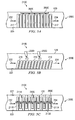
- FIGURES 5A, 5B, and 5C show pin fin/fluid dispenser configuration 200C, 200D, and 200E, according to embodiments of the invention.
- the pin fin/fluid dispenser configuration 200C, 200D, and 200E of FIGURES 5A, 5B, and 5C are intended as illustrating some of the variety of pin fin/fluid dispenser configurations that may be utilized, according to embodiments of the inventions. Although several are specifically shown, others will become apparent to one of ordinary skill in the art after review of this specification.
- the pin fin/fluid dispenser configurations 200C, 200D, and 200E may operate in a similar manner and may be made from similar or different materials than the pin fin/fluid dispenser configuration 200A and 200B, described with reference to FIGURES 4A and 4B.
- Each of the pin fin/fluid dispenser configuration 200C, 200D, and 200E of FIGURES 5A, 5B, and 5C is shown with a channel 120 with a fluid flow towards pin fin configurations 210C, 210D, and 210E, indicated by arrow 232, and a fluid flow away from the pin fin configuration configurations 210C, 210D, and 210E,, indicated by arrow 234.
- Each of the pin fin configurations 210C, 210D, and 210E of FIGURES 4A, 4B, and 4C is additionally shown extending from a channel wall 225 that may be in thermal communication with a heat generating structure (e.g., heat generating structure 12 of FIGURE 1).
- FIGURE 5A shows that pin fins 217 in pin fin configuration 210C may extend substantially across a channel 120 and that an orifice plate 260C may have a plurality of nozzles 250C to deposit fluid coolant on each of the pin fins 217.
- the pin fins 217 may only extend a portion of the distance across a channel.
- the pin fins 217 are show as all the same length, in other embodiments the pin fins 217 may be different lengths.
- FIGURE 5B shows that pin fins 219 in pin fin configuration 210D may tilt at an angle and be deposited with nozzles 250D, also tilted at an angle.
- the pin fins 219 and nozzles 250D are shown tilting at a downstream angle from the fluid flow in this embodiment, in other embodiments, one or both of the pin fins 219 and nozzles 250D may tilt at an upstream angle. And, in some embodiments, some of the pin fins 219 and the nozzles 250D may tilt in one direction and others of the pin fins 219 and the nozzles 250D may tilt in a different direction. Similar to that described above, in particular embodiments, the pin fins 219 may also be different lengths.
- FIGURE 5C shows that pin fins 211A, 211B in pin fin configuration 210E may extend from different channel walls 225, 227 and that an orifice 260E with a plurality of nozzles 250E pointing towards different walls 225, 227 may extend through a center of the channel 120. Similar to that described above, in particular embodiments, the pin fins 211A, 211B may also be different lengths and tilt in different directions.
Landscapes
- Engineering & Computer Science (AREA)
- Physics & Mathematics (AREA)
- Mechanical Engineering (AREA)
- Thermal Sciences (AREA)
- General Engineering & Computer Science (AREA)
- Cooling Or The Like Of Semiconductors Or Solid State Devices (AREA)
- Cooling Or The Like Of Electrical Apparatus (AREA)
Applications Claiming Priority (1)
| Application Number | Priority Date | Filing Date | Title |
|---|---|---|---|
| US42018406A | 2006-05-24 | 2006-05-24 |
Publications (2)
| Publication Number | Publication Date |
|---|---|
| EP1860695A2 true EP1860695A2 (fr) | 2007-11-28 |
| EP1860695A3 EP1860695A3 (fr) | 2010-06-16 |
Family
ID=38472943
Family Applications (1)
| Application Number | Title | Priority Date | Filing Date |
|---|---|---|---|
| EP07251481A Withdrawn EP1860695A3 (fr) | 2006-05-24 | 2007-04-03 | Système et procédé de refroidissement par projection de jet sur des surfaces étendues |
Country Status (1)
| Country | Link |
|---|---|
| EP (1) | EP1860695A3 (fr) |
Cited By (6)
| Publication number | Priority date | Publication date | Assignee | Title |
|---|---|---|---|---|
| US8266802B2 (en) | 2008-06-18 | 2012-09-18 | International Business Machines Corporation | Cooling apparatus and method of fabrication thereof with jet impingement structure integrally formed on thermally conductive pin fins |
| CN104685984A (zh) * | 2012-09-28 | 2015-06-03 | 惠普发展公司,有限责任合伙企业 | 冷却组件 |
| US9529395B2 (en) | 2012-03-12 | 2016-12-27 | Hewlett Packard Enterprise Development Lp | Liquid temperature control cooling |
| US9788452B2 (en) | 2012-10-31 | 2017-10-10 | Hewlett Packard Enterprise Development Lp | Modular rack system |
| US9803937B2 (en) | 2013-01-31 | 2017-10-31 | Hewlett Packard Enterprise Development Lp | Liquid cooling |
| US10123464B2 (en) | 2012-02-09 | 2018-11-06 | Hewlett Packard Enterprise Development Lp | Heat dissipating system |
Citations (6)
| Publication number | Priority date | Publication date | Assignee | Title |
|---|---|---|---|---|
| JPS60136349A (ja) | 1983-12-26 | 1985-07-19 | Hitachi Ltd | 半導体チップの冷却装置 |
| US5198889A (en) | 1990-06-30 | 1993-03-30 | Kabushiki Kaisha Toshiba | Cooling apparatus |
| JPH06268109A (ja) * | 1993-03-12 | 1994-09-22 | Hitachi Ltd | 半導体チップおよびこの半導体チップを組み込んだ電子装置 |
| DE10333877A1 (de) | 2003-07-25 | 2005-02-24 | Sdk-Technik Gmbh | Kühlvorrichtung, insbesondere zur Kühlung von Bauelementen der Leistungselektronik mittels eines Wärmeübertragungskreislaufes |
| EP1519646A2 (fr) | 2003-09-26 | 2005-03-30 | Thermal Form & Function LLC | Emploi de matériaux en mousse graphitée dans un liquide pompé, refroidissiment biphasé, radiateur |
| JP4147657B2 (ja) | 1998-12-21 | 2008-09-10 | 住友金属鉱山株式会社 | 積層セラミックコンデンサーの内部電極ペースト用ニッケル粉 |
Family Cites Families (2)
| Publication number | Priority date | Publication date | Assignee | Title |
|---|---|---|---|---|
| US3609991A (en) * | 1969-10-13 | 1971-10-05 | Ibm | Cooling system having thermally induced circulation |
| JP2550770B2 (ja) * | 1990-10-11 | 1996-11-06 | 日本電気株式会社 | 電子部品冷却機構 |
-
2007
- 2007-04-03 EP EP07251481A patent/EP1860695A3/fr not_active Withdrawn
Patent Citations (6)
| Publication number | Priority date | Publication date | Assignee | Title |
|---|---|---|---|---|
| JPS60136349A (ja) | 1983-12-26 | 1985-07-19 | Hitachi Ltd | 半導体チップの冷却装置 |
| US5198889A (en) | 1990-06-30 | 1993-03-30 | Kabushiki Kaisha Toshiba | Cooling apparatus |
| JPH06268109A (ja) * | 1993-03-12 | 1994-09-22 | Hitachi Ltd | 半導体チップおよびこの半導体チップを組み込んだ電子装置 |
| JP4147657B2 (ja) | 1998-12-21 | 2008-09-10 | 住友金属鉱山株式会社 | 積層セラミックコンデンサーの内部電極ペースト用ニッケル粉 |
| DE10333877A1 (de) | 2003-07-25 | 2005-02-24 | Sdk-Technik Gmbh | Kühlvorrichtung, insbesondere zur Kühlung von Bauelementen der Leistungselektronik mittels eines Wärmeübertragungskreislaufes |
| EP1519646A2 (fr) | 2003-09-26 | 2005-03-30 | Thermal Form & Function LLC | Emploi de matériaux en mousse graphitée dans un liquide pompé, refroidissiment biphasé, radiateur |
Cited By (10)
| Publication number | Priority date | Publication date | Assignee | Title |
|---|---|---|---|---|
| US8266802B2 (en) | 2008-06-18 | 2012-09-18 | International Business Machines Corporation | Cooling apparatus and method of fabrication thereof with jet impingement structure integrally formed on thermally conductive pin fins |
| US10123464B2 (en) | 2012-02-09 | 2018-11-06 | Hewlett Packard Enterprise Development Lp | Heat dissipating system |
| US9529395B2 (en) | 2012-03-12 | 2016-12-27 | Hewlett Packard Enterprise Development Lp | Liquid temperature control cooling |
| CN104685984A (zh) * | 2012-09-28 | 2015-06-03 | 惠普发展公司,有限责任合伙企业 | 冷却组件 |
| US9927187B2 (en) | 2012-09-28 | 2018-03-27 | Hewlett Packard Enterprise Development Lp | Cooling assembly |
| US10571206B2 (en) | 2012-09-28 | 2020-02-25 | Hewlett Packard Enterprise Development Lp | Cooling assembly |
| US9788452B2 (en) | 2012-10-31 | 2017-10-10 | Hewlett Packard Enterprise Development Lp | Modular rack system |
| US9803937B2 (en) | 2013-01-31 | 2017-10-31 | Hewlett Packard Enterprise Development Lp | Liquid cooling |
| US10330395B2 (en) | 2013-01-31 | 2019-06-25 | Hewlett Packard Enterprise Development Lp | Liquid cooling |
| US10458724B2 (en) | 2013-01-31 | 2019-10-29 | Hewlett Packard Enterprise Development Lp | Liquid cooling |
Also Published As
| Publication number | Publication date |
|---|---|
| EP1860695A3 (fr) | 2010-06-16 |
Similar Documents
| Publication | Publication Date | Title |
|---|---|---|
| EP1892494B1 (fr) | Système et procédé pour transfert de chaleur bouillante utilisant le transport et la projection de refroidissement auto-induit | |
| EP1793422A2 (fr) | Procédé et appareil pour le transfer amélioré de chaleur bouillante utilisant des puits de chaleur à picots | |
| US6952346B2 (en) | Etched open microchannel spray cooling | |
| US6571569B1 (en) | Method and apparatus for high heat flux heat transfer | |
| US6827135B1 (en) | High flux heat removal system using jet impingement of water at subatmospheric pressure | |
| EP1860695A2 (fr) | Système et procédé de refroidissement par projection de jet sur des surfaces étendues | |
| US7654100B2 (en) | Method and apparatus for high heat flux heat transfer | |
| US7522417B2 (en) | Multi-mode fluid cooling system and method | |
| US20160033204A1 (en) | High Efficiency Thermal Management System | |
| US6993926B2 (en) | Method and apparatus for high heat flux heat transfer | |
| EP2203696B1 (fr) | Système de refroidissement | |
| US20060162365A1 (en) | Cooling electronics via two-phase tangential jet impingement in a semi-toroidal channel | |
| US7159414B2 (en) | Hotspot coldplate spray cooling system | |
| US8651172B2 (en) | System and method for separating components of a fluid coolant for cooling a structure | |
| US6793007B1 (en) | High flux heat removal system using liquid ice | |
| EP1754011A2 (fr) | Refroidissement d'un point chaud par pulverisation | |
| EP2317601B1 (fr) | Structure d'antenne intégrée dotée d'un canal de refroidissement intégré | |
| US7392660B2 (en) | Spray cooling system for narrow gap transverse evaporative spray cooling | |
| EP1796447B1 (fr) | Système et méthode pour un chassis électronique, électronique montée dans une baie avec un système de refroidissement intégré sousambiant | |
| CN208205489U (zh) | 一种使用相变材料冷却喷雾介质和使用微通道换热器防止失效的机载喷雾冷却系统 | |
| RU2649170C1 (ru) | Способ охлаждения электронного оборудования с использованием комбинированных пленочных и капельных потоков жидкости | |
| CN110285607B (zh) | 卧式冲击式降膜蒸发器及方法 | |
| Hong et al. | The local and average heat transfer characteristic of confined jet array impingement boiling of aqueous ethylene glycol solutions | |
| RU2773679C1 (ru) | Способ охлаждения электронного оборудования с использованием комбинированных потоков газа и микрокапель | |
| JP3806522B2 (ja) | 吸収式ヒートポンプ装置 |
Legal Events
| Date | Code | Title | Description |
|---|---|---|---|
| PUAI | Public reference made under article 153(3) epc to a published international application that has entered the european phase |
Free format text: ORIGINAL CODE: 0009012 |
|
| AK | Designated contracting states |
Kind code of ref document: A2 Designated state(s): AT BE BG CH CY CZ DE DK EE ES FI FR GB GR HU IE IS IT LI LT LU LV MC MT NL PL PT RO SE SI SK TR |
|
| AX | Request for extension of the european patent |
Extension state: AL BA HR MK YU |
|
| PUAL | Search report despatched |
Free format text: ORIGINAL CODE: 0009013 |
|
| AK | Designated contracting states |
Kind code of ref document: A3 Designated state(s): AT BE BG CH CY CZ DE DK EE ES FI FR GB GR HU IE IS IT LI LT LU LV MC MT NL PL PT RO SE SI SK TR |
|
| AX | Request for extension of the european patent |
Extension state: AL BA HR MK RS |
|
| 17P | Request for examination filed |
Effective date: 20101216 |
|
| AKX | Designation fees paid |
Designated state(s): AT BE BG CH CY CZ DE DK EE ES FI FR GB GR HU IE IS IT LI LT LU LV MC MT NL PL PT RO SE SI SK TR |
|
| 17Q | First examination report despatched |
Effective date: 20130717 |
|
| STAA | Information on the status of an ep patent application or granted ep patent |
Free format text: STATUS: THE APPLICATION IS DEEMED TO BE WITHDRAWN |
|
| 18D | Application deemed to be withdrawn |
Effective date: 20131101 |