EP1863181A1 - Détection de données avec des niveaux de référence adaptables - Google Patents
Détection de données avec des niveaux de référence adaptables Download PDFInfo
- Publication number
- EP1863181A1 EP1863181A1 EP06114816A EP06114816A EP1863181A1 EP 1863181 A1 EP1863181 A1 EP 1863181A1 EP 06114816 A EP06114816 A EP 06114816A EP 06114816 A EP06114816 A EP 06114816A EP 1863181 A1 EP1863181 A1 EP 1863181A1
- Authority
- EP
- European Patent Office
- Prior art keywords
- reference levels
- reliability
- detector
- data detection
- code words
- Prior art date
- Legal status (The legal status is an assumption and is not a legal conclusion. Google has not performed a legal analysis and makes no representation as to the accuracy of the status listed.)
- Withdrawn
Links
- 238000001514 detection method Methods 0.000 title claims abstract description 26
- 230000003044 adaptive effect Effects 0.000 title claims abstract description 16
- 230000006978 adaptation Effects 0.000 claims abstract description 30
- 238000000034 method Methods 0.000 claims abstract description 16
- 238000007476 Maximum Likelihood Methods 0.000 claims description 14
- 230000003287 optical effect Effects 0.000 description 8
- 238000001914 filtration Methods 0.000 description 5
- 238000004088 simulation Methods 0.000 description 5
- 238000012935 Averaging Methods 0.000 description 3
- BQCADISMDOOEFD-UHFFFAOYSA-N Silver Chemical compound [Ag] BQCADISMDOOEFD-UHFFFAOYSA-N 0.000 description 2
- 238000010586 diagram Methods 0.000 description 2
- 229910052709 silver Inorganic materials 0.000 description 2
- 239000004332 silver Substances 0.000 description 2
- 238000013459 approach Methods 0.000 description 1
- 230000005540 biological transmission Effects 0.000 description 1
- 238000012937 correction Methods 0.000 description 1
- 238000005259 measurement Methods 0.000 description 1
- 230000010363 phase shift Effects 0.000 description 1
- 238000013139 quantization Methods 0.000 description 1
- 238000000926 separation method Methods 0.000 description 1
- 230000001629 suppression Effects 0.000 description 1
- 238000012360 testing method Methods 0.000 description 1
- 238000012546 transfer Methods 0.000 description 1
Images

Classifications
-
- H—ELECTRICITY
- H03—ELECTRONIC CIRCUITRY
- H03M—CODING; DECODING; CODE CONVERSION IN GENERAL
- H03M13/00—Coding, decoding or code conversion, for error detection or error correction; Coding theory basic assumptions; Coding bounds; Error probability evaluation methods; Channel models; Simulation or testing of codes
- H03M13/37—Decoding methods or techniques, not specific to the particular type of coding provided for in groups H03M13/03 - H03M13/35
- H03M13/39—Sequence estimation, i.e. using statistical methods for the reconstruction of the original codes
- H03M13/41—Sequence estimation, i.e. using statistical methods for the reconstruction of the original codes using the Viterbi algorithm or Viterbi processors
- H03M13/4138—Sequence estimation, i.e. using statistical methods for the reconstruction of the original codes using the Viterbi algorithm or Viterbi processors soft-output Viterbi algorithm based decoding, i.e. Viterbi decoding with weighted decisions
- H03M13/4146—Sequence estimation, i.e. using statistical methods for the reconstruction of the original codes using the Viterbi algorithm or Viterbi processors soft-output Viterbi algorithm based decoding, i.e. Viterbi decoding with weighted decisions soft-output Viterbi decoding according to Battail and Hagenauer in which the soft-output is determined using path metric differences along the maximum-likelihood path, i.e. "SOVA" decoding
-
- G—PHYSICS
- G11—INFORMATION STORAGE
- G11B—INFORMATION STORAGE BASED ON RELATIVE MOVEMENT BETWEEN RECORD CARRIER AND TRANSDUCER
- G11B20/00—Signal processing not specific to the method of recording or reproducing; Circuits therefor
- G11B20/10—Digital recording or reproducing
- G11B20/10009—Improvement or modification of read or write signals
-
- G—PHYSICS
- G11—INFORMATION STORAGE
- G11B—INFORMATION STORAGE BASED ON RELATIVE MOVEMENT BETWEEN RECORD CARRIER AND TRANSDUCER
- G11B20/00—Signal processing not specific to the method of recording or reproducing; Circuits therefor
- G11B20/10—Digital recording or reproducing
- G11B20/10009—Improvement or modification of read or write signals
- G11B20/10046—Improvement or modification of read or write signals filtering or equalising, e.g. setting the tap weights of an FIR filter
-
- G—PHYSICS
- G11—INFORMATION STORAGE
- G11B—INFORMATION STORAGE BASED ON RELATIVE MOVEMENT BETWEEN RECORD CARRIER AND TRANSDUCER
- G11B20/00—Signal processing not specific to the method of recording or reproducing; Circuits therefor
- G11B20/10—Digital recording or reproducing
- G11B20/10009—Improvement or modification of read or write signals
- G11B20/10046—Improvement or modification of read or write signals filtering or equalising, e.g. setting the tap weights of an FIR filter
- G11B20/10055—Improvement or modification of read or write signals filtering or equalising, e.g. setting the tap weights of an FIR filter using partial response filtering when writing the signal to the medium or reading it therefrom
-
- H—ELECTRICITY
- H03—ELECTRONIC CIRCUITRY
- H03M—CODING; DECODING; CODE CONVERSION IN GENERAL
- H03M13/00—Coding, decoding or code conversion, for error detection or error correction; Coding theory basic assumptions; Coding bounds; Error probability evaluation methods; Channel models; Simulation or testing of codes
- H03M13/37—Decoding methods or techniques, not specific to the particular type of coding provided for in groups H03M13/03 - H03M13/35
- H03M13/3707—Adaptive decoding and hybrid decoding, e.g. decoding methods or techniques providing more than one decoding algorithm for one code
-
- H—ELECTRICITY
- H03—ELECTRONIC CIRCUITRY
- H03M—CODING; DECODING; CODE CONVERSION IN GENERAL
- H03M13/00—Coding, decoding or code conversion, for error detection or error correction; Coding theory basic assumptions; Coding bounds; Error probability evaluation methods; Channel models; Simulation or testing of codes
- H03M13/37—Decoding methods or techniques, not specific to the particular type of coding provided for in groups H03M13/03 - H03M13/35
- H03M13/39—Sequence estimation, i.e. using statistical methods for the reconstruction of the original codes
- H03M13/3905—Maximum a posteriori probability [MAP] decoding or approximations thereof based on trellis or lattice decoding, e.g. forward-backward algorithm, log-MAP decoding, max-log-MAP decoding
-
- H—ELECTRICITY
- H03—ELECTRONIC CIRCUITRY
- H03M—CODING; DECODING; CODE CONVERSION IN GENERAL
- H03M13/00—Coding, decoding or code conversion, for error detection or error correction; Coding theory basic assumptions; Coding bounds; Error probability evaluation methods; Channel models; Simulation or testing of codes
- H03M13/63—Joint error correction and other techniques
- H03M13/6325—Error control coding in combination with demodulation
-
- H—ELECTRICITY
- H03—ELECTRONIC CIRCUITRY
- H03M—CODING; DECODING; CODE CONVERSION IN GENERAL
- H03M13/00—Coding, decoding or code conversion, for error detection or error correction; Coding theory basic assumptions; Coding bounds; Error probability evaluation methods; Channel models; Simulation or testing of codes
- H03M13/63—Joint error correction and other techniques
- H03M13/6343—Error control coding in combination with techniques for partial response channels, e.g. recording
-
- H—ELECTRICITY
- H04—ELECTRIC COMMUNICATION TECHNIQUE
- H04L—TRANSMISSION OF DIGITAL INFORMATION, e.g. TELEGRAPHIC COMMUNICATION
- H04L25/00—Baseband systems
- H04L25/02—Details ; arrangements for supplying electrical power along data transmission lines
- H04L25/06—DC level restoring means; Bias distortion correction ; Decision circuits providing symbol by symbol detection
- H04L25/067—DC level restoring means; Bias distortion correction ; Decision circuits providing symbol by symbol detection providing soft decisions, i.e. decisions together with an estimate of reliability
-
- G—PHYSICS
- G11—INFORMATION STORAGE
- G11B—INFORMATION STORAGE BASED ON RELATIVE MOVEMENT BETWEEN RECORD CARRIER AND TRANSDUCER
- G11B20/00—Signal processing not specific to the method of recording or reproducing; Circuits therefor
- G11B20/10—Digital recording or reproducing
- G11B20/14—Digital recording or reproducing using self-clocking codes
- G11B20/1403—Digital recording or reproducing using self-clocking codes characterised by the use of two levels
- G11B20/1423—Code representation depending on subsequent bits, e.g. delay modulation, double density code, Miller code
- G11B20/1426—Code representation depending on subsequent bits, e.g. delay modulation, double density code, Miller code conversion to or from block codes or representations thereof
-
- H—ELECTRICITY
- H04—ELECTRIC COMMUNICATION TECHNIQUE
- H04L—TRANSMISSION OF DIGITAL INFORMATION, e.g. TELEGRAPHIC COMMUNICATION
- H04L25/00—Baseband systems
- H04L25/02—Details ; arrangements for supplying electrical power along data transmission lines
- H04L25/03—Shaping networks in transmitter or receiver, e.g. adaptive shaping networks
- H04L25/03006—Arrangements for removing intersymbol interference
- H04L25/03171—Arrangements involving maximum a posteriori probability [MAP] detection
Definitions
- the present invention relates to data detection with adaptive reference levels based on reliability estimations, and to storage systems and systems for receiving digital data using such data detection.
- Maximum likelihood detection is an established approach for achieving an improved bit error rate (BER) at low signal to noise ratios (SNR).
- Maximum likelihood detection is often employed in optical disk systems or data transmission systems.
- its effectiveness is limited by the Euclidean distance between the received code word and the given reference levels.
- a proper choice of reference levels greatly improves the detection performance.
- a main problem of maximum likelihood detection is the determination of the best reference values even in case of bad or changing channel conditions, e.g. asymmetry, noise, or other distortion (e.g. black dot or scratch etc. on an optical disk).
- Other detection schemes based on adaptive reference levels are known, using for example a slicer or a MAP detector (Maximum a Posteriori).
- a plurality of solutions for determining the reference levels are known.
- a first solution is to use fixed reference levels based on measurements or tests. This solution, however, is unable to react properly to a changing channel transfer function.
- a further solution is to provide adaptive reference levels through low-pass filtering.
- This solution is described, for example, in Jpn. J. Appl. Phys. Vol. 41 (2002) pp. 1789-1790: Adaptive Partial-Response Maximum Likelihood Detection in Optical Recording Media .
- the use of fixed coefficients for the low-pass filter results in a coarse quantization of the reference levels.
- JP 2002-217860 According to this so-called pilot averaging solution a pilot channel is used for estimating the channel response for all other channels.
- the solution is only applicable to OFDM systems (Orthogonal Frequency Division Multiplex), because in these systems the channel response is not fixed.
- the pilot channel can be fixed or randomly connected to a sub frequency of the OFDM system. For the whole channel response (all sub channels) an interpolation of the channel response of each pilot channel is made.
- the better the estimation of the pilot channel the better is the estimation of the whole channel response and the better is the estimation of the OFDM symbols used for demapping.
- the reliability and dependability signal is used for improving the estimation of the pilot channel.
- Modulation techniques which are addressed in this document, are QPSK (Quadrature Phase Shift Keying) and QAM (Quadrature Amplitude Modulation).
- this object is achieved by a method for adapting the reference levels of a detector, wherein the adaptation rate of the reference levels is determined by the reliability of the detected code words.
- this object is also achieved by a data detection system having a detector with adaptive reference levels, wherein the adaptation rate of the reference levels is determined by the reliability of the detected code words.
- the invention proposes a fine adjustment of the reference levels for a detector, e.g. a maximum likelihood detector, a slicer, or a maximum a posteriori detector, by using reliability estimations for each code word.
- a detector e.g. a maximum likelihood detector, a slicer, or a maximum a posteriori detector
- the solution has the advantage that the reference levels are optimally adapted to changing channel conditions such as asymmetry or amplitude level fluctuations.
- the method has a high resistance against noise and other types of distortions (e.g. black dots, silver dots, scratches, or finger prints on an optical disk).
- the hardware complexity of the data detection system is only slightly increased.
- the proposed solution is especially suitable for time invariant, baseband channels.
- the pilot averaging solution uses a pilot channel (i.e. symbols, not bits) for estimation of the channel response and hence for adjustment of the demapping levels.
- the proposed solution uses all transmitted symbols (bits) for the reference level adaptation.
- the adaptation rate is high when the reliability of the detected code words is high, and the adaptation rate is low when the reliability of the detected code words is low. In this way the suppression of disturbances in reference level adaptation is enabled.
- the reference levels are either directly adapted by a reference level adaptation block, or indirectly adapted by adapting filter coefficients of a low-pass filter used for providing adaptive reference levels.
- the reliability information is preferably calculated by the detector, e.g. a Soft-In/Soft-Out (SISO) decoder. This allows an optimal adaptation of the signal levels to changing channel characteristics and distortions.
- SISO Soft-In/Soft-Out
- the method according to the invention is used in an apparatus for reading from and/or writing to recording media, e.g. optical recording media.
- recording media e.g. optical recording media.
- no pilot channel is available for channel estimation.
- the method according to the invention still allows for a reliable adjustment of the reference levels.
- the method is likewise applicable for other types of recording media, such as magnetic recording media.
- the solution is applicable to all types of systems for receiving digital data.
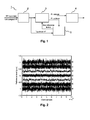
- Fig. 1 shows a block diagram of a maximum likelihood detection system 1 with adaptive reference levels as an example of a data detection system.
- RF input data are equalized by an adaptive equalizer 2 and fed to a Soft-In/Soft-Out (SISO) maximum likelihood detector 3.
- the maximum likelihood detector 3 outputs reliability data Pi_intrinsic and Pi_extrinsic.
- reliability data For determining the reliability data different methods may be used, e.g. MAP (Maximum a Posteriori), log MAP, max log MAP, or SOVA (Soft Output Viterbi Algorithm). In essence, any reliability determining method can be employed.
- the Pi_intrinsic data are fed to a demodulation and error correction block 4, which then decides which binary value was finally received.
- the Pi_extrinsic data are fed to a reference level adaptation block 5 to adjust the reference levels of the maximum likelihood detector 3 based on the reliability of the received data and the equalized HF-signal.
- reference levels adjustable is to be capable to react properly to changing channel conditions, e.g. asymmetry, amplitude level fluctuations, noise, and other distortions. Typical distortions in case of optical disks are black dots, scratches etc. When fixed reference levels are used, the detection is likely to fail or at least the performance degrades.
- the known adaptive solution based on low-pass filtering improves the detection.
- a drawback of this solution is the non-adaptive time constant of the filter.
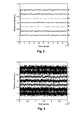
- a time constant which is chosen too small results in very noisy and unstable reference levels for the maximum likelihood detector 3 under noisy channel conditions. This is illustrated in Fig. 2, in which simulated reference levels are plotted against the clock samples. If the time constant is chosen too large, this results in a very inflexible filter and, therefore, in almost fixed reference levels with their described disadvantages.
- a simulated example of this case is illustrated in Fig. 3. In the figures, the reference levels return to '0' at the end of the simulation. This is caused by the simulation and does not occur in a real system.
- the invention solves this problem by using the reliability information Pi_extrinsic calculated by the maximum likelihood detector 3 for continuously adapting the reference levels.
- the idea is to have a high and fast adaptation when the reliability is high, and to have a slow or even no adaptation when the reliability is low. This enables a very fast and stable adjustment of the reference levels under good channel conditions and in case of certain operation modes, e.g. after a jump or at startup. At the same time the reference levels are less susceptible to noise and other distortions, like black or silver dots, scratches or fingerprints.
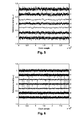
- Fig. 5 shows a simulation of the same reference levels under the same conditions but using an adaptation based on reliability information according to the invention.
- the reference level curves are flatter, i.e. more settled than in Fig. 4, and there always is a clear separation between two reference levels.
- FIG. 6 depicts the reference levels in case of a plurality of black dot distortions using the normal low-pass adaptation.
- the black dots manifest as spikes in some of the reference level curves, especially the curves for t1, t2, and t3.
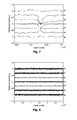
- Fig. 7 shows a zoom into Fig. 6. In this zoom a selected single signal collapse due to a black dot is seen, followed by a slow new adaptation to the old value. The time needed for the new adaptation of course depends on the employed time constant.
Landscapes
- Engineering & Computer Science (AREA)
- Physics & Mathematics (AREA)
- Probability & Statistics with Applications (AREA)
- Theoretical Computer Science (AREA)
- Signal Processing (AREA)
- Power Engineering (AREA)
- Computer Networks & Wireless Communication (AREA)
- Signal Processing For Digital Recording And Reproducing (AREA)
Priority Applications (2)
| Application Number | Priority Date | Filing Date | Title |
|---|---|---|---|
| EP06114816A EP1863181A1 (fr) | 2006-06-01 | 2006-06-01 | Détection de données avec des niveaux de référence adaptables |
| EP07301053A EP1863182A1 (fr) | 2006-06-01 | 2007-05-21 | Détection de données avec des niveaux de référence adaptables |
Applications Claiming Priority (1)
| Application Number | Priority Date | Filing Date | Title |
|---|---|---|---|
| EP06114816A EP1863181A1 (fr) | 2006-06-01 | 2006-06-01 | Détection de données avec des niveaux de référence adaptables |
Publications (1)
| Publication Number | Publication Date |
|---|---|
| EP1863181A1 true EP1863181A1 (fr) | 2007-12-05 |
Family
ID=36791426
Family Applications (1)
| Application Number | Title | Priority Date | Filing Date |
|---|---|---|---|
| EP06114816A Withdrawn EP1863181A1 (fr) | 2006-06-01 | 2006-06-01 | Détection de données avec des niveaux de référence adaptables |
Country Status (1)
| Country | Link |
|---|---|
| EP (1) | EP1863181A1 (fr) |
-
2006
- 2006-06-01 EP EP06114816A patent/EP1863181A1/fr not_active Withdrawn
Non-Patent Citations (2)
| Title |
|---|
| IDE N: "Adaptive partial-response maximum-likelihood detection in optical recording media", OPTICAL MEMORY AND OPTICAL DATA STORAGE TOPICAL MEETING, 2002. INTERNATIONAL SYMPOSIUM ON 7-11 JULY 2002, PISCATAWAY, NJ, USA,IEEE, 7 July 2002 (2002-07-07), pages 269 - 271, XP010600195, ISBN: 0-7803-7379-0 * |
| JINHONG YUAN ET AL: "Performance of Parallel and Serial Concatenated Codes on Fading Channels", IEEE TRANSACTIONS ON COMMUNICATIONS, IEEE SERVICE CENTER, PISCATAWAY, NJ, US, vol. 50, no. 10, October 2002 (2002-10-01), XP011071034, ISSN: 0090-6778 * |
Similar Documents
| Publication | Publication Date | Title |
|---|---|---|
| US7917836B1 (en) | Detection in the presence of media noise | |
| US6647070B1 (en) | Method and apparatus for combating impulse noise in digital communications channels | |
| US8413029B2 (en) | Error correction capability adjustment of LDPC codes for storage device testing | |
| US8699167B2 (en) | Systems and methods for data detection using distance based tuning | |
| US7599450B2 (en) | Pattern-dependent equalization and detection | |
| US20070172005A1 (en) | Processing servo data having DC level shifts | |
| EP0644661B1 (fr) | Appareil pour traiter des signaux | |
| US7603611B2 (en) | Maximum likelihood decoding device, signal evaluating method, and reproducing apparatus | |
| US20230118769A1 (en) | Sequence detection device using path-selective sequence detection and associated sequence detection method | |
| WO2006102909A1 (fr) | Modulation adaptative avec symboles non-pilotes | |
| EP1195960B1 (fr) | Démappage dans un récepteur multiporteuse | |
| US6563889B1 (en) | Method and apparatus for adapting the boost of a read channel filter | |
| US7522663B2 (en) | Burst error limiting feedback equalizer system and method for multidimensional modulation systems | |
| US7424077B2 (en) | Jitter sensitive maximum-a-posteriori sequence detection | |
| CN114884782B (zh) | 一种应用于gfsk接收机的判决修正方法及装置 | |
| KR100975056B1 (ko) | 데이터 재생 장치 및 방법 | |
| EP1863182A1 (fr) | Détection de données avec des niveaux de référence adaptables | |
| EP0737384B1 (fr) | Systeme de transmission et d'enregistrement numeriques avec un systeme de correction d'erreurs simple | |
| EP1863181A1 (fr) | Détection de données avec des niveaux de référence adaptables | |
| US8922934B2 (en) | Systems and methods for transition based equalization | |
| US6683922B1 (en) | Data decoding apparatus and data decoding method | |
| US6246722B1 (en) | Method of detection of misconvergence using constellation scanning in an equalizer | |
| EP2031791A1 (fr) | Appareil et procédé de récupération de données dans un signal d'entrée synchronisé | |
| KR20080110888A (ko) | 최대 유사도 시퀀스 추정 디코딩 | |
| US20020114247A1 (en) | Data processing apparatus and method for d=2 optical channels |
Legal Events
| Date | Code | Title | Description |
|---|---|---|---|
| PUAI | Public reference made under article 153(3) epc to a published international application that has entered the european phase |
Free format text: ORIGINAL CODE: 0009012 |
|
| AK | Designated contracting states |
Kind code of ref document: A1 Designated state(s): AT BE BG CH CY CZ DE DK EE ES FI FR GB GR HU IE IS IT LI LT LU LV MC NL PL PT RO SE SI SK TR |
|
| AX | Request for extension of the european patent |
Extension state: AL BA HR MK YU |
|
| AKX | Designation fees paid | ||
| STAA | Information on the status of an ep patent application or granted ep patent |
Free format text: STATUS: THE APPLICATION IS DEEMED TO BE WITHDRAWN |
|
| 18D | Application deemed to be withdrawn |
Effective date: 20080606 |
|
| REG | Reference to a national code |
Ref country code: DE Ref legal event code: 8566 |