EP1863276A2 - Appareil et procédé d'affichage - Google Patents
Appareil et procédé d'affichage Download PDFInfo
- Publication number
- EP1863276A2 EP1863276A2 EP07106565A EP07106565A EP1863276A2 EP 1863276 A2 EP1863276 A2 EP 1863276A2 EP 07106565 A EP07106565 A EP 07106565A EP 07106565 A EP07106565 A EP 07106565A EP 1863276 A2 EP1863276 A2 EP 1863276A2
- Authority
- EP
- European Patent Office
- Prior art keywords
- image
- viewer
- display
- screen
- section
- Prior art date
- Legal status (The legal status is an assumption and is not a legal conclusion. Google has not performed a legal analysis and makes no representation as to the accuracy of the status listed.)
- Withdrawn
Links
Images




Classifications
-
- H—ELECTRICITY
- H04—ELECTRIC COMMUNICATION TECHNIQUE
- H04N—PICTORIAL COMMUNICATION, e.g. TELEVISION
- H04N5/00—Details of television systems
- H04N5/14—Picture signal circuitry for video frequency region
-
- G—PHYSICS
- G09—EDUCATION; CRYPTOGRAPHY; DISPLAY; ADVERTISING; SEALS
- G09G—ARRANGEMENTS OR CIRCUITS FOR CONTROL OF INDICATING DEVICES USING STATIC MEANS TO PRESENT VARIABLE INFORMATION
- G09G5/00—Control arrangements or circuits for visual indicators common to cathode-ray tube indicators and other visual indicators
-
- H—ELECTRICITY
- H04—ELECTRIC COMMUNICATION TECHNIQUE
- H04N—PICTORIAL COMMUNICATION, e.g. TELEVISION
- H04N21/00—Selective content distribution, e.g. interactive television or video on demand [VOD]
- H04N21/40—Client devices specifically adapted for the reception of or interaction with content, e.g. set-top-box [STB]; Operations thereof
- H04N21/41—Structure of client; Structure of client peripherals
- H04N21/414—Specialised client platforms, e.g. receiver in car or embedded in a mobile appliance
- H04N21/41422—Specialised client platforms, e.g. receiver in car or embedded in a mobile appliance located in transportation means, e.g. personal vehicle
-
- H—ELECTRICITY
- H04—ELECTRIC COMMUNICATION TECHNIQUE
- H04N—PICTORIAL COMMUNICATION, e.g. TELEVISION
- H04N21/00—Selective content distribution, e.g. interactive television or video on demand [VOD]
- H04N21/40—Client devices specifically adapted for the reception of or interaction with content, e.g. set-top-box [STB]; Operations thereof
- H04N21/41—Structure of client; Structure of client peripherals
- H04N21/422—Input-only peripherals, i.e. input devices connected to specially adapted client devices, e.g. global positioning system [GPS]
-
- H—ELECTRICITY
- H04—ELECTRIC COMMUNICATION TECHNIQUE
- H04N—PICTORIAL COMMUNICATION, e.g. TELEVISION
- H04N21/00—Selective content distribution, e.g. interactive television or video on demand [VOD]
- H04N21/40—Client devices specifically adapted for the reception of or interaction with content, e.g. set-top-box [STB]; Operations thereof
- H04N21/43—Processing of content or additional data, e.g. demultiplexing additional data from a digital video stream; Elementary client operations, e.g. monitoring of home network or synchronising decoder's clock; Client middleware
- H04N21/431—Generation of visual interfaces for content selection or interaction; Content or additional data rendering
-
- H—ELECTRICITY
- H04—ELECTRIC COMMUNICATION TECHNIQUE
- H04N—PICTORIAL COMMUNICATION, e.g. TELEVISION
- H04N21/00—Selective content distribution, e.g. interactive television or video on demand [VOD]
- H04N21/40—Client devices specifically adapted for the reception of or interaction with content, e.g. set-top-box [STB]; Operations thereof
- H04N21/43—Processing of content or additional data, e.g. demultiplexing additional data from a digital video stream; Elementary client operations, e.g. monitoring of home network or synchronising decoder's clock; Client middleware
- H04N21/442—Monitoring of processes or resources, e.g. detecting the failure of a recording device, monitoring the downstream bandwidth, the number of times a movie has been viewed, the storage space available from the internal hard disk
- H04N21/44213—Monitoring of end-user related data
- H04N21/44218—Detecting physical presence or behaviour of the user, e.g. using sensors to detect if the user is leaving the room or changes his face expression during a TV programme
-
- B—PERFORMING OPERATIONS; TRANSPORTING
- B60—VEHICLES IN GENERAL
- B60R—VEHICLES, VEHICLE FITTINGS, OR VEHICLE PARTS, NOT OTHERWISE PROVIDED FOR
- B60R11/00—Arrangements for holding or mounting articles, not otherwise provided for
- B60R11/02—Arrangements for holding or mounting articles, not otherwise provided for for radio sets, television sets, telephones, or the like; Arrangement of controls thereof
- B60R11/0229—Arrangements for holding or mounting articles, not otherwise provided for for radio sets, television sets, telephones, or the like; Arrangement of controls thereof for displays, e.g. cathodic tubes
- B60R11/0235—Arrangements for holding or mounting articles, not otherwise provided for for radio sets, television sets, telephones, or the like; Arrangement of controls thereof for displays, e.g. cathodic tubes of flat type, e.g. LCD
-
- G—PHYSICS
- G09—EDUCATION; CRYPTOGRAPHY; DISPLAY; ADVERTISING; SEALS
- G09G—ARRANGEMENTS OR CIRCUITS FOR CONTROL OF INDICATING DEVICES USING STATIC MEANS TO PRESENT VARIABLE INFORMATION
- G09G2320/00—Control of display operating conditions
- G09G2320/08—Arrangements within a display terminal for setting, manually or automatically, display parameters of the display terminal
-
- G—PHYSICS
- G09—EDUCATION; CRYPTOGRAPHY; DISPLAY; ADVERTISING; SEALS
- G09G—ARRANGEMENTS OR CIRCUITS FOR CONTROL OF INDICATING DEVICES USING STATIC MEANS TO PRESENT VARIABLE INFORMATION
- G09G2340/00—Aspects of display data processing
- G09G2340/04—Changes in size, position or resolution of an image
- G09G2340/0407—Resolution change, inclusive of the use of different resolutions for different screen areas
-
- G—PHYSICS
- G09—EDUCATION; CRYPTOGRAPHY; DISPLAY; ADVERTISING; SEALS
- G09G—ARRANGEMENTS OR CIRCUITS FOR CONTROL OF INDICATING DEVICES USING STATIC MEANS TO PRESENT VARIABLE INFORMATION
- G09G2340/00—Aspects of display data processing
- G09G2340/04—Changes in size, position or resolution of an image
- G09G2340/0464—Positioning
-
- H—ELECTRICITY
- H04—ELECTRIC COMMUNICATION TECHNIQUE
- H04N—PICTORIAL COMMUNICATION, e.g. TELEVISION
- H04N5/00—Details of television systems
- H04N5/44—Receiver circuitry for the reception of television signals according to analogue transmission standards
Definitions
- the present invention relates to a display apparatus and display method, and, more particularly, to a display apparatus and display method for at least one fellow passenger in a vehicle to view image inside the vehicle.
- a display apparatus is installed between the driver's seat and the front passenger's seat and image typified by video is displayed on the installed display apparatus.
- viewer the fellow passenger seated in the backseat (hereinafter referred to as "viewer") to enjoy the image displayed on the display apparatus while the vehicle is moving (see, for example Japanese Patent Application Laid-Open No.2002-293195 ).
- the view position is restricted by the backseat, resulting in cases where the viewer views the displayed image from an oblique direction with respect to the display apparatus.
- the viewer looks at the displayed image compressed mainly in the horizontal direction of the display apparatus.
- the viewer cannot view image at aspect ratios viewable from the front of the display apparatus, and the problem arises that making the displayed image is difficult to see on the conventional apparatus.
- This problem is particularly severe in case that a screen of the conventional apparatus is wide in the horizontal direction.
- the displayed image appears compressed in the horizontal direction when the viewer moves just slightly to one side.
- the present invention provides a display apparatus and display method capable of displaying image that is easy for the viewer to see from an oblique direction, by expanding the image at predetermined expansion rates.
- the display apparatus of the present invention achieves the above-described object by providing a display apparatus employing a configuration having: a display setting section that sets, based on a relative position of a viewer with respect to a screen displaying an image, at least one display position of the image in the screen; an expansion section that expands an inputted image at an expansion rate in accordance with a direction from which the viewer views the image to be displayed in the display position set by the display setting section; and a display section that displays the image expanded by the expansion section.
- the display method of the present invention achieves the above-described object by providing a display method including: setting, based on a relative position of a viewer with respect to a screen displaying an image, at least one display position of the image in the screen; expanding an inputted image at an expansion rate in accordance with a direction from which the viewer views the image to be displayed in the display position; and displaying the expanded image in the display position.
- the present invention expands image at above-prescribed expansion rates, thereby enabling a viewer to view the image at the original aspect ratio when viewing the image from an oblique direction and making the image easy to see.
- FIG.1 is a block diagram showing the configuration of a vehicle-mounted apparatus 100 according to an embodiment of the present invention.
- a display apparatus 120 is formed with an operation processing section 106, a first video processing section 107, a second video processing section 108, an image synthesizing section 109, a third video processing section 110, and a display section 111 that is fixedly installed in a predetermined position inside a vehicle.
- a viewer position reading section 101 uses weight sensors installed in each backseat, for example, reads the position where a viewer is seated, relative to display section 111. Further, the viewer position reading section 101 presets the angle in the vertical direction (hereinafter “vertical view angle”) and the angle in the horizontal direction (hereinafter “horizontal view angle”) formed by the line connecting the horizontal center in the horizontal direction of a screen of the display section 111 and right backseat and the line perpendicular to the screen and passing through the center in the horizontal direction of the screen.
- vertical view angle the angle in the vertical direction
- horizontal view angle the angle in the horizontal direction formed by the line connecting the horizontal center in the horizontal direction of a screen of the display section 111 and right backseat and the line perpendicular to the screen and passing through the center in the horizontal direction of the screen.
- a viewer position reading section 101 presets the angle in the vertical direction (hereinafter referred to as “vertical view angle”) and the angle in the horizontal direction (hereinafter referred to as “horizontal view angle”) formed by the line connecting the center in the horizontal direction of the display screen and left backseat and the line perpendicular to the screen and passing through the center in the horizontal direction of the screen. Further, the viewer position reading section 101 presets the angle in the vertical direction (hereinafter referred to as “vertical view angle”) and the angle in the horizontal direction (hereinafter referred to as “horizontal view angle”) formed by the line connecting the center in the horizontal direction of the screen and center backseat and the line perpendicular to the display screen and passing through the center in the horizontal direction of the screen. In this manner, the viewer position reading section 101 reads the position where the viewer is seated as the direction (viewing direction) from which the viewer views the screen. Then, the viewer position reading section 101 outputs the read result as display control information to a control processing section 105.
- a first operation section 102 is installed near the right backseat of the vehicle, has a switch for reporting the seated position (right backseat) of the viewer who is one fellow passenger in the vehicle, and outputs information to the control processing section 105 indicating the seated position (right backseat) of the viewer as display control information when the switch is operated by the viewer.
- the information indicating the seated position (right backseat) of the viewer refers to information indicating the relative position of the viewer with respect to the screen of the display section 111 and the direction from which the viewer views the screen.
- the first operation section 102 has an operation section for the viewer to finely adjust the horizontal view angle and vertical view angle, and outputs signals for horizontal view angle and vertical view angle adjustment to the control processing section 105 when the viewer operates the operation section. Further, the first operation section 102 has an adjustment section for the viewer to adjust the contrast and other elements on the overall screen, and outputs signals for adjusting the contrast and other elements to control processing section 105 when the viewer operates the adjustment section.
- a second operation section 103 is installed near the left backseat of the vehicle, has switches for reporting a seatedposition (left backseat) of a viewer who is the other fellow passenger in the vehicle, and outputs information indicating the seated position (left backseat) of the viewer as display control information to control processing section 105 when the switch is operated by the viewer.
- the information indicating the seated position (left backseat) of the viewer is information indicating the relative position of the viewer with respect to the screen and the direction from which the viewer views the screen.
- the second operation section 103 has an operation section for the viewer to finely adjust the horizontal view angle and vertical view angle, and outputs signals for the horizontal view angle and vertical view angle adjustment to the control processing section 105 when the viewer operates the operation section.
- the second operation section 103 has an adjustment section for the viewer to adjust the contrast and other elements on the overall screen, and outputs signals for adjusting the contrast and other elements to the control processing section 105 when the viewer operates the adjustment section. Furthermore, the second operation section 103 is typically operated by a viewer other than the viewer who operates a first operation section 102.
- a memory 104 stores information for selecting the display position and expansion rates of image displayed on the screen.
- the control processing section 105 determines the expansion rates and display position of image displayed on the screen based on the display control information inputted from the viewer position reading section 101 and the information for selecting the image display position and image expansion rates stored in the memory 104. Further, the control processing section 105 determines the expansion rates and displayposition of image displayed on the screen based on the display control information inputted from the first operation section 102 and the second operation section 103 and the information for selecting the image display position and image expansion rates stored in the memory 104. Then, the control processing section 105 creates a command for expanding the image at determined expansion rates and a command for displaying the image on the determined display position, and outputs the created commands to an operation processing section 106.
- control processing section 105 creates a command for adjusting the expansion rates based on the horizontal view angle and vertical view angle adjustment signals inputted from the first operation section 102 and the second operation section 103, and outputs the created command to the operation processing section 106. Further, the control processing section 105 creates a command for adjusting the contrast and other elements based on the signals for contrast and other adjustment inputted from the first operation section 102 and the second operation section 103, and outputs the created command to the operation processing section 106. The details of the method for determining the expansion rates and display position will be described later.
- the operation processing section 106 determines the destinations of the commands inputted from the control processing section 105 and, based on the determination results, outputs the commands to the first video processing section 107, the second video processing section 108, the image synthesizing section 109 and the third video processing section 110. Specifically, the operation processing section 106 outputs the command for expanding the image at determined expansion rates to the first video processing section 107 and the second video processing section 108. Further, the operation processing section 106 outputs the command for displaying the image on a determined display position to image the synthesizing section 109. Further, the operation processing section 106 outputs the command for adjusting the expansion rates to the first video processing section 107 and the second video processing section 108. Further, the operation processing section 106 outputs the command for contrast and other adjustment to the third video processing section 110.
- the first video processing section 107 which exemplifies an expansion means, processes the image in accordance with the command for expanding the image inputted from the operation processing section 106. Specifically, the first video processing section 107 expands the image in the horizontal and vertical directions using the expansion rates selected by the control processing section 105. Further, the first video processing section 107 adjusts the expansion rates of the image in accordance with the viewer operation of the first operation section 102 and the second operation section 103. Then, the first video processing section 107 outputs the expanded image to the image synthesizing section 109.
- the second video processing section 108 which exemplifies an expansion means, processes the image in accordance with the command for expanding the image inputted from the operation processing section 106. Specifically, the second video processing section 108 expands the image in the horizontal and vertical directions using the expansion rates selected by the control processing section 105. Further, the second video processing section 108 adjusts the expansion rates of the image in accordance with the viewer's operation of the first operation section 102 and the second operation section 103. Then, the second video processing section 108 outputs the expanded image to the image synthesizing section 109. The specific method for expanding the image will be described later.
- the image synthesizing section 109 which exemplifies a display setting means, processes the image in accordance with the command for displaying the image on the determined display position inputted from the operation processing section 106. Specifically, the image synthesizing section 109, in accordance with the command inputted from the operation processing section 106, synthesizes the image inputted from the first video processing section 107 and the image inputted from the second video processing section 108, so that the images are displayed together in the determined display positions of the display section 111.
- the image synthesizing section 109 performs processing in accordance with the command inputted from the operation processing section 106 and either displays the inputted image in the left part, center, or right part of the screen or displays the inputted image over the entire screen. Then, the image synthesizing section 109 outputs the processed image to the third video processing section 110.
- the third video processing section 110 adjusts the contrast and other elements of the overall image in accordance with the command for adjusting the contrast and other elements of the image inputted from the operation processing section 106. Then, the third video processing section 110 outputs the image with the contrast and other elements adjusted, to the display section 111.
- the display section 111 displays, on the screen thereof, the image inputted from the third video processing section 110. Specifically, when an image in which a plurality of different images are synthesized are inputted from the third video processing section 110, the display section 111 displays the synthesized image. When a single image is inputted from the third video processing section 110, the display section 111 displays the single image in the left part, center, or right part of the screen or over the entire screen.
- FIG.2 is a flowchart showing an image display method.
- the viewer position reading section 101 reads the position from which the viewer views the image displayed on the screen of the display section 111 .
- the viewer position reading section 101 using weight sensors installed in each seat, recognizes that a viewer is seated on a seat and reads the relative position of the seat, on which the viewer is seated, with respect to the display section 111. Then, the viewer position reading section 101 regards the read position as viewer position information (step ST201).
- control processing section 105 refers to screen display setting information stored in the memory 104 (step ST202).
- FIG.3 shows an example of the screen display setting information 301.
- the control processing section 105 judges whether the screen display setting is normal occupancy or full occupancy. Further, the control processing section 105 judges whether there is one viewer or there are two viewers based on the viewer position information obtained in the viewer position reading section 101 (step ST203).
- step ST203 when the control processing section 105 judges that there is one viewer and selects single-screen full occupancy, the image expanded to the full screen is displayed on the screen as shown in FIG.4.
- the control processing section 105 refers to the single-screen display viewer position of the screen display setting information 301 (step ST204).
- the viewer position is judged based on either a mode where the viewer right, left, or center view position is set by a remote control, escutcheon, or a navigation system set around the frontseat, or a mode where the viewer right, left, or center view position is set by the detection result of a weight sensor installed in a seat.
- the control processing section 105 selects the display position and expansion rates based on the view position inputted by the first operation section 102 or the second operation section 103 when the viewer operates switches.
- the control processing section 105 selects the display position and expansion rates based on the view position read by the viewer position reading section 101.
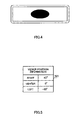
- the control processing section 105 refers to the viewer position information 501 of FIG.5 stored in the memory 104 (step ST205). Referring to the viewer position information 501, the control processing section 105 selects a view angle of 40 degrees when the viewer is seated in the right seat with respect to the forward direction of the vehicle. When the viewer is seated on the center seat, the control processing section 105 selects a view angle of 0 degrees. When the viewer is seated on the left seat with respect to the forward direction, the control processing section 105 selects a view angle of -40 degrees.
- control processing section 105 judges the position of the viewer based on the settings of the first operation section 102 and the second operation section 103, and the result of reading by the viewer position reading section 101 (step ST206).
- the control processing section 105 selects the viewer position information 501 stored in the memory 104, selects a view angle of -40 degrees and, using the angle information for the selected view angle of -40 degrees, selects the expansion table for the left seat stored in the memory 104 to select the expansion rates (step ST207).
- control processing section 105 selects the viewer position information 501 stored in the memory 104, selects a view angle of 0 degrees and, using the angle information for the selected view angle of 0 degrees, selects the expansion table for the center seat stored in memory 104 to select the expansion rates (step ST208) .
- the control processing section 105 selects the viewer position information 501 stored in the memory 104, selects a view angle of 40 degrees and, using the angle information for the selected view angle of 40 degrees, selects the expansion table for the right seat stored in the memory 104 to select the expansion rates (step ST209) .
- FIG.6 shows an example of an expansion rate table 601.
- the expansion rate table 601 includes information that associates the angles at which the viewer views the screen with expansion rates. For example, when the control processing section 105 selects a view angle of 40 degrees from the viewer position information 501, the control processing section 105 selects the expansion rates associated with the angle of 40 degrees from the expansion rate table 601.
- the first video processing section 107 or the second video processing section 108 expands the image at the expansion rates selected by the control processing section 105 (step ST210) .
- vehicle-mounted apparatus 100 enters a viewer position detection signal wait state (step ST211) . Then, when a viewer position detection signal is inputted, vehicle-mounted apparatus 100 starts the processing of the step ST201 to the step ST227.
- step ST203 when the control processing section 105 judges that there are two viewers and selects dual-screen full occupancy, two different images are simultaneously displayed on the screen as shown in FIG.7
- the control processing section 105 refers to the single-screen display viewer position of the screen display setting information 301 (step ST212).
- the single-screen display viewer position the viewer position is judged using either a mode where the viewer right, left, or center view position is set by a remote control, escutcheon, or a navigation system set around the frontseat, or a mode where the viewer right, left, or center view position is set by the detection of a signal of a weight sensor installed in the seat.
- the processing of each mode is the same as that of the single-screen display viewer position, and a description thereof is omitted.
- control processing section 105 refers to the viewer position information 501 of FIG.5 stored in the memory 104 (step ST213).
- control processing section 105 judges the position of the viewer based on the settings of the first operation section 102 and the second operation section 103, and the result of reading by the viewer position reading section 101 (step ST214).
- the control processing section 105 selects the viewer position information 501 stored in the memory 104, selects a view angle of -40 degrees and, using the angle information for the selected view angle of -40 degrees, selects the expansion table for the left seat stored in the memory 104 to select the expansion rates (step ST215) .
- control processing section 105 selects the viewer position information 501 stored in the memory 104, selects a view angle of 0 degrees and, using the angle information for the selected view angle of 0 degrees, selects the expansion table for the center seat stored in the memory 104 to select the expansion rates (step ST216) .
- the control processing section 105 selects the viewer position information 501 stored in the memory 104, selects a view angle of 40 degrees and, using the angle information for the selected view angle of 40 degrees, selects the expansion table for the right seat stored in the memory 104 to select the expansion rates (step ST217) .
- the first video processing section 107 or the second video processing section 108 expands the image displayed on a display screen 701 at the expansion rates selected by the control processing section 105 (step ST218).
- the control processing section 105 refers to the dual-screen display viewer position of the screen display setting information 301 (step ST219).
- the viewer position is determined using either a mode where the viewer right, left, or center view position is set by a remote control, escutcheon, or a navigation system set around the frontseat, or a mode where the viewer right, left, or center view position is set by the detection of a signal of a weight sensor installed in a seat.
- the processing of each mode is the same as that of the above-described single-screen display viewer position, and a description thereof is omitted.
- control processing section 105 refers to the viewer position information 501 of FIG.5 stored in the memory 104.
- control processing section 105 judges the position of the viewer based on the settings of the first operation section 102 and the second operation section 103, and the result of reading by viewer position reading section 101 (step ST220).
- the control processing section 105 selects the viewer position information 501 stored in the memory 104, selects a view angle of -40 degrees and, using the angle information for the selected view angle of -40 degrees, selects the expansion table for the left seat stored in the memory 104 to select the expansion rates (step ST221).
- the control processing section 105 selects the viewer position information 501 stored in the memory 104, selects a view angle of 0 degrees and, using the angle information for the selected view angle of 0 degrees, selects the expansion table for the center seat stored in the memory 104 to select the expansion rates (step ST222).
- the control processing section 105 selects the viewer position information 501 stored in the memory 104, selects a view angle of 40 degrees and, using the angle information for the selected view angle of 40 degrees, selects the expansion table for the right seat stored in the memory 104 to select the expansion rates (step ST223) .
- the first video processing section 107 or the second video processing section 108 expands the image displayed on the screen 702 at the expansion rates selected by the control processing section 105 (step ST224).
- the vehicle-mounted apparatus 100 enters a viewer position detection signal wait state (step ST211).
- the control processing section 105 judges that there is one viewer and selects single-screen normal occupancy, one image is displayed on the screen of the display section 111.
- the control processing section 105 refers to the single-screen display viewer position of the screen display setting information 301 (step ST225) .
- the viewer position is determined using a mode where the viewer right, left, or center view position is set by a remote control, escutcheon, or a navigation system set around the frontseat, or a mode where the viewer right, left, or center view position is set by the detection result of a weight sensor installed in a seat.
- one image is displayed at normal aspect ratios in the center of the screen of the display section 111, as shown in FIG.8.
- a viewer 801 can view the image at normal aspect ratios when the viewer 801 faces an image 802
- a viewer 901 views the image 802 from an oblique direction when seated on a right seat 902, causing the image 802 to look compressed to the viewer 901.
- the conditions under which the image 802 looks compressed are the same when the viewer 901 is seated on a left seat 903.
- the control processing section 105 selects the horizontal start position by referring to horizontal start position information 1001 shown in FIG.10 using the settings of the first operation section 102 or the second operation section 103 and the result of reading by the viewer position reading section 101 (step ST226).
- the horizontal start position information 1001 is information that associates the viewer position and pixels of the screen as the horizontal startposition. Furthermore, because image is drawn from left to right on the screen with analog video signals, the left edge of the screen is set as the zeroth pixel even with digital video data.
- the control processing section 105 selects a horizontal start position 800 so that an image 1103 is drawn in the right part of the screen 1104. Then, the image synthesizing section 109 sets the display position so that the image 1103 is drawn in the right part of the screen 1104. In this manner, the viewer 1102 seated in the right seat 1101 is able to view the image 1103 displayed on the screen 1104 as if he or she viewed the image from the front of the screen 1104.
- the control processing section 105 selects the horizontal start position 0 so that an image 1203 is drawn in the left part of the screen 1204. Then, the image synthesizing section 109 sets the display position so that the image 1203 is drawn in the left part of the screen 1204. In this manner, the viewer 1202 seated in the left seat 1201 is able to view the image 1203 displayed on the screen 1204 as if he or she viewed the image from the front of the screen 1204.
- control processing section 105 performs the processing for setting the selected horizontal start position (step ST227), and the display section 111 displays the image in the set horizontal start position of the screen.
- the vehicle-mounted apparatus 100 changes to a viewer position detection signal wait state (step ST211).
- FIG.13 is a drawing for explaining the method for expanding the image.
- the screen is split into two partial areas C and D.
- the partial area C is illustrated in the left side of a boundary line 1301, and the partial area D is illustrated in the right side of the boundary line 1301.
- the control processing section 105 separately finds angle ⁇ c at which a viewer 1302 views the image to be displayed in the area C, and angle ⁇ d at which the viewer 1302 views the image to be displayed in the area D.
- the first video processing section 107 and the second video processing section 108 separately expand the image to be displayed in the area C and the image to be displayed in the area D at expansion rates according to angles ⁇ c and ⁇ d found by the control processing section 105.
- FIG. 14 is a drawing for explaining another method of expanding image that is different from FIG.13.
- each view angle ⁇ i as shown in FIG.14, is the angle formed by lines 1404-1 to 1404-5 connecting a viewer 1403 and a horizontal position Pi and lines 1402-1 to 1402-5 perpendicular to a screen 1401 each of the horizontal positions Pi along the horizontal direction (left and right directions in FIG.14) of the screen 1401 of each inflection point i.
- the number of inflection points n is 5, and the horizontal positions Pi of the inflection points i are the respective positions P0 to P4 shown in FIG.14.
- the view angle ⁇ i is ⁇ 0 for the position P0, ⁇ 1 for the position P1, ⁇ 2 for the position P2, ⁇ 3 for the position P3, and ⁇ 4 for the position P4, hence the relationship ⁇ 1 > ⁇ 2 > ⁇ 3 > ⁇ 4.
- the expansion rates of the image to be displayed on the screen 1401 increase in proportion to the distance from the viewer 1403 of the screen 1401 (i.e., from the right to the left on the screen 1401).
- the screen 1401 has 481 scanning lines of horizontal scanning lines 0 to 480.
- FIG.15 is a diagram comparing a conventional case where image is not expanded, to the case of the present embodiment where image is expanded.
- the image 1501 does not look compressed.
- the image 1501 looks compressed at 76% leftward in the horizontal direction to the viewer.
- the image 1501 looks compressed at 76 % rightward in the horizontal direction to the viewer.
- the image 1501 looks, on the display, compressed at 98 % upward in the vertical direction to the viewer.
- FIG.15(D) the viewer is able to view the image in the same state as the image 1501 of FIG. 15 (A) where the viewer views the image straight-on with respect to the screen.
- image displayed in a predetermined display position or image displayed using a predetermined display method is expanded at expansion rates according to the view direction of the viewer, thereby enabling the viewer to view the image at the original aspect ratio when viewing the image from an oblique direction and making the image easy to see.
- the display position of the image is changed so that the viewer can view the image at normal aspect ratios, thereby enabling the viewer to view the optimal image without having to move.
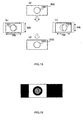
- the present invention is not limited thereto, and, as shown in FIG.16, the image may be displayed in any arbitrary position that enables the viewer to view the image at normal aspect ratios.
- This processing is performed by the image synthesizing section 109 in accordance with commands generated by the control processing section 105.
- the display apparatus 120 is formed with the operation processing section 106, first video processing section 107, second video processing section 108, image synthesizing section 109, third video processing section 110 and display section 111
- the present invention is not limited thereto, and the display apparatus may include the control processing section 105 as well.
- the present invention expands image at predetermined expansion rates, thereby enabling a viewer to view the image at the original aspect ratio when viewing the image from an oblique direction and making the image easy to see.
Landscapes
- Engineering & Computer Science (AREA)
- Multimedia (AREA)
- Signal Processing (AREA)
- Health & Medical Sciences (AREA)
- General Health & Medical Sciences (AREA)
- Social Psychology (AREA)
- Physics & Mathematics (AREA)
- Databases & Information Systems (AREA)
- Computer Networks & Wireless Communication (AREA)
- Computer Hardware Design (AREA)
- General Physics & Mathematics (AREA)
- Theoretical Computer Science (AREA)
- Controls And Circuits For Display Device (AREA)
- Control Of Indicators Other Than Cathode Ray Tubes (AREA)
- Devices For Indicating Variable Information By Combining Individual Elements (AREA)
Applications Claiming Priority (1)
| Application Number | Priority Date | Filing Date | Title |
|---|---|---|---|
| JP2006117272A JP2007292809A (ja) | 2006-04-20 | 2006-04-20 | 表示装置及び表示方法 |
Publications (2)
| Publication Number | Publication Date |
|---|---|
| EP1863276A2 true EP1863276A2 (fr) | 2007-12-05 |
| EP1863276A3 EP1863276A3 (fr) | 2009-04-01 |
Family
ID=38610485
Family Applications (1)
| Application Number | Title | Priority Date | Filing Date |
|---|---|---|---|
| EP07106565A Withdrawn EP1863276A3 (fr) | 2006-04-20 | 2007-04-20 | Appareil et procédé d'affichage |
Country Status (3)
| Country | Link |
|---|---|
| EP (1) | EP1863276A3 (fr) |
| JP (1) | JP2007292809A (fr) |
| CN (1) | CN101059954A (fr) |
Cited By (2)
| Publication number | Priority date | Publication date | Assignee | Title |
|---|---|---|---|---|
| WO2009145640A1 (fr) * | 2008-05-30 | 2009-12-03 | Tandberg Telecom As | Procédé d'affichage d'une image sur un dispositif d'affichage |
| US10582144B2 (en) | 2009-05-21 | 2020-03-03 | May Patents Ltd. | System and method for control based on face or hand gesture detection |
Families Citing this family (2)
| Publication number | Priority date | Publication date | Assignee | Title |
|---|---|---|---|---|
| US8209635B2 (en) * | 2007-12-20 | 2012-06-26 | Sony Mobile Communications Ab | System and method for dynamically changing a display |
| WO2020073334A1 (fr) * | 2018-10-12 | 2020-04-16 | 北京小米移动软件有限公司 | Procédé, appareil et système d'affichage de contenu étendu, et support d'informations |
Family Cites Families (6)
| Publication number | Priority date | Publication date | Assignee | Title |
|---|---|---|---|---|
| FR2682798B1 (fr) * | 1991-10-22 | 1994-01-21 | Sextant Avionique | Procede et dispositif d'optimisation des performances d'un ecran matriciel a cristaux liquides en fonction de l'angle d'observation. |
| JPH10268231A (ja) * | 1997-03-26 | 1998-10-09 | Philips Japan Ltd | 立体画像表示装置 |
| AU1363201A (en) * | 1999-12-08 | 2001-06-18 | Neurok, Llc | Volumetric display device |
| JP2004510271A (ja) * | 2000-09-27 | 2004-04-02 | コーニンクレッカ フィリップス エレクトロニクス エヌ ヴィ | スクリーンに表示される画像を提供する方法及び装置 |
| US6931596B2 (en) * | 2001-03-05 | 2005-08-16 | Koninklijke Philips Electronics N.V. | Automatic positioning of display depending upon the viewer's location |
| JP3443414B2 (ja) * | 2001-08-01 | 2003-09-02 | コナミ株式会社 | ゲーム装置 |
-
2006
- 2006-04-20 JP JP2006117272A patent/JP2007292809A/ja active Pending
-
2007
- 2007-04-20 EP EP07106565A patent/EP1863276A3/fr not_active Withdrawn
- 2007-04-20 CN CN200710100829.9A patent/CN101059954A/zh not_active Withdrawn
Cited By (4)
| Publication number | Priority date | Publication date | Assignee | Title |
|---|---|---|---|---|
| WO2009145640A1 (fr) * | 2008-05-30 | 2009-12-03 | Tandberg Telecom As | Procédé d'affichage d'une image sur un dispositif d'affichage |
| NO331839B1 (no) * | 2008-05-30 | 2012-04-16 | Cisco Systems Int Sarl | Fremgangsmate for a fremvise et bilde pa et display |
| EP2286587A4 (fr) * | 2008-05-30 | 2012-07-04 | Cisco Systems Int Sarl | Procédé d'affichage d'une image sur un dispositif d'affichage |
| US10582144B2 (en) | 2009-05-21 | 2020-03-03 | May Patents Ltd. | System and method for control based on face or hand gesture detection |
Also Published As
| Publication number | Publication date |
|---|---|
| EP1863276A3 (fr) | 2009-04-01 |
| CN101059954A (zh) | 2007-10-24 |
| JP2007292809A (ja) | 2007-11-08 |
Similar Documents
| Publication | Publication Date | Title |
|---|---|---|
| US20070250868A1 (en) | Display apparatus and display method | |
| US7773075B2 (en) | Display apparatus | |
| US20050249379A1 (en) | Vehicle periphery viewing apparatus | |
| US8564729B2 (en) | Dual-sided display for vehicle rear-viewing system | |
| EP1837748A1 (fr) | Appareil d'affichage | |
| US20070132886A1 (en) | Image display apparatus and operating method thereof | |
| US20030095239A1 (en) | Projection type display device | |
| US20150124170A1 (en) | Display Device and Display Method | |
| JPH1145323A (ja) | 画像処理装置 | |
| JP2007145158A (ja) | 車載用表示装置及びその表示制御方法 | |
| EP1863276A2 (fr) | Appareil et procédé d'affichage | |
| US20240314265A1 (en) | Method for Superimposing and Displaying Extra-Information on Image Data for Display on a Display Unit of a Digital Vision System for a Vehicle and Digital Vision System for a Vehicle | |
| JPH06195056A (ja) | 表示装置 | |
| EP3572284B1 (fr) | Dispositif d'affichage de l'environnement d'un véhicule | |
| US20210203890A1 (en) | Apparatus for monitoring surrounding of vehicle | |
| KR100642505B1 (ko) | 멀티스크린 디스플레이 시스템 및 그 제어방법 | |
| EP1447975A2 (fr) | Méthode de correction pour image projetée et projecteur | |
| CN102547229A (zh) | 捕捉设备、捕捉系统和捕捉方法 | |
| US8941769B2 (en) | Image capturing apparatus, image display apparatus, and image display system | |
| US6329998B1 (en) | Multiple screen processor for processing video image data formats | |
| WO2006046444A1 (fr) | Dispositif d’interpolation d’image et dispositif d’affichage | |
| JP2009083791A (ja) | 画像表示方法、車載用画像表示システム及び画像処理装置 | |
| EP1837852A2 (fr) | Appareil et procédé d'affichage | |
| JP4413630B2 (ja) | 車載情報システム | |
| JP2013024904A (ja) | 映像表示装置およびその制御方法 |
Legal Events
| Date | Code | Title | Description |
|---|---|---|---|
| PUAI | Public reference made under article 153(3) epc to a published international application that has entered the european phase |
Free format text: ORIGINAL CODE: 0009012 |
|
| AK | Designated contracting states |
Kind code of ref document: A2 Designated state(s): AT BE BG CH CY CZ DE DK EE ES FI FR GB GR HU IE IS IT LI LT LU LV MC MT NL PL PT RO SE SI SK TR |
|
| AX | Request for extension of the european patent |
Extension state: AL BA HR MK YU |
|
| RAP1 | Party data changed (applicant data changed or rights of an application transferred) |
Owner name: PANASONIC CORPORATION |
|
| PUAL | Search report despatched |
Free format text: ORIGINAL CODE: 0009013 |
|
| AK | Designated contracting states |
Kind code of ref document: A3 Designated state(s): AT BE BG CH CY CZ DE DK EE ES FI FR GB GR HU IE IS IT LI LT LU LV MC MT NL PL PT RO SE SI SK TR |
|
| AX | Request for extension of the european patent |
Extension state: AL BA HR MK RS |
|
| STAA | Information on the status of an ep patent application or granted ep patent |
Free format text: STATUS: THE APPLICATION HAS BEEN WITHDRAWN |
|
| 18W | Application withdrawn |
Effective date: 20090605 |