EP1865335A1 - Localisation hybride dans un système de communication radio - Google Patents
Localisation hybride dans un système de communication radio Download PDFInfo
- Publication number
- EP1865335A1 EP1865335A1 EP06011780A EP06011780A EP1865335A1 EP 1865335 A1 EP1865335 A1 EP 1865335A1 EP 06011780 A EP06011780 A EP 06011780A EP 06011780 A EP06011780 A EP 06011780A EP 1865335 A1 EP1865335 A1 EP 1865335A1
- Authority
- EP
- European Patent Office
- Prior art keywords
- subscriber station
- localization method
- determining
- stations
- network
- Prior art date
- Legal status (The legal status is an assumption and is not a legal conclusion. Google has not performed a legal analysis and makes no representation as to the accuracy of the status listed.)
- Withdrawn
Links
- 230000004807 localization Effects 0.000 title claims abstract description 94
- 238000004891 communication Methods 0.000 title claims abstract description 23
- 238000000034 method Methods 0.000 claims abstract description 154
- 238000005259 measurement Methods 0.000 claims abstract description 68
- 238000004590 computer program Methods 0.000 claims abstract description 10
- 239000011159 matrix material Substances 0.000 claims description 29
- 238000004364 calculation method Methods 0.000 description 4
- 230000001419 dependent effect Effects 0.000 description 4
- 238000005516 engineering process Methods 0.000 description 4
- 238000011161 development Methods 0.000 description 3
- 230000018109 developmental process Effects 0.000 description 3
- 230000005540 biological transmission Effects 0.000 description 2
- 238000010295 mobile communication Methods 0.000 description 2
- 230000002123 temporal effect Effects 0.000 description 2
- 238000012546 transfer Methods 0.000 description 2
- 238000012935 Averaging Methods 0.000 description 1
- 230000001413 cellular effect Effects 0.000 description 1
- 230000007123 defense Effects 0.000 description 1
- 230000000694 effects Effects 0.000 description 1
- 230000010399 physical interaction Effects 0.000 description 1
- 230000005855 radiation Effects 0.000 description 1
- 230000008054 signal transmission Effects 0.000 description 1
- 230000011664 signaling Effects 0.000 description 1
- 238000004088 simulation Methods 0.000 description 1
- 230000001360 synchronised effect Effects 0.000 description 1
Images
Classifications
-
- G—PHYSICS
- G01—MEASURING; TESTING
- G01S—RADIO DIRECTION-FINDING; RADIO NAVIGATION; DETERMINING DISTANCE OR VELOCITY BY USE OF RADIO WAVES; LOCATING OR PRESENCE-DETECTING BY USE OF THE REFLECTION OR RERADIATION OF RADIO WAVES; ANALOGOUS ARRANGEMENTS USING OTHER WAVES
- G01S5/00—Position-fixing by co-ordinating two or more direction or position line determinations; Position-fixing by co-ordinating two or more distance determinations
- G01S5/02—Position-fixing by co-ordinating two or more direction or position line determinations; Position-fixing by co-ordinating two or more distance determinations using radio waves
- G01S5/0205—Details
- G01S5/021—Calibration, monitoring or correction
-
- G—PHYSICS
- G01—MEASURING; TESTING
- G01S—RADIO DIRECTION-FINDING; RADIO NAVIGATION; DETERMINING DISTANCE OR VELOCITY BY USE OF RADIO WAVES; LOCATING OR PRESENCE-DETECTING BY USE OF THE REFLECTION OR RERADIATION OF RADIO WAVES; ANALOGOUS ARRANGEMENTS USING OTHER WAVES
- G01S5/00—Position-fixing by co-ordinating two or more direction or position line determinations; Position-fixing by co-ordinating two or more distance determinations
- G01S5/02—Position-fixing by co-ordinating two or more direction or position line determinations; Position-fixing by co-ordinating two or more distance determinations using radio waves
- G01S5/0257—Hybrid positioning
- G01S5/0268—Hybrid positioning by deriving positions from different combinations of signals or of estimated positions in a single positioning system
Definitions
- the invention relates to a method for determining the position of subscriber stations of a radio communication system, in which a determination of the position of a subscriber station is carried out using a first and a second localization method.
- messages such as voice information, picture information, video information, short message service (SMS), multimedia messaging service (MMS) or other data are transmitted by electromagnetic waves over a radio interface between the transmitting and receiving stations.
- the stations may be different subscriber stations or network-based radio stations such as repeaters, radio access points or base stations depending on the specific embodiment of the radio communication system.
- a mobile radio communication system at least part of the subscriber stations are mobile radio stations.
- the radiation of the electromagnetic waves takes place with carrier frequencies which lie in the frequency band provided for the respective system.
- Mobile radio communication systems are often called cellular systems e.g. according to the standard GSM (Global System for Mobile Communication) or UMTS (Universal Mobile Telecommunications System) with a network infrastructure consisting e.g. formed from base stations, facilities for controlling and controlling the base stations and other network-side facilities.
- Location-based services such as route planners, are services that are the location of a Use the subscriber station. Location-dependent services thus require localization methods which enable a position determination of a subscriber station. Localization methods, for example satellite-based methods such as the GPS (Global Positioning System), are implemented on the radio interface by software and hardware extensions of the radio communication system.
- GPS Global Positioning System
- position determination units In network-side devices of the radio communication systems or also in subscriber stations, there are position determination units to which positioning requests, for example from a location-dependent service, are directed. The position determination units then trigger the position determination process and, depending on the positioning method used, make measurements and / or calculations to determine the position of the subscriber station and, for example, to transfer it to the location-dependent service.
- Known localization methods use different measured values determined by measurements on the radio interface in order to achieve the greatest possible accuracy in determining the position. These measured values include, for example, signal propagation times or reception times of signals or reception field strengths. Furthermore, different localization methods can be combined to achieve better accuracy of the particular position.
- the invention has for its object to provide an efficient method for determining the position of subscriber stations. Furthermore, a device and a computer program product for carrying out the method will be presented.
- the position of a first subscriber station is determined using a first localization method.
- reception time measurements of the first subscriber station and at least one further subscriber station concerning signals of a plurality of network-side radio stations are used.
- signal strength measurements of the first subscriber station concerning signals of a plurality of network-side radio stations are used.
- the position of the first subscriber station is determined twice, in different ways: firstly using the first localization method and secondly using the second localization method.
- the two determinations or at least the measurements used for the determinations take place approximately simultaneously.
- the two position determinations thus relate to the same location of the first subscriber station.
- measurements of the first subscriber station and measurements of one or more other subscriber stations are used. These are measurements of reception times of Signals from network radio stations.
- a subscriber station respectively measures signals from two or more network radio stations.
- the plurality of subscriber stations meter signals from the same network radio stations.
- the first subscriber station can measure signals from a first and a second network-side radio station with regard to their reception times, and another subscriber station can measure signals from the same two network-side radio stations.
- the other subscriber station can measure signals from the second and a third or from a third and a fourth network-side radio station.
- no further measurements of subscriber stations are used for the position determination after the first localization method, in particular no reception strength measurements.
- measurements of the first subscriber station are used. These are measurements of the strength of signals received by the first subscriber station.
- the first subscriber station in this case misses signals of a plurality of network-side radio stations.
- no measurements from subscriber stations, neither from the first nor from other subscriber stations are used for the position determination according to the second localization method, in particular no reception time measurements.
- the position of the first subscriber station is determined in two different ways, at least two position determination results for the location of the first subscriber station are present. Both results are used in a position determination of a second subscriber station.
- This position determination of the second subscriber station is carried out according to the second Localization method. That is, in the method for determining the position of the second subscriber station, signal strength measurements of the second subscriber station concerning signals of a plurality of network-side radio stations are used.
- the second localization method ie in particular not the first localization method, is used for determining the position of the second subscriber station.
- the consideration of the position determinations of the first subscriber station in determining the position of the second subscriber station can take place in various ways.
- the position of the first subscriber station determined using the first localization method can be compared with the position of the first subscriber station determined using the second localization method.
- the difference between the two specific positions can be included.
- a model used in the second localization method e.g. a path loss descriptive model, changed. This change can be made so that the result of the second localization process becomes more similar to the result of the first localization process.
- the reception time measurements for the first localization method are based on the same signals as the signal strength measurements. This means that a subscriber station, which performs both reception time measurements and signal strength measurements for the first localization method, uses the same signals for this purpose.
- the signals of different network-end radio stations have no temporal synchronization. In this case can not do it be assumed that similar signals, such as for all subscriber stations in a radio cell certain signaling messages are broadcast from different network-side radio stations simultaneously. This corresponds, for example, to the conditions in a Flash OFDM system.
- this procedure is suitable e.g. when, preferably, the first localization method is to be used, and the second only when the use of the first is impossible or difficult.
- the first localization method may be, for example, the matrix method.
- M subscriber stations measure the signals of N network-side matrix methods radio stations. These measurement results are input to a system of equations which is solvable when M ⁇ N is greater than 3 ⁇ M + N- 1 .
- a result of the first and / or the second localization method is output, while as a result of the position determination of the second subscriber station a result of the second localization method is output.
- the output position of the second subscriber station may be e.g. to be a weighted averaging from the position determined according to the first and the second location method.
- the inventive device for determining the position of subscriber stations of a radio communication system comprises means for determining the position of a first subscriber station using a first Localization method, wherein in the first localization method receiving time measurements of the first subscriber station and at least one further subscriber station concerning signals of a plurality of network-side radio stations are used. Furthermore, means are provided for determining the position of the first subscriber station using a second localization method, wherein in the second localization method signal strength measurements of the first subscriber station concerning signals of a plurality of network-side radio stations are used. Finally, means are provided for determining the position of a second subscriber station using the second localization method, each taking into account a result of determining the position of the first subscriber station using the first and second localization methods.
- the computer program product according to the invention for determining the position of subscriber stations of a radio communication system comprises means for determining the position of a first subscriber station using a first localization method, wherein in the first localization method reception time measurements of the first subscriber station and at least one further subscriber station concerning signals of a plurality of network-side radio stations are used. Furthermore, means are provided for determining the position of the first subscriber station using a second localization method, wherein in the second localization method signal strength measurements of the first subscriber station concerning signals of a plurality of network-side radio stations are used. Finally, means are provided for determining the position of a second subscriber station using the second localization method, wherein in each case a result of the determination of the position of the first subscriber station under Use of the first and the second localization method is taken into account.
- a computer program product apart from the actual computer program (with its technical effect beyond the normal physical interaction between program and arithmetic unit), is in particular a record carrier for the computer program, a file library, a configured arithmetic unit, but also, for example, a memory device or a server on which the computer program associated files are stored understood.
- the device according to the invention and the computer program product according to the invention are particularly suitable for carrying out the method according to the invention, and this may also apply to the embodiments and developments. For this they may include other suitable means.
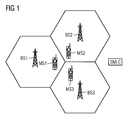
- the section of a mobile radio communication system shown in FIG. 1 comprises the network-end radio stations BS1, BS2 and BS3, as well as the subscriber stations MS1, MS2 and MS3.
- the radio cells of the network-side radio stations BS1, BS2 and BS3 are shown in simplified form as hexagons. For reasons of clarity, further subscriber stations, network-end radio stations and other network-side devices are not shown in FIG. In the following, it is assumed that the considered mobile radio communication system is is a Flash OFDM system; However, the invention is also applicable to other radio communication systems.
- Flash-OFDM The radio technology of Flash-OFDM is described eg in Flarion Technologies, Inc: OFDM for Mobile Data Communications, White Paper, March 2003, and Flarion Technologies, Inc: Flash OFDM® for 450MHz, Advanced Mobile Broadband Solution for 450MHz Operators, White Paper, November 2004, found at www.flarion.com/products/white_papers.asp.
- a further component of the mobile radio communication system of FIG. 1 is the device SMLC (Serving Mobile Location Center), which serves to determine the positions of the subscriber stations MS1, MS2 and MS3.
- the device SMLC receives measurement results from subscriber stations MS1, MS2 and MS3 and calculates the positions of subscriber stations MS1, MS2 and MS3 using these measurement results.
- CPS Chipbridge Positioning System
- CPS Chipbridge Positioning System
- the positions of a plurality of subscriber stations are determined together. For this purpose, these subscriber stations determine the reception times of signals emitted by network-side radio stations.
- beacon signals can be used for the measurements of the subscriber stations, which signals are transmitted periodically by network radio stations, described, for example, in US Pat WO 2004/019529 A2 , The transmission power at which the beacon signals are broadcast is higher than the transmission power of other signals broadcast in the flash OFDM system. Because of that receives a subscriber station usually beacon signals of multiple network radio stations. The multiple measurement results can then be used at the network for position determination using the matrix method.
- the subscriber stations send the results of their receive time measurements to the device SMLC.
- i 1 ... M: the number of subscriber stations which deliver the reception time measurements to the device SMLC .
- k 1 ... N : the number of network-side radio stations with respect to whose signals the reception times are determined by the subscriber stations.
- t ik the measured time at which the signal of the k-th network-side radio station is received by the i-th subscriber station.
- r i the vector which shows in two-dimensional starting from a certain origin to the ith subscriber station.
- b k the vector which shows in two-dimensional starting from the specific origin to the k th network-side radio station.
- ⁇ i the time offset of the internal clock of the ith subscriber station.
- ⁇ k the offset of the signal transmission time of the k-th network-side radio station.
- the availability of a sufficient number of measuring subscriber stations is therefore important for a good position determination with the matrix method.
- the measurements by the various subscriber stations preferably take place simultaneously or approximately simultaneously. However, it is also possible to store measurement results determined by a subscriber station and to use them in a later calculation, ie solution of the equation system. In this case, when carrying out the calculation, the respective subscriber station is generally no longer at the place where it performed the measurements.
- a position determination using a second, different method is possible in the system under consideration.
- This second method uses signal field strength measurements from subscriber stations. Examples of such processes are CIT +, described, for example, in US Pat M. Kuipers, P. Gradalski, M. Pakulski: “Low Cost Positioning and Efficient Fallback in GSM and UTRAN Networks", Joint 2nd Workshop on Positioning, Navigation and Communication 2005, (WPNC 05 ) and E-CITA, described eg in H. Schmitz, M. Kuipers, K. Majewski, P.
- a subscriber station determines the reception power of one or more signals of several network-side radio stations.
- the beacon signals already explained above can be used for the measurements of the reception strengths.
- the position of the subscriber station can then be determined, if appropriate using further measured variables.
- a model is used, referred to below as the Pathloss model. Using the Pathloss model, information about the position of the subscriber station performing the measurement can be obtained from the measurement of the reception power of one or more signals of one or more network-end radio stations.
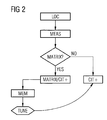
- a request is made in method step LOC, which Determine position of a subscriber station.
- This localization request can originate from the respective subscriber station or also from a network-side device.
- MEAS the subscriber station measures both reception times and reception strengths of beacon signals of several network-side radio stations. If necessary, the subscriber station will be requested.
- the subscriber station sends these measurement results to a network-based radio station, from which they are forwarded to the device SMLC. Further subscriber stations measure at least reception times of beacon signals, which they receive from several network radio stations, and report these measurement results.
- step MATRIX it is checked whether there are sufficiently many measurements of reception times, so that the system of equations of the matrix method is solvable. If this does not apply, corresponding to the branch "NO" in FIG. 2, in the method step CIT +, only the position determination with the second location method using the received power measurements takes place.
- the second localization method can thus be used as a fallback solution for the matrix method. This applies in particular to the case that in the step MEAS reception time measurements are carried out exclusively by that subscriber station whose position is to be determined.
- the calculation of the position of the subscriber station with the matrix method takes place in the step MATRIX / CIT +.
- the position of the subscriber station is also determined using the second localization method. The latter is possible because the subscriber station has measured not only the reception times, but also the reception strengths.
- the position determination can be output either the result of the matrix method, or the result of the location determination method using the received power measurements, or a combination of these two quantities, such as in the form of a weighted average.
- step MEM both the position of the subscriber station determined using the matrix method and that using the second location method are stored. The two results can now be compared.
- step TUNE the result of the location determination using the matrix method is used to improve the pathloss model of the second localization method. Because usually a more accurate localization of a subscriber station is possible using the matrix method. Accordingly, the Pathloss model is modified such that, given the received power measurements, it is no longer the original result, i. the result according to the unchanged Pathloss model, but a modified result. This modified result is more similar to the result of the matrix method than the original result.
- the revised Pathloss model can then be used in later positioning of subscriber stations, providing greater accuracy. This is particularly advantageous if the use of the matrix method is to be dispensed with. Reasons for this may be that there are not enough measurement results for reception times. The latter is particularly possible if the storage of reception time measurement results of currently not active subscriber stations should be dispensed with. The use of these stored measurement results is advantageous for the result of the matrix method, since the accuracy of the Position determination is increased. However, the positions of subscriber stations are determined which may not desire a determination of their position. In this way, the matrix method can collide with the data protection, because when using stored measurement results are indirectly stored information about the whereabouts of a subscriber over a longer period.
- the procedure described thus makes it possible to use the matrix method if there are sufficient measurements for this purpose. If the latter is not true, the accuracy of the positioning of the matrix method does not have to be completely waived since the pathloss model of the second localization method was modified by using a previous position determination on the one hand by the matrix method and on the other hand by the second method. so that the location accuracy of the second localization method is improved.
Landscapes
- Physics & Mathematics (AREA)
- Engineering & Computer Science (AREA)
- General Physics & Mathematics (AREA)
- Radar, Positioning & Navigation (AREA)
- Remote Sensing (AREA)
- Mobile Radio Communication Systems (AREA)
Priority Applications (1)
| Application Number | Priority Date | Filing Date | Title |
|---|---|---|---|
| EP06011780A EP1865335A1 (fr) | 2006-06-07 | 2006-06-07 | Localisation hybride dans un système de communication radio |
Applications Claiming Priority (1)
| Application Number | Priority Date | Filing Date | Title |
|---|---|---|---|
| EP06011780A EP1865335A1 (fr) | 2006-06-07 | 2006-06-07 | Localisation hybride dans un système de communication radio |
Publications (1)
| Publication Number | Publication Date |
|---|---|
| EP1865335A1 true EP1865335A1 (fr) | 2007-12-12 |
Family
ID=37103180
Family Applications (1)
| Application Number | Title | Priority Date | Filing Date |
|---|---|---|---|
| EP06011780A Withdrawn EP1865335A1 (fr) | 2006-06-07 | 2006-06-07 | Localisation hybride dans un système de communication radio |
Country Status (1)
| Country | Link |
|---|---|
| EP (1) | EP1865335A1 (fr) |
Citations (5)
| Publication number | Priority date | Publication date | Assignee | Title |
|---|---|---|---|---|
| EP1260829A1 (fr) * | 2001-05-24 | 2002-11-27 | Lucent Technologies Inc. | Etalonnage autonome d'un système de positionnement global sans fil |
| US20040022214A1 (en) * | 2002-06-04 | 2004-02-05 | Goren David P. | Method for locating mobile units based on received signal strength ratio |
| EP1555845A1 (fr) * | 2004-01-15 | 2005-07-20 | Siemens Aktiengesellschaft | Procédé de localisation des postes d'abonnés d'un système de communication radio |
| US20050195109A1 (en) * | 2004-03-05 | 2005-09-08 | Davi Gregg S. | Wireless node location mechanism responsive to observed propagation characteristics of wireless network infrastructure signals |
| US6990428B1 (en) * | 2003-07-28 | 2006-01-24 | Cisco Technology, Inc. | Radiolocation using path loss data |
-
2006
- 2006-06-07 EP EP06011780A patent/EP1865335A1/fr not_active Withdrawn
Patent Citations (5)
| Publication number | Priority date | Publication date | Assignee | Title |
|---|---|---|---|---|
| EP1260829A1 (fr) * | 2001-05-24 | 2002-11-27 | Lucent Technologies Inc. | Etalonnage autonome d'un système de positionnement global sans fil |
| US20040022214A1 (en) * | 2002-06-04 | 2004-02-05 | Goren David P. | Method for locating mobile units based on received signal strength ratio |
| US6990428B1 (en) * | 2003-07-28 | 2006-01-24 | Cisco Technology, Inc. | Radiolocation using path loss data |
| EP1555845A1 (fr) * | 2004-01-15 | 2005-07-20 | Siemens Aktiengesellschaft | Procédé de localisation des postes d'abonnés d'un système de communication radio |
| US20050195109A1 (en) * | 2004-03-05 | 2005-09-08 | Davi Gregg S. | Wireless node location mechanism responsive to observed propagation characteristics of wireless network infrastructure signals |
Non-Patent Citations (1)
| Title |
|---|
| JAMI I ET AL: "Comparison of methods of locating and tracking cellular mobiles", IEE COLLOQUIUM NOVEL METHODS OF LOCATION AND TRACKING OF CELLULAR MOBILES AND THEIR SYSTEM APPLICATION, IEE, LONDON, BG, 17 May 1999 (1999-05-17), pages 1 - 5, XP002125128 * |
Similar Documents
| Publication | Publication Date | Title |
|---|---|---|
| EP2071932B1 (fr) | Procede et dispositif pour gerer des informations de reference d'environnement | |
| EP1606965B1 (fr) | Procede et dispositif pour adapter un modele de reseau radio aux conditions d'un reseau radio reel | |
| EP2238792B1 (fr) | Procédé de suppression d'utilisation d'un réseau de téléphonie mobile dans une région | |
| DE60126485T2 (de) | Verfahren zum berechnen der echten schleifenlaufzeit und des aufenthaltsortes einer teilnehmereinrichtung in wcdma/utran | |
| WO2003086005A1 (fr) | Procede, dispositif, programme informatique comportant des elements de code de programme et produit de programme destines a determiner une position d'un appareil de communication mobile dans un reseau de communication | |
| DE102014119709A1 (de) | Verfahren zur Bestimmung des Standorts drahtloser Vorrichtungen | |
| EP2301289B1 (fr) | Procédé d'activation d'une femtocellule dépendant du lieu | |
| DE112005003895B4 (de) | Verfahren zur Synchronisation von Takteinrichtungen | |
| DE2829558A1 (de) | Phasenvergleichs-hyperbelverfahren zur ortung flaechengebundener fahrzeuge und einrichtung zur durchfuehrung des verfahrens | |
| EP1569483A2 (fr) | Procédé et dispositif pour la détermination de la position d'un terminal dans un réseau mobile cellulaire | |
| EP3226021A1 (fr) | Procédé s-tdoa (différence séquentielle entre les temps d'arrivée) destiné à déterminer la position d'objets mobiles par détermination de différence séquentielle entre les temps d'arrivée de signaux périodiques | |
| EP1668942B1 (fr) | Procede d'evaluation de position d'une station d'abonne d'un systeme de communication radio et dispositif reseau | |
| DE60026268T2 (de) | Technik zur Benachrichtigung mobiler Endgeräte mittels geografischer Koordinaten | |
| DE102010023960A1 (de) | Verfahren und Vorrichtung zur Ortsbestimmung | |
| EP1555845A1 (fr) | Procédé de localisation des postes d'abonnés d'un système de communication radio | |
| DE19908728C2 (de) | Verfahren zur Bestimmung der Koordinaten des geographischen Ortes eines mobilen GSM-Endgerätes | |
| DE112022001966T5 (de) | Basisstation, funkkommunikationsverfahren und funkkommunikationssystem | |
| EP1745674B1 (fr) | Procede pour localiser un terminal de radiotelephonie mobile dans un reseau de radiotelephonie mobile | |
| EP1635185A2 (fr) | Procédé et appareil pour déterminer la position d'une station d'abonné d'un réseau de télécommunication sans fil | |
| DE102007057563B4 (de) | Verfahren und Vorrichtung zum Zugriff auf ein mobiles Endgerät in einem digitalen zellulären Mobilfunknetz | |
| EP2301264B1 (fr) | Module de traitement de données dans un réseau de radiocommunication à services basés sur la localisation | |
| EP2073592A2 (fr) | Procédé destiné à la détermination de la position d'un appareil de communication radio mobile | |
| EP1319959B1 (fr) | Procédé de localisation non-coopérative des abonnés dans un système de radio mobile de contrôle de puissance | |
| DE10124811A1 (de) | Verfahren zur Positionsbestimmung | |
| DE102012214190A1 (de) | Verfahren zur Positionsbestimmung eines bewegten Objektes in einer Innenraumumgebung |
Legal Events
| Date | Code | Title | Description |
|---|---|---|---|
| PUAI | Public reference made under article 153(3) epc to a published international application that has entered the european phase |
Free format text: ORIGINAL CODE: 0009012 |
|
| AK | Designated contracting states |
Kind code of ref document: A1 Designated state(s): AT BE BG CH CY CZ DE DK EE ES FI FR GB GR HU IE IS IT LI LT LU LV MC NL PL PT RO SE SI SK TR |
|
| AX | Request for extension of the european patent |
Extension state: AL BA HR MK YU |
|
| AKX | Designation fees paid | ||
| STAA | Information on the status of an ep patent application or granted ep patent |
Free format text: STATUS: THE APPLICATION IS DEEMED TO BE WITHDRAWN |
|
| 18D | Application deemed to be withdrawn |
Effective date: 20080613 |
|
| REG | Reference to a national code |
Ref country code: DE Ref legal event code: 8566 |