EP1865590A1 - Agencement d'actionneur - Google Patents
Agencement d'actionneur Download PDFInfo
- Publication number
- EP1865590A1 EP1865590A1 EP07252243A EP07252243A EP1865590A1 EP 1865590 A1 EP1865590 A1 EP 1865590A1 EP 07252243 A EP07252243 A EP 07252243A EP 07252243 A EP07252243 A EP 07252243A EP 1865590 A1 EP1865590 A1 EP 1865590A1
- Authority
- EP
- European Patent Office
- Prior art keywords
- actuator
- link
- actuators
- output shaft
- output
- Prior art date
- Legal status (The legal status is an assumption and is not a legal conclusion. Google has not performed a legal analysis and makes no representation as to the accuracy of the status listed.)
- Granted
Links
Images
Classifications
-
- H—ELECTRICITY
- H02—GENERATION; CONVERSION OR DISTRIBUTION OF ELECTRIC POWER
- H02K—DYNAMO-ELECTRIC MACHINES
- H02K7/00—Arrangements for handling mechanical energy structurally associated with dynamo-electric machines, e.g. structural association with mechanical driving motors or auxiliary dynamo-electric machines
- H02K7/06—Means for converting reciprocating motion into rotary motion or vice versa
-
- B—PERFORMING OPERATIONS; TRANSPORTING
- B64—AIRCRAFT; AVIATION; COSMONAUTICS
- B64C—AEROPLANES; HELICOPTERS
- B64C13/00—Control systems or transmitting systems for actuating flying-control surfaces, lift-increasing flaps, air brakes, or spoilers
- B64C13/24—Transmitting means
- B64C13/26—Transmitting means without power amplification or where power amplification is irrelevant
- B64C13/28—Transmitting means without power amplification or where power amplification is irrelevant mechanical
- B64C13/341—Transmitting means without power amplification or where power amplification is irrelevant mechanical having duplication or stand-by provisions
-
- B—PERFORMING OPERATIONS; TRANSPORTING
- B64—AIRCRAFT; AVIATION; COSMONAUTICS
- B64C—AEROPLANES; HELICOPTERS
- B64C13/00—Control systems or transmitting systems for actuating flying-control surfaces, lift-increasing flaps, air brakes, or spoilers
- B64C13/24—Transmitting means
- B64C13/38—Transmitting means with power amplification
- B64C13/50—Transmitting means with power amplification using electrical energy
- B64C13/505—Transmitting means with power amplification using electrical energy having duplication or stand-by provisions
-
- F—MECHANICAL ENGINEERING; LIGHTING; HEATING; WEAPONS; BLASTING
- F16—ENGINEERING ELEMENTS AND UNITS; GENERAL MEASURES FOR PRODUCING AND MAINTAINING EFFECTIVE FUNCTIONING OF MACHINES OR INSTALLATIONS; THERMAL INSULATION IN GENERAL
- F16H—GEARING
- F16H21/00—Gearings comprising primarily only links or levers, with or without slides
- F16H21/02—Gearings comprising primarily only links or levers, with or without slides the movements of two or more independently-moving members being combined into a single movement
-
- F—MECHANICAL ENGINEERING; LIGHTING; HEATING; WEAPONS; BLASTING
- F16—ENGINEERING ELEMENTS AND UNITS; GENERAL MEASURES FOR PRODUCING AND MAINTAINING EFFECTIVE FUNCTIONING OF MACHINES OR INSTALLATIONS; THERMAL INSULATION IN GENERAL
- F16H—GEARING
- F16H25/00—Gearings comprising primarily only cams, cam-followers and screw-and-nut mechanisms
- F16H25/18—Gearings comprising primarily only cams, cam-followers and screw-and-nut mechanisms for conveying or interconverting oscillating or reciprocating motions
- F16H25/20—Screw mechanisms
-
- F—MECHANICAL ENGINEERING; LIGHTING; HEATING; WEAPONS; BLASTING
- F16—ENGINEERING ELEMENTS AND UNITS; GENERAL MEASURES FOR PRODUCING AND MAINTAINING EFFECTIVE FUNCTIONING OF MACHINES OR INSTALLATIONS; THERMAL INSULATION IN GENERAL
- F16H—GEARING
- F16H25/00—Gearings comprising primarily only cams, cam-followers and screw-and-nut mechanisms
- F16H25/18—Gearings comprising primarily only cams, cam-followers and screw-and-nut mechanisms for conveying or interconverting oscillating or reciprocating motions
- F16H25/20—Screw mechanisms
- F16H2025/2059—Common movement by two screws or two nuts, e.g. two connected screws with opposite thread direction
-
- F—MECHANICAL ENGINEERING; LIGHTING; HEATING; WEAPONS; BLASTING
- F16—ENGINEERING ELEMENTS AND UNITS; GENERAL MEASURES FOR PRODUCING AND MAINTAINING EFFECTIVE FUNCTIONING OF MACHINES OR INSTALLATIONS; THERMAL INSULATION IN GENERAL
- F16H—GEARING
- F16H25/00—Gearings comprising primarily only cams, cam-followers and screw-and-nut mechanisms
- F16H25/18—Gearings comprising primarily only cams, cam-followers and screw-and-nut mechanisms for conveying or interconverting oscillating or reciprocating motions
- F16H25/20—Screw mechanisms
- F16H25/22—Screw mechanisms with balls, rollers, or similar members between the co-operating parts; Elements essential to the use of such members
- F16H25/2204—Screw mechanisms with balls, rollers, or similar members between the co-operating parts; Elements essential to the use of such members with balls
-
- H—ELECTRICITY
- H02—GENERATION; CONVERSION OR DISTRIBUTION OF ELECTRIC POWER
- H02K—DYNAMO-ELECTRIC MACHINES
- H02K16/00—Machines with more than one rotor or stator
-
- Y—GENERAL TAGGING OF NEW TECHNOLOGICAL DEVELOPMENTS; GENERAL TAGGING OF CROSS-SECTIONAL TECHNOLOGIES SPANNING OVER SEVERAL SECTIONS OF THE IPC; TECHNICAL SUBJECTS COVERED BY FORMER USPC CROSS-REFERENCE ART COLLECTIONS [XRACs] AND DIGESTS
- Y10—TECHNICAL SUBJECTS COVERED BY FORMER USPC
- Y10T—TECHNICAL SUBJECTS COVERED BY FORMER US CLASSIFICATION
- Y10T74/00—Machine element or mechanism
- Y10T74/18—Mechanical movements
- Y10T74/18056—Rotary to or from reciprocating or oscillating
Definitions
- This invention relates to an actuator arrangement, for example for use in aerospace applications, but which could also be used in other applications.
- the invention relates, in particular, to a linear actuator arrangement suitable for use with electrically operated actuators.
- hydraulically driven linear actuators in aerospace applications is well known, but has the disadvantage that hydraulic fluid under pressure has to be supplied to each location in which an actuator is provided, and this is inconvenient.
- hydraulically driven actuators arrangements are also known in which electrically driven linear actuators are used.
- electrically driven linear actuators has the advantage that the necessity to supply hydraulic fluid under pressure to the actuator location is avoided.
- One form of electrically powered linear actuator is described in EP1548327 .
- actuator arrangement in which there is sufficient redundancy that, in the event of the failure of an individual actuator, a flight control surface or other component which would usually be driven by that actuator can still be driven, for example using other actuators.
- This may be achieved, for example, by providing two or more actuators in each location in which an actuator arrangement is required, each individual actuator being capable of driving the flight control surface or other component in the event of the failure of the other actuator.
- Such arrangements result in relatively large actuators being used, and this adds to the cost and weight of the actuator arrangement.
- an actuator arrangement comprising a first linear actuator having a first output shaft, a second linear actuator having a second output shaft, the first and second output shafts being pivotally connected to a link, and a pivotable output connection provided on the link intermediate the locations at which the first and second output shafts are pivotally connected to the link.
- the first and second actuators are preferably electrically driven actuators.
- each linear actuator needs only supply part of the overall required output force of the actuator arrangement.
- continued operation of the other of the actuators results in the link pivoting about the point of connection with the failed actuator and, as the output connection is located intermediate the points at which the failed and operating actuators are connected to the link, it will be appreciated that the resulting leverage results in the remaining operating actuator still needing to be capable of providing only part of the required output force of the actuator arrangement. Redundancy can thus be attained in a relatively simple and convenient manner.
- the first and second actuators are capable of providing substantially the same output force as one another, and the location of the output connection is preferably approximately midway between the locations of the pivotal connections of the first and second outputs with the link.
- Such an arrangement is advantageous in that the same output force can be attained irrespective of whether both or only one of the actuators is operating.
- the first and second actuators preferably include brake means.
- the corresponding brake means is conveniently applied to ensure that the point about which the link pivots remains fixed or substantially fixed.
- the pivotal connections between the first and second output shafts and the link are conveniently spherical pivot connections, and are also preferably capable of accommodating lateral movement of the link.
- the provision of spherical type pivot arrangements reduces the risk of the actuator arrangement becoming jammed, in use, and the ability to accommodate lateral movement accommodates changes in the spacing of the pivotal connections to the link as occur when the link undergoes pivoting movement.
- the actuator arrangement conveniently includes a control arrangement adapted to compare the statuses of the first and second actuators, and to adjust the operating speeds thereof, in normal use, to limit or avoid tilting movement of the link.
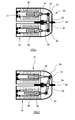
- a linear actuator arrangement 10 comprising a first electrically driven linear actuator 12 having a first output shaft 14, and a second electrically driven linear actuator 16 having a second output shaft 18.
- the first and second actuators 12, 16 are substantially identical to one another, and are arranged so as to be parallel to one another, the output shafts 14, 18 lying parallel to one another and spaced apart from one another.
- Each actuator conveniently incorporates a brake assembly which preferably locks the respective actuator in position when electrical power to the actuator is removed.
- a link 20 interconnects the output shafts 14, 18, the link 20 being pivotally connected to the output shafts 14, 18, conveniently by spherical pivot arrangements 22.
- the pivot arrangements 22 are designed in such a manner as to allow pivoting movement to occur between the shafts 14, 18 and the link 20, and in addition to allow some sliding movement to occur therebetween in the direction of the axis 24 of the link 20.
- a pivotable output connection 26 whereby an output shaft 28 is pivotally connected to the link 20.
- the output connection 26, like the arrangements 22, is in the form of a spherical pivot arrangement. However, it is designed in such a manner that sliding movement in the direction of the axis 24 of the link 20 is not permitted.
- the first and second actuators 12, 16 are both driven to cause linear movement of the respective output shafts 14, 18 to occur.
- the actuators 12, 16 are controlled in such a manner that the shafts 14, 18 are driven simultaneously at substantially the same speed and by substantially the same distance. It will be appreciated that such operation of the actuators 14, 18 causes the link 20 to translate, for example to the position shown in broken lines in Figure 1, the motion of the link 20 being transmitted through the output connection 26 to cause linear, axial movement of the output shaft 28. It will be appreciated that in this mode of operation, no or minimal tilting or pivotal movement occurs between the output shafts 14, 18 and the link 20 and, similarly, no or minimal tilting or pivotal movement occurs between the link 20 and the output shaft 28.
- the output shaft 28 is required to move through a distance D, applying a load F to a component, for example a flight control surface, connected thereto, it will be appreciated that the output shafts 14, 18 of the first and second actuators 12, 16 must both move through the distance D and each must contribute a force of F/2 to the total output force.
- a component for example a flight control surface
- Figure 2 illustrates the situation where the first actuator 12 or the control arrangement associated therewith has failed with the output shaft 14 thereof in its extended position.
- the second actuator 16 is still fully functioning.
- the output shaft 28 is in an intermediate position. If it is desired to move the output shaft 28 to a more extended position, the second actuator 16 is operated to move the output shaft 18 thereof towards its extended position.
- the first actuator 12 has failed, and thus the output shaft 14 thereof will remain in a fixed position.
- the output force of the actuator arrangement 10 is maintained despite one of the actuators failing, it will be appreciated that in order for the output shaft 28 to move through a distance D, the output shaft 18 of the functioning actuator 16 will need to be moved through an increased distance of 2D, and for a given speed of operation of the actuator 16, the output shaft 28 may be moved more slowly than when both actuators are functioning, although the manner in which the actuator arrangement 10 is controlled may be used to compensate for this.
- each of the actuators 12, 16 is preferably capable of extending over a distance 3x, again as identified in Figure 5, as described below.
- both actuators 12, 16, and the output shaft 28 extend and retract over a distance x between the positions identified as min and max.
- the second actuator 16 would need to retract from the max position through a distance 2x in order to move the output shaft 28 through a distance x to the min position.
- each actuator 12, 16 must be capable of extending/retracting over a distance x each side of the normal operating range x, giving a total required range of movement of 3x. In the event that it is sensed that the actuator shaft of one or other of the actuators is located outside of the normal range of movement, then this can be used to provide an indication that one of the actuators has failed. The brake assembly associated with the failed actuator can then be applied and the remaining functioning actuator used to drive the output shaft 28 through its normal operating range of movement.
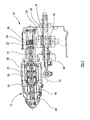
- the actuators 12, 16 are conveniently of concentric form, for example as described and illustrated in EP1548327 , each comprising a housing 30 containing an electrically operable motor 32 arranged to drive a tubular drive shaft 34 for rotation. Secured to the drive shaft 34 is a nut 36, the nut 36 being mounted for rotation through bearings, but being secured against axial movement. The nut 36 cooperates with threads formed on the output shaft 14, 18. The output shaft is mounted so as to be axially moveable, but rotation thereof is prevented or restricted. Operation of the motor 32 to drive the nut 36 for rotation causes linear movement of the output shaft 14, 18 to occur.
- Each actuator 12, 16 incorporates a brake arrangement 44 operable to secure the associated output shaft 14, 18 against axial movement.
- the brake arrangement 44 may comprise a permanent magnet operated brake which is disengaged, in normal use, by the application of an electric current to an associated actuator.
- the arrangement 22 formed at the outer end of each output shaft 14, 18 comprises a coupling member 38 pivotally connected to the associated output shaft.
- the coupling member 38 has an opening formed therein through which a rod-like part 40 of the link 20 passes, the part 40 being slidable within the opening.
- the output connection 26 is of similar form, including a coupling member 42 rotatable within a part spherical recess, but sliding movement between the link 20 and the output shaft 28 is not permitted.
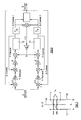
- Figure 4 illustrates part of a control arrangement for use with the actuator arrangement described hereinbefore.
- an input signal Xdemand representative of the desired position of the output shaft 28 is compared with a signal Xcurrent representative of the actual output shaft position.
- Xcurrent may be derived from appropriate sensors associated with the output shaft 28, for example from LVDT 48.
- the comparison operation results in the derivation of a signal ⁇ X representative of the difference between the actual and desired output shaft positions.
- the signal ⁇ X is converted to a desired actuator speed signal Vdemand which is compared with a signal Vcurrent representative of the current operating speed of the actuator to produce a difference signal ⁇ V which is converted to command signal K.
- each actuator Xcurrent1 and Xcurrent2 (derived from respective LVDT sensors), are compared to produce a signal ⁇ x representative of the difference in actuator position, signal ⁇ x being used to produce a command signal k which is used in combination with the corresponding command signal K to control the operation of each actuator.
- the control arrangement will control the operation of the actuator arrangement such that substantially no tilting or pivotal movement of the link 20 occurs. If the signal ⁇ x exceeds a predetermined threshold, then the system will automatically assume that one of the actuators has failed, and will apply the brake arrangement associated with that one of the actuators.
- the control system will assume that an actuator has failed and control the further operation of the actuator arrangement accordingly.
- the remaining functioning actuator can be operated at a higher speed, for example at double the normal operating speed, to maintain substantially normal operation of the flight control surface or other component with which the actuator arrangement is used.
- the current positions of the actuators are conveniently sensed using LVDT sensors 50.
- Resolvers 46 are provided in the actuators 12, 16 for sensing to the actuator speed, the resolvers using, for example, the Hall effect to monitor changes in the magnetic field strength and thereby determine the positions of the output shafts 14, 18 of the actuators 12, 16.
- other sensors for example LVDTs may be used to sense the positions of the actuators.
Landscapes
- Engineering & Computer Science (AREA)
- General Engineering & Computer Science (AREA)
- Mechanical Engineering (AREA)
- Automation & Control Theory (AREA)
- Aviation & Aerospace Engineering (AREA)
- Power Engineering (AREA)
- Transmission Devices (AREA)
- Valves And Accessory Devices For Braking Systems (AREA)
- Braking Systems And Boosters (AREA)
Applications Claiming Priority (1)
| Application Number | Priority Date | Filing Date | Title |
|---|---|---|---|
| GBGB0611525.7A GB0611525D0 (en) | 2006-06-10 | 2006-06-10 | Actuator arrangement |
Publications (2)
| Publication Number | Publication Date |
|---|---|
| EP1865590A1 true EP1865590A1 (fr) | 2007-12-12 |
| EP1865590B1 EP1865590B1 (fr) | 2017-08-02 |
Family
ID=36745676
Family Applications (1)
| Application Number | Title | Priority Date | Filing Date |
|---|---|---|---|
| EP07252243.6A Active EP1865590B1 (fr) | 2006-06-10 | 2007-06-02 | Agencement d'actionneur |
Country Status (3)
| Country | Link |
|---|---|
| US (1) | US20070295120A1 (fr) |
| EP (1) | EP1865590B1 (fr) |
| GB (1) | GB0611525D0 (fr) |
Cited By (4)
| Publication number | Priority date | Publication date | Assignee | Title |
|---|---|---|---|---|
| RU2442721C1 (ru) * | 2010-06-09 | 2012-02-20 | Российская Федерация, От Имени Которой Выступает Министерство Промышленности И Торговли Российской Федерации | Устройство электромеханического привода аэродинамической поверхности самолета |
| EP2460721A1 (fr) * | 2010-12-03 | 2012-06-06 | EADS Deutschland GmbH | Transmission d'une force de commande |
| GB2490959A (en) * | 2011-05-20 | 2012-11-21 | Ge Aviat Systems Ltd | High integrity linear actuator |
| EP3330570A1 (fr) * | 2016-12-02 | 2018-06-06 | Microtecnica S.r.l. | Système de commande pour un actionneur |
Families Citing this family (4)
| Publication number | Priority date | Publication date | Assignee | Title |
|---|---|---|---|---|
| US10570936B2 (en) * | 2014-03-07 | 2020-02-25 | Parker-Hannifin Corporation | Symmetrically loaded dual hydraulic fly-by-wire actuator |
| JP6779183B2 (ja) * | 2017-07-18 | 2020-11-04 | 川崎重工業株式会社 | 電気機械式アクチュエータを備える航空機操舵システム |
| NO344201B1 (en) * | 2017-10-17 | 2019-10-14 | Electrical Subsea & Drilling As | Electro mechanical power actuator |
| WO2022076340A1 (fr) * | 2020-10-07 | 2022-04-14 | Moog Inc. | Actionneur à trajet de charge multiple à détection de défaillance |
Citations (4)
| Publication number | Priority date | Publication date | Assignee | Title |
|---|---|---|---|---|
| US3269676A (en) * | 1965-04-30 | 1966-08-30 | Sperry Rand Corp | Valve actuator apparatus |
| US3509435A (en) * | 1965-12-06 | 1970-04-28 | Sperry Rand Ltd | Mechanically cross-coupled dual channel actuator system |
| US4967124A (en) * | 1988-07-12 | 1990-10-30 | Teijin Seiki Company Limited | Servo control apparatus |
| US20040075019A1 (en) * | 2002-10-18 | 2004-04-22 | Collins Andrew J. | Flight control surface actuation system |
Family Cites Families (1)
| Publication number | Priority date | Publication date | Assignee | Title |
|---|---|---|---|---|
| US4370706A (en) * | 1980-09-26 | 1983-01-25 | The Bendix Corporation | Controller for a dual servo system |
-
2006
- 2006-06-10 GB GBGB0611525.7A patent/GB0611525D0/en not_active Ceased
-
2007
- 2007-06-02 EP EP07252243.6A patent/EP1865590B1/fr active Active
- 2007-06-06 US US11/758,694 patent/US20070295120A1/en not_active Abandoned
Patent Citations (4)
| Publication number | Priority date | Publication date | Assignee | Title |
|---|---|---|---|---|
| US3269676A (en) * | 1965-04-30 | 1966-08-30 | Sperry Rand Corp | Valve actuator apparatus |
| US3509435A (en) * | 1965-12-06 | 1970-04-28 | Sperry Rand Ltd | Mechanically cross-coupled dual channel actuator system |
| US4967124A (en) * | 1988-07-12 | 1990-10-30 | Teijin Seiki Company Limited | Servo control apparatus |
| US20040075019A1 (en) * | 2002-10-18 | 2004-04-22 | Collins Andrew J. | Flight control surface actuation system |
Cited By (7)
| Publication number | Priority date | Publication date | Assignee | Title |
|---|---|---|---|---|
| RU2442721C1 (ru) * | 2010-06-09 | 2012-02-20 | Российская Федерация, От Имени Которой Выступает Министерство Промышленности И Торговли Российской Федерации | Устройство электромеханического привода аэродинамической поверхности самолета |
| EP2460721A1 (fr) * | 2010-12-03 | 2012-06-06 | EADS Deutschland GmbH | Transmission d'une force de commande |
| DE102010053396B4 (de) * | 2010-12-03 | 2014-12-24 | Airbus Defence and Space GmbH | Übertragung einer Steuerungskraft |
| GB2490959A (en) * | 2011-05-20 | 2012-11-21 | Ge Aviat Systems Ltd | High integrity linear actuator |
| US20120291574A1 (en) * | 2011-05-20 | 2012-11-22 | Terence Ross Golding | High integrity linear actuator and method of operation |
| US9016151B2 (en) * | 2011-05-20 | 2015-04-28 | Triumph Actuation Systems—UK, Ltd. | High integrity linear actuator and method of operation |
| EP3330570A1 (fr) * | 2016-12-02 | 2018-06-06 | Microtecnica S.r.l. | Système de commande pour un actionneur |
Also Published As
| Publication number | Publication date |
|---|---|
| EP1865590B1 (fr) | 2017-08-02 |
| GB0611525D0 (en) | 2006-07-19 |
| US20070295120A1 (en) | 2007-12-27 |
Similar Documents
| Publication | Publication Date | Title |
|---|---|---|
| EP1865590B1 (fr) | Agencement d'actionneur | |
| EP1972548B1 (fr) | Agencement d'actionneur | |
| US10065728B2 (en) | Horizontal stabilizer trim actuator failure detection system and method using position sensors | |
| JP5192058B2 (ja) | 制御システム | |
| US8322242B2 (en) | Velocity summing linear actuator | |
| EP1846291B1 (fr) | Vanne concentrique double a double moteur | |
| EP1978233B1 (fr) | Agencement d'actionneur pour inverseur de poussée | |
| JPS63152761A (ja) | ノンジャミングねじアクチュエータ装置 | |
| CN111183077A (zh) | 机械制动装置 | |
| US6389915B1 (en) | Dual load path ball screw with rod end swivel | |
| JPH05196097A (ja) | 位置決め装置 | |
| US8210206B2 (en) | Dual redundant servovalve | |
| CN113365913B (zh) | 用于飞行器的控制棒的力施加设备 | |
| EP1793477A1 (fr) | Actionneur électromagnétique tolérant aux défauts avec système de détection et de contrôle de couple | |
| EP1927543B1 (fr) | Actionneur linéaire électromécanique | |
| EP1245867B1 (fr) | Dispositif de surveillance | |
| US12110098B1 (en) | Apparatus, system and method for control of electromechanical boost actuators | |
| US20250146563A1 (en) | Fault tolerant rotary ema | |
| CN116324219A (zh) | 具有故障检测的多载荷路径致动器 | |
| CN115367107B (zh) | 机电伺服控制器、具有至少四个机电伺服控制器的斜盘系统和旋翼飞行器 | |
| EP1921347A2 (fr) | Système d'actionnement de commande simple avec redondance et dispositif de sécurité | |
| EP4122818B1 (fr) | Système de commande d'une surface de commande de vol | |
| US7141897B2 (en) | Electric actuator expanded with sensor and electronic brake | |
| JP2010105633A (ja) | 電磁サスペンション装置 | |
| NO347355B1 (no) | Anordning ved aktuator |
Legal Events
| Date | Code | Title | Description |
|---|---|---|---|
| PUAI | Public reference made under article 153(3) epc to a published international application that has entered the european phase |
Free format text: ORIGINAL CODE: 0009012 |
|
| AK | Designated contracting states |
Kind code of ref document: A1 Designated state(s): AT BE BG CH CY CZ DE DK EE ES FI FR GB GR HU IE IS IT LI LT LU LV MC MT NL PL PT RO SE SI SK TR |
|
| AX | Request for extension of the european patent |
Extension state: AL BA HR MK YU |
|
| 17P | Request for examination filed |
Effective date: 20080610 |
|
| AKX | Designation fees paid |
Designated state(s): DE FR GB |
|
| 17Q | First examination report despatched |
Effective date: 20080917 |
|
| RIN1 | Information on inventor provided before grant (corrected) |
Inventor name: DUBOIS ROBERT Inventor name: GERBIER, DOMINIQUE Inventor name: GRAND, SERGE Inventor name: SANDLER, SAMUEL |
|
| GRAP | Despatch of communication of intention to grant a patent |
Free format text: ORIGINAL CODE: EPIDOSNIGR1 |
|
| RIC1 | Information provided on ipc code assigned before grant |
Ipc: F16H 21/02 20060101ALI20161108BHEP Ipc: H02K 16/00 20060101ALN20161108BHEP Ipc: B64C 13/42 20060101ALI20161108BHEP Ipc: B64C 13/50 20060101ALI20161108BHEP Ipc: F16H 25/20 20060101ALI20161108BHEP Ipc: F16H 25/22 20060101ALN20161108BHEP Ipc: H02K 7/06 20060101AFI20161108BHEP |
|
| STAA | Information on the status of an ep patent application or granted ep patent |
Free format text: STATUS: GRANT OF PATENT IS INTENDED |
|
| INTG | Intention to grant announced |
Effective date: 20161215 |
|
| GRAS | Grant fee paid |
Free format text: ORIGINAL CODE: EPIDOSNIGR3 |
|
| GRAA | (expected) grant |
Free format text: ORIGINAL CODE: 0009210 |
|
| STAA | Information on the status of an ep patent application or granted ep patent |
Free format text: STATUS: THE PATENT HAS BEEN GRANTED |
|
| AK | Designated contracting states |
Kind code of ref document: B1 Designated state(s): DE FR GB |
|
| REG | Reference to a national code |
Ref country code: GB Ref legal event code: FG4D |
|
| REG | Reference to a national code |
Ref country code: DE Ref legal event code: R096 Ref document number: 602007051817 Country of ref document: DE |
|
| REG | Reference to a national code |
Ref country code: DE Ref legal event code: R097 Ref document number: 602007051817 Country of ref document: DE |
|
| REG | Reference to a national code |
Ref country code: FR Ref legal event code: PLFP Year of fee payment: 12 |
|
| PLBE | No opposition filed within time limit |
Free format text: ORIGINAL CODE: 0009261 |
|
| STAA | Information on the status of an ep patent application or granted ep patent |
Free format text: STATUS: NO OPPOSITION FILED WITHIN TIME LIMIT |
|
| 26N | No opposition filed |
Effective date: 20180503 |
|
| PGFP | Annual fee paid to national office [announced via postgrant information from national office to epo] |
Ref country code: DE Payment date: 20250520 Year of fee payment: 19 |
|
| PGFP | Annual fee paid to national office [announced via postgrant information from national office to epo] |
Ref country code: GB Payment date: 20250520 Year of fee payment: 19 |
|
| PGFP | Annual fee paid to national office [announced via postgrant information from national office to epo] |
Ref country code: FR Payment date: 20250520 Year of fee payment: 19 |