EP1865612A2 - Unité autoalimentée héliportable pour télécommunications - Google Patents
Unité autoalimentée héliportable pour télécommunications Download PDFInfo
- Publication number
- EP1865612A2 EP1865612A2 EP20070425341 EP07425341A EP1865612A2 EP 1865612 A2 EP1865612 A2 EP 1865612A2 EP 20070425341 EP20070425341 EP 20070425341 EP 07425341 A EP07425341 A EP 07425341A EP 1865612 A2 EP1865612 A2 EP 1865612A2
- Authority
- EP
- European Patent Office
- Prior art keywords
- telescoping mast
- container
- unit according
- photovoltaic
- arms
- Prior art date
- Legal status (The legal status is an assumption and is not a legal conclusion. Google has not performed a legal analysis and makes no representation as to the accuracy of the status listed.)
- Withdrawn
Links
- 238000004873 anchoring Methods 0.000 claims description 8
- 238000010079 rubber tapping Methods 0.000 claims description 8
- 238000009434 installation Methods 0.000 claims description 5
- 230000002093 peripheral effect Effects 0.000 claims description 5
- 230000000284 resting effect Effects 0.000 claims 1
- 230000001413 cellular effect Effects 0.000 abstract description 2
- 238000010276 construction Methods 0.000 description 5
- 230000008878 coupling Effects 0.000 description 2
- 238000010168 coupling process Methods 0.000 description 2
- 238000005859 coupling reaction Methods 0.000 description 2
- 239000000463 material Substances 0.000 description 2
- 238000009825 accumulation Methods 0.000 description 1
- 230000000703 anti-shock Effects 0.000 description 1
- 238000013016 damping Methods 0.000 description 1
- 230000003247 decreasing effect Effects 0.000 description 1
- 230000007613 environmental effect Effects 0.000 description 1
- 230000005484 gravity Effects 0.000 description 1
- 238000003754 machining Methods 0.000 description 1
- 238000004519 manufacturing process Methods 0.000 description 1
- 230000004048 modification Effects 0.000 description 1
- 238000012986 modification Methods 0.000 description 1
- 230000000717 retained effect Effects 0.000 description 1
- 239000002699 waste material Substances 0.000 description 1
- XLYOFNOQVPJJNP-UHFFFAOYSA-N water Substances O XLYOFNOQVPJJNP-UHFFFAOYSA-N 0.000 description 1
Images



Classifications
-
- H—ELECTRICITY
- H01—ELECTRIC ELEMENTS
- H01Q—ANTENNAS, i.e. RADIO AERIALS
- H01Q1/00—Details of, or arrangements associated with, antennas
- H01Q1/12—Supports; Mounting means
- H01Q1/1235—Collapsible supports; Means for erecting a rigid antenna
-
- H—ELECTRICITY
- H04—ELECTRIC COMMUNICATION TECHNIQUE
- H04B—TRANSMISSION
- H04B1/00—Details of transmission systems, not covered by a single one of groups H04B3/00 - H04B13/00; Details of transmission systems not characterised by the medium used for transmission
- H04B1/02—Transmitters
- H04B1/03—Constructional details, e.g. casings, housings
Definitions
- the present invention relates to a helitransportable self-powered unit for telecommunications.
- the unit according to this invention is able to carry out various tasks, one of its most important applications can be considered to create an emergency radio relay system, for example for temporary cellular telephone coverages.
- Italian patent N. 1292220 essentially discloses an insulated-core self-powered module equipped with a control unit.
- the module as described in the cited patent is small in its dimensions and very easily transportable.
- the module is provided on a rear wall thereof with a folding base for supporting a telescoping mast whose installation further needs a coupling for compressed-air feeding. It is found that, at least theoretically, in time, repeated stresses on the folding base could endanger a matching of male and female parts in the coupling, that are located in the telescoping mast and on the rear wall of the module, respectively, with a result of less reliability of the module operation.
- Italian patent N. 1307726 discloses a H-shaped construction adapted to support the photovoltaic panels and designed to be positioned on a horizontal tubular bracket symmetrically at both sides of a telescoping mast.
- Each H-shaped construction is comprised of a pair of half rods or arms, that are mutually foldable to be readily housed within a powered module of the type as described in patent N. 1292220.
- the arms are mutually folded intermediately, where a flange, which can be clamped to the tubular bracket by a hand-wheel, is provided.
- Such a type of arm construction which is generally shaped as pliers, even if it does not imply particular trouble in its installation, causes waste of time and, at least theoretically, a lowered reliability when in specially heavy operating and load conditions.
- an object of the present invention is to assure adequate standards of productiveness and allow a telescoping mast and parts connected thereto, to be installed in a quick, reliable and safe way in a self-powered unit for telecommunications.
- the invention provides a helitransportable self-powered unit for telecommunications, comprising a container having a vertical rear wall and including inside, under a front cover and in a contracted condition, a telescoping mast able to hold up at least an antenna and to support photovoltaic panels, and also means designed to extend a telescoping mast after its manual installation on the vertical rear wall of the container, the telescoping mast being provided with connecting means to be connected to conjugated connecting means arranged in said vertical rear wall of the container and with supporting means for said photovoltaic panels, said connecting means of the telescoping mast comprising:
- the unit is made from light as well as strong materials, and other measures are taken that will be evident below.
- FIG. 1 an axonometric view of a helitransportable self-powered unit for telecommunications according to an embodiment of the present invention is shown in Figure 1.
- the unit is installed and ready to work.
- a container or "cabinet" is indicated at 1
- a telescoping mast at 2
- tubular brackets at 3
- photovoltaic-panel holder arms at 4.
- the container 1 has preferably parallelepiped shape, with dimensions and manufacturing material varying according to the unit configuration.
- the container 1 acts also as both a support base for extended constructions and a workbench for operators. Further, such a container assures mechanical and environmental protection of internal components and apparatuses.
- an electric accumulation system together with its control electronics, a pneumatic driving system for the extendible parts, and every other specific apparatus necessary for the operation according to the present invention, there are housed within the container 1 the telescoping mast 2 in contracted condition, the tubular brackets 3 and the panel-holder arms 4, as well as photovoltaic panels 5, a tip 6 and antennas 7, 70 (only fragmentarily shown).
- peripheral hitching points or eyebolts generally indicated at 9, which are located and made in such a way that they can be adjusted in view of the location of the centre of gravity, which changes according to the unit configuration, in order to assure in any case a balanced lifting of the unit when it is transported hung externally from an aircraft.
- the peripheral eyebolts 9 are self-centring and articulated on manual jacks for levelling the container, jacks that are advantageously safe hitching points for the load made up of the container 1 and of its contents.
- the jacks which are neither indicated in figures or shown in detail, are composed of a prismatic link that is fully obtained by chip-forming machining, suitably grooved and bored at its ends, and of a double coaxial screw-extendable rod is displaced inside the prismatic link. These jacks are conveniently located in peripheral positions of the container 1, in order to level steadily the unit before assembling the extended constructions and allow circular plates (not shown) to be positioned comfortably and safely to the jack feet for distributing the load on the ground.
- FIG. 2 showing, in enlarged scale, the container 1 of the unit according to the present invention which is cut off by a vertical plane ⁇ , a central eyebolt 10, suitable for the connection to terrestrial lifting means for handling the container 1 on the ground, is provided on its upper wall 8.
- the eyebolts 9, 10 are suitably restrained to the upper wall of the container by clamping means or clips. Further, on the upper wall 8 of the container 1 there are a compass 11 and a water level 12.
- a front-upper part of the container 1 can be opened through a cover 13 to constitute a work post for the operators.
- This cover can be fastened in two different safe positions.
- the hinges 15 rotate 180 degrees and, in a maximum opening position, can be easily locked from the front part of the container, by means of a rotating retainer thereof (that may not be seen in the figures) to enter grooves formed on inverted U-shaped members 16.
- the closure of the container is bad weather proof. Even if not shown, the telescoping mast 2 in its contracted position, the tubular brackets 3 and the panel-holder arms 4, as well as the photovoltaic panels 5, the tip 6 and the antennas 7, 70 are located under the cover 13, all suitably fixed.
- a rear wall thereof is indicated at 17.
- a recess 18 which is provided substantially in a central position and inside which an anchoring rod 19 is horizontally fixed, and, above the recess 18, a cut-out 20 for a tapping valve 340 for drawing compressed air.
- an anchoring hole 21 On both side of the cut-out 20 there is an anchoring hole 21.
- the above cited parts act as connecting means, as it will clearer from the following of the description.
- a space 170 and a turning footrest 171 which is shown in its rest position inside the space 170, and further a plurality of power plugs 172 for the photovoltaic panels and a plurality of antenna connectors 173.
- a known insulating system made up of antishock devices and vibration-damping wire devices (neither shown in figures, or indicated in detail), suitable to protect the unit in case of accidental impacts.
- FIG 4 is an axonometric view of the telescoping mast 2 in its contracted condition.
- the telescoping mast 2 has an external mast section 22, i.e. the lowest one, and a multiplicity of mast sections, being of diameters decreasing upward so that each upper mast section can slide into a lower one. Between a mast section and the subsequent one a seal for the compressed air is created by a hose clamp indicated generally at 223. An end of the telescoping mast 2 opposite to the external mast section 22 is indicated at 224.
- the lowest mast section 22 has a hooking bottom 23, which is applied in its lower part, and a locking sleeve 24 in its upper part. Both the hooking bottom 23 and the locking sleeve 24 have rear gripping means for the operator in the form of handles denoted as 25 and 26, respectively, as well as connecting means designed to engage correspondent connecting means provided in the rear vertical wall 17 of the container, as above mentioned.
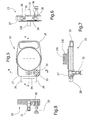
- the hooking bottom 23 is shown in detail in Figures 5 to 8, which are an enlarged top plan view and a left-hand side view of the hooking bottom respectively, and cross-sectional views taken along lines A-A and B-B in Figure 5, respectively.
- telescoping mast 2 Since the telescoping mast 2 has to be anchored to the rear vertical wall 17 of the container 1, parts thereof facing the rear wall 17 of the container 1 are defined as front parts, and opposite parts of telescoping mast as rear parts.
- the hooking bottom 23, which is designed to be attached to the low end of the telescoping mast 2 has a front projection 27.
- the front projection 27 is provided with connecting means for the connection to the rear vertical wall 17 of the container 1 in the form of a pair of hook members 28 facing downward.
- the pair of hook members 28 is suitably one-piece with a bar 29, which is fastened by screws 30 to the front projection 27 of the hooking bottom 23.
- the hooking bottom 23 has in its front projection 27 a pipe fitting 31 for a compressed-air piping system (not shown), as it will be explained below.
- the pipe fitting 31 branches off toward the bottom of the lowest mast section 22 and also outside in the environment through a duct 32.
- the duct 32 can be closed by a cock 33, in order to prevent the compressed air pressure, which is generated by a compressor inside the unit, to be lowered, or the duct. 32 can be opened to cause the exit of the air inside the telescoping mast, so that the telescoping mast is reduced in its height.
- the hooking bottom 23 is provided in its external lower part with a rest protrusion 230 designed to be housed in a correspondent seat (not shown in detail) in a first side wall, inside the container 1, when the telescoping mast 2 is in its contracted condition.
- a through hole 231 adapted to match a through hole correspondingly provided in said seat, so that the rest protrusion 230, and then the hooking bottom 23 of the telescoping mast can be crossed by a locking pin (not shown).
- a second side wall, opposite to the first one, of the container is at least a supporting member (not shown) for an end 224, which is opposite to the hooking bottom 23, of the telescoping mast.
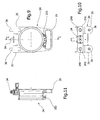
- FIGS 9 to 11 show an enlarged top plan view and a side view of the locking sleeve 24, and a cross-sectional view taken along a line C-C, respectively.
- the locking sleeve 24, adapted to lock the telescoping mast 2 to the rear wall 17 of the container 1, is provided, together with a hose clamp 223, in the upper end of the lowest mast section 22, however at a such a height that a locking-sleeve valve 34, having a projecting pressure-containing member, is positioned in correspondence with a swinging tapping valve 340, of known type, which is located inside the cut-out 20 for drawing compressed air through the rear vertical wall 17 of the container 1 ( Figure 3).
- the locking sleeve 24 has two articulated fixing members 35, not shown in Figure 4.
- the articulated fixing members 35 are pivoted about bolts 240 which are screwed on fork portions 241 of the locking sleeve 24.
- the articulated fixing members 35 support at right angles threaded pins 36, which are retained therein by their anti-thread ends.
- the threaded pins 36 are designed to be fit and screwed into correspondent anchoring holes 21 which are provided in the rear wall 17 on both side of the tapping valve 340 for drawing compressed air as above said.
- the telescoping mast 2 can be extended as shown in Figure 1, even if fragmentarily sectioned by planes ⁇ , ⁇ '.
- the operating way of the cock for extending or contracting the telescoping mast will not be described as it is well known in the art.
- FIGs 12 to 14 are an enlarged top plan view and a side view of a supporting block 37, as well as a cross-sectioned view taken along a line D-D, respectively.
- the supporting block 37 of the photovoltaic panels 5 includes two split holes 38, 39 having mutually orthogonal axes.
- the split hole 38, having a split 380, is vertical to allow the supporting block 37 to be fit and locked on the telescoping mast 2 at the desired height by a bolt 381.
- the choice of the height is based on dimensions of the photovoltaic panels 5 that the telescoping mast 2 has to support.
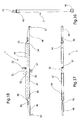
- the other split hole 39 is horizontal and serves for quickly fitting facing ends of tubular brackets 3, one of which is shown in Figure 16 as an enlarged top plan view thereof.
- the horizontal split hole 39 of the supporting block 37 for fitting an end 43 of a tubular bracket 3 ( Figure 16) has a bored plate 44, whose hole is peripherally toothed at least partially.
- the clamping pin 40 is provided with a reduction 400 that is so shaped to allow a tubular bracket end 43 to pass through the horizontal hole 39.
- the clamping pin 40 is rotated by acting manually on the handle 41 against a spring-back applied in a known way by an elastic counteracting washer, which is mounted on the clamping pin 40 in its end opposite to the handle 41 ( Figure 14).
- the bored plate 44 is able to engage a conjugated toothed profile that is provided in the opposite ends 43 of tubular brackets 3, so that an arrangement with varying orientation of the tubular brackets 3 and, as consequence, of photovoltaic-panel holder arms 4 and of photovoltaic panels 5 on the telescoping mast 2, is feasible.
- tubular brackets 3 have adjacent the respective end 43 and at the free opposite end thereto a retaining cylindrical section 45, 46 having protrusions to retain the photovoltaic-panel holder arms 4.
- the photovoltaic-panel holder arms 4 are shown in Figures 17 and 18, that are a rear view and a longitudinal cross-sectional view thereof, respectively.
- the photovoltaic-panel holder arms 4 comprise an elongated body 47 and a pair of small arms 48, 48, which are pivoted at the respective ends of the elongated body 47.
- the small arms 48, 48 are pivoted so to swing inside the photovoltaic-panel holder arms from an opened position shown in Figures 17 and 18, in which each small arm 48 is aligned with the elongated body 47 outward, to an opposed closed position.
- each small arm 48 is folded on the elongated body 47 so to reduce the overall dimensions of the photovoltaic-panel holder arms 4 in a rest position inside the container 1.
- the elongated body 47 of the panel holder arms 4 is made from a channel that is preferably lightened by through holes generally indicated at 49.
- the elongated body 47 has intermediately a triangular cutout 50 and a jaw 51, which is mounted rotatably to face the cutout 50.
- the jaw 51 is pivoted in a hinge 52 and has a closure bolt 53. In this way a tie retaining the photovoltaic-panel holder arm to the tubular brackets 3 in the circular retaining section 45, 46 thereof.
- the small arms 48, 48 which are pivoted at the ends of the elongated body 47, are articulated about a pivot 54 at the ends of the elongated body 47.
- the pivot 54 is defined at its ends by a disk 55 provided with at least two peripheral notches, the one being a closing notch and the other an opening notch.
- a spring latch 56 is provided on the small arms 48, 48 engaging either notch in the opened position and the closed position, alternatively, of the small arms.
- the telescoping mast 2 can be removed from the container 1 in its contracted condition and put on the rear vertical wall 17 of the container 1 quickly by one person, and the photovoltaic panels 5 can be readily mounted thereon, after elongating the panel-holder arms 4 by rotating the small arms 48 from the elongated body 47 and fixing each panel-holder arm 4 symmetrically and oppositely to the telescoping mast 2 by means of relevant ties.
- the telescoping mast 2 can be uninstalled and put into the container 1.
- four panel holder arm 4 are stacked, placed side by side to the tip 6 and the antennas 7, 70, the telescoping mast 2 in turn being over them in its contracted condition.
- the four photovoltaic panels 5 are positioned side by side being separated by a protection baffle.
Landscapes
- Engineering & Computer Science (AREA)
- Computer Networks & Wireless Communication (AREA)
- Signal Processing (AREA)
- Photovoltaic Devices (AREA)
Applications Claiming Priority (1)
| Application Number | Priority Date | Filing Date | Title |
|---|---|---|---|
| ITRM20060294 ITRM20060294A1 (it) | 2006-06-05 | 2006-06-05 | Unita autoalimentata elitrasportabile per telecomunicazioni |
Publications (1)
| Publication Number | Publication Date |
|---|---|
| EP1865612A2 true EP1865612A2 (fr) | 2007-12-12 |
Family
ID=38512201
Family Applications (1)
| Application Number | Title | Priority Date | Filing Date |
|---|---|---|---|
| EP20070425341 Withdrawn EP1865612A2 (fr) | 2006-06-05 | 2007-06-04 | Unité autoalimentée héliportable pour télécommunications |
Country Status (2)
| Country | Link |
|---|---|
| EP (1) | EP1865612A2 (fr) |
| IT (1) | ITRM20060294A1 (fr) |
Cited By (2)
| Publication number | Priority date | Publication date | Assignee | Title |
|---|---|---|---|---|
| WO2013140195A1 (fr) * | 2012-03-22 | 2013-09-26 | Applications Techniques Etudes Realisations Mecaniques Electroniques Systemes | Balise de surveillance |
| WO2018046883A1 (fr) * | 2016-09-08 | 2018-03-15 | Smerdon Tim | Centrale électrique solaire portable |
-
2006
- 2006-06-05 IT ITRM20060294 patent/ITRM20060294A1/it unknown
-
2007
- 2007-06-04 EP EP20070425341 patent/EP1865612A2/fr not_active Withdrawn
Cited By (3)
| Publication number | Priority date | Publication date | Assignee | Title |
|---|---|---|---|---|
| WO2013140195A1 (fr) * | 2012-03-22 | 2013-09-26 | Applications Techniques Etudes Realisations Mecaniques Electroniques Systemes | Balise de surveillance |
| CN104272525A (zh) * | 2012-03-22 | 2015-01-07 | 机电系统技术应用研究工程公司 | 监测信标 |
| WO2018046883A1 (fr) * | 2016-09-08 | 2018-03-15 | Smerdon Tim | Centrale électrique solaire portable |
Also Published As
| Publication number | Publication date |
|---|---|
| ITRM20060294A1 (it) | 2007-12-06 |
Similar Documents
| Publication | Publication Date | Title |
|---|---|---|
| US20200102764A1 (en) | System for lateral support of shoring posts | |
| US20120280521A1 (en) | Flange Lifter Device | |
| TWI818015B (zh) | 絕緣礙子分離工法以及該工法所使用之柱上起吊裝置、絕緣礙子支撐工具、對電線桿固定用工具、及吊掛工具 | |
| CA2981269C (fr) | Echauffaudage a support | |
| CA2777181C (fr) | Ensemble de tour basculante et sa methode d'utilisation, et methode d'expedition et de montage d'une tour basculante | |
| AU2017100111B4 (en) | Surveillance equipment tower | |
| EP1865612A2 (fr) | Unité autoalimentée héliportable pour télécommunications | |
| US2687863A (en) | Base mount for antenna masts | |
| KR20190074853A (ko) | 고소작업차량의 전복방지장치 | |
| US5878837A (en) | Tool holding apparatus | |
| EP3184479A1 (fr) | Élément modulaire en forme de treillis avec assemblage simplifié pour tour des grues à tour et tour comprenant un tel élément modulaire | |
| AU2022100174A4 (en) | Collapsible Mast | |
| JP3299729B2 (ja) | マンホール蓋の開閉方法及びその装置 | |
| CN212978154U (zh) | 一种集装箱装卸桥吊具用顶销顶升工具 | |
| CN216991452U (zh) | 一种矿用水切割退锚安全操作装置及一种水切割机 | |
| KR20240011016A (ko) | 컷아웃스위치 | |
| CN218988733U (zh) | 一种防护性能好的船舶修复用高空作业用吊篮 | |
| US7300301B2 (en) | Conductor head | |
| JPH1088785A (ja) | 親綱用支柱付き足場枠 | |
| CN220768944U (zh) | 可调节转角支架 | |
| CN219200620U (zh) | 一种爆破振动无线监测装置 | |
| EP4491345B1 (fr) | Robot parallèle à six degrés de liberté pour les tâches en hauteur et à haute tension | |
| CN220860532U (zh) | 一种安全带悬挂结构 | |
| KR200195448Y1 (ko) | 호이스트 출입문 임시 설치 브래킷 | |
| KR102128447B1 (ko) | 바켓트럭 윈치 삽입형 절연 보조 아암 |
Legal Events
| Date | Code | Title | Description |
|---|---|---|---|
| PUAI | Public reference made under article 153(3) epc to a published international application that has entered the european phase |
Free format text: ORIGINAL CODE: 0009012 |
|
| AK | Designated contracting states |
Kind code of ref document: A2 Designated state(s): AT BE BG CH CY CZ DE DK EE ES FI FR GB GR HU IE IS IT LI LT LU LV MC MT NL PL PT RO SE SI SK TR |
|
| AX | Request for extension of the european patent |
Extension state: AL BA HR MK YU |
|
| STAA | Information on the status of an ep patent application or granted ep patent |
Free format text: STATUS: THE APPLICATION IS DEEMED TO BE WITHDRAWN |
|
| 18D | Application deemed to be withdrawn |
Effective date: 20110104 |