EP1865639A1 - Verfahren und vorrichtung zum beseitigen der schmalbandigen störungen in dem spreizspektrumsystem - Google Patents
Verfahren und vorrichtung zum beseitigen der schmalbandigen störungen in dem spreizspektrumsystem Download PDFInfo
- Publication number
- EP1865639A1 EP1865639A1 EP05813777A EP05813777A EP1865639A1 EP 1865639 A1 EP1865639 A1 EP 1865639A1 EP 05813777 A EP05813777 A EP 05813777A EP 05813777 A EP05813777 A EP 05813777A EP 1865639 A1 EP1865639 A1 EP 1865639A1
- Authority
- EP
- European Patent Office
- Prior art keywords
- accumulated
- unit
- time
- power
- data
- Prior art date
- Legal status (The legal status is an assumption and is not a legal conclusion. Google has not performed a legal analysis and makes no representation as to the accuracy of the status listed.)
- Withdrawn
Links
Images
Classifications
-
- H—ELECTRICITY
- H04—ELECTRIC COMMUNICATION TECHNIQUE
- H04B—TRANSMISSION
- H04B1/00—Details of transmission systems, not covered by a single one of groups H04B3/00 - H04B13/00; Details of transmission systems not characterised by the medium used for transmission
- H04B1/69—Spread spectrum techniques
- H04B1/707—Spread spectrum techniques using direct sequence modulation
- H04B1/7097—Interference-related aspects
- H04B1/71—Interference-related aspects the interference being narrowband interference
- H04B1/7102—Interference-related aspects the interference being narrowband interference with transform to frequency domain
Definitions
- the present invention relates to interference elimination in wireless communication system, and more specifically, to a method and an apparatus for eliminating the narrow-band interference in spread spectrum communication system.
- the spread spectrum communication system becomes more and more popular in today's world.
- the spread spectrum or pseudo-noise code (PN) modulation can decrease the interference from other wireless signals and users.
- PN pseudo-noise code
- the interference is a narrow-band signal, it may spread to the whole frequency band during the cross-correlation between receiving signal and PN sequence, and thus weaken the effect of the interference. Therefore, the spread spectrum signal can weaken the narrow-band interference to some extent.
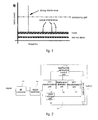
- the typical spectrum of a spread spectrum signal (such as spreading spectrum by PN sequence), is submerged in the noise, as shown in Figure 1.
- a desired signal is the signal energy actually transmitted by the mobile station, and noise is the additive interference. Obviously, the energy of the spread desired signal is usually less than that of the noise.
- “Strong interference” generally refers to block signals or the signals transmitted by TV, wireless stations or communication devices in the vicinity, and “typical interference” refers to the signals transmitted by low power sources, such as amateur radio. Processing gain denotes the level of the interference signal tolerable for the spread spectrum signal of the mobile station.
- the spread spectrum signal can be restored when affected by typical interference, but can not be restored when there exists strong interference. Moreover, there will be a decrease in system performance, though the signal can be restored in the case of typical interference.
- the frequency band is always swept to protect CDMA signal from interference of the narrow-band signal, but some burst signals can not be totally forbidden easily because of their burst characteristic. Therefore, the narrow-band interference shows disorder and randomness.
- CDMA code division multiple access
- the narrow-band interference can result in increase in call drop rate and congestion rate, overload of the RF power control system, increase in the power dissipation of the mobile station, and decrease in the coverage scope of the base station. Under the extreme condition, interference with high power may even block the whole cell, resulting in the failure of a normal communication. Therefore, a good solution method of eliminating the influence of the narrow-band interference signal on CDMA signal should be found to ensure the communication quality.
- the methods for processing narrow-band interference can be divided into two categories:
- One category is to make the signal (usually for analogue process) pass through a narrow-band notch filter or a group of notch filters, which is generally achieved via acoustic surface technology. Frequency of the interference signal is estimated and according to the result of estimation, a narrow-band trap device is placed where the interference signals (phase-locked loop can also be used to trace the interference signal) exists. But the analogue technology itself has limitations and lacks flexibility.
- the other category is methods of elimination in frequency domain, which is generally achieved via digital processing. After digitalized, the signal is Fourier transformed into frequency domain, and after the data is processed in frequency domain, it is inverse Fourier transformed into time domain and output.
- the method for processing the interference signal in frequency domain can be summed up into two classes. One is to apply filter to the data in frequency domain to filter the effect of interference, and it is suitable for cases with known bandwidth and position of the interference. This method has some limitation when it is impossible to determine the interference position in frequency domain, the interference bandwidth and the number of interferences, for it is difficult to design a fully adaptive filter.
- the other one is to calculate the signal amplitude at each frequency, and compare it with the threshold value, set 0 for the signals surpassing the threshold value or decrease them to the noise level. This method can adaptively process several interferences with different interference bandwidths and variable interference frequency.
- this method when processing with this method, it needs to calculate the threshold and make comparison for each data sampling, continuously estimate the spectrum and limit the power spectrum in a certain range.
- the amount of calculation required is relatively large for data in broadband system with high speed, resulting in difficulty in the real-time implementation of hardware.
- this method still Fourier transforms and inversely transforms the data when no narrow-band signal is detected, which is a waste of system resources.
- the way of determining the threshold value in this method is susceptible to the influence of the narrow-band interference, its threshold is not stable enough, which may result in misjudgment.
- the present invention provides a method and an apparatus for eliminating the narrow-band interference in the spread spectrum communication system to reduce the amount of calculation and real-time requirement for the hardware.
- the present invention provides a method for eliminating the narrow-band interference in the spread spectrum communication system, which includes the following steps of:
- the process of eliminating the interference includes the following step of:
- the foregoing method may have the following feature: the extracted N digital signals are stored in said step (a), and before performing said step (b') in the process of eliminating the interference, whether there is identification information of points with accumulated power value greater than said threshold recorded in the previous time period is determined; if there is, step (b') is performed; otherwise, the N points of digital data stored in step (a) obtained by sampling is output as the resultant data every time, ending.
- the foregoing method may have the following feature: in said step (c), when calculating said threshold, the minimum value of said N power accumulated values is picked out and multiplied with a coefficient larger than 1 to get said threshold.
- the foregoing method may have the following feature: in step (c), the minimum values of the power accumulated values are averaged according to said accumulated time span to get the minimum power value; in said step (b'), the data power value corresponding to said points recorded in the previous period of time is reduced to the minimum power value recorded in the previous period of time.
- said threshold is 2.0 to 4.0 times of the minimum of said power accumulated values.
- said foregoing method may have the following feature: said set accumulated time period is 60 ⁇ 120ms.
- the foregoing method may have the following feature: said N is chosen according to the precision requirement for identifying the narrow-band interference, and is at least larger than the value obtained by the system data sampling rate divided by the bandwidth of the narrow-band interference to be identified.
- said spectrum transformation is fast Fourier transformation, cosine transformation or wavelet transformation.
- the present invention also offers an apparatus for eliminating the narrow-band interference in the spread spectrum system, which is characterized in including sequentially connected spectrum transformation unit, interference elimination unit and inverse spectrum transformation unit, and the interference elimination control unit which is connected with said spectrum transformation unit and said interference elimination unit, wherein:
- Said spectrum transformation unit is used to perform spectrum transformation to the externally input N points of digital signals, and output the resultant data of the N points to said interference elimination unit and said interference elimination control unit;
- Said interference elimination control unit is used to respectively calculate the power accumulated values of the N sampling point data after the spectrum transforming during each set accumulated period of time, calculate a threshold value according to said N power accumulated values, and compare the N power accumulated values with said threshold, and record the identification information of points with power accumulated value larger than the threshold;
- Said interference elimination unit is used to adjust, according to the identification information of the points with power accumulated value larger than the threshold recorded in the previous period of time, the power value of spectrum transformation data of the corresponding points in the current period of time to the level below that of the noise, then output it to said inverse spectrum transformation unit;
- Said inverse spectrum transformation unit is used to perform the inverse spectrum transformation for the input data and output the result.
- the foregoing apparatus may have the following feature: it includes a data storage unit and a selection unit which are connected with each other, and said selection unit is connected to said inverse spectrum transformation unit and interference elimination control unit, wherein:
- Said data storage unit is used to store the externally input N points of digital signal and output these data to said selection unit;
- said interference elimination control unit When there exist points with power accumulated value larger than the threshold in current period of time, said interference elimination control unit output the indication signal of existent narrow-band interference to said selection unit, as basis for said selection unit to select output data in next period of time.
- Said selection unit is used to select the data output from inverse spectrum transformation unit if indication signal of existent narrow-band interference is received, otherwise, output data stored in said data storage unit.
- said interference elimination control unit includes:
- N power calculation units for respectively receiving the N complex signals output from said spectrum transformation unit, calculating their power values and outputting respectively to the N accumulation units;
- N accumulation units connected with said N energy calculation units respectively, for accumulating the calculated power value obtained each time respectively in said accumulated period of time to get N power accumulated values
- An accumulative counting control output unit connected with said N accumulation units, for outputting said N accumulated power values and performing zero clearing for said N accumulation units when the current times of accumulations reaches the accumulated counting number corresponding to a certain accumulated period of time;
- a threshold value calculation unit connected with said accumulated counting control output unit, for calculating a threshold value according to said N accumulated power values
- a comparison unit connected with said threshold value calculation unit and said accumulated counting control output unit, for comparing said N accumulated power values with said threshold value, and outputting the identification information of those points with accumulated power values larger than the threshold value;
- a record unit connected with said comparison unit, for storing identification information of the points with accumulated power values larger than the threshold value, and zero clearing the stored information when there is no point with accumulated power value larger than the threshold in the present time segment.
- said threshold value calculation unit further includes:
- a minimum value unit connected with said accumulated counting control output unit, for receiving said N accumulated power values and selecting the minimum one to output;
- a multiplier connected with said minimum value unit, for multiplying the minimum value with a coefficient larger than 1, and outputting the result as said threshold value.
- said interference elimination control unit also includes a time-average unit connected with said minimum value unit and said interference elimination unit, for dividing the minimum value of the accumulated power result with said accumulated period of time to get the minimum power value; said interference elimination unit adjusts the power value to be the minimum power value when adjusting the power value of the spectrum transformed data.
- the foregoing apparatus may have the following feature: the coefficient determined by said multiplier is 2 ⁇ 4.
- the foregoing apparatus may have the following feature: the accumulated counting value determined by said accumulated counting control output unit corresponds to the accumulated period of 60 ⁇ 120ms.
- the present invention uses the power spectrum estimated for a period of time to judge narrow-band interference, record the position where the narrow-band interference appears.
- the process for the real-time data is limited to the data in the position of the narrow-band interference obtained according to the previous period of time, and thus the amount of calculation is dramatically reduced.
- the threshold calculation and comparison calculation are performed every period of time, with no need to process each data segment, which will greatly reduce the real-time requirement for the hardware. Compared with the prior art, satisfying performance can be obtained with largely reduced amount of calculation for real-time of hardware, as long as the length of the accumulated time is properly selected.
- the present invention transforms the signal to the frequency domain, estimates the power spectrum via averaging several periodograms in a period of time, and then uses the obtained power spectrum to calculate the judgment threshold of the narrow-band interference and eliminates the effect of large power value.
- the obtained threshold is very stable and can adaptively prevent the occurrence of misjudgment in every situation.
- the present invention may be further designed to have a selection unit, when there is no narrow-band interference detected, the operation of module with relatively larger amount of calculation, such as IFFT transformation unit, can be shielded, therefore the occupation of the hardware resources can be further reduced.
- the present invention has simple calculation, can obviously reduce narrow-band interference and can use real-time implementation of the hardware to reduce the requirement for the hardware.
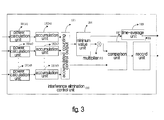
- Figure 2 is a block diagram of the apparatus structure according to the embodiment of the present invention.
- the apparatus of the embodiment includes a RF converter 100, a digital quantizer 110 and an interference elimination device 120.
- signal is received by the RF converter 100, directed to the digital quantizer 110 for sampling and converted into digital signal.
- digital signals ofN points are picked up every time and input to the interference elimination device 120 for FFT.
- the value of N is related with the minimum narrow-band interference bandwidth that can be identified.
- the bandwidth of the spread spectrum signal is 1.2288MHz
- N 256 is applied in the foregoing embodiment.
- interference elimination device 120 includes the following units:
- a data storage unit 130 for storing the digital signal input by the digital quantizer 110 and output to the selection unit 170.
- the interference elimination control unit 180 for calculating the accumulated power values of the N sampling points and comparing them with a threshold related to the minimum value of the accumulated power values, and recording the identification information (such as position information or identification information) of those points with accumulated power values larger than the threshold, and the new minimum value (namely the energy value obtained by time-averaging the minimum values of the accumulated power values), and outputting the indication signal indicating whether there is narrow-band interference.
- the interference elimination control unit 180 further includes:
- N power calculation units 181A 1 ⁇ 181A N which respectively receive N complex signals output by the FFT transformation unit 140, calculating squares of the N complex signal modulus and outputting the results to N accumulation units 182A 1 ⁇ 182A N ;
- N accumulation units 182A 1 ⁇ 182A N for accumulating the power values obtained from each calculation by the N power calculation units in an accumulated period of time.
- the present invention can adaptively varies according to the change in the surroundings.
- the present invention uses the power spectrum estimated for a period of time to judge narrow-band interference.
- the process for the real-time data is limited to the data in the position where the narrow-band interference appears in the previous period of time, and thus the amount of calculation is dramatically reduced.
- the threshold calculation, the minimum value updating and comparison calculation occur once every other period of time, which will greatly reduce the real-time requirement for the hardware.
- An interference elimination unit 150 is used to adjust the power value of the FFT data of the points in the current period of time to the minimum energy value obtained in the previous period of time according to the identification information, output by the record unit 188, of points with accumulated power value larger than the threshold, and output them to the IFFT transformation unit 160, and make no adjustment when there is no identification information output from the record unit 188.
- An IFFT transformation unit 160 is used to perform inverse fast Fourier transformation to the input data and put the results to the selection unit 170.
- a selection unit 170 is used to select data to output, and output directly the data from the data storage unit 130 if the indication that there is no narrow-band interference is received; otherwise, it outputs the data from the IFFT transformation unit 160.
- the selection unit 170 directly output the data stored in the data storage unit 130 without performing the operation of the interference elimination unit 150 and the IFFT transformation unit 160, therefore further reducing hardware operation and saving hardware spending.
- the method for eliminating the narrow-band interference in the spread spectrum system in the embodiment includes the following steps:
- Step 1 in each set period of time, N points of the digital signal obtained by sampling the received data are picked up one time by one time and stored, and fast Fourier transformation (FFT) is performed. N is determined by the minimum identifiable interference bandwidth;
- Step 2 square of modulus of data obtained after FFT of each time, i.e., the power of the data, is calculated, to obtain the periodograms of the data segment.
- the periodograms is an estimation of the power spectrum, and the normal broadband signal in the power spectrum is submerged in the noise, while the power of the narrow-band interference is higher since the power is concentrated in some frequency points;
- the process after step 2 can be divided into two parallel sub-processes, one is to update the identification information of those points with accumulated power values larger than the threshold and the minimum power value, namely the process of the information updating, as the basis of processing the interference elimination for the data in the next previous of time.
- the other one is to eliminate the interference for the data in the present period of time according to the identification information of the points and the minimum energy value, namely, the process of interference elimination.
- the processing flow of the information updating will be introduces firstly in the following:
- Step 3 the power values of the N points data currently calculated are added to their respective calculated power values in the current period of time;
- the span of the accumulated time can not be too short so as to guarantee stable power spectrum obtained in the accumulated time on the one hand; on the other hand, it should not be too long so as to ensure that the narrow-band interference characteristic in this period of time does not change dramatically to make the estimation result of the power spectrum capable of timely reflecting the change in the narrow-band interference in the spread spectrum signal.
- the duration time for the narrow-band interference is in seconds, therefore, the accumulated period of time can be chosen as 60 ⁇ 120ms, which will not cause great influence on the system's reactive capability to the narrow-band interference. In an example of the present invention, about 106.7ms is selected as the accumulated time span.
- the simulation result illustrates the selected span does not influence the system's capability in eliminating the narrow-band interference and can also obtain a relatively stable estimation result of the power spectrum. In other examples, 60ms, 120ms or any value between them can be selected.
- Step 4 whether the accumulation times of the power of each point reaches the set accumulated counting number is determined; if yes, perform step 5, otherwise, return to step 1;
- the accumulated counting number equals to the accumulated time divided by the product of the number N of the points for FFT and the data sampling interval.
- the points for FFT is 256
- the data sampling rate is 2 ⁇ 1.2288MHz
- the accumulated counting number or the accumulated time is determined according to the performance requirement desired by the system. For example, if it is desirable that the system is stable, the accumulated counting number or the accumulated time should be larger, and if it is desirable that the system rapidly react to the external interference, the accumulated counting number or the accumulated time should be smaller.
- Step 5 the minimum value of the power accumulated results ofN points in a period of time is calculated
- the minimum value rather than the average value is calculated, because the current power spectrum is already relatively stable, and no over low value will appear, while the average value will be greatly influenced by the amount of the narrow-band interferences and the change of the strength. Furthermore, it only needs some comparison operation to get the minimum value, and the amount of calculation is relatively small.
- Step 6 the foregoing minimum value is multiplied with a certain times to get a threshold for judgment, and the N accumulated results are compared with the threshold; if there is accumulated results larger than the threshold, perform step 7, otherwise, perform step 8;
- the selected times will influence the final system performance. Based on simulation result, the times is generally in the range of 2.0 ⁇ 4.0.
- Step 7 the identification information of those points with accumulated power values larger than the threshold and the minimum power value obtained during this period of time are recorded for use in the next period of time; meanwhile, the values in other positions are zero cleared.
- Step 8 the values in all position are zero cleared, namely, no identification information of any point is recorded.
- step 2 the process for interference elimination includes the following steps:
- Step 3' whether there are records of identification information of those points with the accumulated power values larger than the threshold in the previous period of time is determined; if yes, perform step 4', otherwise, perform step 5';
- Step 4' for the N data output by each FFT in the current period of time, t the power value of the data corresponding to the points recorded in the previous period of time is adjusted to the minimum energy value obtained in the previous period of time, and IFFT is performed for the adjusted data and the resultant data are output, ending;
- Step 5' in this period of time, the previously stored N point digital signals obtained by sampling is selected every time to output as the result data, ending.
- the present invention has been implemented in the reverse link simulation of cdma_20001x. Through simulation, it can be confirmed that the influence on the system caused by several narrow-band interference in different time points and different positions in frequency bandwidth can be effectively reduced, thus the congestion rate of CDMA and dropping call rate are obviously decreased, the power dissipation of the mobile station is reduced.
- the present invention may have some variations on the basis of the foregoing embodiment.
- the calculation method for the threshold value is not limited to applying the minimum value.
- the power value is obtained by averaging N accumulated power values after removing several maximum power values or several maximum values and minimum values, or by other methods.
- it is not intended to limit to adjustment to the minimum power value but should below the noise level in the embodiment.
- FFT transformation and IFFT transformation are only one kind of spectrum transformation, in another embodiment, cosine transformation, wavelet transformation and other methods of spectrum transformation can be applied.
- the present invention can be applied in the spread spectrum communication system, and the obtained threshold is very stable and can adaptively prevent the occurrence of misjudgment in every situation, and the amount of calculation for the real-time hardware can be greatly reduced while obtaining satisfying performance.
Landscapes
- Engineering & Computer Science (AREA)
- Computer Networks & Wireless Communication (AREA)
- Signal Processing (AREA)
- Mobile Radio Communication Systems (AREA)
- Noise Elimination (AREA)
- Radar Systems Or Details Thereof (AREA)
Applications Claiming Priority (2)
| Application Number | Priority Date | Filing Date | Title |
|---|---|---|---|
| CN200510033912 | 2005-03-29 | ||
| PCT/CN2005/002008 WO2006102811A1 (en) | 2005-03-29 | 2005-11-25 | A method and an apparatus for eliminating the narrow-band interference in the spread spectrum system |
Publications (2)
| Publication Number | Publication Date |
|---|---|
| EP1865639A1 true EP1865639A1 (de) | 2007-12-12 |
| EP1865639A4 EP1865639A4 (de) | 2010-04-07 |
Family
ID=37052946
Family Applications (1)
| Application Number | Title | Priority Date | Filing Date |
|---|---|---|---|
| EP05813777A Withdrawn EP1865639A4 (de) | 2005-03-29 | 2005-11-25 | Verfahren und vorrichtung zum beseitigen der schmalbandigen störungen in dem spreizspektrumsystem |
Country Status (4)
| Country | Link |
|---|---|
| EP (1) | EP1865639A4 (de) |
| NO (1) | NO20075089L (de) |
| RU (1) | RU2365042C2 (de) |
| WO (1) | WO2006102811A1 (de) |
Cited By (4)
| Publication number | Priority date | Publication date | Assignee | Title |
|---|---|---|---|---|
| CN106026973A (zh) * | 2016-05-17 | 2016-10-12 | 中国电子科技集团公司第四十研究所 | 一种对fft数据实施的平均噪声降噪方法 |
| CN108880605A (zh) * | 2018-07-26 | 2018-11-23 | 武汉轻工大学 | 抑制窄波干扰的短波通信方法及系统 |
| CN110504988A (zh) * | 2019-04-22 | 2019-11-26 | 长沙翼盾电子科技有限公司 | 一种时频域相结合的抗窄带干扰方法 |
| CN112019284A (zh) * | 2020-08-27 | 2020-12-01 | 中电科仪器仪表有限公司 | 一种低信噪比下的窄带信号时差计算方法及系统 |
Families Citing this family (4)
| Publication number | Priority date | Publication date | Assignee | Title |
|---|---|---|---|---|
| RU2695542C1 (ru) * | 2018-11-29 | 2019-07-24 | Акционерное общество "Концерн "Созвездие" | Способ защиты от узкополосных и импульсных помех для цифрового приёмника |
| CN111914806B (zh) * | 2020-08-18 | 2023-12-15 | 成都爱科特科技发展有限公司 | 一种高噪声环境下超短波微弱信号检测方法、装置、终端设备及存储介质 |
| CN113595587B (zh) * | 2021-08-16 | 2022-07-08 | 中国电子科技集团公司第五十四研究所 | 一种用于变换域干扰抑制的自适应幅度恢复系统 |
| CN119182418B (zh) * | 2024-11-22 | 2025-03-07 | 北京融为科技有限公司 | 扩频信号中窄带干扰信号的检测方法、装置和设备 |
Family Cites Families (7)
| Publication number | Priority date | Publication date | Assignee | Title |
|---|---|---|---|---|
| US5793795A (en) * | 1996-12-04 | 1998-08-11 | Motorola, Inc. | Method for correcting errors from a jamming signal in a frequency hopped spread spectrum communication system |
| US6130907A (en) * | 1998-01-14 | 2000-10-10 | Lucent Technologies Inc. | Interference detection for spread spectrum systems |
| EP1662672B1 (de) * | 1998-01-22 | 2009-12-02 | BRITISH TELECOMMUNICATIONS public limited company | Empfang von Speizbandsignalen mit Schmalbandstörung |
| US6229998B1 (en) * | 1999-04-12 | 2001-05-08 | Qualcomm Inc. | Method and system for detecting in-band jammers in a spread spectrum wireless base station |
| FI20010952A0 (fi) * | 2001-05-07 | 2001-05-07 | Nokia Corp | Signaalikomponenttien erottaminen radiojärjestelmän vastaanottimessa |
| RU2210860C1 (ru) * | 2002-01-14 | 2003-08-20 | Федеральное Государственное унитарное предприятие Воронежский научно-исследовательский институт связи | Система связи с широкополосными сигналами |
| RU2232464C2 (ru) * | 2002-08-22 | 2004-07-10 | Бобков Михаил Николаевич | Способ подавления узкополосной помехи в системе широкополосной связи |
-
2005
- 2005-11-25 EP EP05813777A patent/EP1865639A4/de not_active Withdrawn
- 2005-11-25 WO PCT/CN2005/002008 patent/WO2006102811A1/zh not_active Ceased
- 2005-11-25 RU RU2007136612/09A patent/RU2365042C2/ru active
-
2007
- 2007-10-09 NO NO20075089A patent/NO20075089L/no not_active Application Discontinuation
Cited By (7)
| Publication number | Priority date | Publication date | Assignee | Title |
|---|---|---|---|---|
| CN106026973A (zh) * | 2016-05-17 | 2016-10-12 | 中国电子科技集团公司第四十研究所 | 一种对fft数据实施的平均噪声降噪方法 |
| CN106026973B (zh) * | 2016-05-17 | 2019-02-05 | 中国电子科技集团公司第四十一研究所 | 一种对fft数据实施的平均噪声降噪方法 |
| CN108880605A (zh) * | 2018-07-26 | 2018-11-23 | 武汉轻工大学 | 抑制窄波干扰的短波通信方法及系统 |
| CN108880605B (zh) * | 2018-07-26 | 2019-12-24 | 武汉轻工大学 | 抑制窄带干扰的短波通信方法及系统 |
| CN110504988A (zh) * | 2019-04-22 | 2019-11-26 | 长沙翼盾电子科技有限公司 | 一种时频域相结合的抗窄带干扰方法 |
| CN112019284A (zh) * | 2020-08-27 | 2020-12-01 | 中电科仪器仪表有限公司 | 一种低信噪比下的窄带信号时差计算方法及系统 |
| CN112019284B (zh) * | 2020-08-27 | 2022-06-17 | 中电科思仪科技股份有限公司 | 一种低信噪比下的窄带信号时差计算方法及系统 |
Also Published As
| Publication number | Publication date |
|---|---|
| WO2006102811A1 (en) | 2006-10-05 |
| RU2007136612A (ru) | 2009-05-10 |
| NO20075089L (no) | 2007-10-25 |
| EP1865639A4 (de) | 2010-04-07 |
| RU2365042C2 (ru) | 2009-08-20 |
Similar Documents
| Publication | Publication Date | Title |
|---|---|---|
| US8059768B2 (en) | Method and device for removing narrow band interference in spreading frequency system | |
| US10270626B2 (en) | Adaptive narrowband interference cancellation method, and apparatus | |
| US7218934B2 (en) | Mobile station speed estimation | |
| US6505053B1 (en) | Method for sinusoidal modeling and prediction of fast fading processes | |
| CN102508269A (zh) | 卫星导航导频信号捕获方法、伪随机序列剥离方法及装置 | |
| US20050267370A1 (en) | Velocity estimation apparatus and method | |
| RU2365042C2 (ru) | Способ и устройство устранения узкополосных радиопомех в широкополосной системе | |
| US8175829B2 (en) | Analyzer for signal anomalies | |
| CN101136654B (zh) | 一种消除通信系统中窄带干扰的方法及装置 | |
| EP1962433B1 (de) | Verfahren und vorrichtung zum beseitigen von schmalbandigen störungen mittels fensterverarbeitung in einem spreizspektrumsystem | |
| CN100375401C (zh) | 扩频系统中窄带干扰消除的方法和装置 | |
| KR100608109B1 (ko) | 이동통신 시스템에서 도플러 주파수 및 단말기의 이동속도 계산 장치 및 방법 | |
| EP2413552B1 (de) | Verfahren und Vorrichtung zur Bestimmung der reibungslosen Fensterlänge bei der Kanalschätzung | |
| US7499473B2 (en) | Method and device for synchronizing a mobile radio receiver | |
| CN100505569C (zh) | 带宽估计的方法和装置 | |
| JP5252430B2 (ja) | 信号検出方法,プログラム,情報記憶媒体,及びセンサー | |
| CN109302360A (zh) | 信道估计方法及装置、计算机可读存储介质、终端 | |
| Yang et al. | Adaptive median threshold algorithm used in FDIS of DSSS receivers | |
| US8311132B2 (en) | Pilot-assisted doppler frequency estimation | |
| CN1682475B (zh) | 移动无线接收器同步方法及装置 | |
| CN120102973A (zh) | 宽带频谱监测中低占空比窄脉冲的实时检测方法及系统 | |
| JP3432288B2 (ja) | 伝搬路推定装置 | |
| US20030153274A1 (en) | Doppler spread estimation | |
| WO2005086370A1 (en) | Method and apparatus for code tracking in code division multipe access (cdma) systems |
Legal Events
| Date | Code | Title | Description |
|---|---|---|---|
| PUAI | Public reference made under article 153(3) epc to a published international application that has entered the european phase |
Free format text: ORIGINAL CODE: 0009012 |
|
| 17P | Request for examination filed |
Effective date: 20070924 |
|
| AK | Designated contracting states |
Kind code of ref document: A1 Designated state(s): AT BE BG CH CY CZ DE DK EE ES FI FR GB GR HU IE IS IT LI LT LU LV MC NL PL PT RO SE SI SK TR |
|
| DAX | Request for extension of the european patent (deleted) | ||
| A4 | Supplementary search report drawn up and despatched |
Effective date: 20100308 |
|
| 17Q | First examination report despatched |
Effective date: 20100507 |
|
| STAA | Information on the status of an ep patent application or granted ep patent |
Free format text: STATUS: THE APPLICATION IS DEEMED TO BE WITHDRAWN |
|
| 18D | Application deemed to be withdrawn |
Effective date: 20151020 |