EP1865748A2 - Verfahren zum Erstellen eines individuellen Hörgeräteprogramms - Google Patents
Verfahren zum Erstellen eines individuellen Hörgeräteprogramms Download PDFInfo
- Publication number
- EP1865748A2 EP1865748A2 EP07108595A EP07108595A EP1865748A2 EP 1865748 A2 EP1865748 A2 EP 1865748A2 EP 07108595 A EP07108595 A EP 07108595A EP 07108595 A EP07108595 A EP 07108595A EP 1865748 A2 EP1865748 A2 EP 1865748A2
- Authority
- EP
- European Patent Office
- Prior art keywords
- recording
- hearing aid
- individual
- microphone
- link
- Prior art date
- Legal status (The legal status is an assumption and is not a legal conclusion. Google has not performed a legal analysis and makes no representation as to the accuracy of the status listed.)
- Granted
Links
Images
Classifications
-
- A—HUMAN NECESSITIES
- A61—MEDICAL OR VETERINARY SCIENCE; HYGIENE
- A61B—DIAGNOSIS; SURGERY; IDENTIFICATION
- A61B5/00—Measuring for diagnostic purposes; Identification of persons
- A61B5/12—Audiometering
- A61B5/121—Audiometering evaluating hearing capacity
-
- H—ELECTRICITY
- H04—ELECTRIC COMMUNICATION TECHNIQUE
- H04R—LOUDSPEAKERS, MICROPHONES, GRAMOPHONE PICK-UPS OR LIKE ACOUSTIC ELECTROMECHANICAL TRANSDUCERS; ELECTRIC HEARING AIDS; PUBLIC ADDRESS SYSTEMS
- H04R25/00—Electric hearing aids
- H04R25/70—Adaptation of deaf aid to hearing loss, e.g. initial electronic fitting
-
- H—ELECTRICITY
- H04—ELECTRIC COMMUNICATION TECHNIQUE
- H04R—LOUDSPEAKERS, MICROPHONES, GRAMOPHONE PICK-UPS OR LIKE ACOUSTIC ELECTROMECHANICAL TRANSDUCERS; ELECTRIC HEARING AIDS; PUBLIC ADDRESS SYSTEMS
- H04R2225/00—Details of deaf aids covered by H04R25/00, not provided for in any of its subgroups
- H04R2225/41—Detection or adaptation of hearing aid parameters or programs to listening situation, e.g. pub, forest
-
- H—ELECTRICITY
- H04—ELECTRIC COMMUNICATION TECHNIQUE
- H04R—LOUDSPEAKERS, MICROPHONES, GRAMOPHONE PICK-UPS OR LIKE ACOUSTIC ELECTROMECHANICAL TRANSDUCERS; ELECTRIC HEARING AIDS; PUBLIC ADDRESS SYSTEMS
- H04R2225/00—Details of deaf aids covered by H04R25/00, not provided for in any of its subgroups
- H04R2225/43—Signal processing in hearing aids to enhance the speech intelligibility
Definitions
- the present invention relates to a method for creating an individual hearing aid program for improving sound and speech intelligibility.
- the object of the present invention is therefore to provide a method with which it is possible to adjust hearing aids so that the speech intelligibility and the sound is improved in media playback.
- this object is achieved by a method for creating an individual hearing aid program by recording acoustic signals at a recording location as the base recording on a data medium, simultaneously recording the acoustic signals with a first microphone as the first recording at the recording location independent of the base recording, playing the data carrier on a individual playback device and / or in an individually predetermined environment, which is different from the recording location, re-recording the signal played by the disk with a second microphone as a second recording, forming a linkage of the first recording and the second recording, setting a hearing aid program in dependence from the link.
- the sound and speech intelligibility in the medial reproduction can thus be individually improved, since individual circumstances are taken into account when setting the hearing device.
- the media production is a film or video recording.
- the recording can then be done live in a studio, whereby at the same time the acoustic signals with the first microphone are recorded live in the studio.
- the data carrier may be a DVD which is played back with an individual television as an individual player.
- other storage media such as CDs, memory, tapes, etc. are used as data carriers for playback on an individual television set.
- the first microphone and the second microphone are / are the same or the same hearing device microphone.
- the exact difference between the acoustic situation in a studio and the individual acoustic situation, for example in a living room, can be determined and taken into account for a hearing aid wearer.
- the first and the second image are each a long-term spectral recording. This makes it easier to assess the acoustic conditions during recording and playback in general.
- a reverb algorithm of the hearing aid program can be parameterized individually depending on the linkage. In this way, when creating an individual hearing aid program, it is possible to specifically address the reverberant characteristics of the environment of a hearing aid wearer.
- the linkage data is input via an interface directly into a hearing aid.
- filters in a hearing aid can be configured very quickly.
- the link between the first and second recording can be a quotient or a difference between the two recordings.
- other reasonable mathematical links may be used to account for the difference between a standard listening situation and an individual hearing situation for hearing aid reproduction.
- the hearing aid program for television should be set individually for a hearing aid wearer.
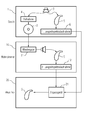
- a recording of a television program on a data carrier, in particular a DVD 2 is first made in a standard acoustic situation in a studio 1.
- the signal source is symbolized here by a loudspeaker 3 which generates the sound for a recording device 4.
- the recorder 4 then supplies the DVD 2.
- the acoustic output signals of the loudspeaker 3 are recorded in the studio 1 via a hearing aid 5.
- the hearing aid 5 is located on a dummy head, in the vicinity of the temple, where it is usually carried by the hearing aid wearer.
- the acoustic ambient conditions correspond approximately to those that would actually find a hearing aid wearer.
- the recorded via the hearing aid 5 recording is averaged statistically. This results in a first long-term spectral recording 6. This reflects the acoustic environment in the studio 1 during recording again.
- the DVD 2 is now played in the living room 10 of a hearing aid wearer.
- the living room 10 stands here for an individual acoustic environment, which in principle can be any other room or a headphone. It is essential that the reproduction takes place via an individual device of the hearing device wearer in his familiar environment with the usual volume. In the specific case, it is the playback device 11 around the individual TV. This is in accordance with the recording on the DVD 2 a corresponding acoustic output signal in the living room 10 again.
- the hearing aid wearer will typically always watch television broadcasts at a particular location in his living room 10. His ear is then at a correspondingly predetermined location. At this point, when playing DVD 2, the sound is recorded again via the same microphone, here the hearing aid microphone.
- a hearing aid can be used by an acoustician, the built-in microphone in a remote control, or directly a hearing aid microphone.
- the recording carried out again with the aid of this microphone or the hearing device 5 reflects the influences of the individual television and the acoustic properties of the television or living room of the hearing device wearer.
- This re-recording takes place, for example, digitally in MP3 format.
- other defined test signals can be played in the living room 10 or the individual environment and resumed via the hearing aid 5 or a corresponding other microphone. From these recordings made in the living room 10, a second long-term spectral recording 12 is created similar to the recordings in the studio 1.
- the two long-term spectral images 6 and 12 are now transmitted to an acoustician 20.
- This transmission can also take place, for example, via a data network, if appropriate online.
- the acoustician subtracts in an adapter 21, the two long-term spectral recordings of each other, once live and once from the television of the hearing aid wearer, in order to gain data on the acoustic situation of the hearing aid wearer in his usual environment. From this data, the frequency response of the hearing aid 5 is individually adjusted in the television-optimized hearing aid program. About that In addition, individual tuning parameters for reverb algorithms can be extracted from the inclusion of special test signals.
- the acoustician enters the data into the software similar to a RECD (Real Ear to Coupler Difference), with which you can adjust the frequency response of the volume of the auditory canal (eg in children) in today's software.
- the data can also be fed in automatically via, for example, a USB connection. If the hearing aid is then individually adapted in this way, the sound and speech intelligibility of the television for the hearing aid wearer improves.
Landscapes
- Health & Medical Sciences (AREA)
- Physics & Mathematics (AREA)
- Engineering & Computer Science (AREA)
- Life Sciences & Earth Sciences (AREA)
- Audiology, Speech & Language Pathology (AREA)
- Otolaryngology (AREA)
- Acoustics & Sound (AREA)
- General Health & Medical Sciences (AREA)
- Medical Informatics (AREA)
- Public Health (AREA)
- Biomedical Technology (AREA)
- Heart & Thoracic Surgery (AREA)
- Biophysics (AREA)
- Molecular Biology (AREA)
- Surgery (AREA)
- Animal Behavior & Ethology (AREA)
- Multimedia (AREA)
- Pathology (AREA)
- Veterinary Medicine (AREA)
- Neurosurgery (AREA)
- Signal Processing (AREA)
- Signal Processing For Digital Recording And Reproducing (AREA)
- Circuit For Audible Band Transducer (AREA)
- Signal Processing Not Specific To The Method Of Recording And Reproducing (AREA)
- Circuits Of Receivers In General (AREA)
- Management Or Editing Of Information On Record Carriers (AREA)
Abstract
Description
- Die vorliegende Erfindung betrifft ein Verfahren zum Erstellen eines individuellen Hörgeräteprogramms zur Verbesserung von Klang und Sprachverständlichkeit.
- Studien belegen, dass für Hörgeräteträger die Sprachverständlichkeit und der Klang beim Fernsehen häufig nicht zufriedenstellend sind. Der Grund hierfür liegt darin, dass die Hörgeräteprogramme in der Regel nur pauschal für die Hörsituation "Fernsehen" entwickelt sind und dabei nicht auf individuelle Hörsituationen eingegangen werden kann. Zum anderen sind die Hörverluste der Hörgeräteträger derart unterschiedlich, dass auch diesbezüglich keine Individualisierung im Hinblick auf die Sprachverständlichkeit von Fernsehsendungen stattfinden kann. Die Hörsituation "Fernsehen" wird aber von den Hörgeräteträgern als sehr wichtig angesehen.
- Derzeit bietet praktisch jeder Hörgerätehersteller ein Hörgerätesignalverarbeitungsprogramm für das Betrachten von Fernsehsendungen an. Diese Hörgeräteprogramme sind in ihrem Frequenzgang pauschal etwas gegenüber anderen Hörgeräteprogrammen geändert. Hieraus ergibt sich aber in vielen Fällen ein unzureichender Klang und eine unzureichende Sprachverständlichkeit.
- Aus der Druckschrift
EP 1 320 282 A2 ist ein Verfahren zum Aufzeichnen von Informationen in einem Hörgerät bekannt. Dieses Verfahren bringt dem Entwickler von Hörgeräten den Vorteil, dass die Wahl der automatischen Betriebseinstellungen in Abhängigkeit von den wirklichen akustischen Umgebungen getestet und kontrolliert werden kann. - Darüber hinaus beschreibt die Druckschrift
DE 199 28 115 A1 ein Verfahren zum Anpassen von Hörgeräteparametern. Dabei werden mittels eines Audio-Aufzeichnungsgeräts unterschiedliche Audio-Informationen in unterschiedlichen Situationen erfasst und zu einem späteren Zeitpunkt zum Anpassen des Hörgeräts verwendet. - Die Aufgabe der vorliegenden Erfindung besteht somit darin, ein Verfahren anzugeben, mit dem es möglich ist, Hörgeräte so einzustellen, dass die Sprachverständlichkeit und der Klang bei Medienwiedergaben verbessert ist.
- Erfindungsgemäß wird diese Aufgabe gelöst durch ein Verfahren zum Erstellen eines individuellen Hörgeräteprogramms durch Aufnehmen von Akustiksignalen an einem Aufnahmeort als Basisaufnahme auf einen Datenträger, gleichzeitiges Aufnehmen der Akustiksignale mit einem ersten Mikrofon als erste Aufnahme an dem Aufnahmeort unabhängig von der Basisaufnahme, Abspielen des Datenträgers auf einem individuellen Wiedergabegerät und/oder in einer individuell vorgegebenen Umgebung, die von dem Aufnahmeort verschieden ist, erneutes Aufnehmen des von dem Datenträger abgespielten Signals mit einem zweiten Mikrofon als zweite Aufnahme, Bilden einer Verknüpfung der ersten Aufnahme und der zweiten Aufnahme, Einstellen eines Hörgeräteprogramms in Abhängigkeit von der Verknüpfung.
- Erfindungsgemäß kann somit der Klang und die Sprachverständlichkeit bei der medialen Wiedergabe individuell verbessert werden, da individuelle Gegebenheiten bei der Einstellung des Hörgeräts berücksichtigt werden.
- Vorzugsweise handelt es sich bei der Medienproduktion um eine Film- oder Videoaufnahme. Die Aufnahme kann dann live in einem Studio erfolgen, wobei auch gleichzeitig die Akustiksignale mit dem ersten Mikrofon live in dem Studio aufgenommen werden.
- Der Datenträger kann eine DVD sein, die mit einem individuellen Fernsehgerät als individuelles Wiedergabegerät abgespielt wird. Selbstverständlich können auch andere Speichermedien wie CDs, Festspeicher, Bänder usw. als Datenträger zur Wiedergabe an einem individuellen Fernsehgerät eingesetzt werden.
- Besonders vorteilhaft ist es, wenn das erste Mikrofon und das zweite Mikrofon dasselbe oder das gleiche Hörgerätemikrofon ist/sind. Damit kann für einen Hörgeräteträger der genaue Unterschied zwischen der akustischen Situation in einem Studio und der individuellen akustischen Situation beispielsweise in einem Wohnzimmer ermittelt und berücksichtigt werden.
- Entsprechend einer Weiterbildung des erfindungsgemäßen Verfahrens ist die erste und die zweite Aufnahme jeweils eine Langzeitspektralaufnahme. Damit lassen sich die akustischen Bedingungen bei Aufnahme und Wiedergabe besser allgemein beurteilen.
- Darüber hinaus kann ein Enthallungs-Algorithmus des Hörgeräteprogramms in Abhängigkeit von der Verknüpfung individuell parametrisiert werden. Auf diese Weise kann bei der Erstellung eines individuellen Hörgeräteprogramms speziell auf die Halleigenschaften der Umgebung eines Hörgeräteträgers eingegangen werden.
- Darüber hinaus kann in vorteilhafter Weise vorgesehen sein, dass die Verknüpfungsdaten über eine Schnittstelle direkt in ein Hörgerät eingegeben werden. Somit lassen sich beispielsweise Filter in einem Hörgerät sehr rasch konfigurieren.
- Bei der Verknüpfung zwischen der ersten und zweiten Aufnahme kann es sich um einen Quotienten oder eine Differenz der beiden Aufnahmen handeln. Es können aber auch andere vernünftige mathematische Verknüpfungen verwendet werden, um den Unterschied zwischen einer Standardhörsituation und einer individuellen Hörsituation für die Hörgerätewiedergabe zu berücksichtigen.
- Die vorliegende Erfindung wird nun anhand der beigefügten Zeichnung näher erläutert, die eine Prinzipskizze eines Ausführungsbeispiels eines erfindungsgemäßen Verfahrens wiedergibt.
- Die nachfolgend näher geschilderten Ausführungsbeispiele stellen bevorzugte Ausführungsformen der vorliegenden Erfindung dar.
- Das Hörgeräteprogramm für Fernsehen soll für einen Hörgeräteträger individuell eingestellt werden. Hierzu wird zunächst in einer akustischen Standardsituation in einem Studio 1 eine Aufnahme eines Fernsehprogramms auf einen Datenträger, insbesondere eine DVD 2 gemacht. Die Signalquelle ist hier durch einen Lautsprecher 3 symbolisiert, der den Schall für ein Aufnahmegerät 4 generiert. Das Aufnahmegerät 4 liefert dann die DVD 2.
- Gleichzeitig werden die akustischen Ausgangssignale des Lautsprechers 3 im Studio 1 über ein Hörgerät 5 mitgeschnitten. Dabei befindet sich das Hörgerät 5 an einem Kunstkopf, und zwar in der Nähe der Schläfe, wo es üblicherweise auch vom Hörgeräteträger getragen wird. Damit entsprechen die akustischen Umgebungsbedingungen in etwa denen, wie sie ein Hörgeräteträger tatsächlich vorfinden würde.
- Der über das Hörgerät 5 aufgenommene Mitschnitt wird statistisch gemittelt. Daraus resultiert eine erste Langzeitspektralaufnahme 6. Diese spiegelt die akustische Umgebung in dem Studio 1 während der Aufnahme wieder.
- Die DVD 2 wird nun im Wohnzimmer 10 eines Hörgeräteträgers abgespielt. Das Wohnzimmer 10 steht hier für eine individuelle akustische Umgebung, die prinzipiell auch jeder andere Raum oder ein Kopfhörer sein kann. Wesentlich ist, dass die Wiedergabe über ein individuelles Gerät des Hörgeräteträgers in seiner vertrauten Umgebung mit der gewohnten Lautstärke erfolgt. Im konkreten Fall handelt es sich bei dem Wiedergabegerät 11 um den individuellen Fernseher. Dieser gibt entsprechend der Aufnahme auf der DVD 2 ein entsprechendes akustisches Ausgangssignal in dem Wohnzimmer 10 wieder.
- Der Hörgeräteträger wird Fernsehsendungen typischerweise immer an einem bestimmten Ort in seinem Wohnzimmer 10 verfolgen. Sein Ohr befindet sich dann an einer entsprechend vorgegebenen Stelle. An dieser Stelle wird bei der Wiedergabe der DVD 2 der Schall über das gleiche Mikrofon, hier das Hörgerätemikrofon erneut aufgenommen. Für diese Zwecke kann eine Hörgeräteleihgabe von einem Akustiker, das eingebaute Mikrofon in einer Fernbedienung oder direkt ein Hörgerätemikrofon verwendet werden.
- Die mit Hilfe dieses Mikrofons beziehungsweise des Hörgeräts 5 erneut durchgeführte Aufnahme spiegelt die Einflüsse des individuellen Fernsehers und die akustischen Eigenschaften des Fernseh- beziehungsweise Wohnzimmers des Hörgeräteträgers wieder. Diese erneute Aufnahme erfolgt beispielsweise digital in dem Format MP3. Neben der Wiedergabe des Films beziehungsweise Videos der DVD 2 können in dem Wohnzimmer 10 beziehungsweise der individuellen Umgebung auch andere definierte Testsignale abgespielt und über das Hörgerät 5 beziehungsweise ein entsprechendes anderes Mikrofon wieder aufgenommen werden. Aus diesen im Wohnzimmer 10 durchgeführten Aufnahmen wird ähnlich wie aus den Aufnahmen in dem Studio 1 eine zweite Langzeitspektralaufnahme 12 erstellt.
- Die beiden Langzeitspektralaufnahmen 6 und 12 werden nun einem Akustiker 20 übermittelt. Diese Übermittlung kann beispielsweise auch über ein Datennetz, gegebenenfalls online erfolgen. Der Akustiker subtrahiert in einem Anpassgerät 21 die beiden Langzeitspektralaufnahmen voneinander, die einmal live und einmal vom Fernseher des Hörgeräteträgers stammen, um auch Daten über die akustische Situation des Hörgeräteträgers in seiner gewohnten Umgebung zu gewinnen. Aus diesen Daten wird der Frequenzgang des Hörgeräts 5 in dem für Fernsehen optimierten Hörgeräteprogramm individuell angepasst. Darüber hinaus können aus der Aufnahme spezieller Testsignale individuelle Einstellparameter für Enthallungs-Algorithmen extrahiert werden.
- Für die Anpassung gibt der Akustiker die Daten ähnlich wie bei einer RECD (Real Ear to Coupler Difference), mit der man bei der heutigen Software den Frequenzgang dem Volumen des Gehörgangs (z. B. bei Kindern) anpassen kann, in die Software ein. Die Daten können aber auch über beispielsweise einen USB-Anschluss automatisch eingespeist werden. Ist dann das Hörgerät auf diese Weise individuell angepasst, so verbessert sich der Klang und die Sprachverständlichkeit beim Fernsehen für den Hörgeräteträger.
Claims (8)
- Verfahren zum Erstellen eines individuellen Hörgeräteprogramms durch- Aufnehmen von Akustiksignalen an einem Aufnahmeort (1) als Basisaufnahme auf einen Datenträger (2),- gleichzeitiges Aufnehmen der Akustiksignale mit einem ersten Mikrofon als erste Aufnahme an dem Aufnahmeort (1) unabhängig von der Basisaufnahme,- Abspielen des Datenträgers (2) auf einem individuellen Wiedergabegerät (11) und/oder in einer individuell vorgegebenen Umgebung (10), die von dem Aufnahmeort (1) verschieden ist,- erneutes Aufnehmen des von dem Datenträger (2) abgespielten Signals mit einem zweiten Mikrofon als zweite Aufnahme,- Bilden einer Verknüpfung der ersten Aufnahme und der zweiten Aufnahme,- Einstellen eines Hörgeräteprogramms in Abhängigkeit von der Verknüpfung.
- Verfahren nach Anspruch 1, wobei die Medienproduktion eine Film- oder Videoaufnahme ist.
- Verfahren nach Anspruch 1 oder 2, wobei der Datenträger (2) eine DVD ist, die mit einem individuellen Fernsehgerät als individuelles Wiedergabegerät (11) wiedergegeben wird.
- Verfahren nach einem der vorhergehenden Ansprüche, wobei das erste Mikrofon und das zweite Mikrofon dasselbe oder das gleiche Hörgerätemikrofon ist.
- Verfahren nach einem der vorhergehenden Ansprüche, wobei die erste und die zweite Aufnahme jeweils eine Langzeitspektralaufnahme (6, 12) ist.
- Verfahren nach einem der vorhergehenden Ansprüche, wobei ein Enthallungs-Algorithmus des Hörgeräteprogramms in Abhängigkeit von der Verknüpfung individuell parametrisiert wird.
- Verfahren nach einem der vorhergehenden Ansprüche, wobei die Verknüpfungsdaten über eine Schnittstelle direkt in ein Hörgerät (5) eingegeben werden.
- Verfahren nach einem der vorhergehenden Ansprüche, wobei die Verknüpfung ein Quotient oder eine Differenz ist.
Applications Claiming Priority (1)
| Application Number | Priority Date | Filing Date | Title |
|---|---|---|---|
| DE102006026489A DE102006026489B4 (de) | 2006-06-07 | 2006-06-07 | Verfahren zum Erstellen eines individuellen Hörgeräteprogramms |
Publications (3)
| Publication Number | Publication Date |
|---|---|
| EP1865748A2 true EP1865748A2 (de) | 2007-12-12 |
| EP1865748A3 EP1865748A3 (de) | 2008-06-18 |
| EP1865748B1 EP1865748B1 (de) | 2009-08-19 |
Family
ID=38521442
Family Applications (1)
| Application Number | Title | Priority Date | Filing Date |
|---|---|---|---|
| EP07108595A Not-in-force EP1865748B1 (de) | 2006-06-07 | 2007-05-22 | Verfahren zum Erstellen eines individuellen Hörgeräteprogramms |
Country Status (5)
| Country | Link |
|---|---|
| US (1) | US8144904B2 (de) |
| EP (1) | EP1865748B1 (de) |
| AT (1) | ATE440458T1 (de) |
| DE (2) | DE102006026489B4 (de) |
| DK (1) | DK1865748T3 (de) |
Families Citing this family (4)
| Publication number | Priority date | Publication date | Assignee | Title |
|---|---|---|---|---|
| US20090097669A1 (en) * | 2007-10-11 | 2009-04-16 | Fujitsu Ten Limited | Acoustic system for providing individual acoustic environment |
| US9814879B2 (en) | 2013-05-13 | 2017-11-14 | Cochlear Limited | Method and system for use of hearing prosthesis for linguistic evaluation |
| US9685926B2 (en) | 2014-12-10 | 2017-06-20 | Ebay Inc. | Intelligent audio output devices |
| WO2020115553A2 (en) * | 2018-12-07 | 2020-06-11 | Cochlear Limited | Speech discrimination test system and device |
Family Cites Families (7)
| Publication number | Priority date | Publication date | Assignee | Title |
|---|---|---|---|---|
| DE4227826C2 (de) * | 1991-08-23 | 1999-07-22 | Hitachi Ltd | Digitales Verarbeitungsgerät für akustische Signale |
| EP0772374B1 (de) * | 1995-11-02 | 2008-10-08 | Bang & Olufsen A/S | Verfahren und Vorrichtung zur Leistungsregelung eines Lautsprechers in einem Raum |
| DE19928115A1 (de) * | 1999-06-19 | 2000-12-21 | Audio Service Gmbh As | Verfahren und Vorrichtung zum Anpassen von Hörgeräte-Parametern |
| US7110951B1 (en) * | 2000-03-03 | 2006-09-19 | Dorothy Lemelson, legal representative | System and method for enhancing speech intelligibility for the hearing impaired |
| US7349549B2 (en) * | 2003-03-25 | 2008-03-25 | Phonak Ag | Method to log data in a hearing device as well as a hearing device |
| EP1320282A3 (de) * | 2003-03-25 | 2004-01-07 | Phonak Ag | Verfahren zum Aufzeichnen von Informationen in einem Hörgerät sowie ein Hörgerät |
| WO2005125280A2 (en) * | 2004-06-14 | 2005-12-29 | Johnson & Johnson Consumer Companies, Inc. | Hearing aid demonstration unit and method of using |
-
2006
- 2006-06-07 DE DE102006026489A patent/DE102006026489B4/de not_active Expired - Fee Related
-
2007
- 2007-05-22 EP EP07108595A patent/EP1865748B1/de not_active Not-in-force
- 2007-05-22 DE DE502007001328T patent/DE502007001328D1/de active Active
- 2007-05-22 DK DK07108595T patent/DK1865748T3/da active
- 2007-05-22 AT AT07108595T patent/ATE440458T1/de active
- 2007-06-07 US US11/810,977 patent/US8144904B2/en not_active Expired - Fee Related
Also Published As
| Publication number | Publication date |
|---|---|
| DE102006026489A1 (de) | 2007-12-13 |
| US8144904B2 (en) | 2012-03-27 |
| ATE440458T1 (de) | 2009-09-15 |
| EP1865748B1 (de) | 2009-08-19 |
| DK1865748T3 (da) | 2009-12-14 |
| DE502007001328D1 (de) | 2009-10-01 |
| US20070299654A1 (en) | 2007-12-27 |
| DE102006026489B4 (de) | 2010-07-22 |
| EP1865748A3 (de) | 2008-06-18 |
Similar Documents
| Publication | Publication Date | Title |
|---|---|---|
| DE3752052T2 (de) | Stereoeffektverbesserungssystem | |
| DE69633124T2 (de) | Stereoeffektverbesserungssystem | |
| EP3149969B1 (de) | Ermittlung und nutzung hörraumoptimierter übertragungsfunktionen | |
| DE4227826C2 (de) | Digitales Verarbeitungsgerät für akustische Signale | |
| DE3687836T2 (de) | Mehrkanalstereowiedergabeapparat. | |
| DE112016004218T5 (de) | Verfahren zum stereophonischen Aufnehmen und binaurale Ohrhörereinheit | |
| EP1865748B1 (de) | Verfahren zum Erstellen eines individuellen Hörgeräteprogramms | |
| EP1367856A2 (de) | Vorrichtung und Verfahren zur Feedbackreduktion bei Hörsystemen | |
| DE112019002337T5 (de) | Architektur für Dynamikbearbeitungseffekte | |
| DE112009005147T5 (de) | System und Verfahren zum Modifizieren eines Audiosignals | |
| Krebs | The failure of binaural stereo: German sound engineers and the introduction of artificial head microphones | |
| DE102011003450A1 (de) | Erzeugung von benutzerangepassten Signalverarbeitungsparametern | |
| DE9421236U1 (de) | Vorrichtung zur Wiedergabe von Schallsignalen sowie Steuergerät und Schallwiedergabeeinheit | |
| EP1416764B1 (de) | Verfahren zur Einstellung eines Hörgerätes sowie Vorrichtung zur Durchführung des Verfahrens | |
| DE10059538A1 (de) | Audiowiedergabegerät | |
| EP0025509B1 (de) | Stereophones Übertragungsverfahren und Mittel zur Durchführung des Verfahrens | |
| DE10220274B4 (de) | Verfahren und Vorrichtung zur Archivierung analoger Audiodaten | |
| DE102008002689A1 (de) | Vorrichtung und Verfahren zur Anpassung des Widergabespektrums zweier Audioquellen | |
| DE102007011436A1 (de) | Vorrichtung und Verfahren zum Formen eines digitalen Audiosignals | |
| Newell et al. | Cinema sound and the loudness issue: its origins and implications | |
| DE19628261A1 (de) | Verfahren und Vorrichtung zum elektronischen Einbetten von Richtungseinsätzen bei Zweikanal-Ton | |
| Baumgartner et al. | Speech Intelligibility in TV | |
| Weibush | Production Audio for Non-Fiction Video: A Beginner's Field Guide | |
| DE112022000838T5 (de) | Informationsverarbeitungsvorrichtung, informationsverarbeitungsverfahren und programm | |
| DE202007018141U1 (de) | Aufbau eines Tonwiedergabegeräts zur Dämmung von Außengeräuschen |
Legal Events
| Date | Code | Title | Description |
|---|---|---|---|
| PUAI | Public reference made under article 153(3) epc to a published international application that has entered the european phase |
Free format text: ORIGINAL CODE: 0009012 |
|
| AK | Designated contracting states |
Kind code of ref document: A2 Designated state(s): AT BE BG CH CY CZ DE DK EE ES FI FR GB GR HU IE IS IT LI LT LU LV MC MT NL PL PT RO SE SI SK TR |
|
| AX | Request for extension of the european patent |
Extension state: AL BA HR MK YU |
|
| PUAL | Search report despatched |
Free format text: ORIGINAL CODE: 0009013 |
|
| AK | Designated contracting states |
Kind code of ref document: A3 Designated state(s): AT BE BG CH CY CZ DE DK EE ES FI FR GB GR HU IE IS IT LI LT LU LV MC MT NL PL PT RO SE SI SK TR |
|
| AX | Request for extension of the european patent |
Extension state: AL BA HR MK RS |
|
| 17P | Request for examination filed |
Effective date: 20080710 |
|
| AKX | Designation fees paid |
Designated state(s): AT BE BG CH CY CZ DE DK EE ES FI FR GB GR HU IE IS IT LI LT LU LV MC MT NL PL PT RO SE SI SK TR |
|
| GRAP | Despatch of communication of intention to grant a patent |
Free format text: ORIGINAL CODE: EPIDOSNIGR1 |
|
| GRAS | Grant fee paid |
Free format text: ORIGINAL CODE: EPIDOSNIGR3 |
|
| GRAA | (expected) grant |
Free format text: ORIGINAL CODE: 0009210 |
|
| AK | Designated contracting states |
Kind code of ref document: B1 Designated state(s): AT BE BG CH CY CZ DE DK EE ES FI FR GB GR HU IE IS IT LI LT LU LV MC MT NL PL PT RO SE SI SK TR |
|
| REG | Reference to a national code |
Ref country code: GB Ref legal event code: FG4D Free format text: NOT ENGLISH |
|
| REG | Reference to a national code |
Ref country code: CH Ref legal event code: NV Representative=s name: SIEMENS SCHWEIZ AG Ref country code: CH Ref legal event code: EP |
|
| REG | Reference to a national code |
Ref country code: IE Ref legal event code: FG4D |
|
| REF | Corresponds to: |
Ref document number: 502007001328 Country of ref document: DE Date of ref document: 20091001 Kind code of ref document: P |
|
| REG | Reference to a national code |
Ref country code: DK Ref legal event code: T3 |
|
| LTIE | Lt: invalidation of european patent or patent extension |
Effective date: 20090819 |
|
| PG25 | Lapsed in a contracting state [announced via postgrant information from national office to epo] |
Ref country code: ES Free format text: LAPSE BECAUSE OF FAILURE TO SUBMIT A TRANSLATION OF THE DESCRIPTION OR TO PAY THE FEE WITHIN THE PRESCRIBED TIME-LIMIT Effective date: 20091130 Ref country code: FI Free format text: LAPSE BECAUSE OF FAILURE TO SUBMIT A TRANSLATION OF THE DESCRIPTION OR TO PAY THE FEE WITHIN THE PRESCRIBED TIME-LIMIT Effective date: 20090819 Ref country code: SE Free format text: LAPSE BECAUSE OF FAILURE TO SUBMIT A TRANSLATION OF THE DESCRIPTION OR TO PAY THE FEE WITHIN THE PRESCRIBED TIME-LIMIT Effective date: 20090819 Ref country code: LT Free format text: LAPSE BECAUSE OF FAILURE TO SUBMIT A TRANSLATION OF THE DESCRIPTION OR TO PAY THE FEE WITHIN THE PRESCRIBED TIME-LIMIT Effective date: 20090819 Ref country code: IS Free format text: LAPSE BECAUSE OF FAILURE TO SUBMIT A TRANSLATION OF THE DESCRIPTION OR TO PAY THE FEE WITHIN THE PRESCRIBED TIME-LIMIT Effective date: 20091219 |
|
| NLV1 | Nl: lapsed or annulled due to failure to fulfill the requirements of art. 29p and 29m of the patents act | ||
| PG25 | Lapsed in a contracting state [announced via postgrant information from national office to epo] |
Ref country code: NL Free format text: LAPSE BECAUSE OF FAILURE TO SUBMIT A TRANSLATION OF THE DESCRIPTION OR TO PAY THE FEE WITHIN THE PRESCRIBED TIME-LIMIT Effective date: 20090819 Ref country code: LV Free format text: LAPSE BECAUSE OF FAILURE TO SUBMIT A TRANSLATION OF THE DESCRIPTION OR TO PAY THE FEE WITHIN THE PRESCRIBED TIME-LIMIT Effective date: 20090819 Ref country code: PL Free format text: LAPSE BECAUSE OF FAILURE TO SUBMIT A TRANSLATION OF THE DESCRIPTION OR TO PAY THE FEE WITHIN THE PRESCRIBED TIME-LIMIT Effective date: 20090819 Ref country code: SI Free format text: LAPSE BECAUSE OF FAILURE TO SUBMIT A TRANSLATION OF THE DESCRIPTION OR TO PAY THE FEE WITHIN THE PRESCRIBED TIME-LIMIT Effective date: 20090819 |
|
| REG | Reference to a national code |
Ref country code: IE Ref legal event code: FD4D |
|
| PG25 | Lapsed in a contracting state [announced via postgrant information from national office to epo] |
Ref country code: BG Free format text: LAPSE BECAUSE OF FAILURE TO SUBMIT A TRANSLATION OF THE DESCRIPTION OR TO PAY THE FEE WITHIN THE PRESCRIBED TIME-LIMIT Effective date: 20091119 Ref country code: PT Free format text: LAPSE BECAUSE OF FAILURE TO SUBMIT A TRANSLATION OF THE DESCRIPTION OR TO PAY THE FEE WITHIN THE PRESCRIBED TIME-LIMIT Effective date: 20091221 Ref country code: CY Free format text: LAPSE BECAUSE OF FAILURE TO SUBMIT A TRANSLATION OF THE DESCRIPTION OR TO PAY THE FEE WITHIN THE PRESCRIBED TIME-LIMIT Effective date: 20090819 |
|
| PG25 | Lapsed in a contracting state [announced via postgrant information from national office to epo] |
Ref country code: EE Free format text: LAPSE BECAUSE OF FAILURE TO SUBMIT A TRANSLATION OF THE DESCRIPTION OR TO PAY THE FEE WITHIN THE PRESCRIBED TIME-LIMIT Effective date: 20090819 Ref country code: CZ Free format text: LAPSE BECAUSE OF FAILURE TO SUBMIT A TRANSLATION OF THE DESCRIPTION OR TO PAY THE FEE WITHIN THE PRESCRIBED TIME-LIMIT Effective date: 20090819 Ref country code: IE Free format text: LAPSE BECAUSE OF FAILURE TO SUBMIT A TRANSLATION OF THE DESCRIPTION OR TO PAY THE FEE WITHIN THE PRESCRIBED TIME-LIMIT Effective date: 20090819 Ref country code: RO Free format text: LAPSE BECAUSE OF FAILURE TO SUBMIT A TRANSLATION OF THE DESCRIPTION OR TO PAY THE FEE WITHIN THE PRESCRIBED TIME-LIMIT Effective date: 20090819 |
|
| PG25 | Lapsed in a contracting state [announced via postgrant information from national office to epo] |
Ref country code: SK Free format text: LAPSE BECAUSE OF FAILURE TO SUBMIT A TRANSLATION OF THE DESCRIPTION OR TO PAY THE FEE WITHIN THE PRESCRIBED TIME-LIMIT Effective date: 20090819 |
|
| PLBE | No opposition filed within time limit |
Free format text: ORIGINAL CODE: 0009261 |
|
| STAA | Information on the status of an ep patent application or granted ep patent |
Free format text: STATUS: NO OPPOSITION FILED WITHIN TIME LIMIT |
|
| 26N | No opposition filed |
Effective date: 20100520 |
|
| PG25 | Lapsed in a contracting state [announced via postgrant information from national office to epo] |
Ref country code: GR Free format text: LAPSE BECAUSE OF FAILURE TO SUBMIT A TRANSLATION OF THE DESCRIPTION OR TO PAY THE FEE WITHIN THE PRESCRIBED TIME-LIMIT Effective date: 20091120 |
|
| BERE | Be: lapsed |
Owner name: SIEMENS AUDIOLOGISCHE TECHNIK G.M.B.H. Effective date: 20100531 |
|
| PG25 | Lapsed in a contracting state [announced via postgrant information from national office to epo] |
Ref country code: MC Free format text: LAPSE BECAUSE OF NON-PAYMENT OF DUE FEES Effective date: 20100531 |
|
| PG25 | Lapsed in a contracting state [announced via postgrant information from national office to epo] |
Ref country code: BE Free format text: LAPSE BECAUSE OF NON-PAYMENT OF DUE FEES Effective date: 20100531 Ref country code: IT Free format text: LAPSE BECAUSE OF FAILURE TO SUBMIT A TRANSLATION OF THE DESCRIPTION OR TO PAY THE FEE WITHIN THE PRESCRIBED TIME-LIMIT Effective date: 20090819 |
|
| PG25 | Lapsed in a contracting state [announced via postgrant information from national office to epo] |
Ref country code: MT Free format text: LAPSE BECAUSE OF FAILURE TO SUBMIT A TRANSLATION OF THE DESCRIPTION OR TO PAY THE FEE WITHIN THE PRESCRIBED TIME-LIMIT Effective date: 20090819 |
|
| PG25 | Lapsed in a contracting state [announced via postgrant information from national office to epo] |
Ref country code: LU Free format text: LAPSE BECAUSE OF NON-PAYMENT OF DUE FEES Effective date: 20100522 Ref country code: HU Free format text: LAPSE BECAUSE OF FAILURE TO SUBMIT A TRANSLATION OF THE DESCRIPTION OR TO PAY THE FEE WITHIN THE PRESCRIBED TIME-LIMIT Effective date: 20100220 |
|
| PG25 | Lapsed in a contracting state [announced via postgrant information from national office to epo] |
Ref country code: TR Free format text: LAPSE BECAUSE OF FAILURE TO SUBMIT A TRANSLATION OF THE DESCRIPTION OR TO PAY THE FEE WITHIN THE PRESCRIBED TIME-LIMIT Effective date: 20090819 |
|
| REG | Reference to a national code |
Ref country code: AT Ref legal event code: MM01 Ref document number: 440458 Country of ref document: AT Kind code of ref document: T Effective date: 20120522 |
|
| PG25 | Lapsed in a contracting state [announced via postgrant information from national office to epo] |
Ref country code: AT Free format text: LAPSE BECAUSE OF NON-PAYMENT OF DUE FEES Effective date: 20120522 |
|
| REG | Reference to a national code |
Ref country code: DE Ref legal event code: R082 Ref document number: 502007001328 Country of ref document: DE Representative=s name: FDST PATENTANWAELTE FREIER DOERR STAMMLER TSCH, DE Ref country code: DE Ref legal event code: R081 Ref document number: 502007001328 Country of ref document: DE Owner name: SIVANTOS GMBH, DE Free format text: FORMER OWNER: SIEMENS AUDIOLOGISCHE TECHNIK GMBH, 91058 ERLANGEN, DE |
|
| REG | Reference to a national code |
Ref country code: FR Ref legal event code: PLFP Year of fee payment: 10 |
|
| REG | Reference to a national code |
Ref country code: FR Ref legal event code: PLFP Year of fee payment: 11 |
|
| REG | Reference to a national code |
Ref country code: FR Ref legal event code: PLFP Year of fee payment: 12 |
|
| PGFP | Annual fee paid to national office [announced via postgrant information from national office to epo] |
Ref country code: DK Payment date: 20200519 Year of fee payment: 14 Ref country code: CH Payment date: 20200522 Year of fee payment: 14 Ref country code: DE Payment date: 20200525 Year of fee payment: 14 Ref country code: FR Payment date: 20200519 Year of fee payment: 14 |
|
| PGFP | Annual fee paid to national office [announced via postgrant information from national office to epo] |
Ref country code: GB Payment date: 20200522 Year of fee payment: 14 |
|
| REG | Reference to a national code |
Ref country code: DE Ref legal event code: R119 Ref document number: 502007001328 Country of ref document: DE |
|
| REG | Reference to a national code |
Ref country code: DK Ref legal event code: EBP Effective date: 20210531 |
|
| REG | Reference to a national code |
Ref country code: CH Ref legal event code: PL |
|
| GBPC | Gb: european patent ceased through non-payment of renewal fee |
Effective date: 20210522 |
|
| PG25 | Lapsed in a contracting state [announced via postgrant information from national office to epo] |
Ref country code: CH Free format text: LAPSE BECAUSE OF NON-PAYMENT OF DUE FEES Effective date: 20210531 Ref country code: LI Free format text: LAPSE BECAUSE OF NON-PAYMENT OF DUE FEES Effective date: 20210531 |
|
| PG25 | Lapsed in a contracting state [announced via postgrant information from national office to epo] |
Ref country code: GB Free format text: LAPSE BECAUSE OF NON-PAYMENT OF DUE FEES Effective date: 20210522 Ref country code: DK Free format text: LAPSE BECAUSE OF NON-PAYMENT OF DUE FEES Effective date: 20210531 Ref country code: DE Free format text: LAPSE BECAUSE OF NON-PAYMENT OF DUE FEES Effective date: 20211201 |
|
| PG25 | Lapsed in a contracting state [announced via postgrant information from national office to epo] |
Ref country code: FR Free format text: LAPSE BECAUSE OF NON-PAYMENT OF DUE FEES Effective date: 20210531 |