EP1866960B1 - Strahlungshärtbare cycloaliphatische sperrdichtstoffe - Google Patents
Strahlungshärtbare cycloaliphatische sperrdichtstoffe Download PDFInfo
- Publication number
- EP1866960B1 EP1866960B1 EP06749107A EP06749107A EP1866960B1 EP 1866960 B1 EP1866960 B1 EP 1866960B1 EP 06749107 A EP06749107 A EP 06749107A EP 06749107 A EP06749107 A EP 06749107A EP 1866960 B1 EP1866960 B1 EP 1866960B1
- Authority
- EP
- European Patent Office
- Prior art keywords
- cycloaliphatic
- curable
- resin
- optoelectronic device
- radiation
- Prior art date
- Legal status (The legal status is an assumption and is not a legal conclusion. Google has not performed a legal analysis and makes no representation as to the accuracy of the status listed.)
- Ceased
Links
- 0 C1CC=*CC1 Chemical compound C1CC=*CC1 0.000 description 9
- ZZWZMGZBBUUIGC-JKNRPWOOSA-N C=CC(OC1(C2)C2(C2)C2C2C1C[C@@H]1OC21)=O Chemical compound C=CC(OC1(C2)C2(C2)C2C2C1C[C@@H]1OC21)=O ZZWZMGZBBUUIGC-JKNRPWOOSA-N 0.000 description 1
- HZDIXQIWKNQYDI-UHFFFAOYSA-N C=COCC(C(COC=C)C(C1(Cl)Cl)(C(Cl)=C2Cl)Cl)C12Cl Chemical compound C=COCC(C(COC=C)C(C1(Cl)Cl)(C(Cl)=C2Cl)Cl)C12Cl HZDIXQIWKNQYDI-UHFFFAOYSA-N 0.000 description 1
Images

Classifications
-
- C—CHEMISTRY; METALLURGY
- C08—ORGANIC MACROMOLECULAR COMPOUNDS; THEIR PREPARATION OR CHEMICAL WORKING-UP; COMPOSITIONS BASED THEREON
- C08G—MACROMOLECULAR COMPOUNDS OBTAINED OTHERWISE THAN BY REACTIONS ONLY INVOLVING UNSATURATED CARBON-TO-CARBON BONDS
- C08G59/00—Polycondensates containing more than one epoxy group per molecule; Macromolecules obtained by polymerising compounds containing more than one epoxy group per molecule using curing agents or catalysts which react with the epoxy groups
- C08G59/18—Macromolecules obtained by polymerising compounds containing more than one epoxy group per molecule using curing agents or catalysts which react with the epoxy groups ; e.g. general methods of curing
- C08G59/20—Macromolecules obtained by polymerising compounds containing more than one epoxy group per molecule using curing agents or catalysts which react with the epoxy groups ; e.g. general methods of curing characterised by the epoxy compounds used
- C08G59/22—Di-epoxy compounds
- C08G59/24—Di-epoxy compounds carbocyclic
-
- H—ELECTRICITY
- H10—SEMICONDUCTOR DEVICES; ELECTRIC SOLID-STATE DEVICES NOT OTHERWISE PROVIDED FOR
- H10W—GENERIC PACKAGES, INTERCONNECTIONS, CONNECTORS OR OTHER CONSTRUCTIONAL DETAILS OF DEVICES COVERED BY CLASS H10
- H10W74/00—Encapsulations, e.g. protective coatings
- H10W74/40—Encapsulations, e.g. protective coatings characterised by their materials
-
- C—CHEMISTRY; METALLURGY
- C08—ORGANIC MACROMOLECULAR COMPOUNDS; THEIR PREPARATION OR CHEMICAL WORKING-UP; COMPOSITIONS BASED THEREON
- C08G—MACROMOLECULAR COMPOUNDS OBTAINED OTHERWISE THAN BY REACTIONS ONLY INVOLVING UNSATURATED CARBON-TO-CARBON BONDS
- C08G59/00—Polycondensates containing more than one epoxy group per molecule; Macromolecules obtained by polymerising compounds containing more than one epoxy group per molecule using curing agents or catalysts which react with the epoxy groups
- C08G59/18—Macromolecules obtained by polymerising compounds containing more than one epoxy group per molecule using curing agents or catalysts which react with the epoxy groups ; e.g. general methods of curing
- C08G59/40—Macromolecules obtained by polymerising compounds containing more than one epoxy group per molecule using curing agents or catalysts which react with the epoxy groups ; e.g. general methods of curing characterised by the curing agents used
- C08G59/4007—Curing agents not provided for by the groups C08G59/42 - C08G59/66
-
- C—CHEMISTRY; METALLURGY
- C08—ORGANIC MACROMOLECULAR COMPOUNDS; THEIR PREPARATION OR CHEMICAL WORKING-UP; COMPOSITIONS BASED THEREON
- C08G—MACROMOLECULAR COMPOUNDS OBTAINED OTHERWISE THAN BY REACTIONS ONLY INVOLVING UNSATURATED CARBON-TO-CARBON BONDS
- C08G75/00—Macromolecular compounds obtained by reactions forming a linkage containing sulfur with or without nitrogen, oxygen, or carbon in the main chain of the macromolecule
- C08G75/02—Polythioethers
- C08G75/04—Polythioethers from mercapto compounds or metallic derivatives thereof
- C08G75/045—Polythioethers from mercapto compounds or metallic derivatives thereof from mercapto compounds and unsaturated compounds
-
- C—CHEMISTRY; METALLURGY
- C08—ORGANIC MACROMOLECULAR COMPOUNDS; THEIR PREPARATION OR CHEMICAL WORKING-UP; COMPOSITIONS BASED THEREON
- C08G—MACROMOLECULAR COMPOUNDS OBTAINED OTHERWISE THAN BY REACTIONS ONLY INVOLVING UNSATURATED CARBON-TO-CARBON BONDS
- C08G75/00—Macromolecular compounds obtained by reactions forming a linkage containing sulfur with or without nitrogen, oxygen, or carbon in the main chain of the macromolecule
- C08G75/12—Polythioether-ethers
-
- H—ELECTRICITY
- H10—SEMICONDUCTOR DEVICES; ELECTRIC SOLID-STATE DEVICES NOT OTHERWISE PROVIDED FOR
- H10W—GENERIC PACKAGES, INTERCONNECTIONS, CONNECTORS OR OTHER CONSTRUCTIONAL DETAILS OF DEVICES COVERED BY CLASS H10
- H10W74/00—Encapsulations, e.g. protective coatings
-
- H—ELECTRICITY
- H10—SEMICONDUCTOR DEVICES; ELECTRIC SOLID-STATE DEVICES NOT OTHERWISE PROVIDED FOR
- H10W—GENERIC PACKAGES, INTERCONNECTIONS, CONNECTORS OR OTHER CONSTRUCTIONAL DETAILS OF DEVICES COVERED BY CLASS H10
- H10W76/00—Containers; Fillings or auxiliary members therefor; Seals
- H10W76/10—Containers or parts thereof
-
- H—ELECTRICITY
- H10—SEMICONDUCTOR DEVICES; ELECTRIC SOLID-STATE DEVICES NOT OTHERWISE PROVIDED FOR
- H10W—GENERIC PACKAGES, INTERCONNECTIONS, CONNECTORS OR OTHER CONSTRUCTIONAL DETAILS OF DEVICES COVERED BY CLASS H10
- H10W99/00—Subject matter not provided for in other groups of this subclass
-
- H—ELECTRICITY
- H10—SEMICONDUCTOR DEVICES; ELECTRIC SOLID-STATE DEVICES NOT OTHERWISE PROVIDED FOR
- H10K—ORGANIC ELECTRIC SOLID-STATE DEVICES
- H10K50/00—Organic light-emitting devices
- H10K50/80—Constructional details
- H10K50/84—Passivation; Containers; Encapsulations
- H10K50/842—Containers
- H10K50/8426—Peripheral sealing arrangements, e.g. adhesives, sealants
-
- H—ELECTRICITY
- H10—SEMICONDUCTOR DEVICES; ELECTRIC SOLID-STATE DEVICES NOT OTHERWISE PROVIDED FOR
- H10W—GENERIC PACKAGES, INTERCONNECTIONS, CONNECTORS OR OTHER CONSTRUCTIONAL DETAILS OF DEVICES COVERED BY CLASS H10
- H10W76/00—Containers; Fillings or auxiliary members therefor; Seals
- H10W76/60—Seals
Definitions
- This invention relates to barrier adhesives, sealants, encapsulants, and coatings for use in electronic and opto-electronic devices.
- adhesives, sealants, encapsulants and coatings are similar materials, all having adhesive, sealant, encapsulants and coating properties and functions. When any one is recited, the others are deemed to be included.
- Radiation curable materials have found increased use as coatings, adhesives, and sealants over the past three decades for reasons including low energy consumption during cure, rapid cure speed through both radical and cationic mechanisms, low curing temperature, wide availability of curable materials, and the availability of solvent-free products. These benefits have made such products especially suited for rapidly adhering and sealing electronic and optoelectronic devices that are temperature sensitive or cannot conveniently withstand prolonged curing times. Optoelectronic devices particularly are often thermally sensitive and may need to be optically aligned and spatially immobilized through curing in a very short time period.
- a common approach is to seal the device between an impermeable substrate on which it is positioned and an impermeable glass or metal lid, and seal or adhere the perimeter of the lid to the bottom substrate using a radiation curable adhesive or sealant.
- FIG. 1 A common manifestation of this package geometry is exemplified in Figure 1 , which discloses the use of a radiation curable perimeter sealant (1) to bond a metal or glass lid (2) over an organic light emitting diode (OLED) stack (3) fabricated on a glass substrate (4).
- OLED organic light emitting diode
- a typical device also contains an anode (5), a cathode (6), and some form of electrical interconnect between the OLED pixel/device and external circuitry (7).
- no particular device geometry is specified or required aside from one which incorporates an adhesive/sealant material such as a perimeter sealant (1).
- both the glass substrate and the metal/glass lid are essentially impermeable to oxygen and moisture, and the sealant is the only material that surrounds the device with any appreciable permeability.
- moisture permeability is very often more critical than oxygen permeability; consequently, the oxygen barrier requirements are much less stringent, and it is the moisture barrier properties of the perimeter sealant that are critical to successful performance of the device.
- Good barrier sealants will exhibit low bulk moisture permeability, good adhesion, and strong Interfacial adhesive/substrate Interactions. If the quality of the substrate to sealant interface is poor, the interface may function as a weak boundary, which allows rapid moisture Ingress into the device regardless of the bulk moisture permeability of the sealant If the interface is at least as continuous as the bulk sealant, then the permeation of moisture typically will be dominated by the bulk moisture permeability of the sealant itself.
- moisture permeability P
- WVTR water vapor transmission rate
- permeability coefficient e.g. g.mil/(100 in 2 .day.atm)
- permeation coefficient e.g. g.ml/(100 in 2 .day) at a given temperature and relative humidity
- the solubility term reflects the affinity of the barrier for the permeant, and, In relation to water vapor, a low S term is obtained from hydrophobic materials.
- the diffusion term is a measure of the mobility of a permeant in the barrier matrix and is directly related to material properties of the barrier, such as free volume and molecular mobility. Often, a low D term is obtained from highly crosslinked or crystalline materials (in contrast to less crosslinked or amorphous analogs). Permeability will increase drastically as molecular motion increases (for example as temperature is increased, and particularly when the T g of a polymer is exceeded).
- liquid materials that are radiation or thermally cured to solid sealants such as the inventive compositions
- the attainment of lower molecular mobility within the cured matrix is approached through high crosslink density, microcrystallinity, or close packing of molecular backbones between the crosslinked portions of the matrix.
- the inventors have discovered that certain resin and resin/filler systems provide superior barrier performance through the Incorporation of a radiation-curable material that possesses a cycloaliphatic backbone.
- Such cycloaliphatic barrier materials may be used alone or in combination with other resins and various fillers.
- the resulting compositions exhibit a commercially useful cure rate, a balance of high crosslink density, rigidity, and molecular packing (low permeant mobility/diffusivity term, D), hydrophobicity (low water solubility term, S), and adhesion (strong adhesive/substrate interfaces) to make them effective for use in sealing and encapsulating electronic, optoelectronic, and MEMS devices.
- This invention is a curable barrier adhesive or sealant comprising: (a) a curable resin characterized in that it has (i) a cycloaliphatic (or alicyclic) backbone, and (ii) at least one reactive functional group present at a level that provides an equivalent weight of less than 400 grams per mole of reactive functional group; as defined in claim 1 and (b) an initiator.
- a curable resin characterized in that it has (i) a cycloaliphatic (or alicyclic) backbone, and (ii) at least one reactive functional group present at a level that provides an equivalent weight of less than 400 grams per mole of reactive functional group; as defined in claim 1 and (b) an initiator.
- at least one reactive functional group is deemed to mean one or more of the same type of reactive functional group and/or one or more types of reactive functional groups; the overall functional group equivalent weight will remain less than 400 grams per mole.
- the radiation-curable barrier adhesive or sealant further comprises (c) a reactive or non-reactive resin (other than the resin with a cycloaliphatic backbone).
- the curable barrier adhesive or sealant further comprises (d) a filler. Radiation curable sealants are often preferred (for the reasons noted in the Background section) but thermally curable sealants are also useful depending on the specific application.
- actinic radiation is defined as electromagnetic radiation that induces a chemical change in a material, and for purposes within this specification will also include electron-beam curing. In most cases electromagnetic radiation with wavelengths in the ultraviolet (UV) and/or visible regions of the spectrum are most useful.
- UV radiation ultraviolet
- cycloaliphatic or alicyclic refer generally to a class of organic compounds containing carbon and hydrogen atoms joined to form one or more rings, which may contain other atoms, such as, halogens (e.g. Cl, Br, I), heteroatoms (e.g. O. S, N), or substituent groups (e.g. OR, SR, NR 2 in which R is a linear or branched alkyl or cycloalkyl or aryl group).
- cycloaliphatic resins are defined as resins that contain a cyclic carbon-based ring structure in their backbone, which cyclic carbon backbone may have heteroatoms within the backbone or attached to it.
- the cycloaliphatic resin backbone be composed primarily of carbon, hydrogen and halogen atoms.
- the cycloaliphatic radiation-curable resins (a) may be small molecules, oligomers, or polymers depending on the desired end use application and materials properties.
- X can be attached to the cycloaliphatic backbone by a direct bond or can be a part of the cycloaliphatic backbone.
- suitable compounds include those selected from the group having the structures: and in which R is hydrogen, an alkyl group, a heteroalkyl group, or a halogen.
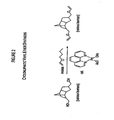
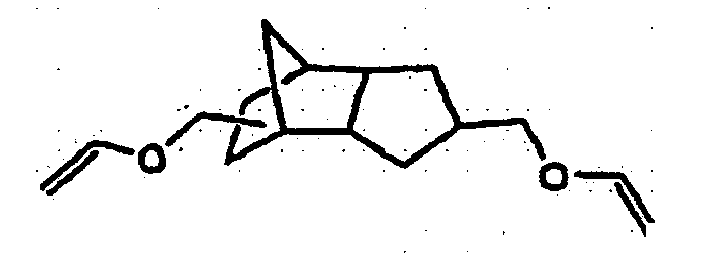
- suitable resins include dicyclopentadiene (DCPD) dimethylol diacrylate and the cycloaliphatic vinyl ether derived from DCPD dimethylol as shown in Figure 2 .
- DCPD dicyclopentadiene
- Additional suitable radiation-curable resins with cycloaliphatic backbones are those selected from the group consisting of and
- the curable resin for the moisture-barrier sealant is in which R is hydrogen, alkyl (e.g. methyl) or halogen (e.g. chlorine). In another embodiment the curable resin for the moisture-barrier sealant is In which R is hydrogen, alkyl (e.g. methyl) or halogen (e.g. chlorine).
- curable functionalities on the resins (a) include any known to those with experience in the field of UV and thermally curable materials and filled polymer composites.
- Common curable functionalities include, but are not limited to, epoxies, selected from glycidyl epoxy, aliphatic epoxy, and cycloaliphatic epoxy; acrylate and methacrylate; itaconate; maleimide; vinyl, propenyl, crotyl, allyl, and propargyl ether and thio-ethers of those groups; maleate, fumarate, and cinnamate esters; styrenic; acrylamide and methacrylamide; chalcone; thiol; allyl, alkenyl, and cycloalkenyl.
- the polymerization mechanism upon irradiation or heating is not limited, but is typically either a radical or cationic process.
- the inventors have found, within predefined boundaries of overall crosslink density, that the type of reactive functional groups present are not as critical to barrier properties as the nature of the backbone to which those reactive functional groups are attached.
- the reactive functionality will be present at a level that provides an equivalent weight of less than 400 grams per mole of reactive functional group.
- equivalent weight is that commonly used by those skilled In the art: it is the molecular weight divided by the total functionality (e.g. epoxy, acrylate, maleimide, etc.).
- Equivalent weight is the mass per mole of reactive group. In general, molecules with low equivalent weights are highly functional, and will provide highly crosslinked matrices after curing (assuming good conversion upon cure).
- the permeant has low solubility in the barrier material.
- the barrier material is hydrophobic, this results in low moisture solubility in the cured adhesive/sealant barrier material, which reduces moisture permeability.
- hydrophobic materials are not necessarily good barrier materials, particularly if they have low crosslink density (high uncured equivalent weight) or exhibit high mobility/high free volume In the cured state.
- the term hydrophobic means absorbing less than 5.00 weight % water at 85°C and 85% relative humidity (RH).
- cycloaliphatic backbones those with low functional group equivalent weight, can provide low uncured viscosity while packing efficiently in a radiation or thermally cured system.
- Such backbone molecular packing combined with the high crosslink density afforded by the low functional group equivalent weight, results in low cured matrix mobility, and accordingly, in low permeant mobility.
- the cycloallphatic-based compositions tend to be hydrophobic as they are primarily hydrocarbon in nature. This hydrophobicity results in low moisture solubility in the cured material, which also reduces moisture permeability.
- the use of primarily cycloaliphatic materials to achieve this combination of low permeant mobility and low moisture solubility is novel and unexpected among curable barrier materials.
- Both suitable radiation curable resins and suitable photoinitiator for radiation curable resins may be any of those commonly described in the open literature. Representative examples may be found in literature sources such as Fouassier, J-P., Photoinitiation, Photopolymerization and Photocuring Fundamentals and Applications 1995, Hanser/Gardner Publications, Inc., New York, NY. Chapter 6 is a particularly useful overview of the various classes of radiation curable resins and photoinitiators used by those practiced in the art. Exemplary photoinitiators are disclosed in Ionic Polymerizations and Related processes, 45-60, 1999, Kluwer Academic Publishers; Netherlands; J.E. Puskas et al. (eds .). Curing mechanisms may be any of those described therein and most frequently the resin system cures through either a radical or cationic mechanism.
- the initiator (b) will be a photoinitiator.
- photoinitiator (b) for the Inventive radiation curable barrier adhesives is familiar to those skilled In the art of radiation curing.
- the selection of an appropriate photoinitiator system is highly dependent on the specific application in which the barrier sealant is to be used.
- a suitable photoinitiator is one that exhibits a light absorption spectrum that is distinct from that of the resins, fillers, and other additives In the radiation curable system. If the sealant must be cured through a cover or substrate, the photoinitiator will be one capable of absorbing radiation at wavelengths for which the cover or substrate is transparent.
- the photoinitiator must have significant absorbance above ca. 320 nm, which is the UV cut-off of sodalime glass. In some cases, it is anticipated that the use of photosensitizers will be helpful.
- Type I (cleavage) or Type II (H abstraction) radical photoinitiators may be used for systems that cure via a radical mechanism.
- Small molecule, polymeric, or polymerizeable photoinitiators may be used.
- common cleavage photoinitiators such as those offered by Ciba Specialty Chemicals, are useful.
- Preferred photoinitiators include Irgacure 651, Irgacure 907, and Irgacure 819, all sold by Ciba.
- a preferred class of photoinitiators are polymer-bound aromatic ketones, or polymeric Type II photoinitiators.
- Such systems do not produce small molecule photo by-products, and therefore tend to produce less odor, outgassing, and extractable components upon UV cure.
- Such systems may or may not require a photosensitizer, depending on the specific application and resin system used.
- Preferred cationic photoinitiators include diaryllodonium salts and triarylsulfonium salts.
- Well known commercially available examples include UV9380C (GE Silicones), PC2506 (Polyset), Rhodorsil 2074 (Rhodia), and UVI-6974 (Dow). If curing through certain covers or substrates, an appropriate photosensitizer should be used to assure adequate light absorption by the photoinitiating system.
- Preferred sensitizers for diaryliodonium salts are isopropylthioxanthone (often sold as a mixture of 2- and 4-isomers) and 2-chloro-4-prcpoxythloxanthone.
- the selection of an efficient cationic photoinitiating system for a particular curing geometry and resin system is known to those skilled in the art of cationic UV curing, and is not limited within the scope of this Invention.
- photogenerated bases e.g. photogenerated amines or photogenerated polythiols
- curing agents are also anticipated in cases where such basic catalysts, initiators, and curing agents are appropriate.
- inventive cycloaliphatic barrier adhesives may be cured thermally as well as photochemically.
- Appropriate thermal initiators are well known to those skilled in the art of thermoset chemistry, and will vary widely depending on resin type, curing mechanism, and end use of the barrier sealant.
- azo-type initiators such as 2,2'-azobisisobutyronitrile (sold by various vendors, Including DuPont as Vazo 64), peroxyketals such as 1,1'-di( t -amylperoxy)cyclohexane (sold by Witco as USP-90MD), peresters such as t -amyl peroxypivalate (sold by Akzo as Trigonox 125-C75), and alkylperoxides, such as, di-cumyl peroxide (sold by various vendors such as Witco).
- azo-type initiators such as 2,2'-azobisisobutyronitrile (sold by various vendors, Including DuPont as Vazo 64), peroxyketals such as 1,1'-di( t -amylperoxy)cyclohexane (sold by Witco as USP-90MD), peresters such as t -amyl peroxypivalate (sold by Akzo
- thermal cationic initiators are also contemplated.
- such catalysts include any sort of Br ⁇ nsted or Lewis acids, often in the form of a latent thermal acid generator.
- latent thermal acid generators include, but are not limited to, diaryliodonium salts, benzylsulfonium salts, phenacylsulfonium salts, N-benzylpyridinium salts, N-benzylpyrazinium salts, N-benzylammonium salts, phosphonium salts, hydrazinium salts, and ammonium borate salts.
- An example of a useful diaryliodonium salt thermal cationic initiator is PC2506 (Polyset).
- Diaryliodonium salts can often be accelerated (made to initiate at low temperature with acceptable latency) by adding electron donating co-initiators such as benzopinacol. The initiation mechanism then essentially becomes one of redox reduction of the diaryliodonium salt by a species generated through the thermal decomposition of the co-initiator.
- co-initiators such as benzopinacol.
- Other representative examples of thermally activated cationic catalysts include sulfonates and sulfonate salts (available from King Industries under the tradename of Nacure and K-cure).
- the cycloaliphatic resin component may optionally be blended with one or more other reactive or non-reactive resin components (c). These optional resins may be used to modify specific properties of the compositions, such as toughness, flexibility, adhesion to certain substrates, or to minimize weight loss during or after cure. Typically, it is beneficial to use as much cycloaliphatic material as is practical.
- the amount of these other resin components will varying depending on the application, processing conditions, and barrier requirements, but will generally fall within the range of 1-90% of the total resinous portion of the barrier sealant composition.
- the second (non-cycloaliphatic) resin component may contain any of the reactive groups described previously for the cycloaliphatic resin component.
- common reactive optional resins include, but are not limited to epoxy resins, acrylic resins, maleimide resins, vinyl and propargyl ether resins, fumarate esters, maleate esters, cinnamate esters, chalcones, polythiols, and allylated molecules.
- Representive epoxy resins are glycidyl ethers and cycloaliphatic epoxies.
- Various sources and variations of glycidyl ethers are well known to those skilled in the art.
- Representative aromatic liquid glycidyl ethers include epoxy resins such as Epikote 862 (essentially bisphenol F diglycidyl ether) or Epikote 828 (essentially bisphenol A diglycidyl ether).
- Preferred solid glycidyl ethers include Epon 1031, Epon 164, SU-8, DER 542 (brominated bisphenol A diglycidyl ether), RSS 1407 (tetramethylbiphenyldiglycidyl ether), and Erisys RDGE (resorcinol diglycidyl ether). All of these Epikote ® and Epon ® glycidyl ethers are available from Resolution Performance Products. Erisys RDGE ® is available from CVC Specialty Chemicals, Inc.
- Representative non-aromatic glycidyl epoxy resins include EXA-7015 available from Dainippon Ink & Chemicals (hydrogeneated bisphenol A diglycidylether).
- Representative cycloaliphatic epoxy resins include ERL 4221 and ERL 6128 available from Dow Chemical Co.
- vinyl ether molecules such as Rapicure-CHVE (cyclohexanedimethylol divinyl ether), Rapicure-DPE-3 (tripropylene glycol divinyl ether) or Rapicure-DDVE (dodecyl vinyl ether) are readily available from International Specialty Products. Analogous vinyl ethers are also available from BASF. Vinyl ether-terminal urethanes and polyesters are available from Morflex. Reactive unsaturated polyesters are available from Reichold. A wide variety of acrylate monomers, oligomers and polymers are available from vendors such as Sartomer Corporation, and may be useful as reactive resin additives. These include various mono- and multifunctional acrylic monomers, acrylated polyurethanes, acrylated polyesters, and metal diacrylates. Acrylated siloxanes may be obtained from Gelest and others.
- Rapicure-CHVE cyclohexanedimethylol divinyl ether
- Rapicure-DPE-3 tripropylene glycol diviny
- Optional fillers (d) may vary widely and are well known to those skilled in the art of composite materials. Common fillers include, but are not limited to ground quartz, fused silica, amorphous silica, talc, glass beads, graphite, carbon black, alumina, clays, mica, vermiculite, aluminum nitride, and boron nitride. Metal powders and flakes consisting of silver, copper, gold, tin, tin/lead alloys, and other alloys are contemplated. Organic filler powders such as poly(tetrachloroethylene), poly(chlorotriflouroethylene), and poly(vinylidene chloride) may also be used.
- Fillers that act as desiccants or oxygen scavengers including but not limited to, CaO, BaO, Na 2 SO 4 , CaSO 4 , MgSO 4 , zeolite, silica gel, P 2 O 5 , CaCl 2 , and Al 2 O 3 may also be utilized.
- UV curable acrylate compositions were formulated by mixing several structurally distinct acrylate resins with a polythiol, a photoinitiator, and fumed silica in parts by weight as shown in Table 1.
- HDDA is hexanediol diacrylate
- TMPTA is trimethylolpropane triacrylate
- pBD DMA is poly(butadiene)dimethacrylate
- DCPDDA is dicyclopentadienedimethylol diacrylate.
- Q-43 is pentaerythritol tris(3-mercapto-propionate) and is a polythiol, which acts to reduce oxygen inhibition and as a flexibilizer.
- the Q-43 polythiol has the structure:
- the photoinitiator used was Irgacure 651, obtained from Ciba Specialty Chemicals.
- the fumed silica acts as a thixotrope to allow high quality films to be formed and purged with nitrogen prior to cure without dewetting the release liner substrate.
- Drawdown films of the filled formulations were made on release-coated Mylar substrates. These films were placed in a flow-through chamber and purged with nitrogen for three minutes, followed by UV curing in a Dymax stationary curing unit. UV dose was 3J UVA/cm 2 , at an intensity of ca. 45 mW UVA/cm 2 as measured using an EIT compact radiometer. The cured films were then removed from the release Mylar substrate. The equilibrium bulk moisture permeation coefficient was measured using a Mocon Permatran-W 3/33 instrument at 50°C/100% relative humidity (RH). Results are provided in Table 2 below.
- the three resin systems 1 through 3 have low equivalent weight, and are thus expected to produce highly crosslinked materials upon cure. Yet, the cycloaliphatic resin-based system (formulation 3), exhibits significantly lower bulk permeability than the other two acrylate formulations (formulations 1 and 2). Also, HDDA (formulaton 1) and DCPDDA (formulation 3) are both considered hydrophobic acrylate materials (TMPTA, formulation 2, is fairly hydrophobic as well), yet again the cycloaliphatic resin provides superior moisture barrier properties.
- TMPTA hydrophobic acrylate materials
- the film based on a poly(butadiene) backbone (formulation 4) exhibited, by far, the highest moisture permeability. This demonstrates that, despite the well known extremely hydrophobic nature of the poly(butadiene) backbone of pBD DMA, the low crosslink density of this film results In high molecular mobility and high permeation coefficient. Hydrophobicity alone does not yield a good barrier material.
- HDDA, TMPTA, and pBD DMA molecules exhibit some properties that lead one to expect that they might produce good moisture barriers, it is not just hydrophobicity or just high crosslink density, but the unique combination of backbone structure/packing and high crosslink density that provide the DCPDDA-based formulation 3 with clearly superior moisture barrier properties.
- UV curable thiol-ene formulations were prepared according to Table 3 using the same polythiol (Q-43) as in Example 1, various ene components, and a photoinitiator.
- Q-43 is pentaerythritol tetrakis(3-mercpatopropionate); DAC is diallylchlorendate; TAIC is triallyl isocyanurate (with 100 ppm BHT stabilizer); TABPA Is tetraallyl bisphenol A.
- the photoinitiator was Irgacure 651, obtained from Ciba Specialty Chemicals and used at a level appropriate for each formulation
- Drawdown films of the various formulations were made on release-coated Mylar substrates or directly onto PTFE-coated aluminum plates. (Some haziness was noted in formulations 9 & 10.) These films were UV cured in a Dymax stationary curing unit. UV dose was 3J UVA/cm 2 , at an intensity of ca. 45 mW UVA/cm 2 as measured using an EIT compact radiometer. The cured films were then removed from the release Mylar or PTFE-coated plate. In some indicated cases a light thermal post-cure (thermal bump) was Included in the cure schedule, as thiol-ene curing can be induced via both radiation or heat.
- thermal post-cure thermal post-cure
- the internal double bond of DAC is not as reactive as its allyl groups, and as such the trifunctional ene TAIC should produce higher crosslink densities relative to DAC as indicated by photoOSC exotherm.
- the data show that the TAIC-containing formulations exhibit inferior moisture barrier properties relative to the DAC-containing formulations, even though the TAIC-containing formulations have higher crosslink densities when cured relative to the DAC films.
- the cycloaliphatic nature of the DAC ene is presumed to play a role In this phenomenon, and the chlorination of DAC may contribute favorably to its moisture barrier properties as well.
- the components were handmixed, followed by mixing in a Speedmixer DAC 150 FV2-K (FlackTek Inc.) for two minutes at 3000 rpm.
- the resulting pastes were coated onto release-coated PET film using a drawdown bar, and the resulting wet films were UV cured in a Dymax stationary curing unit.
- UV dose was 3J UVA/cm 2 , at an intensity of ca. 45 mW UVA/cm 2 as measured using an EIT compact radiometer.
- the cured epoxy/vinyl ether films were removed from the PET backing and analyzed. The equilibrium bulk moisture permeation coefficient of the films was measured using a Mocon Permatran-W 3/33 instrument at 50°C/100% relative humidity (RH).
- BDDVE butane diol divinyl ether
- CAVE dicyclopentadienedimethylol divinyl ether
- CHVE cyclohexanedimethylol divinyl ether
- its formulation with an aromatic epoxy should exhibit a higher cured crosslink density relative to formulations derived from CAVE and CHVE (formulations 11 and 12 respectively).
- CAVE, CHVE, and BDDVE should have similar hydrophobicity, as should their respective cured formulations.
- the fourth formulation containing triethylene glycol divinyl ether (DVE-3, formulation 14) exhibited much higher moisture permeability, presumably due to the hydrophilic nature of its backbone (and the resulting higher solubility of water in the polymer matrix) and the flexibility/mobility of its poly(ether) backbone (resulting in higher permeant diffusivity).
- a syringe dispensable, UV-curabte barrier sealant was formulated under short wavelength-visible filtered lighting using the components as shown in Table 7.
- the resin components were combined and mixed to dissolve the ITX photosensitizer.
- the silica fillers were subsequently added and hand mixed until bulk wet-out was obtained.
- the paste was then milled at least two times on a three-roll mill using a gap setting less than 0.5 mil between each roll. The paste was considered adequately milled when no particles larger than 10 ⁇ m were observed in a Hegeman gauge test. This product was allowed to age in the dark for at least 24 hours prior to checking rheology or testing for material properties.
- This adhesive composition can be used to seal various types of optoelectronic devices in which substrates such as glass, metal, or polymeric films are bonded.
- sodalime glass die were bonded to sodalime glass substrates to simulate a perimeter sealed "glass-to-giass" OLED device.
- Adhesive was dispensed onto a PTFE-coated Al substrate, and a ca. 4 mil film was formed using a drawdown bar. Glass die were placed on this wet film, removed, and subsequently placed on a cleaned glass substrate with light pressure to simulate a "pick and place" type robotic packaging process.
- Samples were then inverted and irradiated with UV light through the glass substrate to produce a cured glass-to-glass bond.
- UV curing was performed in a Dymax stationary curing unit.
- the UV dose was 3J UVA/cm 2 , at an intensity of ca. 45 mW UVA/cm 2 as measured using an EIT compact radiometer.
- Similar samples can be assembled to simulate glass-to-metal bonding also common for packaging OLED and other optoelectronic devices.
- the physical properties of the uncured and cured formulation are as follows:
- ⁇ at 1 rpm 38,000cP
- 3.0 Water Vapor Permeation Coefficient (P) (equilibrium bulk moisture permeation coefficient) was measured using a Mocon Permatran-W 3/33 instrument at 50°C and 100% relative humidity.
- CAVE cycloaliphatic vinyl ether
- CAVE contributes hydrophobicity (as evidenced by low saturation moisture uptake/weight gain at 85°C/85% RH), good crosslink density due to its low equivalent weight and multifunctionality (as evidenced by its relatively high T g for a UV cured formulation and the excellent shear adhesion strength of the formulation), excellent UV reactivity (evidenced by low TGA weight loss of cured films), and a bulk moisture permeation coefficient lower than currently available perimeter sealant products known to the inventors.
- the improved moisture barrier properties arise from the material's high crosslink density and rigid backbone (low permeant mobility) combined with the overall hydrophobicity of the composite (low permeant solubility).
- the diacrylate (DCPDDA), thiol (Q43), and photoinitiator (Irgacure 651) were combined and stirred magnetically to dissolve the photoinitiator.
- To this resins system was added 50 parts by weight of talc as a filler.
- the resin/filler blend was handmixed, followed by mixing in a Speedmixer DAC 150 FV2-K (FlackTek Inc.) for one minute at 2000 rpm and one minute at 300 rpm.
- the paste was coated onto release-coated PET film using a drawdown bar, and the resulting wet film was placed in a nitrogen-purged chamber for five minutes prior to UV curing.
- the film was cured in a Dymax stationary curing unit.
- UV dose was 3J UVA/cm 2 , at an intensity of ca. 45 mW UVA/cm 2 as measured using an EIT compact radiometer.
- the equilibrium bulk moisture permeation coefficient was measured using a Mocon Permatran-W 3/33 instrument at 50°C/100% relative humidity (RH). The permeation coefficient at these conditions was determined to be 4.1 g.mil/100in 2 .day, which indicates excellent bulk moisture barrier performance relative to typical UV-curable acrylic materials.
- This adhesive composition can be used to seal various types of optoelectronic devices that bond substrates such as glass, metal, or polymeric films.
- sodalime glass die were bonded to sodalime glass substrates to simulate a perimeter sealed "glass-to-glass" OLED device.
- Adhesive was dispensed onto a PTFE-coated Al substrate, and a ca. 4 mil film was formed using a drawdown bar. Glass die were placed on this wet film, removed, and subsequently placed on a glass substrate with light pressure to simulate a "pick and place" type packaging process.
- Two radically curable liquid bismaleimide-based formulations were made using the components listed in Table 10. When a discrete photoinitiator was used (formulas 16 and 18), it was dissolved in the respective bismaleimide resin with magnetic stirring. Drawdown films of the formulations were made on release-coated Mylar substrates or on PTFE-coated aluminum plates. These films were UV cured in a Dymax stationary curing unit. UV dose was 3J UVA/cm 2 , at an intensity of ca. 45 mW UVA/cm 2 as measured using an EIT compact radiometer. The cured films were then removed from the release Mylar or PTFE substrate. The equilibrium bulk moisture permeation coefficient was measured using a Mocon Permatran-W 3/33 instrument at 50°C/100% relative humidity (RH).
- RH relative humidity
- BMI-1 has the following structure:
- BMI-4 has the following structure:
- the inventors note that the formulations that incorporate a discrete photoinitiator likely polymerize/crosslink predominantly through a standard radical chain polymerization mechanism, whereas the formulations that do not contain discrete photoinitiator are expected to polymerize/chain extend primarily via a [2+2] cycloaddition process. These different polymerization mechanisms will produce different cured matrices, which would be expected to exhibit different transmission rates due to differences in crosslink density and/or morphology. Mixed modes of polymerization likely occur in both cases, but these details were not further Investigated in this case and are not critical to the basic conclusions and trends regarding moisture permeability vs. equivalent weight and backbone structure noted above.
- a syringe dispensable, UV-curable barrier sealant was formulated under short wavelength-visible filtered lighting using the components as shown in Table 11.
- the resin components were combined and mixed to dissolve the ITX photosensitizer.
- the talc filler was subsequently added and hand mixed until bulk wet-out was obtained.
- the paste was then milled at least two times on a three-roll mill using a gap setting less than 0.5 mil between each roll. The paste was considered adequately milled when no particles larger than 20 ⁇ m were observed in a Hegeman gauge test. This product was allowed to age in the dark at least 24 hours prior to checking rheology or testing for material properties.
- This adhesive composition can be used to seal various types of optoelectronic devices in which substrates such as glass, metal, or polymeric films are bonded.
- sodalime glass die were bonded to sodalime glass substrates to simulate a perimeter sealed "glass-to-glass" OLED device.
- Adhesive was dispensed onto a PTFE-coated Al substrate, and a ca. 4 mil film was formed using a drawdown bar. Glass die were placed on this wet film, removed, and subsequently placed on a cleaned glass substrate with light pressure to simulate a "pick and place" type robotic packaging process.
- UV curing was performed in a Dymax stationary curing unit.
- the UV dose was 3J UVA/cm 2 , at an intensity of ca. 45 mW UVA/cm 2 as measured using an EIT compact radiometer. (Similar samples can be assembled to simulate glass-to-metal bonding also common for packaging OLED and other optoelectronic devices.)
- DSS die shear strength
Landscapes
- Chemical & Material Sciences (AREA)
- Health & Medical Sciences (AREA)
- Chemical Kinetics & Catalysis (AREA)
- Medicinal Chemistry (AREA)
- Polymers & Plastics (AREA)
- Organic Chemistry (AREA)
- Sealing Material Composition (AREA)
- Electroluminescent Light Sources (AREA)
- Macromonomer-Based Addition Polymer (AREA)
Claims (19)
- Strahlungshärtbarer Sperrdichtstoff umfassend(a) ein härtbares Harz, dadurch gekennzeichnet, dass es(i) eine cycloaliphatische Hauptkette hat,(ii) mindestens eine reaktive funktionelle Gruppe hat, die in einer Menge vorhanden ist, die ein äquivalentes Gewicht von unter 400 Gramm pro Mol der reaktiven funktionellen Gruppe ergibt, und(b) einen Initiator,bei welchem das cycloaliphatische Harz ausgewählt ist aus der Gruppe bestehend aus


bei welchemX eine reaktive Gruppe ist, die unabhängig ausgewählt ist aus Glycidylepoxid, aliphatischem Epoxid und cycloaliphatischem Epoxid; Itaconat; Maleimid; Vinyl-, Propenyl-, Crotyl-, Allyl- und Propargylether sowie den Thioethern dieser Gruppen; Maleat-, Fumarat- und Cinnamatestern; styrolisch;Acrylamid und Methacrylamid; Chalkon; Thiol; Allyl, Alkenyl und Cycloalkenyl;R Wasserstoff, Alkyl oder Halogen ist;R1 unverzweigtes Alkyl, verzweigtes Alkyl oder Cycloalkyl ist und Heteroatome enthalten kann, undz 0 oder 1 ist. - Härtbarer Sperrdichtstoff nach Anspruch 1, bei welchem die reaktive Gruppe X am strahlungshärtbaren Harz Vinylether ist.
- Härtbarer Sperrdichtstoff nach Anspruch 2, bei welchem das strahlungshärtbare Harz

bei welchem R Wasserstoff, Alkyl oder Halogen ist. - Härtbarer Sperrdichtstoff nach Anspruch 3, bei welchem das härtbare Harz
- Härtbarer Sperrdichtstoff nach Anspruch 1, bei welchem das cycloaliphatische Harz ausgewählt ist aus der Gruppe bestehend aus


- Härtbarer Sperrdichtstoff nach irgendeinem der Ansprüche 1 bis 5, ferner umfassend (c) ein Harz, das keine cycloaliphatische Hauptkette enthält.
- Härtbarer Sperrdichtstoff nach irgendeinem der Ansprüche 1 bis 5, ferner umfassend (d) einen Füllstoff.
- Härtbarer Sperrdichtstoff nach irgendeinem der Ansprüche 1 bis 5, ferner umfassend (c) ein Harz, das keine cycloaliphatische Hauptkette enthält, und (d) einen Füllstoff.
- Elektronische oder optoelektronische Vorrichtung, abgedichtet mit einem strahlungshärtbaren Sperrdichtstoff umfassend(a) ein härtbares Harz, dadurch gekennzeichnet, dass es(i) eine cycloaliphatische Hauptkette hat,(ii) mindestens eine reaktive funktionelle Gruppe hat, die in einer Menge vorhanden ist, die ein äquivalentes Gewicht von unter 400 Gramm pro Mol der reaktiven funktionellen Gruppe ergibt, und(b) einen Initiator,bei welchem das cycloaliphatische Harz ausgewählt ist aus der Gruppe bestehend aus


bei welchemX eine reaktive Gruppe ist, die unabhängig ausgewählt ist aus Glycidylepoxid, aliphatischem Epoxid und cycloaliphatischem Epoxid; Acrylat und Methacrylat; Itaconat; Maleimid; Vinyl-, Propenyl-, Crotyl-, Allyl- und Propargylether sowie den Thioethern dieser Gruppen; Maleat-, Fumarat- und Cinnamatestern; styrolisch; Acrylamid und Methacrylamid; Chalkon; Thiol; Allyl, Alkenyl und Cycloalkenyl;R Wasserstoff, Alkyl oder Halogen ist;R1 unverzweigtes Alkyl, verzweigtes Alkyl oder Cycloalkyl ist und Heteroatome enthalten kann, undz 0 oder 1 ist. - Elektronische oder optoelektronische Vorrichtung nach Anspruch 9, bei welcher die reaktive Gruppe X am strahlungshärtbaren Harz Vinylether oder Acrylat ist.
- Elektronische oder optoelektronische Vorrichtung nach Anspruch 10, bei welcher das strahlungshärtbare Harz
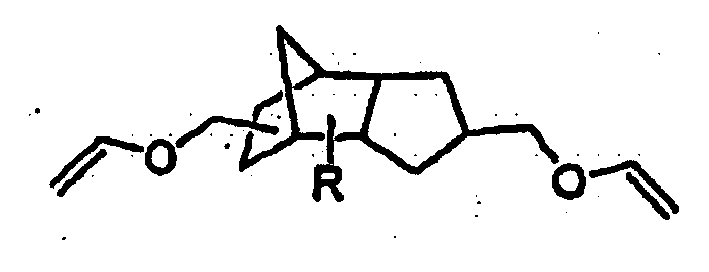
bei welchem R Wasserstoff, Alkyl oder Halogen ist. - Elektronische oder optoelektronische Vorrichtung nach Anspruch 11, bei welcher das härtbare Harz

- Elektronische oder optoelektronische Vorrichtung nach Anspruch 10, bei welcher das härtbare Harz

bei welchem R Wasserstoff, Alkyl oder Halogen ist. - Elektronische oder optoelektronische Vorrichtung nach Anspruch 13, bei welcher das härtbare Harz

- Elektronische oder optoelektronische Vorrichtung nach Anspruch 9, bei welcher das cycloaliphatische Harz ausgewählt ist aus der Gruppe bestehend aus


- Elektronische oder optoelektronische Vorrichtung nach irgendeinem der Ansprüche 9 bis 15, wobei der strahlungshärtbare Sperrdichtstoff ferner (c) ein Harz umfasst, das keine cycloaliphatische Hauptkette enthält.
- Elektronische oder optoelektronische Vorrichtung nach irgendeinem der Ansprüche 9 bis 15, wobei der strahlungshärtbare Sperrdichtstoff ferner (d) einen Füllstoff umfasst.
- Elektronische oder optoelektronische Vorrichtung nach irgendeinem der Ansprüche 9 bis 15, wobei der strahlungshärtbare Sperrdichtstoff ferner (c) ein Harz, das keine cycloaliphatische Hauptkette enthält, und (d) einen Füllstoff umfasst.
- Optoelektronische Vorrichtung nach irgendeinem der Ansprüche 9 bis 15, welche eine OLED ist.
Applications Claiming Priority (2)
| Application Number | Priority Date | Filing Date | Title |
|---|---|---|---|
| US11/098,115 US20060223937A1 (en) | 2005-04-04 | 2005-04-04 | Radiation curable cycloaliphatic barrier sealants |
| PCT/US2006/012181 WO2006107802A1 (en) | 2005-04-04 | 2006-04-03 | Radiation curable cycloaliphatic barrier sealants |
Publications (2)
| Publication Number | Publication Date |
|---|---|
| EP1866960A1 EP1866960A1 (de) | 2007-12-19 |
| EP1866960B1 true EP1866960B1 (de) | 2010-01-13 |
Family
ID=36790973
Family Applications (1)
| Application Number | Title | Priority Date | Filing Date |
|---|---|---|---|
| EP06749107A Ceased EP1866960B1 (de) | 2005-04-04 | 2006-04-03 | Strahlungshärtbare cycloaliphatische sperrdichtstoffe |
Country Status (9)
| Country | Link |
|---|---|
| US (2) | US20060223937A1 (de) |
| EP (1) | EP1866960B1 (de) |
| JP (1) | JP5575393B2 (de) |
| KR (1) | KR101332702B1 (de) |
| CN (1) | CN101151726B (de) |
| AT (1) | ATE455371T1 (de) |
| DE (1) | DE602006011724D1 (de) |
| TW (1) | TWI406364B (de) |
| WO (1) | WO2006107802A1 (de) |
Families Citing this family (27)
| Publication number | Priority date | Publication date | Assignee | Title |
|---|---|---|---|---|
| EP2004746B1 (de) * | 2006-03-29 | 2018-08-01 | Henkel AG & Co. KGaA | Strahlungshärtbarer kautschuk-klebstoff/dichtstoff |
| JP5498156B2 (ja) * | 2006-03-29 | 2014-05-21 | ヘンケル・アーゲー・アンド・カンパニー・カーゲーアーアー | 放射線−または熱−硬化性バリヤシーラント |
| FR2936106B1 (fr) * | 2008-09-16 | 2010-10-01 | Commissariat Energie Atomique | Micro-batterie au lithium comportant une couche d'encapsulation et procede de fabrication. |
| EP2418235B1 (de) * | 2008-12-18 | 2019-03-13 | Henkel IP & Holding GmbH | Lichthärtbare harzzusammensetzung für ultraviolett-led-strahlung |
| TW201031737A (en) * | 2009-02-03 | 2010-09-01 | Henkel Corp | Encapsulant for inkjet print head |
| DE102009013710A1 (de) * | 2009-03-20 | 2010-09-23 | Merck Patent Gmbh | Polymere aus Mischungen mit Vinylether-Monomeren |
| US8525635B2 (en) | 2009-07-17 | 2013-09-03 | Tyco Electronics Corporation | Oxygen-barrier packaged surface mount device |
| US9136195B2 (en) * | 2009-07-17 | 2015-09-15 | Tyco Electronics Corporation | Oxygen barrier compositions and related methods |
| EP2404916B1 (de) * | 2010-07-08 | 2015-06-17 | Ivoclar Vivadent AG | Dentalmaterialien auf der Basis von Dimersäure-Derivaten mit ringöffnend polymerisierbaren Gruppen |
| EP2445028A1 (de) | 2010-10-25 | 2012-04-25 | Nederlandse Organisatie voor toegepast -natuurwetenschappelijk onderzoek TNO | Optoelektrische Vorrichtung und Verfahren zur Herstellung einer optoelektrischen Vorrichtung |
| EP2445029A1 (de) * | 2010-10-25 | 2012-04-25 | Nederlandse Organisatie voor toegepast -natuurwetenschappelijk onderzoek TNO | Mehrschichtige Schutzschicht, organische optoelektrische Vorrichtung und Verfahren zu ihrer Herstellung |
| US9364985B2 (en) | 2012-05-24 | 2016-06-14 | Henkel IP & Holding GmbH | Process for preparing flowable amorphous poly-alpha olefin adhesive pellets |
| JP2016514175A (ja) * | 2013-02-19 | 2016-05-19 | サン ケミカル コーポレイション | 印刷可能な放射線硬化性バリアコーティング |
| CA2906984A1 (en) | 2013-03-15 | 2014-09-18 | Cargill, Incorporated | Carbohydrate compositions |
| CN105073846B (zh) * | 2013-03-22 | 2019-04-16 | 汉高知识产权控股有限责任公司 | 二烯/亲二烯体偶合物和具有可再加工性的热固性树脂组合物 |
| WO2015072415A1 (ja) * | 2013-11-13 | 2015-05-21 | 積水化学工業株式会社 | 液晶表示素子用シール剤、上下導通材料、及び、液晶表示素子 |
| CN106062075B (zh) * | 2014-02-19 | 2019-11-01 | 汉高股份有限及两合公司 | 用于密封液晶的可固化树脂组合物 |
| WO2016014690A1 (en) | 2014-07-25 | 2016-01-28 | Kateeva, Inc. | Organic thin film ink compositions and methods |
| WO2017039857A1 (en) | 2015-08-31 | 2017-03-09 | Kateeva, Inc. | Di- and mono(meth)acrylate based organic thin film ink compositions |
| KR20180082510A (ko) * | 2015-11-11 | 2018-07-18 | 쓰리엠 이노베이티브 프로퍼티즈 캄파니 | 배리어 층 및 밀봉 층을 포함하는 다층 구조물 |
| US10487445B2 (en) * | 2016-05-12 | 2019-11-26 | The Sherwin-Williams Company | Spray applied insulative and protective coating |
| TWI705983B (zh) | 2016-12-09 | 2020-10-01 | 南韓商Lg化學股份有限公司 | 封裝組成物 |
| TWI650383B (zh) | 2016-12-09 | 2019-02-11 | 南韓商Lg化學股份有限公司 | 封裝組成物 |
| CN111788265B (zh) | 2017-04-21 | 2024-04-23 | 柯狄公司 | 用于形成有机薄膜的组合物和技术 |
| CN109305896B (zh) * | 2017-07-26 | 2022-07-19 | 郑州大学 | 一种低极性树脂及其制备方法和应用 |
| US12312484B2 (en) | 2018-11-12 | 2025-05-27 | Lg Chem, Ltd. | Encapsulating composition |
| US20240317914A1 (en) * | 2020-12-31 | 2024-09-26 | Lg Chem, Ltd. | Encapsulating composition and organic electronic device comprising same |
Family Cites Families (61)
| Publication number | Priority date | Publication date | Assignee | Title |
|---|---|---|---|---|
| NL215804A (de) * | 1956-03-28 | |||
| US3835003A (en) * | 1968-08-20 | 1974-09-10 | American Can Co | Photopolymerization of oxetanes |
| US4081397A (en) * | 1969-12-22 | 1978-03-28 | P. R. Mallory & Co. Inc. | Desiccant for electrical and electronic devices |
| US3704806A (en) * | 1971-01-06 | 1972-12-05 | Le T Im Lensoveta | Dehumidifying composition and a method for preparing the same |
| DE2200022A1 (de) * | 1972-01-03 | 1973-07-19 | Henkel & Cie Gmbh | Plastisole |
| AU497960B2 (en) * | 1974-04-11 | 1979-01-25 | Minnesota Mining And Manufacturing Company | Photopolymerizable compositions |
| US4013566A (en) * | 1975-04-07 | 1977-03-22 | Adsorbex, Incorporated | Flexible desiccant body |
| JPS5259088A (en) * | 1975-11-11 | 1977-05-16 | Japan Exlan Co Ltd | Adsorbent for treating waste fluid |
| US4036360A (en) * | 1975-11-12 | 1977-07-19 | Graham Magnetics Incorporated | Package having dessicant composition |
| US4020233A (en) * | 1976-01-22 | 1977-04-26 | W. R. Grace & Co. | Heat activated ethylenically unsaturated-polythiol compositions |
| US4265976A (en) * | 1978-09-19 | 1981-05-05 | Celanese Corporation | Radiation-curable coated article having moisture barrier propetes |
| US4547431A (en) * | 1983-06-20 | 1985-10-15 | General Electric Company | Ultraviolet radiation-curable silicone controlled release compositions |
| CA1312040C (en) * | 1985-12-19 | 1992-12-29 | Joseph Victor Koleske | Conformal coatings cured with actinic radiation |
| FR2614626B1 (fr) * | 1987-04-30 | 1989-07-21 | Ranoux Claude | Conteneur pour fecondation des ovocytes et replacement des embryons chez l'homme et l'animal |
| US5008137A (en) * | 1988-02-04 | 1991-04-16 | Ppg Industries, Inc. | Barrier coatings |
| US5300541A (en) * | 1988-02-04 | 1994-04-05 | Ppg Industries, Inc. | Polyamine-polyepoxide gas barrier coatings |
| US5171760A (en) * | 1988-08-05 | 1992-12-15 | Edison Polymer Innovation Corp. | UV curable polymer formulation |
| US5122403A (en) * | 1989-04-03 | 1992-06-16 | Ppg Industries, Inc. | Windshield edge seal |
| US5304419A (en) * | 1990-07-06 | 1994-04-19 | Alpha Fry Ltd | Moisture and particle getter for enclosures |
| US5244707A (en) * | 1992-01-10 | 1993-09-14 | Shores A Andrew | Enclosure for electronic devices |
| US5463084A (en) * | 1992-02-18 | 1995-10-31 | Rensselaer Polytechnic Institute | Photocurable silicone oxetanes |
| US5827908A (en) * | 1994-01-26 | 1998-10-27 | Shin-Etsu Chemical Co., Ltd. | Naphthalene and or biphenyl skeleton containing epoxy resin composition |
| US5436084A (en) * | 1994-04-05 | 1995-07-25 | Dow Corning Corporation | Electronic coatings using filled borosilazanes |
| US5882842A (en) * | 1996-02-16 | 1999-03-16 | Kansai Paint Co., Ltd. | Active energy ray-curable resin composition |
| US5703394A (en) * | 1996-06-10 | 1997-12-30 | Motorola | Integrated electro-optical package |
| JP3736817B2 (ja) * | 1996-07-12 | 2006-01-18 | 日本化薬株式会社 | 多官能ビニルエーテル、重合性組成物及びその硬化物 |
| US5665823A (en) * | 1996-08-30 | 1997-09-09 | Dow Corning Corporation | Polyisobutylene polymers having acrylic functionality |
| DE19736471A1 (de) * | 1997-08-21 | 1999-02-25 | Espe Dental Ag | Lichtinduziert kationisch härtende Zusammensetzungen und deren Verwendung |
| US6121358A (en) * | 1997-09-22 | 2000-09-19 | The Dexter Corporation | Hydrophobic vinyl monomers, formulations containing same, and uses therefor |
| US6081071A (en) * | 1998-05-18 | 2000-06-27 | Motorola, Inc. | Electroluminescent apparatus and methods of manufacturing and encapsulating |
| US6057381A (en) * | 1998-07-02 | 2000-05-02 | National Starch And Chemical Investment Holding Corporation | Method of making an electronic component using reworkable underfill encapsulants |
| US6150479A (en) * | 1998-11-23 | 2000-11-21 | Loctite Corporation | Radical-curable adhesive compositions, reaction products of which demonstrate superior resistance to thermal degradation |
| US6054549A (en) * | 1998-11-25 | 2000-04-25 | Dow Corning Asia, Ltd. | Alkenyl ether functional polyisobutylenes and methods for the preparation thereof |
| US6211320B1 (en) * | 1999-07-28 | 2001-04-03 | Dexter Corporation | Low viscosity acrylate monomers formulations containing same and uses therefor |
| KR20010080093A (ko) * | 1999-08-12 | 2001-08-22 | 사토 아키오 | 실링제용광경화형수지조성물 및 실링방법. |
| DE19943149A1 (de) * | 1999-09-09 | 2001-04-05 | Siemens Ag | Verfahren zur Verkapselung von Bauelementen |
| US6833668B1 (en) * | 1999-09-29 | 2004-12-21 | Sanyo Electric Co., Ltd. | Electroluminescence display device having a desiccant |
| JP4614214B2 (ja) * | 1999-12-02 | 2011-01-19 | 信越化学工業株式会社 | 半導体装置素子用中空パッケージ |
| US7012120B2 (en) * | 2000-03-31 | 2006-03-14 | Henkel Corporation | Reworkable compositions of oxirane(s) or thirane(s)-containing resin and curing agent |
| US6226890B1 (en) * | 2000-04-07 | 2001-05-08 | Eastman Kodak Company | Desiccation of moisture-sensitive electronic devices |
| US6703433B1 (en) * | 2000-05-12 | 2004-03-09 | Dow Corning Corporation | Radiation curable compositions containing alkenyl ether functional polyisobutylenes |
| JP2001328225A (ja) * | 2000-05-24 | 2001-11-27 | Oike Ind Co Ltd | ハードコートフイルム |
| US6521731B2 (en) * | 2001-02-07 | 2003-02-18 | Henkel Loctite Corporation | Radical polymerizable compositions containing polycyclic olefins |
| JP2003096185A (ja) * | 2001-07-17 | 2003-04-03 | Mitsui Chemicals Inc | 光硬化型樹脂組成物 |
| KR20030007186A (ko) * | 2001-07-17 | 2003-01-23 | 미쯔이카가쿠 가부시기가이샤 | 광 양이온성 경화가능 수지 조성물 및 그 용도 |
| JP2003096184A (ja) * | 2001-07-17 | 2003-04-03 | Mitsui Chemicals Inc | 光硬化型樹脂組成物 |
| US6692610B2 (en) * | 2001-07-26 | 2004-02-17 | Osram Opto Semiconductors Gmbh | Oled packaging |
| US7005799B2 (en) * | 2001-07-30 | 2006-02-28 | Intel Corporation | Sealing organic light emitting device displays |
| KR20040019098A (ko) * | 2001-08-03 | 2004-03-04 | 디에스엠 엔.브이 | 표시 장치용 경화성 조성물 |
| JP2003055316A (ja) * | 2001-08-06 | 2003-02-26 | Toagosei Co Ltd | ノルボルネン構造を有する基を有する化合物及びその製造方法 |
| US6740145B2 (en) * | 2001-08-08 | 2004-05-25 | Eastman Kodak Company | Desiccants and desiccant packages for highly moisture-sensitive electronic devices |
| US20030111519A1 (en) * | 2001-09-04 | 2003-06-19 | 3M Innovative Properties Company | Fluxing compositions |
| US6936131B2 (en) * | 2002-01-31 | 2005-08-30 | 3M Innovative Properties Company | Encapsulation of organic electronic devices using adsorbent loaded adhesives |
| US6835950B2 (en) * | 2002-04-12 | 2004-12-28 | Universal Display Corporation | Organic electronic devices with pressure sensitive adhesive layer |
| JP2003327951A (ja) * | 2002-05-10 | 2003-11-19 | Mitsui Chemicals Inc | シール材用光硬化型樹脂組成物 |
| US20030221770A1 (en) * | 2002-05-28 | 2003-12-04 | 3M Innovative Properties Company | Segmented curable transfer tapes |
| TWI225501B (en) * | 2002-11-06 | 2004-12-21 | Delta Optoelectronics Inc | Packaging material used for a display device and method of forming thereof |
| JP2004265776A (ja) * | 2003-03-03 | 2004-09-24 | Hitachi Ltd | 有機elディスプレイ装置 |
| JP2004352881A (ja) * | 2003-05-29 | 2004-12-16 | Mitsubishi Chemicals Corp | 活性エネルギー線重合性材料、活性エネルギー線硬化性樹脂組成物及びその硬化膜と光記録媒体 |
| JP4150857B2 (ja) * | 2004-04-13 | 2008-09-17 | Dic株式会社 | 光ディスク用紫外線硬化型組成物及びこれを用いた光ディスク |
| US7259123B2 (en) * | 2005-04-08 | 2007-08-21 | Shell Oil Company | Catalytic trimerization and tetramerization of olefinic monomers |
-
2005
- 2005-04-04 US US11/098,115 patent/US20060223937A1/en not_active Abandoned
-
2006
- 2006-04-03 KR KR1020077024674A patent/KR101332702B1/ko not_active Expired - Fee Related
- 2006-04-03 CN CN2006800108791A patent/CN101151726B/zh not_active Expired - Fee Related
- 2006-04-03 EP EP06749107A patent/EP1866960B1/de not_active Ceased
- 2006-04-03 JP JP2008505403A patent/JP5575393B2/ja not_active Expired - Fee Related
- 2006-04-03 DE DE602006011724T patent/DE602006011724D1/de not_active Expired - Lifetime
- 2006-04-03 WO PCT/US2006/012181 patent/WO2006107802A1/en not_active Ceased
- 2006-04-03 AT AT06749107T patent/ATE455371T1/de not_active IP Right Cessation
- 2006-04-03 TW TW095111705A patent/TWI406364B/zh not_active IP Right Cessation
- 2006-06-26 US US11/474,772 patent/US20070117917A1/en not_active Abandoned
Also Published As
| Publication number | Publication date |
|---|---|
| TWI406364B (zh) | 2013-08-21 |
| KR20070118139A (ko) | 2007-12-13 |
| KR101332702B1 (ko) | 2013-11-25 |
| EP1866960A1 (de) | 2007-12-19 |
| CN101151726B (zh) | 2010-06-23 |
| ATE455371T1 (de) | 2010-01-15 |
| WO2006107802A1 (en) | 2006-10-12 |
| TW200703597A (en) | 2007-01-16 |
| JP5575393B2 (ja) | 2014-08-20 |
| US20060223937A1 (en) | 2006-10-05 |
| CN101151726A (zh) | 2008-03-26 |
| US20070117917A1 (en) | 2007-05-24 |
| DE602006011724D1 (de) | 2010-03-04 |
| JP2008536968A (ja) | 2008-09-11 |
Similar Documents
| Publication | Publication Date | Title |
|---|---|---|
| US20060223937A1 (en) | Radiation curable cycloaliphatic barrier sealants | |
| EP2004746B1 (de) | Strahlungshärtbarer kautschuk-klebstoff/dichtstoff | |
| US8278401B2 (en) | Radiation or thermally curable barrier sealants | |
| EP1992654B1 (de) | Sperrdichtstoffe aus strahlungs- oder wärmehärtbarem Oxetan | |
| US7687119B2 (en) | Radiation-curable desiccant-filled adhesive/sealant | |
| EP1874885B1 (de) | Strahlenhärtbares, mit trockenmittel gefülltes klebe-/dichtmittel | |
| US7256221B2 (en) | Low outgassing photo or electron beam curable rubbery polymer material, preparation thereof and device comprising same | |
| KR20210116425A (ko) | 유기 el 표시 소자용 봉지제 세트 및 유기 el 표시 소자 | |
| HK1121581A (en) | Radiation curable cycloaliphatic barrier sealants | |
| KR20080104163A (ko) | 방사선 경화성 고무 접착제/밀봉제 | |
| JPH0491169A (ja) | 電子材料用樹脂組成物 | |
| HK1121486A (en) | Radiation-curable desiccant-filled adhesive/sealant | |
| JP2014055296A (ja) | 放射線−または熱−硬化性バリヤシーラント |
Legal Events
| Date | Code | Title | Description |
|---|---|---|---|
| PUAI | Public reference made under article 153(3) epc to a published international application that has entered the european phase |
Free format text: ORIGINAL CODE: 0009012 |
|
| 17P | Request for examination filed |
Effective date: 20071004 |
|
| AK | Designated contracting states |
Kind code of ref document: A1 Designated state(s): AT BE BG CH CY CZ DE DK EE ES FI FR GB GR HU IE IS IT LI LT LU LV MC NL PL PT RO SE SI SK TR |
|
| 17Q | First examination report despatched |
Effective date: 20080125 |
|
| DAX | Request for extension of the european patent (deleted) | ||
| RAP1 | Party data changed (applicant data changed or rights of an application transferred) |
Owner name: HENKEL AG & CO. KGAA |
|
| GRAP | Despatch of communication of intention to grant a patent |
Free format text: ORIGINAL CODE: EPIDOSNIGR1 |
|
| GRAS | Grant fee paid |
Free format text: ORIGINAL CODE: EPIDOSNIGR3 |
|
| GRAA | (expected) grant |
Free format text: ORIGINAL CODE: 0009210 |
|
| AK | Designated contracting states |
Kind code of ref document: B1 Designated state(s): AT BE BG CH CY CZ DE DK EE ES FI FR GB GR HU IE IS IT LI LT LU LV MC NL PL PT RO SE SI SK TR |
|
| REG | Reference to a national code |
Ref country code: GB Ref legal event code: FG4D |
|
| REG | Reference to a national code |
Ref country code: CH Ref legal event code: EP |
|
| REG | Reference to a national code |
Ref country code: IE Ref legal event code: FG4D |
|
| REF | Corresponds to: |
Ref document number: 602006011724 Country of ref document: DE Date of ref document: 20100304 Kind code of ref document: P |
|
| REG | Reference to a national code |
Ref country code: NL Ref legal event code: VDEP Effective date: 20100113 |
|
| LTIE | Lt: invalidation of european patent or patent extension |
Effective date: 20100113 |
|
| PG25 | Lapsed in a contracting state [announced via postgrant information from national office to epo] |
Ref country code: AT Free format text: LAPSE BECAUSE OF FAILURE TO SUBMIT A TRANSLATION OF THE DESCRIPTION OR TO PAY THE FEE WITHIN THE PRESCRIBED TIME-LIMIT Effective date: 20100113 |
|
| PG25 | Lapsed in a contracting state [announced via postgrant information from national office to epo] |
Ref country code: PT Free format text: LAPSE BECAUSE OF FAILURE TO SUBMIT A TRANSLATION OF THE DESCRIPTION OR TO PAY THE FEE WITHIN THE PRESCRIBED TIME-LIMIT Effective date: 20100513 Ref country code: ES Free format text: LAPSE BECAUSE OF FAILURE TO SUBMIT A TRANSLATION OF THE DESCRIPTION OR TO PAY THE FEE WITHIN THE PRESCRIBED TIME-LIMIT Effective date: 20100424 Ref country code: LT Free format text: LAPSE BECAUSE OF FAILURE TO SUBMIT A TRANSLATION OF THE DESCRIPTION OR TO PAY THE FEE WITHIN THE PRESCRIBED TIME-LIMIT Effective date: 20100113 Ref country code: NL Free format text: LAPSE BECAUSE OF FAILURE TO SUBMIT A TRANSLATION OF THE DESCRIPTION OR TO PAY THE FEE WITHIN THE PRESCRIBED TIME-LIMIT Effective date: 20100113 Ref country code: IS Free format text: LAPSE BECAUSE OF FAILURE TO SUBMIT A TRANSLATION OF THE DESCRIPTION OR TO PAY THE FEE WITHIN THE PRESCRIBED TIME-LIMIT Effective date: 20100513 |
|
| PG25 | Lapsed in a contracting state [announced via postgrant information from national office to epo] |
Ref country code: LV Free format text: LAPSE BECAUSE OF FAILURE TO SUBMIT A TRANSLATION OF THE DESCRIPTION OR TO PAY THE FEE WITHIN THE PRESCRIBED TIME-LIMIT Effective date: 20100113 Ref country code: PL Free format text: LAPSE BECAUSE OF FAILURE TO SUBMIT A TRANSLATION OF THE DESCRIPTION OR TO PAY THE FEE WITHIN THE PRESCRIBED TIME-LIMIT Effective date: 20100113 Ref country code: SI Free format text: LAPSE BECAUSE OF FAILURE TO SUBMIT A TRANSLATION OF THE DESCRIPTION OR TO PAY THE FEE WITHIN THE PRESCRIBED TIME-LIMIT Effective date: 20100113 |
|
| PG25 | Lapsed in a contracting state [announced via postgrant information from national office to epo] |
Ref country code: SE Free format text: LAPSE BECAUSE OF FAILURE TO SUBMIT A TRANSLATION OF THE DESCRIPTION OR TO PAY THE FEE WITHIN THE PRESCRIBED TIME-LIMIT Effective date: 20100113 Ref country code: CY Free format text: LAPSE BECAUSE OF FAILURE TO SUBMIT A TRANSLATION OF THE DESCRIPTION OR TO PAY THE FEE WITHIN THE PRESCRIBED TIME-LIMIT Effective date: 20100113 Ref country code: BE Free format text: LAPSE BECAUSE OF FAILURE TO SUBMIT A TRANSLATION OF THE DESCRIPTION OR TO PAY THE FEE WITHIN THE PRESCRIBED TIME-LIMIT Effective date: 20100113 Ref country code: EE Free format text: LAPSE BECAUSE OF FAILURE TO SUBMIT A TRANSLATION OF THE DESCRIPTION OR TO PAY THE FEE WITHIN THE PRESCRIBED TIME-LIMIT Effective date: 20100113 Ref country code: GR Free format text: LAPSE BECAUSE OF FAILURE TO SUBMIT A TRANSLATION OF THE DESCRIPTION OR TO PAY THE FEE WITHIN THE PRESCRIBED TIME-LIMIT Effective date: 20100414 Ref country code: RO Free format text: LAPSE BECAUSE OF FAILURE TO SUBMIT A TRANSLATION OF THE DESCRIPTION OR TO PAY THE FEE WITHIN THE PRESCRIBED TIME-LIMIT Effective date: 20100113 |
|
| PLBE | No opposition filed within time limit |
Free format text: ORIGINAL CODE: 0009261 |
|
| STAA | Information on the status of an ep patent application or granted ep patent |
Free format text: STATUS: NO OPPOSITION FILED WITHIN TIME LIMIT |
|
| PG25 | Lapsed in a contracting state [announced via postgrant information from national office to epo] |
Ref country code: BG Free format text: LAPSE BECAUSE OF FAILURE TO SUBMIT A TRANSLATION OF THE DESCRIPTION OR TO PAY THE FEE WITHIN THE PRESCRIBED TIME-LIMIT Effective date: 20100413 Ref country code: SK Free format text: LAPSE BECAUSE OF FAILURE TO SUBMIT A TRANSLATION OF THE DESCRIPTION OR TO PAY THE FEE WITHIN THE PRESCRIBED TIME-LIMIT Effective date: 20100113 Ref country code: MC Free format text: LAPSE BECAUSE OF NON-PAYMENT OF DUE FEES Effective date: 20100430 Ref country code: CZ Free format text: LAPSE BECAUSE OF FAILURE TO SUBMIT A TRANSLATION OF THE DESCRIPTION OR TO PAY THE FEE WITHIN THE PRESCRIBED TIME-LIMIT Effective date: 20100113 |
|
| REG | Reference to a national code |
Ref country code: CH Ref legal event code: PL |
|
| 26N | No opposition filed |
Effective date: 20101014 |
|
| PG25 | Lapsed in a contracting state [announced via postgrant information from national office to epo] |
Ref country code: DK Free format text: LAPSE BECAUSE OF FAILURE TO SUBMIT A TRANSLATION OF THE DESCRIPTION OR TO PAY THE FEE WITHIN THE PRESCRIBED TIME-LIMIT Effective date: 20100113 Ref country code: IE Free format text: LAPSE BECAUSE OF NON-PAYMENT OF DUE FEES Effective date: 20100403 |
|
| PG25 | Lapsed in a contracting state [announced via postgrant information from national office to epo] |
Ref country code: LI Free format text: LAPSE BECAUSE OF NON-PAYMENT OF DUE FEES Effective date: 20100430 Ref country code: CH Free format text: LAPSE BECAUSE OF NON-PAYMENT OF DUE FEES Effective date: 20100430 |
|
| PG25 | Lapsed in a contracting state [announced via postgrant information from national office to epo] |
Ref country code: HU Free format text: LAPSE BECAUSE OF FAILURE TO SUBMIT A TRANSLATION OF THE DESCRIPTION OR TO PAY THE FEE WITHIN THE PRESCRIBED TIME-LIMIT Effective date: 20100714 Ref country code: LU Free format text: LAPSE BECAUSE OF NON-PAYMENT OF DUE FEES Effective date: 20100403 |
|
| PG25 | Lapsed in a contracting state [announced via postgrant information from national office to epo] |
Ref country code: TR Free format text: LAPSE BECAUSE OF FAILURE TO SUBMIT A TRANSLATION OF THE DESCRIPTION OR TO PAY THE FEE WITHIN THE PRESCRIBED TIME-LIMIT Effective date: 20100113 |
|
| REG | Reference to a national code |
Ref country code: FR Ref legal event code: PLFP Year of fee payment: 11 |
|
| REG | Reference to a national code |
Ref country code: FR Ref legal event code: PLFP Year of fee payment: 12 |
|
| REG | Reference to a national code |
Ref country code: FR Ref legal event code: PLFP Year of fee payment: 13 |
|
| PGFP | Annual fee paid to national office [announced via postgrant information from national office to epo] |
Ref country code: FI Payment date: 20180419 Year of fee payment: 13 |
|
| PGFP | Annual fee paid to national office [announced via postgrant information from national office to epo] |
Ref country code: IT Payment date: 20180423 Year of fee payment: 13 Ref country code: FR Payment date: 20180420 Year of fee payment: 13 |
|
| PGFP | Annual fee paid to national office [announced via postgrant information from national office to epo] |
Ref country code: GB Payment date: 20180418 Year of fee payment: 13 |
|
| PGFP | Annual fee paid to national office [announced via postgrant information from national office to epo] |
Ref country code: DE Payment date: 20190418 Year of fee payment: 14 |
|
| GBPC | Gb: european patent ceased through non-payment of renewal fee |
Effective date: 20190403 |
|
| PG25 | Lapsed in a contracting state [announced via postgrant information from national office to epo] |
Ref country code: GB Free format text: LAPSE BECAUSE OF NON-PAYMENT OF DUE FEES Effective date: 20190403 Ref country code: FI Free format text: LAPSE BECAUSE OF NON-PAYMENT OF DUE FEES Effective date: 20190403 |
|
| PG25 | Lapsed in a contracting state [announced via postgrant information from national office to epo] |
Ref country code: FR Free format text: LAPSE BECAUSE OF NON-PAYMENT OF DUE FEES Effective date: 20190430 |
|
| PG25 | Lapsed in a contracting state [announced via postgrant information from national office to epo] |
Ref country code: IT Free format text: LAPSE BECAUSE OF NON-PAYMENT OF DUE FEES Effective date: 20190403 |
|
| REG | Reference to a national code |
Ref country code: DE Ref legal event code: R119 Ref document number: 602006011724 Country of ref document: DE |
|
| PG25 | Lapsed in a contracting state [announced via postgrant information from national office to epo] |
Ref country code: DE Free format text: LAPSE BECAUSE OF NON-PAYMENT OF DUE FEES Effective date: 20201103 |