EP1868050A2 - Vorrichtung und Verfahren zum Senden/Empfangen von Zeitinformationen in einem mobilen Kommunikationssystem - Google Patents
Vorrichtung und Verfahren zum Senden/Empfangen von Zeitinformationen in einem mobilen Kommunikationssystem Download PDFInfo
- Publication number
- EP1868050A2 EP1868050A2 EP07107880A EP07107880A EP1868050A2 EP 1868050 A2 EP1868050 A2 EP 1868050A2 EP 07107880 A EP07107880 A EP 07107880A EP 07107880 A EP07107880 A EP 07107880A EP 1868050 A2 EP1868050 A2 EP 1868050A2
- Authority
- EP
- European Patent Office
- Prior art keywords
- time
- time information
- information
- frame
- length
- Prior art date
- Legal status (The legal status is an assumption and is not a legal conclusion. Google has not performed a legal analysis and makes no representation as to the accuracy of the status listed.)
- Withdrawn
Links
Images




Classifications
-
- G—PHYSICS
- G04—HOROLOGY
- G04R—RADIO-CONTROLLED TIME-PIECES
- G04R20/00—Setting the time according to the time information carried or implied by the radio signal
- G04R20/14—Setting the time according to the time information carried or implied by the radio signal the radio signal being a telecommunication standard signal, e.g. GSM
-
- G—PHYSICS
- G04—HOROLOGY
- G04G—ELECTRONIC TIME-PIECES
- G04G21/00—Input or output devices integrated in time-pieces
- G04G21/04—Input or output devices integrated in time-pieces using radio waves
-
- H—ELECTRICITY
- H04—ELECTRIC COMMUNICATION TECHNIQUE
- H04W—WIRELESS COMMUNICATION NETWORKS
- H04W56/00—Synchronisation arrangements
Definitions
- the present invention relates generally to a mobile communication system, and in particular, to an apparatus and method for transmitting/receiving time information in an idle state in a GSM (Global System for Mobile Communications) communication system by using an idle frame or a stealing flag of a normal burst contained in a Broadcast Control CHannel (BCCH).
- GSM Global System for Mobile Communications
- BCCH Broadcast Control CHannel
- transmission/reception of time information in mobile communication systems is performed differently depending on the types of access schemes used, such as CDMA (Code Division Multiple Access) and GSM.
- CDMA Code Division Multiple Access
- GSM Global System for Mobile Communications
- base stations acquire synchronization using a Global Positioning System (GPS) and transmit time information received from the GPS to portable terminals, thereby completing time setting without users' intervention. That is, the CDMA portable terminals can keep accurate time even without users' intervention for time setting.
- GPS Global Positioning System
- a GSM communication system does not use the GPS. Therefore, in the GSM communication system, time setting in a GSM portable terminal is performed by a user's intervention or by using time information received from a network, and a built-in Real-Time Clock (RTC) is used to maintain the time setting when the GSM portable terminal is turned off.
- RTC Real-Time Clock
- the time setting using the built-in RTC is low in reliability.
- the GSM communication system requires time correction.
- a dedicated channel is used to transmit time information from the GSM network to the GSM portable terminal.
- the optional method uses an optional message, such as mobility management information message, for transmission of the time information.
- the optional message is not necessarily to be transmitted from the network, and the dedicated channel causes overhead to the network.
- an object of the present invention is to provide an apparatus and method for keeping accurate time in the GSM communication system without causing overhead to the GSM network.
- An aspect of the present invention is to provide an apparatus and method for transmitting/receiving time information in the GSM communication system by using an idle frame or a stealing flag of a normal burst contained in a BCCH.
- a further aspect of the present invention is to provide an apparatus and method for keeping accurate time information in the GSM communication system by periodic transmission/reception of time information.
- a method for calculating a current time in a mobile communication system includes receiving time information from a base station; obtaining date information and parameters for calculation of time on the basis of the received time information; calculating a lapse time from a reference time on the basis of the parameters; and calculating a current time using the calculated lapse time and the date information.
- a method for transmitting time information in a mobile communication system includes receiving time information; and transmitting the time information using a stealing flag of a normal burst contained in a BCCH of a signaling frame structure.
- an apparatus for calculating a current time in a mobile communication system includes a controller for providing time information received through a receiver to a time information parameter calculator; and the time information parameter calculator for calculating a current time in response to a command of the controller and providing the calculated current time to the controller.
- an apparatus for transmitting time information in a mobile communication system includes a controller for providing a time received through a receiver to a time information calculator to convert the time into time information; and the time information calculator for converting the time provided by the controller into the time information in response to a command of the controller.
- the GSM communication system uses a Time Division Multiple Access (TDMA) scheme in which time is divided into a plurality of time slots to be allocated to users.
- TDMA Time Division Multiple Access
- one TX or RX frame has a length of 4.615 ms.
- One frame is divided evenly into 8 bursts and thus one burst has a length of 576.9 ⁇ s.
- the four types of bursts are a normal burst, a random access burst, a frequency correction burst, and a synchronization burst.
- the normal burst is intended for general use.
- the random access burst is used for initial access of a portable terminal.
- the frequency correction burst is transmitted from a base station to the portable terminal so that the portable terminal acquires frequency synchronization with the base station.
- the synchronization burst is transmitted from the base station to the portable terminal and contains information for demodulation and decoding in the portable terminal.
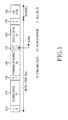
- FIG. 1 is a diagram illustrating the structure of a normal burst according to the present invention.
- the normal burst has a length of 148 bits.
- Each of tail bits 110 and 170 has a length of 3 bits and is used to discern the start and the end of the burst, respectively.
- Each of coded data 120 and 160 has a length of 57 bits and contains actual data.
- Each of stealing flags 130 and 150 has a length of 1 bit and indicates whether the normal burst is a signal burst or a data burst.
- stealing flags 130 and 150 are normally unused (unnecessary). According to the present invention, stealing flags 130 and 150 of the normal burst in the BCCH are used for transmission of time information.
- Training sequence 140 is used for synchronization. Training sequence 140 has a length of 26 bits and is constructed in a sequence that is negotiated between the base station and the portable terminal.
- Guard period 180 is intended for smooth transmission/reception of the normal burst and does not contain actual data.
- Information of a synchronization burst is used to obtain a frame number so that a portable terminal can detect the location of the normal burst in a frame that carries time information.
- FIG. 2 is a diagram illustrating the structure of a synchronization burst according to the present invention.
- the synchronization burst is used to transmit information of a Synchronization CHannel (SCH) in the GSM communication system.
- SCH Synchronization CHannel
- the synchronization burst has a length of 148 bits.
- Each of tail bits 210 and 270 has a length of 3 bits and is used to discern the start and the end of the burst, respectively.
- Each of coded data 220 and 260 has a length of 39 bits and contains actual data.
- Synchronization sequence 240 has a length of 64 bits and is used for synchronization.
- Guard period 280 is intended for smooth transmission/reception of the normal burst and does not contain actual data.
- the frame number illustrated in FIG. 1 and a Base Station identity Code (BSIC) are contained in coded data 220 and 260.
- the BCCH of the normal burst containing the time information and the SCH of the synchronization burst containing the frame number are contained in a signaling frame structure.
- the signaling frame structure includes 51 frames, while a data frame structure or a traffic frame structure includes 26 frames.
- FIG. 3 is a diagram illustrating the structure of a signaling frame according to the present invention.
- the signaling frame structures are classified according to the channel combination structures thereof.
- the signaling frame structure of FIG. 3 corresponds to combination structure 4.
- F Frequency Correction CHannel
- SCH Synchronization CHannel
- Broadcast Control CHannel Broadcast Control CHannel
- Common Control CHannel Common Control CHannel
- Time information according to the present invention is contained in a stealing flag of a normal burst in a BCCH frame.
- the portable terminal can transmit and receive time information using an idle frame that is the last frame.
- the time information is contained in an idle state.
- LCM least common multiple
- a superframe is composed of 1,326 frames and 2,048 superframes constitute a hyperframe.
- FIG. 4 is a diagram illustrating the structures of and the relationship among a traffic frame, a signaling frame, a superframe, and a hyperframe according to the present invention.
- the signaling frame has a time length of 120 ms and the traffic frame has a time length of 235.38 ms.
- the superframe has a time length of 6.12 seconds, and the hyperframe has a time length of 3h 2m 53s 760ms.
- FIG. 5 is a diagram illustrating parameters for obtaining the frame number according to the present invention.
- FIG. 5 illustrates information elements that are contained in the synchronization burst of a synchronization channel, which will be used for the following description.
- BSIC indicates an identity code of a base station that is used as a base station identifier.
- T1 (520, 530, 540) indicates a frame count of a superframe.
- T2 (550) indicates a frame count of a traffic frame structure.
- T3 indicates a frame count of a signaling frame structure.
- the mobile terminal can obtain the current frame count value from the synchronization burst in the synchronization channel of FIG. 2.
- a base station and a portable terminal use parameters termed Transaction Capabilities (TC) for mapping a frame number.
- TC Transaction Capabilities
- the TC is used to determine whether transmission of time information is completed.
- Equation (3) the result of the frame number divided by 51 equals the number of frames in the signaling frame structure. If the stealing flag is used, 8 bits may be allocated to time information for each signaling frame structure.
- the TC increases by 1 when 8 bits are transmitted. For example, when 64 bits are necessary for transmission of time information, if the TC value is 8, it can be seen that 64 bits are provided.
- TC Frame Number / 51 ⁇ mod 16
- a lapse time from a reference time e.g., midnight
- a reference time e.g., midnight
- complete time information can be obtained.
- T1, T2 and T3 indicate the frame number from which the reference time starts. If the values of T1, T2 and T3, the frame count value, and the date information are contained in the normal burst transmitted to the portable terminal over the BCCH, the portable terminal can obtain the complete time information using the current frame number value that can be obtained from the above information and the current SCH.
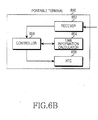
- FIGs. 6A and 6B are block diagrams of a time information transmitting/receiving apparatus according to the present invention.
- FIG. 6A illustrates base station 610 that transmits the time information
- FIG. 6B illustrates portable terminal 652 that receives the time information.
- receiver 612 receives time information from an upper-layer network. Controller 614 provides the time information to time information parameter calculator 616. Under the control of controller 614, time information parameter calculator 616 outputs T1, T2 and T3 at the reference time, a parameter that is a count value of a complete hyperframe structure after the reference time, time information that is date information such as year, month and the outputs are transmitted by transmitter 618 over a BCCH to portable terminal 650.
- Time information parameter calculator 616 calculates T1 (11 bits), T2 (5 bits) and T3 (6 bits) for indication of a frame number at the reference time on the basis of the time information received from controller 614, and provides a counter value of a complete hyperframe structure after the reference time, a year value (7 bits), a month value (4 bits) and a date value (5 bits) to controller 614.
- portable terminal 650 receives the time information.
- Receiver 652 receives and provides time information to controller 658.
- Controller 658 provides the time information to time information calculator 654 to calculate a complete time.
- Time information calculator 654 calculates the complete time using T1, T2 and T3 for indicating a frame number at a reference time, a frame count value of a complete hyperframe structure after the reference time, date information (i.e., year, month and day), and a frame number of a current hyperframe structure in an SCH, and provides the calculated complete time to controller 658.
- a method for controlling the complete time will be described in detail later with reference to FIG. 8.
- Controller 658 inputs the received time information into Real-Time Clock (RTC) 656 for reflection.
- RTC Real-Time Clock
- Base station 610 updates the time information periodically or when a specific event occurs, and provides the updated time information to portable terminal 650.
- Portable terminal 650 receives and applies the updated time information.
- An example of the update of the time information is as follows.
- Portable terminal 650 receives the time information from base station 610 at one reference time per day or when a reference time changes (e.g., the start and the end of daylight saving time). The time information is updated in case of a change in a region.
- FIG. 7 is a flowchart illustrating a procedure for transmitting time information according to an embodiment of the present invention.
- time information parameter calculator 616 calculates T1, T2 and T3 for indicating a frame number at a reference time, a frame count value of a complete hyperframe structure after the reference time, date information (i.e., year, month and day), in step 710, in response to a command of controller 614.
- the calculated information is provided to controller 614.
- a plurality of signaling frames may be required depending on the length of the time information.
- the portable terminal can detect the time of completion of the reception of the time information using specific mapping parameters.
- FIG. 8 is a flowchart illustrating a procedure for receiving time information according to an embodiment of the present invention.
- controller 658 of portable terminal 650 calculates a TC value from a received signaling frame structure in step 820.
- step 830 controller 658 determines if the TC value is 0. If so, the procedure proceeds to step 840; and if not, the procedure proceeds to step 835. In step 835, controller 658 calculates a TC value from the next signaling frame structure and then the procedure returns to step 830.
- the TC value may vary depending on the size of the time information.
- time information calculator 654 calculates T1, T2 and T3 for indicating a frame number at a reference time, a frame count value of a complete hyperframe structure after the reference time, and date information (i.e., year, month and day) on the basis of the time information.
- time information calculator 654 calculates the time from the time information to the start of the complete hyperframe structure.
- the time from the time information to the start of the complete hyperframe structure can be calculated as follows.
- T1, T2 and T3 values among the time information are used to calculate a frame number corresponding to the start of a reference time.
- the maximum value of the frame number is 2,715,647, which is the number of frames in a hyperframe less 1.
- the value of the frame number corresponding to the start of the reference time is subtracted from the maximum value.
- the value of the subtraction result is multiplied by the time length of one frame (4.615 ms), thereby obtaining the time from the reference time to the start of the first complete hyper structure.
- time information calculator 654 calculates the time from the start to the end of the complete hyperframe.
- the time from the start to the end of the complete hyperframe can be calculated as follows.
- a count value of the complete hyperframe structure after the reference time is multiplied by the time length of the hyperframe (3h 2m 53s 760ms), thereby obtaining the time from the start to the end of the complete hyperframe structure.
- step 860 time information calculator 654 calculates a frame number in the current hyperframe structure to obtain a time from the end of the complete hyperframe structure to a current time.
- step 850 uses a received T3 value
- step 860 uses Equation (1) to calculate a T3 value from a T3' value.
- the frame number in the current hyperframe structure can be obtained from a synchronization burst of an SCH.
- the current frame structure is obtained from the current hyperframe structure and the resulting value is multiplied by a frame time length, thereby obtaining the time from the end of the complete hyperframe structure to the current time.
- time information calculator 654 adds the times of steps 850, 855 and 860 to obtain the lapse time from the reference time.
- time information calculator 654 adds date (i.e., year, month and day) information to the lapse time to obtain the complete time.
- Time information calculator 654 provides the complete time to controller 658 and controller 658 stores the complete time in the RTC, in step 875.
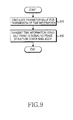
- FIG. 9 is a flowchart illustrating a procedure for transmitting time information according to another embodiment of the present invention.
- time information parameter calculator 616 calculates T1, T2 and T3 for indicating a frame number at a reference time, a frame count value of a complete hyperframe structure after the reference time, date information (i.e., year, month and day), in step 910, in response to a command of controller 614.
- the calculated information is provided to controller 614.
- controller 614 transmits the time information through transmitter 618 using an idle flag of a signaling frame structure containing a BCCH.
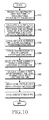
- FIG. 10 is a flowchart illustrating a procedure for receiving time information according to another embodiment of the present invention.
- controller 658 of portable terminal 650 receives time information through receiver 652 from an idle frame of a signaling frame structure and provides the time information to time information calculator 654.
- steps 1045 through 1075 are identical respectively to steps 845 through 875.
- the time information transmission procedures of FiGs. 7 and 9 and the time information reception procedures of FIGs. 8 and 10 can be applied independently but cannot be applied selectively under specific conditions.
- the present invention transmits and receives time information periodically using the idle frame of an idle state and the stealing flag of a normal burst contained in the BCCH (not a dedicated channel). Accordingly, it is possible to prevent overhead to the network and to maintain the accurate time information.
Landscapes
- Physics & Mathematics (AREA)
- General Physics & Mathematics (AREA)
- Engineering & Computer Science (AREA)
- Computer Networks & Wireless Communication (AREA)
- Signal Processing (AREA)
- Mobile Radio Communication Systems (AREA)
Applications Claiming Priority (1)
| Application Number | Priority Date | Filing Date | Title |
|---|---|---|---|
| KR1020060052824A KR100761696B1 (ko) | 2006-06-13 | 2006-06-13 | 이동통신 시스템에서 시간 정보 송 수신 장치 및 방법 |
Publications (2)
| Publication Number | Publication Date |
|---|---|
| EP1868050A2 true EP1868050A2 (de) | 2007-12-19 |
| EP1868050A3 EP1868050A3 (de) | 2009-11-18 |
Family
ID=38596301
Family Applications (1)
| Application Number | Title | Priority Date | Filing Date |
|---|---|---|---|
| EP07107880A Withdrawn EP1868050A3 (de) | 2006-06-13 | 2007-05-10 | Vorrichtung und Verfahren zum Senden/Empfangen von Zeitinformationen in einem mobilen Kommunikationssystem |
Country Status (4)
| Country | Link |
|---|---|
| US (1) | US7974263B2 (de) |
| EP (1) | EP1868050A3 (de) |
| KR (1) | KR100761696B1 (de) |
| CN (1) | CN101090572B (de) |
Cited By (1)
| Publication number | Priority date | Publication date | Assignee | Title |
|---|---|---|---|---|
| WO2016055942A1 (en) * | 2014-10-09 | 2016-04-14 | Telefonaktiebolaget L M Ericsson (Publ) | Frame number extension for long discontinuous receive (drx) cycles |
Families Citing this family (6)
| Publication number | Priority date | Publication date | Assignee | Title |
|---|---|---|---|---|
| CN101997567B (zh) * | 2009-08-21 | 2013-03-06 | 联芯科技有限公司 | 一种基站识别码的识别方法和装置 |
| US8428080B2 (en) | 2010-09-16 | 2013-04-23 | Apple Inc. | Method to control reconfiguration of multiple radio access bearers in a wireless device |
| US20130232373A1 (en) * | 2012-03-01 | 2013-09-05 | Tung-Yi Wang | Method for performing real time clock calibration through frame number calculation, and associated apparatus |
| US9066288B2 (en) | 2012-09-13 | 2015-06-23 | Qualcomm Incorporated | Apparatus and method for enabling communication on a supplemental channel in a GSM wireless communication network |
| CN105450467B (zh) * | 2015-11-11 | 2020-06-12 | 腾讯科技(深圳)有限公司 | 监控方法、接入机以及业务服务器 |
| CN114070544A (zh) * | 2018-02-08 | 2022-02-18 | 华为技术有限公司 | 信息发送/接收方法和装置 |
Citations (1)
| Publication number | Priority date | Publication date | Assignee | Title |
|---|---|---|---|---|
| US20030040869A1 (en) | 2000-03-30 | 2003-02-27 | Joseph Nir | Providing time sychronization to a gps locator |
Family Cites Families (14)
| Publication number | Priority date | Publication date | Assignee | Title |
|---|---|---|---|---|
| GB9207861D0 (en) * | 1992-04-09 | 1992-05-27 | Philips Electronics Uk Ltd | A method of time measurement in a communications system,a communications system and a receiving apparatus for use in the system |
| US6118827A (en) * | 1997-09-05 | 2000-09-12 | Ericsson Inc. | Apparatus for providing increased data rates within existing modulation systems |
| US6204808B1 (en) * | 1998-08-13 | 2001-03-20 | Ericsson Inc. | Method and system for aiding GPS receivers via a cellular or PCS network |
| FI108202B (fi) * | 1998-12-22 | 2001-11-30 | Nokia Networks Oy | Signalointimenetelmä ja tietoliikennejärjestelmä |
| KR20000044264A (ko) * | 1998-12-30 | 2000-07-15 | 윤종용 | 휴대 전화 단말 장치의 시간 자동 설정 방법 |
| EP1143640A1 (de) * | 1999-10-15 | 2001-10-10 | Mitsubishi Denki Kabushiki Kaisha | Zeiteinstellung für mobiles kommunikationsgerät, und mobiles kommunikationsgerät |
| US6377792B1 (en) | 1999-10-22 | 2002-04-23 | Motorola, Inc. | Method and apparatus for network-to-user verification of communication devices based on time |
| US6963588B1 (en) * | 2000-11-21 | 2005-11-08 | Cellco Partnership | System and methodology for automatically setting a clock |
| US7006834B2 (en) | 2001-10-29 | 2006-02-28 | Qualcomm Incorporated | Base station time calibration using position measurement data sent by mobile stations during regular position location sessions |
| KR20040076533A (ko) * | 2003-02-26 | 2004-09-01 | 에스케이텔레텍주식회사 | 시각 알림 방법 및 이를 이용한 이동통신단말기 |
| KR100603445B1 (ko) * | 2003-07-15 | 2006-07-24 | 주식회사 팬택 | 무선통신단말기에서의 세계 시간 표시 방법 |
| DE10361593A1 (de) * | 2003-12-30 | 2005-07-28 | Atmel Germany Gmbh | Verfahren zur Bestimmung des Sekundenbeginns aus einem gesendeten Zeitzeichensignal |
| KR20050073802A (ko) * | 2004-01-12 | 2005-07-18 | 엘지전자 주식회사 | 전자기기의 시각설정방법 및 장치 |
| CN100524103C (zh) * | 2004-06-23 | 2009-08-05 | Nxp股份有限公司 | 用于更新当前时间的方法和使用所述方法的设备 |
-
2006
- 2006-06-13 KR KR1020060052824A patent/KR100761696B1/ko not_active Expired - Fee Related
-
2007
- 2007-05-10 EP EP07107880A patent/EP1868050A3/de not_active Withdrawn
- 2007-05-24 US US11/753,234 patent/US7974263B2/en not_active Expired - Fee Related
- 2007-06-12 CN CN2007101090109A patent/CN101090572B/zh not_active Expired - Fee Related
Patent Citations (1)
| Publication number | Priority date | Publication date | Assignee | Title |
|---|---|---|---|---|
| US20030040869A1 (en) | 2000-03-30 | 2003-02-27 | Joseph Nir | Providing time sychronization to a gps locator |
Cited By (2)
| Publication number | Priority date | Publication date | Assignee | Title |
|---|---|---|---|---|
| WO2016055942A1 (en) * | 2014-10-09 | 2016-04-14 | Telefonaktiebolaget L M Ericsson (Publ) | Frame number extension for long discontinuous receive (drx) cycles |
| US9999089B2 (en) | 2014-10-09 | 2018-06-12 | Telefonaktiebolaget Lm Ericsson (Publ) | Frame number extension for long discontinuous receive (DRX) cycles |
Also Published As
| Publication number | Publication date |
|---|---|
| KR100761696B1 (ko) | 2007-09-28 |
| CN101090572A (zh) | 2007-12-19 |
| US20070291731A1 (en) | 2007-12-20 |
| US7974263B2 (en) | 2011-07-05 |
| EP1868050A3 (de) | 2009-11-18 |
| CN101090572B (zh) | 2011-03-30 |
Similar Documents
| Publication | Publication Date | Title |
|---|---|---|
| EP1868050A2 (de) | Vorrichtung und Verfahren zum Senden/Empfangen von Zeitinformationen in einem mobilen Kommunikationssystem | |
| RU2419995C2 (ru) | Формирование заключения о применимости параметра синхронизации восходящей линии связи | |
| KR0179402B1 (ko) | 이동통신 수신기의 소비전력을 감소하는 장치 및 방법 | |
| EP0726508B1 (de) | Echtzeituhr geeignet für ein Mobiltelefon | |
| JP3058821B2 (ja) | 無線電話機 | |
| EP1511336B1 (de) | Verfahren zur Steuerung des Schlafmodus in einem drahtlosen Breitband-Zugangskommunikationssystem | |
| JP3110670B2 (ja) | 無線電話機 | |
| KR100723556B1 (ko) | 시계를 자동적으로 설정하기 위한 시스템 | |
| US20090117853A1 (en) | Mobile station, wireless access network apparatus, mobile communication system, and informative information transmitting/receiving method | |
| EP1818739A2 (de) | Vorrichtung und Verfahren zum Verwalten von Zeitinformationen | |
| KR20110075777A (ko) | 무선 통신망에서 수면모드를 제어하는 방법 및 장치 | |
| WO1998018216A2 (en) | A digital wireless communications system and a wireless radio station | |
| US5722065A (en) | Mobile communications system and mobile receiver | |
| EP1677424B1 (de) | Verfahren und Vorrichtung zur Reduktion der Leistungsaufnahme in einem Mobilfunk-Endgerät | |
| KR101050647B1 (ko) | 랜덤 엑세스 채널 신호를 다양한 송신 파워 레벨로전송하는 이동통신 단말기 및 방법 | |
| WO2008150206A1 (en) | Dual random access channels in extended range | |
| JP5195233B2 (ja) | 無線端末装置、無線中継装置及びプログラム | |
| JP3288196B2 (ja) | 移動体通信端末 | |
| KR100678084B1 (ko) | 이동통신 단말기의 전원을 절약하는 장치 및 방법 | |
| JP2006211279A (ja) | 無線基地局装置、チャネル数制御装置及びチャネル数制御方法 | |
| CN100524103C (zh) | 用于更新当前时间的方法和使用所述方法的设备 | |
| US20020151319A1 (en) | Method for controlling the transmission and reception activities of a local radiocommunications system | |
| US6028529A (en) | Clock correction function for a radio selective call receiver with an intermittent receiver | |
| JP2733378B2 (ja) | 移動通信における無線回線の切替方法及び装置 | |
| JP2919247B2 (ja) | 移動無線通信方式および受信機 |
Legal Events
| Date | Code | Title | Description |
|---|---|---|---|
| PUAI | Public reference made under article 153(3) epc to a published international application that has entered the european phase |
Free format text: ORIGINAL CODE: 0009012 |
|
| 17P | Request for examination filed |
Effective date: 20070510 |
|
| AK | Designated contracting states |
Kind code of ref document: A2 Designated state(s): AT BE BG CH CY CZ DE DK EE ES FI FR GB GR HU IE IS IT LI LT LU LV MC MT NL PL PT RO SE SI SK TR |
|
| AX | Request for extension of the european patent |
Extension state: AL BA HR MK YU |
|
| PUAL | Search report despatched |
Free format text: ORIGINAL CODE: 0009013 |
|
| AK | Designated contracting states |
Kind code of ref document: A3 Designated state(s): AT BE BG CH CY CZ DE DK EE ES FI FR GB GR HU IE IS IT LI LT LU LV MC MT NL PL PT RO SE SI SK TR |
|
| AX | Request for extension of the european patent |
Extension state: AL BA HR MK RS |
|
| 17Q | First examination report despatched |
Effective date: 20100615 |
|
| AKX | Designation fees paid |
Designated state(s): DE FR GB |
|
| RAP1 | Party data changed (applicant data changed or rights of an application transferred) |
Owner name: SAMSUNG ELECTRONICS CO., LTD. |
|
| STAA | Information on the status of an ep patent application or granted ep patent |
Free format text: STATUS: THE APPLICATION IS DEEMED TO BE WITHDRAWN |
|
| 18D | Application deemed to be withdrawn |
Effective date: 20130626 |
|
| REG | Reference to a national code |
Ref country code: DE Ref legal event code: R079 Free format text: PREVIOUS MAIN CLASS: G04G0001060000 Ipc: G04G0021040000 Effective date: 20140618 |