EP1868138A2 - Procédé de suivi d'un oeil humain dans une image vidéo - Google Patents
Procédé de suivi d'un oeil humain dans une image vidéo Download PDFInfo
- Publication number
- EP1868138A2 EP1868138A2 EP07075445A EP07075445A EP1868138A2 EP 1868138 A2 EP1868138 A2 EP 1868138A2 EP 07075445 A EP07075445 A EP 07075445A EP 07075445 A EP07075445 A EP 07075445A EP 1868138 A2 EP1868138 A2 EP 1868138A2
- Authority
- EP
- European Patent Office
- Prior art keywords
- eye
- target
- patches
- candidates
- search window
- Prior art date
- Legal status (The legal status is an assumption and is not a legal conclusion. Google has not performed a legal analysis and makes no representation as to the accuracy of the status listed.)
- Withdrawn
Links
Images



Classifications
-
- G—PHYSICS
- G06—COMPUTING OR CALCULATING; COUNTING
- G06T—IMAGE DATA PROCESSING OR GENERATION, IN GENERAL
- G06T7/00—Image analysis
- G06T7/20—Analysis of motion
-
- G—PHYSICS
- G06—COMPUTING OR CALCULATING; COUNTING
- G06V—IMAGE OR VIDEO RECOGNITION OR UNDERSTANDING
- G06V40/00—Recognition of biometric, human-related or animal-related patterns in image or video data
- G06V40/10—Human or animal bodies, e.g. vehicle occupants or pedestrians; Body parts, e.g. hands
- G06V40/18—Eye characteristics, e.g. of the iris
- G06V40/19—Sensors therefor
Definitions
- the present invention relates to a method of tracking a human's eyes in successively produced video image frames.
- Vision systems frequently entail detecting and tracking a person's eyes in a stream of images generated by a video camera.
- a camera can be used to generate an image of the driver's face, and portions of the image corresponding to the driver's eyes can be analyzed to assess drive gaze or drowsiness. See, for example, the U.S. Patent Nos. 5,795,306 ; 5,878,156 ; 5,926,251 ; 6,097,295 ; 6,130,617 ; 6,243,015 ; 6,304,187 ; and 6,571,002 , incorporated herein by reference.
- eye detection and tracking algorithms can work reasonably well in a controlled environment, they tend to perform poorly under real world imaging conditions where the lighting produces shadows and the person's eyes can be occluded by eyeglasses, sunglasses or makeup.
- pixel clusters associated with the eyes tend to be grouped together with non-eye features and discarded when subjected to appearance-based testing. This problem occurs both in eye detection routines that initially locate the eyes, and in eye tracking routines that track the eye from one image frame to the next.
- Problems that especially plague eye tracking include head movement and eye blinking, both of which can cause previously detected eyes to suddenly disappear.
- the present invention is directed to an efficient and reliable method of tracking a human eye between successively produced video image frames. Once the eye is detected, its location is used to define a search window in the next image frame. Potential eye candidates within the search window are identified using horizontal projection filtering, coupled with rudimentary appearance-based testing. The identified eye candidates are clustered and subjected to additional appearance-based testing to determine if one or more eye candidates should be accepted. If no eye candidates are accepted, a correlation/appearance technique is applied to the search window to identify the eye. If the correlation or appearance test results do not meet predefined criteria, it is assumed that the eye is closed, and peripheral eye-related patches from the previous image frame are extracted and compared with the search window to identify corresponding features in the search window for the current frame.
- the eye center is computed according to the mean of the eye periphery patches. Only when all of these techniques fail to locate an eye in the search window is the tracking routine abandoned and the eye detection routine re-initialized.
- the method of the present invention is disclosed in the context of a system that monitors a driver of a motor vehicle. However, it will be recognized that the method of this invention is equally applicable to other vision systems that detect and track eye movement, whether vehicular or non-vehicular, and to systems that detect and track other types of features or targets.
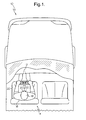
- the reference numeral 10 generally designates a motor vehicle equipped with an eye monitoring apparatus 12 according to the present invention.
- the apparatus 12 is mounted in the passenger compartment 14 forward of the driver 16 in a location that affords an unobstructed view of the driver's face 18 when the driver 16 is reposed on the seat 20, taking into account differences in driver height and orientation.
- the eye monitoring apparatus 12 produces a series of video images of the driver's face 18, and executes digital signal processing routines for detecting portions of a given image that correspond to the driver's eyes 22 and tracking the eye location between successively produced video images.
- the state of the eyes 22 can be characterized for various purposes such as detecting driver drowsiness and/or distraction, or even driver gaze.
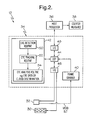
- the apparatus 12 includes an infrared (IR) light illumination device 30, a solid-state imaging device 32 and a vision processor 34.
- the apparatus 12 provides eye state information to a remote host processor 36 via line 37, and the host processor 36 selectively activates one or more counter-measure devices or systems 38 such as an alarm or a braking system if it is determined that the driver's lack of alertness or attention may possibly compromise vehicle safety.
- the illumination device 30 may be an array of light emitting diodes, for example, and the imaging device 32 may be a CCD or CMOS imaging chip.
- the vision processor 34 comprises conventional components, including a frame grabber 40 for acquiring video images from imaging device 32, a non-volatile memory 42 for storing various signal processing routines, and a digital signal processor (DSP) 44 for selectively executing the routines stored in memory 42 processing the video images acquired by frame grabber 40.
- the DSP 44 outputs various control signals to illumination device 30 and imaging device 32 via interface 46, and communicates with host processor 37 via interface 48.
- the signal processing routines residing in the vision processor memory 42 include an eye detection routine 50, an eye tracking routine 52, and an eye analysis routine 54.
- the eye detection routine 50 identifies the regions of a video image that correspond to the driver's eyes 22
- the eye tracking routine 52 tracks the eye location from one video image to the next
- the eye analysis routine 54 characterizes the state of the driver's eyes (open vs. closed, for example).
- the present invention primarily concerns the eye tracking routine 52; the eye detection routine 50, the eye analysis routine 54 and the routines executed by host processor 36 for using the eye state information may comprise any of a number of known processing techniques.
- the eye tracking routine 52 is broadly described by the main loop flow diagram of FIG. 7, and is illustrated in part by the images of FIGS. 3-6.
- the flow diagrams of FIGS. 8-11 detail various aspects of the mail loop flow diagram.
- the block 60 is first executed to acquire a new image frame and to extract a local search window (LSW) of predetermined size, centered on the last-identified location of the occupant's eye.
- LSW local search window
- the local search window for the occupant's right eye is designated by a large solid-lined rectangle.
- the blocks 62 and 64 are executed to extract eye candidates from the LSW using an inverse receptive hole extraction (IRHE) technique and to test the extracted eye candidates to determine if they should be accepted.
- IRHE inverse receptive hole extraction
- the functionality of block 62 is detailed in the flow diagram of FIG. 8, and the functionality of block 64 is detailed in the flow diagram of FIG. 9. If at least one eye candidate is accepted, the block 62 sets the status of a Tracking Flag to IRHE; otherwise, the status of the Tracking Flag is set to NONE. The block 66 then checks the status of the Tracking Flag.
- block 66 determines that the Tracking Flag status is IRHE
- block 68 is executed to update a state vector that marks the location of the eye, whereafter the routine is re-executed for the next image frame.
- the Tracking Flag status is NONE
- the IRHE technique was unsuccessful, and DSP 44 executes block 70 to perform an alternate eye extraction technique using correlation and appearance testing (CAT).
- CAT correlation and appearance testing
- the block 70 also sets the status of the Tracking Flag -- if at least one eye candidate is extracted and accepted, block 70 sets the status of the Tracking Flag to CAT; otherwise, the status of the Tracking Flag is set to NONE.
- the block 72 then checks the status of the Tracking Flag.
- Block 68 is executed to update the eye location state vector as explained above. If the Tracking Flag status is NONE, the alternate eye extraction technique of block 70 was also unsuccessful. This can occur, for example, when the driver's eye is closed. In this case, DSP 44 executes the missed-observation routine of block 74 to determine if the eye location can be identified based on peripheral eye-related patches. As indicated, the functionality of block 74 is detailed in the flow diagram of FIG. 11. Block 74 also sets the status of the Tracking Flag -- if at least one eye candidate is identified and accepted, the status of the Tracking Flag is set to EPT; otherwise, the status of the Tracking Flag is set to NONE. Finally, the block 76 checks the status of the Tracking Flag.
- Block 68 is executed to update the eye location state vector as explained above. If the Tracking Flag status is NONE, the occupant's previously detected eye could not be successfully tracked, and the block 78 is executed to re-start the eye detection routine 50.
- the process of extracting eye candidates from the local search window is initiated at blocks 80 and 82 which apply a morphological bottom-hat filter to the LSW and binarize the filtered image.
- the bottom-hat filter is implemented with a mask of predefined size, and generally serves to suppress extraneous pixel information and emphasize the edges of objects and other definable features and regions within the LSW.
- the filtered image is initially binarized to form a "white image" -- i.e., an image in which the dark pixels of the filtered image are represented by white pixels, and light pixels of the filtered image are represented by black pixels.
- FIG. 4 depicts a "white image" version of a typical LSW -- it is seen that the occupant's facial skin and other highly reflective regions are represented by black pixels, while dark regions such as the occupant's iris and pupil are represented by white pixels.
- the block 84 scans the "white image" developed at block 80 to identify the largest "blob" of contiguous white pixels (referred to herein as an "eye-blob") and to define a rectangular patch of the image (boundary box) that bounds the identified eye-blob.
- the filtered image of block 80 is then binarized at block 86 to form a "black image” which is the opposite of the "white image” depicted in FIG. 4.
- dark pixels of the filtered image i.e., the occupant's iris and pupil
- light pixels of the filtered image i.e., the occupant's facial skin
- the block 88 extracts a patch of the binarized black image corresponding to the eye-blob boundary box defined at block 84.
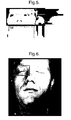
- An extracted black-image eye-blob patch based on the image of FIG. 4 is depicted in the upper left-hand corner of FIG. 5.
- block 90 is executed to count the number of black pixels (receptive holes) in each horizontal line or row of the patch.
- the pixel counts are represented by the histogram to the right of the eye-blob patch. In most cases, the highest pixel count will generally occur in the pixel rows that correspond to the occupant's pupil, as is the case in the example of FIG. 5.
- Block 90 identifies the pixel row having the highest pixel count or receptive hole content (MAX_COUNT_ROW) and block 92 identifies each black pixel in that row as an eye candidate center.
- Block 94 extracts a grey-scale image patch of predetermined size centered about each eye candidate identified at block 92, and performs an appearance-based test (eye vs. non-eye) of each patch.
- the appearance-based test utilizes an Eigen analysis in which Eigen-space distances between a respective candidate grey-scale patch and relatively low resolution (Level-I) eye and non-eye models are computed. Any candidate patch that resembles the LEVEL-I eye model will have a relatively short eye distance and a relatively long non-eye distance; any candidate patch that resembles the Level-I non-eye model will have a relatively short non-eye distance and a relatively long eye distance.
- the distances are compared to thresholds to classify the eye candidates as DESIRED, UNDESIRED or UNSURE.
- the DESIRED classification indicates a high confidence determination that an eye candidate is the center of the occupant's eye; i.e., that it resembles the Level-I eye model, and does not resemble the Level-I non-eye model.
- the UNDESIRED classification indicates a high confidence determination that the eye candidate is a non-eye feature; i.e., that it resembles the Level-I non-eye model, and does not resemble the Level-I eye model.
- the UNSURE classification indicates that a high confidence determination cannot be made.
- the confidence metric is based on the separation between the eye distance and the non-eye distance, with larger separation signifying higher confidence in the appearance determination.
- the process defined by blocks 92-94 is repeated for a predefined number N of pixel rows above and below MAX_COUNT_ROW.
- the predefined number N depends on the application, and may be determined based on the available processing time.
- the end result is a list of potential eye candidates, each comprising an eye-sized patch of the grey-scale image.
- the blocks 98 and 100 are then executed to cluster the extracted eye candidates.
- the block 98 pairs a selected eye candidate with neighboring eye candidates - i.e., with any eye candidate whose center is within a predetermined coordinate-space distance of the selected eye candidate. If such pairing is possible, the block 100 compares the stored Eigen eye distances for the respective eye candidates; the eye candidate having the smallest Eigen eye distance is retained, while the other eye candidate(s) is removed from the eye candidate list. As indicated at block 102, the process defined by blocks 98-100 is then repeated for the next eye candidate until every eye candidate in the list has been processed.
- the process of appearance testing the retained eye candidates begins at block 106 where DSP 44 extracts a gray-scale patch of the LSW centered on a selected eye candidate.
- the block 108 then computes Eigen-space distances between the eye candidate and various Level-II models and compares the distances to thresholds to classify the respective eye candidate as DESIRED, UNDESIRED or UNSURE as described above in reference to block 94 of FIG. 8.
- Block 110 then checks the classification results.
- the blocks 112 and 114 are executed to eliminate the eye candidate from the list and to set the Tracking Flag to NONE. If the eye candidate is classified as DESIRED or UNSURE by at least one of the tests, the blocks 116 and 118 are executed to store the minimum Eigen distance attributed to the eye candidate and to set the Tracking Flag to IRHE. As indicated at block 120, the process defined by blocks 106-118 is then repeated for the next eye candidate until every eye candidate in the list has been selected.
- the correlation/appearance testing involves attempting to locate an eye within the LSW by correlation (blocks 122-128), and if successful, conducting appearance-based testing of each identified eye candidate (blocks 132-140).
- the block 122 computes a similarity distance (i.e., a single normalized cross-correlation) between a grey-scale eye-box patch from the previous image frame and a corresponding patch from the current image frame.
- the block 124 compares the computed similarity distance to a threshold THR. If the distance is less than THR, the patches compare favorably, and block 132 is executed to begin appearance testing of the patch from the current image frame.
- the block 126 is executed to compute a multiple, or pixel-by-pixel, correlation matrix between the grey-scale eye-box patch from the previous image frame and the LSW. This time, the block 128 checks if any of the correlation values exceed a threshold such as 90%. If so, the DSP 44 is directed to block 132 to begin appearance testing of the identified region(s) of the LSW. If not, an eye candidate could not verified by correlation, and the block 130 is executed to set the Tracking Flag to NONE.
- a threshold such as 90%
- Block 132 computes Eigen-space distances between the eye candidate and various Level-II models and compares the distances to thresholds to classify the respective eye candidate as DESIRED, UNDESIRED or UNSURE as described above in reference to FIGS. 8-9.
- block 132 compares the eye candidate to two different sets of Level-II appearance-based models: eye vs. non-eye; and eyeglasses vs. non-eye.
- Block 134 then checks the classification results. If the eye candidate is classified as DESIRED by either test, the block 136 is executed to set the Tracking Flag to CAT.
- the block 138 computes Eigen-space distances between the eye candidate and Level-II appearance models to judge closed-eye vs. non-eye and the corresponding classification. If the classification is DESIRED, the block 140 directs DSP 44 to set the Tracking Flag to CAT; otherwise the block 130 is executed to set the Tracking Flag to NONE.
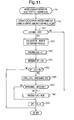
- the missed observation routine (i.e., block 74 of FIG. 7) is initiated at block 142 which extracts a set of eye-periphery image patches from the previous image frame and attempts to identify comparable patches in the LSW.
- the extracted image patches are clustered about, and geometrically symmetrical with respect to, the previously detected eye location.
- the image of FIG. 6 illustrates a mechanization in which DSP 44 extracts a set of four eye-periphery image patches. However, it should be understood that the number and placement of the eye-periphery patches may be different than shown.
- DSP 44 computes and evaluates a similarity distance between the extracted patches and each set of potentially matching patches in the LSW.
- the block 144 compares the similarity distances to a threshold THR. If less than a specified number of matches are found, the missed observation routine is unsuccessful, and the blocks 146 and 148 are executed to set the Tracking Flag to NONE and to reset a counter EPT_CTR to zero. However, if at least a specified number of matches are found, block 144 is answered in the affirmative, and blocks 150 and 152 are executed to compute the eye center according to the mean (center) of the matching eye-periphery patches and to set the Tracking Flag to EPT. Additionally, the block 154 increments EPT_CTR, and block 156 compares the count to a reference count REF such as sixty (which corresponds to two seconds at a frame rate of 30Hz).
- a reference count REF such as sixty (which corresponds to two seconds at a frame rate of 30Hz).
- block 156 is answered in the affirmative, and blocks 158 and 160 are executed to perform an appearance check to determine if the located eye region resembles a closed eye.
- the block 158 extracts a grey-scale eye patch centered on the computed eye center and computes Eigen-space distances between the eye patch and Level-II appearance models to judge closed-eye vs. non-eye and the corresponding classification.
- the block 160 checks the classification.
- the blocks 144 and 146 are executed to set the Tracking Flag to NONE and to reset EPT_CTR to zero; otherwise, the status of the Tracking Flag is maintained as EPT and the block 148 is executed to reset EPT_CTR to zero.
- the method of the present invention provides a multi-faceted approach to eye tracking that minimizes lost eyes even in situations where the person's head turns or the eyes momentarily close. While the present invention has been described with respect to the illustrated embodiment, it is recognized that numerous modifications and variations in addition to those mentioned herein will occur to those skilled in the art. For example, the method of this invention may be applied to a human facial feature other than an eye, or to a distinguishable target feature in general. Accordingly, it is intended that the invention not be limited to the disclosed embodiment, but that it have the full scope permitted by the language of the following claims.
Landscapes
- Engineering & Computer Science (AREA)
- Physics & Mathematics (AREA)
- General Physics & Mathematics (AREA)
- Multimedia (AREA)
- Theoretical Computer Science (AREA)
- Health & Medical Sciences (AREA)
- General Health & Medical Sciences (AREA)
- Ophthalmology & Optometry (AREA)
- Human Computer Interaction (AREA)
- Computer Vision & Pattern Recognition (AREA)
- Image Analysis (AREA)
- Eye Examination Apparatus (AREA)
Applications Claiming Priority (1)
| Application Number | Priority Date | Filing Date | Title |
|---|---|---|---|
| US11/452,871 US7620216B2 (en) | 2006-06-14 | 2006-06-14 | Method of tracking a human eye in a video image |
Publications (2)
| Publication Number | Publication Date |
|---|---|
| EP1868138A2 true EP1868138A2 (fr) | 2007-12-19 |
| EP1868138A3 EP1868138A3 (fr) | 2010-05-12 |
Family
ID=38520602
Family Applications (1)
| Application Number | Title | Priority Date | Filing Date |
|---|---|---|---|
| EP07075445A Withdrawn EP1868138A3 (fr) | 2006-06-14 | 2007-06-07 | Procédé de suivi d'un oeil humain dans une image vidéo |
Country Status (2)
| Country | Link |
|---|---|
| US (1) | US7620216B2 (fr) |
| EP (1) | EP1868138A3 (fr) |
Families Citing this family (16)
| Publication number | Priority date | Publication date | Assignee | Title |
|---|---|---|---|---|
| US8467570B2 (en) * | 2006-06-14 | 2013-06-18 | Honeywell International Inc. | Tracking system with fused motion and object detection |
| US20090245580A1 (en) * | 2006-07-21 | 2009-10-01 | Darryl Greig | Modifying parameters of an object detector based on detection information |
| KR20080073933A (ko) | 2007-02-07 | 2008-08-12 | 삼성전자주식회사 | 객체 트래킹 방법 및 장치, 그리고 객체 포즈 정보 산출방법 및 장치 |
| US20080201641A1 (en) * | 2007-02-21 | 2008-08-21 | Yiling Xie | Method And The Associated Mechanism For 3-D Simulation Stored-Image Database-Driven Spectacle Frame Fitting Services Over Public Network |
| US20090123031A1 (en) * | 2007-11-13 | 2009-05-14 | Smith Matthew R | Awareness detection system and method |
| US8885882B1 (en) | 2011-07-14 | 2014-11-11 | The Research Foundation For The State University Of New York | Real time eye tracking for human computer interaction |
| JP5418579B2 (ja) * | 2011-12-06 | 2014-02-19 | 株式会社デンソー | 開閉眼検出装置 |
| US9265458B2 (en) | 2012-12-04 | 2016-02-23 | Sync-Think, Inc. | Application of smooth pursuit cognitive testing paradigms to clinical drug development |
| JP2014116716A (ja) * | 2012-12-07 | 2014-06-26 | Samsung Display Co Ltd | 追尾装置 |
| US9230180B2 (en) * | 2013-01-18 | 2016-01-05 | GM Global Technology Operations LLC | Eyes-off-the-road classification with glasses classifier |
| US9380976B2 (en) | 2013-03-11 | 2016-07-05 | Sync-Think, Inc. | Optical neuroinformatics |
| CN103366174B (zh) * | 2013-07-05 | 2017-02-08 | 深圳泰山体育科技股份有限公司 | 图像信息获取的方法及系统 |
| DE102014211882A1 (de) * | 2014-06-20 | 2015-12-24 | Robert Bosch Gmbh | Verfahren zur Ermittlung der Herzfrequenz des Fahrers eines Fahrzeugs |
| US10016130B2 (en) | 2015-09-04 | 2018-07-10 | University Of Massachusetts | Eye tracker system and methods for detecting eye parameters |
| US9830708B1 (en) * | 2015-10-15 | 2017-11-28 | Snap Inc. | Image segmentation of a video stream |
| CN109993115B (zh) * | 2019-03-29 | 2021-09-10 | 京东方科技集团股份有限公司 | 图像处理方法、装置及可穿戴设备 |
Family Cites Families (15)
| Publication number | Priority date | Publication date | Assignee | Title |
|---|---|---|---|---|
| US5016282A (en) * | 1988-07-14 | 1991-05-14 | Atr Communication Systems Research Laboratories | Eye tracking image pickup apparatus for separating noise from feature portions |
| US5164992A (en) | 1990-11-01 | 1992-11-17 | Massachusetts Institute Of Technology | Face recognition system |
| US5243418A (en) * | 1990-11-27 | 1993-09-07 | Kabushiki Kaisha Toshiba | Display monitoring system for detecting and tracking an intruder in a monitor area |
| JP3293308B2 (ja) * | 1994-03-10 | 2002-06-17 | 三菱電機株式会社 | 人物状態検出装置 |
| JP3452685B2 (ja) * | 1995-05-10 | 2003-09-29 | 三菱電機株式会社 | 顔画像の処理装置 |
| JP3350296B2 (ja) * | 1995-07-28 | 2002-11-25 | 三菱電機株式会社 | 顔画像処理装置 |
| US6381345B1 (en) * | 1997-06-03 | 2002-04-30 | At&T Corp. | Method and apparatus for detecting eye location in an image |
| JPH1166320A (ja) * | 1997-08-12 | 1999-03-09 | Mitsubishi Electric Corp | 目画像追跡装置 |
| FR2773521B1 (fr) * | 1998-01-15 | 2000-03-31 | Carlus Magnus Limited | Procede et dispositif pour surveiller en continu l'etat de vigilance du conducteur d'un vehicule automobile, afin de detecter et prevenir une tendance eventuelle a l'endormissement de celui-ci |
| DE19803158C1 (de) * | 1998-01-28 | 1999-05-06 | Daimler Chrysler Ag | Vorrichtung zur Vigilanzzustandsbestimmung |
| JP3600755B2 (ja) * | 1999-05-13 | 2004-12-15 | 三菱電機株式会社 | 顔画像処理装置 |
| US6130617A (en) * | 1999-06-09 | 2000-10-10 | Hyundai Motor Company | Driver's eye detection method of drowsy driving warning system |
| JP2001010368A (ja) * | 1999-06-17 | 2001-01-16 | Hyundai Motor Co Ltd | 居眠り運転警報システムの居眠り運転判断方法 |
| US6895103B2 (en) * | 2001-06-19 | 2005-05-17 | Eastman Kodak Company | Method for automatically locating eyes in an image |
| US7362885B2 (en) * | 2004-04-20 | 2008-04-22 | Delphi Technologies, Inc. | Object tracking and eye state identification method |
-
2006
- 2006-06-14 US US11/452,871 patent/US7620216B2/en not_active Expired - Fee Related
-
2007
- 2007-06-07 EP EP07075445A patent/EP1868138A3/fr not_active Withdrawn
Also Published As
| Publication number | Publication date |
|---|---|
| US20070291983A1 (en) | 2007-12-20 |
| EP1868138A3 (fr) | 2010-05-12 |
| US7620216B2 (en) | 2009-11-17 |
Similar Documents
| Publication | Publication Date | Title |
|---|---|---|
| EP1868138A2 (fr) | Procédé de suivi d'un oeil humain dans une image vidéo | |
| EP1732028B1 (fr) | Système et procédé de détection d'un oeil | |
| EP1933256B1 (fr) | Système et procédé de reconnaissance de fermeture des yeux | |
| US7940962B2 (en) | System and method of awareness detection | |
| US7253739B2 (en) | System and method for determining eye closure state | |
| US7798643B2 (en) | System for analyzing eye responses to automatically track size, location, and movement of the pupil | |
| US9646215B2 (en) | Eye part detection apparatus | |
| CN107292251B (zh) | 一种基于人眼状态的驾驶员疲劳检测方法及系统 | |
| CN111616718B (zh) | 基于姿态特征的驾驶员疲劳状态检测方法和系统 | |
| CN109325462B (zh) | 基于虹膜的人脸识别活体检测方法及装置 | |
| EP2060993B1 (fr) | Système et procédé de détection de sensibilisation | |
| US7746235B2 (en) | System and method of detecting eye closure based on line angles | |
| JP2000259814A (ja) | 画像処理装置及びその方法 | |
| WO2003073359A2 (fr) | Procede et appareil de reconnaissance d'objets | |
| JPH07181012A (ja) | 画像データの特徴量検出装置 | |
| US7650034B2 (en) | Method of locating a human eye in a video image | |
| CN106203338B (zh) | 基于网格区域分割和阈值自适应的人眼状态快速识别方法 | |
| Huang et al. | An optimized eye locating and tracking system for driver fatigue monitoring | |
| CN114202750A (zh) | 一种应用于汽车驾驶员的疲劳监测方法 | |
| KR20060022935A (ko) | 눈 영상 기반의 졸음 감지방법 및 장치 | |
| Cristiani et al. | Driver drowsiness identification by means of passive techniques for eye detection and tracking | |
| US10275648B2 (en) | Image processing method and system for iris recognition | |
| Syahputra et al. | EYE ASPECT RATIO ADJUSTMENT DETECTION FOR STRONG BLINKING SLEEPINESS BASED ON FACIAL LANDMARKS WITH EYE-BLINK DATASET | |
| JP2018173799A (ja) | 画像解析装置 | |
| Kaur et al. | Automatic detection of driver fatigue-Phase III |
Legal Events
| Date | Code | Title | Description |
|---|---|---|---|
| PUAI | Public reference made under article 153(3) epc to a published international application that has entered the european phase |
Free format text: ORIGINAL CODE: 0009012 |
|
| AK | Designated contracting states |
Kind code of ref document: A2 Designated state(s): AT BE BG CH CY CZ DE DK EE ES FI FR GB GR HU IE IS IT LI LT LU LV MC MT NL PL PT RO SE SI SK TR |
|
| AX | Request for extension of the european patent |
Extension state: AL BA HR MK YU |
|
| PUAL | Search report despatched |
Free format text: ORIGINAL CODE: 0009013 |
|
| RIC1 | Information provided on ipc code assigned before grant |
Ipc: G06T 7/20 20060101ALI20100322BHEP Ipc: G06K 9/00 20060101AFI20070928BHEP |
|
| AK | Designated contracting states |
Kind code of ref document: A3 Designated state(s): AT BE BG CH CY CZ DE DK EE ES FI FR GB GR HU IE IS IT LI LT LU LV MC MT NL PL PT RO SE SI SK TR |
|
| AX | Request for extension of the european patent |
Extension state: AL BA HR MK RS |
|
| 17P | Request for examination filed |
Effective date: 20101112 |
|
| 17Q | First examination report despatched |
Effective date: 20101209 |
|
| AKX | Designation fees paid |
Designated state(s): AT BE BG CH CY CZ DE DK EE ES FI FR GB GR HU IE IS IT LI LT LU LV MC MT NL PL PT RO SE SI SK TR |
|
| STAA | Information on the status of an ep patent application or granted ep patent |
Free format text: STATUS: THE APPLICATION IS DEEMED TO BE WITHDRAWN |
|
| 18D | Application deemed to be withdrawn |
Effective date: 20110621 |