EP1868324A2 - Système et procédé pour la représentation d'un protocole de transit à infrarouges dans un réseau domestique - Google Patents
Système et procédé pour la représentation d'un protocole de transit à infrarouges dans un réseau domestique Download PDFInfo
- Publication number
- EP1868324A2 EP1868324A2 EP07011782A EP07011782A EP1868324A2 EP 1868324 A2 EP1868324 A2 EP 1868324A2 EP 07011782 A EP07011782 A EP 07011782A EP 07011782 A EP07011782 A EP 07011782A EP 1868324 A2 EP1868324 A2 EP 1868324A2
- Authority
- EP
- European Patent Office
- Prior art keywords
- media
- irpt
- media content
- content item
- server
- Prior art date
- Legal status (The legal status is an assumption and is not a legal conclusion. Google has not performed a legal analysis and makes no representation as to the accuracy of the status listed.)
- Withdrawn
Links
Images
Classifications
-
- H—ELECTRICITY
- H04—ELECTRIC COMMUNICATION TECHNIQUE
- H04L—TRANSMISSION OF DIGITAL INFORMATION, e.g. TELEGRAPHIC COMMUNICATION
- H04L12/00—Data switching networks
- H04L12/28—Data switching networks characterised by path configuration, e.g. LAN [Local Area Networks] or WAN [Wide Area Networks]
- H04L12/2803—Home automation networks
-
- H—ELECTRICITY
- H04—ELECTRIC COMMUNICATION TECHNIQUE
- H04L—TRANSMISSION OF DIGITAL INFORMATION, e.g. TELEGRAPHIC COMMUNICATION
- H04L12/00—Data switching networks
- H04L12/28—Data switching networks characterised by path configuration, e.g. LAN [Local Area Networks] or WAN [Wide Area Networks]
- H04L12/2803—Home automation networks
- H04L12/2807—Exchanging configuration information on appliance services in a home automation network
- H04L12/2812—Exchanging configuration information on appliance services in a home automation network describing content present in a home automation network, e.g. audio video content
-
- H—ELECTRICITY
- H04—ELECTRIC COMMUNICATION TECHNIQUE
- H04L—TRANSMISSION OF DIGITAL INFORMATION, e.g. TELEGRAPHIC COMMUNICATION
- H04L12/00—Data switching networks
- H04L12/28—Data switching networks characterised by path configuration, e.g. LAN [Local Area Networks] or WAN [Wide Area Networks]
- H04L12/2803—Home automation networks
- H04L12/2807—Exchanging configuration information on appliance services in a home automation network
- H04L12/2814—Exchanging control software or macros for controlling appliance services in a home automation network
-
- H—ELECTRICITY
- H04—ELECTRIC COMMUNICATION TECHNIQUE
- H04N—PICTORIAL COMMUNICATION, e.g. TELEVISION
- H04N21/00—Selective content distribution, e.g. interactive television or video on demand [VOD]
- H04N21/40—Client devices specifically adapted for the reception of or interaction with content, e.g. set-top-box [STB]; Operations thereof
- H04N21/41—Structure of client; Structure of client peripherals
- H04N21/422—Input-only peripherals, i.e. input devices connected to specially adapted client devices, e.g. global positioning system [GPS]
- H04N21/42204—User interfaces specially adapted for controlling a client device through a remote control device; Remote control devices therefor
-
- H—ELECTRICITY
- H04—ELECTRIC COMMUNICATION TECHNIQUE
- H04N—PICTORIAL COMMUNICATION, e.g. TELEVISION
- H04N21/00—Selective content distribution, e.g. interactive television or video on demand [VOD]
- H04N21/40—Client devices specifically adapted for the reception of or interaction with content, e.g. set-top-box [STB]; Operations thereof
- H04N21/43—Processing of content or additional data, e.g. demultiplexing additional data from a digital video stream; Elementary client operations, e.g. monitoring of home network or synchronising decoder's clock; Client middleware
- H04N21/436—Interfacing a local distribution network, e.g. communicating with another STB or one or more peripheral devices inside the home
- H04N21/43615—Interfacing a Home Network, e.g. for connecting the client to a plurality of peripherals
-
- H—ELECTRICITY
- H04—ELECTRIC COMMUNICATION TECHNIQUE
- H04N—PICTORIAL COMMUNICATION, e.g. TELEVISION
- H04N21/00—Selective content distribution, e.g. interactive television or video on demand [VOD]
- H04N21/40—Client devices specifically adapted for the reception of or interaction with content, e.g. set-top-box [STB]; Operations thereof
- H04N21/43—Processing of content or additional data, e.g. demultiplexing additional data from a digital video stream; Elementary client operations, e.g. monitoring of home network or synchronising decoder's clock; Client middleware
- H04N21/436—Interfacing a local distribution network, e.g. communicating with another STB or one or more peripheral devices inside the home
- H04N21/43622—Interfacing an external recording device
-
- H—ELECTRICITY
- H04—ELECTRIC COMMUNICATION TECHNIQUE
- H04N—PICTORIAL COMMUNICATION, e.g. TELEVISION
- H04N21/00—Selective content distribution, e.g. interactive television or video on demand [VOD]
- H04N21/40—Client devices specifically adapted for the reception of or interaction with content, e.g. set-top-box [STB]; Operations thereof
- H04N21/43—Processing of content or additional data, e.g. demultiplexing additional data from a digital video stream; Elementary client operations, e.g. monitoring of home network or synchronising decoder's clock; Client middleware
- H04N21/436—Interfacing a local distribution network, e.g. communicating with another STB or one or more peripheral devices inside the home
- H04N21/4363—Adapting the video stream to a specific local network, e.g. a Bluetooth® network
- H04N21/43637—Adapting the video stream to a specific local network, e.g. a Bluetooth® network involving a wireless protocol, e.g. Bluetooth®, RF or wireless LAN [IEEE 802.11]
-
- H—ELECTRICITY
- H04—ELECTRIC COMMUNICATION TECHNIQUE
- H04L—TRANSMISSION OF DIGITAL INFORMATION, e.g. TELEGRAPHIC COMMUNICATION
- H04L12/00—Data switching networks
- H04L12/28—Data switching networks characterised by path configuration, e.g. LAN [Local Area Networks] or WAN [Wide Area Networks]
- H04L12/2803—Home automation networks
- H04L2012/284—Home automation networks characterised by the type of medium used
- H04L2012/2841—Wireless
Definitions
- This invention relates generally to home networks that transmit audio and/or video (audio-video or "AV"), and more particularly to a system and method in a home network based on the Universal-Plug-and-Play (UPnP TM ) technology for representing an infrared (IR) remote control (RC) pass-through protocol in the UPnP Content Directory Service (CDS).
- UPF TM Universal-Plug-and-Play
- IR infrared
- RC remote control
- CDS UPnP Content Directory Service
- LANs Local area networks
- WLANs wireless local area networks
- PLC powerline communications
- DLNA Digital Living Network Alliance
- PC personal computer
- UPnP UPnP AV technology for media management and control to enable devices and applications to identify, manage and distribute AV media content to ensure an interoperable home network.
- UPnP AV technology defines two AV devices, a Media Server and a Media Renderer.
- the user must be able to browse the AV media items stored on the Media Server or available for transmission from one or more media source devices connected to the Media Server, select a specific item, and cause it to be played on the Media Renderer.
- it is desirable to allow the user to do this from a variety of media rendering devices because it is not likely that the user will interact directly with a media source device.
- UPnP AV technology defines a Content Directory Service (CDS) in the Media Server.
- CDS Content Directory Service
- the CDS provides a method for the Media Server to publish a listing of the media items that it can serve, along with related metadata that describe the items.
- UPnP technology is built upon the Extensible Markup Language (XML), so CDS is defined primarily by XML schema, but additional constraints may be placed on it by other standards.
- AV devices that can function as media source devices or media rendering devices include an associated infrared (IR) remote control (RC).
- IR infrared
- RC remote control
- the media source device is located remotely from the media rendering device, often in another room. It would thus be desirable to be able to control the media source device using an IR RC at the media rendering device. This is not possible using current technology and standards, because the RC commands transmitted by the IR RC are encoded by the media source device using an IR encoding scheme or protocol that can not be ascertained by the media renderer.
- Different CE device manufacturers may use different IR protocols, so the IR protocol may be different for different AV media source devices.
- What is needed is a system and method in a home network for representing an IR pass-through protocol to enable reception and encoding of RC commands at a media rendering device, transport of the encoded commands across the network, and decoding of the commands for controlling the media source device.
- an AV media server system includes a media server that receives AV media content from one or more media source devices, transmits it as an AV media stream over a local area network to a media renderer, and receives encoded IR RC commands from the media renderer for controlling the media source device.
- the media server is connected to one or more media source devices and has at least one IR transmitter (sometimes called an IR "blaster") that can transmit IR RC commands to the media source devices.
- the media server is a UPnP Media Server device that includes a Content Directory Service (CDS) expressed in Extensible Markup Language (XML).
- CDS includes a listing of media source devices, which are defined in the CDS as media content "items”.
- IRPT-ID IR pass-through protocol identifier
- Each IRPT-ID identifies an IR pass-through encoding/ decoding scheme or protocol that is used to carry the IR signal over the network.
- the media server may need to support more than one IR pass-through encoding/decoding scheme or protocol, so there may be a plurality of different IRPT-IDs associated with each media content item.
- IP internet protocol
- IRPT-CP IP address and port number
- IP internet protocol
- a first resource (RES) XML element in the CDS has a first attribute representing the media format of a media content item and a second attribute representing the IRPT-ID associated with that media content item.
- the media content item associated with the IRPT-ID includes a second resource (RES) XML element representing the IRPT-ID.
- the media content item associated with the IRPT-ID is represented in a first XML namespace and the IRPT-ID is represented in a second XML namespace.
- the method enables IR RC of the media source device (or devices if there is more than one) by the media renderer.
- the media renderer browses the CDS to identify the media content item and its associated IRPT-ID (or IRPT-IDs if there is more than one).
- the IR RC sends RC commands to the IR receiver.
- the output of the IR receiver is then encoded at the media renderer using the IR pass-through encoding/decoding protocol represented by the IRPT-ID.
- the encoded RC commands are then transmitted over the network from the media renderer to the media server, using the IRPT-CP associated with the IRPT-ID, in the reverse direction of the AV media stream.
- the encoded RC commands are decoded at the media server according to the same IR pass-through encoding/ decoding protocol represented by the IRPT-ID and then sent to the IR transmitter.
- the media server's IR transmitter then transmits them as IR RC commands to the media source device to control its operation.
- an infrared decoder decodes the encoded infrared remote control signal into a remote control command for transmission from an infrared transmitter to a media source device, and the infrared transmitter sends the decoded infrared remote control command to the media source device.
- the media source device by the infrared remote control command. This allows the media renderer or the like to control the media source device over the local area network.
- the audio/video media server is provided with a memory including at least one IR pass-through protocol identifier representing an IR pass-through encoding/decoding scheme usable by the infrared decoder. Therefore the infrared decoder can decode the infrared remote control signal into the remote control signal for transmission, based on the IR pass-through encoding/ decoding scheme represented by the IR pass-through protocol identifier. On this account, even when the audio/video media server is connected to plural AV media source devices using different IR signals, the audio/video media server can control the AV media source devices by sending, to the respective AV media source devices, remote control signals for transmission, which are suitable for the respective AV media source devices.
- the IR pass-through protocol identifiers are associated with respective media content items.
- the infrared decoder can decode the infrared remote control signal into a remote control signal for transmission, based on an IR pass-through encoding/decoding scheme represented by an IR pass-through protocol identifier corresponding to the selected media content item.
- a remote control signal for transmission which corresponds to the selected media content item, is sent to the AV media source devices so that a media content item corresponding to the selected media content item is supplied from the AV media source device corresponding to the selected media content item.
- the audio/video media server receives a media content from the media source device over the local area network, converts the received media content into a format that can be transmitted over the network by an adopter, and sends the media content to the media renderer or the like. As a result, it is possible to send, to the media renderer or the like, a media content corresponding to the selected media content item.
- This invention allows the discovery of a specific IR pass-through protocol used to control a network device. It allows a media rendering device to determine when connecting to an AV media stream if the stream can be controlled by IR RC and the IR pass-through protocol used to carry the RC commands over the network.
- the invention is applicable to a system and method in a local area network based on the Universal Plug and Play (UPnP TM ) technology.
- the invention is applicable to a home network that distributes AV media content between a serving device and a rendering device, and in particular to a home network that uses UPnP AV technology.
- UPnP technology is defined in "UPnP Device Architecture, Version 1.0," and is built upon Internet Protocol (IP), Transmission Control Protocol (TCP), User Datagram Protocol (UDP), Hypertext Transfer Protocol HTTP, and Extensible Markup Language (XML).
- the Media Server has access to media content and can send that media content to other devices on the network.
- Examples of newer digital devices that can function as a Media Servers include MP3 servers, personal video recorder (PVRs), and Home Media Servers such as the personal computer (PC).
- Traditional media source devices that can connect to a Media Server include VCRs, CD players, DVD players, audio-tape players, still-image cameras, camcorders, radios, TV Tuners, and set-top boxes.
- the Media Renderer is able to receive media content and render that content. Examples of media rendering devices include traditional devices such as TVs and stereo systems. In typical implementations, the Media Renderer is either connected to or integrated with a display device for displaying the rendered content.
- the Control Point coordinates the operation of the Media Server and the Media Renderer to accomplish the desires of the user.
- the UPnP AV specification includes a template for necessary services to manage the Media Renderer and Media Server.
- Such services include a connection manager service, an AV transport service, and a Content Directory Service (CDS).
- the connection manager service provides the methods for a control point to get sink and source capabilities of media source devices (called media content "items" in the CDS) and media rendering devices, along with other control details.
- the AV transport service provides control methods for media rendering devices.
- the CDS provides control methods and schema for organizing media content and its attributes.
- media files e.g., audio files, video files, images, etc.
- live media content are represented as objects.
- the current version of the CDS specification describes a class system for representing media objects.
- the base class is the object class.
- Two classes are derived from the object class, the item class and the container class.
- An item i.e., an instance of the item class
- a container i.e., an instance of the container class
- the CDS is primarily defined by an XML schema but additional constraints may be placed on it by other standards.
- the XML schema uses the DIDL-Lite element set.
- DIDL Lite is derived from a subset of DIDL, a Digital Item Declaration Language developed within ISO/MPEG21 (DIDL).
- DIDL Digital Item Declaration Language
- An example of a portion of a CDS is provided in the XML fragment 1 below which shows XML data that represents a TV tuner with a number of channels. This example is taken from DLNA guidelines.
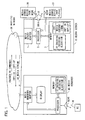
- Fig. 1 is a high-level block diagram of a home network with the system and method of this invention.
- the network is illustrated as a wireless network 20, such as an IEEE 802.11 wireless LAN, with a media server 10 and a media renderer 40 connected to the network 20.
- a wireless LAN is shown for illustration purposes only. However, numerous other types of wireless and wired networks are possible for use with the invention.
- the media server 10 is illustrated as being connected to two legacy media source devices (media content items) 30 and 31, such as a video cassette recorder (VCR) and a digital versatile disc (DVD) player, that provide media content.
- the legacy devices are presented to the media server 10 as "auxiliary" inputs so that their media content, e.g., the actual video files to be sent to the media server 10, are considered as "live” media content.
- the media server 10, such as a PVR or home media PC would also typically include a hard disk drive that contains "stored” media content, such as digital videos, photographs and music.
- the media server 10 includes at least one IR transmitter XMTR for transmitting IR RC commands to the media source devices 30 and 31.
- Each media source device 30 or 31 has an IR receiver RCVR and is controllable by an IR RC.
- the media source devices 30 and 31 are located with their IR receivers RCVR within IR range of the media server's IR transmitter XMTR.
- Fig. 1 depicts the media sever 10 with only one IR transmitter XMTR but it may have one or more additional IR transmitters XMTR, e.g., with each IR transmitter XMTR assigned to one or more media source devices 30 and 31, to assure IR connection with the multiple media source devices 30 and 31.
- the IR transmission from the media server 10 to the media source devices 30 and 31 can be facilitated by a commercially available IR "dongle” that plugs into a universal serial bus (USB) or other port on the media server 10 and allows the IR output to be positioned near the media source device's IR receiver RCVR.
- USB universal serial bus
- the media server 10 also includes a media server adapter 1 for converting the media content from the media source devices 30 and 31 into a format that can be transmitted as an AV media stream over the network 20 to the media renderer 40.
- the VCR and DVD player media source devices 30 and 31 are for illustration purposes only; numerous other media source devices 30 and 31 are possible, including CD players, audio-tape players, still-image cameras, camcorders, radios and TV tuners, and including other media source devices that supply live media content.
- the media server adapter 1 would include a wireless transceiver.
- the media server 10 also includes a processor (e.g., a microprocessor or microcontroller) 2 as an IR decoder and associated memory 3.
- the memory 3 includes an encoding/decoding algorithm corresponding to the IR pass-through protocol or scheme that enables RC commands transmitted over the network 20 from the media renderer 40 to be converted into RC commands for transmission by the media server's IR transmitter XMTR to control the VCR 30 and DVD player 31.
- the media server 10 is capable of handling multiple IR pass-through protocols, so multiple algorithms may be stored in memory 3.
- the memory 3 also includes the CDS.
- the CDS is depicted as containing not only a listing of the media content items and associated metadata, but the IR pass-through protocol identifiers (IRPT-IDs) associated with the media content items and the IRPT connection points (IRPT-CPs) associated with the IRPT-IDs.
- IRPT-IDs IR pass-through protocol identifiers
- IRPT-CPs IRPT connection points
- a media content item in the CDS represents a specific media source device.
- Associated with each media content item in the CDS is at least one IRPT-ID/IRPT-CP pair or a list of IRPT-ID/IRPT-CP pairs. Each pair represents an IR pass-through protocol and its IP connection point.
- the multiple media content items may have the same IRPT-ID/IRPT-CP pairs. If the media server 10 has more than one IR transmitter, for example a second IR transmitter for controlling a second media source device, then the second media content item may have the same IRPT-IDs as the first media content item, but would have different IRPT-CPs. Based on the IRPT-CP the media server 10 selects which IR transmitter to use.
- the media renderer 40 includes a display and a media renderer adapter for converting the network transmission from the media server 10 back to a format capable of being rendered on the display.
- the media renderer 40 is also controllable by an IR RC and thus includes an IR receiver RCVR.
- the media renderer 40 also includes a processor (e.g., a microprocessor or microcontroller) and associated memory. As shown in Fig. 1, all of the components of the media renderer 40 may be included in a single unit, such as a digital TV.
- the media renderer 40 may also be a legacy TV connected to a separate media renderer adapter, in which case the media renderer adapter would include the processor and associated memory.
- commercial media renderer adapters are available, such as the Linksys® WMA11b that attaches to legacy TVs and stereo systems using standard consumer electronics cables and connects to a home networked PC (the media server 10) through wireless IEEE 802.11b or 10/ 100 Ethernet cabling.
- the media renderer's memory contains one or more IR pass-through encoding/decoding algorithms, each algorithm corresponding to a particular type of IR pass-through protocol or scheme and identifiable by a unique IRPT-ID.
- Each IRPT-ID has an associated internet protocol (IP) connection point (IRPT-CP).
- IP internet protocol
- IRPT-CP internet protocol connection point
- the IR RC at the media renderer 40 sends RC commands to the media renderer 40 that are encoded using the IR pass-through protocol represented by the IRPT-ID.
- the output of the IR RC is received by the media renderer's IR receiver RCVR.
- the processor recalls from memory the IR pass-through encoding algorithm associated with the IRPT-ID and uses this algorithm to encode the IR signal from the IR receiver RCVR.
- the encoded RC commands are converted by the media renderer adapter to a format that can be transmitted over the network 20 and then transmitted back to the media server adapter 1 in the reverse direction of the AV media stream over the aforesaid network.
- the media server adapter 1 receives the network transmission and converts it back to encoded RC commands.
- the encoded RC commands are then decoded by the media server's processor 2 using the same IR pass-through encoding/decoding algorithm identified by the IRPT-ID.
- the IR RC commands are then transmitted by the media server's IR transmitter XMTR to the IR receiver RCVR on the media source device (the VCR or DVD player) 30 or 31 to control the media source device 30 or 31. If the media server 10 has more than one IR transmitter XMTR, for example, with each one designated for one or more media source devices 30 and 31, the correct IR transmitter XMTR is selected because it is identified by the specific IRPT-CP in the IRPT-ID/IRPT-CP pair.
- the XML fragment 2 shows the baseline case where no IR pass-through protocol support is published in the CDS.
- the media content item corresponds to an "auxiliary input” where any type of media source device may be connected.
- the AV media stream is class "videoBroadcast” indicating that it is live, not stored, media content.
- the protocol to retrieve the AV media stream is "HTTP” and "GET” method must be used.
- the media format is defined by DLNA MIME type and is MPEG 2 PS.
- the host IP address and port number are provided in the URI field of the resource or "res" element.
- the XML fragment 3 below shows one implementation where IR pass-through protocol support is added to the baseline case.
- the "CntrlIRProtocol” attribute functions to inform the media renderer 40 that the media content item is controllable by IR RC and identifies the IR pass-through protocol associated with the media content item (called "FFIR” in XML fragment 3).
- FFIR IR pass-through protocol associated with the media content item
- “CntrlProtocol” identifies the IP protocol used, which can be either TCP or UDP.
- “CntrlIPAddress” and “CntrlPortNumber” provide the IRPT-CP information.
- XML fragment 3 requires that the schema be modified to allow new attributes to be understood. In this method only a single IR pass-through protocol is supported per "res" item. Also this method links the IR pass-through protocol to a specific media format (i.e., "res" item), whereas typically there is no dependency between the IR pass-through protocol and the media format.
- the XML fragment 4 below shows a second implementation where IR pass-through protocol support is added to the baseline case.
- a second "res" element is added to the media content item to provide the IRPT-ID and the IRPT-CP.
- the IRPT-ID is defined by the value of the "protocolInfo” attribute.
- the method defined in UPnP for defining a proprietary protocol is used.
- the "res" element value "tcp://192.168.0.20:60000” provides the IRPT-CP information in a proprietary URI like format.
- This method does not require a change to the DIDL-Lite schema.
- the "res” element is used in an unintended way because the "res” element is designed for some type of binary asset, such as a photo, song, video, etc., and not for a control protocol.
- this does not cause a problem for client devices that browse the CDS because they will typically ignore “res” elements that are not understood. Only clients that understand the "protoco1Info” will use the "res” item.
- This method also allows multiple different IR pass-through protocols to be published in the CDS without any dependency on the media format.
- the XML fragment 5 below shows a third implementation where IR pass-through protocol support is added to the baseline case.
- the IR decoder of the media server 10 may be constructed by hardware logic or by software by means of a storage medium (such as the memory 3) storing a decoder program and a processor 2 which executes the decoder program.
Landscapes
- Engineering & Computer Science (AREA)
- Signal Processing (AREA)
- Multimedia (AREA)
- Automation & Control Theory (AREA)
- Computer Networks & Wireless Communication (AREA)
- Human Computer Interaction (AREA)
- Two-Way Televisions, Distribution Of Moving Picture Or The Like (AREA)
- Computer And Data Communications (AREA)
Applications Claiming Priority (1)
| Application Number | Priority Date | Filing Date | Title |
|---|---|---|---|
| US11/424,782 US20070294372A1 (en) | 2006-06-16 | 2006-06-16 | System and method for representing an infrared pass-through protocol in a home network |
Publications (2)
| Publication Number | Publication Date |
|---|---|
| EP1868324A2 true EP1868324A2 (fr) | 2007-12-19 |
| EP1868324A3 EP1868324A3 (fr) | 2009-09-23 |
Family
ID=38521157
Family Applications (1)
| Application Number | Title | Priority Date | Filing Date |
|---|---|---|---|
| EP07011782A Withdrawn EP1868324A3 (fr) | 2006-06-16 | 2007-06-15 | Système et procédé pour la représentation d'un protocole de transit à infrarouges dans un réseau domestique |
Country Status (3)
| Country | Link |
|---|---|
| US (1) | US20070294372A1 (fr) |
| EP (1) | EP1868324A3 (fr) |
| JP (1) | JP2007336553A (fr) |
Cited By (3)
| Publication number | Priority date | Publication date | Assignee | Title |
|---|---|---|---|---|
| US8706777B2 (en) * | 2006-12-18 | 2014-04-22 | Microsoft Corporation | Media content catalogs |
| US9984563B2 (en) * | 2015-07-02 | 2018-05-29 | Smart Always On | Method and device for controlling subordinate electronic device or supporting control of subordinate electronic device by learning IR signal |
| US11457087B2 (en) | 2018-10-26 | 2022-09-27 | Sony Corporation | Information processing apparatus and information processing method for processing profile identification information of content |
Families Citing this family (18)
| Publication number | Priority date | Publication date | Assignee | Title |
|---|---|---|---|---|
| US8312267B2 (en) | 2004-07-20 | 2012-11-13 | Time Warner Cable Inc. | Technique for securely communicating programming content |
| US8266429B2 (en) | 2004-07-20 | 2012-09-11 | Time Warner Cable, Inc. | Technique for securely communicating and storing programming material in a trusted domain |
| US8520850B2 (en) | 2006-10-20 | 2013-08-27 | Time Warner Cable Enterprises Llc | Downloadable security and protection methods and apparatus |
| US8621540B2 (en) | 2007-01-24 | 2013-12-31 | Time Warner Cable Enterprises Llc | Apparatus and methods for provisioning in a download-enabled system |
| CA2712354A1 (fr) * | 2008-01-29 | 2009-08-06 | Thomson Licensing | Procede, appareil et systeme de redirection de codes de commande infrarouge via un reseau, pour la commande et le traitement |
| US8965903B2 (en) | 2008-06-24 | 2015-02-24 | Microsoft Corporation | Automatic selection of media representations |
| US7948887B2 (en) * | 2008-06-24 | 2011-05-24 | Microsoft Corporation | Network bandwidth measurement |
| GB2480737A (en) * | 2009-03-24 | 2011-11-30 | Logitech Europ Sa | Apparatus and method of operation for a remote control system |
| US9602864B2 (en) | 2009-06-08 | 2017-03-21 | Time Warner Cable Enterprises Llc | Media bridge apparatus and methods |
| US9866609B2 (en) | 2009-06-08 | 2018-01-09 | Time Warner Cable Enterprises Llc | Methods and apparatus for premises content distribution |
| KR20110020694A (ko) * | 2009-08-24 | 2011-03-03 | 삼성전자주식회사 | 네트워크를 통한 기능 공유 방법 및 장치 |
| US8140702B2 (en) * | 2009-12-28 | 2012-03-20 | General Instrument Corporation | System and method of maximizing utility in media delivery network |
| US9906838B2 (en) | 2010-07-12 | 2018-02-27 | Time Warner Cable Enterprises Llc | Apparatus and methods for content delivery and message exchange across multiple content delivery networks |
| US20120300129A1 (en) * | 2011-05-24 | 2012-11-29 | Hetke Theodore S | System and method for controlling audio/video data streams |
| US9565472B2 (en) | 2012-12-10 | 2017-02-07 | Time Warner Cable Enterprises Llc | Apparatus and methods for content transfer protection |
| US20140282786A1 (en) | 2013-03-12 | 2014-09-18 | Time Warner Cable Enterprises Llc | Methods and apparatus for providing and uploading content to personalized network storage |
| US9621940B2 (en) | 2014-05-29 | 2017-04-11 | Time Warner Cable Enterprises Llc | Apparatus and methods for recording, accessing, and delivering packetized content |
| EP4109911A4 (fr) * | 2020-02-21 | 2023-11-22 | LG Electronics, Inc. | Dispositif et procédé d'affichage |
Family Cites Families (10)
| Publication number | Priority date | Publication date | Assignee | Title |
|---|---|---|---|---|
| US6910068B2 (en) * | 1999-06-11 | 2005-06-21 | Microsoft Corporation | XML-based template language for devices and services |
| US20010053274A1 (en) * | 2000-06-20 | 2001-12-20 | Koninklijke Philips Electronics N.V. | System and method for remote control of consumer electronics over data network with visual feedback |
| US6930730B2 (en) * | 2001-05-03 | 2005-08-16 | Mitsubishi Digital Electronics America, Inc. | Control system and user interface for network of input devices |
| US7933945B2 (en) * | 2002-06-27 | 2011-04-26 | Openpeak Inc. | Method, system, and computer program product for managing controlled residential or non-residential environments |
| US7024256B2 (en) * | 2002-06-27 | 2006-04-04 | Openpeak Inc. | Method, system, and computer program product for automatically managing components within a controlled environment |
| US7987489B2 (en) * | 2003-01-07 | 2011-07-26 | Openpeak Inc. | Legacy device bridge for residential or non-residential networks |
| US7136709B2 (en) * | 2003-11-04 | 2006-11-14 | Universal Electronics Inc. | Home appliance control system and methods in a networked environment |
| US8205235B2 (en) * | 2003-11-14 | 2012-06-19 | Sharp Laboratories Of America, Inc. | Systems and methods for representing a tuner device in a media server content directory service |
| JP2005197951A (ja) * | 2004-01-06 | 2005-07-21 | Sony Corp | 電子機器 |
| US20060041596A1 (en) * | 2004-08-19 | 2006-02-23 | Vlad Stirbu | Caching directory server data for controlling the disposition of multimedia data on a network |
-
2006
- 2006-06-16 US US11/424,782 patent/US20070294372A1/en not_active Abandoned
-
2007
- 2007-06-13 JP JP2007156748A patent/JP2007336553A/ja not_active Withdrawn
- 2007-06-15 EP EP07011782A patent/EP1868324A3/fr not_active Withdrawn
Cited By (4)
| Publication number | Priority date | Publication date | Assignee | Title |
|---|---|---|---|---|
| US8706777B2 (en) * | 2006-12-18 | 2014-04-22 | Microsoft Corporation | Media content catalogs |
| US9323790B2 (en) | 2006-12-18 | 2016-04-26 | Microsoft Technology Licensing, Llc | Media content catalogs |
| US9984563B2 (en) * | 2015-07-02 | 2018-05-29 | Smart Always On | Method and device for controlling subordinate electronic device or supporting control of subordinate electronic device by learning IR signal |
| US11457087B2 (en) | 2018-10-26 | 2022-09-27 | Sony Corporation | Information processing apparatus and information processing method for processing profile identification information of content |
Also Published As
| Publication number | Publication date |
|---|---|
| US20070294372A1 (en) | 2007-12-20 |
| EP1868324A3 (fr) | 2009-09-23 |
| JP2007336553A (ja) | 2007-12-27 |
Similar Documents
| Publication | Publication Date | Title |
|---|---|---|
| EP1868324A2 (fr) | Système et procédé pour la représentation d'un protocole de transit à infrarouges dans un réseau domestique | |
| US9229937B2 (en) | Apparatus and method for managing digital contents distributed over network | |
| US9432628B2 (en) | Information processing device, information processing method, and computer program | |
| KR100619018B1 (ko) | 네트워크를 통하여 a/v 컨텐츠를 공유하는 방법, 싱크디바이스, 소오스 디바이스 및 메시지 구조 | |
| US7788409B2 (en) | System and method for achieving interoperability in home network with IEEE 1394 and UPnP devices | |
| US7574514B2 (en) | Systems and methods for identifying original streams of media content | |
| US9736530B2 (en) | Address mapping in a HDMI network | |
| US20040090984A1 (en) | Network adapter for remote devices | |
| US20070258718A1 (en) | Method and system for extending internet protocol remote control to non-internet protocol devices | |
| US8694583B2 (en) | Information processing apparatus and method for controlling the same | |
| US8316140B2 (en) | Method for controlling a device in a network of distributed stations, and network station | |
| EP2661877B1 (fr) | Système et procédé pour une distribution vidéo sur des réseaux ip | |
| JP5042063B2 (ja) | 被制御装置、制御システムおよび管理装置 | |
| CN101243645A (zh) | 控制共享资源的网络的方法和设备 | |
| Heredia | An introduction to the DLNA architecture: network technologies for media devices | |
| US20080163298A1 (en) | Display apparatus and method for controlling the same | |
| KR20070101000A (ko) | Dlna 네트워크에서 디지털 컨텐츠 매니지먼트 기능을이용한 컨텐츠 분류 방법 및 장치 | |
| JP2009199339A (ja) | 情報公開装置、情報公開システムおよび管理装置 |
Legal Events
| Date | Code | Title | Description |
|---|---|---|---|
| PUAI | Public reference made under article 153(3) epc to a published international application that has entered the european phase |
Free format text: ORIGINAL CODE: 0009012 |
|
| AK | Designated contracting states |
Kind code of ref document: A2 Designated state(s): AT BE BG CH CY CZ DE DK EE ES FI FR GB GR HU IE IS IT LI LT LU LV MC MT NL PL PT RO SE SI SK TR |
|
| AX | Request for extension of the european patent |
Extension state: AL BA HR MK YU |
|
| RIN1 | Information on inventor provided before grant (corrected) |
Inventor name: SATO, JUNSEI Inventor name: WADE, STEVEN A., JR. Inventor name: HLASNY, DARYL |
|
| PUAL | Search report despatched |
Free format text: ORIGINAL CODE: 0009013 |
|
| AK | Designated contracting states |
Kind code of ref document: A3 Designated state(s): AT BE BG CH CY CZ DE DK EE ES FI FR GB GR HU IE IS IT LI LT LU LV MC MT NL PL PT RO SE SI SK TR |
|
| AX | Request for extension of the european patent |
Extension state: AL BA HR MK RS |
|
| AKX | Designation fees paid | ||
| STAA | Information on the status of an ep patent application or granted ep patent |
Free format text: STATUS: THE APPLICATION IS DEEMED TO BE WITHDRAWN |
|
| 18D | Application deemed to be withdrawn |
Effective date: 20100324 |
|
| REG | Reference to a national code |
Ref country code: DE Ref legal event code: 8566 |