EP1870026B1 - Diabetescare-System zur Detektion eines Analyten und Verfahren zur selktiven Datenübertragung - Google Patents
Diabetescare-System zur Detektion eines Analyten und Verfahren zur selktiven Datenübertragung Download PDFInfo
- Publication number
- EP1870026B1 EP1870026B1 EP06012693.5A EP06012693A EP1870026B1 EP 1870026 B1 EP1870026 B1 EP 1870026B1 EP 06012693 A EP06012693 A EP 06012693A EP 1870026 B1 EP1870026 B1 EP 1870026B1
- Authority
- EP
- European Patent Office
- Prior art keywords
- data
- mobile component
- base station
- transmitted
- partial set
- Prior art date
- Legal status (The legal status is an assumption and is not a legal conclusion. Google has not performed a legal analysis and makes no representation as to the accuracy of the status listed.)
- Active
Links
Images
Classifications
-
- A—HUMAN NECESSITIES
- A61—MEDICAL OR VETERINARY SCIENCE; HYGIENE
- A61B—DIAGNOSIS; SURGERY; IDENTIFICATION
- A61B5/00—Measuring for diagnostic purposes; Identification of persons
- A61B5/0002—Remote monitoring of patients using telemetry, e.g. transmission of vital signals via a communication network
-
- A—HUMAN NECESSITIES
- A61—MEDICAL OR VETERINARY SCIENCE; HYGIENE
- A61B—DIAGNOSIS; SURGERY; IDENTIFICATION
- A61B5/00—Measuring for diagnostic purposes; Identification of persons
- A61B5/145—Measuring characteristics of blood in vivo, e.g. gas concentration or pH-value ; Measuring characteristics of body fluids or tissues, e.g. interstitial fluid or cerebral tissue
- A61B5/14532—Measuring characteristics of blood in vivo, e.g. gas concentration or pH-value ; Measuring characteristics of body fluids or tissues, e.g. interstitial fluid or cerebral tissue for measuring glucose, e.g. by tissue impedance measurement
-
- G—PHYSICS
- G01—MEASURING; TESTING
- G01N—INVESTIGATING OR ANALYSING MATERIALS BY DETERMINING THEIR CHEMICAL OR PHYSICAL PROPERTIES
- G01N33/00—Investigating or analysing materials by specific methods not covered by groups G01N1/00 - G01N31/00
- G01N33/48—Biological material, e.g. blood, urine; Haemocytometers
- G01N33/483—Physical analysis of biological material
- G01N33/487—Physical analysis of biological material of liquid biological material
- G01N33/48785—Electrical and electronic details of measuring devices for physical analysis of liquid biological material not specific to a particular test method, e.g. user interface or power supply
- G01N33/48792—Data management, e.g. communication with processing unit
-
- H—ELECTRICITY
- H04—ELECTRIC COMMUNICATION TECHNIQUE
- H04L—TRANSMISSION OF DIGITAL INFORMATION, e.g. TELEGRAPHIC COMMUNICATION
- H04L67/00—Network arrangements or protocols for supporting network services or applications
- H04L67/14—Session management
-
- H—ELECTRICITY
- H04—ELECTRIC COMMUNICATION TECHNIQUE
- H04L—TRANSMISSION OF DIGITAL INFORMATION, e.g. TELEGRAPHIC COMMUNICATION
- H04L69/00—Network arrangements, protocols or services independent of the application payload and not provided for in the other groups of this subclass
- H04L69/04—Protocols for data compression, e.g. ROHC
-
- A—HUMAN NECESSITIES
- A61—MEDICAL OR VETERINARY SCIENCE; HYGIENE
- A61N—ELECTROTHERAPY; MAGNETOTHERAPY; RADIATION THERAPY; ULTRASOUND THERAPY
- A61N1/00—Electrotherapy; Circuits therefor
- A61N1/18—Applying electric currents by contact electrodes
- A61N1/32—Applying electric currents by contact electrodes alternating or intermittent currents
- A61N1/36—Applying electric currents by contact electrodes alternating or intermittent currents for stimulation
- A61N1/372—Arrangements in connection with the implantation of stimulators
- A61N1/37211—Means for communicating with stimulators
- A61N1/37252—Details of algorithms or data aspects of communication system, e.g. handshaking, transmitting specific data or segmenting data
- A61N1/37276—Details of algorithms or data aspects of communication system, e.g. handshaking, transmitting specific data or segmenting data characterised by means for reducing power consumption during telemetry
Definitions
- the invention relates to a diabetes care system having a mobile component and a base station, the mobile component being wearable on the body or implantable in the body and including a memory for storing data and a communication unit for transmitting data to the base station.
- the base station includes a communication unit for wirelessly receiving data from the mobile component and a storage unit for storing transmitted data.
- an output unit for displaying data transmitted by the mobile component may be provided.
- a data transmission between the mobile component and the base station takes place within a period of time in which there is a wireless communication connection.
- the invention also relates to a method for selectively transmitting data within a diabetes care system having a mobile component and a base station.
- Diabetes care systems serve to detect an analyte relevant for the treatment of diabetes mellitus in the human body and / or for therapy, in particular by injection of medicaments.
- Important examples are blood glucose meters or insulin pumps.
- Modern diabetes care systems assist their users by performing Actions are logged and thus available for later evaluation. In this way, so-called “history files" are created over a longer period of use.
- analysis data can be stored in Diabetescare systems. Especially in the case of portable (invasive or non-invasive) and implanted in the body analysis systems takes place a frequent, often even practically continuous measurement and determination of the analyte, in which a large amount of measurement or analysis data are obtained.
- the cached data must then be transmitted from time to time to a base station, such as a PC.
- body-worn devices often use wired interfaces or wireless interfaces with appropriate interface protocols.
- data transmission naturally always takes place wirelessly.
- “classical” data transmission typically all the available data is downloaded.
- a sequential transmission takes place, wherein the data are transmitted in the order of their generation (first in - first out) or in the reverse order of generation (last in - first out).
- the document US2004 / 0122488 discloses a diabetes care system having a base station and a mobile component that may be wearable or implantable in the body. It has a memory for storing data and a communication unit for transmitting data.
- the base station has a communication unit for receiving data from the mobile component, wherein a transmission of data takes place when a communication connection exists. To increase the data rate, compression of the data in the mobile component is performed prior to transmission.
- connection duration available for such communication between a body worn mobile component and the base station varies depending on the length of stay of the user in the vicinity of the base station. Thus, the time available for data transmission is unknown to the system. With the known in the art Diabetescare systems reliable data transmission with varying and unknown connection duration is not possible.
- the present object is achieved by a diabetes care system with the features of claim 1 and by a method for selective data transmission with the features of claim 13.
- the diabetes care system for use on the human body comprises a mobile component and a base station.
- the mobile component is wearable or implementable in the body and includes a memory for storing data and a communication unit for transmitting data to the base station.
- the base station has a communication unit for wirelessly receiving data from the mobile component and a storage unit for storing transmitted data.
- the base station also has an output unit for displaying data transmitted by the mobile component.
- the data transmission between the mobile component and the base station occurs within a period of time in which there is a wireless communication connection. Since the period of time for data transmission is unknown in principle, a selective data transmission is performed, wherein within the first time period, a first subset of data is transmitted. The first subset of the data is selected by means of a processor-controlled selection algorithm such that the data transmitted in the time period is representative of the totality of the data stored in the mobile component.
- Such a diabetes care system is particularly advantageous when the mobile component has a continuously operating and measuring measuring unit that is implanted in the body.
- the memory of the mobile component usually contains measured values from a longer period of time, up to several days. From this large number of measured values, the most accurate possible picture of the entirety of the measured values is already generated by a small subset with the present invention.
- the measured values or their evaluation are used for the analysis and evaluation of controlled variables, for example in the case of blood glucose meters for determining the dose of insulin to be administered, the most recent measured values are generally particularly important.
- at least a portion of the first subset of the selected data or measurements is transmitted to the base station in an order that is reverse to the order of their generation ("last in - first out" principle).
- the last measured value is transmitted first.
- This principle does not have to be strictly applied because it can be combined with other criteria of transmission that are in the foreground. In principle, it also applies here that the information content of a measured value is decisive, not only the time of its creation.
- the time interval between two selected data being equidistant
- a uniform overview of the data is generated from the ensemble.
- the selection of the data may then, after the first subset of the data has been transmitted from the mobile component to the base station, be successively refined by shifting the raster, for example such that the first value to be selected lies between two data of the first subset.
- the equidistant time interval between the selected data can also be reduced.
- the data of the first subset is selected by means of a selection algorithm in which a probability function is implemented.
- the time interval between each two temporally adjacent selected data of the first subset is different.
- the selected data of the first subset are selected according to a probability density.
- the function can also implement higher-level "meta-information".
- This "meta-information” can be generated by the Diabetescare system or the analysis system or the mobile component itself, if it is a "self-learning" system. For this purpose, from the past and the analysis of the data already selected and transmitted in earlier data transmissions, for example, information about when increased abnormalities in measured values occur. If the occurrence of conspicuous values in the morning has so far been more pronounced in a patient, then the probability that noticeable values were detected in the morning even in the case of the values currently available in the memory of the mobile component is increased. The selection algorithm can be changed in such a way that, in particular, enhanced values are queried in the morning.
- the selection algorithm may also be based on a random function instead of the probability function, so that the selected data of the first subset are selected "randomly".
- the time interval of each two adjacent selected data is then also usually different and not equidistant, so that the problems of occurrence of periodic errors are avoided.
- the probable duration of the first time span for the data transmission is also determined from data transmissions already carried out between the mobile component and the base station. Likewise, from already taken data transmissions, the probable amount of data that can be transmitted in the time span of the existing communication connection can be determined. This time duration or the amount of data is a measure of the probability that the same connection duration will be available or the same number of data will be transmitted even when the mobile component and the base station are transmitting or exchanging data can. It is assumed that the patient shows an approximately constant pattern of behavior. Especially if several already occurred Data transmissions can be evaluated, the prediction of the next transmission duration can be specified. Thus, an effective use of the available period of data transmission can be achieved.
- the first subset of the data transmitted from the mobile component to the base station during a data transmission is registered in the Diabetescare system. It is particularly advantageous if the already transmitted data are noted both in the mobile component and in the base station. Alternatively, a flag is set only in one of the two devices. If a data transmission is aborted prematurely, for example because the user moves away from the base station with his mobile component and this does not correspond to his predicted behavioral pattern, the aborted transmission can be continued during the next data transmission. In this case, data already transmitted need not be transmitted again from the mobile component to the base station. The efficiency of the data transmission from the mobile component to the base station thereby increases. In a preferred embodiment of the diabetes care system according to the invention, the already transmitted data of the first subset are deleted from the memory of the mobile component.
- Mobile components that are "wearable” are also understood to mean those that are brought into contact with the body.
- An example of this is an injection pen for injecting a medicament, for example insulin, in which dosing information is to be transmitted to a base station.
- a mobile device is only briefly worn on the body, namely during the application of the drug.
- data in the context of this invention is understood in its general form and includes all information transmitted between a mobile component and a base station of a diabetic system. These include, for example, measured values of blood parameters, such as blood sugar, dosing volumes, in particular of injection pens, delivery volumes of pumps, in particular insulin pumps or measured pressure profiles. Likewise, time values of the term “data” are included, which are generated for example by an internal clock or a counter and can be present as absolute or relative time. In this way, the time of collection of the measured values can be recorded and transmitted. Data may also be measured electrical resistances, voltages or currents. Also optically recorded values (photometry) or other state information are subsumed under the term "data” in the context of this invention.
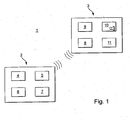
- analysis system 1 comprises as a mobile component a wearable or implantable analyzer 2 and a separate base station. 3
- the analyzer 2 contains a measuring unit 4 for the detection of an analyte and for generating measured values suitable for the analysis. It further includes a communication unit 5, a processor 6 and a memory 7 for storing measured values.
- the measured values form data which are transmitted to the base station in the event of an existing communication connection.
- a first subset of the measured values is selected by means of a selection algorithm, which is controlled by the processor 6 of the analyzer 2,
- the first subset of the measured values is selected even before the data transmission between the analyzer 2 and the base station 3 begins.
- all measured values to be transmitted are available, so that they can be transmitted immediately.
- the base station 3 comprises a communication unit 8 for wirelessly receiving measured values of the analysis device 2, a memory unit 9 for storing the measured values transmitted by the analysis unit 2, and an output unit 10 with which the measured values are displayed.
- the output unit 2 can also include a loudspeaker for outputting acoustic signals or the measured value in the form of speech.
- the base station 3 preferably includes a signaling device 11 in order to output a visual and / or audible warning message if the number of transmitted measured values falls below a lower limit.
- the signaling device 11 may comprise a display, an optical light display and / or a loudspeaker.
- the warning message can be generated if too few measured values have been transmitted from the analyzer 2 to the base station 3, in order to make a reliable statement about the totality of the measured values stored in the analyzer.
- the base station 3 transmits a request on a defined frequency and with a defined transmission power.
- the base station 3 is referred to as "master”, while the analyzer 2 is the “slave”, so that there is a "master-slave relationship" between the two devices.
- the analyzer 2 as a slave listens on the same frequency to an incoming request from the base station 3.
- the transmission power can be designed such that the analyzer recognizes the falling below a defined distance on the basis of the increase in the signal strength. It is also possible to measure the bidirectional data transmission time between the communication unit 5 and the communication unit 8.
- a waiting time may be set before the actual data transmission begins, e.g. to detect a too short or possibly unwanted connection or to adjust the data transmission parameters between the two devices, ie the speed of data transmission, the transmission power, etc. set.
- the analyzer 2 (preferably also without a direct request from the base station 3) transmits the first subset of the measured values to the master, ie the base station 3. Dispensing with the request of the base station 3 shortens the time required for the data exchange ,
- the analyzer 2 is offset from its "idle state" to an "active state” by a pulse, signal, or command from the base station 3.
- Hibernation is a power-saving mode or a reduced-power mode. This becomes the reduces the radiation exposure of the patient wearing the analyzer 2; on the other hand energy is saved.
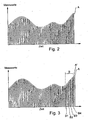
- FIG. 2 shows measured values stored in the analyzer 2. This shows the totality of all discrete measured values which have been measured in equidistant time intervals.
- the data transmission between the analyzer 2 and the base station 3 can be started immediately when a communication connection is established.
- the analyzer 2 preferably operates as a master and the base station as a slave.
- the most recent measured value A from the first subset can be transmitted first. It is also possible to transmit another value from the first subset as the first value, for example, a measured value detected as conspicuous. If there is no criterion, due to which a measured value is transmitted first because of its increased information content, then the most recently measured value measured is used.
- the base station 3 can optionally output a signal in order to inform the patient that a value has been transmitted.
- the patient himself can set whether a message of the base station 3 should be made. If such a feedback is desired, it can be done either after the transmission of the first and / or each further measured value or at the end of the data transmission.
- the analyzer 2 working as master during the data transmission again becomes the slave and returns to its idle state after an optional waiting time.
- the base station 3 becomes the master again, so that the analyzer 2 and the base station 3 always switch back and forth between the function of the master and the slave.
- an acknowledgment signal can be exchanged between the analyzer 2 and the base station 3.
- the base station 3 can then request further measured values from the analyzer 2.
- the analyzer 2 can also transmit further measured values until the entirety of the measured values in its memory has been transmitted to the base station 3.
- the selection is preferably based on requirements necessary for a medical assessment. For this reason, the values measured immediately before the data transmission are often of interest.
- this value is preferably transmitted.
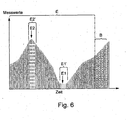
- the tolerance band is predetermined in the system and can preferably be changed, for example by medical personnel. A change by the patients themselves is usually not desired, but possible.
- the selection of further measured values is made depending on an already selected (selected) measured value. This dependent selection is advantageous, in particular, if the selected value is characterized as conspicuous. Preferably within an interval around a conspicuous measured value which lies outside of a predetermined tolerance band, the further measured values are selected with a fixed temporal raster. Particularly preferably, all measured values are selected within an interval around the conspicuous measured value.
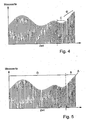
- Measurements A and A ' are considered conspicuous because they are above a medically indicated limit. Then the interval B is selected, in which the dashed line shown Measured values B1 to B4 are selected.
- the equidistant selection of the measured values in the interval B provides an overview of the course of the values in this period and makes it possible to detect an increase or a fall towards the conspicuous value A, A '. Again, the data transfer could begin with the most recent value and continue as long as the communication link is in place.
- interval C is defined following the interval B, in which values with an equidistant raster are also selected. This expands the overview of the totality of the values. Such a procedure is in FIG. 4 shown.
- the entirety of the measured values stored in the memory is subdivided into a plurality of intervals, wherein the first subset is composed of measured values of the intervals.
- the measured values are selected with different density from the intervals such that a weighting of the intervals is achieved.
- the selection of measured values with a different weighting from different intervals is particularly advantageous if it is known from the history that conspicuous measured values can occur more frequently at certain time intervals. From these intervals, a relatively higher density of readings is then selected than from other intervals that have been rather uncritical in the past.
- the entirety of the stored measured values can be subdivided into two intervals, with the measured values of the first interval being younger than the measured values of the second interval.
- the first subset is selected in such a way that the density of the measured values selected from the first interval is greater than the density of the measured values selected from the second interval. This takes into account that as a rule the younger measured values contain a higher information content.
- the Dosing insulin delivery the more recent readings are of more interest than more recent readings.
- the distribution of the totality of the stored measured values into two intervals is in FIG. 5 shown.
- the interval B comprises a first number of recent measured values.
- the measured values combined in interval B in the example shown reflect about 15 percent of the total of the measured values. From these 15 percent the four measured values B1 to B4 are selected.
- Interval D covers the remaining 85 percent of readings. From this interval a total of 9 measured values shown in dashed lines are selected.
- the absolute number of measured values selected from interval D is greater than the number of measured values from interval B; nevertheless, the measured value density of the selected values from the interval B is higher.
- FIG. 5 shows that in interval B the measured values are selected with a constant raster, while in interval D the measured values are selected with a raster based on a probability function.
- the time intervals of the selected measured values are not equidistant here.
- the high information content underlying the conspicuous values and the values adjacent to them is taken into account when selecting the first subset.
- the selected ones Measured values of the first subset thus represent the totality of the measured values sufficiently accurately in order to already make a statement about all measured values from the first subset of the measured values, for example in order to be able to assess the health status of the patient or the system status of an insulin pump.
Landscapes
- Health & Medical Sciences (AREA)
- Engineering & Computer Science (AREA)
- Life Sciences & Earth Sciences (AREA)
- Physics & Mathematics (AREA)
- Biomedical Technology (AREA)
- Biophysics (AREA)
- General Health & Medical Sciences (AREA)
- Pathology (AREA)
- Medical Informatics (AREA)
- Molecular Biology (AREA)
- Computer Networks & Wireless Communication (AREA)
- Optics & Photonics (AREA)
- Chemical & Material Sciences (AREA)
- Surgery (AREA)
- Public Health (AREA)
- Veterinary Medicine (AREA)
- Animal Behavior & Ethology (AREA)
- Heart & Thoracic Surgery (AREA)
- Signal Processing (AREA)
- Food Science & Technology (AREA)
- General Physics & Mathematics (AREA)
- Hematology (AREA)
- Urology & Nephrology (AREA)
- Databases & Information Systems (AREA)
- Emergency Medicine (AREA)
- Medicinal Chemistry (AREA)
- Analytical Chemistry (AREA)
- Biochemistry (AREA)
- Human Computer Interaction (AREA)
- Immunology (AREA)
- Computer Security & Cryptography (AREA)
- Measuring And Recording Apparatus For Diagnosis (AREA)
- Measurement Of The Respiration, Hearing Ability, Form, And Blood Characteristics Of Living Organisms (AREA)
- Mobile Radio Communication Systems (AREA)
- Medical Treatment And Welfare Office Work (AREA)
- External Artificial Organs (AREA)
- Small-Scale Networks (AREA)
- Infusion, Injection, And Reservoir Apparatuses (AREA)
Priority Applications (8)
| Application Number | Priority Date | Filing Date | Title |
|---|---|---|---|
| DK06012693.5T DK1870026T3 (en) | 2006-06-21 | 2006-06-21 | Diabetes treatment system for detecting an analyte and method for selective data transfer |
| ES06012693.5T ES2554469T3 (es) | 2006-06-21 | 2006-06-21 | Sistema de tratamiento de la diabetes para la detección de un analito y procedimiento para la transmisión de datos selectiva |
| EP06012693.5A EP1870026B1 (de) | 2006-06-21 | 2006-06-21 | Diabetescare-System zur Detektion eines Analyten und Verfahren zur selktiven Datenübertragung |
| JP2007155558A JP2008048382A (ja) | 2006-06-21 | 2007-06-12 | 分析物検出のための糖尿病管理装置と選択的にデータを転送する方法 |
| US11/763,004 US9554703B2 (en) | 2006-06-21 | 2007-06-14 | Diabetes care system for detection of an analyte and method for selective data transmission |
| CA2592222A CA2592222C (en) | 2006-06-21 | 2007-06-19 | Diabetes care system for detection of an analyte and method for selective data transmission |
| CNA2007101118886A CN101091653A (zh) | 2006-06-21 | 2007-06-20 | 检测分析物的糖尿病护理系统和选择性数据传输的方法 |
| JP2010154685A JP5323774B2 (ja) | 2006-06-21 | 2010-07-07 | 分析物検出のための糖尿病管理装置と選択的にデータを転送する方法 |
Applications Claiming Priority (1)
| Application Number | Priority Date | Filing Date | Title |
|---|---|---|---|
| EP06012693.5A EP1870026B1 (de) | 2006-06-21 | 2006-06-21 | Diabetescare-System zur Detektion eines Analyten und Verfahren zur selktiven Datenübertragung |
Publications (2)
| Publication Number | Publication Date |
|---|---|
| EP1870026A1 EP1870026A1 (de) | 2007-12-26 |
| EP1870026B1 true EP1870026B1 (de) | 2015-09-30 |
Family
ID=37432279
Family Applications (1)
| Application Number | Title | Priority Date | Filing Date |
|---|---|---|---|
| EP06012693.5A Active EP1870026B1 (de) | 2006-06-21 | 2006-06-21 | Diabetescare-System zur Detektion eines Analyten und Verfahren zur selktiven Datenübertragung |
Country Status (7)
| Country | Link |
|---|---|
| US (1) | US9554703B2 (es) |
| EP (1) | EP1870026B1 (es) |
| JP (2) | JP2008048382A (es) |
| CN (1) | CN101091653A (es) |
| CA (1) | CA2592222C (es) |
| DK (1) | DK1870026T3 (es) |
| ES (1) | ES2554469T3 (es) |
Families Citing this family (14)
| Publication number | Priority date | Publication date | Assignee | Title |
|---|---|---|---|---|
| US20080177154A1 (en) * | 2001-08-13 | 2008-07-24 | Novo Nordisk A/S | Portable Device and Method Of Communicating Medical Data Information |
| EP1688085A1 (en) * | 2005-02-02 | 2006-08-09 | Disetronic Licensing AG | Ambulatory medical device and method of communication between medical devices |
| DK1870026T3 (en) | 2006-06-21 | 2016-01-11 | Hoffmann La Roche | Diabetes treatment system for detecting an analyte and method for selective data transfer |
| US8229535B2 (en) | 2008-02-21 | 2012-07-24 | Dexcom, Inc. | Systems and methods for blood glucose monitoring and alert delivery |
| US8843321B2 (en) * | 2010-01-26 | 2014-09-23 | Roche Diagnostics Operations, Inc. | Methods and systems for processing glucose data measured from a person having diabetes |
| RU2482485C2 (ru) * | 2011-03-23 | 2013-05-20 | Государственное образовательное учреждение высшего профессионального образования Ижевская государственная медицинская академия Министерства здравоохранения и социального развития Российской Федерации | Способ прогнозирования достижения компенсации сахарного диабета 2 типа |
| US20130100819A1 (en) * | 2011-10-19 | 2013-04-25 | Qualcomm Incorporated | Selectively acquiring and advertising a connection between a user equipment and a wireless local area network |
| US20140191880A1 (en) * | 2013-01-10 | 2014-07-10 | Covidien Lp | System, method, and software for ambulatory patient monitoring |
| JP6525679B2 (ja) * | 2015-03-31 | 2019-06-05 | キヤノン株式会社 | 放射線撮影制御装置、放射線撮像装置、およびプログラム |
| US10492141B2 (en) * | 2015-11-17 | 2019-11-26 | Tandem Diabetes Care, Inc. | Methods for reduction of battery usage in ambulatory infusion pumps |
| CN107335137B (zh) * | 2016-04-28 | 2021-04-27 | 台湾共振波研发股份有限公司 | 糖尿病舒缓系统 |
| CN107436876A (zh) * | 2016-05-25 | 2017-12-05 | 富泰华工业(深圳)有限公司 | 文件分割系统及方法 |
| EP3396919A1 (de) | 2017-04-26 | 2018-10-31 | Siemens Aktiengesellschaft | Verfahren zur datenübertragung von einem gerät an ein datenverwaltungsmittel, vermittlungseinheit, gerät und system |
| DE102017213510A1 (de) * | 2017-08-03 | 2019-02-07 | Robert Bosch Gmbh | Verfahren und Vorrichtung zum Erzeugen eines maschinellen Lernsystems, und virtuelle Sensorvorrichtung |
Family Cites Families (20)
| Publication number | Priority date | Publication date | Assignee | Title |
|---|---|---|---|---|
| US5353793A (en) * | 1991-11-25 | 1994-10-11 | Oishi-Kogyo Company | Sensor apparatus |
| US5839100A (en) * | 1996-04-22 | 1998-11-17 | Wegener; Albert William | Lossless and loss-limited compression of sampled data signals |
| JPH09319672A (ja) * | 1996-05-30 | 1997-12-12 | Fuji Xerox Co Ltd | データ伝送装置および方法 |
| DE69918333T2 (de) * | 1998-11-30 | 2005-08-25 | Novo Nordisk A/S | SYSTEM ZUR UNTERSTüTZUNG EINER MEDIZINISCHEN SELBSTBEHANDLUNG,WELCHE EINE MEHRZAHL VON SCHRITTEN UMFASST |
| US7060031B2 (en) * | 1999-12-17 | 2006-06-13 | Medtronic, Inc. | Method and apparatus for remotely programming implantable medical devices |
| JP3475142B2 (ja) | 2000-03-01 | 2003-12-08 | 三菱電機株式会社 | 地図データ送信装置、地図データ送信方法、及び、地図データ送信方法をコンピュータに実行させるためのプログラムを記録したコンピュータ読み取り可能な記録媒体 |
| US20010027384A1 (en) * | 2000-03-01 | 2001-10-04 | Schulze Arthur E. | Wireless internet bio-telemetry monitoring system and method |
| GB0022269D0 (en) * | 2000-09-12 | 2000-10-25 | Koninkl Philips Electronics Nv | Data transmission system |
| US6694177B2 (en) * | 2001-04-23 | 2004-02-17 | Cardionet, Inc. | Control of data transmission between a remote monitoring unit and a central unit |
| US20040054263A1 (en) * | 2001-08-20 | 2004-03-18 | Piet Moerman | Wireless diabetes management devices and methods for using the same |
| US7022072B2 (en) * | 2001-12-27 | 2006-04-04 | Medtronic Minimed, Inc. | System for monitoring physiological characteristics |
| US20050038680A1 (en) * | 2002-12-19 | 2005-02-17 | Mcmahon Kevin Lee | System and method for glucose monitoring |
| US7395117B2 (en) * | 2002-12-23 | 2008-07-01 | Cardiac Pacemakers, Inc. | Implantable medical device having long-term wireless capabilities |
| US7127300B2 (en) * | 2002-12-23 | 2006-10-24 | Cardiac Pacemakers, Inc. | Method and apparatus for enabling data communication between an implantable medical device and a patient management system |
| ATE444520T1 (de) | 2003-01-08 | 2009-10-15 | Microsoft Corp | Verfahren und system zum aufzeichnen von makros in einer sprachunabhängigen syntax |
| US7130678B2 (en) * | 2003-04-25 | 2006-10-31 | Medtronic, Inc. | Adaptive memory prioritization for implanted medical devices |
| CA2562313C (en) * | 2004-04-30 | 2012-10-16 | Becton, Dickinson And Company | Systems and methods for administering a medical regimen |
| US20060122469A1 (en) * | 2004-11-16 | 2006-06-08 | Martel Normand M | Remote medical monitoring system |
| DK1870026T3 (en) | 2006-06-21 | 2016-01-11 | Hoffmann La Roche | Diabetes treatment system for detecting an analyte and method for selective data transfer |
| US8295934B2 (en) * | 2006-11-14 | 2012-10-23 | Neurovista Corporation | Systems and methods of reducing artifact in neurological stimulation systems |
-
2006
- 2006-06-21 DK DK06012693.5T patent/DK1870026T3/en active
- 2006-06-21 ES ES06012693.5T patent/ES2554469T3/es active Active
- 2006-06-21 EP EP06012693.5A patent/EP1870026B1/de active Active
-
2007
- 2007-06-12 JP JP2007155558A patent/JP2008048382A/ja active Pending
- 2007-06-14 US US11/763,004 patent/US9554703B2/en active Active
- 2007-06-19 CA CA2592222A patent/CA2592222C/en not_active Expired - Fee Related
- 2007-06-20 CN CNA2007101118886A patent/CN101091653A/zh active Pending
-
2010
- 2010-07-07 JP JP2010154685A patent/JP5323774B2/ja not_active Expired - Fee Related
Also Published As
| Publication number | Publication date |
|---|---|
| CN101091653A (zh) | 2007-12-26 |
| JP2008048382A (ja) | 2008-02-28 |
| CA2592222C (en) | 2011-05-31 |
| DK1870026T3 (en) | 2016-01-11 |
| JP5323774B2 (ja) | 2013-10-23 |
| JP2010279705A (ja) | 2010-12-16 |
| US20070299324A1 (en) | 2007-12-27 |
| EP1870026A1 (de) | 2007-12-26 |
| CA2592222A1 (en) | 2007-12-21 |
| ES2554469T3 (es) | 2015-12-21 |
| US9554703B2 (en) | 2017-01-31 |
Similar Documents
| Publication | Publication Date | Title |
|---|---|---|
| EP1870026B1 (de) | Diabetescare-System zur Detektion eines Analyten und Verfahren zur selktiven Datenübertragung | |
| DE69724386T2 (de) | Stimulationsvorrichtung zur Verhinderung der Harninkontinenz | |
| DE69933761T2 (de) | Rückenmarks-Stimulationssystem mit Patientenaktivität und Therapieeinstellungen | |
| EP2207582B1 (de) | System und verfahren zur überwachung und regelung von blutglukosewerten | |
| EP1589438B1 (de) | Verfahren und Vorrichtung zum Überwachen einer Konzentration eines Analyten im lebenden Körper eines Menschen oder Tieres | |
| DE102006015291B4 (de) | Verfahren zur Einstellung eines Patientenmonitors | |
| DE69925506T2 (de) | Implantierbares medizinisches gerät, überwachungsverfahren und -system | |
| EP2055348B1 (de) | Vorrichtung zur Bestimmung eines Nachsorgetermins für die Versorgung eines implantierbaren medizinischen Gerätes | |
| EP2218427B1 (de) | Verfahren zum Steuern eines implantierten Magenbandes | |
| DE112015006231B4 (de) | Keucherfassungsvorrichtung | |
| DE102007017552A1 (de) | Fallabhängige Krankheitsverlaufsvorhersage bei einem Echtzeit-Überwachungssystem | |
| DE102008054442A1 (de) | Verfahren zur ferndiagnostischen Überwachung und Unterstützung von Patienten sowie Einrichtung und telemedizinisches Zentrum | |
| DE202010005472U1 (de) | Prothesen- oder Orthesensystem | |
| DE112015006232B4 (de) | Anzeigevorrichtung für keuchbezogene Informationen | |
| EP2409253B1 (de) | Verfahren zum automatischen erzeugen eines nutzerspezifischen messdatenerfassungsregimes für eine diskontinuierliche butzuckermessung sowie datenverarbeitungsvorrichtung und blutzuckermessgerät | |
| WO2007014545A2 (de) | Mobiles ekg-gerät | |
| WO2013079644A1 (de) | Telemedizinische anordnung für diabetis mellitus-patienten | |
| EP2805300A1 (de) | Verfahren und vorrichtung zur kontinuierlichen messung von intraokulardrücken | |
| DE202024105231U1 (de) | Intelligentes Gerät mit künstlicher Intelligenz zur Überwachung neuropathischer Schmerzen | |
| DE102006062466A1 (de) | System und Verfahren zur patientenspezifischen Lebenszeichenschätzung | |
| EP1351181B1 (de) | Computersystem und Verfahren zur Datenerfassung für die Ermittlung des Verlaufs einer chronischen Erkrankung | |
| DE10102564A1 (de) | Verfahren, System und Mobiltelefon zur Untersuchung wenigstens einer Flüssigkeit und zur drahtlosen Übertragung der Meßwerte | |
| DE10220244A1 (de) | Verfahren und System zur Verwaltung von Patientendaten | |
| WO2009008952A2 (en) | Device, method and/or system for monitoring the condition of a subject | |
| DE202025100327U1 (de) | System zur kontinuierlichen Glukoseüberwachung und Echtzeit-Vorhersage zum Diabetes-Management |
Legal Events
| Date | Code | Title | Description |
|---|---|---|---|
| PUAI | Public reference made under article 153(3) epc to a published international application that has entered the european phase |
Free format text: ORIGINAL CODE: 0009012 |
|
| AK | Designated contracting states |
Kind code of ref document: A1 Designated state(s): AT BE BG CH CY CZ DE DK EE ES FI FR GB GR HU IE IS IT LI LT LU LV MC NL PL PT RO SE SI SK TR |
|
| AX | Request for extension of the european patent |
Extension state: AL BA HR MK YU |
|
| 17P | Request for examination filed |
Effective date: 20080612 |
|
| 17Q | First examination report despatched |
Effective date: 20080723 |
|
| AKX | Designation fees paid |
Designated state(s): AT BE BG CH CY CZ DE DK EE ES FI FR GB GR HU IE IS IT LI LT LU LV MC NL PL PT RO SE SI SK TR |
|
| APBK | Appeal reference recorded |
Free format text: ORIGINAL CODE: EPIDOSNREFNE |
|
| APBN | Date of receipt of notice of appeal recorded |
Free format text: ORIGINAL CODE: EPIDOSNNOA2E |
|
| APBR | Date of receipt of statement of grounds of appeal recorded |
Free format text: ORIGINAL CODE: EPIDOSNNOA3E |
|
| APAV | Appeal reference deleted |
Free format text: ORIGINAL CODE: EPIDOSDREFNE |
|
| APBT | Appeal procedure closed |
Free format text: ORIGINAL CODE: EPIDOSNNOA9E |
|
| GRAP | Despatch of communication of intention to grant a patent |
Free format text: ORIGINAL CODE: EPIDOSNIGR1 |
|
| INTG | Intention to grant announced |
Effective date: 20150430 |
|
| GRAS | Grant fee paid |
Free format text: ORIGINAL CODE: EPIDOSNIGR3 |
|
| GRAA | (expected) grant |
Free format text: ORIGINAL CODE: 0009210 |
|
| AK | Designated contracting states |
Kind code of ref document: B1 Designated state(s): AT BE BG CH CY CZ DE DK EE ES FI FR GB GR HU IE IS IT LI LT LU LV MC NL PL PT RO SE SI SK TR |
|
| REG | Reference to a national code |
Ref country code: CH Ref legal event code: EP Ref country code: GB Ref legal event code: FG4D Free format text: NOT ENGLISH |
|
| REG | Reference to a national code |
Ref country code: DE Ref legal event code: R081 Ref document number: 502006014555 Country of ref document: DE Owner name: ROCHE DIABETES CARE GMBH, DE Free format text: FORMER OWNERS: ROCHE DIAGNOSTICS GMBH, 68305 MANNHEIM, DE; F. HOFFMANN-LA ROCHE AG, 4070 BASEL, CH |
|
| REG | Reference to a national code |
Ref country code: AT Ref legal event code: REF Ref document number: 751881 Country of ref document: AT Kind code of ref document: T Effective date: 20151015 |
|
| REG | Reference to a national code |
Ref country code: IE Ref legal event code: FG4D Free format text: LANGUAGE OF EP DOCUMENT: GERMAN |
|
| REG | Reference to a national code |
Ref country code: DE Ref legal event code: R096 Ref document number: 502006014555 Country of ref document: DE |
|
| REG | Reference to a national code |
Ref country code: ES Ref legal event code: FG2A Ref document number: 2554469 Country of ref document: ES Kind code of ref document: T3 Effective date: 20151221 |
|
| REG | Reference to a national code |
Ref country code: DK Ref legal event code: T3 Effective date: 20160108 |
|
| PG25 | Lapsed in a contracting state [announced via postgrant information from national office to epo] |
Ref country code: LT Free format text: LAPSE BECAUSE OF FAILURE TO SUBMIT A TRANSLATION OF THE DESCRIPTION OR TO PAY THE FEE WITHIN THE PRESCRIBED TIME-LIMIT Effective date: 20150930 Ref country code: GR Free format text: LAPSE BECAUSE OF FAILURE TO SUBMIT A TRANSLATION OF THE DESCRIPTION OR TO PAY THE FEE WITHIN THE PRESCRIBED TIME-LIMIT Effective date: 20151231 Ref country code: FI Free format text: LAPSE BECAUSE OF FAILURE TO SUBMIT A TRANSLATION OF THE DESCRIPTION OR TO PAY THE FEE WITHIN THE PRESCRIBED TIME-LIMIT Effective date: 20150930 Ref country code: LV Free format text: LAPSE BECAUSE OF FAILURE TO SUBMIT A TRANSLATION OF THE DESCRIPTION OR TO PAY THE FEE WITHIN THE PRESCRIBED TIME-LIMIT Effective date: 20150930 |
|
| REG | Reference to a national code |
Ref country code: LT Ref legal event code: MG4D |
|
| REG | Reference to a national code |
Ref country code: NL Ref legal event code: FP |
|
| PG25 | Lapsed in a contracting state [announced via postgrant information from national office to epo] |
Ref country code: SE Free format text: LAPSE BECAUSE OF FAILURE TO SUBMIT A TRANSLATION OF THE DESCRIPTION OR TO PAY THE FEE WITHIN THE PRESCRIBED TIME-LIMIT Effective date: 20150930 |
|
| REG | Reference to a national code |
Ref country code: DE Ref legal event code: R081 Ref document number: 502006014555 Country of ref document: DE Owner name: ROCHE DIABETES CARE GMBH, DE Free format text: FORMER OWNER: ROCHE DIAGNOSTICS GMBH, 68305 MANNHEIM, DE |
|
| PG25 | Lapsed in a contracting state [announced via postgrant information from national office to epo] |
Ref country code: EE Free format text: LAPSE BECAUSE OF FAILURE TO SUBMIT A TRANSLATION OF THE DESCRIPTION OR TO PAY THE FEE WITHIN THE PRESCRIBED TIME-LIMIT Effective date: 20150930 Ref country code: IS Free format text: LAPSE BECAUSE OF FAILURE TO SUBMIT A TRANSLATION OF THE DESCRIPTION OR TO PAY THE FEE WITHIN THE PRESCRIBED TIME-LIMIT Effective date: 20160130 Ref country code: SK Free format text: LAPSE BECAUSE OF FAILURE TO SUBMIT A TRANSLATION OF THE DESCRIPTION OR TO PAY THE FEE WITHIN THE PRESCRIBED TIME-LIMIT Effective date: 20150930 |
|
| PG25 | Lapsed in a contracting state [announced via postgrant information from national office to epo] |
Ref country code: RO Free format text: LAPSE BECAUSE OF FAILURE TO SUBMIT A TRANSLATION OF THE DESCRIPTION OR TO PAY THE FEE WITHIN THE PRESCRIBED TIME-LIMIT Effective date: 20150930 Ref country code: PT Free format text: LAPSE BECAUSE OF FAILURE TO SUBMIT A TRANSLATION OF THE DESCRIPTION OR TO PAY THE FEE WITHIN THE PRESCRIBED TIME-LIMIT Effective date: 20160201 Ref country code: PL Free format text: LAPSE BECAUSE OF FAILURE TO SUBMIT A TRANSLATION OF THE DESCRIPTION OR TO PAY THE FEE WITHIN THE PRESCRIBED TIME-LIMIT Effective date: 20150930 |
|
| REG | Reference to a national code |
Ref country code: FR Ref legal event code: PLFP Year of fee payment: 11 |
|
| REG | Reference to a national code |
Ref country code: DE Ref legal event code: R097 Ref document number: 502006014555 Country of ref document: DE |
|
| PLBE | No opposition filed within time limit |
Free format text: ORIGINAL CODE: 0009261 |
|
| STAA | Information on the status of an ep patent application or granted ep patent |
Free format text: STATUS: NO OPPOSITION FILED WITHIN TIME LIMIT |
|
| 26N | No opposition filed |
Effective date: 20160701 |
|
| PG25 | Lapsed in a contracting state [announced via postgrant information from national office to epo] |
Ref country code: SI Free format text: LAPSE BECAUSE OF FAILURE TO SUBMIT A TRANSLATION OF THE DESCRIPTION OR TO PAY THE FEE WITHIN THE PRESCRIBED TIME-LIMIT Effective date: 20150930 |
|
| PG25 | Lapsed in a contracting state [announced via postgrant information from national office to epo] |
Ref country code: BE Free format text: LAPSE BECAUSE OF NON-PAYMENT OF DUE FEES Effective date: 20160630 |
|
| PG25 | Lapsed in a contracting state [announced via postgrant information from national office to epo] |
Ref country code: MC Free format text: LAPSE BECAUSE OF FAILURE TO SUBMIT A TRANSLATION OF THE DESCRIPTION OR TO PAY THE FEE WITHIN THE PRESCRIBED TIME-LIMIT Effective date: 20150930 |
|
| REG | Reference to a national code |
Ref country code: CH Ref legal event code: PL |
|
| REG | Reference to a national code |
Ref country code: IE Ref legal event code: MM4A |
|
| PG25 | Lapsed in a contracting state [announced via postgrant information from national office to epo] |
Ref country code: CH Free format text: LAPSE BECAUSE OF NON-PAYMENT OF DUE FEES Effective date: 20160630 Ref country code: LI Free format text: LAPSE BECAUSE OF NON-PAYMENT OF DUE FEES Effective date: 20160630 |
|
| REG | Reference to a national code |
Ref country code: FR Ref legal event code: PLFP Year of fee payment: 12 |
|
| PG25 | Lapsed in a contracting state [announced via postgrant information from national office to epo] |
Ref country code: IE Free format text: LAPSE BECAUSE OF NON-PAYMENT OF DUE FEES Effective date: 20160621 |
|
| REG | Reference to a national code |
Ref country code: AT Ref legal event code: MM01 Ref document number: 751881 Country of ref document: AT Kind code of ref document: T Effective date: 20160621 |
|
| PG25 | Lapsed in a contracting state [announced via postgrant information from national office to epo] |
Ref country code: AT Free format text: LAPSE BECAUSE OF NON-PAYMENT OF DUE FEES Effective date: 20160621 |
|
| REG | Reference to a national code |
Ref country code: FR Ref legal event code: PLFP Year of fee payment: 13 |
|
| PG25 | Lapsed in a contracting state [announced via postgrant information from national office to epo] |
Ref country code: HU Free format text: LAPSE BECAUSE OF FAILURE TO SUBMIT A TRANSLATION OF THE DESCRIPTION OR TO PAY THE FEE WITHIN THE PRESCRIBED TIME-LIMIT; INVALID AB INITIO Effective date: 20060621 Ref country code: CY Free format text: LAPSE BECAUSE OF FAILURE TO SUBMIT A TRANSLATION OF THE DESCRIPTION OR TO PAY THE FEE WITHIN THE PRESCRIBED TIME-LIMIT Effective date: 20150930 |
|
| PG25 | Lapsed in a contracting state [announced via postgrant information from national office to epo] |
Ref country code: LU Free format text: LAPSE BECAUSE OF NON-PAYMENT OF DUE FEES Effective date: 20160621 Ref country code: TR Free format text: LAPSE BECAUSE OF FAILURE TO SUBMIT A TRANSLATION OF THE DESCRIPTION OR TO PAY THE FEE WITHIN THE PRESCRIBED TIME-LIMIT Effective date: 20150930 |
|
| PG25 | Lapsed in a contracting state [announced via postgrant information from national office to epo] |
Ref country code: BG Free format text: LAPSE BECAUSE OF FAILURE TO SUBMIT A TRANSLATION OF THE DESCRIPTION OR TO PAY THE FEE WITHIN THE PRESCRIBED TIME-LIMIT Effective date: 20150930 |
|
| PGFP | Annual fee paid to national office [announced via postgrant information from national office to epo] |
Ref country code: NL Payment date: 20250520 Year of fee payment: 20 |
|
| PGFP | Annual fee paid to national office [announced via postgrant information from national office to epo] |
Ref country code: DE Payment date: 20250520 Year of fee payment: 20 |
|
| PGFP | Annual fee paid to national office [announced via postgrant information from national office to epo] |
Ref country code: GB Payment date: 20250520 Year of fee payment: 20 Ref country code: DK Payment date: 20250520 Year of fee payment: 20 |
|
| PGFP | Annual fee paid to national office [announced via postgrant information from national office to epo] |
Ref country code: IT Payment date: 20250520 Year of fee payment: 20 |
|
| PGFP | Annual fee paid to national office [announced via postgrant information from national office to epo] |
Ref country code: FR Payment date: 20250520 Year of fee payment: 20 |
|
| PGFP | Annual fee paid to national office [announced via postgrant information from national office to epo] |
Ref country code: CZ Payment date: 20250529 Year of fee payment: 20 |
|
| PGFP | Annual fee paid to national office [announced via postgrant information from national office to epo] |
Ref country code: ES Payment date: 20250701 Year of fee payment: 20 |