EP1870253A1 - Méthode pour décoration de surface - Google Patents
Méthode pour décoration de surface Download PDFInfo
- Publication number
- EP1870253A1 EP1870253A1 EP06425410A EP06425410A EP1870253A1 EP 1870253 A1 EP1870253 A1 EP 1870253A1 EP 06425410 A EP06425410 A EP 06425410A EP 06425410 A EP06425410 A EP 06425410A EP 1870253 A1 EP1870253 A1 EP 1870253A1
- Authority
- EP
- European Patent Office
- Prior art keywords
- resin
- support
- decorative layer
- temperature
- thermosetting resin
- Prior art date
- Legal status (The legal status is an assumption and is not a legal conclusion. Google has not performed a legal analysis and makes no representation as to the accuracy of the status listed.)
- Withdrawn
Links
- 238000000034 method Methods 0.000 title claims abstract description 51
- 238000005034 decoration Methods 0.000 title claims abstract description 28
- 229920005989 resin Polymers 0.000 claims abstract description 58
- 239000011347 resin Substances 0.000 claims abstract description 58
- 229920001187 thermosetting polymer Polymers 0.000 claims abstract description 24
- 239000000049 pigment Substances 0.000 claims description 13
- 239000000843 powder Substances 0.000 claims description 10
- 239000000463 material Substances 0.000 claims description 9
- 238000010438 heat treatment Methods 0.000 claims description 8
- 230000001070 adhesive effect Effects 0.000 claims description 6
- -1 polyethylene Polymers 0.000 claims description 4
- 238000003908 quality control method Methods 0.000 claims description 4
- 239000004952 Polyamide Substances 0.000 claims description 3
- 239000003595 mist Substances 0.000 claims description 3
- 229920002647 polyamide Polymers 0.000 claims description 3
- 229920000728 polyester Polymers 0.000 claims description 3
- 239000004925 Acrylic resin Substances 0.000 claims description 2
- 229920000178 Acrylic resin Polymers 0.000 claims description 2
- 239000004698 Polyethylene Substances 0.000 claims description 2
- 239000004743 Polypropylene Substances 0.000 claims description 2
- 239000003822 epoxy resin Substances 0.000 claims description 2
- LNEPOXFFQSENCJ-UHFFFAOYSA-N haloperidol Chemical compound C1CC(O)(C=2C=CC(Cl)=CC=2)CCN1CCCC(=O)C1=CC=C(F)C=C1 LNEPOXFFQSENCJ-UHFFFAOYSA-N 0.000 claims description 2
- 229920000647 polyepoxide Polymers 0.000 claims description 2
- 229920000573 polyethylene Polymers 0.000 claims description 2
- 229920001155 polypropylene Polymers 0.000 claims description 2
- 239000004814 polyurethane Substances 0.000 claims description 2
- 229920002635 polyurethane Polymers 0.000 claims description 2
- 238000000926 separation method Methods 0.000 claims description 2
- 238000004040 coloring Methods 0.000 description 11
- 239000003973 paint Substances 0.000 description 11
- 239000000976 ink Substances 0.000 description 10
- 239000002184 metal Substances 0.000 description 7
- 229910052751 metal Inorganic materials 0.000 description 7
- 238000000859 sublimation Methods 0.000 description 5
- 230000008022 sublimation Effects 0.000 description 5
- 239000000853 adhesive Substances 0.000 description 4
- 238000010422 painting Methods 0.000 description 3
- 229920002522 Wood fibre Polymers 0.000 description 2
- 230000000694 effects Effects 0.000 description 2
- 230000005686 electrostatic field Effects 0.000 description 2
- 238000000227 grinding Methods 0.000 description 2
- 238000002844 melting Methods 0.000 description 2
- 230000008018 melting Effects 0.000 description 2
- 230000000930 thermomechanical effect Effects 0.000 description 2
- 229910000838 Al alloy Inorganic materials 0.000 description 1
- 229910000831 Steel Inorganic materials 0.000 description 1
- 239000004411 aluminium Substances 0.000 description 1
- 229910052782 aluminium Inorganic materials 0.000 description 1
- XAGFODPZIPBFFR-UHFFFAOYSA-N aluminium Chemical compound [Al] XAGFODPZIPBFFR-UHFFFAOYSA-N 0.000 description 1
- 238000004873 anchoring Methods 0.000 description 1
- QHIWVLPBUQWDMQ-UHFFFAOYSA-N butyl prop-2-enoate;methyl 2-methylprop-2-enoate;prop-2-enoic acid Chemical compound OC(=O)C=C.COC(=O)C(C)=C.CCCCOC(=O)C=C QHIWVLPBUQWDMQ-UHFFFAOYSA-N 0.000 description 1
- 239000003054 catalyst Substances 0.000 description 1
- 239000011248 coating agent Substances 0.000 description 1
- 238000000576 coating method Methods 0.000 description 1
- 239000003086 colorant Substances 0.000 description 1
- 239000004020 conductor Substances 0.000 description 1
- 230000008878 coupling Effects 0.000 description 1
- 238000010168 coupling process Methods 0.000 description 1
- 238000005859 coupling reaction Methods 0.000 description 1
- 229920006037 cross link polymer Polymers 0.000 description 1
- 238000007598 dipping method Methods 0.000 description 1
- 239000007769 metal material Substances 0.000 description 1
- 150000002739 metals Chemical class 0.000 description 1
- 239000000203 mixture Substances 0.000 description 1
- 238000007591 painting process Methods 0.000 description 1
- 239000012188 paraffin wax Substances 0.000 description 1
- 239000004033 plastic Substances 0.000 description 1
- 229920003023 plastic Polymers 0.000 description 1
- 229920006122 polyamide resin Polymers 0.000 description 1
- 239000004645 polyester resin Substances 0.000 description 1
- 229920001225 polyester resin Polymers 0.000 description 1
- 229920001296 polysiloxane Polymers 0.000 description 1
- 238000002360 preparation method Methods 0.000 description 1
- 238000011084 recovery Methods 0.000 description 1
- 230000000717 retained effect Effects 0.000 description 1
- 238000007650 screen-printing Methods 0.000 description 1
- 239000002904 solvent Substances 0.000 description 1
- 239000007921 spray Substances 0.000 description 1
- 238000005507 spraying Methods 0.000 description 1
- 239000010959 steel Substances 0.000 description 1
- 239000000758 substrate Substances 0.000 description 1
- XLYOFNOQVPJJNP-UHFFFAOYSA-N water Substances O XLYOFNOQVPJJNP-UHFFFAOYSA-N 0.000 description 1
Images

Classifications
-
- B—PERFORMING OPERATIONS; TRANSPORTING
- B41—PRINTING; LINING MACHINES; TYPEWRITERS; STAMPS
- B41M—PRINTING, DUPLICATING, MARKING, OR COPYING PROCESSES; COLOUR PRINTING
- B41M3/00—Printing processes to produce particular kinds of printed work, e.g. patterns
- B41M3/12—Transfer pictures or the like, e.g. decalcomanias
-
- B—PERFORMING OPERATIONS; TRANSPORTING
- B44—DECORATIVE ARTS
- B44C—PRODUCING DECORATIVE EFFECTS; MOSAICS; TARSIA WORK; PAPERHANGING
- B44C1/00—Processes, not specifically provided for elsewhere, for producing decorative surface effects
- B44C1/10—Applying flat materials, e.g. leaflets, pieces of fabrics
- B44C1/105—Applying flat materials, e.g. leaflets, pieces of fabrics comprising an adhesive layer
-
- B—PERFORMING OPERATIONS; TRANSPORTING
- B44—DECORATIVE ARTS
- B44C—PRODUCING DECORATIVE EFFECTS; MOSAICS; TARSIA WORK; PAPERHANGING
- B44C5/00—Processes for producing special ornamental bodies
- B44C5/04—Ornamental plaques, e.g. decorative panels, decorative veneers
- B44C5/0415—Ornamental plaques, e.g. decorative panels, decorative veneers containing metallic elements
-
- B—PERFORMING OPERATIONS; TRANSPORTING
- B44—DECORATIVE ARTS
- B44C—PRODUCING DECORATIVE EFFECTS; MOSAICS; TARSIA WORK; PAPERHANGING
- B44C5/00—Processes for producing special ornamental bodies
- B44C5/04—Ornamental plaques, e.g. decorative panels, decorative veneers
- B44C5/043—Ornamental plaques, e.g. decorative panels, decorative veneers containing wooden elements
-
- B—PERFORMING OPERATIONS; TRANSPORTING
- B41—PRINTING; LINING MACHINES; TYPEWRITERS; STAMPS
- B41M—PRINTING, DUPLICATING, MARKING, OR COPYING PROCESSES; COLOUR PRINTING
- B41M2205/00—Printing methods or features related to printing methods; Location or type of the layers
- B41M2205/38—Intermediate layers; Layers between substrate and imaging layer
Definitions
- the present invention relates to a process for surface decoration.
- the present invention is addressed to the decoration of metal surfaces belonging to aluminium section members, sheet metals, sheet metal rolls known in the particular technical field as "coils", etc., to which a particular appearance is required to be given.
- the present invention is also addressed to decoration of MDF surfaces, i.e. wooden surfaces made up of wood fibres or narrow bundles obtained through high-temperature thermomechanical grinding, bonded together with or without use of thermosetting adhesives and hot pressed.
- the present invention is used for decorating metal door and window frames that must have a wood-like aesthetic appearance or reproduce particular chromatic fancy images.
- the present invention is concerned with the decoration of surfaces by means of inks/paints having colouring pigments of sizes included between 0.5 and 10 microns that cannot be applied by means of the known sublimation techniques.
- thermoadhesive/thermosetting resin a thermoadhesive/thermosetting resin onto the surface to be decorated.
- the metal surface is electrostatically charged and introduced into a mist of powders of said thermosetting resin.
- the resin under the action of the electrostatic field, lays onto the surface and becomes fixed thereto.
- the surface is maintained to a temperature of about 100-130°C, to enable the resin to reveal and keep its thermoadhesive properties, and sprayed by means of a spray gun for example, with a colouring paint adhering to the resin itself.
- the surface is then brought to a predetermined temperature of about 200°C, to which the resin polymerises retaining the colouring powders in a stable manner.
- the just described known process is in any case a limiting process because it does not allow execution of particular patterns but it only enables colouring of the surfaces in a substantially uniform manner because laying of the individual paint pigments is quite random.
- the transfer technique For application of patterns, use of the transfer technique is also known.
- the pattern is originally positioned on a support, a layer of release material, of the waxy type for example, being interposed therebetween.
- the support is associated with the surface to be decorated with the colouring pigments in contact with said surface.
- the surface and support are brought to such a temperature (about 100-130°C) that detachment of the colouring layer from the support is caused through melting of the waxy layer, as well as transfer of same onto the surface.
- the adhesion/clinging force of the dye or colouring material to the surface carried out by means of the transfer process is in any case weak, so that the colouring layer often separates from the surface itself.
- the technical task of the present invention is to propose a process for surface decoration that is free from the above mentioned drawbacks.
- Another aim of the present invention is to propose a process enabling sure application of decorations also when they are very complicated.
- a surface to be decorated has been generally identified with reference numeral 1.
- Surface 1 is preferably made of metal material such as steel or an aluminium alloy and for instance belongs to a section member, a flat section, a rolled section currently referred to as "coil", etc.
- Surface 1 can also be a MDF surface, i.e. a wooden surface made up of wood fibres or narrow bundles obtained through high-temperature thermomechanical grinding, bonded together with or without use of thermosetting adhesives and hot pressed.
- MDF surface i.e. a wooden surface made up of wood fibres or narrow bundles obtained through high-temperature thermomechanical grinding, bonded together with or without use of thermosetting adhesives and hot pressed.
- thermosetting resin 2 is first applied to surface 1, the function of resin 2 being to form an anchoring substrate for the decoration.
- thermosetting resin 2 is preferably selected from two-component resins comprising catalysts that can be activated to predetermined temperatures.
- Thermosetting resins are cross-linked polymers that, once modelled to high temperatures, cannot be modified as regards their shape.
- the main feature of same is their resistance to high temperatures.
- thermosetting resins used are polyurethane powders, epoxy resins, polyamide resins, acrylic resins polyester resins, for example.
- thermosetting resin 2 to surface 1 can be carried out following different methods, such as painting, spraying, coating, silk-screen printing, rotogravure, depending on the type of resin 2 used.
- this application is of the electrostatic type.
- the metal surface is electrostatically charged and introduced into a mist of powders of said thermosetting resin 2.
- the resin powder under the action of the electrostatic field, lays onto the surface 1 and is provisionally fixed thereto.
- surface 1 is previously made electrically conductive, by previously dipping said surface 1 into a solution of an electrically conductive material.
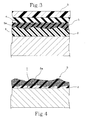
- Fig. 1 When laying has been carried out (Fig. 1), surface 1 is heated to a temperature Tp so as to fix the resin 2 to surface 1 at least provisionally.
- Tp The exact pre-heating temperature Tp depends on the resin used and is generally included between 100°C and 150°C.
- heating is obtained by introducing the workpiece carrying surface 1 to be decorated into an oven, an infrared oven for example, of known type and as used in current painting processes.
- a support 3 Before or during preparation of surface 1, a support 3 is to be provided which has an intermediate release layer 4, of the silicone, TeflonTM, paraffin type, and preferably of the waxy type, and at least one decorative layer 5 superposed on the waxy layer 4 (Fig. 1).
- the intermediate layer 4 is capable of retaining the decorative layer 5 at room temperature and melting at temperatures included between 100°C and 150°C as specified below, so as to release the retained decorative layer 5.
- the decorative layer 5 may contain one or more types of ink/paint and may represent the most different shapes and colours without any limitation.
- the types of ink used are pigment inks, water inks or inks in a solvent and they are not sublimable.
- the decorative layer 5 has colouring pigments 5a of sizes included between 0.5 and 10 microns.
- the support 3 is preferably defined by a film of plastic or paper material.
- the film is selected from the group consisting of polyesters, polyamides, polyethylene, polypropylene.
- thermosetting resin 2 are preheated to the temperature Tp, so as to fix resin 2 to surface 1 at least temporarily.
- surface 1 is drawn out of the oven and preferably cooled to enable cold coupling of same to the support 3.
- the support 3 is positioned on surface 1 by bringing the decorative layer 5 into contact with the resin 2, which resin 2 has not yet been submitted to polymerisation or hardened (Figs. 2 and 3).
- the support 2 temporarily adheres to surface 1 and, also when application has been completed, can be in any case shifted relative to said surface 1, so as to correct a possible positioning error.
- the surface 1 and support 3 are therefore heated until causing separation of the decorative layer 5 from the support 3, adhesion of the decorative layer 5 to the thermosetting resin 2 and subsequent polymerisation and hardening of this resin 2 together with the decorative layer 5.
- This heating too can be advantageously obtained by introduction of surface 1 and support 3 into an oven of known type.
- heating is carried out in a first step, during which the surface 1 to be decorated and the support 3 are brought to a first temperature "T 1 ".
- T 1 a first temperature
- the resin 2 takes the above mentioned adhesive properties and the waxy layer 4 loses its consistency and releases the decorative layer 5. Therefore transfer of the decorative layer 5 to surface 1 occurs.
- the parts of resin 2 not concerned with pigments 5a tend to increase their volume during polymerisation, while the parts of resin 2 covered with pigments 5a do not substantially increase their volume, generating therefore a decoration having different depth levels.
- the second temperature “T 2 " is higher than the first temperature "T 1 ". Said temperatures “T 1 ", “T 2 " depend on the type of resin used.
- the first temperature “T 1 " is included between 100°C and 150°C.
- the second temperature “T 2 " is included between 160°C and 220°C.
- Surface 1 and the transferred decorative layer 5 are preferably maintained to the second temperature "T 2 " for a period of time included between 5 and 30 minutes, depending on the selected temperature "T 2 ".
- the decorated surface 1 can be advantageously submitted to a quality control.
- the invention reaches the intended purposes and achieves important advantages.
- the process of the invention allows also complicated and aesthetically high-quality decorations to be obtained, which decorations show an excellent adhesion/clinging of the paint/paints to the decorated surface.
- the present process enables the percentage of decorated pieces with faults to be drastically reduced, because the quality control takes place before polymerisation of the resin and the decoration.
- the process of the invention is also particularly advantageous even if compared with known sublimation techniques.
- RAL powders/ paints can be used which are less expensive than the specific paints used for sublimation techniques.
Landscapes
- Life Sciences & Earth Sciences (AREA)
- Engineering & Computer Science (AREA)
- Wood Science & Technology (AREA)
- Laminated Bodies (AREA)
- Application Of Or Painting With Fluid Materials (AREA)
Priority Applications (1)
| Application Number | Priority Date | Filing Date | Title |
|---|---|---|---|
| EP06425410A EP1870253A1 (fr) | 2006-06-16 | 2006-06-16 | Méthode pour décoration de surface |
Applications Claiming Priority (1)
| Application Number | Priority Date | Filing Date | Title |
|---|---|---|---|
| EP06425410A EP1870253A1 (fr) | 2006-06-16 | 2006-06-16 | Méthode pour décoration de surface |
Publications (1)
| Publication Number | Publication Date |
|---|---|
| EP1870253A1 true EP1870253A1 (fr) | 2007-12-26 |
Family
ID=37607249
Family Applications (1)
| Application Number | Title | Priority Date | Filing Date |
|---|---|---|---|
| EP06425410A Withdrawn EP1870253A1 (fr) | 2006-06-16 | 2006-06-16 | Méthode pour décoration de surface |
Country Status (1)
| Country | Link |
|---|---|
| EP (1) | EP1870253A1 (fr) |
Citations (5)
| Publication number | Priority date | Publication date | Assignee | Title |
|---|---|---|---|---|
| US3907974A (en) * | 1973-11-08 | 1975-09-23 | Dennison Mfg Co | Curable decorating systems for glass or metal containers |
| GB1600115A (en) * | 1976-06-28 | 1981-10-14 | Bemrsoe Spendon Ltd | Processes for applying designs to aluminium strip |
| US5976296A (en) * | 1998-04-27 | 1999-11-02 | American Trim, Llc | Transfer printing of complex objects |
| WO2001049486A1 (fr) * | 1999-12-30 | 2001-07-12 | Mitsubishi Chemical America, Inc. | Procede d'impression de substrat metalliques par transfert thermique et articles revetus d'une surface decorative correspondants |
| US20050150591A1 (en) * | 2004-01-08 | 2005-07-14 | Roscoe Manufacturing Corporation | Method for applying images to surfaces |
-
2006
- 2006-06-16 EP EP06425410A patent/EP1870253A1/fr not_active Withdrawn
Patent Citations (5)
| Publication number | Priority date | Publication date | Assignee | Title |
|---|---|---|---|---|
| US3907974A (en) * | 1973-11-08 | 1975-09-23 | Dennison Mfg Co | Curable decorating systems for glass or metal containers |
| GB1600115A (en) * | 1976-06-28 | 1981-10-14 | Bemrsoe Spendon Ltd | Processes for applying designs to aluminium strip |
| US5976296A (en) * | 1998-04-27 | 1999-11-02 | American Trim, Llc | Transfer printing of complex objects |
| WO2001049486A1 (fr) * | 1999-12-30 | 2001-07-12 | Mitsubishi Chemical America, Inc. | Procede d'impression de substrat metalliques par transfert thermique et articles revetus d'une surface decorative correspondants |
| US20050150591A1 (en) * | 2004-01-08 | 2005-07-14 | Roscoe Manufacturing Corporation | Method for applying images to surfaces |
Similar Documents
| Publication | Publication Date | Title |
|---|---|---|
| EP1140524B1 (fr) | Procede de preparation d'un substrat decore | |
| CN104975522A (zh) | 一种烫金胶液及用其烫金的方法 | |
| US6001427A (en) | Process for coating selected portions of a substrate using a powder transfer member | |
| EP0616905B1 (fr) | Robinetterie sanitaire à surface revêtue et procédé pour sa fabrication | |
| US20100065197A1 (en) | Decorative transfer label with ink-only layer | |
| EP1592567B1 (fr) | Realisation d'images sur des surfaces | |
| CN110869999A (zh) | 变色热转印标签 | |
| JP3075057B2 (ja) | 被加飾物のホットスタンピング印刷方法およびホットスタンピング印刷が施された被加飾物 | |
| EP2140307B1 (fr) | Procédé d'application d'un revêtement pulvérulent | |
| KR102221661B1 (ko) | 승화전사문양을 갖는 패션장식물과 그 제조방법 | |
| US12070965B2 (en) | Ink, transfers, methods of making transfers, and methods of using transfers to decorate plastic articles | |
| WO1996023041A1 (fr) | Pulverisation et revetement thermoplastiques, et procede | |
| KR100528377B1 (ko) | 부분도장 방법 | |
| KR20050096451A (ko) | 장식물이 구성된 라벨 전사지의 제조방법 및 그 라벨전사지. | |
| JP4406975B2 (ja) | 化粧無機質板 | |
| US20110217652A1 (en) | Process for applying a powder coating | |
| US11408183B1 (en) | Integrated image layer constructions | |
| KR20010110285A (ko) | 열 부착형 알루미늄 장식물 소재의 제조방법 | |
| CN110551464A (zh) | 一种玻璃喷漆酒瓶用热转印胶水 | |
| ITMI20100391A1 (it) | Procedimento per la decorazione di superfici | |
| KR0153038B1 (ko) | U.v경화성 도료층이 코팅된 u.v전사지 | |
| JPS61694A (ja) | 熱反転式植毛転写生地 | |
| JPH11321193A (ja) | マグカップペイント方法 | |
| KR20050022948A (ko) | 장식층이 인쇄층에 형성된 라벨용 전사지의 제조방법 및라벨용 전사지 | |
| JPS6114941A (ja) | 熱反転式植毛転写生地の製造法 |
Legal Events
| Date | Code | Title | Description |
|---|---|---|---|
| PUAI | Public reference made under article 153(3) epc to a published international application that has entered the european phase |
Free format text: ORIGINAL CODE: 0009012 |
|
| 17P | Request for examination filed |
Effective date: 20070727 |
|
| AK | Designated contracting states |
Kind code of ref document: A1 Designated state(s): AT BE BG CH CY CZ DE DK EE ES FI FR GB GR HU IE IS IT LI LT LU LV MC NL PL PT RO SE SI SK TR |
|
| AX | Request for extension of the european patent |
Extension state: AL BA HR MK YU |
|
| AKX | Designation fees paid |
Designated state(s): AT BE BG CH CY CZ DE DK EE ES FI FR GB GR HU IE IS IT LI LT LU LV MC NL PL PT RO SE SI SK TR |
|
| 17Q | First examination report despatched |
Effective date: 20120919 |
|
| STAA | Information on the status of an ep patent application or granted ep patent |
Free format text: STATUS: THE APPLICATION IS DEEMED TO BE WITHDRAWN |
|
| 18D | Application deemed to be withdrawn |
Effective date: 20130130 |