EP1870853A2 - Vorrichtung zur Anzeige der Fahrzeugumgebung und Verfahren zur Anzeige der Fahrzeugumgebung - Google Patents
Vorrichtung zur Anzeige der Fahrzeugumgebung und Verfahren zur Anzeige der Fahrzeugumgebung Download PDFInfo
- Publication number
- EP1870853A2 EP1870853A2 EP07011620A EP07011620A EP1870853A2 EP 1870853 A2 EP1870853 A2 EP 1870853A2 EP 07011620 A EP07011620 A EP 07011620A EP 07011620 A EP07011620 A EP 07011620A EP 1870853 A2 EP1870853 A2 EP 1870853A2
- Authority
- EP
- European Patent Office
- Prior art keywords
- vehicle
- approaching
- video
- frequency
- displaying
- Prior art date
- Legal status (The legal status is an assumption and is not a legal conclusion. Google has not performed a legal analysis and makes no representation as to the accuracy of the status listed.)
- Withdrawn
Links
Images




Classifications
-
- G—PHYSICS
- G06—COMPUTING OR CALCULATING; COUNTING
- G06T—IMAGE DATA PROCESSING OR GENERATION, IN GENERAL
- G06T7/00—Image analysis
- G06T7/20—Analysis of motion
- G06T7/215—Motion-based segmentation
-
- G—PHYSICS
- G06—COMPUTING OR CALCULATING; COUNTING
- G06T—IMAGE DATA PROCESSING OR GENERATION, IN GENERAL
- G06T2207/00—Indexing scheme for image analysis or image enhancement
- G06T2207/30—Subject of image; Context of image processing
- G06T2207/30248—Vehicle exterior or interior
- G06T2207/30252—Vehicle exterior; Vicinity of vehicle
Definitions
- the present invention relates to a unit for picking up and displaying a video of surroundings of a vehicle. Moreover, the present invention relates to a method of displaying the vehicle surroundings.
- JP2004173048 discloses a conventional technology. Based on a plurality of picked-up videos of surroundings of a vehicle, the above conventional technology obtains an optical flow through template matching, detects other vehicle on the picked-up videos and displays the other vehicle on a monitor.
- the vehicle surroundings display unit of a subject vehicle Based on a picked-up video of vehicle surroundings, the vehicle surroundings display unit of a subject vehicle detects an approaching vehicle and displays the thus detected approaching vehicle which is distinguished from an obstacle not approaching the subject vehicle.
- a vehicle surroundings display unit comprising: 1) a pick-up unit for picking up a video of vehicle surroundings; 2) an approaching vehicle sensor for sensing, based on the video picked up by the pick-up unit, an approaching vehicle which is approaching a subject vehicle; 3) a display processor for displaying the approaching vehicle sensed by the approaching vehicle sensor while distinguishing the approaching vehicle from an obstacle which is not approaching the subject vehicle; 4) a display unit for displaying the video which has undergone the displaying operation by the display processor; and 5) a frequency decomposing unit configured to make the following operations: i) decomposing a time-varying component of a pixel of the picked-up video for each frequency, ii) extracting the pixel having a frequency of the time-varying component higher than a certain frequency, and iii) of the thus extracted pixels of the picked up video, displaying the pixels in a vehicle area.
- a method of displaying vehicle surroundings comprising: 1) picking up a video of the vehicle surroundings; 2) sensing, based on the video thus picked up, an approaching vehicle which is approaching a subject vehicle; 3) displaying the approaching vehicle thus sensed while distinguishing the approaching vehicle from an obstacle which is not approaching the subject vehicle; 4) displaying the video which has undergone the displaying operation of the approaching vehicle; and 5) decomposing a frequency, the decomposing including the following sub-operations: i) decomposing a time-varying component of a pixel of the picked-up video for each frequency, ii) extracting the pixel having a frequency of the time-varying component higher than a certain frequency, and iii) of the thus extracted pixels of the picked up video, displaying the pixels in a vehicle area.
- a vehicle surroundings display unit comprising: 1) picking-up means for picking up a video of vehicle surroundings; 2) approaching vehicle sensing means for sensing, based on the video picked up by the picking-up means, an approaching vehicle which is approaching a subject vehicle; 3) display processing means for displaying the approaching vehicle sensed by the approaching vehicle sensing means while distinguishing the approaching vehicle from an obstacle which is not approaching the subject vehicle; 4) displaying means for displaying the video which has undergone the displaying operation by the displaying means; and 5) frequency decomposing means configured to make the following operations: i) decomposing a time-varying component of a pixel of the picked-up video for each frequency, ii) extracting the pixel having a frequency of the time-varying component higher than a certain frequency, and iii) of the thus extracted pixels of the picked up video, displaying the pixels in a vehicle area.
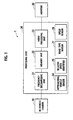
- Fig. 1 is a view showing a structure of a vehicle surroundings display unit, according to an embodiment of the present invention.
- Fig. 2 is a view showing an example of a location where an in-vehicle camera is attached.
- Fig. 3 is a view showing an example of a video picked up by the in-vehicle camera.
- Fig. 4 is a view showing brightness variation (relative to time) of a single pixel (x, y) on the picked up video.
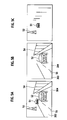
- Fig. 5A is a view showing an example of the video picked up by the in-vehicle camera
- Fig. 5B is a view of a video restructured by extracting a low frequency component based on data after time-frequency decomposition process
- Fig. 5C is a view showing a video reconstructed by extracting a high frequency component based on data after the time-frequency decomposition process.
- Fig. 6 is a view showing an example of the video picked up by the in-vehicle camera.
- Fig. 7 is a view showing data of the high frequency component within a vehicle area.
- Fig. 8 is a view showing data of the low frequency components.
- Fig. 9 is a view of a video where a red bias is applied for emphasis to the video of the high frequency component shown in Fig. 7 which is superimposed on the video of the low frequency components shown in Fig. 8.
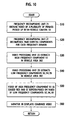
- Fig. 10 is a flowchart showing a flow of processes performed in a processing unit.
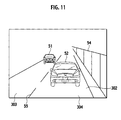
- Fig. 11 is a view showing an example for displaying that an edge (profile) of an approaching vehicle is emphasized.
- Fig. 1 is a view showing a structure of a vehicle surroundings display unit 1, according to an embodiment of the present invention.
- the vehicle surroundings display unit 1 includes an in-vehicle camera 10 (otherwise referred to as "pick-up unit"), a processing unit 20, and a monitor 30.
- Fig. 2 is a view showing an example of a location where the in-vehicle camera 10 is attached. As shown in Fig. 2, the in-vehicle camera 10 is attached to the rear center of a subject vehicle 100 and picks up videos of the subject vehicle 100's rearward.
- the processing unit 20 includes a frequency decomposing unit 21, a memory unit 22, and a video processing unit 23 (otherwise referred to as "display processor").
- the frequency decomposing unit 21 Based on the videos picked up by the in-vehicle camera 10, the frequency decomposing unit 21 performs a process to decompose time-varying components of videos for each frequency domain.
- the memory unit 22 memorizes the data which is decomposed by the frequency decomposing unit 21 for each frequency domain.
- the video processing unit 23 makes the following operations: i) detecting a vehicle approaching the subject vehicle 100 and ii) generating a video for displaying the detected approaching vehicle while distinguishing the approaching vehicle from an obstacle which is not approaching the subject vehicle 100.
- the monitor 30 displays the video generated by the video processing unit 23.
- the processing unit 20 further includes an approaching vehicle sensor 24, a relative speed identifier 25, a road type sensor 27, and a speed sensor 28.
- Fig. 3 is a view showing an example of a video of the subject vehicle 100's rearward picked up by the in-vehicle camera 10.
- a parting line 305 extending to the left and right at the longitudinal center of the video partitions the video into a background area 301 and a vehicle area 302.
- the parting line 305 is set in advance based on an imaging direction or the like of the in-vehicle camera 10.
- the background area 301 is an area where a background such as the sky or apartment buildings is mainly captured
- the vehicle area 302 is an area where other vehicle or the like is mainly captured.
- the vehicle area 302 includes i) an adjacent lane area 303 (otherwise referred to as "first lane area”) which shows an adjacent lane, and ii) a same lane area 304 (otherwise referred to as "second lane area”) which shows a lane in which the subject vehicle 100 is traveling.
- the frequency decomposing unit 21 Based on the videos picked up by the in-vehicle camera 10, the frequency decomposing unit 21 performs the process to decompose the time-varying components of the videos for each frequency domain.
- the process to decompose the time-varying components of the videos for each frequency domain is referred to as time-frequency decomposition.
- Fig. 4 is a view showing brightness variation (relative to time) of a single pixel (x, y) on the picked-up video.
- the frequency decomposing unit 21 decomposes (or divides) the brightness variation (relative to time) into frequency components. For example, the frequency decomposing unit 21 makes the following operations: 1) operating (calculating) an average of brightness for each pixel based on a plurality of video frames picked up at different times, 2) obtaining differences between i) the thus operated (calculated) average brightness and ii) brightness of current videos, 3) then, categorizing the differences for each frequency domain. In a case where the video is picked up at 30 frames per second, a bandpass filter is categorized into a specific frequency.
- the data decomposed for each frequency domain by the frequency decomposing unit 21 is memorized in the memory unit 22.
- pixels with small brightness variation are categorized into a low-frequency component, and pixels with large brightness variation are categorized into a high-frequency component. Therefore, brightness of pixels in which the sky or ground (road) is captured does not vary over time, and therefore the above pixels are extracted as the low frequency component.
- pixels in which the approaching vehicle is captured or ii) pixels which move on the video as the subject vehicle 100 travels i.e., such pixels as those for a pylon (otherwise referred to as "steel tower"
- the brightness varies over time, and therefore the above pixels i) and ii) are extracted as the high frequency component.
- Fig. 5A is a view showing an example of the video of the subject vehicle 100's rearward picked up by the in-vehicle camera 10.
- a first rear vehicle 51, a second rear vehicle 52, a pylon 53, a side wall 54, and so forth are captured.
- the first rear vehicle 51 traveling in the adjacent lane 303 is trying to overtake the subject vehicle 100
- the second rear vehicle 52 traveling just behind the subject vehicle 100 is traveling at substantially the same speed as that of the subject vehicle 100.
- Fig. 5B is a view of a video restructured by the following sequential operations: i) performing the time-frequency decomposition process by the frequency decomposing unit 21, and then ii) extracting a low frequency component lower than a certain frequency.
- Fig. 5C is a view of a video restructured by the following sequential operations: i) performing the time-frequency decomposition process by the frequency decomposing unit 21, and then ii) extracting a high frequency component higher than the certain frequency. Since the brightness of pixels of the second rear vehicle 52 traveling at substantially the same speed as that of the subject vehicle 100 hardly vary, the second rear vehicle 52 is extracted as the low frequency component.
- each of the approaching vehicle 51 and the pylon 53 which move on the video as the subject vehicle 100 travels is extracted as the high frequency component.
- the video processing unit 23 Based on the data decomposed by the frequency decomposing unit 21 for each frequency domain, the video processing unit 23 makes the following operations: i) detecting the first rear vehicle 51 approaching the subject vehicle 100 and ii) generating a video for displaying the detected approaching vehicle 51 while distinguishing the approaching vehicle 51 from an obstacle which is not approaching the subject vehicle 100. A method for generating the video for displaying the approaching vehicle 51 while distinguishing the approaching vehicle 51 from another obstacle is described below.
- Fig. 6 is a view showing an example of the video of the subject vehicle 100's rearward picked up by the in-vehicle camera 10.
- the frequency decomposing unit 21 performs the time-frequency decomposition process.
- the video processing unit 23 extracts the data of the high frequency component in the vehicle area 302.
- Fig. 7 is a view showing the data of the high frequency component thus extracted.
- the pylon 53 captured in Fig. 6 is the high-frequency component from the data after the time frequency decomposition process.
- the pylon 53 included in the background area 301 instead of the vehicle area 302 is, however, not extracted in Fig. 7.
- the frequency decomposing unit 21 performs the time-frequency decomposition process. From the data memorized in the memory unit 22, the video processing unit 23 extracts the data of the low frequency component.
- the vehicle area 302 not only the vehicle area 302 but also the background area 301 is subject to the time-frequency decomposition process.
- Fig. 8 is a view showing the data of the low frequency component thus extracted.
- Fig. 9 is a view showing the video obtained by the combination of Fig. 7 and Fig. 8.
- the first rear vehicle 51 extracted as the high frequency component is displayed in red.
- the video generated by the video processing unit 23 is displayed on the monitor 30.
- Fig. 10 is a flowchart showing a flow of the processes performed in each of the frequency decomposing unit 21, memory unit 2, and video processing unit 23 in the processing unit 20 described above.
- Step S 10 the frequency decomposing unit 21 obtains a video of a plurality of frames picked up by the in-vehicle camera 10. Then, the process moves on to Step S20.
- Step 20 the frequency decomposing unit 21 decomposes the time-varying components of the videos for each frequency domain. Then, the process moves onto Step S30.
- the video processing unit 23 extracts in Step S30 the data of the high frequency component (i.e., the first rear vehicle 51) within the vehicle area 302.
- the video processing unit 23 extracts in Step S40 the data of the low frequency components (i.e., the second rear vehicle 52, the side wall 54, and the white line 55). Then, the process moves onto Step S50.
- the data of the low frequency components i.e., the second rear vehicle 52, the side wall 54, and the white line 55.
- Step S50 the video of the high frequency component (i.e., the first rear vehicle 51) is emphasized by applying a red bias to the video, and superimposed on the video of the low frequency components (i.e., the second rear vehicle 52, the side wall 54, and the white line 55), thus generating the video emphasizing the approaching vehicle 51.
- the video of the high frequency component i.e., the first rear vehicle 51
- the low frequency components i.e., the second rear vehicle 52, the side wall 54, and the white line 55
- the monitor 30 displays the thus generated video.
- the vehicle surroundings display unit 1 of the embodiment based on the picked-up video of the surroundings of the subject vehicle 100, the first rear vehicle 51 which is approaching the subject vehicle 100 is detected, and the thus detected approaching vehicle 51 is displayed while being distinguished from the obstacle which is not approaching the subject vehicle 100. Therefore, a driver can easily identify the first rear vehicle 51 which is approaching the subject vehicle 100.
- the approaching vehicle 51 is detected based on the data obtained by decomposing the time-varying components of the picked-up videos for each frequency domain. Therefore, the first rear vehicle 51 approaching the subject vehicle 100 at the speed relative to that of the subject vehicle 100 can be detected highly accurately. According to this method, even when a number of vehicles are captured on the picked-up video, the approaching vehicle 51 can be detected with a small amount of operations (calculations).
- the brightness variation (relative to time) of each pixel on the picked-up video is decomposed for each frequency domain. 2) Moreover, based on the decomposed data, the pixel area where the brightness variation (relative to time) has the certain frequency or higher is determined as the area where the approaching vehicle 51 is captured. Therefore, the approaching vehicle 51 can be detected highly accurately.
- the display color for the detected approaching vehicle 51 is changed by the video processing unit 23. Therefore, the driver can easily distinguish the approaching vehicle 51 from the obstacle which is not approaching the subject vehicle 100.
- the approaching vehicle 51 having the relative speed to the subject vehicle 100 can be identified by the driver of the subject vehicle 100 through the time-frequency decomposition including: extracting the approaching vehicle 51 as the pixel of the high frequency component in the vehicle area 302, and displaying the thus extracted approaching vehicle 51.
- the number of operations (calculations) can be decreased.
- the present invention is not limited to the foregoing embodiment. Specifically described as follows. As described in Fig. 7, the data of the high frequency component (i.e., the first rear vehicle 51) within the vehicle area 302 is extracted from the data which underwent the time-frequency decomposition process. After this, a space filter such as a sharpening filter or an edge emphasizing filter may be used for the thus extracted data, so as to emphasizedly display an edge (profile) of the approaching vehicle 51.
- a space filter such as a sharpening filter or an edge emphasizing filter may be used for the thus extracted data, so as to emphasizedly display an edge (profile) of the approaching vehicle 51.
- Fig. 11 is a view showing a display example where the edge of the approaching vehicle 51 is emphasized by the video processing unit 23. With the edge of the approaching vehicle 51 thus emphasized, the driver can more easily distinguish the approaching vehicle 51 from the obstacle which is not approaching the subject vehicle 100.
- the detected approaching vehicle 51 is displayed with the red bias applied thereto in the foregoing embodiment, the color is not limited to red as long as the color is different from color information of the picked-up video.
- a method of blinking the approaching vehicle 51 may be applied for distinguishing the approaching vehicle 51 from the obstacle which is not approaching the subject vehicle 100.
- the parting line 305 for separating the background area 301 from the vehicle area 302 is set in advance, as described above. Otherwise, the parting line 305 may be so set as to be varied in accordance with a traveling state of the subject vehicle 100.
- the background area 301 varies when the subject vehicle 100 is traveling down a hill or along a curve. Therefore, it is preferred to obtain a current location of the subject vehicle 100 from a navigation system or the like and then change the location of the parting line 305 in accordance with the thus obtained current location of the subject vehicle 100.
- the parting line 305 in accordance with the traveling state of the subject vehicle 100, the information useful for the driver can be displayed more effectively.
- the lower the speed relative to the subject vehicle 100 is, the lower the frequency component is, while the higher the relative speed is, the higher the frequency component is. Therefore, when the display colors of the approaching vehicles 51 are so made as to be varied in accordance with the extracted frequencies, the approaching vehicles 51 can be displayed with different display colors in accordance with the speed relative to the subject vehicle 100. With this, among the vehicles 51 approaching the subject vehicle 100, the driver can distinguish the one traveling at a relatively high speed from the other traveling at a relatively low speed.
- the display control method for the approaching vehicle 51 may be varied according to the type of road on which the subject vehicle 100 is traveling. For example, in a case where the subject vehicle 100 is traveling on an express way, the relative speed of the approaching vehicle 51 to be emphasizedly displayed may be set higher. Specifically, in the data obtained by decomposing the brightness variation (relative to time) for each frequency, the frequency to be extracted may be set higher in the case of the express way compared to a case where the subject vehicle 100 is traveling on a normal road.
- the information of the type of road can be obtained from a road type sensor 27, for example, the navigation system.
- the display control method for the approaching vehicle 51 may be varied in accordance with the subject vehicle 100's traveling speed extracted by the speed sensor 28. For example, when the subject vehicle 100 stops, temporarily suspending the emphasized display of the approaching vehicle 51 can prevent all approaching vehicles 51 from being emphasizedly displayed.
- only one in-vehicle camera 10 is provided.
- a plurality of in-vehicle cameras 10 may be provided.
- a method for detecting the approaching vehicle 51 is not limited to the one aforementioned. Other detecting methods may be employed.
Landscapes
- Engineering & Computer Science (AREA)
- Multimedia (AREA)
- Computer Vision & Pattern Recognition (AREA)
- Physics & Mathematics (AREA)
- General Physics & Mathematics (AREA)
- Theoretical Computer Science (AREA)
- Closed-Circuit Television Systems (AREA)
- Traffic Control Systems (AREA)
Applications Claiming Priority (1)
| Application Number | Priority Date | Filing Date | Title |
|---|---|---|---|
| JP2006169694A JP4826355B2 (ja) | 2006-06-20 | 2006-06-20 | 車両周囲表示装置 |
Publications (2)
| Publication Number | Publication Date |
|---|---|
| EP1870853A2 true EP1870853A2 (de) | 2007-12-26 |
| EP1870853A3 EP1870853A3 (de) | 2012-08-29 |
Family
ID=38529434
Family Applications (1)
| Application Number | Title | Priority Date | Filing Date |
|---|---|---|---|
| EP07011620A Withdrawn EP1870853A3 (de) | 2006-06-20 | 2007-06-13 | Vorrichtung zur Anzeige der Fahrzeugumgebung und Verfahren zur Anzeige der Fahrzeugumgebung |
Country Status (3)
| Country | Link |
|---|---|
| US (1) | US7652559B2 (de) |
| EP (1) | EP1870853A3 (de) |
| JP (1) | JP4826355B2 (de) |
Families Citing this family (9)
| Publication number | Priority date | Publication date | Assignee | Title |
|---|---|---|---|---|
| JP5210994B2 (ja) * | 2009-08-18 | 2013-06-12 | 東芝アルパイン・オートモティブテクノロジー株式会社 | 車両用画像表示装置 |
| JP5806733B2 (ja) * | 2011-05-20 | 2015-11-10 | 本田技研工業株式会社 | 車線変更支援情報可視化システム |
| JP5477394B2 (ja) * | 2012-01-10 | 2014-04-23 | 株式会社デンソー | 車両周辺監視装置 |
| DE102012002149B3 (de) * | 2012-02-04 | 2013-06-20 | Audi Ag | Verfahren zur Visualisierung des Umfelds eines Kraftfahrzeugs und zugehöriges Kraftfahrzeug |
| US9516277B2 (en) * | 2012-05-02 | 2016-12-06 | GM Global Technology Operations LLC | Full speed lane sensing with a surrounding view system |
| EP3280132B1 (de) | 2015-03-31 | 2020-03-11 | Nikon Corporation | Bildverarbeitungsvorrichtung, bilderfassungsvorrichtung, programm und speichermedium |
| EP3531337B1 (de) * | 2018-02-21 | 2022-03-16 | Honda Research Institute Europe GmbH | Auf optischem fluss basierende unterstützung für betrieb und koordination in dynamischen umgebungen |
| JP7711696B2 (ja) * | 2020-02-28 | 2025-07-23 | ソニーグループ株式会社 | 画像処理装置、画像処理方法、プログラム、および画像提示システム |
| JP7636113B2 (ja) * | 2021-04-13 | 2025-02-26 | アルプスアルパイン株式会社 | 映像表示システム |
Citations (1)
| Publication number | Priority date | Publication date | Assignee | Title |
|---|---|---|---|---|
| JP2004173048A (ja) | 2002-11-21 | 2004-06-17 | Auto Network Gijutsu Kenkyusho:Kk | 車載カメラシステム |
Family Cites Families (16)
| Publication number | Priority date | Publication date | Assignee | Title |
|---|---|---|---|---|
| JPH07101457B2 (ja) * | 1992-02-28 | 1995-11-01 | 山口県 | 動物体抽出方式およびその装置 |
| US6396397B1 (en) * | 1993-02-26 | 2002-05-28 | Donnelly Corporation | Vehicle imaging system with stereo imaging |
| US6498620B2 (en) * | 1993-02-26 | 2002-12-24 | Donnelly Corporation | Vision system for a vehicle including an image capture device and a display system having a long focal length |
| US5586063A (en) * | 1993-09-01 | 1996-12-17 | Hardin; Larry C. | Optical range and speed detection system |
| US6636257B1 (en) * | 1998-08-11 | 2003-10-21 | Honda Giken Kogyo Kabushiki Kaisha | Mobile body recognizing apparatus and motor vehicle monitoring apparatus |
| JP3735468B2 (ja) * | 1998-08-11 | 2006-01-18 | 本田技研工業株式会社 | 移動体認識装置 |
| JP3596314B2 (ja) * | 1998-11-02 | 2004-12-02 | 日産自動車株式会社 | 物体端の位置計測装置および移動体の通行判断装置 |
| JP4110561B2 (ja) * | 1998-12-24 | 2008-07-02 | マツダ株式会社 | 車両の障害物警報装置 |
| JP3515926B2 (ja) * | 1999-06-23 | 2004-04-05 | 本田技研工業株式会社 | 車両の周辺監視装置 |
| JP3608527B2 (ja) * | 2001-05-15 | 2005-01-12 | 株式会社豊田中央研究所 | 周辺状況表示装置 |
| JP2004173071A (ja) * | 2002-11-21 | 2004-06-17 | Auto Network Gijutsu Kenkyusho:Kk | 車両周辺監視装置 |
| JP3991915B2 (ja) * | 2003-05-12 | 2007-10-17 | 日産自動車株式会社 | 車両用運転操作補助装置およびその装置を備えた車両 |
| JP2005173880A (ja) * | 2003-12-10 | 2005-06-30 | Nissan Motor Co Ltd | 接近対象物報知装置および方法 |
| JP4376147B2 (ja) * | 2004-07-28 | 2009-12-02 | ダイハツ工業株式会社 | 障害物認識方法及び障害物認識装置 |
| JP2006051850A (ja) * | 2004-08-10 | 2006-02-23 | Matsushita Electric Ind Co Ltd | 運転支援装置及び運転支援方法 |
| JP2006268097A (ja) * | 2005-03-22 | 2006-10-05 | Nissan Motor Co Ltd | 車載物体検出装置、および物体検出方法 |
-
2006
- 2006-06-20 JP JP2006169694A patent/JP4826355B2/ja not_active Expired - Fee Related
-
2007
- 2007-06-13 EP EP07011620A patent/EP1870853A3/de not_active Withdrawn
- 2007-06-18 US US11/812,297 patent/US7652559B2/en active Active
Patent Citations (1)
| Publication number | Priority date | Publication date | Assignee | Title |
|---|---|---|---|---|
| JP2004173048A (ja) | 2002-11-21 | 2004-06-17 | Auto Network Gijutsu Kenkyusho:Kk | 車載カメラシステム |
Non-Patent Citations (2)
| Title |
|---|
| F. PORIKLI ET AL.: "Change Detection by Frequency Decomposition: Wave-Back", PROCEEDINGS OF WORKSHOP ON IMAGE ANALYSIS FOR MULTIMEDIA INTERACTIVE SERVICES |
| JUNXIAN WANG ET AL.: "Overtaking Vehicle Detection Using Dynamic and Quasi-Static Background Modeling", COMPUTER VISION AND PATTERN RECOGNITION, 25 June 2005 (2005-06-25), pages 64 |
Also Published As
| Publication number | Publication date |
|---|---|
| US7652559B2 (en) | 2010-01-26 |
| US20070296566A1 (en) | 2007-12-27 |
| EP1870853A3 (de) | 2012-08-29 |
| JP2008004989A (ja) | 2008-01-10 |
| JP4826355B2 (ja) | 2011-11-30 |
Similar Documents
| Publication | Publication Date | Title |
|---|---|---|
| US7652559B2 (en) | Vehicle surroundings display unit and a method of displaying vehicle surroundings | |
| US8244027B2 (en) | Vehicle environment recognition system | |
| Wu et al. | Lane-mark extraction for automobiles under complex conditions | |
| US8005266B2 (en) | Vehicle surroundings monitoring apparatus | |
| JP4876080B2 (ja) | 環境認識装置 | |
| JP4957807B2 (ja) | 移動物検知装置及び移動物検知プログラム | |
| US20160314357A1 (en) | Method and Device for Monitoring an External Dimension of a Vehicle | |
| EP1968014A1 (de) | Fahrzeug und spurenmarkierungsdetektionseinrichtung | |
| US20200090323A1 (en) | Information processing method and device, cloud-based processing device, and computer program product | |
| US20090010482A1 (en) | Diagrammatizing Apparatus | |
| CN103366155B (zh) | 通畅路径检测中的时间相干性 | |
| US11263758B2 (en) | Image processing method and apparatus | |
| JP2009040108A (ja) | 画像表示制御装置及び画像表示制御システム | |
| KR20210130688A (ko) | 탑-뷰 영상 생성 장치 및 그 방법 | |
| US11458892B2 (en) | Image generation device and image generation method for generating a composite image | |
| JP6152261B2 (ja) | 車載用駐車枠認識装置 | |
| EP1897751A2 (de) | Fahrunterstützungssystem für ein Kraftfahrzeug | |
| WO2019156072A1 (ja) | 姿勢推定装置 | |
| CN108256470A (zh) | 一种车道偏移判断方法及汽车 | |
| JP6847709B2 (ja) | カメラ装置、検出装置、検出システムおよび移動体 | |
| JP5155204B2 (ja) | 白線検出装置 | |
| JP4070450B2 (ja) | 前方車両認識装置及び認識方法 | |
| EP3389015A1 (de) | Rollwinkelkalibrierverfahren und rollwinkelkalibriervorrichtung | |
| JP2011095846A (ja) | 車両位置検出装置、車両位置検出方法、及び車両位置検出プログラム | |
| JP2008257399A (ja) | 画像処理装置 |
Legal Events
| Date | Code | Title | Description |
|---|---|---|---|
| PUAI | Public reference made under article 153(3) epc to a published international application that has entered the european phase |
Free format text: ORIGINAL CODE: 0009012 |
|
| 17P | Request for examination filed |
Effective date: 20070817 |
|
| AK | Designated contracting states |
Kind code of ref document: A2 Designated state(s): AT BE BG CH CY CZ DE DK EE ES FI FR GB GR HU IE IS IT LI LT LU LV MC MT NL PL PT RO SE SI SK TR |
|
| AX | Request for extension of the european patent |
Extension state: AL BA HR MK YU |
|
| RIC1 | Information provided on ipc code assigned before grant |
Ipc: G06T 7/00 20060101ALI20120220BHEP Ipc: G06T 5/00 20060101AFI20120220BHEP |
|
| PUAL | Search report despatched |
Free format text: ORIGINAL CODE: 0009013 |
|
| AK | Designated contracting states |
Kind code of ref document: A3 Designated state(s): AT BE BG CH CY CZ DE DK EE ES FI FR GB GR HU IE IS IT LI LT LU LV MC MT NL PL PT RO SE SI SK TR |
|
| AX | Request for extension of the european patent |
Extension state: AL BA HR MK RS |
|
| RIC1 | Information provided on ipc code assigned before grant |
Ipc: G06T 5/00 20060101AFI20120724BHEP Ipc: G06T 7/20 20060101ALI20120724BHEP Ipc: G06T 7/00 20060101ALI20120724BHEP |
|
| AKX | Designation fees paid |
Designated state(s): DE FR GB |
|
| STAA | Information on the status of an ep patent application or granted ep patent |
Free format text: STATUS: THE APPLICATION HAS BEEN WITHDRAWN |
|
| 18W | Application withdrawn |
Effective date: 20160621 |