EP1870857A1 - Estimation de mouvement global - Google Patents
Estimation de mouvement global Download PDFInfo
- Publication number
- EP1870857A1 EP1870857A1 EP06115665A EP06115665A EP1870857A1 EP 1870857 A1 EP1870857 A1 EP 1870857A1 EP 06115665 A EP06115665 A EP 06115665A EP 06115665 A EP06115665 A EP 06115665A EP 1870857 A1 EP1870857 A1 EP 1870857A1
- Authority
- EP
- European Patent Office
- Prior art keywords
- profiles
- shift
- updated
- profile
- motion estimation
- Prior art date
- Legal status (The legal status is an assumption and is not a legal conclusion. Google has not performed a legal analysis and makes no representation as to the accuracy of the status listed.)
- Withdrawn
Links
Images



Classifications
-
- H—ELECTRICITY
- H04—ELECTRIC COMMUNICATION TECHNIQUE
- H04N—PICTORIAL COMMUNICATION, e.g. TELEVISION
- H04N19/00—Methods or arrangements for coding, decoding, compressing or decompressing digital video signals
- H04N19/50—Methods or arrangements for coding, decoding, compressing or decompressing digital video signals using predictive coding
- H04N19/503—Methods or arrangements for coding, decoding, compressing or decompressing digital video signals using predictive coding involving temporal prediction
- H04N19/51—Motion estimation or motion compensation
- H04N19/513—Processing of motion vectors
- H04N19/521—Processing of motion vectors for estimating the reliability of the determined motion vectors or motion vector field, e.g. for smoothing the motion vector field or for correcting motion vectors
-
- G—PHYSICS
- G06—COMPUTING OR CALCULATING; COUNTING
- G06T—IMAGE DATA PROCESSING OR GENERATION, IN GENERAL
- G06T7/00—Image analysis
- G06T7/20—Analysis of motion
- G06T7/254—Analysis of motion involving subtraction of images
-
- H—ELECTRICITY
- H04—ELECTRIC COMMUNICATION TECHNIQUE
- H04N—PICTORIAL COMMUNICATION, e.g. TELEVISION
- H04N19/00—Methods or arrangements for coding, decoding, compressing or decompressing digital video signals
- H04N19/50—Methods or arrangements for coding, decoding, compressing or decompressing digital video signals using predictive coding
- H04N19/503—Methods or arrangements for coding, decoding, compressing or decompressing digital video signals using predictive coding involving temporal prediction
- H04N19/51—Motion estimation or motion compensation
- H04N19/527—Global motion vector estimation
Definitions
- the invention relates to a method and device for global motion estimation.
- Motion estimation in general, and global motion estimation in particular, is a common field of activity within video processing.
- Global motion estimation usually serves as an enabling technology to a wide variety of algorithms, such as temporal interpolation and camera stabilization.
- Global motion estimation is sometimes used as a cost-effective alternative to block/pixel accurate motion estimation.
- a fundamental problem in global motion estimation is to distinguish between global and non-global motion.
- Global motion estimation assumes that all motion in an image can be summarized in a few parameters. When the assumption of global motion estimation does not hold, then a global motion estimation will come up with unreliable answers, as it is designed to come up with a simple answer, one that does not explain, say, a globally moving scene with one or more independently moving objects in it.
- profiles are determined of frames of an input video signal by combining pixels in a first direction.
- the profiles are updated with a first shift to obtain updated profiles, and the updated profiles are matched to obtain a secondary shift.
- the first shift is a zero shift.
- the first shift is obtained by matching the profiles of mutually different frames.
- the updating may be effected by shifting one of the profiles over the shift to obtain a shifted profile, and subtracting another one of the profiles from the shifted profile.
- the profile may comprise a vertically combined (e.g. averaged) pixel value for each pixel in the horizontal direction.
- One aspect of this invention presents a way to use simple global motion estimation in an iterative way to reliably estimate the background motion in the presence of foreground objects, and also to estimate the motion of the foreground objects in the video, i.e. to find foreground objects in addition to the larger background.
- Another aspect of this invention presents a way to quantify the quality of solutions found by the global motion estimation, so that one can judge how global the solution is, or how prominent an additional foreground object is present.
- profile matching is applied. For each horizontal position separately, vertically averaged pixel values (thus averaging all video lines) are determined. In this manner, a horizontal profile is created for each frame. Such a horizontal profile can be used to detect a horizontal shift by comparing the profile of one frame with respect to another, e.g. by determining a mean absolute difference for each possible shift: the shift at which the minimum difference occurs represents the (main) horizontal shift.
- vertical profiles can be obtained by horizontally averaging all pixels of a line, which vertical profile can be used to detect a vertical shift or vertical motion component. So, to obtain both horizontal and vertical motion components, the invention is carried out twice. Clearly, instead of averaging, another operation like adding may be used.
- a residue is computed by subtracting the profiles at the optimal shift, thus eliminating the first solution from the data. Then the secondary shift can be found by matching the residual profiles, using the same matching procedure as used to determine the main shift.
- the original profiles are updated with the secondary shift, and the main shift is estimated again.
- the main shift is estimated again.
- zero motion components static structures like subtitles
- Static structures are common issues in TV images, which advocates checking the presence of a zero shift always, as the additional computational costs seem limited.
- the second stage global motion detection now comes down to matching profiles of frame differences.
- Fig. 1 shows profiles (line average LA vs. pixel index PI) of line-averaged pixel value for two frames mutually shifted by 10 pixels.
- the first frame is represented by a dotted line, whereas the second frame is represented by a normal line.
- the curves are identical, apart from a horizontal shift by 10 pixels.
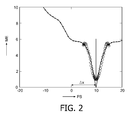
- Fig. 2 shows the match error ME between the two profiles of Fig. 1 (as a mean-absolute difference) as a function of the horizontal pixel shift PS from the first frame relative to the second frame.
- the match error is zero at a pixel shift of precisely 10 pixels. Furthermore, the match error exhibits a well-defined sharp profile and thus a clear global maximum of the match error.
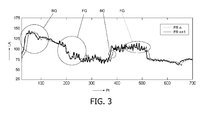
- Fig. 3 shows profiles (line average LA vs. pixel index PI) of two subsequent frames (frame FR n shown with a dotted line, and frame FR n+1 shown with a normal line) in a real scene with a rightward moving background BG, and a static foreground FG, dominated by high-contrast edges of subtitles.
- BG rightward moving background
- FG static foreground FG
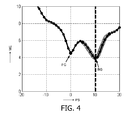
- Fig. 4 shows the match error ME as a function of the pixel shift PS for the case of Fig. 3. Note that this curve shows two minima: a global minimum caused by the background motion at +10 pixels, and a local minimum caused by the foreground at 0 pixels. Thus, in contrast to Fig. 2, this profile does not define a sharp and clear, single minimum.
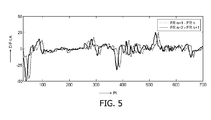
- Fig. 5 shows residuals (differential line average DIF-LA vs. pixel index PI) of the profiles shown in Fig. 3.
- the dotted line shows the residual profile of two frames, say frame FR n and frame FR n+1, whereas the normal line shows the residual profile of the next frame pair, i.e. frame FR n+1 and frame FR n+2.
- the residual profiles are very similar in shape and differ only by a horizontal shift.
- Fig. 6 shows the match error ME as a function of the pixel shift PS of the residual profile of Fig. 5.
- Matching of the residuals now clearly shows the second solution at a well-defined minimum at ⁇ x being about 10 pixels. See also the match error ideal for 'pure' global motion in Fig. 2.
- Fig. 7 shows a flowchart of the iterative matching procedure.
- Consecutive frames FR1, FR2, FR3, FR4 serve as the initial input for computation (Comp Prof) of profiles (Profl / Prof2 / Prof3 / Prof4).
- the profiles are being compared in shift / matching operations S/M, resulting in an optimal match and corresponding shifts ⁇ x 12, ⁇ x 23 and ⁇ x 34.
- the profiles are updated in update profile operations Upd Prof: the profiles are subtracted from each other after being shifted by the optimal shift ⁇ x 12, ⁇ x 23 and ⁇ x 34 .
- a confidence metric may be applied to quantify the quality of the solution (i.e. of the minimum), and to decide whether to accept/discard global motion vectors that result from the proposed method.
- the metric expresses that confidence is high if the global minimum is well defined (i.e. is it a sharp dip'?) and that local minima are not prominent. Such a metric is straightforward (details not shown here).
- Fig. 8 illustrates in a match error ME vs. pixel shift PS graph that a confidence metric should express a sharp global minimum and 'weak'/absent local minima.
- the vertical distances ⁇ y1, ⁇ y2 (at pixel shifts ⁇ d from the global minimum at 10 pixels) and ⁇ y3 should therefore be large: the minimum of these 3 values can be remapped to a range [0..1], resulting in a confidence metric, with 0 meaning no-confidence and 1 meaning full confidence. In this example, the confidence would be low as the local minimum is too prominent (i.e. ⁇ y3 is too small).
- the algorithm is to find any first solution, and to check for a second solution with zero (static) excluded. So, match profiles by shifting to obtain a first solution at minimum match error. Then update the profile by subtracting profiles with zero shift (i.e. eliminate static structures). Then match updated profiles by shifting, and finally use a confidence metric to evaluate the quality of both solutions.
- This special case is a meaningful, easier case. Static structures are common issues in TV images, which advocates checking the presence of a zero shift always, as the additional computational costs seem limited.
- the notion frame includes the notion field.
- This specification may be used to program a video processor for use in a television set or other video signal-processing device to obtain an enhanced video signal.
- Such an enhanced video signal may have an increased number of fields per second in comparison with the input video signal, or may be a non-interlaced version of an interlaced input video signal, or may have been subjected to processing to eliminate artifacts resulting from a film-to-video signal conversion, or may have been compensated for unintended handheld camera movements.
- any reference signs placed between parentheses shall not be construed as limiting the claim.
- the word “comprising” does not exclude the presence of elements or steps other than those listed in a claim.
- the word "a” or “an” preceding an element does not exclude the presence of a plurality of such elements.
- the invention may be implemented by means of hardware comprising several distinct elements, and/or by means of a suitably programmed processor. In the device claim enumerating several means, several of these means may be embodied by one and the same item of hardware. The mere fact that certain measures are recited in mutually different dependent claims does not indicate that a combination of these measures cannot be used to advantage.
Landscapes
- Engineering & Computer Science (AREA)
- Multimedia (AREA)
- Signal Processing (AREA)
- Computer Vision & Pattern Recognition (AREA)
- Physics & Mathematics (AREA)
- General Physics & Mathematics (AREA)
- Theoretical Computer Science (AREA)
- Television Systems (AREA)
- Compression Or Coding Systems Of Tv Signals (AREA)
- Image Analysis (AREA)
Priority Applications (6)
| Application Number | Priority Date | Filing Date | Title |
|---|---|---|---|
| EP06115665A EP1870857A1 (fr) | 2006-06-19 | 2006-06-19 | Estimation de mouvement global |
| JP2009516020A JP5059855B2 (ja) | 2006-06-19 | 2007-06-12 | 大域的動き推定方法 |
| US12/304,336 US8451900B2 (en) | 2006-06-19 | 2007-06-12 | System and method for global motion estimation using profile matching |
| PCT/IB2007/052222 WO2007148260A1 (fr) | 2006-06-19 | 2007-06-12 | Estimation de mouvement global |
| EP07766728A EP2038844A1 (fr) | 2006-06-19 | 2007-06-12 | Estimation de mouvement global |
| CNA2007800228092A CN101473350A (zh) | 2006-06-19 | 2007-06-12 | 全局运动估计 |
Applications Claiming Priority (1)
| Application Number | Priority Date | Filing Date | Title |
|---|---|---|---|
| EP06115665A EP1870857A1 (fr) | 2006-06-19 | 2006-06-19 | Estimation de mouvement global |
Publications (1)
| Publication Number | Publication Date |
|---|---|
| EP1870857A1 true EP1870857A1 (fr) | 2007-12-26 |
Family
ID=37434000
Family Applications (2)
| Application Number | Title | Priority Date | Filing Date |
|---|---|---|---|
| EP06115665A Withdrawn EP1870857A1 (fr) | 2006-06-19 | 2006-06-19 | Estimation de mouvement global |
| EP07766728A Withdrawn EP2038844A1 (fr) | 2006-06-19 | 2007-06-12 | Estimation de mouvement global |
Family Applications After (1)
| Application Number | Title | Priority Date | Filing Date |
|---|---|---|---|
| EP07766728A Withdrawn EP2038844A1 (fr) | 2006-06-19 | 2007-06-12 | Estimation de mouvement global |
Country Status (5)
| Country | Link |
|---|---|
| US (1) | US8451900B2 (fr) |
| EP (2) | EP1870857A1 (fr) |
| JP (1) | JP5059855B2 (fr) |
| CN (1) | CN101473350A (fr) |
| WO (1) | WO2007148260A1 (fr) |
Cited By (1)
| Publication number | Priority date | Publication date | Assignee | Title |
|---|---|---|---|---|
| CN103888779A (zh) * | 2012-12-21 | 2014-06-25 | 辉达公司 | 对运动搜索使用平均运动矢量 |
Families Citing this family (3)
| Publication number | Priority date | Publication date | Assignee | Title |
|---|---|---|---|---|
| US8300958B2 (en) * | 2007-07-11 | 2012-10-30 | Samsung Electronics Co., Ltd. | System and method for detecting scrolling text in mixed mode film and video |
| CN103109522B (zh) * | 2010-11-16 | 2016-05-11 | 本田技研工业株式会社 | 车载摄像头位置变化量检测装置 |
| EP3418975A1 (fr) | 2017-06-23 | 2018-12-26 | Koninklijke Philips N.V. | Traitement d'une carte de profondeur pour une image |
Family Cites Families (4)
| Publication number | Priority date | Publication date | Assignee | Title |
|---|---|---|---|---|
| US5446501A (en) | 1992-10-22 | 1995-08-29 | Accom, Incorporated | Three-dimensional median and recursive filtering apparatus and method for video image enhancement |
| FR2700654B1 (fr) * | 1993-01-19 | 1995-02-17 | Thomson Csf | Procédé d'estimation de disparité entre les images monoscopiques constituant une image stéréoscopiques. |
| WO2005020152A1 (fr) | 2003-08-21 | 2005-03-03 | Matsushita Electric Industrial Co., Ltd. | Dispositif et procede de detection d'etre humain |
| JP2006014121A (ja) | 2004-06-29 | 2006-01-12 | Sanyo Electric Co Ltd | 画像符号化方法、画像符号化装置および撮像装置 |
-
2006
- 2006-06-19 EP EP06115665A patent/EP1870857A1/fr not_active Withdrawn
-
2007
- 2007-06-12 CN CNA2007800228092A patent/CN101473350A/zh active Pending
- 2007-06-12 JP JP2009516020A patent/JP5059855B2/ja not_active Expired - Fee Related
- 2007-06-12 EP EP07766728A patent/EP2038844A1/fr not_active Withdrawn
- 2007-06-12 US US12/304,336 patent/US8451900B2/en not_active Expired - Fee Related
- 2007-06-12 WO PCT/IB2007/052222 patent/WO2007148260A1/fr not_active Ceased
Non-Patent Citations (4)
| Title |
|---|
| JOON-SEEK KIM ET AL: "A FAST FEATURE-BASED BLOCK MATCHING ALGORITHM USING INTEGRAL PROJECTIONS", IEEE JOURNAL ON SELECTED AREAS IN COMMUNICATIONS, IEEE SERVICE CENTER, PISCATAWAY, NJ, US, vol. 10, no. 5, 1 June 1992 (1992-06-01), pages 968 - 971, XP000276102, ISSN: 0733-8716 * |
| KEN SAUER ET AL: "Efficient Block Motion Estimation Using Integral Projections", IEEE TRANSACTIONS ON CIRCUITS AND SYSTEMS FOR VIDEO TECHNOLOGY, IEEE SERVICE CENTER, PISCATAWAY, NJ, US, vol. 6, no. 5, October 1996 (1996-10-01), XP011014326, ISSN: 1051-8215 * |
| KIM M-K ET AL: "AN EFFICIENT GLOBAL MOTION CHARACTERIZATION METHOD FOR IMAGE PROCESSING APPLICATION", IEEE TRANSACTIONS ON CONSUMER ELECTRONICS, IEEE SERVICE CENTER, NEW YORK, NY, US, vol. 43, no. 4, 1 November 1997 (1997-11-01), pages 1010 - 1017, XP000768553, ISSN: 0098-3063 * |
| RATAKONDA K: "Real-time digital video stabilization for multi-media applications", CIRCUITS AND SYSTEMS, 1998. ISCAS '98. PROCEEDINGS OF THE 1998 IEEE INTERNATIONAL SYMPOSIUM ON MONTEREY, CA, USA 31 MAY-3 JUNE 1998, NEW YORK, NY, USA,IEEE, US, vol. 4, 31 May 1998 (1998-05-31), pages 69 - 72, XP010289419, ISBN: 0-7803-4455-3 * |
Cited By (2)
| Publication number | Priority date | Publication date | Assignee | Title |
|---|---|---|---|---|
| CN103888779A (zh) * | 2012-12-21 | 2014-06-25 | 辉达公司 | 对运动搜索使用平均运动矢量 |
| US10602175B2 (en) | 2012-12-21 | 2020-03-24 | Nvidia Corporation | Using an average motion vector for a motion search |
Also Published As
| Publication number | Publication date |
|---|---|
| JP2009542080A (ja) | 2009-11-26 |
| WO2007148260A1 (fr) | 2007-12-27 |
| EP2038844A1 (fr) | 2009-03-25 |
| US20090153742A1 (en) | 2009-06-18 |
| JP5059855B2 (ja) | 2012-10-31 |
| US8451900B2 (en) | 2013-05-28 |
| CN101473350A (zh) | 2009-07-01 |
Similar Documents
| Publication | Publication Date | Title |
|---|---|---|
| US8054881B2 (en) | Video stabilization in real-time using computationally efficient corner detection and correspondence | |
| US8644387B2 (en) | Motion estimation method | |
| US7936950B2 (en) | Apparatus for creating interpolation frame | |
| TWI435608B (zh) | 圖框速率轉換裝置及方法 | |
| US8817878B2 (en) | Method and system for motion estimation around a fixed reference vector using a pivot-pixel approach | |
| US20030090593A1 (en) | Video stabilizer | |
| WO2010024479A1 (fr) | Dispositif et procédé de conversion de signaux d’images 2d en signaux d’images 3d | |
| US20140320682A1 (en) | Image processing device | |
| US7227897B2 (en) | Motion vector detector and motion vector detecting method | |
| US20030206246A1 (en) | Motion estimator for reduced halos in MC up-conversion | |
| US20050232357A1 (en) | Motion vector estimation at image borders | |
| EP2011342A1 (fr) | Estimation de mouvement au niveau des bordures d'image | |
| US20100177239A1 (en) | Method of and apparatus for frame rate conversion | |
| CN101826211A (zh) | 用于提供可靠运动矢量的方法和系统 | |
| KR20050012766A (ko) | 현재 모션 벡터 추정을 위한 유닛 및 모션 벡터 추정 방법 | |
| JP4213035B2 (ja) | オクルージョン領域を検出するオクルージョン検出器および方法 | |
| US8451900B2 (en) | System and method for global motion estimation using profile matching | |
| EP2237559A1 (fr) | Halosenkung basierend auf der Hintergrundbewegungseinschätzung | |
| AU2004200237B2 (en) | Image processing apparatus with frame-rate conversion and method thereof | |
| JP2009533887A (ja) | 動きベクトル場修正装置及び方法 | |
| EP1128678A1 (fr) | Appareil et méthode d'estimation de mouvement | |
| KR20190056741A (ko) | 디스플레이장치 및 그 제어 방법 | |
| KR20040058391A (ko) | 프레임 레이트 변환 장치 및 방법 | |
| JP4261381B2 (ja) | 映像信号処理装置 | |
| US20090167935A1 (en) | Image processing method and related apparatus for generating target image block |
Legal Events
| Date | Code | Title | Description |
|---|---|---|---|
| PUAI | Public reference made under article 153(3) epc to a published international application that has entered the european phase |
Free format text: ORIGINAL CODE: 0009012 |
|
| AK | Designated contracting states |
Kind code of ref document: A1 Designated state(s): AT BE BG CH CY CZ DE DK EE ES FI FR GB GR HU IE IS IT LI LT LU LV MC NL PL PT RO SE SI SK TR |
|
| AX | Request for extension of the european patent |
Extension state: AL BA HR MK YU |
|
| STAA | Information on the status of an ep patent application or granted ep patent |
Free format text: STATUS: THE APPLICATION IS DEEMED TO BE WITHDRAWN |
|
| 18D | Application deemed to be withdrawn |
Effective date: 20071020 |