EP1871114A1 - Verfahren und Vorrichtung zur Bewegungsvektorschätzung in einem Bewegungsfeld mit mindestens einer stationären Fläche - Google Patents
Verfahren und Vorrichtung zur Bewegungsvektorschätzung in einem Bewegungsfeld mit mindestens einer stationären Fläche Download PDFInfo
- Publication number
- EP1871114A1 EP1871114A1 EP06300715A EP06300715A EP1871114A1 EP 1871114 A1 EP1871114 A1 EP 1871114A1 EP 06300715 A EP06300715 A EP 06300715A EP 06300715 A EP06300715 A EP 06300715A EP 1871114 A1 EP1871114 A1 EP 1871114A1
- Authority
- EP
- European Patent Office
- Prior art keywords
- motion vectors
- static
- area
- transition area
- filtering
- Prior art date
- Legal status (The legal status is an assumption and is not a legal conclusion. Google has not performed a legal analysis and makes no representation as to the accuracy of the status listed.)
- Withdrawn
Links
- 230000033001 locomotion Effects 0.000 title claims abstract description 78
- 239000013598 vector Substances 0.000 title claims abstract description 64
- 230000003068 static effect Effects 0.000 title claims abstract description 52
- 238000000034 method Methods 0.000 title claims abstract description 21
- 230000007704 transition Effects 0.000 claims abstract description 37
- 238000001914 filtration Methods 0.000 claims abstract description 29
- 230000000877 morphologic effect Effects 0.000 claims description 2
- 230000015654 memory Effects 0.000 description 13
- 238000001514 detection method Methods 0.000 description 4
- 230000003628 erosive effect Effects 0.000 description 4
- 230000003287 optical effect Effects 0.000 description 3
- 230000005540 biological transmission Effects 0.000 description 2
- 238000004590 computer program Methods 0.000 description 2
- 230000007246 mechanism Effects 0.000 description 2
- 230000008569 process Effects 0.000 description 2
- 230000000750 progressive effect Effects 0.000 description 2
- 230000002123 temporal effect Effects 0.000 description 2
- 230000009471 action Effects 0.000 description 1
- 238000006243 chemical reaction Methods 0.000 description 1
- 230000003247 decreasing effect Effects 0.000 description 1
- 230000010339 dilation Effects 0.000 description 1
- 230000004927 fusion Effects 0.000 description 1
- 230000006872 improvement Effects 0.000 description 1
- 230000000644 propagated effect Effects 0.000 description 1
- 230000009467 reduction Effects 0.000 description 1
Images

Classifications
-
- H—ELECTRICITY
- H04—ELECTRIC COMMUNICATION TECHNIQUE
- H04N—PICTORIAL COMMUNICATION, e.g. TELEVISION
- H04N19/00—Methods or arrangements for coding, decoding, compressing or decompressing digital video signals
- H04N19/20—Methods or arrangements for coding, decoding, compressing or decompressing digital video signals using video object coding
-
- H—ELECTRICITY
- H04—ELECTRIC COMMUNICATION TECHNIQUE
- H04N—PICTORIAL COMMUNICATION, e.g. TELEVISION
- H04N19/00—Methods or arrangements for coding, decoding, compressing or decompressing digital video signals
- H04N19/50—Methods or arrangements for coding, decoding, compressing or decompressing digital video signals using predictive coding
- H04N19/503—Methods or arrangements for coding, decoding, compressing or decompressing digital video signals using predictive coding involving temporal prediction
- H04N19/51—Motion estimation or motion compensation
Definitions
- the invention concerns a method and a device to estimate motion vectors in a video frame comprising at least one static area.
- the goal of a motion estimator applied on a video sequence is often to define motion vector fields between successive video frames.
- the invention proposes a method that modifies the motion vector fields in transition areas close to the static areas.
- Japanese patent application JP8-149421 describes a method for replacing the vectors in a transition area by zero motion vectors. However, this application does not describe how to obtain a smooth transition between the static area and the pixels in movement. Moreover, the transition area is linked to the amplitude of the motion vectors.
- the invention concerns a method to estimate motion vectors for a video field comprising at least one static area, said method comprising the steps of:
- the method comprises the step of filtering the motion vectors associated with the pixels of said transition area.
- the transition area is determined by applying dilatation morphological operators to the static area.
- the filtering consists in applying a linear horizontal filtering followed by a linear vertical filtering on the motion vectors of said transition area.
- the step of filtering consists in replacing the motion vectors of the static area by zero motion vectors.
- the invention concerns also a device to estimate motion vectors for a video field comprising at least one static area, said device comprising
- the device contains means for applying a dilatation operation to the static area in order to obtain the transition area.
- the device comprises means for applying a linear horizontal filtering followed by a linear vertical filtering to the motion vectors of the pixels comprised in said transition area.
- the device comprises means for replacing the motion vectors of the static area by zero motion vectors.
- Embodiments of the present invention may be implemented in software, firmware, hardware or by any combination of various techniques.
- the present invention may be provided as a computer program product or software which may include a machine or computer-readable medium having stored thereon instructions which may be used to program a computer (or other electronic devices) to perform a process according to the present invention.
- steps of the present invention might be performed by specific hardware component that contain hardwired logic for performing the steps, or by any combination of programmed computer components and custom hardware components.
- a machine-readable medium may include any mechanism for storing or transmitting information in a form readable by a machine (for instance a computer).
- These mechanisms include, but are not limited to, floppy diskettes, optical disks, hard disk drives, holographic disks, compact disks read-only memory (CD-ROMs), magneto-optical disks, read-only memory (ROMs), random access memory (RAM), Erasable Programmable Read-only memory (EEPROM), magnetic or optical cards, flash memory, a transmission over the Internet, electrical, optical, acoustical or other forms of propagated signals (for instance carrier waves, infrared signals, digital signals, etc), or the like.
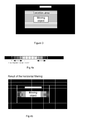
- a static object on an image for instance a logo in an image, is located at the same place on each of the video frame.
- the motion vectors on the left side of the logo are correctly evaluated by a motion vector estimation module.
- the motion vectors on the right side are not correctly evaluated, if the global movement direction goes from the left to the right of the frame.
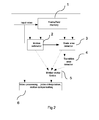
- a motion estimator module 2 estimates the movement between two fields of the same parity, field at time T-2 and field at time T in a known manner by the man skilled in the art.
- the static areas are detected by a static area detector module 3. It consists in detecting the areas which from one field to the next one, or from one frame to the next one, have no movement.
- the static area detection is done using the luminance information and is carried out on bloc of variable size.
- the fields/frames are memorized by a field/frame memory 1 which has the capacity of storing several fields/frames.
- the embodiment describes the invention applied to progressive mode and therefore the field/frame memory 1 is a field memory. At least, the field memory 1 needs to store three fields in order to be able to detect the static areas between field at instant T and field at instant T-2.
- the static areas are not calculated for each pixel but for 2*2 blocs of pixels, in order to assume some stability.
- the error mean rate cannot be higher than 6, threshold value.
- a binary image is obtained, "1" representing a static pixel, "0" representing a non-static pixel.
- an erosion operation is performed on the binary image obtained previously. For this purpose, a window centered on the current pixel is moved pixel by pixel on the image. If the number of static pixels in the window is lower than a predefined threshold, the current pixel is considered as being in movement.
- a 3*3 pixels window is chosen.
- a dilatation operation is performed on the binary image obtained after the erosion operation by a transition area detector 4. For this purpose, a window centered on the current pixel is moved pixel by pixel on the image. If the number of static pixels in the window is higher or equal to a predefined threshold, the current pixel is considered as being static. Otherwise it is considered as being in movement. According to the size of the window and to the threshold, this dilatation can be more or less high around the static area.
- a 3*3 pixels window is chosen.
- the calculated motion vectors are not in line with the movement of the image and therefore do not represent the real movement of the pixels of this area.
- the movement vectors of the pixels in this area are modified in order to have less disturbed motion vectors by a motion vectors fusion module 5.
- the vectors in this area are filtered in order to get a smooth transition from the static area to the moving area.
- a linear filter is applied combining a linear horizontal filtering and an horizontal linear filtering.
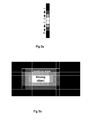
- the current frame is scanned line by line as shown on figure 4a.
- the motion vector V1 and the position P1 of the last pixel not in the transition area is memorized as well as the motion vector V2 and the position P2 of the first pixel not in the transition area.
- a linear filtering of the motion vectors of the pixels located between positions P1 and P2 is done, the value of the motion vectors of the pixels being higher for the pixel close to the highest value and decreasing linearly until the lowest value.
- Figure 4b shows the obtained motion vectors in the transition area.
- a vertical filtering requests much more memory capacities as such a filtering requests to memorize several lines of data.
- the resulting motion vectors for the pixels in the transition area are modified so that they decrease linearly from a high value until a low value. Therefore, a smooth transition is obtained between static areas and moving areas of the frame.
- the new motion vectors for the transition area can be used for applications such as video processing.
- the video processing module 6 can be motion compensation oriented or video interpolation oriented.
- the motion vectors of the transition area are replaced by zero motion vectors.
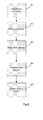
- Figure 6 illustrates an embodiment of a method according to the invention. Such a method can be put into practice in the form of a computer program product in a device such as a set-top box or any digital device. The different steps described below are not described in details as they are similar to the description of figure 2 when referring to the device according to an embodiment of the invention.
- a step E1 the fields are stored in a memory, for instance in the form of a random access memory. At least three consecutive fields have to be stored as the motion estimation is done on fields of the same parity.
- step E2 motion estimation is carried on based on these fields of same parity. Motion estimation of field at instant T is thus evaluated.
- pixels having "0" motion are determined.
- isolated pixels having "0" motion vectors are excluded by performing an erosion operation on the pixels.
- transition areas around the static areas are determined by performing a dilation operation around the static areas.
- a step E5 the motion vectors of the pixels in the transition area are filtered in order to obtain a smooth transition between the vectors in the static area and the vectors of the moving pixels of the field.
- the field/frame memory 1 is a frame memory storing at least two frames in order to perform the motion estimation.
Landscapes
- Engineering & Computer Science (AREA)
- Multimedia (AREA)
- Signal Processing (AREA)
- Television Systems (AREA)
Priority Applications (2)
| Application Number | Priority Date | Filing Date | Title |
|---|---|---|---|
| EP06300715A EP1871114A1 (de) | 2006-06-22 | 2006-06-22 | Verfahren und Vorrichtung zur Bewegungsvektorschätzung in einem Bewegungsfeld mit mindestens einer stationären Fläche |
| EP07110255A EP1914995A1 (de) | 2006-06-22 | 2007-06-14 | Verfahren und Vorrichtung zum Schätzen von Bewegungsvektoren in einem Feld mit mindestens einem statischen Bereich |
Applications Claiming Priority (1)
| Application Number | Priority Date | Filing Date | Title |
|---|---|---|---|
| EP06300715A EP1871114A1 (de) | 2006-06-22 | 2006-06-22 | Verfahren und Vorrichtung zur Bewegungsvektorschätzung in einem Bewegungsfeld mit mindestens einer stationären Fläche |
Publications (1)
| Publication Number | Publication Date |
|---|---|
| EP1871114A1 true EP1871114A1 (de) | 2007-12-26 |
Family
ID=37074992
Family Applications (1)
| Application Number | Title | Priority Date | Filing Date |
|---|---|---|---|
| EP06300715A Withdrawn EP1871114A1 (de) | 2006-06-22 | 2006-06-22 | Verfahren und Vorrichtung zur Bewegungsvektorschätzung in einem Bewegungsfeld mit mindestens einer stationären Fläche |
Country Status (1)
| Country | Link |
|---|---|
| EP (1) | EP1871114A1 (de) |
Citations (2)
| Publication number | Priority date | Publication date | Assignee | Title |
|---|---|---|---|---|
| EP0805405A2 (de) * | 1996-02-05 | 1997-11-05 | Texas Instruments Incorporated | Detektion von Bewegungsereignissen zum Indexieren von Videos |
| US6738424B1 (en) * | 1999-12-27 | 2004-05-18 | Objectvideo, Inc. | Scene model generation from video for use in video processing |
-
2006
- 2006-06-22 EP EP06300715A patent/EP1871114A1/de not_active Withdrawn
Patent Citations (2)
| Publication number | Priority date | Publication date | Assignee | Title |
|---|---|---|---|---|
| EP0805405A2 (de) * | 1996-02-05 | 1997-11-05 | Texas Instruments Incorporated | Detektion von Bewegungsereignissen zum Indexieren von Videos |
| US6738424B1 (en) * | 1999-12-27 | 2004-05-18 | Objectvideo, Inc. | Scene model generation from video for use in video processing |
Non-Patent Citations (4)
| Title |
|---|
| DEMIN WANG ET AL: "Segmentation-Based Motion-Compensated Video Coding Using Morphological Filters", June 1997, IEEE TRANSACTIONS ON CIRCUITS AND SYSTEMS FOR VIDEO TECHNOLOGY, IEEE SERVICE CENTER, PISCATAWAY, NJ, US, ISSN: 1051-8215, XP011014398 * |
| HENRI NICOLAS ET AL: "Minimum Description Length Criterion and Segmentation Map Coding for Region-Based Video Compression", February 2001, IEEE TRANSACTIONS ON CIRCUITS AND SYSTEMS FOR VIDEO TECHNOLOGY, IEEE SERVICE CENTER, PISCATAWAY, NJ, US, ISSN: 1051-8215, XP011014164 * |
| MEIER T ET AL: "Video object plane segmentation using a morphological motion filter and Hausdorff object tracking", 4 October 1998, IMAGE PROCESSING, 1998. ICIP 98. PROCEEDINGS. 1998 INTERNATIONAL CONFERENCE ON CHICAGO, IL, USA 4-7 OCT. 1998, LOS ALAMITOS, CA, USA,IEEE COMPUT. SOC, US, PAGE(S) 652-656, ISBN: 0-8186-8821-1, XP010308551 * |
| ROBERTO CASTAGNO ET AL: "Video Segmentation Based on Multiple Features for Interactive Multimedia Applications", September 1998, IEEE TRANSACTIONS ON CIRCUITS AND SYSTEMS FOR VIDEO TECHNOLOGY, IEEE SERVICE CENTER, PISCATAWAY, NJ, US, ISSN: 1051-8215, XP011014490 * |
Similar Documents
| Publication | Publication Date | Title |
|---|---|---|
| JP5594968B2 (ja) | ビデオ画像間の運動を確定するための方法と装置 | |
| Huang et al. | Correlation-based motion vector processing with adaptive interpolation scheme for motion-compensated frame interpolation | |
| US7221776B2 (en) | Video stabilizer | |
| US20110188583A1 (en) | Picture signal conversion system | |
| US8494055B2 (en) | Apparatus and method for frame interpolation based on accurate motion estimation | |
| EP1912172B1 (de) | Interpolationsverfahren für ein bewegungskompensiertes Bild und Vorrichtung zur Umsetzung dieses Verfahrens | |
| EP2227012A1 (de) | Verfahren und System zum Bereitstellen zuverlässiger Bewegungsvektoren | |
| KR100727998B1 (ko) | 움직임 보상형 시간적 잡음 제거 방법 및 시스템 | |
| US20020101543A1 (en) | Spatio-temporal filter unit and image display apparatus comprising such a spatio-temporal filter unit | |
| US8184705B2 (en) | Method and apparatus for motion compensated filtering of video signals | |
| US7957610B2 (en) | Image processing method and image processing device for enhancing the resolution of a picture by using multiple input low-resolution pictures | |
| EP3149940B1 (de) | Erkennung einer blockbasierten statischen region zur videoverarbeitung | |
| US7868946B2 (en) | Adaptive motion compensated interpolating method and apparatus | |
| US7197075B2 (en) | Method and system for video sequence real-time motion compensated temporal upsampling | |
| EP2204982A1 (de) | Verfahren zur Erzeugung von Bewegungsvektoren von Bildern einer Videosequenz | |
| EP2330818A1 (de) | Bildfrequenzumwandlungsvorrichtung und entsprechende punktschätzungsvorrichtung, entsprechendes punktschätzungsverfahren und entsprechendes punktschätzungsprogramm | |
| EP2107523A1 (de) | Verfahren zum Erkennen einer Szenenänderung in einer Videobildsequenz | |
| US8350966B2 (en) | Method and system for motion compensated noise level detection and measurement | |
| EP1871114A1 (de) | Verfahren und Vorrichtung zur Bewegungsvektorschätzung in einem Bewegungsfeld mit mindestens einer stationären Fläche | |
| EP1914995A1 (de) | Verfahren und Vorrichtung zum Schätzen von Bewegungsvektoren in einem Feld mit mindestens einem statischen Bereich | |
| Kang | Adaptive luminance coding-based scene-change detection for frame rate up-conversion | |
| Van Roosmalen et al. | Restoration and Storage of Film and Video | |
| Woods et al. | Motion compensated spatiotemporal Kalman filter | |
| EP1955548B1 (de) | Bewegungsschätzung mit hilfe von bewegungsunschärfeinformation | |
| US10015513B2 (en) | Image processing apparatus and image processing method thereof |
Legal Events
| Date | Code | Title | Description |
|---|---|---|---|
| PUAI | Public reference made under article 153(3) epc to a published international application that has entered the european phase |
Free format text: ORIGINAL CODE: 0009012 |
|
| AK | Designated contracting states |
Kind code of ref document: A1 Designated state(s): AT BE BG CH CY CZ DE DK EE ES FI FR GB GR HU IE IS IT LI LT LU LV MC NL PL PT RO SE SI SK TR |
|
| AX | Request for extension of the european patent |
Extension state: AL BA HR MK YU |
|
| AKX | Designation fees paid | ||
| REG | Reference to a national code |
Ref country code: DE Ref legal event code: 8566 |
|
| STAA | Information on the status of an ep patent application or granted ep patent |
Free format text: STATUS: THE APPLICATION IS DEEMED TO BE WITHDRAWN |
|
| 18D | Application deemed to be withdrawn |
Effective date: 20080627 |