EP1871897B1 - Verfahren zur herstellung von oligonukleotiden - Google Patents
Verfahren zur herstellung von oligonukleotiden Download PDFInfo
- Publication number
- EP1871897B1 EP1871897B1 EP06706145A EP06706145A EP1871897B1 EP 1871897 B1 EP1871897 B1 EP 1871897B1 EP 06706145 A EP06706145 A EP 06706145A EP 06706145 A EP06706145 A EP 06706145A EP 1871897 B1 EP1871897 B1 EP 1871897B1
- Authority
- EP
- European Patent Office
- Prior art keywords
- nicking
- probe
- nucleic acid
- nucleotides
- cassette
- Prior art date
- Legal status (The legal status is an assumption and is not a legal conclusion. Google has not performed a legal analysis and makes no representation as to the accuracy of the status listed.)
- Expired - Lifetime
Links
Images


Classifications
-
- C—CHEMISTRY; METALLURGY
- C12—BIOCHEMISTRY; BEER; SPIRITS; WINE; VINEGAR; MICROBIOLOGY; ENZYMOLOGY; MUTATION OR GENETIC ENGINEERING
- C12P—FERMENTATION OR ENZYME-USING PROCESSES TO SYNTHESISE A DESIRED CHEMICAL COMPOUND OR COMPOSITION OR TO SEPARATE OPTICAL ISOMERS FROM A RACEMIC MIXTURE
- C12P19/00—Preparation of compounds containing saccharide radicals
- C12P19/26—Preparation of nitrogen-containing carbohydrates
- C12P19/28—N-glycosides
- C12P19/30—Nucleotides
- C12P19/34—Polynucleotides, e.g. nucleic acids, oligoribonucleotides
-
- C—CHEMISTRY; METALLURGY
- C12—BIOCHEMISTRY; BEER; SPIRITS; WINE; VINEGAR; MICROBIOLOGY; ENZYMOLOGY; MUTATION OR GENETIC ENGINEERING
- C12N—MICROORGANISMS OR ENZYMES; COMPOSITIONS THEREOF; PROPAGATING, PRESERVING, OR MAINTAINING MICROORGANISMS; MUTATION OR GENETIC ENGINEERING; CULTURE MEDIA
- C12N15/00—Mutation or genetic engineering; DNA or RNA concerning genetic engineering, vectors, e.g. plasmids, or their isolation, preparation or purification; Use of hosts therefor
- C12N15/09—Recombinant DNA-technology
- C12N15/10—Processes for the isolation, preparation or purification of DNA or RNA
-
- C—CHEMISTRY; METALLURGY
- C12—BIOCHEMISTRY; BEER; SPIRITS; WINE; VINEGAR; MICROBIOLOGY; ENZYMOLOGY; MUTATION OR GENETIC ENGINEERING
- C12Q—MEASURING OR TESTING PROCESSES INVOLVING ENZYMES, NUCLEIC ACIDS OR MICROORGANISMS; COMPOSITIONS OR TEST PAPERS THEREFOR; PROCESSES OF PREPARING SUCH COMPOSITIONS; CONDITION-RESPONSIVE CONTROL IN MICROBIOLOGICAL OR ENZYMOLOGICAL PROCESSES
- C12Q1/00—Measuring or testing processes involving enzymes, nucleic acids or microorganisms; Compositions therefor; Processes of preparing such compositions
- C12Q1/68—Measuring or testing processes involving enzymes, nucleic acids or microorganisms; Compositions therefor; Processes of preparing such compositions involving nucleic acids
- C12Q1/6844—Nucleic acid amplification reactions
Definitions
- the present invention represents an improved method for the production of oligonucleotides.
- the invention also relates to probes for use in the method.
- oligonucleotides are as primers for the polymerase chain reaction (PCR), for reverse transcription PCR (rtPCR), for sequencing, and as substrates for different enzymatic reactions.
- PCR polymerase chain reaction
- rtPCR reverse transcription PCR
- substrates for different enzymatic reactions.
- padlock probes 5' phosphorylated oligonucleotides of 70-100 nucleotides in length.
- Such probes may well cost 100-200$, taking the extra cost for 5' phosphorylations (25-35$) and HPLC purifications (25-35$) into account.
- oligonucleotides can to some extent be amplified enzymatically by known methods, e.g. cloning, PCR, rolling circle amplification or Circle-to-circle amplification (C2CA).
- C2CA Circle-to-circle amplification
- Cloning is a time consuming technique where a double stranded DNA sequence is inserted into a plasmid, transformed into an appropriate host organism e.g. bacteria or yeast, the organism grown, and the DNA purified. This is then followed by isolation of the DNA fragment of interest by restriction endonucleases.
- the technique is laborious, is more suitable for the production of double stranded DNA and at the same time a lot of non-useful DNA is co-amplified and, in particular for the production of shorter DNA segments, the production of non-useful (vector)-DNA will be dominant. Furthermore a laboratory classified for gene modified organisms is required.
- PCR is based on the amplification of a double stranded DNA fragment by the use of a thermostable DNA polymerase and primers complementary to the DNA fragment. Amplification of the DNA fragment takes place by alternating heating and cooling. This technique is more suitable for the production of double stranded DNA and requires a primer for each amplified DNA strand. Furthermore, since the product created is used as template for the next rounds of amplification, mis-incorporation of a nucleotide early in the process will be amplified exponentially along with the desired product.
- In vitro rolling circle replication traditionally uses a circular single stranded DNA oligonucleotide as a rolling-circle-template and a short oligonucleotide as a primer. The addition of a DNA polymerase and dNTPs starts the polymerization. As the rolling-circle-template is endless, the product will be a long single stranded DNA molecule composed of tandem repeats complementary to the rolling-circle-template. In contrast to the PCR reaction, a falsely incorporated nucleotide will not be further amplified as the circular oligonucleotide is template for each round of amplification.
- US 2003/0087241 describes the method of "Rolling circle amplification" in which a rolling circle product can be designed in a way, that allows it to fold into distinct hairpin structures containing a binding site for a restriction endonuclease.
- the rolling circle product can therefore, by a restriction endonuclease, be turned into monomers.
- Limitations to this technique include that it does not amplify the circular oligonucleotide, but rather replicate the complementary sequence, and that it only provides one round of amplification.
- US5714320 (Kool ) describes a "Rolling circle amplification" method. Different ways of cutting the product are described.
- Circle-to-circle amplification is a method for the amplification of a single stranded DNA sequence, based on successive rounds of rolling circle DNA synthesis.
- the DNA sequence is circularized using an external template for ligation.
- a long tandem repeat complementary to the start DNA sequence is synthesized.
- the single stranded tandem repeat can be turned into monomers by addition of a restriction endonuclease.
- This technique requires the additional production of oligonucleotides for cleavage of the rolling circle product, and, even more importantly, it does not provide free design of the ends of the DNA sequence to be amplified as they are defined by the presence of a binding/cleavage site for a restriction endonuclease.
- the invention provides a method for the production of oligonucleotides, enabling efficient amplification of oligonucleotides at lengths up to at least 1000 nucleotides and in high amounts contained within a nicking cassette.
- the reaction principle applies the alternating strand approach of the circle-to-circle amplification, but adding a nicking cassette to the sequence of the oligonucleotide to be amplified.
- This nicking cassette is capable of forming a double stranded structure (a hairpin) comprising one or more nicking sites.
- the one or more nicking sites allow the first rolling circle product to be cleaved into monomers.
- the double stranded feature of the nicking cassette allows the nicking to be done without the addition of an extra oligonucleotide to form the proper double stranded substrate for the nicking enzyme.
- This feature also enables the monomers released from a rolling circle product by the nicking enzyme to be circularized without the addition of external ligation templates.
- the design thus eliminates the need for cleavage and ligation of oligonucleotides inherent to the circle-to-circle-amplification technique.
- the monomers produced in the first round of amplification are then, upon circularisation, subjected to a second round of amplification. If desired, the nicking enzyme may be employed again and the amplification reaction repeated.
- this aspect of the invention provides production of oligonucleotides contained within a nicking cassette, at any length, at least within the range 10-1000 nucleotides, and in amounts that are largely limited by the number of successive rounds of ligation, rolling circle replication, and nicking.
- the method is based on the use of a nucleic acid probe (probe (A)), comprising the sequence of the oligonucleotide to be amplified and a nicking cassette.
- the nicking cassette is a nucleic acid sequence comprising complementary sequences enabling the nicking cassette to hybridise to itself, and further comprising a site for a nicking enzyme.
- the probe (probe (A)) is circularised either by self-templated ligation via hybridisation of the complementary regions of the nicking cassette, or by externally templated ligation of one or more oligonucleotides.
- the probe (probe (A)) Upon circularisation, the probe (probe (A)) is used as rolling-circle-template for rolling circle replication, employing a primer recognizing part of the probe.
- the rolling circle product comprising multiple copies of the complementary sequence to the probe (A) (probe (B)), is exposed to a nicking enzyme, which cuts within the nicking cassette. This results in multiple copies of probe (B).
- circularisation of probe (B) is mediated by self-templated ligation via hybridisation of the complementary regions of the nicking cassette.
- the multiple copies of the circularized probe (B) are used for rolling circle replication employing primers with a target sequence complementary to part of probe (B).
- a second nicking reaction is employed.
- the method of the invention provides production of an oligonucleotide up to a length of at least 1000 nucleotides in high amounts contained within a nicking cassette.
- the invention provides a method for the production of oligonucleotides, enabling efficient amplification of oligonucleotides at lengths up to about 1000 nucleotides and in high amounts.
- the reaction principle applies the alternating strand and self-templated approach outlined above, but adding a restriction site to the nicking cassette.
- a nicking cassette comprising one or more nicking sites and one or more restriction sites will be referred to as a nicking cassette or a suicide cassette, alternatively, depending upon its use.
- This suicide cassette is capable of forming a double stranded structure (a hairpin) comprising one or more nicking sites and one or more restriction sites.
- the one or more nicking sites allow the first, and any subsequent, rolling circle products to be cleaved into monomers as described above.
- the one or more restriction sites allow the rolling circle products to be converted into multiple copies of the oligonucleotide to be amplified contemporary with the release of the suicide cassette from the oligonucleotides.
- the method of the invention provides production of oligonucleotides with freely designable 5'-ends and 3'-ends, at any lengths, at least within the range of 10-1000 nucleotides, and in amounts that are largely limited by the number of rounds of ligation, rolling circle replication and nicking.
- the method provides alternating amplification of probe (B) from probe (A) and of probe (A) of probe (B) as outlined above, with the added feature that any of the rolling circle products may be digested with the restriction enzyme releasing the suicide cassette from the oligonucleotide.
- the invention relates to a method for amplifying an oligonucleotide contained within a nicking cassette through successive rounds of ligation, rolling circle replication, and nicking:
- a method for amplifying one or more oligonucleotides comprising
- the invention also relates to a probe for use in the method as outlined above.
- the probe of the invention comprises a nicking cassette, wherein the nicking cassette is a nucleic acid sequence comprising complementary sequences, enabling the nicking cassette to hybridise to itself and bind the necessary modifying enzymes.
- the invention in a second aspect of the invention, relates to a method for amplifying an oligonucleotide contained within a suicide cassette, releasing the oligonucleotide from the suicide cassette at the end of the amplification.
- the aspect also relates to a probe for use in the method as outlined above.
- the probe of the invention comprises a suicide cassette, wherein the suicide cassette is a nucleic acid sequence comprising complementary sequences, enabling the suicide cassette to hybridise to itself, bind the necessary modifying enzymes, and be cleaved out at the end of the reaction.
- the invention relates to a method for the amplification of one ore more oligonucleotides contained within a nicking cassette comprising one or more binding and cleavage sites for nicking enzymes.
- the nicking cassette is further equipped with one or more restriction sites (giving rise to a so-called suicide cassette) allowing the release of the cassette from the one ore more oligonucleotides after amplification.
- Artificial nucleotide Nucleic acids not found in the nature e.g. but not limited to, iso-dCTP or iso-dGTP, with or without modifications, e.g., but not limited to, biotin and fluorophores and any of the natural nucleic acids containing modifications, e.g., but not limited to, biotin and fluorophores.
- Blotin-coupled-oligonucleotide An oligonucleotide with a bound biotin molecule e.g. to its 5'-end.
- Closed circular structure A nucleic acid sequence with a non-ending sugar-phosphate backbone.
- Externally templated ligation Ligation of the 5'-end and the 3'-end of the same or different oligonucleotides by hybridization to a template, which is not part of the oligonucleotide/oligonucleotides.
- Hairpin A section of single-stranded nucleic acid sequence that hybridises onto itself creating a single stranded nucleic acid loop and a double stranded nucleic acid region.
- Ligation template A nucleic acid sequence to which the 5'-end of one oligonucleotide and the 3'-end of the same or another oligonucleotide can hybridise and be aligned in a way, which allows ligation of the two ends.
- LNA Locked nucleic acids.
- Mly I A type IIS enzyme, which recognises the sequence 5'-GAGTCNNNNN-3' and cuts double stranded DNA blunt end after the last N creating a 3'-hydroxyl and a 5-phosphate.
- N Any of the nucleotides G, C, A, T, I, U and any artificial nucleotides.
- N.Alw I (Nt.Alw I): A nicking enzyme, which recognises the sequence 5'-GGATCNNNNN-3' and nicks the recognition sequence between the two last N's: 5'-GGATCNNNN - nicking - N.
- Natural nucleotide Any of the nucleotides G, C, A, T, I, U.
- Nicking cassette A nucleic acid sequence comprising a loop and one or more complementary sequences, which enable parts of the nicking cassette to hybridise to parts of itself.
- the nicking cassette is able to bind one or more modifying enzymes, preferably nicking enzymes. If the nicking cassette is to be removed from the nucleic acid sequence to which it is added, it is designed as a suicide cassette.
- Nicking enzyme An enzyme, which recognises a double stranded nucleic acid sequence and is capable of cutting one and only one strand in the double stranded nucleic acid sequence, creating a 3'-hydroxyl and a 5'-phosphate.
- Nucleic acid sequence Any sequence containing natural nucleotides e.g., but not limited to, G, C, A, T, I, U or any artificial nucleotides e.g., but not limited to, iso-dCTP, iso-dGTP or a mixture thereof.
- Nucleic acid probe (A) A nucleic acid sequence comprising the nucleic acid sequence of the one or more oligonucleotides to be amplified by the method of the invention and the nucleic acid sequence of one or more nicking cassettes.
- Nucleic acid probe (B) A nucleic acid sequence complementary to nucleic acid sequence (A).
- Nucleotide Any natural, artificial or modified nucleotide.
- Oligonucleotide A single stranded nucleic acid sequence having a length of 10-1000 nucleotides, such as e.g. 10-800 nucleotides, or such as e.g. 10-600 nucleotides, or such as e.g. 10-500 nucleotides, or such as e.g. 15-400 nucleotides, or such as e.g. 15-300 nucleotides, or such as e.g. 20-250 nucleotides, or such as e.g. 20-200, or such as e.g. such as e.g. 20-180, or such as e.g. 20-160, or such as e.g.
- nucleotides such as e.g. 30-130 nucleotides, or such as e.g. 40-120 nucleotides, or such as e.g. 50-110 nucleotides, or such as e.g. 60-110 nucleotides, or such as e.g.70-100 nucleotides.
- PNA Peptide nucleic acid
- Rolling circle replication Nucleic acid synthesis using a circular single stranded oligonucleotide as rolling-circle-template and a short nucleic acid sequence as a primer. The addition of a DNA polymerase and dNTPs starts the polymerization. As the rolling-circle-template is endless the product will be a single long nucleic acid strand composed of tandem repeats complementary to the rolling-circle-template.
- Rolling-circle-template The closed circular nucleic acid sequence which a polymerase uses as template for rolling circle replication.
- Self-templated ligation Ligation of the 5'-end and the 3'-end of the same or different oligonucleotides by hybridization to a template which is part of the oligonucleotide, or part of one of the oligonucleotides.
- Solid support Any solid support an oligonucleotide can be attached to or synthesised on, e.g., but not limited to, PCR-tubes, microscopic slides, ELISA-plates, microchips, plastic CDs (produced by the company ⁇ mic), or beads.
- Suicide cassette A nucleic acid sequence comprising one or more complementary sequences, which enable parts of the suicide cassette to hybridise to parts of itself. The complementary sequences are separated by a loop.
- the suicide cassette is able to bind one or more modifying enzymes, preferably nicking enzymes and restriction enzymes.
- the suicide cassette can be removed from the nucleic acid sequence to which it is added by restriction digestion.
- a suicide cassette is a nicking cassette further comprising one or more restriction sites.
- Type IIS enzyme An enzyme which recognises asymmetric nucleotide sequences and cleaves DNA at a specified position outside of the recognition site.
- oligonucleotides to be amplified by the invention such as e.g. 1-10 oligonucleotides, or such as e.g. 1-5 oligonucleotides, or such as e.g. 3 oligonucleotides, or such as e.g. 2 oligonucleotides, or such as e.g. 1 oligonucleotide.
- the present invention provides a method for the amplification of one or more oligonucleotides using a single-stranded probe as template for the amplification reaction.
- the probes of the invention for use in the method are composed of the one or more oligonucleotides to be amplified and one or more cassettes (nicking cassettes or suicide cassettes).
- cassettes nicking cassettes or suicide cassettes.
- the purpose, components and characteristics of the nicking cassette and the suicide cassette are outlined in detail below.
- the presence of the one or more nicking cassettes or one or more suicide cassettes in the probes of the invention makes it possible to amplify any oligonucleotide comprising a sequence of at least 10-1000 nucleotides by the method of the invention without any requirements on the nucleic acid sequence of the oligonucleotide, such as e.g. the presence of restriction sites.
- the relationship between the nicking cassette and the suicide cassette is thus: i) all suicide cassettes are also nicking cassettes (and may be used as such), since they are nicking cassettes with an added feature, an element designed to enable their removal at convenience. ii) Since the nicking cassette is not removed, it equips the synthesis product with the functionalities of the nicking cassette, i.e. the possibility of self-templated ligation into a closed circular structure and reduction of polymers to monomers. The suicide feature does not equip the product with this functionality, but leaves it with freely designable 5'-ends and 3'-ends, such as e.g. needed in padlock probes.
- Nicking cassettes thus serve amplification purposes and add the feature of self-circularisation to the product, whereas the suicide element serves purification purposes only.
- probe (A), probe (B), the oligonucleotide contained within probe (A), and the oligonucleotide contained within probe (B) can be obtained by the use of this invention.
- the invention relates to a method for amplifying an oligonucleotide contained within a nicking cassette through successive rounds of ligation, rolling circle replication, and nicking.
- the method comprises
- a method for amplifying one or more oligonucleotides comprising
- steps b-i can be repeated as many times as needed. If each round e.g. amplifies 300 ⁇ , two rounds equals 300 2 ⁇ amplification, three rounds equals 300 3 ⁇ amplification and four rounds equals 300 4 ⁇ amplification. Thus, after four rounds 1 ng of probe (A) may be turned into about 8 grams of probe (A), enough for several million individual application reactions. Obviously, the larger production of oligonucleotides occurs in the later cycles, so for large scale production the reaction is cycled more than once.
- the method according to the invention relates to a method, wherein steps b)-i) are performed one or more times, such as e.g. 1-100 times, or such as e.g. 1-50 times, or such as e.g. 1-25 times, or such as e.g. 1-10 times, or such as e.g. 1-5 times, or such as e.g. 1-4 times, or such as e.g. 1-3 times, or such as e.g. 1-2 times.
- the method according to the invention relates to a method, wherein steps b)-i) are performed one or more times, such as e.g. one time, or such as e.g. two times, or such as e.g.
- the method according to the invention relates to a method wherein probe (A) is acquired after step i).
- the method according to the invention relates to a method wherein probe (B) is acquired after step e)
- the nucleic acid probe of the invention comprises the one or more oligonucleotides to be amplified by the method of the invention and one or more nicking cassettes, wherein the nicking cassette is a nucleic acid sequence comprising one or more complementary sequences, enabling parts of the nicking cassette to hybridise to parts of itself.
- the nicking cassette is furthermore able to bind one or more modifying enzymes, preferably a nicking enzyme. This allows the nicking cassette and the oligonucleotide contained within it to be amplified through successive rounds of ligation, rolling circle replication, and nicking.
- the invention relates to a nucleic acid probe comprising one or more oligonucleotides and one or more nicking cassettes, wherein the one or more nicking cassettes are nucleic acid sequences comprising one or more complementary sequences and one or more nicking sites.
- nicking cassette The purpose and characteristics of the nicking cassette are outlined below in details.
- the nicking cassette of the invention is a nucleic acid sequence.
- the nicking cassette can comprise any sequence of the natural nucleotides G, C, A, T, I, U, or any artificial nucleotides e.g., but not limited to, iso-dCTP, iso-dGTP, or a mixture thereof.
- the nicking cassette of the invention has a linear length of 20-200 nucleotides.
- the invention relates to a method, wherein the one or more nicking cassettes have a length of 20-200 nucleotides, such as e.g. 20-150 nucleotides, or such as e.g. 20-100 nucleotides, or such as e.g. 20-80 nucleotides, or such as e.g. 20-60 nucleotides, or such as e.g. 20-40 nucleotides, or such as e.g. 20-30 nucleotides.
- the aim of the nicking cassette is to enable amplification of an oligonucleotide by applying the method of the invention, which is based on the principle of rolling circle replication.
- the nicking cassette is added to the sequence of the oligonucleotide to be amplified before the initiation of the rolling circle replication, most conveniently during the initial synthesis of probe (A).
- the nicking cassette is attached to the sequence of the oligonucleotide to be amplified during the steps of the rolling circle replication.
- the nicking cassette possesses several characteristics: 1) the cassette comprises one or more complementary sequences, enabling the cassette to hybridise to itself, 2) the cassette comprises one or more sites for nicking enzymes, and 3) the cassette comprises a loop structure ( Figure 2 ).
- the loop structure of the nicking cassette aims to connect the ends of the two complementary sequences.
- the loop comprises 3-100 nucleotides, such as e.g. 3-80 nucleotides, or such as e.g. 3-60 nucleotides, or such as e.g. 3-40 nucleotides, or such as e.g. 3-20 nucleotides, or such as e.g. 3-10 nucleotides, or such as e.g. 3-9 nucleotides, or such as e.g. 3-8, or such as e.g. 3-7 nucleotides, or such as e.g. 3-6 nucleotides, or such as e.g. 3-5 nucleotides.
- the loop sequence is 3-7 nucleotides long ( Figure 2 ), such as e.g. 3 nucleotides, or such as e.g. 4 nucleotides, or such as e.g. 5 nucleotides, or such as e.g. 6 nucleotides, or such as e.g. 7 nucleotides.
- loop structures include, but not limited to: 5'-AATAA-3' for the (+)-strand and 5'-TTATT-3' for the (-)-strand, 5'-GAA-3' for the (+)-strand and 5'-TTC-3' for the (-)-strand, 5'-GAAA-3' for the (+)-strand and 5'-TTTC-3' for the (-)-strand, or 5'- AAAA-3' for the (+)-strand and 5'-TTTT-3' for the (-)-strand.
- the (+)-strand is the loop-sequence of probe (A)
- the (-)-strand is the loop-sequence of probe (B).
- the loop structure can be selected from but is not limited to the group consisting of AATAA, GAA, GAA, AAAA, and TTTT for the (+)-strand.
- the invention relates to a method, wherein the one or more nicking cassettes comprise a loop-structure selected from the group consisting of AATAA, GAA, GAA, AAAA, and TTTT.
- the sequence of the nicking cassette in probe (A) is selected from but not limited to the group consisting of AATAA, GAA, GAA, AAAA, and TTTT.
- the complementary sequences of the nicking cassette are positioned on each side of the loop structure in the sequence of the nicking cassette ( Figure 2 ).
- the complementary sequences comprise 10-100 nucleotides, such as e.g. 10-80 nucleotides, such as e.g. 10-60 nucleotides, such as e.g. 10-30 nucleotides, or such as e.g. 10-40 nucleotides.
- the complementary sequences are 10-20 nucleotides long, such as e.g. 10-20 nucleotides, such as e.g. 12-20 nucleotides, such as e.g. 14-20 nucleotides, or such as e.g. 15-20 nucleotides. Examples of complementary sequences are, but not limited to:
- the invention relates to a method, wherein the one or more nicking cassettes comprise the complementary sequences:
- the invention relates to a method, wherein the one or more nicking cassettes comprise the complementary sequences:
- the invention relates to a method, wherein the one or more nicking cassettes comprise the complementary sequences:
- the invention relates to a method, wherein the one or more nicking cassettes comprise the complementary sequences:
- the aim of the complementary sequences of the nicking cassette is to form binding sites for nicking enzymes. Furthermore, the complementary sequences enable the probe (A) or (B) to be circularized by self-templated hybridization of the complementary sequences in the nicking cassette.
- parts of the nicking cassette will be added to each end of the oligonucleotide sequence to be amplified during the initial synthesis.
- a minimum of 5 nucleotides able to accommodate self-templated hybridization is positioned at each end of the oligonucleotide.
- the nicking cassette is positioned central in the probe (A). In this case circularisation can be performed by externally templated ligation of one or more oligonucleotides.
- the nicking cassette comprises a recognition site for one or more nicking enzymes.
- a nicking enzyme recognises a double stranded nucleic acid sequence and cuts one and only one strand in the double stranded nucleic acid sequence, creating a 3'-hydroxyl and a 5'-phosphate.
- the nicking enzyme is used in step e) and step i) of the method of the invention.
- the rolling circle product of the first amplification round comprising multiple copies of the complementary sequence to probe (A) (probe (B)
- the amplified product comprises a multimer of successive copies of probe (B).
- Each nicking cassette sequence is forming a hairpin as the complementary sequences in the nicking cassette are hybridising to each other.
- the nicking enzyme recognises the nicking site in the double stranded hairpin region of the nicking cassette and cuts one strand in the double stranded sequence.
- the cutting of the amplified product by the nicking enzyme results in multiple copies of probe (B).
- the nicking enzyme prepares the rolling circle product of the first amplification round for the second round of ligation, rolling circle replication, and nicking.
- the nicking enzyme is used in step i) of the method of the invention.
- step i) the rolling circle product of the second amplification round, comprising multiple copies of the complementary sequence to the probe (B) (probe (A)), is exposed to the nicking enzyme.
- the cutting of the amplified product of the second amplification round by the nicking enzyme results in multiple copies of probe (A).
- the nicking enzyme prepares the rolling circle product of the second amplification round for additional rounds of rolling circle replication (step b) to step i) of the method of the invention).
- Additional base pairs on either side of the binding site for the nicking enzyme in the complementary sequences of the nicking cassette may be included to increase the cleavage efficiency of the nicking enzyme ( Figure 2 ).
- two base pairs are inserted on either side, alternatively 0-50 base pairs are inserted on one or both sides, such as e.g. 0-40 base pairs on one or both sides, or such as e.g. 0-30 base pairs on one or both sides, or such as e.g. 0-20 base pairs on one or both sides, or such as e.g. 0-10 base pairs on one or both sides, or such as e.g. 0-8 base pairs on one or both sides, or such as e.g. 0-6 base pairs on one or both sides, or such as e.g. 0-4 base pairs on one or both sides.
- extra base pairs can be freely chosen as long as they are not identical to the enzyme binding sites already used, or create additional binding sites for the enzymes to be used.
- nicking enzymes are available on the market, and therefore only a few nicking cassettes can be designed.
- nicking enzymes with higher cleavage efficiencies and more narrow recognition sites will most likely be developed. This will allow new designs of nicking cassettes, possibly limiting the size of the nicking cassette and/or increasing the amplification efficiency.
- the detailed structure of the nicking cassette may vary, as the position of the binding site for the nicking enzyme, the number of extra nucleotides, and the nucleotide composition of the loop all can be adjusted for optimal performance in the amplification reaction.
- the sequence of the binding site for the nicking enzyme also depends on the specific enzyme used.
- the circularisation of probe (A) in the step b) can be obtained by externally templated ligation of one or more oligonucleotides.
- nucleic acid sequences of the nicking cassette include, but are not limited to:
- the invention relates to a method, wherein the one or more nicking cassettes comprise a nucleic acid sequence selected from the group consisting of
- the one or more oligonucleotides to be amplified by the method of the invention can comprise a sequence of at least 10-1000 nucleotides.
- the invention relates to a method, wherein the one or more oligonucleotides comprise a sequence of 10-1000 nucleotides, such as e.g. 10-800 nucleotides, or such as e.g. 10-600 nucleotides, or such as e.g. 10-500 nucleotides, or such as e.g. 15-400 nucleotides, or such as e.g. 15-300 nucleotides, or such as e.g. 20-250 nucleotides, or such as e.g.
- 20-200 or such as e.g. such as e.g. 20-180, or such as e.g. 20-160, or such as e.g. 25-140 nucleotides, or such as e.g. 30-130 nucleotides, or such as e.g. 40-120 nucleotides, or such as e.g. 50-110 nucleotides, or such as e.g. 60-110 nucleotides, or e.g. such as 70-100 nucleotides.
- the invention relates to method wherein the one or more oligonucleotides are DNA oligonucleotides.
- the oligonucleotide can comprise any nucleic acid sequence composed of any of the natural deoxyribonucleotides G, C, A, T, and any of the artificial nucleotides, iso-dCTP, iso-dGTP, or any natural or artificial nucleotides containing modifications.
- the invention relates to a method, wherein the one or more oligonucleotides are DNA sequences.
- the genetic alphabet is expanded to contain three base pairing components; G-C, A-T, and e.g. isoG-isoC.
- the starting nucleic acid sequence (probe (A)), which comprises one or more oligonucleotides to be amplified and one or more nicking cassettes, can be synthesised by standard chemical methods, such as e.g. beta-cyanoethyl phosphoramidite chemistry.
- the 5'-phosphate can be added during this synthesis, or alternatively the 5'-phosphate can be coupled enzymatically to the 5'-end of the nucleic acid sequence, by e.g. using T4 polynucleotide kinase.
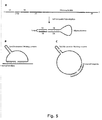
- probe (A) can be created by externally templated ligation of two or more oligonucleotides ( Figure 5 ).
- the invention relates to a method, wherein the probe (A) is created by ligation of one or more nucleic acid sequences comprising one or more parts of the one or more oligonucleotides and the one or more nicking cassettes.
- the probe (A) will contain a part of the nicking cassette in each end of the probe.
- the nicking cassette is positioned centrally in the oligonucleotide. If the probe (A) is created by externally templated ligation of several synthesized sequences, a part of the nicking cassette can be positioned at the 3'-end of one sequence and another part can be positioned in the neighboring 5'-end of another sequence. Alternatively the cassette can be positioned centrally in one or more of the synthesized sequences.
- the start nucleic acid sequence (probe (A)) can also contain more than one nicking cassette, which can be either identical or different in design, i.e. nucleic acid composition.
- the invention relates to a method, wherein the probe (A) comprises a nucleic acid sequence selected from the group consisting of:
- Circularisation of probe (A) can be performed by self-templated ligation or by externally templated ligation or a combination of both.
- probe (A) contains a part of the nicking cassette in each end of probe (A)
- ligation can be performed by self-templated ligation ( Figure 5A ).
- Figure SA by hybridization between element 1A-1B and element 2A-2B, the nucleic acid probe folds into an open circle by self-templated hybridization.
- ligation can be performed by externally templated ligation of one or more oligonucleotide ( Figure 5B ).
- probe (A) can e.g. be constructed by ligation of more than one nucleic acid sequence, e.g. by a combination of self-templated hybridisation and externally templated hybridisation ( Figure 5C ).
- the invention relates to a method, wherein the closed circular structure of nucleic acid probe (A) is obtained by self-templated ligation.
- the circularisation of probe (A) can be obtained by self-templated hybridization of the probe (A) via hybridisation of the complementary regions of the one or more nicking cassettes within the probe (A), to enable ligation of the ends of probe (A).
- a closed circular structure can be created by standard enzymatic ligation for both externally templated ligation and self-templated ligation, by applying the correct buffer conditions together with the appropriate energy source (ATP or NAD+) and a ligase.
- the T4 DNA ligase is used.
- ATP is supplied in a concentration of 0.001-10 mM preferably 0.1-1 mM
- T4 DNA ligase is supplied in a final concentration of 0.00025-0.1 Weiss unit/ ⁇ l, preferably 0.0025-0.05 U/ ⁇ l.
- other ligases such as Tsc ligase, Tth ligase, Ampligase, and Taq ligase, can be used.
- Chemical ligation may also be used.
- a circle containing one or more nicking cassettes will typically comprise 50-1000 nucleotides, preferably 50-500 nucleotides.
- a primer is needed to start the rolling circle replication reaction.
- a primer consists of 5-50 nucleotides and preferably of 7-15 nucleotides.
- the primer has to be complementary to part of the nucleic acid probe, preferably a part outside the nicking cassette, alternatively a part inside the nicking cassette.
- the primer is 100% complementary to the probe, alternatively nucleotides at the 5'-end of the primer are non-complementary to the probe, e.g. 1 nucleotide, 3 nucleotides, 5 nucleotides, 10 nucleotides, 25 nucleotides or 50 nucleotides.
- a polymerase containing 3' to 5' exonuclease activity e.g. Phi29 DNA polymerase
- non-complementary nucleotides at the 3'-end of the primer can be present, such as e.g. 1 nucleotide, such as e.g. 3 nucleotides, such as e.g.
- nucleotides such as e.g. 10 nucleotides, such as e.g. 25 nucleotides, or such as e.g. 50 nucleotides.
- mismatched nucleotides in the primer can be present, e.g. 1 nucleotide, such as e.g. 3 nucleotides, such as e.g. 5 nucleotides, such as e.g. 10 nucleotides, or such as e.g. 25 nucleotides.
- the primer can be synthesised by standard chemical methods (e.g. beta-cyanoethyl phosphoramidite chemistry).
- a primer can also contain modifications e.g., but not limited to, streptavidine, avidin, biotin, 32 P, and fluorophores, or it may comprise artificial nucleotides such as, but not limited to, LNA, PNA, iso-dCTP, and iso-dGTP.
- a molar ratio of 0.1-100 between circle and primer is mixed, preferably 0.8-1.2.
- polymerases which do not need a primer can also be used by the method of the invention, In this case no primers are needed to start the rolling circle replication.
- an improvement of the procedure can be obtained by letting one or more reagents, e.g. the primers, in step c and/or step g of the method of the invention, be anchored to a solid support, thereby attaching the rolling circle product to a surface.
- the primer can be coupled in the 5'-end to a solid support - a 5'-biotin labelled primer may e.g. be coupled to a streptavidine coated solid support including, but not limited to, PCR-tubes, ELISA plates, beads, plastic CDs (produced by the company ⁇ mic), and microscope slides.
- Microfluidics solutions provide a set of platforms where reagents can be anchored and conditions can be changed all within one design. Besides the physical anchoring of reagents (e.g. primer, polymerase) microfluidics systems also provide means of confining reagents to defined compartments, permanently or transiently, without attaching them to a support, i.e. a non-physical anchoring.
- reagents e.g. primer, polymerase
- Either the primer, the nucleic acid circle, the polymerase, or the endonucleases may thus be attached to a solid support or otherwise confined spatially without seriously damaging the overall efficiency of the amplification reaction.
- the circle In the case of the circle, the circle can be locked around a structure on the support allowing rolling of the circle but inhibiting the circle from diffusing away from the surface.
- the invention relates to a method, wherein the primer in step c is immobilised on a solid support.
- the invention relates to a method, wherein the primer in step g is immobilised on a solid support.
- the invention relates to a method, wherein nucleic acid circle is attached to a solid support or otherwise spatially confined.
- the invention relates to a method, wherein the polymerase is attached to a solid support or otherwise spatially confined.
- the invention relates to a method, wherein the endonucleases are immobilised on a solid support or otherwise spatially confined.
- dNTPs deoxynucleotide triphosphates
- primer 1 primer 1
- rolling circle replication can take place.
- the polymerase will start the polymerization from the 3'-end of the primer, using the circular probe as a rolling-circle-template.
- the rolling circle product will comprise a multimer complementary to the sequence of the circular probe.
- the polymerase is the Phi29 DNA polymerase.
- a final concentration of 0.001-2 units of phi29 polymerase (Fermentas) is used, preferably 0.05-1 unit is used.
- a final dNTP concentration of 0.005-10 mM, preferably 0.1-1 mM is used.
- polymerases such as the T7 DNA polymerase, Sequenase Version 2.0 T7 DNA Polymerase, and Bst DNA polymerase can be used.
- the incubation time should be between 10 minutes and 24 hours, preferably 30 minutes to 5 hours, at the temperature optimal for the polymerase of choice.
- SSB single stranded binding protein
- a concentration of 0 ⁇ g/ ⁇ l SSB is preferably used.
- a concentration of 0.001-0.2 ⁇ g/ ⁇ l can be used.
- the length of the rolling circle product is preferably between 500 and 500.000 nucleotides in length.
- the speed and duration of the elongation can be controlled by varying the concentrations of dNTP, polymerase, circle, primer, and SSB. Furthermore, temperature and buffer conditions are adjustable.
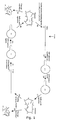
- the rolling circle product which comprises multiple copies of a complementary sequence to probe (A) (called probe (B)), will fold into distinct hairpins, each composed of a nicking cassette.
- probe (B) will fold into distinct hairpins, each composed of a nicking cassette.
- the multimer is cut with a nicking enzyme.
- the binding site of the nicking enzyme is positioned in the nicking cassette.
- the preferred nicking enzymes are N.Alw I (Nt.Alw I), N.BbvC IA (Nb.BbvC I), N.BbvC IB (Nt.BbvC I), Nt.BstNB I, Nb.Bpu10I and Nb.Bsm I.
- the invention relates to a method, wherein the nicking enzyme is selected from the group consisting of N.Alw I (Nt.Alw I), N.BbvC IA (Nb.BbvC I), N.BbvC IB (Nt.BbvC I), and Nb.Bsm I.
- the N.Alw I (Nt.Alw I) is in the method of the invention. Therefore, in a preferred embodiment, the invention relates to a method, wherein the nicking enzyme is N.Alw I (Nt.Alw I).
- the buffer mixture is adjusted to accommodate nicking conditions without a purification step, alternatively the rolling circle product is purified by known methods (e.g. gel purification or ethanol precipitation) and optimal buffer conditions for the nicking enzyme is supplied.
- a purification step e.g. gel purification or ethanol precipitation
- optimal buffer conditions for the nicking enzyme is supplied.
- Preferably 0.3-1 U/ ⁇ l of nicking enzyme is used alternatively 0.05-3 U/ ⁇ l is used.
- Incubation time can be from 30 minutes to 3 days, preferably 3-20 hours.
- the nicked product can be acquired following a nicking reaction by standard purification methods e.g. by gel purification, ethanol precipitation or HPLC purification.
- a denaturation-renaturation step by heating and cooling may be performed, which will promote the monomers (multiple copies of probe (B)) to fold into an open circular structure by self-templated hybridization in the region of the nicking cassette ( Figure 1 ).
- circularisation of probe (B) can be obtained by intra-molecular hybridization of the probe (B) via hybridisation of the complementary regions of the one or more nicking cassettes, enabling ligation of the ends of probe (B). Therefore, one embodiment of the invention relates to a method, wherein the circularisation of probe (B) is obtained by self-templated ligation.
- a closed circular structure of probe (B) can be created by standard enzymatic ligation.
- the buffer conditions are adjusted to improve ligation without a purification step, alternatively the nicked product is purified by known methods (e.g. gel purification or ethanol precipitation), before ligation.
- the second rolling circle replication is performed similarly to the first rolling circle replication.
- the primer (primer 2) is complementary to the one used in the first round of rolling circle replication, alternatively it hybridizes to another part of the probe sequence than primer 1.
- This step of the reaction is similar to the nicking of the rolling circle product of the first round.
- the difference from the first round of nicking is that it is now a tandem repeat of probe (A) which is nicked and not a tandem repeat of probe (B).
- the product can be purified e.g. by gel purification, ethanol precipitation or HPLC purification.
- the nicking product is amplified further by successive rounds of ligation, rolling circle replication, and nicking as outlined above.
- the invention relates to a method wherein probe (A) is amplified through successive rounds of ligation, rolling circle replication, and nicking.
- the invention relates to a method wherein probe (B) is amplified through successive rounds of ligation, rolling circle replication, and nicking as outlined above.
- the invention also relates to a nucleic acid probe comprising one or more nicking cassettes, wherein said one or more nicking cassettes are nucleic acid sequences comprising one or more complementary sequences, and one or more nicking sites.
- said details of the complementary sequences and nicking sites are as outlined above.
- the probe of the invention comprises one or more oligonucleotides for amplification by the method of the invention.
- the invention relates to a nucleic acid probe comprising one or more oligonucleotides and one or more nicking cassettes, wherein the one or more nicking cassettes are nucleic acid sequences comprising one or more complementary sequences and one or more nicking sites.
- the one or more oligonucleotides for amplification by the method of the invention comprise a sequence of at least 10-1000 nucleotides. Therefore in one aspect, the invention relates to a nucleic acid probe, wherein the one or more oligonucleotides comprise a sequence of 10-1000 nucleotides.
- the details of the complementary sequences and the nicking sites for the nicking cassette comprised in the probe of the invention are as outlined under the method of the invention.
- the invention relates to a nucleic acid probe, wherein the one or more nicking cassettes have a length of 20-200 nucleotides.
- the invention relates to a nucleic acid probe, wherein the one or more nicking cassettes comprise a loop-structure selected from the group consisting of AATAA, GAA, GAA, AAAA, and TTTT.
- the invention relates to a nucleic acid probe, wherein the one or more nicking cassettes comprise the complementary sequences:
- the invention relates to a nucleic acid probe, wherein the one or more nicking cassettes comprise the complementary sequences:
- the invention relates to a nucleic acid probe, wherein the one or more nicking cassettes comprise the complementary sequences:
- the invention relates to a nucleic acid probe, wherein the one or more nicking cassettes comprise the complementary sequences:
- the invention relates to a nucleic acid probe, wherein the one or more nicking cassettes comprise a nucleic acid sequence selected from the group consisting of:
- the invention relates to a nucleic acid probe, wherein the probe comprises a nucleic acid sequence selected from the group consisting of:
- the nucleic acid probe of the invention can be used in rolling circle replication for different purposes - For example as a probe for use in the detection of nucleic acid molecules in situ (an in vitro diagnostic method).
- the probes in this context can be used for the detection of single nucleic acid molecules by rolling circle replication.
- the probes mentioned below can be used for in vitro diagnostics and in diagnostic kits.
- a probe which can be turned into a closed circular structure by self-templated ligation may be preferable when the ligation efficiency on the target nucleic acid molecule is low (e.g. on RNA targets or on DNA targets containing modifications resulting from degradation, preparation, or fixation, such as e.g. addition of mono-methylol (-CH 2 OH) groups to the bases of the nucleic acids, resulting in dimerisation of adenine groups by methylene bridging).
- -CH 2 OH mono-methylol
- the invention relates to a nucleic acid probe further comprising a part comprising a sequence of nucleic acid residues, which is at least 75% complementary to a target nucleic acid sequence, such as e.g. 75-100% complementary, or such as e.g. 80-100% complementary, or such as e.g. 85-100% complementary, 90-100% complementary, or such as e.g. 95-100% complementary, or such as e.g. 100% complementary.
- This part could for instance be part of the oligonucleotide contained within the nicking cassette.
- Target primed rolling circle reactions are primed from the natural 3'-end of a target nucleic acid molecule. Detecting nucleic acid molecules by target primed rolling circle replication has the advantage of strong signal amplification and a localised signal due to the target primed reaction ( WO 97/20948 and Larsson C. et al. Nature Methods 1, 227-32 (2004 )).
- the target RNA can preferably be a non-polyadenylated RNA, such as, but not limited to, EBER1 and EBER2 from the Epstein-Barr virus, the adenovirus-encoded small RNA's VA1 and VA2, ribosomal RNA's, the RNA part of the telomerase complex (hTERC), small interfering RNA's (siRNA's), and micro-RNA's (miRNA's).
- EBER1 and EBER2 from the Epstein-Barr virus
- VA1 and VA2 the adenovirus-encoded small RNA's VA1 and VA2
- ribosomal RNA's the RNA part of the telomerase complex
- shTERC small interfering RNA's
- siRNA's small interfering RNA's
- miRNA's micro-RNA's
- a preferred embodiment of the invention relates to a circular nucleic acid probe comprising a part of nucleic acid residues, wherein a part comprises a sequence of nucleic acid residues, which is at least 75% complementary to a target RNA sequence, such as e.g. 75-100% complementary, or such as e.g. 80-100% complementary, or such as e.g. 85-100% complementary, 90-100% complementary, or such as e.g. 95-100% complementary, or such as e.g. 100% complementary.
- This part could for instance be part of the oligonucleotide contained within the nicking cassette.
- the part of the probe comprising a nucleic acid sequence complementary to a target nucleic acid sequence, can have a linear length of 6-100.
- the invention refers to a circular nucleic acid probe, wherein the length of a part is 6-100 nucleotides, such as e.g. 20-100 nucleotides, or such as e.g. 20-80 nucleotides, or such as e.g. 20-60 nucleotides, or such as e.g. 20-40 nucleotides, or such as e.g. 20-30 nucleotides.
- the invention relates to a circular nucleic acid probe, further comprising one or more elements defining the specific probe.
- the identifiers need to have a certain length to be specific to a target sequence and to allow hybridisation under the reaction conditions.
- an identifier could match the total length of the probe, but in most cases a shorter identifier element would be preferable. Shorter identifiers would have faster hybridisation kinetics and would enable a probe to contain more than one identifier.
- the invention relates to an element defining the specific probe, which is a nucleotide sequence of 6-200 nucleotides, such as e.g. 6-150 nucleotides, or such as e.g. 6-150 nucleotides, or such as e.g.
- 6-100 nucleotides or such as e.g. 6-80 nucleotides, or such as e.g. 6-60 nucleotides, or such as e.g. 6-50 nucleotides, or such as e.g. 10-40 nucleotides, or such as e.g. 10-30 nucleotides, or such as e.g. 15-30 nucleotides.
- probes are used as rolling-circle-templates in a rolling circle replication reaction
- detection can also be obtained through synthesis.
- detection through synthesis could be performed similar to established linear PRINS reactions.
- incorporation of a labelled (e.g. a fluorophore) A, T, G, C, or U is an obvious approach, it will give rise to background staining, as these nucleotides could be incorporated not only in the rolling circle replication product but also elsewhere in the sample.
- Incorporating one or more artificial nucleotides, such as isoC or isoG, into the sequence of the probe and providing the complementary nucleotide as a labelled nucleotide e.g.
- a fluorophore during replication may therefore be preferable. Since such artificial nucleotides are not found in nature, iso-dCTP and iso-dGTP will not be incorporated elsewhere in the sample, minimizing background reactions. This aspect makes the use of a fluorophore-coupled iso-dCTP nucleotides or iso-dGTP nucleotides preferable. If detection is obtained through synthesis, the identifier element, defining the specific probe, may therefore preferably be one or more artificial nucleotide. Thus, in another embodiment, the invention relates to an element defining the specific probe, which is composed of one or more artificial nucleotides, such as e.g. 1-20 artificial nucleotides, or such as e.g.
- 1-10 artificial nucleotides or such as e.g. 1-5 artificial nucleotides, or such as e.g. 4 artificial nucleotides, or such as e.g. 3 artificial nucleotides, or such as e.g. 2 artificial nucleotides, or such as e.g. 1 artificial nucleotide.
- the invention refers to a circular nucleic acid probe, wherein the total length of the probe is 30-200 nucleotides, such as e.g. 30-150 nucleotides, or such as e.g. 50-150 nucleotides, or such as e.g. 70-150 nucleotides, or such as e.g. 90-150 nucleotides, or such as e.g. 70-130 nucleotides, or such as e.g. 70-110 nucleotides.
- the total length of the probe is 30-200 nucleotides, such as e.g. 30-150 nucleotides, or such as e.g. 50-150 nucleotides, or such as e.g. 70-150 nucleotides, or such as e.g. 90-150 nucleotides, or such as e.g. 70-130 nucleotides, or such as e.g. 70-110 nucleotides.
- the invention relates to a probe comprising the sequence (SEQ ID NO:1): wherein P is a 5'-phosphate.
- the invention relates to a probe comprising the sequence (SEQ ID NO:2): wherein P is a 5'-phosphate.
- the invention relates to a probe comprising the sequence (SEQ ID NO:3): wherein P is a 5'-phosphate.
- the invention relates to a probe comprising the sequence (SEQ ID NO:4): wherein P is a 5'-phosphate.
- the invention relates to a probe comprising the sequence (SEQ ID NO:5): wherein P is a 5'-phosphate.
- the method refers to a nucleic acid probe, for use in rolling circle replication.
- probes mentioned above could be amplified using a nicking cassette. Since the ligation efficiency of probes amplified by the method of the invention is superior to chemically synthesised oligonucleotides, the probes of the invention are suited for the production of such probes.
- the nucleic acid probe according to invention is intended for use in the method of the invention.
- the invention in a second aspect of the invention, relates to a method for amplifying an oligonucleotide contained within a probe comprising a suicide cassette, and furthermore releasing it from the suicide cassette at the end of the amplification.
- a suicide cassette is a nicking cassette further comprising one or more restriction sites.
- the invention relates to a method wherein the nicking cassette further comprises one or more restriction sites. It is to be understood that all suicide cassettes can be used as nicking cassette, by using the method described above.
- the method using a suicide cassette comprises:
- a method for amplifying one or more oligonucleotides comprising
- steps b-i can be repeated as many times as needed. If each round e.g. amplifies 300x, two rounds equals 300 2 ⁇ amplification, three rounds equals 300 3 ⁇ amplification and four rounds equals 300 4 ⁇ amplification. Thus, after four rounds 1 ng of probe (A) may be turned into about 7 grams of probe (A), enough for several million individual application reactions. Obviously, the larger production of oligonucleotides occurs in the later cycles, so for large scale production the reaction is cycled more than once.
- the method according to the invention relates to a method, wherein steps b-i are performed one or more times, such as e.g. 1-100 times, or such as e.g. 1-50 times, or such as e.g. 1-25 times, or such as e.g. 1-10 times, or such as e.g. 1-5 times, or such as e.g. 1-4 times, or such as e.g. 1-3 times, or such as e.g. 1-2 times.
- the method according to the invention relates to a method, wherein steps b-i are performed one or more times, such as e.g. one time, or such as e.g. two times, or such as e.g.
- the nucleic add probe of the invention comprises the one or more oligonucleotides to be amplified by the method of the invention and one or more suicide cassettes, wherein the suicide cassette is a nucleic acid sequence comprising one or more complementary sequences, enabling parts of the suicide cassette to hybridise to parts of itself.
- the suicide cassette is furthermore able to bind two or more modifying enzymes, preferably nicking enzymes and restriction enzymes. This allows the suicide cassette to be eliminated from the probe at the end of the reaction, thereby releasing the one or more amplified oligonucleotides.
- the method of the invention provides production of oligonucleotides with freely designable 5'-ends and 3'-ends, of any lengths, at least 10-1000 nucleotides, and in amounts that are largely limited by the number of rounds of ligation, rolling circle replication, and nicking.
- the invention relates to a nucleic acid probe comprising one or more suicide cassettes, wherein said one ore more suicide cassettes are a nucleic acid sequence comprising one or more complementary sequences, one or more nicking sites and one or more restriction sites.
- the suicide cassette of the invention is a nucleic acid sequence.
- the suicide cassette can comprise any sequence of the natural nucleotides G, C, A, T, I, U, or any artificial nucleotides e.g., but not limited to, iso-dCTP, iso-dGTP or a mixture thereof.
- the suicide cassette of the invention has a single stranded length of 20-200 nucleotides.
- the invention relates to a method, wherein the one or more suicide cassettes has a length of 20-200 nucleotides, such as e.g. 20-150 nucleotides, or such as e.g. 20-100 nucleotides, or such as e.g. 20-80 nucleotides, or such as e.g. 20-60 nucleotides, or such as e.g. 20-40 nucleotides, or such as e.g. 20-30 nucleotides.
- 20-200 nucleotides such as e.g. 20-150 nucleotides, or such as e.g. 20-100 nucleotides, or such as e.g. 20-80 nucleotides, or such as e.g. 20-60 nucleotides, or such as e.g. 20-40 nucleotides, or such as e
- the aim of the suicide cassette is to enable amplification of an oligonucleotide by applying the method of the invention, which is based on the principle of rolling circle replication.
- the suicide cassette is added to the sequence of the oligonucleotide to be amplified before the initiation of the rolling circle replication, most conveniently during the initial synthesis of probe (A).
- the suicide cassette is released from the amplified oligonucleotides by cutting the rolling circle product with a restriction enzyme.
- the suicide cassette is attached to the sequence of the oligonucleotide to be amplified during the steps of the rolling circle replication.
- the suicide cassette is eliminated from the sequence of the oligonucleotide.
- the suicide cassette possesses several characteristics: 1) the cassette comprises one or more complementary sequences, enabling the cassette to hybridise to itself, 2) the cassette comprises one or more sites for nicking enzymes, 3) the cassette comprises one or more restriction sites for restriction enzymes, and 4) the cassette comprises a loop structure ( Figure 3 ).
- the loop structure of the suicide cassette aims to connect the ends of the two complementary sequences.
- the loop comprises 3-100 nucleotides, such as e.g. 3-80 nucleotides, or such as e.g. 3-60 nucleotides, or such as e.g. 3-40 nucleotides, or such as e.g. 3-20 nucleotides, or such as e.g. 3-10 nucleotides, or such as e.g. 3-9 nucleotides, or such as e.g. 3-8, or such as e.g. 3-7 nucleotides, or such as e.g. 3-6 nucleotides, or such as e.g. 3-5 nucleotides.
- the loop sequence is 3-7 nucleotides long ( Figure 3 ), such as e.g. 3 nucleotides, or such as e.g. 4 nucleotides, or such as e.g. 5 nucleotides, or such as e.g. 6 nucleotides, or such as e.g. 7 nucleotides.
- loop structures include, but not limited to: 5'-AATAA-3' for the (+)-strand and 5'-TTATT-3' for the (-)-strand, 5'-GAA-3' for the (+)-strand and 5'-TTC-3' for the (-)-strand, 5'-GAAA-3' for the (+)-strand and 5'-TTTC-3' for the (-)-strand, or 5'- AAAA-3' for the (+)-strand and 5'-TTTT-3' for the (-)-strand.
- the (+)-strand is the loop-sequence of probe (A)
- the (-)-strand is the loop-sequence of probe (B).
- the loop structure can be selected from but is not limited to the group consisting of AATAA, GAA, GAA, AAAA, and TTTT for the (+)-strand.
- the invention relates to a method, wherein the one or more suicide cassettes comprise a loop-structure selected from the group consisting of AATAA, GAA, GAA, AAAA, and TTTT. This means that the sequence of the suicide cassette in probe (A) is selected from but not limited to the group consisting of AATAA, GAA, GAA, AAAA, and TTTT.
- the complementary sequences of the suicide cassette are positioned on each side of the loop structure in the sequence of the suicide cassette ( Figure 3 ).
- the complementary sequences comprise 10-100 nucleotides, such as e.g. 10-80 nucleotides, 10-60 nucleotides, 13-30 nucleotides or 13-40 nucleotides.
- the complementary sequences are 12-20 nucleotides long, such as e.g. 12-20 nucleotides, such as e.g. 13-20 nucleotides, such as e.g. 14-20 nucleotides, or such as e.g. 15-20 nucleotides.
- Examples of complementary sequences are, but not limited to:
- the invention relates to a method, wherein the one or more nicking cassettes comprise the complementary sequences:
- the invention relates to a method, wherein the one or more nicking cassettes comprise the complementary sequences:
- the invention relates to a method, wherein the one or more nicking cassettes comprise the complementary sequences:
- the aim of the complementary sequences of the suicide cassette is to form binding sites for both nicking enzymes and restriction enzymes. Furthermore, the complementary sequences enable the probe (A) or (B) to be circularized by self-templated hybridization of the complementary sequences in the suicide cassette.
- parts of the suicide cassette will be added to each end of the oligonucleotide sequence to be amplified during the initial synthesis.
- a minimum of 5 nucleotides able to accommodate self-templated hybridization is positioned at each end of the oligonucleotide.
- the suicide cassette is positioned central in the probe (A). In this case circularisation can be performed by externally templated ligation.
- the suicide cassette comprises a recognition site for a nicking enzyme and a recognition site for a restriction enzyme.
- a nicking enzyme recognises a double stranded nucleic acid sequence and cuts one and only one strand in the double stranded nucleic acid sequence, creating a 3'-hydroxyl and a 5'-phosphate.
- the nicking enzyme is used in step e) and in step i) of the method of the invention.
- the rolling circle product of the first amplification round comprising multiple copies of the complementary sequence to probe (A) (probe (B)) is exposed to the nicking enzyme.
- the amplified product comprises a multimer of successive copies of probe (B) and the suicide cassette.
- Each suicide cassette sequence is forming a hairpin as the complementary sequences in the suicide cassette are hybridising to each other.
- the nicking enzyme recognises the nicking site in the double stranded hairpin region of the suicide cassette and cuts one strand in the double stranded sequence.
- the cutting of the amplified product by the nicking enzyme results in multiple copies of probe (B).
- the nicking enzyme prepares the rolling circle product of the first amplification round for the second round of ligation, rolling circle replication and cleavage/nicking.
- the rolling circle product of the second amplification round comprising multiple copies of the complementary sequence to the probe (B) (probe (A)
- the cutting of the amplified product of the second amplification round by the nicking enzyme results in multiple copies of probe (A).
- the nicking enzyme prepares the rolling circle product of the second amplification round for additional rounds of rolling circle replication (step b) to step i) of the method of the invention).
- a restriction enzyme recognises a double stranded nucleic add sequence and cuts both strands in a double stranded nucleic acid sequence.
- the restriction enzyme can be used following steps d) or h) of the method of the invention. Following these steps, the rolling circle products comprise multiple copies of probe (A) or probe (B).
- each suicide cassette in the amplification product is forming a hairpin, as the complementary sequences in the suicide cassette are hybridising to each other.
- the restriction enzyme recognises the restriction site within the hairpin, and cleaves the DNA at a specific position, releasing the oligonucleotide contained within probe (A) or probe (B) from the suicide cassette. Thereby, multiple copies of the oligonucleotide contained within probe (A) or probe (B) are obtained.
- the invention relates to a method, wherein probe (A) is acquired after step h) by cutting the rolling circle product of probe (B) with a restriction enzyme.
- the invention relates to a method, wherein probe (B) is acquired after step d) by cutting the rolling circle product of probe (A) with a restriction enzyme.
- the binding site for the restriction enzyme is positioned closest to the loop of the suicide cassette and the binding site for the nicking enzyme is furthest away from the loop ( Figure 3 , A-B).
- the binding site for the nicking enzyme is closest to the loop ( Figure 3 , C-D), or the two binding sites are overlapping.
- Additional base pairs next to the loop structure may be included to increase the cleavage efficiency of the enzymes ( Figure 3 ).
- two base pairs are inserted, alternatively 0-50 base pairs are inserted, such as e.g. 0-40 base pairs, or such as e.g. 0-30 base pairs, or such as e.g. 0-20 base pairs, or such as e.g. 0-10 base pairs, or such as e.g. 0-8 base pairs, or such as e.g. 0-6 base pairs, or such as e.g. 0-4 base pairs.
- 0-50 base pairs can be positioned between the two binding sites. If the recognition site for the type IIS restriction enzyme Mly I is positioned furthest away from the loop structure, an additional five base pairs are needed for the unrestricted design of the 5'-end and the 3'-end of the oligonucleotide to be amplified ( Figure 3 , C-D).
- the extra base pairs can be freely chosen as long as they are not identical to the enzyme binding sites already used, or create additional binding sites for the enzymes to be used.
- nicking enzymes and restriction enzymes cutting blunt end outside its recognition sequence are available on the market, and therefore only a few suicide cassettes can be designed.
- nicking enzymes with higher cleavage efficiencies and more narrow recognition sites, as well as further restriction enzymes cleaving blunt end outside the recognition site will most likely be developed. This will allow new designs of suicide cassettes, possibly limiting the size of the suicide cassette and/or increasing the amplification efficiency.
- the detailed structure of the suicide cassette may vary, as the position of the binding site for the nicking enzyme, the position of the binding site for the restriction enzyme, the number of extra nucleotides, and the nucleotide composition of the loop all can be adjusted for optimal performance in the amplification reaction.
- the sequences of the binding sites for the restriction enzyme and the nicking enzyme also depend on the specific enzymes used.
- the circularisation of probe (A) in the step b) can be obtained by externally templated ligation of one or more oligonucleotides.
- nucleic acid sequences of the suicide cassette include, but are not limited to:
- the invention relates to a method, wherein the one or more nicking cassettes comprise a nucleic acid sequence selected from the group consisting of
- the one or more oligonucleotides to be amplified by the method of the invention can be any nucleic add sequence comprising a sequence of at least 10-1000 nucleotides.
- the invention relates to a method, wherein the one or more oligonucleotides comprise a sequence of 10-1000 nucleotides, such as e.g. 10-800 nucleotides, or such as e.g. 10-600 nucleotides, or such as e.g. 10-500 nucleotides, or such as e.g. 15-400 nucleotides, or such as e.g. 15-300 nucleotides, or such as e.g.
- 20-250 nucleotides or such as e.g. 20-200, or such as e.g. such as e.g. 20-180, or such as e.g. 20-160, or such as e.g. 25-140 nucleotides, or such as e.g. 30-130 nucleotides, or such as e.g. 40-120 nucleotides, or such as e.g. 50-110 nucleotides, or such as e.g. 60-110 nucleotides, or such as e.g. 70-100 nucleotides.
- the oligonucleotide can comprise any nucleic acid sequence composed of any of the natural deoxyribonucleotides G, C, A, T, I, U, and any of the artificial nucleotides, iso-dCTP, iso-dGTP or any natural or artificial nucleotides containing modifications.
- the invention relates to a method, wherein the one or more oligonucleotides are DNA sequences.
- the genetic alphabet is expanded to contain three base pairing components; G-C, A-T, and e.g. isoG-isoC.
- the starting nucleic acid sequence (probe (A)), which comprises one or more oligonucleotides to be amplified, and one or more suicide cassettes, can be synthesised by standard chemical methods, such as e.g. beta-cyanoethyl phosphoramidite chemistry.
- the 5'-phosphate can be added during this synthesis, alternatively the 5'-phosphate can be coupled enzymatically to the 5'-end of the nucleic acid sequence, e.g. using the T4 polynucleotide kinase.
- the invention relates to a method, wherein probe (A) comprises the nucleic acid sequence (SEQ ID NO:8): wherein P is the 5'-phosphate.
- probe (A) can be created by externally templated ligation of two or more oligonucleotides ( Figure 5 ).
- the invention relates to a method, wherein the probe (A) is created by ligation of one or more nucleic acid sequences comprising one or more parts of the one or more oligonucleotides and the one or more suicide cassettes.
- the probe (A) will contain a part of the suicide cassette in each end of the probe.
- the suicide cassette is positioned centrally in the oligonucleotide. If the probe (A) is created by externally templated ligation of several synthesized sequences, a part of the suicide cassette can be positioned at the 3'-end of one sequence and another part can be positioned in the neighboring 5'-end of another sequence. Alternatively, the cassette can be positioned centrally in one or more of the synthesized sequences.
- the start nucleic acid sequence (probe (A)) can also contain more than one suicide cassette, which can be either identical or different in design, i.e. nucleic acid composition.
- the invention relates to a method, wherein the probe (A) comprises a nucleic acid sequence selected from the group consisting of:
- Circularisation of probe (A) can be performed by self-templated ligation, by externally templated ligation, or by a combination of both.
- probe (A) contains a part of the suicide cassette in each end of probe (A)
- ligation can be performed by self-templated ligation ( Figure 5A ).
- Figure 5A by hybridization between element 1A-1B and element 2A-2B, the nucleic acid probe folds into an open circle by self-templated hybridization.
- the suicide cassette is positioned centrally in an oligonucleotide, ligation can be performed by externally templated ligation of one or more oligonucleotide ( Figure 5B ).
- probe (A) can be constructed by ligation of more than one nucleic acid sequence, e.g. by a combination of self-templated hybridisation and externally templated hybridisation ( Figure 5C ).
- the invention relates to a method, wherein the closed circular structure of nucleic acid probe (A) is obtained by self-templated ligation.
- the circularisation of probe (A) can be obtained by self-templated folding of the probe (A) via hybridisation of the complementary regions of the one or more suicide cassettes within the probe (A), to enable ligation of the ends of probe (A).
- a closed circular structure can be created by standard enzymatic ligation for both externally templated ligation and self-templated ligation, by applying the correct buffer conditions together with the appropriate energy source (ATP or NAD+) and a ligase.
- the T4 DNA ligase is used.
- ATP is supplied in a concentration of 0.001-10 mM preferably 0.1-1 mM
- T4 DNA ligase is supplied in a final concentration of 0.00025-0.1 Weiss unit/ ⁇ l, preferably 0.0025-0.05 U/ ⁇ l.
- other ligases such as Tsc ligase, Tth ligase, Ampligase and Taq ligase, can be used.
- Chemical ligation may also be used.
- a circle containing one or more suicide cassettes will typically comprise 50-1000 nucleotides, preferably 50-500 nucleotides.
- a primer is needed to start the rolling circle replication reaction.
- a primer consists of 5-50 nucleotides and preferably of 7-15 nucleotides.
- the primer has to be complementary to part of the nucleic acid probe, preferably a part outside the suicide cassette, alternatively a part inside the suicide cassette.
- the primer is 100% complementary to the probe, alternatively nucleotides at the 5'-end of the primer is non-complementary to the probe, e.g. 1 nucleotide, 3 nucleotides, 5 nucleotides, 10 nucleotides, 25 nucleotides or 50 nucleotides.
- a polymerase containing 3' to 5' exonuclease activity e.g. Phi29 DNA polymerase
- non-complementary nucleotides at the 3'-end of the primer can be present, e.g. 1 nucleotide, such as e.g. 3 nucleotides, such as e.g. 5 nucleotides, such as e.g.
- nucleotides such as e.g. 25 nucleotides or such as e.g. 50 nucleotides.
- mismatched nucleotides in the primer can be present, e.g. 1 nucleotide, such as e.g. 3 nucleotides, such as e.g. 5 nucleotides, such as e.g. 10 nucleotides or 25 nucleotides.
- the primer can be synthesised by standard chemical methods (e.g. beta-cyanoethyl phosphoramidite chemistry).
- a primer can also contain modifications e.g., but not limited to, streptavidine, avidin, biotin, 32 P, and fluorophores, or it may comprise artificial nucleotides such as, but not limited to, LNA, PNA, iso-dCTP, and iso-dGTP.
- a molar ratio of 0.1-100 between circle and primer is mixed, preferably 0.8-1.2. It is to be understood that polymerases which do not need a primer can also be used by the method of the invention, in this case no primers are needed to start the rolling circle replication.
- the invention relates to a method, wherein the primer comprises the nucleic acid sequence (SEQ ID NO:9):
- the invention relates to a method, wherein the primer comprises the nucleic acid sequence (SEQ ID NO:10):
- an improvement of the procedure can be obtained by letting one or more reagents, e.g. the primers, in step c and/or step g of the method of the invention, be anchored to a solid support, thereby attaching the rolling circle product to a surface.
- the primer can be coupled in the 5'-end to a solid support- a 5'-biotin labelled primer may e.g. be coupled to a streptavidine coated solid support including, but not limited to, PCR-tubes, ELISA plates, beads, plastic CDs (produced by the company ⁇ mic), and microscope slides.
- Microfluidics solutions provide a set of platforms where reagents can be anchored and conditions can be changed all within one design. Besides the physical anchoring of reagents (e.g. primer, polymerase) microfluidics systems also provide means of confining reagents to defined compartments, permanently or transiently, without attaching them to a support, i.e. a non-physical anchoring.
- reagents e.g. primer, polymerase
- Either the primer, the nucleic acid circle, the polymerase, or the endonucleases may thus be attached to a solid support or otherwise confined spatially without seriously damaging the overall efficiency of the amplification reaction.
- the circle In the case of the circle, the circle can be locked around a structure on the support allowing rolling of the circle but inhibiting the circle from diffusing away from the surface.
- the invention relates to a method, wherein the primer in step c is immobilised on a solid support.
- the invention relates to a method, wherein the primer in step g is immobilised on a solid support.
- the invention relates to a method, wherein nucleic acid circle is attached to a solid support or otherwise spatially confined.
- the invention relates to a method, wherein the polymerase is attached to a solid support or otherwise spatially confined.
- the invention relates to a method, wherein the endonucleases are immobilised on a solid support or otherwise spatially confined.
- dNTPs deoxynucleotide triphosphates
- primer 1 primer 1
- rolling circle replication can take place.
- the polymerase will start the polymerization from the 3'-end of the primer, using the circular probe as a rolling-circle-template.
- the rolling circle product will comprise a multimer complementary to the sequence of the circular probe.
- the polymerase is the Phi29 DNA polymerase.
- a final concentration of 0.001-2 units of phi29 polymerase (Fermentas) is used, preferably 0.05-1 unit is used.
- a final dNTP concentration of 0.005-10 mM, preferably 0.1-1 mM is used.
- polymerases such as the T7 DNA polymerase, Sequenase Version 2.0 T7 DNA Polymerase and Bst DNA polymerase can be used.
- the incubation time should be between 10 minutes and 24 hours, preferably 30 minutes to 5 hours, at the temperature optimal for the polymerase of choice.
- SSB single stranded binding protein
- a concentration of 0 ⁇ g/ ⁇ l SSB is preferably used.
- a concentration of 0.001-0.2 ⁇ g/ ⁇ l can be used.
- the length of the rolling circle product is preferably between 500 and 500.000 nucleotides in length.
- the speed and duration of the elongation can be controlled by varying the concentrations of dNTP, polymerase, circle, primer and SSB. Furthermore, temperature and buffer conditions are adjustable.
- the rolling circle product which comprises multiple copies of a complementary sequence to probe (A) (called probe (B)), will fold into distinct hairpins composed of the suicide cassettes.
- probe (B) will fold into distinct hairpins composed of the suicide cassettes.
- the multimer is cut with a nicking enzyme.
- the binding site of the nicking enzyme is positioned in the suicide cassette.
- the following nicking enzyme can be used N.Alw I (Nt.Alw I), N.BbvC IA (Nb.BbvC I), N.BbvC IB (Nt.BbvC I), Nt.BstNB I, Nb.Bpu10I or Nb.Bsm I.
- the invention relates to a method, wherein the nicking enzyme is selected from the group consisting of N.Alw I (Nt.Alw I), N.BbvC IA (Nb.BbvC I), N.BbvC IB (Nt.BbvC I), Nt.BstNB I, Nb.Bpu10I and Nb.Bsm I.
- the N.Alw I (Nt.Alw I) is in the method of the invention. Therefore, in a preferred embodiment, the invention relates to a method, wherein the nicking enzyme is N.Alw I (Nt.Alw I).
- the buffer mixture is adjusted to accommodate nicking conditions without a purification step, alternatively the rolling circle product is purified by known methods (e.g. gel purification or ethanol precipitation) and optimal buffer conditions for the nicking enzyme is supplied.
- a purification step e.g. gel purification or ethanol precipitation
- optimal buffer conditions for the nicking enzyme is supplied.
- Preferably 0.3-1 U/pi of nicking enzyme is used alternatively 0.05-3 U/pi is used.
- Incubation time can be from 30 minutes to 3 days, preferably 3-20 hours.
- a denaturation-renaturation step by heating and cooling may be performed, which will promote the monomers (multiple copies of probe (B)) to fold into an open circular structure by self-templated hybridization in the region of the suicide cassette ( Figure 1 ).
- circularisation of probe (B) can be obtained by intra-molecular hybridization of the probe (B) via hybridisation of the complementary regions of the one or more suicide cassettes, enabling ligation of the ends of probe (B). Therefore, one embodiment of the invention relates to a method, wherein the circularisation of probe (B) is obtained by self-templated ligation.
- a closed circle structure of probe (B) can be created by standard enzymatic ligation.
- the buffer conditions are adjusted to improve ligation without a purification step, alternatively the nicked product is purified by known methods (e.g. gel purification or ethanol precipitation), before ligation.
- the second rolling circle replication is performed similarly to the first rolling circle replication.
- the primer (primer 2) is complementary to the one used in the first round of rolling circle, alternatively it hybridizes to another part of the probe sequence than primer 1.
- Yet another round of nicking can be performed to amplify the oligonucleotide further.
- the difference from the first round of nicking is that it is now a tandem repeat of probe (A), which is nicked and not a tandem repeat of probe (B).
- the probe (A) and probe (B) can be amplified further through successive rounds of ligation, rolling circle replication, and nicking before the removal of the suicide cassette.
- the suicide cassette enables the continuous copying of the nucleic acid sequence, such as e.g. DNA, through (+) and (-) strand syntheses.
- the synthesized nucleic acid sequence such as e.g. DNA
- the multimer is cut with a type IIS restriction enzyme.
- the binding site is positioned in the suicide cassette.
- the enzyme cuts in the suicide cassette, or at the border of the suicide cassette and the oligonucleotide, thereby releasing the oligonucleotide from the suicide cassette.
- the invention relates to a method, wherein the restriction enzyme recognises the restriction site in the one or more nicking cassettes, said restriction enzyme cutting in the one or more nicking cassettes, or at the border of the one or more nicking cassettes and the one or more oligonucleotides.
- the invention relates to a method, wherein the restriction enzyme is a type IIS enzyme.
- the restriction enzyme is Mly I
- another restriction enzyme can be used. Therefore, in a preferred embodiment, the invention relates to a method, wherein the restriction enzyme is Mly I.
- the buffer mixture is adjusted to improve cleavage conditions without a purification step.
- the rolling circle product is purified by known methods (e.g. gel purification or ethanol precipitation) before restriction cleavage, and optimal buffer conditions for the restriction enzyme is supplied.
- the incubation time can be from 30 minutes to 3 days, preferably 3-20 hours. If necessary, the enzyme can be heat-inactivated.
- the end product is purified e.g. by gel purification, ethanol precipitation or HPLC purification.
- the invention also relates to a nucleic acid probe comprising one or more suicide cassettes, wherein said one or more suicides cassettes are nucleic acid sequences comprising one or more complementary sequences, one or more nicking sites and one or more restriction sites.
- a suicide cassette is a nicking cassette further comprising a restriction site.
- the invention relates to a nucleic acid probe, wherein the nicking cassette further comprises one or more restriction sites.
- the details of the complementary sequences, nicking sites and restriction sites are as outlined above.
- the probe of the invention comprises one or more oligonucleotides for amplification by the method of the invention.
- the invention relates to a nucleic acid probe comprising one or more oligonucleotides and one or more suicide cassettes.
- the one or more oligonucleotides for amplification by the method of the invention comprise a sequence of at least 10-1000 nucleotides. Therefore, in one aspect, the invention relates to a nucleic acid probe, wherein the one or more oligonucleotides comprise a sequence of at least 10-1000 nucleotides.
- the details of the complementary sequences, nicking sites and restriction sites for the suicide cassette comprised in the probe of the invention are as outlined under the method of the invention.
- the invention relates to a nucleic acid probe, wherein the suicide cassette has a length of 20-200 nucleotides in its single stranded form.
- the invention relates to a nucleic add probe, wherein the suicide cassette comprises a loop-structure selected from the group consisting of AATAA, GAA, GAA, AAAA, and TTTT.
- the invention relates to a nucleic acid probe, wherein the suicide cassette comprises the complementary sequences:
- the invention relates to a nucleic acid probe, wherein the suicide cassette comprises the complementary sequences:
- the invention relates to a nucleic acid probe, wherein the suicide cassette comprises the complementary sequences:
- the invention relates to a nucleic acid probe, wherein the suicide cassette comprises a nucleic acid sequence selected from the group consisting of:
- the invention relates to a nucleic acid probe, wherein the probe comprises a nucleic acid sequence selected from the group consisting of:
- the nucleic acid probe of the invention can be used in rolling circle replication for different purposes.
- the method of the invention offers the amplification of 5-phosphorylated oligonucleotides with freely designable 5'-ends and 3'-ends, an obvious production target could be padlock probes where the ligation efficiency of probes produced by the method of the invention is superior to chemically synthesized oligonucleotides.
- the method refers to a nucleic acid probe, eg. padlock probe for use in rolling circle replication.
- Another obvious production target could be long oligonucleotides (at least 1000 nucleotides). Since chemical synthesis has a limitation in the range of 150 nucleotides, the method of the invention allows for the production of oligonucleotides with freely designable 5'-ends and 3'-ends at a length previously not possible. Such long oligonucleotides could be used for e.g. substrates for enzymatic reactions, for in situ hybridizations, etc.
- Suicide/nicking cassettes can also be ligated to both ends of a PCR-product, a PCR-product wherein the ends have been modified with a restriction enzyme, or restriction cleaved DNA purified from an organism.
- the one or more targets can be turned into closed circular structures.
- the closed circular structure can then serve for amplification of the DNA contained within the one or more cassettes, by the method outlined above.
- a single stranded sequence e.g. cDNA
- a nicking/suicide cassette to the ends of the sequence.
- the closed circular structure can then serve for amplification of the DNA contained within the cassette, by the method outlined above.
- the nucleic acid probe according to invention is intended for use in the method of the invention.
- a suicide cassette is a hairpin structure containing a binding site for a nicking enzyme and a restriction enzyme; in this example N.Alw I (Nt.Alw I) and Mly I respectively ( Figure 3 , A-B).
- the oligonucleotide can be amplified with either polarity.
- the suicide cassette can be separated from the oligonucleotide by restriction cleavage with Mly I ( Figure 1 ).
- Oligonucleotide to be amplified + suicide cassette (SF86) (SEQ ID NO:8):
- Oligonucleotide to be amplified without suicide cassette (SF86-SC) (SEQ ID NO:11):
- Step 1 ligation 1 .
- Self-templated ligation was performed with 1.5 ⁇ M of SF86 and 0.0125 U/ ⁇ l T4 DNA ligase (Fermentas) in the recommended buffer for 30 min at 37°C ( Figure 1A-1B and Figure 4 lane 1-2).
- Step 2 Rolling circle replication 1 .
- Rolling circle replication was initiated in a mixture containing 250 pM of the ligated product, 250 pM of (+)-primer, 0.25 ⁇ M dNTP, and 0.25 U/ ⁇ l Phi29 DNA polymerase (Fermentas) in the recommended buffer for 16 hours at 37°C. ( Figure 1C and Figure 4 lane 3).
- the product was a mulitimeric DNA sequence complementary to the DNA circle, which functioned as a rolling-circle-template.
- Step 3 Nicking of RC-product 1 .
- the RC-product was nicked adding one volume of 1x NEB-buffer 2 containing 1U/ ⁇ l N.Alw I (Nt.Alw I), and incubating for 16 hours at 37°C.
- N.Alw I Nt.Alw I
- the RC-product could be turned into monomers ( Figure 1D and Figure 4 lane 4 and 7).
- Step 4 ligation 2.
- the monomers will predominantly fold into open circle structures ready for a second round of ligation ( Figure 1F ).
- Figure 1G and Figure 4 lane 8 By the addition of T4 DNA ligase and ATP to final concentration of 0.05 U/ ⁇ l and 0.5 ⁇ M, second round of ligation was performed ( Figure 1G and Figure 4 lane 8). This reaction turns the monomers into a single stranded DNA circle comprising a hairpin.
- the circle is complementary to the circle made in step 1.
- Step 5 Rolling circle replication 2.
- the ligation product was diluted 100x and an equal concentration of the (-)-primer (complementary to the primer used in step 2) was added.
- the second rolling circle replication was performed in a mixture 0.25 ⁇ M dNTP, and 0.25 U/ ⁇ l Phi29 DNA polymerase (Fermentas) in the recommended buffer for 16 hours at 37°C. ( Figure 1H and Figure 4 lane 9).
- the product was a mulitimeric DNA sequence identical to SF86.
- Step 6A Cleavage with Mly I .
- the SF86-SC oligonucleotide could be separated from the suicide cassette by cleavage with Mly I ( Figure 1I ).
- the reaction included the addition of 1 volume of 1x NEB-buffer 4 containing 1U/ul of Mly I and incubation for 16 hours at 37°C.
- the products were isolated on a 10% denaturing polyacrylamid gel, separating the 5'-phosporylated SF86-SC from the suicide cassette ( Figure 4 lane 11).
- Step 6B Nicking with N.Alw I (Nt.Alw I) 2.
- N.Alw I Nt.Alw I
- several rounds of nicking, ligation and rolling circle replication can be performed amplifying the oligonucleotide even further ( Figure 1J and Figure 4 lane 10).
- the Bcc I (+)-oligo and the Bcc I (-)-oligo were hybridized to both the first and second round of RC-products.
- the hybridization sequence contain a binding site for the restriction enzyme Bcc I (NEB), which recognizes a non-palindromic sequence.
- Bcc I the restriction enzyme
- a cleavage band only appeared in the lane where the Bcc I (-)-oligo, complementary to part of the expected sequence of the RC-product, was hybridized ( Figure 4 lane 15).
- the lanes where the Bcc I (+)-oligo was hybridized, or none was added no cleavage bands appeared ( Figure 4 lane 14 and 16). This shows that the product of the first rolling circle replication reaction is pure and has one polarity.
- the nicking cassette is composed of the following elements: A binding site for a nicking enzyme, a loop, and additional base pairs.
- A Nicking cassette containing the binding and cleavage site for N.BbvC IA (Nb.BbvC I). Top : Linear sequence. Bottom: Structure of the sequence.
- B Nicking cassette containing the binding and cleavage site for N.BbvC IB (Nt.BbvC I). Top : Linear sequence. Bottom : Structure of the sequence.
- C Nicking cassette containing the binding and cleavage site for N.Alw I (Nt.Alw I). Top : Linear sequence. Bottom : Structure of the sequence.
- N Linear sequence.
- Bsm cleavage site for Nb.Bsm
- Top Linear sequence.
- Bottom Structure of the sequence.
- N n denotes the oligonucleotide to be amplified,
- ⁇ or
- ⁇ denote cleavage sites for the nicking enzyme.
- I indicates base pairing.
- X and Y are any pair of natural or artificial nucleotides which can hybridize to each other
- the suicide cassette is composed of the following elements: A binding site for a nicking enzyme, a binding site for a restriction enzyme, a loop, and additional base pairs.
- A The binding site for Mly I is positioned closest to the loop whereas the binding site for N.Alw I (Nt.Alw I) is positioned further away. Two additional base pairs are inserted.
- Top Linear sequence.
- Bottom Structure of the sequence.
- B The binding site for Mly I is positioned closest to the loop, whereas the binding site for N.Alw I (Nt.Alw I) is positioned further away. Two additional random base pairs are inserted.
- N.BbvC IA The binding site for N.BbvC IA (Nb.BbvC I) is positioned closest to the loop, whereas the binding site for Mly I is positioned further away. Seven additional base pairs are inserted.
- Top Linear sequence.
- Bottom Structure of the sequence.
- D The binding site for N.BbvC IA (Nb.BbvC I) is positioned closest to the loop, whereas the binding site for Mly I is positioned further away. Seven additional random base pairs are inserted.
- Top Linear sequence. Bottom: Structure of the sequence.
- A-D a loop comprised of 5'-AATAA is used.
- N n denotes the oligonucleotide to be amplified,
- ⁇ and
- ⁇ denote cleavage sites for restriction and nicking enzymes.
- I indicates base pairing.
- X and Y are any pair of natural or artificial nucleotides which can hybridize to each other.
- Lane 2 Circularization of oligonucleotide SF86 by self-templated ligation.
- Lane 3 Rolling circle product of diluted circle from lane 2, (+)-primer used.
- Lane 4 and 7 Nicking of RC-product from lane 3 with N.Alw I (Nt.Alw I).
- Lane 5 Restriction cleavage of RC-product from lane 3 with Mly I.
- Lane 8) Ligation of nicked product from lane 7 by self-templated ligation.
- Lane 9) Rolling circle product of the diluted circle from lane 8, (-)-primer used.
- Lane 10) Nicking of RC-product from lane 9 with N.Alw I (Nt.Alw I).
- Lane 11 Restriction cleavage of RC-product from lane 9 with Mly I.
- Lane 14 Hybridization of Bcc I (+)-oligo to RC-product from lane 3 and restriction cleavage with Bcc I.
- Lane 15 Hybridization of Bcc I (+)-oligo to RC-product from lane 3 and restriction cleavage with Bcc I.
- Lane 16 Restriction cleavage of RC-product from lane 3 with Bcc I.
- Lane 17 Hybridization of Bcc I (+)-oligo to RC-product from lane 9 and restriction cleavage with Bcc I.
- Lane 18 Hybridization of Bcc I (-)-oligo to RC-product from lane 9 and restriction cleavage with Bcc I. Lane 19) Restriction cleavage of RC-product from lane 9 with Bcc I. Lane 1, 13 and 20) 98 nucleotide marker. Lane 6 and 12) 66 nucleotide marker.
- RC-1 First round of rolling circle replication.
- RC-2 Second round of rolling circle replication.
- RC Rolling circle. 10% denaturing polyacrylamid gel, stained with SYBR Gold.
Landscapes
- Chemical & Material Sciences (AREA)
- Life Sciences & Earth Sciences (AREA)
- Organic Chemistry (AREA)
- Health & Medical Sciences (AREA)
- Engineering & Computer Science (AREA)
- Wood Science & Technology (AREA)
- Zoology (AREA)
- Genetics & Genomics (AREA)
- General Engineering & Computer Science (AREA)
- Biotechnology (AREA)
- Molecular Biology (AREA)
- Bioinformatics & Cheminformatics (AREA)
- Biochemistry (AREA)
- General Health & Medical Sciences (AREA)
- Microbiology (AREA)
- Biophysics (AREA)
- Chemical Kinetics & Catalysis (AREA)
- Biomedical Technology (AREA)
- Physics & Mathematics (AREA)
- Proteomics, Peptides & Aminoacids (AREA)
- Crystallography & Structural Chemistry (AREA)
- Analytical Chemistry (AREA)
- Plant Pathology (AREA)
- Immunology (AREA)
- General Chemical & Material Sciences (AREA)
- Measuring Or Testing Involving Enzymes Or Micro-Organisms (AREA)
- Apparatus Associated With Microorganisms And Enzymes (AREA)
- Saccharide Compounds (AREA)
- Preparation Of Compounds By Using Micro-Organisms (AREA)
Claims (39)
- Verfahren zur Amplifizierung eines oder mehrerer Oligonukleotide, wobei mana) eine Nukleinsäure-Sonde (A) bereitstellt, die ein oder mehrere Oligonukleotide und eine oder mehrere doppelsträngige Nicking-Kassette(n) mit komplementären Sequenzen umfasst, wobei jede Nicking-Kassette eine doppelsträngige Nicking-Endonuklease-Erkennungsstelle umfasst, die komplementäre Nukleinsäuresequenzen aufweist, wobei eine Nicking-Endonuklease, die in der Lage ist, die doppelsträngige Erkennungsstelle zu erkennen, einen Einzeistrangbruch in nur einem der Stränge der doppelsträngigen Nukleinsäure erzeugt,b) die in Schritt a) bereitgestellte Sonde (A) durch Eigen-Template-Hybridisierung der komplementären Nukleinsäuresequenzen der einen oder mehreren Nicking-Kassette(n) zirkularisiert und die zirkularisierte Sonde (A) ligiert,c) einen Primer bereitstellt, der in der Lage ist, eine Zielsequenz in einem Teil der zirkularisierten Sonde (A) zu erkennen, die in Schritt b) erhalten wurde,d) den in Schritt c) bereitgestellten Primer verwendet, um eine Rolling-Circle-Replikation der zirkularisierten Sonde (A) durchzuführen, wobei ein Rolling-Circle-Produkt der Sonde (A) bereitgestellt wird, das eine oder mehrere doppelsträngige Nicking-Kassette(n) mit komplementären Sequenzen umfasst, wobei jede Nicking-Kassette eine doppelsträngige Wicking-Endonuklease-Erkennungsstelle umfasst, die komplementäre Nukleinsäuresequenzen aufweist,e) eine Nicking-Endonuklease bereitstellt, die in der Lage ist, doppelsträngige Nicking-Endonuklease-Erkennungsstellen in dem Rolling-Circle-Produkt der Sonde (A) zu erkennen, und mit der bereitgestellten Nicking-Endonuklease einen Einzelstrangbruch in den doppelsträngigen Nicking-Endonuklease-Erkennungsstellen erzeugt, wobei man mehrere Kopien einer Sonde (B) erhält, die eine zur Sonde (A) komplementäre Nukleinsäuresequenz umfassen,f) die in Schritte) erhaltene Sonde (B) über Eigen-Template-Hybridisierung der komplementären Nukleinsäuresequenzen der einen oder mehreren Nicking-Kassette(n) zirkularisiert und die zirkularisierte Sonde (B) ligiert, die eine zur Sonde (A) komplementäre Nukleinsäuresequenz umfasst,g) einen Primer bereitstellt, der in der Lage ist, eine Zielsequenz in einem Teil der in Schritt f) erhaltenen zirkularisierten Sonde (B) zu erkennen,h) den in Schritt g) bereitgestellten Primer verwendet, zeine Rolling-Circle-Replikation der zirkularisierten Sonde (B) durchzuführen, wobei ein Rolling-Circle-Produkt der Sonde (B) bereitgestellt wird, das eine oder mehrere doppelsträngige Nicking-Kassette(n) mit komplementären Sequenzen umfasst, wobei jede Nicking-Kassette eine doppelsträngige Nicking-Endonuklease-Erkennungsstelle mit komplementären Nukleinsäuresequenzen umfasst, undi) eine Nicking-Endonuklease bereitstellt, die in der Lage ist, doppelsträngige Nicking-Endonuklease-Erkennungsstellen in dem Rolling-Circle-Produkt der Sonde (B) zu erkennen, und mit der bereitgestellten Nicking-Endonuklease einen Einzelstrangbruch in den doppelsträngigen Nicking-Endonuklease-Erkennungsstellen erzeugt, wobei man mehrere Kopien einer Sonde (A) erhält, die eine zur Sonde (B) komplementäre Nukleinsäuresequenz umfassen.
- Verfahren nach Anspruch 1, wobei die Amplifizierung der Sonden (A) und (B) durch ein-oder mehrmalige Wiederholung der Schritte b) bis i) erfolgt.
- Verfahren nach Anspruch 1, wobei die Amplifizierung der Sonden (A) und (B) erfolgt, indem man die Schritte b) bis i) mehr als einmal wiederholt.
- Verfahren nach einem der Ansprüche 2 und 3, wobei die Sonde (A) nach Schritt i) in jeder Syntheserunde erhalten wird.
- Verfahren nach einem der Ansprüche 2 und 3, wobei die Sonde (B) nach Schritt e) in jeder Syntheserunde erhalten wird.
- Verfahren nach einem der Ansprüche 2 bis 4, wobei Oligonukleotide mit einer Länge von bis zu 1000 Nukleotiden amplifiziert werden.
- Verfahren nach einem der vorhergehenden Ansprüche, wobei das eine oder die mehreren Oligonukleotide DNA-Oligonukleotide sind.
- Verfahren nach einem der vorhergehenden Ansprüche, wobei das Nicking-Enzym ausgewählt ist unter N.Alw I (Nt.Alw I), N.BbvC IA (Nb.BbvC I), N.BbvC IB (Nt.Bbvc I) und Nb.Bsm I.
- Verfahren nach einem der vorhergehenden Ansprüche, wobei das Nicking-Enzym N.Alw I (Nt.Alw I) ist.
- Verfahren nach einem der vorhergehenden Ansprüche, wobei der Primer in Schritt c) auf einem festen Träger immobilisiert ist.
- Verfahren nach einem der vorhergehenden Ansprüche, wobei der Primer in Schritt g) auf einem festen Träger immobilisiert ist.
- Verfahren nach einem der vorhergehenden Ansprüche, wobei das eine oder die mehreren Oligonukleotide eine Sequenz von 10 bis 1000 Nukleotiden umfassen.
- Verfahren nach einem der vorhergehenden Ansprüche, wobei die eine oder die mehreren Nicking-Kassette(n) eine Länge von 20 bis 200 Nukleotiden aufweisen.
- Verfahren nach einem der vorhergehenden Ansprüche, wobei die eine oder die mehreren Nicking-Kassette(n) eine Schleifen-Struktur umfassen, die ausgewählt ist unter AATAA, GAA, GAAA, AAAA, und TTTT.
- Verfahren nach einem der vorhergehenden Ansprüche, wobei die eine oder die mehreren Nicking-Kassette(n) die komplementären Sequenzen:5'-XXGCTGAGGXX-3' und 5'-YYCCTCAGCYY-3'umfassen,
wobei X und Y für ein beliebiges natürliches oder künstliches Nukleotid stehen, die miteinander hybridisieren können. - Verfahren nach einem der Ansprüche 1 bis 14, wobei die eine oder die mehreren Nicking-Kassetten die komplementären Sequenzen
5'-XXCCTCAGCXX-3' und 5'-YYGCTGAGGYY-3'
umfassen,
wobei X und Y für ein beliebiges Paar natürlicher oder künstlicher Nukleotide stehen, die miteinander hybridisieren können. - Verfahren nach einem der Ansprüche 1 bis 14, wobei die eine oder die mehreren Nicking-Kassetten die komplementären Sequenzen
5'-XXXXXXXGATCCXX-3' und 5'-YYGGATCYYYYYYY-3'
umfassen,
wobei X und Y für ein beliebiges Paar natürlicher oder künstlicher Nukleotide stehen, die miteinander hybridisieren könnten. - Verfahren nach einem der Ansprüche 1 bis 14, wobei die eine oder die mehreren Nicking-Kassetten die komplementären Sequenzen
5'-XXGAATGCXX-3' und 5'-YYGCATTCYY-3'
umfassen,
wobei X und Y für ein beliebiges Paar natürlicher oder künstlicher Nukleotide stehen, die miteinander hybridisieren können. - Verfahren nach einem der Ansprüche 1 bis 14, wobei die eine oder die mehreren Nicking-Kassetten eine Nukleinsäuresequenz umfassen, die ausgewählt ist unter
5'-YYCCTCAGCYYAATAAXXGCTGAGGXX-3'
5'-YYGCTGAGGYYAATAAXXCCTCAGCXX-3'
5'-YYGGATCYYYYYYYAATAAXXXXXXXGATCCXX-3' und
5'-YYGAATGCYYAATAAXXGCATTCXX-3',
wobei X und Y für beliebiges Paar natürlicher oder künstlicher Nukleotide stehen, die miteinander hybridisieren können. - Verfahren nach einem der Ansprüche 1 bis 14, wobei die Sonde (A) eine Nukleotidsequenz umfasst, die ausgewählt ist unter
5'-P-GAGGXX-Z-YYCCTCAGCYYAATAAXXGCT-3'
5'-P-CAGCXX-Z-YYGCTGAGGYYAATAAXXCCT-3'
5'-P-XXGATCCXX-Z-YYGGATCYYYYYYYAATAAXXXX-3' und
5'-P-TTCYY-Z-XXGAATGCYYAATAAXXGCA-3';
wobei
Z für das eine oder die mehreren zu amplifizierenden Oligonukleotide steht,
X und Y für ein beliebiges Paar natürlicher oder künstlicher Nukleotide stehen, die miteinander hybridisieren können,
und P ein 5'-Phosphat ist. - Verfahren nach einem der vorhergehenden Ansprüche, wobei die Sonde (A) erzeugt wird durch Ligation einer oder mehrerer Nukleinsauresequenzen, die einen oder mehrere Teile des einen oder der mehreren Oligonukleotide umfassen, und der einen oder der mehreren Nicking-Kassetten.
- Verfahren nach einem der Ansprüche 1 bis 21, wobei die eine oder die mehreren doppelsträngigen Nicking-Kassetten weiterhin eine Erkennungsstelle für eine Restriktionsendonuklease umfassen, die in der Lage ist, die Erkennungsstelle zu erkennen und beide Stränge zu schneiden.
- Verfahren nach Anspruch 22, wobei die Schritte b) bis i) einmal oder mehrmals durchgeführt werden.
- Verfahren nach einem der Ansprüche 22 und 23, wobei die Sonde (A) durch Schneiden des Rolling-Circle-Produkts der Sonde (B) mit dem Restriktionsenzym nach Schritt h) erhalten wird.
- Verfahren nach einem der Ansprüche 22 und 23, wobei die Sonde (B) durch Schneiden des Rolling-Circle-Produkts der Sonde (A) mit dem Restriktionsenzym nach Schritt d) erhalten wird.
- Verfahren nach einem der Ansprüche 24 und 25, wobei die Restriktionsendonuklease die doppelsträngige Nukleinsäure entweder innerhalb der Nukleihsäuresequenz der einen oder der mehreren Nicking-Kassetten oder an der Grenze der einen oder der mehreren Nicking-Kassetten und des einen oder der mehreren Oligonukleotide schneidet.
- Verfahren nach einem der Ansprüche 24 bis 26, wobei die Restriktionsendonuklease ein Typ IIS-Restriktionsenzym ist.
- Verfahren nach einem der Ansprüche 24 bis 27, wobei die Restriktionsendonuklease das Restriktionsenzym Mly I ist.
- Verfahren nach einem der Ansprüche 22 bis 28, wobei die eine oder die mehreren Nicking-Kassetten die komplementären Sequenzen
5'- XXCCTCAGCGAGTCXXXXX-3' und 5'-YYYYYGACTCGCTGAGGYY-3'
umfassen,
wobei X und Y für ein beliebiges natürliches oder künstliches Nukleotid stehen, die miteinander hybridisieren können. - Verfahren nach einem der Ansprüche 22 bis 28, wobei die eine oder die mehreren Nicking-Kassetten die komplementären Sequenzen
5'- XCCTCAGCGAGTCXXXXX-3' und 5'-YYYYYGACTCGCTGAGGY-3'
umfassen,
wobei X und Y für ein beliebiges Paar natürlicher oder künstlicher Nukleotide stehen, die miteinander hybridisieren können. - Verfahren nach einem der Ansprüche 22 bis 28, wobei die eine oder die mehreren Nicking-Kassetten die komplementären Sequenzen
5'-XXGAGTCGATCC-3' und 5'-GGATCGACTCYY-3'
umfassen,
wobei X und Y für ein beliebiges Paar natürlicher oder künstlicher Nukleotide stehen, die miteinander hybridisieren können. - Verfahren nach einem der Ansprüche 22 bis 28, wobei die eine oder die mehreren Nicking-Kassetten eine Nukleinsäuresequenz umfassen, die ausgewählt ist unter
5'- GGATCGACTCYYAATAAXXGAGTCGATCC-3'
5'-GGATCGACTCAAATAATTGAGTCGATCC-3', (SEQ ID NO:6).
5'-GGATCGACTCGCTGAGGYYAATAAXXCCTCAGCGAGTCGATCC-3', und
5'-GGATCGACTCGCTGAGGAAAATAATTCCTCAGCGAGTCGATCC-3' (SEQ ID NO:7);
wobei X und Y für ein beliebiges Paar natürlicher oder künstlicher Nukleotide stehen, die miteinander hybridisieren können. - Verfahren nach einem der Ansprüche 22 bis 28, wobei die Sonde (A) eine Nukleinsäuresequenz umfasst, die ausgewählt ist unter:5'-P-TCGATCC-Z-GGATCGACTCYYAATAAXXGAG-3',5'-P-TCGATCC-Z-GGATCGACTCAAAATAATTGAG-3',und
 5'-P-CGAGTCGATCC-Z-GGATCGACTCGCTGAGGAAAATAATTCCTCAG-3',wobeiZ für das eine oder die mehreren zu amplifzierenden Oligonukleotide steht,X und Y für ein beliebiges Paar natürlicher oder künstlicher Nukleotide stehen,die miteinander hybridisieren können,P ein 5'-Phosphat ist.
 - Zirkularisierte Nukleinsäure-Sonde, umfassend mehr als ein einzelsträngiges Oligonukleotid, das kovalent gebunden ist mit einer oder mehreren doppelsträngigen Nicking-Kassette(n) mit komplementären Sequenzen,
wobei jede Nicking-Kassette eine doppelsträngige Nicking-Endönuklease-Erkennungsstelle mit komplementären Nukleinsäuresequenz umfasst, wobei eine Nicking-Endonuklease, die zur Erkennung der doppelsträngigen Erkennungstelle in der Lage ist, einen Einzelstrangbruch nur in einem der Stränge der doppelsträngigen Nukleinsäure erzeugt, und
wobei jede Nicking-Kassette weiterhin eine doppelsträngige Restriktionsendonuklease-Erkennungsstelle mit komplementären Nukleinsäuresequenzen umfasst, wobei eine Restriktionsendonuklease, die zur Erkennung der doppelsträngigen Erkennungstelle in der Lage ist, einen Einzelstrangbruch in beiden Strängen der doppelsträngigen Nukleinsäure erzeugt,
wobei entweder (i) die eine oder die mehreren Nicking-Kassetten eine Nukleinsäuresequenz umfassen, die ausgewählt ist unter:5'-YYCCTCAGCYYAATAAXXGCTGAGGXX-3'5'-YYGCTGAGGYYAATAAXXCCTGAGCXX-3'5'-YYGGATCYYYYYYYAATAAXXXXXXGATCCXX-3', und5'-YYGAATGCYYAATAAXXGCATTCXX-3',wobei X und Y für ein beliebiges Paar natürlicher oder künstlicher Nukleotide stehen, die miteinander hybridisieren können;
oder wobei (ii) die Sonde eine Nukleinsäuresequenz umfasst, die ausgewählt ist unter:5'-P-GAGGXX-Z-YYCCTCAGCYYAATAAXXGCT-3'5'-P-CAGCXX-Z-YYG CTGAGGYYAATAAXXCCT-35'-P-XXGATCCXX-Z-YYGGATCYYYYYYAATAAXXXXX-3', und5'-P-TTCYY-Z-XXGAATG CYYAATAAXXGCA-3',wobeiZ für das eine oder die mehreren zu amplifzierenden Oligonukleotide steht,X und Y für ein beliebiges Paar natürlicher oder künstlicher Nukleotide stehen, die miteinander hybridisieren können,P ein 5'-Phosphat ist. - Zirkularisierte Nukleinsäure-Sonde nach Anspruch 34, wobei das eine oder die mehreren Oligonukleotide eine Sequenz von 10 bis 1000 Nukleotiden umfassen.
- Zirkularisierte Nukleinsäure-Sonde nach Anspruch 34 oder 35, wobei die eine oder die mehreren Nicking-Kassetten eine Länge von 20 bis 200 Nukleotiden aufweisen.
- Zirkularisieirte Nukleinsäure-Sonde nach einem der Ansprüche 34 bis 36, wobei die Nicking-Endonuklease-Erkennungsstelle von einer Nicking-Endonuklease erkannt wird, die ausgewählt ist unter N.Alw I (Nt.Alw I), N.BbvC IA (Nb.BbvC I), N.BbvC IB (Nt.BbvC I), Nt.BstNB I, Nb.Bpu10I, und Nb.Bsm I.
- Zirkularisierte Nukleinsäure-Sonde nach einem der Ansprüche 34 bis 36, wobei die Restriktionsendonuklease-Erkennungsstelle von einer Restriktionsendonuklease vom Typ IIS erkannt wird.
- Zirkularisierte Nukleinsäure-Sonde nach Anspruch 38, wobei die Restriktionsendonuklease Mly I ist.
Applications Claiming Priority (2)
| Application Number | Priority Date | Filing Date | Title |
|---|---|---|---|
| DKPA200500521 | 2005-04-12 | ||
| PCT/DK2006/050012 WO2006108423A2 (en) | 2005-04-12 | 2006-04-10 | Methods for production of oligonucleotides |
Publications (2)
| Publication Number | Publication Date |
|---|---|
| EP1871897A2 EP1871897A2 (de) | 2008-01-02 |
| EP1871897B1 true EP1871897B1 (de) | 2010-09-29 |
Family
ID=36942313
Family Applications (1)
| Application Number | Title | Priority Date | Filing Date |
|---|---|---|---|
| EP06706145A Expired - Lifetime EP1871897B1 (de) | 2005-04-12 | 2006-04-10 | Verfahren zur herstellung von oligonukleotiden |
Country Status (6)
| Country | Link |
|---|---|
| US (1) | US8080393B2 (de) |
| EP (1) | EP1871897B1 (de) |
| CN (1) | CN101213310A (de) |
| AT (1) | ATE483032T1 (de) |
| DE (1) | DE602006017192D1 (de) |
| WO (1) | WO2006108423A2 (de) |
Families Citing this family (32)
| Publication number | Priority date | Publication date | Assignee | Title |
|---|---|---|---|---|
| US20060223098A1 (en) * | 2005-03-31 | 2006-10-05 | Lane David J | Circularizable nucleic acid probes and amplification methods |
| US8492098B2 (en) | 2006-02-21 | 2013-07-23 | The Trustees Of Tufts College | Methods and arrays for target analyte detection and determination of reaction components that affect a reaction |
| GB0901593D0 (en) | 2009-01-30 | 2009-03-11 | Touchlight Genetics Ltd | Production of closed linear DNA |
| WO2011109379A1 (en) | 2010-03-01 | 2011-09-09 | Quanterix Corporation | Methods and systems for extending dynamic range in assays for the detection of molecules or particles |
| US8236574B2 (en) | 2010-03-01 | 2012-08-07 | Quanterix Corporation | Ultra-sensitive detection of molecules or particles using beads or other capture objects |
| GB201013153D0 (en) | 2010-08-04 | 2010-09-22 | Touchlight Genetics Ltd | Primer for production of closed linear DNA |
| US9952237B2 (en) | 2011-01-28 | 2018-04-24 | Quanterix Corporation | Systems, devices, and methods for ultra-sensitive detection of molecules or particles |
| US20120295801A1 (en) * | 2011-02-17 | 2012-11-22 | President And Fellows Of Harvard College | High-Throughput In Situ Hybridization |
| JP6093498B2 (ja) * | 2011-12-13 | 2017-03-08 | 株式会社日立ハイテクノロジーズ | 核酸増幅方法 |
| WO2013119888A1 (en) * | 2012-02-09 | 2013-08-15 | President And Fellows Of Harvard College | Selective nucleic acid amplification from nucleic acid pools |
| EP2653559A1 (de) * | 2012-04-20 | 2013-10-23 | Samsung Electronics Co., Ltd | Polynucleotide und Verwendung davon |
| KR101984700B1 (ko) * | 2012-11-19 | 2019-05-31 | 삼성전자주식회사 | 폴리뉴클레오티드 및 그의 용도 |
| US10114015B2 (en) | 2013-03-13 | 2018-10-30 | Meso Scale Technologies, Llc. | Assay methods |
| US9618510B2 (en) | 2013-03-13 | 2017-04-11 | Meso Scale Technologies, Llc. | Assay methods |
| CN103276074B (zh) * | 2013-05-21 | 2015-08-19 | 昆山彭济凯丰生物科技有限公司 | 一种合成短单链脱氧核糖核苷酸探针的方法 |
| US9828599B2 (en) | 2013-09-18 | 2017-11-28 | General Electric Company | Methods of selecting binding-elements and uses thereof |
| US10359419B2 (en) | 2013-10-02 | 2019-07-23 | General Electric Company | Methods for detection of target using affinity binding |
| GB201321123D0 (en) | 2013-11-29 | 2014-01-15 | Linea Ab Q | Amplification of circular molecules |
| US10408823B2 (en) | 2014-05-15 | 2019-09-10 | Meso Scale Technologies, Llc. | Assay methods |
| WO2016130943A1 (en) | 2015-02-13 | 2016-08-18 | Rana Therapeutics, Inc. | Hybrid oligonucleotides and uses thereof |
| GB201502645D0 (en) | 2015-02-17 | 2015-04-01 | Touchlight Genetics Ltd | Method |
| CN106554957B (zh) | 2015-09-30 | 2020-04-21 | 中国农业科学院深圳农业基因组研究所 | 测序文库及其制备和应用 |
| US12318489B2 (en) | 2015-10-26 | 2025-06-03 | Translate Bio Ma, Inc. | Nanoparticle formulations for delivery of nucleic acid complexes |
| GB201621514D0 (en) | 2016-12-16 | 2017-02-01 | Q-Linea Ab | Padlock probe detection method |
| GB201901583D0 (en) * | 2019-02-05 | 2019-03-27 | Ducani Cosimo | Method and products for producing funtionaslised single stranded oligonucleotides |
| KR20260021093A (ko) | 2019-03-01 | 2026-02-12 | 메소 스케일 테크놀러지즈, 엘엘시 | 면역검정 방법에서 사용을 위한 전기화학발광성 표지화된 프로브, 이의 사용 방법 및 이를 포함하는 키트 |
| GB201905651D0 (en) * | 2019-04-24 | 2019-06-05 | Lightbio Ltd | Nucleic acid constructs and methods for their manufacture |
| EP4069731A4 (de) | 2019-12-03 | 2024-05-29 | Alamar Biosciences, Inc. | Nukleinsäure-gekoppelter immun-sandwich-assay (nulisa) |
| US12252738B2 (en) | 2021-03-30 | 2025-03-18 | Pixelgen Technologies Ab | Rolling circle amplification product having multiple free ends |
| EP4419677A4 (de) | 2021-10-18 | 2025-09-24 | Flagship Pioneering Innovations Vii Llc | Dna-zusammensetzungen und zugehörige verfahren |
| FI20245660A1 (en) * | 2024-05-23 | 2025-11-24 | Genomill Health Oy | Circular nucleic acid molecule and process for its production |
| FI20245658A1 (en) * | 2024-05-23 | 2025-11-24 | Genomill Health Oy | Method for amplifying and storing circular nucleic acid molecules |
Citations (1)
| Publication number | Priority date | Publication date | Assignee | Title |
|---|---|---|---|---|
| WO2003044193A2 (de) * | 2001-11-22 | 2003-05-30 | Sloning Bio Technology Gmbh | Nukleinsäure-linker und deren verwendung in der gensynthese |
Family Cites Families (41)
| Publication number | Priority date | Publication date | Assignee | Title |
|---|---|---|---|---|
| US4683202A (en) | 1985-03-28 | 1987-07-28 | Cetus Corporation | Process for amplifying nucleic acid sequences |
| US4683195A (en) | 1986-01-30 | 1987-07-28 | Cetus Corporation | Process for amplifying, detecting, and/or-cloning nucleic acid sequences |
| US4800159A (en) | 1986-02-07 | 1989-01-24 | Cetus Corporation | Process for amplifying, detecting, and/or cloning nucleic acid sequences |
| JPH06500014A (ja) | 1990-07-25 | 1994-01-06 | シンジーン,インコーポレイテッド | 多数の核酸相補体を生成させる環状伸長法 |
| AU8997991A (en) | 1991-01-31 | 1992-08-06 | Becton Dickinson & Company | Exonuclease mediated strand displacement amplification |
| US5455166A (en) | 1991-01-31 | 1995-10-03 | Becton, Dickinson And Company | Strand displacement amplification |
| JP3080178B2 (ja) | 1991-02-18 | 2000-08-21 | 東洋紡績株式会社 | 核酸配列の増幅方法およびそのための試薬キット |
| JP3085409B2 (ja) | 1991-03-29 | 2000-09-11 | 東洋紡績株式会社 | 標的核酸配列の検出方法およびそのための試薬キット |
| GB9117910D0 (en) | 1991-08-20 | 1991-10-09 | Nat Res Dev | Oligonucleotides and their use in an assay |
| WO1993009245A1 (en) | 1991-10-31 | 1993-05-13 | University Of Pittsburgh | Reverse dot blot hybridization using tandem head-to-tail monomers containing probes synthesized by staggered complementary primers |
| US5270184A (en) | 1991-11-19 | 1993-12-14 | Becton, Dickinson And Company | Nucleic acid target generation |
| US6180338B1 (en) | 1992-08-04 | 2001-01-30 | Beckman Coulter, Inc. | Method, reagent and kit for the detection and amplification of nucleic acid sequences |
| US5614389A (en) | 1992-08-04 | 1997-03-25 | Replicon, Inc. | Methods for the isothermal amplification of nucleic acid molecules |
| US5834202A (en) | 1992-08-04 | 1998-11-10 | Replicon, Inc. | Methods for the isothermal amplification of nucleic acid molecules |
| US6261808B1 (en) | 1992-08-04 | 2001-07-17 | Replicon, Inc. | Amplification of nucleic acid molecules via circular replicons |
| WO1994003624A1 (en) | 1992-08-04 | 1994-02-17 | Auerbach Jeffrey I | Methods for the isothermal amplification of nucleic acid molecules |
| US5733733A (en) | 1992-08-04 | 1998-03-31 | Replicon, Inc. | Methods for the isothermal amplification of nucleic acid molecules |
| US7135312B2 (en) | 1993-04-15 | 2006-11-14 | University Of Rochester | Circular DNA vectors for synthesis of RNA and DNA |
| US6077668A (en) | 1993-04-15 | 2000-06-20 | University Of Rochester | Highly sensitive multimeric nucleic acid probes |
| US6096880A (en) | 1993-04-15 | 2000-08-01 | University Of Rochester | Circular DNA vectors for synthesis of RNA and DNA |
| US5714320A (en) | 1993-04-15 | 1998-02-03 | University Of Rochester | Rolling circle synthesis of oligonucleotides and amplification of select randomized circular oligonucleotides |
| US5876924A (en) | 1994-06-22 | 1999-03-02 | Mount Sinai School Of Medicine | Nucleic acid amplification method hybridization signal amplification method (HSAM) |
| USRE38442E1 (en) | 1994-06-22 | 2004-02-24 | Mount Sinai School Of Medicine | Nucleic acid amplification method hybridization signal amplification method (HSAM) |
| EP0717782A1 (de) | 1994-06-22 | 1996-06-26 | Mount Sinai School Of Medicine Of The City University Of New York | Ligation-abhängige amplifizierung zum nachweis von infektösen pathogenen und anormalen genen |
| US5942391A (en) | 1994-06-22 | 1999-08-24 | Mount Sinai School Of Medicine | Nucleic acid amplification method: ramification-extension amplification method (RAM) |
| US5648245A (en) | 1995-05-09 | 1997-07-15 | Carnegie Institution Of Washington | Method for constructing an oligonucleotide concatamer library by rolling circle replication |
| US5854033A (en) | 1995-11-21 | 1998-12-29 | Yale University | Rolling circle replication reporter systems |
| US6143495A (en) | 1995-11-21 | 2000-11-07 | Yale University | Unimolecular segment amplification and sequencing |
| ATE238434T1 (de) | 1995-12-05 | 2003-05-15 | Jorn Erland Koch | Eine in kaskaden verlaufende vervielfältigungsreaktion von nukleinsäuren |
| US6558928B1 (en) | 1998-03-25 | 2003-05-06 | Ulf Landegren | Rolling circle replication of padlock probes |
| US6743605B1 (en) | 1998-06-24 | 2004-06-01 | Enzo Life Sciences, Inc. | Linear amplification of specific nucleic acid sequences |
| FR2794755A1 (fr) | 1999-06-14 | 2000-12-15 | Inst Nat Sante Rech Med | Procede de circularisation d'oligonucleotides autour d'un acide nucleique en double brin, les structures obtenues et leurs applications |
| US6221603B1 (en) | 2000-02-04 | 2001-04-24 | Molecular Dynamics, Inc. | Rolling circle amplification assay for nucleic acid analysis |
| WO2001077383A2 (en) | 2000-04-11 | 2001-10-18 | Mats Bo Johan Nilsson | Nucleic acid detection medium |
| US6783943B2 (en) | 2000-12-20 | 2004-08-31 | The Regents Of The University Of California | Rolling circle amplification detection of RNA and DNA |
| GB0230238D0 (en) | 2002-12-28 | 2003-02-05 | Fu Guoliang | Combined exponential and linear amplification |
| US20040086892A1 (en) | 2002-11-06 | 2004-05-06 | Crothers Donald M. | Universal tag assay |
| US20060094016A1 (en) | 2002-12-02 | 2006-05-04 | Niall Gormley | Determination of methylation of nucleic acid sequences |
| JP2007524395A (ja) | 2003-06-25 | 2007-08-30 | ソーマジェニックス インコーポレイテッド | 標的依存性の環状化及びトポロジー的結合が可能なポリヌクレオチド |
| US20050069929A1 (en) * | 2003-08-08 | 2005-03-31 | Invitrogen Corporation | Methods and compositions for seamless cloning of nucleic acid molecules |
| EP1664328A2 (de) * | 2003-09-26 | 2006-06-07 | Circleamp, Inc. | Amplifikation von polynukleotiden mittels rolling-circle-amplifikation |
-
2006
- 2006-04-10 WO PCT/DK2006/050012 patent/WO2006108423A2/en not_active Ceased
- 2006-04-10 EP EP06706145A patent/EP1871897B1/de not_active Expired - Lifetime
- 2006-04-10 DE DE602006017192T patent/DE602006017192D1/de not_active Expired - Lifetime
- 2006-04-10 US US11/911,521 patent/US8080393B2/en active Active
- 2006-04-10 CN CNA2006800209167A patent/CN101213310A/zh active Pending
- 2006-04-10 AT AT06706145T patent/ATE483032T1/de not_active IP Right Cessation
Patent Citations (1)
| Publication number | Priority date | Publication date | Assignee | Title |
|---|---|---|---|---|
| WO2003044193A2 (de) * | 2001-11-22 | 2003-05-30 | Sloning Bio Technology Gmbh | Nukleinsäure-linker und deren verwendung in der gensynthese |
Also Published As
| Publication number | Publication date |
|---|---|
| EP1871897A2 (de) | 2008-01-02 |
| DE602006017192D1 (de) | 2010-11-11 |
| WO2006108423A2 (en) | 2006-10-19 |
| US20100028953A1 (en) | 2010-02-04 |
| CN101213310A (zh) | 2008-07-02 |
| ATE483032T1 (de) | 2010-10-15 |
| US8080393B2 (en) | 2011-12-20 |
| WO2006108423A3 (en) | 2007-01-25 |
Similar Documents
| Publication | Publication Date | Title |
|---|---|---|
| US8080393B2 (en) | Methods for production of oligonucleotides | |
| AU2018260633B2 (en) | Compositions and methods for improving sample identification in indexed nucleic acid libraries | |
| US10202628B2 (en) | Assembly of nucleic acid sequences in emulsions | |
| CA2948951C (en) | Synthesis of double-stranded nucleic acids | |
| EP2419537B1 (de) | Verfahren und zusammensetzungen für den nachweis von kurzen rna | |
| EP4524259B1 (de) | Gesteuerte strangverdrängung zur sequenzierung mit gepaartem ende | |
| JP2018503403A (ja) | 液相におけるライゲーションアッセイ | |
| US20230257805A1 (en) | Methods for ligation-coupled-pcr | |
| US20150051117A1 (en) | Assembly of Nucleic Acid Sequences in Emulsions | |
| US20130052652A1 (en) | Method for generating a double stranded nucleic acid with a single stranded overhang | |
| CN111542532B (zh) | 酶法合成寡核苷酸的方法和体系 | |
| EP4010493B1 (de) | Verfahren zur multiplexierten isothermen amplifikation von nukleinsäuresequenzen | |
| CN112424378B (zh) | 利用核酸内切酶介导的移动平衡(EM-SEq)进行核酸扩增的方法 | |
| JP7333171B2 (ja) | Rna検出方法、rna検出用核酸及びrna検出用キット | |
| WO2019014359A2 (en) | POLYMERASE CHAIN TRANSCRIPTION (PCT): EXPONENTIAL SYNTHESIS OF RNA AND MODIFIED RNA | |
| WO2018009677A1 (en) | Fast target enrichment by multiplexed relay pcr with modified bubble primers | |
| JP7127023B2 (ja) | 核酸検出方法、核酸検出用プライマー及び核酸検出用キット | |
| WO2017193025A1 (en) | Stoichiometric nucleic acid purification using randomer capture probe libraries | |
| HK40122432A (en) | Controlled strand-displacement for paired-end sequencing | |
| KR100844010B1 (ko) | 다중 유전자 동시 증폭방법 | |
| CN118355129A (zh) | 捕获crispr核酸内切酶切割产物的方法 | |
| HK40075118A (en) | Methods for the multiplexed isothermal amplification of nucleic acid sequences | |
| HK40075118B (en) | Methods for the multiplexed isothermal amplification of nucleic acid sequences | |
| JP2007325534A (ja) | RecAタンパク質を利用した核酸の等温増幅法 |
Legal Events
| Date | Code | Title | Description |
|---|---|---|---|
| PUAI | Public reference made under article 153(3) epc to a published international application that has entered the european phase |
Free format text: ORIGINAL CODE: 0009012 |
|
| 17P | Request for examination filed |
Effective date: 20071112 |
|
| AK | Designated contracting states |
Kind code of ref document: A2 Designated state(s): AT BE BG CH CY CZ DE DK EE ES FI FR GB GR HU IE IS IT LI LT LU LV MC NL PL PT RO SE SI SK TR |
|
| DAX | Request for extension of the european patent (deleted) | ||
| 17Q | First examination report despatched |
Effective date: 20090313 |
|
| RAP1 | Party data changed (applicant data changed or rights of an application transferred) |
Owner name: OLINK AB |
|
| GRAP | Despatch of communication of intention to grant a patent |
Free format text: ORIGINAL CODE: EPIDOSNIGR1 |
|
| GRAJ | Information related to disapproval of communication of intention to grant by the applicant or resumption of examination proceedings by the epo deleted |
Free format text: ORIGINAL CODE: EPIDOSDIGR1 |
|
| GRAP | Despatch of communication of intention to grant a patent |
Free format text: ORIGINAL CODE: EPIDOSNIGR1 |
|
| GRAS | Grant fee paid |
Free format text: ORIGINAL CODE: EPIDOSNIGR3 |
|
| GRAA | (expected) grant |
Free format text: ORIGINAL CODE: 0009210 |
|
| AK | Designated contracting states |
Kind code of ref document: B1 Designated state(s): AT BE BG CH CY CZ DE DK EE ES FI FR GB GR HU IE IS IT LI LT LU LV MC NL PL PT RO SE SI SK TR |
|
| REG | Reference to a national code |
Ref country code: GB Ref legal event code: FG4D |
|
| REG | Reference to a national code |
Ref country code: CH Ref legal event code: EP |
|
| REG | Reference to a national code |
Ref country code: IE Ref legal event code: FG4D |
|
| REF | Corresponds to: |
Ref document number: 602006017192 Country of ref document: DE Date of ref document: 20101111 Kind code of ref document: P |
|
| PG25 | Lapsed in a contracting state [announced via postgrant information from national office to epo] |
Ref country code: AT Free format text: LAPSE BECAUSE OF FAILURE TO SUBMIT A TRANSLATION OF THE DESCRIPTION OR TO PAY THE FEE WITHIN THE PRESCRIBED TIME-LIMIT Effective date: 20100929 Ref country code: FI Free format text: LAPSE BECAUSE OF FAILURE TO SUBMIT A TRANSLATION OF THE DESCRIPTION OR TO PAY THE FEE WITHIN THE PRESCRIBED TIME-LIMIT Effective date: 20100929 Ref country code: LT Free format text: LAPSE BECAUSE OF FAILURE TO SUBMIT A TRANSLATION OF THE DESCRIPTION OR TO PAY THE FEE WITHIN THE PRESCRIBED TIME-LIMIT Effective date: 20100929 |
|
| REG | Reference to a national code |
Ref country code: NL Ref legal event code: VDEP Effective date: 20100929 |
|
| LTIE | Lt: invalidation of european patent or patent extension |
Effective date: 20100929 |
|
| PG25 | Lapsed in a contracting state [announced via postgrant information from national office to epo] |
Ref country code: SI Free format text: LAPSE BECAUSE OF FAILURE TO SUBMIT A TRANSLATION OF THE DESCRIPTION OR TO PAY THE FEE WITHIN THE PRESCRIBED TIME-LIMIT Effective date: 20100929 |
|
| PG25 | Lapsed in a contracting state [announced via postgrant information from national office to epo] |
Ref country code: GR Free format text: LAPSE BECAUSE OF FAILURE TO SUBMIT A TRANSLATION OF THE DESCRIPTION OR TO PAY THE FEE WITHIN THE PRESCRIBED TIME-LIMIT Effective date: 20101230 Ref country code: LV Free format text: LAPSE BECAUSE OF FAILURE TO SUBMIT A TRANSLATION OF THE DESCRIPTION OR TO PAY THE FEE WITHIN THE PRESCRIBED TIME-LIMIT Effective date: 20100929 Ref country code: SE Free format text: LAPSE BECAUSE OF FAILURE TO SUBMIT A TRANSLATION OF THE DESCRIPTION OR TO PAY THE FEE WITHIN THE PRESCRIBED TIME-LIMIT Effective date: 20100929 |
|
| PG25 | Lapsed in a contracting state [announced via postgrant information from national office to epo] |
Ref country code: NL Free format text: LAPSE BECAUSE OF FAILURE TO SUBMIT A TRANSLATION OF THE DESCRIPTION OR TO PAY THE FEE WITHIN THE PRESCRIBED TIME-LIMIT Effective date: 20100929 Ref country code: SK Free format text: LAPSE BECAUSE OF FAILURE TO SUBMIT A TRANSLATION OF THE DESCRIPTION OR TO PAY THE FEE WITHIN THE PRESCRIBED TIME-LIMIT Effective date: 20100929 Ref country code: IS Free format text: LAPSE BECAUSE OF FAILURE TO SUBMIT A TRANSLATION OF THE DESCRIPTION OR TO PAY THE FEE WITHIN THE PRESCRIBED TIME-LIMIT Effective date: 20110129 Ref country code: CZ Free format text: LAPSE BECAUSE OF FAILURE TO SUBMIT A TRANSLATION OF THE DESCRIPTION OR TO PAY THE FEE WITHIN THE PRESCRIBED TIME-LIMIT Effective date: 20100929 Ref country code: IT Free format text: LAPSE BECAUSE OF FAILURE TO SUBMIT A TRANSLATION OF THE DESCRIPTION OR TO PAY THE FEE WITHIN THE PRESCRIBED TIME-LIMIT Effective date: 20100929 Ref country code: PT Free format text: LAPSE BECAUSE OF FAILURE TO SUBMIT A TRANSLATION OF THE DESCRIPTION OR TO PAY THE FEE WITHIN THE PRESCRIBED TIME-LIMIT Effective date: 20110131 Ref country code: RO Free format text: LAPSE BECAUSE OF FAILURE TO SUBMIT A TRANSLATION OF THE DESCRIPTION OR TO PAY THE FEE WITHIN THE PRESCRIBED TIME-LIMIT Effective date: 20100929 Ref country code: EE Free format text: LAPSE BECAUSE OF FAILURE TO SUBMIT A TRANSLATION OF THE DESCRIPTION OR TO PAY THE FEE WITHIN THE PRESCRIBED TIME-LIMIT Effective date: 20100929 |
|
| PG25 | Lapsed in a contracting state [announced via postgrant information from national office to epo] |
Ref country code: BE Free format text: LAPSE BECAUSE OF FAILURE TO SUBMIT A TRANSLATION OF THE DESCRIPTION OR TO PAY THE FEE WITHIN THE PRESCRIBED TIME-LIMIT Effective date: 20100929 |
|
| PG25 | Lapsed in a contracting state [announced via postgrant information from national office to epo] |
Ref country code: ES Free format text: LAPSE BECAUSE OF FAILURE TO SUBMIT A TRANSLATION OF THE DESCRIPTION OR TO PAY THE FEE WITHIN THE PRESCRIBED TIME-LIMIT Effective date: 20110109 |
|
| PLBE | No opposition filed within time limit |
Free format text: ORIGINAL CODE: 0009261 |
|
| STAA | Information on the status of an ep patent application or granted ep patent |
Free format text: STATUS: NO OPPOSITION FILED WITHIN TIME LIMIT |
|
| PG25 | Lapsed in a contracting state [announced via postgrant information from national office to epo] |
Ref country code: DK Free format text: LAPSE BECAUSE OF FAILURE TO SUBMIT A TRANSLATION OF THE DESCRIPTION OR TO PAY THE FEE WITHIN THE PRESCRIBED TIME-LIMIT Effective date: 20100929 Ref country code: PL Free format text: LAPSE BECAUSE OF FAILURE TO SUBMIT A TRANSLATION OF THE DESCRIPTION OR TO PAY THE FEE WITHIN THE PRESCRIBED TIME-LIMIT Effective date: 20100929 |
|
| REG | Reference to a national code |
Ref country code: DE Ref legal event code: R097 Ref document number: 602006017192 Country of ref document: DE Effective date: 20110630 |
|
| PG25 | Lapsed in a contracting state [announced via postgrant information from national office to epo] |
Ref country code: MC Free format text: LAPSE BECAUSE OF NON-PAYMENT OF DUE FEES Effective date: 20110430 |
|
| REG | Reference to a national code |
Ref country code: CH Ref legal event code: PL |
|
| PG25 | Lapsed in a contracting state [announced via postgrant information from national office to epo] |
Ref country code: LI Free format text: LAPSE BECAUSE OF NON-PAYMENT OF DUE FEES Effective date: 20110430 Ref country code: CH Free format text: LAPSE BECAUSE OF NON-PAYMENT OF DUE FEES Effective date: 20110430 |
|
| REG | Reference to a national code |
Ref country code: IE Ref legal event code: MM4A |
|
| PG25 | Lapsed in a contracting state [announced via postgrant information from national office to epo] |
Ref country code: IE Free format text: LAPSE BECAUSE OF NON-PAYMENT OF DUE FEES Effective date: 20110410 |
|
| PG25 | Lapsed in a contracting state [announced via postgrant information from national office to epo] |
Ref country code: CY Free format text: LAPSE BECAUSE OF FAILURE TO SUBMIT A TRANSLATION OF THE DESCRIPTION OR TO PAY THE FEE WITHIN THE PRESCRIBED TIME-LIMIT Effective date: 20100929 Ref country code: LU Free format text: LAPSE BECAUSE OF NON-PAYMENT OF DUE FEES Effective date: 20110410 |
|
| PG25 | Lapsed in a contracting state [announced via postgrant information from national office to epo] |
Ref country code: TR Free format text: LAPSE BECAUSE OF FAILURE TO SUBMIT A TRANSLATION OF THE DESCRIPTION OR TO PAY THE FEE WITHIN THE PRESCRIBED TIME-LIMIT Effective date: 20100929 Ref country code: BG Free format text: LAPSE BECAUSE OF FAILURE TO SUBMIT A TRANSLATION OF THE DESCRIPTION OR TO PAY THE FEE WITHIN THE PRESCRIBED TIME-LIMIT Effective date: 20101229 |
|
| PG25 | Lapsed in a contracting state [announced via postgrant information from national office to epo] |
Ref country code: HU Free format text: LAPSE BECAUSE OF FAILURE TO SUBMIT A TRANSLATION OF THE DESCRIPTION OR TO PAY THE FEE WITHIN THE PRESCRIBED TIME-LIMIT Effective date: 20100929 |
|
| REG | Reference to a national code |
Ref country code: FR Ref legal event code: PLFP Year of fee payment: 11 |
|
| REG | Reference to a national code |
Ref country code: FR Ref legal event code: PLFP Year of fee payment: 12 |
|
| REG | Reference to a national code |
Ref country code: FR Ref legal event code: PLFP Year of fee payment: 13 |
|
| P01 | Opt-out of the competence of the unified patent court (upc) registered |
Effective date: 20230523 |
|
| PGFP | Annual fee paid to national office [announced via postgrant information from national office to epo] |
Ref country code: DE Payment date: 20250423 Year of fee payment: 20 |
|
| PGFP | Annual fee paid to national office [announced via postgrant information from national office to epo] |
Ref country code: GB Payment date: 20250417 Year of fee payment: 20 |
|
| PGFP | Annual fee paid to national office [announced via postgrant information from national office to epo] |
Ref country code: FR Payment date: 20250417 Year of fee payment: 20 |
|
| REG | Reference to a national code |
Ref country code: DE Ref legal event code: R071 Ref document number: 602006017192 Country of ref document: DE |
|
| REG | Reference to a national code |
Ref country code: GB Ref legal event code: PE20 Expiry date: 20260409 |