EP1872869A2 - Erzeugung eines Sortierungsschemas auf der Basis der Behälterkapazität - Google Patents
Erzeugung eines Sortierungsschemas auf der Basis der Behälterkapazität Download PDFInfo
- Publication number
- EP1872869A2 EP1872869A2 EP07012813A EP07012813A EP1872869A2 EP 1872869 A2 EP1872869 A2 EP 1872869A2 EP 07012813 A EP07012813 A EP 07012813A EP 07012813 A EP07012813 A EP 07012813A EP 1872869 A2 EP1872869 A2 EP 1872869A2
- Authority
- EP
- European Patent Office
- Prior art keywords
- delivery point
- point identifier
- bins
- volume
- Prior art date
- Legal status (The legal status is an assumption and is not a legal conclusion. Google has not performed a legal analysis and makes no representation as to the accuracy of the status listed.)
- Withdrawn
Links
- 238000000034 method Methods 0.000 claims abstract description 57
- 230000006870 function Effects 0.000 claims description 11
- 230000004044 response Effects 0.000 claims description 4
- 230000000007 visual effect Effects 0.000 claims description 2
- 239000000463 material Substances 0.000 abstract description 4
- 230000015654 memory Effects 0.000 description 11
- 230000008569 process Effects 0.000 description 11
- 238000004891 communication Methods 0.000 description 7
- 238000012015 optical character recognition Methods 0.000 description 7
- 230000003287 optical effect Effects 0.000 description 6
- 230000001174 ascending effect Effects 0.000 description 4
- 230000005540 biological transmission Effects 0.000 description 3
- 238000009825 accumulation Methods 0.000 description 2
- 238000005516 engineering process Methods 0.000 description 2
- 230000004048 modification Effects 0.000 description 2
- 238000012986 modification Methods 0.000 description 2
- 238000010408 sweeping Methods 0.000 description 2
- 238000011144 upstream manufacturing Methods 0.000 description 2
- RYGMFSIKBFXOCR-UHFFFAOYSA-N Copper Chemical compound [Cu] RYGMFSIKBFXOCR-UHFFFAOYSA-N 0.000 description 1
- 230000006399 behavior Effects 0.000 description 1
- 238000004364 calculation method Methods 0.000 description 1
- 230000001419 dependent effect Effects 0.000 description 1
- 238000001514 detection method Methods 0.000 description 1
- 238000010586 diagram Methods 0.000 description 1
- 238000007688 edging Methods 0.000 description 1
- 239000000835 fiber Substances 0.000 description 1
- 238000003384 imaging method Methods 0.000 description 1
- 238000002372 labelling Methods 0.000 description 1
- 239000004973 liquid crystal related substance Substances 0.000 description 1
- 230000007246 mechanism Effects 0.000 description 1
- 230000000737 periodic effect Effects 0.000 description 1
- 230000002093 peripheral effect Effects 0.000 description 1
- 238000007639 printing Methods 0.000 description 1
- 238000009877 rendering Methods 0.000 description 1
- 238000000926 separation method Methods 0.000 description 1
Images



Classifications
-
- B—PERFORMING OPERATIONS; TRANSPORTING
- B07—SEPARATING SOLIDS FROM SOLIDS; SORTING
- B07C—POSTAL SORTING; SORTING INDIVIDUAL ARTICLES, OR BULK MATERIAL FIT TO BE SORTED PIECE-MEAL, e.g. BY PICKING
- B07C3/00—Sorting according to destination
Definitions
- the subject matter discussed herein relates to a method and system for mail item processing, and particularly, a method and system for the processing of mail items with respect to mail item bin capacity.
- Document processing facilities often use high speed document processing machines such as sorters, to sort and direct mail items appropriately to one or more mail bins for distribution.
- the efficiency of a sorter is generally dependent upon various factors, including the rate at which mail items can be fed into a mail transport and subsequently transported along a transport path via a system of mechanized pulleys, levers and rollers, the ability for the address components (e.g., recipient address, ZIP code, bar code) marked upon the mail items to be identified by a reader device for association of each mail piece with a sort scheme managed by a sort scheme computer, and the number of mail items that can be effectively stacked by a mail stacker into one or more mail pockets or bins, in accordance with the specified sort scheme.
- address components e.g., recipient address, ZIP code, bar code
- FIG. 1 is a depiction of a mail bin similar to that disclosed in United States Patent Application Pub. No. 2004/0069691 by Svyatsky et al. , the disclosure of which is incorporated by reference in its entirety.
- the mail bin 200 accumulates mail items 210 as they are directed and retrieved from along the transport path 106.
- a diverter e.g., driven by a solenoid oriented along the transport path
- This new transport direction of the mail item is represented in FIG. 1 as the smaller arrow 106b, which leads in the direction of a mail paddle 206.
- the leading edge of the mail piece is then guided to a side edging 204, and the mail item is placed adjacently to the front plane of the mail paddle 206.
- the mail paddle 206 shifts horizontally along a slide shaft 208 (maintained by a retractable tension device, such as a tension pulley-not shown).
- One or more sensors may be placed accordingly along the mail bin 200 to detect the movement and/or distance of the mail paddle 206 from an initial position, and consequently, to detect when the mail bin is filled to capacity (overflow) or partially (e.g., 2/3 full).
- smaller (standard) capacity bins and larger capacity mail bins can be used.
- the larger capacity mail bins can accommodate a greater volume (number) of mail items given its extended physical length (e.g., up to 300 mail items depending upon the physical characteristics of the mail) versus the smaller capacity mail bins, which are of a lesser length and thus provide lesser mail item accumulation volume (e.g., maximum of 150 mail items given the physical characteristics of the mail).
- a method and system for ensuring that larger capacity groupings of mail pieces with a common attribute are assigned to larger capacity bins is needed. In this way, the frequency at which mail sweeps must be conducted during a mail job is minimized, and in turn improves the overall efficiency of a sort operation.
- the method includes obtaining data information regarding volume of mail pieces to be sorted into a plurality of mail groupings.
- Each mail grouping includes a plurality of the mail pieces and each mail piece has a delivery point identifier.
- a bin is assigned for each respective mail grouping based on the volume of the respective mail grouping and at least one delivery point identifier corresponds to the respective mail grouping.
- the delivery point identifier is detected on each mail piece each mail piece is routed in response to the detected delivery point identifier to a mail bin assigned to the respective grouping corresponding to the delivery point identifier.
- a method which includes receiving a stream of addressed mail contains a plurality of mail pieces. At least one readable delivery point identifier is detected on each mail piece. A volume of each respective one of a plurality of mail groupings of the stream of mail is determined, with each mail grouping including a portion of the mail pieces. A bin is assigned for each mail grouping based on the volume of the respective mail grouping and each mail piece is routed to the mail bin assigned to the respective mail grouping.
- the system includes machinery for executing one or more mail processing functions.
- a software based controller is included with the machinery for controlling execution of several processing functions.
- the controller is capable of obtaining data information regarding volume of mail pieces to be sorted into a plurality of mail groupings.
- Each mail grouping includes a plurality of the mail pieces with each mail piece having a delivery point identifier.
- the delivery point identifier is detected on each mail piece each mail piece is routed in response to the detected delivery point identifier to a mail bin assigned to the respective mail grouping corresponding to the delivery point identifier.
- a method of generating a sort scheme for use in sorting items in a mail stream includes obtaining information including volume of mail items in the mail stream having a first delivery point identifier associated therewith and including volume of mail items in the mail stream having a second delivery point identifier associated therewith.
- the second delivery point identifier is different from the first delivery point identifier.
- the obtained information indicates that the volume of mail items having the first delivery point identifier is greater than the volume of mail items having the second delivery point identifier.
- a first sort bin is assigned to receive mail items having the first delivery point identifier, from among a plurality of sort bins available to receive mail items during a sorting of the mail stream.
- a second sort bin is assigned to receive mail items having the second delivery point identifier, from among the plurality of sort bins available to receive mail items during the sorting of the mail stream.
- the first bin sort bin has a larger volume capacity for receiving mail items than the second sort bin.
- FIG. 1 depicts a conventional mail pocket for processing mail pieces of a conventional size
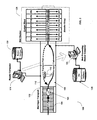
- FIG. 2 depicts an exemplary high speed sorter device adapted to process mail items with a mail bin assignment scheme based on bin capacity
- FIG. 3 is flow chart depicting an exemplary mail bin assignment scheme based on bin capacity
- FIG. 4 depicts an exemplary physical allocation of mail groupings of varying volumes to a plurality of bins based on bin capacity.
- the term "mail piece” or "mail item” refers to any document having human or machine readable content generated thereon, and particularly that intended for delivery to a given recipient. In the context of a general mailing facility, this may include envelopes, newsletters, newspapers, magazines, post cards, parcels or packages of varying thicknesses (e.g., flat mail), coupon booklets, brochures, and any other like documents. Such documents may or may not be generated for the purposes of being distributed via a distribution channel (e.g., delivery company, postal authority), but rather, may be generated for direct/personal carry, delivery, or internal distribution.
- a distribution channel e.g., delivery company, postal authority
- Groupings may include a plurality of mail items having a. common ZIP code or range thereof, common internal destination point, or common rules, limitations, or special instructions as defined according to a sort scheme.
- document or mail processing system refers to any high speed transport device(s) capable of processing documents at considerably high rates with considerably high precision.
- Document processing systems may include, but are not limited to, inbound sorting equipment, outbound mail sorting equipment, and even various forms of inserter machines, mail integrity systems, or the like for office, commercial, or industrial settings.
- a "stacker,” “bin” or “pocket” may refer to any device, typically used as part of a document processing system for receiving, accumulating and/or collecting processed mail pieces.
- FIG. 2 is an example of a high speed sorter device adapted to process mail items with a mail bin assignment based on bin capacity.
- FIG. 3 is a flowchart depicting an exemplary mail bin assignment scheme to be applied in accordance with the teachings herein.
- the number of bins required to accommodate the mail items to be handled is first determined (step 300). As an example, a sort job requiring the processing of one million mail items with various delivery point identifiers, must be weighed against the number of bins available for the mail processing system 100 (Fig. 2).
- This determination takes into consideration the availability of a machine to handle the mailing given that machine characteristics may vary-e.g., a mail processing facility having several different types of mail processing devices with different numbers of mail bins. The determination may also take into account the scalability of the high speed document processing machine upon which the sort job is to be processed-e.g., a machine having modular bin attachment capability for adding or subtracting mail bins as needed. Another configuration task may include assignment of special mail bins (FIG. 4), such as those mail bins required for mail repass, out of scheme mail, mail overflow, etc. Those skilled in the art will recognize that the configuration of specialized bins such as those stated above, are well known factors to account for in facilitating sort operations and do not limit the scope of the teachings presented herein.
- a delivery point identifier includes a ZIP code that is marked upon each of the mail items 106 and can be identified by a reader device 112 for routing or sorting of each mail piece in accord with a sort scheme managed by the mail processing device computer 124, and the number of mail items that can be effectively stacked by a mail stacker 126 into one or more mail pockets or bins P1-P14, in accordance with the specified sort scheme.
- the delivery point identifier such as a ZIP code may be up to 11 digits long.
- other delivery point identifiers that may be used include the recipient's name or entity name, street name, P.O. Box number, building name, postage or indicia, etc.
- the mail processing system 100 may include a mail input transport component 102, including a grooved belt drive or conveyor belt system 104 for transporting a mail piece 106 and aligning it properly with a transport path 108.
- the transport path 108 defines the general direction that an incoming mail piece is guided along during its processing by the mail processing system 100.
- an image scanning or reader device 110 is coupled to the mail input transport component 102, equipped with an imaging device such as an optical scanner or camera.
- the reader device 112 scans or images a mail piece 106, or at least the one or more delivery point identifiers on the mail piece, as it is processed by the mail processing system 100 along the transport path 108.
- the reader device 112 is placed upstream along the transport path 108 so that the address components can be scanned early on in the processing phase, and subsequently recognized or tracked against recognized data records using optical character recognition technology (OCR).
- OCR optical character recognition technology
- Typical OCR systems include the optical scanner or reader 112 for reading text, and sophisticated software for analyzing images.
- the OCR system may include a combination of hardware (e.g., specialized circuit boards) and software to recognize characters, or can be executed entirely through software.
- Those skilled in the art will recognize that various OCR systems may be employed by the reader device 112 for the purpose of recognizing a delivery point identifier residing on the mail piece 106.
- the reader device 112 may be controlled by a reader computer 114, which as described above, may or may not execute the OCR utility.
- the reader computer 114 is capable of executing various operating system mechanisms that control the behavior of the reader device 112.
- the reader computer 114 may also include a monitor capable of rendering a user interface to a user of the mail processing system 100 for accessing, interpreting, and depicting the various images scanned by the reader device 112.
- the reader database 120 can be customized from one enterprise to the next to include an enterprise's commonly known address components.
- the term enterprise encompasses various sized business organizations, non-profit organizations, educational institutions, etc.
- OCR technology is used for recognizing the physical address components on the mail piece
- the address components may be compared to the data records within the reader database to identify if the mail piece is a match.
- information regarding the delivery point identifier marked upon each mail item 106 can be obtained from a database by the mail processing device computer 124.
- An enterprise may employ inserting devices, sorting devices or other mail processing tools, including a reader device for recognizing the delivery point identifier marked upon each mail piece.
- the term enterprise encompasses various sized business organizations, non-profit organizations, educational institutions, etc.
- the database of the particular enterprise stores the delivery point identifier and the mail processing computer 124 can obtain this information from the enterprise database.
- the enterprise database can be internally or externally located from the facility housing the mail processing system 100.
- the bin assignments are mapped to a bin configuration table (step 302).
- the bin configuration map/table is used to associate a specific physical bin to a bin number, or slot, within the machine. For example, with respect to an exemplary sorting device of FIG. 2, one or more bins would be mapped to or assigned bin numbers P1 through P 14, not including any special assigned bins.
- the bin configuration bin/map may include physical layout information and bin dimensional data. This bin assignment information is then saved to a bin configuration database 128, and maintained for access by the mail processing device computer 124 of FIG. 2, or other processing device for subsequent access.
- Such information may be utilized by a sort scheme utility or software program that applies specialized sort rules to mail items, which are further assigned to a specific bin.
- the physical characteristic data e.g. the dimensions of the mail bins may be utilized for intuitive calculation of the volume capacity of a bin relative to the dimensions of the mail items to be processed (e.g., average mail item thickness).
- Such capability could be facilitated via the usage of a thickness detection device placed appropriately upstream along the transport path.
- the number of high capacity bins available is determined, corresponding to step 304 in FIG. 3.
- an indicator referred to herein as highCapacityCount is assigned a value equivalent to or representative of the number of high capacity bins available.
- the highCapacityCount indicator is a processing variable, which may be utilized by the mail processing device computer 124 or sort scheme processing software tool to indicate a count of the number of high capacity bins during a sort pass after the allocation of any special assignment bins.
- the highCapacityCount would be assigned a value of '7' indicative of the seven bins P8 through P14 of Fig. 2, that are capable of handling higher mail volume. If, however, one of the larger bins, such as P8 was specially assigned as a mail re-pass bin or other specialized bin, then highCapacityCount would be assigned a value indicative of the six (6) remaining high volume bins (P9 through P14).
- the various mail items to be processed are separated into groupings ordered based on piece count (mail item count), corresponding to step 306.
- piece count mail item count
- the volume of each grouping is known, and can be organized accordingly (e.g., in ascending or descending order) with respect to the sort scheme.
- FIG. 4 depicts several groupings of mail pieces-one or more mail items associated or grouped by a common attribute-ordered in descending order by volume. Practitioners of the art will recognize the order in which the groupings of FIG. 4 are presented is exemplary, and that groupings need not be ordered in a descending manner as shown.
- FIG. 4 is meant to be exemplary, and in no way limits the scope of the teachings herein.
- the highest volume grouping 400 consists of 240 mail items having common 5-digit ZIP codes ranging from 60090 to 60096, while the smallest volume grouping 410 has 80 mail items of common ZIP code 60124. While various means of creating and/or ordering the groupings may be applied, it is not uncommon to group a range of ZIP codes into a single grouping, such as in accordance with postal authority (e.g., United States Postal Service) address rules. It is noted that a range or number of ZIP codes can be assigned to each bin and not a single ZIP code to one bin. As an example, all items with a ZIP code starting with a 0 digit can be assigned to one bin and all ZIP codes starting with a 1 digit can be assigned to another bins.
- postal authority e.g., United States Postal Service
- the groupings are to be directed to the mail stacker 426 component of the sorting device having differing sized bin capacities, to accommodate the differing sized groupings (e.g., volume greater than or equal to 150, or less than 150 mail items).
- the mail stacker 426 employs eight bins, four of which are larger sized capacity bins P5-P8, and the other four being smaller in size P1-P4.
- the mail processing device computer 124 applies the appropriate sort scheme to the number of groupings equivalent to the current highCapacityCount value (step 308).
- sort rules are applied via the usage of a sort scheme specified by the sort scheme utility or software tool. Alternatively, depending upon the mail processing requirements, the sort rules may be applied at an earlier time than specified in the exemplary diagram.
- the appropriate bin assignment data specified within the sort scheme e.g., the bin numbers-for the newly re-ordered mail groupings is retrieved from the bin configuration database (step 310), and a highCapacityCount number of larger mail the groupings are assigned accordingly to the high capacity bins (step 312) P5 through P8.
- the exemplary procedure disclosed herein ensures that volume is accounted for early within the sort process, to affect the ultimate bin assignment and usage throughout the mail processing cycle.
- step 324 the sort rules are applied to these remaining groupings (step 321) in accordance with the established sort scheme, and the appropriate bin assignment data is retrieved from the bin configuration database (step 322). Once retrieved, the groupings are assigned to the low capacity bins, corresponding to step 324. This process is then repeated for as long as there are remaining groupings requiring sorting (step 314) during the subsequent mail passes. When all of the groupings are assigned, the sort process ends (step 320).
- the number of highCapacityCount groupings in this example is two, namely P5 and P6, while P7 and P8 are specially assigned for repass and mail overflow, respectively.
- there are two larger capacity bins available however, there are three larger volume groupings, namely groupings 400, 402 and 404.
- the mail items that comprise the larger volume groupings possess physical characteristics (e.g., mail item thickness) and quantity that makes them better suited for direction to a larger capacity bin.
- grouping 400, 402 and 404 would be directed firstly to the smaller capacity bins P1 through P4. Assuming the smaller capacity bins P1 through P4 accommodate a maximum of 150 mail items at a time, groupings 400, 402, 404 and 406 would be assigned to mail bins P1, P2, P3 and P4 respectively in sequential ascending order.
- groupings 400, 402 and 404 each in excess of the 150 mail item limit of the smaller capacity bins, necessitates more mail sweeps to be conducted per mail bin.
- grouping 140, as assigned to mail bin P4 would require a single mail sweep, while the others would require at least two sweeps.
- the subsequent groupings 406 and 408 would be assigned to the larger capacity bins P5 and P6; an obvious misusage of the larger sized bins relative to such small sized groupings.
- Grouping 410 would be need to be passed through the machine again, or placed in the overflow bin P7.
- the exemplary teachings would call for the current highCapacityCount groupings to be assigned to the larger capacity bins first.
- the larger capacity bins P5 and P6 are capable of accommodating volumes of up to 300 mail items. Therefore, the two largest groupings 400 and 402 would be applied in sequential ascending order to P5 and P6 respectively. The remaining groupings, 404, 406, 408 and 410 are then assigned to the smaller capacity bins P1 through P4 respectively. With this configuration and assignment process in place, the largest mail groupings are assigned to the larger sized bins, resulting in fewer overall mail sweeps.
- the bins could be assigned in a specialized manner, such as towards the beginning or end of a mail processing machine, or at a lower or upper mail stacker level (e.g. for a multi-tiered mail stacker device), to accommodate the differing material handling needs of a facility.
- the present teachings reduce the frequency at which mail sweeps must be conducted during a mail job, and in turn, improves the overall efficiency of a sort operation.
- the present teachings present a means for enabling the high capacity bins to be sorted to with respect to volume at the beginning or end of a mail processing device.
- a further teaching within the context of this disclosure contemplates the usage of a visual indicator (e.g., a user interface) for specifying the relative bin sizes of the mail stacker.
- Such an interface could be used in conjunction with the sort scheme utility or software program, and could provide extra added functionality, such as a depiction of the physical bin dimensions of the various bins, mouse click enabled selection of bins for sequential order, and non bin volume conscious sorting versus bin volume conscious sorting.
- the exemplary mail processing computer 124 of the mail processing system 100 may include a central processing unit (CPU), memories, and an interconnect bus.
- the CPU may contain a single microprocessor, or may contain a plurality of microprocessors for configuring the mail processing computer 124 as a multi-processor system.
- the memories include a main memory, a read only memory, and mass storage devices such as various disk drives, tape drives, etc.
- the main memory typically includes dynamic random access memory (DRAM) and high-speed cache memory. In operation, the main memory stores at least portions of instructions for execution by the CPU and data for processing in accord with the executed instructions.
- DRAM dynamic random access memory
- the bin configuration database 128 may include one or more magnetic disk or tape drives or optical disk drives, for storing data and instructions for use by the CPU of the mail processing computer 124.
- a workstation PC for example, at least one mass storage system 208 in the form of a disk drive or tape drive, stores the operating system and application software as well as a data file.
- the bin configuration database 128 may also include one or more drives for various portable media, such as a floppy disk, a compact disc read only memory (CD-ROM or DVD-ROM), or an integrated circuit non-volatile memory adapter (i.e. PC-MCIA adapter) to input and output data and code to and from the mail processing device computer 124.
- PC-MCIA adapter integrated circuit non-volatile memory adapter
- the mail processing device computer 124 also includes one or more input/output interfaces for communications, shown by way of example as an interface for data communications via a network or direct line connection.
- the interface may be a modem, an Ethernet card or any other appropriate data communications device.
- the physical communication links may be optical, wired, or wireless.
- the network or discrete interface may further connect to various electrical components of other document processing devices to transmit instructions and receive information for control thereof (e.g., print file information stored locally or as received remotely for enabling network printing).
- the network shall include any type of communication implementation for receiving and transmitting information to and from components of the mail processing system 100 and components external to and/or remote from the mail processing system 100.
- the mail processing device computer 124 may further include appropriate input/output ports for interconnection with a display and a keyboard serving as the respective user interface.
- the mail processing device computer 124 may include a graphics subsystem to drive the output display.
- the output display may include a cathode ray tube (CRT) display or liquid crystal display (LCD).
- CTR cathode ray tube
- LCD liquid crystal display
- the PC type system typically would include a port for connection to a printer.
- the input control devices for such an implementation of the system would include the keyboard for inputting alphanumeric and other key information.
- the input control devices may further include a cursor control device (not shown), such as a mouse, a trackball, a touchpad, stylus, or cursor direction keys.
- the links of the peripherals to the system may be wired connections or use wireless communications.
- the mail processing device computer 124 shown and discussed is an example of a platform supporting processing and control functions of the mail processing system described herein.
- the control processing functions and the sort scheme capabilities discussed herein may reside on a single computer system, or two separate systems; or one or both of these functions may be distributed across a number of computers.
- the control processing function and sort scheme operations may be implemented as one or more microprocessors or executable modules (e.g., firmware) that reside and operate upon the mail processing device computer 124.
- the software functionalities of the mail processing device computer 124 involve programming, including executable code as well as associated stored data.
- Software code is executable by the mail processing device computer 124 that functions the system controller. In operation, the code and possibly the associated data records are stored within the mail processing device computer 124. At other times, however, the software may be stored at other locations and/or transported for loading into the appropriate general-purpose computer system.
- the embodiments involve one or more software products in the form of one or more modules of code carried by at least one machine-readable medium. Execution of such code by a processor of the computer platform enables the platform to implement the sort scheme and related document processing control functions, in essentially the manner performed in the embodiments discussed and illustrated herein.
- Non-volatile media include, for example, optical or magnetic disks, such as any of the storage devices in any computer(s) operating as one of the system control platform, discussed above.
- Volatile media include dynamic memory, such as main memory of such a computer platform.
- Physical transmission media include coaxial cables; copper wire and fiber optics, including the wires that comprise a bus within a computer system.
- Carrier-wave transmission media can take the form of electric or electromagnetic signals, or acoustic or light waves such as those generated during radio frequency (RF) and infrared (IR) data communications.
- Common forms of computer-readable media therefore include, for example: a floppy disk, a flexible disk, hard disk, magnetic tape, any other magnetic medium, a CD-ROM, DVD, any other optical medium, punch cards, paper tape, any other physical medium with patterns of holes, a RAM, a PROM, and EPROM, a FLASH-EPROM, any other memory chip or cartridge, a carrier wave transporting data or instructions, cables or links transporting such a carrier wave, or any other medium from which a computer can read programming code and/or data.
- Many of these forms of computer readable media may be involved in carrying one or more sequences of one or more instructions to a processor for execution and/or in carrying one or more data files to a computer or to a printer.
Landscapes
- Sorting Of Articles (AREA)
Applications Claiming Priority (1)
| Application Number | Priority Date | Filing Date | Title |
|---|---|---|---|
| US11/477,431 US20080000817A1 (en) | 2006-06-30 | 2006-06-30 | Sort scheme generation based on bin capacity |
Publications (2)
| Publication Number | Publication Date |
|---|---|
| EP1872869A2 true EP1872869A2 (de) | 2008-01-02 |
| EP1872869A3 EP1872869A3 (de) | 2008-04-30 |
Family
ID=38477010
Family Applications (1)
| Application Number | Title | Priority Date | Filing Date |
|---|---|---|---|
| EP07012813A Withdrawn EP1872869A3 (de) | 2006-06-30 | 2007-06-29 | Erzeugung eines Sortierungsschemas auf der Basis der Behälterkapazität |
Country Status (2)
| Country | Link |
|---|---|
| US (1) | US20080000817A1 (de) |
| EP (1) | EP1872869A3 (de) |
Cited By (9)
| Publication number | Priority date | Publication date | Assignee | Title |
|---|---|---|---|---|
| CN101537411A (zh) * | 2008-02-14 | 2009-09-23 | 埃森哲全球服务有限公司 | 分拣规划优化 |
| EP2226130A1 (de) | 2009-03-03 | 2010-09-08 | Siemens Aktiengesellschaft | Sortierverfahren und Sortieranlage mit zwei verschiedenen Gruppen von Ausgabeeinrichtungen |
| WO2011031917A1 (en) * | 2009-09-11 | 2011-03-17 | Siemens Industry, Inc. | System and method for indicating a swept mail sort pocket |
| WO2013000885A1 (de) * | 2011-06-27 | 2013-01-03 | Siemens Aktiengesellschaft | Verfahren und vorrichtung zum sortieren von zwei arten von gegenständen in mehreren sortierläufen |
| FR2984187A1 (fr) * | 2011-12-19 | 2013-06-21 | Solystic | Procede de traitement d'envois postaux comprenant une agregation des lots d'envois |
| CN104044903A (zh) * | 2014-05-08 | 2014-09-17 | 苏州安特实业有限公司 | 一种自动追踪物流系统 |
| EP3208003A1 (de) * | 2016-02-18 | 2017-08-23 | BEUMER GmbH & Co. KG | Sortiervorrichtung mit einstellbaren endstellen |
| EP3471030A3 (de) * | 2017-10-16 | 2019-09-11 | Kabushiki Kaisha Toshiba | Sortiersystem und -verfahren |
| RU2819231C1 (ru) * | 2023-02-27 | 2024-05-15 | Аньхуэй Юниверсити оф Сайенс энд Текнолоджи | Система сортировки товаров |
Families Citing this family (14)
| Publication number | Priority date | Publication date | Assignee | Title |
|---|---|---|---|---|
| US8977385B2 (en) * | 2004-11-22 | 2015-03-10 | Bell And Howell, Llc | System and method for tracking a mail item through a document processing system |
| US8129646B2 (en) * | 2004-11-22 | 2012-03-06 | Bell And Howell, Llc | System and method for validating mailings received |
| US7741575B2 (en) * | 2004-11-22 | 2010-06-22 | Bowe Bell + Howell Company | Mail piece consolidation and accountability using advanced tracking methods |
| DE102007019948A1 (de) * | 2007-04-27 | 2008-10-30 | Böwe Bell + Howell GmbH | Mischpost-Sortierer |
| US8271399B2 (en) * | 2008-02-27 | 2012-09-18 | International Business Machines Corporation | Sorting optimization of documents for mailing |
| US20090223872A1 (en) * | 2008-03-07 | 2009-09-10 | Ronald Robbins | System and method for sorting items |
| US8748768B2 (en) * | 2008-05-16 | 2014-06-10 | Bell And Howell, Llc | Method and system to indicate bin sweep status on document processing equipment |
| FR2945462B1 (fr) * | 2009-05-15 | 2011-04-22 | Solystic | Procede pour trier des envois postaux dans une machine de faible capacite. |
| DE102010012069A1 (de) | 2010-03-19 | 2011-09-22 | Siemens Aktiengesellschaft | Sortierverfahren und Sortiervorrichtung für ergonomisches Sortieren in zwei Sortierläufen |
| DE102010012068A1 (de) | 2010-03-19 | 2011-09-22 | Siemens Aktiengesellschaft | Sortierverfahren und Sortiervorrichtung für verschiedenartige Gegenstände |
| US10650925B2 (en) * | 2013-05-24 | 2020-05-12 | Carefusion 303, Inc. | Automated utilization driven inventory management |
| US20210081904A1 (en) * | 2019-09-16 | 2021-03-18 | Coupang Corp. | Computer implemented method for automatic assignment and reassignment of flexible delivery work |
| FR3101264B1 (fr) | 2019-09-30 | 2021-10-01 | Solystic | Installation pour le tri de colis ou paquets postaux |
| CN111062505A (zh) * | 2019-11-29 | 2020-04-24 | 合肥美的智能科技有限公司 | 柜格分配方法、柜格分配装置、柜格设备及存储介质 |
Citations (4)
| Publication number | Priority date | Publication date | Assignee | Title |
|---|---|---|---|---|
| US5287271A (en) | 1991-08-22 | 1994-02-15 | International Business Machines Corporation | Data processing system for optimized mail piece sorting and mapping to carrier walk sequence using real time statistical data |
| WO2002000362A2 (en) | 2000-06-26 | 2002-01-03 | United States Postal Service | Method and system for single pass letter and flat processing |
| WO2002055222A2 (en) | 2001-01-09 | 2002-07-18 | Consignia Plc | An improved sorting system |
| US20030127792A1 (en) | 2002-01-09 | 2003-07-10 | Lockheed Martin Corporation | Thickness measuring device for use within a mail handling system, and a method of using the same |
Family Cites Families (9)
| Publication number | Priority date | Publication date | Assignee | Title |
|---|---|---|---|---|
| US5703783A (en) * | 1992-04-06 | 1997-12-30 | Electrocom Automation, L.P. | Apparatus for intercepting and forwarding incorrectly addressed postal mail |
| US5703786A (en) * | 1995-08-14 | 1997-12-30 | Profile Systems, Llc | Medication dispensing and timing system utilizing time reference message |
| JPH09239325A (ja) * | 1996-03-11 | 1997-09-16 | Hitachi Ltd | 郵便物配達順並べ替え区分方法および装置 |
| DE19705891C1 (de) * | 1996-12-07 | 1998-03-26 | Siemens Ag | Verfahren zur Sortierung von Sendungen |
| US6954729B2 (en) * | 2000-01-27 | 2005-10-11 | Bowe Bell & Howell Postal Systems Company | Address learning system and method for using same |
| US6762384B1 (en) * | 2000-09-25 | 2004-07-13 | Siemens Aktiengesellschaft | Method of presorting mail for minimized effort to sequence mail for delivery |
| AU2003217317A1 (en) * | 2002-02-04 | 2003-09-02 | David J. Payne | A method and system for sequencing deliverables |
| US7498539B2 (en) * | 2002-06-18 | 2009-03-03 | Bowe Bell & Howell Company | Progressive modularity assortment system with high and low capacity bins |
| US8370165B2 (en) * | 2003-04-11 | 2013-02-05 | United States Postal Service | Methods and systems for providing an alternative delivery point code |
-
2006
- 2006-06-30 US US11/477,431 patent/US20080000817A1/en not_active Abandoned
-
2007
- 2007-06-29 EP EP07012813A patent/EP1872869A3/de not_active Withdrawn
Patent Citations (4)
| Publication number | Priority date | Publication date | Assignee | Title |
|---|---|---|---|---|
| US5287271A (en) | 1991-08-22 | 1994-02-15 | International Business Machines Corporation | Data processing system for optimized mail piece sorting and mapping to carrier walk sequence using real time statistical data |
| WO2002000362A2 (en) | 2000-06-26 | 2002-01-03 | United States Postal Service | Method and system for single pass letter and flat processing |
| WO2002055222A2 (en) | 2001-01-09 | 2002-07-18 | Consignia Plc | An improved sorting system |
| US20030127792A1 (en) | 2002-01-09 | 2003-07-10 | Lockheed Martin Corporation | Thickness measuring device for use within a mail handling system, and a method of using the same |
Cited By (14)
| Publication number | Priority date | Publication date | Assignee | Title |
|---|---|---|---|---|
| CN101537411A (zh) * | 2008-02-14 | 2009-09-23 | 埃森哲全球服务有限公司 | 分拣规划优化 |
| EP2226130A1 (de) | 2009-03-03 | 2010-09-08 | Siemens Aktiengesellschaft | Sortierverfahren und Sortieranlage mit zwei verschiedenen Gruppen von Ausgabeeinrichtungen |
| DE102009011428A1 (de) * | 2009-03-03 | 2010-09-16 | Siemens Aktiengesellschaft | Sortierverfahren und Sortieranlage mit zwei verschiedenen Gruppen von Ausgabeeinrichtung |
| WO2011031917A1 (en) * | 2009-09-11 | 2011-03-17 | Siemens Industry, Inc. | System and method for indicating a swept mail sort pocket |
| US8432280B2 (en) | 2009-09-11 | 2013-04-30 | Siemens Industry, Inc. | System and method for indicating a swept mail sort pocket |
| US8983648B2 (en) | 2011-06-27 | 2015-03-17 | Siemens Aktiengesellschaft | Method and device for sorting two types of objects in multiple sorting passes |
| WO2013000885A1 (de) * | 2011-06-27 | 2013-01-03 | Siemens Aktiengesellschaft | Verfahren und vorrichtung zum sortieren von zwei arten von gegenständen in mehreren sortierläufen |
| FR2984187A1 (fr) * | 2011-12-19 | 2013-06-21 | Solystic | Procede de traitement d'envois postaux comprenant une agregation des lots d'envois |
| US8903542B2 (en) | 2011-12-19 | 2014-12-02 | Solystic | Method of processing mailpieces, the method including combining the batches of mailpieces |
| EP2606988A1 (de) | 2011-12-19 | 2013-06-26 | Solystic | Verfahren zur Bearbeitung von Postsendungen, das eine Gruppierung von Sendungen umfasst |
| CN104044903A (zh) * | 2014-05-08 | 2014-09-17 | 苏州安特实业有限公司 | 一种自动追踪物流系统 |
| EP3208003A1 (de) * | 2016-02-18 | 2017-08-23 | BEUMER GmbH & Co. KG | Sortiervorrichtung mit einstellbaren endstellen |
| EP3471030A3 (de) * | 2017-10-16 | 2019-09-11 | Kabushiki Kaisha Toshiba | Sortiersystem und -verfahren |
| RU2819231C1 (ru) * | 2023-02-27 | 2024-05-15 | Аньхуэй Юниверсити оф Сайенс энд Текнолоджи | Система сортировки товаров |
Also Published As
| Publication number | Publication date |
|---|---|
| EP1872869A3 (de) | 2008-04-30 |
| US20080000817A1 (en) | 2008-01-03 |
Similar Documents
| Publication | Publication Date | Title |
|---|---|---|
| EP1872869A2 (de) | Erzeugung eines Sortierungsschemas auf der Basis der Behälterkapazität | |
| US8249997B2 (en) | Method and system for integrated pallet and sort scheme maintenance | |
| US7745754B2 (en) | Apparatus, method and program product for processing mail or documents using a mail or document processing device | |
| EP1439496B1 (de) | System zum Verfolgen von Poststücken | |
| US10058897B2 (en) | Methods and systems for parcel one pass labeling and sorting for presort qualification | |
| EP2072152A2 (de) | Verfahren und Vorrichtung zum Erzeugen von meherern Postsortierplänen | |
| US20080154751A1 (en) | Sortation and extraction system for item management systems and associated methods | |
| EP1659523A1 (de) | Eingehende Verbindung für ankommende Post | |
| US20080162381A1 (en) | Mail transportation processing | |
| US8748768B2 (en) | Method and system to indicate bin sweep status on document processing equipment | |
| US8028982B2 (en) | Method and system for simultaneously processing letters and flat mail | |
| US20050171919A1 (en) | Method for generating mailpieces and storing mailpiece identification and tracking information | |
| EP1814005A2 (de) | Abarbeitung in einer Warteschlange gespeicherter Fehler | |
| EP1560166A2 (de) | Verfahren zum Speichern von Daten eines Poststücks | |
| US20060139678A1 (en) | Dual dependent channel print stream processing module optimizer | |
| US7659487B2 (en) | Data controlled mail collation system | |
| EP1113376A2 (de) | Verfahren zum Berechnen der Sortierkosten für die Rückverrechnungsbuchhaltung eines Sortierapparats für einlaufende Post | |
| US20050209979A1 (en) | Methods and apparatus for processing business reply mail | |
| JPS60137475A (ja) | 郵便物区分装置 | |
| JP7529894B2 (ja) | 帳票仕分けシステム、ロボット制御方法、及び、プログラム | |
| US8311668B2 (en) | Automatic feeder control setup based on client mailstream | |
| US7596532B2 (en) | Web server integrated directly into an inserter system to provide status monitoring and configuration control | |
| JP3937667B2 (ja) | 分類処理装置および記憶媒体 | |
| JPH0710359A (ja) | 郵便物検査仕分け装置 | |
| US20020179501A1 (en) | Method of sorting document items into pockets of a document processing system and an apparatus therefor |
Legal Events
| Date | Code | Title | Description |
|---|---|---|---|
| PUAI | Public reference made under article 153(3) epc to a published international application that has entered the european phase |
Free format text: ORIGINAL CODE: 0009012 |
|
| AK | Designated contracting states |
Kind code of ref document: A2 Designated state(s): AT BE BG CH CY CZ DE DK EE ES FI FR GB GR HU IE IS IT LI LT LU LV MC MT NL PL PT RO SE SI SK TR |
|
| AX | Request for extension of the european patent |
Extension state: AL BA HR MK YU |
|
| PUAL | Search report despatched |
Free format text: ORIGINAL CODE: 0009013 |
|
| AK | Designated contracting states |
Kind code of ref document: A3 Designated state(s): AT BE BG CH CY CZ DE DK EE ES FI FR GB GR HU IE IS IT LI LT LU LV MC MT NL PL PT RO SE SI SK TR |
|
| AX | Request for extension of the european patent |
Extension state: AL BA HR MK RS |
|
| 17P | Request for examination filed |
Effective date: 20081030 |
|
| AKX | Designation fees paid |
Designated state(s): DE FR GB IT |
|
| 17Q | First examination report despatched |
Effective date: 20100702 |
|
| STAA | Information on the status of an ep patent application or granted ep patent |
Free format text: STATUS: THE APPLICATION IS DEEMED TO BE WITHDRAWN |
|
| 18D | Application deemed to be withdrawn |
Effective date: 20101117 |