EP1874846B1 - Polymer von polycarbonatdiol mit alicyclischer struktur und herstellungsverfahren dafür - Google Patents
Polymer von polycarbonatdiol mit alicyclischer struktur und herstellungsverfahren dafür Download PDFInfo
- Publication number
- EP1874846B1 EP1874846B1 EP06731637A EP06731637A EP1874846B1 EP 1874846 B1 EP1874846 B1 EP 1874846B1 EP 06731637 A EP06731637 A EP 06731637A EP 06731637 A EP06731637 A EP 06731637A EP 1874846 B1 EP1874846 B1 EP 1874846B1
- Authority
- EP
- European Patent Office
- Prior art keywords
- diol
- polycarbonate diol
- reaction
- formula
- polycarbonate
- Prior art date
- Legal status (The legal status is an assumption and is not a legal conclusion. Google has not performed a legal analysis and makes no representation as to the accuracy of the status listed.)
- Expired - Lifetime
Links
Classifications
-
- C—CHEMISTRY; METALLURGY
- C08—ORGANIC MACROMOLECULAR COMPOUNDS; THEIR PREPARATION OR CHEMICAL WORKING-UP; COMPOSITIONS BASED THEREON
- C08G—MACROMOLECULAR COMPOUNDS OBTAINED OTHERWISE THAN BY REACTIONS ONLY INVOLVING UNSATURATED CARBON-TO-CARBON BONDS
- C08G64/00—Macromolecular compounds obtained by reactions forming a carbonic ester link in the main chain of the macromolecule
- C08G64/02—Aliphatic polycarbonates
- C08G64/0208—Aliphatic polycarbonates saturated
-
- C—CHEMISTRY; METALLURGY
- C08—ORGANIC MACROMOLECULAR COMPOUNDS; THEIR PREPARATION OR CHEMICAL WORKING-UP; COMPOSITIONS BASED THEREON
- C08G—MACROMOLECULAR COMPOUNDS OBTAINED OTHERWISE THAN BY REACTIONS ONLY INVOLVING UNSATURATED CARBON-TO-CARBON BONDS
- C08G64/00—Macromolecular compounds obtained by reactions forming a carbonic ester link in the main chain of the macromolecule
- C08G64/02—Aliphatic polycarbonates
-
- C—CHEMISTRY; METALLURGY
- C08—ORGANIC MACROMOLECULAR COMPOUNDS; THEIR PREPARATION OR CHEMICAL WORKING-UP; COMPOSITIONS BASED THEREON
- C08G—MACROMOLECULAR COMPOUNDS OBTAINED OTHERWISE THAN BY REACTIONS ONLY INVOLVING UNSATURATED CARBON-TO-CARBON BONDS
- C08G64/00—Macromolecular compounds obtained by reactions forming a carbonic ester link in the main chain of the macromolecule
- C08G64/20—General preparatory processes
- C08G64/22—General preparatory processes using carbonyl halides
Definitions
- the present invention relates to a polymer of polycarbonate diol having as a diol component a diol including specific alicyclic structure, more specifically the invention relates to a polymer of polycarbonate diol which has as a diol component, an organic residue derived from a diol component as represented by formula (1) (in the formula, n is 0 or an integer of 1 to 4) and which has high electrical insulating properties and heat resistance and to a production method thereof.
- Polycarbonate diol is used as a material for reacting with an isocyanate compound to thereby produce a polyurethane.
- Polycarbonate diol is prepared by using diol components such as 1,4-butanediol, 1,5-pentanediol, 3-methyl-1,5-pentanediol, 1,6-hexanediol, 2-methyl-1,8-octanediol,1,9-nonanediol and 1,4-cyclohexanedimethanol.
- the object of the present invention is to provide polymer of polycarbonate diol, which enables production of a polyurethane having flexibility and heat resistance in a well-balanced manner and highly reliable in long-term insulating performance under high temperature/high humidity conditions, through reaction between the polymer and an isocyanate compound.
- the present inventors have found as raw material compound a polycarbonate diol containing a diol compound having a specific alicyclic structure which is expected to enable production of a polyurethane having flexibility and heat resistance in a well-balanced manner and highly reliable in long-term insulating performance under high temperature/high humidity conditions, and thereby have completed the invention.
- the present invention relates to a polycarbonate diol and a production method thereof, as follows.
- the polymer of polycarbonate diol according to the present invention which gives a polyurethane compound having an excellent balance between flexibility and heat resistance and an excellent reliability in long-term insulating performance under high temperature/high humidity conditions through reaction with an isocyanate compound, is expected to be applicable to insulating films or the like in electronic/electric materials.
- the polycarbonate diol of the present invention comprises an organic residue derived from a diol component represented by formula (1).
- n is 0 or an integer of 1 to 4, preferably 0 or an integer of 1 to 2, more preferably 0 or 1.
- the norbornane structure and the cyclopentane structure may be substituted with one or more halogen atoms or hydrocarbon groups respectively.
- the hydrocanbon group is preferably an aliphatic hydrocarbon group such as an alkyl group and an alkenyl group, more preferably an alkyl or alkenyl group having 1 to 12 carbon atoms, still more preferably an alkyl group having 1 to 6 carbon atoms or an or alkenyl group having 2 to 6 carbon atoms.
- halogen atom examples include a chlorine atom, a bromine atom and an iodine atom.
- an organic residue derived from a diol component means a structure where hydrogen is removed from at least one terminal -CH 2 OH group in the above formula (1).
- compound of formula (1) include tricyclodecane dimethanol represented by formula (2) and pentacyclopentadecane dimethanol represented by formula (3).
- the polycarbonate diol of the present invention can be produced by subjecting a diol component having a specific structure represented by formula (1) with carbonic acid ester in the presence of an transesterification catalyst. In the reaction, other diol components may be present.
- diols used herein include dihydroxy compounds having a relatively low molecular weight such as ethylene glycol, diethylene glycol, propylene glycol, 1,4-butanediol, 1,3-butanediol, 1,5-pentanediol, neopentyl glycol, 3-methyl-1,5-pentanediol, 1,6-hexanediol, 1,4-cyclohexanedimethanol, 2-methyl-1,8-octanediol, 1,9-nonanediol, hydroquinone, resorcin, bisphenol-A, bisphenol-F and 4,4'-biphenol and diol oligomers having a relatively high molecular weight such as polyether polyols such as polyethylene glycol, polypropylene glycol and polytetramethylene glycol, polyester polyols such as polyhexamethylene adipate, polyhexamethylene succinate and poly
- the diol of formula (1) is used in an amount of 5 mol% or more, preferably at 40 mol% or more based on the total amount of all the diol components.
- carbonic acid ester used in the invention examples include dialkyl carbonate (dimethyl carbonate, diethyl carbonate or the like), diaryl carbonate (diphenyl carbonate or the like) and alkylene carbonate (ethylene carbonate or the like).
- dialkyl carbonate dimethyl carbonate, diethyl carbonate or the like
- diaryl carbonate diaryl carbonate or the like
- alkylene carbonate ethylene carbonate or the like.
- catalyst used in synthesis of the polycarbonate diol of the present invention include catalysts (transesterification catalysts) usually employed in transesterification reaction.
- catalysts transesterification catalysts
- alkali metal compounds such as hydroxides of alkali metals (lithium hydroxide, sodium hydroxide, potassium hydroxide and the like), carbonates of alkali metals (lithium carbonate, sodium carbonate, potassium carbonate and the like), carboxylic salts of alkali metals (lithium acetate, sodium acetate, potassium acetate and the like) and alkali metal alkoxides (lithium alkoxide, lithium methoxide, sodium methoxide, potassium t-butoxide and the like), alkali earth metal compounds such as hydroxides of alkali earth metals(magnesium hydroxide and the like), alkali earth metal alkoxide(magnesium methoxide and the like), aluminum compounds such as aluminum alkoxides (aluminum ethoxide, aluminum
- titanium compounds and organic tin compounds are preferred.
- titanium alkoxides such as tetraethoxy titanium, tetraisopropoxy titanium and tetrabutoxy titanium.
- titanium alkoxides and tetrabutoxy titanium is most preferred.
- the transesterification reaction temperature is preferably from 50 to 300 °C, particularly preferably from 80 to 250 °C.
- the reaction pressure may be normal pressure. If necessary, the reaction pressure may be increased or reduced. Moreover, although the reaction can proceed in air, it is more advantageous in consideration of the problem of coloring to conduct the reaction in an inert gas atmosphere such as nitrogen, argon or helium.
- azeotropy of dimethyl carbonate and methanol generated may be caused to thereby remove the dimethyl carbonate together with methanol.
- dimethyl carbonate it is preferable to add dimethyl carbonate to make up for the dimethyl carbonate after distilled off in azeotropy with methanol or to use an extra amount of dimethyl carbonate at the beginning of the reaction to allow a wide margin for the amount to be distilled off.
- the average molecular weight (number average molecular weight) of the polymer of polycarbonate diol obtained in this method can be controlled by adjusting the molar ratio of materials used.
- a copolymer of polycarbonate diol generated can be obtained by cooling the reaction liquid after the reaction.
- further reaction may be conducted by adding carbonic acid ester compound as appropriate while in a case where the average molecular weight is larger than the desired molecular weight, further transesterification reaction may be conducted by adding a diol compound, to thereby control a desired molecular weight of the polymer of polycarbonate diol.
- the polycarbonate diol polymer of the present invention can be produced by subjecting a diol having a specific structure of formula (1) or if necessary a mixture of the diol and other diols to reaction with phosgene.
- a diol having a specific structure of formula (1) or if necessary a mixture of the diol and other diols to reaction with phosgene.
- Examples of other diol components usable here and the preferable ratio for blending the diols are the same as described above.
- reaction may be performed in the presence of an appropriate solvent and in the presence of a trapping agent.
- a trapping agent a tertiary amine compound such as triethylamine or tributylamine is generally employed.
- the solvent include aromatic hydrocarbons such as benzene, toluene and xylene, ether compounds such as diethylether, diisopropylether and dibutylether, and halogen-based hydrocarbons such as chloroform and methylene chloride.
- the reaction temperature is preferably from -20 to 150 °C, particularly preferably 0 to 120 °C.
- the molecular weight of the obtained polycarbonate diol can be controlled by adjusting the molar ratios of the raw material diol compound and phosgene.
- the polymer of the polycarbonate diol contains an transesterification catalyst
- the thus obtained copolymer of polycarbonate diol according to the present invention preferably has a number average molecular weight of 300 to 50,000, preferably 500 to 5,000 as a raw material employed in production of polyurethane.
- the reaction with an isocyanate compound may be conducted by using for example, diphenylmethane diisocyanate, hydrogenerated diphenylmethane diisocyanate, isophorone diisocyanate and dicyclohexylmethane diisocyanate according to conventionally known method.
- reaction vessel equipped with a stirrer, thermometer and fractionating column, 785.2 g(4.00 mol) of tricyclodecane methanol, 360.32 g(4.00 mol) of dimethyl carbonate and 520 mg of tetra-n-ethoxytitanium were placed and reaction was conducted at a temperature of 90 to 140 °C while distilling off methanol by-produced in the reaction. After distillation of the methanol was almost completed, the reaction was continued for further 8 hours under a pressure reduced to 10 mmHg or less. The reaction was conducted in a nitrogen atmosphere.
- reaction liquid was cooled and a pale yellow solid was obtained at room temperature.
- the product was confirmed to be a polymer of polycarbonate diol by GPC and NMR analyses.
- the number average molecular weight of the product was 824.
- reaction liquid was cooled and a colorless transparent liquid was obtained at room temperature.
- the product was confirmed to be a polymer of polycarbonate diol by GPC and NMR analyses.
- the number average molecular weight of the product was 1823.
- reaction vessel equipped with a stirrer, thermometer and fractionating column, 392.6 g (2.00 mol) of tricyclodecane dimethanol, 236.36 g (2.00 mol) of 1,6-hexanediol, 360.32 g (4.00 mol) of dimethyl carbonate and 40 mg of tetra-n-ethoxytitanium were placed and reaction was conducted at a temperature of 95 to 160 °C while distilling off methanol by-produced in the reaction. After distillation of the methanol was almost completed, the reaction was continued for further 4 hours under a pressure reduced to 10 mmHg or less. The reaction was conducted in a nitrogen atmosphere.
- reaction liquid was cooled and a colorless transparent liquid was obtained at room temperature.
- the product was confirmed to be a polymer of polycarbonate diol by GPC and NMR analyses.
- the number average molecular weight of the product was 2390.
- reaction container equipped with a stirrer, thermometer and fractionating column, 392.6 g (2.00 mol) of tricyclodecane dimethanol, 288.44 g (2.00 mol) of 1,4-cyclohexanedimethanol, 360.32 g (4.00 mol) of dimethyl carbonate and 40 mg of tetra-n-ethoxytitanium were placed and reaction was conducted at a temperature of 95 to 160 °C while distilling off methanol by-produced in the reaction. After distillation of the methanol was almost completed, the reaction was continued for further 4 hours under a pressure reduced to 10 mmHg or less. The reaction was conducted in a nitrogen atmosphere.
- reaction liquid was cooled and a colorless transparent liquid was obtained at room temperature.
- the product was confirmed to be a polymer of polycarbonate diol by GPC and NMR analyses.
- the number average molecular weight of the product was 1762.
- a resin composition having excellent heat resistance, flexibility and reliability in long-term insulating properties under high temperature/high humidity conditions can be produced.
Landscapes
- Chemical & Material Sciences (AREA)
- Health & Medical Sciences (AREA)
- Chemical Kinetics & Catalysis (AREA)
- Medicinal Chemistry (AREA)
- Polymers & Plastics (AREA)
- Organic Chemistry (AREA)
- Polyesters Or Polycarbonates (AREA)
Claims (7)
- Polycarbonatdiol, das einen von einer Diolkomponente der Formel (1) abgeleiteten organischen Rest enthält,

- Polycarbonatdiol nach Anspruch 1, wobei die Diolkomponente der Formel (1) zu 5 Mol-% oder mehr, bezogen auf die anderen Diolkomponenten, enthalten ist.
- Polycarbonatdiol nach Anspruch 1 oder 2, wobei die Diolkomponente Tricyclodecandimethanol und/oder Pentacyclopentadecandimethanol ist.
- Polycarbonatdiol nach Anspruch 3, wobei das Tricyclodecandimethanol durch Formel (2) dargestellt ist.
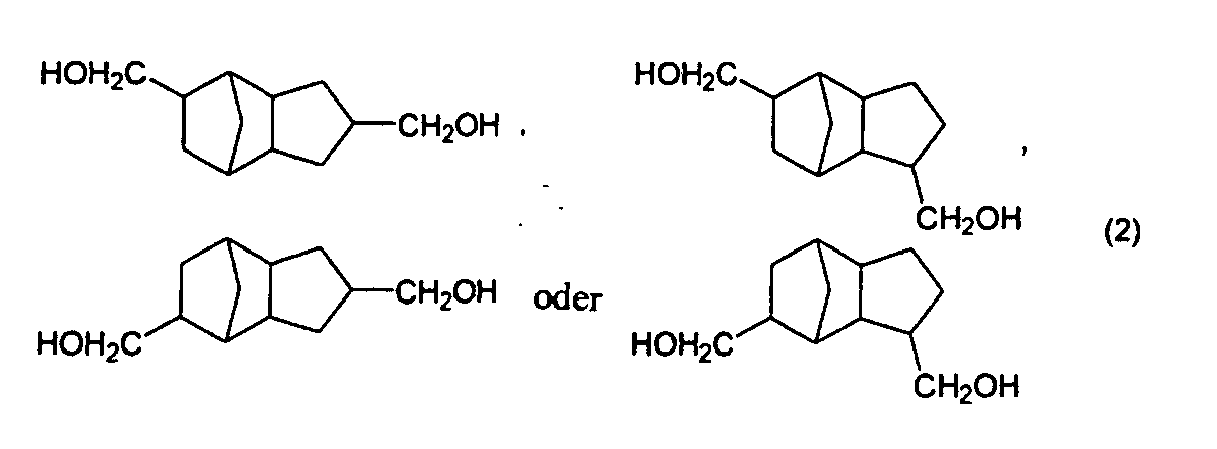
- Polycarbonatdiol nach Anspruch 3, wobei das Pentacyclopentadecandimethanol durch die Formel (3) dargestellt ist.

- Verfahren zur Herstellung eines Polycarbonatdiols mit einem von der Diolkomponente der Formel (1) abgeleiteten organischen Rest, wobei die in Anspruch 1 beschriebe Diolkomponente der Formel (1) und bei Bedarf andere Diolkomponenten einer Umesterungsreaktion mit einem Carbonsäureester in Anwesenheit eines Umesterungskatalysators unterzogen werden.
- Verfahren zur Herstellung eines Polycarbonatdiols mit einem von der Diolkomponente der Formel (1) abgeleiteten organischen Rest, wobei die in Anspruch 1 beschriebe Diolkomponente der Formel (1) und bei Bedarf andere Diolkomponenten einer Reaktion mit Phosgen unterworfen werden.
Applications Claiming Priority (2)
| Application Number | Priority Date | Filing Date | Title |
|---|---|---|---|
| JP2005109461 | 2005-04-06 | ||
| PCT/JP2006/307690 WO2006109816A1 (en) | 2005-04-06 | 2006-04-05 | Polymer of polycarbonate diol having an alicyclic structure and production process thereof |
Publications (2)
| Publication Number | Publication Date |
|---|---|
| EP1874846A1 EP1874846A1 (de) | 2008-01-09 |
| EP1874846B1 true EP1874846B1 (de) | 2011-06-08 |
Family
ID=38802439
Family Applications (1)
| Application Number | Title | Priority Date | Filing Date |
|---|---|---|---|
| EP06731637A Expired - Lifetime EP1874846B1 (de) | 2005-04-06 | 2006-04-05 | Polymer von polycarbonatdiol mit alicyclischer struktur und herstellungsverfahren dafür |
Country Status (6)
| Country | Link |
|---|---|
| US (1) | US7642334B2 (de) |
| EP (1) | EP1874846B1 (de) |
| KR (1) | KR101241248B1 (de) |
| CN (1) | CN101155852B (de) |
| TW (1) | TW200643059A (de) |
| WO (1) | WO2006109816A1 (de) |
Cited By (3)
| Publication number | Priority date | Publication date | Assignee | Title |
|---|---|---|---|---|
| US9447234B2 (en) | 2012-11-09 | 2016-09-20 | Lotte Chemical Corporation | High molecular weight aliphatic polycarbonate copolymer and preparation method thereof |
| US9475905B2 (en) | 2013-01-18 | 2016-10-25 | Lotte Chemical Corporation | High-molecular weight aliphatic polycarbonate prepared using base catalyst |
| US9975990B2 (en) | 2013-10-30 | 2018-05-22 | Lotte Chemical Corporation | Aliphatic polycarbonate with long-chain branches and aromatic copolyester thereof |
Families Citing this family (16)
| Publication number | Priority date | Publication date | Assignee | Title |
|---|---|---|---|---|
| JP5526545B2 (ja) * | 2006-08-18 | 2014-06-18 | 三菱瓦斯化学株式会社 | ポリカーボネート樹脂およびこれを用いた光学フィルム |
| TWI444282B (zh) * | 2007-10-19 | 2014-07-11 | Showa Denko Kk | 樹脂壓模(stamper)之製造方法及製造裝置及壓印(imprint)方法、以及磁性記錄媒體及磁性記錄再生裝置 |
| EP2103316A1 (de) * | 2008-03-20 | 2009-09-23 | Bayer MaterialScience AG | Hydrophile Polyurethandispersionen |
| DE102008025613A1 (de) * | 2008-05-28 | 2009-12-03 | Bayer Materialscience Ag | Hydrophile Polyurethanbeschichtungen |
| KR20110065449A (ko) * | 2008-09-04 | 2011-06-15 | 바이엘 머티리얼사이언스 아게 | Tcd 기재 친수성 폴리우레탄 분산액 |
| ATE547135T1 (de) * | 2008-09-04 | 2012-03-15 | Bayer Materialscience Ag | Tcd-basierte hydrophile polyurethanlösungen |
| WO2010084872A1 (ja) * | 2009-01-20 | 2010-07-29 | 昭和電工株式会社 | (ポリ)カーボネートポリオールおよび該(ポリ)カーボネートポリオールを原料とするカルボキシル基含有ポリウレタン |
| JP5579081B2 (ja) * | 2009-01-20 | 2014-08-27 | 昭和電工株式会社 | カルボキシル基含有ポリウレタン |
| US20120263778A1 (en) * | 2009-12-16 | 2012-10-18 | Bayer Intellectual Property Gmbh | Polyurethane urea for stent coatings |
| ES2935824T3 (es) | 2010-04-14 | 2023-03-10 | Mitsubishi Chem Corp | Diol de policarbonato y método de producción del mismo, y poliuretano y composición polimérica curable por rayos de energía activa ambos formados usando el mismo |
| US8940397B2 (en) * | 2011-02-28 | 2015-01-27 | Momentive Performance Materials Inc. | Weatherable and abrasion resistant coating systems for polymeric substrates |
| WO2013083511A1 (de) * | 2011-12-06 | 2013-06-13 | Bayer Intellectual Property Gmbh | Tcd-alkohol-basierende thermoplastische polyurethanharnstoff-polymere und deren verwendung |
| RU2617478C1 (ru) | 2011-12-28 | 2017-04-25 | Торэй Индастриз, Инк. | Многослойная пленка для декоративного формования, полиуретановая смола и способ получения декоративного формованного изделия |
| JP6643846B2 (ja) * | 2015-09-18 | 2020-02-12 | 日本化薬株式会社 | ポリウレタン化合物及びそれを含有する樹脂組成物 |
| DE102015014864A1 (de) | 2015-11-17 | 2017-05-18 | Gt Elektrotechnische Produkte Gmbh | Verfahren zur Herstellung von zelligen, elastischen Polycarbonaturethan-Materialien sowie die Polycarbonaturethan-Materialien |
| CN116925333A (zh) * | 2022-04-08 | 2023-10-24 | 中国科学院成都有机化学有限公司 | 一种脂肪族共聚碳酸酯及其制备方法 |
Family Cites Families (6)
| Publication number | Priority date | Publication date | Assignee | Title |
|---|---|---|---|---|
| US4950736A (en) * | 1988-09-02 | 1990-08-21 | Kuraray Company, Ltd. | Polycarbonate or polyestercarbonate resin from bicyclol polycyclo dimethanol |
| CA2037606C (en) | 1990-03-13 | 2002-06-04 | Yukiatsu Komiya | Polyurethane, elastic polyurethane fiber and polyesterpolycarbonatediol used for the same |
| JP3396942B2 (ja) | 1994-02-21 | 2003-04-14 | 三菱化学株式会社 | 芳香族ポリカーボネートの製造方法 |
| US6316576B1 (en) * | 1999-01-08 | 2001-11-13 | Mitsubishi Gas Chemical Company, Inc. | Polycarbonate resin and process for producing the same |
| JP4203690B2 (ja) * | 1999-07-02 | 2009-01-07 | 三菱瓦斯化学株式会社 | ポリカーボネート樹脂 |
| DE60013703T2 (de) * | 1999-07-02 | 2005-09-29 | Mitsubishi Gas Chemical Co., Inc. | Cycloaliphatische Copolycarbonate, ihre Darstellung und Verwendung |
-
2006
- 2006-04-04 TW TW095111986A patent/TW200643059A/zh not_active IP Right Cessation
- 2006-04-05 EP EP06731637A patent/EP1874846B1/de not_active Expired - Lifetime
- 2006-04-05 CN CN2006800113569A patent/CN101155852B/zh not_active Expired - Fee Related
- 2006-04-05 KR KR1020077023790A patent/KR101241248B1/ko not_active Expired - Fee Related
- 2006-04-05 WO PCT/JP2006/307690 patent/WO2006109816A1/en not_active Ceased
- 2006-04-05 US US11/910,822 patent/US7642334B2/en not_active Expired - Fee Related
Cited By (3)
| Publication number | Priority date | Publication date | Assignee | Title |
|---|---|---|---|---|
| US9447234B2 (en) | 2012-11-09 | 2016-09-20 | Lotte Chemical Corporation | High molecular weight aliphatic polycarbonate copolymer and preparation method thereof |
| US9475905B2 (en) | 2013-01-18 | 2016-10-25 | Lotte Chemical Corporation | High-molecular weight aliphatic polycarbonate prepared using base catalyst |
| US9975990B2 (en) | 2013-10-30 | 2018-05-22 | Lotte Chemical Corporation | Aliphatic polycarbonate with long-chain branches and aromatic copolyester thereof |
Also Published As
| Publication number | Publication date |
|---|---|
| CN101155852B (zh) | 2011-05-04 |
| US7642334B2 (en) | 2010-01-05 |
| WO2006109816A1 (en) | 2006-10-19 |
| KR101241248B1 (ko) | 2013-03-14 |
| EP1874846A1 (de) | 2008-01-09 |
| TW200643059A (en) | 2006-12-16 |
| US20090030242A1 (en) | 2009-01-29 |
| TWI378951B (de) | 2012-12-11 |
| KR20070122487A (ko) | 2007-12-31 |
| CN101155852A (zh) | 2008-04-02 |
Similar Documents
| Publication | Publication Date | Title |
|---|---|---|
| US7642334B2 (en) | Polymer of polycarbonate diol having an alicyclic structure and production process thereof | |
| US4978691A (en) | Polycarbonatediol composition and polyurethane resin | |
| CN101855269B (zh) | 反应的稳定化容易的聚碳酸酯二醇 | |
| JP5123950B2 (ja) | ポリカーボネートジオール | |
| JP5068159B2 (ja) | ポリカーボネートジオール | |
| JP4098088B2 (ja) | コポリカーボネートジオールおよびそれから得られる熱可塑性ポリウレタン | |
| EP0358555A2 (de) | Polycarbonatdiol-Zusammensetzung sowie Polyurethanharz | |
| JP4605491B2 (ja) | 1,4−ブタンジオールを主剤とするコポリカーボネートジオールの製造方法、およびそのコポリカーボネートジオールを用いたポリウレタン樹脂。 | |
| JP3128275B2 (ja) | 反応性安定化ポリオール | |
| CN107540830B (zh) | 聚碳酸酯二醇组合物 | |
| JP2009051888A (ja) | 反応の制御が容易なポリカーボネートジオール | |
| CA2517554A1 (en) | Metal acetylacetonates as transesterification catalysts | |
| JP3985264B2 (ja) | 高官能ポリカーボネートポリオールの製造方法 | |
| TW202000727A (zh) | 聚碳酸酯二醇及其形成之聚氨酯 | |
| JP5073218B2 (ja) | 脂環骨格を有するポリカーボネートジオール重合体及びその製造方法 | |
| JPWO2018190280A1 (ja) | ポリカーボネートジオール組成物及びその製造方法 | |
| US20060004176A1 (en) | Oligocarbonate polyols having terminal secondary hydroxyl groups | |
| JP2884088B2 (ja) | ポリウレタンの製造方法 | |
| JP2879685B2 (ja) | ポリカーボネートジオール | |
| JP2844466B2 (ja) | ポリウレタンの製造方法 | |
| JP2884358B2 (ja) | ポリウレタン | |
| EP3165552A1 (de) | Polycarbonat, polyurethan, elastomer, verfahren zur herstellung von polycarbonat und verfahren zur herstellung von polyurethan | |
| CN115197409A (zh) | 聚碳酸酯二醇和其制造方法 | |
| JP3412476B2 (ja) | ポリカーボネートの製造法 | |
| HK1100672B (en) | Oligocarbonate polyols comprising terminal secondary hydroxyl groups |
Legal Events
| Date | Code | Title | Description |
|---|---|---|---|
| PUAI | Public reference made under article 153(3) epc to a published international application that has entered the european phase |
Free format text: ORIGINAL CODE: 0009012 |
|
| 17P | Request for examination filed |
Effective date: 20071102 |
|
| AK | Designated contracting states |
Kind code of ref document: A1 Designated state(s): AT BE BG CH CY CZ DE DK EE ES FI FR GB GR HU IE IS IT LI LT LU LV MC NL PL PT RO SE SI SK TR |
|
| DAX | Request for extension of the european patent (deleted) | ||
| 17Q | First examination report despatched |
Effective date: 20100112 |
|
| GRAP | Despatch of communication of intention to grant a patent |
Free format text: ORIGINAL CODE: EPIDOSNIGR1 |
|
| RIN1 | Information on inventor provided before grant (corrected) |
Inventor name: HIRAKAWA, RITSUKO Inventor name: UCHIDA, HIROSHI |
|
| GRAS | Grant fee paid |
Free format text: ORIGINAL CODE: EPIDOSNIGR3 |
|
| GRAA | (expected) grant |
Free format text: ORIGINAL CODE: 0009210 |
|
| AK | Designated contracting states |
Kind code of ref document: B1 Designated state(s): AT BE BG CH CY CZ DE DK EE ES FI FR GB GR HU IE IS IT LI LT LU LV MC NL PL PT RO SE SI SK TR |
|
| REG | Reference to a national code |
Ref country code: GB Ref legal event code: FG4D |
|
| REG | Reference to a national code |
Ref country code: CH Ref legal event code: EP |
|
| REG | Reference to a national code |
Ref country code: IE Ref legal event code: FG4D |
|
| REG | Reference to a national code |
Ref country code: DE Ref legal event code: R096 Ref document number: 602006022377 Country of ref document: DE Effective date: 20110721 |
|
| REG | Reference to a national code |
Ref country code: NL Ref legal event code: VDEP Effective date: 20110608 |
|
| PG25 | Lapsed in a contracting state [announced via postgrant information from national office to epo] |
Ref country code: LT Free format text: LAPSE BECAUSE OF FAILURE TO SUBMIT A TRANSLATION OF THE DESCRIPTION OR TO PAY THE FEE WITHIN THE PRESCRIBED TIME-LIMIT Effective date: 20110608 Ref country code: SE Free format text: LAPSE BECAUSE OF FAILURE TO SUBMIT A TRANSLATION OF THE DESCRIPTION OR TO PAY THE FEE WITHIN THE PRESCRIBED TIME-LIMIT Effective date: 20110608 |
|
| PG25 | Lapsed in a contracting state [announced via postgrant information from national office to epo] |
Ref country code: AT Free format text: LAPSE BECAUSE OF FAILURE TO SUBMIT A TRANSLATION OF THE DESCRIPTION OR TO PAY THE FEE WITHIN THE PRESCRIBED TIME-LIMIT Effective date: 20110608 Ref country code: GR Free format text: LAPSE BECAUSE OF FAILURE TO SUBMIT A TRANSLATION OF THE DESCRIPTION OR TO PAY THE FEE WITHIN THE PRESCRIBED TIME-LIMIT Effective date: 20110909 Ref country code: FI Free format text: LAPSE BECAUSE OF FAILURE TO SUBMIT A TRANSLATION OF THE DESCRIPTION OR TO PAY THE FEE WITHIN THE PRESCRIBED TIME-LIMIT Effective date: 20110608 Ref country code: SI Free format text: LAPSE BECAUSE OF FAILURE TO SUBMIT A TRANSLATION OF THE DESCRIPTION OR TO PAY THE FEE WITHIN THE PRESCRIBED TIME-LIMIT Effective date: 20110608 Ref country code: CY Free format text: LAPSE BECAUSE OF FAILURE TO SUBMIT A TRANSLATION OF THE DESCRIPTION OR TO PAY THE FEE WITHIN THE PRESCRIBED TIME-LIMIT Effective date: 20110608 Ref country code: LV Free format text: LAPSE BECAUSE OF FAILURE TO SUBMIT A TRANSLATION OF THE DESCRIPTION OR TO PAY THE FEE WITHIN THE PRESCRIBED TIME-LIMIT Effective date: 20110608 Ref country code: ES Free format text: LAPSE BECAUSE OF FAILURE TO SUBMIT A TRANSLATION OF THE DESCRIPTION OR TO PAY THE FEE WITHIN THE PRESCRIBED TIME-LIMIT Effective date: 20110919 |
|
| PG25 | Lapsed in a contracting state [announced via postgrant information from national office to epo] |
Ref country code: NL Free format text: LAPSE BECAUSE OF FAILURE TO SUBMIT A TRANSLATION OF THE DESCRIPTION OR TO PAY THE FEE WITHIN THE PRESCRIBED TIME-LIMIT Effective date: 20110608 Ref country code: BE Free format text: LAPSE BECAUSE OF FAILURE TO SUBMIT A TRANSLATION OF THE DESCRIPTION OR TO PAY THE FEE WITHIN THE PRESCRIBED TIME-LIMIT Effective date: 20110608 |
|
| PG25 | Lapsed in a contracting state [announced via postgrant information from national office to epo] |
Ref country code: PT Free format text: LAPSE BECAUSE OF FAILURE TO SUBMIT A TRANSLATION OF THE DESCRIPTION OR TO PAY THE FEE WITHIN THE PRESCRIBED TIME-LIMIT Effective date: 20111010 Ref country code: IS Free format text: LAPSE BECAUSE OF FAILURE TO SUBMIT A TRANSLATION OF THE DESCRIPTION OR TO PAY THE FEE WITHIN THE PRESCRIBED TIME-LIMIT Effective date: 20111008 Ref country code: CZ Free format text: LAPSE BECAUSE OF FAILURE TO SUBMIT A TRANSLATION OF THE DESCRIPTION OR TO PAY THE FEE WITHIN THE PRESCRIBED TIME-LIMIT Effective date: 20110608 Ref country code: EE Free format text: LAPSE BECAUSE OF FAILURE TO SUBMIT A TRANSLATION OF THE DESCRIPTION OR TO PAY THE FEE WITHIN THE PRESCRIBED TIME-LIMIT Effective date: 20110608 |
|
| PG25 | Lapsed in a contracting state [announced via postgrant information from national office to epo] |
Ref country code: PL Free format text: LAPSE BECAUSE OF FAILURE TO SUBMIT A TRANSLATION OF THE DESCRIPTION OR TO PAY THE FEE WITHIN THE PRESCRIBED TIME-LIMIT Effective date: 20110608 Ref country code: SK Free format text: LAPSE BECAUSE OF FAILURE TO SUBMIT A TRANSLATION OF THE DESCRIPTION OR TO PAY THE FEE WITHIN THE PRESCRIBED TIME-LIMIT Effective date: 20110608 Ref country code: RO Free format text: LAPSE BECAUSE OF FAILURE TO SUBMIT A TRANSLATION OF THE DESCRIPTION OR TO PAY THE FEE WITHIN THE PRESCRIBED TIME-LIMIT Effective date: 20110608 |
|
| PLBE | No opposition filed within time limit |
Free format text: ORIGINAL CODE: 0009261 |
|
| STAA | Information on the status of an ep patent application or granted ep patent |
Free format text: STATUS: NO OPPOSITION FILED WITHIN TIME LIMIT |
|
| 26N | No opposition filed |
Effective date: 20120309 |
|
| PG25 | Lapsed in a contracting state [announced via postgrant information from national office to epo] |
Ref country code: IT Free format text: LAPSE BECAUSE OF FAILURE TO SUBMIT A TRANSLATION OF THE DESCRIPTION OR TO PAY THE FEE WITHIN THE PRESCRIBED TIME-LIMIT Effective date: 20110608 |
|
| PG25 | Lapsed in a contracting state [announced via postgrant information from national office to epo] |
Ref country code: DK Free format text: LAPSE BECAUSE OF FAILURE TO SUBMIT A TRANSLATION OF THE DESCRIPTION OR TO PAY THE FEE WITHIN THE PRESCRIBED TIME-LIMIT Effective date: 20110608 |
|
| REG | Reference to a national code |
Ref country code: DE Ref legal event code: R097 Ref document number: 602006022377 Country of ref document: DE Effective date: 20120309 |
|
| PG25 | Lapsed in a contracting state [announced via postgrant information from national office to epo] |
Ref country code: MC Free format text: LAPSE BECAUSE OF NON-PAYMENT OF DUE FEES Effective date: 20120430 |
|
| REG | Reference to a national code |
Ref country code: CH Ref legal event code: PL |
|
| GBPC | Gb: european patent ceased through non-payment of renewal fee |
Effective date: 20120405 |
|
| REG | Reference to a national code |
Ref country code: IE Ref legal event code: MM4A |
|
| REG | Reference to a national code |
Ref country code: FR Ref legal event code: ST Effective date: 20121228 |
|
| PG25 | Lapsed in a contracting state [announced via postgrant information from national office to epo] |
Ref country code: GB Free format text: LAPSE BECAUSE OF NON-PAYMENT OF DUE FEES Effective date: 20120405 Ref country code: CH Free format text: LAPSE BECAUSE OF NON-PAYMENT OF DUE FEES Effective date: 20120430 Ref country code: IE Free format text: LAPSE BECAUSE OF NON-PAYMENT OF DUE FEES Effective date: 20120405 Ref country code: LI Free format text: LAPSE BECAUSE OF NON-PAYMENT OF DUE FEES Effective date: 20120430 |
|
| REG | Reference to a national code |
Ref country code: DE Ref legal event code: R119 Ref document number: 602006022377 Country of ref document: DE Effective date: 20121101 |
|
| PG25 | Lapsed in a contracting state [announced via postgrant information from national office to epo] |
Ref country code: FR Free format text: LAPSE BECAUSE OF NON-PAYMENT OF DUE FEES Effective date: 20120430 |
|
| PG25 | Lapsed in a contracting state [announced via postgrant information from national office to epo] |
Ref country code: BG Free format text: LAPSE BECAUSE OF FAILURE TO SUBMIT A TRANSLATION OF THE DESCRIPTION OR TO PAY THE FEE WITHIN THE PRESCRIBED TIME-LIMIT Effective date: 20110908 |
|
| PG25 | Lapsed in a contracting state [announced via postgrant information from national office to epo] |
Ref country code: TR Free format text: LAPSE BECAUSE OF FAILURE TO SUBMIT A TRANSLATION OF THE DESCRIPTION OR TO PAY THE FEE WITHIN THE PRESCRIBED TIME-LIMIT Effective date: 20110608 |
|
| PG25 | Lapsed in a contracting state [announced via postgrant information from national office to epo] |
Ref country code: LU Free format text: LAPSE BECAUSE OF NON-PAYMENT OF DUE FEES Effective date: 20120405 |
|
| PG25 | Lapsed in a contracting state [announced via postgrant information from national office to epo] |
Ref country code: HU Free format text: LAPSE BECAUSE OF FAILURE TO SUBMIT A TRANSLATION OF THE DESCRIPTION OR TO PAY THE FEE WITHIN THE PRESCRIBED TIME-LIMIT Effective date: 20060405 |
|
| PG25 | Lapsed in a contracting state [announced via postgrant information from national office to epo] |
Ref country code: DE Free format text: LAPSE BECAUSE OF FAILURE TO SUBMIT A TRANSLATION OF THE DESCRIPTION OR TO PAY THE FEE WITHIN THE PRESCRIBED TIME-LIMIT Effective date: 20121101 |