EP1876013A2 - Stratifié et processus de production d'un stratifié de ce type - Google Patents
Stratifié et processus de production d'un stratifié de ce type Download PDFInfo
- Publication number
- EP1876013A2 EP1876013A2 EP07019326A EP07019326A EP1876013A2 EP 1876013 A2 EP1876013 A2 EP 1876013A2 EP 07019326 A EP07019326 A EP 07019326A EP 07019326 A EP07019326 A EP 07019326A EP 1876013 A2 EP1876013 A2 EP 1876013A2
- Authority
- EP
- European Patent Office
- Prior art keywords
- laminate
- solvent
- thermoplastic
- hardener
- plastic
- Prior art date
- Legal status (The legal status is an assumption and is not a legal conclusion. Google has not performed a legal analysis and makes no representation as to the accuracy of the status listed.)
- Withdrawn
Links
Images
Classifications
-
- B—PERFORMING OPERATIONS; TRANSPORTING
- B32—LAYERED PRODUCTS
- B32B—LAYERED PRODUCTS, i.e. PRODUCTS BUILT-UP OF STRATA OF FLAT OR NON-FLAT, e.g. CELLULAR OR HONEYCOMB, FORM
- B32B15/00—Layered products comprising a layer of metal
- B32B15/04—Layered products comprising a layer of metal comprising metal as the main or only constituent of a layer, which is next to another layer of the same or of a different material
- B32B15/08—Layered products comprising a layer of metal comprising metal as the main or only constituent of a layer, which is next to another layer of the same or of a different material of synthetic resin
- B32B15/092—Layered products comprising a layer of metal comprising metal as the main or only constituent of a layer, which is next to another layer of the same or of a different material of synthetic resin comprising epoxy resins
-
- B—PERFORMING OPERATIONS; TRANSPORTING
- B32—LAYERED PRODUCTS
- B32B—LAYERED PRODUCTS, i.e. PRODUCTS BUILT-UP OF STRATA OF FLAT OR NON-FLAT, e.g. CELLULAR OR HONEYCOMB, FORM
- B32B15/00—Layered products comprising a layer of metal
- B32B15/04—Layered products comprising a layer of metal comprising metal as the main or only constituent of a layer, which is next to another layer of the same or of a different material
- B32B15/08—Layered products comprising a layer of metal comprising metal as the main or only constituent of a layer, which is next to another layer of the same or of a different material of synthetic resin
-
- B—PERFORMING OPERATIONS; TRANSPORTING
- B32—LAYERED PRODUCTS
- B32B—LAYERED PRODUCTS, i.e. PRODUCTS BUILT-UP OF STRATA OF FLAT OR NON-FLAT, e.g. CELLULAR OR HONEYCOMB, FORM
- B32B15/00—Layered products comprising a layer of metal
- B32B15/18—Layered products comprising a layer of metal comprising iron or steel
-
- B—PERFORMING OPERATIONS; TRANSPORTING
- B32—LAYERED PRODUCTS
- B32B—LAYERED PRODUCTS, i.e. PRODUCTS BUILT-UP OF STRATA OF FLAT OR NON-FLAT, e.g. CELLULAR OR HONEYCOMB, FORM
- B32B15/00—Layered products comprising a layer of metal
- B32B15/20—Layered products comprising a layer of metal comprising aluminium or copper
-
- B—PERFORMING OPERATIONS; TRANSPORTING
- B32—LAYERED PRODUCTS
- B32B—LAYERED PRODUCTS, i.e. PRODUCTS BUILT-UP OF STRATA OF FLAT OR NON-FLAT, e.g. CELLULAR OR HONEYCOMB, FORM
- B32B27/00—Layered products comprising a layer of synthetic resin
- B32B27/06—Layered products comprising a layer of synthetic resin as the main or only constituent of a layer, which is next to another layer of the same or of a different material
-
- B—PERFORMING OPERATIONS; TRANSPORTING
- B32—LAYERED PRODUCTS
- B32B—LAYERED PRODUCTS, i.e. PRODUCTS BUILT-UP OF STRATA OF FLAT OR NON-FLAT, e.g. CELLULAR OR HONEYCOMB, FORM
- B32B27/00—Layered products comprising a layer of synthetic resin
- B32B27/28—Layered products comprising a layer of synthetic resin comprising synthetic resins not wholly covered by any one of the sub-groups B32B27/30 - B32B27/42
- B32B27/285—Layered products comprising a layer of synthetic resin comprising synthetic resins not wholly covered by any one of the sub-groups B32B27/30 - B32B27/42 comprising polyethers
-
- B—PERFORMING OPERATIONS; TRANSPORTING
- B32—LAYERED PRODUCTS
- B32B—LAYERED PRODUCTS, i.e. PRODUCTS BUILT-UP OF STRATA OF FLAT OR NON-FLAT, e.g. CELLULAR OR HONEYCOMB, FORM
- B32B27/00—Layered products comprising a layer of synthetic resin
- B32B27/38—Layered products comprising a layer of synthetic resin comprising epoxy resins
-
- B—PERFORMING OPERATIONS; TRANSPORTING
- B32—LAYERED PRODUCTS
- B32B—LAYERED PRODUCTS, i.e. PRODUCTS BUILT-UP OF STRATA OF FLAT OR NON-FLAT, e.g. CELLULAR OR HONEYCOMB, FORM
- B32B2250/00—Layers arrangement
- B32B2250/40—Symmetrical or sandwich layers, e.g. ABA, ABCBA, ABCCBA
-
- B—PERFORMING OPERATIONS; TRANSPORTING
- B32—LAYERED PRODUCTS
- B32B—LAYERED PRODUCTS, i.e. PRODUCTS BUILT-UP OF STRATA OF FLAT OR NON-FLAT, e.g. CELLULAR OR HONEYCOMB, FORM
- B32B2307/00—Properties of the layers or laminate
- B32B2307/70—Other properties
- B32B2307/732—Dimensional properties
- B32B2307/734—Dimensional stability
-
- B—PERFORMING OPERATIONS; TRANSPORTING
- B32—LAYERED PRODUCTS
- B32B—LAYERED PRODUCTS, i.e. PRODUCTS BUILT-UP OF STRATA OF FLAT OR NON-FLAT, e.g. CELLULAR OR HONEYCOMB, FORM
- B32B2311/00—Metals, their alloys or their compounds
- B32B2311/24—Aluminium
-
- B—PERFORMING OPERATIONS; TRANSPORTING
- B32—LAYERED PRODUCTS
- B32B—LAYERED PRODUCTS, i.e. PRODUCTS BUILT-UP OF STRATA OF FLAT OR NON-FLAT, e.g. CELLULAR OR HONEYCOMB, FORM
- B32B2311/00—Metals, their alloys or their compounds
- B32B2311/30—Iron, e.g. steel
-
- B—PERFORMING OPERATIONS; TRANSPORTING
- B32—LAYERED PRODUCTS
- B32B—LAYERED PRODUCTS, i.e. PRODUCTS BUILT-UP OF STRATA OF FLAT OR NON-FLAT, e.g. CELLULAR OR HONEYCOMB, FORM
- B32B2363/00—Epoxy resins
-
- B—PERFORMING OPERATIONS; TRANSPORTING
- B32—LAYERED PRODUCTS
- B32B—LAYERED PRODUCTS, i.e. PRODUCTS BUILT-UP OF STRATA OF FLAT OR NON-FLAT, e.g. CELLULAR OR HONEYCOMB, FORM
- B32B2371/00—Polyethers, e.g. PEEK, i.e. polyether-etherketone; PEK, i.e. polyetherketone
-
- B—PERFORMING OPERATIONS; TRANSPORTING
- B32—LAYERED PRODUCTS
- B32B—LAYERED PRODUCTS, i.e. PRODUCTS BUILT-UP OF STRATA OF FLAT OR NON-FLAT, e.g. CELLULAR OR HONEYCOMB, FORM
- B32B2375/00—Polyureas; Polyurethanes
-
- B—PERFORMING OPERATIONS; TRANSPORTING
- B32—LAYERED PRODUCTS
- B32B—LAYERED PRODUCTS, i.e. PRODUCTS BUILT-UP OF STRATA OF FLAT OR NON-FLAT, e.g. CELLULAR OR HONEYCOMB, FORM
- B32B37/00—Methods or apparatus for laminating, e.g. by curing or by ultrasonic bonding
- B32B37/14—Methods or apparatus for laminating, e.g. by curing or by ultrasonic bonding characterised by the properties of the layers
- B32B37/15—Methods or apparatus for laminating, e.g. by curing or by ultrasonic bonding characterised by the properties of the layers with at least one layer being manufactured and immediately laminated before reaching its stable state, e.g. in which a layer is extruded and laminated while in semi-molten state
- B32B37/153—Methods or apparatus for laminating, e.g. by curing or by ultrasonic bonding characterised by the properties of the layers with at least one layer being manufactured and immediately laminated before reaching its stable state, e.g. in which a layer is extruded and laminated while in semi-molten state at least one layer is extruded and immediately laminated while in semi-molten state
-
- Y—GENERAL TAGGING OF NEW TECHNOLOGICAL DEVELOPMENTS; GENERAL TAGGING OF CROSS-SECTIONAL TECHNOLOGIES SPANNING OVER SEVERAL SECTIONS OF THE IPC; TECHNICAL SUBJECTS COVERED BY FORMER USPC CROSS-REFERENCE ART COLLECTIONS [XRACs] AND DIGESTS
- Y10—TECHNICAL SUBJECTS COVERED BY FORMER USPC
- Y10T—TECHNICAL SUBJECTS COVERED BY FORMER US CLASSIFICATION
- Y10T428/00—Stock material or miscellaneous articles
- Y10T428/12—All metal or with adjacent metals
- Y10T428/12493—Composite; i.e., plural, adjacent, spatially distinct metal components [e.g., layers, joint, etc.]
- Y10T428/12535—Composite; i.e., plural, adjacent, spatially distinct metal components [e.g., layers, joint, etc.] with additional, spatially distinct nonmetal component
- Y10T428/12556—Organic component
- Y10T428/12569—Synthetic resin
-
- Y—GENERAL TAGGING OF NEW TECHNOLOGICAL DEVELOPMENTS; GENERAL TAGGING OF CROSS-SECTIONAL TECHNOLOGIES SPANNING OVER SEVERAL SECTIONS OF THE IPC; TECHNICAL SUBJECTS COVERED BY FORMER USPC CROSS-REFERENCE ART COLLECTIONS [XRACs] AND DIGESTS
- Y10—TECHNICAL SUBJECTS COVERED BY FORMER USPC
- Y10T—TECHNICAL SUBJECTS COVERED BY FORMER US CLASSIFICATION
- Y10T428/00—Stock material or miscellaneous articles
- Y10T428/31504—Composite [nonstructural laminate]
- Y10T428/31511—Of epoxy ether
- Y10T428/31515—As intermediate layer
- Y10T428/31522—Next to metal
-
- Y—GENERAL TAGGING OF NEW TECHNOLOGICAL DEVELOPMENTS; GENERAL TAGGING OF CROSS-SECTIONAL TECHNOLOGIES SPANNING OVER SEVERAL SECTIONS OF THE IPC; TECHNICAL SUBJECTS COVERED BY FORMER USPC CROSS-REFERENCE ART COLLECTIONS [XRACs] AND DIGESTS
- Y10—TECHNICAL SUBJECTS COVERED BY FORMER USPC
- Y10T—TECHNICAL SUBJECTS COVERED BY FORMER US CLASSIFICATION
- Y10T428/00—Stock material or miscellaneous articles
- Y10T428/31504—Composite [nonstructural laminate]
- Y10T428/31511—Of epoxy ether
- Y10T428/31529—Next to metal
Definitions
- the invention relates to a metal-plastic-metal laminate, comprising a core layer containing a thermoplastic, which core layer is situated between two substantially parallel metal skins and is joined thereto.
- the invention further relates to a laminate comprising a plastic layer which contains a thermoplastic, which plastic layer is joined on one side to a substantially parallel metal skin.
- the invention further relates to a process for producing a laminate of this type, including a metal-plastic-metal laminate.
- Patent Publication EP 0 598 428 describes a metal-plastic-metal laminate.
- the described laminate comprises two metal skin plates, each with a thickness of between 0.08 and 0.3 mm, between which there is a core layer of solid polypropylene (PP) with a thickness in a range from 0.5 to 2.0 mm, and a layer of adhesive between the core layer and the skin plates.
- PP solid polypropylene
- This known laminate can be used as a laminate for producing bodywork parts.
- a laminate comprising a thermoplastic containing layer that is joined on one side to a substantially parallel metal skin can be used for certain other bodywork parts.
- the processing to form usable products, of the laminate comprising a layer containing a thermoplastic joined to at least one metal skin, such as bodywork parts, structural sheets and structural sections for walls and roofs and other objects, generally comprises cold-working followed by coating of the components.
- a coating treatment carried out on automobile bodies and components therefor made from steel comprises a cataphoresis treatment, a filler treatment and a topcoat treatment.
- the cataphoresis treatment usually takes place at 180°C, while a curing step at a temperature of between 180 and 200°C usually forms part of the topcoat treatment. Mechanical stresses are formed in the laminate as a result of the cold-working.
- a product produced therefrom, after it has been converted into the desired form be dimensionally stable during one or more of the subsequent treatments at the corresponding temperatures.
- the term dimensionally stable is understood as meaning that the laminate, in a test which is described in EP 0 598 428 during which a specimen of the laminate is firstly cold-worked and then, during a subsequent heat treatment at a set temperature, changes in shape by no more than 0.5°.
- One drawback of the known metal-plastic-metal laminate is that it is insufficiently dimensionally stable at a temperature of over 145°C.
- Another drawback of the known laminate is that an additional adhesion layer is always required between the core layer and the metal skins.
- a metal-plastic-metal laminate comprising a core layer with a thermoplastic, which core layer is situated between two substantially parallel metal skins and is joined thereto, wherein the core layer furthermore comprises a solvent and a hardener, the thermoplastic being dissolved in the solvent, and the hardener being capable of reaction with the solvent.
- thermoplastic and the solvent has a lower viscosity than the thermoplastic and is therefore easier to process than the thermoplastic itself.
- the result is a laminate in which the core layer comprising a thermoplastic, at least during production of the laminate, can be processed at a temperature which is lower than the glass transition temperature of the thermoplastic without solvent.
- the solvent and the hardener preferably each comprise at least two reactable groups. This ensures that the hardener can be polymerized with the solvent, forming a reaction product which comprises polymer chains.
- the reaction product which is formed from the solvent and the hardener is preferably not miscible with the plastic.
- the solvent preferably comprises a low molecular weight epoxy resin.
- Epoxy resins have proven to be very effective solvents for a large number of thermoplastics. Moreover, epoxy resins are easy to polymerize, with the result that the solvent can easily be removed from the plastic. Moreover, epoxy groups exhibit good adhesion to metal surfaces. The good adhesion of epoxy groups to metal surfaces leads to good adhesion between the core layer and the metal skin without an additional adhesion layer being required. Dispensing with a separate adhesion layer has a beneficial effect on the cost price of the laminate, in particular because the production process is simpler.
- the hardener preferably belongs to the group of amines, the group of amides or the group of anhydrides. Hardeners of this type react excellently with epoxy groups. Moreover, hardeners of this type are commercially available, in a broad selection, at favourable prices.
- the temperature and rate at which these hardeners react with the epoxy groups depend, inter alia, on the type of hardener, so that a suitable laminate according to the invention is possible for various types of applications. For example, with anhydrides epoxy resins usually harden at a temperature which is typically higher than 180°C, so that it is thus possible to achieve a laminate in which the core layer has not yet hardened at lower temperatures and room temperature.
- the laminate which has been described hitherto is an intermediate. As long as the plastic is dissolved in the solvent, the laminate does not yet have the high dimensional stability which is ultimately desired.
- the invention is also embodied by a laminate, comprising a core layer which contains a thermoplastic, which core layer is situated between two substantially parallel metal skins and is joined thereto, in which metal-plastic-metal laminate the core layer comprises polymer particles which are dispersed in the thermoplastic, which polymer particles are formed from a solvent and a hardener which is capable of reaction with the solvent.
- a metal-plastic-metal laminate in which the skin plates are joined to one another via a network of uninterrupted paths through the thermoplastic in the core layer, the solvent having been separated out of the thermoplastic. As a result, the ultimately desired dimensional stability is achieved.
- the thermoplastic in the laminate preferably only has an amorphous phase. If a crystalline phase is possible as well as an amorphous phase, there is a risk that nuclei will actually form from the crystalline phase.
- the formation of crystalline nuclei is disadvantageous, since the density of the crystalline phase differs from the density of the amorphous phase. The difference in density results in high internal stresses in the core layer, which internal stresses readily cause deformation of the laminate.
- the thermoplastic in the laminate preferably has a glass transition temperature which lies in a range from 180°C to 240°C. This ensures that the laminate retains its dimensional stability at temperatures which are usually employed after the cold-working in a production line for bodywork parts.
- the thermoplastic more preferably has a glass transition temperature which lies in a range from 200°C to 220°C. In this way, subsequent treatments during which the temperatures rise to between 180°C and 200°C can be carried out while maintaining the form of the laminate as laid down by the initially imposed requirement.
- a laminate with a core layer comprising a thermoplastic with a glass transition temperature which is higher than the temperatures which occur during the subsequent treatment is able to withstand the treatment for a longer time while retaining its shape than a laminate in which the plastic has a lower glass transition temperature.
- the advantage of a glass transition temperature which is not too far above the maximum temperature of a subsequent treatment is that if desired it is also relatively easy to carry out other subsequent treatments which involve raising the temperature to above the glass transition temperature.
- the thermoplastic belongs to the group of poly(phenylene ethers), including poly(2,6-dimethyl-1,4-phenylene ether), known as PPE for short.
- PPE satisfies the demands set out above. It has only an amorphous phase and has a glass transition temperature of approximately 220°C.
- a similar plastic in which the non-reactive groups on the phenylene differ from the 2,6-dimethyl structure can be used, in order, for example, to achieve a different glass transition temperature.
- the core layer of the metal-plastic-metal laminate preferably has a thickness in a range from 0.5 to 2.5 mm.
- the result is a metal-plastic-metal laminate in which the metal skins are sufficiently separate from one another to produce the required rigidity of the laminate. Compared to a metal sheet of the same rigidity as the corresponding metal-plastic-metal laminate, the corresponding metal-plastic-metal laminate is lighter, since the core layer has a relatively low density.
- the thickness is more preferably in a range from 0.5 to 1.0 mm.
- the result is a metal-plastic-metal laminate which is sufficiently rigid to satisfy the requirements for bodywork parts for cars, for example, in which as little plastic as possible is processed. This reduces the cost price of the metal-plastic-metal laminate.
- a metal skin preferably consists of steel, galvanized steel, stainless steel or an aluminium alloy. These are materials which are already being used in vehicle bodies, so that further process steps in the production of vehicle bodies do not have to be adapted. These materials are also employed in the field of packaging production.
- Certain aluminium alloys are particularly suitable for hardening by thermal means, and certain aluminium alloys are particularly suitable for work-hardening.
- the aluminium alloy preferably belongs to the group of aluminium alloys which are particularly suitable for work-hardening. A better laminate is produced as a result.
- suitable aluminium alloys are Aluminium Association 5182, 5054, 6063 and 6016. Aluminium of this type has the appropriate hardness and properties for the intended applications. It is recommended that the laminate comprise prestretched aluminium, in order to prevent so-called Lüders lines from developing during the cold-working of the laminate.
- the metal skin has a thickness in a range from 0.08 to 0.3 mm.
- the result is a metal-plastic-metal laminate which is eminently suitable for producing products for a wide range of applications.
- the thickness of the metal is preferably between 0.12 and 0.19 mm.
- the result is a metal-plastic-metal laminate which is eminently suitable for bodywork parts in, for example, the automotive industry.
- the laminate comprises an adhesion layer between the core layer and the metal skin. This improves the adhesion between the core layer and a metal skin, in order to provide a laminate for applications in which better adhesion is desirable. Moreover, improved adhesion between the core layer and the metal skin contributes to improving the dimensional stability of the laminate as a whole.
- the adhesion layer preferably belongs to the group of polyurethanes (PUR). Unlike epoxy resin, for example, PUR adheres well to poly(phenylene ethers).
- the invention is also embodied in a laminate comprising a plastic layer which contains a thermoplastic, which plastic layer is joined on one side to a substantially parallel metal skin, wherein the plastic layer furthermore comprises a solvent and a hardener, the thermoplastic being dissolved in the solvent, and the hardener being capable of reaction with the solvent; and the invention is also embodied in a laminate comprising a plastic layer which contains a thermoplastic, which plastic layer is joined on one side to a substantially parallel metal skin, wherein the plastic layer comprises polymer particles which are dispersed in the thermoplastic, which polymer particles are formed from a solvent and a hardener which is capable of reaction with the solvent.
- a laminate of a plastic layer joined on one side to a metal skin can be designed and manufactured such that the mechanical strength is provided mainly by the plastic, whereas the outside appearance of the laminated product is metal like.
- a metal skin being a metal foil having a thickness of between 0.020 mm and 0.080 mm is sufficient.
- Such a laminate is, amongst other applications, very suitable for manufacturing an automobile bumper.
- thermoplastic containing core layer of the metal-plastic-metal laminate according to above described perferred embodiments of the invention and the choice of metals of the metal-plastic-metal laminate according to above described perferred embodiments of the invention, are also preferred technical features for the laminates wherein, instead of the plastic layer being situated between two metal skin layers, the plastic layer is joined to a substantially parallel metal skin on one side only leaving the other side substantially free of a skin, or wherein the plastic layer is situated between a metal skin and a non-metallic skin or a body comprising a non-metallic material.
- the non-metallic material may be another plastic, or wood, or glass.
- the invention relates to a process for producing a laminate comprising a thermoplastic containing layer that is joined at least on one side to a substantially parallel metal skin, including a metal-plastic-metal laminate.
- the process comprises the steps of:
- this process is understood to include a process for the production of the metal-plastic-metal laminate according to the invention, wherein step iv amounts to forming a metal-plastic-metal laminate comprising a core layer of the extruded mixture.
- one embodiment of the process furthermore comprises the steps of:
- the laminate is thus suitable for cold-working while having sufficient dimensional stability to be subjected to a conventional coating treatment after the cold-working, without mechanical stresses which have built up in the laminate relaxing.
- the heating of the laminate in order to make the hardener react with the solvent is preferably carried out at the same time as the formation of the laminate.
- the result is that a dimensionally stable laminate is produced using a quicker and easier production process.
- the laminate obtained in this way can still be cold-worked to form a product, but the shape of the product remains stable during subsequent heat treatments.
- a further advantage of forming the laminate at the same time as carrying out the reaction between the solvent and the hardener is that the hardener and/or the solvent is/are thus also available for bonding to the surface of a metal skin.
- the core layer adheres to a metal skin with the aid of these constituents, so that it is possible to dispense with the need to apply a separate adhesion layer between the core layer and the metal skin.
- step v is carried out before step iv but after step iii.
- the result is an intermediate product of a hardened, extruded sheet, which can subsequently be processed to form a laminate.
- the reaction between the hardener and the solvent preferably takes place at a temperature which is higher than the glass transition temperature of the thermoplastic. Since the viscosity of the plastic falls as the temperature rises, mass transfer and diffusion processes in the plastic are accelerated, so that a thermally and/or chemically induced phase separation between the plastic and the reaction product becomes possible. As a result, polymer particles are formed, it being possible for the polymer particles to be dispersed within the plastic.
- the plastic is selected from the group of poly(phenylene ethers), such as PPE, and the solvent is selected from the group of low molecular weight epoxy resins, and the hardener is selected from the group consisting of amines, amides and anhydrides.
- PPE only has a amorphous phase and has a glass transition temperature of approximately 220°C.
- Epoxy resins adhere well to metal surfaces. Moreover, it is likely that during the hardening the epoxy resin preferentially binds in the vicinity of the metal surface. Both aromatic resins (for example bisphenol-A-diglycidyl ether, BADGE) and aliphatic resins (for example polypropylene oxide diglycidyl ether, PPODGE), as well mixtures thereof, can be used.
- aromatic resins for example bisphenol-A-diglycidyl ether, BADGE
- aliphatic resins for example polypropylene oxide diglycidyl ether, PPODGE
- the molecular weight of the poly(phenylene ether) selected is preferably between 20 000 and 30 000 atomic mass units (amu).
- a plastic with PPE chains of this type of length has the correct viscosity for the core layer of the laminate. Below 20 000 amu, the phase separation has been found to be too slow for the above applications. Above 30 000 amu there are in relative terms too few terminal phenolic groups. However, these terminal groups are desirable, since they are able to react with the epoxy particles, resulting in secure anchoring between the epoxy particles and the plastic, which is of benefit for the adhesion of the core layer to the metal skins. Moreover, the viscosity of the mixture becomes too high at a high molecular weight, thus reducing the applicability and extrudability at a defined temperature.
- the mixture preferably comprises between 60 and 80% by weight of poly(phenylene ethers). At higher percentages than 80%, the melt can no longer be sufficiently processed, while at lower percentages than 60%, the ultimately desired dimensional stability is not achieved, since an excessively large fraction of epoxy particles is dispersed in the core layer, making the plastic network less strong.
- the percentage of poly(phenylene ethers) in the mixture is preferably approximately 70% by weight. The result is a dimensional stability which is sufficient for the above applications, while the dissolved plastic also remains sufficiently processible and extrudable.
- the extrusion of the mixture comprising PPE and epoxy resin is preferably carried out at a temperature in a range from 160°C to 200°C, and more preferably in a range from 170°C to 180°C. This temperature is just slightly lower than the temperature to which the laminate is subjected in a coating operation.
- the temperature at which the PPE granules are dissolved in the epoxy resin preferably lies in a range from 170°C to 200°C.
- the result is a homogeneous composition.
- a particular advantage is achieved if the extrusion is also carried out in a temperature range of this nature, since the mixing and extrusion can then be carried out in the same device.
- the laminate with a PPE-containing core layer is preferably formed at a temperature which is higher than 240°C. This temperature is a good deal higher than the glass transition temperature of PPE, with the result that the plastic flows sufficiently and can bed itself snugly against the metal skin.
- One of the objects of the invention is to provide laminate comprising a thermoplastic containing layer, which laminate is dimensionally stable at a temperature of at least 180°C.
- a problem with plastics having a sufficiently high dimensional stability and a sufficiently high glass transition temperature is that insufficient extrudability and processibility at a temperature which is customary in industry is inherent to a plastic of this type.
- the plastic Even if a plastic having the required high dimensional stability is selected, and sufficiently high temperatures are used during the production of the laminate to process such a plastic, the plastic may burn already before it can be made sufficiently extrudable as a result of the temperature being raised to the appropriate range.
- the present invention at least partly resides in that the core layer comprises, in addition to a thermoplastic, a solvent and a hardener which is capable of reaction therewith.
- the processing range of the thermoplastic is temporarily shifted towards lower temperatures, since the dissolved plastic has a lower viscosity than the plastic itself.
- the solvent can be removed from the plastic with the aid of a polymerization reaction between the hardener and the solvent.
- thermoplastics of this type and segregation thereof with the aid of chemically or thermodynamically induced phase separation, are known, for example, from the article " Processing of thermoplastic polymers using reactive solvents" by H. E. H. Meijer et al., published in 1996, in Volume 8 of "High Performance Polymers ".
- the idea of producing a dimensionally stable laminate or metal-plastic-metal laminate from exactly such a mixture is altogether novel.
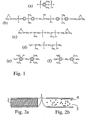
- Figure 1 shows an overview of structural formulae of a number of compounds which are referred to in the description. These are (a) the plastic PPE, (b) an aromatic epoxy resin BADGE, (c) an aliphatic epoxy resin PPODGE, (d) an aliphatic hardener polypropylene oxide diamine PODA, and (e), (f) aromatic hardeners M-CDEA and M-DEA.
- Fig. 2a diagrammatically depicts a metal-plastic-metal laminate according to the first aspect of the invention. It comprises two substantially parallel metal skins 1, between which there is a core layer 2 which is connected to the metal skins.
- the core layer comprises a solution of a thermoplastic in a solvent mixed with a hardener which is capable of reaction with the solvent.
- the core layer in Fig. 2b comprises a continuous plastic layer 3, in which the polymer particles 4 formed from the solvent and the hardener are dispersed.
- a side of the plastic layer that is shown in Figs. 2a and 2b is joined to a metal skin layer.
- one of the metal skin layers shown in Figs. 2a and 2b is replaced by a non-metallic skin or a body comprising a non-metallic material.
- poly(phenylene ethers) such as PPE
- PPE poly(phenylene ethers)
- the molecular weight of the poly(phenylene ethers) it is desired for the molecular weight of the poly(phenylene ethers) to be as high as possible, since a high molecular weight promotes the phase separation of the hardener/epoxy particles formed.
- a certain fraction of terminal phenolic groups is also desirable, since they can bind themselves to the epoxy particles. This typically occurs at a temperature of approximately 200°C. The adhesion of the core layer to the metal skins is improved as a result.
- the viscosity of poly(phenylene ethers) of lower molecular weight is lower, so that less solvent is required to achieve the same viscosity and it is possible for a higher fraction of the core layer to be formed from the poly(phenylene ethers) with the high dimensional stability. It has been found that a molecular weight of between 20 000 and 30 000 amu gives good results for the abovementioned applications.
- poly(phenylene ethers) In addition to poly(phenylene ethers), various types of polyamides also exhibit a sufficiently high dimensional stability at a temperature of between 180°C and 200°C in order, if desired, to be suitable for consideration as the base material. However, for bodywork applications, it is preferable to use PPE types, since they have a higher moisture resistance than the said polyamides.
- plastics have both an amorphous phase and a crystalline phase.
- the amorphous phase is transformed to a crystalline phase, the result is local density differences in the plastic, leading to internal stresses. It is possible to counteract the formation of crystalline nuclei and the growth of this phase as far as possible with the aid of additives, but according to the invention it is preferable to select a plastic which does not have a crystalline phase.
- the use of an epoxy resin as solvent has a particular advantage, since it has been found that the epoxy particles bind themselves preferentially in the vicinity of a metal surface, during which process they also adhere to the metal surface. Therefore, even after they have been removed from the thermoplastic as solvent, they form an important constituent of the core layer, since they promote the adhesion of the core layer and the metal. Consequently, it is unnecessary to arrange an additional adhesion layer between the core layer and a metal skin, leading to reduced production costs.
- the amount of hardener which is preferably present in the mixture is usually adapted in approximately stoichiometric proportions to the amount of reactable solvent. If desired, it is possible to deviate from these proportions. It has been found that, particularly in the case of aromatic compounds, a proportion of the hardener is absorbed in the plastic and is therefore not available for bonding with the solvent. In such cases, it is recommended to adjust the mixing ratio accordingly.
- Typical glass transition temperatures of polymer particles formed from epoxy resin and amines are around 180°C, depending on the degree of crosslinking.
- thermoplastic particles are dissolved.
- this can be carried out in a twin-screw extruder, for example.
- PPE and epoxy resin this most suitably takes place at a temperature of between 170°C and 200°C.
- difunctional epoxy resin an amount of between 10 and 20% by weight will create a sufficiently low viscosity.
- the desired, approximately stoichiometric amount of hardener can be added to the solution, preferably just before the extrusion takes place, and then a sheet of the desired thickness and width is extruded.
- PPE/epoxy resin/amine this takes place at a temperature of between 160°C and 200°C.
- the extruded sheet can then be hardened further, resulting in a marketable intermediate being created.
- the mean dimension of the epoxy particles which are dispersed in the PPE network lies in a range from 0.5 to 1 ⁇ m when using a mixture containing 10% difunctional epoxy resin, and in a range from 1.5 to 3 ⁇ m when using a mixture containing 20% difunctional epoxy resin.
- the number and dimension of the epoxy particles is dependent on the extent of phase separation achieved. Both the temperature to which the extruded mixture is heated in order to make the hardener react with the epoxy resin and the time for which the mixture is held at this temperature are decisive factors in a given system of PPE/epoxy resin/hardener for the extent of phase separation and therefore the toughness of the core layer.
- the metal skins preferably consist of steel, galvanized steel, stainless steel or an aluminium alloy, or combinations thereof. It is thus possible to create a laminate of which one metal skin consists of high-grade stainless steel while the "reverse side" of the metal-plastic-metal laminate consists of a less expensive steel grade.
- an aluminium alloy of a type which is particularly appropriate for work-hardening is particularly suitable for the laminate.
- An alloy which is suitable for hot-hardening is less suitable, on account of the process normally used to produce the laminate.
- the aluminium alloy belongs to the AA5xxx or the AA6xxx series, such as, without being restricted to, 5182, 5054, 6063 and 6016. Aluminium of this type has the right strength and properties for the intended applications. It is recommended for the laminate to comprise prestretched aluminium, to prevent so-called Lüders lines from developing during the cold-working of the laminate.
- a laminate having a thermoplastic layer that is on one side substantially uncovered may be somewhat thicker, for instance up to 5 mm, or up to 2 mm, because of the strength that must be delivered.
Landscapes
- Laminated Bodies (AREA)
- Epoxy Resins (AREA)
- Extrusion Moulding Of Plastics Or The Like (AREA)
- Compositions Of Macromolecular Compounds (AREA)
Applications Claiming Priority (2)
| Application Number | Priority Date | Filing Date | Title |
|---|---|---|---|
| NL1014112A NL1014112C2 (nl) | 2000-01-19 | 2000-01-19 | Metaal-kunststof-metaal laminaat en werkwijze voor het vervaardigen van een dergelijk laminaat. |
| EP01915160A EP1268192A2 (fr) | 2000-01-19 | 2001-01-19 | Lamine et processus de production d'un lamine de ce type |
Related Parent Applications (2)
| Application Number | Title | Priority Date | Filing Date |
|---|---|---|---|
| EP01915160.4 Division | 2001-01-19 | ||
| EP01915160A Division EP1268192A2 (fr) | 2000-01-19 | 2001-01-19 | Lamine et processus de production d'un lamine de ce type |
Publications (2)
| Publication Number | Publication Date |
|---|---|
| EP1876013A2 true EP1876013A2 (fr) | 2008-01-09 |
| EP1876013A3 EP1876013A3 (fr) | 2012-02-29 |
Family
ID=19770621
Family Applications (2)
| Application Number | Title | Priority Date | Filing Date |
|---|---|---|---|
| EP01915160A Ceased EP1268192A2 (fr) | 2000-01-19 | 2001-01-19 | Lamine et processus de production d'un lamine de ce type |
| EP20070019326 Withdrawn EP1876013A3 (fr) | 2000-01-19 | 2001-01-19 | Stratifié et processus de production d'un stratifié de ce type |
Family Applications Before (1)
| Application Number | Title | Priority Date | Filing Date |
|---|---|---|---|
| EP01915160A Ceased EP1268192A2 (fr) | 2000-01-19 | 2001-01-19 | Lamine et processus de production d'un lamine de ce type |
Country Status (7)
| Country | Link |
|---|---|
| US (1) | US6841252B2 (fr) |
| EP (2) | EP1268192A2 (fr) |
| JP (1) | JP4794795B2 (fr) |
| KR (1) | KR100692791B1 (fr) |
| AU (1) | AU4235001A (fr) |
| NL (1) | NL1014112C2 (fr) |
| WO (1) | WO2001053072A2 (fr) |
Families Citing this family (11)
| Publication number | Priority date | Publication date | Assignee | Title |
|---|---|---|---|---|
| US9186875B1 (en) | 2005-09-13 | 2015-11-17 | Mark V. Loen | Processing improvements in applying polyester onto a metal substrate |
| US7655278B2 (en) * | 2007-01-30 | 2010-02-02 | Sabic Innovative Plastics Ip B.V. | Composite-forming method, composites formed thereby, and printed circuit boards incorporating them |
| US20100035080A1 (en) * | 2008-02-29 | 2010-02-11 | Gm Global Technology Operations, Inc. | Corrosion resistant laminated steel |
| CA2734738C (fr) | 2008-08-18 | 2019-05-07 | Productive Research LLC. | Composites legers aptes a la mise en forme |
| KR101774911B1 (ko) | 2009-12-28 | 2017-09-05 | 프로덕티브 리서치 엘엘씨 | 복합 재료의 용접 공정 및 그로부터 제조된 제품 |
| US9415568B2 (en) | 2010-02-15 | 2016-08-16 | Productive Research Llc | Formable light weight composite material systems and methods |
| CA2862610A1 (fr) | 2011-02-21 | 2012-08-30 | Productive Research Llc | Materiaux composites incluant des regions dotees de proprietes differentes et procedes associes |
| US9233526B2 (en) | 2012-08-03 | 2016-01-12 | Productive Research Llc | Composites having improved interlayer adhesion and methods thereof |
| EP3569405A1 (fr) * | 2018-05-18 | 2019-11-20 | voestalpine Stahl GmbH | Bande ou tôle électrique, procédé de fabrication d'une telle bande ou tôle électrique ainsi qu'empilement de tôles correspondant |
| US11338552B2 (en) | 2019-02-15 | 2022-05-24 | Productive Research Llc | Composite materials, vehicle applications and methods thereof |
| KR102428824B1 (ko) | 2019-12-11 | 2022-08-02 | 주식회사 포스코 | 금속-플라스틱 복합소재 및 이의 제조 방법 |
Family Cites Families (11)
| Publication number | Priority date | Publication date | Assignee | Title |
|---|---|---|---|---|
| US4424254A (en) * | 1978-12-22 | 1984-01-03 | Monsanto Company | Metal-thermoplastic-metal laminates |
| US4330587A (en) * | 1981-02-23 | 1982-05-18 | Monsanto Company | Metal-thermoplastic-metal laminates |
| DE3876371T2 (de) * | 1987-10-14 | 1993-05-13 | Structural Laminates Co | Schichtstoff aus metallschichten und aus durchgehendem,faserverstaerkten,synthetischen,thermoplastischen material und verfahren zu seiner herstellung. |
| JP2547802B2 (ja) * | 1987-12-11 | 1996-10-23 | 新日本製鐵株式会社 | 複合型制振材料用組成物 |
| US5043367A (en) * | 1988-12-22 | 1991-08-27 | General Electric Company | Curable dielectric polyphenylene ether-polyepoxide compositions useful in printed circuit board production |
| JPH0391288A (ja) * | 1989-09-01 | 1991-04-16 | Mitsubishi Petrochem Co Ltd | 加撓性印刷回路用基板 |
| NL9200781A (nl) * | 1992-04-28 | 1993-11-16 | Schreiner Luchtvaart | Sandwichmateriaal. |
| NL9201968A (nl) | 1992-11-11 | 1994-06-01 | Hoogovens Hylite B V | Aluminium-polypropyleen-aluminium laminaat. |
| US6349747B1 (en) * | 1998-01-22 | 2002-02-26 | Institut Francais Du Petrole | Use of polymer compositions for coating surfaces, and surface coating comprising such compositions |
| JP3612594B2 (ja) * | 1998-05-29 | 2005-01-19 | 三井金属鉱業株式会社 | 樹脂付複合箔およびその製造方法並びに該複合箔を用いた多層銅張り積層板および多層プリント配線板の製造方法 |
| US20020147283A1 (en) * | 1998-10-08 | 2002-10-10 | Sung Chul Kim | Process for preparing toughened thermosetting structural materials |
-
2000
- 2000-01-19 NL NL1014112A patent/NL1014112C2/nl not_active IP Right Cessation
-
2001
- 2001-01-19 WO PCT/EP2001/000813 patent/WO2001053072A2/fr not_active Ceased
- 2001-01-19 AU AU42350/01A patent/AU4235001A/en not_active Abandoned
- 2001-01-19 KR KR1020027009304A patent/KR100692791B1/ko not_active Expired - Fee Related
- 2001-01-19 EP EP01915160A patent/EP1268192A2/fr not_active Ceased
- 2001-01-19 JP JP2001553102A patent/JP4794795B2/ja not_active Expired - Fee Related
- 2001-01-19 US US10/181,156 patent/US6841252B2/en not_active Expired - Fee Related
- 2001-01-19 EP EP20070019326 patent/EP1876013A3/fr not_active Withdrawn
Also Published As
| Publication number | Publication date |
|---|---|
| US20030162049A1 (en) | 2003-08-28 |
| AU4235001A (en) | 2001-07-31 |
| NL1014112C2 (nl) | 2001-07-20 |
| EP1876013A3 (fr) | 2012-02-29 |
| WO2001053072A2 (fr) | 2001-07-26 |
| KR20020069018A (ko) | 2002-08-28 |
| WO2001053072A3 (fr) | 2002-01-03 |
| JP2003520144A (ja) | 2003-07-02 |
| KR100692791B1 (ko) | 2007-03-12 |
| US6841252B2 (en) | 2005-01-11 |
| EP1268192A2 (fr) | 2003-01-02 |
| JP4794795B2 (ja) | 2011-10-19 |
Similar Documents
| Publication | Publication Date | Title |
|---|---|---|
| US6841252B2 (en) | Laminate and process for producing a laminate of this type | |
| KR101630219B1 (ko) | 금속 복합체의 제조 방법 및 전자기기 하우징 | |
| JP7687947B2 (ja) | 高度に加工可能な共有結合ネットワークポリマー及びブレンドへの無水経路 | |
| EP1651432B1 (fr) | Composite stratifie en metal-polyamide/polyethylene-metal | |
| EP2723796B1 (fr) | Composition thermodurcissable et procédé pour la préparation de composites renforcés par des fibres | |
| AU746116B2 (en) | Polymer composite comprising a hydroxy-functionalized polyether or polyester and an inorganic filler and method for preparing the same | |
| JPS60240724A (ja) | 共重合ポリエステルフイルム並びに該フイルムからなるホツトメルト接着剤 | |
| CN108307632A (zh) | 结构处理膜 | |
| EP3904074A1 (fr) | Matériau composite de métal et plastique renforcé par des fibres | |
| CN106459491B (zh) | 用于金属-塑料混合部件的增粘剂 | |
| CN111491978B (zh) | 具有改善机械性能的形状记忆材料 | |
| JP4639899B2 (ja) | ハニカムパネルの製造方法 | |
| CN112795148B (zh) | 一种热塑性共聚酯复合材料及其制备方法和应用 | |
| JP2637802B2 (ja) | 改良された構造物用接着剤 | |
| WO1992012008A1 (fr) | Feuilles multicouches ayant un excellent pouvoir adhesif | |
| US12337768B2 (en) | Adhesive resins and films for composites and tapes and methods of using the same | |
| EP3268191B1 (fr) | Composition de liant et son utilisation dans des procédés pour la production de panneaux de fibres de bois | |
| JP4821159B2 (ja) | エポキシ樹脂組成物の製造方法 | |
| EP4596612A1 (fr) | Préimprégné et procédé de production d'un matériau composite renforcé par des fibres à l'aide dudit préimprégné | |
| WO2025204944A1 (fr) | Composition de résine époxyde, produit durci de résine époxyde, préimprégné, matériau composite renforcé par des fibres, procédé de réparation de produit durci de résine époxyde, procédé de réparation de matériau composite renforcé par des fibres, procédé de remodelage de produit durci de résine époxyde, procédé de remodelage de matériau composite renforcé par des fibres, procédé de décomposition de produit durci de résine époxyde, et procédé de récupération de fibres de renforcement à partir d'un matériau composite renforcé par des fibres | |
| JP2023096752A (ja) | 車載モーターの製造方法、及び車載モーターを含む電動コンプレッサの製造方法 | |
| CN118451009A (zh) | 保险杠加强件的制造方法 | |
| JP2023097088A (ja) | 車両用ステアリングハンガーの製造方法 | |
| JPH03172342A (ja) | 制振性樹脂組成物及びその複合材 | |
| JPH03103432A (ja) | 金属積層用ポリエステル樹脂組成物およびフィルム |
Legal Events
| Date | Code | Title | Description |
|---|---|---|---|
| PUAI | Public reference made under article 153(3) epc to a published international application that has entered the european phase |
Free format text: ORIGINAL CODE: 0009012 |
|
| AC | Divisional application: reference to earlier application |
Ref document number: 1268192 Country of ref document: EP Kind code of ref document: P |
|
| AK | Designated contracting states |
Kind code of ref document: A2 Designated state(s): AT BE CH CY DE DK ES FI FR GB GR IE IT LI LU MC NL PT SE TR |
|
| AX | Request for extension of the european patent |
Extension state: AL LT LV MK RO SI |
|
| 17P | Request for examination filed |
Effective date: 20080627 |
|
| RAP1 | Party data changed (applicant data changed or rights of an application transferred) |
Owner name: TATA STEEL IJMUIDEN BV |
|
| PUAL | Search report despatched |
Free format text: ORIGINAL CODE: 0009013 |
|
| AK | Designated contracting states |
Kind code of ref document: A3 Designated state(s): AT BE CH CY DE DK ES FI FR GB GR IE IT LI LU MC NL PT SE TR |
|
| AX | Request for extension of the european patent |
Extension state: AL LT LV MK RO SI |
|
| RIC1 | Information provided on ipc code assigned before grant |
Ipc: B32B 15/08 20060101AFI20120124BHEP |
|
| AKX | Designation fees paid |
Designated state(s): AT BE CH CY DE DK ES FI FR GB GR IE IT LI LU MC NL PT SE TR |
|
| STAA | Information on the status of an ep patent application or granted ep patent |
Free format text: STATUS: THE APPLICATION IS DEEMED TO BE WITHDRAWN |
|
| 18D | Application deemed to be withdrawn |
Effective date: 20120830 |