EP1876208A1 - Aufzeichnungsflüssigkeit, flüssigkeitspatrone, flüssigkeitsausgabevorrichtung und flüssigkeitsausgabeverfahren - Google Patents
Aufzeichnungsflüssigkeit, flüssigkeitspatrone, flüssigkeitsausgabevorrichtung und flüssigkeitsausgabeverfahren Download PDFInfo
- Publication number
- EP1876208A1 EP1876208A1 EP05733992A EP05733992A EP1876208A1 EP 1876208 A1 EP1876208 A1 EP 1876208A1 EP 05733992 A EP05733992 A EP 05733992A EP 05733992 A EP05733992 A EP 05733992A EP 1876208 A1 EP1876208 A1 EP 1876208A1
- Authority
- EP
- European Patent Office
- Prior art keywords
- liquid
- ink
- recording
- ejecting
- dihydric alcohol
- Prior art date
- Legal status (The legal status is an assumption and is not a legal conclusion. Google has not performed a legal analysis and makes no representation as to the accuracy of the status listed.)
- Withdrawn
Links
Images








Classifications
-
- C—CHEMISTRY; METALLURGY
- C09—DYES; PAINTS; POLISHES; NATURAL RESINS; ADHESIVES; COMPOSITIONS NOT OTHERWISE PROVIDED FOR; APPLICATIONS OF MATERIALS NOT OTHERWISE PROVIDED FOR
- C09D—COATING COMPOSITIONS, e.g. PAINTS, VARNISHES OR LACQUERS; FILLING PASTES; CHEMICAL PAINT OR INK REMOVERS; INKS; CORRECTING FLUIDS; WOODSTAINS; PASTES OR SOLIDS FOR COLOURING OR PRINTING; USE OF MATERIALS THEREFOR
- C09D11/00—Inks
- C09D11/30—Inkjet printing inks
-
- C—CHEMISTRY; METALLURGY
- C09—DYES; PAINTS; POLISHES; NATURAL RESINS; ADHESIVES; COMPOSITIONS NOT OTHERWISE PROVIDED FOR; APPLICATIONS OF MATERIALS NOT OTHERWISE PROVIDED FOR
- C09D—COATING COMPOSITIONS, e.g. PAINTS, VARNISHES OR LACQUERS; FILLING PASTES; CHEMICAL PAINT OR INK REMOVERS; INKS; CORRECTING FLUIDS; WOODSTAINS; PASTES OR SOLIDS FOR COLOURING OR PRINTING; USE OF MATERIALS THEREFOR
- C09D11/00—Inks
- C09D11/30—Inkjet printing inks
- C09D11/38—Inkjet printing inks characterised by non-macromolecular additives other than solvents, pigments or dyes
-
- B—PERFORMING OPERATIONS; TRANSPORTING
- B41—PRINTING; LINING MACHINES; TYPEWRITERS; STAMPS
- B41J—TYPEWRITERS; SELECTIVE PRINTING MECHANISMS, i.e. MECHANISMS PRINTING OTHERWISE THAN FROM A FORME; CORRECTION OF TYPOGRAPHICAL ERRORS
- B41J2/00—Typewriters or selective printing mechanisms characterised by the printing or marking process for which they are designed
- B41J2/005—Typewriters or selective printing mechanisms characterised by the printing or marking process for which they are designed characterised by bringing liquid or particles selectively into contact with a printing material
- B41J2/01—Ink jet
-
- B—PERFORMING OPERATIONS; TRANSPORTING
- B41—PRINTING; LINING MACHINES; TYPEWRITERS; STAMPS
- B41J—TYPEWRITERS; SELECTIVE PRINTING MECHANISMS, i.e. MECHANISMS PRINTING OTHERWISE THAN FROM A FORME; CORRECTION OF TYPOGRAPHICAL ERRORS
- B41J2/00—Typewriters or selective printing mechanisms characterised by the printing or marking process for which they are designed
- B41J2/005—Typewriters or selective printing mechanisms characterised by the printing or marking process for which they are designed characterised by bringing liquid or particles selectively into contact with a printing material
- B41J2/01—Ink jet
- B41J2/17—Ink jet characterised by ink handling
- B41J2/175—Ink supply systems ; Circuit parts therefor
- B41J2/17503—Ink cartridges
- B41J2/17506—Refilling of the cartridge
- B41J2/17509—Whilst mounted in the printer
-
- B—PERFORMING OPERATIONS; TRANSPORTING
- B41—PRINTING; LINING MACHINES; TYPEWRITERS; STAMPS
- B41J—TYPEWRITERS; SELECTIVE PRINTING MECHANISMS, i.e. MECHANISMS PRINTING OTHERWISE THAN FROM A FORME; CORRECTION OF TYPOGRAPHICAL ERRORS
- B41J2/00—Typewriters or selective printing mechanisms characterised by the printing or marking process for which they are designed
- B41J2/005—Typewriters or selective printing mechanisms characterised by the printing or marking process for which they are designed characterised by bringing liquid or particles selectively into contact with a printing material
- B41J2/01—Ink jet
- B41J2/17—Ink jet characterised by ink handling
- B41J2/175—Ink supply systems ; Circuit parts therefor
- B41J2/17596—Ink pumps, ink valves
-
- B—PERFORMING OPERATIONS; TRANSPORTING
- B41—PRINTING; LINING MACHINES; TYPEWRITERS; STAMPS
- B41J—TYPEWRITERS; SELECTIVE PRINTING MECHANISMS, i.e. MECHANISMS PRINTING OTHERWISE THAN FROM A FORME; CORRECTION OF TYPOGRAPHICAL ERRORS
- B41J2/00—Typewriters or selective printing mechanisms characterised by the printing or marking process for which they are designed
- B41J2/005—Typewriters or selective printing mechanisms characterised by the printing or marking process for which they are designed characterised by bringing liquid or particles selectively into contact with a printing material
- B41J2/01—Ink jet
- B41J2/17—Ink jet characterised by ink handling
- B41J2/19—Ink jet characterised by ink handling for removing air bubbles
-
- B—PERFORMING OPERATIONS; TRANSPORTING
- B41—PRINTING; LINING MACHINES; TYPEWRITERS; STAMPS
- B41M—PRINTING, DUPLICATING, MARKING, OR COPYING PROCESSES; COLOUR PRINTING
- B41M5/00—Duplicating or marking methods; Sheet materials for use therein
Definitions
- This invention relates to a recording liquid deposited on a support in the state of droplets for recording thereon, a liquid cartridge for holding the recording liquid, and to a liquid ejecting device and a liquid ejecting method for ejecting the recording liquid, contained in the liquid cartridge, as droplets through an ejecting opening onto the support.
- an ink jet printer apparatus in which a recording liquid, or a so-called ink, is ejected via an ink ejecting head to a recording paper sheet, as a support, to record an image or a letter/character thereon.
- the printer apparatus of the ink jet system has advantages such as low running costs, small size, and ease in printing a colored image.
- the ink jet system ejecting the ink via an ink ejecting head
- the ink is turned into fine liquid droplets, which are then ejected via ejecting openings, that is, nozzles, of an ink ejecting head, so as to be deposited on the sheet for recording an image or a letter/character thereon.
- a preset quantity of a gas such as air, remains dissolved. If, with rise in temperature, the gas is lowered in solubility, the gas which may not be dissolved in the liquid is separated to form fine bubbles in the liquid.
- a gas such as air
- the ink present in an ink tank adapted for supplying the ink to e.g. an ink ejecting head, in an ink duct or in an ink ejecting duct rises in temperature, the gas dissolved in the liquid is released to form fine bubbles.
- ejection troubles such as non-ejection of the ink from the nozzle or warped ejection of the ink, that is, the ink being ejected from the nozzle along a path offset from the intended path, are produced, with the result that printed image suffers from white spots or becomes blurred to degrade the printing quality.
- the ink In the recording system in which the ink is turned into fine liquid droplets, under the action of thermal energy, and the so formed liquid droplets are ejected from the nozzle, that is, in the recording system of the thermal type or the bubble jet type, the ink is heated rapidly by a heater and ejected in the form of liquid droplets under the pressure of air bubbles generated by film boiling of the ink.
- a heater heat is accumulated in the vicinity of the heater, and hence the ink in the ink duct is extremely liable to be raised in temperature, with the result that ejection troubles, such as the aforementioned non-ejection or warped ejection, tend to be produced to a pronounced extent.
- Patent Publication 3 It has also been proposed in Patent Publication 3 to add an ethylene oxide adduct of a higher dehydrate alcohol alkoxylate in an aqueous pigment ink.
- the ink proposed in this Patent Publication 3 is alleged to be superior in ejection stability during high frequency driving, penetrability to the recording paper sheet and in drying properties.
- a compound obtained on adding only ethylene oxide to the higher alcohol a dihydric alcohol alkoxylate is contained in the ink, in association with the teaching by Patent Publication 1, it has not been possible to cope successfully with the problem of the nozzles being stopped with fine bubbles.
- the ink obtained on adding 7 mol or more only of ethylene oxide undergoes vigorous foaming to cause severe nozzle clogging.
- Patent Publication 4 For meeting the demand, it has been proposed in e.g. Patent Publication 4 to use a compound, obtained on treating a water-insoluble colorant with a high polymer material containing a sulfonic acid (sulfonate) group and/or with a high polymer material containing phosphoric acid (phosphate) group, as a colorant, and also to add a high polymer material, including a carboxylic acid (carboxylate) to the ink. It has also been proposed in Patent Publication 5 to get the ink doped with an alginic acid having a D-mannuronic acid to L-guluronic acid ratio ranging between 0.5 and 1.2.
- Patent Publication 6 It has also been proposed in Patent Publication 6 to add at least one surfactant selected from the group of fluorine-based surfactants and silicon -based surfactants and alginates to the ink.
- at least one surfactant selected from the group of fluorine-based surfactants and silicon -based surfactants and alginates to the ink.
- a line-based printer apparatus having one or more rows of nozzles juxtaposed in a direction substantially at right angles to the width-wise direction of the recording paper sheet, as distinct from a serial-based printer apparatus in which an ink ejecting head is scanned in a direction substantially at right angles to the feed direction of the recording paper sheet, an ink duct for conducting the ink from an ink tank is formed for traversing the feed direction of the recording paper sheet, and in which a plural number of ink ejecting heads, each having a nozzle, are arrayed on one or both sides of the ink duct, the number of ink heating sites is correspondingly increased with the number of the nozzles, so that fine bubbles tend to be generated.
- the ink tank is separated from the ink ejecting head a long distance, whilst the structure from the ink tank to the ink ejecting head is complicated to render it difficult to remove the fine bubbles generated, with the result that inconveniences ascribable to the fine bubbles occur most pronouncedly.
- the period of ejection of liquid droplets from one nozzle line to the next is that short and hence an ink exhibiting superior penetration characteristics into the recording paper sheet needs to be used. If the ink of this sort is used for a paper sheet of medium quality, the ink exhibits the tendency to seep into the paper sheet along its depth, that is, along its thickness, with the result that the optical density tends to be lowered.
- Patent Publication 1 Japanese Laid-Open Patent publication 2001-2964 Patent Publication 2: Japanese Laid-Open Patent publication H10-46075 Patent Publication 3: Japanese Laid-Open Patent publication H7-70491 Patent Publication 4: Japanese Laid-Open Patent publication 2000-154342 Patent Publication 5: Japanese Laid-Open Patent publication H8-290656 Patent Publication 6: Japanese Laid-Open Patent publication H8-193177 Patent Publication 7: Japanese Laid-Open Patent publication 2002-36522 Patent Publication 8: Japanese Laid-Open Patent publication 2001-315385 Patent Publication 9: Japanese Laid-Open Patent publication 2001-301199
- the present invention provides a recording liquid deposited on a support in the state of liquid droplets for recording thereon, comprising a coloring matter, a solvent for dispersing the coloring matter, and an ethylene oxide adduct of a a dihydric alcohol, containing a hydrocarbon group with 9 or less carbon atoms and having a ratio I/O of an inorganic value (IV) to an organic value (OV) not less than 1 and not larger than 1.37.
- the present invention also provides a liquid cartridge mounted to a liquid supply device for operating as a supply source for the recording liquid for the liquid supply device, the liquid supply device being provided to a liquid ejecting device adapted for ejecting the recording liquid, held in a liquid vessel, in the form of liquid droplets, and depositing the ejected ink on a support, for effecting the recording.
- the recording liquid comprises a coloring matter, a solvent for dispersing the coloring matter and an ethylene oxide adduct of a dihydric alcohol, containing a hydrocarbon group with 9 or less carbon atoms and having a ratio I/O of an inorganic value (IV) to an organic value (OV) not less than 1 and not larger than 1.37.
- the present invention also provides a liquid ejecting device comprising ejecting means including a liquid chamber for storing a recording liquid, a supply part for supplying the recording liquid to the liquid chamber, one or more pressure generating element(s) provided to the liquid chamber for thrusting the recording liquid stored in the liquid chamber, and an ejecting opening for ejecting the recording liquid, thrust by the pressure generating element, onto the major surface of a support from the liquid chamber as liquid droplets, and a liquid cartridge connected to the ejecting means for operating as a supply source for the recording liquid.
- ejecting means including a liquid chamber for storing a recording liquid, a supply part for supplying the recording liquid to the liquid chamber, one or more pressure generating element(s) provided to the liquid chamber for thrusting the recording liquid stored in the liquid chamber, and an ejecting opening for ejecting the recording liquid, thrust by the pressure generating element, onto the major surface of a support from the liquid chamber as liquid droplets, and a liquid cartridge connected to the e
- the recording liquid comprises a coloring matter, a solvent for dispersing the coloring matter and an ethylene oxide adduct of a dihydric alcohol, containing a hydrocarbon group with 9 or less carbon atoms and having a ratio I/O of an inorganic value (IV) to an organic value (OV) not less than 1 and not larger than 1.37.
- the present invention also provides a liquid ejecting method employing a liquid ejecting device comprising ejecting means including a liquid chamber for storing the recording liquid, a supply part for supplying the recording liquid to the liquid chamber, one or more pressure generating element(s) provided to the liquid chamber for thrusting the recording liquid stored in the liquid chamber, and an ejecting opening for ejecting the recording liquid, thrust by the pressure generating element, onto the major surface of a support from the liquid chamber as liquid droplets, and a liquid cartridge connected to the ejecting means for operating as a supply source for the recording liquid.
- ejecting means including a liquid chamber for storing the recording liquid, a supply part for supplying the recording liquid to the liquid chamber, one or more pressure generating element(s) provided to the liquid chamber for thrusting the recording liquid stored in the liquid chamber, and an ejecting opening for ejecting the recording liquid, thrust by the pressure generating element, onto the major surface of a support from the liquid chamber as liquid droplets, and
- the recording liquid comprises a coloring matter, a solvent for dispersing the coloring matter and an ethylene oxide adduct of a dihydric alcohol, containing a hydrocarbon group with 9 or less carbon atoms and having a ratio I/O of an inorganic value (IV) to an organic value (OV) not less than 1 and not larger than 1.37.
- the recording liquid contains an ethylene oxide adduct of a dihydric alcohol, having a hydrocarbon group with 9 or less carbon atoms and having a ratio I/O of an inorganic value (IV) to an organic value (OV) not less than 1 and not larger than 1.37, it becomes possible to prevent fine bubbles from being generated in the recording liquid, while it also becomes possible to prevent ejection defects, such as non-ejection or warped ejection of the recording liquid from the ejecting openings.
- the ejection defects ascribable to fine bubbles generated in the recording liquid may be prevented to eliminate blurring or generation of white spots, and that, since the recording liquid may exhibit superior wettability for the support, it is possible to achieve high quality recording of high optical density free of boundary bleeding or speckled color mixing in all-over printing.
- a recording liquid, a liquid cartridge, a liquid ejecting device and a liquid ejecting method, embodying the present invention will be explained in detail.
- An ink jet printer apparatus referred to below as a printer apparatus 1, shown in Fig.1, ejects e.g. the ink to a recording paper sheet P, running in a preset direction, for printing an image or a letter/character thereon.
- the printer apparatus 1 is a so-called line-based printer including a plural number of ink ejecting openings (nozzles) juxtaposed substantially in a line along the width of the recording paper sheet P, that is, in a direction indicated by arrow W in Fig. 1, in keeping with the printing width on the recording paper sheet P.
- this printer apparatus 1 includes an ink jet printer head cartridge, referred to below as a head cartridge 3, for ejecting an ink 2, as a recording liquid for recording an image or a letter/character on the recording paper sheet P, and a main printer body unit 4 for loading the head cartridge 3 thereon.
- the head cartridge 3 may be mounted on or dismounted from the main printer body unit 4, whilst ink tanks 11y, 11m, 11c and 11k may be mounted on or dismounted from the head cartridge 3.
- These ink tanks are liquid cartridges containing the ink 2, and operate as ink supply sources for the head cartridge 3.
- the ink tank 11y for yellow, the ink tank 11m for magenta, the ink tank 11c for cyan and the ink tank 11k for black are usable.
- the head cartridge 3, that may be mounted on or dismounted from the main printer body unit 4, and the ink tanks 11y, 11m, 11c and 11k, that may be mounted on or dismounted from the head cartridge 3, are consumable items.
- the recording paper sheet P housed in a tray 55a, adapted for accommodating a stack of the plural recording paper sheets P therein, may be mounted in a tray loading unit 5, provided on the front bottom part of the main printer body unit 4, for supplying the recording paper sheets P into the inside of the main printer body unit 4.
- the tray 55a is loaded on the tray loading unit 5 on the front surface of the main printer body unit 4
- the recording paper sheet P is supplied by a paper sheet supplying/ discharging mechanism 54 via paper sheet supply port 55 to the back surface side of the main printer body unit 4.
- the recording paper sheet P forwarded to the back surface side of the main printer body unit 4, has its running direction reversed by a reversing roll 83, as later explained, and is forwarded on the upper forward running path from the back surface side towards the front side of the main printer body unit 4.
- a reversing roll 83 As later explained, and is forwarded on the upper forward running path from the back surface side towards the front side of the main printer body unit 4.
- printing data corresponding to input letter/ character data, entered from an information processing apparatus 69, such as a personal computer, which will be explained subsequently, is printed as letter/character on the so forwarded recording paper sheet P.
- the ink 2 used as a recording liquid in printing contains a colorant material, such as various pigments or water-soluble dyes, acting as coloring matter, a solvent for dispersing the colorant material, and an ethylene oxide (EO) adduct of a dihydric alcohol with a ratio of an inorganic value (IV) to an organic value (OV), referred to below as I/O ratio, ranging between 1 and 1.37.
- a colorant material such as various pigments or water-soluble dyes, acting as coloring matter
- a solvent for dispersing the colorant material a solvent for dispersing the colorant material
- EO ethylene oxide
- the colorant material fine particles of dyes, pigments or colored polymers, well-known in the art, may be used alone or as a mixture.
- the water-soluble dyes are preferred.
- any of acidic dyes, direct dyes, basic dyes, reactive dyes or edible dyes may be selected and used, mainly from the perspective of solubility in water, coloration and color fastness.
- the yellow water-soluble dyes may be enumerated by, for example, C.I. Acid Yellow 17, 23, 42, 44, 79 and 142, C.I. Food Yellow 3 and 4, C.I. Direct Yellow 1, 12, 24, 26, 33, 44, 50, 86, 120, 132, 142 and 144, C.I. Direct Orange 26, 29, 62 and 102, C.I. Basic yellow 1,2, 11, 13, 14, 15, 19, 21, 23, 24, 25, 28, 29, 32, 36, 40, 41, 45, 49, 51, 53, 63, 64, 65, 67, 70, 73, 77, 87 and 91, C.I. Reactive Yellow 1, 5, 11, 13, 14, 20, 21, 22, 25, 40, 47, 51, 55, 65 and 67.
- the magenta water-soluble dyes may be enumerated by, for example, C.I. Acid Red 1, 8, 13, 14, 18, 26, 27, 35, 37, 42, 52, 82, 87, 89, 92, 97, 106, 111, 114, 115, 134, 186, 249, 254 and 289, C.I. Food Red, 7, 9 and 14, C.I. Direct Red 1, 4, 9, 13, 17, 20, 28, 31, 39, 80, 81, 83, 89, 225 and 227, C.I.
- the cyan water-soluble dyes may be enumerated by, for example, C.I. Acid blue 9, 29, 45, 92 and 249, C.I, Direct Blue 1, 2, 6, 15, 22, 25, 71, 76, 79, 86, 87, 90, 98, 163, 165, 199 and 202, C.I. Basic Blue 1, 3, 5, 7, 9, 21, 22, 26, 35, 41, 45, 47, 54, 62, 65, 66, 67, 69, 75, 77, 78, 89, 92, 93, 105, 117, 120, 122, 124, 129, 137, 141, 147 and 155, and C.I. Reactive Blue 1, 2, 7, 14, 15, 23, 32, 35, 38, 41, 63, 80 and 95.
- the black water-soluble dyes may be enumerated by, for example, C.I. Acid Black 1, 2, 7, 24, 26 and 94, C.I. Food Black 1 and 2, C.I. Direct Black 19, 22, 32, 38, 51, 56, 71, 74, 75, 77, 154, 168 and 171, and C.I. Basic Black 3, 4, 7, 11, 12 and 17.
- the amount of addition of the aforementioned colorant to the ink 2 ranges between 1 mass wt% to 10 mass wt%, preferably between 3 mass wt% and 5 mass wt%, to the total mass weight of the ink 2, and is determined in consideration of, for example, the viscosity, drying performance, ejecting stability of coloration properties of the ink and preservation stability of the printed product.
- the ink 2 is used dissolved in water, as a solvent, it is also possible to use well-known organic solvents, either singly or in combination, for the purpose of imparting desirable physical properties to the ink 2, improving dispersibility and solubility in water of the colorant and preventing the ink 2 from drying.
- the organic solvents may be enumerated by, for example, lower alcohols, such as ethanol, 2-propanol, polyhydric alcohols, such as ethylene glycol, diethylene glycol, triethylene glycol, polyethylene glycol, polypropylene glycol, 1,5- pentanediol, 1,6- hexanediol, glycerin, 1,2,6- hexanetriol, 1,2,4- butanetriol or petriol, polyhydric alcohol alkylethers, such as ethyleneglycol monoethylether, ethyleneglycol monobuthylether, diethyleneglycol monomethylether, diethyleneglycol monoethylether, diethyleneglycol monobuthylether, tetraethyleneglycol monomethylether, or propyleneglycol monophenylether, polyhydric alcohol allylethers, such as ethyleneglycol monophenylether or ethyleneglycol monobenzyl
- the amount of addition of the aforementioned organic solvents in the ink 2 ranges between 5 mass wt% to 50 mass wt%, preferably between 10 mass wt% and 35 mass wt%, based on the total mass weight of the ink 2, and is determined in consideration of the viscosity, drying performance or ejection stability of the ink 2, as in the case of the colorant.
- the optical density of an image obtained on recording by deposition thereof on the recording paper sheet P, that is, on printing becomes higher to suppress boundary bleeding or speckled color mixing in allover printing to achieve an image printed to high quality.
- the ink 2 containing, as the EO adduct of a dihydric alcohol with the number of carbon atoms not larger than 9 and with the I/O ratio ranging between 1 and 1.37, the EO adduct of the dihydric alcohol, with hydrocarbon groups with an iso-branching or a tert-branching, as indicated by the chemical formulas 9 to 16, the ink may further be improved in ejection stability, so that a printed image obtained may be of higher quality, because the steric chemical structure of the EO adduct of the a dihydric alcohol is further deterrent to the generation of fine bubbles.
- the compounds indicated by the chemical formulas 11 to 16 are preferably contained as the EO adduct of a dihydric alcohol with the number of carbon atoms not larger than 9 and with the I/O ratio ranging between 1 and 1.37.
- the ink containing these compounds either alone or in combination, outstanding operation and effects may be produced.
- the number of carbon atoms exceeds 9
- the ink 2 is increased in viscosity and, depending on the content of the organic compound, the ink 2 tends to be deteriorated in penetrability into the recording paper sheet P.
- the number of carbon atoms is spontaneously determined by the value of the I/O ratio.
- the EO adduct of a dihydric alcohol is preferably contained in an amount ranging between 0.1 mass wt% and 5 mass wt%, more preferably, in an amount ranging between 0.5 mass wt% and 3 mass wt%, based on the total mass weight of the ink 2. If the amount of content of the EO adduct of a dihydric alcohol is smaller than 0.1 mass wt%, it becomes difficult to achieve the aforementioned favorable operation and results.
- the ink 2 tends to be higher in viscosity and deteriorated in penetrability into the recording paper sheet P.
- the inorganic value (IV) and the organic value (OV) may be found from discussions on an organic conceptual diagram shown e.g. in Yoshio Koda: “Systematic Organic Qualitative Analysis- Fundamentals and Application”, published by SANKYO Publishing Co. Ltd., 1984 , Fujita and Akatsuka, “Systematic Organic Qualitative Analysis (for Mixtures)", published by Kazama-Shobou (1974 ), Nonuhiko Kuroki, "Theoretical Chemistry on Dyes”, published by Maki-Shoten, 1966 , Tobita and Uchida, “Fine Chemicals", Maruzen (1982 ) and in Inoue, Uehara and Minami, “Method for Separating Organic Compounds", published by Shoukabou, 1990 .
- the organic conceptual diagram are relative with a technique of grasping the physical properties of a subject organic compound from the combination of 'inorganic properties', denoting the degree of the physical and chemical properties of an organic compound by the force of electrical affinity, and 'organic properties', denoting the degree of the physical and chemical properties of the organic compound by the Van Der Waals force.
- the inorganic value (IV) of a given compound is increased, it is apt to be polarized to be more readily soluble in water and, if the organic value (OV) of a given compound is increased, the compound is increased in oleophilicity and lowered in solubility in water, while being more readily soluble in an organic solvent.
- the compound in the EO adduct of a dihydric alcohol, contained in the ink 2, if the I/O ratio is less than 1, the compound tends to be lowered in hydrophilic properties and separated in the ink 2, with the compound then forming oil droplets to deteriorate ejection stability of the ink such as by clogging the nozzle 42a. If conversely the I/O ratio exceeds 1.37, the EO adduct tends to be lowered in hydrophobic properties to produce the tendency for generating fine bubbles in the ink 2, thus again lowering the ejection stability.
- the I/O values of the EO adduct of the dihydric alcohol are calculated on the basis of Table 1.1, page 13 of the aforementioned Yoshio Koda: “Systematic Organic Qualitative Analysis- Fundamentals and Application”.
- the organic value of a carbon atom is set to 2.0, although this is not shown in the Tables 1 and 2.
- the inorganic value (I/O) of the EO adduct of the dihydric alcohol (IV) may be found by adding inorganic values of the totality of the inorganic groups contained in the EO adduct of the dihydric alcohol from the Tables 1 and 2.
- the organic value of the If the EO adduct of the dihydric alcohol EO adduct of the dihydric alcohol (OV) may be found from the organic value of the carbon atoms.
- the inorganic value of the organic/ inorganic groups is added to the inorganic value as found from the inorganic groups, whilst the organic value of the organic/ inorganic groups (OV) is added to the organic value of the carbon atom (OV).
- the resulting inorganic value (IV) is then divided by the inorganic value (OV) to find the I/O of the EO adduct of the dihydric alcohol.
- Inorganic groups Values Organic/inorganic groups Values Organic Inorganic Light metal (salt) 500 or more R 4 Bi-OH 80 250 Heavy metal (salt), amine and NH 4 salt 400 or more R 4 Sb-OH 60 250 -AsO 3 H 2 ,>AsO 2 H 300
- R 4 As-OH 40 250 -SO 2 -NH-CO-, -N N-NH 2 260
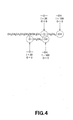
- the chemical formula 5 includes two -OH groups and two -O- groups and two -O- groups, as inorganic groups, two -O-CH 2 -CH 2 groups, referred to below as 'EO', as organic/ inorganic groups, and 12 C atoms, forming organic groups, as shown in Fig.5.
- 'EO' organic/ inorganic groups
- 12 C atoms forming organic groups, as shown in Fig.5.
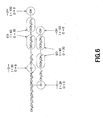
- the first ether linkage part from the main chain is excluded and the second and the following ether linkage parts are counted as EOs. From the Tables 1 and 2, the IV and OV of the EO are 60 and 30, respectively.
- the chemical formula 6 is similar to the chemical formula 5 except containing two more EOs, as organic/ inorganic groups, than the chemical formula 5, and hence the explanation on the specified method for calculating the I/O value is dispensed with.
- the chemical formula 7 is similar to the chemical formula 4 except containing two less Cs, as atoms making up organic groups, than the chemical formula 4, with the number of C atoms being 10, and hence the explanation on the specified method for calculating the I/O value is dispensed with.
- the chemical formula 8 is similar to the chemical formula 4 except containing two less Cs, as atoms making up organic groups, than the chemical formula 4, with the number of C atoms being 10, and also containing one EO group, as an organic/ inorganic group, and hence the explanation on the specified method for calculating the I/O value is dispensed with.
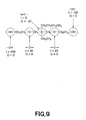
- this chemical formula is similar to the chemical formula 11, except that having four more EO groups, as organic/inorganic groups, than the chemical formula 11, and containing four EO groups, and hence the specified method for calculating the I/O is not explained here specifically.
- the chemical formula 14 is similar to the chemical formula 13 except having three more EO groups, as organic/ inorganic groups, than the chemical formula 13, and having three EO groups. Hence, the explanation of the method for calculating the specified value of the I/O ratio is dispensed with.
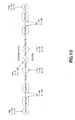
- the chemical formula 16 is similar to the chemical formula 15 except having four more EO groups, as organic/ inorganic groups, than the chemical formula 15 and having four EO groups, as shown in Fig. 10. Hence, the explanation of the method for calculating the specified value of the I/O ratio is dispensed with.
- the chemical formula 9 is similar to the chemical formula 15 except having two less EO groups, as organic groups, than the chemical formula 15, and having 11 carbon atoms. Hence, the explanation of the method for calculating the specified value of the I/O ratio is dispensed with.
- the chemical formula 10 is similar to the chemical formula 15 except having two less C atoms, making up organic/ inorganic groups, as organic groups, than the chemical formula 15, having 11 carbon atoms, and also having one EO group, as the organic/ inorganic group.
- the I/O value is not less than 1 and not larger than 1.37 for the EO adducts of a dihydric alcohol, shown by the above chemical formulas 4 to 16, and, when contained in the ink 2, such adduct suppresses generation of oil droplets or fine bubbles in the ink 2, so that it is possible to prevent failure in ejection, such as non-ejection or deviation in ejection.
- the organic compounds shown by the chemical formulas 4 to 16 are shown.
- the present invention is, however, not limited to these organic compounds. That is, such EO adducts of a dihydric alcohol, having the I/O values ranging between 1 and 1.37 and the hydrocarbon groups with the number of carbon atoms not larger than 9, may be used as a surfactant for the ink 2 with favorable operation and effect comparable with those of the compounds of the chemical formulas 4 to 16.
- the dynamic surface tension of the ink 2 at 20Hz ( ⁇ 20 ), that is, the surface tension when air bubbles are generated every 50 msec, and that at 1 Hz ( ⁇ 1 ), that is, the surface tension when air bubbles are generated every sec, are set to not less than 30 mN/m and to not larger than 38 mN/m, respectively.
- the ink 2 having these values of the dynamic surface tension the optical density becomes higher, while the boundary bleeding and speckled color mixing in all-over printing may further be suppressed.
- the rate of penetration of the ink 2 into the recording paper sheet P in other words, the spreading of the ink 2 from its deposited position along the direction of thickness and along the planar direction of the recording paper sheet P, along its pulp fibers, becomes uniform.
- the dynamic surface tension may be measured by e.g. a dynamic surface tension meter produced on the basis of the known principle for measuring the dynamic surface tension as disclosed in, for example the Japanese Laid-Open Patent Publication 63-31237 .
- a dynamic bubble pressure surface tension meter manufactured by KRUSS, capable of measuring the dynamic surface tension by the maximum bubble pressure method (Trade name: BP-2), or a dynamic surface tension measurement device, manufactured by LAUDA (trade name: MPT2), may be used.
- the dynamic surface tension may basically be adjusted by selecting the sort of the EO adduct of the dihydric alcohol, having a hydrocarbon group with 9 or less carbon atoms and having the I/O ratio ranging between 1 and 1.37, or by adjusting the amount of the adduct to be contained in the ink 2.
- routinely used surfactants include special phenol based nonionic surfactants, such as polycyclic phenol ethoxylates, ester-based nonionic surfactants, such as ethylene oxide adducts of glyceride, polyethylene glycol oleate, polyoxyalkylene taloate, sorbitan laurylester, sorbitan oleylester, and polyoxyethylene sorbitane oleylester, amide-based non-ionic surfactants, such as coconut oil fatty acid diethanol amide, or polyoxyethylene coconut oil fatty acid diethanol amide and polyoxyethylene coconut oil fatty acid monoethanol amide, acetylene glycol and ethylene oxide adducts thereof, anionic surfactants, such as alcohol sulfate sodium salts, higher alcohol sulfate sodium salts, polyoxyethylene alkyl phenylether sulfuric acid ester ammonium salts, and alkylbenzene sulfonic acid sodium salts,
- the aforementioned known surfactants are added in an amount not larger than 30 mass wt% and preferably not larger than 20 mass wt%, based on the total weight of the EO adduct of a dihydric alcohol having a hydrocarbon group with 9 or less carbon atoms and having the I/O ratio value ranging between 1 and 1.37, contained in the ink 2. If the known surfactants are added in an amount exceeding 30 mass wt% of the total weight of the EO adduct of a dihydric alcohol, having a hydrocarbon group with 9 or less carbon atoms and having the I/O ratio value ranging between 1 and 1.37, the risk is high that the optical density is lowered and boundary bleeding or speckles in color mixing in all-over printing.
- solvents, EO adducts of a dihydric alcohols, functioning as a surfactant, having hydrocarbon groups with 9 or less carbon atoms and also having the I/O ratio value ranging between 1 and 1.37, and the routinely used surfactants, viscosity adjustment agents, pH adjustment agents, antiseptics, rust-proofing agents or mildew-preventatives, may also be added to the ink 2.
- the viscosity adjustment agents and the pH adjustment agents may be exemplified by proteins, such as gelatin and casein, natural rubber, such as gum Arabic, cellulose derivatives, such as methyl cellulose, carboxy methyl cellulose or hydroxyl methyl cellulose, natural high polymeric materials, such as ligninsulfonates or shellac, polyacrylates, styrene- acrylate copolymer, polyvinyl alcohol and polyvinyl pyrrolidone. These may be used alone or in combination.
- the antiseptics, rust-proofing agents or mildew-preventatives may be exemplified by benzoic acid, dichlorophene, hexachlophene, sorbic acid, p-hydroxybenzoate and ethylene diamine tetraacetate (EDTA), these being used either alone or in combination.
- the above ink 2 may be prepared by mixing the aforementioned colorant, solvent and the EO adduct of a dihydric alcohol, having a hydrocarbon group with 9 or less carbon atoms and having the I/O ratio ranging between 1 and 1.37, by predetermined proportions, and by agitating and dispersing the resulting mass, such as by a screw, under heating to ambient temperature or to a temperature on the order of 40°C to 80°C.
- the ink 2, prepared as described above, is accommodated in each ink tank. It is noted that the ink with a yellow color is accommodated in the ink tank 11y, the ink with a magenta color is accommodated in the ink tank 11m, the ink with a cyan color is accommodated in the ink tank 11c and the ink with a cyan color is accommodated in the ink tank 11k.
- the head cartridge 3 that may be mounted to and dismounted from the main printer body unit 4, making up the printer apparatus 1, and the ink tanks 11y, 11m, 11c and 11k, will now be explained with reference to the drawings.
- the head cartridge 3 for printing on the recording paper sheet P is loaded from the side of the upper surface of the main printer body unit 4, that is, from the direction of an arrow A in Fig. 1, and ejects the ink 2 onto the recording paper sheet P, fed by the paper sheet supplying/ discharging mechanism 54, in order to eject the ink 2 to effect printing.
- the head cartridge 3 pulverizes the ink 2 into extremely fine particles, by the pressure generated by pressure generating means of, for example the electro-thermal transducing type or an electro-mechanical transducing type device, to spray the ink as fine droplets onto the major surface of the support, such as the recording paper sheet P.
- the head cartridge 3 includes a main cartridge body unit 21, on which are loaded the ink tanks 11y, 11m, 11c and 11k, as vessels, each of which is charged with the ink 2.
- the ink tanks 11y, 11m, 11c and 11k are also simply referred to as an ink tank 11.
- the ink tank 11, which may be mounted to and dismounted from the head cartridge 3, includes a tank vessel 12, prepared on injection molding e.g. a resin material, such as polypropylene, exhibiting strength and resistance against the ink.
- the tank vessel 12 is formed to a substantially rectangular shape, having a dimension substantially equal to the width-wise size of the recording paper sheet P, traveling along its longitudinal direction, for thereby increasing the capacity of the ink stored therein.
- the tank vessel 12, forming the ink tank 11 is provided with an ink reservoir 13, accommodating the ink 2, an ink supplying unit 14 for supplying the ink 2 from the ink reservoir 13 into the main cartridge body unit 21 of the head cartridge 3, a series of communication ports 15 for taking in air from outside into the ink reservoir 13, an air inlet duct 16 for introducing air taken in via communication ports 15 into the ink reservoir 13, an ink storage 17 for transient storage of the ink 2 between the communication ports 15 and the air inlet duct 16, a retention lug 18 for retaining the ink tank 11 by the main cartridge body unit 21 and an engagement step 19.
- the ink reservoir 13 formed of a material of high air tightness, delimits a spacing in which to accommodate the ink 2.
- the ink reservoir 13 is formed to a substantially rectangular shape having a long-side dimension substantially equal to the width-wise size of the recording paper sheet P, traveling along its longitudinal direction, that is, along the direction indicated by arrow W in Fig.3.
- the ink supplying unit 14 is provided at a mid part on the lower surface of the ink reservoir 13.
- This ink supplying unit 14 is a substantially protuberantly-shaped nozzle kept in communication with the ink reservoir 13.
- the distal end of the nozzle is fitted to a connecting part 26 of the head cartridge 3 as later explained to connect the tank vessel 12 of the ink tank 2 with the main cartridge body unit 21 of the head cartridge 3.
- the ink supplying unit 14 is provided with a supply port 14b for supplying the ink 2 to a bottom surface 14a of the ink tank 11.
- a valve 14c for opening/ closing the supply port 14b
- a coil spring 14d for biasing the valve 14c in a direction of closing the supply port 14b
- an opening/closing pin 14e for opening/ closing the valve 14c.
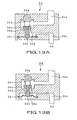
- the supply port 14b connected to the connecting part 26 of the head cartridge 3 for supplying the ink 2 is closed by the valve 14c being biased in a direction of closing the supply port 14b, under the bias of the coil spring 14d, as a biasing member, as shown in Fig. 11 A.
- the opening/closing pin 14e is uplifted in a direction opposite to the biasing direction of the coil spring 14d, by an upper part of the connecting part 26 of the main cartridge body unit 21 forming the head cartridge 3, as shown in Fig. 11B.
- the opening/closing pin 14e thus uplifted, uplifts the valve 14c, against the bias of the coil spring 14d, for opening the supply port 14b.
- the communication port 15 is an air take-in port for taking in air from outside the ink tank 11 into the ink reservoir 13.
- the communication port 15 is provided at a preset location in the upper surface of the tank vessel 12 facing the outside when the ink tank is loaded on the loading part 22, here at a mid part on the upper surface of the vessel, so that the communication port faces the outside to take in outside air even when the ink tank is mounted on the loading part 22.
- the communication port 15 takes in air into the ink tank in an amount corresponding to a decreased amount of the ink 2 in the ink reservoir 13 when the ink tank 11 is loaded on the main cartridge body unit 21 and the ink 2 has flown down from the ink reservoir 13 towards the main cartridge body unit 21.
- the air inlet duct 16 sets up communication between the ink reservoir 13 and the communication port 15 to introduce air taken in at the communication port 15 into the ink reservoir 13.
- the ink storage 17 is provided between the communication port 15 and the air inlet duct 16 for transiently storing the ink 2, so that, when the ink 2 has leaked out from the air inlet duct 16 communicating with the ink reservoir 13, the ink 2 will not flow outwards precipitously.
- This ink storage 17 is lozenge shaped, with the long diagonal line extending along the longitudinal direction of the ink reservoir 13.
- the inlet duct 16 is located at an apex point of the ink storage, lying at a lowermost point of the ink reservoir 13, that is, at the lower end of the short diagonal line of the lozenge shape, such that the ink 2 introduced from the ink reservoir 13 will again be restored into the ink reservoir 13.
- the communication port 15 is provided at the uppermost end of the short diagonal line of the lozenge shape such that the ink 2 introduced from the ink reservoir 13 will hardly leak to outside through the port 15.
- the retention lug 18 is provided on one lateral short side of the ink tank 11 and is engaged in an engagement opening 24a formed in a latch lever 24 of the main cartridge body unit 21 of the head cartridge 3.
- This retention lug 18 has an upper surface formed as a planar surface extending substantially at right angles to the lateral surface of the ink reservoir 13, while having a lower surface inclined from the lateral surface to the upper surface.
- the engagement step 19 is provided at an upper part of the ink tank 11 on the opposite lateral side with respect to the lateral side carrying the retention lug 18.
- the engagement step 19 is made up by an inclined surface 19a, connecting to the upper surface of the tank vessel 12, and by a planar surface 19b consecutive to the other end of the inclined surface 19a and extending substantially parallel to the upper surface of the tank vessel 12. Since the ink tank 11 is provided with the engagement step 19, the lateral surface thereof provided with the planar surface 19b is lower by one step than the upper surface of the tank vessel 12. It is by this step that the ink tank is engaged with an engagement part 23 of the main cartridge body unit 21.
- the engagement step 19 is provided on the inserting side lateral surface of the ink tank when the ink tank is inserted into the loading part 22 of the head cartridge 3.
- the engagement step is engaged with the engagement part 23 of the loading part 22 of the head cartridge 3 so as to act as a fulcrum point of rotation when the ink tank 11 is mounted on the loading part 22.
- the above-described ink tank 11 includes, in addition to the above component parts, a residual ink quantity detection unit for detecting the residual quantity of the ink 2 in the ink reservoir 13, and a discriminating unit for discriminating the ink tanks 11 y, 11m, 11 c and 11k.
- the head cartridge 3 on which to load the ink tanks 11y, 11m, 11c and 11k, accommodating the yellow, magenta, cyan and black inks 2, respectively, as described above, will now be explained in detail.
- the head cartridge 3 is made up by the aforementioned ink tank 11 and the main cartridge body unit 21, as shown in Figs.2 and 3.
- the main cartridge body unit 21 includes loading zones 22y, 22m, 22c and 22k, on which is loaded the ink tank 11. When these loading zones are denoted in their entirety, they are simply referred to below as the loading part 22.
- the main cartridge body unit 21 also includes the engagement part 23 and the latch lever 24 for securing the ink tank 11, a biasing member 25 for biasing the ink tank 11 in a takeout direction, the connecting part 26 connected to the ink supplying unit 14 so as to be supplied with the ink 2, an ink ejecting head 27 for ejecting the ink 2, and a head cap 28 for protecting the ink ejecting head 27.
- the loading part 22, on which to load the ink tank 11, has a substantially recessed upper surface for use as an inserting/ ejecting opening for the ink tank 11.
- this recessed upper surface there are arrayed the four ink tanks 11 in juxtaposition in a direction substantially perpendicular to the width of the recording paper sheet P, that is, in a direction along the feed direction of the recording paper sheet P.
- the loading part 22, in which is loaded the ink tank 11, is of a length elongated along the printing width, as is the ink tank 11.
- the ink tank 11 is housed and loaded in the main cartridge body unit 21.
- the loading part 22 is a zone in which the ink tank 11 is loaded, as shown in Fig.2.
- the zones of the loading part, on which are loaded the ink tank 11y for yellow, the ink tank 11m for magenta, the ink tank 11c for cyan and the ink tank 11k for black, are labeled 22y, 22m, 22c and 22k, respectively.
- the loading zones 22y, 22m, 22c and 22k are separated from each other by partitions 22a.
- the ink tank 11k for black is of a larger thickness in order to accommodate a larger quantity of the ink in view of the generally larger consumption of the black ink, and hence the ink tank 11k for black is larger in width than the remaining ink tanks. Consequently, the loading zone 22k is broader in width than the remaining loading zones 22y, 22m, 22c, 22k in keeping with the thickness of the ink tank 11k.
- the opening end of the loading part 22, on which is loaded the ink tank 11, is provided with the engagement part 23, as shown in Fig.3.
- This engagement part 23 is provided at a longitudinal end of the loading part 22 so as to be engaged with the engagement step 19 of the ink tank 11.
- the ink tank 11 may be mounted on the loading part 22 by obliquely inserting the ink tank 11 into the loading part 22, with the engagement step 19 of the ink tank 11 first.
- the side of the ink tank 11 not provided with the engagement step 19 may then be rotated towards the loading part 22, with the location of engagement of the engagement step 19 of the ink tank 11 as the fulcrum point of rotation, for loading the ink tank on the loading part 22. In this manner, the ink tank 11 may readily be mounted on the loading part 22.
- the latch lever 24 is formed by bending a spring sheet and is provided on the lateral surface of the loading part 22 opposite to the engagement part 23, that is, on the opposite longitudinal end of the loading part 22.
- the proximal end of the latch lever 24 is provided as one with the bottom surface of the opposite lateral surface along the longitudinal end of the loading part 22 so that the distal end thereof is resiliently flexed in a direction towards and away from the aforementioned lateral surface.
- the distal end of the latch lever 24 is provided with an engagement opening 24a.
- the latch lever 24 is resiliently deflected the instant the ink tank 11 is mounted on the loading part 22, with the retention lug 18 of the ink tank 11 then engaging with the engagement opening 24a to prevent the ink tank 11 from becoming detached from the loading part 22 on which has been loaded the ink tank.
- the biasing member 25 is a spring sheet provided on the bottom surface towards the lateral surface provided with the engagement step 19 of the ink tank 11, with the spring sheet being bent for biasing the ink tank 11 in the direction of dismounting the ink tank 11.
- the biasing member 25 includes a top formed by bending and may be resiliently deflected in a direction towards and away from the aforementioned bottom surface, in order to thrust the bottom surface of the ink tank 11 at the top to bias the ink tank 11 loaded on the loading part 22 in a direction of being dismounted from the loading part 22.
- a connecting part 26 On mid parts along the longitudinal direction of the loading zones 22y, 22m, 22c and 22k, there is provided a connecting part 26 the ink supplying units 14 of the ink tanks 11y, 11m, 11 c and 11k are connected to when the ink tanks 11y, 11m, 11c and 11k are mounted to the loading zones 22y, 22m, 22c and 22k, respectively.
- This connecting part 26 operates as an ink supply duct for delivery of the ink 2 from the ink supplying unit 14 of the ink tank 11 mounted on the loading part 22 to the ink ejecting head 27 provided to the bottom surface of the main cartridge body unit 21.
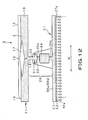
- the connecting part 26 includes an ink well 31 for storing the ink 2 supplied from the ink tank 11, a sealing member 32 for sealing the ink supplying unit 14 connected to the connecting part 26, a filter 33 for removing impurities in the ink 2 and a valving mechanism 34 for opening/closing the supply duct to the ink ejecting head 27, as shown in Fig. 12.
- the ink well 31 is a spacing connecting to the ink supplying unit 14 and in which the ink 2 is stored.
- the sealing member 32 is provided on the top of the ink well 31 and, when the ink supplying unit 14 of the ink tank 11 is connected to the ink well 31 of the connecting part 26, the sealing member hermetically seals the boundary between the ink well 31 and the ink supplying unit 14 in order to prevent the ink 2 from leaking to outside.
- the filter 33 removes dust and dirt, eventually mixed into the ink 2, such as during the mounting and the dismounting of the ink tank 11, and is provided downstream of the ink well 31.
- the valving mechanism 34 includes an ink inlet duct 34a, the ink 2 is supplied to from the ink well 31, an ink chamber 34b, the ink 2 flows to from the ink inlet duct 34a, an ink effluent duct 34c, on which the ink 2 flows out from the ink chamber 34b, an opening 34d provided between the ink inlet duct 34a and the ink effluent duct 34c of the ink chamber 34b, a valve 34e for opening/closing the opening 34d, a biasing member 34f for biasing the valve 34e in the direction of closing the opening 34d, a negative pressure adjustment screw 34g for adjusting the biasing force of the biasing member 34f, a valve shaft 34h connected to the valve 34e and a diaphragm 34i connected to the valve shaft 34h.
- the ink inlet duct 34a is a supply duct connecting to the ink reservoir 13 for supplying the ink in the ink reservoir 13 in the ink tank 11 through the ink well 31 to the ink ejecting head 27.
- the ink inlet duct 34a is provided for extending from the bottom side of the ink well 31 to the ink chamber 34b.
- the ink chamber 34b is a substantially rectangular spacing, formed as one with the ink inlet duct 34a, ink effluent duct 34c and with the opening 34d.
- the ink 2 flows via the ink inlet duct 34a into the ink chamber 34b to flow out through the opening 34d and the ink effluent duct 34c.
- the ink effluent duct 34c supplied with the ink 2 from the ink chamber 34b through the opening 34d, connects to the ink ejecting head 27.
- the ink effluent duct 34c extends from the bottom side of the ink chamber 34b to the ink ejecting head 27.
- the valve 34e closes the opening 34d to separate the side of the ink inlet duct 34a and the side of the ink effluent duct 34c from each other.
- the valve 34e is moved in the up-and-down direction under the biasing force of the biasing member 34f, the force of restoration of the diaphragm 34i, connected to the valve shaft 34h, and under the negative pressure of the ink 2 on the side of the ink effluent duct 34c.
- the valve 34e When at the lower end of the valve stroke, the valve 34e closes the opening 34d for separating the ink inlet duct 34a and the side of the ink effluent duct 34c of the ink chamber 34b from each other for interrupting the supply of the ink 2 to the ink effluent duct 34c.
- the valve 34e against the bias of the biasing member 34f, the valve 34e does not separate the ink inlet duct 34a and the side of the ink effluent duct 34c of the ink chamber 34b from each other to enable the ink 2 to be supplied to the ink ejecting head 27.
- the material of the valve 34e it is formed e.g. of an elastic rubber, such as elastomer, in order to assure sufficient closing characteristics.
- the biasing member 34f is e.g. a compression coil spring and interconnects the negative pressure adjustment screw 34g and the valve 34e between the upper surface of the valve 34e and the upper surface of the ink chamber 34b to bias the valve 34e in a direction of closing the opening 34d under its force of elasticity.
- the negative pressure adjustment screw 34g adjusts the biasing force of the biasing member 34f. By adjusting the negative pressure adjustment screw 34g, it is possible to adjust the biasing force of the biasing member 34f. By so doing, the negative pressure of the ink 2 for actuating the valve 34e, configured for opening/closing the opening 34d, may be adjusted by the negative pressure adjustment screw 34g, as will be explained in detail subsequently.
- the valve shaft 34h has its one end connected to the valve 34e and its other end to the diaphragm 34i for producing concerted movements thereof.
- the diaphragm 34i is a thin sheet of an elastic material connected to the opposite side end of the valve shaft 34h.
- the diaphragm 34i is a thin flexible sheet connected to the valve shaft 34h.
- This diaphragm 34i includes a major surface towards the ink effluent duct 34c of the ink chamber 34b and the opposite side major surface contacting with atmospheric air, and is elastically deflected towards the atmospheric air side and towards the ink effluent duct 34c side under the atmospheric pressure and under the negative pressure of the ink 2.
- valve 34e is thrust for closing the opening 34d of the ink chamber 34b under the bias of the biasing member 34f and under the biasing force of the diaphragm 34i, as shown in Fig. 13A.
- the diaphragm 34i is uplifted by the atmospheric pressure under the negative pressure of the ink 2, as shown in Fig.13B, for uplifting the valve 34e, along with the valve shaft 34h, against the bias of the biasing member 34f, as shown in Fig.6B.
- the opening 34d between the ink inlet duct 34a and the ink effluent duct 34c of the ink chamber 34b is opened to supply the ink 2 from the ink inlet duct 34a towards the ink effluent duct 34c.
- the diaphragm 34i is restored to its original shape.
- the biasing force of the biasing member 34f lowers the valve 34e, along with the valve shaft 34h, for closing the ink chamber 34b.
- the amount of the ink 2 in the ink reservoir 13 is decreased when the ink 2 in the ink reservoir 13 is supplied to the ink chamber 34b.
- the atmospheric air is introduced into the ink tank 11 from the air inlet duct 16.
- the air introduced into the ink tank 11 is forwarded to an upper part of the ink tank 11. This restores the state prior to ejection of the ink droplets i from nozzles 42a, as later explained, to set up a state of equilibrium. In this state of equilibrium, there is scarcely no ink 2 contained in the air inlet duct 16.
- the connecting part 26 is of a complicated structure, as described above. It is through this complicated structure that the ink 2 is transported. Since the EO adduct of a dihydric alcohol, having a hydrocarbon group with 9 or less carbon atoms and having the I/O ratio ranging between 1 and 1.37, is contained in the ink 2, fine bubbles may be prevented from being produced in the ink 2 due to the opening/closing operation of the valve 34e or transportation of the ink 2 through ink ducts, such that the ink not admixed with bubbles may be supplied to the ink ejecting head 27.
- the ink ejecting head 27 is arranged for extending along the bottom surface of the main cartridge body unit 21, and a plurality of nozzles 42a, as ink ejection ports for ejecting ink droplets i, supplied from the connecting part 26, are arranged as shown in Fig. 12. Specifically, these nozzles 42a are arrayed substantially in a line along the width of the recording paper sheet P, that is, in a direction indicated by arrow W in Fig.12, from one color to the next.
- a head cap 28 is a cover provided for protecting the ink ejecting head 27, as shown in Fig.2.
- the head cap is retreated from the ink ejecting head 27 during the printing operation.
- the head cap 28 is provided with a pair of engagement ribs 28a on both ends along the opening/ closing direction indicated by arrow W in Fig.2, and with a cleaning roll 28b, extending along the longitudinal direction, for sucking off excess ink 2 deposited on an ink ejecting surface 27a of the ink ejecting head 27.
- the engagement ribs 28a of the head cap 28 are engaged in a pair of engagement grooves 27b, formed in the ink ejecting surface 27a for extending substantially at right angles to the direction of the arrow W in Fig.2, so that the head cap is moved for opening/ closure along the short side of the ink tank 11, that is, in a direction substantially at right angles to the direction W in Fig.2.
- the above-described head cartridge 3 includes, in addition to the above component parts, a residual quantity detection unit for detecting the residual quantity of the ink 2 in the ink tank 11, and a discriminating unit for discriminating the presence/ absence of the ink 2 when the ink supplying unit 14 is connected to the connecting part 26.
- the ink ejecting head 27 includes a printed circuit board 41, as a base, a nozzle sheet 42, provided with plural nozzles 42a, a film 43 for separating the printed circuit board 41 from the nozzle sheet 42 for each nozzle 42a, an ink liquid chamber 44 for pressurizing the ink 2 supplied via an ink duct 43, a resistance heater 45 for heating the ink 2 supplied to the ink liquid chamber 44, and an ink duct 46 for supplying the ink 2 to the ink liquid chamber 44.
- the printed circuit board 41 forms a control circuit, formed by a logic IC (integrated circuit) or a driver transistor, on a semiconductor wafer, formed e.g. of silicon, and forms an upper surface of the ink liquid chamber 44.
- the nozzle sheet 42 is a sheet material, with a thickness on the order of 10 to 15 ⁇ m, and is provided with the nozzle 42a, reduced in diameter towards the ejecting surface 41, and having a diameter on the ink ejecting surface 41 of the order of 20 ⁇ m.
- the nozzle sheet is arranged on the opposite side of the printed circuit board 41, with the film 43 in-between, for forming the lower surface of the ink liquid chamber 44.
- the film 43 is a dry film resist cured on light exposure, for example, and is formed for surrounding each film 42a except the communicating area with the ink duct 43.
- the film 43 is interposed between the printed circuit board 41 and the nozzle sheet 42 for forming the lateral surface of the ink liquid chamber 44.
- the ink liquid chamber 44 surrounded by the printed circuit board 41, nozzle sheet 42 and the film 43, forms a spacing for pressurizing the ink 2 supplied from the ink duct 43 from one nozzle 42a to the next.
- the resistance heater 45 is arranged on the printed circuit board 41, facing the ink liquid chamber 44, and is electrically connected to e.g. a control circuit provided to the printed circuit board 41.
- the resistance heater 45 is heated under control by e.g. the control circuit to heat the ink 2 within the ink liquid chamber 44.
- the ink duct 46 is connected to the ink effluent duct 34c of the connecting part 26 and is supplied with the ink 2 from the ink tank 11 connected to the connecting part 26 to supply the ink 2 to each ink liquid chamber 44 communicating with the ink duct 46. That is, the ink duct 46 communicates with the connecting part 26. Thus, the ink 2, supplied from the ink tank 11, flows into the ink duct 46 so as to be charged into the ink liquid chamber 44.
- the above-described sole ink ejecting head 27 is provided with the resistance heater 45, from one ink liquid chamber 44 to the next, and includes approximately 100 to 5000 ink liquid chambers 44, provided each with the resistance heater 45, from one color ink tank 11 to the next.
- the resistance heaters 45 of the ink liquid chambers 44 are selectively heated, under a command from a controller 68 of the printer apparatus 1, as later explained, to eject the ink 2 in the ink liquid chamber 44, associated with the heated resistance heater 45, from the nozzle 42a, associated with the ink liquid chambers 44, in the from of ink liquid droplets i.
- the control circuit of the printed circuit board 41 actuates the resistance heater 45, in a controlled manner, to supply the pulse current for e.g. 1 to 3 ⁇ sec to the selected resistance heater 45.
- the resistance heater 45 of the ink ejecting head 27 is heated quickly.
- an air bubble b is generated in the ink 2 in the ink liquid chamber 44, contacting with the resistance heater 45, in the ink ejecting head 27, as shown in Fig. 15A.
- the air bubble b is expanded to pressurize the ink 2, with the extruded ink 2 being ejected as the ink liquid droplet i, as shown in Fig.15B.
- the ink 2 is supplied through the ink duct 43 into the ink liquid chamber 44, in the ink ejecting head 27, so that the state prior to ejection is again reached.
- the above-described ink ejecting head 27 is formed by forming the film 43 on one major surface of the printed circuit board 41, in its entirety, shaping the film 43 in keeping with the ink liquid chamber 44, and by laminating the nozzle sheet 42 thereon.
- the number of heating sites for the ink 2 is increased with the number of the resistance heaters 45, so that fine bubbles tend to be generated correspondingly.
- the ink 2 contains the EO adducts of a dihydric alcohol having hydrocarbon groups with 9 or less carbon atoms and having the I/O ratio ranging between 1 and 1.37, it is possible to suppress fine bubbles from being produced in the ink 2 in the ink liquid chamber 44 to prevent ejection troubles exemplified by non-ejection or bent ejection of the ink liquid droplet i.
- the main printer body unit 4 forming the printer apparatus 1, on which to mount the head cartridge 3, constructed as described above, will now be explained.
- the main printer body unit 4 includes a head cartridge loading part 51, the head cartridge 3 is mounted to, a head cartridge holding mechanism 52 for holding and securing the head cartridge 3, a head cap opening/ closing mechanism 53, a paper sheet supplying/ discharging mechanism 54 for feeding/ discharging the recording paper sheet P, a paper sheet feed port 55 for supplying the recording paper sheet P to the paper sheet supplying/ discharging mechanism 54, and a paper sheet discharge port 56 for outputting the recording paper sheet P from the paper sheet supplying/ discharging mechanism 54.
- the head cartridge loading part 51 is a recess in which to load the head cartridge 3.
- the head cartridge 3 is loaded so that the ink ejecting surface 27a of the ink ejecting head 27 will be substantially parallel to the paper sheet surface of the recording paper sheet P, in order to effect printing on the running recording paper sheet P in keeping with the data.
- the head cartridge 3 needs to be exchanged due to ink clogging in the ink ejecting head 27. Since the head cartridge 3 is a consumable commodity, even if it does not have to be exchanged so often as the ink tank 11, the head cartridge 3 is detachably held by the head cartridge holding mechanism 52 relative to the head cartridge 3.
- the head cartridge holding mechanism 52 is used for detachably holding the head cartridge 3 on the head cartridge loading part 51, and is designed and constructed for holding and securing the head cartridge 3, with the head cartridge 3 pressuring against the reference surface 4a in the main printer body unit 4, with a knob 52a provided to the head cartridge 3 being retained in position by a biasing member, such as a spring, provided in a retention opening 52b of the main printer body unit 4.
- a biasing member such as a spring
- the head cap opening/ closing mechanism 53 includes a driving unit for opening/closing the head cap 28 of the head cartridge 3. For printing, the head cap 28 is opened for exposing the ink ejecting head 27 to the recording paper sheet P and, when the printing is finished, the head cap 28 is closed to protect the ink ejecting head 27.
- the paper sheet supplying/ discharging mechanism 54 includes a driving unit for transporting the recording paper sheet P. Specifically, the paper sheet supplying/ discharging mechanism transports the recording paper sheet P, supplied from the paper sheet feed port 55, to the ink ejecting head 27 of the head cartridge 3, and transports the recording paper sheet P, on which the ink liquid droplets i, supplied from the nozzles 42a, have been deposited, to effect the printing, to the paper sheet discharge port 56, to outside the apparatus.
- the paper sheet feed port 55 is an opening for supplying the recording paper sheet P to the paper sheet supplying/ discharging mechanism 54, and is able to stock plural recording paper sheets P in stacked up state on e.g. a tray 55a.
- the paper sheet discharge port 56 is an opening through which the recording paper sheet P, on which the ink liquid droplets i have been deposited by way of printing, are discharged.
- a control circuit 61 shown in Fig.17, for controlling the printing by the printer apparatus, designed and constructed as described above, will now be explained with reference to the drawings.
- the control circuit 61 includes a printer controller 62 for controlling the driving of the head cap opening/ closing mechanism 53 and the paper sheet supplying/ discharging mechanism 54 of the main printer body unit 4, an ejection controller 63 for controlling e.g. the current supplied to the ink ejecting head 27, associated with each color of the ink i, an alarm unit 64 for indicating the residual quantity of the ink i of each color, an input/output terminal 65 for inputting/outputting signals for an external apparatus, a ROM (Read Only Memory) 66 having recorded thereon e.g. a control program, a RAM (Random Access Memory) 67 for transiently recording e.g. a read-out control program and reading out the so recorded control program as necessary, and a controller 68 for controlling various components.
- a printer controller 62 for controlling the driving of the head cap opening/ closing mechanism 53 and the paper sheet supplying/ discharging mechanism 54 of the main printer body unit 4
- an ejection controller 63 for controlling e.g. the
- the printer controller 62 actuates a driving motor of the head cap opening/closing mechanism 53, based on a control signal from the controlling 68, in order to control the head cap opening/ closing mechanism for opening/ controlling the head cap 28.
- the printer controller 62 also actuates a driving motor of the paper sheet supplying/ discharging mechanism 54, based on a control signal from the controlling 68, in order to control the paper sheet supplying/ discharging mechanism 54 to feed the recording paper sheet P from the paper sheet feed port 55 of the main printer body unit 4 to discharge the printed paper sheet P from the paper sheet discharge port 56 after printing.
- the ejection controller 63 is an electrical circuit including, for example, a switching element for on/off controlling the electrical connection to an external power supply supplying the pulse current to the resistance heater 45, provided to the ink ejecting head 27, a resistor for adjusting the value of the pulse current supplied to the resistance heater 45, and a control circuit for controlling the on/off switching of e.g. switching elements.
- the ejection controller 63 adjusts the pulse current e.g. supplied to the resistance heater 45 provided to the ink ejecting head 27 to control the ink ejecting head 27 adapted for ejecting the ink i from the nozzles 42a.
- the alarm unit 64 is a display means, such as LCD (liquid crystal display), and demonstrates the information exemplified by printing conditions, printing states or residual ink quantities.
- the alarm unit 64 may also be a voice outputting means, such as a loudspeaker, in which case the information such as the printing conditions, printing states or the residual ink quantities is output by voice.
- the alarm unit 64 may include the display means and the voice outputting means in combination.
- the alarm may be issued by, for example a monitor or a loudspeaker of an information processing device 69.
- the input/output terminal 65 sends the information, such as the printing conditions, printing states or the residual ink quantities, over an interface to e.g. the external information processing device 69.
- the input/output terminal 65 is also supplied from e.g. the information processing device 69 with printing data or with control signals for outputting the information exemplified by the above-mentioned printing conditions, printing states or the residual ink quantities.
- the information processing device 69 is an information processing device exemplified by e.g. a personal computer or a PDA (Personal Digital Assistant).
- the input/output terminal 65 connected to e.g. the information processing device 69, may use e.g. a serial parallel interface or a parallel interface, and is specifically pursuant to standards, such as USB (Universal Serial Bus), RS (Recommended Standard) 232C or IEEE (Institute of Electrical and Electronic Engineers) 1394.
- the input/output terminal 65 may have data communication, by a wired or wireless route, with the information processing device 69.
- the standards for wireless communication there are, for example, the IEEE802.11a, 802.11 b and 802.11 g.
- the input/output terminal 65 is connected in this case to a network, exemplified by LAN (Local Area Network), ISDN (Integrated Services Digital Network), xDSL (Digital Subscriber Line), FTHP (Fiber to the Home), CATV (Community Antenna TeleVision) or BS (Broadcasting Satellite), and data communication is carried out in association with various protocols, such as TCP/IP (Transmission Control Protocol/Internet Protocol).
- LAN Local Area Network
- ISDN Integrated Services Digital Network
- xDSL Digital Subscriber Line
- FTHP Wireless Fidelity Protocol
- CATV Common Antenna TeleVision
- BS Broadcasting Satellite
- the ROM 66 is a memory, such as EP-ROM (Erasable Programmable Read-Only Memory), having stored therein a program for various processing operations carried out by the controller 68. This stored program is loaded by the controller 68 to the RAM 67.
- the RAM 67 stores the program as read out from the ROM 66 by the controller 68 or various states of the printer apparatus 1.
- the controller 68 controls various parts based e.g. on printing data supplied from the input/output terminal 65 and on data of the residual quantity of the ink 2, supplied from the head cartridge 3.
- the controller 68 reads out a processing program, controlling the various parts, based e.g. on the input control signal, from the ROM 66, for storage in the RAM 67, to control or process various parts based on this processing program.
- the processing program is stored in the ROM 66.
- the program storage medium is not limited to the ROM 66, such that a variety of other recording mediums, such as an optical disc, a magnetic disc, an MO disc or an IC card, having the processing program recorded thereon, may also be used.
- the control circuit 61 is connected to drives for actuating the recording mediums either directly or through the information processing device 69 for reading out the processing program from these recording mediums.
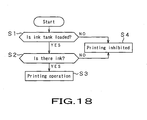
- the printing operation by the printer apparatus 1 will now be explained with reference to a flowchart shown in Fig.18. It is noted that the present operation is carried out by processing operations by a CPU (central processing unit), not shown, provided in the controller 68, based on a processing program stored in a memory, such as ROM 66.
- a CPU central processing unit
- a user issues a command, by acting e.g. on an operating panel provided on the main printer body unit 4, in order for the printer apparatus 1 to carry out the printing operation.
- the controller 68 verifies whether or not the ink tank 11 of a preset color has been loaded on each loading part 22. If the ink tanks 11 of proper colors are mounted on all of the loading zones 22, the controller 68 proceeds to a step S2 and, if otherwise, the controller 68 proceeds to a step S4 to inhibit the printing operation.
- the controller 68 in the step S2 verifies whether or not the quantity of the ink 2 in the ink tank 11 is less than a predetermined quantity, that is, whether or not the ink tank 11 is in the ink-depleted state. If it is determined that the ink tank 11 is in the ink-depleted state, the alarm unit 64 issues an alarm to that effect and, in the step S4, the printing operation is inhibited. If conversely the quantity of the ink 2 in the ink tank 11 is above the predetermined value, that is, the ink tank is charged with the ink, the printing operation is permitted in a step S3.
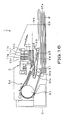
- the controller 68 causes the driving units 53, 54 to be driven in a controlled manner, by the printer controller 62, to shift the recording paper sheet P to a printing enabling position. Specifically, the controller 68 causes the actuation of the driving motor, forming the head cap opening/ closing mechanism 53, to cause movement of the head cap 28 towards the tray 55a with respect to the head cartridge 3, to expose the nozzles 42a of the ink ejecting head 27, as shown in Fig.19. The controller 68 causes the driving of the driving motor, forming the paper sheet supplying/ discharging mechanism 54, to cause the feed movement of the recording paper sheet P.
- the controller 68 controls the paper sheet supplying/ discharging mechanism 54 in such a manner that the recording paper sheet P is pulled out from the tray 55a by a paper sheet feed roll 81, the recording paper sheet P, thus pulled out, is transported by paired separating rolls 82a, 82b, rotating in opposite directions, to a direction reversing roll 83 to reverse the transport direction, the recording paper sheet P then is transported to a transport belt 84, and the recording paper sheet P, thus transported, is held at a preset position by retention means 85, to determine the position of deposition of the ink 2.
- the controller 68 then controls the ink ejecting head 27 by the ejection controller 63 and causes the ink liquid droplet i to be ejected and deposited via nozzles 42a on the recording paper sheet P, transported to the printing position, to record an image or a letter/character formed by ink dots.
- the ink 2 contains an EO adduct of a dihydric alcohol, having a hydrocarbon group with 9 or less carbon atoms and having an I/O ratio ranging between 1 and 1.37, it is possible in the ink ejecting head 27 to suppress fine bubbles from being generated in the ink 2 charged into the ink liquid chamber 44, in such a manner as to prevent ejection troubles, such as non-ejection or warped ejection of the ink liquid droplet i.
- the ink liquid droplet i deposited contains the EO adduct of a dihydric alcohol, having a hydrocarbon group with 9 or less carbon atoms and having an I/O ratio ranging between 1 and 1.37, the image or the letter/ character is of a high quality with high optical density and suffers from boundary bleeding or generation of speckled mixed colors in all-over printing only to a lesser extent.
- the diaphragm 34i is uplifted by atmospheric pressure under the negative pressure of the ink 2, along with the valve shaft 34h, to uplift the valve 34e, which has so far kept the opening 34d of the ink chamber 34b closed under the bias of the biasing member 34f and the diaphragm 34i, against the bias of the biasing member 34f, as shown in Fig.13A.
- the opening 34d between the ink inlet duct 34a and the ink inlet duct 34a of the ink chamber 34b is opened at this time to supply the ink 2 from the ink inlet duct 34a side to the ink effluent duct 34c side to replenish the ink 2 to the ink duct 46 of the ink ejecting head 27.
- the negative pressure of the ink 2 is then decreased so that the diaphragm 34i is reset to its original shape by the restoring force, with the valve 34e then being lowered, along with the valve shaft 34h, such as to close the ink chamber 34b.
- the above-described operation is repeated each time the ink liquid droplet i is ejected to raise the negative pressure of the ink 2.
- the ink 2 contains the EO adduct of a dihydric alcohol having hydrocarbon groups with 9 or less carbon atoms and having the I/O ratio ranging between 1 and 1.37, it is possible to suppress fine bubbles from being produced in the ink 2 in the ink liquid chamber 44, even when the ink 2 is repeatedly supplied as described above, that is, when the ink 2 is repeatedly supplied through a flow duct of a complex profile. Thu, the ink 2 free from fine bubbles may be delivered to the ink ejecting head 27 to prevent ejection troubles exemplified by non-ejection or bent ejection of the ink liquid droplet i.
- the letter/character or an image consistent with printing data may be printed with superior quality on the recording paper sheet P being fed by the paper sheet supplying/ discharging mechanism 54.
- the recording paper sheet P, on which printing has been made as described above, is then discharged via paper sheet discharge port 56 by the paper sheet supplying/ discharging mechanism 54.
- the ink 2 containing the EO adduct of a dihydric alcohol, having a hydrocarbon group with 9 or less carbon atoms and having an I/O ratio ranging between 1 and 1.37, as surfactant, is contained in the ink tank 11, with the ink 2 being ejected as ink liquid droplet i from the nozzles 42a, it is possible to suppress fine bubbles from being produced in the ink 2 to prohibit ejection troubles, with the result that the image is free from blurring or white spots and hence there may be obtained high-quality printed image or letter/character.
- the present printer apparatus 1 in which the ink containing the EO adduct of a dihydric alcohol, having a hydrocarbon group with 9 or less carbon atoms and having an I/O ratio ranging between 1 and 1.37, as surfactant, is deposited on the recording paper sheet P, for printing thereon, it is possible to effect printing of an image of high quality and high optical density, suppressed in boundary bleeding or speckled color mixing in all-over printing.
- the ink tank 11 may be mounted to or dismounted from the main cartridge body unit 21.
- the present invention is not limited to this configuration. That is, since the head cartridge 3 itself is a consumable item and may be mounted to or dismounted from the main printer body unit 4, the ink tank 11 may be mounted as one with the main cartridge body unit 21.
- the present invention is directed to a printer apparatus.
- the present invention is not limited to this configuration and may broadly be applied to other liquid ejecting apparatus, such as facsimile machine, copying machine, an ejecting apparatus for DNA chips in the liquid (see Japanese laid-Open Patent Publication 2002-34560 ) or to a liquid ejecting apparatus for ejecting a liquid containing electrically conductive particles for forming a wiring pattern for an printed circuit board.
- the ink ejecting head 27, in which the ink 2 is heated by the sole resistance heater 45, and the ink so heated is ejected, is taken as an example for explanation.
- the present invention is not limited to this configuration and may also be applied to a liquid ejecting apparatus provided with ejecting means having plural pressure generating elements each of which delivers discrete values or the energy at different timings to control the liquid ejecting direction.
- a line-based printer apparatus 1 has been explained.
- the present invention is not limited to this configuration and may also be applied to a serial-based liquid ejecting apparatus in which the ink head is moved in a direction substantially at right angles to the traveling direction of the recording paper sheet P.
- a magenta-based ink was first prepared.
- 3 mass wt% of C.I. Acid red, as a colorant 75 mass wt% of water, as a solvent, 10 mass wt% of glycerin, as another solvent, 5 mass wt% of 1,3- butanediol, as another solvent, 5 mass wt% of neopentyl glycol, as yet another solvent, and 1.5 mass wt% of the compound shown by the above chemical formula 4, were mixed together and filtered by a membrane filter, with a pore size of 0.22 ⁇ m (trade name: Millex- 0.22), to prepare a magenta-based ink.
- a cyan-based ink was prepared.
- 2.5 mass wt% of C.I. Direct Blue, as a colorant 76 mass wt% of water, as a solvent, 10 mass wt% of glycerin, as another solvent, 5 mass wt% of 1,3- butanediol, as another solvent, 5 mass wt% ofneopentyl glycol, as yet another solvent, and 1.5 mass wt% of the compound shown by the above chemical formula 4, as a surfactant, were mixed together and filtered by a membrane filter, with a pore size of 0.22 ⁇ m (trade name: Millex- 0.22), to prepare a cyan-based ink.
- a magenta-based ink and a cyan-based ink each containing an EO adduct of a dihydric alcohol, having a hydrocarbon group with 8 carbon atoms and having an I/O ratio of 1.00, as shown by the chemical formula 4, as the surfactant, were prepared.
- a magenta-based ink and a cyan-based ink were prepared in the same way as with the sample 1, except that the amount of addition of the EO adduct of a dihydric alcohol, shown by the chemical formula 4, as a surfactant, was set to 1 wt%.
- a magenta-based ink and a cyan-based ink wereprepared in the same way as with the sample 1, except that the amount of addition of the EO adduct of a dihydric alcohol, shown by the chemical formula 4, as a surfactant, was set to 0.5 wt%.
- a magenta-based ink and a cyan-based ink were prepared in the same way as with the sample 1, except that an EO adduct of a dihydric alcohol, having a hydrocarbon group with 8 carbon atoms and having an I/O ratio of 1.20, as shown by the chemical formula 5, was used as a surfactant, in place of the organic compound shown by the chemical formula 4.
- a magenta-based ink and a cyan-based ink were prepared in the same way as with the sample 1, except that an EO adduct of a dihydric alcohol, having a hydrocarbon group with 8 carbon atoms and having an I/O ratio of 1.33, as shown by the chemical formula 6, was used as a surfactant, in place of the organic compound shown by the chemical formula 4.
- a magenta-based ink and a cyan-based ink were prepared in the same way as with the sample 1, except that an EO adduct of a dihydric alcohol, having a hydrocarbon group with 6 carbon atoms and having an I/O ratio of 1.20, as shown by the chemical formula 7, was used as a surfactant, in place of the organic compound shown by the chemical formula 4.
- a magenta-based ink and a cyan-based ink were prepared in the same way as with the sample 1, except that an EO adduct of a dihydric alcohol, having a hydrocarbon group with 7 carbon atoms and having an I/O ratio of 1.20, as shown by the chemical formula 9, was used as a surfactant, in place of the organic compound shown by the chemical formula 4.
- a magenta-based ink and a cyan-based ink were prepared in the same way as with the sample 1, except that an EO adduct of a dihydric alcohol, having a hydrocarbon group with 9 carbon atoms and having an I/O ratio of 1.00, as shown by the chemical formula 11, was used as a surfactant, in place of the organic compound shown by the chemical formula 4.
- a magenta-based ink and a cyan-based ink were prepared in the same way as with the sample 1, except that an EO adduct of a dihydric alcohol, having a hydrocarbon group with 8 carbon atoms and having an I/O ratio of 1.04, as shown by the chemical formula 13, was used as a surfactant, in place of the organic compound shown by the chemical formula 4.
- a magenta-based ink and a cyan-based ink were prepared in the same way as with the sample 1, except that an EO adduct of a dihydric alcohol, having a hydrocarbon group with 9 carbon atoms and having an I/O ratio of 1.00, as shown by the chemical formula 15, was used as a surfactant, in place of the organic compound shown by the chemical formula 4.
- a magenta-based ink and a cyan-based ink were prepared in the same way as with the sample 1, except that no EO adduct of a dihydric alcohol was added.
- the inorganic value (IV), organic value (OV) and I/O, for the EO adducts of a dihydric alcohol, shown in the above chemical formulas 17 to 21, are shown in Table 4.
- the inorganic values and the organic values and the inorganic values were calculated, based on the Tables 1 and 2, as in the chemical formulas 4 to 16, provided that the iso branch and the tert branch in the Tables 1 and 2 were applied in the case of the C-chain, as described above, and that the organic value of the carbon atoms was set to 20, from In counting the EO groups, the first ether linkage from the main chain was excluded and the second and the following ether linkage parts were counted as EO groups.
- the EO adducts of dhhydric alcohol of the chemical formulas 18 to 20, with the I/O exceeding 1.37, are contained in the ink, the resultant ink is lowered in hydrophilicity, whilst fine bubbles tend to be generated in the ink to deteriorate the ejection stability.
- the chemical formula 21 the I/O is 1.29, while the number of carbon atoms is 12, that is, the number of carbon atoms is larger than 9.
- magenta-based and cyan-based inks of the respective samples evaluation was made of ejection stability, intermittent ejection stability, optical density, boundary bleeding and speckled color mixing in all-over printing.
- ejection stability was evaluated as follows: The inks of the respective samples were charged into respective ink tanks and mounted on the head cartridge. After ejecting the inks by the line-based ink jet printer apparatus, the head cartridge was transiently dismounted from the ink jet printer apparatus and was preserved in an atmosphere of the temperature of 10°C and the relative humidity of 50% for five days and then in an atmosphere of the temperature of 40°C and the relative humidity of 50% for five days so as to be exposed to an environment of the temperature of 20°C and the relative humidity of 50%.
- the head cartridge was then mounted again on the line-based ink jet printer apparatus and a preset area of a copy paper sheet manufactured by RICOH (trade name: My Paper) was coated in its entirety, from one color to the next, by way of a so-called all-over printing.
- the ink tanks were then dismounted from the head cartridge and visual check was then conducted as to whether or not fine bubbles have not been generated in the ink ejection head. The image printed was also visually checked.
- the intermittent ejection stability was evaluated by the following method.
- the inks of respective samples were charged in ink tanks which were then loaded on the head cartridge.
- the inks were ejected by a line-based ink jet printer apparatus and the head cartridge was transiently dismounted from the ink jet printer apparatus. With the ejecting surface of the head cartridge exposed to outside, the head cartridge was allowed to stand stationarily for seven minutes at a temperature of 30°C and an RH of 10%.
- the head cartridge was then mounted on the line-based ink jet printer apparatus and all-over printing was then carried out for each color on copy sheets manufactured by RICOH (trade name: MyPaper). A visual check was then conducted of the printed images.
- optical density was measured by the following method.
- the inks of the respective samples were charged in the ink tanks and loaded on the head cartridge. All-over printing was then carried out for each color on copy sheets manufactured by RICOH (trade name: MyPaper) and reflection optical density was measured by an optical density meter, manufactured by MACBETH (trade name: TR924).
- the boundary bleeding was measured by the following method.
- the inks of the respective samples were charged in the ink tanks and loaded on the head cartridge. Then, all-over printing was carried out for each color on copy sheets manufactured by RICOH (trade name: MyPaper), with the respective colors lying adjacent to one another. The bleeding state at the boundaries of the colors in the printed image was then visually checked.
- Evaluation of speckled color mixing in all-over printing was evaluated by the following method.
- the ink samples were charged in the respective ink samples and loaded on the head cartridge. All-over printing was carried out with blue color several times so that the blue color of each printing will overlap and the evenness of the blue color density, that is, the possible presence of irregular color, in the printed image, was visually checked.
- Table 5 The ejection stability, intermittent ejection stability, optical density, boundary bleeding and speckled color mixing in all-over printing for the respective samples are shown in the following Table 5: Table 5 EO adduct of dihydric alcohol Ejection stability Intermittent ejection stability Optical density Boundary bleeding Color mixing in allover printing Sort I/O Number of C atoms of hydrocarbon group Sort of hydrocarbon group Sanple 1 Chemical formula 4 1.00 8 Straight-chained ⁇ ⁇ 1.12 ⁇ ⁇ Sanple 2 Chemical formula 4 1.00 8 Straight-chained ⁇ ⁇ 1.21 ⁇ ⁇ Sanple 3 Chemical formula 4 1.00 8 Straight-chained ⁇ ⁇ 1.15 ⁇ ⁇ Sanple 4 Chemical formula 5 1.20 8 Straight-chained ⁇ ⁇ 1.15 ⁇ ⁇ Sanple 5 Chemical formula 6 1.33 8 Straight-chained ⁇ ⁇ 1.14 ⁇ ⁇ Sanple 6 Chemical formula 7 1.20 6 Straight-chained O O 1.15 ⁇ ⁇ Sanple 7 Chemical formula 9 1.20 7 Branched ⁇
- a symbol ⁇ indicates that there are no white spots in the entire image and that no fine bubbles are generated in the ink in the ink ejection head
- a symbol ⁇ indicates that the image quality is not of a problem but there is slight white spot in the image and a minor quantity of bubbles are generated in the ink in the ink ejection head
- a symbol ⁇ indicates that a minor quantity of bubbles are generated in the ink in the ink ejection head
- a symbol ⁇ indicates that there is white spot responsible for degrading the image quality and a large quantity of fine bubbles are generated in the ink in the ink ejection head.
- a symbol ⁇ indicates that the image is clear and free of blurring
- a symbol ⁇ indicates that the image suffers from slight blurring
- a symbol ⁇ indicates that the entire image is blurred and the image quality is severely degraded.
- boundary bleeding indicates that there is no bleeding of each color at the boundary
- a symbol ⁇ indicates that image quality is not of a problem but that there is a minor quantity of bleeding for each color at the boundary
- a symbol ⁇ indicates that there is bleeding of each color on the boundary degrading the image quality
- a symbol ⁇ indicates that there is bleeding of each color on the entire boundary significantly degrading the image quality.
- a symbol ⁇ indicates that an image printed all-over to a blue color is completely free from color irregularities
- a symbol ⁇ indicates that the image quality is not of a problem but the image suffers from color irregularities, even though to a lesser extent
- a symbol ⁇ indicates that the image suffers from color irregularities that detract from the image quality
- a symbol ⁇ indicates that the entire image suffers from color irregularities such that the image quality is deteriorated significantly.
- the samples 12 to 15 with the I/O off the range of 1 to 1.37 or to the sample containing an EO adduct of a dihydric alcohol having a hydrocarbon group with 12 carbon atoms the samples 1 to 10 containing an EO adduct of a dihydric alcohol, having a hydrocarbon group with 9 or less carbon atoms and having an I/O ratio ranging between 1 and 1.37 are not of a problem in the image quality in the evaluation of ejection stability, intermittent ejection stability, boundary bleeding and speckled color mixing in all-over printing, while being superior in optical density.
- samples 1 to 16 not containing an EO adduct of a dihydric alcohol, having a hydrocarbon group with 9 or less carbon atoms and having an I/O ratio ranging between 1 and 1.37, it becomes difficult to raise the optical density of the image or to suppress generation of boundary bleeding or speckled color mixing in all-over printing, such that no image of high image quality can be produced.
- an image printed may be of high image quality, being superior in optical density and suppressed in boundary bleeding or in speckled color mixing in all-over printing.
- the dynamic surface tension ( ⁇ 20 ) at 20Hz and that ( ⁇ 1 ) at 1Hz were measured, under measurement conditions of 25°C atmosphere and a capillary diameter of 0.215 mm, using a bubble pressure dynamic surface tension meter (BP-2) manufactured by KRUSS.
- BP-2 bubble pressure dynamic surface tension meter
- the recording liquid of the present invention suffers from bubbling to a lesser extent and superior in ejection stability and, when the recording liquid is used for multi-color printing an image or a letter/character on a paper sheet of medium quality, the recording liquid is high in optical density and free from boundary bleeding or speckled color mixing in all-over printing, and hence the recording liquid of the present invention may be used for high-quality printing.
Landscapes
- Chemical & Material Sciences (AREA)
- Life Sciences & Earth Sciences (AREA)
- Engineering & Computer Science (AREA)
- Materials Engineering (AREA)
- Wood Science & Technology (AREA)
- Organic Chemistry (AREA)
- Inks, Pencil-Leads, Or Crayons (AREA)
- Ink Jet Recording Methods And Recording Media Thereof (AREA)
- Ink Jet (AREA)
Applications Claiming Priority (1)
| Application Number | Priority Date | Filing Date | Title |
|---|---|---|---|
| PCT/JP2005/007482 WO2006114867A1 (ja) | 2005-04-19 | 2005-04-19 | 記録液、液体カートリッジ、液体吐出装置及び液体吐出方法 |
Publications (2)
| Publication Number | Publication Date |
|---|---|
| EP1876208A1 true EP1876208A1 (de) | 2008-01-09 |
| EP1876208A4 EP1876208A4 (de) | 2008-05-28 |
Family
ID=37214505
Family Applications (1)
| Application Number | Title | Priority Date | Filing Date |
|---|---|---|---|
| EP05733992A Withdrawn EP1876208A4 (de) | 2005-04-19 | 2005-04-19 | Aufzeichnungsflüssigkeit, flüssigkeitspatrone, flüssigkeitsausgabevorrichtung und flüssigkeitsausgabeverfahren |
Country Status (5)
| Country | Link |
|---|---|
| EP (1) | EP1876208A4 (de) |
| JP (1) | JPWO2006114867A1 (de) |
| KR (1) | KR101162380B1 (de) |
| CN (1) | CN1946816A (de) |
| WO (1) | WO2006114867A1 (de) |
Families Citing this family (3)
| Publication number | Priority date | Publication date | Assignee | Title |
|---|---|---|---|---|
| JP5330763B2 (ja) * | 2007-09-25 | 2013-10-30 | 富士フイルム株式会社 | 画像形成方法及び画像形成装置 |
| CN106103609B (zh) * | 2014-03-28 | 2020-11-03 | 马姆杰特科技有限公司 | 用于改善印刷头寿命的油墨配制品 |
| JP7505261B2 (ja) * | 2020-05-21 | 2024-06-25 | セイコーエプソン株式会社 | 圧電素子、液体吐出ヘッドおよび液体吐出装置 |
Family Cites Families (12)
| Publication number | Priority date | Publication date | Assignee | Title |
|---|---|---|---|---|
| JPH0770491A (ja) * | 1993-09-03 | 1995-03-14 | Ricoh Co Ltd | インクジェット用記録液及びそれを用いた記録方法 |
| JP3859021B2 (ja) * | 1995-11-30 | 2006-12-20 | 大日本インキ化学工業株式会社 | インクジェット記録用水性インク |
| DE19749082A1 (de) * | 1997-11-06 | 1999-05-12 | Bayer Ag | Nanoskalige anorganische Pigmente enthaltende Ink-Jet-Tinten |
| GB2357514A (en) * | 1999-12-23 | 2001-06-27 | Sericol Ltd | An ink for decoration of paper substrates for poster displays |
| JP5268219B2 (ja) * | 2000-09-28 | 2013-08-21 | ヒューレット−パッカード デベロップメント カンパニー エル.ピー. | 市販のオフセット媒体及びオフセットインクと併用される水性インクジェットインク |
| US6444017B1 (en) * | 2000-10-30 | 2002-09-03 | Hewlett-Packard Company | Aqueous ink jet inks for use with commercial offset media and offset ink |
| US6776830B2 (en) * | 2001-04-17 | 2004-08-17 | Seiko Epson Corporation | Aqueous ink composition for use in an ink-jet printer |
| JP3931205B2 (ja) * | 2001-12-26 | 2007-06-13 | サカタインクス株式会社 | 水性インクジェット用インク組成物 |
| US6881250B2 (en) * | 2003-01-15 | 2005-04-19 | Xerox Corporation | Tailored ink for piston driven electrostatic liquid drop modulator |
| JP2005008853A (ja) * | 2003-05-29 | 2005-01-13 | Sony Corp | 記録液、液体カートリッジ、液体吐出装置及び液体吐出方法 |
| JP4517591B2 (ja) * | 2003-06-05 | 2010-08-04 | 富士ゼロックス株式会社 | インクジェット用インクセット、及びインクジェット記録方法 |
| US20050137282A1 (en) * | 2003-12-19 | 2005-06-23 | Cagle Phillip C. | Liquid vehicle systems for improving latex ink-jet ink frequency response |
-
2005
- 2005-04-19 KR KR1020067006247A patent/KR101162380B1/ko not_active Expired - Fee Related
- 2005-04-19 EP EP05733992A patent/EP1876208A4/de not_active Withdrawn
- 2005-04-19 WO PCT/JP2005/007482 patent/WO2006114867A1/ja not_active Ceased
- 2005-04-19 JP JP2007514379A patent/JPWO2006114867A1/ja active Pending
- 2005-04-19 CN CNA2005800010229A patent/CN1946816A/zh active Pending
Also Published As
| Publication number | Publication date |
|---|---|
| KR20080000499A (ko) | 2008-01-02 |
| WO2006114867A1 (ja) | 2006-11-02 |
| EP1876208A4 (de) | 2008-05-28 |
| JPWO2006114867A1 (ja) | 2008-12-11 |
| CN1946816A (zh) | 2007-04-11 |
| KR101162380B1 (ko) | 2012-07-04 |
Similar Documents
| Publication | Publication Date | Title |
|---|---|---|
| US7695099B2 (en) | Liquid for head and method of determining contents of components thereof and method of stabilizing component ratio | |
| US20060038867A1 (en) | Inkjet ink with long latency | |
| EP1816172A1 (de) | Aufzeichnungsflüssigkeit, aufzeichnungsflüssigkeitspatrone sowie vorrichtung und verfahren zur flüssigkeitsabgabe | |
| US7475978B2 (en) | Recording liquid, liquid cartridge, liquid ejection cartridge, liquid ejection apparatus, and liquid ejection method | |
| US7407537B2 (en) | Ink set for ink-jet recording, method for producing the same, and the ink-jet printer | |
| EP1847574A1 (de) | Flüssigpatrone mit aufzeichnungsflüssigkeit, abgabevorrichtung für flüssigkeit und abgabeverfahren für flüssigkeit | |
| US7470017B2 (en) | Recording liquid, liquid cartridge emitting device and liquid emitting method | |
| US6793724B2 (en) | Ink for ink-jet recording and color ink set | |
| US20090035467A1 (en) | Recording Liquid, Liquid Cartridge, Liquid Emitting Device and Liquid Emitting Method | |
| US6811243B2 (en) | Priming fluid for ink jet printheads | |
| EP1839870A1 (de) | Vorrichtung und verfahren zur tintenstrahlkopfreinigung | |
| EP1876208A1 (de) | Aufzeichnungsflüssigkeit, flüssigkeitspatrone, flüssigkeitsausgabevorrichtung und flüssigkeitsausgabeverfahren | |
| US7314275B2 (en) | Recording liquid, liquid cartridge, liquid discharge apparatus and method of liquid discharge | |
| JP2010506967A (ja) | インクジェットインク | |
| US8431631B2 (en) | Aqueous pigmented yellow inkjet ink composition | |
| JP2020059275A (ja) | インクジェット記録方法、及びインクジェット記録装置 | |
| US20050264629A1 (en) | Recording fluid, cartridge for fluid, device and method for discharging fluid | |
| EP1669420A1 (de) | Aufzecihnungsflüssigkeit, flüssigkeitspatrone, flüssigkeitsabgeber und verfahren zur flüssigkeitsabgabe | |
| US20070296786A1 (en) | Black ink composition, ink cartridge including the ink composition and ink jet recording apparatus including the ink cartridge | |
| JP2019147312A (ja) | インクジェット記録方法、及びインクジェット記録装置 | |
| CN100363441C (zh) | 记录液体、液体盒、液体喷射装置与液体喷射方法 | |
| JP2005008853A (ja) | 記録液、液体カートリッジ、液体吐出装置及び液体吐出方法 | |
| JP2006117772A (ja) | 記録液、液体カートリッジ、液体吐出装置及び液体吐出方法 |
Legal Events
| Date | Code | Title | Description |
|---|---|---|---|
| PUAI | Public reference made under article 153(3) epc to a published international application that has entered the european phase |
Free format text: ORIGINAL CODE: 0009012 |
|
| 17P | Request for examination filed |
Effective date: 20060329 |
|
| AK | Designated contracting states |
Kind code of ref document: A1 Designated state(s): DE FR GB |
|
| A4 | Supplementary search report drawn up and despatched |
Effective date: 20080429 |
|
| DAX | Request for extension of the european patent (deleted) | ||
| RBV | Designated contracting states (corrected) |
Designated state(s): DE FR GB |
|
| 17Q | First examination report despatched |
Effective date: 20080729 |
|
| STAA | Information on the status of an ep patent application or granted ep patent |
Free format text: STATUS: THE APPLICATION IS DEEMED TO BE WITHDRAWN |
|
| 18D | Application deemed to be withdrawn |
Effective date: 20090130 |