EP1876810A2 - Récepteur pour la diffusion par télévision numérique terrestre - Google Patents
Récepteur pour la diffusion par télévision numérique terrestre Download PDFInfo
- Publication number
- EP1876810A2 EP1876810A2 EP07111635A EP07111635A EP1876810A2 EP 1876810 A2 EP1876810 A2 EP 1876810A2 EP 07111635 A EP07111635 A EP 07111635A EP 07111635 A EP07111635 A EP 07111635A EP 1876810 A2 EP1876810 A2 EP 1876810A2
- Authority
- EP
- European Patent Office
- Prior art keywords
- channel
- data
- broadcast service
- digital television
- television broadcasting
- Prior art date
- Legal status (The legal status is an assumption and is not a legal conclusion. Google has not performed a legal analysis and makes no representation as to the accuracy of the status listed.)
- Withdrawn
Links
Images






Classifications
-
- H—ELECTRICITY
- H04—ELECTRIC COMMUNICATION TECHNIQUE
- H04N—PICTORIAL COMMUNICATION, e.g. TELEVISION
- H04N21/00—Selective content distribution, e.g. interactive television or video on demand [VOD]
- H04N21/40—Client devices specifically adapted for the reception of or interaction with content, e.g. set-top-box [STB]; Operations thereof
- H04N21/43—Processing of content or additional data, e.g. demultiplexing additional data from a digital video stream; Elementary client operations, e.g. monitoring of home network or synchronising decoder's clock; Client middleware
- H04N21/438—Interfacing the downstream path of the transmission network originating from a server, e.g. retrieving encoded video stream packets from an IP network
- H04N21/4383—Accessing a communication channel
-
- H—ELECTRICITY
- H04—ELECTRIC COMMUNICATION TECHNIQUE
- H04H—BROADCAST COMMUNICATION
- H04H20/00—Arrangements for broadcast or for distribution combined with broadcast
- H04H20/26—Arrangements for switching distribution systems
-
- H—ELECTRICITY
- H04—ELECTRIC COMMUNICATION TECHNIQUE
- H04N—PICTORIAL COMMUNICATION, e.g. TELEVISION
- H04N21/00—Selective content distribution, e.g. interactive television or video on demand [VOD]
- H04N21/40—Client devices specifically adapted for the reception of or interaction with content, e.g. set-top-box [STB]; Operations thereof
- H04N21/41—Structure of client; Structure of client peripherals
- H04N21/426—Internal components of the client ; Characteristics thereof
-
- H—ELECTRICITY
- H04—ELECTRIC COMMUNICATION TECHNIQUE
- H04N—PICTORIAL COMMUNICATION, e.g. TELEVISION
- H04N21/00—Selective content distribution, e.g. interactive television or video on demand [VOD]
- H04N21/40—Client devices specifically adapted for the reception of or interaction with content, e.g. set-top-box [STB]; Operations thereof
- H04N21/43—Processing of content or additional data, e.g. demultiplexing additional data from a digital video stream; Elementary client operations, e.g. monitoring of home network or synchronising decoder's clock; Client middleware
- H04N21/434—Disassembling of a multiplex stream, e.g. demultiplexing audio and video streams, extraction of additional data from a video stream; Remultiplexing of multiplex streams; Extraction or processing of SI; Disassembling of packetised elementary stream
- H04N21/4345—Extraction or processing of SI, e.g. extracting service information from an MPEG stream
-
- H—ELECTRICITY
- H04—ELECTRIC COMMUNICATION TECHNIQUE
- H04N—PICTORIAL COMMUNICATION, e.g. TELEVISION
- H04N21/00—Selective content distribution, e.g. interactive television or video on demand [VOD]
- H04N21/40—Client devices specifically adapted for the reception of or interaction with content, e.g. set-top-box [STB]; Operations thereof
- H04N21/43—Processing of content or additional data, e.g. demultiplexing additional data from a digital video stream; Elementary client operations, e.g. monitoring of home network or synchronising decoder's clock; Client middleware
- H04N21/443—OS processes, e.g. booting an STB, implementing a Java virtual machine in an STB or power management in an STB
- H04N21/4432—Powering on the client, e.g. bootstrap loading using setup parameters being stored locally or received from the server
-
- H—ELECTRICITY
- H04—ELECTRIC COMMUNICATION TECHNIQUE
- H04N—PICTORIAL COMMUNICATION, e.g. TELEVISION
- H04N5/00—Details of television systems
- H04N5/44—Receiver circuitry for the reception of television signals according to analogue transmission standards
- H04N5/50—Tuning indicators; Automatic tuning control
-
- H—ELECTRICITY
- H04—ELECTRIC COMMUNICATION TECHNIQUE
- H04H—BROADCAST COMMUNICATION
- H04H20/00—Arrangements for broadcast or for distribution combined with broadcast
- H04H20/53—Arrangements specially adapted for specific applications, e.g. for traffic information or for mobile receivers
- H04H20/57—Arrangements specially adapted for specific applications, e.g. for traffic information or for mobile receivers for mobile receivers
Definitions
- the present invention relates to a receiver for terrestrial digital television broadcasting.
- Terrestrial digital television broadcasting uses a multi-frequency network (MFN) to prevent radio waves from interfering between adjacent broadcasting areas. That is to say, adjacent broadcasting areas use transmitting channels (physical channels or transmitting frequencies) different from each other. As shown in FIG. 14, for example, terrestrial digital television broadcasting enables broadcasting one or plural logical channels (services or programs) using a single transmitting channel.
- MFN multi-frequency network
- a receiver for terrestrial digital television broadcasting has a data table referred to as “channel list” or “preset table” to facilitate the selection of logical channels.
- Data for receiving logical channels (hereinafter, referred to as “channel data”) is registered on the data table.
- the channel data is formed of data for selecting and setting transmitting channels and data for designating one of plural logical channels broadcasted by the transmitting channel.
- Depressing any of numeric keys provided on the transmitter of a remote controller takes channel data corresponding to the depressed numeric key out of the channel list.
- the channel data is set in a tuner circuit and TS decoder circuit to select the logical channel of a corresponding transmitting channel.
- the receiver for terrestrial digital television broadcasting can select a logical channel using a preset selection function.
- "logical channel” is simply referred to as "channel” in the following description.
- Patent document 1 Japanese Unexamined Patent Application Publication No. 1996-237570 .
- Patent document 2 Japanese Unexamined Patent Application Publication No. 2004-336093 .
- a receiver mounted on a vehicle can move from a broadcast service area A to a broadcast service area B as the vehicle travels and fails to receive a channel which has been received so far.
- a user has to renew registered contents of a channel list after moved from the broadcast service area A to the broadcast service area B, however, it takes several minutes to scan all transmitting channels and renew the channel list.
- the user when the user returns to the original broadcast service area A from the broadcast service area B, the user has to renew the channel list, though the broadcast area A is an original area for reception.
- FIG. 15 shows the distribution of transmitting stations (broadcast antennas) of terrestrial digital television broadcasting in London and its environs.
- Nine transmitting stations are set up in the area within about 80-km radius from the center of London. In other words, broadcast service areas covered by the transmitting stations are not so wide.
- the channel data obtained in the broadcast service area A in FIG. 16A is left in the channel list on which the channel data obtained in the broadcast service area B is additionally registered as shown in FIG. 16 B. This eliminates the need for registering and renewing the channel data of broadcast service areas where a user has ever passed.
- the number of channels in one broadcast service area generally totals up to 20 to 30, so that additionally registering channels of several broadcast service areas on a channel list significantly increases the number of channels. For example, if channels in broadcast service areas in London and its environs as shown in FIG. 15 are registered, the number of channels reaches about 250 to 300 in all. This makes it very difficult to zap programs (or to search a desired program while selecting channels).
- a channel "BBC ONE" can be received in any broadcast service area therein. If channels registered on a channel list are sorted, as shown in FIG. 17, nine "BBC ONEs" appear in series corresponding to the number of broadcast service areas. A user therefore cannot identify the channel which can be currently received at a place where the user is. Actually, the number of channels to be displayed at a time is limited to about eight and generally the channel number is not displayed. For this reason, it is very troublesome to select a desired channel.
- a receiver for terrestrial digital television broadcasting includes a receiving circuit for receiving terrestrial digital television broadcasting to output a video signal and an audio signal of a predetermined channel and an information signal of information related to a channel being received; a data table in the receiving circuit on which channel data for selecting channels of the terrestrial digital television broadcasting is registered; and a control circuit.
- the control circuit is configured such that first data for identifying a channel, second data for identifying a broadcast service area and third data for identifying a transport stream are taken out of the information signal to be supplied to the control circuit, if the first data is normally obtained, the receiving circuit selects a channel based on the first data with reference to the data table, and if the first data is not normally obtained, the receiving circuit selects a channel based on the second and the third data with reference to the data table.
- selecting a channel using an LCN enables a user to continuously receive the same channel even if the user moves from one broadcast service area to another. Furthermore, even if a channel with the same channel name is registered on a channel list, the channel name of a channel which can be received in the current broadcast service area is displayed to facilitate selecting a desired channel.
- An original network identifier and a transport stream identifier are used to identify a channel, facilitating selecting a channel even if broadcast does not use an LCN.
- the terrestrial digital television broadcasting transmits a video signal, audio signal or data signal and at the same time various information signals as well.
- the following describes contents and functions of the information signals usable in the embodiment of the present among the various information signals. Related matters are also described.
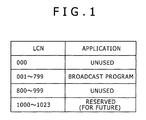
- the LCN is data for identifying a channel (logical channel and service) and has such values as shown in FIG. 1.
- the LCN is 10 bits long and can use values 10 to 1023, however, (11) the LCN is allocated to all channels; (12) the values 001 to 799 out of the LCNs are uniquely allocated to a plurality of channels; (13) the values 001 to 799 out of the LCNs are the same value in the same channel (the same service) even if broadcast service areas are different from each other; (14) the values 800 to 999 out of the LCNs can be used at discretion on a receiver side; and (15) the values 000 and 1000 or more out of the LCNs are not used.
- Using the LCN enables determining whether a channel is the same or not. That is to say, when a user has moved from one broadcast service area to another, selecting the channel which is the same in the LCN as the channel which the user has received allows the user to continuously view and listen to the same channel (service and program).
- the LCN is specified by standard for terrestrial digital television broadcasting (DVB-T).
- the allocation of the values of the LCN is specified by standard of each country.
- SIT Service Information Table
- SDT Service Description Table
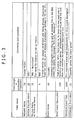
- a Linkage Descriptor Syntax in the SDT includes the following identifiers, as shown in FIG. 2, referred to as: (21) "original network ID” and (22) "transport stream ID.”
- the original network identifier is 16 bits long and a unique data for identifying broadcast service areas.
- the transport stream identifier is 16 bits long and unique data for identifying a transport stream.
- these identifiers can be used for determining broadcast service areas and transmitting channels when a channel list is produced. In other words, if a regular LCN is not obtained, it can be replaced with these identifiers.
- information shown in FIG. 3 is included in a part of the SIT transmitted in terrestrial digital television broadcasting.
- Using the information of; (31) Network Name; (32) Service Provider Name; and (33) Service Name enables determining transmitting stations (transmitting locations) and broadcast service areas thereof
- the above data needs to be checked each time transmitting channel (physical channel) or logical channel (service) are changed over, so that those data pieces need to be stored for each channel.
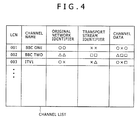
- the data table shown in FIG. 4, for example, may be used as a channel list.
- the LCN, channel name, original network identifier, transport stream identifier and channel data form one group in this channel list.
- Each receivable channel has the group.
- the LCN, channel name and channel data have been described above.
- the original network identifier and transport stream identifier have been also described in [1-2].
- a user scans the frequencies of terrestrial digital television broadcasting, for example, in an area where the user lives to register receivable channels (service) in the area on a channel list.
- the scan may be started and executed by pressing a manual button or by automatic control according to prescribed conditions.
- FIG. 5A shows the result of scan in the broadcast service area A in London.
- a channel list is formed for receivable channels in the broadcast service area A.
- the channel names are registered in order of LCNs.
- the channel list includes the original network identifier, transport stream identifier and channel data, however, for the sake of simplicity, the illustration and description thereof are omitted from FIG. 5 and the following figures.
- the user again scans frequencies to additionally register the LCNs and channel names of the channels receivable in the broadcast service area B on the channel list as shown in FIG. 5B for example.
- the LCNs and channel names of the channels receivable in the broadcast service area B may be duplicated.
- the cells of the LCNs and channel names of the channels receivable in the broadcast service area B are shaded to discriminate between the LCNs and channel names of the channels receivable in the broadcast service areas A and B.
- the LCNs and channel names of the channels receivable in other broadcast service areas are additionally registered on the channel list.
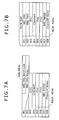
- the registered contents are sorted in order of the LCNs as shown in FIG. 6A.
- the contents of the channel list sorted in the above [2-4] are displayed on a display in order of the LCNs in a menu format shown in FIG. 6B.
- the LCN and channel name are displayed at a rate of one per LCN.
- FIG. 6B is a main menu.
- a plurality of broadcast service areas may correspond to one LCN as shown in FIG. 6A.
- the broadcast service areas A and B correspond to one LCN.
- LCN 001 or the transmitting locations of the channel name "BBC ONE" indicate "North-East” and "Wales.” Incidentally, the names of transmitting locations can be obtained from information shown in [1-3].
- the main menu displays the channel name (and LCN) of the channel receivable in the broadcast service area corresponding to the transmitting location "North-East”.
- the channel name (and LCN) of the channel receivable in the broadcast service area corresponding to the transmitting location "Wales" is not displayed.
- the channel in the broadcast service area corresponding to the transmitting location "North-East" can be selected, thereby the channel can be surely received.
- FIG. 8A corresponds to FIG. 6A and shows a channel list on which the LCNs and channel names of four broadcast service areas A to D are registered. Also, in this case, if there is a plurality of the same LCNs in the list, the LCNs and channel names of one of them are displayed as a representative as shown in FIG. 8B.
- a channel can be selected from those in the sub-menu.
- the main menu is renewed to that corresponding to the channels receivable in broadcast service areas corresponding to the channel. As a result, even when other channels are selected, the channel can be surely received.
- the LCNs and channel names receivable in the broadcast service area C are additionally registered on the channel list according to [2-2] and [2-3]. Thereafter, executing sorting in [2-4] and the following to select and receive a channel with the same LCN in the broadcast service area C.
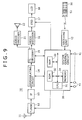
- FIG. 9 is one example of a receiver for terrestrial digital television broadcasting to which an embodiment of the present invention is applied and shows a receiving circuit 10.
- a broadcast wave of terrestrial digital television broadcasting is received by the antenna 11.
- the received signal including a desired channel (logical channel) is supplied to a synthesizer tuner to be converted into an intermediate frequency signal.
- the intermediate frequency signal is supplied to a demodulating circuit 14 through an intermediate frequency circuit 13.
- the demodulating circuit 14 outputs a demodulated MPEG2 transport stream to be supplied to a TS decoder circuit 15 to select data stream of video and audio of a desired channel and output a decoded stream.
- the output video data stream is supplied to a video decoder circuit 16 to be decoded to an original digital video signal.
- the digital video signal is supplied to a display device of digital input, for example, to an LCD panel 18 through an OSD circuit 17 to display video of a desired channel.
- the OSD circuit 17 serves to control the supply of a video signal from the video decoder circuit 16 to the LCD panel 18 according to the control signal from a system control circuit 30 described later.
- the OSD circuit 17 further serves to form digital video signals for displaying predetermined characters (including numerals and marks) according to display data from a system control circuit 30 to supply them to the LCD panel 18.
- a main menu is displayed according to display data to be supplied to the OSD circuit 17.
- Audio data stream output from the TS decoder circuit 15 is supplied to an audio decoder circuit 21 to be decoded to an original digital audio signal and to be converted to an analog signal. This signal is supplied to a loudspeaker 22 to output voice corresponding to the video signal displayed on the LCD panel 18.
- the TS decoder circuit 15 outputs the aforementioned information signal to be supplied to a system control circuit 30.
- the demodulating circuit 14 and TS decoder circuit 15 supply status signals to the system control circuit 30.
- the system control circuit 30 supplies a channel selection signal to the tuner circuit 12, in which a physical channel including a desired logical channel is frequency-converted.
- the system control circuit 30 also supplies a control signal to the TS decoder circuit 15 to select and decode the desired logical channel.
- the system control circuit 30 serves to control channels received by the receiving circuit 10 and the display of the LCD panel 18.
- the system control circuit 30 is formed by a micro computer and includes a CPU 31, a ROM 32 in which various programs are written, a RAM 33 for a work area and a non-volatile memory 34.
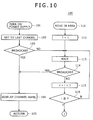
- the ROM 32 includes a routine 100 as a part of the programs, for example, as shown in FIGS. 10 and 11.
- the routine 100 serves to select a channel and is described in detail later.
- the routine 100 in FIGS. 10 and 11 illustrates only a part related to an embodiment of the present invention.
- the memory 34 includes a channel list shown in FIG. 4, for example and an area for saving data for receiving a last channel (or a channel received when a power supply has been turned off).
- Various operation keys 41 and a receiving unit 42 for a remote controller are connected to the system control circuit 30.
- the receiving unit 42 is paired with a transmitter 50 for the remote controller.
- the transmitter 50 and the receiving unit 42 realize the remote controller using infrared rays.
- the transmitter 50 has "1" to "10" numeric keys 51 as a part of the operation keys.
- the numeric keys 51 also serve to realize preset channel selection function described later.
- step 102 the channel data of the last channel is read from the memory 34 to be set in the tuner circuit 12 and TS decoder circuit 15.
- the tuner circuit 12 selects a physical channel including a desired logical channel based on the channel selection signal out of channel data in the last channel.
- the TS decoder circuit 15 selects and decodes a desired logical channel based on the control signal out of channel data of the last channel.
- a status signal for example, from the TS decoder circuit 15 is checked to determine as to whether broadcast can be received by the channel set at step 102.
- the receiver operates so as to receive the channel (last channel) which was received when the power supply was turned off.
- step 104 A predetermined digital video signal is formed by the OSD circuit 17 according to the control of the system control circuit 30 and supplied to the LCD panel 18 to display the channel name for a predetermined period.
- the routine 100 is terminated at step 105. Consequently, this case means that the channel received when the power supply was turned off last time can be received.
- a status signal from the TS decoder circuit 15 notifies the system control circuit 30 of this status. Then, the process of the CPU 31 causes the routine 100 to start at step 111 and at step 112 a loop counter i is set to "1" to wait for a predetermined period of time at step 113.
- step 114 the status signal from the TS decoder circuit 15 is checked to determine as to whether the channel received until then can be received. If the channel received until then cannot be received, the process proceeds from step 114 to step 115.
- the loop counter i is incremented by "1" and, thereafter, at step 116 determination is made as to whether the loop counter i reaches the upper limit of four or more in FIG. 10. If the loop counter i is less than four, the process returns from step 116 to step 113. Thus, wait at step 113 and reception and conformation of channel at step 115 are repeated. (0072)
- step 114 If the channel received until then can be received at step 114, the process advances from step 114 to step 104.
- the routine 100 is terminated at step 105. For this reason, if the channel received until then cannot be received temporarily because a vehicle goes into a tunnel or moves behind a building, the channel received until then is continuously received.
- step 103 If the channel received when the power supply was turned off last time cannot be received at step 103, the process advances from step 103 to step 113, and wait at step 113 and reception and conformation of channel at step 115 are repeated.
- step 104 the process advances from step 114 to step 104, and the channel received when the power supply was turned off last time is continuously received.
- step 116 when a receiver moves to another broadcast service area, the channel received until then (or the channel received when the power supply was turned off last time) cannot be continuously received, and the number of repetitions between steps 113 to 116 exceeds the upper value of four in FIG. 10, which is determined in step 116 and the process proceeds from step 116 to step 121 where the processes described in [4-3] and [4-4] are performed.
- the LCN is correctly transmitted in UK.
- Using the channel list (refer to FIG. 4) enables the channel name of a received channel to be converted into the LCN.
- the LCN is not correctly transmitted, so that the channel name cannot be converted into the LCN.
- step 121 a channel list is referred to execute the process for converting the channel name of a desired channel into an LCN.
- step 122 determination is made whether a conversion process is normally executed at step 121. If the channel name is normally converted into an LCN, the process advances from step 122 to step 131 and a list shown in FIG. 12, for example, is produced at step 131. Hereinafter, the list is referred to as "LCN list.”
- two groups are taken out to be compiled into an LCN list.
- all the groups of the LCNs having the same in value as the LCNs converted at step 121 in the channel list (FIG. 5B) and the groups of the channel names and channels data forming the groups with the LCNs are taken to be registered on the LCN list.
- the channel data of a first group in the LCN list (for example, FIG. 12) is taken out to be set in the tuner circuit 12 and TS decoder circuit 15.
- the status signal from the TS decoder circuit 15 is checked to determine whether the channel received until then can be received.
- step 134 determination is made whether all the groups including the final group in the LCN list (for example, FIG. 12) are subjected to determination on reception at steps 132 and 133. If all the groups including the final group are not subjected to determination on reception, the process proceeds from step 134 to step 135. At step 135, the channel data of the next group is taken out to be set in the tuner circuit 12 and TS decoder circuit 15. Thereafter, the process returns to step 133.
- the channel data registered on the LCN list is sequentially set in the tuner circuit 12 and TS decoder circuit 15 and determination is sequentially made whether the same channel as received until then can be received. In other words, this means that a broadcast service area where the same channel as received until then can be received is searched.
- step 133 If the same channel can be received in a certain channel data to be searched, this is determined at step 133.
- the process advances from step 133 to step 136 and, hereinafter, the channel shown by the channel data is continuously received.
- step 136 data of the channel name forming a group with the channel data at that point is taken out of the LCN list to be supplied to the OSD circuit 17 and the channel name at that point is displayed on the LVD panel 18 for a predetermined period. After that, the routine 100 is terminated at step 137.
- the channel Even if the channel received until then cannot be received because a vehicle has moved from one broadcast service area to another, the channel can be continuously received as long as the channel with the same LCN is broadcasted.
- step 122 if it is determined that the channel name is not normally converted into an LCN, the process advances from step 122 to step 141. In addition, if the same channel cannot be received though all the groups including the final group in the LCN list (for example, FIG. 12) are subjected to determination on reception at steps 132 and 133, the process advances from step 134 to step 141.
- a list shown in FIG. 13, for example, is formed.
- the list is referred to as "identifier list.”
- the first group of channel data in the identifier list (for example, FIG. 13) is taken out to be set in the tuner circuit 12 and TS decoder circuit 15.
- the status signal from the TS decoder circuit 15 is checked to determine whether the same channel as received until then can be received.
- step 144 determination is made whether all the groups including the final group in the identifier list (for example, FIG. 13) are subjected to determination on reception at steps 142 and 143. If all the groups including the final group are not subjected to determination on reception, the process proceeds from step 144 to step 145.
- step 145 the channel data of the next group is taken out to be set in the tuner circuit 12 and TS decoder circuit 15. Thereafter, the process returns to step 143.
- the channel data registered on the identifier list is sequentially set in the tuner circuit 12 and TS decoder circuit 15 and determination is sequentially made whether the same channel as received until then can be received. In other words, this means that a broadcast service area where the same channel as received until then can be received is searched.
- step 143 If the same channel can be received in a certain channel data to be searched, this is determined at step 143.
- the process advances from step 143 to step 136 and, hereinafter, the channel shown by the channel data is continuously received and the routine 100 is terminated at step 137.
- the channel can be continuously received as long as the same channel is broadcasted.
- step 146 a predetermined display data is supplied to the OSD circuit 17 and the LCD panel 18 displays a failure in reception of the same channel. After that, the routine 100 is terminated at step 147.
- a numeric key to which a desired channel is preset is pressed in the numeric keys 51 of the remote controller transmitter 50.
- Pressing, for example, a key "3" in the numeric keys 51 transmits infrared rays from the transmitter 50 to the receiver 42 to notify the system control circuit 30 that the key "3" has been pressed. Then, the system control circuit 30 takes channel data out of the group of the key "3" in the channel list and supplies it to the tuner circuit 12 and TS decoder circuit 15.
- the LCD panel 18 displays the video signal of the channel preset to the key "3.”
- the loudspeaker 22 outputs audio sound of the channel preset to the key "3.”
- the foregoing television receiver is adapted to select a channel using the LCN when moving to another broadcast service area, so that the receiver is capable of continuously receiving the same channel when moving to another broadcast service area. Furthermore, the channel list does not need to be renewed after the receiver has moved to another broadcast service area. Even if a channel with the same channel name is registered on a channel list, the channel name of a channel receivable in the present broadcast service area is displayed, facilitating selection of a desired channel.
- the receiver identifies channels using the original network identifier and transport stream identifier, so that it easily selects a channel without the LCN in Spain and Germany for example.
- an embodiment of the present invention is applicable to a receiver mounted on other moving objects or a mobile receiver such as a receiver incorporated in a notebook personal computer or a cellular phone.
- the values of the LCN are used not only in DVB-T but in all digital broadcasts in each country, therefore an embodiment of the present invention is applicable not only to DVB (European system) but to ISDB-T (Japanese system) and ATSC (US system).
- the routine 100 may be automatically executed at the back while a television broadcast is not being received, that is, while a cassette tape or a CD is being played or a navigation device is being operated.
- the process is caused to be in a state of wait for instructions from a user and may repeat the step 122 and the following steps when the user instructs the process to renew. Alternatively, the steps may be automatically repeated without the user's instructions, and scanning may be repeated until the number of repetitions thereof or the total time period of repetitions reaches a predetermined value.
- a flag may be provided on a channel list instead of the LCN list or the identifier list to perform the same process as in the LCN list or the identifier list by setting and resetting the flag.
Landscapes
- Engineering & Computer Science (AREA)
- Signal Processing (AREA)
- Multimedia (AREA)
- General Engineering & Computer Science (AREA)
- Software Systems (AREA)
- Circuits Of Receivers In General (AREA)
- Two-Way Televisions, Distribution Of Moving Picture Or The Like (AREA)
Applications Claiming Priority (1)
| Application Number | Priority Date | Filing Date | Title |
|---|---|---|---|
| JP2006183029A JP4544212B2 (ja) | 2006-07-03 | 2006-07-03 | 地上デジタルテレビ放送の受信機 |
Publications (2)
| Publication Number | Publication Date |
|---|---|
| EP1876810A2 true EP1876810A2 (fr) | 2008-01-09 |
| EP1876810A3 EP1876810A3 (fr) | 2008-02-20 |
Family
ID=38566993
Family Applications (1)
| Application Number | Title | Priority Date | Filing Date |
|---|---|---|---|
| EP07111635A Withdrawn EP1876810A3 (fr) | 2006-07-03 | 2007-07-03 | Récepteur pour la diffusion par télévision numérique terrestre |
Country Status (4)
| Country | Link |
|---|---|
| US (1) | US8120712B2 (fr) |
| EP (1) | EP1876810A3 (fr) |
| JP (1) | JP4544212B2 (fr) |
| CN (1) | CN100576891C (fr) |
Cited By (5)
| Publication number | Priority date | Publication date | Assignee | Title |
|---|---|---|---|---|
| EP2091244A1 (fr) | 2008-02-06 | 2009-08-19 | Alpine Electronics, Inc. | Procédé et système de réception de signaux de radiodiffusion, particulièrement utilisé pour un dispositif mobile |
| DE102008014881A1 (de) * | 2008-03-17 | 2009-10-08 | Technisat Digital Gmbh | Verfahren zur Darstellung und zum Aufruf überregional übertragener regionaler Rundfunkprogramme |
| EP2309730A1 (fr) * | 2009-09-09 | 2011-04-13 | Samsung Electronics Co., Ltd. | Appareil et procédé pour la recherche de canaux hors réseau dans un système de diffusion vidéo numérique |
| EP2343881A3 (fr) * | 2010-01-07 | 2012-03-14 | LG Electronics Inc. | Procédé de traitement d'application dans un récepteur de diffusion numérique connecté à un réseau interactif, et récepteur de diffusion numérique |
| EP2416569A4 (fr) * | 2009-03-30 | 2012-12-12 | Mitsubishi Electric Corp | Récepteur de diffusion numérique |
Families Citing this family (15)
| Publication number | Priority date | Publication date | Assignee | Title |
|---|---|---|---|---|
| US7676192B1 (en) * | 2005-12-21 | 2010-03-09 | Radio Shack, Corp. | Radio scanner programmed from frequency database and method |
| JP4525684B2 (ja) * | 2007-01-05 | 2010-08-18 | 船井電機株式会社 | デジタル放送受信装置 |
| KR101448621B1 (ko) * | 2007-11-30 | 2014-10-08 | 엘지전자 주식회사 | 단말기 및 이것의 채널 스캔 방법 |
| JP2009177706A (ja) * | 2008-01-28 | 2009-08-06 | Funai Electric Co Ltd | 放送受信装置 |
| CN101521795A (zh) * | 2008-12-30 | 2009-09-02 | 深圳市同洲电子股份有限公司 | 一种数字电视接收终端及其定位方法和系统 |
| US20100231809A1 (en) * | 2009-02-19 | 2010-09-16 | Panasonic Corporation | Broadcast receiving apparatus, and broadcast receiving method |
| WO2011030475A1 (fr) * | 2009-09-11 | 2011-03-17 | 三菱電機株式会社 | Dispositif de réception de radiodiffusion numérique et procédé de réception de radiodiffusion numérique |
| IT1397588B1 (it) * | 2009-12-21 | 2013-01-16 | Sisvel Technology Srl | Metodo per la programmazione automatica di un ricevitore atto a ricevere segnali radiotelevisivi in almeno due diversi formati e relativo ricevitore. |
| JP2011211627A (ja) * | 2010-03-30 | 2011-10-20 | Sony Corp | 受信装置、受信方法、送信装置、送信方法、及び、プログラム |
| US9237298B2 (en) * | 2011-12-28 | 2016-01-12 | Mitsubishi Electric Corporation | Digital broadcast receiving device and station selection method |
| JP2015510347A (ja) * | 2012-02-07 | 2015-04-02 | ヒルシュマン カー コミュニケーション ゲゼルシャフト ミット ベシュレンクテル ハフツングHirschmann Car Communication GmbH | 異なる規格間での送信所追跡 |
| KR102213760B1 (ko) * | 2017-02-10 | 2021-02-05 | 히르쉬만 카 커뮤니케이션 게엠베하 | 터널을 통한 차량들에 의한 이동들 동안의 송신기 식별 |
| CN107318040A (zh) * | 2017-08-14 | 2017-11-03 | 青岛海信电器股份有限公司 | 电视节目排序的方法及装置 |
| KR102695229B1 (ko) * | 2020-04-24 | 2024-08-16 | 삼성전자주식회사 | 전자장치 및 그 제어방법 |
| CN111918120B (zh) * | 2020-07-30 | 2022-09-20 | 深圳创维-Rgb电子有限公司 | 频道号的赋值方法、电视和存储介质 |
Citations (4)
| Publication number | Priority date | Publication date | Assignee | Title |
|---|---|---|---|---|
| US20020166128A1 (en) | 2000-07-28 | 2002-11-07 | Tamotsu Ikeda | Digital broadcasting system |
| US20020166125A1 (en) | 2001-03-05 | 2002-11-07 | Fulmer Daniel E. | Universal home cabling system |
| JP2004336093A (ja) | 2003-04-30 | 2004-11-25 | Matsushita Electric Ind Co Ltd | 放送受信装置 |
| WO2005015900A1 (fr) | 2003-08-07 | 2005-02-17 | Koninklijke Philips Electronics, N.V. | Triage des numeros des canaux de television numerique |
Family Cites Families (8)
| Publication number | Priority date | Publication date | Assignee | Title |
|---|---|---|---|---|
| US5734589A (en) * | 1995-01-31 | 1998-03-31 | Bell Atlantic Network Services, Inc. | Digital entertainment terminal with channel mapping |
| JPH08237570A (ja) | 1995-02-24 | 1996-09-13 | Toshiba Corp | 移動受信用テレビジョン受信装置 |
| US5600378A (en) * | 1995-05-22 | 1997-02-04 | Scientific-Atlanta, Inc. | Logical and composite channel mapping in an MPEG network |
| US6003041A (en) * | 1998-01-05 | 1999-12-14 | Gateway 2000, Inc. | Method and managing multiple channel maps from multiple input devices in a multimedia system |
| JP2002094889A (ja) * | 2000-09-12 | 2002-03-29 | Hitachi Ltd | 選局装置および方法 |
| GB0303176D0 (en) * | 2003-02-12 | 2003-03-19 | Video Networks Ltd | A system for capture and selective playback of broadcast programmes |
| JP4036814B2 (ja) * | 2003-10-07 | 2008-01-23 | シャープ株式会社 | デジタル放送受信装置、デジタル放送受信方法、デジタル放送受信プログラム、及び、プログラム記録媒体 |
| US7567806B2 (en) | 2004-02-27 | 2009-07-28 | Nokia Corporation | Method and system to improve handover between mobile video networks and cells |
-
2006
- 2006-07-03 JP JP2006183029A patent/JP4544212B2/ja not_active Expired - Fee Related
-
2007
- 2007-06-29 US US11/823,874 patent/US8120712B2/en not_active Expired - Fee Related
- 2007-07-03 EP EP07111635A patent/EP1876810A3/fr not_active Withdrawn
- 2007-07-03 CN CN200710146462A patent/CN100576891C/zh not_active Expired - Fee Related
Patent Citations (4)
| Publication number | Priority date | Publication date | Assignee | Title |
|---|---|---|---|---|
| US20020166128A1 (en) | 2000-07-28 | 2002-11-07 | Tamotsu Ikeda | Digital broadcasting system |
| US20020166125A1 (en) | 2001-03-05 | 2002-11-07 | Fulmer Daniel E. | Universal home cabling system |
| JP2004336093A (ja) | 2003-04-30 | 2004-11-25 | Matsushita Electric Ind Co Ltd | 放送受信装置 |
| WO2005015900A1 (fr) | 2003-08-07 | 2005-02-17 | Koninklijke Philips Electronics, N.V. | Triage des numeros des canaux de television numerique |
Cited By (8)
| Publication number | Priority date | Publication date | Assignee | Title |
|---|---|---|---|---|
| EP2091244A1 (fr) | 2008-02-06 | 2009-08-19 | Alpine Electronics, Inc. | Procédé et système de réception de signaux de radiodiffusion, particulièrement utilisé pour un dispositif mobile |
| DE102008014881A1 (de) * | 2008-03-17 | 2009-10-08 | Technisat Digital Gmbh | Verfahren zur Darstellung und zum Aufruf überregional übertragener regionaler Rundfunkprogramme |
| DE102008014881B4 (de) * | 2008-03-17 | 2014-02-27 | Technisat Digital Gmbh | Verfahren zur Darstellung und zum Aufruf überregional übertragener regionaler Rundfunkprogramme |
| EP2416569A4 (fr) * | 2009-03-30 | 2012-12-12 | Mitsubishi Electric Corp | Récepteur de diffusion numérique |
| EP2309730A1 (fr) * | 2009-09-09 | 2011-04-13 | Samsung Electronics Co., Ltd. | Appareil et procédé pour la recherche de canaux hors réseau dans un système de diffusion vidéo numérique |
| US8819730B2 (en) | 2009-09-09 | 2014-08-26 | Samsung Electronics Co., Ltd. | Apparatus and method for non-network channel scanning in digital video broadcasting system |
| EP2343881A3 (fr) * | 2010-01-07 | 2012-03-14 | LG Electronics Inc. | Procédé de traitement d'application dans un récepteur de diffusion numérique connecté à un réseau interactif, et récepteur de diffusion numérique |
| US8769570B2 (en) | 2010-01-07 | 2014-07-01 | Lg Electronics Inc. | Method of processing application in digital broadcast receiver connected with interactive network and the digital broadcast receiver |
Also Published As
| Publication number | Publication date |
|---|---|
| EP1876810A3 (fr) | 2008-02-20 |
| US8120712B2 (en) | 2012-02-21 |
| CN101102431A (zh) | 2008-01-09 |
| JP4544212B2 (ja) | 2010-09-15 |
| JP2008016910A (ja) | 2008-01-24 |
| CN100576891C (zh) | 2009-12-30 |
| US20080005768A1 (en) | 2008-01-03 |
Similar Documents
| Publication | Publication Date | Title |
|---|---|---|
| US8120712B2 (en) | Channel selection in a receiver for terrestrial digital television broadcasting | |
| EP2416569B1 (fr) | Récepteur de diffusion numérique | |
| JP4176519B2 (ja) | デジタル放送受信装置 | |
| US8302135B2 (en) | Digital broadcast receiver | |
| US7567304B2 (en) | Method of sharing preference channel in digital broadcasting reception terminal | |
| JP2000295125A (ja) | デジタル音声放送の受信機 | |
| US7043215B2 (en) | Method of performing a fast tune for a digital broadcast station in a radio receiver | |
| US20080074557A1 (en) | Method for switching a channel of an image display device and apparatus therefor | |
| JP2005045508A (ja) | 受信装置および受信方法 | |
| US20070060082A1 (en) | Receiving apparatus | |
| EP1734750A2 (fr) | Méthode et dispositif pour la réception de signaux de télédiffusion numérique | |
| JP2009159212A (ja) | 携帯型放送受信装置 | |
| JP2007288603A (ja) | 放送受信装置 | |
| JP5031412B2 (ja) | 地上デジタル放送受信装置 | |
| KR101304930B1 (ko) | 이동형 디지털 방송 환경에서 인접채널 방송서비스를 자동으로 링킹하기 위한 장치 및 방법, 그리고 이를 위한 방송서비스 자동링킹 프로그램을 기록한 컴퓨터로 판독가능한 기록매체 | |
| EP1802112A2 (fr) | Appareil d'affichage et son procédé de commande | |
| JP5105953B2 (ja) | デジタル放送受信装置 | |
| KR100737096B1 (ko) | Dmb 수신기에서 채널 탐색 방법 | |
| US20070285583A1 (en) | Receiver for digital television broadcasting | |
| CN101268687A (zh) | 数字广播接收装置 | |
| JP2007336408A (ja) | 地上デジタル放送の受信機 | |
| JP2007318487A (ja) | デジタルテレビ放送の受信機 | |
| JP2008153995A (ja) | 通信端末及びチャンネル決定方法。 | |
| JP2009049801A (ja) | 放送受信装置 | |
| JP2008011315A (ja) | テレビジョン放送受信機、チャンネルリスト作成方法、及び、チャンネルリスト作成プログラム |
Legal Events
| Date | Code | Title | Description |
|---|---|---|---|
| PUAI | Public reference made under article 153(3) epc to a published international application that has entered the european phase |
Free format text: ORIGINAL CODE: 0009012 |
|
| AK | Designated contracting states |
Kind code of ref document: A2 Designated state(s): AT BE BG CH CY CZ DE DK EE ES FI FR GB GR HU IE IS IT LI LT LU LV MC MT NL PL PT RO SE SI SK TR |
|
| AX | Request for extension of the european patent |
Extension state: AL BA HR MK YU |
|
| PUAL | Search report despatched |
Free format text: ORIGINAL CODE: 0009013 |
|
| AK | Designated contracting states |
Kind code of ref document: A3 Designated state(s): AT BE BG CH CY CZ DE DK EE ES FI FR GB GR HU IE IS IT LI LT LU LV MC MT NL PL PT RO SE SI SK TR |
|
| AX | Request for extension of the european patent |
Extension state: AL BA HR MK YU |
|
| RIC1 | Information provided on ipc code assigned before grant |
Ipc: H04N 5/44 20060101ALI20080115BHEP Ipc: H04N 5/00 20060101AFI20071018BHEP |
|
| 17P | Request for examination filed |
Effective date: 20080808 |
|
| AKX | Designation fees paid |
Designated state(s): DE FR GB NL |
|
| 17Q | First examination report despatched |
Effective date: 20081117 |
|
| STAA | Information on the status of an ep patent application or granted ep patent |
Free format text: STATUS: THE APPLICATION IS DEEMED TO BE WITHDRAWN |
|
| 18D | Application deemed to be withdrawn |
Effective date: 20160202 |