EP1877932B1 - Systeme et procede d'agregation et de controle de donnees multimedia enregistrees de façon decentralisee - Google Patents
Systeme et procede d'agregation et de controle de donnees multimedia enregistrees de façon decentralisee Download PDFInfo
- Publication number
- EP1877932B1 EP1877932B1 EP05747769A EP05747769A EP1877932B1 EP 1877932 B1 EP1877932 B1 EP 1877932B1 EP 05747769 A EP05747769 A EP 05747769A EP 05747769 A EP05747769 A EP 05747769A EP 1877932 B1 EP1877932 B1 EP 1877932B1
- Authority
- EP
- European Patent Office
- Prior art keywords
- user
- arithmetic unit
- module
- rating
- mood
- Prior art date
- Legal status (The legal status is an assumption and is not a legal conclusion. Google has not performed a legal analysis and makes no representation as to the accuracy of the status listed.)
- Expired - Lifetime
Links
Images






Classifications
-
- G—PHYSICS
- G06—COMPUTING OR CALCULATING; COUNTING
- G06F—ELECTRIC DIGITAL DATA PROCESSING
- G06F16/00—Information retrieval; Database structures therefor; File system structures therefor
- G06F16/90—Details of database functions independent of the retrieved data types
- G06F16/95—Retrieval from the web
- G06F16/951—Indexing; Web crawling techniques
-
- G—PHYSICS
- G06—COMPUTING OR CALCULATING; COUNTING
- G06F—ELECTRIC DIGITAL DATA PROCESSING
- G06F16/00—Information retrieval; Database structures therefor; File system structures therefor
- G06F16/90—Details of database functions independent of the retrieved data types
- G06F16/95—Retrieval from the web
- G06F16/953—Querying, e.g. by the use of web search engines
- G06F16/9535—Search customisation based on user profiles and personalisation
Definitions
- the invention relates to a system and a method for aggregation and analysis of decentrally stored multimedia data, wherein one or more attachable search terms are stored in a data memory, a computing unit accesses network nodes connected to source databases and data of the source databases are selected based on the search terms , More particularly, the invention relates to a system and method for real-time analysis of such decentrally stored multimedia data.
- the Internet or the worldwide backbone network is undoubtedly one of the most important sources of information in industry, science and technology today and is probably one of the most important technical achievements of the late 20th century. It is a fact that today gigantic amounts of data can be accessed via the Internet to a degree that was hardly conceivable until 10 years ago. Despite all the resulting benefits, this also raises the difficulty of finding really relevant data in this huge amount of data.
- Search Engines such as the well-known Internet search engines with eg the well-known Altavista engine as a word-based search engine or the Yahoo engine as a topic-based search engine, make the variety of decentralized data sources for the user only usable because without such tools The prospect that as many of the relevant data as possible are really found to be drastically reduced.
- the Internet without search engines is like a motor vehicle without an engine. This is particularly evident in the statistical fact that Internet users spend more time on search engines online than anywhere else.
- the search engine technology available in the prior art is common to the user no really satisfactory answers.
- a user wishes to find information, for example on the Fiat Uno car model type, eg in connection with a liability claim for product liability with respect to a faulty design technical consequences.
- General search engines will typically yield a multitude of irrelevant links to the keyword "Uno" or "Fiat Uno" on this topic, since the search engines find the context (in this case the legal-legal context) in which the search term is found , can not recognize.
- search engine in the art is commonly used for various types of search engines.
- the available search engines can be roughly divided into four categories: robots / crawlers, metacrawlers, search catalogs with search options and catalogs or link collections.
- FIG. 2 show the How robots / crawlers work.
- Search robots or crawlers are characterized by a process (ie, the crawler) that travels through the network 70, here the Internet 701-704, from network node 73 to network node 73, and from web site 73 to web, respectively Site 73 is moved (arrow 71), while the contents of each Web document, which he finds, sends back to his host computer 72.
- the host computer 72 indexes the web documents 722 sent by the crawler and stores the information in a database 721. Each request by a user accesses the information of the database 721.
- the prior art crawlers normally consider any information as relevant, therefore any web documents found anywhere are indexed by the host computer 72. Examples of such robots / crawlers include Google TM , Altavista TM and Hotbot TM .
- FIG. 3 illustrates the so-called Metacrawlers. Metacrawlers differ from the robots / crawlers in the ability to search by a single searcher 82, the response being additionally generated by a plurality of other systems 77 of the network 75. The metacrawler thus serves as a front end to a plurality of other systems 77. The response to a search request from a metacrawler is typically limited by the number of its further systems 77. Examples of Metacrawlers include MetaCrawler TM , LawCrawler TM and LawRunner TM
- Catalogs with or without search options are characterized by a special selection of links, which are structured and / or organized by hand and stored in a corresponding database.
- the manually stored information is searched by the system for the desired search term in a search request.
- the user In the case of a catalog without search options, the user must search for the desired information himself from the list of stored links, for example by manually clicking through the list or scrolling. In the latter case, the user himself decides which information from the list is relevant to him and which is less relevant to him.
- Catalogs are naturally limited by the volume of performance and the priorities of the editor (s). Examples of such catalogs include Yahoo! TM and FindLaw TM . Catalogs fall under the category of portals and / or vortals.
- Portals manually attempt to gain an overview of selected computer sites by "surfing" editors through the Internet, ie having the content judged, and compiling relevant data sources or sites. The editors are able to search, read and evaluate an average of about 10 to 25 sites per day, of which 25 usually only just 1 or 2 sites contain documents with the desired quality or information. It is clear that portals are very inefficient in terms of time, cost and effort for the provider if the goal of a portal is to provide a comprehensive indexing of all available data on a topic on the Internet.
- the search engines of the prior art usually consist of a crawler and a front-end query facility for a user.
- the search engines further include a database of stored links to various web documents or sites.
- the crawler selects a link, downloads the document, and saves it to a data store. Then he selects the next link and also loads the document into the data memory etc. etc.
- An indexing module reads one of the stored documents from the data memory and analyzes its contents (eg on a word basis). If the indexing engine has more links in the Document, it stores it in the crawler's database so that the crawler can later load the corresponding documents into the data store as well. How the content of the document is indexed depends on the respective search engine.
- the indexed information may be stored in a hash table or other suitable tool for later use.
- a user can now enter a search request through the front end, and the search engine searches for the corresponding indexed pages.
- the process is based on the "everything is relevant" principle, which means the crawler will fetch and store any web document that is somehow accessible.
- Complex, content-oriented queries are not feasible with today's search engines, without either excluding relevant documents or specifying a flood of irrelevant documents for the query.
- search engines hardly ever give even approximately satisfying answers.
- the US patent application US2003 / 0195872 discloses a system that can be used to combine search terms with emotional rating terms and perform a search on the Internet and / or intranet based on this mapping of search terms and emotional rating terms.
- the system does not allow targeted screening of databases. In particular, no temporal statements by means of the system are possible. This prevents or makes impossible an objective assessment of tendencies or expected events.
- the system only allows a static listing of documents stored in the available databases. This requires all relevant documents in This system can be read and interpreted more or less completely after the listing, which makes automation in the sense of eg a dynamic warning system impossible.
- the US patent application US 2002/0120609 shows a three-component system, consisting of a first technical unit, which continuously eg based on a user-specific profile so-called.
- “Informons” a kind of metadata aggregated from the Internet accessible databases.
- the informons include data for the particular user that may be of a current or future interest to the user.
- Informons are also aggregated in a search request of the user, whereby the current search request is taken into account.
- those informons are selected from the aggregated informons that come closest to the search term.
- an automated, simple and efficient system and method is proposed to perform complex, content-oriented queries.
- non-thematic and / or non-tangible parameters such as.
- Moods or mood swings of the network users may be possible as filter parameters.
- inventive method and system should also be possible with the inventive method and system to detect moods and mood swings of network users on a subject early and specify the appropriate documents.
- a computing unit accesses network nodes connected to source databases network nodes and selects data of the source databases based on the search terms be stored in a data store at least one evaluation parameter associated with a search term and / or a combination of search terms that a plurality of source databases of the network nodes is accessed by means of a filter module of the arithmetic unit and for each scoring parameter in conjunction with the associated search terms a scorecard with records are found, wherein each of the records found at least one source database type and / or a Time of the occurrence of the documents in the source database and / or location information associated with the source database is stored that generates a variable mood variable at least partially dynamically by means of a Parametris istsmodul based on the scoring list, the associated source database type and / or the times and / or location information for the respective scoring parameters becomes, which variable mood size
- the source database types may include, for example: different newsgroups and / or mail forums and / or WWW servers and / or chat servers and / or journal servers and / or topic boards and / or subject-specific databases.
- a monitoring module may trigger on a determinable event based on the variable mood magnitude, with the trigger occurring as a function of the time course of the mood magnitude.
- upcoming events can be monitored and, for example, checked for their probability of occurrence.
- the system can then, for example, also activate further system event-triggered.
- Such systems could be used in addition to alarm systems, especially rescue systems, administrative units (eg also in risk management of portfolios, etc.).
- an expert module of the parameterization module for example newly occurring source database types can be dynamically recorded, weighted by comparison with historical data in the time course of the mood variables and assigned to the filter module for generating the variable mood size.
- the arithmetic unit can generate an HTML (Hyper Text Markup Language) and / or Handheld Device Markup Language (HDML) and / or WML (Wireless Markup Language) and / or VRML for generating the variable mood magnitudes and / or the data of the content module - (Virtual Reality Modeling Language) and / or ASP (Active Server Pages) module.
- HTML Hyper Text Markup Language
- HDML Handheld Device Markup Language
- WML Wireless Markup Language
- VRML Virtual Reality Modeling Language
- VRML Virtual Reality Modeling Language
- This embodiment variant has the advantage that the system is based on a previously specifically definable set of sources from a network, in particular from the Internet (eg web sites, chat rooms, e-mail forums, etc.), which also according to previously definable search criteria be scanned.
- the system not only enables the generation of a "hit list" of web sites with corresponding content found on the Internet, but the system allows the aforementioned screening of predefinable sources and their systematic and thus quantitatively relevant evaluation according to the desired and defined content criteria (eg which drugs are called in connection with serious side effects - and in what frequency).
- This content-related screening can be carried out in a periodic sequence, whereby all found 'hit' contents can be made available again at any time and thus statistical statements, just over time, are possible.
- the documents can also be otherwise recorded on their time allocation, eg based on the date of storage. The system also recognizes when which content was stored in said sources.
- the system can 'monitor' the defined sources independently and an exceeding of a 'threshold value' (quantitatively) represent accordingly.
- the system makes it possible to define search criteria in such a way that it is possible to search for a content-related logical connection (meaningful) (not just the keyword counts, but contextual context). The system thus connects the search criteria to a content, which is then searched for.
- one or more of the scoring parameters are generated by means of a lexicographic scoring database.
- a lexicographic scoring database can be realized for the search terms.
- search and rating terms can be defined user-specifically and / or application-specific.
- the lexicographic scoring database and / or keyword database can be dynamically supplemented and / or changed based on already performed searches / analyzes. This allows the system be automatically adapted to changing conditions and / or word formations, which was not possible in the prior art.
- one or more of the scoring parameters are generated dynamically by means of the arithmetic unit during generation of the scoring list. This variant has u.a. the same advantages as the previous embodiment.
- the scoring list with the found data records and / or references to the data records found is stored accessible to a user in a content module of the arithmetic unit.
- This variant has u.a. the advantage that the system e.g. can be used as a warning system to the user informing and / or warning him of impending market or population trends (e.g., Class Actions, etc.).
- the mood variables are periodically checked by means of the arithmetic unit and if at least one of the mood sizes is outside a definable fluctuation tolerance or a determinable expected value, the corresponding scorecard with the found records and / or references to found records stored in the content module of the arithmetic unit accessible to a user and / or updated.
- This variant has u.a. the advantage that the databases are sensitive to temporal changes or expected events, e.g. can be selectively scanned by means of a definable probability threshold, and the user can be warn in time (for example, product defect, product liability, etc.).
- a user profile is created based on user information, based on the data records found in the content module and / or references to records found by means of a repackaging module taking into account the data of the user profile optimized user-specific data are generated, which user-specific optimized data the Users are made available in the content module of the arithmetic unit.
- the user can be stored as a variant variant different user profiles for different communication devices of the user assigned. Further, for example, data on the user behavior can also be automatically recorded by the arithmetic unit and stored in association with the user profile.
- This embodiment variant has the advantage, inter alia, that different user access options can be taken into account in a user-specific manner and the system can be optimized in a user-specific manner.
- the values are stored by a history module for each calculated variable mood size up to a definable past time.
- This variant has u.a. the same benefits of time control and detection of changes within the stored and accessible documents.
- the arithmetic unit calculates, by means of an extrapolation module, expected values for a determinable mood variable based on the data of the history module for a determinable future time and stores them in a data memory of the arithmetic unit.
- This variant has u.a. the advantage that expected events can be predicted automatically. This may be useful not only in warning systems (e.g., against class actions in product liability, etc.), but more generally in systems where statistical-temporal extrapolation is important, such as risk management systems in the stock market or financial markets, etc.
- the one or more associable search terms will be generated at least partially dynamically.
- All corresponding means can be hardware and / or software implemented. This has the advantage, among other things, that new topics or relevant search terms can be recorded dynamically without them having to be specified. It is even imaginable that only a rough topic area has to be given, whereby the system first categorizes and then to the corresponding search terms according to the invention performs analysis and / or evaluation of the available documents.
- New search terms can be determined using completely different methods and systems. Thus, for example, the frequency in a document or specific databases, the proximity to other keywords already included in the text, the comparison with relevant synonym tables, etc., etc. can be used as a filter or part of means for generating new or further search terms.
- the present invention also relates to a system for carrying out this method. Furthermore, it is not limited to the said system and method, but also relates to a computer program product for implementing the method according to the invention.
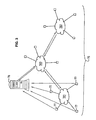
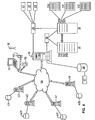
- FIG. 1 and 3 schematically illustrate an architecture that may be used to implement the invention.
- one or more linkable search terms 310,311,312,313 are stored in a data memory 31 for the aggregation and analysis of decentrally stored multimedia data.
- Multimedia data includes digital data such as texts, graphics, images, maps, animations, moving images, video, quicktime, sound recordings, programs (software), program-related data and hyperlinks or references to multimedia data. These include, for example, MPx (MP3) or MPEGx (MPEG4 or 7) standards, as defined by the Moving Picture Experts Group.
- the multimedia data may be in the HTML (Hyper Text Markup Language), Handheld Device Markup Language (HDML), Wireless Markup Language (WMD), Virtual Reality Modeling Language (VRML), or Extensible Markup Language (XML) format.
- a computing unit 10 accesses network nodes 40, 41, 42, 43 connected to source databases 401, 411, 421, 43 via a network 50, and data of the source databases 401, 411, 421, 431 are selected based on the search terms 310, 313, 313, 313.
- the arithmetic unit 10 is bidirectionally connected to the network nodes 40, 41, 42, 43 via a communications network.
- the communication network 50 comprises, for example, a GSM or a UMTS network, or a satellite-based mobile radio network, and / or one or more fixed networks, for example the public switched telephone network, the worldwide Internet or a suitable Local Area Network (LAN) or WAN (Wide Area Network) Network). In particular, it also includes ISDN and XDSL connections.
- the multimedia data can, as shown, be stored at different locations in different networks or locally accessible to the arithmetic unit 10.
- the network nodes 40,41,42,43 can WWW server (HTTP: Hyper Text Transfer Protocol / WAP: Wireless Application Protocol, etc.), chat server, e-mail server (MIME), news server, e-journal Server, group server, or any other file server, such as FTP: File Transfer Protocol (FTP) servers, Active Server Pages (ASD) based servers, or Structured Query Language (SQL) based servers.
- WWW server Hyper Text Transfer Protocol / WAP: Wireless Application Protocol, etc.
- chat server e-mail server
- MIME e-mail server
- news server e-journal Server
- group server e-journal Server
- FTP File Transfer Protocol
- ASD Active Server Pages
- SQL Structured Query Language
- At least one evaluation parameter 320,321,322 is assigned to a search term 310,311,312,313 and / or a combination of search terms 310,311,312,313 and stored.
- the search term 310,311,312,313 and / or a combination of search terms 310,311,312,313 includes the actual search term.
- the search term would include 310,311,312,313 and / or a combination of search terms 310,311,312,313 thus eg Fiat, Fiat Uno, Fiat AND / OR Uno FIAT etc.
- the rating parameters 320,321,322 include the rating theme eg class action, court case etc. with corresponding rating attributes.
- the rating attributes may be specific to a scoring theme, such as damage, liability, sum insured, or all general judgments of judgment such as "good”, “bad”, “angry” etc., ie eg psychological or emotional attributes or words permitting such association.
- the scoring parameters 320, 31, 322 may also include restrictions on the network 50 and / or specific network nodes 40-43. As an example, this makes it possible to limit the aggregation and analysis of the multimedia data, for example, to certain newsgroups and / or web sites by means of corresponding rating parameters 320,321,322.
- one or more of the scoring parameters 320,321,322 may be generated by means of a lexicographic or other scoring database. It may also be expedient that the one or more evaluation parameters 320, 31, 322 are generated at least partially dynamically by means of the arithmetic unit 10 during the generation of the evaluation list 330, 333, 322. Dynamically may mean, for example, that the parameterization module 20 or the filter module 30 during indexing and / or at a later time of the method, the multimedia data and / or the data of the scorecard 330,331,332 for a score parameters 320,321,322 associatively checked and adds them to the rating parameters 320,321,322. It may be useful in this case that the evaluation parameters 320,321,322 can be edited by the user 12. In the case of dynamic generation, analysis modules based on neural network algorithms, for example, may be particularly useful.
- At least one of the source databases 401, 411, 421, 431 can be stored assigned to a search term 310, 31, 31, 31, 1313 and / or a combination of search terms 310, 31, 31, 31, 1313.
- the mapping may include not only explicit network addresses and / or references to databases, but also categories and / or groups of databases such as web sites, chat rooms, email forums, etc.
- the mapping may be automated, partially automated be implemented manually and / or based on a user profile and / or other user-specific and / or application-specific data.
- the arithmetic unit 10 accesses the source databases 401, 411, 421, 431 of the network nodes 40, 41, 42, 43 by means of a filter module 30 and, for each evaluation parameter, generates 320, 31, 322 in connection with the associated search terms 310,311,312,313 and / or source databases 401,411,421,431 a scoring list 330,331,332 with found records. It is immediately obvious to one of ordinary skill in the art that the scoring topic does not necessarily have to be treated equally as the scoring attributes. To generate the scorecard 330,331,332 based on the multimedia data, for example, metadata based on the content of the multimedia data may be generated or aggregated by a metadata extraction module of the computing unit 10.
- the scorecard 330,331,332 can thus include such metadata.
- the metadata or, more generally, the data in the rating list 330,331,332 can be extracted, for example, using a content-based indexing technique and can include keywords, synonyms, references to multimedia data (eg hyperlinks), image and / or sound sequences, etc.
- Such systems are known in the prior art in a great variety of variations. Examples are the US patent US 5,414,644 which describes a three-file indexing technique or the US patent US 5 210 868 , which also stores synonyms as search keywords when indexing the multimedia data and extracting the metadata.
- the metadata can also be generated at least partially dynamically (in real time) based on user data of a user profile.
- the said user profile can be created, for example, based on user information and stored in the arithmetic unit 10 assigned to the user 12.
- the user profile either remains permanently assigned to a specific user 12 or is temporarily created.
- the user's communication device 11/112/113 may be, for example, a PC (Personal Computer), TV, PDA (Personal Digital Assistant) or a mobile device (especially, for example, in combination with a broadcast receiver).
- the user profile can provide information about a Users, such as location of the user's communication unit 111/112/113 in the network, identity of the user, user-specific network properties, user-specific hardware properties, user behavior data, etc.
- the user 12 can specify and / or modify at least parts of user data of the user profile in advance for a search request.
- the user 12 always has the option of searching for and accessing multimedia data by means of direct access, that is to say without searching and assembling aid of the arithmetic unit 10 in the network.
- the remaining data of the user profile can be automatically determined by the computing unit 10, by authorized third parties or also by the user.
- the arithmetic unit 10 may include automatic port identification, user identification, and / or automatic recording and evaluation of user behavior (time of access, frequency of access, etc.). In a variant, these user behavior data can in turn be modified by the user according to his wishes.
- variable mood variable 21 is at least partially dynamically generated for the respective scoring parameter 320,321,322.
- HTML and / or HDML and / or WML and / or VRML and / or ASD can be used to generate the variable mood magnitudes 21 and / or the data of the content module 60.
- the variable mood size 21 corresponds to positive and / or negative mood swings of users of the network 50.
- the variable mood size 21 may also be specific to a scoring subject.
- variable mood magnitude 21 may reflect the likelihood of a class action against a particular company and / or product or, for example, for a drug, a general utility rating by the users or a specific subgroup such as physicians and / or other healthcare professionals.
- the scoring list 330,331,332 with the found data records and / or references to found data records in a content module 60 of the arithmetic unit 10 can be stored accessible to a user. In order to be able to access the content module 60, it may be useful (for example, to charge the claimed service) to identify a particular user 12 from the computing unit 10 by means of a user database. For example, personal identification numbers (PIN) and / or so-called smart cards can be used for identification.
- PIN personal identification numbers
- smart cards can be used for identification.
- Smart cards normally require a card reader in the communication device 111/112/113. In both cases, the name or other identification of the user 12 and the PIN is transmitted to the computing unit 10 or a trusted remote server. An identification module or authentication module decrypts (if necessary) and checks the PIN via the user database. Credit cards can also be used to identify the user 12 as an embodiment variant. If the user 12 uses his credit card, he can also enter his PIN. Typically, the magnetic stripe of the credit card contains the account number and the encrypted PIN of the authorized holder, ie in this case the user 12. The decryption can be done directly in the card reader itself, as is common in the art. Smart cards have the advantage that they allow a greater security against fraud by an additional encryption of the PIN.
- This encryption can be done either by a dynamic number key, which contains eg time, day or month or another algorithm.
- the decryption and identification does not happen in the device itself, but externally via the identification module.
- Another possibility is a smart card inserted directly into the communication device 111/112/113.
- the chip card can be, for example, SIM cards (Subscriber Identification Module) or smart cards, with the chip cards each being assigned a telephone number.
- the assignment can be made, for example via an HLR (Home Location Register) by the IMSI (International Mobile Subscriber Identification) of a phone number, for example, a MSISDN (Mobile Subscriber ISDN) is stored in the HRL then a unique identification of the user 12 is possible ,
- a user 12 transmits via a front end a search request for the corresponding query from the communication device 111/112/113 via the network 50 to the computing unit.
- the search request data can be input via input elements of the communication device 111/112/113.
- the input elements For example, keyboards, graphic input devices (mouse, trackball, eye tracker with Virtual Retinal Display (VRD) etc.), but also IVR (Interactive Voice Response) etc. can be included.
- the user 12 has the option of determining at least part of the search request data himself. This can be done, for example, by the user being requested by the receiving device 111/112/113 to fill out a corresponding front-end query via an interface.
- the front-end query may in particular include additional authentication and / or fees for the query.
- the search request data are checked and, if they satisfy determinable criteria, the search is carried out.
- the mood magnitudes 21 can be checked periodically by means of the arithmetic unit 10 and if at least one of the mood magnitudes 21 is outside a definable fluctuation tolerance or a determinable expected value, the corresponding one Score list 330,331,332 with the found records and / or references to found records in the content module 60 of the computing unit 10 accessible to a user accessible and / or updated.
- user-specific optimized data is generated based on the found in the content module 60 found records and / or references to found records using a repackaging module 61, taking into account the data of the user profile become.
- the user-specifically optimized data can then be made available to the user 12 in the content module 60 of the arithmetic unit 10, for example. It may be advantageous for a user 12 to be allocated different user profiles for different communication devices 111, 112, 113 of this user 12. For the user profile, for example, data on user behavior can also be automatically acquired by the arithmetic unit 10 and stored in association with the user profile.
- FIGS. 5 to 9 show an embodiment variant for monitoring the opinion of pharmaceutical and / or medical products and warning the company of impending product liability cases and / or class actions or other court cases.
- the embodiment should allow a real-time monitoring of public discussion on side effects and / or side effects of a drug or pharmaceutical product, for example in the worldwide backbone network, the Internet.
- more than 2500 medicines and pharmaceutical products were monitored in more than 10'000 public topic related news channels on the Internet in one example. This was not possible in the prior art so far.
- side effects liver damage, kidney damage, heart damage, brain damage, drug-induced depression with suicidal consequences, and allergic reactions were used as scores and / or search combination terms in the context of the drug and / or pharmaceutical product.
- FIG. 5 exemplifies one of the results of the medical and / or pharmaceutical monitoring system based on drugs depending on their hit list in the documents.
- FIG. 6 also shows by way of example one of the results or intermediate results in the system of a drug in connection with occurring diseases and / or causes of death.
- Reference number 1110 corresponds to liver damage at 3.9% with 11 references found to be relevant in the documents in this context.
- Reference No 1111 corresponds to kidney damage at 1.1% with 3 sites judged to be relevant by the system Documents.
- Reference number 1112 corresponds to 16.1% heart damage with 46 documents found to be relevant by the system.
- Reference number 1113 corresponds to brain damage at 25.3% with 72 documents found to be relevant by the system.
- the reference number 1114 corresponds to the depression-related suicides with 53.7% with 153 by the system as relevant assessed references in the documents.
- FIG. 7 shows in the same embodiment of FIG. 5 and 6 the time recorded on the example of the drug Serzone in the documents of the available and / or certain source databases 401,411,421,431. The relevance could be proven with all documents found.
- the system can also be used to dynamically find new data sources, for example.
- the system can be used in particular as an early warning system for companies. Multilingual evaluations and / or analyzes can also be carried out, for example, with the system, inter alia by adaptations (eg manual / automated and / or dynamic by the system, etc.) of the rating and / or search term databases, etc.
- FIG. 8 shows an exemplary listing of companies (here, for example, law firms etc.) depending on a selection of scoring and / or search terms 310,311,312,313 (here industry names) and their number of hits in the documents in this embodiment.
- FIG. 9 also shows such a listing of companies (here, for example, law firms etc.) depending on a selection of valuation and / or search terms 310,311,312,313 (here, for example, pharmaceutical products) and their number of hits in the documents.
- FIGS. 10 to 14 show an embodiment of an early warning system regarding upcoming class actions or other court cases against companies.
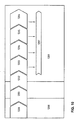
- FIG. 10 shows the timing of an event that can lead to a class action against a company.
- the reference numbers 2008 and 2009 include two stages in the course before submission of a class action.
- 2008 a first discussion about the side effects of a product in the public or in the specific forum.
- an early warning of the affected company may be important.
- 2009 the legal and legal discussion in the forums (eg legal web sites, etc.) begins, which ultimately leads to the submission of the class action.
- a legal warning to the company can be vital.
- 1200 is the early onset of side effects and / or side effects on a product eg in public email forums and / or newsgroups.
- a first discussion on legal aspects in the forums sets in time.
- legal steps begin to be prepared.
- first claims, such as claims for damages, are transmitted to the company.
- the class action is filed against the company.
- the class action is either admitted by the court or dismissed for legal reasons.
- the judgment of the judicial authorities in this case takes place.
- the parties may make an out-of-court settlement or dispute resolution in this case at any time, which would end the discussion.
- Such legal development can be achieved, for example, by monitoring legal forums and law firm websites, etc.
- FIG. 11 shows the listing of company names depending on valuation terms such as lawsuit etc. and / or products and their number of hits in messages or emails of a forum.
- FIG. 12 shows the listing in the same embodiment as in FIG. 11 generally by company name.
- FIG. 13 shows the listing in the same embodiment as in FIG. 11 and 12 By valuation terms such as pharmaceutical products.
- the system has many potential applications without being limited in any way by the described embodiments.
- Other application examples include systems for accident monitoring in the detection of accidents and / or accident reports such as the oil and petrochemical industry, the chemical industry, in buses, etc ..
- the system may include, inter alia, identification and assignment of messages on various unspecified specified features. Such messages may include date and / or location and / or accident type, among others. Further possibilities are: EMF systems for recording reports on EMF regarding their scientific and / or political and / or legal characteristics and effects. Such systems may, for example, include the identification and assignment of the messages via precisely specified features: eg company and topic (eg liver).
- the identification of the early detection by means of the system may include a quantitative comparison of messages in different source types, eg chat and / or newspapers.
- systems for the automated generation of accidental atlases which include, for example, all accident reports (eg bus accidents) and their assignment to geographical locations, time and consequences of accidents.
- the systems just described can be used in particular in systems in the insurance and / or reinsurance industry.
- Other possibilities are, for example, in real estate marketing for identifying and structuring market information on specific sub-topics and / or structuring by postal code and / or provider and / or product.
- unspecified specified attributes eg interest rates of the competition.
- real estate market monitoring Systems whereby the system can be used to capture and structure market information so that the mortgage seller and / or construction supplier, etc., obtains as soon as possible a complete market overview with all available information.
- the system can be implemented as a money laundering tool for the identification of persons and their entire publicly known networks as well as for the creation of personal profiles with regard to defined topics.
- the system can also include, for example, the identification of unspecified persons with a specified profile.
- the system can be used as a performance tool to analyze all information relevant to a company's performance (hard and soft factors and data, generation of real-time indicators derived from a variety of basic data).
- the system can automatically detect and capture new jobs on company websites and transfer this job information to another database, for example, by automated extraction and structuring of unspecified attributes (eg job title, job description, job address ).
- the system can also be used for automated issue management, such as identifying critical issues for a company, identifying new sub-issues, identifying new stakeholders, etc.
- the identification may include, for example, unspecified topics with a specified profile.
- an automated personal identification can be realized by means of the system, whereby unspecified persons are identified, for example, with a determinable profile.
- the system may be used for automated webclipping, eg for collecting all web-based information on a topic (eg institution) and / or sub-topics, identification of origin (country / language), technical channel, author, rating (positive Likewise, as an exemplary embodiment, an automated customer relation monitoring can be realized by means of the system, in particular for monitoring and recording all statements of the customers concerning the addressees, the topics and the evaluations, etc. Furthermore, exemplary embodiments are systems for automated firing -Monitoring conceivable, whereby a monitoring of the fire use by the own company or by foreign companies feasible is. In particular, the system may include the automated identification of brandnames, logos, etc.
Landscapes
- Engineering & Computer Science (AREA)
- Databases & Information Systems (AREA)
- Theoretical Computer Science (AREA)
- Data Mining & Analysis (AREA)
- Physics & Mathematics (AREA)
- General Engineering & Computer Science (AREA)
- General Physics & Mathematics (AREA)
- Information Retrieval, Db Structures And Fs Structures Therefor (AREA)
- Closed-Circuit Television Systems (AREA)
Claims (29)
- Procédé d'agrégation et d'analyse de données multimédia sauvegardées de façon décentralisée, dans lequel un ou plusieurs termes de recherche (310, 311, 312, 313) aptes à être combinés sont sauvegardés dans une mémoire de données (31), une unité de calcul (10) accède, sur un réseau (50), à des noeuds de réseau (40, 41, 42, 43) liés à des bases de données sources (401, 411, 421, 431) et des données de la base de données source (401, 411, 421, 431) sont sélectionnées sur la base des termes de recherche (310, 311, 312, 313), caractérisé par le fait que :au moins un paramètre d'évaluation (320, 321, 322) est sauvegardé dans une mémoire de données (32) en étant associé à un terme de recherche (310, 311, 312, 313) et/ou à une combinaison de termes de recherche (310, 311, 312, 313),au moyen d'un module filtre (30) de l'unité de calcul (10) on accède à une pluralité de bases de données sources (401, 411, 421, 431) des noeuds de réseau (40, 41, 42, 43), et pour chaque paramètre d'évaluation (320, 321, 322) en liaison avec le terme de recherche associé (310, 311, 312, 313) une liste d'évaluation (330, 331, 332) avec des enregistrements trouvés est générée, au moins un type de base de données source et/ou une donnée de date de l'apparition du document dans la base de données source (401, 411, 421, 431) et/ou une donnée d'emplacement de la base de données source (401, 411, 421, 431) étant sauvegardé en étant associé à chacun des enregistrements trouvés,une grandeur d'humeur variable (21) est générée de façon au moins partiellement dynamique au moyen d'un module de paramétrage (20) sur la base de la liste d'évaluation (330, 331, 332), le type de base de données source associé et/ou les données de date et/ou les données d'emplacement pour le paramètre d'évaluation respectif, laquelle grandeur d'humeur variable (21) correspond à des changements d'humeur temporels de l'utilisateur du réseau (50), etun module de contrôle déclenche, sur la base de la grandeur d'humeur variable (21), un événement déterminable, le déclenchement se produisant en fonction de l'historique temporel de la grandeur d'humeur (21).
- Procédé selon la revendication 1, caractérisé par le fait que les types de base de données source comprennent différents Newsgroups et/ou forums de courrier et/ou serveurs WWW et/ou serveurs de conversation en ligne et/ou serveurs de journal et/ou forums thématiques et/ou bases de données spécifiques à un sujet.
- Procédé selon l'une des revendications 1 ou 2, caractérisé par le fait que de nouveaux types de base de données source apparaissant sont répertoriés de façon dynamique au moyen d'un module expert du module de paramétrage, sont pondérés au moyen d'une comparaison avec des données d'historique dans l'historique temporel des grandeurs d'humeur et sont associés au module filtre (20) pour générer des grandeurs d'humeur variables (21).
- Procédé selon l'une des revendications 1 à 3, caractérisé par le fait qu'au moyen d'un module d'historique, l'historique temporel de la grandeur d'humeur (21) variable est sauvegardé et est mis à disposition d'un utilisateur sur le réseau (50), avec un accès contrôlé.
- Procédé selon l'une des revendications 1 à 4, caractérisé par le fait que la liste d'évaluation (330, 331, 332) avec les enregistrements trouvés et/ou les références aux enregistrements trouvés est sauvegardée dans un module de contenu (60) de l'unité de calcul (10) de façon accessible pour un utilisateur.
- Procédé selon l'une des revendications 1 à 5, caractérisé par le fait que périodiquement les grandeurs d'humeur (21) sont vérifiées au moyen de l'unité de calcul (10) et dans le cas où au moins l'une des grandeurs d'humeur (21) se situe en dehors d'une tolérance de variation déterminable ou d'une valeur attendue déterminable, la liste d'évaluation correspondante (330, 331, 332) avec les enregistrements trouvés et/ou les références aux enregistrements trouvés est sauvegardée et/ou est actualisée dans le module de contenu (60) de l'unité de calcul (10) de façon accessible pour un utilisateur.
- Procédé selon l'une des revendications 1 à 6, caractérisé par le fait qu'un ou plusieurs des paramètres d'évaluation (320, 321, 322) sont générés au moyen d'une base de données d'évaluation lexicographique.
- Procédé selon l'une des revendications 1 à 7, caractérisé par le fait qu'un ou plusieurs des paramètres d'évaluation (320, 321, 322) sont générés de façon dynamique au moyen de l'unité de calcul (10) pendant la génération de la liste d'évaluation (330, 331, 332).
- Procédé selon l'une des revendications 1 à 8, caractérisé par le fait que pour la génération des grandeurs d'humeur variables (21) et/ou des données du module de contenu (60) sont utilisés de l'HTML ou de l'HDML et/ou du WML et/ou du VRML et/ou de l'ASD.
- Procédé selon l'une des revendications 1 à 9, caractérisé par le fait qu'un profil d'utilisateur est établi à l'aide d'informations d'utilisateur, dans lequel des données optimisées spécifiques à l'utilisateur sont générées sur la base des enregistrements trouvés et/ou des références aux enregistrements trouvés sauvegardés dans le module de contenu (60) au moyen d'un module de reconditionnement (61) en tenant compte des données du profil d'utilisateur, lesquelles données optimisées spécifiques à l'utilisateur sont mises à disposition de l'utilisateur (12) en étant sauvegardées dans le module de contenu (60) de l'unité de calcul (10).
- Procédé selon la revendication 10,
caractérisé par le fait que différents profils d'utilisateur pour différents dispositifs de communication (111, 112, 113) de l'utilisateur (12) sont sauvegardés en étant associés à l'utilisateur (12). - Procédé selon l'une des revendications 10 à 11, caractérisé par le fait que des données sur le comportement de l'utilisateur sont répertoriées automatiquement par l'unité de calcul (10) et sont sauvegardées en étant associées au profil d'utilisateur.
- Procédé selon l'une des revendications 1 à 12, caractérisé par le fait qu'au moyen d'un module d'historique (22), pour chaque grandeur d'humeur variable (21) calculée, les valeurs jusqu'à un point temporel passé déterminable sont sauvegardées.
- Procédé selon la revendication 13, caractérisé par le fait que l'unité de calcul (10) calcule au moyen d'un module d'extrapolation (23) les grandeurs attendues pour une grandeur d'humeur (21) déterminable, sur la base des données du module d'historique (22) pour un point temporel futur déterminable et les sauvegarde dans une mémoire de données de l'unité de calcul (10).
- Procédé selon l'une des revendications 1 à 14, caractérisé par le fait qu'un ou plusieurs termes de recherche apte à être combinés (310, 311, 312, 313) sont générés de façon au moins partiellement dynamique.
- Système d'agrégation et de contrôle de données multimédias sauvegardées de façon décentralisée, qui comprend une unité de calcul (10), une mémoire de données (31) pour sauvegarder un ou plusieurs termes de recherche apte à être combinés (310, 311, 312, 313) ainsi que des noeuds de réseau (40, 41, 42, 43) liés à des bases de données sources (401, 411, 421, 431), les bases de données sources (401, 411, 421, 431) étant liées de façon bidirectionnelle sur le réseau (50) à l'unité de calcul (10), caractérisé par le fait que :l'unité de calcul (10) comprend une mémoire de données (32) pour sauvegarder au moins un paramètre d'évaluation (320, 321, 322), le paramètre d'évaluation (320, 321, 322) étant apte à être associé à un terme de recherche (310, 311, 312, 313) et/ou à une combinaison de termes de recherche (310, 311, 312, 313),l'unité de calcul (10) comprend un module filtre (30) pour générer une liste d'évaluation (330, 331, 332) des enregistrements trouvés dans les bases de données sources (401, 411, 421, 431) des noeuds de réseau (40, 41, 42, 43), une liste d'évaluation (330, 331, 332) avec des enregistrements trouvés étant associée à chaque paramètre d'évaluation (320, 321, 322) en liaison avec les termes de recherche associés (310, 311, 312, 313), et chacun des enregistrements trouvés comprenant au moins un type de base de données source et/ou une donnée de date d'apparition des documents dans la base de données source (401, 411, 421, 431) et/ou une donnée d'emplacement des bases de données sources (401, 411, 421, 431),l'unité de calcul (10) comprend un module de paramétrage (20) pour générer de façon au moins partiellement dynamique une grandeur d'humeur variable (21) en se basant sur la liste d'évaluation (330, 331, 332) pour les paramètres d'évaluation respectifs (320, 321, 322), laquelle grandeur d'humeur variable (21) correspond à des variations d'humeur positives et/ou négatives de l'utilisateur du réseau (50), etau moyen d'un module de contrôle, sur la base des grandeurs d'humeur variables (21), un événement déterminable est déclenchable, le déclenchement se produisant en fonction de l'historique temporel de la grandeur d'humeur (21).
- Système selon la revendication 16, caractérisé par le fait que les types de base de données source comprennent différents Newsgroups et/ou forums de courrier et/ou serveurs WWW et/ou serveur de conversation en ligne et/ou serveur de journal et/ou forums thématiques et/ou bases de données spécifiques à un sujet.
- Système selon l'une des revendications 16 ou 17, caractérisé par le fait que l'unité de calcul comprend une base de données d'évaluation lexicographique pour générer un ou plusieurs des paramètres d'évaluation (320, 321, 322).
- Système selon l'une des revendications 16 à 18, caractérisé par le fait que l'unité de calcul comprend un module pour générer de façon dynamique un ou plusieurs des paramètres d'évaluation (320, 321, 322) pendant la génération de la liste d'évaluation (330, 331, 332).
- Système selon l'une des revendications 16 à 19, caractérisé par le fait que la liste d'évaluation (330, 331, 332) avec les enregistrements trouvés et/ou les références aux enregistrements trouvés est sauvegardée dans un module de contenu (60) de l'unité de calcul (10) de façon accessible pour un utilisateur.
- Système selon la revendication 20, caractérisé par le fait qu'au moyen de l'unité de calcul (10), les grandeurs d'humeur (21) sont vérifiées de façon périodique et, dans le cas où au moins l'une des grandeurs d'humeur (21) est située en dehors d'une tolérance de variation déterminable ou d'une valeur attendue déterminable, la liste d'évaluation correspondante (330, 331, 332), avec les enregistrements trouvés et/ou les références aux enregistrements trouvés est actualisable dans le module de contenu (60) de l'unité de calcul (10).
- Système selon l'une des revendications 16 à 21, caractérisé par le fait que l'unité de calcul (10) comprend un module pour générer les grandeurs d'humeur variables (21) et/ou les données du module de contenu (60) au moyen d'HTML et/ou d'HDML et/ou de WML et/ou de VRML et/ou d'ASD.
- Système selon l'une des revendications 16 à 22, caractérisé par le fait que l'unité de calcul (10) comprend pour chaque utilisateur (12) un profil d'utilisateur avec des informations d'utilisateur, dans lequel des données optimisées spécifiques à l'utilisateur sont aptes à être générés sur la base des enregistrements trouvés et/ou des références aux enregistrements trouvés sauvegardés dans le module de contenu (60), au moyen d'un module de reconditionnement (61), en tenant compte des données du profil d'utilisateur.
- Système selon la revendication 23, caractérisé par le fait que des profils d'utilisateur différents pour des dispositifs de communication (111, 112, 113) différents de l'utilisateur (12) sont sauvegardés en étant associés à l'utilisateur (12).
- Système selon l'une des revendications 23 ou 24, caractérisé par le fait que des données sur le comportement de l'utilisateur sont répertoriées de façon automatique par l'unité de calcul (10) et sont aptes à être sauvegardés en étant associées au profil d'utilisateur.
- Système selon l'une des revendications 16 à 25, caractérisé par le fait que l'unité de calcul (10) comprend un module d'historique (22), lequel comprend, pour chaque grandeur d'humeur variable (21) déterminable, les valeurs jusqu'à un point temporel passé déterminable, et sur lequel les grandeurs d'humeur variables (21) sont accessibles au moyen des dispositifs de communication (111, 112, 113).
- Système selon la revendication 26, caractérisé par le fait que l'unité de calcul (10) comprend un module d'extrapolation (23), au moyen duquel sont calculées des valeurs attendues pour un point temporel futur déterminable par l'utilisateur (12).
- Système selon l'une des revendications 16 à 27, caractérisé par le fait que le système comprend un moyen pour générer de façon au moins partiellement dynamique un ou plusieurs termes de recherche apte à être combinés (310, 311, 312, 313).
- Produit de programme d'ordinateur, qui est apte à être chargé dans la mémoire interne d'un ordinateur numérique et comprend des parties de code de programme, aptes à exécuter les étapes telles que définies à l'une des revendications 1 à 15, quand le produit fonctionne sur un ordinateur.
Applications Claiming Priority (1)
| Application Number | Priority Date | Filing Date | Title |
|---|---|---|---|
| PCT/EP2005/052120 WO2006119801A1 (fr) | 2005-05-10 | 2005-05-10 | Systeme et procede d'agregation et de controle de donnees multimedia enregistrees de façon decentralisee |
Publications (2)
| Publication Number | Publication Date |
|---|---|
| EP1877932A1 EP1877932A1 (fr) | 2008-01-16 |
| EP1877932B1 true EP1877932B1 (fr) | 2010-05-05 |
Family
ID=34968772
Family Applications (1)
| Application Number | Title | Priority Date | Filing Date |
|---|---|---|---|
| EP05747769A Expired - Lifetime EP1877932B1 (fr) | 2005-05-10 | 2005-05-10 | Systeme et procede d'agregation et de controle de donnees multimedia enregistrees de façon decentralisee |
Country Status (5)
| Country | Link |
|---|---|
| US (1) | US20080195602A1 (fr) |
| EP (1) | EP1877932B1 (fr) |
| AT (1) | ATE467193T1 (fr) |
| DE (1) | DE502005009548D1 (fr) |
| WO (1) | WO2006119801A1 (fr) |
Cited By (1)
| Publication number | Priority date | Publication date | Assignee | Title |
|---|---|---|---|---|
| EP4235452A1 (fr) | 2022-11-17 | 2023-08-30 | Patentpool Target GmbH | Procédé et agencement de système pour l'interrogation efficace d'un système de base de données |
Families Citing this family (15)
| Publication number | Priority date | Publication date | Assignee | Title |
|---|---|---|---|---|
| US7970934B1 (en) * | 2006-07-31 | 2011-06-28 | Google Inc. | Detecting events of interest |
| US20080172461A1 (en) * | 2007-01-12 | 2008-07-17 | Nthid Networks, Inc. | Contextual persona management in a communication medium to enhance relationship based interaction |
| US20090043756A1 (en) * | 2007-08-10 | 2009-02-12 | Click Group, Inc. | Computer program, system and method for creating representations of web pages and transmitting crawler links for crawling the representations |
| US20090043757A1 (en) * | 2007-08-10 | 2009-02-12 | Click Group, Inc. | Method and system for creating a representation of a web page using keywords or search phrases |
| US20090043779A1 (en) * | 2007-08-10 | 2009-02-12 | Click Group, Inc. | Method and system for providing information over a network based on a predictive account balance |
| EP2193456A1 (fr) * | 2007-09-03 | 2010-06-09 | IQser IP AG | Détection de corrélations entre des données représentant des informations |
| CN101452470B (zh) * | 2007-10-18 | 2012-06-06 | 广州索答信息科技有限公司 | 摘要式网络搜索引擎系统及其搜索方法与应用 |
| US20100042615A1 (en) * | 2008-08-12 | 2010-02-18 | Peter Rinearson | Systems and methods for aggregating content on a user-content driven website |
| EP2350883A4 (fr) * | 2008-10-14 | 2012-08-22 | Brand Affinity Tech Inc | Appareil, système et procédé pour un moteur d'affinité avec une marque utilisant des mentions positives et négatives et une indexation |
| US9626405B2 (en) * | 2011-10-27 | 2017-04-18 | Edmond K. Chow | Trust network effect |
| US20100306241A1 (en) * | 2009-06-01 | 2010-12-02 | Click Group, Inc. | Intelligent feed system for creating a representation of a web page for a search engine |
| US8745067B2 (en) * | 2009-08-12 | 2014-06-03 | Google Inc. | Presenting comments from various sources |
| US8972509B2 (en) * | 2012-07-27 | 2015-03-03 | Adobe Systems Incorporated | Automated rich-content messaging |
| US10366359B2 (en) * | 2015-11-18 | 2019-07-30 | Microsoft Technology Licensing, Llc | Automatic extraction and completion of tasks associated with communications |
| CN113221572B (zh) * | 2021-05-31 | 2024-05-07 | 抖音视界有限公司 | 一种信息处理方法、装置、设备及介质 |
Family Cites Families (9)
| Publication number | Priority date | Publication date | Assignee | Title |
|---|---|---|---|---|
| US5210868A (en) | 1989-12-20 | 1993-05-11 | Hitachi Ltd. | Database system and matching method between databases |
| US5414644A (en) | 1993-11-24 | 1995-05-09 | Ethnographics, Inc. | Repetitive event analysis system |
| US6314420B1 (en) * | 1996-04-04 | 2001-11-06 | Lycos, Inc. | Collaborative/adaptive search engine |
| US20030195872A1 (en) | 1999-04-12 | 2003-10-16 | Paul Senn | Web-based information content analyzer and information dimension dictionary |
| US6892198B2 (en) * | 2002-06-14 | 2005-05-10 | Entopia, Inc. | System and method for personalized information retrieval based on user expertise |
| US7640232B2 (en) * | 2003-10-14 | 2009-12-29 | Aol Llc | Search enhancement system with information from a selected source |
| WO2005057426A1 (fr) * | 2003-12-09 | 2005-06-23 | Swiss Reinsurance Company | Systeme et procede d'agregation et d'analyse de donnees multimedia memorisees de facon decentralisee |
| US7240055B2 (en) * | 2003-12-11 | 2007-07-03 | Xerox Corporation | Method and system for expertise mapping based on user activity in recommender systems |
| US7519595B2 (en) * | 2004-07-14 | 2009-04-14 | Microsoft Corporation | Method and system for adaptive categorial presentation of search results |
-
2005
- 2005-05-10 DE DE502005009548T patent/DE502005009548D1/de not_active Expired - Lifetime
- 2005-05-10 US US11/913,738 patent/US20080195602A1/en not_active Abandoned
- 2005-05-10 AT AT05747769T patent/ATE467193T1/de not_active IP Right Cessation
- 2005-05-10 WO PCT/EP2005/052120 patent/WO2006119801A1/fr not_active Ceased
- 2005-05-10 EP EP05747769A patent/EP1877932B1/fr not_active Expired - Lifetime
Cited By (2)
| Publication number | Priority date | Publication date | Assignee | Title |
|---|---|---|---|---|
| EP4235452A1 (fr) | 2022-11-17 | 2023-08-30 | Patentpool Target GmbH | Procédé et agencement de système pour l'interrogation efficace d'un système de base de données |
| WO2024104642A1 (fr) | 2022-11-17 | 2024-05-23 | Patentpool Target Gmbh | Procédé et agencement de système pour interroger efficacement un système de base de données |
Also Published As
| Publication number | Publication date |
|---|---|
| EP1877932A1 (fr) | 2008-01-16 |
| ATE467193T1 (de) | 2010-05-15 |
| DE502005009548D1 (de) | 2010-06-17 |
| US20080195602A1 (en) | 2008-08-14 |
| WO2006119801A1 (fr) | 2006-11-16 |
Similar Documents
| Publication | Publication Date | Title |
|---|---|---|
| EP2100234B1 (fr) | Systeme et procede pour la navigation multidimensionnelle commandee par l'utilisateur et/ou agregation thematique et/ou surveillance de donnees multimedia | |
| DE602004003361T2 (de) | System und verfahren zur erzeugung von verfeinerungskategorien für eine gruppe von suchergebnissen | |
| DE69811066T2 (de) | Datenzusammenfassungsgerät. | |
| DE69718798T2 (de) | Echtzeitsuchmotor mit strukturierten zusammenfassungen | |
| DE69622350T2 (de) | Ein Geschichtsanzeigegerät | |
| DE69834386T2 (de) | Textverarbeitungsverfahren und rückholsystem und verfahren | |
| EP1877932A1 (fr) | Systeme et procede d'agregation et de controle de donnees multimedia enregistrees de façon decentralisee | |
| DE10333530A1 (de) | Automatische Indexierung von digitalen Bildarchiven zur inhaltsbasierten, kontextsensitiven Suche | |
| DE102010049891A1 (de) | Ersatz von maschinell vorgegebenen Stichworten von Webseiten durch manuelle Eingaben | |
| EP2354968A1 (fr) | Hyper-adaptateur et procédé d'accès à des documents dans une base de documents | |
| EP1779263A1 (fr) | Dispositif d'analyse vocale et textuelle et procede correspondant | |
| WO2009030247A1 (fr) | Détection de corrélations entre des données représentant des informations | |
| DE202012013725U1 (de) | Kontextsensible Suche | |
| EP1697861A1 (fr) | Systeme et procede d'agregation et de controle de donnees multimedia enregistrees de fa on decentralisee | |
| DE102008005083A1 (de) | Abrufen einer Information eines fallbasierten Schliessens aus Archivaufzeichnungen | |
| WO2007042245A1 (fr) | Moteur de recherche pour effectuer une recherche relative a un lieu | |
| EP2193455A1 (fr) | Détection de corrélations entre des données qui représentent des informations | |
| EP1755049B1 (fr) | Procédée der transmission d'information d'un serveur d'information à un client | |
| EP2193457A1 (fr) | Détection de corrélations entre des données représentant des informations | |
| WO2005116867A1 (fr) | Procede et systeme de generation automatisee de dispositifs de commande et d'analyse assistes par ordinateur | |
| Al-Kadi | Knowledge management systems requirements specifications | |
| Hurst | Temporal Text Mining. | |
| DE10160920B4 (de) | Verfahren und Vorrichtung zur Erzeugung eines Extrakts von Dokumenten | |
| Nowick et al. | A model search engine based on cluster analysis of user search terms | |
| WO2004095313A1 (fr) | Systeme de traitement de donnees pour recherches conviviales dans une bande de donnees |
Legal Events
| Date | Code | Title | Description |
|---|---|---|---|
| PUAI | Public reference made under article 153(3) epc to a published international application that has entered the european phase |
Free format text: ORIGINAL CODE: 0009012 |
|
| 17P | Request for examination filed |
Effective date: 20071010 |
|
| AK | Designated contracting states |
Kind code of ref document: A1 Designated state(s): AT BE BG CH CY CZ DE DK EE ES FI FR GB GR HU IE IS IT LI LT LU MC NL PL PT RO SE SI SK TR |
|
| DAX | Request for extension of the european patent (deleted) | ||
| GRAP | Despatch of communication of intention to grant a patent |
Free format text: ORIGINAL CODE: EPIDOSNIGR1 |
|
| GRAS | Grant fee paid |
Free format text: ORIGINAL CODE: EPIDOSNIGR3 |
|
| GRAA | (expected) grant |
Free format text: ORIGINAL CODE: 0009210 |
|
| AK | Designated contracting states |
Kind code of ref document: B1 Designated state(s): AT BE BG CH CY CZ DE DK EE ES FI FR GB GR HU IE IS IT LI LT LU MC NL PL PT RO SE SI SK TR |
|
| REG | Reference to a national code |
Ref country code: GB Ref legal event code: FG4D Free format text: NOT ENGLISH |
|
| REG | Reference to a national code |
Ref country code: CH Ref legal event code: EP |
|
| REG | Reference to a national code |
Ref country code: IE Ref legal event code: FG4D Free format text: LANGUAGE OF EP DOCUMENT: GERMAN |
|
| REF | Corresponds to: |
Ref document number: 502005009548 Country of ref document: DE Date of ref document: 20100617 Kind code of ref document: P |
|
| REG | Reference to a national code |
Ref country code: CH Ref legal event code: NV Representative=s name: BRAUNPAT BRAUN EDER AG |
|
| REG | Reference to a national code |
Ref country code: NL Ref legal event code: VDEP Effective date: 20100505 |
|
| LTIE | Lt: invalidation of european patent or patent extension |
Effective date: 20100505 |
|
| PG25 | Lapsed in a contracting state [announced via postgrant information from national office to epo] |
Ref country code: SE Free format text: LAPSE BECAUSE OF FAILURE TO SUBMIT A TRANSLATION OF THE DESCRIPTION OR TO PAY THE FEE WITHIN THE PRESCRIBED TIME-LIMIT Effective date: 20100505 Ref country code: NL Free format text: LAPSE BECAUSE OF FAILURE TO SUBMIT A TRANSLATION OF THE DESCRIPTION OR TO PAY THE FEE WITHIN THE PRESCRIBED TIME-LIMIT Effective date: 20100505 Ref country code: LT Free format text: LAPSE BECAUSE OF FAILURE TO SUBMIT A TRANSLATION OF THE DESCRIPTION OR TO PAY THE FEE WITHIN THE PRESCRIBED TIME-LIMIT Effective date: 20100505 Ref country code: ES Free format text: LAPSE BECAUSE OF FAILURE TO SUBMIT A TRANSLATION OF THE DESCRIPTION OR TO PAY THE FEE WITHIN THE PRESCRIBED TIME-LIMIT Effective date: 20100816 |
|
| PGFP | Annual fee paid to national office [announced via postgrant information from national office to epo] |
Ref country code: CH Payment date: 20100629 Year of fee payment: 6 |
|
| BERE | Be: lapsed |
Owner name: NETBREEZE GMBH Effective date: 20100531 |
|
| PG25 | Lapsed in a contracting state [announced via postgrant information from national office to epo] |
Ref country code: IS Free format text: LAPSE BECAUSE OF FAILURE TO SUBMIT A TRANSLATION OF THE DESCRIPTION OR TO PAY THE FEE WITHIN THE PRESCRIBED TIME-LIMIT Effective date: 20100905 Ref country code: SI Free format text: LAPSE BECAUSE OF FAILURE TO SUBMIT A TRANSLATION OF THE DESCRIPTION OR TO PAY THE FEE WITHIN THE PRESCRIBED TIME-LIMIT Effective date: 20100505 Ref country code: FI Free format text: LAPSE BECAUSE OF FAILURE TO SUBMIT A TRANSLATION OF THE DESCRIPTION OR TO PAY THE FEE WITHIN THE PRESCRIBED TIME-LIMIT Effective date: 20100505 |
|
| REG | Reference to a national code |
Ref country code: IE Ref legal event code: FD4D |
|
| PG25 | Lapsed in a contracting state [announced via postgrant information from national office to epo] |
Ref country code: GR Free format text: LAPSE BECAUSE OF FAILURE TO SUBMIT A TRANSLATION OF THE DESCRIPTION OR TO PAY THE FEE WITHIN THE PRESCRIBED TIME-LIMIT Effective date: 20100806 Ref country code: CY Free format text: LAPSE BECAUSE OF FAILURE TO SUBMIT A TRANSLATION OF THE DESCRIPTION OR TO PAY THE FEE WITHIN THE PRESCRIBED TIME-LIMIT Effective date: 20100519 Ref country code: PL Free format text: LAPSE BECAUSE OF FAILURE TO SUBMIT A TRANSLATION OF THE DESCRIPTION OR TO PAY THE FEE WITHIN THE PRESCRIBED TIME-LIMIT Effective date: 20100505 Ref country code: MC Free format text: LAPSE BECAUSE OF NON-PAYMENT OF DUE FEES Effective date: 20100531 |
|
| PGFP | Annual fee paid to national office [announced via postgrant information from national office to epo] |
Ref country code: GB Payment date: 20100805 Year of fee payment: 6 |
|
| PG25 | Lapsed in a contracting state [announced via postgrant information from national office to epo] |
Ref country code: DK Free format text: LAPSE BECAUSE OF FAILURE TO SUBMIT A TRANSLATION OF THE DESCRIPTION OR TO PAY THE FEE WITHIN THE PRESCRIBED TIME-LIMIT Effective date: 20100505 Ref country code: IE Free format text: LAPSE BECAUSE OF FAILURE TO SUBMIT A TRANSLATION OF THE DESCRIPTION OR TO PAY THE FEE WITHIN THE PRESCRIBED TIME-LIMIT Effective date: 20100505 Ref country code: PT Free format text: LAPSE BECAUSE OF FAILURE TO SUBMIT A TRANSLATION OF THE DESCRIPTION OR TO PAY THE FEE WITHIN THE PRESCRIBED TIME-LIMIT Effective date: 20100906 Ref country code: EE Free format text: LAPSE BECAUSE OF FAILURE TO SUBMIT A TRANSLATION OF THE DESCRIPTION OR TO PAY THE FEE WITHIN THE PRESCRIBED TIME-LIMIT Effective date: 20100505 |
|
| PG25 | Lapsed in a contracting state [announced via postgrant information from national office to epo] |
Ref country code: SK Free format text: LAPSE BECAUSE OF FAILURE TO SUBMIT A TRANSLATION OF THE DESCRIPTION OR TO PAY THE FEE WITHIN THE PRESCRIBED TIME-LIMIT Effective date: 20100505 Ref country code: CZ Free format text: LAPSE BECAUSE OF FAILURE TO SUBMIT A TRANSLATION OF THE DESCRIPTION OR TO PAY THE FEE WITHIN THE PRESCRIBED TIME-LIMIT Effective date: 20100505 Ref country code: RO Free format text: LAPSE BECAUSE OF FAILURE TO SUBMIT A TRANSLATION OF THE DESCRIPTION OR TO PAY THE FEE WITHIN THE PRESCRIBED TIME-LIMIT Effective date: 20100505 |
|
| PGFP | Annual fee paid to national office [announced via postgrant information from national office to epo] |
Ref country code: DE Payment date: 20100812 Year of fee payment: 6 |
|
| PLBE | No opposition filed within time limit |
Free format text: ORIGINAL CODE: 0009261 |
|
| STAA | Information on the status of an ep patent application or granted ep patent |
Free format text: STATUS: NO OPPOSITION FILED WITHIN TIME LIMIT |
|
| PG25 | Lapsed in a contracting state [announced via postgrant information from national office to epo] |
Ref country code: IT Free format text: LAPSE BECAUSE OF FAILURE TO SUBMIT A TRANSLATION OF THE DESCRIPTION OR TO PAY THE FEE WITHIN THE PRESCRIBED TIME-LIMIT Effective date: 20100505 Ref country code: BE Free format text: LAPSE BECAUSE OF NON-PAYMENT OF DUE FEES Effective date: 20100531 |
|
| 26N | No opposition filed |
Effective date: 20110208 |
|
| REG | Reference to a national code |
Ref country code: DE Ref legal event code: R097 Ref document number: 502005009548 Country of ref document: DE Effective date: 20110207 |
|
| PG25 | Lapsed in a contracting state [announced via postgrant information from national office to epo] |
Ref country code: AT Free format text: LAPSE BECAUSE OF NON-PAYMENT OF DUE FEES Effective date: 20100510 |
|
| PG25 | Lapsed in a contracting state [announced via postgrant information from national office to epo] |
Ref country code: FR Free format text: LAPSE BECAUSE OF NON-PAYMENT OF DUE FEES Effective date: 20100705 |
|
| REG | Reference to a national code |
Ref country code: CH Ref legal event code: PL |
|
| GBPC | Gb: european patent ceased through non-payment of renewal fee |
Effective date: 20110510 |
|
| PG25 | Lapsed in a contracting state [announced via postgrant information from national office to epo] |
Ref country code: LI Free format text: LAPSE BECAUSE OF NON-PAYMENT OF DUE FEES Effective date: 20110531 Ref country code: CH Free format text: LAPSE BECAUSE OF NON-PAYMENT OF DUE FEES Effective date: 20110531 |
|
| REG | Reference to a national code |
Ref country code: DE Ref legal event code: R119 Ref document number: 502005009548 Country of ref document: DE Effective date: 20111201 |
|
| PG25 | Lapsed in a contracting state [announced via postgrant information from national office to epo] |
Ref country code: GB Free format text: LAPSE BECAUSE OF NON-PAYMENT OF DUE FEES Effective date: 20110510 |
|
| PG25 | Lapsed in a contracting state [announced via postgrant information from national office to epo] |
Ref country code: HU Free format text: LAPSE BECAUSE OF FAILURE TO SUBMIT A TRANSLATION OF THE DESCRIPTION OR TO PAY THE FEE WITHIN THE PRESCRIBED TIME-LIMIT Effective date: 20101106 Ref country code: LU Free format text: LAPSE BECAUSE OF NON-PAYMENT OF DUE FEES Effective date: 20100510 Ref country code: BG Free format text: LAPSE BECAUSE OF FAILURE TO SUBMIT A TRANSLATION OF THE DESCRIPTION OR TO PAY THE FEE WITHIN THE PRESCRIBED TIME-LIMIT Effective date: 20100505 |
|
| PG25 | Lapsed in a contracting state [announced via postgrant information from national office to epo] |
Ref country code: TR Free format text: LAPSE BECAUSE OF FAILURE TO SUBMIT A TRANSLATION OF THE DESCRIPTION OR TO PAY THE FEE WITHIN THE PRESCRIBED TIME-LIMIT Effective date: 20100505 |
|
| PG25 | Lapsed in a contracting state [announced via postgrant information from national office to epo] |
Ref country code: DE Free format text: LAPSE BECAUSE OF NON-PAYMENT OF DUE FEES Effective date: 20111201 |
|
| PG25 | Lapsed in a contracting state [announced via postgrant information from national office to epo] |
Ref country code: BG Free format text: LAPSE BECAUSE OF FAILURE TO SUBMIT A TRANSLATION OF THE DESCRIPTION OR TO PAY THE FEE WITHIN THE PRESCRIBED TIME-LIMIT Effective date: 20100805 |