EP1878205B1 - Verfahren und vorrichtung zur umsetzung von internet-protokoll-adressen innerhalb eines kommunikationsnetzwerkes - Google Patents
Verfahren und vorrichtung zur umsetzung von internet-protokoll-adressen innerhalb eines kommunikationsnetzwerkes Download PDFInfo
- Publication number
- EP1878205B1 EP1878205B1 EP06725720A EP06725720A EP1878205B1 EP 1878205 B1 EP1878205 B1 EP 1878205B1 EP 06725720 A EP06725720 A EP 06725720A EP 06725720 A EP06725720 A EP 06725720A EP 1878205 B1 EP1878205 B1 EP 1878205B1
- Authority
- EP
- European Patent Office
- Prior art keywords
- address
- internet protocol
- private
- nat
- public
- Prior art date
- Legal status (The legal status is an assumption and is not a legal conclusion. Google has not performed a legal analysis and makes no representation as to the accuracy of the status listed.)
- Expired - Lifetime
Links
Images
Classifications
-
- H—ELECTRICITY
- H04—ELECTRIC COMMUNICATION TECHNIQUE
- H04L—TRANSMISSION OF DIGITAL INFORMATION, e.g. TELEGRAPHIC COMMUNICATION
- H04L61/00—Network arrangements, protocols or services for addressing or naming
- H04L61/09—Mapping addresses
- H04L61/25—Mapping addresses of the same type
- H04L61/2503—Translation of Internet protocol [IP] addresses
- H04L61/2521—Translation architectures other than single NAT servers
- H04L61/2528—Translation at a proxy
-
- H—ELECTRICITY
- H04—ELECTRIC COMMUNICATION TECHNIQUE
- H04L—TRANSMISSION OF DIGITAL INFORMATION, e.g. TELEGRAPHIC COMMUNICATION
- H04L61/00—Network arrangements, protocols or services for addressing or naming
-
- H—ELECTRICITY
- H04—ELECTRIC COMMUNICATION TECHNIQUE
- H04L—TRANSMISSION OF DIGITAL INFORMATION, e.g. TELEGRAPHIC COMMUNICATION
- H04L61/00—Network arrangements, protocols or services for addressing or naming
- H04L61/09—Mapping addresses
- H04L61/25—Mapping addresses of the same type
- H04L61/2503—Translation of Internet protocol [IP] addresses
- H04L61/256—NAT traversal
- H04L61/2564—NAT traversal for a higher-layer protocol, e.g. for session initiation protocol [SIP]
-
- H—ELECTRICITY
- H04—ELECTRIC COMMUNICATION TECHNIQUE
- H04L—TRANSMISSION OF DIGITAL INFORMATION, e.g. TELEGRAPHIC COMMUNICATION
- H04L61/00—Network arrangements, protocols or services for addressing or naming
- H04L61/09—Mapping addresses
- H04L61/25—Mapping addresses of the same type
- H04L61/2503—Translation of Internet protocol [IP] addresses
- H04L61/256—NAT traversal
- H04L61/2578—NAT traversal without involvement of the NAT server
Definitions
- the invention relates to a method according to the preamble of claim 1.
- IP Internet Protocol
- NAT Network Address Translation
- NAT In NAT, the IP header of this packet is modified before sending an IP data packet.
- the internal IP address including port number is replaced by a public IP address with a different port number.
- a NAT host stores the mapping from the internal IP address to the public (external) IP address. If the NAT host now receives an IP data packet, it maps the public (external) IP address back to the internal IP address.
- the NAT host is to be understood as a two networks interconnecting computer on which a corresponding software (NAT engine) provides for the address translation.
- VoIP Voice over IP
- a method for address translation in Voice over IP networks is known in which a switch is configured to include a specially adapted IP service switch that performs multiple independent instances of address translation using multiple ones Contains tables. For each private network to be connected, one table is kept in each case. The assignment between public and private addresses is permanently entered and administrated by a respective customer. A query of the server is not provided.
- the object of the present invention is to provide a method which enables the conversion of private IP addresses into public IP addresses in a communication network in a manner that is as user-friendly as possible without software adaptation of the clients.
- An advantage of the present invention is that the VoIP software on the clients need not be adapted for use in communications networks separated by a NAT host from public communications networks.
- the functionality of address translation from private IP addresses to public IP addresses is handled by a server system switched between private and public network, eg. A proxy server or preferably a gatekeeper.
- NAT addresses are negotiated in advance centrally by this proxy server or gatekeeper, and the private IP addresses contained in the VoIP protocol data of each VoIP data packet are converted into the corresponding public IP addresses.
- the negotiation is done via appropriate protocols, under the use of which the proxy server contacts a NAT name server, preferably a STUN (Simple Traversal of UDP over NATs) server.
- STUN Simple Traversal of UDP over NATs
- Another advantage of the present invention is that the use of VoIP applications for users in communication networks, the public and private IP addresses integrate and therefore rely on NAT is greatly simplified.
- clients have to be extensively configured or special software is required to be able to communicate via VoIP even in NAT environments. So far, VoIP products could only be configured by experienced users or technical staff, while private users were often overwhelmed with the configuration.
- Software adaptation is particularly difficult in so-called "embedded systems", in which - in contrast to single-user systems such as PCs - new software is difficult to integrate.
- the present invention represents a significant advantage.
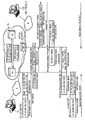
- FIG. 1 shows the implementation according to the invention of private IP addresses in a communication network, consisting of two terminals (clients) C1, C2, a server system S, a proxy server (preferably gatekeeper) PS, a NAT address server (preferably STUN server). Server) NA, as well as a NAT host NH.
- the communication network is divided into a private area A and a public area B, e.g. As the public Internet, on.
- the NAT host NH is located at the interface of the two communication networks A and B.
- the proxy server PS is actively involved in the NAT address translation.
- an exemplary sequence of a VoIP session between two clients C1 and C2 is shown with regard to the address translation according to the invention.
- Client C1 with the private IP address 141.23.209.105 starts a connection setup for a VoIP session with client C2, to which the IP address 192.178.63.4 is assigned.
- the connection request in the form of a VoIP data packet V1 first reaches the proxy server PS.
- the VoIP data packet V1 consists of a header containing the IP address of the sender C1, and a user data part containing the VoIP protocol data.
- the VoIP protocol data contains both the IP address including the port specification of the sender C1 (141.23.209.105:1245) and the IP address of the recipient or client C2 (192.178.63.4:1720).
- the proxy server PS Since the user data part remains untouched by the NAT protocol host NH with the VoIP protocol data, the proxy server PS first sets the private IP address of the client C1 (141.23.209.105:1245) to the correct public IP address (145.30.62.1 : 48324). For this purpose, the proxy server PS contacts a NAT address server NA and transmits the private IP address of the client C1 including the port specification (141.23.209.105:1245). The NAT address server NA then sends the corresponding public IP address including port information for the client C1 (145.30.62.1:48324) to the proxy server PS.
- the proxy server PS now replaces the private IP address of the client C1 (141.23.209.105:1245) in the VoIP protocol data with the correct public IP address (145.30.62.1:48324) and sends the VoIP data packet V2 further to the NAT -Host NH.
- the NAT host NH replaced in the header of the VoIP data packet, the private IP address of the sender C1 (141.23.209.105:1245) by the correct public IP address (145.30.62.1:48324) and sends the VoIP data packet V3 the client C2.
- the client C2 can now refer to the correct public address (145.30.62.1:48324) of the requesting client C1 and now in turn send back a corresponding response in the form of a VoIP data packet V4 to client C1.
- the VoIP data packet V4 contains in the header the public IP address of the recipient C1 (145.30.62.1:48324). In the VoIP protocol data of the VoIP data packet V4, the public IP address of C1 (145.30.62.1:48324) is also entered as the recipient. The VoIP data packet V4 reaches the NAT host NH, which is the public IP address of the Converts clients C1 (195.30.62.1:48324) into the correct private IP address (141.23.209.105:1245) and sends the modified VoIP data packet V5 to client C1.
- the VoIP protocol data is adapted by the proxy server PS by the proxy server PS by a request to the NAT address server NA based on the public IP address of the client C1 (145.30.62.1: 48324) determines the correct private IP address of client C1 (141.23.209.105:1245) and converts the recipient address in VoIP protocol data to the correct private IP address of client C1 (141.23.209.105:1245). Subsequently, the proxy server PS sends the modified VoIP data packet to the client C1. This will successfully initiate a VoIP session. Between the clients C1 and C2 can now on the basis of appropriate media protocols such. B. RTP or RTCP a direct communication connection can be established. In media protocols such. B. RTP IP addresses are transmitted only in the header. The actual media protocol data does not contain any IP addresses, so that these do not have to be adapted if media data is exchanged between the clients C1 and C2 over NAT boundaries in the further course of the VoIP session.
- client C2 initiates a VoIP session.
- client C1 all that is required is for client C1 to know its public IP address and to notify client C2 of this in a suitable manner (for example by e-mail) in order to establish a connection.
- suitable manner for example by e-mail
- both client C1 and client C2 are located in a private communication network separated from other communication networks by a respective NAT host.
- each of the two proxy servers then involved knows the public IP address of the other proxy server and communicates this to the respective external client in a suitable manner.
Landscapes
- Engineering & Computer Science (AREA)
- Computer Networks & Wireless Communication (AREA)
- Signal Processing (AREA)
- Data Exchanges In Wide-Area Networks (AREA)
- Small-Scale Networks (AREA)
Description
- Die Erfindung betrifft ein Verfahren nach dem Oberbegriff des Anspruchs 1.
- Verfahren der in Rede stehenden Art werden heute in breitem Umfang zur Übermittlung von Sprach-, Audio-, Video- und/oder Nutzdaten über Netzwerkgrenzen, z. B. zwischen internen und öffentlichen Datennetzen, hinweg eingesetzt. Bei der Übermittlung von Daten über Internet-Protokoll-Netze (IP-Netze) treten immer wieder Probleme auf, wenn an einer Netzwerkgrenze eine Adressumsetzung mit Network Address Translation (NAT) erfolgt. NAT ist dabei aus verschiedenen Gründen von wesentlicher Bedeutung für die Internettechnologie. Unter anderem werden verschiedene Arten von Zugangssicherungen im Sinne einer Firewall sowie Fehlertoleranz und Hochverfügbarkeit unterstützt. Weiterhin werden grundlegende Funktionen der Netzwerkadministration vereinfacht.
- Da der in den_Gründungs jahren des Internets vorgesehene Adressraum für die Vergabe von IP-Adressen auf absehbare Zeit nicht mehr ausreichen wird, insbesondere der Ausbau von internen und hochkomplexen Datennetzen mehr und mehr IP-Adressen erfordert, wird NAT aber vor allem eingesetzt, um die intern benutzten IP-Adressen nach außen zu verbergen. Dies macht zum einen die Verwaltung interner Netze einfacher, zum anderen werden Kosten gespart, da man nach außen weniger öffentliche kostenpflichtige IP-Adressen benutzen muss als dies intern erforderlich ist. So lassen sich eine Vielzahl von Endgeräten in einem internen Netzwerk auf eine einzige öffentliche IP-Adresse abbilden, indem die Portadresse der öffentlichen IP-Adresse variiert wird.
- Bei NAT wird vor dem Versenden eines IP-Datenpaketes der IP-Header dieses Paketes modifiziert. Die interne IP-Adresse inklusive Portnummer wird durch eine öffentliche IP-Adresse mit einer anderen Portnummer ersetzt. Ein NAT-Host speichert die Zuordnung (Mapping) von interner IP-Adresse auf die öffentliche (externe) IP-Adresse. Empfängt nun der NAT-Host ein IP-Datenpaket, so bildet er die öffentliche (externe) IP-Adresse wieder auf die interne IP-Adresse ab. Der NAT-Host ist dabei als ein zwei Netzwerke miteinander verbindender Rechner zu verstehen, auf welchem eine entsprechende Software (NAT-Engine) für die Adressumsetzung sorgt.
- Die Umsetzung der privaten IP-Adressen in öffentliche IP-Adressen ist sehr aufwändig und überfordert viele Kommunikationsprotokolle. Im Zusammenhang mit Voice over IP (VoIP) besteht zudem das Problem, dass der NAT-Host lediglich den IP-Header eines jeden VoIP-Datenpaketes durch Umsetzen der privaten IP-Adresse eines internen Clients in die entsprechende öffentliche IP-Adresse ändert, nicht aber die für die korrekte Zustellung notwendigen VoIP-Protokolldaten, insbesondere die private IP-Adresse im Nutzdaten-Teil des VoIP-Datenpaketes. Somit können die VoIP-Datenpakete des externen Clients nicht an den Zielclient zugestellt werden.
- Es wurde schon vorgeschlagen, die Software in den Endgeräten (Clients) zu erweitern, so dass die Adressumsetzung per Look ahead-Mechanismus von einem NAT-Host unter Beibehaltung bestehender NAT-Konfigurationen vorgenommen werden kann (Patentanmeldung
EP 1421766 A1 ). Das dort vorgestellte Verfahren erfordert jedoch eine sehr aufwändige softwareseitige Anpassung der Clients, die insbesondere Anwender im Heimbereich häufig überfordert. - Aus der
US 2003/161295 A1 ist ein Verfahren zur Adressumsetzung in Voice over IP Netzwerken bekannt, bei der eine Vermittlungsstelle so ausgestaltet ist, dass diese einen speziell angepassten IP-Service-Switch enthält, welcher mehrere unabhängige Instanzen von Adressumsetzen unter Verwendung mehrer Tabellen enthält. Für jedes anzubindene private Netzwerk wird dabei jeweils eine Tabelle vorgehalten. Die Zuordnung zwischen öffentlichen und privaten Adressen wird dabei fest eingetragen und von einem jeweiligen Kunden administriert. Eine Abfrage des Servers ist nicht vorgesehen. - Aus der
US 2002/0138622 A1 ist ein Verfahren zur Verwendung von langlebigen Adressen in einem privaten Netzwerk zur "Push"-Übermittlung von Nachrichten an mobile Endgeräte bekannt. Gemäß der dortigen Lehre wird eine Programmierschnittstelle eines Adressumsetzers benötigt, um statische Einträge programmieren zu können. Weiterhin wird ein Application Layer Gateway eingesetzt, welches eine Veränderung der Nutzdaten vornimmt. - Aus der
EP 1318649 A1 ist ein weiterer Adressumsetzer bekannt, welcher in analoger Weise eine Programmierschnittstelle für ein Application Layer Gateway verwendet. Die oben genannten Einschränkungen gelten daher auch für diese Druckschrift. - Aufgabe der vorliegenden Erfindung ist es, ein Verfahren bereitzustellen, das die Umsetzung privater IP-Adressen in öffentliche IP-Adressen in einem Kommunikationsnetzwerk möglichst benutzungsfreundlich ohne softwaremäßige Anpassung der Clients ermöglicht.
- Es ist weiterhin Aufgabe der vorliegenden Erfindung, eine Vorrichtung zur Durchführung des erfindungsgemäßen Verfahrens bereitzustellen.
- Diese Aufgabe wird hinsichtlich des Verfahrens durch die Merkmale des Anspruchs 1 gelöst.
- Vorteilhafte Ausgestaltungen und Weiterbildungen sind Gegenstand der abhängigen Ansprüche.
- Ein Vorteil der vorliegenden Erfindung besteht darin, dass die VoIP-Software auf den Clients nicht für den Einsatz in Kommunikationsnetzwerken, die durch einen NAT-Host von öffentlichen Kommunikationsnetzwerken getrennt sind, angepasst werden müssen. Die Funktionalität der Adressumsetzung von privaten IP-Adressen in öffentliche IP-Adressen übernimmt ein zwischen privates und öffentliches Netzwerk geschaltetes Serversystem, z. B. ein Proxyserver oder vorzugsweise ein Gatekeeper. Dadurch werden in einem VoIP-Netzwerk NAT-Adressen zentral von diesem Proxyserver bzw. Gatekeeper vorab ausgehandelt und die privaten IP-Adressen, die in den VoIP-Protokolldaten jedes VoIP-Datenpaketes enthalten sind, in die entsprechenden öffentlichen IP-Adressen umgesetzt. Das Aushandeln geschieht über entsprechende Protokolle, unter deren Verwendung der Proxyserver einen NAT-Nameserver, vorzugsweise einen STUN (Simple traversal of UDP over NATs)-Server, kontaktiert. Durch die Verlagerung der Adressumsetzung auf das zwischengeschaltete Serversystem ist es nicht mehr notwendig, ein NAT-Aushandlungsprotokoll auf den Clients zu implementieren, die Clients bleiben damit unverändert. Die Umsetzung der IP-Adressen im Header jedes VoIP-Datenpaketes wird weiterhin von einem expliziten NAT-Host vorgenommen.
- Ein weiterer Vorteil der vorliegenden Erfindung besteht darin, dass die Nutzung von VoIP-Applikationen für Anwender in Kommunikationsnetzwerken, die öffentliche und private IP-Adressen integrieren und daher auf NAT angewiesen sind, wesentlich vereinfacht wird. Bisher müssen Clients aufwändig konfiguriert werden bzw. es ist spezielle Software nötig, um auch in NAT-Umgebungen per VoIP kommunizieren zu können. Bisher konnten VoIP-Produkte daher nur von versierten Anwendern oder technischem Personal konfiguriert werden, während private Nutzer häufig mit der Konfiguration überfordert waren. Besonders schwierig gestaltet sich die Softwareanpassung in sogenannten "Embedded systems", in die - im Gegensatz zu Einzelplatzsystemen wie PCs - neue Software nur schwer zu integrieren ist. Insbesondere für derartige "Embedded systems" stellt die vorliegende Erfindung einen wesentlichen Vorteil dar.
- Nachfolgend wird die Erfindung anhand eines Ausführungsbeispiels und mit Bezug auf die beiliegende Zeichnung näher erläutert. Dabei zeigt:
- Figur 1: Adressumsetzung durch NAT in einem Kommunikationsnetzwerk
- Figur 1 zeigt die erfindungsgemäße Umsetzung von privaten in öffentliche IP-Adressen in einem Kommunikationsnetzwerk, bestehend aus zwei Endgeräten (Clients) C1, C2, einem Serversystem S, einem Proxyserver (vorzugsweise Gatekeeper) PS, einem NAT-Adress-Server (vorzugsweise STUN-Server) NA, sowie einem NAT-Host NH. Das Kommunikationsnetzwerk teilt sich in einen privaten Bereich A und einen öffentlichen Bereich B, z. B. das öffentliche Internet, auf. An der Schnittstelle der beiden Kommunikationsnetzwerke A und B befindet sich der NAT-Host NH.Erfindungsgemäß ist der Proxyserver PS aktiv an der Adressumsetzung per NAT beteiligt. Im Folgenden ist ein beispielhafter Ablauf einer VoIP-Sitzung zwischen zwei Clients C1 und C2 in Hinblick auf die erfindungsgemäße Adressumsetzung dargestellt.
- Client C1 mit der privaten IP-Adresse 141.23.209.105 startet einen Verbindungsaufbau für eine VoIP-Sitzung mit Client C2, dem die IP-Adresse 192.178.63.4 zugewiesen ist. Über das private Kommunikationsnetzwerk A erreicht die Verbindungsanfrage in Form eines VoIP-Datenpaketes V1 zunächst den Proxyserver PS. Das VoIP-Datenpaket V1 besteht aus einem Header, der die IP-Adresse des Absenders C1 enthält, sowie einem Nutzdaten-Teil, der die VoIP-Protokolldaten enthält. Die VoIP-Protokolldaten enthalten sowohl die IP-Adresse inklusive Portangabe des Absenders C1 (141.23.209.105:1245) als auch die IP-Adresse des Empfängers bzw. Clients C2 (192.178.63.4:1720). Da der Nutzdaten-Teil mit den VoIP-Protokolldaten vom NAT-Host NH unberührt bleibt, setzt nun zunächst der Proxyserver PS die private IP-Adresse des Clients C1 (141.23.209.105:1245) in die korrekte öffentliche IP-Adresse (145.30.62.1:48324) um. Zu diesem Zweck kontaktiert der Proxyserver PS einen NAT-Adress-Server NA und übermittelt die private IP-Adresse des Clients C1 inklusive Portangabe (141.23.209.105:1245). Der NAT-Adress-Server NA sendet daraufhin die entsprechende öffentliche IP-Adresse inklusive Portangabe für den Client C1 (145.30.62.1:48324) an den Proxyserver PS. Der Proxyserver PS ersetzt nun die private IP-Adresse des Clients C1 (141.23.209.105:1245) in den VoIP-Protokolldaten durch die korrekte öffentliche IP-Adresse (145.30.62.1:48324) und sendet das VoIP-Datenpaket V2 weiter an den NAT-Host NH. Der NAT-Host NH ersetzt nun im Header des VoIP-Datenpakets die private IP-Adresse des Absenders C1 (141.23.209.105:1245) durch die korrekte öffentliche IP-Adresse (145.30.62.1:48324) und sendet das VoIP-Datenpaket V3 an den Client C2. Aus den so modifizierten VoIP-Protokolldaten kann der Client C2 nun die korrekte öffentliche Adresse (145.30.62.1:48324) des anfragenden Clients C1 entnehmen und nun seinerseits eine entsprechende Antwort in Form eines VoIP-Datenpakets V4 an Client C1 zurücksenden. Das VoIP-Datenpaket V4 enthält im Header die öffentliche IP-Adresse des Empfängers C1 (145.30.62.1:48324). In den VoIP-Protokolldaten des VoIP-Datenpakets V4 ist als Empfänger ebenfalls die öffentliche IP-Adresse von C1 (145.30.62.1:48324) eingetragen. Das VoIP-Datenpaket V4 erreicht den NAT-Host NH, der die öffentliche IP-Adresse des Clients C1(195.30.62.1:48324) in die korrekte private IP-Adresse (141.23.209.105:1245) umsetzt und das so modifizierte VoIP-Datenpaket V5 weiter an den Client C1 sendet. Bevor das VoIP-Datenpaket V5 den Client C1 erreicht, werden die VoIP-Protokolldaten vom Proxyserver PS angepasst, indem der Proxyserver PS durch eine Anfrage an den NAT-Adress-Server NA anhand der öffentlichen IP-Adresse des Clients C1 (145.30.62.1:48324) die korrekte private IP-Adresse des Clients C1 (141.23.209.105:1245) ermittelt und die Empfängeradresse in VoIP-Protokolldaten entsprechend auf die korrekte private IP-Adresse des Clients C1 (141.23.209.105:1245) umsetzt. Anschließend sendet der Proxyserver PS das so modifizierte VoIP-Datenpaket weiter an den Client C1. Auf diese Weise wird erfolgreich eine VoIP-Sitzung eingeleitet. Zwischen den Clients C1 und C2 kann nun auf der Basis entsprechender Mediaprotokolle wie z. B. RTP oder RTCP eine direkte Kommunikationsverbindung aufgebaut werden. In Mediaprotokollen wie z. B. RTP werden IP-Adressen ausschließlich im Header übermittelt. Die eigentlichen Mediaprotokolldaten enthalten keine IP-Adressen, so dass diese auch nicht angepasst werden müssen, wenn im weiteren Verlauf der VoIP-Sitzung Mediadaten zwischen den Clients C1 und C2 über NAT-Grenzen hinweg ausgetauscht werden.
- Neben dem oben dargestellten Szenario, wie es in Figur 1 dargestellt ist, ist es ebenso denkbar, dass Client C2 eine VoIP-Sitzung initiiert. In diesem Fall ist es lediglich erforderlich, dass Client C1 seine öffentliche IP-Adresse kennt und diese Client C2 in geeigneter Weise (z. B. per E-Mail) mitteilt, um einen Verbindungsaufbau zu ermöglichen. Der weitere Ablauf des VoIP-Sitzungsaufbaus ist analog zum oben dargestellten Szenario.
- Weiterhin ist ein erweitertes Szenario denkbar, im dem sich sowohl Client C1 als auch Client C2 in einem privaten und durch jeweils einen NAT-Host von anderen Kommunikationsnetzwerken getrennten Kommunikationsnetzwerk befinden. In diesem Fall ist es vor dem eigentlichen VoIP-Sitzungsaufbau erforderlich, dass jeder der beiden dann beteiligten Proxyserver die öffentliche IP-Adresse des jeweils anderen Proxyservers kennt und diese dem jeweils externen Client in geeigneter Weise mitteilt.
Claims (3)
- Verfahren zur Umsetzung von Internet-Protokoll-Adressen innerhalb eines Kommunikationsnetzwerkes,- bei dem Internet-Protokoll-Datenpakete zwischen den Kommunikationseinrichtungen (C1, C2, NA, NH, PS) vermittelt werden,- bei dem das Kommunikationsnetzwerk in ein öffentliches Kommunikationsnetzwerk (B) und mindestens ein privates Kommunikationsnetzwerk (A) aufgeteilt ist,- bei dem jeder Kommunikationseinrichtung (C1, C2, NA, NH, PS) im Kommunikationsnetzwerk eine eindeutige öffentliche Internet-Protokoll-Adresse zugeordnet ist,- bei dem ein Serversystem (S), die Kommunikation zwischen den Endgeräten (C1, C2) im Kommunikationsnetzwerk vermittelt,- bei dem jedem Endgerät (C1, C2) in einem privaten Kommunikationsnetzwerk (A) durch das Serversystem (S) eine private Internet-Protokoll-Adresse zugeordnet wird,- bei dem die jeweilige Umsetzung zwischen privaten und öffentlichen Internet-Protokoll-Adressen durch Network Address Translation vorgenommen wird,
dadurch gekennzeichnet, dass das Serversystem aus einem Proxyserver (Ps), einem NAT-Adress Server (NA) und einem NAT-Host (NH) besteht,- seitens des Proxyservers (PS) eine jeweilige Umsetzung der in den Nutzdaten der Internet-Protokoll-Datenpakete enthaltenen privaten Internet-Protokoll-Adresse eines Endgeräts (C1, C2) und einer zugehörigen durch den Proxyserver (PS) vom NAT-Adress-Server (NA) bezogenen öffentlichen Internet-Protokoll-Adresse erfolgt- und anschließend seitens des NAT-Host (NH)eine jeweilige Umsetzung zwischen der im Header der Internet-Protokoll-Datenpakete enthaltenen privaten Internet-Protokoll-Adresse und der öffentlichen Internet-Protokoll-Adresse eines Endgeräts (C1, C2) durch Network Address Translation vorgenommen wird. - Verfahren nach Anspruch 1,
dadurch gekennzeichnet, dass es sich bei den Internet-Protokoll-Datenpaketen um Voice over IP-Datenpakete handelt. - Verfahren nach einem der vorherigen Ansprüche,
dadurch gekennzeichnet, dass der NAT-Adress-Server (NA) als "Simple traversal of UDP over NATs" (kurz STUN)-Server ausgestaltet ist.
Applications Claiming Priority (2)
| Application Number | Priority Date | Filing Date | Title |
|---|---|---|---|
| DE102005020924A DE102005020924A1 (de) | 2005-05-04 | 2005-05-04 | Verfahren und Vorrichtung zur Umsetzung von Internet-Protokoll-Adressen innerhalb eines Kommunikationsnetzwerkes |
| PCT/EP2006/061542 WO2006117284A2 (de) | 2005-05-04 | 2006-04-12 | Verfahren und vorrichtung zur umsetzung von internet-protokoll-adressen innerhalb eines kommunikationsnetzwerkes |
Publications (2)
| Publication Number | Publication Date |
|---|---|
| EP1878205A2 EP1878205A2 (de) | 2008-01-16 |
| EP1878205B1 true EP1878205B1 (de) | 2009-10-14 |
Family
ID=37111456
Family Applications (1)
| Application Number | Title | Priority Date | Filing Date |
|---|---|---|---|
| EP06725720A Expired - Lifetime EP1878205B1 (de) | 2005-05-04 | 2006-04-12 | Verfahren und vorrichtung zur umsetzung von internet-protokoll-adressen innerhalb eines kommunikationsnetzwerkes |
Country Status (5)
| Country | Link |
|---|---|
| US (1) | US8223762B2 (de) |
| EP (1) | EP1878205B1 (de) |
| CN (1) | CN101208935B (de) |
| DE (2) | DE102005020924A1 (de) |
| WO (1) | WO2006117284A2 (de) |
Families Citing this family (5)
| Publication number | Priority date | Publication date | Assignee | Title |
|---|---|---|---|---|
| CN100583814C (zh) * | 2005-05-12 | 2010-01-20 | 中兴通讯股份有限公司 | 一种实现多媒体业务nat穿越的方法 |
| EP2169903A1 (de) * | 2008-09-30 | 2010-03-31 | France Telecom | Vorrichtung und Verfahren für das Routing der Übersetzung von Adressen in Kaskade in einem Netzwerk |
| KR101225185B1 (ko) * | 2009-10-23 | 2013-01-22 | 한국전자통신연구원 | 네트워크 주소 변환 방법 |
| CN102932461B (zh) * | 2012-11-06 | 2016-08-03 | 深信服网络科技(深圳)有限公司 | 网络加速传输方法及装置 |
| CN108234511B (zh) * | 2018-01-18 | 2021-07-13 | 携程旅游信息技术(上海)有限公司 | 多媒体数据传输的方法、系统、设备、存储介质及网关 |
Family Cites Families (9)
| Publication number | Priority date | Publication date | Assignee | Title |
|---|---|---|---|---|
| GB2365256A (en) * | 2000-07-28 | 2002-02-13 | Ridgeway Systems & Software Lt | Audio-video telephony with port address translation |
| US20020101859A1 (en) * | 2000-09-12 | 2002-08-01 | Maclean Ian B. | Communicating between nodes in different wireless networks |
| US20020138622A1 (en) * | 2001-03-21 | 2002-09-26 | Motorola, Inc. | Apparatus and method of using long lived addresses in a private network for push messaging to mobile devices |
| US7085267B2 (en) * | 2001-04-27 | 2006-08-01 | International Business Machines Corporation | Methods, systems and computer program products for translating internet protocol (IP) addresses located in a payload of a packet |
| US7006436B1 (en) * | 2001-11-13 | 2006-02-28 | At&T Corp. | Method for providing voice-over-IP service |
| JP4349766B2 (ja) | 2001-12-07 | 2009-10-21 | 株式会社日立製作所 | アドレス変換装置 |
| US7224687B2 (en) * | 2002-02-28 | 2007-05-29 | Lucent Technologies Inc. | Method and apparatus for voice over IP network address translation |
| US7302496B1 (en) * | 2002-11-12 | 2007-11-27 | Cisco Technology, Inc. | Arrangement for discovering a localized IP address realm between two endpoints |
| TWI245192B (en) * | 2003-12-11 | 2005-12-11 | Inst Information Industry | Method, system and storage medium for passing through network address translation device |
-
2005
- 2005-05-04 DE DE102005020924A patent/DE102005020924A1/de not_active Withdrawn
-
2006
- 2006-04-12 WO PCT/EP2006/061542 patent/WO2006117284A2/de not_active Ceased
- 2006-04-12 US US11/919,767 patent/US8223762B2/en active Active
- 2006-04-12 EP EP06725720A patent/EP1878205B1/de not_active Expired - Lifetime
- 2006-04-12 CN CN200680015119XA patent/CN101208935B/zh not_active Expired - Fee Related
- 2006-04-12 DE DE502006005110T patent/DE502006005110D1/de not_active Expired - Lifetime
Also Published As
| Publication number | Publication date |
|---|---|
| CN101208935A (zh) | 2008-06-25 |
| DE102005020924A1 (de) | 2006-11-09 |
| EP1878205A2 (de) | 2008-01-16 |
| CN101208935B (zh) | 2012-07-11 |
| WO2006117284A2 (de) | 2006-11-09 |
| US8223762B2 (en) | 2012-07-17 |
| WO2006117284A3 (de) | 2007-01-18 |
| DE502006005110D1 (de) | 2009-11-26 |
| US20090092132A1 (en) | 2009-04-09 |
Similar Documents
| Publication | Publication Date | Title |
|---|---|---|
| DE10353925B4 (de) | Verfahren zum Austausch von Daten zwischen zwei Hosts | |
| EP2193649B1 (de) | Verfahren und Vorrichtung zur Verbindung paketorientierter Kommunikationsendgeräte | |
| EP2073480A1 (de) | Verfahren zur Zuordnung von zumindest einer Nutzdatenverbindung zu zumindest einer Multiplexverbindung | |
| EP2387261B1 (de) | Bereitstellung einer Ende-zu-Ende-Verbindung von einer Endeinheit in ein Netz | |
| EP1878205B1 (de) | Verfahren und vorrichtung zur umsetzung von internet-protokoll-adressen innerhalb eines kommunikationsnetzwerkes | |
| EP1421766B1 (de) | Vorabaushandlung von nat-adressen | |
| WO2010034499A2 (de) | Verfahren und einrichtung zur bidirektionalen adressumsetzung in sip-gesteuerten datenströmen zwischen ipv4- und ipv6- datenendgeräten | |
| EP2036313B1 (de) | Verfahren zur verwaltung von kommunikationsverbindungen über netzwerk-adressumsetzende nat netzknoten | |
| EP1623559B1 (de) | Verfahren zum datenaustausch zwischen netzelementen in netzwerken mit verschiedenen adressbereichen | |
| WO2012130263A1 (de) | Verfahren zur adressierung von nachrichten in einem computernetzwerk | |
| DE60314255T2 (de) | Signalisierung einer trägerverbindung in einer verteilten architektur | |
| DE102005043239B4 (de) | Verfahren zum Aufbau und Verwalten einer Verbindung | |
| EP1854267A1 (de) | Verfahren zum einrichten einer kommunikationsbeziehung in zumindest einem kommunikationsnetz | |
| EP1430688A1 (de) | Netzübergangseinrichtung und kommunikationssystem für echtzeitkommunikationsverbindungen | |
| DE10345017A1 (de) | Verfahren und Vorrichtung zur Adressierbarkeit von Personen für Sprachkommunikation hinter beliebigen verbindungsorientierten Anschlussarten | |
| EP2108229B1 (de) | Verfahren und kommunikationsanordnung zum transport von multimediadaten zwischen ip-endgeräten in einem lokalen netz eines wan | |
| DE102008009925B4 (de) | Verfahren und Einrichtung zum Verbindungsaufbau für die Internettelefonie | |
| EP1383295B1 (de) | Verfahren zur Adressumsetzung in Paketnetzen und Adressumsetzer für Kommunikationsnetzwerke | |
| EP1924072A1 (de) | Aufbau einer Kommunikationsverbindung in einem privaten IP-Netzwerk ohne Kontaktierung eines öffentlichen STUN-Servers | |
| DE10250201A1 (de) | Verfahren und Vorrichtung zum Austausch von Daten mittels einer Tunnelverbindung | |
| DE10155939A1 (de) | Verfahren zur Übertragung von Signalisierungsdaten und Telekommunikationssystem | |
| EP1575241A1 (de) | Multimedia-Gateway für IP Version 4 und IP Version 6 Netze | |
| EP1359721A1 (de) | Verfahren und Vorrichtung zum Übertragen von Datenpaketen in einem Kommunikationssystem |
Legal Events
| Date | Code | Title | Description |
|---|---|---|---|
| PUAI | Public reference made under article 153(3) epc to a published international application that has entered the european phase |
Free format text: ORIGINAL CODE: 0009012 |
|
| 17P | Request for examination filed |
Effective date: 20070921 |
|
| AK | Designated contracting states |
Kind code of ref document: A2 Designated state(s): DE FR GB IT SE |
|
| DAX | Request for extension of the european patent (deleted) | ||
| RBV | Designated contracting states (corrected) |
Designated state(s): DE FR GB IT SE |
|
| 17Q | First examination report despatched |
Effective date: 20080930 |
|
| GRAP | Despatch of communication of intention to grant a patent |
Free format text: ORIGINAL CODE: EPIDOSNIGR1 |
|
| GRAS | Grant fee paid |
Free format text: ORIGINAL CODE: EPIDOSNIGR3 |
|
| GRAA | (expected) grant |
Free format text: ORIGINAL CODE: 0009210 |
|
| AK | Designated contracting states |
Kind code of ref document: B1 Designated state(s): DE FR GB IT SE |
|
| REG | Reference to a national code |
Ref country code: GB Ref legal event code: FG4D Free format text: NOT ENGLISH |
|
| REF | Corresponds to: |
Ref document number: 502006005110 Country of ref document: DE Date of ref document: 20091126 Kind code of ref document: P |
|
| REG | Reference to a national code |
Ref country code: SE Ref legal event code: TRGR |
|
| PLBE | No opposition filed within time limit |
Free format text: ORIGINAL CODE: 0009261 |
|
| STAA | Information on the status of an ep patent application or granted ep patent |
Free format text: STATUS: NO OPPOSITION FILED WITHIN TIME LIMIT |
|
| 26N | No opposition filed |
Effective date: 20100715 |
|
| REG | Reference to a national code |
Ref country code: DE Ref legal event code: R082 Ref document number: 502006005110 Country of ref document: DE Representative=s name: FRITZSCHE, THOMAS MICHAEL, DIPL.-CHEM. DR.RER., DE |
|
| REG | Reference to a national code |
Ref country code: DE Ref legal event code: R081 Ref document number: 502006005110 Country of ref document: DE Owner name: UNIFY GMBH & CO. KG, DE Free format text: FORMER OWNER: SIEMENS ENTERPRISE COMMUNICATIONS GMBH & CO. KG, 81379 MUENCHEN, DE Effective date: 20131112 Ref country code: DE Ref legal event code: R082 Ref document number: 502006005110 Country of ref document: DE Representative=s name: FRITZSCHE, THOMAS MICHAEL, DIPL.-CHEM. DR.RER., DE Effective date: 20131112 Ref country code: DE Ref legal event code: R082 Ref document number: 502006005110 Country of ref document: DE Representative=s name: FRITZSCHE PATENTANWAELTE, DE Effective date: 20131112 |
|
| REG | Reference to a national code |
Ref country code: FR Ref legal event code: CD Owner name: UNIFY GMBH & CO. KG, DE Effective date: 20150209 |
|
| REG | Reference to a national code |
Ref country code: FR Ref legal event code: PLFP Year of fee payment: 11 |
|
| PGFP | Annual fee paid to national office [announced via postgrant information from national office to epo] |
Ref country code: IT Payment date: 20160422 Year of fee payment: 11 Ref country code: SE Payment date: 20160422 Year of fee payment: 11 |
|
| REG | Reference to a national code |
Ref country code: DE Ref legal event code: R082 Ref document number: 502006005110 Country of ref document: DE Representative=s name: SCHAAFHAUSEN PATENTANWAELTE PARTNERSCHAFTSGESE, DE Ref country code: DE Ref legal event code: R082 Ref document number: 502006005110 Country of ref document: DE Representative=s name: FRITZSCHE PATENTANWAELTE, DE Ref country code: DE Ref legal event code: R081 Ref document number: 502006005110 Country of ref document: DE Owner name: UNIFY GMBH & CO. KG, DE Free format text: FORMER OWNER: UNIFY GMBH & CO. KG, 81379 MUENCHEN, DE |
|
| REG | Reference to a national code |
Ref country code: FR Ref legal event code: PLFP Year of fee payment: 12 |
|
| PG25 | Lapsed in a contracting state [announced via postgrant information from national office to epo] |
Ref country code: SE Free format text: LAPSE BECAUSE OF NON-PAYMENT OF DUE FEES Effective date: 20170413 |
|
| REG | Reference to a national code |
Ref country code: FR Ref legal event code: PLFP Year of fee payment: 13 |
|
| PG25 | Lapsed in a contracting state [announced via postgrant information from national office to epo] |
Ref country code: IT Free format text: LAPSE BECAUSE OF NON-PAYMENT OF DUE FEES Effective date: 20170412 |
|
| REG | Reference to a national code |
Ref country code: DE Ref legal event code: R082 Ref document number: 502006005110 Country of ref document: DE Representative=s name: SCHAAFHAUSEN PATENTANWAELTE PARTNERSCHAFTSGESE, DE |
|
| REG | Reference to a national code |
Ref country code: DE Ref legal event code: R079 Ref document number: 502006005110 Country of ref document: DE Free format text: PREVIOUS MAIN CLASS: H04L0029120000 Ipc: H04L0067286900 |
|
| REG | Reference to a national code |
Ref country code: DE Ref legal event code: R081 Ref document number: 502006005110 Country of ref document: DE Owner name: UNIFY BETEILIGUNGSVERWALTUNG GMBH & CO. KG, DE Free format text: FORMER OWNER: UNIFY GMBH & CO. KG, 80807 MUENCHEN, DE |
|
| PGFP | Annual fee paid to national office [announced via postgrant information from national office to epo] |
Ref country code: FR Payment date: 20250310 Year of fee payment: 20 |
|
| PGFP | Annual fee paid to national office [announced via postgrant information from national office to epo] |
Ref country code: GB Payment date: 20250306 Year of fee payment: 20 |
|
| PGFP | Annual fee paid to national office [announced via postgrant information from national office to epo] |
Ref country code: DE Payment date: 20250305 Year of fee payment: 20 |
|
| REG | Reference to a national code |
Ref country code: GB Ref legal event code: 732E Free format text: REGISTERED BETWEEN 20250828 AND 20250903 |
|
| REG | Reference to a national code |
Ref country code: GB Ref legal event code: 732E Free format text: REGISTERED BETWEEN 20251106 AND 20251112 |
|
| REG | Reference to a national code |
Ref country code: DE Ref legal event code: R071 Ref document number: 502006005110 Country of ref document: DE |