EP1878555A2 - Procédé de moulage et appareil pour produire un produit en résine de mousse moulé - Google Patents
Procédé de moulage et appareil pour produire un produit en résine de mousse moulé Download PDFInfo
- Publication number
- EP1878555A2 EP1878555A2 EP07012278A EP07012278A EP1878555A2 EP 1878555 A2 EP1878555 A2 EP 1878555A2 EP 07012278 A EP07012278 A EP 07012278A EP 07012278 A EP07012278 A EP 07012278A EP 1878555 A2 EP1878555 A2 EP 1878555A2
- Authority
- EP
- European Patent Office
- Prior art keywords
- backing
- core
- mold half
- term
- speed
- Prior art date
- Legal status (The legal status is an assumption and is not a legal conclusion. Google has not performed a legal analysis and makes no representation as to the accuracy of the status listed.)
- Withdrawn
Links
Images





Classifications
-
- B—PERFORMING OPERATIONS; TRANSPORTING
- B29—WORKING OF PLASTICS; WORKING OF SUBSTANCES IN A PLASTIC STATE IN GENERAL
- B29C—SHAPING OR JOINING OF PLASTICS; SHAPING OF MATERIAL IN A PLASTIC STATE, NOT OTHERWISE PROVIDED FOR; AFTER-TREATMENT OF THE SHAPED PRODUCTS, e.g. REPAIRING
- B29C44/00—Shaping by internal pressure generated in the material, e.g. swelling or foaming ; Producing porous or cellular expanded plastics articles
- B29C44/34—Auxiliary operations
- B29C44/58—Moulds
- B29C44/586—Moulds with a cavity increasing in size during foaming
-
- B—PERFORMING OPERATIONS; TRANSPORTING
- B29—WORKING OF PLASTICS; WORKING OF SUBSTANCES IN A PLASTIC STATE IN GENERAL
- B29C—SHAPING OR JOINING OF PLASTICS; SHAPING OF MATERIAL IN A PLASTIC STATE, NOT OTHERWISE PROVIDED FOR; AFTER-TREATMENT OF THE SHAPED PRODUCTS, e.g. REPAIRING
- B29C44/00—Shaping by internal pressure generated in the material, e.g. swelling or foaming ; Producing porous or cellular expanded plastics articles
- B29C44/02—Shaping by internal pressure generated in the material, e.g. swelling or foaming ; Producing porous or cellular expanded plastics articles for articles of definite length, i.e. discrete articles
- B29C44/04—Shaping by internal pressure generated in the material, e.g. swelling or foaming ; Producing porous or cellular expanded plastics articles for articles of definite length, i.e. discrete articles consisting of at least two parts of chemically or physically different materials, e.g. having different densities
- B29C44/0415—Shaping by internal pressure generated in the material, e.g. swelling or foaming ; Producing porous or cellular expanded plastics articles for articles of definite length, i.e. discrete articles consisting of at least two parts of chemically or physically different materials, e.g. having different densities by regulating the pressure of the material during or after filling of the mould, e.g. by local venting
-
- B—PERFORMING OPERATIONS; TRANSPORTING
- B29—WORKING OF PLASTICS; WORKING OF SUBSTANCES IN A PLASTIC STATE IN GENERAL
- B29C—SHAPING OR JOINING OF PLASTICS; SHAPING OF MATERIAL IN A PLASTIC STATE, NOT OTHERWISE PROVIDED FOR; AFTER-TREATMENT OF THE SHAPED PRODUCTS, e.g. REPAIRING
- B29C44/00—Shaping by internal pressure generated in the material, e.g. swelling or foaming ; Producing porous or cellular expanded plastics articles
- B29C44/34—Auxiliary operations
- B29C44/60—Measuring, controlling or regulating
Definitions
- This invention relates to molding methods and apparatuses for producing a molded foamed resin product.
- the core-back technique used in molding an expandable resin to produce a molded foamed resin product is known to promote foaming of the expandable resin.
- This technique involves keeping the cavity of a mold at a small volume during charging of the expandable resin into the mold and setting a movable mold half of the mold back from a stationary mold half of the mold after the end of the charging, i.e., performing so-called "core-backing", to extend the cavity to a volume corresponding to the molded article size.
- Published Japanese Patent Application No. H10-100182 discloses a technique in which an expandable resin is charged into a mold composed of a die and a piston and the piston is then set back from the die at a speed lower than the expansion speed of the expandable resin.
- the piston is set at the setback speed described above.
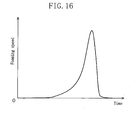
- FIG. 16 is a graph showing changes in foaming speed with time when an expandable resin is allowed to freely expand with no pressure applied thereon. The figure shows that with free expansion, i.e., with the pressure relieved, foaming rapidly progressed.
- the core-backing speed the speed of core-backing
- pressure relief due to this may rapidly develop foaming of the expandable resin to such an extent as to cause a breakage of the skin layer being formed by contact with the molding surfaces of the mold.
- the expandable resin itself has a high foaming pressure. This easily causes breakage of the skin layer owing to abrupt expandable resin foaming due to core-backing, thereby degrading the appearance of the resultant molded article. Furthermore, foaming agent leaks out through broken holes of the skin layer, which makes the internal expanding condition of the article uneven and reduces the foam expansion ratio.
- the mold takes much heat from the expandable resin and thereby decreases the expandable resin temperature. Therefore, the expandable resin increases its viscosity, which works more against its expansion or foaming as the end of core-backing approaches. Furthermore, cooldown and curing of the expandable resin progress fast. Therefore, the expandable resin may not expand to an expected thickness and easily results in a molded article having uneven thickness.
- the present invention has an object of providing a molded foamed resin product free from foaming defects and having a good appearance by appropriately controlling the core-backing speed.
- the core-backing speed in the previous core-backing term is made slower than that in the latter core-backing term.
- an aspect of the present invention is directed to a molding method for producing a molded foamed resin product in which an expandable resin containing a resin material containing a foaming agent is charged into a cavity between a stationary mold half and a movable mold half and core-backing is then performed by setting the movable mold half back from the stationary mold half to extend the cavity to a volume corresponding to the size of the molded foamed resin product.
- the core-backing speed is controlled to be low in a previous core-backing term and higher in a latter core-backing term than in the previous core-backing term.
- Another aspect of the present invention is directed to a molding apparatus for producing a molded foamed resin product
- a mold including a stationary mold half and a movable mold half; a movable mold half actuator for sliding the movable mold half towards and away from the stationary mold half; and an injector for charging an expandable resin containing a resin material containing a foaming agent into a cavity between the stationary mold half and the movable mold half, in which, after the charging of the expandable resin, core-backing is performed by setting the movable mold half back from the stationary mold half to extend the cavity to a volume corresponding to the size of the molded foamed resin product.
- the molding apparatus includes a controller for controlling the movement of the movable mold half actuator so that the core-backing speed is low in a previous core-backing term and higher in a latter core-backing term than in the previous core-backing term.
- the core-backing speed is made low in the previous core-backing term in which the expandable resin has high foaming pressures. This restrains an abrupt foaming of the expandable resin and avoids the foaming from causing breakage of the skin layer. Furthermore, since the core-backing speed is higher in the latter core-backing term than in the previous core-backing term, the foaming of the expandable resin is promoted during the latter core-backing term, which is advantageous in rapidly and uniformly expanding the entire expandable resin in spite of increase in its viscosity.
- the core-backing is preferably started after the elapse of a predetermined delay time from the end of charging of the expandable resin. Since the predetermined delay time exists, the formation of the skin layer progresses during the delay time, which is advantageous in preventing breakage of the skin layer due to the foaming.
- the core-backing speed in the latter core-backing term is preferably equal to or lower than the expansion speed of the expandable resin in free expansion. The reason for this is that if the core-backing speed in the latter core-backing term is higher than the expansion speed, a gap will be created between the movable mold half and the expandable resin and foaming gas in the resin may leak out through the resin surface to reduce the scale foam expansion ratio and cause breakage of the skin layer.
- the core-backing may be continued without stopping the movable mold half over the previous and latter core-backing terms. This eliminates time loss and enhances production efficiency.
- the core-backing speed may be reduced to zero during transition from the previous core-backing term to the latter core-backing term. In this case, while the core-backing speed is zero, the formation of the skin layer progresses, thereby forming a high-strength skin layer. This is advantageous in preventing the skin layer from being broken through by the foaming of the expandable resin.
- Applicable foaming agents include organic compounds including azo compounds such as azodicarbon amid, nitroso compounds such as N,N'-dinitroso-pentamethylene tetramine, and sulfonyl hydrazide compounds such as 4,4'-oxybis(benzenesulfonyl hydrazide), inorganic compounds such as sodium bicarbonate, other chemical foaming agents, and physical foaming agents such as carbon dioxide gas, nitrogen gas, air, propane and butane. Particularly for the physical foaming agents, if they are in the form of supercritical fluid, they can disperse and dissolve well into a resin material and enhance the foaming pressure. Therefore, the physical foaming agent is preferably used in the form of supercritical fluid.
- the physical foaming agents generally have higher foaming pressures than chemical foaming agents. Therefore, the above core-backing controls according to the present invention are useful particularly for the physical foaming agents.
- the supercritical fluid when used as the foaming agent, fine bubble cells are formed under the skin layer, which is advantageous in ensuring the rigidity of the molded article while reducing the weight thereof.
- Figure 1 shows a molding apparatus for producing a molded foamed resin product, wherein reference numeral 1 denotes a mold and reference numeral 2 denotes an injector for charging an expandable resin into the cavity of the mold 1.
- the mold 1 is composed of a stationary mold half 3 and a movable mold half 4 movable towards and away from the stationary mold half 3.
- the stationary mold half 3 has a sprue 5 formed therein.
- the mold 1 is connected to a movable mold half actuator 6 for sliding the movable mold half 4 towards and away from the stationary mold half 3.
- the movable mold half actuator 6 is composed of a piston/cylinder assembly 7 and a guide 8 for guiding the forward and backward movement of the movable mold half 4 actuated by the piston/cylinder assembly 7.
- the movement of the piston/cylinder assembly 7 is controlled by a controller 9 using a microcomputer.
- the injector 2 includes a cylinder 11 having a screw rotatably inserted therein and a heater disposed on the outer periphery thereof.
- the cylinder 11 is provided at the tip with a nozzle 12.
- the nozzle 12 is connected to the sprue 5 in the stationary mold half 3.
- the cylinder 11 is also provided at the root end with a hopper 13 for feeding an expandable resin or a resin material and a screw actuator 14 for rotating and reciprocating the screw.
- the expandable resin In molding an expandable resin containing a chemical foaming agent, the expandable resin is loaded through the hopper 13 into the cylinder 11. In molding an expandable resin containing a physical foaming agent, a resin material is loaded through the hopper 13 into the cylinder 11 and the physical foaming agent is fed in the form of supercritical fluid from a supercritical fluid generator 15 partway into the cylinder 11. In producing a fiber-reinforced molded foamed resin product, reinforcing fibers are mixed in advance into a resin material.
- Reinforcing fibers preferably used are those having an average fiber length smaller than the thickness of a molded foamed resin product to be produced in a direction of sliding of the movable mold half (a core-backing direction).
- molded foamed resin products preferably molded are those having a larger thickness in the core-backing direction than the average fiber length of reinforcing fibers used, particularly those having a thickness twice larger than the average fiber length. This is advantageous in utilizing the spring-back effect of reinforcing fibers to promote foaming of the expandable resin.
- the type of reinforcing fibers used is not particularly limited. For example, glass fibers or carbon fibers may be used.
- the controller 9 controls the movable mold half actuator 6 to perform core-backing, i.e., set the movable mold half 4 back from the stationary mold half 3.
- core-backing i.e., set the movable mold half 4 back from the stationary mold half 3.
- the cavity 16 is extended to a volume corresponding to the size of a molded article.
- Figures 2B, 2C and 2D schematically show a state of the mold 1 when the delay time from the end of charging of the expandable resin to the start of core-backing terminates, a state of the mold 1 in process of core-backing and a state of the mold 1 at the end of core-backing, respectively.
- the bold border line in the cavity 16 denotes a skin layer 22 at the surface of the expandable resin
- reference numeral 23 denotes an expanding foam of the expandable resin
- reference numeral 24 denotes a molded foamed resin product after the end of foaming (after the end of core-backing).
- Figure 3 is a time chart showing a core-backing control according to Example 1.
- the controller 9 receives a signal indicating the end of charging of an expandable resin (the end of injection) from the injector 2 and then starts core-backing at an interval of a predetermined delay time.
- the core-backing term is divided into a previous core-backing term Tf in which core-backing is performed at a low speed and a latter core-backing term Ts in which core-backing is performed at a higher speed than in the previous core-backing term Tf.
- the controller 9 controls core-backing so that, in the previous core-backing term Tf, the movable mold half 4 is accelerated from a speed of zero up to a first speed V1 and held at the first speed V1 for a predetermined time and, in the latter core-backing term Ts, the movable mold half 4 is accelerated from the first speed V1 up to a second speed V2, then held at the second speed V2 for a predetermined time and then decelerated down to a speed of zero.
- the second speed V2 is higher than the first speed V1 and the first and second speeds V1 and V2 are set to be equal to or lower than the expansion speed of the expandable resin in free expansion and, preferably, to be lower than the expansion speed.
- the lengths of the delay time, the previous core-backing term Tf and the latter core-backing term Ts vary depending upon the type and the injection temperature of expandable resin used and the mold temperature.
- the delay time can be set within the range of 5 to 25 seconds and the previous core-backing term Tf and the latter core-backing term Ts can be set within the range of 1 to 10 seconds.
- the cavity 16 can be extended in the previous core-backing term Tf, for example, so that its thickness in the core-backing direction becomes 1.3 times to 1.7 times larger than that at the end of charging of the expandable resin, and can be extended in the latter core-backing term Ts, for example, so that its thickness in the core-backing direction becomes 2.1 times to 2.6 times larger than that at the end of charging of the expandable resin.
- Figure 4 shows changes in the amount of backward movement (the core-backing distance) of the movable mold half 4 due to the core-backing control with time. After a delay time has passed from the end of charging, the previous core-backing term Tf is reached. The amount of backward movement of the movable mold half 4 gradually increases during the previous core-backing term Tf and then gradually increases at a higher speed during the latter core-backing term Ts.
- Figures 5 to 8 stepwise illustrates how a molded foamed resin product 24 is molded by the core-backing control.
- a supercritical fluid of carbon dioxide gas as a foaming agent and glass fibers as reinforcing fibers 25
- the molded article 24 was obtained that has a thickness in the core-backing direction twice or more times larger than the average fiber length (1.0 to 1.8 mm) of the reinforcing fibers 25.
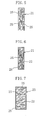
- Figure 5 shows an expandable resin 21 at the end of charging into the mold.
- the expandable resin 21 flows through the sprue 5 in the stationary mold half 3 shown in Figure 2 into the cavity 16 towards its surrounding region. Therefore, by the effect of the flow in the cavity 16, the reinforcing fibers 25 are oriented along the opposed molding surfaces of the fixed and movable mold halves 3 and 4 (in a direction substantially orthogonal to the core-backing direction (the thickness direction of the molded article)).
- Figure 6 shows the expandable resin 21 when the delay time has passed.
- the expandable resin 21 gives heat at a part thereof in contact with the molding surfaces of the mold 1 (at its surrounding surface) to the mold 1 and thereby starts curing to gradually form a skin layer 22 around it.
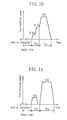
- FIG 7 shows the expandable resin 21 at the end of the previous core-backing term Tf. Since core-backing starts and reduces the in-mold pressure, the expandable resin 21 develops expansion and gradually becomes a foam 23. During the previous core-backing term Tf, the expandable resin 21 has high foaming pressures as shown in Figure 9 and the spring-back effect of the reinforcing fibers 25 causes an expansion force inside the expandable resin 21. However, since the core-backing speed is restricted to the first speed V1, this avoids an abrupt foaming of the foaming agent and prevents foaming from progressing to such an extent as to cause a breakage of the skin layer 2. Also during the previous core-backing term Tf, the foam 23 gives heat to the mold 1 to gradually form the skin layer 22 and gradually increase the strength of the skin layer 22.
- Figure 8 shows the expandable resin 21 at the end of the latter core-backing term Ts.
- the core-backing speed is set at the second speed V2 higher than the first speed V1 in the previous core-backing term Tf. Therefore, by a combination of in-mold pressure reduction due to core-backing at the higher speed and the spring-back effect of the reinforcing fibers 25, the foaming agent in the foam 23 rapidly expands so that the entire foam 23 uniformly expands and foams. Since the high-strength skin layer 22 has yet been formed at the start of the latter core-backing term Ts, this prevents the skin layer 22 from breaking owing to the foaming during the latter core-backing term Ts. As a result, a good appearance molded foamed resin product 24 can be obtained that has a homogeneous foam structure under the skin layer 22.
- Figure 10 shows a core-backing control according to Example 2.
- the core-backing speed is stepwise increased so as to be first increased to a first A speed V1a, held at the first A speed V1a for a certain period of time, then increased to a first B speed V1b and then held at the first B speed V1b for a certain period of time.
- the core-backing speed is increased to the second speed V2 higher than in the previous core-backing term Tf and held at the second speed V2 for a certain period of time. Then, the core-backing is terminated.
- the core-backing speed is restricted to relatively low speeds V1a and V1b in the previous core-backing term Tf and increased to a relatively high second speed V2 in the latter core-backing term Ts. Therefore, like Example 1, the entire foam can be uniformly expanded without breaking through the skin layer. As a result, a good appearance molded foamed resin product can be obtained that has a homogeneous foam structure under the skin layer.
- the core-backing speed is stepwise increased in the previous core-backing term Tf, this is advantageous in promoting a smooth expandable resin foaming towards the latter core-backing term Ts while preventing the skin layer from being broken through by abrupt foaming of the foaming agent.
- the core-backing speed may be continuously increased during the previous core-backing term Tf until the cavity volume of the mold extends up to 1.3 to 1.7 times larger than its original volume, and then may reach the second speed V2 in the latter core-backing term Ts.
- Figure 11 shows a core-backing control according to Example 3.
- the core-backing speed is increased to the first speed V1, held at the first speed V1 for a certain period of time and then reduced to zero to stop the core-backing. Thereafter, when the latter core-backing term Ts is reached, the core-backing speed is increased to the second speed V2.
- Example 2 a good appearance molded foamed resin product can be obtained that has a homogeneous foam structure under the skin layer. Furthermore, since the core-backing speed is once reduced to zero during transition from the previous core-backing term Tf to the latter core-backing term Ts, this is advantageous in forming a high-strength skin layer to prevent the skin layer from being broken through by foaming.
- Figure 12 shows a core-backing control according to Example 4.
- the core-backing speed is increased to the first speed V1, held at the first speed V1 for a certain period of time, then once reduced to zero to stop the core-backing, then increased again to the first speed V1, held at the first speed V1 for a certain period of time and then reduced again to zero.
- the core-backing speed is increased to the second speed V2.
- Example 2 a good appearance molded foamed resin product can be obtained that has a homogeneous foam structure under the skin layer. Furthermore, since the core-backing speed is once reduced to zero midway in the previous core-backing term Tf, this is advantageous in forming a high-strength skin layer to prevent the skin layer from being broken through by foaming.
- Figure 13 shows a core-backing control according to Example 5.
- the core-backing speed is stepwise increased first to a first A speed V1a and then to a first B speed V1b in the previous core-backing term Tf after the elapse of the delay time, and then increased to the second speed V2 when the latter core-backing term Ts is reached.
- the core-backing speed is reduced to zero between the first A and B speeds V1a and V1b and between the first B speed V1b and the second speed V2 in the latter core-backing term Ts.
- Example 2 a good appearance molded foamed resin product can be obtained that has a homogeneous foam structure under the skin layer. Furthermore, since the core-backing speed is once reduced to zero midway in the previous core-backing term Tf, this is advantageous in forming a high-strength skin layer to prevent the skin layer from being broken through by foaming.
- Figure 14 shows a core-backing control according to Example 6.
- the core-backing speed is once reduced to zero midway in the previous core-backing term Tf after the elapse of the delay time.
- the first B speed V1b is lower than the first A speed V1a.
- the rest of the core-backing control are the same as according to Example 5.
- a good appearance molded foamed resin product can be obtained that has a homogeneous foam structure under the skin layer. Furthermore, since the core-backing speed is once reduced to zero midway in the previous core-backing term Tf, this is advantageous in forming a high-strength skin layer to prevent the skin layer from being broken through by foaming. Furthermore, since the first B speed V1b is lower than the first A speed V1a, the core-backing can make the transition from the previous core-backing term Tf to the latter core-backing term Ts with bubble cells in the foam arrayed, which is advantageous in forming homogeneous bubble cells.
- Figure 15 shows a core-backing control according to Example 7.
- core-backing is immediately started without giving any delay time and the core-backing speed is stepwise increased as in Example 5. Since, however, no delay time is given after the end of charging unlike Example 5, the first A and B speeds V1a and V1b in the previous core-backing term Tf are restricted to lower levels.
- Example 2 a good appearance molded foamed resin product can be obtained that has a homogeneous foam structure under the skin layer.
- the molding method and apparatus for producing a molded foamed resin product according to the present invention can be applied to molding of automotive parts and other various kinds of molded foamed resin products.
- applicable automotive parts include door module plates in which a speaker, a door latch assembly, a door lock actuating mechanism, a glass elevating mechanism and the like are incorporated, bumpers and other plate articles.
Landscapes
- Injection Moulding Of Plastics Or The Like (AREA)
- Molding Of Porous Articles (AREA)
Applications Claiming Priority (1)
| Application Number | Priority Date | Filing Date | Title |
|---|---|---|---|
| JP2006194262A JP2008018677A (ja) | 2006-07-14 | 2006-07-14 | 発泡樹脂成形品の成形方法及び成形装置 |
Publications (2)
| Publication Number | Publication Date |
|---|---|
| EP1878555A2 true EP1878555A2 (fr) | 2008-01-16 |
| EP1878555A3 EP1878555A3 (fr) | 2009-06-17 |
Family
ID=38562187
Family Applications (1)
| Application Number | Title | Priority Date | Filing Date |
|---|---|---|---|
| EP07012278A Withdrawn EP1878555A3 (fr) | 2006-07-14 | 2007-06-22 | Procédé de moulage et appareil pour produire un produit en résine de mousse moulé |
Country Status (4)
| Country | Link |
|---|---|
| US (1) | US20080012166A1 (fr) |
| EP (1) | EP1878555A3 (fr) |
| JP (1) | JP2008018677A (fr) |
| CN (1) | CN101104299A (fr) |
Cited By (5)
| Publication number | Priority date | Publication date | Assignee | Title |
|---|---|---|---|---|
| WO2009121615A3 (fr) * | 2008-04-04 | 2010-06-10 | Otto Bock Schaumsysteme Gmbh | Procédé d'élaboration de pièce moulée et outil de formage approprié |
| WO2012103451A3 (fr) * | 2011-01-27 | 2013-01-10 | New Balance Athletic Shoe, Inc. | Systèmes de moulage par injection et procédés de formation de matériaux utilisés dans articles chaussants et matériaux fabriqués par lesdits systèmes et procédés |
| WO2017001461A1 (fr) * | 2015-07-02 | 2017-01-05 | Universität Stuttgart | Procédé permettant d'agir sur l'orientation de matières de charge dans de la matière plastique fondue pendant la fabrication d'un corps moulé par un procédé de moulage par injection |
| US9956732B2 (en) | 2014-08-06 | 2018-05-01 | New Balance Athletics, Inc. | Injection molding systems and methods for forming materials used in footwear and materials manufactured by said systems and methods |
| CN111590809A (zh) * | 2020-05-23 | 2020-08-28 | 侯奥 | 一种可调节式多功能发泡模具装置 |
Families Citing this family (7)
| Publication number | Priority date | Publication date | Assignee | Title |
|---|---|---|---|---|
| RU2543901C2 (ru) | 2010-08-05 | 2015-03-10 | ФОРД ГЛОУБАЛ ТЕКНОЛОДЖИЗ, ЭлЭлСи | Устройство и способ инжекционного формования вспененных полимеров |
| CN103895147A (zh) * | 2014-04-09 | 2014-07-02 | 郁震宇 | 调模机构 |
| JP5872668B1 (ja) | 2014-11-20 | 2016-03-01 | 東芝機械株式会社 | 開閉装置、成形装置および成形方法 |
| JP6456735B2 (ja) * | 2015-03-19 | 2019-01-23 | 東北資材工業株式会社 | 補助充填機及びこれを用いた発泡樹脂成形品の製造方法 |
| CN109591243A (zh) * | 2018-11-23 | 2019-04-09 | 苏州富顺新型包装材料股份有限公司 | 一种发泡塑料产品的镜面成型工艺及其应用 |
| DE102020206378B4 (de) | 2019-05-20 | 2022-06-30 | Ford Global Technologies, Llc | Verfahren zur Herstellung einer Belüftungslamelle mit schallabsorbierendem Schaum |
| WO2022220148A1 (fr) * | 2021-04-15 | 2022-10-20 | 株式会社プライムポリマー | Corps en mousse moulé par injection |
Family Cites Families (5)
| Publication number | Priority date | Publication date | Assignee | Title |
|---|---|---|---|---|
| DE69735855T2 (de) * | 1996-02-16 | 2006-09-14 | Idemitsu Kosan Co. Ltd. | Verfahren zum herstellen eines leichten, faserverstärkten gegenstands aus thermoplastischem harz und leichtes formprodukt |
| DE60117322T2 (de) * | 2000-06-22 | 2006-11-02 | Mitsui Chemicals, Inc. | Verfahren, Vorrichtung und Zusammensetzung zum Spritzgiessen von Schaum |
| JP3802774B2 (ja) * | 2001-04-09 | 2006-07-26 | 日泉化学株式会社 | 発泡成形品の製造方法 |
| CA2477149C (fr) * | 2002-02-28 | 2012-10-02 | Ube Machinery Corporation, Ltd. | Procede de moulage par injection et a dilatation |
| JP4074618B2 (ja) * | 2002-04-26 | 2008-04-09 | 株式会社プライムポリマー | 吸音体、吸音構造体およびこれらの製造方法 |
-
2006
- 2006-07-14 JP JP2006194262A patent/JP2008018677A/ja not_active Abandoned
-
2007
- 2007-06-20 CN CNA2007101118918A patent/CN101104299A/zh active Pending
- 2007-06-22 EP EP07012278A patent/EP1878555A3/fr not_active Withdrawn
- 2007-07-09 US US11/822,586 patent/US20080012166A1/en not_active Abandoned
Cited By (7)
| Publication number | Priority date | Publication date | Assignee | Title |
|---|---|---|---|---|
| WO2009121615A3 (fr) * | 2008-04-04 | 2010-06-10 | Otto Bock Schaumsysteme Gmbh | Procédé d'élaboration de pièce moulée et outil de formage approprié |
| WO2012103451A3 (fr) * | 2011-01-27 | 2013-01-10 | New Balance Athletic Shoe, Inc. | Systèmes de moulage par injection et procédés de formation de matériaux utilisés dans articles chaussants et matériaux fabriqués par lesdits systèmes et procédés |
| US9708456B2 (en) | 2011-01-27 | 2017-07-18 | New Balance Athletics, Inc. | Injection molding systems and methods for forming materials used in footwear and materials manufactured by said systems and methods |
| US9956732B2 (en) | 2014-08-06 | 2018-05-01 | New Balance Athletics, Inc. | Injection molding systems and methods for forming materials used in footwear and materials manufactured by said systems and methods |
| WO2017001461A1 (fr) * | 2015-07-02 | 2017-01-05 | Universität Stuttgart | Procédé permettant d'agir sur l'orientation de matières de charge dans de la matière plastique fondue pendant la fabrication d'un corps moulé par un procédé de moulage par injection |
| CN111590809A (zh) * | 2020-05-23 | 2020-08-28 | 侯奥 | 一种可调节式多功能发泡模具装置 |
| CN111590809B (zh) * | 2020-05-23 | 2022-11-08 | 芜湖达锦新材料科技有限公司 | 一种可调节式多功能发泡模具装置 |
Also Published As
| Publication number | Publication date |
|---|---|
| EP1878555A3 (fr) | 2009-06-17 |
| US20080012166A1 (en) | 2008-01-17 |
| JP2008018677A (ja) | 2008-01-31 |
| CN101104299A (zh) | 2008-01-16 |
Similar Documents
| Publication | Publication Date | Title |
|---|---|---|
| US20080012166A1 (en) | Molding method and apparatus for producing molded foamed resin product | |
| EP0876891B1 (fr) | Procédé pour obtenir un produit moulé par injection en matière plastique à gaz introduit renforcé de fibres et machine de moulage par injection pour mise en oeuvre de ce procédé | |
| KR102265615B1 (ko) | 발포 폼 엠브리오의 제조를 위한 장치 및 방법 | |
| EP3144119B1 (fr) | Procédé de fabrication d'un article moulé | |
| US8500426B2 (en) | Apparatus for controlling counterpressure and temperature in mold cavity | |
| US6451230B1 (en) | Method for injection molding molded parts from thermoplastic and added fluid | |
| EP1806217A1 (fr) | Procédé et appareil pour la production d'un article moulé en résine moussée | |
| EP2737989B1 (fr) | Procédé et dispositif de production d'élément tuyau | |
| KR101255770B1 (ko) | 열가소성 수지의 사출발포 성형방법 | |
| US20130328229A1 (en) | Process and device for producing an injection moulding | |
| WO2021070853A1 (fr) | Article moulé en résine | |
| EP2208598B1 (fr) | Procédé et appareil pour le moulage d'un produit en mousse de résine | |
| JP2010162765A (ja) | 熱硬化性樹脂発泡成形体の製造方法およびそれにより得られる発泡成形体 | |
| JPH10315262A (ja) | 繊維強化樹脂の成形方法および成形品 | |
| JP2008018678A (ja) | 発泡樹脂成形品の成形方法及び成形装置 | |
| JP2002210776A (ja) | 発泡成形体の超音波成形方法及び超音波成形装置 | |
| JP2009095982A (ja) | 発泡樹脂成形品の成形方法及び成形装置 | |
| JPH10305467A (ja) | ガラス繊維強化熱可塑性樹脂の成形方法および成形品 | |
| EP4023410B1 (fr) | Article moulé en résine | |
| JP2000210969A (ja) | 発泡射出成形法及びその装置 | |
| JP2011046011A (ja) | 表皮付き発泡樹脂成形品の成形方法及び成形装置 | |
| KR100517596B1 (ko) | 플라스틱 발포 사출 방법 | |
| Di Maio et al. | Molding processes | |
| JP5277607B2 (ja) | 発泡成形体の製造方法 | |
| JP2005074794A (ja) | 熱可塑性樹脂組成物発泡成形体の成形装置 |
Legal Events
| Date | Code | Title | Description |
|---|---|---|---|
| PUAI | Public reference made under article 153(3) epc to a published international application that has entered the european phase |
Free format text: ORIGINAL CODE: 0009012 |
|
| AK | Designated contracting states |
Kind code of ref document: A2 Designated state(s): AT BE BG CH CY CZ DE DK EE ES FI FR GB GR HU IE IS IT LI LT LU LV MC MT NL PL PT RO SE SI SK TR |
|
| AX | Request for extension of the european patent |
Extension state: AL BA HR MK YU |
|
| PUAL | Search report despatched |
Free format text: ORIGINAL CODE: 0009013 |
|
| AK | Designated contracting states |
Kind code of ref document: A3 Designated state(s): AT BE BG CH CY CZ DE DK EE ES FI FR GB GR HU IE IS IT LI LT LU LV MC MT NL PL PT RO SE SI SK TR |
|
| AX | Request for extension of the european patent |
Extension state: AL BA HR MK RS |
|
| RIC1 | Information provided on ipc code assigned before grant |
Ipc: B29C 44/04 20060101ALI20090514BHEP Ipc: B29C 44/60 20060101ALI20090514BHEP Ipc: B29C 44/58 20060101AFI20071012BHEP |
|
| AKX | Designation fees paid | ||
| STAA | Information on the status of an ep patent application or granted ep patent |
Free format text: STATUS: THE APPLICATION IS DEEMED TO BE WITHDRAWN |
|
| 18D | Application deemed to be withdrawn |
Effective date: 20091218 |
|
| REG | Reference to a national code |
Ref country code: DE Ref legal event code: 8566 |