EP1879247B1 - Matériau actif d'anode pour batterie secondaire au lithium hybridisé par des nano fibres de carbone - Google Patents
Matériau actif d'anode pour batterie secondaire au lithium hybridisé par des nano fibres de carbone Download PDFInfo
- Publication number
- EP1879247B1 EP1879247B1 EP07252760A EP07252760A EP1879247B1 EP 1879247 B1 EP1879247 B1 EP 1879247B1 EP 07252760 A EP07252760 A EP 07252760A EP 07252760 A EP07252760 A EP 07252760A EP 1879247 B1 EP1879247 B1 EP 1879247B1
- Authority
- EP
- European Patent Office
- Prior art keywords
- carbon nano
- active material
- anode active
- nano fibers
- secondary battery
- Prior art date
- Legal status (The legal status is an assumption and is not a legal conclusion. Google has not performed a legal analysis and makes no representation as to the accuracy of the status listed.)
- Not-in-force
Links
- 239000006183 anode active material Substances 0.000 title claims abstract description 130
- OKTJSMMVPCPJKN-UHFFFAOYSA-N Carbon Chemical compound [C] OKTJSMMVPCPJKN-UHFFFAOYSA-N 0.000 title claims abstract description 112
- 229910052744 lithium Inorganic materials 0.000 title claims abstract description 40
- WHXSMMKQMYFTQS-UHFFFAOYSA-N Lithium Chemical compound [Li] WHXSMMKQMYFTQS-UHFFFAOYSA-N 0.000 title claims abstract description 38
- 229910052799 carbon Inorganic materials 0.000 title claims description 40
- VNWKTOKETHGBQD-UHFFFAOYSA-N methane Chemical class C VNWKTOKETHGBQD-UHFFFAOYSA-N 0.000 claims abstract description 169
- 239000002134 carbon nanofiber Substances 0.000 claims abstract description 158
- 229910002804 graphite Inorganic materials 0.000 claims abstract description 53
- 239000010439 graphite Substances 0.000 claims abstract description 52
- 239000010405 anode material Substances 0.000 claims abstract description 39
- 238000000034 method Methods 0.000 claims abstract description 36
- 229910021417 amorphous silicon Inorganic materials 0.000 claims abstract description 31
- 229910052751 metal Inorganic materials 0.000 claims abstract description 30
- 239000002184 metal Substances 0.000 claims abstract description 30
- 239000003054 catalyst Substances 0.000 claims abstract description 23
- 238000005229 chemical vapour deposition Methods 0.000 claims abstract description 6
- 239000007789 gas Substances 0.000 claims description 27
- 229910052710 silicon Inorganic materials 0.000 claims description 27
- 229910052802 copper Inorganic materials 0.000 claims description 21
- 239000002245 particle Substances 0.000 claims description 20
- UFHFLCQGNIYNRP-UHFFFAOYSA-N Hydrogen Chemical compound [H][H] UFHFLCQGNIYNRP-UHFFFAOYSA-N 0.000 claims description 19
- 238000010438 heat treatment Methods 0.000 claims description 19
- 239000001257 hydrogen Substances 0.000 claims description 19
- 229910052739 hydrogen Inorganic materials 0.000 claims description 19
- 239000001307 helium Substances 0.000 claims description 16
- 229910052734 helium Inorganic materials 0.000 claims description 16
- SWQJXJOGLNCZEY-UHFFFAOYSA-N helium atom Chemical compound [He] SWQJXJOGLNCZEY-UHFFFAOYSA-N 0.000 claims description 16
- VGGSQFUCUMXWEO-UHFFFAOYSA-N Ethene Chemical compound C=C VGGSQFUCUMXWEO-UHFFFAOYSA-N 0.000 claims description 11
- 239000005977 Ethylene Substances 0.000 claims description 11
- ATRRKUHOCOJYRX-UHFFFAOYSA-N Ammonium bicarbonate Chemical compound [NH4+].OC([O-])=O ATRRKUHOCOJYRX-UHFFFAOYSA-N 0.000 claims description 9
- 229910000013 Ammonium bicarbonate Inorganic materials 0.000 claims description 9
- 229910002651 NO3 Inorganic materials 0.000 claims description 9
- NHNBFGGVMKEFGY-UHFFFAOYSA-N Nitrate Chemical compound [O-][N+]([O-])=O NHNBFGGVMKEFGY-UHFFFAOYSA-N 0.000 claims description 9
- 235000012538 ammonium bicarbonate Nutrition 0.000 claims description 9
- 239000001099 ammonium carbonate Substances 0.000 claims description 9
- UGFAIRIUMAVXCW-UHFFFAOYSA-N Carbon monoxide Chemical compound [O+]#[C-] UGFAIRIUMAVXCW-UHFFFAOYSA-N 0.000 claims description 8
- PXHVJJICTQNCMI-UHFFFAOYSA-N nickel Substances [Ni] PXHVJJICTQNCMI-UHFFFAOYSA-N 0.000 claims description 8
- HSFWRNGVRCDJHI-UHFFFAOYSA-N alpha-acetylene Natural products C#C HSFWRNGVRCDJHI-UHFFFAOYSA-N 0.000 claims description 7
- 125000002534 ethynyl group Chemical group [H]C#C* 0.000 claims description 7
- 239000000203 mixture Substances 0.000 claims description 7
- KBJMLQFLOWQJNF-UHFFFAOYSA-N nickel(ii) nitrate Chemical compound [Ni+2].[O-][N+]([O-])=O.[O-][N+]([O-])=O KBJMLQFLOWQJNF-UHFFFAOYSA-N 0.000 claims description 6
- 229910002091 carbon monoxide Inorganic materials 0.000 claims description 5
- 229910052759 nickel Inorganic materials 0.000 claims description 5
- 229910052725 zinc Inorganic materials 0.000 claims description 5
- 238000000498 ball milling Methods 0.000 claims description 4
- 229910052742 iron Inorganic materials 0.000 claims description 4
- 238000001694 spray drying Methods 0.000 claims description 4
- 229910052718 tin Inorganic materials 0.000 claims description 4
- BVKZGUZCCUSVTD-UHFFFAOYSA-L Carbonate Chemical compound [O-]C([O-])=O BVKZGUZCCUSVTD-UHFFFAOYSA-L 0.000 claims description 3
- VEXZGXHMUGYJMC-UHFFFAOYSA-M Chloride anion Chemical compound [Cl-] VEXZGXHMUGYJMC-UHFFFAOYSA-M 0.000 claims description 3
- 150000004703 alkoxides Chemical class 0.000 claims description 3
- 239000012298 atmosphere Substances 0.000 claims description 3
- 238000001027 hydrothermal synthesis Methods 0.000 claims description 3
- 229910052749 magnesium Inorganic materials 0.000 claims description 3
- 229910052748 manganese Inorganic materials 0.000 claims description 3
- 238000001556 precipitation Methods 0.000 claims description 3
- 238000003980 solgel method Methods 0.000 claims description 3
- 239000007921 spray Substances 0.000 claims description 3
- 229910052719 titanium Inorganic materials 0.000 claims description 3
- 238000007740 vapor deposition Methods 0.000 claims description 3
- 229910052726 zirconium Inorganic materials 0.000 claims description 3
- 229910052738 indium Inorganic materials 0.000 claims description 2
- 238000002203 pretreatment Methods 0.000 claims description 2
- 238000002360 preparation method Methods 0.000 description 59
- XUIMIQQOPSSXEZ-UHFFFAOYSA-N Silicon Chemical compound [Si] XUIMIQQOPSSXEZ-UHFFFAOYSA-N 0.000 description 36
- 229910021382 natural graphite Inorganic materials 0.000 description 33
- 238000007599 discharging Methods 0.000 description 26
- 239000010703 silicon Substances 0.000 description 25
- 239000000463 material Substances 0.000 description 24
- 230000000052 comparative effect Effects 0.000 description 21
- 239000010949 copper Substances 0.000 description 20
- RYGMFSIKBFXOCR-UHFFFAOYSA-N Copper Chemical compound [Cu] RYGMFSIKBFXOCR-UHFFFAOYSA-N 0.000 description 18
- 239000011230 binding agent Substances 0.000 description 18
- 229910021419 crystalline silicon Inorganic materials 0.000 description 18
- 239000002086 nanomaterial Substances 0.000 description 18
- 239000002002 slurry Substances 0.000 description 17
- 239000002041 carbon nanotube Substances 0.000 description 16
- 229910021393 carbon nanotube Inorganic materials 0.000 description 16
- 239000000835 fiber Substances 0.000 description 16
- 238000003892 spreading Methods 0.000 description 15
- 230000007480 spreading Effects 0.000 description 15
- XLYOFNOQVPJJNP-UHFFFAOYSA-N water Substances O XLYOFNOQVPJJNP-UHFFFAOYSA-N 0.000 description 15
- 239000010453 quartz Substances 0.000 description 14
- VYPSYNLAJGMNEJ-UHFFFAOYSA-N silicon dioxide Inorganic materials O=[Si]=O VYPSYNLAJGMNEJ-UHFFFAOYSA-N 0.000 description 14
- 239000007787 solid Substances 0.000 description 14
- 239000000725 suspension Substances 0.000 description 14
- 238000003801 milling Methods 0.000 description 12
- 238000006243 chemical reaction Methods 0.000 description 10
- 239000011863 silicon-based powder Substances 0.000 description 10
- 125000004122 cyclic group Chemical group 0.000 description 9
- 238000010000 carbonizing Methods 0.000 description 8
- 239000011248 coating agent Substances 0.000 description 8
- 238000000576 coating method Methods 0.000 description 8
- 238000001914 filtration Methods 0.000 description 7
- 239000007770 graphite material Substances 0.000 description 7
- 238000011282 treatment Methods 0.000 description 7
- HBBGRARXTFLTSG-UHFFFAOYSA-N Lithium ion Chemical compound [Li+] HBBGRARXTFLTSG-UHFFFAOYSA-N 0.000 description 6
- 229910001416 lithium ion Inorganic materials 0.000 description 6
- 238000012423 maintenance Methods 0.000 description 6
- 238000000354 decomposition reaction Methods 0.000 description 5
- XEEYBQQBJWHFJM-UHFFFAOYSA-N iron Substances [Fe] XEEYBQQBJWHFJM-UHFFFAOYSA-N 0.000 description 5
- 230000008569 process Effects 0.000 description 5
- 229910003481 amorphous carbon Inorganic materials 0.000 description 4
- 230000005540 biological transmission Effects 0.000 description 4
- UFMZWBIQTDUYBN-UHFFFAOYSA-N cobalt dinitrate Chemical compound [Co+2].[O-][N+]([O-])=O.[O-][N+]([O-])=O UFMZWBIQTDUYBN-UHFFFAOYSA-N 0.000 description 4
- 229910001981 cobalt nitrate Inorganic materials 0.000 description 4
- 230000007423 decrease Effects 0.000 description 4
- 238000011161 development Methods 0.000 description 4
- 239000010410 layer Substances 0.000 description 4
- 238000004519 manufacturing process Methods 0.000 description 4
- 229920000049 Carbon (fiber) Polymers 0.000 description 3
- 229910000676 Si alloy Inorganic materials 0.000 description 3
- 239000011149 active material Substances 0.000 description 3
- 238000004220 aggregation Methods 0.000 description 3
- 230000002776 aggregation Effects 0.000 description 3
- 229910021383 artificial graphite Inorganic materials 0.000 description 3
- 239000004917 carbon fiber Substances 0.000 description 3
- 239000003575 carbonaceous material Substances 0.000 description 3
- 230000008859 change Effects 0.000 description 3
- 239000006258 conductive agent Substances 0.000 description 3
- 238000005516 engineering process Methods 0.000 description 3
- 238000003780 insertion Methods 0.000 description 3
- 230000037431 insertion Effects 0.000 description 3
- 150000002739 metals Chemical class 0.000 description 3
- 230000003647 oxidation Effects 0.000 description 3
- 238000007254 oxidation reaction Methods 0.000 description 3
- 238000011946 reduction process Methods 0.000 description 3
- 238000002407 reforming Methods 0.000 description 3
- 230000002441 reversible effect Effects 0.000 description 3
- 229910052709 silver Inorganic materials 0.000 description 3
- XKRFYHLGVUSROY-UHFFFAOYSA-N Argon Chemical group [Ar] XKRFYHLGVUSROY-UHFFFAOYSA-N 0.000 description 2
- -1 Li1.71~4.4Si Chemical compound 0.000 description 2
- 229910018590 Ni(NO3)2-6H2O Inorganic materials 0.000 description 2
- MCMNRKCIXSYSNV-UHFFFAOYSA-N Zirconium dioxide Chemical compound O=[Zr]=O MCMNRKCIXSYSNV-UHFFFAOYSA-N 0.000 description 2
- 239000012300 argon atmosphere Substances 0.000 description 2
- 239000000571 coke Substances 0.000 description 2
- 239000006185 dispersion Substances 0.000 description 2
- 238000001035 drying Methods 0.000 description 2
- 239000007772 electrode material Substances 0.000 description 2
- 239000003792 electrolyte Substances 0.000 description 2
- 238000009396 hybridization Methods 0.000 description 2
- 230000001939 inductive effect Effects 0.000 description 2
- MVFCKEFYUDZOCX-UHFFFAOYSA-N iron(2+);dinitrate Chemical compound [Fe+2].[O-][N+]([O-])=O.[O-][N+]([O-])=O MVFCKEFYUDZOCX-UHFFFAOYSA-N 0.000 description 2
- 239000002923 metal particle Substances 0.000 description 2
- 238000002156 mixing Methods 0.000 description 2
- 230000001590 oxidative effect Effects 0.000 description 2
- 239000000843 powder Substances 0.000 description 2
- 239000002243 precursor Substances 0.000 description 2
- 238000011160 research Methods 0.000 description 2
- 239000002210 silicon-based material Substances 0.000 description 2
- 239000011856 silicon-based particle Substances 0.000 description 2
- 239000000243 solution Substances 0.000 description 2
- 239000002344 surface layer Substances 0.000 description 2
- 238000012360 testing method Methods 0.000 description 2
- 229910052723 transition metal Inorganic materials 0.000 description 2
- 150000003624 transition metals Chemical class 0.000 description 2
- XMWRBQBLMFGWIX-UHFFFAOYSA-N C60 fullerene Chemical compound C12=C3C(C4=C56)=C7C8=C5C5=C9C%10=C6C6=C4C1=C1C4=C6C6=C%10C%10=C9C9=C%11C5=C8C5=C8C7=C3C3=C7C2=C1C1=C2C4=C6C4=C%10C6=C9C9=C%11C5=C5C8=C3C3=C7C1=C1C2=C4C6=C2C9=C5C3=C12 XMWRBQBLMFGWIX-UHFFFAOYSA-N 0.000 description 1
- 229910000733 Li alloy Inorganic materials 0.000 description 1
- 229910001290 LiPF6 Inorganic materials 0.000 description 1
- 239000002033 PVDF binder Substances 0.000 description 1
- 239000002253 acid Substances 0.000 description 1
- 239000000654 additive Substances 0.000 description 1
- 229910045601 alloy Inorganic materials 0.000 description 1
- 239000000956 alloy Substances 0.000 description 1
- 229910052782 aluminium Inorganic materials 0.000 description 1
- 239000007864 aqueous solution Substances 0.000 description 1
- 229910052786 argon Inorganic materials 0.000 description 1
- QVGXLLKOCUKJST-UHFFFAOYSA-N atomic oxygen Chemical compound [O] QVGXLLKOCUKJST-UHFFFAOYSA-N 0.000 description 1
- 229910052796 boron Inorganic materials 0.000 description 1
- 239000000919 ceramic Substances 0.000 description 1
- 238000000975 co-precipitation Methods 0.000 description 1
- 238000004891 communication Methods 0.000 description 1
- 230000000536 complexating effect Effects 0.000 description 1
- 238000001816 cooling Methods 0.000 description 1
- 150000004696 coordination complex Chemical class 0.000 description 1
- 239000002180 crystalline carbon material Substances 0.000 description 1
- 230000006378 damage Effects 0.000 description 1
- 230000003247 decreasing effect Effects 0.000 description 1
- 238000000151 deposition Methods 0.000 description 1
- 238000010586 diagram Methods 0.000 description 1
- 239000011883 electrode binding agent Substances 0.000 description 1
- 238000002474 experimental method Methods 0.000 description 1
- 239000010419 fine particle Substances 0.000 description 1
- 229910003472 fullerene Inorganic materials 0.000 description 1
- 238000010574 gas phase reaction Methods 0.000 description 1
- 229910052737 gold Inorganic materials 0.000 description 1
- 239000002391 graphite-based active material Substances 0.000 description 1
- XLYOFNOQVPJJNP-UHFFFAOYSA-M hydroxide Chemical compound [OH-] XLYOFNOQVPJJNP-UHFFFAOYSA-M 0.000 description 1
- 230000006872 improvement Effects 0.000 description 1
- 229910001853 inorganic hydroxide Inorganic materials 0.000 description 1
- 229910052809 inorganic oxide Inorganic materials 0.000 description 1
- 230000002452 interceptive effect Effects 0.000 description 1
- 150000002500 ions Chemical class 0.000 description 1
- 230000001788 irregular Effects 0.000 description 1
- 238000003475 lamination Methods 0.000 description 1
- 238000002074 melt spinning Methods 0.000 description 1
- 238000002844 melting Methods 0.000 description 1
- 230000008018 melting Effects 0.000 description 1
- 150000002736 metal compounds Chemical class 0.000 description 1
- 229910001960 metal nitrate Inorganic materials 0.000 description 1
- 229910044991 metal oxide Inorganic materials 0.000 description 1
- 150000004706 metal oxides Chemical class 0.000 description 1
- 239000005300 metallic glass Substances 0.000 description 1
- 239000011806 microball Substances 0.000 description 1
- 239000011812 mixed powder Substances 0.000 description 1
- 239000007773 negative electrode material Substances 0.000 description 1
- 229910000480 nickel oxide Inorganic materials 0.000 description 1
- 239000003960 organic solvent Substances 0.000 description 1
- GNRSAWUEBMWBQH-UHFFFAOYSA-N oxonickel Chemical class [Ni]=O GNRSAWUEBMWBQH-UHFFFAOYSA-N 0.000 description 1
- 239000001301 oxygen Substances 0.000 description 1
- 229910052760 oxygen Inorganic materials 0.000 description 1
- 239000004033 plastic Substances 0.000 description 1
- 229920001296 polysiloxane Polymers 0.000 description 1
- 229920002981 polyvinylidene fluoride Polymers 0.000 description 1
- 230000002265 prevention Effects 0.000 description 1
- 230000009467 reduction Effects 0.000 description 1
- 239000004065 semiconductor Substances 0.000 description 1
- 238000005245 sintering Methods 0.000 description 1
- 239000002904 solvent Substances 0.000 description 1
- 239000012798 spherical particle Substances 0.000 description 1
- 239000000126 substance Substances 0.000 description 1
- XOLBLPGZBRYERU-UHFFFAOYSA-N tin dioxide Chemical compound O=[Sn]=O XOLBLPGZBRYERU-UHFFFAOYSA-N 0.000 description 1
- 229910001887 tin oxide Inorganic materials 0.000 description 1
Images







Classifications
-
- H—ELECTRICITY
- H01—ELECTRIC ELEMENTS
- H01M—PROCESSES OR MEANS, e.g. BATTERIES, FOR THE DIRECT CONVERSION OF CHEMICAL ENERGY INTO ELECTRICAL ENERGY
- H01M4/00—Electrodes
- H01M4/02—Electrodes composed of, or comprising, active material
- H01M4/36—Selection of substances as active materials, active masses, active liquids
- H01M4/58—Selection of substances as active materials, active masses, active liquids of inorganic compounds other than oxides or hydroxides, e.g. sulfides, selenides, tellurides, halogenides or LiCoFy; of polyanionic structures, e.g. phosphates, silicates or borates
- H01M4/583—Carbonaceous material, e.g. graphite-intercalation compounds or CFx
- H01M4/587—Carbonaceous material, e.g. graphite-intercalation compounds or CFx for inserting or intercalating light metals
-
- B—PERFORMING OPERATIONS; TRANSPORTING
- B82—NANOTECHNOLOGY
- B82Y—SPECIFIC USES OR APPLICATIONS OF NANOSTRUCTURES; MEASUREMENT OR ANALYSIS OF NANOSTRUCTURES; MANUFACTURE OR TREATMENT OF NANOSTRUCTURES
- B82Y30/00—Nanotechnology for materials or surface science, e.g. nanocomposites
-
- D—TEXTILES; PAPER
- D01—NATURAL OR MAN-MADE THREADS OR FIBRES; SPINNING
- D01F—CHEMICAL FEATURES IN THE MANUFACTURE OF ARTIFICIAL FILAMENTS, THREADS, FIBRES, BRISTLES OR RIBBONS; APPARATUS SPECIALLY ADAPTED FOR THE MANUFACTURE OF CARBON FILAMENTS
- D01F9/00—Artificial filaments or the like of other substances; Manufacture thereof; Apparatus specially adapted for the manufacture of carbon filaments
- D01F9/08—Artificial filaments or the like of other substances; Manufacture thereof; Apparatus specially adapted for the manufacture of carbon filaments of inorganic material
- D01F9/12—Carbon filaments; Apparatus specially adapted for the manufacture thereof
- D01F9/127—Carbon filaments; Apparatus specially adapted for the manufacture thereof by thermal decomposition of hydrocarbon gases or vapours or other carbon-containing compounds in the form of gas or vapour, e.g. carbon monoxide, alcohols
-
- H—ELECTRICITY
- H01—ELECTRIC ELEMENTS
- H01M—PROCESSES OR MEANS, e.g. BATTERIES, FOR THE DIRECT CONVERSION OF CHEMICAL ENERGY INTO ELECTRICAL ENERGY
- H01M4/00—Electrodes
- H01M4/02—Electrodes composed of, or comprising, active material
- H01M4/36—Selection of substances as active materials, active masses, active liquids
- H01M4/362—Composites
- H01M4/364—Composites as mixtures
-
- H—ELECTRICITY
- H01—ELECTRIC ELEMENTS
- H01M—PROCESSES OR MEANS, e.g. BATTERIES, FOR THE DIRECT CONVERSION OF CHEMICAL ENERGY INTO ELECTRICAL ENERGY
- H01M4/00—Electrodes
- H01M4/02—Electrodes composed of, or comprising, active material
- H01M4/36—Selection of substances as active materials, active masses, active liquids
- H01M4/362—Composites
- H01M4/366—Composites as layered products
-
- H—ELECTRICITY
- H01—ELECTRIC ELEMENTS
- H01M—PROCESSES OR MEANS, e.g. BATTERIES, FOR THE DIRECT CONVERSION OF CHEMICAL ENERGY INTO ELECTRICAL ENERGY
- H01M4/00—Electrodes
- H01M4/02—Electrodes composed of, or comprising, active material
- H01M4/36—Selection of substances as active materials, active masses, active liquids
- H01M4/38—Selection of substances as active materials, active masses, active liquids of elements or alloys
- H01M4/386—Silicon or alloys based on silicon
-
- H—ELECTRICITY
- H01—ELECTRIC ELEMENTS
- H01M—PROCESSES OR MEANS, e.g. BATTERIES, FOR THE DIRECT CONVERSION OF CHEMICAL ENERGY INTO ELECTRICAL ENERGY
- H01M10/00—Secondary cells; Manufacture thereof
- H01M10/05—Accumulators with non-aqueous electrolyte
- H01M10/052—Li-accumulators
- H01M10/0525—Rocking-chair batteries, i.e. batteries with lithium insertion or intercalation in both electrodes; Lithium-ion batteries
-
- H—ELECTRICITY
- H01—ELECTRIC ELEMENTS
- H01M—PROCESSES OR MEANS, e.g. BATTERIES, FOR THE DIRECT CONVERSION OF CHEMICAL ENERGY INTO ELECTRICAL ENERGY
- H01M4/00—Electrodes
- H01M4/02—Electrodes composed of, or comprising, active material
- H01M2004/021—Physical characteristics, e.g. porosity, surface area
-
- Y—GENERAL TAGGING OF NEW TECHNOLOGICAL DEVELOPMENTS; GENERAL TAGGING OF CROSS-SECTIONAL TECHNOLOGIES SPANNING OVER SEVERAL SECTIONS OF THE IPC; TECHNICAL SUBJECTS COVERED BY FORMER USPC CROSS-REFERENCE ART COLLECTIONS [XRACs] AND DIGESTS
- Y02—TECHNOLOGIES OR APPLICATIONS FOR MITIGATION OR ADAPTATION AGAINST CLIMATE CHANGE
- Y02E—REDUCTION OF GREENHOUSE GAS [GHG] EMISSIONS, RELATED TO ENERGY GENERATION, TRANSMISSION OR DISTRIBUTION
- Y02E60/00—Enabling technologies; Technologies with a potential or indirect contribution to GHG emissions mitigation
- Y02E60/10—Energy storage using batteries
Definitions
- the present invention relates to an anode active material hybridizing carbon nano fibers for lithium secondary battery and a manufacturing method for preparing an anode for lithium secondary battery. More particularly, this invention relates to anode active material selected from amorphous silicon or a complex of graphite and amorphous silicon on which carbon nano fibers are grown and hybridized, and a preparation method thereof, wherein carbon nano fibers are grown on the surface of anode active material.
- anode active material such as inorganic coating, crystalline carbon coating, pyrocarbon coating, carbon nano fiber dispersion or carbon nano tube dispersion
- Such methods prevent the destruction of crystalline structure in anode material in the course of inserting/emitting the lithium ions in lithium secondary battery.
- natural graphite anode material coated with crystalline carbon has been developed in order to improve the charge and discharge properties of lithium secondary battery.
- anode active material is prepared by a carbon/metal complex using carbon material and a metal precursor.
- Korean Patent No. 536,247 'Anode active material for lithium secondary battery and lithium secondary battery containing said anode' disclosed that anode active material is prepared by forming the inorganic oxide or hydroxide layer, such as Al, Ag, B, Zn, or Zr to the surface of graphite carbon material according to the heat treatment process.
- the surface coating material shall be uniformly dispersed before coating. Further, to obtain a uniformed metal oxide layer, a large amount of metal precursors shall be required. On the other hand, a plate type of graphite which is not a spherical particle is hard to be uniformly dispersed, which requires additional heat treatment to prepare the layer having uniformed thickness.
- metal silicon anode material has been known that it shows more than 10 times high energy density compared to that of graphite anode material.
- the volume expansion caused by alloy of lithium and silicon, such as Li 1.71 ⁇ 4.4 Si is induced, which is 4 times larger than that of silicon itself. Therefore, this expansion causes the decomposition of silicon electrode structure, which results in the rapid decline of discharging capacity even less than 20% of the initial discharging capacity.
- the silicon material shall lose the function of anode active material.
- many researches have been carried out to enhance the stability of silicon electrode structure.
- Some representative examples include the uses of nano size particle of silicon and the uses of alloy with transition metal, such as nickel or copper, carbon/silicon complex, changing the oxygen contents of silicon and/or development of electrode binder.
- transition metal such as nickel or copper
- carbon/silicon complex changing the oxygen contents of silicon and/or development of electrode binder.
- the decline of capacity by repeating the charging and discharging cycles as well as the maintenance of more than 1000mAh/g of high capacity of silicon anode material has not been solved yet.
- Carbon nano material such as vapor-grow carbon fibers (VGCF), carbon nano tubes, carbon nano fibers or fullerene, has been developed as carbon electrode material.
- PCT Patent pamphlet WO 03/67699 A2 disclosed that anode active material for lithium battery is prepared by mixed materials of spherical graphite of meso-phase carbon micro-balls; carbon nano-fibers (VGCF) of 200nm diameter and 65 ⁇ 70nm inner core diameter; and an ion conducting polymeric binder.
- Japanese Patent Early publication No. 2004-186067 disclosed that anode active material for lithium battery is prepared by a mixture of carbon nano fibers having 10 ⁇ 500nm of average diameter and carbon agglutinated particles.
- carbon nano material such as the carbon nano tube or the carbon nano fiber has large surface area
- such material has a handicap due to the high ratio of volume to weight in the electrode. Therefore, according to the increase of amount of carbon nano material, the processibility of electrode has to be declined due to the difficulty of binding the nano material with current collector in the electrode. Further, the high cost of carbon nano material compared to graphite is another handicap for commercializing.
- Korean Patent No. 566,028 'Carbon nano material for anode active material of lithium secondary battery and its preparation method' disclosed the carbon nano fiber complex with metal particles, such as Ag, Sn, Mg, Pd, or Zn as anode active material.
- metal particles such as Ag, Sn, Mg, Pd, or Zn as anode active material.
- the simple complex of carbon nano material with anode material causes another handicap, because the growth of carbon nano fibers has been made in an irregular direction as well as in a large volume density of carbon nano fibers in the electrode.
- carbon nano fibers have a main role of anode active material, which results in low cyclic property of the carbon nano fiber itself.
- anode active material shall be prepared by introducing heat treatment process at more than 2000 °C. Even though the electro-conductivity between anode active materials can be enhanced by adding a conductive agent, the decomposition of structure caused by fundamental volume expansion cannot be avoided in the course of charging and discharging cycles.
- U.S.Pat. No. 6,440,610 B1 'Anode active material for lithium secondary battery and its preparation method' disclosed a method for growing the vapor deposition carbon nano fiber or nano tube at the surface of anode active material. It has been disclosed that the vapor grown carbon fiber is prepared by the steps comprising i) adsorbing metal nitrate particle to the anode material by spray drying method after mixing and dissolving metal salt in an aqueous solution, ii) heating the obtained material in a high temperature for oxidation and reduction process, and iii) growing the carbon nano fiber by a vapor deposition method.
- this preparation method has following drawbacks of i) inducing the aggregation of metal nitrate particles having strong hydrophilic property in the course of preparing a catalyst, ii) irregularly growing the carbon nano fiber due to said aggregation, iii) sintering the metal catalyst particles during the continuous carbonation, oxidation and reduction in high temperature, and iv) inducing the thermal change of graphite particles.
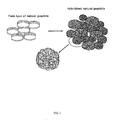
- FIG. 1 illustrates the structure of graphite hybridized with carbon nano fibers according to the present invention.
- Carbon nano fibers are hybridized with stacked natural graphite to be used as anode active material of lithium secondary battery.
- carbon nano fibers of the present invention surround the stacked natural graphite in a vine form. Therefore, the surface of natural graphite is hybridized with carbon nano fibers in which natural graphite particles function as support material for carbon nano fibers.
- the disclosure of present invention is different from that of U.S. Pat. No. 6,440,610 B1 'Negative active material for lithium secondary battery and manufacturing method of same', in which carbon nano material is grown in a vertical direction or a slope direction from the surface of graphite anode active material.
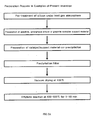
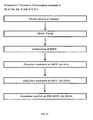
- FIG. 2(A) the process diagram for preparing carbon nano fibers of the present invention shown in FIG. 2(A) is different from the process disclosed in U.S. Pat. No. 6,440,610 B1 as shown in FIG. 2(C) .
- the carbon nano fiber grown on the surface of crystalline silicon particles may be easily detached at the time of compressing the particles, because the binding force between the crystalline silicon particle and the carbon nano fiber becomes low.
- the carbon nano fiber inclines to be easily detached from the surface of crystalline silicon when the outside force is influenced. Therefore, the carbon nano fiber cannot surround the surface of crystalline silicon effectively, which cannot prevent the volume expansion of silicon in the course of repeating the charging/discharging cycles.
- the alloy of silicon with other rare metals has been attempted in order to enhance the charging/discharging property of silicon.
- the silicon alloy having high charging/discharging properties has not been developed yet.
- anode active material composed by graphite or metal in the lithium secondary battery inclines to be expanded or contracted during the insertion/emission of lithium ion, which results in the decomposition of crystalline structure.
- this anode material can not be used any longer due to the decline of cyclic capacity.
- the inventors recently found a new method making amorphous silicone by adding shear stress to the crystalline silicon in an inert atmosphere, which results in the decomposition of crystalline structure of silicon. Further, the high degree of amorphous silicon can be obtained if the shear stress is added by mixing graphite particles with the silicon. Using the high degree of amorphous silicon, the growth of carbon nano fibers can be made in a hybridized form on the silicon anode active material. Eventually, the adjustment of crystalline portion and amorphous portion in the silicon structure enables to control the hybridization of carbon nano fibers with the silicon anode active material.
- the present invention can be completed by developing hybridized material between the carbon nano fiber and the anode active material which maintains the high capacity charging/discharging properties and the cyclic properties of graphite and/or silicon material.
- the object of the present invention is to provide anode active material hybridized with carbon nano fibers for lithium secondary battery prepared by following steps comprising, i) dispersing the nano size metal catalyst to the surface of anode material selected from amorphous silicon or a complex of graphite and amorphous silicon; and ii) growing the carbon nano fiber by a chemical vapor deposition method, wherein carbon nano fibers are grown on the surface of the anode active material; wherein said amorphous silicon is prepared by pre-treatment using mechanical friction energy under an inert atmosphere.
- the complex of graphite and amorphous silicon is prepared by the weight ratio of 1 ⁇ 50 wt% of graphite and 50 ⁇ 99 wt% of amorphous silicon.
- the structure of the carbon nano fiber is platelet or herringbone structure hybridized with anode active material.
- the grown amount of carbon nano fibers is 1 ⁇ 200 wt part as to 100 wt part of anode active material
- the diameter of carbon nano fibers is 5 ⁇ 300 nm
- the aspect ratio is 10 ⁇ 10000
- the thickness of carbon nano fibers on the active anode material is 5 ⁇ 1000 nm.
- the preferred grown amount of carbon nano fibers is 5 ⁇ 100 wt part as to 100 wt part of anode active material
- the preferred diameter of carbon nano fibers is 5 ⁇ 100 nm
- the preferred aspect ratio is 10 ⁇ 1000
- the preferred thickness of carbon nano fibers on the active anode material is 10 ⁇ 500 nm.
- the further preferred grown amount of carbon nano fibers is 10 ⁇ 80 wt part as to 100 wt part of anode active material, the further preferred diameter of carbon nano fibers is 5 ⁇ 50 nm, the further preferred aspect ratio is 10 ⁇ 100, the further preferred thickness of carbon nano fibers on the active anode material is 15 ⁇ 200 nm.
- said carbon nano fiber is prepared by a chemical vapor deposition method using a carbon source selected from carbon monoxide, methane, acetylene or ethylene in the presence of metal catalyst.
- said metal catalyst comprised at least one selected from the group consisting of Fe, Co, Ni, Cu, Mg, Mn, Ti, Sn, Si, Zr, Zn, Ge, Pb and In, which is in the form of alkoxide, oxide, chloride, nitrate or carbonate, and this catalyst can be prepared in the form of a supported catalyst using a sol-gel method, a precipitation method, a hydrothermal reaction method, a spray heating method, a spray drying method or a ball-mill method.
- said carbon nano fiber is prepared by following steps comprising i) heating the anode active material particles selected from amorphous silicon or a complex of graphite and amorphous silicon using mixed gas of helium and hydrogen (3 ⁇ 5 L/min: 1 L/min) at 300 ⁇ 650°C; ii) growing the carbon nano fiber by vapor deposition using a carbon source selected from carbon monoxide, methane, acetylene or ethylene in the presence of catalyst composition made by nickel nitrate and ammonium bicarbonate in mixed gas of helium and hydrogen at 400 ⁇ 800 °C.
- the other object of the present invention is to provide lithium secondary battery prepared by anode active material of the present invention.
- FIG. 1 shows the change of structure of anode active material while carbon nano fibers are grown and hybridized with a graphite active plate.
- FIG. 2A shows a process flow for preparing the carbon nano fiber on the anode active material in Examples of the present invention.
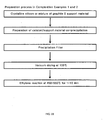
- FIG. 2B shows a process for preparing the carbon nano fiber on the anode active material in Comparative Examples 1 and 2 of the present invention.
- FIG. 2C shows a process for preparing the carbon nano fiber on the anode active material in Comparative Example 4 ( U.S.Pat. No. 6,440,610 B1 ).
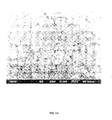
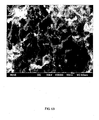
- FIG. 3 is a Field Emission Scanning Electron Microscope (FE-SEM) photography of the surface of graphite in Preparation Example 1, where the carbon nano fiber is hybridized.
- FIG. 3A is a photography (magnitude x1000)
- FIG. 3B is a photography (magnitude x5000)
- FIG. 3C is a photography (magnitude x100000).
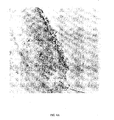
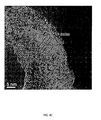
- FIG. 4 is a high resolution transmission electron microscope (TEM) photography of the surface of graphite in Preparation Example 1, where the carbon nano fiber is hybridized in a vine form.
- FIG. 4A and FIG. 4B show carbon nano fibers on the surface of graphite and
- FIG. 4C shows the herringbone structure of the carbon nano fiber.
- FIG. 5 is a Field Emission Scanning Electron Microscope (FE-SEM) photography of the surface of silicon in Preparation Example 4, where the carbon nano fiber is hybridized.
- FIG. 5A is a photography (magnitude x1000)
- FIG. 5B is a photography (magnitude x10000)
- FIG. 5C is a photography (magnitude x50000).
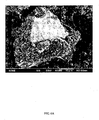
- FIG. 6 is a Field Emission Scanning Electron Microscope (FE-SEM) photography of the surface of silicon in Comparative Preparation Example 2, where the carbon nano fiber is not hybridized, but simply stacked.
- FIG. 6A is a photography (magnitude x2000) and
- FIG. 6B is a photography (magnitude x50000).
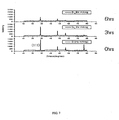
- FIG. 7 is a graph indicating X-Ray Diffractometer (XRD) peak of the silicon powder used in Preparation Examples 3 and 4, according to the time lapse of planetary mill treatment. It shows that the crystalline degree of silicon is declined according to the planetary mill treatment.
- XRD X-Ray Diffractometer
- FIG. 8 is a graph indicating X-Ray Diffractometer (XRD) peak of the complex of the silicon and the graphite powder used in Preparation Examples 5 ⁇ 9, according to the time lapse of planetary mill treatment. It shows that the crystalline degree of silicon is declined according to the planetary mill treatment. The intensity of the plane (111) of silicon and graphite complexes decreases.
- XRD X-Ray Diffractometer
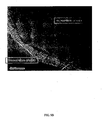
- FIG. 9A is the diffraction pattern of transmission electron microscope (TEM) of the silicon powder used in Preparation Example 4 after planetary mill treatment.
- FIG. 9B is a high resolution transmission electron microscope (TEM) photograph of said silicon powder whose surface is partially amorphous
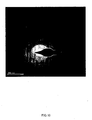
- FIG. 10 is the diffraction pattern of transmission electron microscope (TEM) of the silicon powder used in Preparation Example 9 after planetary mill treatment, which shows the crystalline silicon changes to an amorphous form.
- TEM transmission electron microscope
- the present invention affords the anode active material hybridized with the carbon nano fiber for lithium secondary battery, wherein the carbon nano fiber is grown in a vine form and surrounds the surface of anode active material selected from amorphous silicon and/or the complex of graphite and amorphous silicon.
- the metal catalyst for growing the carbon nano fiber has been prepared by co-precipitation method in an aqueous solution. Further, in order to grow the carbon nano fiber in a vine form, said metal catalyst has been uniformly dispersed on the surface of anode active material, followed by drying and heating the mixture of metal catalyst and anode active material.
- the carbon nano fiber with following structure can be prepared.
- the diameter of the obtained carbon nano fiber is 5 ⁇ 300 nm
- the aspect ratio is 10 ⁇ 10000
- the form of the carbon nano fiber is platelet or herringbone structure
- the thickness of the carbon nano fiber covering the surface of the active anode material is 5 ⁇ 1000 nm. Because the grown carbon nano fiber surrounds anode active material in a vine form, the prevention of volume expansion of anode active material can be made in the course of inserting/emitting the lithium ion.
- the preferred diameter of the obtained carbon nano fiber is 5 ⁇ 50 nm
- the preferred aspect ratio is 10 ⁇ 100
- the preferred thickness of the carbon nano fiber covering the surface of the active anode material is 15 ⁇ 200 nm.
- the carbon nano tube is grown on the surface of anode active material, the enhancement of electro-conductivity can be made, while the charging/discharging properties are declined compared to those of the case applying the carbon nano fiber, according to the repetition of cycles. It has been considered that the volume expansion of anode active material can not be controlled by the carbon nano tube grown on the surface of anode active material.
- graphite material has been used as anode active material instead of pure lithium metal for lithium secondary battery.
- Various kinds of carbon material such as carbon nano fiber, cokes, meso-carbon, artificial graphite and/or natural graphite, have been used as anode active material.
- crystalline graphite has been commercially used as anode active material, because it can maintain the broader voltage flatness compared to that of cokes or amorphous carbon.
- the catalyst for preparing a carbon nano fiber has been already known.
- transition metals such as Fe, Co, and Ni
- at least 1 metal catalyst selected from Fe, Co, Ni, Cu, Mg, Mn, Ti, Sn, Si, Zr, Zn, Ge, Pb and/or In has been used.
- the form of catalyst can be a form of alkoxide, oxide, chloride, nitrate or carbonate.
- anode active material For supporting the metal catalyst particle on the surface of anode active material, a sol-gel method, a precipitation method, a hydrothermal reaction method, a spray heating method, a spray drying method and/or a ball-mill method can be used. Further, anode active material containing metal particles can be prepared by introducing further oxidation or reduction process. However, the preferred preparation method does not require further oxidation or reduction process.
- carbon sources such as carbon monoxide, methane, acetylene and/or ethylene
- the preferred carbon source may be carbon mono oxide or ethylene in the temperature range of 400 ⁇ 800 °C.
- the growing amount of a carbon nano fiber can be 5 ⁇ 200 wt% as to the amount of anode active material.
- the preferred amount of the carbon nano fiber shall be 5 ⁇ 100 wt% as to the amount of anode active material.
- the electrode of secondary battery can be prepared in a known method. Specifically, the electrode has been prepared with following steps comprising i) dissolving the binder (PVDF) with NMP solvent ; ii) preparing the slurry containing the binder and the anode active material where their wt ratio is 15 : 85, respectively; and iii) coating the obtained slurry on the copper plate whose thickness is 15 micro meter.
- the prepared electrode shall be dried in a vacuum oven at 120 ⁇ 180 °C for 12 hours. After drying the obtained electrode, the surface of the electrode is pressed using a roller in order to bind the electrode strongly to the copper plate as well as to maintain the density of electrode constantly.
- the shape of the electrode is coin shape with 12 mm of diameter.
- FE-SEM the growth of carbon nano fibers has been confirmed on the carbon nano fiber/graphite hybridized anode active material.
- the apparatus for observation is FE-SEM model JSM-6700F made by JEOL and the standard magnitude of SEM is adjusted to x100000 at the time of starting. Further, TEM observation has been made simultaneously to interpret the structure under 200 kV condition.
- the gas phase carbonizing reaction is carried out for 5 min by flowing ethylene : hydrogen : helium (80 ml/min : 40 ml/min : 80 ml/min) mixed gas. It has been revealed that the amount of the synthesized carbon nano fiber is 23 wt%, the aspect ratio is more than 50, and the diameter of fiber is 10 ⁇ 50nm which is obtained from the FE-SEM observation. Also, through the TEM observation, the structure of the carbon nano fiber is observed as herringbone structure.
- FIG. 3 and FIG. 4 show the structure of the carbon nano fiber obtained in this Example.
- the obtained material is heated from 100°C to 580°C in a heating velocity of 10°C/min with flowing helium : hydrogen mixed gas (160ml/min : 40ml/min).
- the material is laid at 580°C for 2 hours.
- the gas phase carbonizing reaction is carried out for 30 min by flowing carbon monooxide : hydrogen (160 ml/min : 40 ml/min) mixed gas.
- the amount of the synthesized carbon nano fiber is 16 wt%, the aspect ratio is more than 50, and the diameter of the fiber is 20 ⁇ 60nm which is obtained from the FE-SEM observation. Also, through the TEM observation, the structure of the carbon nano fiber is observed as platelet structure.
- crystalline silicon and 500g of metal sphere having 10mm diameter are laid on 500ml of metal bowl in argon atmosphere.
- crystalline silicon is milled with rotation at 200rpm.
- the milling time is 3 hours ( FIG. 7 ).
- 10g of milled partially amorphous silicon powder, 0.99g of cobalt nitrate (Co (NO 3 ) 3 9H 2 O), 2.2g of ammonium bicarbonate(NH 4 HCO 3 ) and 300ml of water are mixed for 1 hour to prepare suspension.
- the removal of water content is performed by filtering the obtained suspension using a funnel filter.
- the obtained solid content is dried using a vacuum oven at 100°C for 24 hours.
- Anode active material and carbon nano fibers are prepared as the same manner with Preparation Example 1 except that the milling time using planetary mill is changed from 3 hours to 6 hours ( FIG. 7 and FIG. 9 ).
- the amount of the synthesized carbon nano fiber is 31 wt%, the aspect ratio is more than 50, and the diameter of the fiber is 10 ⁇ 20nm which is obtained from the FE-SEM observation. Also, through the TEM observation, the structure of the carbon nano fiber is observed as herringbone structure.
- FIG. 5 shows the structure of the carbon nano fiber obtained in this Example.
- the obtained solid content is dried using a vacuum oven at 100°C for 24 hours. 1g of dried graphite solid content is coated on the quartz plate. Using a horizontal quartz tube, the obtained material is heated from 300 °C to 550°C in a heating velocity of 10°C/min with flowing helium : hydrogen mixed gas (160ml/min : 40ml/min). The material is laid at 550°C for 2 hours. The gas phase carbonizing reaction is carried out for 10 min by flowing ethylene : hydrogen : helium (80 ml/min : 40 ml/min : 80 ml/min) mixed gas.
- the amount of the synthesized carbon nano fiber is 12 wt%, the aspect ratio is more than 50, and the diameter of the fiber is 10 ⁇ 20nm which is obtained from the FE-SEM observation. Also, through the TEM observation, the structure of the carbon nano fiber is observed as herringbone structure.
- Anode active material and carbon nano fibers are prepared as the same manner with Preparation Example 5 except that the milling time using planetary mill is changed from 1 hour to 8 hours ( FIG. 8 ).
- the amount of the synthesized carbon nano fiber is 21 wt%, the aspect ratio is more than 50, and the diameter of the fiber is 10 ⁇ 20nm which is obtained from the FE-SEM observation. Also, through the TEM observation, the structure of the carbon nano fiber is observed as herringbone structure.
- Anode active material and carbon nano fibers are prepared as the same manner with Preparation Example 3 except that the milling time using a planetary mill is changed from 1 hour to 13 hours ( FIG. 8 ).
- the amount of the synthesized carbon nano fiber is 35 wt%, the aspect ratio is more than 50, and the diameter of the fiber is 10 ⁇ 20nm which is obtained from the FE-SEM observation. Also, through the TEM observation, the structure of the carbon nano fiber is observed as herringbone structure.
- Anode active material and carbon nano fibers are prepared as the same manner with Preparation Example 3 except that the milling time using a planetary mill is changed from 1 hour to 18 hours ( FIG. 8 ).
- the amount of the synthesized carbon nano fiber is 39 wt%, the aspect ratio is more than 50, and the diameter of the fiber is 10 ⁇ 20nm which is obtained from the FE-SEM observation. Also, through the TEM observation, the structure of the carbon nano fiber is observed as herringbone structure.
- Anode active material and carbon nano fibers are prepared as the same manner with Preparation Example 3 except that the milling time using planetary mill is changed from 1 hour to 25 hours ( FIG. 8 and FIG. 10 )
- the amount of the synthesized carbon nano fiber is 50 wt%, the aspect ratio is more than 50, and the diameter of the fiber is 10 ⁇ 20nm which is obtained from the FE-SEM observation. Also, through the TEM observation, the structure of the carbon nano fiber is observed as herringbone structure.
- the material is laid at 550 °C for 2 hours.
- the gas phase carbonizing reaction is carried out for 10 min by flowing ethylene : hydrogen : helium (80 ml/min : 40 ml/min : 80 ml/min) mixed gas ( FIG. 2B ).
- the amount of the synthesized carbon nano fiber is 12 wt%, the aspect ratio is more than 50, and the diameter of the fiber is 10 ⁇ 80nm which is obtained from the FE-SEM observation.
- the growth of the carbon nano fiber mainly occurs on the surface of graphite active material, whereas only the small amount of growth of the carbon nano fiber is observed on the surface of silicon.
- the material is laid at 550 °C for 2 hours.
- the gas phase carbonizing reaction is carried out for 10 min by flowing ethylene : hydrogen : helium (80 ml/min : 40 ml/min : 80 ml/min) mixed gas. It has been revealed that the amount of the synthesized carbon nano fiber is 28 wt%, the aspect ratio is more than 50, and the diameter of the fiber is 10 ⁇ 30nm which is obtained from the FE-SEM observation.
- the growth of carbon nano fiber mainly occurs only on the corner part of silicon powder, but not on the plane part of silicon powder ( FIG. 6A ). Further, silicon powder and the carbon nano fiber are easily separated without hybridization ( FIG. 6B ).
- the following description is a method for preparing carbon nano material in U.S.Pat. No. 6,440,610 B1 .
- the solution was mixed with 200 g of natural graphite.
- Graphite material on a surface layer on which particles of nickel nitrate were formed was obtained by spray drying the mixture.
- a resulting graphite material on which nickel oxides were formed was obtained by carbonizing the obtained graphite material at a temperature of 800°C, and oxidizing the carbide in air at a temperature of 400°C for about 4 hours.
- the obtained resulting graphite material was passed through a reduction process in which hydrogen was used for about 20 hours at a temperature of 500°C, obtaining natural graphite powder on a surface layer of which Ni particles were formed.
- a vapor growing fiber was grown on Ni catalysts in a vapor deposition method by putting the obtained powder into a ceramic boat and injecting acetylene gas into the boat at a temperature of about 600°C. After a reaction for about 30 minutes, acetylene gas was substituted with argon, and vapor growing fibers were slowly cooled to the ordinary temperature " ( FIG. 2C ).
- the desirable carbon nano fiber having following conditions such as diameter (5 ⁇ 300nm), aspect ratio (10 ⁇ 10000), and thickness of carbon nano fibers (5 ⁇ 1000nm) cannot be obtained. What we can obtain is only fiber type carbon polymeric material. However, we have measured the yield of the carbon nano tube using an analytical apparatus. In any event, the amount of the carbon nano tube in the carbon polymeric material is less than 5 wt% of the total carbon polymeric material.
- the gas phase carbonizing reaction is carried out for 30 min by flowing carbon monooxide : hydrogen (160 ml/min : 40 ml/min) mixed gas. It has been revealed that the amount of the synthesized carbon nano material is 5 wt%, the aspect ratio is more than 50, and the diameter of the fiber is 20 ⁇ 40nm which is obtained from the FE-SEM observation. Also, through the TEM observation, the structure of the carbon nano material is observed as carbon nano tubes.
- Table 1 shows the composition of anode active material and the amount of grown carbon nano fibers in Preparation Examples and Comparative Preparation Examples.
- Table 1 Sample Amount of graphite (wt part) Amount of silicon (wt part) Milling time (hr) Amorphous degree (%) Amount of grown carbon nano fiber(%) Com.
- Prep.Exp. 1 100 0 0 - 23
- Prep.Exp. 2 100 0 0 - 16
- Com.Prep.Exp. 3 13 87 25 89 50
- Com.Prep.Exp.4 0 100 0 0 28
- Com.Prep.Exp.5 100 0 0 - 0
- Com.Prep.Exp.6 100 0 0 - ⁇ 5
- Com.Prep.Exp.7 100 0 0 - 5
- the amount of the grown carbon nano fiber' is calculated by the following equation ; ( Weight of hybridized anode active material - weight of anode active material before reaction ) / weight of anode active material before reaction ⁇ 100 %
- the charging/discharging capacity has been measured using the anode prepared in Comparative Examples 1-2 Preparation Examples 1 ⁇ 7.
- the charging/discharging capacity has been measured using the anode prepared in Comparative Preparation Examples 3 ⁇ 7.
- the anode is prepared by hybridizing grown carbon nano fibers randomly.
- the anode is prepared by natural graphite.
- the anode is prepared by hybridizing grown carbon nano fibers randomly.
- the anode is prepared by hybridizing grown carbon nano tubes.
Landscapes
- Chemical & Material Sciences (AREA)
- Chemical Kinetics & Catalysis (AREA)
- General Chemical & Material Sciences (AREA)
- Composite Materials (AREA)
- Engineering & Computer Science (AREA)
- Electrochemistry (AREA)
- Nanotechnology (AREA)
- Physics & Mathematics (AREA)
- Condensed Matter Physics & Semiconductors (AREA)
- General Physics & Mathematics (AREA)
- Materials Engineering (AREA)
- Crystallography & Structural Chemistry (AREA)
- Inorganic Chemistry (AREA)
- Thermal Sciences (AREA)
- Textile Engineering (AREA)
- Battery Electrode And Active Subsutance (AREA)
- Carbon And Carbon Compounds (AREA)
- Catalysts (AREA)
Claims (10)
- Matériau actif d'anode hybridé avec des nanofibres de carbone pour une batterie secondaire au lithium, préparé en suivant les étapes consistant à :i) disperser un catalyseur métallique de taille nanométrique sur la surface d'un matériau d'anode choisi parmi du silicium amorphe ou un complexe de graphite et de silicium amorphe ; etii) faire croître la nanofibres de carbone par un procédé de dépôt chimique en phase vapeur, dans lequel des nanofibres de carbone sont mises en croissance sur la surface du matériau actif d'anode ; dans lequel ledit silicium amorphe est préparé par un prétraitement utilisant une énergie mécanique de frottement dans une atmosphère inerte.
- Matériau actif d'anode hybridé avec des nanofibres de carbone pour une batterie secondaire au lithium selon la revendication 1, dans lequel le complexe de graphite et de silicium amorphe est préparé de sorte à obtenir un rapport en poids de 1 à 50 % en poids de graphite et de 50 à 99 % en poids de silicium amorphe.
- Matériau actif d'anode hybridé avec des nanofibres de carbone pour une batterie secondaire au lithium selon la revendication 1, dans lequel la structure de la nanofibre de carbone est une structure de type lamelle ou arête de poisson hybridée avec le matériau actif d'anode.
- Matériau actif d'anode hybridé avec des nanofibres de carbone pour une batterie secondaire au lithium selon la revendication 1, dans lequel la quantité mise en croissance de nanofibres de carbone se situe dans la plage allant de 1 à 200 parties en poids par rapport aux 100 parties en poids de matériau actif d'anode, le diamètre des nanofibres de carbone se situe dans la plage allant de 5 300 nm, le rapport d'aspect se situe dans la plage allant de 10 à 10 000, l'épaisseur des nanofibres de carbone sur le matériau actif d'anode se situe dans la plage allant de 5 à 1 000 nm.
- Matériau actif d'anode hybridé avec des nanofibres de carbone pour une batterie secondaire au lithium selon la revendication 4, dans lequel la quantité mise en croissance de nanofibres de carbone se situe dans la plage allant de 5 à 100 parties en poids par rapport aux 100 parties en poids de matériau actif d'anode, le diamètre des nanofibres de carbone se situe dans la plage allant de 5 à 100 nm, le rapport d'aspect se situe dans la plage allant de 10 à 1 000, l'épaisseur des nanofibres de carbone sur le matériau actif d'anode se situe dans la plage allant de 10 à 500 nm.
- Matériau actif d'anode hybridé avec des nanofibres de carbone pour une batterie secondaire au lithium selon la revendication 5, dans lequel la quantité mise en croissance de nanofibres de carbone se situe dans la plage allant de 10 à 80 parties en poids par rapport aux 100 parties en poids de matériau actif d'anode, le diamètre des nanofibres de carbone se situe dans la plage allant de 5 à 50 nm, le rapport d'aspect se situe dans la plage allant de 10 à 100, l'épaisseur des nanofibres de carbone sur le matériau actif d'anode se situe dans la plage allant de 15 à 200 nm.
- Matériau actif d'anode hybridé avec des nanofibres de carbone pour une batterie secondaire au lithium selon la revendication 1, dans lequel ladite nanofibre de carbone est préparée par un procédé de dépôt chimique en phase vapeur en utilisant une source de carbone choisie parmi du monoxyde de carbone, du méthane, de l'acétylène ou de l'éthylène en présence d'un catalyseur métallique et ledit catalyseur métallique comprenant au moins un élément choisi dans le groupe comprenant les éléments Fe, Co, Ni, Cu, Mg, Mn, Ti, Sn, Si, Zr, Zn, Ge, Pb et In, qui est sous la forme d'un alcoxyde, d'un oxyde, d'un chlorure, d'un nitrate ou d'un carbonate.
- Matériau actif d'anode hybridé avec des nanofibres de carbone pour une batterie secondaire au lithium selon la revendication 7, dans lequel ledit catalyseur peut être préparé sous la forme d'un catalyseur supporté en utilisant un procédé sol-gel, un procédé de précipitation, un procédé hydrothermique, un procédé de chauffage par pulvérisation, un procédé de séchage par pulvérisation ou un procédé de broyage par boulets.
- Matériau actif d'anode hybridé avec des nanofibres de carbone pour une batterie secondaire au lithium selon la revendication 1, dans lequel ladite nanofibre de carbone est préparée en suivant les étapes consistant à :i) chauffer les particules de matériau actif d'anode choisi parmi du silicium amorphe ou un complexe de graphite et de silicium amorphe en utilisant un gaz mixte d'hélium et d'hydrogène (de 3 à 5 L/min : 1 L/min) à une température allant de 300 à 650°C; etii) faire croître la nanofibre de carbone par dépôt chimique en phase vapeur en utilisant une source de carbone choisie parmi du monoxyde de carbone, du méthane, de l'acétylène ou de l'éthylène en présence d'une composition de catalyseur comprenant du nitrate de nickel et du bicarbonate d'ammonium dans un gaz mixte d'hélium et d'hydrogène à une température allant de 400 à 800°C.
- Batterie secondaire au lithium préparée à partir d'un matériau actif d'anode selon la revendication 1.
Applications Claiming Priority (2)
| Application Number | Priority Date | Filing Date | Title |
|---|---|---|---|
| KR1020060066215A KR100835883B1 (ko) | 2006-07-14 | 2006-07-14 | 탄소나노섬유를 혼성화시킨 리튬이차전지용 음극 활물질 |
| KR1020070060218A KR100905691B1 (ko) | 2007-06-20 | 2007-06-20 | 탄소나노섬유를 혼성화시킨 리튬 이차전지용 음극 활물질 |
Publications (2)
| Publication Number | Publication Date |
|---|---|
| EP1879247A1 EP1879247A1 (fr) | 2008-01-16 |
| EP1879247B1 true EP1879247B1 (fr) | 2011-09-21 |
Family
ID=38476927
Family Applications (1)
| Application Number | Title | Priority Date | Filing Date |
|---|---|---|---|
| EP07252760A Not-in-force EP1879247B1 (fr) | 2006-07-14 | 2007-07-10 | Matériau actif d'anode pour batterie secondaire au lithium hybridisé par des nano fibres de carbone |
Country Status (4)
| Country | Link |
|---|---|
| US (1) | US20080020282A1 (fr) |
| EP (1) | EP1879247B1 (fr) |
| JP (1) | JP2008027912A (fr) |
| AT (1) | ATE525761T1 (fr) |
Families Citing this family (75)
| Publication number | Priority date | Publication date | Assignee | Title |
|---|---|---|---|---|
| US6517974B1 (en) * | 1998-01-30 | 2003-02-11 | Canon Kabushiki Kaisha | Lithium secondary battery and method of manufacturing the lithium secondary battery |
| US9431181B2 (en) | 2009-02-25 | 2016-08-30 | Catalyst Power Technologies | Energy storage devices including silicon and graphite |
| US9917300B2 (en) | 2009-02-25 | 2018-03-13 | Cf Traverse Llc | Hybrid energy storage devices including surface effect dominant sites |
| US11233234B2 (en) | 2008-02-25 | 2022-01-25 | Cf Traverse Llc | Energy storage devices |
| US9705136B2 (en) | 2008-02-25 | 2017-07-11 | Traverse Technologies Corp. | High capacity energy storage |
| US9362549B2 (en) | 2011-12-21 | 2016-06-07 | Cpt Ip Holdings, Llc | Lithium-ion battery anode including core-shell heterostructure of silicon coated vertically aligned carbon nanofibers |
| US9412998B2 (en) | 2009-02-25 | 2016-08-09 | Ronald A. Rojeski | Energy storage devices |
| CN104393257B (zh) | 2008-02-25 | 2017-09-22 | 罗纳德·安东尼·罗杰斯基 | 高容量电极 |
| US9966197B2 (en) | 2009-02-25 | 2018-05-08 | Cf Traverse Llc | Energy storage devices including support filaments |
| US9979017B2 (en) | 2009-02-25 | 2018-05-22 | Cf Traverse Llc | Energy storage devices |
| US9349544B2 (en) | 2009-02-25 | 2016-05-24 | Ronald A Rojeski | Hybrid energy storage devices including support filaments |
| US10727481B2 (en) | 2009-02-25 | 2020-07-28 | Cf Traverse Llc | Energy storage devices |
| US9941709B2 (en) | 2009-02-25 | 2018-04-10 | Cf Traverse Llc | Hybrid energy storage device charging |
| US10193142B2 (en) | 2008-02-25 | 2019-01-29 | Cf Traverse Llc | Lithium-ion battery anode including preloaded lithium |
| US10056602B2 (en) | 2009-02-25 | 2018-08-21 | Cf Traverse Llc | Hybrid energy storage device production |
| US10205166B2 (en) | 2008-02-25 | 2019-02-12 | Cf Traverse Llc | Energy storage devices including stabilized silicon |
| KR101089570B1 (ko) * | 2009-07-07 | 2011-12-05 | 금호석유화학 주식회사 | 겉보기 밀도를 조절시킨 탄소나노튜브 제조용 촉매 |
| US20110020701A1 (en) | 2009-07-16 | 2011-01-27 | Carbon Micro Battery Corporation | Carbon electrode structures for batteries |
| EP2472366B1 (fr) * | 2009-08-27 | 2016-07-13 | Kyocera Corporation | Dispositif conférant une sensation tactile et procédé de commande d'un dispositif conférant une sensation tactile |
| US8590646B2 (en) * | 2009-09-22 | 2013-11-26 | Longyear Tm, Inc. | Impregnated cutting elements with large abrasive cutting media and methods of making and using the same |
| EP2494602A1 (fr) * | 2009-10-26 | 2012-09-05 | Trustees of Boston College | Matériaux à nanostructure hétérogène destinés à être utilisés dans des dispositifs de stockage d'énergie et leurs procédés de fabrication |
| KR101156532B1 (ko) * | 2009-11-27 | 2012-06-20 | 삼성에스디아이 주식회사 | 리튬 전지용 음극 및 이를 구비한 리튬 전지 |
| CN102110821A (zh) * | 2009-12-28 | 2011-06-29 | 中国科学院大连化学物理研究所 | 一种适用于动态工况的高稳定性的燃料电池阴极催化剂 |
| US11101465B2 (en) | 2017-03-28 | 2021-08-24 | Enevate Corporation | Reaction barrier between electrode active material and current collector |
| US20170040598A1 (en) | 2015-08-07 | 2017-02-09 | Enevate Corporation | Surface modification of silicon particles for electrochemical storage |
| US9553303B2 (en) | 2010-01-18 | 2017-01-24 | Enevate Corporation | Silicon particles for battery electrodes |
| US11380890B2 (en) | 2010-01-18 | 2022-07-05 | Enevate Corporation | Surface modification of silicon particles for electrochemical storage |
| US10461366B1 (en) | 2010-01-18 | 2019-10-29 | Enevate Corporation | Electrolyte compositions for batteries |
| JP6148012B2 (ja) * | 2010-01-18 | 2017-06-14 | エネヴェート・コーポレーション | 電気化学的ストレージ用の複合材料 |
| EP2534720B1 (fr) * | 2010-02-12 | 2017-09-06 | Washington State University | Batteries lithium-ion possédant des électrodes nanostructurée et procédés de fabrication associés |
| FR2957910B1 (fr) * | 2010-03-23 | 2012-05-11 | Arkema France | Melange maitre de nanotubes de carbone pour les formulations liquides, notamment dans les batteries li-ion |
| US9876221B2 (en) | 2010-05-14 | 2018-01-23 | Samsung Sdi Co., Ltd. | Negative active material for rechargeable lithium battery and rechargeable lithium battery including same |
| CN102001701A (zh) * | 2010-11-12 | 2011-04-06 | 合肥国轩高科动力能源有限公司 | 碳包覆纳米钛酸锂材料的制备方法 |
| CN102479939B (zh) * | 2010-11-25 | 2016-08-03 | 上海交通大学 | 用于锂离子电池的电极及其制造方法 |
| DK2650955T3 (da) * | 2010-12-08 | 2016-02-15 | Nippon Coke & Engineering Co Ltd | Negativt elektrodemateriale til lithiumion-sekundærbatterier og fremgangsmåde til fremstilling heraf |
| US10388943B2 (en) | 2010-12-22 | 2019-08-20 | Enevate Corporation | Methods of reducing occurrences of short circuits and/or lithium plating in batteries |
| US9583757B2 (en) | 2010-12-22 | 2017-02-28 | Enevate Corporation | Electrodes, electrochemical cells, and methods of forming electrodes and electrochemical cells |
| US9397338B2 (en) | 2010-12-22 | 2016-07-19 | Enevate Corporation | Electrodes, electrochemical cells, and methods of forming electrodes and electrochemical cells |
| JP5440488B2 (ja) * | 2010-12-24 | 2014-03-12 | 住友ベークライト株式会社 | 二次電池用炭素材 |
| JP6010279B2 (ja) * | 2011-04-08 | 2016-10-19 | 信越化学工業株式会社 | 非水電解質二次電池用負極活物質の製造方法 |
| KR101708291B1 (ko) | 2011-06-06 | 2017-02-27 | 워싱턴 스테이트 유니버시티 | 나노구조형 전극이 있는 배터리 및 관련 방법 |
| JP2013041704A (ja) * | 2011-08-12 | 2013-02-28 | Mitsubishi Materials Corp | 非水電解質二次電池用電極、およびその製造方法 |
| CN102637898B (zh) * | 2012-04-25 | 2014-12-10 | 东华大学 | 一种锂离子电池及其制备方法 |
| CN102637875B (zh) * | 2012-04-25 | 2014-10-22 | 东华大学 | 一种用于锂离子电池负极材料及其制备方法 |
| CN102637876B (zh) * | 2012-05-07 | 2014-12-31 | 昆明理工大学 | 一种锂电池正极材料及提高电池循环性能的方法 |
| JP2014114205A (ja) * | 2012-11-14 | 2014-06-26 | Toshiba Corp | 炭素材料とその製造方法およびそれを用いた電気化学セルと減酸素装置と冷蔵庫 |
| KR101557559B1 (ko) | 2012-11-30 | 2015-10-07 | 주식회사 엘지화학 | 리튬 이차 전지용 음극재, 이의 제조 방법 및 이를 포함하는 리튬 이차 전지 |
| KR101560892B1 (ko) | 2012-11-30 | 2015-10-19 | 주식회사 엘지화학 | 다공성 규소 산화물―탄소재 복합체를 포함하는 음극 활물질 및 이의 제조방법 |
| US20140203207A1 (en) * | 2013-01-22 | 2014-07-24 | Mk Electron Co., Ltd. | Anode active material for secondary battery and method of manufacturing the same |
| US10193137B2 (en) | 2013-01-29 | 2019-01-29 | Washington State University | Lithium-ion batteries with nanostructured electrodes |
| CN105189347B (zh) | 2013-03-14 | 2018-02-27 | Dic株式会社 | 金属锡‑碳复合体、其制造方法、由其得到的非水系锂二次电池用负极活性物质、包含其的非水系锂二次电池用负极和非水系锂二次电池 |
| US9093705B2 (en) * | 2013-03-15 | 2015-07-28 | GM Global Technology Operations LLC | Porous, amorphous lithium storage materials and a method for making the same |
| CN103247802B (zh) * | 2013-05-03 | 2016-01-06 | 深圳市贝特瑞新能源材料股份有限公司 | 锂离子电池用石墨复合负极材料、制备方法及锂离子电池 |
| KR101692330B1 (ko) * | 2014-06-09 | 2017-01-03 | 울산과학기술원 | 리튬 이차 전지용 음극 활물질, 이의 제조 방법, 및 이를 포함하는 리튬 이차 전지 |
| CN104103821B (zh) * | 2014-06-20 | 2016-08-24 | 浙江瓦力新能源科技有限公司 | 硅碳负极材料的制备方法 |
| KR101631300B1 (ko) | 2014-09-11 | 2016-06-20 | 계명대학교 산학협력단 | 전기영동 증착법을 이용한 니켈/구리 촉매기반 SiO/계 탄소 나노섬유 합성물 제조방법 및 이를 사용하는 이차전지 제조방법 |
| CN105047878A (zh) * | 2015-07-15 | 2015-11-11 | 田东 | 一种气相沉积制备改性硅基负极材料的方法 |
| JP2017091778A (ja) * | 2015-11-09 | 2017-05-25 | 戸田工業株式会社 | 非水電解質二次電池用負極活物質粒子粉末及びその製造方法、並びに非水電解質二次電池 |
| JP6688206B2 (ja) | 2016-11-22 | 2020-04-28 | 本田技研工業株式会社 | 電極合剤層 |
| KR102166020B1 (ko) | 2017-06-08 | 2020-10-15 | 주식회사 엘지화학 | 분산성이 우수한 복합 도전재, 이를 사용한 리튬 이차전지의 전극 형성용 슬러리 및 리튬 이차전지 |
| KR102855942B1 (ko) | 2017-12-07 | 2025-09-04 | 에네베이트 코포레이션 | 탄화규소 및 탄소 입자를 포함하는 복합물 |
| US10686214B2 (en) | 2017-12-07 | 2020-06-16 | Enevate Corporation | Sandwich electrodes and methods of making the same |
| US12548760B2 (en) | 2017-12-07 | 2026-02-10 | Enevate Corporation | Silicon particles for battery electrodes |
| US11133498B2 (en) | 2017-12-07 | 2021-09-28 | Enevate Corporation | Binding agents for electrochemically active materials and methods of forming the same |
| US12334542B2 (en) | 2017-12-07 | 2025-06-17 | Enevate Corporation | Solid film as binder for battery electrodes |
| CN110034282A (zh) * | 2018-08-27 | 2019-07-19 | 溧阳天目先导电池材料科技有限公司 | 一种锂离子电池硅基负极材料及其制备方法和电池 |
| CN110783550B (zh) * | 2019-11-12 | 2023-11-14 | 长园泽晖新能源材料研究院(珠海)有限公司 | 用于制备锂离子电池的炭硅复合负极材料及其制备方法 |
| CN113851614A (zh) * | 2020-06-28 | 2021-12-28 | 上海昱瓴新能源科技有限公司 | 低温快充人造石墨负极材料及制备方法和低温快充电池 |
| KR102540348B1 (ko) * | 2020-12-01 | 2023-06-07 | 한국세라믹기술원 | 음극 활물질 복합체 및 이의 제조 방법 |
| EP4288200A4 (fr) * | 2021-02-08 | 2025-10-08 | Chasm Advanced Mat Inc | Matériaux hybrides de nanotubes de carbone et procédés de production des matériaux hybrides |
| CN113380998A (zh) * | 2021-06-02 | 2021-09-10 | 夏秀明 | 一种硅碳负极材料及其制备方法和应用 |
| US20230163309A1 (en) | 2021-11-22 | 2023-05-25 | Enevate Corporation | Silicon based lithium ion battery and improved cycle life of same |
| CN114843628B (zh) * | 2022-05-25 | 2025-09-30 | 深圳大学 | 一种锌离子电池及其制备方法 |
| CN114835111B (zh) * | 2022-05-30 | 2024-04-30 | 中北大学 | 一种纳米螺旋石墨纤维材料及其制备方法和应用 |
| KR102900249B1 (ko) | 2024-06-17 | 2025-12-16 | 주식회사 어플라이드카본나노 | 탄소나노소재가 합성된 실리콘계 나노 입자를 포함하는 이차전지용 음극 활물질의 제조방법 및 이차전지용 음극 활물질 |
Family Cites Families (12)
| Publication number | Priority date | Publication date | Assignee | Title |
|---|---|---|---|---|
| KR100350535B1 (ko) | 1999-12-10 | 2002-08-28 | 삼성에스디아이 주식회사 | 리튬 이차 전지용 음극 활물질 및 그의 제조 방법 |
| US6537515B1 (en) * | 2000-09-08 | 2003-03-25 | Catalytic Materials Llc | Crystalline graphite nanofibers and a process for producing same |
| JP3573102B2 (ja) * | 2001-04-20 | 2004-10-06 | ソニー株式会社 | 負極活物質及び非水電解質二次電池 |
| US6713519B2 (en) * | 2001-12-21 | 2004-03-30 | Battelle Memorial Institute | Carbon nanotube-containing catalysts, methods of making, and reactions catalyzed over nanotube catalysts |
| AU2003273074A1 (en) * | 2002-10-17 | 2004-05-04 | Nexen Nano Tech Co., Ltd | Ultra-fine fibrous carbon and preparation method thereof |
| WO2004035883A2 (fr) * | 2002-10-17 | 2004-04-29 | Nexen Nano Tech Co., Ltd | Nano-carbone fibreux et procede d'elaboration |
| JP2004220910A (ja) * | 2003-01-15 | 2004-08-05 | Mitsubishi Materials Corp | 負極材料及びこれを用いた負極、並びにこの負極を用いたリチウムイオン電池及びリチウムポリマー電池 |
| JP2004349056A (ja) * | 2003-05-21 | 2004-12-09 | Mitsui Mining Co Ltd | リチウム二次電池用負極材料及びその製造方法 |
| US6939506B2 (en) * | 2003-05-30 | 2005-09-06 | The Regents Of The University Of California | Diamond-silicon carbide composite and method for preparation thereof |
| KR100738054B1 (ko) * | 2004-12-18 | 2007-07-12 | 삼성에스디아이 주식회사 | 음극 활물질, 그 제조 방법 및 이를 채용한 음극과 리튬전지 |
| KR100855166B1 (ko) * | 2004-12-24 | 2008-08-29 | 마쯔시다덴기산교 가부시키가이샤 | 비수전해액 이차전지용 혹은 비수전해액 전기화학캐패시터용의 복합 전극 활물질 및 그 제조법 |
| KR100745734B1 (ko) * | 2005-12-13 | 2007-08-02 | 삼성에스디아이 주식회사 | 탄소나노튜브의 형성방법 및 이를 이용한 전계방출소자의제조방법 |
-
2007
- 2007-07-10 EP EP07252760A patent/EP1879247B1/fr not_active Not-in-force
- 2007-07-10 AT AT07252760T patent/ATE525761T1/de not_active IP Right Cessation
- 2007-07-13 US US11/826,397 patent/US20080020282A1/en not_active Abandoned
- 2007-07-17 JP JP2007186069A patent/JP2008027912A/ja active Pending
Also Published As
| Publication number | Publication date |
|---|---|
| JP2008027912A (ja) | 2008-02-07 |
| ATE525761T1 (de) | 2011-10-15 |
| EP1879247A1 (fr) | 2008-01-16 |
| US20080020282A1 (en) | 2008-01-24 |
Similar Documents
| Publication | Publication Date | Title |
|---|---|---|
| EP1879247B1 (fr) | Matériau actif d'anode pour batterie secondaire au lithium hybridisé par des nano fibres de carbone | |
| KR100905691B1 (ko) | 탄소나노섬유를 혼성화시킨 리튬 이차전지용 음극 활물질 | |
| CN100527484C (zh) | 用于锂二次电池的阳极活性材料杂化碳纳米纤维 | |
| Hsieh et al. | Synthesis of well-ordered CuO nanofibers by a self-catalytic growth mechanism | |
| JP5400602B2 (ja) | ナノ粉末、ナノインク、及びマイクロロッド、並びにこれらの製造方法 | |
| Deng et al. | Recent advances in Mn-based oxides as anode materials for lithium ion batteries | |
| KR101988087B1 (ko) | 이종 나노입자 촉매가 표면에 기능화된 금속산화물 나노섬유 및 이를 이용한 리튬-공기전지의 공기극용 촉매 및 그 제조 방법 | |
| TWI458165B (zh) | 包含犠牲性奈米粒子及其所產生之開孔式奈米複合物之導電性奈米複合物材料 | |
| KR100998618B1 (ko) | 탄소 나노 섬유를 혼성화시킨 실리콘계 리튬 이차전지용음극 활물질 | |
| TWI387150B (zh) | Lithium ion accumulation. Release material manufacturing method, lithium ion accumulation. A release material, and an electrode structure and a power storage device using the same | |
| KR101594836B1 (ko) | 그래핀-금속나노입자복합체, 상기 복합체를 포함하는 탄소나노섬유복합체 및 상기 탄소나노입자복합체를 포함하는 이차전지 | |
| US20130126794A1 (en) | Carbon nanofiber containing metal oxide or intermetallic compound, preparation method thereof, and lithium secondary battery using same | |
| CN103975100A (zh) | 金属和陶瓷纳米纤维 | |
| US20120025147A1 (en) | Method for preparing unique composition high performance anode materials for lithium ion batteries | |
| CN102630355A (zh) | 用于锂离子电池的高容量阳极材料 | |
| KR20140138806A (ko) | 나노섬유들을 포함하는 리튬 이온 배터리들 | |
| Wang et al. | Gadolinium oxide nanorods decorated Ketjen black@ sulfur composites as functional catalyzing polysulfides conversion in lithium/sulfur batteries | |
| EP3776694B1 (fr) | Scellement au silicium pour matériaux d'anode de batterie à haute performance | |
| CN111566847A (zh) | 用于可充电锂电池的硅微反应器 | |
| CN101190799A (zh) | 多孔金属氧化物及其制备方法 | |
| Peng et al. | Electrospinning of nanofibers for battery applications | |
| Kalubarme et al. | Highly crystalline antimony oxide octahedron: an efficient anode for sodium-ion batteries | |
| KR101542838B1 (ko) | 마그네슘 이차전지용 양극활물질의 제조 방법 및 이에 의하여 제조된 마그네슘 이차전지용 양극활물질 | |
| Wu et al. | Surface compatibility in a carbon–alloy composite and its influence on the electrochemical performance of Li/ion batteries | |
| CN115799517B (zh) | 一种钠离子电池负极材料的制备方法及应用 |
Legal Events
| Date | Code | Title | Description |
|---|---|---|---|
| PUAI | Public reference made under article 153(3) epc to a published international application that has entered the european phase |
Free format text: ORIGINAL CODE: 0009012 |
|
| AK | Designated contracting states |
Kind code of ref document: A1 Designated state(s): AT BE BG CH CY CZ DE DK EE ES FI FR GB GR HU IE IS IT LI LT LU LV MC MT NL PL PT RO SE SI SK TR |
|
| AX | Request for extension of the european patent |
Extension state: AL BA HR MK YU |
|
| 17P | Request for examination filed |
Effective date: 20080627 |
|
| 17Q | First examination report despatched |
Effective date: 20080813 |
|
| AKX | Designation fees paid |
Designated state(s): AT BE BG CH CY CZ DE DK EE ES FI FR GB GR HU IE IS IT LI LT LU LV MC MT NL PL PT RO SE SI SK TR |
|
| GRAP | Despatch of communication of intention to grant a patent |
Free format text: ORIGINAL CODE: EPIDOSNIGR1 |
|
| GRAS | Grant fee paid |
Free format text: ORIGINAL CODE: EPIDOSNIGR3 |
|
| GRAA | (expected) grant |
Free format text: ORIGINAL CODE: 0009210 |
|
| AK | Designated contracting states |
Kind code of ref document: B1 Designated state(s): AT BE BG CH CY CZ DE DK EE ES FI FR GB GR HU IE IS IT LI LT LU LV MC MT NL PL PT RO SE SI SK TR |
|
| REG | Reference to a national code |
Ref country code: GB Ref legal event code: FG4D |
|
| REG | Reference to a national code |
Ref country code: CH Ref legal event code: EP |
|
| REG | Reference to a national code |
Ref country code: IE Ref legal event code: FG4D |
|
| REG | Reference to a national code |
Ref country code: DE Ref legal event code: R096 Ref document number: 602007017333 Country of ref document: DE Effective date: 20111117 |
|
| REG | Reference to a national code |
Ref country code: NL Ref legal event code: VDEP Effective date: 20110921 |
|
| PG25 | Lapsed in a contracting state [announced via postgrant information from national office to epo] |
Ref country code: LT Free format text: LAPSE BECAUSE OF FAILURE TO SUBMIT A TRANSLATION OF THE DESCRIPTION OR TO PAY THE FEE WITHIN THE PRESCRIBED TIME-LIMIT Effective date: 20110921 Ref country code: FI Free format text: LAPSE BECAUSE OF FAILURE TO SUBMIT A TRANSLATION OF THE DESCRIPTION OR TO PAY THE FEE WITHIN THE PRESCRIBED TIME-LIMIT Effective date: 20110921 Ref country code: SE Free format text: LAPSE BECAUSE OF FAILURE TO SUBMIT A TRANSLATION OF THE DESCRIPTION OR TO PAY THE FEE WITHIN THE PRESCRIBED TIME-LIMIT Effective date: 20110921 |
|
| LTIE | Lt: invalidation of european patent or patent extension |
Effective date: 20110921 |
|
| PG25 | Lapsed in a contracting state [announced via postgrant information from national office to epo] |
Ref country code: SI Free format text: LAPSE BECAUSE OF FAILURE TO SUBMIT A TRANSLATION OF THE DESCRIPTION OR TO PAY THE FEE WITHIN THE PRESCRIBED TIME-LIMIT Effective date: 20110921 Ref country code: CY Free format text: LAPSE BECAUSE OF FAILURE TO SUBMIT A TRANSLATION OF THE DESCRIPTION OR TO PAY THE FEE WITHIN THE PRESCRIBED TIME-LIMIT Effective date: 20110921 Ref country code: GR Free format text: LAPSE BECAUSE OF FAILURE TO SUBMIT A TRANSLATION OF THE DESCRIPTION OR TO PAY THE FEE WITHIN THE PRESCRIBED TIME-LIMIT Effective date: 20111222 Ref country code: AT Free format text: LAPSE BECAUSE OF FAILURE TO SUBMIT A TRANSLATION OF THE DESCRIPTION OR TO PAY THE FEE WITHIN THE PRESCRIBED TIME-LIMIT Effective date: 20110921 Ref country code: LV Free format text: LAPSE BECAUSE OF FAILURE TO SUBMIT A TRANSLATION OF THE DESCRIPTION OR TO PAY THE FEE WITHIN THE PRESCRIBED TIME-LIMIT Effective date: 20110921 |
|
| REG | Reference to a national code |
Ref country code: AT Ref legal event code: MK05 Ref document number: 525761 Country of ref document: AT Kind code of ref document: T Effective date: 20110921 |
|
| PG25 | Lapsed in a contracting state [announced via postgrant information from national office to epo] |
Ref country code: BE Free format text: LAPSE BECAUSE OF FAILURE TO SUBMIT A TRANSLATION OF THE DESCRIPTION OR TO PAY THE FEE WITHIN THE PRESCRIBED TIME-LIMIT Effective date: 20110921 |
|
| PG25 | Lapsed in a contracting state [announced via postgrant information from national office to epo] |
Ref country code: CZ Free format text: LAPSE BECAUSE OF FAILURE TO SUBMIT A TRANSLATION OF THE DESCRIPTION OR TO PAY THE FEE WITHIN THE PRESCRIBED TIME-LIMIT Effective date: 20110921 Ref country code: SK Free format text: LAPSE BECAUSE OF FAILURE TO SUBMIT A TRANSLATION OF THE DESCRIPTION OR TO PAY THE FEE WITHIN THE PRESCRIBED TIME-LIMIT Effective date: 20110921 Ref country code: IS Free format text: LAPSE BECAUSE OF FAILURE TO SUBMIT A TRANSLATION OF THE DESCRIPTION OR TO PAY THE FEE WITHIN THE PRESCRIBED TIME-LIMIT Effective date: 20120121 |
|
| PG25 | Lapsed in a contracting state [announced via postgrant information from national office to epo] |
Ref country code: EE Free format text: LAPSE BECAUSE OF FAILURE TO SUBMIT A TRANSLATION OF THE DESCRIPTION OR TO PAY THE FEE WITHIN THE PRESCRIBED TIME-LIMIT Effective date: 20110921 Ref country code: PL Free format text: LAPSE BECAUSE OF FAILURE TO SUBMIT A TRANSLATION OF THE DESCRIPTION OR TO PAY THE FEE WITHIN THE PRESCRIBED TIME-LIMIT Effective date: 20110921 Ref country code: NL Free format text: LAPSE BECAUSE OF FAILURE TO SUBMIT A TRANSLATION OF THE DESCRIPTION OR TO PAY THE FEE WITHIN THE PRESCRIBED TIME-LIMIT Effective date: 20110921 Ref country code: IT Free format text: LAPSE BECAUSE OF FAILURE TO SUBMIT A TRANSLATION OF THE DESCRIPTION OR TO PAY THE FEE WITHIN THE PRESCRIBED TIME-LIMIT Effective date: 20110921 Ref country code: PT Free format text: LAPSE BECAUSE OF FAILURE TO SUBMIT A TRANSLATION OF THE DESCRIPTION OR TO PAY THE FEE WITHIN THE PRESCRIBED TIME-LIMIT Effective date: 20120123 Ref country code: RO Free format text: LAPSE BECAUSE OF FAILURE TO SUBMIT A TRANSLATION OF THE DESCRIPTION OR TO PAY THE FEE WITHIN THE PRESCRIBED TIME-LIMIT Effective date: 20110921 |
|
| PLBE | No opposition filed within time limit |
Free format text: ORIGINAL CODE: 0009261 |
|
| STAA | Information on the status of an ep patent application or granted ep patent |
Free format text: STATUS: NO OPPOSITION FILED WITHIN TIME LIMIT |
|
| PG25 | Lapsed in a contracting state [announced via postgrant information from national office to epo] |
Ref country code: DK Free format text: LAPSE BECAUSE OF FAILURE TO SUBMIT A TRANSLATION OF THE DESCRIPTION OR TO PAY THE FEE WITHIN THE PRESCRIBED TIME-LIMIT Effective date: 20110921 |
|
| 26N | No opposition filed |
Effective date: 20120622 |
|
| REG | Reference to a national code |
Ref country code: DE Ref legal event code: R097 Ref document number: 602007017333 Country of ref document: DE Effective date: 20120622 |
|
| PG25 | Lapsed in a contracting state [announced via postgrant information from national office to epo] |
Ref country code: MC Free format text: LAPSE BECAUSE OF NON-PAYMENT OF DUE FEES Effective date: 20120731 |
|
| REG | Reference to a national code |
Ref country code: CH Ref legal event code: PL |
|
| PG25 | Lapsed in a contracting state [announced via postgrant information from national office to epo] |
Ref country code: LI Free format text: LAPSE BECAUSE OF NON-PAYMENT OF DUE FEES Effective date: 20120731 Ref country code: CH Free format text: LAPSE BECAUSE OF NON-PAYMENT OF DUE FEES Effective date: 20120731 Ref country code: ES Free format text: LAPSE BECAUSE OF FAILURE TO SUBMIT A TRANSLATION OF THE DESCRIPTION OR TO PAY THE FEE WITHIN THE PRESCRIBED TIME-LIMIT Effective date: 20120101 |
|
| REG | Reference to a national code |
Ref country code: IE Ref legal event code: MM4A |
|
| PG25 | Lapsed in a contracting state [announced via postgrant information from national office to epo] |
Ref country code: BG Free format text: LAPSE BECAUSE OF FAILURE TO SUBMIT A TRANSLATION OF THE DESCRIPTION OR TO PAY THE FEE WITHIN THE PRESCRIBED TIME-LIMIT Effective date: 20111221 |
|
| PG25 | Lapsed in a contracting state [announced via postgrant information from national office to epo] |
Ref country code: MT Free format text: LAPSE BECAUSE OF FAILURE TO SUBMIT A TRANSLATION OF THE DESCRIPTION OR TO PAY THE FEE WITHIN THE PRESCRIBED TIME-LIMIT Effective date: 20110921 Ref country code: IE Free format text: LAPSE BECAUSE OF NON-PAYMENT OF DUE FEES Effective date: 20120710 |
|
| PG25 | Lapsed in a contracting state [announced via postgrant information from national office to epo] |
Ref country code: TR Free format text: LAPSE BECAUSE OF FAILURE TO SUBMIT A TRANSLATION OF THE DESCRIPTION OR TO PAY THE FEE WITHIN THE PRESCRIBED TIME-LIMIT Effective date: 20110921 |
|
| PG25 | Lapsed in a contracting state [announced via postgrant information from national office to epo] |
Ref country code: LU Free format text: LAPSE BECAUSE OF NON-PAYMENT OF DUE FEES Effective date: 20120710 |
|
| PG25 | Lapsed in a contracting state [announced via postgrant information from national office to epo] |
Ref country code: HU Free format text: LAPSE BECAUSE OF FAILURE TO SUBMIT A TRANSLATION OF THE DESCRIPTION OR TO PAY THE FEE WITHIN THE PRESCRIBED TIME-LIMIT Effective date: 20070710 |
|
| REG | Reference to a national code |
Ref country code: FR Ref legal event code: PLFP Year of fee payment: 9 |
|
| PGFP | Annual fee paid to national office [announced via postgrant information from national office to epo] |
Ref country code: DE Payment date: 20150707 Year of fee payment: 9 |
|
| PGFP | Annual fee paid to national office [announced via postgrant information from national office to epo] |
Ref country code: FR Payment date: 20150629 Year of fee payment: 9 |
|
| REG | Reference to a national code |
Ref country code: DE Ref legal event code: R119 Ref document number: 602007017333 Country of ref document: DE |
|
| PG25 | Lapsed in a contracting state [announced via postgrant information from national office to epo] |
Ref country code: DE Free format text: LAPSE BECAUSE OF NON-PAYMENT OF DUE FEES Effective date: 20170201 Ref country code: FR Free format text: LAPSE BECAUSE OF NON-PAYMENT OF DUE FEES Effective date: 20160801 |
|
| REG | Reference to a national code |
Ref country code: FR Ref legal event code: ST Effective date: 20170331 |
|
| PGFP | Annual fee paid to national office [announced via postgrant information from national office to epo] |
Ref country code: GB Payment date: 20180716 Year of fee payment: 12 |
|
| GBPC | Gb: european patent ceased through non-payment of renewal fee |
Effective date: 20190710 |
|
| PG25 | Lapsed in a contracting state [announced via postgrant information from national office to epo] |
Ref country code: GB Free format text: LAPSE BECAUSE OF NON-PAYMENT OF DUE FEES Effective date: 20190710 |