EP1879409A1 - Zeitrahmenstruktur eines Multi-Hop Funkkommunikationssystems - Google Patents
Zeitrahmenstruktur eines Multi-Hop Funkkommunikationssystems Download PDFInfo
- Publication number
- EP1879409A1 EP1879409A1 EP06014411A EP06014411A EP1879409A1 EP 1879409 A1 EP1879409 A1 EP 1879409A1 EP 06014411 A EP06014411 A EP 06014411A EP 06014411 A EP06014411 A EP 06014411A EP 1879409 A1 EP1879409 A1 EP 1879409A1
- Authority
- EP
- European Patent Office
- Prior art keywords
- subframes
- radio station
- relay
- radio
- subframe
- Prior art date
- Legal status (The legal status is an assumption and is not a legal conclusion. Google has not performed a legal analysis and makes no representation as to the accuracy of the status listed.)
- Withdrawn
Links
- 238000004891 communication Methods 0.000 title claims abstract description 43
- 230000005540 biological transmission Effects 0.000 claims abstract description 71
- 230000009365 direct transmission Effects 0.000 claims abstract description 33
- 238000000034 method Methods 0.000 claims abstract description 33
- 235000008694 Humulus lupulus Nutrition 0.000 description 10
- CIWBSHSKHKDKBQ-JLAZNSOCSA-N Ascorbic acid Chemical compound OC[C@H](O)[C@H]1OC(=O)C(O)=C1O CIWBSHSKHKDKBQ-JLAZNSOCSA-N 0.000 description 8
- 238000000926 separation method Methods 0.000 description 5
- 230000001413 cellular effect Effects 0.000 description 3
- 230000003247 decreasing effect Effects 0.000 description 3
- 230000006978 adaptation Effects 0.000 description 2
- 230000001419 dependent effect Effects 0.000 description 2
- 238000012986 modification Methods 0.000 description 2
- 230000004048 modification Effects 0.000 description 2
- 238000013468 resource allocation Methods 0.000 description 2
- QVWYCTGTGHDWFQ-AWEZNQCLSA-N (2s)-2-[[4-[2-chloroethyl(2-methylsulfonyloxyethyl)amino]benzoyl]amino]pentanedioic acid Chemical compound CS(=O)(=O)OCCN(CCCl)C1=CC=C(C(=O)N[C@@H](CCC(O)=O)C(O)=O)C=C1 QVWYCTGTGHDWFQ-AWEZNQCLSA-N 0.000 description 1
- 238000013459 approach Methods 0.000 description 1
- 230000009286 beneficial effect Effects 0.000 description 1
- 230000002457 bidirectional effect Effects 0.000 description 1
- 230000007423 decrease Effects 0.000 description 1
- 230000001934 delay Effects 0.000 description 1
- 238000013461 design Methods 0.000 description 1
- 230000002542 deteriorative effect Effects 0.000 description 1
- 238000011161 development Methods 0.000 description 1
- 230000018109 developmental process Effects 0.000 description 1
- 230000000694 effects Effects 0.000 description 1
- 238000005562 fading Methods 0.000 description 1
- 230000007774 longterm Effects 0.000 description 1
- 238000010295 mobile communication Methods 0.000 description 1
- 238000012545 processing Methods 0.000 description 1
- 238000000638 solvent extraction Methods 0.000 description 1
- 230000001360 synchronised effect Effects 0.000 description 1
Images



Classifications
-
- H—ELECTRICITY
- H04—ELECTRIC COMMUNICATION TECHNIQUE
- H04B—TRANSMISSION
- H04B7/00—Radio transmission systems, i.e. using radiation field
- H04B7/24—Radio transmission systems, i.e. using radiation field for communication between two or more posts
- H04B7/26—Radio transmission systems, i.e. using radiation field for communication between two or more posts at least one of which is mobile
- H04B7/2643—Radio transmission systems, i.e. using radiation field for communication between two or more posts at least one of which is mobile using time-division multiple access [TDMA]
- H04B7/2656—Radio transmission systems, i.e. using radiation field for communication between two or more posts at least one of which is mobile using time-division multiple access [TDMA] for structure of frame, burst
-
- H—ELECTRICITY
- H04—ELECTRIC COMMUNICATION TECHNIQUE
- H04B—TRANSMISSION
- H04B7/00—Radio transmission systems, i.e. using radiation field
- H04B7/24—Radio transmission systems, i.e. using radiation field for communication between two or more posts
- H04B7/26—Radio transmission systems, i.e. using radiation field for communication between two or more posts at least one of which is mobile
- H04B7/2603—Arrangements for wireless physical layer control
- H04B7/2606—Arrangements for base station coverage control, e.g. by using relays in tunnels
-
- H—ELECTRICITY
- H04—ELECTRIC COMMUNICATION TECHNIQUE
- H04W—WIRELESS COMMUNICATION NETWORKS
- H04W84/00—Network topologies
- H04W84/02—Hierarchically pre-organised networks, e.g. paging networks, cellular networks, WLAN [Wireless Local Area Network] or WLL [Wireless Local Loop]
- H04W84/04—Large scale networks; Deep hierarchical networks
- H04W84/042—Public Land Mobile systems, e.g. cellular systems
- H04W84/047—Public Land Mobile systems, e.g. cellular systems using dedicated repeater stations
Definitions
- the present invention relates to a method for operating a radio communication system, wherein messages are transmitted from a sending radio station to a receiving radio station via a relay radio station.
- Radio stations receiving and/or transmitting messages can be part of the network infrastructure, being e.g. base stations, repeater, access points; on the other hand, radio stations being user terminals exist.
- Radio stations being user terminals exist.
- at least some user terminals are mobile radio stations.
- carrier frequencies available to the respective radio communication system are used.
- Radio communication systems are oftentimes cellular systems designed e.g. according to the standard GSM (Global System for Mobile Communication) or UMTS (Universal Mobile Telecommunications System), having network infrastructure components comprising amongst others base stations and devices for controlling the base stations.
- GSM Global System for Mobile Communication
- UMTS Universal Mobile Telecommunications System
- a further example of a radio communication system is a broadband system with wireless access, e.g. according to IEEE 802.16.
- Future systems may be evolutions of UMTS, referred to as LTE (Long Term Evolution), fourth generation systems, or ad-hoc networks.
- LTE Long Term Evolution
- Wi-Fi Wireless Fidelity
- Multiple access techniques allow for a partitioning of radio resources in the time domain (Time Division Multiple Access, TDMA), in the frequency domain (Frequency Division Multiple Access, FDMA), in the code domain (Code Division Multiple Access, CDMA), and in the space domain (Space Division Multiple Access, SDMA).
- TDMA Time Division Multiple Access
- FDMA Frequency Division Multiple Access
- CDMA Code Division Multiple Access
- SDMA Space Division Multiple Access
- Preferably combinations of different multiple access techniques are applied, such as the combination of a FDMA and a CDMA technique.
- a frequency band can be subdivided into a multiplicity of subcarriers.
- This method permits to transmit several narrowband signals instead of one broadband signal, having the advantage of reducing the complexity on the receiver end.
- radio resources can be assigned to user terminals with high granularity. The latter is especially beneficial for transmissions with varying data rates.
- OFDM Orthogonal Frequency Division Multiplexing
- an example of a multicarrier transmission method uses approximately rectangular pulse shapes in the time domain.
- the signals of the other subcarriers have a zero crossing in the middle of the certain subcarrier, so that OFDM-subcarriers are orthogonal to each other.
- Radio stations can directly communicate with each other if they are located in each others radio coverage area. In case a direct communication is not possible, messages between these radio stations can be relayed by other radio stations acting as repeaters or relay radio stations. The role of a relay radio station can - dependent on the design of the system - be taken over by a radio station of the network infrastructure or by a user terminal. In WLANs for example, messages can be relayed between an access point and a user terminal located far away from the access point. An other example is an ad-hoc mode of a radio communication system where user terminals are able to communicate directly with each other, the messages being relayed over one or more hops, without base stations or access points as intermediary.
- the object of the present invention is to provide an advantageous method for operating a radio communication system which allows for the use of relay radio stations. It is a further object of the invention to provide a respective radio communication system.
- messages are transmitted from a sending radio station to a receiving radio station via a relay radio station, the transmission being carried out in time frames, the time frames comprising subframes.
- First subframes within the time frames are provided for direct transmissions from the sending radio station to the relay radio station.
- Second subframes within the time frames are provided for transmissions from the relay radio station to the receiving radio station. The duration of the first subframes and/or of the second subframes varies.
- messages from the sending radio station to the receiving radio station are not directly transmitted, but over hops.
- the first hop corresponds to the direct transmission from the sending radio station to the relay radio station.
- the transmission from the sending radio station to the receiving radio station is carried out over two hops, the second hop in this case corresponding to the direct transmission from the relay radio station to the receiving radio station.
- the sending radio station can e.g. be a radio station of the radio communication systems infrastructure or a user device. The same applies for the sending radio station and the relay radio station.
- the communication of the sending, relay and receiving radio station is organized using time frames each comprising a plurality of subframes.
- a time frame has a given structure, e.g. certain subframes always being contained in this sort of time frame or a given order of subframes within this sort of time frame.
- the subdivision of a time frame in subframes, each subframe being a block of time within the time frame, enables to dedicate parts of the time frame to certain purposes.
- a time frame according to the invention comprises at least a first subframe and a second subframe.
- time frames having fewer or different subframes in cases where there is nothing to be transmitted in the first and second subframe can exist. It is possible that the time frame contains other subframes besides the first and the second subframe.
- the time frames are not only used for the communication of the sending, relay and receiving radio station, but by each radio station inside a radio cell in which the sending, relay and receiving radio station are located.
- the first subframes are provided for the direct transmission of messages from the sending radio station to the relay radio station. Therefore, if a message intended for the receiving radio station is to be sent from the sending radio station to the relay radio station, it has to be transmitted within a first subframe of a time frame. It is possible and advantageous to use the first subframes for other transmissions, for instance for the transmission of messages intended for other receiving radio stations from the sending radio station to the relay radio station or for the transmission of messages from the sending radio station to other relay radio stations.
- the second subframes are provided for the transmission of messages from the relay radio station to the receiving radio station. Therefore, if a message from the sending radio station is to be transmitted from the relay radio station, it has to be transmitted within a second subframe of a time frame. It is possible and advantageous to use the second subframes for other transmissions, for instance for the transmission of messages intended for other receiving radio stations from the relay radio station.
- the duration of the first subframe and/or of the second subframe is not fixed, but rather varies. This means that there is at least one time frame having a first subframe of a certain length and an other time frame having a first subframe of a different length and/or that there is at least one time frame having a second subframe of a certain length and an other time frame having a second subframe of a different length.
- the variation is due to a change of a radio resource demand and/or of radio channel conditions.
- the sending radio station preferably is a radio station of the network infrastructure
- the receiving radio station preferably is a user terminal.
- third subframes within the time frames are provided for direct transmissions from the sending radio station to a second relay radio station
- fourth subframes within the time frames are provided for transmissions from the second relay station to a second receiving radio station
- the duration of the third subframes and/or of the fourth subframes varies.
- a time frame contains at least a first subframe, a second subframe, a third subframe and a fourth subframe.
- the transmission of messages from the sending radio station to the second receiving radio station can be carried out using two or more hops.
- the transmission from the sending radio station to the relay radio station is separated in time from the transmission from the sending radio station to the second relay radio station by assigning these transmissions to different subframes. There may be more than the two aforementioned subframes provided for transmissions of the sending radio station to different relay radio stations.
- the first subframes are provided for direct transmissions from the sending radio station to a first group of relay radio stations, the first group comprising the relay radio station, and the third subframes are provided for direct transmissions from the sending radio station to a second group of relay radio stations, the second group comprising the second relay radio station.
- a group of relay radio stations comprises at least one relay radio station.
- the first and the third subframes are provided exclusively for transmissions from the sending radio station to relay radio stations of the respective group.
- fifth subframes within the time frames are provided for direct transmissions from the sending radio station to a third receiving radio station, and the duration of the fifth subframes varies.
- a time frame contains at least a first subframe, a second subframe, and a fifth subframe. It is possible that the fifth subframe may be used for direct transmissions from the sending radio station to other receiving radio stations besides the third receiving radio station. Preferably, the fifth subframes are provided exclusively for direct transmissions from the sending radio station to receiving radio stations.
- the order of subframes within the time frames is: first subframe, second subframe, fifth subframe, third subframe, fourth subframe.
- Further subframes can be part of the time frames, being located e.g. before the first subframe, in between the aforementioned five subframes, or after the fourth subframe.
- the messages are transmitted from the relay radio station to the receiving radio station via an other relay radio station, and sixth subframes within the second subframes are provided for direct transmissions from the relay radio station to the other relay radio station, seventh subframes are provided within the second subframes for transmissions from the other relay radio station to the receiving radio station, and the duration of the sixth subframes and/or of the seventh subframes varies.
- the transmission between the sending radio station and the relay radio station and a direct transmission between the relay radio station and the other relay radio station takes place, and furthermore a transmission from the other relay radio station to the receiving radio station follows
- the transmission between the sending radio station and the receiving radio station comprises at least three hops.
- the transmission between the other relay radio station and the receiving radio station can be effected directly or over two or more hops.
- the sending radio station preferably is a user terminal
- the receiving radio station preferably is a radio station of the network infrastructure.
- third subframes within the time frames are provided for direct transmission from a second sending radio station to a second relay radio station
- fourth subframes are provided within the time frames for transmission from the second relay radio station to the receiving radio station
- the duration of the third subframes and/or of the fourth subframes varies.
- a time frame contains at least a first subframe, a second subframe, a third subframe and a fourth subframe.
- the transmission of messages from the second sending radio station to the receiving radio station can be carried out using two or more hops.
- the transmission from the sending radio station to the relay radio station is separated in time from the transmission from the second sending radio station to the second relay radio station by assigning these transmissions to different subframes. There may be more than the aforementioned two subframes provided for direct transmissions of different sending radio stations to different relay radio stations.
- fifth subframes within the time frames are provided for direct transmissions from a third sending radio station to the receiving radio station, and the duration of the fifth subframes varies.
- a time frame contains at least a first subframe, a second subframe, and a fifth subframe. It is possible that the fifth subframe may also be used for direct transmissions from other sending radio station to the receiving radio station.
- the fifth subframes are provided exclusively for direct transmissions from sending radio stations to the receiving radio station.
- the order of subframes within the time frames is: first subframe, second subframe, fifth subframe, third subframe, fourth subframe.
- Further subframes can be part of the time frames, being located e.g. before the first subframe, in between the above mentioned five subframes, or after the fourth subframe.
- the messages are transmitted from the relay radio station to the receiving radio station via an other relay radio station
- sixth subframes within the second subframes are provided for direct transmissions from the relay radio station to the other relay radio station
- seventh subframes within the second subframes are provided for transmissions from the other relay radio station to the receiving radio station
- the duration of the sixth subframes and/or of the seventh subframes varies.
- the transmission between the sending radio station and the receiving radio station comprises at least three hops.
- the transmission between the other relay radio station and the receiving radio station can be effected directly or over two or more hops.
- the method is carried out in a first radio cell by radio stations of the first radio cell and in a second call by radio stations of the second radio cell, and the order of the subframes within the time frames of the first radio cell is adapted to the order of the subframes within the time frames of the second radio cell.
- This can be done in order to improve radio channel conditions in the first and/or the second radio cell, e.g. by reducing interference, lower delays, lower pathloss, ameliorate fading conditions.
- the adaptation of the order is carried out such that intercell-interference is reduced.
- the adaptation can for instance be implemented by placing subframes of radio stations of different cells which are located near the cell borders and therefore are close to each other in such a way that transmissions to and/or from these radio stations do not take place simultaneously.
- the duration of the time frames can be fixed. In this case the length of a time frame does not change even if the length of one or more subframes varies. Alternatively, the duration of the time frame can vary. This can be useful for changing load situations.
- messages of different connections are separated using time and/or frequency and/or space and/or code. It is especially advantageous to apply OFDMA.
- the radio communication system comprises means for transmitting messages from a sending radio station to a receiving radio station via a relay radio station, the transmission being carried out in time frames, the time frames comprising subframes. Furthermore, the radio communication system has means for providing first subframes within the time frames for direct transmissions from the sending radio station to the relay radio station, means for providing second subframes within the time frames for transmissions from the relay radio station to the receiving radio station, and means for varying the duration of the first subframes and/or the second subframes.
- the radio communication system according to the invention is suited in particular for performing method steps according to the invention.
- the radio communication system can comprise means necessary to perform any method steps according to embodiments of the method.
- Figure 1 shows the radio cell C of a mobile radio communication system, the mobile radio communication system being a relay network.
- the radio cell C of figure 1 is the radio cell of the access point AP.
- the access point AP a fixed, nomadic or mobile radio station, is connected to a wired of wireless backhaul service, the backhaul for simplification reasons not being depicted in figure 1.
- the access point AP can be e.g. a base station of a cellular system or an access point of a local system.
- radio stations within the radio cell C can communicate with each other, with radio stations of other radio cells, or with other communication systems such as the internet.
- a user terminal Located inside the radio cell C is the user terminal UT1, the user terminal UT2, and the user terminal UT3.
- a user terminal is for instance a mobile radio terminal, particularly a mobile phone or a flexible fixed device, controlled by a human or a machine.
- a user terminal communicates with access points, relay stations or other user terminals using a wireless link.
- a relay station is a fixed or mobile device which receives a signal transmitted by a source, i.e. by an access point or a user terminal, or by another relay station and forwards the received information to an access point or a user terminal, or to another relay station.
- a relay station can be part of the infrastructure of the radio communication system, or a user terminal temporarily acting as relay station such as a terminal of a user who is willing to forward information of another user.
- the invention can advantageously be used in any kind of radio communications system applying relay stations to forward messages.
- the access point AP is able to directly communicate with the user terminal UT3, but in contrast a direct communication between the access point AP and the user terminals UT2 and UT1 is not feasible due to the distance between the access point AP and the user terminals UT2 and UT1.
- messages between the access point AP and the user terminal UT1 can be forwarded by the relay station RS1, while messages between the access point AP and the user terminal UT2 can be forwarded by the relay station RS2.
- the radio cell C of the access point AP consists not only of the area of direct radio coverage of the access point AP, but also of the area inside which user terminals can be reached by the access point AP via a relay station RS1 or RS2.
- a radio cell hence is an area containing one access point and one or more relay stations, whereby each relay station is directly connected to the access point or connected to the access point via one ore more relay stations. It is possible that the radio communication system comprises several radio cells besides the radio cell C of figure 1.
- a source can directly transmit a message to the sink, the sink being the radio station the message is intended for, or the source transmits the message to a relay station which forwards the message to the sink.
- the downlink transmission in the two hop relay network relates to the information flow from the access point AP to the user terminals UT1, UT2, UT3; the uplink transmission accordingly relates to the information flow from the user terminals UT1, UT2, UT3 to the access point AP.
- Radio transmissions of different radio stations in the radio cell C should be separated to avoid collisions on the wireless medium, the separation applying coordinated resource assignment.
- single carrier and multiple carrier transmissions schemes can be applied.
- radio transmissions are carried out using OFDMA; hence at least FDMA and TDMA are utilized as multiple access schemes.
- multiple access schemes only have to coordinate transmissions between the access point and different user terminals.
- a medium access scheme In a two hop relay network however, a medium access scheme must be applied that in each cell coordinates firstly the transmission between the access point and the relay stations, secondly between the relay stations and user terminals, and thirdly between the access point and user terminals.
- An appropriate multiple access scheme should allow for an efficient allocation of radio resources in order to avoid interference inside a radio cell (intracell interference) and between different radio cells (intercell interference).
- FIG. 2 For the multiple access scheme of the two hop network, frame structures depicted in figure 2 are proposed.
- the upper part of figure 2 shows a downlink time frame DL-FR, while the bottom part shows an uplink time frame UL-FR.
- the frequency dimension corresponds to the vertical direction and the time dimension corresponds to the horizontal direction.
- a time frame is a period of time divided in blocks of time, called subframes, during which the radio resources are used for certain purposes.
- the downlink time frame DL-FR can be of the same or of different length compared to the uplink time frame UL-FR.
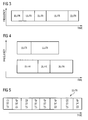
- Figure 3 shows exemplarily the frame order of a TDD (Time Division Duplex) system, in which uplink time frames and downlink time frames alternate. This means that both the uplink time frames and the downlink time frames use the same frequency resources.
- a transmission gap between downlink frames and uplink frames may be introduced in the TDD mode, whereby during a transmission gap no transmission of messages takes place.
- a transmission gap corresponds to a small distance in the time domain between neighbouring uplink and downlink time frames.
- transmission gaps can be used between the individual subframes of a TDD time frame.
- a transmission gap corresponds to a small distance in the time domain between neighbouring subframes.
- Figure 4 shows exemplarily the frame order of a FDD (Frequency Division Duplex) system, in which downlink and uplink transmissions take place on different frequencies. Therefore, in the frequency band of the downlink transmissions, each downlink time frame is followed by a downlink time frame; in the frequency band of the uplink transmissions, each uplink time frame is followed by an uplink time frame.
- FDD Frequency Division Duplex
- the downlink and uplink time frames each contain 2Q+R subframes, Q and R being positive integer values.
- Each subframe has a flexible duration, which means that a certain subframe can change its length from timeframe to timeframe. This allows for an efficient allocation of radio resources as will later on be explained in detail.
- the minimum duration of each subframe is zero.
- the relay stations of a radio cell are divided in Q groups.
- the first group S1 of relay stations comprises the relay station RS1
- the second group S2 of relay stations comprises the relay station RS2.
- each group can contain one or more relay stations.
- Each user terminal UT1, UT2, UT3 is assigned to one of the relay stations RS1, RS2 or directly to the access point AP.
- the user terminal UT1 is assigned to the relay station RS1
- the user terminal UT2 is assigned to the relay station RS2
- the user terminal UT3 is assigned to the access point AP.
- the downlink time frame DL-FR of figure 2 contains:
- the access point AP being allowed to transmit messages to the relay station RS1 during the first subframe
- the relay station RS1 being allowed to transmit messages to the user terminal UT1 during the second subframe
- the access point AP being allowed to transmit messages to the user terminal UT3 during the third subframe
- the access point AP being allowed to transmit messages to the relay station RS2 during the fourth subframe
- the relay station RS2 being allowed to transmit messages to the user terminal UT2 during the fifth subframe.
- the uplink time frame UL-FR of figure 2 contains:
- This uplink time frame UL-FR contains:
- each subframe different connections are separated by using different OFDM-subcarriers.
- a CDMA and/or SDMA separation can be applied.
- OFDMA, CMDA or SDMA separation it is possible to use all of the OFDM-subcarriers for each connection, separating different connections by blocks of time within the subframes.
- Figure 6 shows - using the subframe AP TO S1 as example - the separation of different connections within the subframe AP TO S1 using TDMA.
- the access point AP transmits messages to a first relay station S11 of the group S1 in the first part of the subframe AP TO S1, to a second relay station S12 of the group S1 in the second part, to a third relay station S13 of the group S1 in the third part, and to a fourth relay station S14 of the group S1 in the fourth part.
- Figure 7 shows - using the subframe AP TO S1 as example - the separation of different connections within the subframe AP TO S1 using FDMA.
- the access point AP transmits messages to a first relay station S11 of the group S1 in a first part of a frequency band, to a second relay station S12 of the group S1 in a second part of the frequency band, to a third relay station S13 of the group S1 in a third part of the frequency band, and to a fourth relay station S14 of the group S1 in a fourth part of the frequency band.
- the duration of the subframes may vary over time. This can be due to the varying radio resource demands of user terminals, caused for instance by varying quality of service demands or changing demand for certain services.
- the order of the subframes within the time frames is fixed, so that the sequence of subframes within each downlink frame stays the same, and the sequence of subframes within each uplink frame stays the same.
- the length of the time frames is fixed as well, so that the duration of every downlink frame is the same, and the duration of every uplink frame is the same.
- the length of the time frames can not be constant and therefore vary over time.
- the resource allocation can be adapted e.g. to changes in the number of user terminals or in the radio channel conditions. If for instance the number of user terminals assigned to a relay station of a certain group increases while the number of user terminals assigned directly to the access point decreases, the efficient resource allocation algorithm reacts by decreasing the duration of the subframes used for the direct communication between the access point an the user terminals and by increasing the duration of the subframes used for the communication of the relay stations of the respective group.
- the user terminal UT3 of figure 1 moves away from the access point AP towards the relay station RS1, so that the communication between the access point AP and the user terminal UT3 has to be effected via the relay station RS1.
- the downlink time frame DL-FR of figure 2 should be modified by decreasing the length of the subframe AP TO UT and by increasing the length of the subframes AP to S1 and S1 to UT.
- the uplink time frame UL-FR of figure 2 should be modified by decreasing the length of the subframe UT TO AP and by increasing the length of the subframes UT to S1 and S1 to AP.
- the length of this subframe can be reduced to zero.
- the duration of the subframes AP to UT and UT to AP of figure 2 can be set to zero.
- the relay stations of a radio cell are pooled into Q groups.
- the groups can be formed by dividing the number of relay stations of the cell by the number of groups.
- the number of relay stations within each group can be equal. If for instance two groups are established and the number of relay stations within a cell is 2K, K being an integer, the first group can contain the relay stations with index 1 to K, and the second group can contain the relay stations having as index K+1 to 2K. In the case of an odd number of relay stations and two groups per cell, the number of relay station within one of the two groups exceeds the number of relay station within the other group by at least one.
- the first group S1 of the radio cell C1 contains the relay station RS11, while the first group S1 of the radio cell C2 contains the relay station RS21.
- the second group S2 of the radio cell C1 contains the relay station RS12, while the second group S2 of the radio cell C2 contains the relay station RS22.
- Figure 9 shows the downlink frame DL-FR-C1 of the radio cell C1 and the downlink frame DL-FR-C2 of the radio cell C2, both frame structures being based on the downlink frame structure of figure 2.
- Strong co-channel interference is expected if the subframes of the relay station RS11, i.e. AP1 to RS11 and RS11 to UT, overlap in time with the subframes of the relay station RS22, i.e. AP2 to RS22 and RS22 to UT. This is due to the fact that the relay station RS11 is close-by the relay station RS22.
- the relay station RS11 is assigned to the first group, the first group having its subframes at the beginning of the frame DL-FR-C1, and the relay station RS22 is assigned to the second group, the second group having its subframes at the end of the frame DL-FR-C2, interference between the communications of the relay stations RS11 and RS22 is avoided.
- the time frames DL-FR-C1 and DL-FR-C2 have the same length, the lengths of the subframes of the time frame DL-FR-C1 can differ from the lengths of the subframes of the time frame DL-FR-C2. Therefore, an overlap of the subframes of the relay station RS11 and the subframes of the relay station RS22 is not completely excluded.
- the proposed frame structure in combination with the proposed assignment of relay stations to groups reduces drastically the probability of co-channel interference.
- each subframe intended for the transmission of messages from relay stations to user terminals i.e. for the second hop
- each subframe intended for the transmission of messages from relay stations to user terminals can be split into a sub-subframe intended for the transmission of messages from relay stations to relay stations, i.e. for the second hop, and a sub-subframe intended for the transmission of messages from relay stations to user terminals, i.e. for the third hop.
- each subframe intended for the transmission of messages from relay stations to the access point i.e.
- the subframe of the first hop can be split. According to this principle, time frames for networks allowing for a greater number of hops than three can be built.
Landscapes
- Engineering & Computer Science (AREA)
- Computer Networks & Wireless Communication (AREA)
- Signal Processing (AREA)
- Mobile Radio Communication Systems (AREA)
Priority Applications (2)
| Application Number | Priority Date | Filing Date | Title |
|---|---|---|---|
| EP06014411A EP1879409A1 (de) | 2006-07-11 | 2006-07-11 | Zeitrahmenstruktur eines Multi-Hop Funkkommunikationssystems |
| PCT/EP2007/056332 WO2008006693A1 (en) | 2006-07-11 | 2007-06-25 | Time frame structure of a multi hop radio communication system |
Applications Claiming Priority (1)
| Application Number | Priority Date | Filing Date | Title |
|---|---|---|---|
| EP06014411A EP1879409A1 (de) | 2006-07-11 | 2006-07-11 | Zeitrahmenstruktur eines Multi-Hop Funkkommunikationssystems |
Publications (1)
| Publication Number | Publication Date |
|---|---|
| EP1879409A1 true EP1879409A1 (de) | 2008-01-16 |
Family
ID=37591898
Family Applications (1)
| Application Number | Title | Priority Date | Filing Date |
|---|---|---|---|
| EP06014411A Withdrawn EP1879409A1 (de) | 2006-07-11 | 2006-07-11 | Zeitrahmenstruktur eines Multi-Hop Funkkommunikationssystems |
Country Status (2)
| Country | Link |
|---|---|
| EP (1) | EP1879409A1 (de) |
| WO (1) | WO2008006693A1 (de) |
Cited By (6)
| Publication number | Priority date | Publication date | Assignee | Title |
|---|---|---|---|---|
| EP2157820A1 (de) | 2008-08-22 | 2010-02-24 | Fujitsu Limited | Verfahren und Vorrichtung zum Betreiben eines drahtlosen Kommunikationssystems |
| WO2010090103A1 (en) * | 2009-02-09 | 2010-08-12 | Canon Kabushiki Kaisha | Communication system, communication apparatus, control method of communication apparatus, and computer-readable storage medium |
| WO2012107102A1 (en) * | 2011-02-11 | 2012-08-16 | Nokia Siemens Networks Oy | Tdd data transmission on multiple carriers with sub frames reserved for predetermined transmission directions |
| US8848580B2 (en) | 2008-08-01 | 2014-09-30 | Lg Electronics Inc. | Resource allocation method for backhaul link and access link in a wireless communication system including relay |
| US9203501B2 (en) | 2008-10-24 | 2015-12-01 | Huawei Technologies Co., Ltd. | Relay transmission method and apparatus |
| WO2017201674A1 (zh) * | 2016-05-24 | 2017-11-30 | 广东欧珀移动通信有限公司 | 用于消除小区间干扰的方法和装置 |
Citations (3)
| Publication number | Priority date | Publication date | Assignee | Title |
|---|---|---|---|---|
| DE19950005A1 (de) * | 1999-10-18 | 2001-04-19 | Bernhard Walke | Verfahren zum Betrieb drahtloser Basisstationen für paketvermittelnde Funksysteme mit garantierter Dienstgüte |
| DE10145759A1 (de) * | 2001-09-17 | 2003-04-24 | Siemens Ag | Verfahren und Funk-Kommunikationssystem zur Datenübertragung |
| WO2005067173A1 (en) * | 2003-12-30 | 2005-07-21 | Nokia Corporation | Communication system using relay base stations with asymmetric data links |
-
2006
- 2006-07-11 EP EP06014411A patent/EP1879409A1/de not_active Withdrawn
-
2007
- 2007-06-25 WO PCT/EP2007/056332 patent/WO2008006693A1/en not_active Ceased
Patent Citations (3)
| Publication number | Priority date | Publication date | Assignee | Title |
|---|---|---|---|---|
| DE19950005A1 (de) * | 1999-10-18 | 2001-04-19 | Bernhard Walke | Verfahren zum Betrieb drahtloser Basisstationen für paketvermittelnde Funksysteme mit garantierter Dienstgüte |
| DE10145759A1 (de) * | 2001-09-17 | 2003-04-24 | Siemens Ag | Verfahren und Funk-Kommunikationssystem zur Datenübertragung |
| WO2005067173A1 (en) * | 2003-12-30 | 2005-07-21 | Nokia Corporation | Communication system using relay base stations with asymmetric data links |
Cited By (14)
| Publication number | Priority date | Publication date | Assignee | Title |
|---|---|---|---|---|
| US9100149B2 (en) | 2008-08-01 | 2015-08-04 | Lg Electronics Inc. | Resource allocation method for backhaul link and access link in a wireless communication system including relay |
| US8848580B2 (en) | 2008-08-01 | 2014-09-30 | Lg Electronics Inc. | Resource allocation method for backhaul link and access link in a wireless communication system including relay |
| EP2157820A1 (de) | 2008-08-22 | 2010-02-24 | Fujitsu Limited | Verfahren und Vorrichtung zum Betreiben eines drahtlosen Kommunikationssystems |
| US8532016B2 (en) | 2008-08-22 | 2013-09-10 | Fujitsu Limited | Methods and apparatus for operating a wireless communications system |
| US9203501B2 (en) | 2008-10-24 | 2015-12-01 | Huawei Technologies Co., Ltd. | Relay transmission method and apparatus |
| WO2010090103A1 (en) * | 2009-02-09 | 2010-08-12 | Canon Kabushiki Kaisha | Communication system, communication apparatus, control method of communication apparatus, and computer-readable storage medium |
| CN102197609A (zh) * | 2009-02-09 | 2011-09-21 | 佳能株式会社 | 通信系统、通信设备、通信设备的控制方法和计算机可读存储介质 |
| US8615192B2 (en) | 2009-02-09 | 2013-12-24 | Canon Kabushiki Kaisha | Communication system, communication apparatus, control method of communication apparatus, and computer-readable storage medium |
| CN102197609B (zh) * | 2009-02-09 | 2014-10-29 | 佳能株式会社 | 通信系统、通信设备和通信设备的控制方法 |
| WO2012107102A1 (en) * | 2011-02-11 | 2012-08-16 | Nokia Siemens Networks Oy | Tdd data transmission on multiple carriers with sub frames reserved for predetermined transmission directions |
| CN103503528A (zh) * | 2011-02-11 | 2014-01-08 | 诺基亚西门子通信公司 | 利用针对预定传输方向预留的子帧在多个载波上的tdd数据传输 |
| US10291342B2 (en) | 2011-02-11 | 2019-05-14 | Nokia Solutions And Networks Oy | TDD data transmission on multiple carriers with sub frames reserved for predetermined transmission directions |
| WO2017201674A1 (zh) * | 2016-05-24 | 2017-11-30 | 广东欧珀移动通信有限公司 | 用于消除小区间干扰的方法和装置 |
| US10999027B2 (en) | 2016-05-24 | 2021-05-04 | Guangdong Oppo Mobile Telecommunications Corp., Ltd. | Method and device for eliminating inter-cell interference |
Also Published As
| Publication number | Publication date |
|---|---|
| WO2008006693A1 (en) | 2008-01-17 |
Similar Documents
| Publication | Publication Date | Title |
|---|---|---|
| EP1890402B1 (de) | Vorrichtung und Verfahren zur Bereitstellung von Weiterleitungsdiensten in einem Multihop-Relay-Breitbandkommunikationssystem mit drahtlosem Zugang | |
| US9088337B2 (en) | Methods and apparatuses for interference coordination in a telecommunications system | |
| EP2471326B1 (de) | Funkkommunikationsvorrichtung und verfahren | |
| EP2309813A2 (de) | Ressourcenzuweisungsverfahren für backhaul- und zugangslinks in einem drahtlosen kommunikationssystem mit einem relais | |
| EP1931155A1 (de) | Drahtloses relais-kommunikationssystem und verfahren | |
| US8031604B2 (en) | Algorithm for grouping stations for transmission in a multi-phase frame structure to support multi-hop wireless broadband access communications | |
| EP1796316A1 (de) | Vorrichtung und Verfahren zur Steuerung eines Action Change Gap Intervalls in einem Multi-Hop-Zellnetzwerk | |
| EP2238726B1 (de) | Kommunikation über eine drahtlose Verbindung unter Verwendung einer Ueberrahmenstruktur mit Rahmen verschiedener Art | |
| KR20110117604A (ko) | 중계국을 포함하는 무선 통신 시스템에서 프레임 구성 방법 및 장치 | |
| US20080045270A1 (en) | Radio base station | |
| EP2427007A1 (de) | Funkkommunikations-relaisstationsvorrichtung, funkkommunikations-basisstationsvorrichtung, funkkommunikations-mobilstationsvorrichtung und funkkommunikationsverfahren | |
| WO2012165067A1 (ja) | 無線リソース割当方法及び無線リソース割当装置、並びに通信システム | |
| KR20110023711A (ko) | 중계국을 포함하는 무선통신 시스템에서 프레임 전송방법 | |
| WO2008006693A1 (en) | Time frame structure of a multi hop radio communication system | |
| WO2010103048A1 (en) | A method and apparatus for use in a communication system including access nodes | |
| US9083396B2 (en) | OFDMA-based operation of a wireless subscriber terminal in a plurality of cells | |
| US8169925B2 (en) | Mapping of preamble sequence sets with frame control header (FCH) location for multi-hop wireless broadband access communications | |
| CN101442357B (zh) | 一种采用支持中继的帧结构进行无线传输的方法和系统 | |
| KR20080078194A (ko) | 이종망간 다중화 운영 방법 | |
| KR20080109807A (ko) | 혼잡 상황 동안 직교 주파수-분할 멀티플렉싱의 다이내믹 조정을 위한 방법 및 장치 | |
| KR101349788B1 (ko) | 다중 홉 중계방식을 사용하는 광대역 무선접속통신시스템에서 멀티 프레임 통신 장치 및 방법 | |
| KR20110033049A (ko) | 중계국을 포함하는 무선 통신 시스템에서 무선 자원 할당 방법 및 장치 | |
| KR101391727B1 (ko) | 통신 시스템에서 프레임 구성 장치 및 방법 | |
| KR20110031878A (ko) | 중계국의 신호 송수신 방법 및 장치 | |
| KR101447210B1 (ko) | 무선통신시스템에서 프레임 구성 장치 및 방법 |
Legal Events
| Date | Code | Title | Description |
|---|---|---|---|
| PUAI | Public reference made under article 153(3) epc to a published international application that has entered the european phase |
Free format text: ORIGINAL CODE: 0009012 |
|
| AK | Designated contracting states |
Kind code of ref document: A1 Designated state(s): AT BE BG CH CY CZ DE DK EE ES FI FR GB GR HU IE IS IT LI LT LU LV MC NL PL PT RO SE SI SK TR |
|
| AX | Request for extension of the european patent |
Extension state: AL BA HR MK YU |
|
| AKX | Designation fees paid | ||
| STAA | Information on the status of an ep patent application or granted ep patent |
Free format text: STATUS: THE APPLICATION IS DEEMED TO BE WITHDRAWN |
|
| 18D | Application deemed to be withdrawn |
Effective date: 20080717 |
|
| REG | Reference to a national code |
Ref country code: DE Ref legal event code: 8566 |