EP1883072A2 - Vorrichtung zur Bearbeitung eines Datenstroms - Google Patents
Vorrichtung zur Bearbeitung eines Datenstroms Download PDFInfo
- Publication number
- EP1883072A2 EP1883072A2 EP07112985A EP07112985A EP1883072A2 EP 1883072 A2 EP1883072 A2 EP 1883072A2 EP 07112985 A EP07112985 A EP 07112985A EP 07112985 A EP07112985 A EP 07112985A EP 1883072 A2 EP1883072 A2 EP 1883072A2
- Authority
- EP
- European Patent Office
- Prior art keywords
- frame
- editing
- edited
- point
- fade
- Prior art date
- Legal status (The legal status is an assumption and is not a legal conclusion. Google has not performed a legal analysis and makes no representation as to the accuracy of the status listed.)
- Withdrawn
Links
Images


Classifications
-
- G—PHYSICS
- G11—INFORMATION STORAGE
- G11B—INFORMATION STORAGE BASED ON RELATIVE MOVEMENT BETWEEN RECORD CARRIER AND TRANSDUCER
- G11B27/00—Editing; Indexing; Addressing; Timing or synchronising; Monitoring; Measuring tape travel
- G11B27/02—Editing, e.g. varying the order of information signals recorded on, or reproduced from, record carriers
- G11B27/031—Electronic editing of digitised analogue information signals, e.g. audio or video signals
- G11B27/034—Electronic editing of digitised analogue information signals, e.g. audio or video signals on discs
-
- G—PHYSICS
- G11—INFORMATION STORAGE
- G11B—INFORMATION STORAGE BASED ON RELATIVE MOVEMENT BETWEEN RECORD CARRIER AND TRANSDUCER
- G11B27/00—Editing; Indexing; Addressing; Timing or synchronising; Monitoring; Measuring tape travel
- G11B27/02—Editing, e.g. varying the order of information signals recorded on, or reproduced from, record carriers
- G11B27/031—Electronic editing of digitised analogue information signals, e.g. audio or video signals
- G11B27/038—Cross-faders therefor
-
- H—ELECTRICITY
- H04—ELECTRIC COMMUNICATION TECHNIQUE
- H04N—PICTORIAL COMMUNICATION, e.g. TELEVISION
- H04N19/00—Methods or arrangements for coding, decoding, compressing or decompressing digital video signals
- H04N19/46—Embedding additional information in the video signal during the compression process
-
- H—ELECTRICITY
- H04—ELECTRIC COMMUNICATION TECHNIQUE
- H04N—PICTORIAL COMMUNICATION, e.g. TELEVISION
- H04N19/00—Methods or arrangements for coding, decoding, compressing or decompressing digital video signals
- H04N19/60—Methods or arrangements for coding, decoding, compressing or decompressing digital video signals using transform coding
- H04N19/61—Methods or arrangements for coding, decoding, compressing or decompressing digital video signals using transform coding in combination with predictive coding
Definitions
- the present invention relates to a method and an apparatus for editing data streams, each of which includes at least voice data, particularly to a method and an apparatus for editing compressed streams.
- JP-A No. 2005-117556 discloses a method and an apparatus for editing MPEG-2 transport streams by preventing occurrence of abnormal sounds and silence states that give the user a sense of discomfort when a dividing processing is applied to these streams.
- video signal data and audio signal data to be edited are recorded first on a random accessible recording medium, then multiplexed and compressed in time division multiplex with the MPEG-2 transporting method.
- a TS packet that includes video information is rewritten into a dummy TS data packet so that audio frame data stepping across each dividing position is configured perfectly in its stream before the dividing position.
- the audio TS packets are overwritten with dummy TS packets until audio information TS packet data matching with the video information reproducing timing appears at the dividing position.
- JP-ANo. 2004-336128 also discloses a video/audio signal editing method for solving a problem that an abnormal sound and/or silence state that gives the user a sense of discomfort occurs due to a decoding error that occurs at the time of reproducing of data of transport streams after a dividing process.
- the decoding error is caused by a difference between a timing of connecting video signals and a timing of connecting audio signals in an editing process.
- video and audio signal data to be handled are assumed to be multiplexed and compressed in time division multiplex with use of the MPEG-2 transport stream method.
- the transport packet is substituted for said transport packet that does not include any of video information and audio information, thereby overwriting and recording subject data.
- the present invention provides a stream editing method for editing data streams, each of which includes at least voice data.
- the editingmethod decodes plural frames positioned before an editing point and assumes at least one frame positioned temporally before the editing point as a fade-out frame to generate edited frames including the fade-out frame, then encodes the edited frames again.
- the editing method for editing data streams decodes plural frames positioned after an editing point and assumes at least one frame positioned temporally after the editing point as a fade-in frame to generate edited frames including the fade-in frame, then encodes the edited frames again.
- the stream editing method for editing data streams decodes plural frames positioned after an editing point and assumes at least one frame positioned temporally before the editing point as a fade-out frame and at least one frame positioned temporally after the editing point as a fade-in frame to generate edited frames including both the fade-out frame and the fade-in frame, then encodes the edited frames again.
- the present invention refers to three cases as follows. First case is that a data stream is cut in the middle and terminated there, second case is that the terminated data stream is restarted at the cut position, and third case is that the cut streams are connected again.
- the present invention can prevent noise from being generated in spite of the discontinuity of data stream by fading out and terminating, fading in and starting, or fading in and fading out at a connection point.
- Another stream editing method edits each data stream by connecting a first editing point to a second editing point positioned temporally after the first editing point in the stream that includes at least MPEG formatted video data.
- the stream editing method also generates updated sequence information that includes information related to a latest quantizer matrix included before the second editing point, detects the head of an intra-picture or GOP positioned temporally before the second editing point, then inserts the updated sequence information after the head, thereby generating an edited video stream in which the first and second editing points are connected to each other.
- the present invention generates and inserts updated sequence information that includes the latest quantizermatrix information included before the second editing point upon connecting a data stream to another at the first and second editing points respectively, thereby the present invention can reproduce the data streams correctly even after the second editing point.
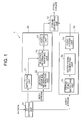
- FIG. 1 shows a block diagram of an editing apparatus in an embodiment of the present invention.
- the editing apparatus 1 includes an AV separation unit 11, a video processing unit 20, an audio processing unit 30, and a stream generating unit 12.
- the AV separation unit inputs AV (Audio Video and Audio Visual) data such as MPEG-2 transport streams (TS: Transport Stream) and separates video packets from audio packets so that video packets are inputted to the video processing unit 20 and audio packets are inputted to the audio processing unit 30.
- AV Audio Video and Audio Visual
- TS Transport Stream
- the video processing unit 20 includes a detection unit 21, an updated sequence information generating unit 22, a sequence information inserting unit 23, and a video editing unit 24.
- the audio processing unit 30 includes an editing point detecting unit 31, an edited frame generating unit 32, and an audio editing unit 33.
- the editing apparatus 1 in this embodiment deletes data between a first editing point (hereunder, to be referred to a point A) and a second editing point (hereunder, to be referred to as a point B) positioned temporally after the point A in AV data and connects the point A to the point B to generate an edited stream to be reproduced without generating any noise and in a quality not to make the user feel any acoustic and visual problems.
- a CPU Central Processing Unit
- the computer program may be provided by storing on a recording medium. It is also possible to send the computer program to the user through the Internet or the like.
- the editing point detecting unit 31 detects audio frames that include points A and B specified from external, for example, the user.
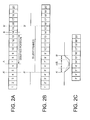
- FIGS. 2A to 2C show a diagram for describing how to edit audio data using of the editing method of the present invention.
- Each of video data and audio data has a unit of decoding/reproducing, which is referred to as an access unit.
- One frame is such an access unit for video data and one audio frame is such an access unit for audio data.
- each PES packet header has a PTS (Presentation Time Stamp) and a DTS (Decoding Time Stamp), in each of the PTS and DTS reproducing time information is described as time stamps to denote when the subject access unit of video/audio data should be decoded and when the data should be reproduced in the reference time respectively.
- Points A and B are specified with time information such as a time PTS for reproducing each access unit. In the following description, it is assumed that the point A is included in the 7th frame and the point B is included in the 14th frame.
- the editing point detecting unit 31 detects audio frames that include those having the points A and B respectively.
- an audio PTS corresponding to an audio frame is added to the subject packet header only when the leading part of the audio frame is in an audio packet.
- only in the first audio frame if two or more audio frames are included in the audio packet.
- a corresponding PTS is not always added to every audio frame. So, the PTS of each audio frame is calculated from the audio PTS and each frame reproducing time.
- the edited frame generating unit 32 generates edited frames that include at least one fade-out frame positioned temporally before the point A and at least one fade-in frame positioned temporally after the point B.
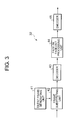
- FIG. 3 shows a block diagram of a configuration of the edited frame generating unit 32.
- the edited frame generating unit 32 includes a silent frame generating unit 41, a frame substituting unit 42, a decoder 43, a fade-out/fade-in processing unit 44, and an encoder 45.
- the silent frame generating unit 41 generates silent audio frames in accordance with the recorded audio sampling frequency and the compression format, and encodes the audio frame with use of the encoder 45 or the like.
- the silent frame generating unit 41 may also generate silent audio streams.
- the frame substituting unit 42 when the editing point detecting unit 31 detects audio frames that include the point A and the point B respectively, detects a point positioned several frames before the point A (hereunder, to be referred to as the point A') and a point positioned several frames after the point B (hereunder, to be referred to as the point B'). Then, the frame substituting unit 42 substitutes the frames between the point A' and the point B' for silent frames generated by the silent frame generating unit 41.
- the point A' should preferably be positioned two or three frames before the point A and the point B' should preferably be positioned two or three frames after the point B. This is because if the edited portions (edited frames) are 4 frames or so in total, a reproduced sound at the said editing point can be prevented from coming into audible bands of 20Hz to 20kHz.
- the decoder 43 decodes several surrounding frames including at least those having the points A' to A respectively and several surrounding frames including at least those having the points B' to B respectively in each audio stream in which the frames between points A' to B' as shown in FIG. 2B are substituted for silent frames. The above substitution may also be done in each silent audio stream after such decoding.
- the fade-out/fade-in processing unit 44 fades out the sound at the point A' first.
- the fading-out processing can be executed in one frame or in part of one frame.
- the fade-out/fade-in processing unit 44 also fades in the sound at the point B'. This fading-in processing can also be executed in one frame or in part of one frame.
- the encoder 45 encodes audio frames again after a fade-out/fade-in processing.
- the audio editing unit 33 deletes unnecessary data between the points A and B and connects the points A and B to each other.
- one of the audio frames (the 7 th or 14 th frames) including the points A and B respectively is deleted and the other is left over, thereby adjusting so as to reduce the error of the reproducing time in the edited stream.
- the deleted portion becomes longer than the time interval between the originally specified points A and B. If both frames that include the points A and B respectively are left over, the deleted portion becomes shorter than the specified time interval. This is why only one of the two audio frames that include the points A and B respectively is deleted.
- the point A is included in the 7 th frame and the point B is included in the 14 th frame.
- the frames from the 7 th frame that includes the point A to the 13 th frame, which is one frame before the 14 th frame that includes the point B, are deleted.
- the 6 th frame is connected to the 14 th frame. It is also possible here to delete frames from the 8 th frame that follows the 7 th frame that includes the point A to the 14 th frame that includes the point B.
- the 5 th frame is a fade-in frame and the 6 th and the 14 th frames become silent frames and the succeeding 15 th frame is a fade-out frame.
- the two frames (5 th and 6 th ) may be fade-in frames.
- the two frames (14 th and 15 th ) may be fade-out frames.
- each connection point between the 5 th and 14 th frames prevent noise generation in the audible range in edited frames that include the 4 th , 5 th , 14 th , and 15 th frames. This means that it is just required to edit each stream so as not to generate audible noise in several frames before and after a connection point between two editing points.
- MPEG-2 video data has a hierarchical structure as shown in FIG. 4.
- the sequence layer most significant layer, has series of some GOPs. Each of those GOPs is a set of plural pictures.
- a GOP is a combination of three types of pictures (I, P, and B) that are different respectively in encoding algorithm.
- the I picture is generated through intra-image encoding and no predicting encoding from the previous image is done. In other words, intra-image encoding is done without referring to another image and the I picture has every necessary information for decoding.
- the P picture is generated through predicting encoding between pictures by referring to the temporally previous I or P picture. Consequently, the P picture requires information of the preceding decoded I or P picture in the subject stream.
- the B picture is generated using two pictures (past and future pictures) which are I picture or P picture respectively, and executed by predictive encoding from both directions. Upon decoding, the B picture requires information of two preceding and decoded I or P pictures in the subject stream.
- the GOPs are classified into OpenGOPs and ClosedGOPs.
- the OpenGOP requires picture information of a GOP displayed precedingly in a forward reproduction process.
- the ClosedGOP does not require such picture information of a GOP displayed precedingly.
- the ClosedGOP begins at an I picture and the OpenGOP begins at a B picture.
- a picture is divided into belt-like regions having a height of 16 pixels respectively. Those divided regions are referred to as slices.
- a 32-bit start code is given to the head of each layer arranged from a sequence layer to a slice layer to enable fast feeding, rewinding, and error recovery.
- a slice consists of more than one macro block.
- a macro block corresponds to a region of 16 x 16 pixels and each region consists of 6 blocks that are 4 luminance blocks (Y) of 8 x 8 pixels respectively and two color difference blocks (Cb and Cr).
- a luminance blocks or color difference blocks are converted to frequency components through a discrete cosine transformation (DCT) process, then sorted in an ascending order of low frequency DCT coefficients.
- DCT discrete cosine transformation
- a stream is divided into those 6 hierarchical layers before it is transmitted.
- an encoded data transmission sequence will be described.
- the sequence layer which is the first layer, has an SHC (Sequence Header Code), which is a starting synchronization code of the sequence layer.
- the sequence layer has parameters of a screen (frames) group having a series of same attributes that are specified for reproducing video information as images.
- the parameters are related to screen sizes for reproduced pictures, that is, HSV (Horizontal Size Value), VSV (Vertical Size Value), and ARI (Aspect Ratio Information).
- HSV Horizontal Size Value
- VSV Very Size Value
- ARI Application Ratio Information
- the BRV Bit Rate Value
- the VBSV Bit Buffer Size Value
- the BRV uses the lower 18 bits of the bit rate to limit the number of bits to be generated and the VBSV uses the lower 10 bits of a vale for determining a size (VBV) of a generation code quantity virtual buffer.
- quantizer matrix values are specified for DCT (Discrete Cosine Transform) (image expansion); LIQM (Load Intra Quantizer Matrix), IQM (Intra Quantizer Matrix), LNIQM (Load Intra Quantizer Matrix), NIQM (Non Intra Quantizer Matrix).
- the LIQM denotes existence of intra MB quantizer matrix data.
- the IQM denotes a value of intra MB quantizer matrix.
- the LNIQM denotes existence of non-intra MB quantizer matrix data.
- the NIQM denotes a value of non-intra MB quantizer matrix.
- these LIQM, IQM, LNIQM, and NIQM are referred to as quantizer matrix information items.
- the next GOP layer has parameters GSC (Group Start Code), TC (Time Code), CG (Closed GOP), and BL (Broken Link).
- GSC Group Start Code
- TC Time Code
- CG Current GOP
- BL Broken Link
- the GSC is a GOP starting synchronization code.
- the TC is a code denoting a time count started at the head of a sequence.
- the CG is a flag denoting that an image in a GOP can be reproduced independently of other GOPs.
- the BL is a flag denoting that the first B picture in a GOP cannot be reproduced correctly due to such a processing as editing.
- the picture layer has a parameter that specifies one screen (frame) in a process for reproducing video information as images.
- this matrix layer is also specified by quantizer matrix information items LIQM, IQM, LNIQM, and NIQM that can be described as well as in the sequence layer.
- the slice layer includes common information specified for sliced small screens of one screen.
- the next macro block layer specifies pixel blocks (macro blocks) obtained by dividing one screen into predetermined sized blocks, each of which is a unit for encoding. For example, this pixel block includes such parameters as a motion vector value.
- the macro block layer uses parameters MBT, QSC, etc.
- the MBT Macroblock Type
- the QSC Quadratizer Scale Code
- the macroblock layer also uses parameters MHC and MVC.
- the MHC (Motion Horizontal Code) and the MVC (Motion Vertical Code) are coding values related to motion vectors with respect to the previous macro block.
- the last block layer stores transformation coefficient itself.
- editing a video stream causes noise generation in images if a difference is found between the edited sequence information after a connection point and the said sequence information before the connection point, and the noise is continued to be generated until the sequence information is updated to be corrected. This has been a problem.
- JP-A No. 2005-33382 discloses an editing apparatus for enabling stable reproducing of data upon trimming of a middle part of MPEG stream data stored on a random accessible recording medium.
- the MPEG-2 stream is required to include system information such as a bit rate value, an image size upon decoding, a compression method, etc. that are all indispensable for decoding/reproducing a series of the follow-on MPEG data.
- the sequence layer records quantizer matrix information.
- the picture layer also records quantizer matrix information.
- Those quantization matrix information items are indispensable for proper decoding of video data.
- Each information item (hereinafter, to be referred to as sequence information) included in the sequence layer is updated entirely when a sequence header code (SHC) of the sequence layer appears.
- SHC sequence header code
- the quantizer matrix information of the picture layer is just added as needed.
- the quantizer matrix information added to this picture layer will be referred to as updated quantizer matrix information.
- the editing method disclosed in JP-A No. 2005-33382 searches the information of the sequence layer positioned just before the point B and adds the subj ect sequence information to the searched the information of the sequence, thereby reproducing video data after the point B. If there is updated quantizer matrix information in the picture layer provided between the sequence layer and the point B at this time, the use of the updated quantizer information is indispensable to reproduce the video data after the point B.
- the video editing unit in this embodiment if there is updated quantizer matrix information upon adding sequence information before a point B, updates the subject quantizer matrix information with updated quantizer matrix information, then adds the updated sequence information before the point B. Consequently, video data after the point B is also reproduced correctly.
- the detection unit 21 detects a video PTS at an editing point, as well as an insert position of updating sequence to be described later.
- the detection unit 21 detects a video PTS at each of the points A and B described above.
- the detection unit 21 searches an insert position set temporally before the point B and nearest to the point B.
- the insert position may be an I picture before the point B and nearest to the point B, or the head of a GOP.
- the detection unit 21 searches a necessary picture for reproducing frames after the point B.
- pictures after the subject one are left over. Pictures after the point A and before the point B are not reproduced.
- the updated sequence information generating unit 22 also includes a sequence information collection unit (not shown) and a sequence information updating unit (not shown).
- the sequence information collection unit collects sequence information to obtain the quantizer matrix information of the sequence layer and the sequence information updating unit rewrites the quantizermatrix information of the sequence layer into updated quantizer matrix information.
- the sequence information collection unit detects a sequence start code SHC, and extracts and stores the sequence information that is the information of the sequence layer as is.
- the sequence information collection unit also overwrites the sequence information every time the unit detects a sequence start code.
- the updated sequence information creating unit extracts updated quantizer matrix information items (LIQM, IQM, LNIQM, and NIQM) included in the sequence layer and in the picture layer that follows the GOP layer if they exist.
- the updated sequence information creating unit also rewrites the quantizer matrix information of the stored latest sequence information with the updated quantizer matrix information and keeps the information as updated sequence information.
- the sequence information inserting unit 23 upon receiving an insertion position from the detection unit 21, inserts the sequence information updated by the updated sequence information generating unit 22 in the specified insertion position.
- the sequence information is updated by taking consideration not only to the sequence information, but also to the updated quantizer matrix information in the picture layer, so that the frames after the point B can also be reproduced correctly.
- the video editing unit 24 connects the point A to the point B and deletes unnecessary streams between those points A and B. This means that streams positioned from the point A to the point B are not deleted, but pictures positioned from the point A to the insert position are deleted.
- the stream generating unit 12 receives an edited video stream from the video editing unit 24 and an edited audio stream from the audio editing unit 33 to generate an edited AV stream (edited stream).
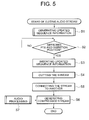
- FIGS. 5 through 7 show diagrams for describing how the stream editing apparatus edits a stream.
- FIG. 5 is a diagram for describing the operation of the entire stream editing apparatus.
- FIG. 6 is a diagram for describing the details of how updated sequence information is generated.
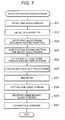
- FIG. 7 is a diagram for describing the detail of how an audio stream is edited.
- the editing processings of a video stream in steps S1 to S5 shown in FIG. 5 and the editing processing of an audio stream in step S7 are executed in parallel.
- the processing in step S1 for generating updated sequence information and the processing in step S2 for detecting a video PTS and an insert position are executed in parallel.
- the updated sequence information generating unit 22 upon receiving a video stream from the AV separating unit 11, generates updated sequence information (step S1). As described above, the updated sequence information is generated from the sequence information of the sequence layer and the updated quantizer matrix information of the picture layer. In this embodiment, the updated sequence information generating unit 22, upon receiving a video stream, generates updated sequence information regardless of the editing points A and B. It is just required here that the updated sequence information before the point B can be generated. For example, the updated sequence information generating unit 22 may generate the latest updated sequence information positioned before the point B after receiving the PTS information at the point B from the detection unit 21.
- the detection unit 21 reads out a video PTS added to the subject packet header while generating updated sequence information, then detects an inser position (step S2). At this time, there is a case in which no video PTSs are found for the points A and B specified from external. In such a case, the detection unit 21 detects the nearest PTSs positioned before the points A and B respectively and identifies a picture that becomes a PTS matching with each of the points A and B from the picture reproducing time.
- the detection unit 21 Upon detecting the video PTS of each of the points A and B and identifying the subject picture, the detection unit 21 searches the I picture nearest to the point B or the first picture (I or B picture) of the subject GOP. Hereunder, this picture will be referred to an insertion picture.
- the detection unit 21 Upon detecting an insertion picture, the detection unit 21 inserts updated sequence information in the specified insert position (step S3). Because the updated sequence information is information of the sequence layer, the updated sequence information is inserted together with the GOP layer before the picture layer of the inserted picture. As described above, four information items GSC, TC, CG, and BL are specified for the GOP layer. Those information items are generated by the sequence information inserting unit 23. And the updated sequence information and the generated GOP layer are inserted before the insertion picture.
- the video editing unit 24 receives a video stream in which updated sequence information is inserted.
- the video editing unit 24 then connects the point A to the point B (steps S4 and S5). Concretely, the video editing unit 24 disconnects the subject stream before the inserted picture, then connects the point A to the point B.
- step S1 for generating updated sequence information
- the video editing unit 24 collects/stores sequence information (step S12 to S14) and obtains/rewrites updated quantizer matrix information (steps S15 to S17) in parallel.
- the video editing unit 24 searches a sequence start code SHC (step S12). Upon detecting the sequence start code SHC, the video editing unit 24 extracts the sequence layer (step S13), then stores the layer in a memory (step S14). After this, the video editing unit 24 repeats the processings in and after step S12 until the detection unit 21 detects an insert position (insertion picture) (step S19).
- the video editing unit 24 searches updated quantizer matrix information in the picture layer (step S15). Upon detecting the information, the video editing unit 24 extracts the detected information (step S16), then updates the quantizer matrix information of the sequence information stored in the memory in step S14 according to this updated quantizer matrix information. Then, the video editing unit 24 repeats the processings in and after step S15 until the detection unit 21 detects an insertion position (step S19).
- step S19: Yes Upon detecting the insert position (step S19: Yes), the video editing unit 24 outputs the sequence information stored in the memory to the sequence information inserting unit 23 as updated sequence information.
- the updated sequence information generating unit 22 may store the sequence information in step S14 or output the updated sequence information as needed when the sequence information is rewritten in step S17 instead of outputting updated sequence information when an insert position is detected.
- the sequence information inserting unit 23 is just required to insert the latest updated sequence information received from the updated sequence information generating unit 22 before the inserted picture upon receiving an insert position from the detection unit 21.
- step S7 executed in parallel to the video editing processing described above.
- the editing point detecting unit 31 upon detecting an audio stream (step S31), detects an audio PTS as an audio reproducing time first (step S32).
- a PTS is not always added to every audio frame in every audio stream.
- the editing point detecting unit 31 detects the (n-1) th audio PTS that satisfies the following condition if it is assumed that the audio PTS added to the (n-1) th audio frame is PTS_A (n-1) and the audio PTS added to the (n) th audio frame is PTS_A (n).
- the PTS at the point A can be received from, for example, the detection unit 21.
- the editing point detecting unit 31 searches an audio frame that includes a video connection point PTS by taking into consideration the reproducing time of each audio frame (step S33). If Tm-1 and Tm are assumed for the times required for reproducing from the audio frame corresponding to the (n-1) th audio PTS to the (m-1) th and (m)th audio frames, the editing point detecting unit 31 searches (m) that satisfies PTS_A (n-1) + Tm - 1 ⁇ PTS at point A ⁇ PTS_A (n-1) + Tm.
- the editing point detecting unit 31 can detect the (m-1)th audio frame from the audio frame corresponding to the (n-1) th audio PTS as audio frame including the point A. Similarly, the editing point detecting unit 31 can also detect audio frames including the point B.
- the edited frame generating unit 32 executes the processings in steps S34 to S37.
- the edited frame generating unit 32 substitutes frames in an editing section in which the points A and B are included and consisting of some frames before and after each of the points A and B (,that is, between points A' and B' shown in FIGS. 2A to 2C) for silent frames generated by the silent frame generating unit 41 (step S34).
- the edited frame generating unit 32 decodes the frames including the section between points A and A' and the section between the points B and B' respectively (step S35).
- the edited frame generating unit 32 may decode the frames in the whole editing section.
- the edited frame generating unit 32 fades out the point A' with one frame and keeps the frames up to one frame before the point B' as substituted silent frames, then fades in the sound at the point B' with said one frame (step S36).
- the edited frame generating unit 32 may use more than two frames or less than one frame for these fade-in and fade-out processings.
- frames are substituted for encoded silent frames.
- the decoded frames from the faded-out one to the faded-in one may be substituted for a silent audio stream.
- the edited frame generating unit 32 encodes the fade-in and fade-out processed streams (step S37) and outputs the encoded streams to the audio editing unit 33.
- the audio editing unit 33 then disconnects the audio stream at frames that include the points A and B respectively (step S38) and deletes unnecessary audio streams (step S39).
- step S40 the streams are connected and the audio stream editing process is ended.
- audio frames before and after a connection point in an editing process are substituted for silent frames, thereby a necessary audio reproducing time is kept on while noise to be caused by rapid changes of sounds at connection points can be prevented.
- the frames in an editing section consist of a fade-out frame, silent frames, and a fade-in frame, it is possible to prevent noise to be caused by rapid changes of sounds, etc. at the time of audio reproducing after connecting frames.
- the editing point detecting unit detects editing points in audio frames.
- the edited frame generating unit generates edited frames.
- the silent frame generating unit generates silent audio frames.
- the frame substituting unit detects a point.
- the fade-out/fade-in processing unit fades out/in the sound.
- the detection unit detects a video PTS at an editing point.
- the updated sequence information generating unit detects a sequence start code, and extracts and stores the sequence information.
- the updated sequence information creating unit extracts updated quantizer matrix information items.
- the sequence information inserting unit inserts the sequence information.
- the video editing unit connects the editing points.
- the stream generation unit generate an edited AV stream based on received video stream and audio stream.
Landscapes
- Engineering & Computer Science (AREA)
- Multimedia (AREA)
- Signal Processing (AREA)
- Management Or Editing Of Information On Record Carriers (AREA)
- Television Signal Processing For Recording (AREA)
- Studio Circuits (AREA)
- Compression Or Coding Systems Of Tv Signals (AREA)
Applications Claiming Priority (1)
| Application Number | Priority Date | Filing Date | Title |
|---|---|---|---|
| JP2006200336A JP4704972B2 (ja) | 2006-07-24 | 2006-07-24 | ストリーム編集方法及びストリーム編集装置 |
Publications (2)
| Publication Number | Publication Date |
|---|---|
| EP1883072A2 true EP1883072A2 (de) | 2008-01-30 |
| EP1883072A3 EP1883072A3 (de) | 2008-04-30 |
Family
ID=38626321
Family Applications (1)
| Application Number | Title | Priority Date | Filing Date |
|---|---|---|---|
| EP20070112985 Withdrawn EP1883072A3 (de) | 2006-07-24 | 2007-07-24 | Vorrichtung zur Bearbeitung eines Datenstroms |
Country Status (3)
| Country | Link |
|---|---|
| US (1) | US20080019664A1 (de) |
| EP (1) | EP1883072A3 (de) |
| JP (1) | JP4704972B2 (de) |
Cited By (2)
| Publication number | Priority date | Publication date | Assignee | Title |
|---|---|---|---|---|
| WO2013190383A1 (en) | 2012-06-22 | 2013-12-27 | Ati Technologies Ulc | Remote audio keep alive for a wireless display |
| CN104429044B (zh) * | 2012-06-22 | 2016-11-30 | Ati科技无限责任公司 | 无线显示器的远程音频保持连接 |
Families Citing this family (5)
| Publication number | Priority date | Publication date | Assignee | Title |
|---|---|---|---|---|
| JP2009290768A (ja) * | 2008-05-30 | 2009-12-10 | Toshiba Corp | 映像処理装置および映像処理方法 |
| JP5463100B2 (ja) * | 2009-08-21 | 2014-04-09 | Necパーソナルコンピュータ株式会社 | 編集装置、制御方法及びプログラム |
| JP5504761B2 (ja) * | 2009-09-01 | 2014-05-28 | 富士通株式会社 | 受信装置、及びその使用方法 |
| US9355683B2 (en) * | 2010-07-30 | 2016-05-31 | Samsung Electronics Co., Ltd. | Audio playing method and apparatus |
| WO2018211613A1 (ja) * | 2017-05-17 | 2018-11-22 | 三菱電機株式会社 | 符号化映像再生装置および符号化映像再生方法 |
Family Cites Families (16)
| Publication number | Priority date | Publication date | Assignee | Title |
|---|---|---|---|---|
| US6262777B1 (en) * | 1996-11-15 | 2001-07-17 | Futuretel, Inc. | Method and apparatus for synchronizing edited audiovisual files |
| JPH1169301A (ja) * | 1997-08-08 | 1999-03-09 | Sony Corp | 復号方法及び復号再生装置、並びに記録媒体 |
| ID21786A (id) * | 1997-09-17 | 1999-07-22 | Matsushita Electric Industrial Co Ltd | Peralatan editing data video, disk optikal untuk digunakan sebagai media perekam peralatan editing data video dan media perekam komputer yang bisa dibaca yang menyimpan program editing |
| US6104441A (en) * | 1998-04-29 | 2000-08-15 | Hewlett Packard Company | System for editing compressed image sequences |
| JP2000243065A (ja) * | 1999-02-19 | 2000-09-08 | Sony Corp | オーディオデータ処理装置 |
| US6633673B1 (en) * | 1999-06-17 | 2003-10-14 | Hewlett-Packard Development Company, L.P. | Fast fade operation on MPEG video or other compressed data |
| JP4639441B2 (ja) * | 1999-09-01 | 2011-02-23 | ソニー株式会社 | ディジタル信号処理装置および処理方法、並びにディジタル信号記録装置および記録方法 |
| JP2002232827A (ja) * | 1999-12-21 | 2002-08-16 | Matsushita Electric Ind Co Ltd | 映像音声編集システム |
| US20010004417A1 (en) * | 1999-12-21 | 2001-06-21 | Ageishi Narutoshi | Video editing system |
| JP2001197424A (ja) * | 2000-01-13 | 2001-07-19 | Matsushita Electric Ind Co Ltd | 映像編集装置、映像編集方法及びそのプログラムを記録した記録媒体 |
| JP2002281458A (ja) * | 2001-03-19 | 2002-09-27 | Matsushita Electric Ind Co Ltd | 画像情報復号化再生装置および画像情報復号化再生方法 |
| US7388995B2 (en) * | 2003-05-21 | 2008-06-17 | Silicon Integrated Systems Corp. | Quantization matrix adjusting method for avoiding underflow of data |
| JP4673543B2 (ja) * | 2003-08-04 | 2011-04-20 | シャープ株式会社 | データ処理装置、及びデータ編集方法 |
| JP4464101B2 (ja) * | 2003-10-10 | 2010-05-19 | キヤノン株式会社 | トランスポートストリーム編集方法及び装置 |
| US9715898B2 (en) * | 2003-12-16 | 2017-07-25 | Core Wireless Licensing S.A.R.L. | Method and device for compressed-domain video editing |
| US7117147B2 (en) * | 2004-07-28 | 2006-10-03 | Motorola, Inc. | Method and system for improving voice quality of a vocoder |
-
2006
- 2006-07-24 JP JP2006200336A patent/JP4704972B2/ja not_active Expired - Fee Related
-
2007
- 2007-07-23 US US11/878,225 patent/US20080019664A1/en not_active Abandoned
- 2007-07-24 EP EP20070112985 patent/EP1883072A3/de not_active Withdrawn
Cited By (4)
| Publication number | Priority date | Publication date | Assignee | Title |
|---|---|---|---|---|
| WO2013190383A1 (en) | 2012-06-22 | 2013-12-27 | Ati Technologies Ulc | Remote audio keep alive for a wireless display |
| CN104429044A (zh) * | 2012-06-22 | 2015-03-18 | Ati科技无限责任公司 | 无线显示器的远程音频保持连接 |
| EP2865162A4 (de) * | 2012-06-22 | 2016-02-10 | Ati Technologies Ulc | Remote-keep-alive für audio einer drahtlosen anzeige |
| CN104429044B (zh) * | 2012-06-22 | 2016-11-30 | Ati科技无限责任公司 | 无线显示器的远程音频保持连接 |
Also Published As
| Publication number | Publication date |
|---|---|
| EP1883072A3 (de) | 2008-04-30 |
| JP2008028793A (ja) | 2008-02-07 |
| JP4704972B2 (ja) | 2011-06-22 |
| US20080019664A1 (en) | 2008-01-24 |
Similar Documents
| Publication | Publication Date | Title |
|---|---|---|
| US6738427B2 (en) | System and method of processing MPEG streams for timecode packet insertion | |
| JP4503739B2 (ja) | 情報ストリームの高フレーム精度シームレス・スプライシング | |
| CA2432170C (en) | Method and apparatus for storing a stream of video data on a storage medium | |
| EP1102493B1 (de) | Formatierung und Speicherung von Videodaten | |
| JP3900050B2 (ja) | データ処理装置、ビデオカメラ及びデータ処理方法 | |
| JP2003046949A (ja) | データ多重化方法、データ記録媒体、データ記録装置及びデータ記録プログラム | |
| JP3932546B2 (ja) | Mpegビデオ編集装置及びmpegビデオ編集方法 | |
| EP2012322B1 (de) | Aufzeichnungs- und Wiedergabevorrichtung, Aufzeichnungsvorrichtung, Wiedergabevorrichtung, Aufzeichnungsverfahren, Wiedergabeverfahren und Computerprogramm | |
| JP2002271744A (ja) | 番組記録装置及び方法 | |
| EP1883072A2 (de) | Vorrichtung zur Bearbeitung eines Datenstroms | |
| EP1995731B1 (de) | Verfahren zur Gewährleistung einer nahtlosen Wiedergabe von Datenströmen | |
| US6275618B1 (en) | Apparatus for and method of processing images | |
| US20080159636A1 (en) | Encoding apparatus and encoding method | |
| JP2003169292A (ja) | アフレコ装置、コンピュータプログラム、記録媒体、伝送方法及び再生装置 | |
| US6643453B1 (en) | Motion picture recording/reproduction apparatus | |
| JP3510783B2 (ja) | 動画像記録再生方法及び動画像記録再生装置 | |
| US20020044609A1 (en) | Long-hour video/audio compression device and method thereof | |
| US6373905B1 (en) | Decoding apparatus and decoding method | |
| JP3807225B2 (ja) | 圧縮映像信号記録装置 | |
| JP4825202B2 (ja) | 記録再生装置、記録媒体、及び集積回路 | |
| JP3034172B2 (ja) | 画像データ記録再生装置 | |
| JP5191294B2 (ja) | 情報処理装置及びプログラム | |
| JP2005198350A (ja) | アフレコ信号再生方法 | |
| JP3456726B2 (ja) | 圧縮信号処理装置 | |
| US20050232594A1 (en) | Playback apparatus, playback method, and program product with playback processing program |
Legal Events
| Date | Code | Title | Description |
|---|---|---|---|
| PUAI | Public reference made under article 153(3) epc to a published international application that has entered the european phase |
Free format text: ORIGINAL CODE: 0009012 |
|
| AK | Designated contracting states |
Kind code of ref document: A2 Designated state(s): AT BE BG CH CY CZ DE DK EE ES FI FR GB GR HU IE IS IT LI LT LU LV MC MT NL PL PT RO SE SI SK TR |
|
| AX | Request for extension of the european patent |
Extension state: AL BA HR MK YU |
|
| PUAL | Search report despatched |
Free format text: ORIGINAL CODE: 0009013 |
|
| AK | Designated contracting states |
Kind code of ref document: A3 Designated state(s): AT BE BG CH CY CZ DE DK EE ES FI FR GB GR HU IE IS IT LI LT LU LV MC MT NL PL PT RO SE SI SK TR |
|
| AX | Request for extension of the european patent |
Extension state: AL BA HR MK RS |
|
| AKX | Designation fees paid | ||
| 17P | Request for examination filed |
Effective date: 20081023 |
|
| RBV | Designated contracting states (corrected) |
Designated state(s): DE FR GB IT |
|
| RAP1 | Party data changed (applicant data changed or rights of an application transferred) |
Owner name: RENESAS ELECTRONICS CORPORATION |
|
| STAA | Information on the status of an ep patent application or granted ep patent |
Free format text: STATUS: THE APPLICATION HAS BEEN WITHDRAWN |
|
| 18W | Application withdrawn |
Effective date: 20140514 |