EP1883191A2 - Procédé et dispositif de contrôle de transmission - Google Patents
Procédé et dispositif de contrôle de transmission Download PDFInfo
- Publication number
- EP1883191A2 EP1883191A2 EP07109460A EP07109460A EP1883191A2 EP 1883191 A2 EP1883191 A2 EP 1883191A2 EP 07109460 A EP07109460 A EP 07109460A EP 07109460 A EP07109460 A EP 07109460A EP 1883191 A2 EP1883191 A2 EP 1883191A2
- Authority
- EP
- European Patent Office
- Prior art keywords
- moving speed
- information
- station
- mobile station
- transmission power
- Prior art date
- Legal status (The legal status is an assumption and is not a legal conclusion. Google has not performed a legal analysis and makes no representation as to the accuracy of the status listed.)
- Granted
Links
Images




Classifications
-
- H—ELECTRICITY
- H04—ELECTRIC COMMUNICATION TECHNIQUE
- H04W—WIRELESS COMMUNICATION NETWORKS
- H04W52/00—Power management, e.g. Transmission Power Control [TPC] or power classes
- H04W52/04—Transmission power control [TPC]
- H04W52/18—TPC being performed according to specific parameters
- H04W52/28—TPC being performed according to specific parameters using user profile, e.g. mobile speed, priority or network state, e.g. standby, idle or non-transmission
-
- H—ELECTRICITY
- H04—ELECTRIC COMMUNICATION TECHNIQUE
- H04W—WIRELESS COMMUNICATION NETWORKS
- H04W24/00—Supervisory, monitoring or testing arrangements
-
- H—ELECTRICITY
- H04—ELECTRIC COMMUNICATION TECHNIQUE
- H04W—WIRELESS COMMUNICATION NETWORKS
- H04W4/00—Services specially adapted for wireless communication networks; Facilities therefor
- H04W4/02—Services making use of location information
- H04W4/023—Services making use of location information using mutual or relative location information between multiple location based services [LBS] targets or of distance thresholds
-
- H—ELECTRICITY
- H04—ELECTRIC COMMUNICATION TECHNIQUE
- H04W—WIRELESS COMMUNICATION NETWORKS
- H04W4/00—Services specially adapted for wireless communication networks; Facilities therefor
- H04W4/02—Services making use of location information
- H04W4/025—Services making use of location information using location based information parameters
- H04W4/027—Services making use of location information using location based information parameters using movement velocity, acceleration information
-
- H—ELECTRICITY
- H04—ELECTRIC COMMUNICATION TECHNIQUE
- H04W—WIRELESS COMMUNICATION NETWORKS
- H04W52/00—Power management, e.g. Transmission Power Control [TPC] or power classes
- H04W52/04—Transmission power control [TPC]
- H04W52/18—TPC being performed according to specific parameters
- H04W52/28—TPC being performed according to specific parameters using user profile, e.g. mobile speed, priority or network state, e.g. standby, idle or non-transmission
- H04W52/282—TPC being performed according to specific parameters using user profile, e.g. mobile speed, priority or network state, e.g. standby, idle or non-transmission taking into account the speed of the mobile
-
- H—ELECTRICITY
- H04—ELECTRIC COMMUNICATION TECHNIQUE
- H04W—WIRELESS COMMUNICATION NETWORKS
- H04W52/00—Power management, e.g. Transmission Power Control [TPC] or power classes
- H04W52/04—Transmission power control [TPC]
- H04W52/18—TPC being performed according to specific parameters
- H04W52/28—TPC being performed according to specific parameters using user profile, e.g. mobile speed, priority or network state, e.g. standby, idle or non-transmission
- H04W52/283—Power depending on the position of the mobile
-
- H—ELECTRICITY
- H04—ELECTRIC COMMUNICATION TECHNIQUE
- H04W—WIRELESS COMMUNICATION NETWORKS
- H04W74/00—Wireless channel access
- H04W74/08—Non-scheduled access, e.g. ALOHA
- H04W74/0808—Non-scheduled access, e.g. ALOHA using carrier sensing, e.g. carrier sense multiple access [CSMA]
-
- H—ELECTRICITY
- H04—ELECTRIC COMMUNICATION TECHNIQUE
- H04W—WIRELESS COMMUNICATION NETWORKS
- H04W52/00—Power management, e.g. Transmission Power Control [TPC] or power classes
- H04W52/04—Transmission power control [TPC]
- H04W52/30—Transmission power control [TPC] using constraints in the total amount of available transmission power
- H04W52/36—Transmission power control [TPC] using constraints in the total amount of available transmission power with a discrete range or set of values, e.g. step size, ramping or offsets
- H04W52/362—Aspects of the step size
-
- H—ELECTRICITY
- H04—ELECTRIC COMMUNICATION TECHNIQUE
- H04W—WIRELESS COMMUNICATION NETWORKS
- H04W52/00—Power management, e.g. Transmission Power Control [TPC] or power classes
- H04W52/04—Transmission power control [TPC]
- H04W52/30—Transmission power control [TPC] using constraints in the total amount of available transmission power
- H04W52/36—Transmission power control [TPC] using constraints in the total amount of available transmission power with a discrete range or set of values, e.g. step size, ramping or offsets
- H04W52/367—Power values between minimum and maximum limits, e.g. dynamic range
-
- H—ELECTRICITY
- H04—ELECTRIC COMMUNICATION TECHNIQUE
- H04W—WIRELESS COMMUNICATION NETWORKS
- H04W64/00—Locating users or terminals or network equipment for network management purposes, e.g. mobility management
- H04W64/006—Locating users or terminals or network equipment for network management purposes, e.g. mobility management with additional information processing, e.g. for direction or speed determination
-
- H—ELECTRICITY
- H04—ELECTRIC COMMUNICATION TECHNIQUE
- H04W—WIRELESS COMMUNICATION NETWORKS
- H04W76/00—Connection management
- H04W76/10—Connection setup
- H04W76/14—Direct-mode setup
-
- H—ELECTRICITY
- H04—ELECTRIC COMMUNICATION TECHNIQUE
- H04W—WIRELESS COMMUNICATION NETWORKS
- H04W92/00—Interfaces specially adapted for wireless communication networks
- H04W92/16—Interfaces between hierarchically similar devices
- H04W92/18—Interfaces between hierarchically similar devices between terminal devices
Definitions
- the present invention relates to a transmission control method and device, and in particular to a transmission control method and device in mobile stations which mutually notify their own information by using a CSMA (carrier sense multiple access) method without interposition of a master station in order to prevent a collision between the mobile stations.
- CSMA carrier sense multiple access
- a mobile station When communication is performed by the CSMA method, a mobile station performs a carrier sense before making data transmissions, thereby confirming whether or not data from other mobile stations exists, and makes data transmissions of its own when determining an idle state in which no data from other mobile stations exists.
- the transmissions have enough power to cover a communication area determined as a system for all of the mobile stations.
- Fig.7 is a diagram showing the concept
- Fig.8 which shows a data transmission flow in each mobile station. It is to be noted that while, by a normal CSMA method, a data receiving side returns an ACK signal for confirming that data has arrived, a broadcast communication is presumed in the case of Fig.7, so that no ACK signal is used.
- Time T1 A mobile station MS2 receives a data transmission request from an upper layer, and performs a carrier sense by listening for a carrier wave upon data transmission (at step S32). At this time, since a carrier is sensed due to a data transmission of a mobile station MS1, carrier sensing is continued until no carrier is sensed (at step S33).
- the mobile station MS2 determines to make transmission at the timing of a time T1 based on a result of sole determination of random transmission timing by the mobile station MS2 (at step S31). Other mobile stations may perform a carrier sense for transmission at the same timing.
- Time T2 Detecting that transmission data of the mobile station MS1 has been completed (at step S34), the mobile station MS2 starts up a timer for a fixed waiting time (at step S35).
- Time T3 Since the fixed waiting time in the mobile station MS2 has elapsed (at step S36), the mobile station MS2 starts up a random timer at this point (at step S37).
- Time T4 Having received the data transmission request from the upper layer, the mobile station MS3 performs a carrier sense for the data transmission (at step S32). Having found that there is no carrier as a result of the carrier sense (at step S33), the mobile station MS3 starts up the timer for the fixed waiting time (at step S35).
- Time T5 The random time in the mobile station MS2 has elapsed (at step S38). Then, the mobile station MS2 performs the carrier sense again (at step S39). Having detected an absence of other traffic, i.e. no carrier transmitted by another mobile station (at step S40), the mobile station MS2 starts its data transmission (at step S41).
- Time T6 Since the fixed waiting time which started at the time T4 has elapsed (at step S36), the mobile station MS3 starts up the random timer (at step S37).
- Time T7 Since the random time in the mobile station MS3 has elapsed (at step S38), the mobile station MS3 performs carrier sensing (at step S39). In the presence of transmission data of the mobile station MS2, the mobile station MS3 detects the carrier. Then, the carrier sense is continued until no carrier is sensed (at step S33).
- Time T8 After the completion of the data transmission of the mobile station MS2 and the detection of the absence of a carrier by the mobile station MS3 (at step S34), the mobile station MS3 starts up the fixed timer again at this point (at step S35).
- Time T9 Since the fixed time in the mobile station MS3 has elapsed (at step S36), the mobile station MS3 starts up the random timer (at step S37), where the maximum value of the random timer time at this time is gradually reduced in inverse proportion to the number of start-ups until data transmission.
- Time T10 Since the random time in the mobile station MS3 has elapsed (at step S38), the mobile station MS3 performs the carrier sense again (at step S39), which results in the detection of the absence of a carrier (at step S40), so that the data is transmitted (at step S41).
- the base station device is provided with a transmitting device which transmits wireless transmission data, a transmission power control circuit which controls a transmission power of the transmitting device, a receiving device which receives the wireless transmission data from a mobile device and generates reception data, and a retransmission detecting circuit which detects a retransmission request included in the reception data.
- the transmission power control circuit is provided with an initial transmission power controller which increases the transmission power of the transmitting device step-by-step from a transmission power initial value predetermined in an initial period of the transmission start according to the retransmission request and stops the increase of the transmission power when the retransmission detection circuit detects no retransmission request.
- the moving speeds of the mobile stations MS1-MS10 are different from each other (the moving speed of only the mobile station MS4 is high) in the prior art method, all of the mobile stations transmit with the same transmission power, so that the same communication area is formed.
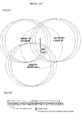
- a mobile station MS 11 newly appears and performs a carrier sense for transmitting its own data as shown in Fig.9B, there is found no "vacancy" (no available slot) in the packet occupation status in the air at the position of the mobile station MS 11, and "carrier presence” is indicated, so that a transmission chance is not provided. Accordingly, there is a possibility that a collision between the mobile stations may be induced.
- a transmission control method of a station namely, a first station transmitting its own information to another mobile station by a CSMA access method comprising: a first step of the station acquiring and holding its own moving speed information and location information; and a second step of the station transmitting the moving speed information and the location information with a predetermined minimum transmission power until its moving speed exceeds a first threshold, and of transmitting the moving speed information and the location information with a first transmission power proportional to the moving speed when the moving speed exceeds the first threshold.
- a transmission control device transmitting information of its own station to another mobile station by a CSMA access method comprising: a first means for acquiring and holding moving speed information and location information of its own station; and a second means for transmitting the moving speed information and the location information with a predetermined minimum transmission power until a moving speed of its own station exceeds a first threshold, and for transmitting the moving speed information and the location information with a first transmission power proportional to the moving speed when the moving speed of its own station exceeds the first threshold.
- the above-mentioned first step (or means) may include a step (or means) of the first station acquiring and holding its own moving direction information in addition to the moving speed information and the location information
- the second step (or means) may include a step (or means) of transmitting the moving direction information in addition to the moving speed information and the location information
- the method (or device) may further comprise a third step (or means) of receiving and holding moving speed information and moving direction information of the other mobile station, and a fourth step (or means) of switching the first transmission power to a second transmission power proportional to a moving speed of the other mobile station, and of the first station transmitting the moving speed information and the moving direction information if the moving speed of the other mobile station exceeds a second threshold higher than the first threshold and a moving direction of the other mobile station is one approaching direction the first station while the first station is not making transmission with the moving speed of its own station exceeding the first threshold.
- the transmission control method may further comprise a fifth step (or means) of transmitting the moving speed information and the moving direction information with the first transmission power when the moving direction of the other mobile station is not an approaching direction to the first station and even if the moving speed of the other mobile station is equal to or more than the second threshold.
- the transmission control method may further comprise a sixth step (or means) of increasing a transmission power in a slope fashion upon switchover from the first transmission power to the second transmission power.
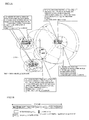
- a mobile station MS3 (first station, local station) among all of the mobile stations MS1-MS10 has not yet entered an area where it can receive information of any other mobile station, it transmits its own moving speed information and location information with a predetermined minimum power so long as the moving speed ⁇ the first threshold.
- the moving speed has become higher than the first threshold (the moving speed > the first threshold)
- the mobile speed information and the location information of the mobile station MS3 is transmitted with the first transmission power proportional to the acquired moving speed of the mobile station MS3 (at step S1).
- another mobile station having received the moving speed and the location information of the mobile station MS3, recognizes the location and the moving speed of the mobile station MS3 and can recognize a risk of a collision by the prior art CSMA method.
- the mobile station MS3 is not located in a receiving area of information from the mobile station MS4 which is moving at a high speed in the approaching direction, the first transmission power is small, the communication area is narrow, and a sufficient communication area required for avoiding the collision is formed (at step S1).
- the mobile stations MS5-MS 10 make data transmission with the first transmission power (at step S2) in this case as well, the communication area is narrow, and the sufficient communication area required for avoiding the collision is formed.
- the mobile stations MS 1 and MS2 moving at a low speed are mutually approaching to the mobile station MS4 moving at a high speed, the mobile stations MS 1 and MS2 transmit their own moving speed information and moving direction information with a second transmission power even if their own moving speed is low (at step S3). Therefore, the communication area becomes wide, information of their own moving speed and moving direction arrives at the mobile station MS4, and the sufficient communication area required for avoiding the collision is formed.
- a mobile station MS 11 moving at a low speed it newly tries to make data transmission and performs a carrier sense.
- the mobile stations MS3, MS5-MS10, and MS11 can detect empty slots since only the mobile stations MS 1, MS2, and MS4 occupy a packet in the air of the mobile station MS 11, whereby data transmission is enabled.
- the communication areas of the mobile stations MS3, MS5-MS 10 are very narrow, no collision of data occurs.
- the mobile station MS 11 is located in the communication areas of the mobile stations MS 1, MS2, and MS4, the mobile stations MS1 and MS2 are moving at a low speed and the mobile station MS4 is not in the approaching direction. Therefore, data transmission is made with the first transmission power.
- each mobile station controls its own transmission output by the "mobile speed information”, forms a communication area according to its own status, and stores the "moving speed information" and the "moving direction information” in transmission data to be transmitted. Also, each mobile station detects the "moving speed information" and the “moving direction information” from received data from another mobile station which has been received in a time zone (slot) during which its own station is not making data transmission.
- the communication area is enlarged, thereby enabling a packet occupancy per unit time to be reduced and the minimum communication area to be formed.
- the communication area according to the moving speed of the other mobile station is secured in order to avoid a collision between the mobile stations by informing the existence of the first station to the other station.
- the transmission power can be increased, the communication range is expanded, and a proper communication area can be formed.
- each of the mobile stations forms the communication area required even if too many mobile stations exist in the communication area. Therefore, an extra signal is not transmitted far, and a vacant time is easily found even if a carrier sense is performed, which contributes to an efficient broadcast communication using the CSMA method.
- Fig.2 shows an arrangement of each mobile station realizing a transmission control method and device according to the present invention, which is composed of a transmission processor 100, a reception processor, and a power control processor 300 briefly.
- the transmission processor 100 is composed of a location information-acquiring portion 4 of its own station, a moving direction information-acquiring portion 5 of its own station, a moving speed information-acquiring portion 6 of its own station, a transmission data generator 1 which inputs information 102-104 acquired by the information-acquiring portions 4-6 and generates transmission data 117, a modulator 2 which modulates the data 117 generated by the transmission data generator 1, a transmitting portion 3 which amplifies the power of modulation data 118 outputted from the modulator 2 and which transmits the amplified data through a directional coupler DC and an antenna ANT, a CSMA controller 13 which starts up transmission for the transmission data generator 1, the modulator 2, and the transmitting portion 3, and a carrier presence/absence determining portion 17 which provides information of carrier presence/absence to the CSMA controller 13.
- the reception processor 200 is composed of a receiving portion 14 which takes out a reception signal from the directional coupler DC, a demodulator 15 which demodulates reception data 118 from a reception signal 112 taken out by the receiving portion 14, and a reception data decoder 16 which decodes data modulated by the demodulator 15.
- the reception data decoder 16 outputs moving direction information 114 of other stations and moving speed information 115 of other stations, and also outputs location information 113 of other stations. It is arranged that the output signal 112 of the receiving portion 14 is also transmitted to the carrier presence/absence determining portion 17, and a carrier sense start-up signal 111 of the CSMA controller 13 is provided to the receiving portion 14.
- the power control processor 300 is provided with a 1 ST transmission power calculator 7 which compares the moving speed information 104 acquired by the moving speed information-acquiring portion 6 in the transmission processor 100 with a threshold "a" from a threshold setting portion 9 and which sequentially calculates a first transmission power A to be outputted, a moving direction information comparing portion 12 which compares the moving direction information 103 from the moving direction information-acquiring portion 5 in the transmission processor 100 with the moving direction information 114 of other stations decoded by the reception data decoder 16 in the reception processor 200, a moving speed information comparing portion 10 which outputs moving speed information 108 of other stations and a selection signal 106 based on a comparison result 107 at the moving direction information comparing portion 12, and a comparison result between a threshold "b" set by a threshold setting portion 11 and the value of the moving speed information 115 of other stations, a 2ND transmission power calculator 8 which sequentially calculates a second transmission power by the moving speed information 108 from the moving information comparing portion 10, and a selector 18 which inputs an output signal
- the location information-acquiring portion 4 is a functional portion for storing location information of the station containing the processor 100, detected by a GPS receiver or the like.
- the moving direction information-acquiring portion 5 is a functional portion for acquiring a moving direction of the station concerned, and a functional portion for calculating and acquiring a moving direction of the station from the location information by the GPS receiver or the like to be outputted. For example, a total 8 bits of information (1, 0 information of 2 bits) indicating four cardinal points and information (1, 0 information of 6 bits) indicating the angle by which the moving direction is shifted clockwise from the direction of the four cardinal points is outputted as a signal 102.
- the moving speed information-acquiring portion 6 is a phase speed information-acquiring portion, which acquires speed information of a mobile unit on which a mobile station is mounted (e.g. 1, 0 information of 9 bits) to be outputted as a signal 104.
- the information 102-104 is mapped into a data format communicated between actual mobile stations, so that transmission data 117 is generated.
- the generated transmission data 117 is modulated by the modulator 2, converted into a carrier by the transmitting portion 3, so that the carrier is transmitted by the antenna ANT through the directional coupler DC after being amplified.
- the transmission data generator 1, the modulator 2, and the transmitting portion 3 are started up by a transmission start-up control signal 110 transmitted when it is found that there is an available transmission timing (there is no other carrier) in the air (within a frame) as a result of a carrier sense by the CSMA controller 13.
- the CSMA controller 13 starts up the carrier sense by the signal 111 for the receiving portion 14. By reception electric field level information of the signal 112 obtained as a result of the carrier sense, the CSMA controller 13 generates the transmission start-up signal 110 and controls the start-up of each transmission system functional portion based on an output of the carrier presence/absence determining portion 17 which determines presence/absence of packets from other stations.
- the reception processor 200 the data received by the receiving portion 14 and demodulated by the demodulator 15 is decoded by the reception data decoder 16.
- the moving direction information 114 of other stations and the moving speed information 115 of other stations within the received packet is transmitted to the power control processor 300.
- the location information 113 of other stations is also outputted from the reception data decoder 16, thereby enabling a prediction of risk of collision or the like by the location and the speed of other stations in the same way as the prior art example.
- either a value of a first transmission power which will be described later or a second transmission power is selected for a final transmission power based on a result of comparison between information of the processor's own station and information of other stations.
- the moving direction information comparing portion 12 compares the moving direction information signal 103 of its own station and the moving direction information 114 of other stations from the reception data decoder 16, and transmits a result 107 of determining whether or not the direction is the approaching direction to the moving speed information comparing portion 10.
- the moving speed information comparing portion 10 compares the threshold "b" set by the threshold setting portion 11 with the moving speed information signal 115 of other stations, and outputs the moving speed information 108 of other stations and the selection signal 106 based on the comparison result 107 from the comparing portion 12.
- the 1 ST transmission power calculator 7 has a first algorithm for comparing the moving speed information 104 of its own station from the moving speed information-acquiring portion 6 with the threshold "a", set by the threshold setting portion 9, to determine the first transmission power A.
- the 2ND transmission power calculator 8 has a second algorithm for determining a second transmission power B based on the speed information read from the data received.
- the selector 18, as mentioned above, selects either the first transmission power A or the second transmission power B based on the selection signal 106 to be provided to the transmitting portion 3 as the final transmission power 109.
- the transmission processor 100 acquires the moving direction information and the moving speed information of its own station respectively by the moving direction information-acquiring portion 5 and the moving speed information-acquiring portion 6 (at step S12).
- the moving speed information 104 is inputted to the 1 ST transmission power calculator 7.
- the 1 ST transmission power calculator 7 determines whether or not the input value 104 exceeds the threshold "a" set by the threshold setting portion 9.
- the threshold "a" e.g. 30 km/h
- the first transmission power A according to the moving speed is obtained based on the first transmission power calculation algorithm (at step S14).
- a power (Pmin) for covering the minimum communication area determined by the system is determined as a transmission power (at step S15).
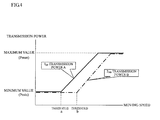
- the first transmission power A shown by a solid line in Fig.4 is determined (at step S 16). It is to be noted that the maximum value (Pmax) is a transmission power covering the maximum communication area which the mobile station is required to cover.
- the first transmission power A is inputted to the selector 18 for determining the final transmission power.
- the reception data decoder 16 takes out the moving direction information 114 and the moving speed information 115 from the reception data to be provided to the power control processor 300, every time data is received from another station in a time zone during which the mobile station itself is not making a transmission.
- the moving speed information comparing portion 10 compares the moving speed information 115 with the threshold "b" (e.g. 40 km/h) set in the threshold setting portion 11 (at step S 18).
- the second transmission power B (indicated by a dashed-dotted line in Fig.4) is calculated by the 2ND transmission power calculator 8 to be made the final power (at steps S20 and S21). It is to be noted that this second transmission power B also has the minimum power Pmin and the maximum power Pmax in the same way as the first transmission power A.
- the first transmission power A is selected.
- whether or not the moving speed information comparing portion 10 is activated is determined by the output 107 from the moving direction information comparing portion 12. Namely, the moving direction information comparing portion 12 compares its own moving direction information 103 with the moving direction information 114 of the reception data, and activates the moving speed information comparing portion 10 only when the directions are mutually approaching.
- the first and second transmission powers A and B are provided to the selector 18, and when the moving direction information of the local station and another station indicate an approaching direction (at step S 19), and the moving speed of the other mobile station exceeds the threshold "b" (at step S 18), the second transmission power B is selected as a final transmission power (at steps S22 and S23).
- the carrier presence/absence determining portion 17 performs a carrier sense (at step S24), detects an empty slot (at step S25), and makes a packet transmission (at step S26).
- the moving direction information, moving speed direction, and location information of its own station is transmitted with the above-mentioned first transmission power A or B. While Fig.3 showing the transmission power control operation, does not show the location information, a mobile station having received the location information as information 113 from another mobile station can preliminarily know a risk of collision by referring to the location information with the moving speed, since the location information 113 indicates a location of a mobile station of a transmitting source.
- Figs.5 and 6 show an operation of an actual power control.
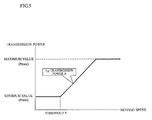
- Fig.5 shows a relationship between the moving speed and the transmission power either in the case where no reception data from another mobile station exists (at step S17), the moving direction is not the approaching direction even if the reception data exists (at step S19), or the moving speed is equal to or less than the threshold even if the reception data exists (at step S 18), where a calculation result A at the 1ST transmission power calculator 7 assumes the final power.
- Fig.6 shows a state of switching over the transmission power to the second transmission power B when the local station is making data transmission with the first transmission power A and at first gradually enhances its moving speed and receives a signal from another mobile station in the approaching direction whose moving speed exceeds the threshold "b".
- the mobile station performing the power control enhances the moving speed with time.
- Pt in this case indicates a calculation result of the 2ND transmission power calculator 8 at the time when the moving speed received from the other station exceeds the threshold "b”, and the transmission power is gradually changed in a slope fashion so as to reach Pt by taking the time during which the moving speed changes from "b” to "c".
- the slope is not related to the increasing degree of the speed of its own station but indicates the temporal increase of the output, and the time is only expressed by "the time during which the speed changes from "b” to “c”” in Fig.6.
Landscapes
- Engineering & Computer Science (AREA)
- Computer Networks & Wireless Communication (AREA)
- Signal Processing (AREA)
- Mobile Radio Communication Systems (AREA)
Applications Claiming Priority (1)
| Application Number | Priority Date | Filing Date | Title |
|---|---|---|---|
| JP2006206941A JP4929906B2 (ja) | 2006-07-28 | 2006-07-28 | 送信制御方法及び装置 |
Publications (3)
| Publication Number | Publication Date |
|---|---|
| EP1883191A2 true EP1883191A2 (fr) | 2008-01-30 |
| EP1883191A3 EP1883191A3 (fr) | 2012-07-04 |
| EP1883191B1 EP1883191B1 (fr) | 2013-12-11 |
Family
ID=38666935
Family Applications (1)
| Application Number | Title | Priority Date | Filing Date |
|---|---|---|---|
| EP07109460.1A Ceased EP1883191B1 (fr) | 2006-07-28 | 2007-06-01 | Procédé et dispositif de contrôle de transmission |
Country Status (4)
| Country | Link |
|---|---|
| US (1) | US8055279B2 (fr) |
| EP (1) | EP1883191B1 (fr) |
| JP (1) | JP4929906B2 (fr) |
| KR (1) | KR100903493B1 (fr) |
Cited By (3)
| Publication number | Priority date | Publication date | Assignee | Title |
|---|---|---|---|---|
| EP2249611A1 (fr) * | 2009-05-07 | 2010-11-10 | Renesas Electronics Corporation | Système de communication de véhicule |
| EP2262147A3 (fr) * | 2009-05-21 | 2010-12-22 | Fujitsu Limited | Système de communication |
| EP2688346A4 (fr) * | 2011-03-14 | 2014-12-10 | Nec Corp | Appareil de communication sans fil, système de communication sans fil, procédé de régulation d'encombrement et support d'enregistrement |
Families Citing this family (10)
| Publication number | Priority date | Publication date | Assignee | Title |
|---|---|---|---|---|
| US8045976B2 (en) | 2006-04-04 | 2011-10-25 | Aegis Mobility, Inc. | Mobility call management |
| WO2008109477A1 (fr) | 2007-03-02 | 2008-09-12 | Aegis Mobility, Inc. | Gestion de sessions de communication de dispositif mobile pour réduire la distraction de l'utilisateur |
| US8391259B2 (en) * | 2008-02-26 | 2013-03-05 | Stmicroelectronics, Inc. | Broadcast/multicast collision free frame transmission |
| US8942686B2 (en) * | 2008-09-05 | 2015-01-27 | Aegis Mobility, Inc. | Providing and managing bypass of enhanced services |
| TWI416411B (zh) * | 2010-08-06 | 2013-11-21 | Univ Nat Taiwan | 利用移動速度控制無線電開關之操作方法及其無線電設備 |
| US8942727B1 (en) | 2014-04-11 | 2015-01-27 | ACR Development, Inc. | User Location Tracking |
| US9413707B2 (en) | 2014-04-11 | 2016-08-09 | ACR Development, Inc. | Automated user task management |
| KR102173999B1 (ko) | 2014-07-17 | 2020-11-04 | 주식회사 만도 | 차량 통신 제어장치 및 방법 |
| CN105792158B (zh) * | 2014-12-22 | 2019-06-11 | 杭州华为数字技术有限公司 | 一种小区中的信息传输的方法及装置 |
| US12061910B2 (en) * | 2019-12-05 | 2024-08-13 | International Business Machines Corporation | Dispatching multiply and accumulate operations based on accumulator register index number |
Family Cites Families (14)
| Publication number | Priority date | Publication date | Assignee | Title |
|---|---|---|---|---|
| TW347616B (en) * | 1995-03-31 | 1998-12-11 | Qualcomm Inc | Method and apparatus for performing fast power control in a mobile communication system a method and apparatus for controlling transmission power in a mobile communication system is disclosed. |
| US5721733A (en) | 1995-10-13 | 1998-02-24 | General Wireless Communications, Inc. | Wireless network access scheme |
| US5872526A (en) * | 1996-05-23 | 1999-02-16 | Sun Microsystems, Inc. | GPS collision avoidance system |
| JP3805520B2 (ja) * | 1998-01-28 | 2006-08-02 | 富士通株式会社 | 移動通信における速度推定装置および方法 |
| WO2002003567A2 (fr) * | 2000-06-21 | 2002-01-10 | Cornell Research Foundation, Inc. | Reglage de puissance adaptatif pour reseaux sans fil |
| US7835762B2 (en) * | 2002-06-27 | 2010-11-16 | Qualcomm Incorporated | Adjusting transmit power in a wireless communication system |
| JP2004206624A (ja) * | 2002-12-26 | 2004-07-22 | Toyota Motor Corp | 車両用運転補助装置 |
| JP2004328394A (ja) | 2003-04-24 | 2004-11-18 | Matsushita Electric Ind Co Ltd | 基地局装置及び送信電力制御方法 |
| CN1567869B (zh) * | 2003-06-30 | 2010-05-05 | 叶启祥 | 可避免干扰损坏并增加空间再用率的干扰控制方法 |
| KR100528336B1 (ko) * | 2003-07-28 | 2005-11-15 | 삼성전자주식회사 | Csma/ca 기반의 무선 랜상에서 수신 소비 전력제어 방법 및 장치 |
| US7120439B2 (en) * | 2003-11-13 | 2006-10-10 | Motorola, Inc. | Method and apparatus for mobile radio velocity estimation |
| WO2006004465A1 (fr) | 2004-07-01 | 2006-01-12 | Telefonaktiebolaget L M Ericsson (Publ) | Commande de la puissance dans un reseau de communications et procede correspondant |
| US20080055068A1 (en) * | 2004-07-22 | 2008-03-06 | Koninklijke Philips Electronics, N.V. | Communication Device and Communication System as Well as Method of Communication Between and Among Mobile Nodes |
| US7653386B2 (en) * | 2006-05-05 | 2010-01-26 | Broadcom Corporation | Access point multi-level transmission power control supporting periodic high power level transmissions |
-
2006
- 2006-07-28 JP JP2006206941A patent/JP4929906B2/ja not_active Expired - Fee Related
-
2007
- 2007-05-21 US US11/802,155 patent/US8055279B2/en not_active Expired - Fee Related
- 2007-06-01 EP EP07109460.1A patent/EP1883191B1/fr not_active Ceased
- 2007-06-11 KR KR1020070056668A patent/KR100903493B1/ko not_active Expired - Fee Related
Cited By (8)
| Publication number | Priority date | Publication date | Assignee | Title |
|---|---|---|---|---|
| EP2249611A1 (fr) * | 2009-05-07 | 2010-11-10 | Renesas Electronics Corporation | Système de communication de véhicule |
| CN101882381A (zh) * | 2009-05-07 | 2010-11-10 | 瑞萨电子株式会社 | 车辆通信装置 |
| US8229668B2 (en) | 2009-05-07 | 2012-07-24 | Renesas Electronics Corporation | Vehicle communication system |
| EP2262147A3 (fr) * | 2009-05-21 | 2010-12-22 | Fujitsu Limited | Système de communication |
| US8218525B2 (en) | 2009-05-21 | 2012-07-10 | Fujitsu Limited | Communication system |
| EP2688346A4 (fr) * | 2011-03-14 | 2014-12-10 | Nec Corp | Appareil de communication sans fil, système de communication sans fil, procédé de régulation d'encombrement et support d'enregistrement |
| US9191854B2 (en) | 2011-03-14 | 2015-11-17 | Nec Corporation | Radio communication device, radio communication system, congestion control method, and record medium |
| US9426758B2 (en) | 2011-03-14 | 2016-08-23 | Nec Corporation | Radio communication device, radio communication system, congestion control method, and record medium |
Also Published As
| Publication number | Publication date |
|---|---|
| EP1883191A3 (fr) | 2012-07-04 |
| KR20080011049A (ko) | 2008-01-31 |
| JP2008035253A (ja) | 2008-02-14 |
| JP4929906B2 (ja) | 2012-05-09 |
| US20080026758A1 (en) | 2008-01-31 |
| US8055279B2 (en) | 2011-11-08 |
| KR100903493B1 (ko) | 2009-06-18 |
| EP1883191B1 (fr) | 2013-12-11 |
Similar Documents
| Publication | Publication Date | Title |
|---|---|---|
| EP1883191B1 (fr) | Procédé et dispositif de contrôle de transmission | |
| CN111213424B (zh) | 在无线通信系统中由终端发送侧链路消息的方法和使用该方法的终端 | |
| US9094944B2 (en) | Dynamic transmission protection in the presence of multiple modulation schemes | |
| US6243591B1 (en) | Mobile communication system | |
| RU2001116718A (ru) | Управление тепловым режимом передачи модема данных радиосвязи | |
| JP2002158605A (ja) | 通信網及び通信方法 | |
| KR20100097285A (ko) | 다중 안테나 시스템에서 채널 환경에 따라 통신 방식을 변경하기 위한 장치 및 방법 | |
| JP5135268B2 (ja) | 無線システム、受信機 | |
| JP2002539735A (ja) | 無線通信システム用の改良したメッセージアクセス | |
| JP4486483B2 (ja) | Tdma通信装置 | |
| JP2531254B2 (ja) | 分散無線システムの回線接続方法 | |
| US20240205800A1 (en) | Prioritization of multiple discovery resource types | |
| JP2007110633A (ja) | 無線通信装置 | |
| KR20180077673A (ko) | 차량용 무선 데이터 교환 시스템 및 그 제어방법 | |
| EP3716690A1 (fr) | Appareil électronique, procédé de communication sans fil et support lisible par ordinateur | |
| US8279082B2 (en) | Intelligent transport (IT) system using wireless communication between a roadside device and an in-vehicle device | |
| EP1434389A2 (fr) | Appareil de communication dans un réseau radio, procédé de contrôle de transmission, procédé de contrôle de la valeur de seuil, et système de réseau radio | |
| US6505042B1 (en) | System and method for establishing a communication link between a mobile station and a base station controller | |
| JP2005086643A (ja) | 通信端末 | |
| JP2748109B2 (ja) | 通信圏内外自動判別方式 | |
| JP2000269884A (ja) | 無線通信システム | |
| JP2005117303A (ja) | 無線lan装置および送信電力制御方法 | |
| JP3386976B2 (ja) | パケット通信方法 | |
| EP1755229A1 (fr) | Appareil récepteur | |
| JP5353858B2 (ja) | 無線通信装置 |
Legal Events
| Date | Code | Title | Description |
|---|---|---|---|
| PUAI | Public reference made under article 153(3) epc to a published international application that has entered the european phase |
Free format text: ORIGINAL CODE: 0009012 |
|
| AK | Designated contracting states |
Kind code of ref document: A2 Designated state(s): AT BE BG CH CY CZ DE DK EE ES FI FR GB GR HU IE IS IT LI LT LU LV MC MT NL PL PT RO SE SI SK TR |
|
| AX | Request for extension of the european patent |
Extension state: AL BA HR MK YU |
|
| REG | Reference to a national code |
Ref country code: DE Ref legal event code: R079 Ref document number: 602007034164 Country of ref document: DE Free format text: PREVIOUS MAIN CLASS: H04L0012560000 Ipc: H04W0052280000 |
|
| PUAL | Search report despatched |
Free format text: ORIGINAL CODE: 0009013 |
|
| AK | Designated contracting states |
Kind code of ref document: A3 Designated state(s): AT BE BG CH CY CZ DE DK EE ES FI FR GB GR HU IE IS IT LI LT LU LV MC MT NL PL PT RO SE SI SK TR |
|
| AX | Request for extension of the european patent |
Extension state: AL BA HR MK RS |
|
| RIC1 | Information provided on ipc code assigned before grant |
Ipc: H04W 52/28 20090101AFI20120531BHEP |
|
| 17P | Request for examination filed |
Effective date: 20130102 |
|
| RAP1 | Party data changed (applicant data changed or rights of an application transferred) |
Owner name: FUJITSU LIMITED |
|
| AKX | Designation fees paid |
Designated state(s): DE FR GB |
|
| GRAP | Despatch of communication of intention to grant a patent |
Free format text: ORIGINAL CODE: EPIDOSNIGR1 |
|
| INTG | Intention to grant announced |
Effective date: 20130627 |
|
| GRAS | Grant fee paid |
Free format text: ORIGINAL CODE: EPIDOSNIGR3 |
|
| GRAA | (expected) grant |
Free format text: ORIGINAL CODE: 0009210 |
|
| AK | Designated contracting states |
Kind code of ref document: B1 Designated state(s): DE FR GB |
|
| REG | Reference to a national code |
Ref country code: GB Ref legal event code: FG4D |
|
| RIN1 | Information on inventor provided before grant (corrected) |
Inventor name: MURAKAMI, HIROKAZU |
|
| REG | Reference to a national code |
Ref country code: DE Ref legal event code: R096 Ref document number: 602007034164 Country of ref document: DE Effective date: 20140206 |
|
| REG | Reference to a national code |
Ref country code: DE Ref legal event code: R097 Ref document number: 602007034164 Country of ref document: DE |
|
| PLBE | No opposition filed within time limit |
Free format text: ORIGINAL CODE: 0009261 |
|
| STAA | Information on the status of an ep patent application or granted ep patent |
Free format text: STATUS: NO OPPOSITION FILED WITHIN TIME LIMIT |
|
| 26N | No opposition filed |
Effective date: 20140912 |
|
| REG | Reference to a national code |
Ref country code: DE Ref legal event code: R097 Ref document number: 602007034164 Country of ref document: DE Effective date: 20140912 |
|
| REG | Reference to a national code |
Ref country code: FR Ref legal event code: PLFP Year of fee payment: 10 |
|
| REG | Reference to a national code |
Ref country code: FR Ref legal event code: PLFP Year of fee payment: 11 |
|
| PGFP | Annual fee paid to national office [announced via postgrant information from national office to epo] |
Ref country code: DE Payment date: 20170523 Year of fee payment: 11 Ref country code: FR Payment date: 20170511 Year of fee payment: 11 Ref country code: GB Payment date: 20170531 Year of fee payment: 11 |
|
| REG | Reference to a national code |
Ref country code: DE Ref legal event code: R119 Ref document number: 602007034164 Country of ref document: DE |
|
| GBPC | Gb: european patent ceased through non-payment of renewal fee |
Effective date: 20180601 |
|
| PG25 | Lapsed in a contracting state [announced via postgrant information from national office to epo] |
Ref country code: DE Free format text: LAPSE BECAUSE OF NON-PAYMENT OF DUE FEES Effective date: 20190101 Ref country code: GB Free format text: LAPSE BECAUSE OF NON-PAYMENT OF DUE FEES Effective date: 20180601 Ref country code: FR Free format text: LAPSE BECAUSE OF NON-PAYMENT OF DUE FEES Effective date: 20180630 |