EP1883208A2 - Terminal portable à deux glissières - Google Patents
Terminal portable à deux glissières Download PDFInfo
- Publication number
- EP1883208A2 EP1883208A2 EP07252845A EP07252845A EP1883208A2 EP 1883208 A2 EP1883208 A2 EP 1883208A2 EP 07252845 A EP07252845 A EP 07252845A EP 07252845 A EP07252845 A EP 07252845A EP 1883208 A2 EP1883208 A2 EP 1883208A2
- Authority
- EP
- European Patent Office
- Prior art keywords
- housing
- posture
- display
- exposed
- pda
- Prior art date
- Legal status (The legal status is an assumption and is not a legal conclusion. Google has not performed a legal analysis and makes no representation as to the accuracy of the status listed.)
- Withdrawn
Links
- 230000009977 dual effect Effects 0.000 title abstract 3
- 238000013519 translation Methods 0.000 claims abstract description 37
- 230000007246 mechanism Effects 0.000 claims abstract description 30
- 230000008878 coupling Effects 0.000 claims abstract description 26
- 238000010168 coupling process Methods 0.000 claims abstract description 26
- 238000005859 coupling reaction Methods 0.000 claims abstract description 26
- 230000036544 posture Effects 0.000 description 152
- 230000008859 change Effects 0.000 description 8
- 230000007704 transition Effects 0.000 description 4
- 230000008901 benefit Effects 0.000 description 2
- 238000000034 method Methods 0.000 description 2
- 229920001690 polydopamine Polymers 0.000 description 2
- 238000013459 approach Methods 0.000 description 1
- 230000005540 biological transmission Effects 0.000 description 1
- 238000004891 communication Methods 0.000 description 1
- 238000013500 data storage Methods 0.000 description 1
- 238000012905 input function Methods 0.000 description 1
- 238000012986 modification Methods 0.000 description 1
- 230000004048 modification Effects 0.000 description 1
- 230000002265 prevention Effects 0.000 description 1
- 230000001105 regulatory effect Effects 0.000 description 1
Images



Classifications
-
- H—ELECTRICITY
- H04—ELECTRIC COMMUNICATION TECHNIQUE
- H04B—TRANSMISSION
- H04B1/00—Details of transmission systems, not covered by a single one of groups H04B3/00 - H04B13/00; Details of transmission systems not characterised by the medium used for transmission
- H04B1/38—Transceivers, i.e. devices in which transmitter and receiver form a structural unit and in which at least one part is used for functions of transmitting and receiving
-
- H—ELECTRICITY
- H04—ELECTRIC COMMUNICATION TECHNIQUE
- H04M—TELEPHONIC COMMUNICATION
- H04M1/00—Substation equipment, e.g. for use by subscribers
- H04M1/02—Constructional features of telephone sets
- H04M1/0202—Portable telephone sets, e.g. cordless phones, mobile phones or bar type handsets
- H04M1/0206—Portable telephones comprising a plurality of mechanically joined movable body parts, e.g. hinged housings
- H04M1/0208—Portable telephones comprising a plurality of mechanically joined movable body parts, e.g. hinged housings characterized by the relative motions of the body parts
- H04M1/0235—Slidable or telescopic telephones, i.e. with a relative translation movement of the body parts; Telephones using a combination of translation and other relative motions of the body parts
- H04M1/0239—Sliding mechanism with two degree of freedom, e.g. translation in two different directions
-
- H—ELECTRICITY
- H04—ELECTRIC COMMUNICATION TECHNIQUE
- H04M—TELEPHONIC COMMUNICATION
- H04M2250/00—Details of telephonic subscriber devices
- H04M2250/18—Details of telephonic subscriber devices including more than one keyboard unit
Definitions
- the present invention relates to a small portable terminal and, more specifically, to a portable terminal having many functions where amount of information input/output varies in accordance with the functions.
- a small portable terminal represented by a portable telephone
- a portable telephone that can be held by one hand comes to incorporate various functions.
- functions of a portable terminal such as a telephone and a personal computer, mainly including communication functions represented by telephone (conversation) function, as well as creation, transmission and display of electronic mails.
- telephone conversation
- many proposals on device structures have been made that allow operations in different forms suitable for the states of use of the portable terminal.
- US2004/189597A1 discloses foldable and slidable type portable telephones.
- an upper case is folded or slid to close and hide an operating panel on the lower case, in order to prevent unintentional button operation.
- an opening for a folding type
- a U-shaped cutout for a sliding type
- US2005/052837A1 discloses a portable terminal having two wedge-shaped bodies slidably coupled to each other to provide space margin mainly for positioning a camera mechanism.
- the wedge-shaped bodies are normally combined to form a rectangular box, allowing compact storage.
- the bodies are slid with respect to each other, so that the overall body comes to have a prescribed length convenient for use.
- the portion corresponding to the bottom of the wedge is thick enough to accommodate camera or other mechanism with ample room.
- Japanese Patent Laying-Open 2006-19925 discloses a portable terminal having a function mainly allowing viewing of television (hereinafter denoted as "TV") broadcast (typically, 1-segment broadcasting service in Japan for distributing TV broadcast to portable terminals.).
- the portable terminal includes a first case having an operation panel and a second case having a display, and by rotational sliding, it is possible to switch between a state in which the operation panel of the first case is covered with the second case, and a state in which the operation panel of the first case is exposed and the display of the second case is set in lateral (landscape) arrangement.
- a mechanism is adopted that allows easy, one-hand operation for rotationally sliding the second case.
- a display screen is preferred to be as large as possible and landscape display capability is desired. Further, for the purpose of playing games on portable terminal displays, which are now popular, a display screen as large as possible and allowing both landscape and portrait arrangements is desired.
- buttons and the like such as numeric buttons and cursor keys.
- buttons and the like such as numeric buttons and cursor keys.
- an application requiring relatively frequent text input, such as electronic mailing is to be implemented, a considerably large number of buttons must be provided.
- Most of such buttons are unnecessary when one views TV broadcast or plays a game and, these buttons are rather troublesome as unintended touching may cause erroneous operation. Therefore, it is preferred that such buttons are hidden at the time of receiving TV broadcast or playing a game.
- the portable terminal described in US2005/052837A1 has operating portions not directly related to TV viewing, such as a camera and camera operating buttons, arranged on a side surface, and the operating portions are always operable no matter whether the bodies are extended or not. In this case also, the user must pay attention not to erroneously press any button unrelated to TV viewing, and hence, carefree TV viewing is not expected.
- the portable terminal described in Japanese Patent Laying-Open No. 2006-019925 realizes both portrait and landscape displays, and switching from the portrait to landscape display can be realized advantageously with one hand.
- the structure of the terminal is such that all buttons and the like are hidden in the portrait display state, and all the buttons and the like are exposed in the landscape display state.
- quick key operation is impossible.
- a channel switch button is placed right beside the display portion.
- the portable terminal described in Japanese Patent Laying-Open No. 2006-019925 allows switching between portrait display and landscape display with one hand, the direction of display is rotated by 90° before and after the switching in either direction. As the display is rotated when the posture is switched, it is necessary to change the manner of display in accordance with the posture and the manner of use after the posture is switched with one hand, and such an operation might be so troublesome as to cancel the advantage of easy posture switching with one hand.
- an object of the present invention is to provide a portable terminal that can be switched to a posture suitable for an application without affecting display, not susceptible to erroneous operation and allowing smooth operation.
- Another object of the present invention is to provide a portable terminal that can be switched to a posture suitable for an application without affecting display, providing key configuration not susceptible to erroneous operation and allowing smooth operation.
- a portable terminal includes: a first housing having a first surface with a display arranged, and a second surface as a rear surface of the first surface; a second housing having a first surface; and a coupling mechanism coupling the first housing and the second housing to each other.
- the coupling mechanism includes a first translation mechanism coupling the first housing to the second housing in a manner allowing translation movement of the first housing relative to the second housing along a prescribed first trajectory, between a first posture in which the first surface of the second housing is covered by the second surface of the first housing and a second posture in which the first surface of the second housing is exposed, and a second translation mechanism coupling the first housing to the second housing in a manner allowing translation movement of the first housing relative to the second housing along a second trajectory different from the first trajectory, between the first posture and a third posture in which the first surface of the second housing is exposed.
- the coupling mechanism By the coupling mechanism, the first surface of the second housing is covered by the first housing in the first posture, and when the posture is changed from the first posture to the second and third postures by translation, the first surface of the second housing is exposed. It is noted, however, that the trajectory of translation when the posture is changed from the first posture to the second posture is different from that when the posture is changed from the first posture to the third posture. As the changes in posture are both realized by the translation mechanism, the posture of display in the first posture is kept unchanged. Therefore, the posture of the portable terminal can be switched among the first, second and third postures without any influence on the manner of display on the display screen. As a result, even when the posture is switched to one suitable for the application, the portable terminal can be used comfortably without any influence on the display.
- input/output devices for operation of an application using the display are arranged on the first surface of the second housing.
- the configuration of the input/output devices exposed in the second posture is different from the configuration of the input/output devices exposed in the third posture.
- the configuration of input/output devices exposed in the second posture is different from that exposed in the third posture.
- the configurations and arrangements of the input/output devices are determined in advance in accordance with the applications to be executed in the second and third postures, it becomes possible to have input/output devices used in the corresponding posture exposed and those not used in the posture unexposed as much as possible.
- a portable terminal that can be switched to a posture suitable for an application without affecting display, not susceptible to erroneous operation and allowing smooth operation can be provided.
- the display has an approximately rectangular shape with longer and shorter sides; the first trajectory forms a line in a direction parallel to the shorter side; and the second trajectory forms a line in a direction parallel to the longer side.
- the posture can be switched among the first, second and third postures. Movement in such directions is intuitive and easy to understand, and does not require difficult operation. As a result, a portable terminal that can be easily switched to a posture suitable for an application, not affecting display even when the posture is switched, and allowing smooth operation can be provided.
- the portable terminal can be switched easily to a posture suitable for an application. Even in that case, the display is not influenced, while the configuration of exposed input/output devices is changed and hence possibility of erroneous operation can be reduced. Therefore, the user can use the portable terminal comfortably.
- a portable terminal includes: a first housing having a first surface with a display arranged, and a second surface as a rear surface of the first surface; an input device having an operating surface for operation of an application using the display; a first translation mechanism coupling the first housing to the input device in a manner allowing translation movement of the housing along a prescribed first trajectory relative to the input device, between a first posture in which the operating surface is covered by the second surface and a second posture in which the operating surface is exposed; and a second translation mechanism coupling the first housing to the input device in a manner allowing translation movement of the first housing along a second trajectory different from the first trajectory relative to the input device, between the first posture and a third posture in which the operating surface is exposed.
- the operating surface of the input device is covered by the first housing in the first posture and when the posture is changed from the first posture to the second and third postures by translation, the operating surface of the input device is exposed. It is noted, however, that the trajectory of translation when the posture is changed from the first posture to the second posture is different from that to the third posture. As the changes in posture are both realized by the translation mechanism, the posture of display in the first posture is kept unchanged. Therefore, the posture of the portable terminal can be switched among the first, second and third postures without any influence on the manner of display on the display screen. By the switching, the exposed portion of the operating surface of the input device is changed. Even when the operating surface is exposed, it is partially hidden by the first housing.
- Fig. 1 shows an appearance of PDA 30 as a portable terminal in accordance with the first embodiment of the present invention.
- PDA 30 includes a first housing 40 of an approximately flat, rectangular box shape having an approximately rectangular upper surface 44 with a main display 46 arranged thereon and a lower surface (not shown) as a rear surface of upper surface 44; and a second housing 42 of an approximately flat, rectangular box shape similar to the first housing, coupled to the first housing 40 such that an upper surface thereof is covered entirely with the first housing 40.
- the second housing 42 has an input device for operating or inputting information to PDA 30 using display 46 on upper surface 44.
- the first and second housings 40 and 42 have approximately the same dimensions, and main display 46 has shorter side length of Cy and longer side length of Cx.
- the first housing 40 is coupled to the second housing by a coupling mechanism, not shown in Fig. 1, such that it can slid by translation from the state shown in Fig. 1(B) to the upper direction in the figure by a distance Ly (Ly ⁇ Cy) along the shorter side of second housing 42, and it can slid by translation from the state shown in Fig. 1(B) to the left direction in the figure by a distance Lx (Lx ⁇ Cx) along the longer side of second housing 42.
- Fig. 1(A) shows the appearance of PDA 30 with the first housing 40 slid in the shorter side direction of second housing 42
- Fig. 1(C) shows the appearance of PDA 30 with the first housing 40 slid in the longer side direction of second housing 42, respectively.
- the posture shown in Fig. 1(B) will be referred to as the first posture
- the posture shown in Fig. 1(A) will be referred to as the second posture
- the posture shown in Fig. 1(C) will be referred to as the third posture.
- Transition between the first and second postures will be referred to as longitudinal slide
- transition between the first and third postures will be referred to as lateral slide.
- directions of translation are two directions, that is, the direction parallel to the shorter side and the direction parallel to the longer side of main display 46, namely, directions parallel to the shorter side and longer side of approximately rectangular upper surface 44, and both result in linear movements.
- Such directions of movement allow intuitive operations of the user, and this approach is advantageous in that the user would not be confused in operation for changing the posture.
- translation is not limited to such straight lines, and directions thereof are not limited to directions parallel to the shorter and longer sides of main display 46.
- the trajectory of movement of first housing 40 may draw a curve, or movement may be in a direction crossing the shorter and longer sides of main display 46 at a prescribed angle.
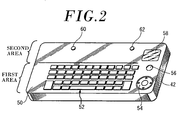
- Fig. 2 shows the appearance of second housing 42.
- the second housing 42 is of an approximately flat, rectangular box shape, and has an upper surface 50 on which a number of main keys 52 used for character input and the like, a cursor key 54 used for moving a cursor, an enter key 56 for establishing an input, and a sub-display 58 capable of displaying an image independent from main display 46 are arranged.
- Main keys 52 are arranged slightly to the left from the center of upper surface 50.
- two projections 60 and 62 are provided, which constitute part of the coupling mechanism mentioned above.
- projections 60 and 62 are arranged at symmetric positions on upper surface 50. Projections 60 and 62 form part of the coupling mechanism described above.
- Upper surface 50 may be divided into a first area from the lower side to a distance Ly, and a second area from that position to the upper side.
- Main keys 52, cursor key 54 and enter key 56 are all provided in the first area.
- Sub-display 58 and projections 60 and 62 are all provided in the second area.
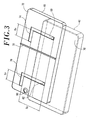
- Fig. 3 schematically shows a structure of a rear surface 72 of first housing 40.
- a pair of L-shaped slide guides 74 and 76 forming a part of the coupling mechanism described above, and an FPC guide 78 for regulating lateral movement of a flexible printed board (not shown) for electrical connection between the first and second housings 40 and 42 are formed.
- a camera lens 80 is provided near the left end on Fig. 3 of rear surface 72.
- Camera lens 80 is normally unexposed, and it is exposed when PDA 30 is set to the second and third postures.
- main display 46 shown in Fig. 1 is used as a finder, and when it is used in the third posture, main display 46 may be turned off and sub-display 58 may be used as a finder.
- projection 60 engages with slide guide 74
- projection 62 engages with slide guide 76
- slide guide 76 whereby a dual-slide mechanism coupling the second and first housings 42 and 40 slidable in two directions relative to each other is formed. Sliding directions are the shorter side and longer side directions of second housing 42.
- PDA 30 is in the second posture shown in Fig. 1(A); when they are at the tip ends of shorter sides, PDA 30 is in the third posture shown in Fig. 1(C); and when projections 62 and 64 are at the bent portions of slide guides 74 and 76, PDA 30 is in the first posture shown in Fig.
- the distance between the shorter side portions of slide guides 74 and 76 shown in Fig. 3 to the upper side of rear surface 72 of first housing 40 is approximately the same as the distance between projections 60 and 62 shown in Fig. 2 and the upper side of upper surface 50 of the second housing 42. Transition from the first posture to the second posture through translation is realized by the first translation mechanism, and transition between the first and third postures through translation is realized by the second translation mechanism.
- FPC guide 78 is formed slightly to the right from the center in Fig. 3 of rear surface 72 of first housing 40, to be parallel to the shorter side of first housing 40 and slightly protruding from rear surface 72. FPC guide 78, together with FPC, will be described later.
- the first housing 80 in the second posture, is moved upward as shown in the figure by the distance Ly, and therefore, main keys 52, cursor key 54 and enter key 56 are exposed.
- text input is possible using main keys 52, cursor key 54 and enter key 56 while viewing main display 46.
- a relatively large area of upper surface 50 is exposed, and therefore, a large number of main keys 52 may be arranged, allowing high-speed text input.
- the first housing 40 is slid by the prescribed distance Lx to the left in the figure.
- a right end portion of upper surface 50 of second housing 42 (area having the width Lx) is exposed, allowing operation of cursor key 54 and enter key 56, and sub-display 58 is viewable.
- the area exposed in this state will be referred to as the third area, and the area not exposed will be referred to as the fourth area.
- the ratio occupied by the length of longitudinal slide with respect to the shorter side of second housing 42 is larger than the ratio occupied by the length of lateral slide with respect to the longer side.
- the reason for this is as follows.
- main operation is expected to be character input, and therefore, it is necessary to expose all main keys 52.
- the third posture is not used for character input, and expected use of this posture is TV viewing or playing games. Therefore, it is unnecessary to expose main keys 52, and it is rather preferred to keep main keys 52 unexposed.
- FPC 90 having a planer shape such as shown in Fig. 4 is used, interposed between the second housing 42 and the first housing 40.
- FPC 90 consists of a first-housing-side end portion 96 and a second-housing-side end portion 94 parallel to each other and having the same length, and a central portion connecting the end portions. These portions are all flexible and can be freely bent in a direction crossing the plane.
- Fig. 5 shows the posture of FPC 90 in PDA 30 in the state of Fig. 1(B) (first posture).
- first posture the second-housing-side end portion 94 is reversed to the lower side in the middle, and connected by means of a connector, not shown, to a circuit in the second housing 42.
- the first-housing-side end portion 96 is reversed to the upper side in the middle, and connected by means of a connector, not shown, to a circuit in the first housing 40.
- the central portion 92 is in an extended state.
- FPC guide 78 described above is formed at a position to be in contact with the longer side of central portion 92 in this state. With the longer side of central portion 92 being in contact with FPC guide 78, movement of FPC 90 over FPC guide 78 is restricted.
- Fig. 6 shows the posture of FPC 90 in PDA 30 in the state of Fig. 1(A) (second posture).
- the second-housing-side end portion 94 and the first-housing-side end portion 96 maintain the postures similar to Fig. 5, relative to the second housing 42 and the first housing 40, respectively.
- the end portion of central portion 92 on the side of first-housing-side end portion 96 is moved, guided by FPC guide 78, by the distance Ly upward to the left in Fig. 6 as the first housing slides and moves.
- Fig. 7 shows the posture of FPC 90 in PDA 30 in the state of Fig. 1(C) (third posture).
- the first-housing-side end portion 96 moves to the left as represented by an arrow 100 and, on the contrary, the second-housing-side end portion 94 moves to the right relative to central portion 92, as represented by an arrow 98, with central portion 92 kept in the extended state. Then, the movement stops when the first housing 40 has moved by the distance Lx relative to the second housing 42.
- electrical connection between the second housing 42 and the first housing 40 can be maintained in any of the first, second and third postures.
- PDA 30 in accordance with the first embodiment as described above is used in the following manner.
- PDA 30 is set to the first posture shown in Fig. 1(B). In this state, unnecessary buttons and the like are all hidden, and hence, there is no possibility of erroneous operation caused by unintended pressing of any button.
- PDA. 30 When characters are to be input at high-speed for writing an e-mail or drafting a document, PDA. 30 is used in the second posture shown in Fig. 1(A). Input/output devices for inputting sentences at high speed such as main keys 52 and cursor key 54 are all available, and therefore, it is possible to form desired sentences at far higher speed than when the number of available keys is limited, as in the case of a conventional portable telephone.
- the PDA is set to the third posture shown in Fig. 1(C).
- the third posture minimum keys necessary for game operation or TV operation such as cursor key 54 are available while other keys are unexposed. Therefore, there is little possibility of erroneous operation caused by unintended pressing of an unrelated key while viewing TV broadcast or playing a game.
- the third posture it is possible to display, for example, broadcast of a different channel on sub-display 58. Therefore, though it is a portable PDA, it allows the user to enjoy TV broadcast in various different manners.
- sub-display 58 is provided in this space, it becomes possible to confirm an image when the terminal is used as a camera, using not the main display 46 but sub-display 58 of smaller power consumption as the finder. It is unnecessary to provide a sub-display used only as the finder on the surface of first housing 40, and thus, surfaces of the first and second housings 40 and 42 can be used effectively.
- the first and second housings 40 and 42 change their positions to assume any of the three postures through translation without rotation.
- Input/output devices provided on the second housing 42 are exposed in different configurations in different states. Specifically, the devices are not at all exposed, most of the devices are exposed or only a part of the devices are exposed. Therefore, any of the three postures described above may be selected in consideration of the types and numbers of the input/output devices to be used, and thus, a portable terminal supporting TV broadcast and relatively free of erroneous operation during use can be provided.
- the first housing 40 entirely covers the upper surface 50 of second housing 42 in the first posture. Therefore, in the first posture, input/output devices are not at all exposed, eliminating possibility of erroneous operation during watching TV broadcast. It is necessary, however, to change the state to the third posture, to switch a channel.
- a channel switch button which can be operated in the first posture
- Fig. 8 shows an appearance of a PDA 110 as an example having such a button, in the second posture.
- PDA 110 includes, in place of the first housing 40 of PDA 30 in accordance with the first embodiment, a first housing 112 having channel switch buttons 114 and 116 provided closer to main display 46.
- PDA 110 can assume, similar to PDA 30 in accordance with the first embodiment, the first, second and third postures shown in Fig. 1, by sliding the first housing 112 either in the longitudinal direction or lateral direction relative to the second housing 42, through translation.
- Channel switch buttons 114 and 116 can be operated regardless of the posture of PDA 110. Therefore, even in the first posture, TV broadcasting channel can be switched by operating channel switch buttons 114 and 116. It is unnecessary to change the posture of PDA 110 to the third posture in order to switch the channel. Possibility of erroneous operation naturally increases as channel switch buttons 114 and 116 are always accessible. It is a trade-off between improved operability and prevention of erroneous operation, and the arrangement shown in Fig. 8 is considered sufficiently useful.
- sub-display 58 is adopted as an input/output device exposed only in the third posture.
- the present invention is not limited to such an embodiment, and various other input/output devices may be provided at this position.
- Fig. 9 shows an appearance of a PDA 130 having a function of portable telephone in accordance with a third embodiment, in the third posture.
- PDA 130 includes first and second housings 140 and 142, and these housings can assume any of the first, second and third postures, similar to the first and second housings 40 and 42 of PDA 30 in accordance with the first embodiment.
- the second housing 142 is the same as the second housing 42 of PDA 30, except that in place of sub-display 58 provided on the second housing 42, a fingerprint sensor 148 is provided.
- First housing 140 is the same as the first housing 40 of PDA 30, except that a microphone 144 and a speaker 146 are provided on left and right sides of main display 46 (up and down sides when PDA 130 is used in portrait arrangement), so as to allow use of PDA 130 as a portable telephone.
- PDA 130 has fingerprint sensor 148 at the position that is exposed only in the third posture, and higher security is assured utilizing a space not used conventionally.
- the upper surface of the second housing 42 or 142 is entirely covered by the first housing 40 or 140, and hence, input/output devices arranged on the upper surface of second housing 42 or 142 are not at all exposed.
- the present invention is not limited to such embodiments.
- PDA 160 having the function of a portable telephone in accordance with the fourth embodiment shown in Fig. 10 a part of the first housing is exposed even in the first posture, and the input/output device existing at that portion can be used.
- Fig. 10(B) shows an appearance of PDA 160 in accordance with the fourth embodiment in the first posture
- Fig. 10(A) shows an appearance in the second posture
- Fig. 10(C) shows an appearance in the third posture.
- PDA 160 includes a first housing 170 having an upper surface 182 with a display 184 provided at the center, and a second housing 172 having an upper surface 180 having channel switch buttons 190 and 192 on the left end and assembled to the first housing 170 such that upper surface 180 is covered by the first housing 180 except for the left end area where channel switch buttons 190 and 192 are provided in the first posture.
- a speaker 146 is provided on the left side of display 184 (when PDA 150 is used in the portrait arrangement, upper side).
- no speaker is provided on upper surface 182 of first housing 170.
- PDA 160 the left end area of upper surface 180 of second housing 172 is exposed in the first posture. Therefore, channel switch buttons 190 and 192 may be operated, and switching from the first posture to another posture for changing the channel while viewing TV is unnecessary.
- PDA 160 is set to the second posture.
- main keys 194 provided slightly to the left from the center of upper surface 180 of second housing 172, cursor key 154 and enter key 56 are exposed. Therefore, in this posture, it is possible to input sentences at a high speed using display 184, main keys 194, cursor key 54 and enter key 56. Further, in the second posture also, channel switch buttons 190 and 192 are exposed, and therefore, it is possible to change the channel without changing the posture of PDA 160, while viewing TV on display 184.
- PDA 160 by sliding the first housing 170 to the left from the first posture, PDA 160 is set to the third posture.
- the third posture in addition to cursor key 54 and enter key 56 provided on the upper surface 180 of second housing 172, the area where sub-display 58 is provided in the first embodiment is exposed.
- a microphone 196 is provided at this position. Therefore, when longitudinally held in this state, PDA 160 can provide the telephone function utilizing microphone 196 and speaker 146.
- channel switch buttons 190 and 192 are hidden by the first housing 170 and, therefore, there is no possibility of pressing these buttons erroneously.
- the first posture as the base posture
- input/output devices other than the main display are not at all or only partially exposed to the outside. Therefore, possibility of erroneous operation by an unintended touching of an input/output device that is not to be manipulated can be reduced.
- main keys including a large number of keys are exposed, and cursor key 54 and enter key 56 are also exposed. High-speed input of sentences becomes possible using these keys and, therefore, this posture is optimal for applications for creating mails and writing sentences.
- keys larger in number than in the first posture but smaller than in the second posture are exposed.
- the embodiments above are all directed to PDAs.
- the present invention is applicable not only to PDAs but also to multi-functional portable telephones, remote controllers, portable music players, portable data storage devices and the like, as can be clearly understood from the foregoing description.
- the first and second housings both have flat, approximately rectangular box shapes.
- the shape of housings is not limited to a rectangular box.
- the housing may have elliptical or oval planer shape.
- the first and second housings may not have the same shape.
Landscapes
- Engineering & Computer Science (AREA)
- Signal Processing (AREA)
- Computer Networks & Wireless Communication (AREA)
- Telephone Set Structure (AREA)
Applications Claiming Priority (1)
| Application Number | Priority Date | Filing Date | Title |
|---|---|---|---|
| JP2006205725A JP5192668B2 (ja) | 2006-07-28 | 2006-07-28 | 携帯型端末 |
Publications (2)
| Publication Number | Publication Date |
|---|---|
| EP1883208A2 true EP1883208A2 (fr) | 2008-01-30 |
| EP1883208A3 EP1883208A3 (fr) | 2009-12-16 |
Family
ID=38750561
Family Applications (1)
| Application Number | Title | Priority Date | Filing Date |
|---|---|---|---|
| EP07252845A Withdrawn EP1883208A3 (fr) | 2006-07-28 | 2007-07-18 | Terminal portable à deux glissières |
Country Status (6)
| Country | Link |
|---|---|
| US (1) | US8160660B2 (fr) |
| EP (1) | EP1883208A3 (fr) |
| JP (1) | JP5192668B2 (fr) |
| KR (1) | KR101055959B1 (fr) |
| CN (1) | CN101115382B (fr) |
| TW (1) | TWI334076B (fr) |
Cited By (1)
| Publication number | Priority date | Publication date | Assignee | Title |
|---|---|---|---|---|
| EP2290920A3 (fr) * | 2009-08-27 | 2013-02-06 | Funai Electric Co., Ltd. | Terminal mobile coulissant |
Families Citing this family (88)
| Publication number | Priority date | Publication date | Assignee | Title |
|---|---|---|---|---|
| EP1794004A4 (fr) * | 2004-08-13 | 2012-05-09 | Examples Inc 5 | Clavier a une rangee et dactylographie approximative |
| US7853301B2 (en) * | 2006-09-19 | 2010-12-14 | Samsung Electronics Co., Ltd | Sliding module for double sliding-type portable communication terminal |
| CN101237478B (zh) * | 2007-02-02 | 2012-03-07 | 深圳富泰宏精密工业有限公司 | 便携式电子装置 |
| JP4752797B2 (ja) * | 2007-03-22 | 2011-08-17 | パナソニック株式会社 | 開閉装置 |
| USD590825S1 (en) * | 2007-05-31 | 2009-04-21 | Compal Electronics, Inc. | Mobile personal computer |
| EP2007116A3 (fr) * | 2007-06-22 | 2011-09-14 | Samsung Electronics Co., Ltd. | Utilisation du mouvement des boîtiers coulissants comme entrée dans un telephone portable |
| US8099144B2 (en) | 2007-08-20 | 2012-01-17 | Google Inc. | Electronic device with hinge mechanism |
| USD578987S1 (en) * | 2007-08-24 | 2008-10-21 | Samsung Electronics Co., Ltd. | Portable phone |
| USD612857S1 (en) * | 2007-09-17 | 2010-03-30 | Easy Park Ltd. | Electronic card |
| USD594454S1 (en) * | 2007-09-21 | 2009-06-16 | Kabushiki Kaisha Toshiba | Portable information terminal unit |
| USD575760S1 (en) * | 2007-09-27 | 2008-08-26 | Samsung Electronics Co., Ltd. | Portable telephone |
| USD583342S1 (en) * | 2007-09-27 | 2008-12-23 | Samsung Electronics Co., Ltd. | Portable telephone |
| USD580400S1 (en) * | 2007-10-31 | 2008-11-11 | Samsung Electronics Co., Ltd. | Portable phone |
| USD580401S1 (en) * | 2007-11-26 | 2008-11-11 | Samsung Electronics Co., Ltd. | Mobile phone |
| TWD128683S1 (zh) * | 2007-12-27 | 2009-05-11 | 三星電子股份有限公司 | 行動電話 |
| TWD128686S1 (zh) * | 2007-12-28 | 2009-05-11 | 三星電子股份有限公司 | 行動電話 |
| USD589021S1 (en) * | 2008-01-25 | 2009-03-24 | Samsung Electronics Co., Ltd. | Mobile phone |
| USD593984S1 (en) * | 2008-02-04 | 2009-06-09 | Sony Ericsson Mobile Communication Ab | Mobile phone |
| US8217964B2 (en) * | 2008-02-14 | 2012-07-10 | Nokia Corporation | Information presentation based on display screen orientation |
| USD594840S1 (en) * | 2008-02-15 | 2009-06-23 | Samsung Electronics Co., Ltd. | Portable phone |
| TWD129756S1 (zh) * | 2008-03-17 | 2009-07-11 | 電子公司 | 手機 |
| TWD134168S1 (zh) * | 2008-03-24 | 2010-04-01 | 東芝股份有限公司 | 攜帶型資訊終端機 |
| CN101981902A (zh) * | 2008-03-27 | 2011-02-23 | 日本电气株式会社 | 通信设备、用于显示通信设备的功能的方法以及用于通信设备的程序的记录介质 |
| USD607858S1 (en) * | 2008-03-28 | 2010-01-12 | Samsung Electronics Co., Ltd. | Portable phone |
| USD601535S1 (en) * | 2008-04-11 | 2009-10-06 | Chi Mei Communication Systems, Inc. | Mobile phone |
| US20090263052A1 (en) * | 2008-04-22 | 2009-10-22 | Han Sang Lee | Dual sliding apparatus |
| JP5077049B2 (ja) * | 2008-04-24 | 2012-11-21 | オンキヨー株式会社 | 表示装置及びこの表示装置を備えたコンピュータ装置 |
| CN101568240B (zh) * | 2008-04-25 | 2012-07-25 | 深圳富泰宏精密工业有限公司 | 滑盖结构及具该滑盖结构的便携式电子装置 |
| USD597512S1 (en) * | 2008-05-06 | 2009-08-04 | Samsung Electronics Co., Ltd. | Mobile phone |
| USD593059S1 (en) * | 2008-05-13 | 2009-05-26 | Samsung Electronics Co., Ltd. | Mobile phone |
| JP2009278411A (ja) * | 2008-05-15 | 2009-11-26 | Sony Ericsson Mobilecommunications Japan Inc | 携帯装置 |
| TWI418202B (zh) * | 2008-05-30 | 2013-12-01 | Fih Hong Kong Ltd | 滑蓋機構及應用該滑蓋機構之可攜式電子裝置 |
| USD593526S1 (en) * | 2008-06-04 | 2009-06-02 | Hon Hai Precision Industry Co., Ltd. | Mobile phone |
| US8385992B2 (en) * | 2008-12-19 | 2013-02-26 | Nokia Corporation | User interfaces and associated apparatus and methods |
| US8442766B2 (en) * | 2008-10-02 | 2013-05-14 | Certusview Technologies, Llc | Marking apparatus having enhanced features for underground facility marking operations, and associated methods and systems |
| KR101545584B1 (ko) * | 2008-11-14 | 2015-08-19 | 엘지전자 주식회사 | 이동 단말기 |
| USD611041S1 (en) * | 2008-11-21 | 2010-03-02 | Nokia Corporation | Handset |
| USD602901S1 (en) * | 2008-11-21 | 2009-10-27 | Nokia Corporation | Handset |
| USD602463S1 (en) * | 2008-11-21 | 2009-10-20 | Nokia Corporation | Handset |
| USD606506S1 (en) * | 2008-12-09 | 2009-12-22 | Samsung Electronics Co., Ltd. | Mobile phone |
| USD657352S1 (en) * | 2008-12-19 | 2012-04-10 | Sony Corporation | Portable electronic device |
| JP5196570B2 (ja) * | 2008-12-25 | 2013-05-15 | 日本電気株式会社 | スライド型電子機器 |
| USD612826S1 (en) * | 2009-02-19 | 2010-03-30 | Motorola, Inc. | Communication device |
| JP5443830B2 (ja) | 2009-05-26 | 2014-03-19 | 京セラ株式会社 | 携帯端末およびスライド制御プログラム |
| TWI407758B (zh) * | 2009-05-27 | 2013-09-01 | Htc Corp | 電子裝置 |
| USD615059S1 (en) * | 2009-06-03 | 2010-05-04 | Motorola, Inc. | Communication device |
| JP5363890B2 (ja) | 2009-06-26 | 2013-12-11 | 京セラ株式会社 | 携帯電話機 |
| JP2011015181A (ja) | 2009-07-02 | 2011-01-20 | Funai Electric Co Ltd | 携帯端末装置 |
| USD636393S1 (en) * | 2009-09-08 | 2011-04-19 | Kowal David P | Mobile device |
| JP2011077660A (ja) * | 2009-09-29 | 2011-04-14 | Strawberry Corporation | スライド装置並びにスライド装置を用いた電子機器 |
| USD622248S1 (en) * | 2009-09-30 | 2010-08-24 | Samsung Electronics Co., Ltd. | Mobile phone |
| USD622249S1 (en) * | 2009-10-09 | 2010-08-24 | Samsung Electronics Co., Ltd. | Mobile phone |
| USD622252S1 (en) * | 2009-10-15 | 2010-08-24 | Samsung Electronics Co., Ltd. | Mobile phone |
| KR20110049633A (ko) * | 2009-11-04 | 2011-05-12 | 김시환 | 휴대용 표시장치 |
| USD633461S1 (en) * | 2010-01-26 | 2011-03-01 | Samsung Electronics Co., Ltd | Mobile phone |
| USD633064S1 (en) * | 2010-01-29 | 2011-02-22 | Samsung Electronics Co., Ltd. | Mobile phone |
| US8284554B2 (en) * | 2010-02-15 | 2012-10-09 | Motorola Mobility Llc | Electronic device housing with pivoting and sliding portions |
| USD639763S1 (en) * | 2010-02-26 | 2011-06-14 | Lg Electronics Inc. | Mobile phone |
| CN102188820B (zh) * | 2010-03-01 | 2013-09-04 | 致伸科技股份有限公司 | 手持式电子装置以及手持式电子装置的按键输入装置 |
| USD647498S1 (en) * | 2010-04-07 | 2011-10-25 | Motorola Mobility, Inc. | Communication device |
| USD640662S1 (en) * | 2010-04-14 | 2011-06-28 | Lg Electronics Inc. | Mobile phone |
| USD635540S1 (en) * | 2010-04-30 | 2011-04-05 | Samsung Electronics Co., Ltd. | Mobile phone |
| KR101629262B1 (ko) * | 2010-05-31 | 2016-06-10 | 엘지전자 주식회사 | 이동 단말기 |
| USD641724S1 (en) * | 2010-08-17 | 2011-07-19 | Cox Communications, Inc. | Mobile communications device with handle members |
| USD640219S1 (en) * | 2010-08-17 | 2011-06-21 | Motorola Mobility, Inc. | Communication device |
| USD640220S1 (en) * | 2010-09-09 | 2011-06-21 | Motorola Mobility, Inc. | Communication device |
| USD641001S1 (en) * | 2010-09-23 | 2011-07-05 | Motorola Mobility, Inc. | Communication device |
| USD648693S1 (en) * | 2010-10-01 | 2011-11-15 | Samsung Electronics Co., Ltd. | Mobile phone |
| JP5636873B2 (ja) * | 2010-10-26 | 2014-12-10 | 富士通株式会社 | 筐体機構 |
| USD654912S1 (en) * | 2010-11-13 | 2012-02-28 | Townsend Michael L | Interface for communication devices |
| AU335414S (en) * | 2010-11-22 | 2011-03-10 | Lg Electronics Inc | Mobile phone |
| USD652005S1 (en) * | 2010-12-16 | 2012-01-10 | Samsung Electronics Co., Ltd. | Mobile phone |
| US8911165B2 (en) | 2011-01-24 | 2014-12-16 | 5 Examples, Inc. | Overloaded typing apparatuses, and related devices, systems, and methods |
| USD701862S1 (en) * | 2011-02-18 | 2014-04-01 | Lg Electronics Inc. | Cart barcode scanner |
| US8427829B2 (en) * | 2011-05-06 | 2013-04-23 | Shin Zu Shing Co., Ltd. | Dual directional sliding hinge and portable device |
| CN202231759U (zh) * | 2011-09-15 | 2012-05-23 | 中兴通讯股份有限公司 | 一种手机 |
| USD671905S1 (en) * | 2011-09-27 | 2012-12-04 | Sony Mobile Communications Ab | Mobile phone |
| USD680995S1 (en) * | 2012-01-10 | 2013-04-30 | Samsung Electronics Co., Ltd. | Mobile communication terminal |
| KR20130099530A (ko) * | 2012-02-29 | 2013-09-06 | 주식회사 팬택 | 슬라이드 방식의 휴대용 단말기 |
| JP5355751B1 (ja) * | 2012-06-12 | 2013-11-27 | 株式会社東芝 | 電子機器および電子機器の制御方法 |
| USD740796S1 (en) * | 2013-08-20 | 2015-10-13 | Lg Electronics Inc. | Mobile phone |
| USD719941S1 (en) * | 2013-08-20 | 2014-12-23 | Lg Electronics Inc. | Mobile phone |
| USD740776S1 (en) * | 2013-08-20 | 2015-10-13 | Lg Electronics Inc. | Mobile phone |
| USD750067S1 (en) * | 2014-02-22 | 2016-02-23 | Samsung Electronics Co., Ltd. | Electronic device |
| USD757718S1 (en) * | 2014-02-22 | 2016-05-31 | Samsung Electronics Co., Ltd. | Electronic device |
| USD777700S1 (en) * | 2015-06-30 | 2017-01-31 | Lg Display Co., Ltd. | Mobile phone |
| USD974351S1 (en) * | 2018-06-05 | 2023-01-03 | Compal Electronics, Inc. | Electronic device with slidable display |
| CN120475091B (zh) * | 2025-06-05 | 2026-01-16 | 北京康泰博控科技有限公司 | 一种双向滑动便携式终端及其使用方法 |
Family Cites Families (38)
| Publication number | Priority date | Publication date | Assignee | Title |
|---|---|---|---|---|
| US6542721B2 (en) * | 1999-10-11 | 2003-04-01 | Peter V. Boesen | Cellular telephone, personal digital assistant and pager unit |
| KR20010068807A (ko) | 2000-01-10 | 2001-07-23 | 윤종용 | 영상 통신용 무선 단말기 |
| EP1296544B1 (fr) | 2000-06-30 | 2011-08-03 | Sanyo Electric Co., Ltd. | Carte de circuit imprime souple et terminal telephonique cellulaire pliable |
| JP3964607B2 (ja) * | 2000-08-08 | 2007-08-22 | アルプス電気株式会社 | 携帯型情報端末 |
| JP2002368440A (ja) * | 2001-06-06 | 2002-12-20 | Toshiba Corp | 折り畳み型電子機器とそのフレキシブル基板 |
| JP2003204383A (ja) * | 2001-10-26 | 2003-07-18 | Nec Corp | 携帯電話機 |
| US6934518B2 (en) * | 2001-11-05 | 2005-08-23 | Quanta Computer Inc. | Mobile phone with a hidden input device |
| US7187363B2 (en) * | 2001-11-30 | 2007-03-06 | Palm, Inc. | Integrated handheld data processing device having a sliding form factor |
| JP3719221B2 (ja) * | 2002-02-25 | 2005-11-24 | オムロン株式会社 | 信号中継用回動構造 |
| KR20040091106A (ko) * | 2002-03-08 | 2004-10-27 | 미쓰비시덴키 가부시키가이샤 | 이동체 통신장치와, 이동체 통신장치의 표시제어방법 |
| KR20040021366A (ko) * | 2002-09-04 | 2004-03-10 | 삼성전자주식회사 | 확장 데이터 입력장치를 구비한 휴대용 정보 단말기 |
| JP4324724B2 (ja) * | 2002-12-25 | 2009-09-02 | カシオ計算機株式会社 | 2軸構造及び携帯端末装置 |
| JP2004222173A (ja) | 2003-01-17 | 2004-08-05 | Matsushita Electric Ind Co Ltd | 携帯電話機 |
| JP2004297417A (ja) * | 2003-03-27 | 2004-10-21 | Sanyo Electric Co Ltd | 携帯型無線端末機 |
| JP2004312846A (ja) | 2003-04-04 | 2004-11-04 | Fujikura Ltd | 電気接続構造、電気接続装置及びそれを用いたシート並びにハーネス余長吸収装置 |
| JP2005084955A (ja) | 2003-09-09 | 2005-03-31 | Hitachi Ltd | 携帯情報端末 |
| KR20050038982A (ko) * | 2003-10-23 | 2005-04-29 | 삼성전자주식회사 | 슬라이딩/스윙 타입 휴대용 디지털 통신 장치 |
| GB2407933B (en) * | 2003-11-06 | 2006-03-08 | Inventec Appliances Corp | Hand-held communication electronic apparatus having two slidable keypads |
| US7907121B2 (en) * | 2003-11-19 | 2011-03-15 | Qualcomm Incorporated | Portable device with versatile keyboard |
| KR100704031B1 (ko) | 2004-04-29 | 2007-04-04 | 삼성전자주식회사 | 이중 슬라이딩 타입 휴대용 통신 장치 |
| KR100703418B1 (ko) * | 2004-05-06 | 2007-04-03 | 삼성전자주식회사 | 슬라이딩 겸용 폴딩 타입 휴대 장치 |
| JP4345005B2 (ja) * | 2004-05-31 | 2009-10-14 | 京セラ株式会社 | 携帯端末 |
| JP2006019925A (ja) | 2004-06-30 | 2006-01-19 | Sharp Corp | 携帯情報端末、その開閉操作方法、およびその表示方法 |
| KR100616197B1 (ko) * | 2004-08-24 | 2006-08-25 | 삼성전자주식회사 | 이중 슬라이딩 타입 휴대용 통신 장치의 슬라이딩 장치 |
| US7142420B2 (en) * | 2004-09-20 | 2006-11-28 | Qualcomm, Incorporated | Devices and methods for controlling relative movement between layers of an electronic device |
| KR100623414B1 (ko) * | 2004-10-12 | 2006-09-19 | 조영길 | 슬라이딩 타입 휴대전화기 |
| KR20060032382A (ko) | 2004-10-12 | 2006-04-17 | 주식회사 팬택앤큐리텔 | 슬라이드 방식의 이동통신단말기 |
| JP2006125429A (ja) * | 2004-10-26 | 2006-05-18 | Omron Corp | 回転支持機構の過回転防止構造および携帯端末 |
| US7671836B2 (en) * | 2005-01-03 | 2010-03-02 | Nokia Corporation | Cell phone with shiftable keypad |
| KR100630869B1 (ko) | 2005-03-29 | 2006-10-02 | 주식회사 케이티프리텔 | 휴대 전화 단말기 |
| KR100652718B1 (ko) * | 2005-04-04 | 2006-12-01 | 엘지전자 주식회사 | 이동통신 단말기의 기어구동형 슬라이드 모듈 및 그 개폐방법 |
| EP1867143B1 (fr) * | 2005-04-06 | 2011-11-02 | Nokia Corporation | Dispositif electronique mobile extensible |
| US20070142101A1 (en) * | 2005-08-23 | 2007-06-21 | Sudhir Seshagiri | Mobile electronic device having a rotatable keypad |
| KR101143697B1 (ko) | 2005-08-26 | 2012-05-09 | 엘지전자 주식회사 | 이동단말기용 2방향 수동 슬라이드 모듈 |
| KR100685388B1 (ko) * | 2005-10-07 | 2007-02-22 | 삼성전자주식회사 | 곡형 슬라이딩 타입 휴대 통신 장치 및 그의 슬라이딩 장치 |
| US7809414B2 (en) | 2005-12-14 | 2010-10-05 | Sharp Kabushiki Kaisha | Portable information terminal, opening/closing operation method, and display method |
| US7636591B2 (en) * | 2006-04-28 | 2009-12-22 | Sony Ericsson Mobile Communications Ab | Two-way sliding mobile terminal |
| US7720446B2 (en) * | 2006-05-16 | 2010-05-18 | Nokia Corporation | Multi-position device |
-
2006
- 2006-07-28 JP JP2006205725A patent/JP5192668B2/ja not_active Expired - Fee Related
-
2007
- 2007-07-02 TW TW096124033A patent/TWI334076B/zh not_active IP Right Cessation
- 2007-07-18 EP EP07252845A patent/EP1883208A3/fr not_active Withdrawn
- 2007-07-23 US US11/878,227 patent/US8160660B2/en not_active Expired - Fee Related
- 2007-07-27 KR KR1020070075431A patent/KR101055959B1/ko not_active Expired - Fee Related
- 2007-07-30 CN CN2007101371174A patent/CN101115382B/zh not_active Expired - Fee Related
Non-Patent Citations (1)
| Title |
|---|
| None |
Cited By (1)
| Publication number | Priority date | Publication date | Assignee | Title |
|---|---|---|---|---|
| EP2290920A3 (fr) * | 2009-08-27 | 2013-02-06 | Funai Electric Co., Ltd. | Terminal mobile coulissant |
Also Published As
| Publication number | Publication date |
|---|---|
| TWI334076B (en) | 2010-12-01 |
| EP1883208A3 (fr) | 2009-12-16 |
| US20080051161A1 (en) | 2008-02-28 |
| CN101115382B (zh) | 2011-05-18 |
| JP2008033595A (ja) | 2008-02-14 |
| CN101115382A (zh) | 2008-01-30 |
| KR101055959B1 (ko) | 2011-08-09 |
| JP5192668B2 (ja) | 2013-05-08 |
| US8160660B2 (en) | 2012-04-17 |
| TW200819953A (en) | 2008-05-01 |
| KR20080011103A (ko) | 2008-01-31 |
Similar Documents
| Publication | Publication Date | Title |
|---|---|---|
| US8160660B2 (en) | Dual slide portable terminal | |
| EP1898605B1 (fr) | Dispositif d'entrée à touches pour appareil de communications portable et module coulissant correspondant | |
| CN101051847B (zh) | 便携式终端及其滑动支架 | |
| US7797026B2 (en) | Portable electric device | |
| CN101129054A (zh) | 具有可再定位的显示器部件的移动电子设备 | |
| US7818038B2 (en) | Handheld electronic apparatus with multiple operational configurations | |
| JP4227994B2 (ja) | 折畳み式携帯機器 | |
| CN1997042A (zh) | 具有两个键区的移动通信终端 | |
| EP1746808B1 (fr) | Terminal portatif coulissant et oscillant | |
| CN101194492B (zh) | 具有可滑动式键盘的电子设备 | |
| US20050250561A1 (en) | Two-way folder-type terminal | |
| KR100800827B1 (ko) | 플립 업 타입 이동 통신 단말기 | |
| KR100664169B1 (ko) | 슬라이드형 이동통신 단말기 | |
| US20080039214A1 (en) | Portable terminal having game function | |
| CN101803349A (zh) | 折叠式移动终端 | |
| JP4795914B2 (ja) | 電子機器 | |
| KR101117783B1 (ko) | 키확장형 이동통신 단말기 | |
| JP2007537657A (ja) | 電子装置及び無線通信装置 | |
| WO2007129470A1 (fr) | Dispositif de terminal d'informations portable | |
| HK1124708B (en) | Foldable portable device |
Legal Events
| Date | Code | Title | Description |
|---|---|---|---|
| PUAI | Public reference made under article 153(3) epc to a published international application that has entered the european phase |
Free format text: ORIGINAL CODE: 0009012 |
|
| AK | Designated contracting states |
Kind code of ref document: A2 Designated state(s): AT BE BG CH CY CZ DE DK EE ES FI FR GB GR HU IE IS IT LI LT LU LV MC MT NL PL PT RO SE SI SK TR |
|
| AX | Request for extension of the european patent |
Extension state: AL BA HR MK YU |
|
| PUAL | Search report despatched |
Free format text: ORIGINAL CODE: 0009013 |
|
| AK | Designated contracting states |
Kind code of ref document: A3 Designated state(s): AT BE BG CH CY CZ DE DK EE ES FI FR GB GR HU IE IS IT LI LT LU LV MC MT NL PL PT RO SE SI SK TR |
|
| AX | Request for extension of the european patent |
Extension state: AL BA HR MK RS |
|
| AKX | Designation fees paid |
Designated state(s): GB |
|
| 17P | Request for examination filed |
Effective date: 20100616 |
|
| REG | Reference to a national code |
Ref country code: DE Ref legal event code: 8566 |
|
| 17Q | First examination report despatched |
Effective date: 20101129 |
|
| STAA | Information on the status of an ep patent application or granted ep patent |
Free format text: STATUS: THE APPLICATION IS DEEMED TO BE WITHDRAWN |
|
| 18D | Application deemed to be withdrawn |
Effective date: 20160928 |