EP1885108A2 - Procédé et terminal mobile pour la recherche rapide de mini messages reçus de ou envoyés à un même numéro de téléphone - Google Patents
Procédé et terminal mobile pour la recherche rapide de mini messages reçus de ou envoyés à un même numéro de téléphone Download PDFInfo
- Publication number
- EP1885108A2 EP1885108A2 EP07015215A EP07015215A EP1885108A2 EP 1885108 A2 EP1885108 A2 EP 1885108A2 EP 07015215 A EP07015215 A EP 07015215A EP 07015215 A EP07015215 A EP 07015215A EP 1885108 A2 EP1885108 A2 EP 1885108A2
- Authority
- EP
- European Patent Office
- Prior art keywords
- message
- key
- received
- phone number
- currently displayed
- Prior art date
- Legal status (The legal status is an assumption and is not a legal conclusion. Google has not performed a legal analysis and makes no representation as to the accuracy of the status listed.)
- Withdrawn
Links
Images



Classifications
-
- H—ELECTRICITY
- H04—ELECTRIC COMMUNICATION TECHNIQUE
- H04M—TELEPHONIC COMMUNICATION
- H04M1/00—Substation equipment, e.g. for use by subscribers
- H04M1/72—Mobile telephones; Cordless telephones, i.e. devices for establishing wireless links to base stations without route selection
- H04M1/724—User interfaces specially adapted for cordless or mobile telephones
- H04M1/72403—User interfaces specially adapted for cordless or mobile telephones with means for local support of applications that increase the functionality
- H04M1/7243—User interfaces specially adapted for cordless or mobile telephones with means for local support of applications that increase the functionality with interactive means for internal management of messages
- H04M1/72436—User interfaces specially adapted for cordless or mobile telephones with means for local support of applications that increase the functionality with interactive means for internal management of messages for text messaging, e.g. short messaging services [SMS] or e-mails
-
- H—ELECTRICITY
- H04—ELECTRIC COMMUNICATION TECHNIQUE
- H04B—TRANSMISSION
- H04B1/00—Details of transmission systems, not covered by a single one of groups H04B3/00 - H04B13/00; Details of transmission systems not characterised by the medium used for transmission
- H04B1/38—Transceivers, i.e. devices in which transmitter and receiver form a structural unit and in which at least one part is used for functions of transmitting and receiving
- H04B1/40—Circuits
-
- H—ELECTRICITY
- H04—ELECTRIC COMMUNICATION TECHNIQUE
- H04M—TELEPHONIC COMMUNICATION
- H04M1/00—Substation equipment, e.g. for use by subscribers
- H04M1/72—Mobile telephones; Cordless telephones, i.e. devices for establishing wireless links to base stations without route selection
- H04M1/724—User interfaces specially adapted for cordless or mobile telephones
- H04M1/72466—User interfaces specially adapted for cordless or mobile telephones with selection means, e.g. keys, having functions defined by the mode or the status of the device
-
- H—ELECTRICITY
- H04—ELECTRIC COMMUNICATION TECHNIQUE
- H04M—TELEPHONIC COMMUNICATION
- H04M1/00—Substation equipment, e.g. for use by subscribers
- H04M1/57—Arrangements for indicating or recording the number of the calling subscriber at the called subscriber's set
- H04M1/575—Means for retrieving and displaying personal data about calling party
Definitions
- the present invention relates to a method and a mobile terminal for searching for messages, and, more particularly, to a method and a mobile terminal for easily and rapidly searching for messages received from or sent to the same phone number of a currently displayed message.
- Mobile terminals can store a plurality of short messages received from other terminals, as well as those input by the users.
- sent messages and received messages are stored separately and in time order, from most recent to oldest.
- Users check sent or received messages by selecting a sent message box or a received message box in their mobile terminals. When the received message box is selected, all received messages are listed on a display screen in arrival time order, with the more recent message listed first.
- short messages stored in a mobile terminal are searched for using the following process.
- the mobile terminal displays sub-menus which include a received message management menu and an inputted/sent message management menu.
- the mobile terminal displays items contained under the selected sub-menu.
- the mobile terminal displays items contained under the received message management menu.
- the mobile terminal displays items contained under the received message management menu.
- the mobile terminal displays a list of all received messages. The user can scroll up or down the display screen using a direction key to search for a desired short message.
- FIG. 1(a) It is assumed that a short message searched for and selected by the user is displayed, as illustrated in FIG. 1(a). If the user presses an up key on the mobile terminal, the display screen will be scrolled up to show the upper or beginning part of the same message, as illustrated in FIG. 1(b). If a down key is pressed, the display screen is scrolled down to show the lower or end part of the same message, as illustrated in FIG. 1(c). If a left key is pressed, a previous message will be displayed, as illustrated in FIG 1(d). If a right key is pressed, a next message will be displayed, as illustrated in FIG. 1(e).
- the user can search for a previous or next message using the left or right key when a received short message is displayed.
- conventional mobile terminals do not offer a function to directly move to any previous or next message received from or sent to the same phone number of the currently displayed short message.
- the user has to enter the main message menu.
- the user has to select an item for "arrangement of messages according to phone numbers.” In other words, the user has to press keys many times to search for the messages received from or sent to the same phone number.
- the present invention has been made to solve the above-mentioned problems occurring in conventional systems, and the object of the present invention is to provide a method and a mobile terminal for easily and rapidly searching for any message received from or sent to the same phone number of a currently displayed message.
- a mobile terminal that includes a memory for storing at least one message; a key input unit provided with at least one of a left key, a right key, an up key and a down key, for outputting a signal corresponding to a key pressed by a user; a display unit for displaying a message input or selected by the user; and a control unit for detecting when the user inputs a key to search for a previous or next message received from or sent to a same phone number of a currently displayed message, searching for a previous or next message received from or sent to the same phone number according to the key inputted by the user and displaying a detected message on the display unit.
- a method for searching for short messages in a mobile terminal that includes: detecting whether a user inputs a key to select a previous or next message received from or sent to a same phone number of a currently displayed message; searching for the previous or next message received from or sent to the same phone number upon detecting the user's key input; and displaying the detected message on a display unit of the mobile terminal.
- FIG. 2 is a block diagram showing the configuration of a mobile terminal which can rapidly search for short messages received from or sent to the same phone number of a currently displayed short message according to the present invention.
- the mobile terminal 200 includes an RF module 210, a baseband processor 220, a control unit 230, a voiceband signal processor 240, a display unit 250, a key input unit 260 and a memory 270.
- the control unit 230 controls overall operations of the mobile terminal 200, including voice communication and data transmission. While a short message selected from a list of received or sent messages is displayed, a user may press a key to search for any other short message received from or sent to the same phone number of the currently displayed short message. Upon detecting user key input, the control unit 230 searches for any short message received from or sent to the same phone number and displays the detected short message on the display unit 250. The controlling operation of the control unit 230 will be explained in more detail with reference to FIGs. 3A to 3C.
- the display unit 250 displays various messages or information under the control of the control unit 230.
- the display unit 250 may comprise an LCD (Liquid Crystal Display), a TFT (Thin Film Transistor) or an organic EL (Electroluminescence).
- the key input unit 260 including a plurality of alphanumeric keys and function keys outputs input data corresponding to a key pressed by the user to the control unit 230.
- the memory 270 connected to the control unit 230 is composed of a ROM (Read Only Memory) and a RAM (Random Access Memory) for storing a plurality of programs and data necessary to control the operations of the mobile terminal. Particularly, the memory 270 stores at least one text message sent or received and programs for implementing the controlling operation of the control unit 230.
- the RF module 210 sends and receives RF signals to and from a base station via an antenna, to perform wireless communication with the base station.
- the RF module 210 converts a received RF signal into an IF (Intermediate Frequency) signal and outputs the IF signal to the baseband processor 220.
- the RF module 210 converts an IF signal inputted from the baseband processor 220 into an RF signal and sends the RF signal.
- the baseband processor 220 converts a baseband digital signal applied from the control unit 230 into an analog IF signal and applies the analog IF signal to the RF module 210.
- the baseband processor 220 converts an analog IF signal applied from the RF module 210 into a baseband digital signal and applies the digital signal to the control unit 230.
- a voiceband signal processor 240 connected to the control unit 230 is also connected to a microphone MIC and a speaker SPK.
- the voiceband signal processor 240 converts a voice signal received from the microphone into data and outputs the data to the control unit 230. It also converts voice data input from the control unit 230 into audible sound and outputs the sound to the speaker.
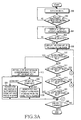
- FIGs. 3A to 3C are flowcharts showing a process of rapidly searching for a short message according to a preferred embodiment of the present invention.
- the control unit 230 of the mobile terminal determines whether a user inputs a key to display a list of received or sent messages in step 302. More specifically, when the user selects a short message menu on the mobile terminal, the control unit 230 displays sub-menus, such as a received message menu and an inputted/sent message menu. In step 302, the control unit 230 detects whether the user selects one of the sub-menus, i.e. the received message menu or the sent message menu. If the user selects the received message menu or the sent message menu in step 302, the control unit 230 proceeds to step 304 to display a list of received messages or sent messages according to the user's selection.
- sub-menus such as a received message menu and an inputted/sent message menu.
- the control unit 230 detects whether the user selects one of the sub-menus, i.e. the received message menu or the sent message menu. If the user selects the received message menu or the sent message menu in step 302, the control unit 230 proceeds to step 304 to display
- step 306 the control unit 230 determines whether the user selects a specific short message from the displayed list. If a short message is selected, the control unit 230 proceeds to step 308 to display the content of the selected short message on the display unit 250.
- step 310 the control unit 230 determines whether a left key or a right key is input in a short press manner.
- the short press manner refers to a manner of pressing a predetermined key for less than a preset time interval for recognition of the short key pressing.
- step 312 the control unit 230 searches for and displays a previous or next message corresponding to the pressed key. In other words, the user can search for the previous message using the left key and the next message using the right key, as generally done in a conventional mobile terminal.
- the control unit 230 determines whether the left key or right key is input in a long press manner.
- the long press manner refers to a manner of pressing a predetermined key over a preset time interval for recognition of the long key pressing.
- control unit 230 When the left key or right key is input in a long press manner, the control unit 230 proceeds to a procedure "C."
- a process in which the control unit 230 proceeds to the procedure "C” after recognizing input of the left key or right key in the long press manner will be discussed with reference to FIG. 3C.
- step 311 when the left key has been input in the long press manner, the control unit 230 proceeds to step 340, in which the control unit determines if the key input in the long press manner is the left key or the right key.
- step 340 when the key input in the long press manner is the left key, the control unit 230 proceeds to step 344, in which the control unit 230 searches for a message that is first received from or sent to the same phone number of a currently displayed message, displays the searched message on a screen, and then proceeds to a procedure "B."
- step 340 when the key input in the long press manner is the right key, the control unit 230 proceeds to step 342, in which the control unit 230 searches for a message that is received last from or sent to the same phone number of a currently displayed message, displays the searched message on a screen, and then proceeds to a procedure "B."
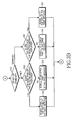
- step 311 when the left key or right key is not input in the long press manner, the control unit 230 proceeds to step 314, in which the control unit 230 determines whether an up key or a down key is pressed in a short press manner. If the control unit 230 detects a short press of the up or down key in step 314, it will proceed to step A, as explained in further detail with reference to FIG. 3B.
- control unit 230 determines whether the pressed key is the up key or the down key in step 315.
- step 316 determines whether the currently displayed portion is the top-most part of the selected message. If the top-most part is currently displayed, the control unit 230 will proceed to step 320 in order to scroll to and display the bottom-most part of the same message. If the currently displayed portion is not the top-most part of the message, the control unit 230 will then proceed to step 318 in order to scroll to and display a part further up than the currently displayed part in the same message.
- step 317 the control unit 230 will proceed to step 317 in order to determine whether the currently displayed portion is the bottom-most part of the selected message. If the bottom-most part is currently displayed, the control unit 230 will proceed to step 321 to scroll to and display the top-most part of the same message. If the currently displayed portion is not the bottom-most part of the message, the control unit 230 will then proceed to step 319 in order to scroll to and display a part lower than the currently displayed portion in the same message. After steps 320, 318, 319 and 321, the control unit 230 proceeds to step B, which will be explained in detail with reference to FIG. 3A.
- step 322 the control unit 230 will proceed to step 322 in order to determine whether the key is pressed in a long press manner.
- the long press manner refers to a pressing of a key for longer than a predetermined period of time. If the up or down key is pressed in the long press manner in step 322, the control unit 230 will proceed to step 324. Otherwise, the control unit 230 will proceed to step 330.
- step 324 the control unit 230 determines whether the pressed key is the up key or the down key. If the up key is pressed in the long press manner, the control unit 230 will proceed to step 328 to search for a previous message received from or sent to the same phone number of the currently displayed message and display the detected previous message. If the down key is pressed in the long press manner, the control unit 230 will proceed to step 326 to search for a next message received from or sent to the same phone number of the currently displayed message and display the detected next message.
- step 326, 328, 322 or B the control unit 230 proceeds to step 330 in order to determine whether the user presses an end key. If the end key is pressed, the control unit 230 will terminate the process of searching for and displaying a short message. Otherwise, the control unit 230 will return to step 310.
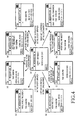
- the process of searching for a short message received from or transmitted to the same phone number of a currently displayed message using the left, right, up and down keys and according to a long press manner as shown in FIGs. 3A to 3C will be explained in further detail with reference to FIGs. 4(a) to 4(i).
- a ninth received short messages is selected by the user and currently displayed on the display screen as illustrated in FIG. 4(a). If the left key is pressed in the short press manner during the display of the ninth message as shown in FIG. 4(a), a previous message, i.e. an eighth message, will be displayed as illustrated in FIG. 4(b). If the right key is pressed in the short press manner during the display of the ninth message as shown in FIG. 4(a), a next message, i.e. a tenth message, will be displayed as illustrated in FIG. 4(f). In other words, when the left or right key is input in the short press manner, it is possible to search for the previous or next message transmitted or received just before or just after the currently displayed message, as generally used in a conventional mobile terminal.
- a message that is first received from or transmitted to a phone number "016-111-1111" corresponding to the ninth message, which is the currently displayed on a screen is searched for and displayed. If the message first received from or transmitted to the searched same phone number is the first message, the message as shown in FIG. 4(b) may be displayed. If the user has selected a predetermined message in an item for identifying a currently received message and the message as shown in FIG.
- a message that is first received from the phone number "016-111-1111," which corresponds to the ninth message when the left key has been input in the long press manner may be searched for and then displayed as shown in FIG. 4(b).
- a message that is last received from or transmitted to a phone number "016-111-1111" corresponding to the ninth message, which is the currently displayed on a screen is searched for and displayed. If the message last received from or transmitted to the searched same phone number is the 20 th message, the message as shown in FIG. 4(g) may be displayed.
- the display screen is scrolled up to show a part further up than the currently displayed part within the ninth message.
- the display screen will be scroll down to show the bottom-part of the same message, as illustrated in FIG. 4 (d).
- the display screen will be scroll down to show a part lower than the currently displayed part in the same message, as illustrated in FIG. 4 (i).
- the mobile terminal will search for a previous message received from the same phone number ("016-111-1111") of the currently displayed ninth message. If a fourth message in the list of received messages is the previous message from the same phone number, the mobile terminal will display as illustrated in FIG. 4 (c). If the user presses the down key in the long press manner during the display of the ninth message, as illustrated in FIG. 4 (a), the mobile terminal will search for a next message received from the same phone number ("016-111-1111") of the currently displayed ninth message. If a twelfth message in the list of received messages is the next message from the same phone number, the mobile terminal will display the tenth message on the display screen, as illustrated in FIG. 4 (h).
- the present invention defines a short press manner and a long press manner. Further, according to the present invention, by pressing a left, right, up, or down key in the long press manner, it is possible to directly find a message having the same phone number as that of a currently displayed message.
- the user can view the previous message received from the same phone number of the currently displayed short message by pressing the up key in the long press manner and the next message received from the same phone number by pressing the down key in the long press manner.
- the next message from the same phone number can be searched for by the long press of the up key, and the previous message from the same phone number by the long press of the down key.
- the user can view the message first received from or transmitted to the same phone number of the currently displayed short message by pressing the left key in the long press manner and the message last received from or transmitted to the same phone number by pressing the right key in the long press manner.
- the user can view the message last received from or transmitted to the same phone number of the currently displayed short message by pressing the left key in the long press manner and the message first received from or transmitted to the same phone number by pressing the right key in the long press manner.
- the up key and the down key are used to search for the previous and next messages received from the same phone number of the currently displayed message, and the left key and the right key are used to search for the first and last messages received from the same phone number of the currently displayed message.
- the left and right keys can be used to search for the previous and next messages received from the same phone number of the currently displayed message
- the up key and the down key can be used to search for the first and last messages received from the same phone number of the currently displayed message. For example, if the left key is pressed in the long press manner during the display of a received short message, the mobile terminal will search for a previous message received from the same phone number of the currently displayed message. If the right key is pressed in the long press manner, the mobile terminal will search for a next message received from the same phone number of the currently displayed message.
- input of the up key and the down key in the long press manner are used to search for the previous and next messages received from the same phone number of the currently displayed message
- input of the left key and the right key in the long press manner are used to search for the first and last messages received from the same phone number of the currently displayed message.
- only the input of the up key and the down key in the long press manner may be used to search for the previous and next messages or the first and last messages received from the same phone number of the currently displayed message, while input of the left key and the right key may be used in a usual manner.
- only the input of the left key and the right key in the long press manner may be used to search for the previous and next messages or the first and last messages received from the same phone number of the currently displayed message, while input of the up key and the down key may be used in a usual manner.
- volume up or down key instead of the long press of the up or down key. For example, if the volume up key is pressed during the display of a received short message, the mobile terminal will search for a previous message received from the same phone number of the currently displayed message. If the volume down key is pressed, the mobile terminal will search for a next message received from the same phone number of the currently displayed message.
- the mobile terminal searches for and displays a previous message, a next message, a first message, or a last message received from the same phone number of the currently displayed message.
- the mobile terminal enables the user to rapidly and easily search for and identify the messages received from or sent to the same phone number with a simple key pressing, eliminating the need to select the main message menu.
Landscapes
- Engineering & Computer Science (AREA)
- Computer Networks & Wireless Communication (AREA)
- Signal Processing (AREA)
- Human Computer Interaction (AREA)
- Business, Economics & Management (AREA)
- General Business, Economics & Management (AREA)
- Mobile Radio Communication Systems (AREA)
Applications Claiming Priority (1)
| Application Number | Priority Date | Filing Date | Title |
|---|---|---|---|
| KR1020060072968A KR100735412B1 (ko) | 2006-08-02 | 2006-08-02 | 동일 송수신 번호에 대해 빠른 단문 메시지 검색을 위한방법 및 이동통신 단말기 |
Publications (2)
| Publication Number | Publication Date |
|---|---|
| EP1885108A2 true EP1885108A2 (fr) | 2008-02-06 |
| EP1885108A3 EP1885108A3 (fr) | 2010-01-20 |
Family
ID=38503166
Family Applications (1)
| Application Number | Title | Priority Date | Filing Date |
|---|---|---|---|
| EP07015215A Withdrawn EP1885108A3 (fr) | 2006-08-02 | 2007-08-02 | Procédé et terminal mobile pour la recherche rapide de mini messages reçus de ou envoyés à un même numéro de téléphone |
Country Status (4)
| Country | Link |
|---|---|
| US (1) | US8355700B2 (fr) |
| EP (1) | EP1885108A3 (fr) |
| KR (1) | KR100735412B1 (fr) |
| CN (1) | CN101119563A (fr) |
Cited By (1)
| Publication number | Priority date | Publication date | Assignee | Title |
|---|---|---|---|---|
| GB2447756A (en) * | 2007-03-15 | 2008-09-24 | Marcus Lewis | User-controllable operation of local outgoing and incoming message stores |
Families Citing this family (4)
| Publication number | Priority date | Publication date | Assignee | Title |
|---|---|---|---|---|
| US8233886B2 (en) * | 2007-08-15 | 2012-07-31 | Sony Mobile Communications Ab | Accessing stored data objects using contact data corresponding to a remote communications party |
| JP5553673B2 (ja) * | 2009-05-11 | 2014-07-16 | キヤノン株式会社 | 撮像装置および表示制御方法 |
| US9417754B2 (en) | 2011-08-05 | 2016-08-16 | P4tents1, LLC | User interface system, method, and computer program product |
| KR20150026560A (ko) * | 2013-09-03 | 2015-03-11 | 삼성전자주식회사 | 개폐 가능한 커버를 포함하는 전자 장치 및 그 동작 방법 |
Family Cites Families (10)
| Publication number | Priority date | Publication date | Assignee | Title |
|---|---|---|---|---|
| GB2341052B (en) * | 1998-08-26 | 2003-05-14 | Nokia Mobile Phones Ltd | Wireless communication terminal |
| KR100335824B1 (ko) * | 2000-09-04 | 2002-05-08 | 홍경 | 이동 통신 단말기에서의 문자 메시지 저장 방법 |
| KR20030063062A (ko) * | 2002-01-22 | 2003-07-28 | 삼성전자주식회사 | 단문 메시지 저장 및 표시 제어 장치 및 방법 |
| US7212808B2 (en) * | 2002-10-15 | 2007-05-01 | Wildseed Ltd. | Unified message box for wireless mobile communication devices |
| KR100455166B1 (ko) * | 2002-10-15 | 2004-11-06 | 엘지전자 주식회사 | 이동 통신 단말기의 단문 메시지 검색 및 표시 방법 |
| JP2004341778A (ja) * | 2003-05-15 | 2004-12-02 | Sharp Corp | 電子メール閲覧装置及び電子メール編集装置 |
| KR100496976B1 (ko) * | 2003-07-01 | 2005-06-23 | 엘지전자 주식회사 | 이동통신 단말기의 메시지 관리방법 |
| KR100540241B1 (ko) * | 2003-07-21 | 2006-01-11 | 엘지전자 주식회사 | 메시지 관리방법 |
| JP2005352566A (ja) | 2004-06-08 | 2005-12-22 | Casio Comput Co Ltd | メール表示装置およびメール表示処理プログラム |
| US20070256025A1 (en) * | 2006-04-28 | 2007-11-01 | Vincent Yen | Mobile application menu system |
-
2006
- 2006-08-02 KR KR1020060072968A patent/KR100735412B1/ko not_active Expired - Fee Related
-
2007
- 2007-08-01 US US11/832,495 patent/US8355700B2/en not_active Expired - Fee Related
- 2007-08-02 CN CNA2007101386945A patent/CN101119563A/zh active Pending
- 2007-08-02 EP EP07015215A patent/EP1885108A3/fr not_active Withdrawn
Non-Patent Citations (1)
| Title |
|---|
| None |
Cited By (1)
| Publication number | Priority date | Publication date | Assignee | Title |
|---|---|---|---|---|
| GB2447756A (en) * | 2007-03-15 | 2008-09-24 | Marcus Lewis | User-controllable operation of local outgoing and incoming message stores |
Also Published As
| Publication number | Publication date |
|---|---|
| US20080032751A1 (en) | 2008-02-07 |
| KR100735412B1 (ko) | 2007-07-04 |
| CN101119563A (zh) | 2008-02-06 |
| EP1885108A3 (fr) | 2010-01-20 |
| US8355700B2 (en) | 2013-01-15 |
Similar Documents
| Publication | Publication Date | Title |
|---|---|---|
| KR100420280B1 (ko) | 이동통신 단말기에서의 메뉴 디스플레이 방법 | |
| US6178338B1 (en) | Communication terminal apparatus and method for selecting options using a dial shuttle | |
| US6865404B1 (en) | Handset | |
| US9575655B2 (en) | Transparent layer application | |
| WO2007004079A1 (fr) | Terminal a application de messagerie | |
| KR20060037927A (ko) | 음성 인식을 이용한 통화 내역 관리 장치 및 방법 | |
| US7515941B2 (en) | Method for performing functions using telephone number searched for in mobile terminal | |
| US20090303185A1 (en) | User interface, device and method for an improved operating mode | |
| US8265604B2 (en) | Mobile phone and call processing method of mobile phone | |
| US20150319283A1 (en) | Mobile communication terminal and method for running an application therein | |
| EP1981252A1 (fr) | Terminal mobile et procédé d'affichage d'une image en fonction d'un appel | |
| US8355700B2 (en) | Method and mobile terminal for rapidly searching for messages received from or sent to same phone number | |
| KR100547858B1 (ko) | 음성인식 기능을 이용하여 문자 입력이 가능한 이동통신단말기 및 방법 | |
| US9973605B2 (en) | Method and apparatus for storing telephone numbers in a portable terminal | |
| US8589820B2 (en) | Mobile terminal and method for retrieving phone number therein | |
| US7872595B2 (en) | Method and apparatus for inputting an alphabet character in a terminal with a keypad | |
| US8554763B2 (en) | Apparatus and method for selecting and performing at least one data function | |
| EP2568692A2 (fr) | Procédé pour exécuter des fonctions associées à un numéro de téléphone dans un terminal de communication mobile | |
| JP2003108487A (ja) | 通信端末 | |
| US20080162971A1 (en) | User Interface for Searches | |
| KR100754655B1 (ko) | 휴대 단말기의 수신처 입력 방법 | |
| KR20030073263A (ko) | 이동통신단말기에서의 전화번호 검색 방법 | |
| KR100881219B1 (ko) | 기능 번호를 이용한 전화번호 정보 검색 방법 및 그 방법을이용하는 사용자 단말기 | |
| KR20040025456A (ko) | 이동 통신 단말기의 단문 메시지 전송 방법 | |
| KR20050042392A (ko) | 이동통신 단말기의 리스트 표시 방법 |
Legal Events
| Date | Code | Title | Description |
|---|---|---|---|
| PUAI | Public reference made under article 153(3) epc to a published international application that has entered the european phase |
Free format text: ORIGINAL CODE: 0009012 |
|
| 17P | Request for examination filed |
Effective date: 20070802 |
|
| AK | Designated contracting states |
Kind code of ref document: A2 Designated state(s): AT BE BG CH CY CZ DE DK EE ES FI FR GB GR HU IE IS IT LI LT LU LV MC MT NL PL PT RO SE SI SK TR |
|
| AX | Request for extension of the european patent |
Extension state: AL BA HR MK YU |
|
| PUAL | Search report despatched |
Free format text: ORIGINAL CODE: 0009013 |
|
| AK | Designated contracting states |
Kind code of ref document: A3 Designated state(s): AT BE BG CH CY CZ DE DK EE ES FI FR GB GR HU IE IS IT LI LT LU LV MC MT NL PL PT RO SE SI SK TR |
|
| AX | Request for extension of the european patent |
Extension state: AL BA HR MK RS |
|
| RIC1 | Information provided on ipc code assigned before grant |
Ipc: H04M 1/72 20060101AFI20071210BHEP Ipc: H04M 1/725 20060101ALI20091214BHEP |
|
| AKX | Designation fees paid |
Designated state(s): DE FR GB |
|
| RAP1 | Party data changed (applicant data changed or rights of an application transferred) |
Owner name: SAMSUNG ELECTRONICS CO., LTD. |
|
| 17Q | First examination report despatched |
Effective date: 20170202 |
|
| GRAP | Despatch of communication of intention to grant a patent |
Free format text: ORIGINAL CODE: EPIDOSNIGR1 |
|
| RIC1 | Information provided on ipc code assigned before grant |
Ipc: H04M 1/57 20060101AFI20170929BHEP Ipc: H04M 1/725 20060101ALI20170929BHEP |
|
| INTG | Intention to grant announced |
Effective date: 20171027 |
|
| STAA | Information on the status of an ep patent application or granted ep patent |
Free format text: STATUS: THE APPLICATION IS DEEMED TO BE WITHDRAWN |
|
| 18D | Application deemed to be withdrawn |
Effective date: 20180307 |