EP1887724B1 - Passives, optisches multiplexnetzwerk zur wellenlängenaufteilung und implementierungsverfahren - Google Patents
Passives, optisches multiplexnetzwerk zur wellenlängenaufteilung und implementierungsverfahren Download PDFInfo
- Publication number
- EP1887724B1 EP1887724B1 EP06817919.1A EP06817919A EP1887724B1 EP 1887724 B1 EP1887724 B1 EP 1887724B1 EP 06817919 A EP06817919 A EP 06817919A EP 1887724 B1 EP1887724 B1 EP 1887724B1
- Authority
- EP
- European Patent Office
- Prior art keywords
- optical
- signal
- wavelength
- modulated
- uplink
- Prior art date
- Legal status (The legal status is an assumption and is not a legal conclusion. Google has not performed a legal analysis and makes no representation as to the accuracy of the status listed.)
- Active
Links
- 230000003287 optical effect Effects 0.000 title claims description 289
- 238000000034 method Methods 0.000 title claims description 17
- 238000001514 detection method Methods 0.000 claims description 8
- 230000035559 beat frequency Effects 0.000 claims description 5
- 238000013507 mapping Methods 0.000 claims description 2
- 230000005540 biological transmission Effects 0.000 description 32
- 238000010586 diagram Methods 0.000 description 8
- 238000011144 upstream manufacturing Methods 0.000 description 7
- 239000013307 optical fiber Substances 0.000 description 6
- 239000000835 fiber Substances 0.000 description 5
- RYGMFSIKBFXOCR-UHFFFAOYSA-N Copper Chemical compound [Cu] RYGMFSIKBFXOCR-UHFFFAOYSA-N 0.000 description 4
- 238000005516 engineering process Methods 0.000 description 4
- 238000001228 spectrum Methods 0.000 description 4
- 230000001427 coherent effect Effects 0.000 description 3
- 238000011161 development Methods 0.000 description 3
- 238000012423 maintenance Methods 0.000 description 3
- 238000004891 communication Methods 0.000 description 2
- 238000012986 modification Methods 0.000 description 2
- 230000004048 modification Effects 0.000 description 2
- 230000008054 signal transmission Effects 0.000 description 2
- 230000002457 bidirectional effect Effects 0.000 description 1
- 230000007547 defect Effects 0.000 description 1
- 230000002542 deteriorative effect Effects 0.000 description 1
- 230000009977 dual effect Effects 0.000 description 1
- 238000001914 filtration Methods 0.000 description 1
- 230000036039 immunity Effects 0.000 description 1
- 238000011835 investigation Methods 0.000 description 1
- 230000006855 networking Effects 0.000 description 1
- 238000005057 refrigeration Methods 0.000 description 1
- 238000011160 research Methods 0.000 description 1
- 230000002269 spontaneous effect Effects 0.000 description 1
- 238000006467 substitution reaction Methods 0.000 description 1
Images



Classifications
-
- H—ELECTRICITY
- H04—ELECTRIC COMMUNICATION TECHNIQUE
- H04J—MULTIPLEX COMMUNICATION
- H04J14/00—Optical multiplex systems
- H04J14/02—Wavelength-division multiplex systems
- H04J14/0226—Fixed carrier allocation, e.g. according to service
-
- H—ELECTRICITY
- H04—ELECTRIC COMMUNICATION TECHNIQUE
- H04J—MULTIPLEX COMMUNICATION
- H04J14/00—Optical multiplex systems
- H04J14/02—Wavelength-division multiplex systems
- H04J14/0227—Operation, administration, maintenance or provisioning [OAMP] of WDM networks, e.g. media access, routing or wavelength allocation
- H04J14/0241—Wavelength allocation for communications one-to-one, e.g. unicasting wavelengths
- H04J14/0242—Wavelength allocation for communications one-to-one, e.g. unicasting wavelengths in WDM-PON
- H04J14/0245—Wavelength allocation for communications one-to-one, e.g. unicasting wavelengths in WDM-PON for downstream transmission, e.g. optical line terminal [OLT] to ONU
- H04J14/0246—Wavelength allocation for communications one-to-one, e.g. unicasting wavelengths in WDM-PON for downstream transmission, e.g. optical line terminal [OLT] to ONU using one wavelength per ONU
-
- H—ELECTRICITY
- H04—ELECTRIC COMMUNICATION TECHNIQUE
- H04J—MULTIPLEX COMMUNICATION
- H04J14/00—Optical multiplex systems
- H04J14/02—Wavelength-division multiplex systems
- H04J14/0227—Operation, administration, maintenance or provisioning [OAMP] of WDM networks, e.g. media access, routing or wavelength allocation
- H04J14/0241—Wavelength allocation for communications one-to-one, e.g. unicasting wavelengths
- H04J14/0242—Wavelength allocation for communications one-to-one, e.g. unicasting wavelengths in WDM-PON
- H04J14/0245—Wavelength allocation for communications one-to-one, e.g. unicasting wavelengths in WDM-PON for downstream transmission, e.g. optical line terminal [OLT] to ONU
- H04J14/0247—Sharing one wavelength for at least a group of ONUs
-
- H—ELECTRICITY
- H04—ELECTRIC COMMUNICATION TECHNIQUE
- H04J—MULTIPLEX COMMUNICATION
- H04J14/00—Optical multiplex systems
- H04J14/02—Wavelength-division multiplex systems
- H04J14/0227—Operation, administration, maintenance or provisioning [OAMP] of WDM networks, e.g. media access, routing or wavelength allocation
- H04J14/0241—Wavelength allocation for communications one-to-one, e.g. unicasting wavelengths
- H04J14/0242—Wavelength allocation for communications one-to-one, e.g. unicasting wavelengths in WDM-PON
- H04J14/0249—Wavelength allocation for communications one-to-one, e.g. unicasting wavelengths in WDM-PON for upstream transmission, e.g. ONU-to-OLT or ONU-to-ONU
- H04J14/025—Wavelength allocation for communications one-to-one, e.g. unicasting wavelengths in WDM-PON for upstream transmission, e.g. ONU-to-OLT or ONU-to-ONU using one wavelength per ONU, e.g. for transmissions from-ONU-to-OLT or from-ONU-to-ONU
-
- H—ELECTRICITY
- H04—ELECTRIC COMMUNICATION TECHNIQUE
- H04J—MULTIPLEX COMMUNICATION
- H04J14/00—Optical multiplex systems
- H04J14/02—Wavelength-division multiplex systems
- H04J14/0227—Operation, administration, maintenance or provisioning [OAMP] of WDM networks, e.g. media access, routing or wavelength allocation
- H04J14/0241—Wavelength allocation for communications one-to-one, e.g. unicasting wavelengths
- H04J14/0242—Wavelength allocation for communications one-to-one, e.g. unicasting wavelengths in WDM-PON
- H04J14/0249—Wavelength allocation for communications one-to-one, e.g. unicasting wavelengths in WDM-PON for upstream transmission, e.g. ONU-to-OLT or ONU-to-ONU
- H04J14/0252—Sharing one wavelength for at least a group of ONUs, e.g. for transmissions from-ONU-to-OLT or from-ONU-to-ONU
-
- H—ELECTRICITY
- H04—ELECTRIC COMMUNICATION TECHNIQUE
- H04J—MULTIPLEX COMMUNICATION
- H04J14/00—Optical multiplex systems
- H04J14/02—Wavelength-division multiplex systems
- H04J14/0278—WDM optical network architectures
- H04J14/0282—WDM tree architectures
-
- H—ELECTRICITY
- H04—ELECTRIC COMMUNICATION TECHNIQUE
- H04J—MULTIPLEX COMMUNICATION
- H04J14/00—Optical multiplex systems
- H04J14/02—Wavelength-division multiplex systems
- H04J14/0298—Wavelength-division multiplex systems with sub-carrier multiplexing [SCM]
-
- H—ELECTRICITY
- H04—ELECTRIC COMMUNICATION TECHNIQUE
- H04J—MULTIPLEX COMMUNICATION
- H04J14/00—Optical multiplex systems
- H04J14/02—Wavelength-division multiplex systems
- H04J14/0224—Irregular wavelength spacing, e.g. to accommodate interference to all wavelengths
-
- H—ELECTRICITY
- H04—ELECTRIC COMMUNICATION TECHNIQUE
- H04J—MULTIPLEX COMMUNICATION
- H04J14/00—Optical multiplex systems
- H04J14/02—Wavelength-division multiplex systems
- H04J14/0227—Operation, administration, maintenance or provisioning [OAMP] of WDM networks, e.g. media access, routing or wavelength allocation
- H04J14/0241—Wavelength allocation for communications one-to-one, e.g. unicasting wavelengths
- H04J14/0242—Wavelength allocation for communications one-to-one, e.g. unicasting wavelengths in WDM-PON
- H04J2014/0253—Allocation of downstream wavelengths for upstream transmission
Definitions
- the present invention relates to the technical field of optical communications and network technology, in particular, to a wavelength division multiplexing passive optical network (WDM-PON) and an implementing method thereof.
- WDM-PON wavelength division multiplexing passive optical network
- An access network refers to the network devices and facilities which provide transmission capability between a core network and a subscriber or between a core network and a customer premise network.
- the network devices and facilities include an optical line terminal (OLT) and an optical network unit (ONU).
- OLT optical line terminal
- ONU optical network unit
- the access network may be classified into a wired access network and a wireless access network, and the wired access network mainly includes a copper wire access network, a hybrid fiber-coax (HFC) access network, and a fiber access network etc.
- HFC hybrid fiber-coax
- the rate of the devices on the both side of an access network is increased to more than 1 Gbit/s. Due to the limitation and influences such as the transmission loss, transmission bandwidth and noises, the copper wire access network in the prior art can hardly meet the requirements for the transmission rate in the development of the new telecommunication broadband services, especially in the video applications.
- the copper wire access network gradually becomes a crucial issue in the development of the broadband Integrated Services Digital Network (ISDN).
- An optical access network (OAN) is developed to overcome the defects brought about by the copper wire access network. OAN adopts optical fiber as a main transmission medium.
- Fiber to the Home is adopted for realizing the Full Service Access Network.
- the OAN may be classified into a passive optical network (PON) and an active optical network (AON).
- PON has advantages such as low cost, easy maintenance and transparent for various services. Further, it is easy to expand the capacity and provide services in a PON. Meanwhile, the PON may be smoothly transited to the FTTH.
- the PON may be classified into a power-split passive optical network (PSPON) and a wavelength-division multiplexing-PON (WDM-PON).
- PSPON power-split passive optical network
- WDM-PON wavelength-division multiplexing-PON
- BPON broadband PON
- GPON Gigabit PON
- a star coupler is used to divide optical signals, and time-division multiple address (TDMA) / time-division multiplexing (TDM) is adopted for uplink/downlink transmission so as to realize channel bandwidth sharing. Therefore, the number of the ONU and the transmission rate for accessing the subscriber are limited.
- TDMA time-division multiple address
- TDM time-division multiplexing
- the application architecture of the WDM-PON in the access network is as shown in Figure 1 .
- An optical line terminal (OLT) communicates with different subscriber network units with dense wavelength-division multiplexing (DWDM) technology, and further to realize information exchange with telephone, computer and television set. Furthermore, the OLT side may send a cable television (CATV) signal to the transmission line via an optical multiplexer.
- CATV cable television
- the topology may be different to some extent, but the function realized is the same: a subscriber ONU needs to receive the information from a central office OLT and upload information; the OLT needs to send information to each ONU, and receive information uploaded by the subscriber.
- the cost of the optical devices is a main issue that baffles the broad application of the WDM technology during the realization of the WDM-PON. It is required that the laser in the transmitting module of ONU or OLT should output a light with a stable wavelength because an optical demultiplexer is adopted in the optical path. However, due to the refrigeration etc., the present laser with a stable wavelength has a high cost, a large volume and high power consumption. Further, it is expected that the ONU is designed to be independent of wavelength. In other words, an ONU does not need to be limited to working with a particular wavelength, so as to reduce the cost for operation, management, maintenance and capacity enlargement.
- a widely applied solution is that only a modulator exists in the ONU, and the carrier optical signal is provided via the optical transport network.
- one method is that C band is used for uplink transmission, L band is used for downlink transmission, and the carrier of the C band is also output from the OLT, which loops back from the ONU and acts as an uplink carrier signal.
- the architecture is as shown in Figure 2 .
- Another method is that a Fabry-Perot (FP) laser is arranged in the ONU, and the network provides wavelength mode-locking.
- the mode-locked optical source is generated from sliced broadband amplified spontaneous emission (ASE).
- the architecture of this method is as shown in Figure 3 . In this method, it is still necessary to arrange an optical source module in the ONU.
- a wavelength band Da (wavelengths d1 to dn) for downlink optical signals corresponding to the n ONUs, a wavelength band Ua (wavelengths u1 to un) for uplink optical signals corresponding to the n ONUs, a wavelength band Db (wavelengths dn+1 to dn+m) for downlink optical signals corresponding to the m ONUs, and a wavelength band Ub (wavelengths un+1 to un+m) for uplink optical signals corresponding to the m ONUs are set different from one another, the wavelength bands Ua and Ub are set adjacent to each other, and the wavelength bands Ua and Da or the wavelength bands Ub and Db are set adjacent to each other.;
- Each of the ONUs has downlink optical signal receiving unit for receiving a downlink optical signal of one of the wavelengths d1 to dn+m in the wavelength bands Da and Db which
- D2 JP 2000 196536 A teaches how to transmit an optical signal bilaterally between a station side unit (OSU) and a user unit (ONU) not having a light source without deteriorating the transmission efficiency with a simple configuration.
- D3 (DENG NING ET AL: "Data remodulation on downstream OFSK signal for upstream transmission in WDM passive optical network", ELECTRONICS LETTERS, IEE STEVENAGE, GB) discloses a employment of optical frequency shift keying (OFSK) as the downstream modulation in a WDM passive optical network.
- OFSK optical frequency shift keying
- the upstream OOK transmitter at the ONU can be realized by remodulating the constant-intensity downstream OFSK signal power with the upstream data.
- D4 discloses a coherent optical system including an optical coupler or combiner (138) for combining a received upstream optical signal and an optical local oscillator signal.
- the coherent optical system further includes a coherent optical receiver (114) which is configured to receive and process the combined optical signal from the optical coupler to retrieve upstream information from the upstream optical signal.
- D5 PONGQING HUI ET AL: "Subcarrier Multiplexing for High-Speed Optical Transmission" discloses a investigation of the performance of high-speed digital fiber-optic transmission using subcarrier multiplexing (SCM) .
- SCM subcarrier multiplexing
- the embodiments of the invention provide a wavelength division multiplexing passive optical network and an implementing method thereof, with which the networking and communication may be implemented with no need of additional laser optical source for the ONU uplink carrier signal.
- An embodiment of the invention provides a wavelength division multiplexing passive optical network, including an OLT and at least one ONU.
- the OLT includes at least one optical transmitting module
- the ONU includes an optical receiving module
- the optical transmitting module and the optical receiving module have a one to one correspondence;
- the optical transmitting module is adapted to split a light with a wavelength of ⁇ , from a same optical source into two optical signals, a first optical signal is modulated and used as a downlink carrier signal, and a second optical signal unchanged loops back from the ONU, and is used as an uplink carrier signal;
- the optical transmitting module of the optical line terminal comprises: a shared optical source, an optical splitter, an optical multiplexer, a modulator, a division selector and an optical receiver; wherein, the optical splitter is adapted to split a continuous light with a wavelength of ⁇ from the optical source into the two optical signals, the first optical signal enters the modulator as the downlink carrier signal, and the second optical signal enters the optical multiplexer directly;
- the modulator is adapted to modulate a downlink signal to the first optical signal and then input a modulated downlink signal to the optical multiplexer, where a central wavelength of the modulated downlink signal has an offset of a preset value ⁇ compared with a central wavelength of the
- the optical receiving module is adapted to receive the multiplexed signal comprising the modulated downlink signal and the second optical signal from the optical transmitting module, separate the multiplexed signal and use the second optical signal received as the uplink carrier signal to transmit the uplink signal.
- the OLT further includes a transmitting module which has no shared optical source; the ONU further includes a receiving module corresponding to the transmitting module.
- the wavelength division multiplexing passive optical network further includes:
- An embodiment of the invention provides an OLT, including:
- An embodiment of the invention further provides a method for implementing the wavelength division multiplexing passive optical network, including:
- a continuous light is transmitted to an ONU at the same time when a downlink signal is transmitted by an OLT, and the continuous light is used as a carrier for uplink signal transmission. Therefore, no additional optical source generator is needed in the ONU for generating the carrier for the uplink signal.
- the optical source generator in the ONU may be saved, the cost of the system may be reduced, and the cost for constitution and maintenance may be also reduced. Further, the uplink optical signal and the downlink optical signal use the same optical wavelength range, so the optical fiber bandwidth may be saved.
- the subcarrier modulation is adopted for the downlink signal, whose central wavelength is different from the central wavelength of the uplink signal, so the mutual interference during the transmission in the same optical fiber may be avoided in the low power circumstance.
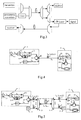
- a WDM-PON includes: an OLT transmitting module 1 on the OLT side, the OLT transmitting module 1 being able to provide a shared optical source; an ONU receiving module 6 on the ONU side; and a transmission optical fiber segment 7.
- the ONU receiving module 6 transmits an uplink signal by using the shared optical source provided by the OLT transmitting module 1, and receives a downlink signal.
- a unidirectional arrow indicates a single fiber in single direction transmission
- a bidirectional arrow indicates a single fiber dual direction transmission.
- the wavelength in the downlink transmission is marked above the lines, and the wavelength in the uplink transmission is marked under the lines.
- the OLT transmitting module 1 includes: a shared optical source 11 (e.g. a single longitudinal mode continuum optical source), an optical splitter 12, an optical multiplexer 13, a modulator 14, a division selector 15 and an OLT receiver 16.
- the optical splitter 12 may also be a power splitter, which is adapted to split the continuous light transmitted from the optical source 11 into two beams. One beam directly enters the optical multiplexer 13, and the other beam passes through the modulator 14, and then enters the optical multiplexer 13 after a transmission signal is loaded, where the other beam is multiplexed with the one beam of the continuous light that carries no signal. Then, the multiplexed light is output to the port I of a circulator.
- a circulator, a device or a system that has the function of dividing and selecting may be adopted as the division selector 15.
- the circulator is a device which transmits the light in a single direction.
- the input light enters the circulator from an input port, and is output from a second port II.
- the light that enters the circulator from the second port is reflected to a third port III and outputs.
- the transmission signal from the OLT to the ONU is referred to as downlink signal
- the transmission signal from the ONU to the OLT is referred to as uplink signal.
- the ONU receiving module 6 is adapted to implement the receiving of the downlink optical signal and the transmitting of the uplink optical signal.
- the ONU receiving module 6 includes an optical demultiplexer 61, an ONU receiver 62, a circulator 63 and a modulator 64.
- the optical demultiplexer 61 is adapted to separate the continuous light with a wavelength of ⁇ from the signal light with a wavelength of ⁇ transmitted from the OLT transmitting module 1.
- the signal light is transmitted to the receiving module for demodulation, and the continuous light is used as the carrier for the uplink signal.
- the continuous light enters the modulator 64 via port II of the circulator, loaded with the signal to be transported, sent to the transmission line via port III of the circulator, and received by the receiving module 16 when the continuous light returns to the module 1.
- the receiving module 16 has the function of handling the burst mode.
- an ONU of the system receives an instruction from the OLT indicating that the ONU is allowed to send data, the ONU sends data to the designated time slot in the uplink frame in a burst mode. Therefore, the optical transceiver of the ONU should also support the burst transmission mode in addition to fulfilling the requirements for a Gigabit Ethernet optical transceiver.
- a photodiode PIN receiver is usually adopted for continuous receiving, and an FP laser or a distributed feedback (DFB) laser may be adopted for burst transmitting.
- DFB distributed feedback
- one transmitting unit on the OLT side which corresponds to one ONU is illustrated.
- one OLT may correspond to a plurality of ONUs. Therefore, a plurality of transmitting modules may be arranged in the OLU, and a wavelength division multiplexer/demultiplexer may be added, so as to constitute a WDM optical network.
- the OLU may be used together with the optical transceiver in the prior art as shown in Figure 5 , wherein, compared with Figure 4 , the following components are added: an optical signal transmitting module 2 which has no shared optical source; a wavelength division multiplexer/demultiplexer 3, which is adapted to multiplex the downlink signals output from a plurality of optical transmitting modules on the OLT side, and demultiplex the uplink signals from the ONUs; a wavelength division multiplexer/demultiplexer 4, which is adapted to multiplex a plurality of uplink signals from the ONU side, and demultiplex the downlink signals from the OLTs; an optical receiving module 5, which is adapted to receive the optical signal from the optical signal transmitting module 2 which has no shared optical source.
- the spectrum of the signal transmitted in the optical fiber segment between the wavelength division multiplexer/demultiplexer 3 and the wavelength division multiplexer/demultiplexer 4 is as shown in Figure 6(a) ; and during the downlink transmission, the spectrum of the signal between the wavelength division multiplexer/demultiplexer 4 and the receiving module 6 is as shown in Figure 6(b) .
- the modulator 14 is a subcarrier modulator (SCM). Therefore, compared with the central wavelength of the continuous light, the central wavelength of the output light of the modulator 14 has an offset of ⁇ (the offset may be a positive offset, or may be a negative offset, and the value of the ⁇ may be determined according to the wavelength resolution of the optical demultiplexer 61).
- a mixed light of the continuous light with a central wavelength ⁇ and the signal light with a central wavelength ⁇ is output from port II of the circular 15.
- the solution according to the embodiments of the invention in which the signal is modulated with subcarrier is different from the solution of the subcarrier modulated electronic heterodyne beat-frequency demodulation in the prior art.
- the solution of the subcarrier modulated electronic heterodyne beat-frequency demodulation is as shown in Figure 7a .
- photoelectric detection is firstly performed for the optical signal received, and the optical signal is converted into the electrical signal; the desired electrical signal is obtained by carrier multiplication demodulation, and then the information data is obtained after filtering with an electrical filter.
- the solution of all optical detection subcarrier demodulation is as shown in Figure 7b , which includes an optical filter 71 and an optical detector 72.
- the optical filter 71 allows the signal in the operating frequency band to pass, and the optical signal is converted to the electrical signal via the optical detector 72.
- f c is the central frequency of the optical carrier
- f 1 and f 2 are subcarrier frequencies.
- the OLT includes a plurality of OLT transmitting modules, and each ONU includes an ONU receiving module.
- a one-to-one mapping is established between the OLT transmitting module and the ONU receiving module.
- the OLT may further include a transmitting module which provides no shared optical source
- the ONU may further include a receiving module corresponding to the above transmitting module.
- Figure 9 A method for realizing the WDM-PON according to an embodiment of the invention is shown in Figure 9 , which includes:
Landscapes
- Engineering & Computer Science (AREA)
- Computer Networks & Wireless Communication (AREA)
- Signal Processing (AREA)
- Optical Communication System (AREA)
Claims (13)
- Passives optisches Wellenlängenmultiplex-Netz, das einen optischen Leitungsabschluss und wenigstens eine optische Netzeinheit umfasst, wobei:der optische Leitungsabschluss wenigstens ein optisches Sendemodul (1) umfasst, die optische Netzeinheit ein optisches Empfangsmodul (6) umfasst und eine Eins-zu-Eins-Abbildung zwischen dem optischen Sendemodul (1) und dem optischen Empfangsmodul (6) aufgebaut wird;das optische Sendemodul (1) dafür ausgelegt ist, Licht mit einer Wellenlänger λ von derselben Lichtquelle in zwei optische Signale zu teilen, wobei ein erstes optisches Signal moduliert und als ein Abwärtsstreckenträgersignal verwendet wird und ein zweites optisches Signal unverändert von der optischen Netzeinheit zurückgeschleift und als ein Aufwärtsstreckenträgersignal verwendet wird,wobei das optische Sendemodul (1) des optischen Leitungsabschlusses Folgendes umfasst: eine gemeinsam genutzte Lichtquelle (11), einen optischen Teiler (12), einen optischen Multiplexer (13), einen Modulator (14), einen Unterteilungsselektor (15) und einen optischen Empfänger (16); wobeider optische Teiler (12) dafür ausgelegt ist, Dauerlicht mit einer Wellenlänge λ von der Lichtquelle in zwei optische Signale zu teilen, wobei das erste optische Signal in den Modulator (14) als ein Abwärtsstreckenträgersignal eintritt und das zweite optische Signal direkt in den optischen Multiplexer (13) eintritt;wobei der Modulator (14) dafür ausgelegt ist, ein Abwärtsstreckensignal in das erste optische Signal zu modulieren und dann ein moduliertes Abwärtsstreckensignal in den optischen Multiplexer (13) einzugeben, wobei eine Mittelwellenlänge des modulierten Abwärtsstreckensignals einen Versatz mit einem im Voraus eingestellten Wert Δλ im Vergleich zu einer Mittelwellenlänge des zweiten optischen Signals hat;wobei der optische Multiplexer (13) dafür ausgelegt ist, das modulierte Abwärtsstreckensignal mit dem zweiten optischen Signal zu multiplexieren und ein multiplexiertes Signal über den Unterteilungsselektor (15) zu der optischen Netzeinheit zu senden; undwobei der optische Empfänger (16) dafür ausgelegt ist, ein Aufwärtsstreckensignal, das von der optischen Netzeinheit gesendet wird, über den Unterteilungsselektor (15) zu empfangen;wobei das optische Empfangsmodul (6) dafür ausgelegt ist, das multiplexierte Signal, das das modulierte Abwärtsstreckensignal und das zweite optische Signal enthält, von dem optischen Sendemodul (1) zu empfangen, das multiplexierte Signal zu trennen und das empfangene zweite optische Signal als das Aufwärtsstreckenträgersignal zu verwenden, um das Aufwärtsstreckensignal zu senden.
- Passives optisches Wellenlängenmultiplex-Netz nach Anspruch 1, wobei das optische Empfangsmodul (6) der optischen Netzeinheit Folgendes umfasst: einen optischen Demultiplexer (61), einen optischen Netzeinheit-Empfänger (62), einen Unterteilungsselektor (63) und einen Aufwärtsstreckensignalmodulator (64); wobei der optische Demultiplexer (61) dafür ausgelegt ist, das Aufwärtsstreckenträgersignal von dem modulierten Abwärtsstreckensignal, das durch das optische Sendemodul (1) gesendet wird, zu trennen;
der optische Netzeinheit-Empfänger (62) dafür ausgelegt ist, das modulierte Abwärtsstreckensignal zu empfangen;
der Unterteilungsselektor (63) dafür ausgelegt ist, das Aufwärtsstreckenträgersignal zu dem Aufwärtsstreckensignalmodulator (64) zu senden; und
der Aufwärtsstreckensignalmodulator (64) dafür ausgelegt ist, das Aufwärtsstreckenträgersignal zu verwenden, um das Aufwärtsstreckensignal zu modulieren, und ein moduliertes Aufwärtsstreckensignal zu dem optischen Leitungsabschluss über den optischen Demultiplexer (61) zu senden. - Passives optisches Wellenlängenmultiplex-Netz nach Anspruch 2, wobei der optische Netzeinheit-Empfänger (62) ferner Folgendes umfasst:einen Demodulator, der dafür ausgelegt ist, das empfangene modulierte Abwärtsstreckensignal zu demodulieren.
- Passives optisches Wellenlängenmultiplex-Netz nach Anspruch 3, wobei der Demodulator ein Unterträgerdemodulator für rein optische Detektion oder ein Demodulator für eine mit einem Unterträger modulierte elektronische Heterodyn-Schwebungsfrequenz ist.
- Passives optisches Wellenlängenmultiplex-Netz nach Anspruch 4, wobei der Unterträgerdemodulator für rein optische Detektion Folgendes umfasst: ein optisches Filter (71) und einen optischen Detektor (72),
wobei das optische Filter (71) den Durchgang eines optischen Signals in einem Betriebsfrequenzband zulässt und das optische Signal über den optischen Detektor (72) in ein elektrisches Signal umgesetzt wird. - Passives optisches Wellenlängenmultiplex-Netz nach Anspruch 1 oder 2, wobei der Unterteilungsselektor (15, 63) ein Zirkulator ist.
- Passives optisches Wellenlängenmultiplex-Netz nach Anspruch 1, wobei der optische Leitungsabschluss ferner ein weiteres Sendemodul (2) umfasst, das keine gemeinsam genutzte Lichtquelle besitzt, wobei die optische Netzeinheit ferner ein weiteres Empfangsmodul (5) umfasst, das dem weiteren Sendemodul (2) entspricht.
- Passives optisches Wellenlängenmultiplex-Netz nach Anspruch 1 oder 7, wobei das Netz ferner Folgendes umfasst:Wellenlängenmultiplexer/Wellenlängendemultiplexer (3, 4), die auf Seiten eines optischen Leitungsabschlusses bzw. auf Seiten einer optischen Netzeinheit angeordnet sind und dafür ausgelegt sind, ein Multiplexieren und Demultiplexieren eines Abwärtsstreckensignals bzw. des Aufwärtsstreckensignals auszuführen.
- Optischer Leitungsabschluss, der Folgendes umfasst:ein optisches Sendemodul (1), das dafür ausgelegt ist, Licht mit einer Wellenlänge von derselben Lichtquelle in zwei optische Signale zu teilen, wobei ein erstes optisches Signal moduliert wird und als ein Abwärtsstreckenträgersignal verwendet wird und ein zweites optisches Signal unverändert von einer optischen Netzeinheit zurückgeschleift und als ein Aufwärtsstreckenträgersignal verwendet wird; wobei das optische Sendemodul (1) des optischen Leitungsabschlusses Folgendes umfasst: eine gemeinsam genutzte Lichtquelle (11), einen optischen Teiler (12), einen optischen Multiplexer (13), einen Modulator (14), einen Unterteilungsselektor (15) und einen optischen Empfänger (16); wobeider optische Teiler (12) dafür ausgelegt ist, Dauerlicht mit einer Wellenlänge λ von der Lichtquelle in zwei optische Signale zu teilen, wobei das erste optische Signal in den Modulator (14) als das Abwärtsstreckenträgersignal eintritt und das zweite optische Signal direkt in den optischen Multiplexer (13) eintritt;der Modulator (14) dafür ausgelegt ist, ein Abwärtsstreckensignal auf das erste optische Signal zu modulieren und dann ein moduliertes Abwärtsstreckensignal in den optischen Multiplexer (13) einzugeben, wobei eine Mittelwellenlänge des modulierten Abwärtsstreckensignals einen Versatz mit einem im Voraus eingestellten Wert Δλ im Vergleich zu einer Mittelwellenlänge des zweiten optischen Signals besitzt;der optische Multiplexer (13) dafür ausgelegt ist, das modulierte Abwärtsstreckensignal mit dem zweiten optischen Signal zu multiplexieren und ein multiplexiertes Signal über den Unterteilungsselektor (15) zu der optischen Netzeinheit zu senden; undder optische Empfänger (16) dafür ausgelegt ist, das von der optischen Netzeinheit über den Unterteilungsselektor (15) gesendete Aufwärtsstreckensignal zu empfangen.
- Optischer Leitungsabschluss nach Anspruch 9, wobei der optische Leitungsabschluss ferner ein weiteres Sendemodul (2) umfasst, das keine gemeinsam genutzte Lichtquelle besitzt.
- Verfahren zum Implementieren eines passiven optischen Wellenlängenmultiplex-Netzes, das Folgendes umfasst:Teilen (s101) von Licht mit einer Wellenlänge λ von derselben Lichtquelle in zwei optische Signale bei einem optischen Leitungsabschluss, Verwenden eines modulierten ersten optischen Signals als ein Abwärtsstreckensignal nach der Modulation und Verwenden eines unveränderten zweiten optischen Signals als ein Aufwärtsstreckenträgersignal, wobei nach der Modulation eine Mittelwellenlänge des modulierten ersten optischen Signals einen Versatz mit einem im Voraus eingestellten Wert Δλ im Vergleich zu einer Mittelwellenlänge des zweiten optischen Signals hat;Multiplexieren (s102) des modulierten ersten optischen Signals mit dem zweiten optischen Signal und Senden eines multiplexierten Signals zu einem Empfangsmodul einer optischen Netzeinheit; undEmpfangen (s103) durch das Empfangsmodul der optischen Netzeinheit des multiplexierten Signals und Trennen des multiplexierten Signals in das erste modulierte optische Signal und das zweite optische Signal und Senden des Aufwärtsstreckensignals mit dem zweiten optischen Signal.
- Verfahren zum Implementieren eines passiven optischen Wellenlängenmultiplex-Netzes nach Anspruch 11, wobei die Modulation eine Unterträgermodulation ist.
- Verfahren zum Implementieren eines passiven optischen Wellenlängenmultiplex-Netzes nach Anspruch 12, wobei eine Unterträgerdemodulation eine Unterträgerdemodulation mit rein optischer Detektion und eine Demodulation einer mit einem Unterträger modulierten elektronischen Heterodyn-Schwebungsfrequenz umfasst.
Applications Claiming Priority (2)
| Application Number | Priority Date | Filing Date | Title |
|---|---|---|---|
| CN200510131990.3A CN1983906B (zh) | 2005-12-22 | 2005-12-22 | 一种波分复用无源光网络及实现方法 |
| PCT/CN2006/003203 WO2007071154A1 (fr) | 2005-12-22 | 2006-11-28 | Reseau optique passif a multiplexage par repartition en longueur d'onde et son procede de mise en oeuvre |
Publications (3)
| Publication Number | Publication Date |
|---|---|
| EP1887724A1 EP1887724A1 (de) | 2008-02-13 |
| EP1887724A4 EP1887724A4 (de) | 2013-03-27 |
| EP1887724B1 true EP1887724B1 (de) | 2016-04-27 |
Family
ID=38166172
Family Applications (1)
| Application Number | Title | Priority Date | Filing Date |
|---|---|---|---|
| EP06817919.1A Active EP1887724B1 (de) | 2005-12-22 | 2006-11-28 | Passives, optisches multiplexnetzwerk zur wellenlängenaufteilung und implementierungsverfahren |
Country Status (3)
| Country | Link |
|---|---|
| EP (1) | EP1887724B1 (de) |
| CN (2) | CN1983906B (de) |
| WO (1) | WO2007071154A1 (de) |
Families Citing this family (27)
| Publication number | Priority date | Publication date | Assignee | Title |
|---|---|---|---|---|
| CN101399618B (zh) * | 2007-09-26 | 2011-06-15 | 华为技术有限公司 | 光线路终端、无源光网络和射频信号传输方法 |
| CN101420285B (zh) * | 2007-10-25 | 2012-02-15 | 华为技术有限公司 | 光线路终端、远端节点单元、减少光源数量的方法及系统 |
| CN101471730B (zh) * | 2007-12-29 | 2013-02-13 | 上海鼎频通信技术有限公司 | 基于波分复用结构的光纤宽带接入系统及光网络单元 |
| CN101286803B (zh) * | 2008-05-30 | 2011-07-06 | 北京北方烽火科技有限公司 | 一种双模锁模光纤无线波分复用系统的优化方法及系统 |
| US8934773B2 (en) * | 2008-07-31 | 2015-01-13 | Xieon Networks S.A.R.L. | Method for data processing in an optical network, optical network component and communication system |
| CN101346006B (zh) * | 2008-08-19 | 2011-01-19 | 武汉长光科技有限公司 | 宽带无线与光传输融合接入的射频无源光网络 |
| TWI416884B (zh) * | 2008-09-04 | 2013-11-21 | Univ Nat Kaohsiung Applied Sci | 可接收無線訊號之被動光學網路傳輸系統 |
| CN101662707B (zh) * | 2009-10-14 | 2013-09-11 | 烽火通信科技股份有限公司 | 多个wdm-pon系统共享宽带光源的方法和装置 |
| CN101702785B (zh) * | 2009-10-29 | 2013-01-23 | 北京邮电大学 | 多波长无源光网络系统、波长重用的方法及光网络单元 |
| CN102201860B (zh) * | 2010-03-24 | 2016-07-06 | 中兴通讯股份有限公司 | 光网络单元异常发光故障隔离系统及方法 |
| CN102131129A (zh) * | 2010-04-28 | 2011-07-20 | 华为技术有限公司 | 无源光网络中上行信号的接收方法、装置和系统 |
| CN102256186A (zh) * | 2010-05-20 | 2011-11-23 | 宁波高新区晓圆科技有限公司 | 新型无源光网络的光模块 |
| CN103404057B (zh) * | 2010-06-22 | 2016-08-03 | 技术研究及发展基金公司 | 光网络单元、光接入网以及用于交换信息的方法 |
| CN101997769A (zh) * | 2010-07-20 | 2011-03-30 | 复旦大学 | 基于ofdm的多边带多子载波分配技术的无源光网络系统 |
| CN102761795B (zh) * | 2012-07-10 | 2015-08-12 | 青岛海信宽带多媒体技术有限公司 | 无源光网络及其光填充系统 |
| CN102820945B (zh) * | 2012-08-24 | 2015-09-30 | 武汉邮电科学研究院 | 基于奈奎斯特波分复用的无源光网络系统及实现方法 |
| CN103152657B (zh) * | 2013-03-21 | 2015-05-27 | 上海交通大学 | 基于共享发射机节能方案的wdm-ofdm-pon系统 |
| WO2014176722A1 (zh) * | 2013-04-28 | 2014-11-06 | 华为技术有限公司 | 一种光器件、无线信号发射装置及系统 |
| CN105680901B (zh) * | 2014-11-19 | 2020-04-10 | 中兴通讯股份有限公司 | 一种实现载频信号合路分配的装置和方法 |
| EP3382919A4 (de) * | 2017-01-24 | 2019-01-16 | Huawei Technologies Co., Ltd. | Kommunikationsverfahren, vorrichtung und system für ein passives optisches netzwerk (pon) |
| CN110798265A (zh) * | 2018-08-01 | 2020-02-14 | 中兴通讯股份有限公司 | 光模块、得到光信号的方法、装置、系统及存储介质 |
| CN109379136B (zh) * | 2018-11-26 | 2021-03-23 | 瑞斯康达科技发展股份有限公司 | 一种光纤传输系统及信息传输的方法 |
| CN110798280B (zh) * | 2019-11-08 | 2022-02-18 | 成都优博创通信技术股份有限公司 | 一种波长锁定方法、装置、光模块及波分复用光网络 |
| CN116601888B (zh) * | 2021-03-10 | 2025-10-14 | 华为技术有限公司 | 用于频率参考无源光网络的波长控制系统和方法 |
| CN113872692B (zh) * | 2021-09-30 | 2023-12-08 | 中国科学院半导体研究所 | 一种终端设备、转发设备、组建光通信网络的方法和装置 |
| CN115426010B (zh) * | 2022-08-05 | 2024-02-23 | 中国电信股份有限公司 | 一种5g mimo信号传输系统及方法 |
| CN116683993A (zh) * | 2023-06-05 | 2023-09-01 | 武汉凹伟能源科技有限公司 | 一种基于分布式传感的单波长双向无源音频传输方法及系统 |
Family Cites Families (7)
| Publication number | Priority date | Publication date | Assignee | Title |
|---|---|---|---|---|
| US6118565A (en) * | 1997-09-30 | 2000-09-12 | Lucent Technologies Inc. | Coherent optical communication system |
| JP2000196536A (ja) | 1998-12-28 | 2000-07-14 | Nippon Telegr & Teleph Corp <Ntt> | 波長多重双方向光伝送システム |
| KR100630049B1 (ko) * | 2002-03-21 | 2006-09-27 | 삼성전자주식회사 | 파장분할다중 방식의 수동형 광네트웍 시스템 |
| CN100377514C (zh) * | 2003-02-19 | 2008-03-26 | 华为技术有限公司 | 波分复用系统中提高光谱利用率的方法及系统 |
| JP3938924B2 (ja) * | 2003-06-18 | 2007-06-27 | 日本電信電話株式会社 | 光波長多重アクセスシステムおよび光ネットワークユニット |
| WO2005013526A1 (en) * | 2003-07-29 | 2005-02-10 | University Of Melbourne | Optical network untilising spread spectrum transmission |
| KR100609698B1 (ko) * | 2004-06-09 | 2006-08-08 | 한국전자통신연구원 | 파장분할다중방식 수동형 광가입자망 시스템 및광원생성방법 |
-
2005
- 2005-12-22 CN CN200510131990.3A patent/CN1983906B/zh not_active Expired - Lifetime
-
2006
- 2006-11-28 CN CN200680012045.4A patent/CN101160768A/zh active Pending
- 2006-11-28 WO PCT/CN2006/003203 patent/WO2007071154A1/zh not_active Ceased
- 2006-11-28 EP EP06817919.1A patent/EP1887724B1/de active Active
Also Published As
| Publication number | Publication date |
|---|---|
| CN1983906A (zh) | 2007-06-20 |
| EP1887724A4 (de) | 2013-03-27 |
| WO2007071154A1 (fr) | 2007-06-28 |
| CN101160768A (zh) | 2008-04-09 |
| EP1887724A1 (de) | 2008-02-13 |
| CN1983906B (zh) | 2010-10-27 |
Similar Documents
| Publication | Publication Date | Title |
|---|---|---|
| EP1887724B1 (de) | Passives, optisches multiplexnetzwerk zur wellenlängenaufteilung und implementierungsverfahren | |
| Shea et al. | Long-reach optical access technologies | |
| Song et al. | Long-reach optical access networks: A survey of research challenges, demonstrations, and bandwidth assignment mechanisms | |
| KR100875922B1 (ko) | Wdm 수동형 광가입자망에서의 파장 무의존 광원을이용한 하향 광송신 장치 및 그 방법과, 그를 이용한광선로 종단 시스템 | |
| KR100819034B1 (ko) | 반사형 반도체 광증폭기 기반 수동형 광가입자망 | |
| KR100921797B1 (ko) | 파장분할 다중화 방식의 수동형 광가입자망 시스템 | |
| CN101114885B (zh) | 混合波分时分复用无源光网络系统、终端及信号传输方法 | |
| US8055133B2 (en) | TDM/WDMA passive optical network device | |
| EP2314003B1 (de) | Verfahren zur datenverarbeitung in einem optischen netzwerk, optische netzwerkkomponente und kommunikationssystem | |
| US20130272707A1 (en) | Optical network | |
| US8934773B2 (en) | Method for data processing in an optical network, optical network component and communication system | |
| EP1973247B1 (de) | Verfahren, System und Vorrichtung zur Datenübertragung in einem optischen Netzwerk | |
| US20080131125A1 (en) | Loopback-type wavelength division multiplexing passive optical network system | |
| EP2285019B1 (de) | Optisches kommunikationssystem, gerät und verfahren | |
| US20100021164A1 (en) | Wdm pon rf/video broadcast overlay | |
| CN101729146B (zh) | 无源光网络中自激励多波长动态调度的光网络单元 | |
| WO2007143931A1 (fr) | Réseau optique passif à multiplexage par répartition en longueur d'onde wavelena | |
| CN101662707B (zh) | 多个wdm-pon系统共享宽带光源的方法和装置 | |
| US9590734B2 (en) | Method for data processing in an optical network component and optical network component | |
| US20070177873A1 (en) | Hybrid passive optical network | |
| CN101127571A (zh) | 一种wdm-pon系统共享的公共光源及光源共享的方法 | |
| EP1953941B1 (de) | WDM-Laserquellen für PON | |
| CN202004922U (zh) | 一种波分复用上的无源光网络系统 | |
| KR100678024B1 (ko) | 무선 통신을 이용한 복합 수동형 광가입자망 | |
| JP3615476B2 (ja) | 光アクセスシステム、アクセスノード装置およびユーザノード装置 |
Legal Events
| Date | Code | Title | Description |
|---|---|---|---|
| PUAI | Public reference made under article 153(3) epc to a published international application that has entered the european phase |
Free format text: ORIGINAL CODE: 0009012 |
|
| 17P | Request for examination filed |
Effective date: 20071212 |
|
| AK | Designated contracting states |
Kind code of ref document: A1 Designated state(s): AT BE BG CH CY CZ DE DK EE ES FI FR GB GR HU IE IS IT LI LT LU LV MC NL PL PT RO SE SI SK TR |
|
| DAX | Request for extension of the european patent (deleted) | ||
| DAX | Request for extension of the european patent (deleted) | ||
| A4 | Supplementary search report drawn up and despatched |
Effective date: 20130221 |
|
| RIC1 | Information provided on ipc code assigned before grant |
Ipc: H04J 14/02 20060101AFI20130215BHEP |
|
| 17Q | First examination report despatched |
Effective date: 20130902 |
|
| GRAP | Despatch of communication of intention to grant a patent |
Free format text: ORIGINAL CODE: EPIDOSNIGR1 |
|
| INTG | Intention to grant announced |
Effective date: 20151106 |
|
| GRAS | Grant fee paid |
Free format text: ORIGINAL CODE: EPIDOSNIGR3 |
|
| GRAA | (expected) grant |
Free format text: ORIGINAL CODE: 0009210 |
|
| AK | Designated contracting states |
Kind code of ref document: B1 Designated state(s): AT BE BG CH CY CZ DE DK EE ES FI FR GB GR HU IE IS IT LI LT LU LV MC NL PL PT RO SE SI SK TR |
|
| REG | Reference to a national code |
Ref country code: GB Ref legal event code: FG4D |
|
| REG | Reference to a national code |
Ref country code: CH Ref legal event code: EP |
|
| REG | Reference to a national code |
Ref country code: AT Ref legal event code: REF Ref document number: 795809 Country of ref document: AT Kind code of ref document: T Effective date: 20160515 |
|
| REG | Reference to a national code |
Ref country code: IE Ref legal event code: FG4D |
|
| REG | Reference to a national code |
Ref country code: DE Ref legal event code: R096 Ref document number: 602006048895 Country of ref document: DE |
|
| REG | Reference to a national code |
Ref country code: LT Ref legal event code: MG4D |
|
| REG | Reference to a national code |
Ref country code: NL Ref legal event code: MP Effective date: 20160427 |
|
| REG | Reference to a national code |
Ref country code: AT Ref legal event code: MK05 Ref document number: 795809 Country of ref document: AT Kind code of ref document: T Effective date: 20160427 |
|
| PG25 | Lapsed in a contracting state [announced via postgrant information from national office to epo] |
Ref country code: NL Free format text: LAPSE BECAUSE OF FAILURE TO SUBMIT A TRANSLATION OF THE DESCRIPTION OR TO PAY THE FEE WITHIN THE PRESCRIBED TIME-LIMIT Effective date: 20160427 |
|
| REG | Reference to a national code |
Ref country code: FR Ref legal event code: PLFP Year of fee payment: 11 |
|
| PG25 | Lapsed in a contracting state [announced via postgrant information from national office to epo] |
Ref country code: PL Free format text: LAPSE BECAUSE OF FAILURE TO SUBMIT A TRANSLATION OF THE DESCRIPTION OR TO PAY THE FEE WITHIN THE PRESCRIBED TIME-LIMIT Effective date: 20160427 Ref country code: LT Free format text: LAPSE BECAUSE OF FAILURE TO SUBMIT A TRANSLATION OF THE DESCRIPTION OR TO PAY THE FEE WITHIN THE PRESCRIBED TIME-LIMIT Effective date: 20160427 Ref country code: FI Free format text: LAPSE BECAUSE OF FAILURE TO SUBMIT A TRANSLATION OF THE DESCRIPTION OR TO PAY THE FEE WITHIN THE PRESCRIBED TIME-LIMIT Effective date: 20160427 |
|
| PG25 | Lapsed in a contracting state [announced via postgrant information from national office to epo] |
Ref country code: GR Free format text: LAPSE BECAUSE OF FAILURE TO SUBMIT A TRANSLATION OF THE DESCRIPTION OR TO PAY THE FEE WITHIN THE PRESCRIBED TIME-LIMIT Effective date: 20160728 Ref country code: PT Free format text: LAPSE BECAUSE OF FAILURE TO SUBMIT A TRANSLATION OF THE DESCRIPTION OR TO PAY THE FEE WITHIN THE PRESCRIBED TIME-LIMIT Effective date: 20160829 Ref country code: LV Free format text: LAPSE BECAUSE OF FAILURE TO SUBMIT A TRANSLATION OF THE DESCRIPTION OR TO PAY THE FEE WITHIN THE PRESCRIBED TIME-LIMIT Effective date: 20160427 Ref country code: AT Free format text: LAPSE BECAUSE OF FAILURE TO SUBMIT A TRANSLATION OF THE DESCRIPTION OR TO PAY THE FEE WITHIN THE PRESCRIBED TIME-LIMIT Effective date: 20160427 Ref country code: ES Free format text: LAPSE BECAUSE OF FAILURE TO SUBMIT A TRANSLATION OF THE DESCRIPTION OR TO PAY THE FEE WITHIN THE PRESCRIBED TIME-LIMIT Effective date: 20160427 Ref country code: SE Free format text: LAPSE BECAUSE OF FAILURE TO SUBMIT A TRANSLATION OF THE DESCRIPTION OR TO PAY THE FEE WITHIN THE PRESCRIBED TIME-LIMIT Effective date: 20160427 |
|
| PG25 | Lapsed in a contracting state [announced via postgrant information from national office to epo] |
Ref country code: BE Free format text: LAPSE BECAUSE OF FAILURE TO SUBMIT A TRANSLATION OF THE DESCRIPTION OR TO PAY THE FEE WITHIN THE PRESCRIBED TIME-LIMIT Effective date: 20160427 Ref country code: IT Free format text: LAPSE BECAUSE OF FAILURE TO SUBMIT A TRANSLATION OF THE DESCRIPTION OR TO PAY THE FEE WITHIN THE PRESCRIBED TIME-LIMIT Effective date: 20160427 |
|
| REG | Reference to a national code |
Ref country code: DE Ref legal event code: R097 Ref document number: 602006048895 Country of ref document: DE |
|
| PG25 | Lapsed in a contracting state [announced via postgrant information from national office to epo] |
Ref country code: DK Free format text: LAPSE BECAUSE OF FAILURE TO SUBMIT A TRANSLATION OF THE DESCRIPTION OR TO PAY THE FEE WITHIN THE PRESCRIBED TIME-LIMIT Effective date: 20160427 Ref country code: CZ Free format text: LAPSE BECAUSE OF FAILURE TO SUBMIT A TRANSLATION OF THE DESCRIPTION OR TO PAY THE FEE WITHIN THE PRESCRIBED TIME-LIMIT Effective date: 20160427 Ref country code: SK Free format text: LAPSE BECAUSE OF FAILURE TO SUBMIT A TRANSLATION OF THE DESCRIPTION OR TO PAY THE FEE WITHIN THE PRESCRIBED TIME-LIMIT Effective date: 20160427 Ref country code: EE Free format text: LAPSE BECAUSE OF FAILURE TO SUBMIT A TRANSLATION OF THE DESCRIPTION OR TO PAY THE FEE WITHIN THE PRESCRIBED TIME-LIMIT Effective date: 20160427 Ref country code: RO Free format text: LAPSE BECAUSE OF FAILURE TO SUBMIT A TRANSLATION OF THE DESCRIPTION OR TO PAY THE FEE WITHIN THE PRESCRIBED TIME-LIMIT Effective date: 20160427 |
|
| PLBE | No opposition filed within time limit |
Free format text: ORIGINAL CODE: 0009261 |
|
| STAA | Information on the status of an ep patent application or granted ep patent |
Free format text: STATUS: NO OPPOSITION FILED WITHIN TIME LIMIT |
|
| 26N | No opposition filed |
Effective date: 20170130 |
|
| PG25 | Lapsed in a contracting state [announced via postgrant information from national office to epo] |
Ref country code: SI Free format text: LAPSE BECAUSE OF FAILURE TO SUBMIT A TRANSLATION OF THE DESCRIPTION OR TO PAY THE FEE WITHIN THE PRESCRIBED TIME-LIMIT Effective date: 20160427 |
|
| REG | Reference to a national code |
Ref country code: CH Ref legal event code: PL |
|
| PG25 | Lapsed in a contracting state [announced via postgrant information from national office to epo] |
Ref country code: LI Free format text: LAPSE BECAUSE OF NON-PAYMENT OF DUE FEES Effective date: 20161130 Ref country code: CH Free format text: LAPSE BECAUSE OF NON-PAYMENT OF DUE FEES Effective date: 20161130 |
|
| REG | Reference to a national code |
Ref country code: IE Ref legal event code: MM4A |
|
| PG25 | Lapsed in a contracting state [announced via postgrant information from national office to epo] |
Ref country code: LU Free format text: LAPSE BECAUSE OF NON-PAYMENT OF DUE FEES Effective date: 20161130 |
|
| REG | Reference to a national code |
Ref country code: FR Ref legal event code: PLFP Year of fee payment: 12 |
|
| PG25 | Lapsed in a contracting state [announced via postgrant information from national office to epo] |
Ref country code: IE Free format text: LAPSE BECAUSE OF NON-PAYMENT OF DUE FEES Effective date: 20161128 |
|
| PG25 | Lapsed in a contracting state [announced via postgrant information from national office to epo] |
Ref country code: HU Free format text: LAPSE BECAUSE OF FAILURE TO SUBMIT A TRANSLATION OF THE DESCRIPTION OR TO PAY THE FEE WITHIN THE PRESCRIBED TIME-LIMIT; INVALID AB INITIO Effective date: 20061128 Ref country code: CY Free format text: LAPSE BECAUSE OF FAILURE TO SUBMIT A TRANSLATION OF THE DESCRIPTION OR TO PAY THE FEE WITHIN THE PRESCRIBED TIME-LIMIT Effective date: 20160427 |
|
| PG25 | Lapsed in a contracting state [announced via postgrant information from national office to epo] |
Ref country code: MC Free format text: LAPSE BECAUSE OF FAILURE TO SUBMIT A TRANSLATION OF THE DESCRIPTION OR TO PAY THE FEE WITHIN THE PRESCRIBED TIME-LIMIT Effective date: 20160427 Ref country code: IS Free format text: LAPSE BECAUSE OF FAILURE TO SUBMIT A TRANSLATION OF THE DESCRIPTION OR TO PAY THE FEE WITHIN THE PRESCRIBED TIME-LIMIT Effective date: 20160427 Ref country code: TR Free format text: LAPSE BECAUSE OF FAILURE TO SUBMIT A TRANSLATION OF THE DESCRIPTION OR TO PAY THE FEE WITHIN THE PRESCRIBED TIME-LIMIT Effective date: 20160427 |
|
| PG25 | Lapsed in a contracting state [announced via postgrant information from national office to epo] |
Ref country code: BG Free format text: LAPSE BECAUSE OF FAILURE TO SUBMIT A TRANSLATION OF THE DESCRIPTION OR TO PAY THE FEE WITHIN THE PRESCRIBED TIME-LIMIT Effective date: 20160427 |
|
| REG | Reference to a national code |
Ref country code: FR Ref legal event code: PLFP Year of fee payment: 13 |
|
| PGFP | Annual fee paid to national office [announced via postgrant information from national office to epo] |
Ref country code: DE Payment date: 20241001 Year of fee payment: 19 |
|
| PGFP | Annual fee paid to national office [announced via postgrant information from national office to epo] |
Ref country code: GB Payment date: 20241001 Year of fee payment: 19 |
|
| PGFP | Annual fee paid to national office [announced via postgrant information from national office to epo] |
Ref country code: FR Payment date: 20241001 Year of fee payment: 19 |