EP1887803A1 - Système et procédé pour transmettre/recevoir des informations de mise à jour des données ESG dans un système DVB-H - Google Patents
Système et procédé pour transmettre/recevoir des informations de mise à jour des données ESG dans un système DVB-H Download PDFInfo
- Publication number
- EP1887803A1 EP1887803A1 EP07114003A EP07114003A EP1887803A1 EP 1887803 A1 EP1887803 A1 EP 1887803A1 EP 07114003 A EP07114003 A EP 07114003A EP 07114003 A EP07114003 A EP 07114003A EP 1887803 A1 EP1887803 A1 EP 1887803A1
- Authority
- EP
- European Patent Office
- Prior art keywords
- data
- version
- esg
- esg data
- information
- Prior art date
- Legal status (The legal status is an assumption and is not a legal conclusion. Google has not performed a legal analysis and makes no representation as to the accuracy of the status listed.)
- Withdrawn
Links
Images






Classifications
-
- H—ELECTRICITY
- H04—ELECTRIC COMMUNICATION TECHNIQUE
- H04N—PICTORIAL COMMUNICATION, e.g. TELEVISION
- H04N21/00—Selective content distribution, e.g. interactive television or video on demand [VOD]
- H04N21/40—Client devices specifically adapted for the reception of or interaction with content, e.g. set-top-box [STB]; Operations thereof
- H04N21/47—End-user applications
- H04N21/472—End-user interface for requesting content, additional data or services; End-user interface for interacting with content, e.g. for content reservation or setting reminders, for requesting event notification, for manipulating displayed content
-
- H—ELECTRICITY
- H04—ELECTRIC COMMUNICATION TECHNIQUE
- H04N—PICTORIAL COMMUNICATION, e.g. TELEVISION
- H04N21/00—Selective content distribution, e.g. interactive television or video on demand [VOD]
- H04N21/40—Client devices specifically adapted for the reception of or interaction with content, e.g. set-top-box [STB]; Operations thereof
- H04N21/43—Processing of content or additional data, e.g. demultiplexing additional data from a digital video stream; Elementary client operations, e.g. monitoring of home network or synchronising decoder's clock; Client middleware
- H04N21/435—Processing of additional data, e.g. decrypting of additional data, reconstructing software from modules extracted from the transport stream
-
- H—ELECTRICITY
- H04—ELECTRIC COMMUNICATION TECHNIQUE
- H04N—PICTORIAL COMMUNICATION, e.g. TELEVISION
- H04N21/00—Selective content distribution, e.g. interactive television or video on demand [VOD]
- H04N21/20—Servers specifically adapted for the distribution of content, e.g. VOD servers; Operations thereof
- H04N21/23—Processing of content or additional data; Elementary server operations; Server middleware
- H04N21/235—Processing of additional data, e.g. scrambling of additional data or processing content descriptors
-
- H—ELECTRICITY
- H04—ELECTRIC COMMUNICATION TECHNIQUE
- H04N—PICTORIAL COMMUNICATION, e.g. TELEVISION
- H04N21/00—Selective content distribution, e.g. interactive television or video on demand [VOD]
- H04N21/20—Servers specifically adapted for the distribution of content, e.g. VOD servers; Operations thereof
- H04N21/23—Processing of content or additional data; Elementary server operations; Server middleware
- H04N21/236—Assembling of a multiplex stream, e.g. transport stream, by combining a video stream with other content or additional data, e.g. inserting a URL [Uniform Resource Locator] into a video stream, multiplexing software data into a video stream; Remultiplexing of multiplex streams; Insertion of stuffing bits into the multiplex stream, e.g. to obtain a constant bit-rate; Assembling of a packetised elementary stream
- H04N21/23614—Multiplexing of additional data and video streams
-
- H—ELECTRICITY
- H04—ELECTRIC COMMUNICATION TECHNIQUE
- H04N—PICTORIAL COMMUNICATION, e.g. TELEVISION
- H04N21/00—Selective content distribution, e.g. interactive television or video on demand [VOD]
- H04N21/20—Servers specifically adapted for the distribution of content, e.g. VOD servers; Operations thereof
- H04N21/23—Processing of content or additional data; Elementary server operations; Server middleware
- H04N21/236—Assembling of a multiplex stream, e.g. transport stream, by combining a video stream with other content or additional data, e.g. inserting a URL [Uniform Resource Locator] into a video stream, multiplexing software data into a video stream; Remultiplexing of multiplex streams; Insertion of stuffing bits into the multiplex stream, e.g. to obtain a constant bit-rate; Assembling of a packetised elementary stream
- H04N21/2362—Generation or processing of Service Information [SI]
-
- H—ELECTRICITY
- H04—ELECTRIC COMMUNICATION TECHNIQUE
- H04N—PICTORIAL COMMUNICATION, e.g. TELEVISION
- H04N21/00—Selective content distribution, e.g. interactive television or video on demand [VOD]
- H04N21/20—Servers specifically adapted for the distribution of content, e.g. VOD servers; Operations thereof
- H04N21/25—Management operations performed by the server for facilitating the content distribution or administrating data related to end-users or client devices, e.g. end-user or client device authentication, learning user preferences for recommending movies
- H04N21/262—Content or additional data distribution scheduling, e.g. sending additional data at off-peak times, updating software modules, calculating the carousel transmission frequency, delaying a video stream transmission, generating play-lists
- H04N21/26283—Content or additional data distribution scheduling, e.g. sending additional data at off-peak times, updating software modules, calculating the carousel transmission frequency, delaying a video stream transmission, generating play-lists for associating distribution time parameters to content, e.g. to generate electronic programme guide data
-
- H—ELECTRICITY
- H04—ELECTRIC COMMUNICATION TECHNIQUE
- H04N—PICTORIAL COMMUNICATION, e.g. TELEVISION
- H04N21/00—Selective content distribution, e.g. interactive television or video on demand [VOD]
- H04N21/40—Client devices specifically adapted for the reception of or interaction with content, e.g. set-top-box [STB]; Operations thereof
- H04N21/43—Processing of content or additional data, e.g. demultiplexing additional data from a digital video stream; Elementary client operations, e.g. monitoring of home network or synchronising decoder's clock; Client middleware
- H04N21/434—Disassembling of a multiplex stream, e.g. demultiplexing audio and video streams, extraction of additional data from a video stream; Remultiplexing of multiplex streams; Extraction or processing of SI; Disassembling of packetised elementary stream
- H04N21/4345—Extraction or processing of SI, e.g. extracting service information from an MPEG stream
-
- H—ELECTRICITY
- H04—ELECTRIC COMMUNICATION TECHNIQUE
- H04N—PICTORIAL COMMUNICATION, e.g. TELEVISION
- H04N21/00—Selective content distribution, e.g. interactive television or video on demand [VOD]
- H04N21/40—Client devices specifically adapted for the reception of or interaction with content, e.g. set-top-box [STB]; Operations thereof
- H04N21/43—Processing of content or additional data, e.g. demultiplexing additional data from a digital video stream; Elementary client operations, e.g. monitoring of home network or synchronising decoder's clock; Client middleware
- H04N21/434—Disassembling of a multiplex stream, e.g. demultiplexing audio and video streams, extraction of additional data from a video stream; Remultiplexing of multiplex streams; Extraction or processing of SI; Disassembling of packetised elementary stream
- H04N21/4348—Demultiplexing of additional data and video streams
-
- H—ELECTRICITY
- H04—ELECTRIC COMMUNICATION TECHNIQUE
- H04N—PICTORIAL COMMUNICATION, e.g. TELEVISION
- H04N21/00—Selective content distribution, e.g. interactive television or video on demand [VOD]
- H04N21/40—Client devices specifically adapted for the reception of or interaction with content, e.g. set-top-box [STB]; Operations thereof
- H04N21/45—Management operations performed by the client for facilitating the reception of or the interaction with the content or administrating data related to the end-user or to the client device itself, e.g. learning user preferences for recommending movies, resolving scheduling conflicts
- H04N21/458—Scheduling content for creating a personalised stream, e.g. by combining a locally stored advertisement with an incoming stream; Updating operations, e.g. for OS modules ; time-related management operations
-
- H—ELECTRICITY
- H04—ELECTRIC COMMUNICATION TECHNIQUE
- H04N—PICTORIAL COMMUNICATION, e.g. TELEVISION
- H04N21/00—Selective content distribution, e.g. interactive television or video on demand [VOD]
- H04N21/60—Network structure or processes for video distribution between server and client or between remote clients; Control signalling between clients, server and network components; Transmission of management data between server and client, e.g. sending from server to client commands for recording incoming content stream; Communication details between server and client
- H04N21/63—Control signaling related to video distribution between client, server and network components; Network processes for video distribution between server and clients or between remote clients, e.g. transmitting basic layer and enhancement layers over different transmission paths, setting up a peer-to-peer communication via Internet between remote STB's; Communication protocols; Addressing
- H04N21/643—Communication protocols
- H04N21/64315—DVB-H
Definitions
- the present invention relates to a Digital Video Broadcasting-Handheld (DVB-H) system, and more particularly to a system and a method for efficiently informing a user of the version of Electronic Service Guide (ESG) data that transfers information on broadcasting services, through a mobile broadcasting terminal.
- DVD-H Digital Video Broadcasting-Handheld
- ESG Electronic Service Guide
- DMB Digital Multimedia Broadcasting
- MediaFLO Media Forward Link Only
- DVB-H mobile broadcasting standards are based on Digital Video Broadcasting (DVB), which corresponds to standards of the existing European digital broadcasting, and also correspond to standards of mobile broadcasting, which are configured on the basis of the Moving Picture Experts Group-2 (MPEG-2) system.
- FIG. 1 shows the protocol stack of a DVB-H system.
- the protocol stack of the DVB-H system includes the DVB-H transport protocol 10, the MPEG-2 Transport Stream (TS) protocol 20, the Internet Protocol (IP) 40, the Program Specific Information/Service Information (PSI/SI) protocol 30, the User Datagram Protocol (UDP) 50, the Realtime Transport Protocol (RTP) 60, Asynchronous Layered Coding/Layered Coding Transport (ALC/LCT) protocol 70, and File deLivery over Unidirectional Transport (FLUTE) protocol 80.
- the protocol stack of the DVB-H system has the characteristic such that all other data except for DVB-H signaling corresponding to PSI/SI information are transmitted through the IP 40. Namely, all data, including audio service, video service, etc., transmitted through the DVB-H system, are transmitted in the form of an IP packet, as swell as a file download service.
- Video and audio data are transmitted/received by using the RTP 60 corresponding to the upper protocol of the IP 40, and files/data are transmitted/received by using the FLUTE protocol 80 located at the highest layer, as compared with the IP 40.
- these IP packets are encapsulated in the form of Multi-Protocol Encapsulation (MPE) and are then transmitted. This process is illustrated in FIG. 2.
- FIG. 2 shows the process of the IP-packet MPE encapsulation.
- an IP packet of an IP stream 101 is encapsulated in a MPE section stream 103, and is carried on MPEG TS 105 corresponding to a transport packet stream.
- DVB-H has another characteristic such that broadcasting data is transferred by using a unique scheme called "time slicing.”
- the time slicing is a scheme in which each data is transferred during a specified time slot when various types of data are multiplexed to be carried on one MPEG TS 105. For instance, when a slice of video data and a slice of audio data are multiplexed to be carried on the MPEG TS 105, the video data is transferred during the time interval of 0 to 1 [second], then the audio data is transferred during the time interval of 1 to 2 [second], and next, transmission of the video data, which has been performed during the time interval of 0 to 1 [second], is reopened during the time interval of 2 to 3 [second].
- a terminal that receives the MPEG TS 105 receives only the data during time intervals 0 to 1 [second], 2 to 3 [second] and 4 to 5 [second] while reproducing the video signal, decodes the received data, and next, can output the video data.
- the reason time slicing is applied to the DVB-H system is battery resources of the terminal; because, the terminal of the DVB-H may be a mobile terminal supplied with power from a battery. Therefore, while receiving broadcasting, minimizing power consumption can be an essential technology.
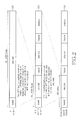
- FIG. 3 shows a DVB-H data transfer model using time slicing.
- ESG data 111, video 1 data 113, audio data 115, and video 2 data 117 can be sequentially transferred during the allocated time slots.
- DVB-H signaling information is transferred not in the scheme of time slicing, but all over the time domain.
- ESG data corresponds to extensible Markup Language (XML) file that has information on broadcasting services sent through the DVB-H system.
- the DVB-H system informs users of the kinds of broadcasting services and of a diversity of information required to receive the broadcasting services ⁇ e.g., an Internet Protocol (IP) platform Identifier (ID), an IP address, information on paid services, etc. ⁇ by using this ESG data.
- IP Internet Protocol
- ID IP address
- paid services etc.
- the ESG data should be received earlier in order to be analyzed before the broadcasting services including video, audio, data, etc., are received.
- the latest data can be maintained by periodically checking if the update did occur.
- a major role which the information of PSI/SI plays in the DVB-H system is to perform signaling with respect to data that comes into an MPEG TS, and information which accords with an IP address.
- related IP data can come to be received by using the IP addresses, and by mapping between the IP address of the broadcasting services of the ESG and a Program ID (PID) of the MPEG TS, which is actually received.
- PID Program ID
- Information on DVB-T and DVB-S broadcasting services is also transferred while carrying PSI/SI data, information related to broadcasting is not actually transferred in the DVB-H, for most of the information related to broadcasting is included in the ESG.
- the PSI/SI data should be also monitored throughout reception of the services. This is why a change should be reflected, if signaling information related to the DVB-H changes. Consequently, it is usual that the PSI/SI does not transfer data using time slicing but is spread all over the time domain so that it may be decoded during any time slot.
- the DVB-H terminal analyzes the ESG data in order to perform the broadcasting services in the DVB-H system. Moreover, while the services are being received, the latest data can be maintained by periodically checking for any update. Yet, the ESG data is also transferred through IP 40, and is transferred using time slicing as the ESG data is carried during a specific time slot, as illustrated in FIG. 2. Referring to FIG 1, a protocol through which the ESG data is transferred is located higher than the FLUTE protocol 80, which corresponds to a file download protocol.
- ESG data update should be periodically checked using the FLUTE protocol 80, after awaking from a time slot into which the ESG data enters as it is received.
- the FLUTE protocol 80 transmits information on whether a file, which is being transferred, has been updated by using XML data called "Formal Description Technique (FDT) instance.” This is illustrated in FIG. 4.
- FIG. 4 shows the FLUTE protocol data transmission concept.
- a second FDT instance 121 is received above all during a time slot for which the ESG data is received, and is compared with a first FDT instance, which has been already received.
- the ESG data is updated.
- the ID of the first FDT instance is the same as the ID of the second FDT instance.
- the ESG data is updated during the third time interval 'c.'
- an FDT instance should be received and analyzed after awaking from a time slot domain during which the ESG data is always received. As a result, checking the update of the ESG data causes a large amount of power to be consumed.
- the present invention has been made to solve the above problems occurring in the prior art. It is the object of the present invention to provide a system and a method in which ESG data can be updated by efficiently checking the version of the ESG data, as power consumption of a DVB-H terminal is reduced.
- a method for transmitting update information of Electronic Service Guide (ESG) data in a Digital Video Broadcasting-Handheld (DVB-H) system including detecting the version of the ESG data which is to be transmitted; and inserting the version information of the ESG data in a predetermined table among tables constructing Program Specific Information/Service Information (PSI/SI), and transmitting the version of the ESG data included in the predetermined table.
- ESG Electronic Service Guide
- DVD-H Digital Video Broadcasting-Handheld
- a method for receiving update information of Electronic Service Guide (ESG) data in a Digital Video Broadcasting-Handheld (DVB-H) system including receiving PSI/SI data; analyzing the received PSI/SI data, and detecting the version of the ESG data from the analyzed PSI/SI data; comparing the detected version of the ESG data with version of ESG data detected from PSI/SI, which has been already received, in order to check if the two versions are in accord with each other; and making connection with a transmission channel of the ESG data if the two versions are not in accord with each other; receiving the ESG data, and updating the received ESG data.
- ESG Electronic Service Guide
- DVD-H Digital Video Broadcasting-Handheld
- a system for transmitting/receiving update information of the Electronic Service Guide (ESG) data in a Digital Video Broadcasting-Handheld (DVB-H) system including a DVB-H system for detecting version of the ESG data which is to be transmitted, for inserting the version information of the ESG data in a predetermined table among tables constructing Program Specific Information/Service Information (PSI/SI) data, and for transmitting the version of the ESG data included in the predetermined table; and a DVB-H receiving terminal for receiving PSI/SI data and then analyzing the received PSI/SI data to detect the version of the ESG data from the analyzed PSI/SI data, for comparing the detected version of the ESG data with version of ESG data detected from PSI/SI, which has been already received, in order to check if the two versions are in accord with each other, and for making connection with a transmission channel of the ESG data if the two versions are not in accord with each other, to receive
- PSI/SI Program Specific Information
- the DVB-H broadcasting receiving terminal includes a moving picture player 210, an ESG information analyzer 220, a Rapid Transport Protocol (RTP) processing unit 230, a FLUTE decoder 240, an Internet Protocol/User Datagram Protocol (IP/UDP) processing unit 250, a DVB-H decapsulator 260, a PSI/SI analyzer 280, a DVB-H demodulator 290, and a DVB-H Radio Frequency (RF) receiving unit 270.
- RTP Rapid Transport Protocol
- IP/UDP Internet Protocol/User Datagram Protocol
- RF DVB-H Radio Frequency
- DVB-H RF receiving unit 270 receives a DVB-H signal from a DVB-H system 200, and provides the received DVB-H signal to DVB-H demodulator 290.
- DVB-H demodulator 290 analyzes the MPEG-2 transport stream, and provides an analyzed MPEG-2 transport stream to DVB-H decapsulator 260 and PSI/SI analyzer 280.
- DVB-H decapsulator 260 decapsulates MPE section data to acquire an IP packet, and provides the acquired IP packet to the IP/UDP processing unit 250.
- the PSI/SI analyzer 280 analyzes the PSI/SI information.
- IP/UDP processing unit 250 processes received IP packets, and outputs the processed IP packets to the RTP processing unit 230 and FLUTE decoder 240.
- FLUTE decoder 240 detects transport data, such as ESG data, etc., from the received IP packets, and outputs the detected transport data to ESG information analyzer 220.
- ESG information analyzer 220 analyzes ESG data provided from FLUTE decoder 240 to extract information necessary for broadcasting services from the analyzed ESG data.
- RTP processing unit 230 processes the received IP packets to provide a processed IP packets to moving picture player 210, and moving picture player 210 reproduces the input RTP-processed IP packets to output reproduced RTP-processed IP packets.
- DVB-H system 200 transmits PSI/SI data, configured as in FIG. 6, for signaling.
- an essential table information which should be necessarily included in the PSI/SI data of the DVB-H to be transmitted, includes a Program Association Table (PAT) 131, a Program Map Table (PMT) 133, a Network Information Table (NIT) 135, IP/MAC Notification Table (INT) 141, and a Time and Date Table (TDT) 137.
- PAT 131 and PMT 133 are tables which include PID information necessary to demultiplex information, which is multiplexed in order to come into an MPEG-2 system.
- the NIT 135 is a table which includes broadcasting network information of an MPEG-2 stream
- the INT 141 is a table in which PID information required to demultiplex services transmitted by using IP accords, is accorded with each IP address.
- TDT 137 is a table which includes information on times to which broadcasting stream refers.
- a Service Description Table (SDT) which includes information on the broadcasting services
- a Event Information Table which includes information on broadcasting program times, are included as the remaining options.
- DVB-H broadcasting receiving terminal 100 analyzes the PSI/SI data configured as described above. Since all data of DVB-H services are configured as IP data, DVB-H broadcasting receiving terminal 100 detects INT 141 related to a relevant IP platform after the DVB-H broadcasting receiving terminal 100 has obtained from the PSI/SI, IP platform information whose service is currently available. Then, DVB-H broadcasting receiving terminal 100 detects, from detected INT 141, IP data whose services are offered by the IP platform, and information required to extract data from MPEG-2 transport stream. To sequentially examine this process with reference to FIG.
- PSI/SI analyzer 280 of DVB-H broadcasting receiving terminal 100 detects NIT 135 first of all to obtain the MPEG stream information of the broadcasting network . Thereafter, PSI/SI analyzer 280 analyzes NIT 135 or Bouquet Association Table (BAT) 139 to obtain information of the IP platform included in the broadcasting network.
- the IP platform becomes a unit of broadcasting services, which broadcasters offer.
- the information of the IP platform includes a service ID, an IP platform ID, and a name of platform, etc.
- PID information which enables PMT 133 related to the service ID to be sought, is now able to be acquired.
- a data_broadcast_id_descriptor( ) which enables a position of the INT related to an IP platform service can be sought.
- INT 141 can be detected by using this PID information, and information on IP addresses whose services are offered by the IP platform, can now be obtained by analyzing INT 141.
- ESG data corresponds to XML data describing information on broadcasting services offered as services in the IP platform. Accordingly, when signaling of the version of the ESG data is attempted, the signaling will be accomplished by the IP platform. Even though there may exist various methods for performing the signaling of the version of ESG data in the PSI/SI, one method will be described as an example among the methods in the present invention. In the course of the process for analyzing PSI/SI data, shown in FIG. 7, it has been aforementioned that a part which would be finally detected in INT 141 corresponds to PMT 133. Information on INT 141, related to a specified platform, is described in data_broadcast_id_descriptor( ) of PMT 133.
- the data_broadcast_id_descriptor( ) is included in part of the description having the structure of PMT 133, and whether to include the data_broadcast_id_descriptor( ) can be distinguished through data_broadcast_id. ID of the data_broadcast_id_descriptor( ) is set to 0x000B.
- INT 141 is transferred by using id_selector_byte included in the data_broadcast_id_descriptor( ), and FIG. 10 illustrates the structure of IP/MAC_notification_info( ), which describes information on INT 141 according to a preferred embodiment of the present invention.
- IP_notification_info( ) an ID of the IP platform, which belongs to INT 141 and the version of INT 141 are provided by IP_notification_info( ).
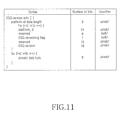
- the method for adding a field required to inform the data_broadcast_id_descriptor() of the ESG version, called "ESG_verion_info(),” is presented as one of the methods for performing the signaling of the version of ESG data in the PSI/SI data.
- ESG_verion_info() is a view illustrating the structure of the ESG_version_info( ) according to a preferred embodiment of the present invention. Referring to FIG.
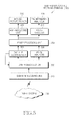
- FIG. 12 is a flowchart of DVB-H receiving terminal 100 updating ESG data after monitoring the PSI/SI data configured as aforementioned, and for checking the ESG version, according to a preferred embodiment of the present invention.
- DVB-H receiving terminal 100 monitors the PSI/SI data while receiving the DVB-H services.
- DVB-H receiving terminal 100 continues to check the ESG_version_info( ) included in PMT 133. If there exists a change of the ESG version denoted by the ESG_version_info( ), DVB-H receiving terminal 100 is connected to a channel, over which the ESG data is transmitted in step 305, and updates the ESG data in step 307.
- DVB-H receiving terminal 100 should be continually connected to the ESG channel. Because a state of the continual connection means that DVB-H receiving terminal 100 should be awakened even during a time slot for which the ESG data is transferred, power consumption of the terminal increases, and the task that checks if the ESG version is updated is additionally required, for the DVB-H receiving terminal 100 should input an FDT instance to check the input FDT one by one. However, as illustrated in FIG. 12, since there is no need to access to the ESG data transmission channel while checking if the ESG version is updated, power consumption can be reduced by that amount.
Landscapes
- Engineering & Computer Science (AREA)
- Multimedia (AREA)
- Signal Processing (AREA)
- Databases & Information Systems (AREA)
- Human Computer Interaction (AREA)
- Two-Way Televisions, Distribution Of Moving Picture Or The Like (AREA)
Applications Claiming Priority (1)
| Application Number | Priority Date | Filing Date | Title |
|---|---|---|---|
| KR1020060074937A KR100800856B1 (ko) | 2006-08-08 | 2006-08-08 | Dvb-h 시스템에서 esg 업데이트 정보 송수신 방법및 시스템 |
Publications (1)
| Publication Number | Publication Date |
|---|---|
| EP1887803A1 true EP1887803A1 (fr) | 2008-02-13 |
Family
ID=38698162
Family Applications (1)
| Application Number | Title | Priority Date | Filing Date |
|---|---|---|---|
| EP07114003A Withdrawn EP1887803A1 (fr) | 2006-08-08 | 2007-08-08 | Système et procédé pour transmettre/recevoir des informations de mise à jour des données ESG dans un système DVB-H |
Country Status (4)
| Country | Link |
|---|---|
| US (1) | US20080040762A1 (fr) |
| EP (1) | EP1887803A1 (fr) |
| KR (1) | KR100800856B1 (fr) |
| CN (1) | CN101159860A (fr) |
Cited By (4)
| Publication number | Priority date | Publication date | Assignee | Title |
|---|---|---|---|---|
| WO2008110921A3 (fr) * | 2007-03-15 | 2009-04-09 | Nokia Corp | Mécanisme de découverte de service dans un réseau de télécommunication de diffusion |
| CN101442552B (zh) * | 2008-12-29 | 2013-01-09 | 上海全景数字技术有限公司 | 分布式sig系统的配置同步方法 |
| EP3155819A4 (fr) * | 2014-06-13 | 2018-01-10 | Thomson Licensing | Système de réseau de diffusion vidéo numérique et procédé d'obtention d'informations de programme dans un système de diffusion vidéo numérique |
| EP2095567B1 (fr) * | 2006-11-06 | 2018-12-19 | QUALCOMM Incorporated | Communication de notifications |
Families Citing this family (10)
| Publication number | Priority date | Publication date | Assignee | Title |
|---|---|---|---|---|
| CN101600059B (zh) * | 2008-06-06 | 2012-08-08 | 乐金电子(中国)研究开发中心有限公司 | 数字电视节目的快速自动更新方法与装置 |
| CN101742059B (zh) * | 2008-11-21 | 2013-01-02 | 康佳集团股份有限公司 | 使用网络信息表管理终端设备接收节目参数的方法 |
| CN101771946B (zh) * | 2008-12-29 | 2012-11-28 | 中兴通讯股份有限公司 | 基于基站的mbms业务控制信令更新方法及系统 |
| KR20110105092A (ko) * | 2010-03-18 | 2011-09-26 | 삼성전자주식회사 | 휴대방송 시스템에서 서비스 접속 정보를 제공하기 위한 장치 및 방법 |
| KR102252402B1 (ko) * | 2011-10-13 | 2021-05-14 | 삼성전자주식회사 | 멀티미디어 서비스 송수신 방법 및 장치 |
| WO2013055179A1 (fr) | 2011-10-13 | 2013-04-18 | Samsung Electronics Co., Ltd. | Procédé et appareil pour l'émission et la réception d'un service multimédia |
| KR101501344B1 (ko) | 2012-05-02 | 2015-03-10 | 삼성전자주식회사 | 멀티미디어 서비스 송수신 방법 및 장치 |
| JP2015073245A (ja) * | 2013-10-04 | 2015-04-16 | ソニー株式会社 | 受信装置、受信方法、送信装置、及び、送信方法 |
| KR102205703B1 (ko) * | 2014-04-18 | 2021-01-21 | 한국전자통신연구원 | 증강방송 서비스를 위한 방송 사업자 장치, 콘텐츠 사업자 장치, 수신 단말 및 증강방송 서비스 방법 |
| CN108093309A (zh) * | 2017-12-29 | 2018-05-29 | 深圳Tcl新技术有限公司 | 电视节目列表生成方法、装置及可读存储介质 |
Citations (3)
| Publication number | Priority date | Publication date | Assignee | Title |
|---|---|---|---|---|
| WO2004056096A1 (fr) * | 2002-12-18 | 2004-07-01 | Nokia Corporation | Procede d'annonces de session |
| WO2004066652A1 (fr) * | 2003-01-21 | 2004-08-05 | Nokia Corporation | Procede, systeme et entite de reseau pour transmission bande large numerique |
| US20060053450A1 (en) * | 2004-09-09 | 2006-03-09 | Nokia Corporation | Mobile television electronic service guide delivery system |
Family Cites Families (4)
| Publication number | Priority date | Publication date | Assignee | Title |
|---|---|---|---|---|
| US5666293A (en) * | 1994-05-27 | 1997-09-09 | Bell Atlantic Network Services, Inc. | Downloading operating system software through a broadcast channel |
| US7150029B1 (en) * | 1997-10-14 | 2006-12-12 | Thomson Licensing | System for formatting and processing multimedia program data and program guide information |
| KR19990085286A (ko) * | 1998-05-15 | 1999-12-06 | 구자홍 | 디지털 티브이의 채널정보변경 방법 |
| AU2005311013A1 (en) | 2004-12-02 | 2006-06-08 | Nokia Corporation | Enhanced electronic service guide container |
-
2006
- 2006-08-08 KR KR1020060074937A patent/KR100800856B1/ko not_active Expired - Fee Related
-
2007
- 2007-05-18 US US11/804,689 patent/US20080040762A1/en not_active Abandoned
- 2007-08-03 CN CNA2007101402191A patent/CN101159860A/zh active Pending
- 2007-08-08 EP EP07114003A patent/EP1887803A1/fr not_active Withdrawn
Patent Citations (3)
| Publication number | Priority date | Publication date | Assignee | Title |
|---|---|---|---|---|
| WO2004056096A1 (fr) * | 2002-12-18 | 2004-07-01 | Nokia Corporation | Procede d'annonces de session |
| WO2004066652A1 (fr) * | 2003-01-21 | 2004-08-05 | Nokia Corporation | Procede, systeme et entite de reseau pour transmission bande large numerique |
| US20060053450A1 (en) * | 2004-09-09 | 2006-03-09 | Nokia Corporation | Mobile television electronic service guide delivery system |
Cited By (6)
| Publication number | Priority date | Publication date | Assignee | Title |
|---|---|---|---|---|
| EP2095567B1 (fr) * | 2006-11-06 | 2018-12-19 | QUALCOMM Incorporated | Communication de notifications |
| WO2008110921A3 (fr) * | 2007-03-15 | 2009-04-09 | Nokia Corp | Mécanisme de découverte de service dans un réseau de télécommunication de diffusion |
| US7903574B2 (en) | 2007-03-15 | 2011-03-08 | Nokia Corporation | Service discovery mechanism in broadcast telecommunication network |
| US8498220B2 (en) | 2007-03-15 | 2013-07-30 | Nokia Corporation | Service discovery mechanism in broadcast telecommunication network |
| CN101442552B (zh) * | 2008-12-29 | 2013-01-09 | 上海全景数字技术有限公司 | 分布式sig系统的配置同步方法 |
| EP3155819A4 (fr) * | 2014-06-13 | 2018-01-10 | Thomson Licensing | Système de réseau de diffusion vidéo numérique et procédé d'obtention d'informations de programme dans un système de diffusion vidéo numérique |
Also Published As
| Publication number | Publication date |
|---|---|
| CN101159860A (zh) | 2008-04-09 |
| US20080040762A1 (en) | 2008-02-14 |
| KR100800856B1 (ko) | 2008-02-04 |
Similar Documents
| Publication | Publication Date | Title |
|---|---|---|
| EP1887803A1 (fr) | Système et procédé pour transmettre/recevoir des informations de mise à jour des données ESG dans un système DVB-H | |
| US11528519B2 (en) | Method and apparatus for transmitting and receiving signaling information associated with multimedia content | |
| US8498220B2 (en) | Service discovery mechanism in broadcast telecommunication network | |
| US8359615B2 (en) | Method and digital broadcasting system for transmitting and receiving ESG | |
| US20110103300A1 (en) | Data encapsulation and service discovery over a broadcast or multicast system | |
| US20070150920A1 (en) | Method and apparatus for transmitting/receiving ESG in digital video broadcasting system | |
| US20080225892A1 (en) | Using Forward Error Correction with Generic Stream Encapsulation in a Digital Broadcast Network | |
| US20080092203A1 (en) | Approach for channel switch time reduction in IPDC over DVB-H | |
| US8270343B2 (en) | Broadcasting of textual and multimedia information | |
| US20070168534A1 (en) | Codec and session parameter change | |
| WO2007148173A1 (fr) | mise à jour de guide de services électroniques adaptéE à un comportement d'utilisateur | |
| WO2007138404A2 (fr) | Section de découverte de service | |
| EP2442582B1 (fr) | Sélection de flux de données pour recevoir un service de données | |
| US20110099577A1 (en) | Filtering of dynamic services in cached service acquisition data | |
| US20080201738A1 (en) | Digital broadcast playback method for mobile terminal | |
| US8036154B2 (en) | Device and method for saving power in digital broadcasting receiver | |
| US20070298756A1 (en) | Optimized acquisition method | |
| EP1928111A2 (fr) | Procédé et système pour régler un canal dans un service DVB-H | |
| WO2007043804A1 (fr) | Procede et appareil pour la fourniture de service de transmission de garantie de confiance dans un systeme de diffusion numerique | |
| KR101304888B1 (ko) | 다중 주파수 채널을 사용하는 디지털 방송수신기의서비스채널 변경 장치 및 방법 | |
| EP2056564A1 (fr) | Procédé pour la signalisation d'un identifiant de programme en DVB IP | |
| CN113923522A (zh) | 机顶盒的时间更新方法、装置及计算机可读存储介质 | |
| Eerenberg et al. | DVB-H link layer |
Legal Events
| Date | Code | Title | Description |
|---|---|---|---|
| PUAI | Public reference made under article 153(3) epc to a published international application that has entered the european phase |
Free format text: ORIGINAL CODE: 0009012 |
|
| 17P | Request for examination filed |
Effective date: 20070808 |
|
| AK | Designated contracting states |
Kind code of ref document: A1 Designated state(s): AT BE BG CH CY CZ DE DK EE ES FI FR GB GR HU IE IS IT LI LT LU LV MC MT NL PL PT RO SE SI SK TR |
|
| AX | Request for extension of the european patent |
Extension state: AL BA HR MK YU |
|
| 17Q | First examination report despatched |
Effective date: 20080618 |
|
| AKX | Designation fees paid |
Designated state(s): DE FI FR GB IT SE |
|
| STAA | Information on the status of an ep patent application or granted ep patent |
Free format text: STATUS: THE APPLICATION IS DEEMED TO BE WITHDRAWN |
|
| 18D | Application deemed to be withdrawn |
Effective date: 20081029 |