EP1889733A2 - Appareil et procédé pour la décoration continue des bandes par sublimation - Google Patents
Appareil et procédé pour la décoration continue des bandes par sublimation Download PDFInfo
- Publication number
- EP1889733A2 EP1889733A2 EP07113153A EP07113153A EP1889733A2 EP 1889733 A2 EP1889733 A2 EP 1889733A2 EP 07113153 A EP07113153 A EP 07113153A EP 07113153 A EP07113153 A EP 07113153A EP 1889733 A2 EP1889733 A2 EP 1889733A2
- Authority
- EP
- European Patent Office
- Prior art keywords
- strip
- decorated
- stage
- transfer backing
- backing
- Prior art date
- Legal status (The legal status is an assumption and is not a legal conclusion. Google has not performed a legal analysis and makes no representation as to the accuracy of the status listed.)
- Withdrawn
Links
Images

Classifications
-
- B—PERFORMING OPERATIONS; TRANSPORTING
- B41—PRINTING; LINING MACHINES; TYPEWRITERS; STAMPS
- B41M—PRINTING, DUPLICATING, MARKING, OR COPYING PROCESSES; COLOUR PRINTING
- B41M5/00—Duplicating or marking methods; Sheet materials for use therein
- B41M5/025—Duplicating or marking methods; Sheet materials for use therein by transferring ink from the master sheet
- B41M5/035—Duplicating or marking methods; Sheet materials for use therein by transferring ink from the master sheet by sublimation or volatilisation of pre-printed design, e.g. sublistatic
- B41M5/0358—Duplicating or marking methods; Sheet materials for use therein by transferring ink from the master sheet by sublimation or volatilisation of pre-printed design, e.g. sublistatic characterised by the mechanisms or artifacts to obtain the transfer, e.g. the heating means, the pressure means or the transport means
-
- B—PERFORMING OPERATIONS; TRANSPORTING
- B44—DECORATIVE ARTS
- B44C—PRODUCING DECORATIVE EFFECTS; MOSAICS; TARSIA WORK; PAPERHANGING
- B44C1/00—Processes, not specifically provided for elsewhere, for producing decorative surface effects
- B44C1/16—Processes, not specifically provided for elsewhere, for producing decorative surface effects for applying transfer pictures or the like
- B44C1/165—Processes, not specifically provided for elsewhere, for producing decorative surface effects for applying transfer pictures or the like for decalcomanias; sheet material therefor
- B44C1/17—Dry transfer
- B44C1/1712—Decalcomanias applied under heat and pressure, e.g. provided with a heat activable adhesive
-
- D—TEXTILES; PAPER
- D06—TREATMENT OF TEXTILES OR THE LIKE; LAUNDERING; FLEXIBLE MATERIALS NOT OTHERWISE PROVIDED FOR
- D06B—TREATING TEXTILE MATERIALS USING LIQUIDS, GASES OR VAPOURS
- D06B11/00—Treatment of selected parts of textile materials, e.g. partial dyeing
- D06B11/0076—Transfer-treating
Definitions
- the present invention has as its subject an apparatus for the continuous decoration of strips by means of colour sublimation.
- the present invention has as its subject a method for the continuous decoration of strips with the said apparatus by means of colour sublimation.
- the present invention is directed at an apparatus and a method for transferring onto metallic and non-metallic strips a decoration, carried by a transfer backing, by means of sublimation.
- transfer backing has the meaning of an element configured as a strip which bears a decoration formed by sublimatable solid pigments.
- the known apparatuses include a first reel from which the strip to be decorated is unwound.
- the latter may be a strip of metallic material or of non-metallic plastic material.
- the known apparatuses furthermore include a second reel from which the transfer backing is unwound.
- the prior art apparatuses include furthermore a first pair of opposed rollers between which both the strip to be decorated and the transfer backing are made to pass.
- one side of the transfer backing, and in particular the side bearing the decoration is coupled with one side of the strip which is to be decorated.
- the two rollers exert pressure on each other to ensure adhesion between strip and backing.
- the rollers are also heated so as to bring the strip and the backing up to sublimation temperature.
- the pigments forming the decoration consequently sublimate and the latter is transferred onto the strip.
- the spent transfer backing is then decoupled from the decorated strip which is wound onto a third reel, while the spent transfer backing is wound onto a fourth reel.
- the zone in which the transfer of the decoration by sublimation occurs is formed approximately by the contact zone of the two heated rollers.
- the extension of this zone can be insufficient to ensure the transfer of the decoration in a complete and satisfying manner.
- apparatuses are available in which the contact zone between the strip to be decorated and the transfer backing extends beyond the contact zone between the rollers. This is effected, for example, by having the strip to be decorated and the transfer backing run over a single heated roller and pressing the strip to be decorated and the transfer backing onto the roller with an endless belt which extends along an arc of circumference of the roller. In this way, the contact zone between strip and backing extends along the entire arc of circumference of the roller affected by the endless belt.
- some apparatuses include two mutually coupled endless belts between which the strip and the backing are made to pass simultaneously.
- the belts are supported and moved by two respective pairs of rollers.
- the heating of the strip and of the backing is performed by suitable heating means. These heating means are located in proximity to the endless belts, so that the heating occurs in the contact area between strip and backing.
- the available apparatuses do not always ensure optimal adhesion and intimate contact between the strip to be decorated and the transfer backing.
- the zone in which adhesion occurs between the strip to be decorated and the transfer backing is limited to the line of contact between the two rollers. This zone may be insufficient to ensure the adhesion necessary for optimal decoration.
- the adhesion zone between the strip to be decorated and the transfer backing is noticeably extended.
- the pressure exerted on the strip and the backing are in fact lower, and adhesion and intimate contact between strip and backing are therefore not in general acceptable.
- the strip to be decorated and the transfer backing can happen that there are areas in which the backing is slightly separated from the strip, creating a gap.
- the pigment sublimates it can spread into the gap and therefore does not transfer onto the strip to be decorated, still less according to the intended design.
- the strip ends up decorated in a manner that is at best blurred, indefinite or fuzzy.
- the technical task of the present invention is to propose an apparatus for the continuous decoration of strips by sublimation, free from the disadvantages mentioned above.
- an object of the present invention is to propose an apparatus and a method for the continuous decoration of strips by sublimation which allows high quality and precision in transferring the decoration onto the strip.
- a further object of the present invention is to propose an apparatus for the continuous decoration of strips by sublimation which is simple to use, and a method for the continuous decoration of strips by sublimation which is quick and simple to implement.
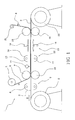
- Reference no. 1 comprehensively indicates an apparatus for the continuous decoration of strips by sublimation according to the present invention.
- the apparatus 1 includes a first reel 2 onto which a strip 3 to be decorated is wound.
- the first reel 2 is moved by means of a motor (not illustrated) to allow the unwinding of the strip 3.
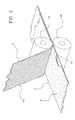
- the strip 3 to be decorated is preferably of metallic material and includes a base layer 4 located on a side 3 which is to be decorated of the strip 3 (figure 2).
- the base layer 4 consists of a coating capable of receiving and retaining sublimated solid pigments.
- the strip 3 to be decorated may also be made in non-metallic material such as, by way of example, plastic material.
- the apparatus 1 includes a second reel 5 onto which a transfer backing 6 is wound. On one side 6a of the latter a decoration is arranged, made with solid sublimatable pigments, which is to be transferred to the strip 3 by sublimation.
- the second reel 5 is moved by means of a motor (not illustrated) to allow the unwinding of the transfer backing 6.
- Suitable materials for making the transfer backing 6 are polyester, polypropylene, polyethylene, polyurethane, polyamide materials, PVA, polyvinyl butyrate and similar.
- the apparatus 1 includes furthermore preheating means 7 which act exclusively on the strip 3 to be decorated.
- the preheating means 7 include at least one infrared ray lamp 8 which heats the strip 3 to a temperature of between 100°C and 230°C, preferably between 130°C and 200°C.
- the preheating means 7 include a hot air heater or an induction heater.
- the apparatus 1 includes furthermore at least one first pair of rollers 9, 10 to couple the strip 3 with the transfer backing 6.
- the rollers 9, 10 are coupled and counter-rotating and are arranged with their respective longitudinal axes (not shown) parallel. Each longitudinal axis is perpendicular to a direction "X" of advance of the strip 3 and the backing 6.
- the strip 3 to be decorated and the transfer backing 6 are fed to the rollers 9, 10 with the same linear speed so as to effect their mutual coupling.
- the strip 3 and the backing 6 are superimposed in such a way that the side 6a of the backing 6 bearing the decoration is placed in contact with the base layer 4 of the strip 3.
- rollers 9, 10 exert pressure so as to compress the strip 3 and the backing 6 between them in order to favour their mutual adhesion.
- the apparatus 1 includes furthermore an electrostatic charge generator 11 for generating an electrostatic attraction force between the strip 3 and the transfer backing 6. More precisely, the generator 11 acts on the transfer backing 6 by electrically charging it. The electrostatic charge produces the high-intensity electrostatic attraction force which ensures a firm and intimate coupling between the transfer backing 6 and the base layer 4.
- the coating which constitutes the base layer 4 is preferably of a dielectric nature.
- the coating is an insulating material so that, once contact has been made between the strip to be decorated and the transfer backing, it does not disperse the electric charges applied to the transfer backing by the generator 11. In this way, the above-mentioned electrostatic attraction force can be generated.
- the coating which makes up the base layer 4 consists of semitransparent thermosetting powders.
- the powders can have a basis of polyester, polyurethane or acrylic resins or various mixtures.
- the coating can be a liquid with a basis of polyester, polyurethane or acrylic resins or various mixtures.
- the base layer 4 can include a further layer of transparent coating.
- the electrostatic charge generator 11 is located in proximity to the first pair of rollers 9, 10. More precisely, the generator 11 is positioned at the exit of the coupled strip 3 and backing 6 from the first pair of rollers 9, 10.
- the apparatus 1 furthermore includes heating means 12 which act on the strip 3 and the backing 6 to enable the decorating pigments to reach sublimation temperature and to be transferred onto the strip 3.
- a further function of the heating means 12 is to enable the coating which constitutes the base layer 4 to undergo a thermosetting reaction. In this way, the colouring pigments transferred onto the coating are solidly incorporated into the base layer 4.
- the heating means 12 include a main heater 13 which acts on the strip 3 to be decorated and on the backing 6 when they are coupled.
- the main heater 13 enables the latter to reach a temperature of between 120°C and 230°C, preferably between 150°C and 200°C.
- the temperature reached by the heater 13 must be such as to heat the pigments to the point of completing their sublimation.
- the transfer backing 6 has a melting point higher than both the sublimation temperature of the pigments and the temperature necessary for the thermosetting of the base layer 4.
- the main heater 13 brings about both the sublimation of the pigments and the thermosetting of the base layer 4.
- the transfer backing 6 is made of a material which has a melting point lower than the thermosetting temperature.
- the main heater 13 brings about only the sublimation of the pigments, and the apparatus provides a further heater (not shown) which acts exclusively on the the decorated strip 3 to bring about the thermosetting of the base layer 4.
- the heater 13 includes advantageously a pair of infrared ray lamps 14, mutually opposed with respect to the strip 3 and the backing 6. In this way, heating is efficient and uniform.
- the heating means 12 include furthermore at least one heating element (not shown in the drawings) located in at least one of rollers 9, 10.
- the heating means 12 include heating elements located in both the rollers 9, 10.
- the apparatus 1 furthermore includes cooling means 15. The latter lower the temperature of the decorated strip 3 and of the spent transfer backing 6 in order to facilitate their separation.
- the cooling means 15 include at least a first fan 16 which generates an airflow directed at the transfer backing 6.
- the cooling means 15 include a second fan 17, opposed to the first, which generates an airflow directed at the strip 3. In this way, faster and more uniform cooling is obtained.
- Apparatus 1 includes furthermore a second pair of rollers 18, 19 which facilitate decoupling between the decorated strip 3 and the spent transfer backing 6 (figure 3).
- rollers 18, 19 are coupled and counter-rotating and are arranged with their respective longitudinal axes (not shown) parallel. Each longitudinal axis of the rollers 18, 19 is perpendicular to the direction "X" of advance.
- the decorated strip 3 and the spent transfer backing 6 pass through the second pair of rollers 18, 19.
- the second pair of rollers 18, 19 contributes to removing heat from the strip 3 and the backing 6.
- the rollers 18, 19 are placed in contact with the strip 3 and the backing 6 and absorb by conduction a fraction of the residual heat.
- the apparatus 1 includes furthermore a third reel 20, onto which the decorated strip 3 is wound, and a fourth reel 21 onto which the spent transfer backing is wound.
- the third reel 20 and the fourth reel 21 are moved by respective motors (not shown).
- the decorated strip 3 and the spent transfer backing 6 are kept coupled and are wound together onto the third wheel 20.
- the spent transfer backing 6 protects the decorated surface of the strip 3.
- the invention also creates a method for the continuous decoration of strips by sublimation.
- the method includes a preliminary stage of preparing the strip 3 to be decorated.
- This preliminary stage includes a stage of painting one surface of the strip 3 with at least one layer of base coating to constitute the base layer 4 of the strip 3 to be decorated.
- the coating used in this stage is of the type already described with reference to apparatus 1.
- the method includes furthermore the stage of preheating solely the strip 3 to be decorated.
- the preheating is performed in such a way that strip 3 reaches a temperature of between 100°C and 230°C, preferably between 130°C and 200°C.
- the preheating is performed to prepare the strip 3 for accepting the pigments which subsequently sublimate.
- the method includes furthermore the stage of coupling the strip 3 to be decorated with the transfer backing 6 bearing the decoration created with the above-mentioned sublimatable pigments.
- th side 6a of the backing 6 bearing the decoration is placed in contact with the base layer 4.
- the stage of coupling the strip 3 and the backing 6 includes also the stage of preliminarily heating the coupled strip 3 and the backing 6.
- the stage of electrostatically charging the transfer backing 6 is performed, in order to generate the electrostatic attraction force between the backing 6 and the strip 3.
- the electrostatic charging stage includes the stage of applying the electrostatic charges to the transfer backing 6 by means of an electrostatic field.
- the method includes furthermore the stage of heating the coupled strip 3 and transfer backing 6 up to the sublimating temperature of the pigments.
- the coupled strip 3 and backing 6 reach a temperature of between 120°C and 230°C, preferably between 150°C and 200°C.
- the pigments sublimate and diffuse onto the base layer 4, imprinting themselves on it.
- the heating stage is performed after the stage of electrostatically charging the transfer backing 6, so that the diffusion of the sublimated pigments is extremely localised.
- the electrostatic force thus generated enables intimate adhesion between the backing 6 and the strip 3 which continues at least during the subsequent heating stage.
- the method continues with a stage of cooling the decorated strip 3 and the spent transfer backing 6.
- This stage is preferably performed by the application of an air flow directed at the strip 3 and the backing 6. This stage enables the consolidation of the pigments in the base layer 4 and, therefore, the stabilisation of the decoration on the strip 3.
- the method continues with a stage of decoupling the decorated strip 3 and the spent transfer backing 6.
- the method includes furthermore the stages of receiving the decorated strip 3 and the spent transfer backing 6.
- the method includes the stage of applying a protective coating after the stage of separating the decorated strip 3 and the spent transfer backing 6. This stage is performed by the application to the decorated strip 3 of a transparent or semi-transparent coating.
- the method can include the stage of keeping the strip 3 and the backing 6 coupled and, subsequently, the stage of receiving the said elements still coupled.
- the invention achieves the objects set forth.
- the electrostatic attraction force which is established thanks to the use of the electrostatic charge generator, enables considerably improved adhesion between the transfer backing 6 and the strip 3.
- the electrostatic force allows the reduction to the point of elimination of the gaps which can be created between the strip 3 and the backing 6 after their mutual coupling. In this way, when the pigments sublimate, they are transferred onto strip 3, reproducing the desired decoration exactly.
- the decoration is applied with continuity over the whole of the base layer 4 of the strip 3 and no areas which are discoloured or entirely without decoration appear.
- the decoration applied to the strip 3 is much sharper and does not display any blurring or fuzzing, because the absence of gaps prevents an excessive and undesirable diffusion of the pigment.
Landscapes
- Decoration By Transfer Pictures (AREA)
- Coloring (AREA)
- Cosmetics (AREA)
- Treatment Of Fiber Materials (AREA)
Applications Claiming Priority (1)
| Application Number | Priority Date | Filing Date | Title |
|---|---|---|---|
| IT001501A ITMI20061501A1 (it) | 2006-07-28 | 2006-07-28 | Apparecchiatura e metodo per la decorazione in continuo di nastri mediante sublimazione |
Publications (2)
| Publication Number | Publication Date |
|---|---|
| EP1889733A2 true EP1889733A2 (fr) | 2008-02-20 |
| EP1889733A3 EP1889733A3 (fr) | 2008-09-17 |
Family
ID=38698397
Family Applications (1)
| Application Number | Title | Priority Date | Filing Date |
|---|---|---|---|
| EP07113153A Withdrawn EP1889733A3 (fr) | 2006-07-28 | 2007-07-25 | Appareil et procédé pour le transfert continu de décorations sur un ruban par sublimation |
Country Status (2)
| Country | Link |
|---|---|
| EP (1) | EP1889733A3 (fr) |
| IT (1) | ITMI20061501A1 (fr) |
Cited By (2)
| Publication number | Priority date | Publication date | Assignee | Title |
|---|---|---|---|---|
| ITVI20100312A1 (it) * | 2010-11-19 | 2012-05-20 | Viv Internat S P A | Impianto e metodo per la decorazione superficiale di prodotti laminari e similari |
| ITUB20152500A1 (it) * | 2015-07-24 | 2017-01-24 | Ribbontex Srl Uninominale | Processo di produzione di un nastro con decori stampati e nastro cosi ottenuto |
Family Cites Families (5)
| Publication number | Priority date | Publication date | Assignee | Title |
|---|---|---|---|---|
| FR1375656A (fr) * | 1960-06-16 | 1964-10-23 | Procédé de décoration ou d'impression en couleurs sur des supports quelconques, appareillage pour son application et articles en résultant | |
| NL7507902A (nl) * | 1975-07-02 | 1977-01-04 | Stork Brabant Bv | Werkwijze en inrichting voor transferdruk. |
| JP2918118B2 (ja) * | 1989-09-04 | 1999-07-12 | 新日本製鐵株式会社 | 捺染プリント装置 |
| EP0455849B1 (fr) * | 1990-05-08 | 1992-12-09 | POLYTREND GESELLSCHAFT FÜR POLYMERE WERKSTOFFE & OBERFLÄCHENTECHNIK MBH | Méthode et appareil pour le transfert d'une décoration en couleur à un substrat plastique ou à un substrat plastique décoré |
| EP0891881B1 (fr) * | 1996-12-27 | 2003-06-11 | Dai Nippon Printing Co., Ltd. | Procede et dispositif de transfert sur des surfaces courbes |
-
2006
- 2006-07-28 IT IT001501A patent/ITMI20061501A1/it unknown
-
2007
- 2007-07-25 EP EP07113153A patent/EP1889733A3/fr not_active Withdrawn
Cited By (3)
| Publication number | Priority date | Publication date | Assignee | Title |
|---|---|---|---|---|
| ITVI20100312A1 (it) * | 2010-11-19 | 2012-05-20 | Viv Internat S P A | Impianto e metodo per la decorazione superficiale di prodotti laminari e similari |
| ITUB20152500A1 (it) * | 2015-07-24 | 2017-01-24 | Ribbontex Srl Uninominale | Processo di produzione di un nastro con decori stampati e nastro cosi ottenuto |
| EP3121323A1 (fr) * | 2015-07-24 | 2017-01-25 | Ribbontex S.r.l. Uninominale | Procédé de production d'un ruban avec décorations imprimées et ruban ainsi obtenu |
Also Published As
| Publication number | Publication date |
|---|---|
| ITMI20061501A1 (it) | 2008-01-29 |
| EP1889733A3 (fr) | 2008-09-17 |
Similar Documents
| Publication | Publication Date | Title |
|---|---|---|
| EP1309446B1 (fr) | Transfert floque et article fabrique contenant ledit transfert | |
| AU2001280711A1 (en) | Flocked transfer and article of manufacture including the flocked transfer | |
| US5156711A (en) | Apparatus for treatment of the surface of a metal hollow body | |
| CN104943324B (zh) | 一种用于制备热熔粘性墙布的复合机 | |
| EP1889733A2 (fr) | Appareil et procédé pour la décoration continue des bandes par sublimation | |
| US8882957B2 (en) | Methods of manufacturing paint roller covers from a tubular fabric sleeve | |
| US5927189A (en) | Method and apparatus for thermal fusing with two textured endless belts | |
| KR101803468B1 (ko) | 고속 라미네이션 장치 | |
| ITMI971582A1 (it) | Procedimento e apparato per stampare e decorare tramite inchiostri sublimabili | |
| CN1307033C (zh) | 薄膜粘贴方法及其装置 | |
| CA1119935A (fr) | Methode et dispositif pour la production d'un element lamellaire | |
| JP2001322181A (ja) | 熱可塑性複合材料テープからほぼ円柱状の構造を形成するための方法および装置 | |
| US20030026897A1 (en) | Automatic machine for varnishing flat wood, MDF or particle board, with ultraviolett powder | |
| EP1002642B1 (fr) | Dispositif de laminage | |
| EP2291292B1 (fr) | Produit pour l'ornementation par transfert à chaud et un procédé pour sa fabrication | |
| KR100685292B1 (ko) | 열수축성 승화전사지를 이용한 승화전사 인쇄방법과 이를위한 승화전사 인쇄장치 및 이에 의하여 만들어진 장식무늬 파이프 | |
| DE3935602C2 (fr) | ||
| JPH09505856A (ja) | 熱可塑性材料の印刷方法 | |
| JP3595695B2 (ja) | 円筒状基材上のフッ素樹脂表面に転写部材の表面模様を転写する方法 | |
| JPH03150162A (ja) | ホットメルト式インライン枚葉ラミネート装置 | |
| EP0573675B1 (fr) | Procédé et appareil pour le transfert de décoration colorée à une feuille plastique | |
| US20160029440A1 (en) | Roll with induction heater, and devices and methods for using | |
| KR100484228B1 (ko) | 철판의 표면에 폴리에틸렌 시트를 융착하는 방법 및 그 장치 | |
| WO2025184336A2 (fr) | Procédé de production d'une image par transfert thermique | |
| GB2072095A (en) | A composite |
Legal Events
| Date | Code | Title | Description |
|---|---|---|---|
| PUAI | Public reference made under article 153(3) epc to a published international application that has entered the european phase |
Free format text: ORIGINAL CODE: 0009012 |
|
| AK | Designated contracting states |
Kind code of ref document: A2 Designated state(s): AT BE BG CH CY CZ DE DK EE ES FI FR GB GR HU IE IS IT LI LT LU LV MC MT NL PL PT RO SE SI SK TR |
|
| AX | Request for extension of the european patent |
Extension state: AL BA HR MK YU |
|
| PUAL | Search report despatched |
Free format text: ORIGINAL CODE: 0009013 |
|
| AK | Designated contracting states |
Kind code of ref document: A3 Designated state(s): AT BE BG CH CY CZ DE DK EE ES FI FR GB GR HU IE IS IT LI LT LU LV MC MT NL PL PT RO SE SI SK TR |
|
| AX | Request for extension of the european patent |
Extension state: AL BA HR MK RS |
|
| RIC1 | Information provided on ipc code assigned before grant |
Ipc: B41M 5/035 20060101ALI20080814BHEP Ipc: B44C 1/17 20060101AFI20080117BHEP |
|
| AKX | Designation fees paid | ||
| REG | Reference to a national code |
Ref country code: DE Ref legal event code: 8566 |
|
| STAA | Information on the status of an ep patent application or granted ep patent |
Free format text: STATUS: THE APPLICATION IS DEEMED TO BE WITHDRAWN |
|
| 18D | Application deemed to be withdrawn |
Effective date: 20090318 |