EP1889936B1 - Blech aus ferritischem edelstahl für balgrohre - Google Patents
Blech aus ferritischem edelstahl für balgrohre Download PDFInfo
- Publication number
- EP1889936B1 EP1889936B1 EP06747136.7A EP06747136A EP1889936B1 EP 1889936 B1 EP1889936 B1 EP 1889936B1 EP 06747136 A EP06747136 A EP 06747136A EP 1889936 B1 EP1889936 B1 EP 1889936B1
- Authority
- EP
- European Patent Office
- Prior art keywords
- mass
- bellows
- less
- stainless steel
- forming
- Prior art date
- Legal status (The legal status is an assumption and is not a legal conclusion. Google has not performed a legal analysis and makes no representation as to the accuracy of the status listed.)
- Active
Links
Images

Classifications
-
- C—CHEMISTRY; METALLURGY
- C21—METALLURGY OF IRON
- C21D—MODIFYING THE PHYSICAL STRUCTURE OF FERROUS METALS; GENERAL DEVICES FOR HEAT TREATMENT OF FERROUS OR NON-FERROUS METALS OR ALLOYS; MAKING METAL MALLEABLE, e.g. BY DECARBURISATION OR TEMPERING
- C21D9/00—Heat treatment, e.g. annealing, hardening, quenching or tempering, adapted for particular articles; Furnaces therefor
- C21D9/46—Heat treatment, e.g. annealing, hardening, quenching or tempering, adapted for particular articles; Furnaces therefor for sheet metals
-
- C—CHEMISTRY; METALLURGY
- C22—METALLURGY; FERROUS OR NON-FERROUS ALLOYS; TREATMENT OF ALLOYS OR NON-FERROUS METALS
- C22C—ALLOYS
- C22C38/00—Ferrous alloys, e.g. steel alloys
- C22C38/18—Ferrous alloys, e.g. steel alloys containing chromium
-
- C—CHEMISTRY; METALLURGY
- C22—METALLURGY; FERROUS OR NON-FERROUS ALLOYS; TREATMENT OF ALLOYS OR NON-FERROUS METALS
- C22C—ALLOYS
- C22C38/00—Ferrous alloys, e.g. steel alloys
- C22C38/001—Ferrous alloys, e.g. steel alloys containing N
-
- C—CHEMISTRY; METALLURGY
- C22—METALLURGY; FERROUS OR NON-FERROUS ALLOYS; TREATMENT OF ALLOYS OR NON-FERROUS METALS
- C22C—ALLOYS
- C22C38/00—Ferrous alloys, e.g. steel alloys
- C22C38/004—Very low carbon steels, i.e. having a carbon content of less than 0,01%
-
- C—CHEMISTRY; METALLURGY
- C22—METALLURGY; FERROUS OR NON-FERROUS ALLOYS; TREATMENT OF ALLOYS OR NON-FERROUS METALS
- C22C—ALLOYS
- C22C38/00—Ferrous alloys, e.g. steel alloys
- C22C38/02—Ferrous alloys, e.g. steel alloys containing silicon
-
- C—CHEMISTRY; METALLURGY
- C22—METALLURGY; FERROUS OR NON-FERROUS ALLOYS; TREATMENT OF ALLOYS OR NON-FERROUS METALS
- C22C—ALLOYS
- C22C38/00—Ferrous alloys, e.g. steel alloys
- C22C38/04—Ferrous alloys, e.g. steel alloys containing manganese
-
- C—CHEMISTRY; METALLURGY
- C22—METALLURGY; FERROUS OR NON-FERROUS ALLOYS; TREATMENT OF ALLOYS OR NON-FERROUS METALS
- C22C—ALLOYS
- C22C38/00—Ferrous alloys, e.g. steel alloys
- C22C38/18—Ferrous alloys, e.g. steel alloys containing chromium
- C22C38/40—Ferrous alloys, e.g. steel alloys containing chromium with nickel
- C22C38/42—Ferrous alloys, e.g. steel alloys containing chromium with nickel with copper
-
- C—CHEMISTRY; METALLURGY
- C22—METALLURGY; FERROUS OR NON-FERROUS ALLOYS; TREATMENT OF ALLOYS OR NON-FERROUS METALS
- C22C—ALLOYS
- C22C38/00—Ferrous alloys, e.g. steel alloys
- C22C38/18—Ferrous alloys, e.g. steel alloys containing chromium
- C22C38/40—Ferrous alloys, e.g. steel alloys containing chromium with nickel
- C22C38/44—Ferrous alloys, e.g. steel alloys containing chromium with nickel with molybdenum or tungsten
-
- C—CHEMISTRY; METALLURGY
- C22—METALLURGY; FERROUS OR NON-FERROUS ALLOYS; TREATMENT OF ALLOYS OR NON-FERROUS METALS
- C22C—ALLOYS
- C22C38/00—Ferrous alloys, e.g. steel alloys
- C22C38/18—Ferrous alloys, e.g. steel alloys containing chromium
- C22C38/40—Ferrous alloys, e.g. steel alloys containing chromium with nickel
- C22C38/48—Ferrous alloys, e.g. steel alloys containing chromium with nickel with niobium or tantalum
-
- C—CHEMISTRY; METALLURGY
- C22—METALLURGY; FERROUS OR NON-FERROUS ALLOYS; TREATMENT OF ALLOYS OR NON-FERROUS METALS
- C22C—ALLOYS
- C22C38/00—Ferrous alloys, e.g. steel alloys
- C22C38/18—Ferrous alloys, e.g. steel alloys containing chromium
- C22C38/40—Ferrous alloys, e.g. steel alloys containing chromium with nickel
- C22C38/50—Ferrous alloys, e.g. steel alloys containing chromium with nickel with titanium or zirconium
-
- F—MECHANICAL ENGINEERING; LIGHTING; HEATING; WEAPONS; BLASTING
- F16—ENGINEERING ELEMENTS AND UNITS; GENERAL MEASURES FOR PRODUCING AND MAINTAINING EFFECTIVE FUNCTIONING OF MACHINES OR INSTALLATIONS; THERMAL INSULATION IN GENERAL
- F16J—PISTONS; CYLINDERS; SEALINGS
- F16J3/00—Diaphragms; Bellows; Bellows pistons
- F16J3/04—Bellows
- F16J3/047—Metallic bellows
-
- F—MECHANICAL ENGINEERING; LIGHTING; HEATING; WEAPONS; BLASTING
- F01—MACHINES OR ENGINES IN GENERAL; ENGINE PLANTS IN GENERAL; STEAM ENGINES
- F01N—GAS-FLOW SILENCERS OR EXHAUST APPARATUS FOR MACHINES OR ENGINES IN GENERAL; GAS-FLOW SILENCERS OR EXHAUST APPARATUS FOR INTERNAL-COMBUSTION ENGINES
- F01N2470/00—Structure or shape of exhaust gas passages, pipes or tubes
- F01N2470/12—Tubes being corrugated
-
- Y—GENERAL TAGGING OF NEW TECHNOLOGICAL DEVELOPMENTS; GENERAL TAGGING OF CROSS-SECTIONAL TECHNOLOGIES SPANNING OVER SEVERAL SECTIONS OF THE IPC; TECHNICAL SUBJECTS COVERED BY FORMER USPC CROSS-REFERENCE ART COLLECTIONS [XRACs] AND DIGESTS
- Y10—TECHNICAL SUBJECTS COVERED BY FORMER USPC
- Y10S—TECHNICAL SUBJECTS COVERED BY FORMER USPC CROSS-REFERENCE ART COLLECTIONS [XRACs] AND DIGESTS
- Y10S148/00—Metal treatment
- Y10S148/902—Metal treatment having portions of differing metallurgical properties or characteristics
- Y10S148/909—Tube
-
- Y—GENERAL TAGGING OF NEW TECHNOLOGICAL DEVELOPMENTS; GENERAL TAGGING OF CROSS-SECTIONAL TECHNOLOGIES SPANNING OVER SEVERAL SECTIONS OF THE IPC; TECHNICAL SUBJECTS COVERED BY FORMER USPC CROSS-REFERENCE ART COLLECTIONS [XRACs] AND DIGESTS
- Y10—TECHNICAL SUBJECTS COVERED BY FORMER USPC
- Y10T—TECHNICAL SUBJECTS COVERED BY FORMER US CLASSIFICATION
- Y10T428/00—Stock material or miscellaneous articles
- Y10T428/12—All metal or with adjacent metals
- Y10T428/12292—Workpiece with longitudinal passageway or stopweld material [e.g., for tubular stock, etc.]
Definitions
- the present invention relates to a ferritic stainless steel sheet for use in raw material pipes for forming bellows pipes that are installed in part of a transport pipeline of liquid or gas and that have a function of absorbing expansion and contraction strain or stress due to thermal expansion and mechanical vibrational strain.
- Bellows pipes or flexible tubing, (hereinafter referred to simply as “bellows") are formed using accordion steel pipes having parallel corrugated walls perpendicular to the axis of the pipes. Bellows can be elongated and contracted, be deflected, or be bent. Thus, bellows have been used in a wide variety of applications, including transportation means such as automobiles, ships, and aircraft, air conditioning, industrial plant equipment, and scientific experiment equipment such as vacuum equipment. In particular, bellows have recently been used as joints in automotive exhaust pipes and function to effectively absorb thermal strain due to high-temperature auto emission and the throb of an engine.
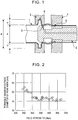
- FIG. 1 is a schematic view illustrating a hydraulic forming method in one-ridge-forming mode as a method for manufacturing an automotive exhaust bellows pipe.
- Reference numeral 1 denotes a raw material pipe for forming bellows pipes. After the raw material pipe is placed as illustrated in Fig. 1 , the raw material pipe is filled with liquid, which is pressurized to expand the wall of the raw material pipe between a clamp die 3 and a forming die 4. Then, the clamp die 3 is compressed in the axial direction of the pipe to form a ridge 6. These procedures are repeated to manufacture a bellows having many ridges. Although the productivity is low, this method can save die cost as compared with a method of forming a predetermined number of ridges by hydraulic forming in one operation. Furthermore, the method illustrated in Fig. 1 can advantageously utilize a relatively simple die and form any number of ridges having any height, thus producing a bellows having a desired shape and a desired number of ridges.
- Raw material pipes to be processed into bellows are generally single or duplex pipes of FCC metal (face centered cubic metal) such as copper or SUS 304 (austenitic stainless steel).
- FCC metal face centered cubic metal
- SUS 304 austenitic stainless steel
- the reason that the FCC metal or austenitic stainless steel sheets are used is that other metallic materials are difficult to process into bellows.
- raw material pipes made of the austenitic stainless steel sheets are easily processed into bellows, high-temperature or corrosive gas or liquid flowing through the bellows tends to cause oxidization, high-temperature corrosion, or stress corrosion cracks.
- the service temperature of austenitic stainless steel bellows for use in automotive exhaust systems is in the range of 500°C to 750°C.
- Japanese Unexamined Patent Application Publication No. 7-268560 discloses a ferritic stainless steel sheet that exhibits excellent bellows formability achieving the elongation of at least 35% and the r-value of at least 1.5 by specifying the contents of C, Si, Mn, S, Cr, Al, Ti, N, and O. Furthermore, Japanese Unexamined Patent Application Publication No.
- 8-176750 discloses a ferritic stainless steel sheet that exhibits excellent bellows formability by specifying the contents of C, Cr, Al, N, Si, Mn, Ti, Nb, Mo, Cu, and Ni and the optimum range of the crystal grain size. Furthermore, Japanese Unexamined Patent Application Publication No. 8-188854 discloses a ferritic stainless steel sheet that exhibits excellent bellows formability and excellent high-temperature fatigue properties by specifying the contents of C, Cr, Al, N, Si, Mn, Ti, Nb, Mo, Cu, and Ni. Furthermore, Japanese Unexamined Patent Application Publication No.
- 9-125208 discloses a ferritic stainless steel sheet that exhibits excellent bellows formability and resists to high-temperature salt corrosion by specifying the contents of C, Cr, N, Ti, and Mo and the optimum range of the surface roughness of a material.
- the bellows formability of raw material pipes for forming bellows pipes made of the ferritic stainless steel sheets is still insufficient as compared with that of raw material pipes for forming bellows pipes made of austenitic stainless steel sheets.
- the ferritic stainless steel sheets are not applicable to bellows having a larger peak height H.
- the peak height H of a bellows pipe is half the difference between the outside diameter of peak ⁇ and the outside diameter of bottom A (the outside diameter of a raw material pipe for forming bellows pipes A) of the bellows pipe, as illustrated in Fig. 1 .
- the present fact is that which characteristic of a ferritic stainless steel sheet used as a material of raw material pipes for forming bellows pipes has an effect on the formability of the raw material pipes for forming bellows pipes is poorly understood.
- the steel sheet can contain one or more selected from ⁇ 0.5% Ti, ⁇ 0.5% Zr and ⁇ 0.5% V, and one or more selected from ⁇ 0.003% B, ⁇ 1.0% Cu and ⁇ 1.0% W.
- US 5 685 923 A relates to a ferritic stainless steel for forming into bellows having high resistance to stress corrosion cracking, comprising, in terms of wt %, not greater than 0.02% of C, from 0.1 to 1.5% of Si, not greater than 1.0% of Mn, from 11.0 to 22.0% of Cr, from 0.01 to 0.08% of Al, not greater than 0.015% of N, at least one of not greater than 0.6% of Ti and not greater than 1.0% of Nb, whenever necessary, and furthermore, at least one of not greater than 2% of Mn, not greater than 1.5% of Cu and not greater than 1.5% of Ni.
- the steel has a crystal grain size, measured in a section in a direction orthogonal to the rolling direction, of not greater than 8.5 in terms of the grain size number, and a crystal grain size, measured in a section orthogonal to a section parallel to the rolling direction, of not smaller than 5.0 on an average in terms of the grain size number.
- JP H11 159616 A relates to a bellows made from a ferrite system stainless steel and having improved fatigue strength.
- EP 1 308 532 A2 relates to a ferritic stainless steel sheet containing ⁇ 0.01 % by mass of C; ⁇ 1.0 % by mass of Si; ⁇ 1.5 % by mass of Mn; 11 to 23 % by mass of Cr; ⁇ 0.06 % by mass of P; ⁇ 0.03 % by mass of S; ⁇ 1.0 % by mass of Al; ⁇ 0.04 % by mass of N; 0.0005 to 0.01 % by mass of B; ⁇ 0.3 % by mass of V; ⁇ 0.8 % by mass or less of Nb and/or ⁇ 1.0 % by mass of Ti wherein 18 ⁇ Nb/(C + N) + 2(Ti/(C + N)) ⁇ 60; and the balance being iron and unavoidable impurities.
- the average crystal grain diameter is ⁇ 40 ⁇ m and the average surface roughness Ra is ⁇ 0.3 ⁇ m.
- the present inventors made extensive and repeated investigations into the relationship between the mechanical characteristics of a ferritic stainless steel sheet material and the formability of a raw material pipe for forming bellows pipes for the purpose of developing a raw material pipe for forming bellows pipes having excellent formability.
- the present inventors found that the formable maximum peak height Hmax (or the maximum outside diameter of peak ⁇ MAX; hereinafter referred to simply as ⁇ MAX) correlates with the yield stress YS of a material and with the produce (YS x UEl) of the yield stress and the uniform elongation properties.
- the present inventors also found that the formable minimum peak height Hmin (or the minimum outside diameter of peak ⁇ MIN; hereinafter referred to simply as ⁇ MIN) correlates with the yield stress YS of a material in bellows forming.
- the present inventors also found that the difference between the formable maximum peak height Hmax and the minimum peak height Hmin, that is, the formable peak height range(or half of ( ⁇ MAX - ⁇ MIN)) correlates with the yield stress YS of a material and with the product (YS x UEl) of the yield stress and the uniform elongation properties.
- the present inventors thus completed the present invention.
- the maximum outside diameter of peak ⁇ MAX and the minimum outside diameter of peak ⁇ MIN are determined as follows.
- the minimum ⁇ av was defined as the formable minimum outside diameter of peak ⁇ MIN.
- the maximum ⁇ av of an accepted product that had no crack during the hydraulic forming was defined as the formable maximum outside diameter of peak ⁇ MAX.
- the relation implies that variation in the outside diameter of peak ⁇ is small. In other words, the relation is indicative of forming stability.
- the relation is particularly effective in evaluating the formable minimum outside diameter of peak ⁇ MIN, around which the forming has a tendency to be unstable.
- the formable maximum outside diameter of peak ⁇ MAX generally depends on the occurrence of a crack in forming and is less affected by variation in the peak height H.
- the present invention is a ferritic stainless steel sheet as defined in the claims for use in raw material pipes for forming bellows pipes.
- the ferritic stainless steel sheet contains 10% to 25% by mass of Cr and has a yield stress in the range of 300 to 450 MPa and the product of the yield stress and the uniform elongation properties of at least 5200 (MPa ⁇ %).
- the stainless steel sheet according to the present invention has a thickness of 0.5 mm or less and is to be used in single or duplex raw material pipes for forming bellows pipes for use in automotive exhaust systems.
- the outside diameter A of the raw material pipes for forming bellows pipes is in the range of 28 to 80 mm.
- the outside diameter A of the raw material pipes for forming bellows pipes is the outside diameter of steel pipes before the formation of the bellows pipes, as illustrated in Fig. 1 .
- the outside diameter A of the raw material pipes is almost the same as the outside diameter of bottom A of the bellows pipes.
- a stainless steel sheet according to the present invention is a ferritic stainless steel sheet for use in raw material pipes for forming bellows pipes having an average crystal grain size of 35 ⁇ m or less.
- a stainless steel sheet according to the present invention is a ferritic stainless steel sheet for use in raw material pipes for forming bellows pipes having a surface roughness Ra of 0.40 ⁇ m or less.
- the surface roughness Ra is an arithmetical mean roughness measured in accordance with JIS B0601 (1997) in a direction perpendicular to the rolling direction of a steel sheet using a stylus surface roughness tester in conformity to JIS B0651.
- Raw material pipes for forming bellows pipes formed of a ferritic stainless steel sheet according to the present invention are inexpensive and exhibit excellent formability.
- the raw material pipes are therefore suitably used as raw material pipes for forming bellows pipes for use in automotive exhaust systems.
- the present inventors investigated which characteristic of a ferritic stainless steel sheet used as a material of raw material pipes for forming bellows pipes has an effect on the formability using hydraulic forming in one-ridge-forming mode described above.
- the formable maximum peak height Hmax (or ⁇ MAX) generally depends on the occurrence of a crack in the wall of an evaginated raw material pipe.
- uniform elongation properties are important as the characteristics required for the material of a raw material pipe. This is because only one nonuniformity deformation in forming may cause a local thinning, thus acting as a source of crack. Even if the nonuniformity deformation does not lead to a crack, the durability performance of the bellows deteriorates greatly.
- the present inventors carried out a tensile test of various ferritic stainless steel sheets and formed bellows from these ferritic stainless steel sheets by hydraulic forming.
- the present inventors investigated the relationship between the tensile properties and the formable maximum peak height Hmax (or ⁇ MAX) of the bellows.
- the results showed that the formable maximum peak height Hmax (or ⁇ MAX) somewhat correlates with the uniform elongation properties and strongly correlates with the yield stress YS as well as the product (YS x UEl) of the yield stress and the uniform elongation properties.
- the results also showed that the formable maximum peak height Hmax (or ⁇ MAX) increases when the YS is below a certain value and YS x UE1 is over a certain value.
- the formable maximum peak height Hmax also strongly correlates with the average grain size D and further increases when the D is below a certain value.
- the results also showed that the formable maximum peak height Hmax (or ⁇ MAX) also strongly correlates with the surface roughness Ra and further increases when the Ra is below a certain value.
- the formable minimum peak height Hmin (or ⁇ MIN) depends on variation in the peak height H (or the outside diameter of peak ⁇ ) under the same forming conditions. This is because although no crack occurs in a processing area where the peak height H (or the outside diameter of peak ⁇ ) is small and therefore the processing strain is small, great variation in the peak height H (or the outside diameter of peak ⁇ ) results in lack of a required quality.
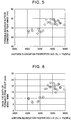
- the present inventors investigate the relationship between variation in the peak height H (or the outside diameter of peak ⁇ ) and the mechanical characteristics of a ferritic stainless steel sheet for use in a raw material pipe. The results showed that, as illustrated in Fig.
- variation in the peak height H correlates .with the yield stress of the raw material pipe; when the yield stress YS is over a predetermined value, variation in the peak height H (or the outside diameter of peak ⁇ ) decreases and thus the formable minimum peak height Hmin (or ⁇ MIN) decreases.
- the reason that the formable minimum peak height Hmin (or ⁇ MIN) decreases when the yield stress YS of a material is over a predetermined value is as follows.
- a small YS means that plastic strain occurs easily.
- a material is easy to deform and the deformation is small, a small YS makes the control of forming difficult, thereby causing variation in peak height H (or outside diameter of peak ⁇ ).
- a bellows is formed by hydraulic forming
- a combination of two types forming: stretching forming by hydraulic pressure, and buckling forming by axial compression as described above, further makes the control of forming difficult.
- the YS is preferably somewhat large to reduce variation in peak height H (or outside diameter of peak ⁇ ).
- the present invention was accomplished based on these findings.
- the yield stress YS of a material and the product (YS x UEl) of the yield stress and the uniform elongation properties are different characteristics.
- the YS may be decreased below a predetermined value, and the YS x UEl may be increased over a predetermined value.
- the YS may be increased over a predetermined value.
- the maximum peak height Hmax (or ⁇ MAX) may be increased, and the minimum peak height Hmin (or ⁇ MIN) may be decreased.
- the reason that the formable maximum peak height Hmax (or ⁇ MAX) increases when the average crystal grain size D decreases below a certain value can be considered as follows.
- the average crystal grain size D decreases the number of crystal grains on a cross section of a steel sheet in the thickness direction increases and therefore the deformation strain propagates uniformly.
- an increase in strength due to a smaller average crystal grain size D reduces the occurrence of a crack.
- Hmax the formable maximum peak height
- a steel material contains an infinite number of crystal grains. Each individual crystal grain deforms anisotropically along a specific glide plane in a glide direction resulting from the crystal orientation.
- a macroscopic plastic strain is a result of total deformation of crystal grains having different crystal orientations.
- crystal grains become large and the number of crystal grains on a cross section of a material in the thickness direction decreases, the effects of anisotropy of the crystal grains increase.
- Some crystal orientations may produce a portion at which a local constriction occurs easily. In a sheet or tubing material, such a portion can be a source of crack, thus causing degradation in formability.
- the formability of a bellows pipe, which often made of a thin-walled material, is therefore susceptible to the average grain size.
- a further increase in formable maximum peak height Hmax may be achieved by reducing the average grain size D below a predetermined value.
- a smaller surface roughness Ra results in a decrease in size of recessed and raised portions on the surface of a steel sheet, thereby reducing the number of sources of crack in processing. This may improve the uniform elongation properties and therefore increases the formable maximum peak height Hmax (or ⁇ MAX).
- a further increase in formable maximum peak height Hmax may be achieved by reducing the surface roughness Ra below a predetermined value.
- the formability improves with decreasing yield stress YS of a material.
- an excessively low YS is not preferred. This is because while a lower YS is indicative of easier deformation, as described above, the lower YS may cause variation in outside diameter of peak ⁇ (or peak height H) in hydraulic forming of a bellows.
- the yield stress YS below 300 MPa increases variation in outside diameter of peak ⁇ (or peak height H) and also tends to increase the formable minimum outside diameter of peak ⁇ MIN (or Hmin).
- Fig. 2 the yield stress YS below 300 MPa increases variation in outside diameter of peak ⁇ (or peak height H) and also tends to increase the formable minimum outside diameter of peak ⁇ MIN (or Hmin).
- the YS of a material over 450 MPa results in degradation in uniform elongation properties, thereby decreasing the formable maximum peak height ⁇ MAX (or Hmax).
- the YS of a material over 450 MPa results in an increase in strength of bellows and impairs the flexibility. This impairs the ability of the bellows to absorb displacement or vibration.
- the yield stress YS must be limited to the range of 300 to 450 MPa.
- the formable maximum peak height Hmax (or ⁇ MAX), which is another factor of determining the bellows formability, that is, the maximum peak height at which bellows can be formed without causing a crack correlates loosely with the simple total elongation or the uniform elongation properties ( Fig. 4 in Example 1 described below).
- the formable maximum peak height Hmax (or ⁇ MAX) depends strongly on the product (YS x UEl) of the yield stress and the uniform elongation properties.
- the formable maximum outside diameter of peak ⁇ MAX (or Hmax) increases with increasing product (YS x UEl).
- the formable maximum peak height Hmax (or ⁇ MAX) increases greatly.
- the difference between the formable maximum peak height ⁇ MAX and the minimum peak height ⁇ MIN that is, the range of the formable peak height H (or half of ⁇ MAX - ⁇ MIN) tends to increase with increasing YS x UE1, as shown in Fig. 6 in Example 1 described below.
- the YS x UE1 must be at least 5200 (MPa ⁇ %).
- the formable maximum peak height Hmax (or ⁇ MAX), which is another factor of determining the bellows formability, that is, the maximum peak height at which bellows can be formed without causing a crack also depends strongly on the average crystal grain size D of a material steel sheet.
- the formable maximum outside diameter of peak ⁇ MAX (or Hmax) further increases with decreasing average grain size.
- a material having an average crystal grain size D of 35 ⁇ m or less exhibits improved uniform elongation properties. This reduces the occurrence of a crack, thereby increasing the formable maximum peak height Hmax (or ⁇ MAX) greatly.
- the difference between the formable maximum peak height ⁇ MAX and the minimum peak height ⁇ MIN tends to increase with decreasing average crystal grain size D.
- the average crystal grain size D must be 35 ⁇ m or less.
- the average crystal grain size D is preferably in the range of 10 to 25 ⁇ m to extend the boundaries of formable dimensions.
- the formable maximum peak height Hmax (or ⁇ MAX), which is another factor of determining the bellows formability, that is, the maximum peak height at which bellows can be formed without causing a crack also depends strongly on the surface roughness Ra of a material steel sheet.
- the formable maximum outside diameter of peak (or Hmax) further increases with decreasing surface roughness Ra. In particular, when the surface roughness of a material is 0.40 ⁇ m or less as determined by the arithmetical mean roughness Ra, the uniform elongation properties is improved.
- the surface roughness must be 0.40 ⁇ m or less as determined by the arithmetical mean roughness Ra.
- the surface roughness Ra is preferably 0.20 ⁇ m or less to extend the boundaries of formable dimensions or improve a product design such as a gloss.
- a ferritic stainless steel sheet with the mechanical characteristics according to the present invention are preferably manufactured by the following method.
- a ferritic stainless steel having a preferred composition described below is melted into a steel slab.
- the steel slab is hot-rolled by a known method.
- the hot-rolled sheet is annealed if necessary, is pickled, is cold-rolled, and is finally annealed to yield an end product.
- Conditions for each process are not limited. However, in the hot rolling, a slab is heated preferably at a temperature in the range of 1000°C to 1250°C. In rough rolling, the rolling temperature is preferably in the range of 1000°C to 1150°C, and the reduction is preferably at least 60%.
- the rolling temperature is preferably in the range of 600°C to 900°C, the reduction is preferably at least 60%, and the coiling temperature is preferably in the range of 400°C to 700°C.
- the hot-rolled sheet is preferably subjected to continuous annealing at a temperature in the range of 800°C to 1050°C for at least 20 seconds or batch annealing at a temperature in the range of 700°C to 850°C for at least four hours.
- the annealed sheet is preferably pickled for descaling.
- the hot-rolled and annealed steel sheet obtained above is subjected to a cold rolling step to form a cold-rolling steel sheet.
- the total rolling reduction in the cold rolling step including one or two or more cold rolling operations is 50% or more.
- Two or more cold rolling operations include intermediate annealing.
- the cold-rolled steel sheet is subjected to final annealing.
- the final annealing is preferably performed by continuous annealing at a temperature in the range of 800°C to 1050°C for at least 10 seconds. If necessary, temper rolling at a reduction of at least 0.3% is performed to form a product sheet, that is, a steel sheet for use in a raw material pipe for forming bellows pipes.
- the UEl may preferably be increased by increasing the reduction in the final cold rolling and by final annealing at a relatively low temperature, or the YS may preferably be controlled by changing the reduction of the temper rolling in the final process, within the preferred manufacturing conditions described above. It is needless to say that the YS and the YS x UEl depend on not only the composition, but also the conditions of each manufacturing process starting from the hot rolling, the subsequent annealing of a hot-rolled sheet, and the cold rolling leading to an end product. Thus, in industrial mass production, the conditions of each production line are preferably adjusted to optimum conditions.
- the average crystal grain size D may preferably be decreased by increasing the reduction in the final cold rolling and by final annealing at a relatively low temperature, within the preferred manufacturing conditions described above. It is needless to say that the average crystal grain size D depends on not only the composition, but also the conditions of each manufacturing process starting from the hot rolling, the subsequent annealing of a hot-rolled sheet, and the cold rolling leading to an end product. Thus, in industrial mass production, the conditions of each production line are preferably adjusted to optimum conditions.
- the arithmetical mean roughness Ra of the surface roughness of a steel sheet can be controlled by controlling the arithmetical mean roughness Ra of the surface roughness of a work roll in the temper rolling or, in the absence of temper rolling, by controlling the arithmetical mean roughness Ra of the surface roughness of a work roll in the final cold rolling.
- the temper rolling can control not only the surface roughness Ra, but also the YS by changing the reduction.
- the temper rolling is preferably combined with the cold rolling reduction and the final annealing temperature to control the YS and the surface roughness Ra.
- the ferritic stainless steel sheet according to the present invention has a thickness of 0.5 mm or less.
- a bellows is formed in a parallel corrugated and accordion-pleated shape and has a function of absorbing displacement due to thermal expansion or vibration. The displacement is converted into bending stress on the bellows. A strain generated in the bellows increases with increasing thickness of the sheet. A strain beyond the elastic limit of the bellows becomes a plastic strain, which causes the fatigue fracture of the bellows pipe.
- the sheet preferably has a thickness as small as possible to prevent the fatigue fracture.
- the sheet in terms of the productivity or the manufacturing costs of a stainless steel sheet material or a stainless steel pipe material, the sheet has a thickness of 0.5 mm or less without causing a substantial problem.
- a cold-rolled and annealed sheet thus manufactured is bent and is subjected to a common arc welding process such as tungsten inert gas (TIG) or plasma welding to produce a raw material pipe for forming bellows pipes having an outside diameter A.
- TIG tungsten inert gas
- the raw material pipe for forming bellows pipes is subjected to a hydraulic forming method to manufacture a bellows pipe having a predetermined outside diameter of peak ⁇ and the outside diameter of bottom A.
- a raw material pipe for forming bellows pipes made of a ferritic stainless steel sheet according to the present invention is preferably a single or duplex pipe having an outside diameter A in the range of 28 to 80 mm.
- the amount of displacement absorbed by a bellows within an elastic limit depends mainly on the peak height.
- the outside diameter of a raw material pipe A also referred to as the outside diameter of bottom A
- the expansion ratio of a ridge increases. This makes forming difficult.
- the formable maximum peak height Hmax decreases.
- a small outside diameter of a raw material pipe A limits the amount of displacement to be absorbed.
- the outside diameter of a raw material pipe A is at least 28 mm to absorb a certain amount of displacement. Furthermore, when a bellows has a large outside diameter of a raw material pipe A and a thin wall, the bellows has a tendency to collapse or buckle because of its insufficient rigidity and is therefore practically difficult to use. Hence, the outside diameter of a raw material pipe A is 80 mm or less.
- the thickness t may be increased.
- an increase in the thickness t is not preferred because it is responsible for fatigue fracture.
- the rigidity or the strength can be maintained by laminating thin-walled steel sheets to form a multiplex pipe.
- a duplex pipe is preferred.
- a triplex or more pipe is not preferred in terms of productivity or manufacturing costs.
- a duplex pipe has lower rigidity and higher flexibility and therefore has a higher fatigue strength.
- the inner surface and the outer surface of a bellows may have different characteristic requirements. In this case, a duplex pipe made of materials satisfying each characteristic requirement is preferred.
- Cr 10% to 25% by mass.
- Cr is an element essential to the corrosion resistance.
- a Cr content less than 10% by mass is insufficient to impart corrosion resistance to a stainless steel.
- a Cr content more than 25% by mass may cause deterioration in brittleness and reduced productivity.
- the Cr content is more preferably in the range of 10% to 18% by mass to reduce the raw material cost.
- a ferritic stainless steel sheet according to the present invention may contain the following elements in a manner that depends on required characteristics to improve the corrosion resistance, the mechanical characteristics, or the chemical characteristics.
- C 0.05% by mass or less.
- N 0.05% by mass or less.
- C and N form compounds with Cr, which cause deterioration in formability as well as corrosion resistance. C and N are therefore reduced as much as possible.
- the C content is 0.05% by mass or less.
- the N content is 0.05% by mass or less. More preferably, the C content is 0.01% by mass or less. More preferably, the N content is 0.01% by mass or less. Because an infinitesimal amount of C or N does not have an adverse effect on the characteristics of a bellows, there is no lower limit on the C content and the N content.
- Si is an element that is effective in improving the resistance to oxidation or high-temperature salt damage. Si is also an element that hardens steel and reduces ductility. At least 0.2% by mass of Si is added to improve the resistance to oxidation or high-temperature salt damage. However, over 1% by mass of Si results in excessive hardness and adversely affects the bellows formability. Hence, the upper limit of Si is 1% by mass. 0.3% to 0.6% by mass of Si is more preferable.
- Mn is an element added to improve deoxidization, desulfurization, and hot workability. At least 0.1% by mass of Mn is preferred to achieve these effects. However, because Mn sulfide causes deterioration in corrosion resistance, a smaller Mn content is preferred. Hence, in consideration of manufacturing costs and productivity, the Mn content is 0.5% by mass or less. While the lower limit of Mn is not particularly specified, at least 0.2% by mass of Mn is preferred to decrease sensitivity to weld solidification cracking.
- the P content is 0.04% by mass or less. More preferably, the P content is 0.03% by mass or less. Because a lower content of P does not adversely affect the advantageous effects of the present invention, it is not necessary to specify the lower limit of the P content.
- S is an element that has an adverse effect on the corrosion resistance or the oxidation resistance.
- the adverse effect is noticeable when the S content is over 0.01% by mass.
- the upper limit of S is 0.01% by mass. More preferably, the upper limit of S is 0.007% by mass or less. Because a lower content of S does not have an adverse effect on the characteristics of a bellows, a lower S content is preferred.
- Ni is an element that improves the corrosion resistance. At least 0.1% by mass of Ni is preferred to achieve this effect. However, the effect levels off at 1.0% by mass. Thus, the addition of over 1.0% by mass of Ni only results in an increase in cost. Hence, the addition of 1.0% or less of Ni is preferred. 0.2% to 0.6% by mass of Ni is more preferred.
- Ti and Nb react with C and N to form deposits and thus reduce the size of crystal grains, thereby improving the uniform elongation properties.
- Ti and Nb are optional elements. At least 0.02% by mass of Ti and/or at least 0.04% by mass of Nb is preferred to achieve these effects.
- the addition of excessive amounts of Ti and Nb results in deterioration in surface properties due to an increase in deposits, an increase in strength due to the formation of an intermetallic compound, and deterioration in formability due to the increased strength.
- the amounts of Ti and Nb to be added are less than 0.5% by mass and less than 1.0% by mass, respectively. 0.05% to 0.4% by mass of Ti and 0.1% to 0.8% by mass of Nb are more preferred. . ⁇ 2 ⁇ Ti + Nb ⁇ 16 C + N
- Ti and Nb immobilize C and N as deposits, improve the orientation of recrystallized grains in annealing after cold rolling, and improve the r-value.
- Ti and Nb is preferably added so as to satisfy 2Ti + Nb ⁇ 16(C + N) to achieve these effects.
- Both Mo and Cu improve the corrosion resistance. At least 1.2% by mass of Mo is preferred to achieve this effect.
- the addition of excessive amounts of Mo and Cu causes a surface flaw in a hot rolling process due to embrittlement, thus resulting in an end product having a poor surface quality.
- the amounts of Mo and Cu to be added are limited to 4.0% by mass or less each. Mo in the range of 1.5% to 3.0% by mass and Cu in the range of 1.5% to 3.0% by mass are more preferred.
- W increases the strength and is effectively improves the fatigue durability at normal temperature and high temperatures required for bellows pipes. At least 0.5% by mass of W is preferred to achieve these effects. However, an excessive amount of W reduces ductility and thus adversely affects the formability.
- the upper limit of W is less than 5.0% by mass. More preferably, the upper limit of W is 4.0% by mass or less.
- a ferritic stainless steel having a composition listed in Table 1 was melted into a steel slab.
- the steel slab was hot-rolled according to a routine procedure.
- the hot-rolled sheet was annealed, was pickled, was cold-rolled, was subjected to final annealing, and was temper-rolled to yield a temper-rolled sheet having a thickness of 0.3 mm.
- the manufacturing conditions in each process were within the preferred ranges described above.
- the mechanical characteristics were varied by changing the conditions of the annealing of the hot-rolled sheet, the final annealing, and the temper rolling.
- a sample was taken from the temper-rolled sheet. JIS 13B specimens were taken from the sample in a direction perpendicular to the rolling direction.
- a tensile test was performed in accordance with JIS Z 2241 to determine the yield stress YS and the uniform elongation properties UEl. Furthermore, a duplex pipe (thickness 0.6 mm) having an outside diameter of 50 mm was manufactured from the temper-rolled sheet. The duplex pipe was subjected to the following forming test as a raw material pipe for forming bellows pipes.
- Ten ridges were continuously formed by hydraulic forming in one-ridge-forming mode, as illustrated in Fig. 1 , under the same conditions while the target value of the outside diameter of peak ⁇ was changed and the outside diameter of bottom A of a bellows pipe was kept constant (50 mm).
- Ten outside diameters of peak of the 10 ridges were measured as ⁇ (1), ⁇ (2), ⁇ (3),..., ⁇ (10). The minimum value of them was designated as ⁇ min. The maximum value of them was designated as ⁇ max. The mean value of them was designated as ⁇ av.
- a bellows pipe satisfying the relation: 0.98 ⁇ av ⁇ ⁇ min ⁇ ⁇ av ⁇ max ⁇ 1.02 ⁇ av was considered as an accepted product.
- the minimum ⁇ av was defined as the formable minimum outside diameter of peak ⁇ MIN.
- the maximum ⁇ av of an accepted product that had no crack during the hydraulic forming was defined as the formable maximum outside diameter of peak ⁇ MAX.
- the relation implies that variation in the outside diameter of peak ⁇ is small. In other words, the relation is indicative of forming stability.
- the relation is particularly effective in evaluating the formable minimum outside diameter of peak ⁇ MIN, around which the forming has a tendency to be unstable.
- the formable maximum outside diameter of peak ⁇ MAX generally depends on the occurrence of a crack in forming and is less affected by variation in the peak height H.
- Table 2 shows the results of the tensile test and the bellows forming test. Furthermore, on the basis of the results shown in Table 2, Fig. 2 illustrates the relationship between the yield stress YS and the formable minimum outside diameter of peak ⁇ MIN, Fig. 3 illustrates the relationship between the yield stress YS and the formable maximum outside diameter of peak ⁇ MAX, Fig. 4 illustrates the relationship between the uniform elongation properties UEl and the formable maximum outside diameter of peak ⁇ MAX, Fig. 5 illustrates the relationship between the product (YS x UEl) of the yield stress and the uniform elongation properties and the formable maximum outside diameter of peak ⁇ MAX, and Fig.
- Example 1 In steel 17 listed in Table 2 in Example 1, which was a working example, the product crystal grain size was varied by changing the temperature of annealing after cold rolling within the range of 800°C to 860°C and the annealing time within the range of 15 to 90 seconds.
- Table 3 shows the results of the bellows forming test of the resulting products. Table 3 shows that the formable maximum outside diameter of peak ⁇ MAX and ⁇ MAX - ⁇ MIN were increased and thus the bellows formability was further improved at a product crystal grain size D of 35 ⁇ m or less.
- Example 1 In steel 10 listed in Table 2 in Example 1, which was a working example, the product surface roughness Ra was varied by changing the roughness of the temper rolling roll within the range of 0.3 to 0.6 ⁇ m.
- Table 4 shows the results of the bellows forming test of the resulting products. Table 4 shows that the formable maximum outside diameter of peak ⁇ MAX and ⁇ MAX - ⁇ MIN were increased and thus the bellows formability was further improved at a product roughness Ra of 0.4 ⁇ m or less.
- a ferritic stainless steel sheet according to the present invention can also be used in applications that requires high-temperature properties, including heat exchangers and fuel cells.
Landscapes
- Chemical & Material Sciences (AREA)
- Engineering & Computer Science (AREA)
- Mechanical Engineering (AREA)
- Materials Engineering (AREA)
- Metallurgy (AREA)
- Organic Chemistry (AREA)
- General Engineering & Computer Science (AREA)
- Physics & Mathematics (AREA)
- Thermal Sciences (AREA)
- Crystallography & Structural Chemistry (AREA)
- Heat Treatment Of Sheet Steel (AREA)
Claims (4)
- Ferritisches Edelstahlblech zur Verwendung in Rohmaterialrohren zum Formen von Balgrohren, umfassend:10 - 25 Massen-% Cr,0,05 Massen-% oder weniger C,0,05 Massen-% oder weniger N,0,2 - 1 Massen-% Si,0,5 Massen-% oder weniger Mn,0,04 Massen-% oder weniger P,0,01 Massen-% oder weniger S,1,0 Massen-% oder weniger Ni,weniger als 0,5 Massen-% Ti,weniger als 1,0 % Massen-% Nb,4,0 Massen-% oder weniger Mo und1,5 - 4,0 Massen-% Cu, undgegebenenfalls 0,5 bis weniger als 5,0 Massen-% W,wobei der Rest Fe und unvermeidbare Verunreinigungen sind,worin das ferritische Edelstahlblecheine Streckgrenze im Bereich von 300 - 450 MPa,eine Dicke von 0,5 mm oder weniger undein Produkt aus Streckgrenze und gleichmäßigen Dehnungseigenschaften von mindestens 5200 MPa·% aufweist.
- Ferritisches Edelstahlblech gemäß Anspruch 1, das eine durchschnittliche Kristallkorngröße von 35 µm oder weniger aufweist.
- Verwendung des ferritischen Edelstahlblechs wie in Anspruch 1 oder 2 definiert als Einzel- oder Duplexrohmaterialrohr beim Formen von Balgrohren zur Verwendung in Automobilabgassystemen, worin die Rohmaterialrohre einen Außendurchmesser von 28 bis 80 mm aufweisen.
- Ferritisches Edelstahlblech gemäß Anspruch 1 oder 2 oder Verwendung gemäß Anspruch 3, worin das ferritische Edelstahlblech eine durch Ra angegebene Oberflächenrauigkeit von 0,40 µm oder weniger aufweist.
Applications Claiming Priority (4)
| Application Number | Priority Date | Filing Date | Title |
|---|---|---|---|
| JP2005169525 | 2005-06-09 | ||
| JP2005169524 | 2005-06-09 | ||
| JP2005169523 | 2005-06-09 | ||
| PCT/JP2006/311156 WO2006132163A1 (ja) | 2005-06-09 | 2006-05-29 | ベローズ素管用フェライト系ステンレス鋼板 |
Publications (3)
| Publication Number | Publication Date |
|---|---|
| EP1889936A1 EP1889936A1 (de) | 2008-02-20 |
| EP1889936A4 EP1889936A4 (de) | 2009-05-27 |
| EP1889936B1 true EP1889936B1 (de) | 2019-03-13 |
Family
ID=37498363
Family Applications (1)
| Application Number | Title | Priority Date | Filing Date |
|---|---|---|---|
| EP06747136.7A Active EP1889936B1 (de) | 2005-06-09 | 2006-05-29 | Blech aus ferritischem edelstahl für balgrohre |
Country Status (4)
| Country | Link |
|---|---|
| US (1) | US7985372B2 (de) |
| EP (1) | EP1889936B1 (de) |
| KR (1) | KR20070116976A (de) |
| WO (1) | WO2006132163A1 (de) |
Families Citing this family (9)
| Publication number | Priority date | Publication date | Assignee | Title |
|---|---|---|---|---|
| EP1889938B1 (de) * | 2005-06-09 | 2018-03-07 | JFE Steel Corporation | Blech aus nichtrostendem ferritstahl für balgstockpipe |
| JP4941970B2 (ja) * | 2007-01-24 | 2012-05-30 | 株式会社日本製鋼所 | 水素吸蔵合金容器 |
| JP5588868B2 (ja) * | 2008-07-23 | 2014-09-10 | 新日鐵住金ステンレス株式会社 | 尿素水タンク用フェライト系ステンレス鋼 |
| CN102639742B (zh) * | 2009-11-18 | 2016-03-30 | 新日铁住金株式会社 | 奥氏体系不锈钢板及其制造方法 |
| US9243306B2 (en) * | 2010-03-11 | 2016-01-26 | Nippon Steel & Sumikin Stainless Steel Corporation | Ferritic stainless steel sheet excellent in oxidation resistance |
| JP6156142B2 (ja) * | 2011-04-13 | 2017-07-05 | 日本電気株式会社 | 冷却装置の配管構造、その製造方法、及び配管接続方法 |
| EP2787096B1 (de) * | 2011-11-30 | 2016-10-12 | JFE Steel Corporation | Ferritischer edelstahl |
| DE102015102255A1 (de) * | 2015-02-17 | 2016-08-18 | Sandvik Materials Technology Deutschland Gmbh | Verfahren zum Herstellen eines Strangs aus Edelstahl sowie Strang aus Edelstahl |
| CN113166831B (zh) | 2018-12-11 | 2022-11-01 | 杰富意钢铁株式会社 | 铁素体系不锈钢板及其制造方法 |
Family Cites Families (19)
| Publication number | Priority date | Publication date | Assignee | Title |
|---|---|---|---|---|
| US3277149A (en) * | 1963-10-07 | 1966-10-04 | United States Steel Corp | Method of treating stainless steel for removal of carbon and nitrogen |
| CA1305911C (en) * | 1986-12-30 | 1992-08-04 | Teruo Tanaka | Process for the production of a strip of a chromium stainless steel of a duplex structure having high strength and elongation as well as reduced plane anisotropy |
| JPH07268560A (ja) | 1994-03-31 | 1995-10-17 | Nippon Steel Corp | ベローズ材用フェライト系ステンレス鋼 |
| JPH08176750A (ja) * | 1994-12-28 | 1996-07-09 | Nippon Steel Corp | ベローズ加工用フェライト系ステンレス鋼 |
| JPH08188854A (ja) | 1995-01-10 | 1996-07-23 | Nippon Steel Corp | 高温疲労特性の優れたベローズ用フェライト系ステンレス鋼 |
| JPH08283914A (ja) * | 1995-04-11 | 1996-10-29 | Nippon Steel Corp | ベローズ用フェライト系ステンレス鋼板 |
| JPH08333656A (ja) * | 1995-06-05 | 1996-12-17 | Nippon Steel Corp | ベローズ用フェライト系ステンレス鋼管 |
| US5806899A (en) * | 1995-10-23 | 1998-09-15 | Calsonic Corporation | Flexible connection tube for automotive exhaust system |
| JPH09125208A (ja) * | 1995-11-02 | 1997-05-13 | Nippon Steel Corp | ベローズ加工性および耐高温塩害特性に優れたベローズ用フェライト系ステンレス鋼板 |
| US5843246A (en) * | 1996-01-16 | 1998-12-01 | Allegheny Ludlum Corporation | Process for producing dual phase ferritic stainless steel strip |
| JPH11159616A (ja) * | 1997-11-28 | 1999-06-15 | Nippon Steel Corp | 疲労特性に優れたフェライト系ステンレス鋼製ベローズ |
| JP2000046182A (ja) * | 1998-07-31 | 2000-02-18 | Nippon Steel Corp | 耐応力腐食割れ性と保温性に優れたステンレス鋼製2重管ベローズ |
| US6413332B1 (en) * | 1999-09-09 | 2002-07-02 | Kawasaki Steel Corporation | Method of producing ferritic Cr-containing steel sheet having excellent ductility, formability, and anti-ridging properties |
| JP4374701B2 (ja) * | 2000-03-16 | 2009-12-02 | Jfeスチール株式会社 | 深絞り性に優れた自動車排気系用フェライト系ステンレス鋼板の製造方法 |
| JP2002212683A (ja) * | 2001-01-17 | 2002-07-31 | Kawasaki Steel Corp | 高温耐酸化性に優れたフェライト系ステンレス鋼板 |
| KR100762151B1 (ko) * | 2001-10-31 | 2007-10-01 | 제이에프이 스틸 가부시키가이샤 | 딥드로잉성 및 내이차가공취성이 우수한 페라이트계스테인리스강판 및 그 제조방법 |
| WO2003106725A1 (ja) * | 2002-06-01 | 2003-12-24 | Jfeスチール株式会社 | Ti添加フェライト系ステンレス鋼板およびその製造方法 |
| JP4311639B2 (ja) * | 2003-11-07 | 2009-08-12 | 日本発條株式会社 | 金属ベローズの製造方法 |
| EP1889938B1 (de) * | 2005-06-09 | 2018-03-07 | JFE Steel Corporation | Blech aus nichtrostendem ferritstahl für balgstockpipe |
-
2006
- 2006-05-29 EP EP06747136.7A patent/EP1889936B1/de active Active
- 2006-05-29 WO PCT/JP2006/311156 patent/WO2006132163A1/ja not_active Ceased
- 2006-05-29 US US11/919,083 patent/US7985372B2/en active Active
- 2006-05-29 KR KR1020077025437A patent/KR20070116976A/ko not_active Ceased
Non-Patent Citations (1)
| Title |
|---|
| None * |
Also Published As
| Publication number | Publication date |
|---|---|
| US20090068490A1 (en) | 2009-03-12 |
| US7985372B2 (en) | 2011-07-26 |
| KR20070116976A (ko) | 2007-12-11 |
| EP1889936A4 (de) | 2009-05-27 |
| WO2006132163A1 (ja) | 2006-12-14 |
| EP1889936A1 (de) | 2008-02-20 |
Similar Documents
| Publication | Publication Date | Title |
|---|---|---|
| US9493865B2 (en) | Thick-walled high-strength hot rolled steel sheet with excellent low-temperature toughness and method of producing same | |
| EP1889936B1 (de) | Blech aus ferritischem edelstahl für balgrohre | |
| EP2036994B1 (de) | Cr-haltiger stahl mit hervorragenden wärmeermüdungseigenschaften | |
| CN1225614C (zh) | 由不锈钢制成的供燃料管 | |
| KR101302534B1 (ko) | 화성 처리용 고가공성 고강도 강관 및 그 제조 방법 | |
| JP2006274436A (ja) | 部品用の断面形状をもつ曲管用のフェライト系ステンレス鋼板および鋼管 | |
| EP1889938B1 (de) | Blech aus nichtrostendem ferritstahl für balgstockpipe | |
| JP3551892B2 (ja) | 耐熱性フェライト系ステンレス鋼とその鋼板 | |
| JP3534083B2 (ja) | マルテンサイト系ステンレス鋼板とその製造方法 | |
| JP4752621B2 (ja) | ベローズ素管用フェライト系ステンレス鋼板 | |
| JP2001262234A (ja) | 深絞り性に優れた自動車排気系用フェライト系ステンレス鋼板の製造方法 | |
| EP1176220A1 (de) | Ferritisch rostfreier Stahl mit guter Verformbarkeit bei Raumtemperatur und mit guten mechanischen Eigenchaften bei hoheren Temperaturen, und Verfahren zur Herstellung derselben | |
| JP5141440B2 (ja) | 加工性に優れた高強度鋼管およびその製造方法 | |
| JP4752620B2 (ja) | ベローズ素管用フェライト系ステンレス鋼板 | |
| JP4752619B2 (ja) | ベローズ素管用フェライト系ステンレス鋼板 | |
| CN100513610C (zh) | 扩管加工性优良的铁素体系不锈钢焊管 | |
| KR100865413B1 (ko) | 확관 가공성이 우수한 페라이트계 스테인레스강 용접관 | |
| CN101171352A (zh) | 波纹管原管用铁素体类不锈钢板 | |
| JP3827986B2 (ja) | ステンレス鋼製フレキシブル管又はダクト管 | |
| JP4752572B2 (ja) | ベローズ素管用フェライト系ステンレス鋼板およびベローズ素管 | |
| JP3844662B2 (ja) | マルテンサイト系ステンレス鋼板およびその製造方法 | |
| JPH07268468A (ja) | 成形加工性の優れたステンレス鋼管の製造方法 | |
| CN101171353A (zh) | 波纹管原管用铁素体类不锈钢板 | |
| JP2007016307A (ja) | ベローズ素管用フェライト系ステンレス鋼板 |
Legal Events
| Date | Code | Title | Description |
|---|---|---|---|
| PUAI | Public reference made under article 153(3) epc to a published international application that has entered the european phase |
Free format text: ORIGINAL CODE: 0009012 |
|
| 17P | Request for examination filed |
Effective date: 20071023 |
|
| AK | Designated contracting states |
Kind code of ref document: A1 Designated state(s): DE FR GB |
|
| DAX | Request for extension of the european patent (deleted) | ||
| RBV | Designated contracting states (corrected) |
Designated state(s): DE FR GB |
|
| A4 | Supplementary search report drawn up and despatched |
Effective date: 20090428 |
|
| RIC1 | Information provided on ipc code assigned before grant |
Ipc: C22C 38/44 20060101ALI20090421BHEP Ipc: C22C 38/50 20060101ALI20090421BHEP Ipc: F16F 1/02 20060101ALI20090421BHEP Ipc: F16J 3/04 20060101ALI20090421BHEP Ipc: C22C 38/18 20060101AFI20090421BHEP Ipc: C22C 38/00 20060101ALI20090421BHEP Ipc: C22C 38/48 20060101ALI20090421BHEP Ipc: C22C 38/42 20060101ALI20090421BHEP Ipc: C22C 38/02 20060101ALI20090421BHEP Ipc: C21D 9/46 20060101ALI20090421BHEP Ipc: C22C 38/04 20060101ALI20090421BHEP Ipc: C22F 1/05 20060101ALI20090421BHEP |
|
| 17Q | First examination report despatched |
Effective date: 20091029 |
|
| STAA | Information on the status of an ep patent application or granted ep patent |
Free format text: STATUS: EXAMINATION IS IN PROGRESS |
|
| GRAP | Despatch of communication of intention to grant a patent |
Free format text: ORIGINAL CODE: EPIDOSNIGR1 |
|
| STAA | Information on the status of an ep patent application or granted ep patent |
Free format text: STATUS: GRANT OF PATENT IS INTENDED |
|
| INTG | Intention to grant announced |
Effective date: 20181030 |
|
| RIN1 | Information on inventor provided before grant (corrected) |
Inventor name: IGUCHI, TAKAAKI Inventor name: KATO, YASUSHI Inventor name: OZAKI, YOSHIHIRO |
|
| GRAS | Grant fee paid |
Free format text: ORIGINAL CODE: EPIDOSNIGR3 |
|
| GRAA | (expected) grant |
Free format text: ORIGINAL CODE: 0009210 |
|
| STAA | Information on the status of an ep patent application or granted ep patent |
Free format text: STATUS: THE PATENT HAS BEEN GRANTED |
|
| AK | Designated contracting states |
Kind code of ref document: B1 Designated state(s): DE FR GB |
|
| REG | Reference to a national code |
Ref country code: GB Ref legal event code: FG4D |
|
| REG | Reference to a national code |
Ref country code: DE Ref legal event code: R096 Ref document number: 602006057594 Country of ref document: DE |
|
| PGFP | Annual fee paid to national office [announced via postgrant information from national office to epo] |
Ref country code: GB Payment date: 20190520 Year of fee payment: 14 |
|
| REG | Reference to a national code |
Ref country code: DE Ref legal event code: R097 Ref document number: 602006057594 Country of ref document: DE |
|
| PLBE | No opposition filed within time limit |
Free format text: ORIGINAL CODE: 0009261 |
|
| STAA | Information on the status of an ep patent application or granted ep patent |
Free format text: STATUS: NO OPPOSITION FILED WITHIN TIME LIMIT |
|
| 26N | No opposition filed |
Effective date: 20191216 |
|
| GBPC | Gb: european patent ceased through non-payment of renewal fee |
Effective date: 20200529 |
|
| PG25 | Lapsed in a contracting state [announced via postgrant information from national office to epo] |
Ref country code: GB Free format text: LAPSE BECAUSE OF NON-PAYMENT OF DUE FEES Effective date: 20200529 |
|
| REG | Reference to a national code |
Ref country code: FR Ref legal event code: PLFP Year of fee payment: 18 |
|
| PGFP | Annual fee paid to national office [announced via postgrant information from national office to epo] |
Ref country code: DE Payment date: 20250402 Year of fee payment: 20 |
|
| PGFP | Annual fee paid to national office [announced via postgrant information from national office to epo] |
Ref country code: FR Payment date: 20250401 Year of fee payment: 20 |