EP1890096A2 - Accumulateur de climatiseur - Google Patents
Accumulateur de climatiseur Download PDFInfo
- Publication number
- EP1890096A2 EP1890096A2 EP07016164A EP07016164A EP1890096A2 EP 1890096 A2 EP1890096 A2 EP 1890096A2 EP 07016164 A EP07016164 A EP 07016164A EP 07016164 A EP07016164 A EP 07016164A EP 1890096 A2 EP1890096 A2 EP 1890096A2
- Authority
- EP
- European Patent Office
- Prior art keywords
- coolant
- pipe
- accumulator
- air conditioner
- tank
- Prior art date
- Legal status (The legal status is an assumption and is not a legal conclusion. Google has not performed a legal analysis and makes no representation as to the accuracy of the status listed.)
- Granted
Links
Images









Classifications
-
- F—MECHANICAL ENGINEERING; LIGHTING; HEATING; WEAPONS; BLASTING
- F25—REFRIGERATION OR COOLING; COMBINED HEATING AND REFRIGERATION SYSTEMS; HEAT PUMP SYSTEMS; MANUFACTURE OR STORAGE OF ICE; LIQUEFACTION SOLIDIFICATION OF GASES
- F25B—REFRIGERATION MACHINES, PLANTS OR SYSTEMS; COMBINED HEATING AND REFRIGERATION SYSTEMS; HEAT PUMP SYSTEMS
- F25B43/00—Arrangements for separating or purifying gases or liquids; Arrangements for vaporising the residuum of liquid refrigerant, e.g. by heat
-
- F—MECHANICAL ENGINEERING; LIGHTING; HEATING; WEAPONS; BLASTING
- F25—REFRIGERATION OR COOLING; COMBINED HEATING AND REFRIGERATION SYSTEMS; HEAT PUMP SYSTEMS; MANUFACTURE OR STORAGE OF ICE; LIQUEFACTION SOLIDIFICATION OF GASES
- F25B—REFRIGERATION MACHINES, PLANTS OR SYSTEMS; COMBINED HEATING AND REFRIGERATION SYSTEMS; HEAT PUMP SYSTEMS
- F25B43/00—Arrangements for separating or purifying gases or liquids; Arrangements for vaporising the residuum of liquid refrigerant, e.g. by heat
- F25B43/006—Accumulators
-
- F—MECHANICAL ENGINEERING; LIGHTING; HEATING; WEAPONS; BLASTING
- F25—REFRIGERATION OR COOLING; COMBINED HEATING AND REFRIGERATION SYSTEMS; HEAT PUMP SYSTEMS; MANUFACTURE OR STORAGE OF ICE; LIQUEFACTION SOLIDIFICATION OF GASES
- F25B—REFRIGERATION MACHINES, PLANTS OR SYSTEMS; COMBINED HEATING AND REFRIGERATION SYSTEMS; HEAT PUMP SYSTEMS
- F25B2400/00—Component parts or details not otherwise provided for in this subclass
- F25B2400/03—Suction accumulators with deflectors
Definitions
- the present invention relates to an accumulator of an air conditioner, and more particularly, to an accumulator of an air conditioner that can be formed of a small tank, so that it can be easily mounted in a small space and is improved in vapor-liquid separating performance with high pressure resistance.
- an air-conditioning cycle is formed by a coolant circulating through the compressor, condenser, throttle valve, and evaporator, and an air-conditioning cycle with a coolant that is compressed at a supercritical pressure above a critical pressure by the compressor is called a supercritical air-conditioning cycle.
- a coolant does not change phase in heat-discharging process into the atmosphere; therefore, a heat discharger for this process is called a gas cooler, not a condenser.
- An air conditioner having the supercritical air-conditioning cycle is, as shown in FIG. 1, a system including a compressor 1, a condenser 2 (gas cooler), a throttle valve 3, an evaporator 4, from which the air-conditioning cycle is completed, an accumulator 5 that separates the coolant out of the evaporator into gas and liquid, and an internal heat exchanger 6 that causes a heat exchange between the coolant out of the condenser 2 (gas cooler) and the coolant out of the accumulator 5.
- a coolant that flows through a coolant inlet pipe 11 into the upper space inside a tank 12 passes through a section plate 13 and is then separated into oil, a liquid coolant, and a gas coolant, depending on the specific gravity. Only the gas coolant flows through a gas coolant inlet 14a of a coolant pipe 14 in the tank 12 into the coolant pipe and is sent to the compressor 1 through a gas coolant outlet 14b of the coolant pipe 14, which prevents liquid back.
- the coolant pipe 14 has a pipe line that is bent down from the gas coolant inlet 14a under the section pipe 13, extends to the gas coolant outlet 14b above the tank 12.
- An oil return hole 14c is formed at the lower portion inside the tank 12 to allow the oil for the compressor (oil separated from the coolant) to flow into and circulate through the coolant pipe 14.
- an object of the present invention is to provide an accumulator of an air conditioner that can be formed of a small tank, so that it can be easily mounted in a small space and is improved in vapor-liquid separating performance with high pressure resistance.
- Another object of the invention is to provide a compact-sized air-conditioning system including the functions of an internal heat exchanger that makes heat exchange between a high-temperature high-pressure side and a low-temperature low-pressure side by fitting high-pressure pipes with each other in the longitudinal direction of a dual pipe such that the internal heat exchange can be integrally provided in an accumulator.
- an accumulator of an air conditioner includes: a tank; a coolant intake that is formed at the upper portion inside the tank; and a coolant outlet pipe that is vertically disposed in the tank to discharge a gas coolant separated from a coolant that has flowed in the tank, and has a gas coolant outlet at the upper portion of the tank, in which the coolant outlet pipe is a dual pipe with an internal pipe and an external pipe, a return cap is combined to the lower end of the dual pipe, the gas coolant flows from the upper portion inside the tank through a gas coolant inlet between the internal pipe and the external pipe, turns into the internal pipe at the return cap, and then continues flowing through the gas coolant outlet to an outer pipe.
- an accumulator of an air conditioner further includes: a high-pressure coolant inlet pipe that longitudinally surrounds a part of the outside of the external pipe of the coolant outlet pipe; and a high-pressure coolant outlet pipe that longitudinally surrounds the other part of the outside of the external pipe of the coolant outlet pipe, in which a connection cap is combined to the lower ends of the high-pressure coolant inlet pipe and the high-pressure coolant outlet pipe such that the coolant that flows inside through the high-pressure coolant inlet pipe turns into the high-pressure coolant outlet pipe at the connection cap, and the coolant outlet pipe is used for outflow of a low-pressure gas coolant.
- FIG. 3 is a view showing the configuration of an accumulator of an air conditioner according to a first embodiment of the invention.
- a section plate 32 is disposed at the upper portion inside a tank 20
- an upper body 34 with a coolant intake 34a that allows a coolant to flow into the upper portion inside the tank is combined to the upper end of the tank 20, and a dual pipe 36 is vertically disposed under the inside bottom of the upper body 34 in the tank 20 to discharge a gas coolant separated from the coolant inside the tank.
- a lower part 24 of the tank is combined to a tank body 22 by welding etc. or the lower part 24 of the tank is integrally formed with the tank body 22 by forging and combined with the upper body 34.
- An explosion means 38 with an explosion plate that explodes under a predetermined pressure to rapidly discharge a coolant outside at an abnormal high pressure is provided at the bottom of the lower part 24 of the tank.
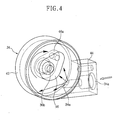
- a side protrusion 44 with a hole for a coolant to flow inside is formed on the outside of a cylinder 42.
- a hole that forms the coolant intake 34a is formed at the side of the side protrusion 44 to easily separate liquid and vapor from the coolant that flows into the upper portion inside the tank 20 by guiding the coolant such that it flows inside while circumferentially rotating.
- a protrusion 46 with a round side 46a is formed at the bottom of the upper body 34 where an internal pipe of the dual pipe 36 (described below) is connected, in order to easily induce a cyclone by allowing the coolant that flows into the tank through the coolant intake 34a to hit the round side and easily rotate.
- a gas coolant outlet 36b through which a gas coolant separated from the coolant in the tank is discharged is formed at the center of the protrusion 46.
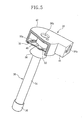
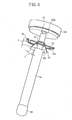
- FIG. 5 is a perspective view showing an example in which the dual pipe 36 is connected to the inside bottom of the upper body 34. As shown in FIG. 5, the internal pipe of the dual pipe 36 (described below) is communicated with the gas coolant outlet 36b of the upper body 34 through the protrusion 46.
- an upper body 134 that is combined to the upper end of the tank 20 may be formed of a cylindrical block of a predetermined thickness.
- a coolant intake 134a that allows a coolant to flow into the tank 20 and a gas coolant outlet 136b through which a gas coolant is discharged from the inside of the tank are vertically formed through the upper body 134 of cylindrical block.
- the section plate 32 is disposed in contact with the lower end of the upper body 34 or fitted on the internal pipe of the dual pipe 36 at a predetermined distance from the upper body 134.
- a plurality of long groove-shaped holes 32a is circumferentially formed through the section plate 32 to allow a coolant to flow down into the tank 20.
- a small filter (not shown) is provided on the plane (generally upper surface) of the section plate 32 and fixed by ring-shaped clips 48, 49 that are fitted on the outer and inner circumferences of the section plate 32, respectively.
- the dual pipe 36 is a pipe with an internal pipe 52 that is communicated with the gas coolant outlets 36b, 136b and an external pipe 54 that is connected to a gas coolant inlet 36a.
- a return cap 56 is combined to the lower end of the dual pipe 36 and the gas coolant flows from the upper portion inside the tank 20 into the gas coolant inlet 36a between the internal pipe 52 and the external pipe 54, turns into the internal pipe 52 at the return cap 56, and continues flowing to an outer pipe through the gas coolant outlets 36b, 136b.
- the coolant intakes 34a, 134a are formed above the section plate 32, the gas coolant inlet 36a is formed under the section pipe 32, and a liquid coolant block pipe 58 that surrounds the gas coolant inlet 36a to prevent the liquid coolant from flowing into the coolant outlet pipe (dual pipe) through the gas coolant inlet 36a is combined to the lower surface of the section plate 32.
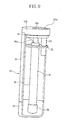
- the liquid coolant block pipe 58 is a cone-shaped pipe with the top cut and the lower end open, or as shown in FIG. 8, may be a liquid coolant block pipe 158 that is a cylindrical pipe with the lower end open.
- the liquid coolant block pipes 58, 158 are fixed by the ring-shaped clip 49 or other specific fixing means.
- the passage area defined by a gap c between the liquid coolant block pipes 58, 158 and the external pipe 54 of the coolant outlet pipe (dual pipe) is larger than the passage area between the internal pipe 52 and the external pipe 54 of the coolant outlet pipe.
- the dual pipe 36 is an extruded dual pipe with the internal pipe 52 and external pipe 54 that are integrally formed, or the internal pipe 52 and the external pipe 54 may be formed by combining a separate internal pipe and external pipe.
- the coolant intake 134a may extend down through the section plate 32 by an inlet pipe 62 and the gas coolant inlet 36a may be formed above the section plate 32.
- the coolant intake 34a (shown in FIG. 5) may extend to the upper portion of the section plate 32 by an inclined inlet pipe 162, in which the protrusion 46 shown in FIG. 5 is not needed and the other configuration is the same as in FIGS. 3 and 5.
- FIG. 11 is a cross-sectional view showing the lower part 24 of the tank in which the return cap 56 is disposed. As shown in FIG. 11, an oil return hole 56a is formed through the return cap 56 to allow the oil for the compressor (oil separated from the coolant) to flow into and circulate through the coolant outlet pipe (dual pipe).
- the internal pipe 52 of the dual pipe 36 extends down more than the external pipe 54 to allow the oil to easily flow into the internal pipe 52.
- a filter 64 is provided over the return cap 56 to prevent any foreign substances from flowing into the internal pipe 52 through the oil return hole 56a.
- a filter 66 may be provided at the lower end of the internal pipe 52.
- the oil that has flowed in the tank 20 is separated in to oil, a liquid coolant, and a gas coolant from the bottom of the tank and it is preferable to form the bottom of the tank under the return cap 56 deeper than other portions to easily collect and return the oil, in which the explosion means 38 shown in FIG. 3 is combined with the higher portion of the bottom of the tank.
- the explosion means 38 is composed of an explosion plate 38a fixed to the bottom of the tank, a housing 38b of a vertical pipe and a horizontal pipe 38c that are sequentially connected to the explosion plate 38a.
- the explosion plate 38a is disposed between the machined surface of the lower part 24 of the tank and the housing 38b of vertical pipe.
- the accumulator it is preferable for the accumulator to increase the diameter of the tank to increase capacity; however, it is strongly required to reduce the outer diameter of the tank because it is restricted by space in a small space, such as an engine room of a vehicle, and it is needed to improve liquid-vapor separating performance and pressure resistance in the tank of a accumulator of a small diameter to solve the above-mentioned problems.
- the tank of an accumulator requires larger capacity than a liquid receiver, so that the diameter of the tank is usually set at 60 mm or more.
- FIG. 14 shows a graph illustrating liquid-vapor separating performance to the diameter of the tank equipped with a dual pipe according to the embodiment of the invention
- FIG. 15 shows a graph illustrating pressure resistance to the diameter of the tank equipped with a dual pipe according to the embodiment.
- a region of a liquid coolant under normal operating condition appears when the ratio of a liquid coolant in the tank of the accumulator to the entire inside volume is 0.65 in a common liquid-vapor separating tank.
- the amount of liquid coolant in the liquid-vapor separating tank that is needed in an air conditioner is at a minimum 250 cc to a maximum 800 cc, it can be seen from the graph that the liquid-vapor separating performance is good when the diameters are in the range of 30 mm to 60 mm.
- An accumulator of an air conditioner according to a second embodiment of the invention has an integral internal heat exchanger.
- the accumulator of an air conditioner according to the first embodiment of the invention does not include an internal heat exchanger, but the accumulator of an air conditioner according to this embodiment of the invention includes an additional mechanism that flows a coolant for internal heat exchange into the tank and circulates it therein.
- the coolant for internal heat exchange in order to distinguish the coolant for internal heat exchange from the coolant that is separated into a liquid and a gas through the coolant outlet pipe, the coolant for internal heat exchange is referred to as a 'high-pressure coolant' and the coolant that is separated into a liquid and a gas through the coolant outlet pipe is referred to as a 'low-pressure coolant'.
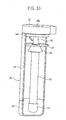
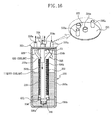
- a low-pressure coolant inlet pipe 322 through which a low-pressure coolant flows is disposed at the upper portion inside a hollow tank 320 and a low-pressure coolant outlet pipe 324 is vertically disposed at the center inside the tank 320 to discharge a gas coolant separated from the coolant that has flowed in the tank.
- the high-pressure coolant inlet pipe 326 longitudinally covers a part of the outside of the low-pressure coolant outlet pipe 324 for heat exchange with the low-pressure coolant
- a high-pressure coolant outlet pipe 328 longitudinally covers the other part of the outside of the low-pressure coolant outlet pipe 324 for heat exchange with the low-pressure coolant while being communicated with the lower end of the high-pressure coolant inlet pipe 326.
- the tank 320 is composed of a tank body 320a and a lower part 320b of the tank combined to the lower portion of the tank body 320a, or the tank body 320a and the lower part 320b of the tank may be integrally formed by forging and an upper body 321 is combined to the upper end of the tank body 320a.
- the tank 320 may be composed of the tank body 320a and the lower part 320b of the tank that are integrally formed.
- the low-pressure coolant inlet pipe 322 is disposed with the upper portion passing through the upper body 321 and the outside of the lower portion having coolant injection hole 322a to inject a coolant to the high-pressure coolant inlet pipe 326, the high-pressure coolant outlet pipe 328, or the inside of the tank 320 and improve liquid-vapor separating performance while the injected coolant rotates.
- the low-pressure outlet pipe 324 is a dual pipe with an internal pipe 324a and an external pipe 324b and a return cap 330 is combined to the lower end of the dual pipe. Accordingly, a gas coolant flows from the upper portion inside the tank 320 through a gas coolant inlet E1 between the internal pipe 324a and the external pipe 324b and turns into the internal pipe 324a at the return cap 330.
- the upper and lower portions of the internal pipe 324a extends more than the upper and lower ends of the external pipe 324b and the upper end of the internal pipe 324a is positioned through the upper body 321.
- the gas coolant inlet E1 is formed under the upper body 321.
- the low-pressure coolant outlet pipe 324 is an extruded dual pipe with the internal pipe 324a and the external pipe 324b that are integrally formed, or the internal pipe and the external pipe are formed by combining separate internal pipe with external pipe.
- the high-pressure coolant inlet pipe 326 has an inlet 326a that is positioned through the upper body 321 and a heat exchanging portion 326b through which heat is exchanged with a low-pressure coolant in the tank 320.
- the high-pressure coolant outlet pipe 328 has an outlet 328a that is positioned through the upper body 321 and a heat exchanging portion 328b through which heat is exchanged with the low-pressure coolant in the tank 320.
- the heat exchanging portions 326b, 328b of the high-pressure coolant inlet pipe 326 and the high-pressure coolant outlet pipe 328 are each formed of a thin tube that is curved in the width,direction and has a plurality of coolant passages H inside.
- the heat exchanging portions 326b, 328b are curved in an arc shape.
- the inlet 326a of the high-pressure coolant inlet pipe 326 and the outlet 328a of the high-pressure coolant outlet pipe 328 are each formed of one coolant passage, and the inlet 326a and the outlet 328a are communicated with corresponding heat exchanging portions 326b, 328b formed of a plurality of coolant passages.
- the curved thin tube (heat exchanging portions 326b, 328b) is formed in a curved thin tube shape by extrusion without a post-machining.
- the outsides of the high-pressure coolant pipes 326, 328 and the low-pressure coolant outlet pipe 324 are joined and arranged such that the coolants in the high-pressure coolant pipes 326, 328 exchange heat with the coolant in the low-pressure coolant outlet pipe 324.
- Heat conductive fins 332 are provided on the outside of the curved thin tube (heat exchanging portions 326b, 328b) to increase heat exchange efficiency.
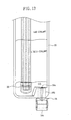
- connection cap 334 may be integrally formed with the return cap 330.
- An oil return hole 330a is formed through the return cap 330 to allow the oil for the compressor (oil separated from the coolant) to flow into and circulate through the internal pipe 324a of the low-pressure coolant outlet pipe 324.
- a filter (not shown) may be provided over the return cap 330 to prevent any foreign substances to flow inside through the oil return hole 330a.
- FIG. 18 shows another embodiment of the heat exchanging portion of the high-pressure coolant inlet pipe 326 and the high-pressure coolant outlet pipe 328 of the invention.
- Protruding heat conductive fins 432 are integrally formed, on the curved outside, with heat exchanging portions 426b, 428b of this embodiment.
- FIG. 19 shows another embodiment of the heat exchanging portion of the high-pressure coolant inlet pipe 326 and the high-pressure coolant outlet pipe 328 of the invention.
- Individual heat conductive fins 532 of offset fins with folds are attached to the curved outside of heat exchanging portions 526b, 528b of the invention.
- the heat conductive fins 532 of offset fins with folds increases the heat exchange rate by increasing the heat exchange area.
- a low-pressure coolant that flows from the evaporator 4 (shown in FIG. 1) into the upper portion inside the tank 320 through the low-pressure coolant inlet pipe 322 is separated into oil, a liquid coolant, and a gas coolant while flowing down.
- the liquid-vapor separating performance is increased by injecting the coolant through the coolant injection hole 322a to the high-pressure coolant inlet pipe 326, the high-pressure coolant outlet pipe 328, or the inside of the tank 320.
- the separated gas coolant flows inside through the gas coolant inlet E1 between the internal pipe 324a and external pipe 324b of the low-pressure coolant outlet pipe 324, turns up into the internal pipe 324a at the return cap 330, and then continues flowing to the outer pipe toward the compressor 1 (shown in FIG. 1).
- the stagnant oil for the compressor at the lower portion in the tank 320 returns to the compressor through the oil return hole 330a.
- the high-pressure coolant that flows from the condenser 2 (gas cooler) (shown in FIG. 1) into the high-pressure coolant inlet pipe 326 exchanges heat with the gas coolant in the low-pressure coolant outlet pipe 324 and the low-pressure coolant in the tank 320 while passing through the heat exchanging portion 326b, exchanges heat with the gas coolant in the low-pressure outlet pipe 324 and the low-pressure coolant in the tank 320 while passing through the heat exchanging portion 328b of the high-pressure coolant outlet pipe 328 across the connection cap 334, and then continues flowing through the outlet 328a of the high-pressure coolant outlet pipe 328 to the outer pipe toward the throttle valve 3 (shown in FIG. 1).
- An accumulator of an air conditioner according to an embodiment of the invention can be formed of a small tank, so that it can be easily mounted in a small space and is improved in vapor-liquid separating performance with high pressure resistance.
- an internal heat exchanger is integrally provided in the accumulator, such that system efficiency is increased by increase in heat exchange efficiency inside the body of the accumulator. Further, the internal heat exchanger is integrally provided without providing a specific internal heat exchanger outside, such that the coolant inlet and outlet are formed at the upper portion of the body of the accumulator and piping is easy.
Landscapes
- Engineering & Computer Science (AREA)
- Chemical & Material Sciences (AREA)
- Analytical Chemistry (AREA)
- Power Engineering (AREA)
- Physics & Mathematics (AREA)
- Mechanical Engineering (AREA)
- Thermal Sciences (AREA)
- General Engineering & Computer Science (AREA)
- Air-Conditioning For Vehicles (AREA)
- Heat-Exchange Devices With Radiators And Conduit Assemblies (AREA)
Applications Claiming Priority (1)
| Application Number | Priority Date | Filing Date | Title |
|---|---|---|---|
| KR1020060078186A KR100784611B1 (ko) | 2006-08-18 | 2006-08-18 | 냉방장치의 내부열교환기 일체형 기액분리기 |
Publications (3)
| Publication Number | Publication Date |
|---|---|
| EP1890096A2 true EP1890096A2 (fr) | 2008-02-20 |
| EP1890096A3 EP1890096A3 (fr) | 2013-05-01 |
| EP1890096B1 EP1890096B1 (fr) | 2015-03-11 |
Family
ID=38720344
Family Applications (1)
| Application Number | Title | Priority Date | Filing Date |
|---|---|---|---|
| EP07016164.1A Active EP1890096B1 (fr) | 2006-08-18 | 2007-08-17 | Accumulateur de climatiseur |
Country Status (3)
| Country | Link |
|---|---|
| US (2) | US20080041093A1 (fr) |
| EP (1) | EP1890096B1 (fr) |
| KR (1) | KR100784611B1 (fr) |
Cited By (2)
| Publication number | Priority date | Publication date | Assignee | Title |
|---|---|---|---|---|
| CN106352617A (zh) * | 2015-07-13 | 2017-01-25 | 株式会社不二工机 | 储液器 |
| US12392532B2 (en) | 2022-06-07 | 2025-08-19 | Carrier Corporation | Accumulator heat exchanger |
Families Citing this family (12)
| Publication number | Priority date | Publication date | Assignee | Title |
|---|---|---|---|---|
| FR2928997B1 (fr) * | 2008-03-20 | 2014-06-20 | Valeo Systemes Thermiques | Echangeur de chaleur et ensemble integre de climatisation comprenant un tel echangeur. |
| JP5644469B2 (ja) * | 2010-12-21 | 2014-12-24 | カルソニックカンセイ株式会社 | アキュムレータ |
| JP5804911B2 (ja) * | 2011-11-24 | 2015-11-04 | 株式会社不二工機 | 気液分離器 |
| DE102014113793A1 (de) * | 2014-02-07 | 2015-08-13 | Halla Visteon Climate Control Corporation | Kältemittelakkumulator, insbesondere für Kraftfahrzeugkältemittelkreisläufe |
| JP6537911B2 (ja) * | 2015-07-17 | 2019-07-03 | 株式会社不二工機 | アキュームレータ |
| US10845106B2 (en) * | 2017-12-12 | 2020-11-24 | Rheem Manufacturing Company | Accumulator and oil separator |
| KR102750535B1 (ko) * | 2019-05-31 | 2025-01-06 | 현대자동차 주식회사 | 차량용 기액 분리장치 |
| CN113758338B (zh) * | 2020-06-03 | 2024-11-12 | 浙江雪波蓝科技有限公司 | 蓄能装置、充冷蓄冷系统、蓄冷供冷系统及冷藏箱 |
| CN112097426B (zh) * | 2020-09-07 | 2024-04-19 | 珠海格力电器股份有限公司 | 气液分离器、空调系统及其控制方法 |
| DE102021125240A1 (de) * | 2020-11-20 | 2022-05-25 | Hanon Systems | Vorrichtung zum Trennen einer gasförmigen und einer flüssigen Phase eines Arbeitsstoffes und zum Speichern der flüssigen Phase |
| DE102021201509B4 (de) * | 2021-02-17 | 2022-11-17 | Hanon Systems | Kombination eines Kältemittel-Akkumulators und eines internen Wärmeübertragers für Kältemittel |
| CN119573333B (zh) * | 2024-12-16 | 2025-12-26 | 中绿中科储能技术有限公司 | 冷箱内部结构及液态空气储能电站 |
Citations (6)
| Publication number | Priority date | Publication date | Assignee | Title |
|---|---|---|---|---|
| US4199960A (en) | 1978-10-26 | 1980-04-29 | Parker-Hannifin Corporation | Accumulator for air conditioning systems |
| US4651540A (en) | 1986-03-21 | 1987-03-24 | Tecumseh Products Company | Suction accumulator including an entrance baffle |
| US4827725A (en) | 1988-07-05 | 1989-05-09 | Tecumseh Products Company | Suction accumulator with dirt trap |
| JPH11278045A (ja) | 1997-09-24 | 1999-10-12 | Denso Corp | 冷凍サイクル装置 |
| US20020083733A1 (en) | 2000-12-29 | 2002-07-04 | Zhang Chao A. | Accumulator with internal heat exchanger |
| US6681597B1 (en) | 2002-11-04 | 2004-01-27 | Modine Manufacturing Company | Integrated suction line heat exchanger and accumulator |
Family Cites Families (15)
| Publication number | Priority date | Publication date | Assignee | Title |
|---|---|---|---|---|
| US1384477A (en) * | 1918-04-03 | 1921-07-12 | Fred E Matthews | Fluid-pressure apparatus |
| US3257824A (en) * | 1964-12-16 | 1966-06-28 | Itt | Integral lubricant return riser for refrigeration systems |
| US4194370A (en) * | 1976-08-13 | 1980-03-25 | Tecumseh Products Company | Accumulator for refrigeration system |
| US4147479A (en) * | 1976-08-13 | 1979-04-03 | Tecumseh Products Company | Refrigeration system and method with compressor mounted accumulator |
| US4551990A (en) * | 1984-10-18 | 1985-11-12 | Honoshowsky John C | Oil return apparatus for a refrigeration system |
| US4627247A (en) * | 1986-03-21 | 1986-12-09 | Tecumseh Products Company | Suction accumulator |
| US5479790A (en) * | 1993-07-06 | 1996-01-02 | Bottum, Jr.; Edward W. | Suction accumulator structure |
| CA2297598C (fr) * | 2000-01-28 | 2003-12-23 | Ki-Sun Jason Ryu | Accumulateur de systeme de conditionnement d'air |
| KR100359822B1 (ko) * | 2000-05-24 | 2002-11-07 | 엘지전자 주식회사 | 공기조화기 |
| JP4492017B2 (ja) * | 2000-11-09 | 2010-06-30 | 株式会社デンソー | アキュムレータモジュール |
| US6453697B1 (en) * | 2001-04-23 | 2002-09-24 | Designed Metal Products, Inc. | Seal for vessel and method of forming same |
| US6463757B1 (en) * | 2001-05-24 | 2002-10-15 | Halla Climate Controls Canada, Inc. | Internal heat exchanger accumulator |
| JP2003065161A (ja) * | 2001-08-24 | 2003-03-05 | Kawasaki Heavy Ind Ltd | 自動二輪車および該自動二輪車に搭載される気化器 |
| US7287399B2 (en) * | 2004-02-17 | 2007-10-30 | Obrist Engineering Gmbh | Collector for the liquid phase of the working medium of an air-conditioning system |
| CN2677728Y (zh) * | 2004-03-02 | 2005-02-09 | 王青 | 盛装环保型制冷剂的防爆罐 |
-
2006
- 2006-08-18 KR KR1020060078186A patent/KR100784611B1/ko active Active
-
2007
- 2007-08-14 US US11/889,523 patent/US20080041093A1/en not_active Abandoned
- 2007-08-17 EP EP07016164.1A patent/EP1890096B1/fr active Active
-
2011
- 2011-02-25 US US13/035,764 patent/US20110146332A1/en not_active Abandoned
Patent Citations (6)
| Publication number | Priority date | Publication date | Assignee | Title |
|---|---|---|---|---|
| US4199960A (en) | 1978-10-26 | 1980-04-29 | Parker-Hannifin Corporation | Accumulator for air conditioning systems |
| US4651540A (en) | 1986-03-21 | 1987-03-24 | Tecumseh Products Company | Suction accumulator including an entrance baffle |
| US4827725A (en) | 1988-07-05 | 1989-05-09 | Tecumseh Products Company | Suction accumulator with dirt trap |
| JPH11278045A (ja) | 1997-09-24 | 1999-10-12 | Denso Corp | 冷凍サイクル装置 |
| US20020083733A1 (en) | 2000-12-29 | 2002-07-04 | Zhang Chao A. | Accumulator with internal heat exchanger |
| US6681597B1 (en) | 2002-11-04 | 2004-01-27 | Modine Manufacturing Company | Integrated suction line heat exchanger and accumulator |
Cited By (4)
| Publication number | Priority date | Publication date | Assignee | Title |
|---|---|---|---|---|
| CN106352617A (zh) * | 2015-07-13 | 2017-01-25 | 株式会社不二工机 | 储液器 |
| CN106352617B (zh) * | 2015-07-13 | 2020-09-04 | 株式会社不二工机 | 储液器 |
| EP3118543B1 (fr) * | 2015-07-13 | 2023-09-06 | Fujikoki Corporation | Accumulateur |
| US12392532B2 (en) | 2022-06-07 | 2025-08-19 | Carrier Corporation | Accumulator heat exchanger |
Also Published As
| Publication number | Publication date |
|---|---|
| US20110146332A1 (en) | 2011-06-23 |
| EP1890096B1 (fr) | 2015-03-11 |
| KR100784611B1 (ko) | 2007-12-11 |
| EP1890096A3 (fr) | 2013-05-01 |
| US20080041093A1 (en) | 2008-02-21 |
Similar Documents
| Publication | Publication Date | Title |
|---|---|---|
| EP1890096A2 (fr) | Accumulateur de climatiseur | |
| KR101091063B1 (ko) | 공기조화시스템용 내장형 열교환기 조립체 | |
| US6523365B2 (en) | Accumulator with internal heat exchanger | |
| US12152817B2 (en) | Gas-liquid separation device and thermal management system | |
| US20140102682A1 (en) | Condenser for vehicle | |
| JP3617083B2 (ja) | 受液器一体型冷媒凝縮器 | |
| US6341647B1 (en) | Separator-integrated condenser for vehicle air conditioner | |
| JP2827404B2 (ja) | 冷媒凝縮器 | |
| CN105904960A (zh) | 冷却模块 | |
| EP3832242B1 (fr) | Condenseur | |
| CN212378295U (zh) | 气液分离装置 | |
| JP3355844B2 (ja) | 受液器一体型冷媒凝縮器 | |
| JP2000213826A (ja) | 受液器一体型冷媒凝縮器 | |
| JP6170422B2 (ja) | 充填効率を向上するための冷媒経路変更器を備えたレシーバタンクを有するサブクール式コンデンサ | |
| JP2001174103A (ja) | 冷媒凝縮器 | |
| JPH09166371A (ja) | 冷媒凝縮器 | |
| US20060070724A1 (en) | Integrated receiver dryer sleeve | |
| KR20170047050A (ko) | 응축기 | |
| JP3764904B2 (ja) | 冷凍サイクルおよび冷凍サイクルの受液器容積決定方法 | |
| KR100766249B1 (ko) | 냉방장치의 기액분리기 | |
| GB2386939A (en) | Accumulator with an internal heat exchanger | |
| CN216448413U (zh) | 一种降低压缩机回油温度的制冷系统 | |
| EP4414631A1 (fr) | Dispositif de séparation d'huile pour condenseur, condenseur le comprenant et système de réfrigération | |
| JP2001099525A (ja) | 受液器および冷凍サイクル装置 | |
| CN111750576B (zh) | 一种储液器及制冷设备 |
Legal Events
| Date | Code | Title | Description |
|---|---|---|---|
| PUAI | Public reference made under article 153(3) epc to a published international application that has entered the european phase |
Free format text: ORIGINAL CODE: 0009012 |
|
| 17P | Request for examination filed |
Effective date: 20070817 |
|
| AK | Designated contracting states |
Kind code of ref document: A2 Designated state(s): AT BE BG CH CY CZ DE DK EE ES FI FR GB GR HU IE IS IT LI LT LU LV MC MT NL PL PT RO SE SI SK TR |
|
| AX | Request for extension of the european patent |
Extension state: AL BA HR MK YU |
|
| PUAL | Search report despatched |
Free format text: ORIGINAL CODE: 0009013 |
|
| AK | Designated contracting states |
Kind code of ref document: A3 Designated state(s): AT BE BG CH CY CZ DE DK EE ES FI FR GB GR HU IE IS IT LI LT LU LV MC MT NL PL PT RO SE SI SK TR |
|
| AX | Request for extension of the european patent |
Extension state: AL BA HR MK RS |
|
| RIC1 | Information provided on ipc code assigned before grant |
Ipc: F25B 43/00 20060101AFI20130326BHEP |
|
| AKX | Designation fees paid |
Designated state(s): DE FR GB IT |
|
| GRAP | Despatch of communication of intention to grant a patent |
Free format text: ORIGINAL CODE: EPIDOSNIGR1 |
|
| INTG | Intention to grant announced |
Effective date: 20140919 |
|
| GRAS | Grant fee paid |
Free format text: ORIGINAL CODE: EPIDOSNIGR3 |
|
| GRAA | (expected) grant |
Free format text: ORIGINAL CODE: 0009210 |
|
| AK | Designated contracting states |
Kind code of ref document: B1 Designated state(s): DE FR GB IT |
|
| REG | Reference to a national code |
Ref country code: GB Ref legal event code: FG4D |
|
| REG | Reference to a national code |
Ref country code: DE Ref legal event code: R096 Ref document number: 602007040554 Country of ref document: DE Effective date: 20150423 |
|
| REG | Reference to a national code |
Ref country code: DE Ref legal event code: R097 Ref document number: 602007040554 Country of ref document: DE |
|
| PG25 | Lapsed in a contracting state [announced via postgrant information from national office to epo] |
Ref country code: IT Free format text: LAPSE BECAUSE OF FAILURE TO SUBMIT A TRANSLATION OF THE DESCRIPTION OR TO PAY THE FEE WITHIN THE PRESCRIBED TIME-LIMIT Effective date: 20150311 |
|
| PLBE | No opposition filed within time limit |
Free format text: ORIGINAL CODE: 0009261 |
|
| STAA | Information on the status of an ep patent application or granted ep patent |
Free format text: STATUS: NO OPPOSITION FILED WITHIN TIME LIMIT |
|
| 26N | No opposition filed |
Effective date: 20151214 |
|
| REG | Reference to a national code |
Ref country code: FR Ref legal event code: PLFP Year of fee payment: 10 |
|
| REG | Reference to a national code |
Ref country code: FR Ref legal event code: PLFP Year of fee payment: 11 |
|
| REG | Reference to a national code |
Ref country code: FR Ref legal event code: PLFP Year of fee payment: 12 |
|
| PGFP | Annual fee paid to national office [announced via postgrant information from national office to epo] |
Ref country code: GB Payment date: 20250624 Year of fee payment: 19 |
|
| PGFP | Annual fee paid to national office [announced via postgrant information from national office to epo] |
Ref country code: FR Payment date: 20250624 Year of fee payment: 19 |
|
| PGFP | Annual fee paid to national office [announced via postgrant information from national office to epo] |
Ref country code: DE Payment date: 20250624 Year of fee payment: 19 |