EP1890121A1 - Quantitative Beurteilung eines Farbfilters - Google Patents
Quantitative Beurteilung eines Farbfilters Download PDFInfo
- Publication number
- EP1890121A1 EP1890121A1 EP07114074A EP07114074A EP1890121A1 EP 1890121 A1 EP1890121 A1 EP 1890121A1 EP 07114074 A EP07114074 A EP 07114074A EP 07114074 A EP07114074 A EP 07114074A EP 1890121 A1 EP1890121 A1 EP 1890121A1
- Authority
- EP
- European Patent Office
- Prior art keywords
- filter
- hue
- sample
- samples
- color
- Prior art date
- Legal status (The legal status is an assumption and is not a legal conclusion. Google has not performed a legal analysis and makes no representation as to the accuracy of the status listed.)
- Granted
Links
Images
Classifications
-
- G—PHYSICS
- G01—MEASURING; TESTING
- G01J—MEASUREMENT OF INTENSITY, VELOCITY, SPECTRAL CONTENT, POLARISATION, PHASE OR PULSE CHARACTERISTICS OF INFRARED, VISIBLE OR ULTRAVIOLET LIGHT; COLORIMETRY; RADIATION PYROMETRY
- G01J3/00—Spectrometry; Spectrophotometry; Monochromators; Measuring colours
- G01J3/46—Measurement of colour; Colour measuring devices, e.g. colorimeters
- G01J3/463—Colour matching
-
- G—PHYSICS
- G01—MEASURING; TESTING
- G01J—MEASUREMENT OF INTENSITY, VELOCITY, SPECTRAL CONTENT, POLARISATION, PHASE OR PULSE CHARACTERISTICS OF INFRARED, VISIBLE OR ULTRAVIOLET LIGHT; COLORIMETRY; RADIATION PYROMETRY
- G01J3/00—Spectrometry; Spectrophotometry; Monochromators; Measuring colours
- G01J3/46—Measurement of colour; Colour measuring devices, e.g. colorimeters
- G01J3/465—Measurement of colour; Colour measuring devices, e.g. colorimeters taking into account the colour perception of the eye; using tristimulus detection
-
- G—PHYSICS
- G01—MEASURING; TESTING
- G01N—INVESTIGATING OR ANALYSING MATERIALS BY DETERMINING THEIR CHEMICAL OR PHYSICAL PROPERTIES
- G01N21/00—Investigating or analysing materials by the use of optical means, i.e. using sub-millimetre waves, infrared, visible or ultraviolet light
- G01N21/17—Systems in which incident light is modified in accordance with the properties of the material investigated
- G01N21/25—Colour; Spectral properties, i.e. comparison of effect of material on the light at two or more different wavelengths or wavelength bands
- G01N21/27—Colour; Spectral properties, i.e. comparison of effect of material on the light at two or more different wavelengths or wavelength bands using photo-electric detection ; circuits for computing concentration
- G01N21/274—Calibration, base line adjustment, drift correction
- G01N21/276—Calibration, base line adjustment, drift correction with alternation of sample and standard in optical path
Definitions
- the present invention relates to a method for quantitative evaluation of a color filter. It can be applied, in particular, to evaluate a rendition of tints by a tinted ophthalmic glass.
- Colored filters are used in many applications, for example to attenuate too much light intensity or to increase an image contrast.
- tinted ophthalmic lenses especially sun protection glasses, are colored filters which are intended to be assembled in an eyeglass frame.
- a filter may have a substantially flat transmission spectrum in the visible light range 380 nm - 780 nm (nm). It should not change the perception of reference sample hues, between an observation of these samples through the filter and a direct observation of the same samples, that is to say without the filter. But such a flat spectrum filter is not feasible in practice, especially because of spectral limitations dyes that are used to make filters. In addition, its gray appearance would be unattractive and unappreciated for ophthalmic applications.
- the transmission spectra in the visible light range of the filters that are used in practice therefore vary. They are then likely to modify the perception of hues by an observer, between a direct observation of samples of these hues and an observation thereof through the filter. For this reason, they are called color filters.
- the document EP 1,273,894 proposes a method of filter color evaluation, which is based on the calculation of chromatic differences expressed in the CIELAB space, indicated by the L *, a *, b * axes and defined by the International Commission on Illumination . The intervention of observers is then no longer necessary, to visually evaluate samples of colors seen through the filters. But the mode of evaluation of the modification of the tints by each filter which is described in this document does not take into account the impression, for a human observer, of a rendering of the colors which is natural.
- An object of the present invention is therefore to provide a quantitative evaluation of a color filter, which does not have the disadvantages mentioned above.
- step / 4 / between the value of the perceptual attribute that is obtained for the hue sample by simulating an observation of it through the filter and the value for an observation without the filter, constitutes an evaluation of the rendering of the hue of the sample of reference by the color filter.
- this result of the evaluation characterizes the ability of the filter to restore the hue in a natural way, that is to say the impression of an observer to perceive the actual hue through the filter.
- Such a method of evaluating a color filter is economical and quick to implement, in particular because it does not require the use of real observers. It only requires spectrophotometric measurement means and calculation means that are simple and commonly available.
- An important feature of the invention is the use, at step / 3 /, of a digital pattern of hue appearance.
- a digital pattern of hue appearance makes it possible to take into account physiological and subjective phenomena that intervene in the visual perception of hues by a human being. Variations in the sensitivity of the human eye as a function of the hue itself or other environmental parameters are thus taken into account, as well as differences in hue appreciation that may result from psychological factors.
- the quantitative evaluation that is obtained according to the invention, to characterize the restoration of the shade of the sample by the color filter therefore corresponds to a real evaluation, as it would be performed by a human observer.
- the color appearance model which is used in step / 3 / may be the model CIECAM02 ("Color Appearance Model"). for Color Management Systems "), defined in 2002 by the International Commission on Illumination in the publications ISBN 3 901 906 290 and CIE 159: 2004. The inventors then verified that the color filter evaluations which are carried out using a process according to the invention satisfactorily correspond to evaluations carried out by a set of human observers.
- CIECAM02 Color Appearance Model
- the evaluation of the rendition of hues by the color filter which is then obtained is based on several hues. It therefore makes it possible to evaluate the filter in a global manner taking into account various conditions of use, that is to say for a multiplicity of hues that are perceived through the filter.
- the reference shade samples can be selected from those referenced in the NCS system ("Natural Color System", see NCS Atlas 1950 Original).
- NCS Natural Color System
- the inventors have shown that evaluations of any color filter that are made from different series of NCS hue samples result in equivalent quantitative results, whereas these series are differentiated by values of clarity and saturation. hues.
- a filter evaluation which is performed according to the invention correctly accounts for the fact that the modification of a hue by a color filter depends little on the clarity and saturation of this hue.
- the invention also proposes to use an evaluation method as described above to quantitatively evaluate the rendering of tints by a tinted ophthalmic glass.
- the improvement of the method of using several color samples to evaluate the overall recovery of the shades by the ophthalmic glass is particularly advantageous.
- the ophthalmic lens can be used by a carrier thereof in a variety of conditions, which depend on its light environment and the objects it observes.
- the invention also proposes a method for classifying color filters, according to which several filters are successively evaluated using an evaluation method as described above.
- the filters can then be classified according to the quantitative evaluation results that are obtained for each of them.
- Such a method of classification is particularly useful when several filters have been manufactured, which present renditions of different hues, and that one of them must be selected as a model for mass production.
- the classification method according to the invention makes it possible to prevent real observers from performing comparative tests of each of the filters. This saves a lot of time when designing the product.
- such a classification method can be used to classify tinted ophthalmic lenses, such as sun protection glasses.
- tinted ophthalmic lenses such as sun protection glasses.
- the selection of a tinted glass according to its ability to restore hues is a particularly important step for ophthalmic application.
- a color filter is characterized in transmission by means of a spectrophotometer, which may be of a commercially available standard type.
- a transmission spectrum of the filter is thus obtained, which groups together transmission values measured for distributed wavelengths in a visible light range.
- the transmission of the filter can be measured over the length interval 400 nm - 7/0 nm with a pitch of 1 nm.
- shade samples are spectrally characterized in reflection.
- Such samples consist of opaque supports uniformly colored on one side.
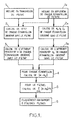
- standard shade samples may be used, such as those fixed by the NCS system. These are divided into series of 40 samples, each series corresponding to a variation of the hue of the samples, and the series being differentiated between them by saturation values ("chromativeness” in English) and clarity ("brightness” or "1-blackness”). Hue samples from the same run can be used to evaluate the color filter. A reflection spectrum of each of these samples is then obtained over the visible light wavelength range 400 nm - 700 nm (step 1a of Figure 1).
- the reflection spectrum of each hue sample is a non-specular reflection spectrum, which better corresponds to actual viewing conditions, with respect to a specular reflection spectrum.
- the reflection spectra of the hue samples correspond to angles of incidence and reflection of light values which are different from those defined by the Bragg reflection conditions.
- the reflection spectral values of the sample are combined with those of filter transmission and with spectral characteristics of an illumination light source (step 2 of FIG. 1).
- Optical data is thus obtained which characterizes the hue sample when illuminated by the light source and observed simultaneously through the filter.
- the spectral characteristics that are used for the light source also called illuminant, can correspond to the lighting conditions "SoLux® Daylight” light source as described in the patent US 5,418,419 .
- the optical data which are obtained are the X, Y, Z tristimulus components relating to the simulation of the observation of the hue sample through the filter.
- the components X, Y, Z are calculated in a manner that is known to those skilled in the art, using simple calculation means such as a personal computer. It is It should be understood that in alternative embodiments of the invention, other optical data may be used in an equivalent manner. These optical data can be obtained by calculation or by any alternative experimental method, such as the use of a colorimetric photometer to directly measure the components X, Y, Z for example.
- step 3 the X, Y, Z components that correspond to the simulation of the observation of each hue sample through the filter, are introduced into a digital model of colored appearance.
- the inventors have experimentally validated that the numerical model CIECAM02 corresponds satisfactorily to a mean human visual perception. For this reason, the use of this model is preferred by the inventors.
- This digital model which can be implemented on a usual personal computer, produces visual perceptual attribute values that characterize the perception of each color input by its optical data. It takes into account, during the simulation of the perception of each shade, the real conditions of observation. In particular, it is considered that the hue sample is observed inside a cabin with white and diffusing walls.
- the perceptual attribute value that is used is that of the hue angle H that can be spotted in the NCS system. It varies in a circle between 0 ° and 360 °, the values 0 °, 90 °, 180 ° and 270 ° respectively corresponding to the colors red, yellow green and blue, and the hue varies continuously between these colors for intermediate values of H
- the hue angle H is therefore particularly suitable for distinguishing samples within the NCS series used.
- Tristimulus components X 0 , Y 0 , Z 0 are thus calculated for each hue sample used (step 2a). They are then introduced into the CIECAM02 model to obtain a H 0 hue angle value that characterizes the visual perception of the sample (step 3a). Since steps 1a, 2a and 3a relate to the color samples independently of the color filter which is being evaluated, they can be executed beforehand and the values that are obtained are repeated to evaluate successively several filters.
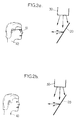
- FIG. 2a and 2b illustrate the observation conditions which correspond respectively to the values H and H 0 for each color sample.
- the hue sample 20 is illuminated by the light source 30, which has an emission spectrum corresponding to the illuminant used for the calculation of the components X, Y, Z.
- the value H corresponds to the case where the sample 20 is viewed by the observer 40 through the colored filter 10, the filter 10 being arranged between the sample 20 and the eye of the observer 40.
- FIG. 2a illustrates a case where the color filter 10 is a tinted ophthalmic glass, in particular a sun protection goggle glass.
- the filter 10 can also be, in an equivalent manner, a helmet-tinted visor, a protective mask glass, an optical measuring device or sighting filter, etc.
- Figure 2b illustrates the observation conditions that correspond to the value H 0 . They are identical to those of FIG. 2a, by deleting the filter 10.
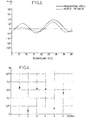
- FIG. 3 is a diagram which groups together the difference values HH 0 obtained for the 40 hue samples of a series NCS used (curve in solid line). The samples are marked on the abscissa by a numbering of these in the NCS series, and the corresponding HH 0 differences are indicated on the ordinate. Such a diagram provides a representation of the change in hue perception that is caused by the color filter.
- a curve close to the abscissa axis indicates that the filter provides a natural perception of hues, with very little alteration thereof.
- Curve portions that have positive ordinate values correspond to tints that are perceived off-set by turning clockwise on the NCS circle.
- parts of curve with values Negative y-coordinates correspond to hues that are perceived off-set by turning counterclockwise on the NCS circle.
- the absolute value of the difference HH 0 constitutes an evaluation of the rendering of the hue of this sample by the filter.
- the filter restitution of the hue of each sample was also evaluated by a set of human observers. Fifteen real observations were made for each sample, with and without the colored filter interposed between the observer and the hue sample. The background luminance used for these observations is 1500 cd / m 2 (candela per square meter). In each case and for each hue sample, an average of the results of fifteen observer evaluations was calculated and then plotted in Figure 3 (dashed line). The similarity of the respective variations of the two curves of FIG. 3 constitutes an validation of the CIECAM02 hue appearance model to account for the perception by the human eye of hue variations.
- the overall rendering of the hues by the filter can be evaluated by calculating an average of the absolute values of the perceptive attribute differences which are obtained respectively for the hue samples (step 5).
- the result of the filter evaluation denoted R, is equal to ⁇ ⁇ samples ⁇
- FIG. 4 reproduces a diagram in which the results R are reported for 6 filters, referenced 1 to 6, which have been evaluated according to the method of the invention.
- the filters 2 and 5, for which R is substantially equal to 0.020 and 0.035 respectively, provide a hue rendering in general more natural than the filters 1, 3, 4 and 6, for which the values of R are of the order of 0.15.
Landscapes
- Physics & Mathematics (AREA)
- Spectroscopy & Molecular Physics (AREA)
- General Physics & Mathematics (AREA)
- Spectrometry And Color Measurement (AREA)
- Eyeglasses (AREA)
- Optical Filters (AREA)
Applications Claiming Priority (1)
| Application Number | Priority Date | Filing Date | Title |
|---|---|---|---|
| FR0607323A FR2905007B1 (fr) | 2006-08-16 | 2006-08-16 | Evaluation quantitave d'un filtre colore |
Publications (2)
| Publication Number | Publication Date |
|---|---|
| EP1890121A1 true EP1890121A1 (de) | 2008-02-20 |
| EP1890121B1 EP1890121B1 (de) | 2018-11-28 |
Family
ID=37851183
Family Applications (1)
| Application Number | Title | Priority Date | Filing Date |
|---|---|---|---|
| EP07114074.3A Active EP1890121B1 (de) | 2006-08-16 | 2007-08-09 | Quantitative beurteilung eines farbfilters |
Country Status (5)
| Country | Link |
|---|---|
| US (1) | US7659982B2 (de) |
| EP (1) | EP1890121B1 (de) |
| JP (1) | JP5112785B2 (de) |
| AU (1) | AU2007207863B2 (de) |
| FR (1) | FR2905007B1 (de) |
Cited By (1)
| Publication number | Priority date | Publication date | Assignee | Title |
|---|---|---|---|---|
| CN117396738A (zh) * | 2021-05-31 | 2024-01-12 | 依视路国际公司 | 用于评估旨在面对用户的眼睛的至少一个光学产品的至少一个光保护水平的方法 |
Families Citing this family (5)
| Publication number | Priority date | Publication date | Assignee | Title |
|---|---|---|---|---|
| FR2905011B1 (fr) * | 2006-08-16 | 2009-04-17 | Essilor Int | Procede d'amelioration d'un filtre colore |
| EP2607884A1 (de) * | 2011-12-23 | 2013-06-26 | Essilor International (Compagnie Générale d'Optique) | Brillenglasbewertung hinsichtlich des Schutzes gegen UV-Gefahren |
| JP6037266B2 (ja) * | 2012-08-01 | 2016-12-07 | 学校法人近畿大学 | 眼用レンズの視認性評価方法 |
| US10757340B2 (en) * | 2018-03-09 | 2020-08-25 | Pony Ai Inc. | Adaptive filter system for self-driving vehicle |
| CN116539284B (zh) * | 2023-07-06 | 2023-09-22 | 天津大学 | 针对彩绘文物照明光源的光源照明质量评价方法及装置 |
Citations (2)
| Publication number | Priority date | Publication date | Assignee | Title |
|---|---|---|---|---|
| JP2001297323A (ja) * | 2000-04-11 | 2001-10-26 | Hoya Corp | レンズカラーセレクション方法及び装置 |
| EP1273894A2 (de) * | 2001-06-22 | 2003-01-08 | ESSILOR INTERNATIONAL (Compagnie Générale d'Optique) | Verfahren zur Erlangung einer Farbpalette |
Family Cites Families (6)
| Publication number | Priority date | Publication date | Assignee | Title |
|---|---|---|---|---|
| US5418419A (en) * | 1994-03-22 | 1995-05-23 | Tailored Lighting Inc. | Lamp for producing a daylight spectrum |
| JP3209053B2 (ja) * | 1995-09-12 | 2001-09-17 | トヨタ自動車株式会社 | 色再現装置 |
| US6373573B1 (en) * | 2000-03-13 | 2002-04-16 | Lj Laboratories L.L.C. | Apparatus for measuring optical characteristics of a substrate and pigments applied thereto |
| JP3855574B2 (ja) * | 2000-01-20 | 2006-12-13 | セイコーエプソン株式会社 | 画像撮像装置のキャリブレーション方法、当該キャリブレーション方法によって色補正がなされた画像撮像装置および記録媒体 |
| JP2004086013A (ja) * | 2002-08-28 | 2004-03-18 | Canon Inc | センサのシェーディング補正方法、補正装置およびカラー画像形成装置 |
| JP2004336657A (ja) * | 2003-05-12 | 2004-11-25 | Minolta Co Ltd | 分光画像撮影システムおよび分光画像撮影システムの調整方法 |
-
2006
- 2006-08-16 FR FR0607323A patent/FR2905007B1/fr not_active Expired - Fee Related
-
2007
- 2007-08-09 EP EP07114074.3A patent/EP1890121B1/de active Active
- 2007-08-14 JP JP2007211231A patent/JP5112785B2/ja active Active
- 2007-08-15 US US11/839,099 patent/US7659982B2/en active Active
- 2007-08-16 AU AU2007207863A patent/AU2007207863B2/en active Active
Patent Citations (2)
| Publication number | Priority date | Publication date | Assignee | Title |
|---|---|---|---|---|
| JP2001297323A (ja) * | 2000-04-11 | 2001-10-26 | Hoya Corp | レンズカラーセレクション方法及び装置 |
| EP1273894A2 (de) * | 2001-06-22 | 2003-01-08 | ESSILOR INTERNATIONAL (Compagnie Générale d'Optique) | Verfahren zur Erlangung einer Farbpalette |
Cited By (1)
| Publication number | Priority date | Publication date | Assignee | Title |
|---|---|---|---|---|
| CN117396738A (zh) * | 2021-05-31 | 2024-01-12 | 依视路国际公司 | 用于评估旨在面对用户的眼睛的至少一个光学产品的至少一个光保护水平的方法 |
Also Published As
| Publication number | Publication date |
|---|---|
| AU2007207863B2 (en) | 2012-10-04 |
| JP5112785B2 (ja) | 2013-01-09 |
| US7659982B2 (en) | 2010-02-09 |
| US20080046207A1 (en) | 2008-02-21 |
| JP2008134220A (ja) | 2008-06-12 |
| FR2905007B1 (fr) | 2008-10-31 |
| AU2007207863A1 (en) | 2008-03-06 |
| EP1890121B1 (de) | 2018-11-28 |
| FR2905007A1 (fr) | 2008-02-22 |
Similar Documents
| Publication | Publication Date | Title |
|---|---|---|
| Gómez-Robledo et al. | Do EnChroma glasses improve color vision for colorblind subjects? | |
| EP1890121B1 (de) | Quantitative beurteilung eines farbfilters | |
| US7529004B2 (en) | Color matching in lighting reproduction systems | |
| US12111520B2 (en) | Method and system for determining a lens of customized color | |
| KR20250162782A (ko) | 결정된 잔류 반사 색상의 투과 광학 시스템, 이를 제조하기 위한 시스템 및 잔류 반사 색상 차이를 평가하기 위한 장치 | |
| EP1890129B1 (de) | Verfahren zur Verbesserung eines Farbfilters | |
| Trukša et al. | Modeling D15 test sequences in red–green anomalous trichromacy | |
| EP1789949B1 (de) | Verfahren und system zum anzeigen von digitalen vollfarbenbildern | |
| EP1766957A1 (de) | Multispektralscanner mit vergrössertem bildbereich, insbesondere ein single-pass-flachscanner | |
| JP2004135276A (ja) | 装置スペクトル応答を決定する方法 | |
| Nieves et al. | Unsupervised illuminant estimation from natural scenes: an RGB digital camera suffices | |
| EP1273894B1 (de) | Verfahren zur Erlangung einer Farbpalette | |
| Zhao et al. | A dual-parameter evaluation method for color-enhancement technologies and its application to lighting-spectrum optimization for color-deficient observers | |
| WO2006079699A2 (fr) | Procede de calibration colorimetrique d’un appareil de capture d’image, appareil ainsi calibre et appication en colorimetrie | |
| WO2004015380A1 (fr) | Procede d'evaluation quantitative du potentiel colorimetrique d'une composition pigmentaire et applications. | |
| Witzel et al. | How color language is shaped by the variability of reflected light under changes of illumination | |
| CN116930127A (zh) | 一种基于视觉特性的色纺纱全光谱配色方法及装置 | |
| Embrechts | Introduction to colorimetry | |
| FR3142024A1 (fr) | Procede de colorisation d’une image infrarouge | |
| FR2852694A1 (fr) | Appareil de mesure optoelectronique a composition modulaire multiple | |
| FR2932261A1 (fr) | Procede de mesure de la hauteur de ton des cheveux | |
| FR2819911A1 (fr) | Procede de transfert de couleurs d'un materiel informatique donne a un a ou plusieurs peripherique (s) informatique(s) |
Legal Events
| Date | Code | Title | Description |
|---|---|---|---|
| PUAI | Public reference made under article 153(3) epc to a published international application that has entered the european phase |
Free format text: ORIGINAL CODE: 0009012 |
|
| AK | Designated contracting states |
Kind code of ref document: A1 Designated state(s): AT BE BG CH CY CZ DE DK EE ES FI FR GB GR HU IE IS IT LI LT LU LV MC MT NL PL PT RO SE SI SK TR |
|
| AX | Request for extension of the european patent |
Extension state: AL BA HR MK YU |
|
| 17P | Request for examination filed |
Effective date: 20080714 |
|
| AKX | Designation fees paid |
Designated state(s): AT BE BG CH CY CZ DE DK EE ES FI FR GB GR HU IE IS IT LI LT LU LV MC MT NL PL PT RO SE SI SK TR |
|
| 17Q | First examination report despatched |
Effective date: 20160520 |
|
| STAA | Information on the status of an ep patent application or granted ep patent |
Free format text: STATUS: EXAMINATION IS IN PROGRESS |
|
| RAP1 | Party data changed (applicant data changed or rights of an application transferred) |
Owner name: ESSILOR INTERNATIONAL Owner name: CENTRE NATIONAL DE LA RECHERCHE SCIENTIFIQUE -CNRS |
|
| GRAP | Despatch of communication of intention to grant a patent |
Free format text: ORIGINAL CODE: EPIDOSNIGR1 |
|
| STAA | Information on the status of an ep patent application or granted ep patent |
Free format text: STATUS: GRANT OF PATENT IS INTENDED |
|
| INTG | Intention to grant announced |
Effective date: 20180719 |
|
| GRAS | Grant fee paid |
Free format text: ORIGINAL CODE: EPIDOSNIGR3 |
|
| GRAA | (expected) grant |
Free format text: ORIGINAL CODE: 0009210 |
|
| STAA | Information on the status of an ep patent application or granted ep patent |
Free format text: STATUS: THE PATENT HAS BEEN GRANTED |
|
| AK | Designated contracting states |
Kind code of ref document: B1 Designated state(s): AT BE BG CH CY CZ DE DK EE ES FI FR GB GR HU IE IS IT LI LT LU LV MC MT NL PL PT RO SE SI SK TR |
|
| REG | Reference to a national code |
Ref country code: GB Ref legal event code: FG4D Free format text: NOT ENGLISH |
|
| REG | Reference to a national code |
Ref country code: CH Ref legal event code: EP |
|
| REG | Reference to a national code |
Ref country code: AT Ref legal event code: REF Ref document number: 1070774 Country of ref document: AT Kind code of ref document: T Effective date: 20181215 |
|
| REG | Reference to a national code |
Ref country code: DE Ref legal event code: R096 Ref document number: 602007056961 Country of ref document: DE |
|
| REG | Reference to a national code |
Ref country code: IE Ref legal event code: FG4D Free format text: LANGUAGE OF EP DOCUMENT: FRENCH |
|
| REG | Reference to a national code |
Ref country code: NL Ref legal event code: MP Effective date: 20181128 |
|
| REG | Reference to a national code |
Ref country code: LT Ref legal event code: MG4D |
|
| REG | Reference to a national code |
Ref country code: AT Ref legal event code: MK05 Ref document number: 1070774 Country of ref document: AT Kind code of ref document: T Effective date: 20181128 |
|
| PG25 | Lapsed in a contracting state [announced via postgrant information from national office to epo] |
Ref country code: FI Free format text: LAPSE BECAUSE OF FAILURE TO SUBMIT A TRANSLATION OF THE DESCRIPTION OR TO PAY THE FEE WITHIN THE PRESCRIBED TIME-LIMIT Effective date: 20181128 Ref country code: IS Free format text: LAPSE BECAUSE OF FAILURE TO SUBMIT A TRANSLATION OF THE DESCRIPTION OR TO PAY THE FEE WITHIN THE PRESCRIBED TIME-LIMIT Effective date: 20190328 Ref country code: AT Free format text: LAPSE BECAUSE OF FAILURE TO SUBMIT A TRANSLATION OF THE DESCRIPTION OR TO PAY THE FEE WITHIN THE PRESCRIBED TIME-LIMIT Effective date: 20181128 Ref country code: ES Free format text: LAPSE BECAUSE OF FAILURE TO SUBMIT A TRANSLATION OF THE DESCRIPTION OR TO PAY THE FEE WITHIN THE PRESCRIBED TIME-LIMIT Effective date: 20181128 Ref country code: LV Free format text: LAPSE BECAUSE OF FAILURE TO SUBMIT A TRANSLATION OF THE DESCRIPTION OR TO PAY THE FEE WITHIN THE PRESCRIBED TIME-LIMIT Effective date: 20181128 Ref country code: LT Free format text: LAPSE BECAUSE OF FAILURE TO SUBMIT A TRANSLATION OF THE DESCRIPTION OR TO PAY THE FEE WITHIN THE PRESCRIBED TIME-LIMIT Effective date: 20181128 Ref country code: BG Free format text: LAPSE BECAUSE OF FAILURE TO SUBMIT A TRANSLATION OF THE DESCRIPTION OR TO PAY THE FEE WITHIN THE PRESCRIBED TIME-LIMIT Effective date: 20190228 |
|
| PG25 | Lapsed in a contracting state [announced via postgrant information from national office to epo] |
Ref country code: PT Free format text: LAPSE BECAUSE OF FAILURE TO SUBMIT A TRANSLATION OF THE DESCRIPTION OR TO PAY THE FEE WITHIN THE PRESCRIBED TIME-LIMIT Effective date: 20190328 Ref country code: SE Free format text: LAPSE BECAUSE OF FAILURE TO SUBMIT A TRANSLATION OF THE DESCRIPTION OR TO PAY THE FEE WITHIN THE PRESCRIBED TIME-LIMIT Effective date: 20181128 Ref country code: GR Free format text: LAPSE BECAUSE OF FAILURE TO SUBMIT A TRANSLATION OF THE DESCRIPTION OR TO PAY THE FEE WITHIN THE PRESCRIBED TIME-LIMIT Effective date: 20190301 |
|
| PG25 | Lapsed in a contracting state [announced via postgrant information from national office to epo] |
Ref country code: NL Free format text: LAPSE BECAUSE OF FAILURE TO SUBMIT A TRANSLATION OF THE DESCRIPTION OR TO PAY THE FEE WITHIN THE PRESCRIBED TIME-LIMIT Effective date: 20181128 |
|
| PG25 | Lapsed in a contracting state [announced via postgrant information from national office to epo] |
Ref country code: CZ Free format text: LAPSE BECAUSE OF FAILURE TO SUBMIT A TRANSLATION OF THE DESCRIPTION OR TO PAY THE FEE WITHIN THE PRESCRIBED TIME-LIMIT Effective date: 20181128 Ref country code: PL Free format text: LAPSE BECAUSE OF FAILURE TO SUBMIT A TRANSLATION OF THE DESCRIPTION OR TO PAY THE FEE WITHIN THE PRESCRIBED TIME-LIMIT Effective date: 20181128 Ref country code: DK Free format text: LAPSE BECAUSE OF FAILURE TO SUBMIT A TRANSLATION OF THE DESCRIPTION OR TO PAY THE FEE WITHIN THE PRESCRIBED TIME-LIMIT Effective date: 20181128 Ref country code: IT Free format text: LAPSE BECAUSE OF FAILURE TO SUBMIT A TRANSLATION OF THE DESCRIPTION OR TO PAY THE FEE WITHIN THE PRESCRIBED TIME-LIMIT Effective date: 20181128 |
|
| REG | Reference to a national code |
Ref country code: DE Ref legal event code: R097 Ref document number: 602007056961 Country of ref document: DE |
|
| PG25 | Lapsed in a contracting state [announced via postgrant information from national office to epo] |
Ref country code: EE Free format text: LAPSE BECAUSE OF FAILURE TO SUBMIT A TRANSLATION OF THE DESCRIPTION OR TO PAY THE FEE WITHIN THE PRESCRIBED TIME-LIMIT Effective date: 20181128 Ref country code: RO Free format text: LAPSE BECAUSE OF FAILURE TO SUBMIT A TRANSLATION OF THE DESCRIPTION OR TO PAY THE FEE WITHIN THE PRESCRIBED TIME-LIMIT Effective date: 20181128 Ref country code: SK Free format text: LAPSE BECAUSE OF FAILURE TO SUBMIT A TRANSLATION OF THE DESCRIPTION OR TO PAY THE FEE WITHIN THE PRESCRIBED TIME-LIMIT Effective date: 20181128 |
|
| PLBE | No opposition filed within time limit |
Free format text: ORIGINAL CODE: 0009261 |
|
| STAA | Information on the status of an ep patent application or granted ep patent |
Free format text: STATUS: NO OPPOSITION FILED WITHIN TIME LIMIT |
|
| PG25 | Lapsed in a contracting state [announced via postgrant information from national office to epo] |
Ref country code: SI Free format text: LAPSE BECAUSE OF FAILURE TO SUBMIT A TRANSLATION OF THE DESCRIPTION OR TO PAY THE FEE WITHIN THE PRESCRIBED TIME-LIMIT Effective date: 20181128 |
|
| 26N | No opposition filed |
Effective date: 20190829 |
|
| PG25 | Lapsed in a contracting state [announced via postgrant information from national office to epo] |
Ref country code: TR Free format text: LAPSE BECAUSE OF FAILURE TO SUBMIT A TRANSLATION OF THE DESCRIPTION OR TO PAY THE FEE WITHIN THE PRESCRIBED TIME-LIMIT Effective date: 20181128 |
|
| PG25 | Lapsed in a contracting state [announced via postgrant information from national office to epo] |
Ref country code: CH Free format text: LAPSE BECAUSE OF NON-PAYMENT OF DUE FEES Effective date: 20190831 Ref country code: LU Free format text: LAPSE BECAUSE OF NON-PAYMENT OF DUE FEES Effective date: 20190809 Ref country code: LI Free format text: LAPSE BECAUSE OF NON-PAYMENT OF DUE FEES Effective date: 20190831 Ref country code: MC Free format text: LAPSE BECAUSE OF FAILURE TO SUBMIT A TRANSLATION OF THE DESCRIPTION OR TO PAY THE FEE WITHIN THE PRESCRIBED TIME-LIMIT Effective date: 20181128 |
|
| REG | Reference to a national code |
Ref country code: BE Ref legal event code: MM Effective date: 20190831 |
|
| PG25 | Lapsed in a contracting state [announced via postgrant information from national office to epo] |
Ref country code: IE Free format text: LAPSE BECAUSE OF NON-PAYMENT OF DUE FEES Effective date: 20190809 |
|
| PG25 | Lapsed in a contracting state [announced via postgrant information from national office to epo] |
Ref country code: BE Free format text: LAPSE BECAUSE OF NON-PAYMENT OF DUE FEES Effective date: 20190831 |
|
| PG25 | Lapsed in a contracting state [announced via postgrant information from national office to epo] |
Ref country code: CY Free format text: LAPSE BECAUSE OF FAILURE TO SUBMIT A TRANSLATION OF THE DESCRIPTION OR TO PAY THE FEE WITHIN THE PRESCRIBED TIME-LIMIT Effective date: 20181128 |
|
| PG25 | Lapsed in a contracting state [announced via postgrant information from national office to epo] |
Ref country code: HU Free format text: LAPSE BECAUSE OF FAILURE TO SUBMIT A TRANSLATION OF THE DESCRIPTION OR TO PAY THE FEE WITHIN THE PRESCRIBED TIME-LIMIT; INVALID AB INITIO Effective date: 20070809 Ref country code: MT Free format text: LAPSE BECAUSE OF FAILURE TO SUBMIT A TRANSLATION OF THE DESCRIPTION OR TO PAY THE FEE WITHIN THE PRESCRIBED TIME-LIMIT Effective date: 20181128 |
|
| PGFP | Annual fee paid to national office [announced via postgrant information from national office to epo] |
Ref country code: DE Payment date: 20250827 Year of fee payment: 19 |
|
| PGFP | Annual fee paid to national office [announced via postgrant information from national office to epo] |
Ref country code: GB Payment date: 20250827 Year of fee payment: 19 |
|
| PGFP | Annual fee paid to national office [announced via postgrant information from national office to epo] |
Ref country code: FR Payment date: 20250825 Year of fee payment: 19 |