EP1890188A1 - Panneau d'affichage à cristaux liquides doté d une électrode flottante - Google Patents
Panneau d'affichage à cristaux liquides doté d une électrode flottante Download PDFInfo
- Publication number
- EP1890188A1 EP1890188A1 EP20070015869 EP07015869A EP1890188A1 EP 1890188 A1 EP1890188 A1 EP 1890188A1 EP 20070015869 EP20070015869 EP 20070015869 EP 07015869 A EP07015869 A EP 07015869A EP 1890188 A1 EP1890188 A1 EP 1890188A1
- Authority
- EP
- European Patent Office
- Prior art keywords
- pixel
- liquid crystal
- electrode
- crystal display
- display panel
- Prior art date
- Legal status (The legal status is an assumption and is not a legal conclusion. Google has not performed a legal analysis and makes no representation as to the accuracy of the status listed.)
- Granted
Links
Images







Classifications
-
- G—PHYSICS
- G02—OPTICS
- G02F—OPTICAL DEVICES OR ARRANGEMENTS FOR THE CONTROL OF LIGHT BY MODIFICATION OF THE OPTICAL PROPERTIES OF THE MEDIA OF THE ELEMENTS INVOLVED THEREIN; NON-LINEAR OPTICS; FREQUENCY-CHANGING OF LIGHT; OPTICAL LOGIC ELEMENTS; OPTICAL ANALOGUE/DIGITAL CONVERTERS
- G02F1/00—Devices or arrangements for the control of the intensity, colour, phase, polarisation or direction of light arriving from an independent light source, e.g. switching, gating or modulating; Non-linear optics
- G02F1/01—Devices or arrangements for the control of the intensity, colour, phase, polarisation or direction of light arriving from an independent light source, e.g. switching, gating or modulating; Non-linear optics for the control of the intensity, phase, polarisation or colour
- G02F1/13—Devices or arrangements for the control of the intensity, colour, phase, polarisation or direction of light arriving from an independent light source, e.g. switching, gating or modulating; Non-linear optics for the control of the intensity, phase, polarisation or colour based on liquid crystals, e.g. single liquid crystal display cells
- G02F1/133—Constructional arrangements; Operation of liquid crystal cells; Circuit arrangements
- G02F1/136—Liquid crystal cells structurally associated with a semi-conducting layer or substrate, e.g. cells forming part of an integrated circuit
- G02F1/1362—Active matrix addressed cells
- G02F1/136209—Light shielding layers, e.g. black matrix, incorporated in the active matrix substrate, e.g. structurally associated with the switching element
-
- G—PHYSICS
- G02—OPTICS
- G02F—OPTICAL DEVICES OR ARRANGEMENTS FOR THE CONTROL OF LIGHT BY MODIFICATION OF THE OPTICAL PROPERTIES OF THE MEDIA OF THE ELEMENTS INVOLVED THEREIN; NON-LINEAR OPTICS; FREQUENCY-CHANGING OF LIGHT; OPTICAL LOGIC ELEMENTS; OPTICAL ANALOGUE/DIGITAL CONVERTERS
- G02F1/00—Devices or arrangements for the control of the intensity, colour, phase, polarisation or direction of light arriving from an independent light source, e.g. switching, gating or modulating; Non-linear optics
- G02F1/01—Devices or arrangements for the control of the intensity, colour, phase, polarisation or direction of light arriving from an independent light source, e.g. switching, gating or modulating; Non-linear optics for the control of the intensity, phase, polarisation or colour
- G02F1/13—Devices or arrangements for the control of the intensity, colour, phase, polarisation or direction of light arriving from an independent light source, e.g. switching, gating or modulating; Non-linear optics for the control of the intensity, phase, polarisation or colour based on liquid crystals, e.g. single liquid crystal display cells
- G02F1/133—Constructional arrangements; Operation of liquid crystal cells; Circuit arrangements
- G02F1/136—Liquid crystal cells structurally associated with a semi-conducting layer or substrate, e.g. cells forming part of an integrated circuit
- G02F1/1362—Active matrix addressed cells
- G02F1/136218—Shield electrodes
Definitions
- the present invention relates to a liquid crystal display (LCD) panel, and more particularly, the present invention relates to a LCD panel having improved image quality.
- LCD liquid crystal display
- a liquid crystal display (LCD) panel comprises a pair of opposing substrates with a liquid crystal layer therebetween.
- One of the substrate is a common electrode substrate having a common electrode while the other substrate is a thin film transistor (TFT) substrate having a plurality of TFTs.
- TFT thin film transistor
- the common electrode substrate and the TFT substrate are assembled by a seal line disposed at the edge of both the common electrode substrate and the TFT substrate.
- the liquid crystal layer is disposed between the common electrode substrate and the TFT substrate. Liquid crystal molecules of the liquid crystal layer are arranged in accordance with the electricity given to the common electrode substrate and TFT substrate respectively.
- the TFT substrate has a plurality of gate lines, a plurality of data lines and a plurality of pixels.
- Each of the gate lines extends horizontally and transmits gate signals.
- each of the data lines extends vertically and transmits data signals.
- Each of the pixels may be defined by one gate line and one data line and has a switching element and a storage capacitor.
- a switching element may be formed near the cross point of one gate line and one data line.
- the switching element is a thin film transistor (TFT) with a gate electrode connected to the gate line, source electrode connected to the data line and drain electrode connected to a pixel electrode.
- the drain electrode may be electrically connected to a liquid crystal capacitor and to a storage capacitor.
- an LCD module has a backlight unit behind the LCD panel that provides light to the LCD panel. With light provided from the backlight unit, transmittance of the LCD panel is controlled by arrangement of the liquid crystal molecules of each pixel by selectively passing light to a display image.
- a black matrix is generally adapted on the common electrode substrate. Specifically, the black matrix is located where the leaked light passes. However, the black matrix may result in a smaller aperture ratio of the overall LCD module to decrease the luminance of the display resulting in poor image quality.
- data signals and pixel electrodes may influence each other. Namely, charge coupling between the data line and pixel electrode can occur causing irregular vertical crosstalk along the data line.
- an LCD panel including a plurality of gate lines, a plurality of data lines, a plurality of pixels and floating electrode(s).
- the floating electrode includes a light blocking pattern extending along the data line, an inter-pixel connection pattern connecting the light blocking patterns of different pixels and intra-pixel connection pattern connecting the light blocking patterns within one pixel.
- the floating electrode includes a light blocking pattern extending along the data line and a plurality of inter-pixel connection patterns each connecting the light blocking patterns of different pixels.
- the floating electrode includes a light blocking pattern wider than and overlapping the data line.
- the floating electrode includes a light blocking pattern and inter-pixel connection pattern connecting the light blocking patterns of horizontally neighboring pixels. Further, a bridge electrode connects the light blocking pattern of one pixel and inter-pixel connection pattern in the vertically neighboring pixel.
- the LCD panel shown in FIGS. 1A through 4 is explained according to one embodiment of the invention.
- the LCD panel includes a TFT substrate, a common electrode substrate and a liquid crystal layer disposed inbetween the TFT substrate and the common electrode substrate.
- the TFT substrate includes a plurality of gate lines, a plurality of data lines, and a plurality of TFTs electrically connected to the gate line and the data line to transmit voltage to a pixel electrode.
- the common electrode substrate faces the TFT substrate and includes a common electrode to control the liquid crystal layer.
- FIG. 1A is a layout of a pixel of the TFT substrate.
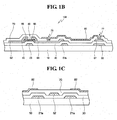
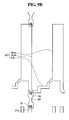
- FIG. 1B is a cross-sectional view of a pixel taken along a line Ib - Ib' of FIG. 1A.
- FIG. 1C is a cross-sectional view of a pixel taken along a line Ic - Ic' of FIG. 1A.
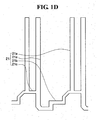
- FIG. 1D is a layout of a floating electrode formed on the TFT substrate of FIG. 1A.
- a gate wiring which comprises a gate line 22 and gate electrode 26 projected from gate line 22 is formed.
- the floating electrode 21 is formed on the insulation substrate 10 and arranged in horizontal direction with vertically extending light blocking pattern 21a near the data line 62.
- the floating electrode 21 of each pixel is, throughout the TFT substrate, interconnected to each other and electrically isolated from external voltage source of the TFT substrate. Alternatively, the interconnected floating electrode 21 throughout the TFT substrate is give a predetermined voltage as long as the floating electrode is effective for vertical crosstalk.
- floating electrode 21 comprises a light blocking pattern 21a, intra-pixel connection pattern 21b, and inter-pixel connection pattern 21c.
- the light blocking pattern 21a is located along the data line 62 to prevent light leakage between the data line 62 and a pixel electrode 82.
- the light blocking pattern 21a may or may not overlap with data line 62. Also, light blocking pattern 21a may or may not overlap with pixel electrode 82.
- a plurality of light blocking patterns 21a may be formed within one pixel. Thus, because every pixel may have the same or similar structure within one horizontal line of the TFT substrate, every pixel may have a plurality of light blocking patterns 21a.
- a plurality of light blocking patterns 21a is connected by an intra-pixel connection pattern 21b of floating electrode 21.
- different pixel's light blocking patterns 21a are connected by an inter-pixel connection pattern 21c of floating electrode 21.
- every light blocking pattern 21a is electrically connected by inter-pixel connection patterns 21c and intra-pixel connection patterns 21b within one horizontal line along gate line 22.
- the whole floating electrode 21 is not electrically connected to external voltage source.
- Previous capacitance type uses storage capacitance by overlapping pixel electrode 82 and previous gate's extended width
- independent capacitance line type uses storage capacitance by overlapping pixel electrode 82 and specially added common voltage (Vcom) line of the same gate metal.
- Vcom common voltage
- gate wiring 22, 26 and floating electrode 21 may include at least one of Al, Al alloy, Ag, Ag alloy, Cu, Cu alloy, Mo, Mo alloy, Cr, Ti and Ta.
- Gate wiring 22, 26 and floating electrode 21 may have a multi-layered structure with conductive layers of different physical characteristics. At least one of the multi-layered structures may be a low resistivity conductive metal of Al, Al alloy, Ag, Al alloy, Cu, or Cu alloy to reduce signal delay or voltage drop of the gate wiring 22, 26 and floating electrode 21.
- at least one layer of the multi-layered structure may be Indium Tin Oxide (ITO) or Indium Zinc Oxide (IZO) friendly material such as Mo, Mo alloy, Cr, Ti, or Ta. Exemplary combinations of low resistivity and good contact characteristics are either lower layer of Cr and upper layer of Al or lower layer of Al and upper layer of Mo.
- the gate wiring and floating electrode material is not limited to the already introduced examples and may be any combination of various conductive materials.
- a gate insulating layer 30 is formed with insulating material such as SiNx.
- semiconductor layer 40 is formed with material such as hydrogenated amorphous silicon or poly-silicon.
- the semiconductor layer 40 may be either line pattern or isolated pattern.
- the isolated pattern semiconductor layer is formed on the gate line 22 as shown in the present invention while the line pattern semiconductor layer may be formed under the data line 62 and extends to the gate line 22 with data line's 62 shape.
- resistive contact layer 55, 56 is formed with highly doped hydrogenated amorphous silicon or silicide.
- the resistive contact layer 55, 56 may be either line pattern or isolated pattern.
- isolated pattern resistive contact layer can be located under the source and drain electrode as in the present invention, whereas the line pattern resistive contact layer may extend under the data line 62.
- data line 62 On the resistive contact layer 55, 56 and gate insulation layer 30, data line 62, source electrode 65 and drain electrode 66 are formed.
- Data line 62 extends vertically to cross the gate line 22.
- Source electrode 65 is projected from the data line 62 and extends to the semiconductor layer 40 while drain electrode 66 on the semiconductor layer is separated from and facing the source electrode 65 with gate electrode 26 in the middle.
- the TFT consists of the gate electrode 22, source electrode 65 and drain electrode 66 and transmits electricity from source electrode 65 to drain electrode 66 when gate electrode 26 receives gate voltage.
- Drain electrode 66 includes a bar type pattern on the semiconductor layer 40 and an extensive area that is elongated from the bar type pattern with contact hole 76.
- the data line 62, source electrode 65 and drain electrode 66 are collectively called data wiring.
- a capacitance electrode 67 of the same material and layer with data line 62 may be formed to overlap the previous gate line 22 by being electrically connected with the pixel electrode 82 via contact hole 77.
- the combination of capacitance electrode 67, previous gate line 22 and intervening gate insulation layer 30 can store capacitance of the liquid crystal layer.
- Data wiring and the capacitance electrode 67 may be either a single layer or multi-layer including at least one of Al, Cr, Mo, Ta and Ti.
- data wiring and capacitance electrodes may be a multi layer of Cr, Mo based material, Ta or Ti in one layer with a lower layer of Cr, Mo based material, Ta or Ti and an upper layer of low resistivity. More specifically, a lower layer of Cr and upper layer of Al, a lower layer of Al and upper layer of Mo, or a lower layer of Mo, middle layer of Al and upper layer of Mo may be used as the multi layered data wiring and capacitance electrode.
- the confronting source electrode 65 and drain electrode 66 at least partially overlap with both gate electrode 26 and semiconductor layer 40 to transmit pixel driving voltage. Additionally, resistive contact layer 55, 56 is sandwiched between a semiconductor layer and either the source electrode 65 or the drain electrode 66 to reduce contact resistance.
- a passivation layer 70 are disposed on the data wiring 62, 65, 66, storage capacitance conductor 67 and exposed semiconductor layer 40.
- the passivation layer may be made of various materials such as inorganic material, organic material, or insulating material with a low dielectric constant.
- inorganic material can be either SiNx or SiOx while organic material may be photosensitive and used for making a flat surface.
- Insulating material with a low dielectric constant is disposed by plasma enhanced chemical vapor deposition (PECVD) and can be either a-Si:C:O or a-Si:O:F. More than two different materials can be used for passivation layer 70.
- PECVD plasma enhanced chemical vapor deposition
- More than two different materials can be used for passivation layer 70.
- an additional bottom layer of inorganic material can be used to prevent the organic material's direct contact with exposed semiconductor layer of TFT.
- Contact holes 76, 77 are formed to partially uncover either a drain electrode 66 or storage capacitance electrode 67.
- pixel electrode 82 is formed along the inner line of each pixel. The pixel electrode 82 is electrically connected to the drain electrode 66 via drain electrode contact hole 76. Further, pixel electrode 82 is electrically connected to the storage capacitance electrode 67 via storage capacitance electrode contact hole 77.
- pixel electrode 82 with a pixel driving voltage can control the arrangement of liquid crystal molecules by causing electric field in cooperation with the common electrode 90 of the common electrode substrate.
- pixel electrode 82 is made of either transparent conductive material such as Indium Tin Oxide (ITO) and Indium Zinc Oxide (IZO) or reflective conductive material such as A1.
- an orientation layer (not shown) may be disposed to setup a basic orientation of the liquid crystal molecules.
- floating electrode 21 extends along data line 62 with at least a partially overlapping relationship.
- a part of pixel electrode closest to the data line overlaps with the floating line, too.
- light blocking pattern 21a of floating electrode 21 is disposed along the data line 62 and partially overlaps with a portion of pixel electrode 82.
- inter-pixel connection electrode 21c partially overlaps with data line 62.
- Liquid crystal molecules around the data line may be undesirably arranged because the electric field from data line 62 is more dominant than the electric field from the pixel electrode. Therefore, light around the data line passes in a wrong direction and light leakage can be seen outside of the LCD panel. However, wrongly directed light can be screened by a pattern around the data line. In FIG. 1A, light blocking pattern 21a screens the wrongly directed light and prevents light leakage.
- the floated light blocking electrode 21a may be electrically coupled to data line 62 and may cause irregular vertical crosstalk of LCD panel.
- each of the light blocking patterns 21a is electrically interconnected to a neighboring light blocking electrode 21a by inter-pixel connection pattern 21c and intra-pixel connection pattern 21b. Now, because the unified floating electrode is not influenced or coupled by or to a specific data line, irregular vertical crosstalk may not be seen.
- unified floating electrode 21 passes a common voltage, liquid crystal molecules around the data line may experience an undesired electric field and be arranged incorrectly because it is being influenced by a common voltage rather than pixel electrode's voltage.
- floating electrode 21 is electrically independent from any other voltage to prevent light leakage.
- FIG. 2 a layout of a pixel of a common electrode substrate is introduced according to one embodiment of the present invention.
- FIG. 3A a layout of a pixel of an assembled LCD panel with a TFT substrate, common electrode substrate and liquid crystal layer is introduced.
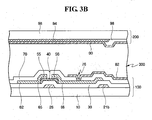
- FIG. 3B shows a cross-sectional view of the LCD panel taken along a line IIIb-IIIb' of FIG. 3A.
- Black matrix 94 is formed on a transparent glass substrate 96.
- Black matrix 94 is also disposed around each of the pixels to prevent undesired light's transmitting.
- Black matrix 94 may be made of at least one such as Cr, metal oxide such as CrOx and organic material.
- color filter 98 is disposed to transmit red, green or blue light.
- An additional overcoat layer (not shown) may be formed on the color filter layer 98 and black matrix 94 to cover an uneven color filter layer and make one flat surface.
- transparent common electrode layer 90 of ITO or IZO is formed on either color filter layer 98 or overcoat layer.
- a supplemental orientation layer (not shown) may be coated on the common electrode layer 90 to align liquid crystal molecules around the common electrode 90.
- the LCD panel has a liquid crystal layer 300 and combined TFT substrate 100 and common electrode substrate 200.
- color filter 98 of common electrode substrate 200 is aligned to overlap almost exactly with pixel electrode 82 of TFT substrate 100.
- the LCD panel is completed by perpendicularly attaching a pair of polarizers on the outer surface of TFT substrate 100 and common electrode substrate 200.
- the LCD module is completed by assembling the LCD panel, a backlight unit behind the LCD panel and frames encompassing the LCD panel and backlight unit.
- the TFT substrate has a plurality of horizontally extending gate lines (G1, G2... Gn), a plurality of vertically extending data lines (D1, D2... Dm) and a plurality of pixels PX defined by each of gate lines and data lines.
- G1, G2... Gn horizontally extending gate lines
- D1, D2... Dm vertically extending data lines
- PX pixels defined by each of gate lines and data lines.
- each and every of the floating electrodes (FP) is interconnected between pixels in one horizontal line along each gate line and each of the horizontal lines' end points are interconnected to each other. Further, a whole floating electrode is isolated from external voltage source.
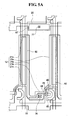
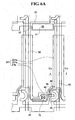
- FIG. 5A is a layout of one pixel of the TFT substrate of the present embodiment
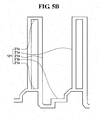
- FIG. 5B is a layout of a floating electrode of FIG. 5A.
- the same elements shown in FIGS. 1 through 4 are expressed with the same reference numeral and corresponding explanations will be omitted.
- every element other than the floating electrode in FIGS. 5A and 5B is the same with the corresponding element in FIGS. 1 through 4.
- FIGS. 5A and 5B a pair of floating electrode's light blocking pattern 21a is interconnected by a plurality of inter-pixel connection patterns 21c. At this point, even though FIGS. 5A and 5B show two inter-pixel connection patterns, the number of inter-pixel connection patterns may be more than two.
- the enlarged overlap area can contribute in reducing the possible overlay difference between neighboring light blocking patterns 21a of floating electrodes 21 of different pixels. Then, the reduced overlay difference may contribute in overcoming the coupling capacitance difference of each data line and each of the light blocking patterns 21a. Thus, irregular vertical crosstalk can be less recognized by a viewer.
- the enlarged overlap area between data line 62 and light blocking pattern 21a can be even more efficient for image quality.
- light entering the data line 62 area can induce unwanted photo current to damage image quality because a photo sensitive semiconductor layer is beneath data line 62.
- the photo current can be suppressed as floating electrode 21 is formed with gate wirings to block light from entering data line 62. Accordingly, image quality can be enhanced.
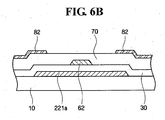
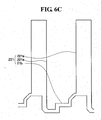
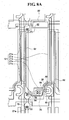
- FIG. 6A is a layout of one pixel of the TFT substrate of the present embodiment while FIGS. 6B and 6C are cross-sectional views of a pixel taken along a line VIb - Vib' of FIG. 6A and layout of floating electrode of FIG. 6A respectively.
- FIGS. 5A and 5B are expressed with the same reference numerals and corresponding explanations will be omitted.
- every element other than the floating electrode in FIGS. 6A through 6C is the same as the corresponding element in FIGS. 5A and 5B.
- floating electrode 221 of FIGS. 6A through 6C consists of a light blocking pattern 221a overlapping data line 62 and inter-pixel connection pattern 21b connecting a pair of light blocking patterns 221a within one pixel. More specifically, light blocking pattern 221a may be wide enough to fully overlap in at least one horizontal direction with data line 62. Further, light blocking pattern 221a may be widened to partially overlap with a pair of pixel electrodes 82 next to one data line 62. Similar to the embodiment of FIGS. 5A and 5B, the semiconductor layer may be under the data line 62. Consequently, the widened light blocking pattern 221a may lessen the recognition of vertical crosstalk and photo leakage occurring on the semiconductor layer beneath the data line 62.
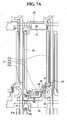
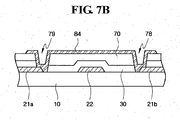
- FIG. 7A is a layout of one pixel of the TFT substrate of the present embodiment while FIGS. 7B and 7C are cross-sectional views of a pixel taken along a line VIIb - VIIb' of FIG. 7A and a layout of the floating electrode and bridge electrode of FIG. 7A respectively.
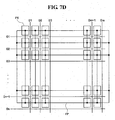
- FIG. 7D shows a simplified LCD panel of this embodiment.
- the same elements shown in FIGS. 1A through 4 are expressed with the same reference numerals and corresponding explanations will be omitted.
- every element other than the bridge electrode in FIGS. 7A through 7D is the same as the corresponding element in FIGS. 1A through 4.
- a vertically extending bridge electrode 84 electrically connects different pixel's different floating electrodes 21. More specifically, bridge electrode 84 electrically connects the intra-pixel connecting pattern 21b of one pixel and light blocking pattern 21a of the other pixel.
- bridge electrode 84 may be the same material with pixel electrode 82 on the same layer.
- floating electrode FP covers all the pixels PX of the TFT substrate which are inter connected to each other while the floating electrode is isolated from outer circuits. More specifically, floating electrode FP is formed on every row of pixels to extend in parallel with the gate lines of the TFT substrate. Each end portions of respective floating electrodes are connected to each other. Finally, respective floating electrodes are electrically connected to each other within the image display area by bridges extended in the data line direction.
- every floating electrode within the display area of the panel bears uniform floating potential all over the TFT panel because horizontally extending floating electrodes are vertically connected by vertically extending bridge electrodes. Evenly distributed floating potential can prevent uneven coupling between data lines and floating electrodes of each pixel to minimize irregular vertical crosstalk by suppressing differently coupled potential between data lines and pixel electrodes of each pixel.
- FIG. 8A is a layout of one pixel of the TFT substrate of the present embodiment
- FIG. 8B is a layout of the floating electrode and bridge electrode of FIG. 8A.
- the same elements shown in FIG. 7A through FIG. 7D are expressed with the same reference numeral and corresponding explanations will be omitted.
- every element other than the shape of the floating electrode in FIGS. 8A and 8B is the same as the corresponding element in FIGS. 7A through 7D.
- the floating pattern of FIGS. 8A and 8B has a pair of light blocking patterns 21a with one data line inbetween and an inter-pixel connection pattern 21c which connects the pair of light blocking patterns 21a.
- the number of inter-pixel connecting pattern may be more than one although FIGS. 8A and 8B shows one inter-pixel connection pattern.
- the semiconductor layer is extended to beneath the data line 62, photo leakage may be incurred by the light entering the semiconductor layer from backlight and cause poor image quality.
- the enlarged overlap area of this embodiment can screen light entering the semiconductor layer and enhance the image quality.
- FIG. 9A is a layout of one pixel of a TFT substrate of present embodiment
- FIG. 9B is a layout of the floating electrode and bridge electrode of FIG. 9A.
- the same elements shown in FIG. 8A through FIG. 8B are expressed with the same reference numeral and corresponding explanations will be omitted.
- every element other than the shape of floating electrode in FIGS. 9A and 9B is the same as the corresponding element in FIGS. 8A and 8B.
- the floating electrode 21 of FIGS. 9A and 9B comprises a light blocking pattern 21a overlapping with data line 62 and an intra-pixel connecting pattern 21b.
- the light blocking pattern 21a may be wide enough to fully cover the data line 62 with a bigger width than the data line's width at least in one horizontal direction.
- the light blocking pattern 21a may be also partially overlapped with pixel electrodes 82 disposed along with data line 62.
- the enlarged light blocking pattern is effective for controlling irregular vertical crosstalk. Moreover, the enlarged light blocking pattern 21a is even more effective when the TFT substrate has a semiconductor layer under data line 62 because semiconductor layer is apt to cause a photo leakage current which adversely affects image quality.
Landscapes
- Physics & Mathematics (AREA)
- Nonlinear Science (AREA)
- Engineering & Computer Science (AREA)
- Microelectronics & Electronic Packaging (AREA)
- Mathematical Physics (AREA)
- Chemical & Material Sciences (AREA)
- Crystallography & Structural Chemistry (AREA)
- General Physics & Mathematics (AREA)
- Optics & Photonics (AREA)
- Liquid Crystal (AREA)
- Devices For Indicating Variable Information By Combining Individual Elements (AREA)
Applications Claiming Priority (2)
| Application Number | Priority Date | Filing Date | Title |
|---|---|---|---|
| KR20060077135 | 2006-08-16 | ||
| KR20060104553A KR20080015696A (ko) | 2006-08-16 | 2006-10-26 | 액정 표시 장치 |
Publications (2)
| Publication Number | Publication Date |
|---|---|
| EP1890188A1 true EP1890188A1 (fr) | 2008-02-20 |
| EP1890188B1 EP1890188B1 (fr) | 2018-10-24 |
Family
ID=38739409
Family Applications (1)
| Application Number | Title | Priority Date | Filing Date |
|---|---|---|---|
| EP07015869.6A Active EP1890188B1 (fr) | 2006-08-16 | 2007-08-13 | Panneau d'affichage à cristaux liquides doté d une électrode flottante |
Country Status (3)
| Country | Link |
|---|---|
| US (1) | US8400599B2 (fr) |
| EP (1) | EP1890188B1 (fr) |
| JP (1) | JP5328117B2 (fr) |
Cited By (2)
| Publication number | Priority date | Publication date | Assignee | Title |
|---|---|---|---|---|
| US20100224880A1 (en) * | 2009-03-05 | 2010-09-09 | Semiconductor Energy Laboratory Co., Ltd. | Semiconductor device |
| US9659969B2 (en) | 2008-10-03 | 2017-05-23 | Semiconductor Energy Laboratory Co., Ltd. | Display device |
Families Citing this family (17)
| Publication number | Priority date | Publication date | Assignee | Title |
|---|---|---|---|---|
| KR20080015696A (ko) * | 2006-08-16 | 2008-02-20 | 삼성전자주식회사 | 액정 표시 장치 |
| KR101306239B1 (ko) | 2006-11-03 | 2013-09-17 | 삼성디스플레이 주식회사 | 액정 표시 장치 및 그의 불량 화소 복구 방법 |
| KR101383707B1 (ko) * | 2007-07-30 | 2014-04-10 | 삼성디스플레이 주식회사 | 액정 표시 장치 |
| KR101442147B1 (ko) * | 2008-01-30 | 2014-11-03 | 삼성디스플레이 주식회사 | 액정 표시 장치 |
| KR101812935B1 (ko) | 2008-09-12 | 2018-01-30 | 가부시키가이샤 한도오따이 에네루기 켄큐쇼 | 디스플레이 장치 |
| KR102426826B1 (ko) | 2008-09-19 | 2022-08-01 | 가부시키가이샤 한도오따이 에네루기 켄큐쇼 | 반도체 장치 |
| JP5371555B2 (ja) * | 2009-06-02 | 2013-12-18 | 株式会社ジャパンディスプレイ | 液晶表示装置 |
| US8614654B2 (en) * | 2009-07-30 | 2013-12-24 | Apple Inc. | Crosstalk reduction in LCD panels |
| KR20110024602A (ko) * | 2009-09-02 | 2011-03-09 | 엘지디스플레이 주식회사 | 액정표시장치용 어레이 기판 |
| KR20110043166A (ko) * | 2009-10-21 | 2011-04-27 | 삼성전자주식회사 | 표시 기판, 이의 제조 방법 및 이를 포함하는 표시 장치 |
| JP5590403B2 (ja) * | 2011-01-27 | 2014-09-17 | 日本精機株式会社 | 液晶表示装置 |
| CN102566175B (zh) * | 2011-11-25 | 2016-04-27 | 深圳市华星光电技术有限公司 | 一种阵列基板、液晶显示装置及阵列基板制作方法 |
| KR20150078308A (ko) * | 2013-12-30 | 2015-07-08 | 삼성디스플레이 주식회사 | 표시 장치 및 그 리페어 방법 |
| KR102228269B1 (ko) | 2014-07-09 | 2021-03-17 | 삼성디스플레이 주식회사 | 표시 기판 및 이의 제조 방법 |
| CN104810375B (zh) * | 2015-04-28 | 2018-09-04 | 合肥鑫晟光电科技有限公司 | 一种阵列基板及其制作方法和一种显示装置 |
| CN105093752A (zh) * | 2015-08-18 | 2015-11-25 | 深圳市华星光电技术有限公司 | 液晶面板 |
| CN114815419A (zh) * | 2022-03-30 | 2022-07-29 | 长沙惠科光电有限公司 | 像素结构和显示面板 |
Citations (3)
| Publication number | Priority date | Publication date | Assignee | Title |
|---|---|---|---|---|
| EP1037094A2 (fr) * | 1999-03-05 | 2000-09-20 | Sel Semiconductor Energy Laboratory Co., Ltd. | Dispositif d' affichage à matrice active |
| US6525788B1 (en) * | 1998-10-21 | 2003-02-25 | Advanced Display Inc. | Liquid crystal display device |
| US20040263710A1 (en) * | 2003-06-24 | 2004-12-30 | Song Hong Sung | Liquid crystal display panel |
Family Cites Families (6)
| Publication number | Priority date | Publication date | Assignee | Title |
|---|---|---|---|---|
| NL194848C (nl) * | 1992-06-01 | 2003-04-03 | Samsung Electronics Co Ltd | Vloeibaar-kristalindicatorinrichting. |
| JPH10239699A (ja) | 1997-02-25 | 1998-09-11 | Advanced Display:Kk | 液晶表示装置 |
| JP2001281690A (ja) * | 2000-03-31 | 2001-10-10 | Fujitsu Ltd | 液晶表示装置及びその修復方法 |
| JP4353660B2 (ja) | 2001-07-27 | 2009-10-28 | 三洋電機株式会社 | アクティブマトリクス型表示装置 |
| KR100904261B1 (ko) | 2002-12-06 | 2009-06-24 | 엘지디스플레이 주식회사 | 액정 표시 패널 |
| US7372528B2 (en) * | 2003-06-09 | 2008-05-13 | Samsung Electronics Co., Ltd. | Array substrate, method of manufacturing the same and liquid crystal display apparatus having the same |
-
2007
- 2007-07-05 US US11/773,585 patent/US8400599B2/en active Active
- 2007-07-24 JP JP2007191875A patent/JP5328117B2/ja active Active
- 2007-08-13 EP EP07015869.6A patent/EP1890188B1/fr active Active
Patent Citations (3)
| Publication number | Priority date | Publication date | Assignee | Title |
|---|---|---|---|---|
| US6525788B1 (en) * | 1998-10-21 | 2003-02-25 | Advanced Display Inc. | Liquid crystal display device |
| EP1037094A2 (fr) * | 1999-03-05 | 2000-09-20 | Sel Semiconductor Energy Laboratory Co., Ltd. | Dispositif d' affichage à matrice active |
| US20040263710A1 (en) * | 2003-06-24 | 2004-12-30 | Song Hong Sung | Liquid crystal display panel |
Cited By (6)
| Publication number | Priority date | Publication date | Assignee | Title |
|---|---|---|---|---|
| US9659969B2 (en) | 2008-10-03 | 2017-05-23 | Semiconductor Energy Laboratory Co., Ltd. | Display device |
| US10573665B2 (en) | 2008-10-03 | 2020-02-25 | Semiconductor Energy Laboratory Co., Ltd. | Display device |
| US10910408B2 (en) | 2008-10-03 | 2021-02-02 | Semiconductor Energy Laboratory Co., Ltd. | Display device |
| US11574932B2 (en) | 2008-10-03 | 2023-02-07 | Semiconductor Energy Laboratory Co., Ltd. | Display device |
| US12094884B2 (en) | 2008-10-03 | 2024-09-17 | Semiconductor Energy Laboratory Co., Ltd. | Display device |
| US20100224880A1 (en) * | 2009-03-05 | 2010-09-09 | Semiconductor Energy Laboratory Co., Ltd. | Semiconductor device |
Also Published As
| Publication number | Publication date |
|---|---|
| JP5328117B2 (ja) | 2013-10-30 |
| US8400599B2 (en) | 2013-03-19 |
| JP2008046625A (ja) | 2008-02-28 |
| EP1890188B1 (fr) | 2018-10-24 |
| US20080068550A1 (en) | 2008-03-20 |
Similar Documents
| Publication | Publication Date | Title |
|---|---|---|
| EP1890188B1 (fr) | Panneau d'affichage à cristaux liquides doté d une électrode flottante | |
| US9470945B2 (en) | Liquid crystal display panel having a light blocking electrode | |
| JP5371063B2 (ja) | 薄膜トランジスタ表示板及びこれを含む液晶表示装置 | |
| EP2752879B1 (fr) | Panneau à réseau de transistors à couche mince | |
| US20040001170A1 (en) | Liquid crystal display device having array substrate of color filter on thin film transistor structure and manufacturing method thereof | |
| US7880849B2 (en) | Display panel with TFT and gate line disposed between sub-electrodes of pixel electrode | |
| US8030103B2 (en) | Liquid crystal display panel and method of manufacturing the same | |
| KR101293950B1 (ko) | 표시기판 및 이를 갖는 표시패널 | |
| US20070058123A1 (en) | Liquid crystal display | |
| US20050157232A1 (en) | Transflective liquid crystal display | |
| US7851799B2 (en) | Thin film transistor substrate | |
| US7817214B2 (en) | Liquid crystal display device | |
| US20080239187A1 (en) | Thin film transistor array panel and method of manufacturing the same | |
| KR20140119395A (ko) | 액정 표시 장치 | |
| JP2007102226A (ja) | 薄膜トランジスタ表示板 | |
| US7714964B2 (en) | Transflective liquid crystal display | |
| CN1932624B (zh) | 薄膜晶体管显示板与使用该板的液晶显示器 | |
| JP2009251417A (ja) | 液晶表示装置 | |
| US20070211194A1 (en) | Method of manufacturing color filter array panel and liquid crystal display | |
| KR20060092712A (ko) | 액정표시장치 및 그 제조방법 | |
| JP2007199339A (ja) | 液晶装置及び電子機器 | |
| KR20080087507A (ko) | 액정표시장치와 이의 제조방법 | |
| JP2007199338A (ja) | 液晶装置及び電子機器 | |
| JP2006322978A (ja) | 液晶ディスプレイパネルの画素保存コンデンサ構造 |
Legal Events
| Date | Code | Title | Description |
|---|---|---|---|
| PUAI | Public reference made under article 153(3) epc to a published international application that has entered the european phase |
Free format text: ORIGINAL CODE: 0009012 |
|
| AK | Designated contracting states |
Kind code of ref document: A1 Designated state(s): AT BE BG CH CY CZ DE DK EE ES FI FR GB GR HU IE IS IT LI LT LU LV MC MT NL PL PT RO SE SI SK TR |
|
| AX | Request for extension of the european patent |
Extension state: AL BA HR MK YU |
|
| 17P | Request for examination filed |
Effective date: 20080812 |
|
| 17Q | First examination report despatched |
Effective date: 20080916 |
|
| AKX | Designation fees paid |
Designated state(s): DE FR GB NL |
|
| RAP1 | Party data changed (applicant data changed or rights of an application transferred) |
Owner name: SAMSUNG ELECTRONICS CO., LTD. |
|
| RAP1 | Party data changed (applicant data changed or rights of an application transferred) |
Owner name: SAMSUNG DISPLAY CO., LTD. |
|
| RAP1 | Party data changed (applicant data changed or rights of an application transferred) |
Owner name: SAMSUNG DISPLAY CO., LTD. |
|
| GRAP | Despatch of communication of intention to grant a patent |
Free format text: ORIGINAL CODE: EPIDOSNIGR1 |
|
| INTG | Intention to grant announced |
Effective date: 20180627 |
|
| GRAS | Grant fee paid |
Free format text: ORIGINAL CODE: EPIDOSNIGR3 |
|
| GRAA | (expected) grant |
Free format text: ORIGINAL CODE: 0009210 |
|
| AK | Designated contracting states |
Kind code of ref document: B1 Designated state(s): DE FR GB NL |
|
| REG | Reference to a national code |
Ref country code: GB Ref legal event code: FG4D |
|
| REG | Reference to a national code |
Ref country code: DE Ref legal event code: R096 Ref document number: 602007056566 Country of ref document: DE |
|
| REG | Reference to a national code |
Ref country code: NL Ref legal event code: FP |
|
| REG | Reference to a national code |
Ref country code: DE Ref legal event code: R097 Ref document number: 602007056566 Country of ref document: DE |
|
| PLBE | No opposition filed within time limit |
Free format text: ORIGINAL CODE: 0009261 |
|
| STAA | Information on the status of an ep patent application or granted ep patent |
Free format text: STATUS: NO OPPOSITION FILED WITHIN TIME LIMIT |
|
| 26N | No opposition filed |
Effective date: 20190725 |
|
| P01 | Opt-out of the competence of the unified patent court (upc) registered |
Effective date: 20230515 |
|
| PGFP | Annual fee paid to national office [announced via postgrant information from national office to epo] |
Ref country code: NL Payment date: 20250722 Year of fee payment: 19 |
|
| PGFP | Annual fee paid to national office [announced via postgrant information from national office to epo] |
Ref country code: DE Payment date: 20250721 Year of fee payment: 19 |
|
| PGFP | Annual fee paid to national office [announced via postgrant information from national office to epo] |
Ref country code: GB Payment date: 20250722 Year of fee payment: 19 |
|
| PGFP | Annual fee paid to national office [announced via postgrant information from national office to epo] |
Ref country code: FR Payment date: 20250725 Year of fee payment: 19 |