EP1890228A2 - Production automatique d'une application - Google Patents
Production automatique d'une application Download PDFInfo
- Publication number
- EP1890228A2 EP1890228A2 EP07015690A EP07015690A EP1890228A2 EP 1890228 A2 EP1890228 A2 EP 1890228A2 EP 07015690 A EP07015690 A EP 07015690A EP 07015690 A EP07015690 A EP 07015690A EP 1890228 A2 EP1890228 A2 EP 1890228A2
- Authority
- EP
- European Patent Office
- Prior art keywords
- platform
- application
- code
- model
- parameters
- Prior art date
- Legal status (The legal status is an assumption and is not a legal conclusion. Google has not performed a legal analysis and makes no representation as to the accuracy of the status listed.)
- Ceased
Links
Images

Classifications
-
- G—PHYSICS
- G06—COMPUTING OR CALCULATING; COUNTING
- G06F—ELECTRIC DIGITAL DATA PROCESSING
- G06F21/00—Security arrangements for protecting computers, components thereof, programs or data against unauthorised activity
- G06F21/70—Protecting specific internal or peripheral components, in which the protection of a component leads to protection of the entire computer
- G06F21/71—Protecting specific internal or peripheral components, in which the protection of a component leads to protection of the entire computer to assure secure computing or processing of information
- G06F21/77—Protecting specific internal or peripheral components, in which the protection of a component leads to protection of the entire computer to assure secure computing or processing of information in smart cards
-
- G—PHYSICS
- G06—COMPUTING OR CALCULATING; COUNTING
- G06F—ELECTRIC DIGITAL DATA PROCESSING
- G06F8/00—Arrangements for software engineering
- G06F8/30—Creation or generation of source code
- G06F8/35—Creation or generation of source code model driven
-
- G—PHYSICS
- G06—COMPUTING OR CALCULATING; COUNTING
- G06F—ELECTRIC DIGITAL DATA PROCESSING
- G06F2221/00—Indexing scheme relating to security arrangements for protecting computers, components thereof, programs or data against unauthorised activity
- G06F2221/21—Indexing scheme relating to G06F21/00 and subgroups addressing additional information or applications relating to security arrangements for protecting computers, components thereof, programs or data against unauthorised activity
- G06F2221/2153—Using hardware token as a secondary aspect
Definitions
- the present invention relates to a method for generating an application code executable on a target platform of portable data carriers and / or application data of an application as well as such a device.
- MDA Model Driven Architecture
- the DE 100 08632 B4 describes a method of assisting programmers in developing a source code program.
- the programming can take place here either on an easier-to-use graphic user level in the form of flowcharts and graphic sequence symbols, or on a technical programming level in the form of a direct development of the source code program.
- a script-language interface Using a script-language interface, a flowchart can be converted into the corresponding source code.
- this system is not suitable for platform-independent development of executable applications for specialized target platforms.
- the object of the present invention is to allow a comfortable platform-independent application development while optimally adapting the application code and / or the application data to the underlying platform.
- An application code and / or application data of an application for a particular target platform is automatically generated by a multi-stage process from a platform-independent application model representing that application.
- a device for generating an application code and / or application data executable on the target platform from the platform-independent application model comprises for this purpose a model modifier which generates a platform-specific application model from the platform-independent application model, an application generator which generates an application code and / or application data from the platform-dependent application model and a code modifier that optimizes the generated application code and / or the generated application data by matching the application code as comprehensively as possible to the technical characteristics and features of the target platform.
- This optimization of the application code is performed by the (code or also) platform modifier on the basis of platform parameters that define or reproduce platform-dependent technical characteristics of the target platform, which are integrated into it when the application code is optimized.
- the creation of the platform-specific application model from the platform-independent application model is based on platform model parameters integrated into the application model that represent technical characteristics of the type of target platform.
- the necessary adaptation of the application to the target platform is thereby achieved by introducing platform-specific information into the respective representation of the application in the implementation of the platform-independent application model in the platform-dependent application model by the model modifier and on the other hand in the optimization of the application code by the code modifier.
- the platform type parameters introduced by the model modifier and the platform parameters introduced by the code modifier are again at different abstraction levels, since the platform type parameters specify or render platform information that can be used at the abstract model level, while the platform parameters provide specific technical details of the target platform or even the platform specify or play back the disk that you want to apply directly to the specific application code level.
- the platform type parameters and the platform parameters are extracted and used by the model modifier or code modifier from appropriate memory of the device as needed.
- parameter eg platform type parameter or platform parameter
- the term parameter is not primarily the respective parameter value but in particular the platform-specific technical contents and features described below, for which a parameter value stands, and which are incorporated into the application model or the application code in order to produce a respectively higher degree of adaptation of the application model or the application code to the platform.
- the abstract level of the platform-independent application model is preceded by a further, more abstract development level, which provides a plurality of meta-models in a memory of the device, each representing a particular type of application of the applications appropriate to the target platform of interest.
- These meta-models provide a further level of abstraction in application development that provides the application developer with more development convenience and even more complete abstraction from the platform-specific features of the target platform or volume.
- a meta-model preferably describes those features and functions of an application that all applications of the particular application type have in common. From such a meta-model, the application developer can, for example, design the platform-independent application model by means of a graphical user interface by adding specific functions and properties of the relevant application, such as interfaces to other functions, to the selected meta-model.
- Such meta-models may, for example, be provided for application types such as SIM toolkit applications for mobile radio cards, stock exchange applications or cryptographic applications to provide the application developer with a framework for developing the application.
- the platform type parameters used by the model modifier to create the platform-specific application model preferably include, but are not limited to, security parameters and / or interface parameters.
- the interface parameters define the programming interface (API) of the operating system of the target platform in order to integrate these programming interfaces of the operating system when creating the platform-specific application model and to be able to access them correctly during the generation of the application code by the code generator.
- the interface parameters may also include the storage space provided by the target platform for an application, a particular runtime environment, such as. For example, a Java Card Runtime Environment (JCRE), a .NET runtime environment (CLR) or other virtual machine, program and system libraries, communication interfaces, and other features of the target platform.
- JCRE Java Card Runtime Environment
- CLR .NET runtime environment
- the platform type parameters may also include security parameters pertaining to a particular security policy or security properties of the target platform that may already be integrated into the platform-specific application model at the model level.
- security parameters are, for example, certain authentication methods that have to be run through by a user authenticating to the data carrier, as well as an intended rights management of the target platform, which reproduce the access privileges of different user groups to the data and resources of the data carrier.
- the platform parameters introduced by the code modifier at the application code level are preferably configuration parameters and / or personalization parameters, but are not limited thereto.
- the configuration parameters relate in particular to information about the implementation of the operating system and its details, so that the configuration parameters generally take into account the components of the operating system that are not visible or unchangeable to the application developer. Such implementation details are usually directly dependent on the type of operating system, e.g. Java Card 2.0, Java Card 2.1, Multos, or a native or multi-tasking system.
- the configuration parameters can also reflect or set the priority management of a multitasking system, a resource management or the memory allocation of the data carrier as well as a performance optimization.
- the personalization parameters may include, in addition to the personal data required for personalization of the volume to a particular user, such as personal data.
- personal data As cryptographic keys, names and addresses, and the like, including information on the initialized during the initialization of a portable data carrier, such as a smart card, data structure.
- the required platform type parameters and / or platform parameters, together with data, contents or method steps representing the technical features designated by the respective parameter, are read from the parameter database by the code modifier or the model modifier and used accordingly for the technical specification of the application.
- the parameters are usually technically conditioned by the target platform or are specified by the manufacturer or publisher of the data carrier.
- the interface parameters and / or the configuration parameters can be predetermined by the type of the target platform or the target platform itself, while the security parameters can be set individually by the manufacturer of the data carrier with regard to its technical equipment or its usual field of application.
- certain parameters are first determined by the application developer, such as the personalization parameters.
- the device may include a suitable input device.
- the device may include a reader to access the portable volume for which the application is being developed and to determine its destination platform.
- the target platform comprises information about the operating system of the data carrier and / or about the hardware of the data carrier itself, e.g. Information about the processor, communication interfaces, features and the like.
- Operating systems which are suitable in connection with the present invention are, in particular, Java Card, Multos, .NET, but also native operating systems and multitasking operating systems, each of these operating systems in turn having at least one application code format which can either be executed directly or at least by an interpreter or a virtual machine are immediately interpretable.
- portable data carriers on which such a target platform can be set up in particular chip cards, smart cards, mobile radio cards, secure multimedia cards and the like come into question.
- the platform-independent and platform-dependent application models typically do not represent conventional executable or translatable applications Programming languages, but are developed in special modeling or description languages, such as B. UML or XML ("Extended Markup Language").
- the code generator then converts such a UML or XML representation into an application code which can be executed or interpreted at least indirectly by the data carrier.
- the code generator directly from the platform-specific application model generates an immediately executable application code or a source code format, which must be translated by a translator before execution.
- Java servlets / applets Java bytecode, other native code, Multos MEL code ("Multos Executable Language”), NET CIL code ("Common Intermediate Language”) or the like come into question as directly executable code formats .
- the code modifier either optimizes the immediately executable or interpretable application code or translates the source code into an immediately executable or interpretable application code.
- the Model Driven Architecture (MDA) approach provides a step-by-step development process through a cascade of platform-specific representations of the application from a sufficiently abstract model level to a sufficiently platform-specific application code level.
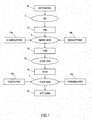
- Fig. 1 shows a process flow of an application development according to the invention and in Fig. 2 a development device that enables the application developer to implement the development approach for application code comfortably.
- the data carrier is a chip card 10, which runs under the special chip card operating system "Java Card”, via its runtime environment (JCRE, "Java Card Runtime Environment”) or via This connected virtual machine can interpret as application code formats at least Java Applets or Java bytecode.
- the development device 1 comprises, in addition to a control unit 2 (CNTL), which comprises the components 4, 5; 6, 7 in an orderly development process activates and controls a Graphical User Interface (GUI) 4, a Model Modifier 5 (MODEL MOD), a Code Generator 6 (CODE GEN), and a Code Modifier 7 (CODE MOD).
- GUI Graphical User Interface
- MODEL MOD Model Modifier 5
- CODE GEN Code Generator 6
- CODE MOD Code Modifier 7
- These components 4, 5, 6, 7 can all be configured as software components of a conventional personal or other computer, which is activated by the control unit, 2 as the main program and be executed by a processor (not shown).
- the developing device 1 can therefore be both a conventional personal computer and a specialized computer-aided design environment with other components not shown in FIG.
- the development device 1 comprises a parameter database 8 and a memory 3 different therefrom and a reading device 9, via which the development device 1 can interact with and access the chip card 10 (CARD), in particular in order to determine its target platform 13 at least the operating system 11 (OS) and the individual hardware components 12 (HW) comprises.
- CDA chip card 10
- OS operating system 11
- HW individual hardware components 12
- the developing device 1 shown in Fig. 2 implements the developing method shown in Fig. 1 and thus constitutes an application development tool which enables an application developer, preferably by means of graphic tools, to create an abstract application model of the application to be developed, according to this application model then automatically for a particular platform 13, ie for a specific hardware 12 and a specific operating system software 11 of the smart card 10 to automatically transform into an executable and optimized application code 20.
- the starting point of the development process illustrated in FIG. 1 is a multiplicity of meta-models 16, 16a-16d (META MODEL), which are predetermined, for example, by the chip card manufacturer and can be stored in the memory 3.
- the meta-models 16, 16a-16d each represent prototypes for a particular type of application, such as SIM toolkit applications for cellphone cards, stock exchange / account applications, or signature applications that encompass as many functions as possible, all applications of the particular application type.
- meta models for individual Functions be predetermined. In this way, an application developer will be provided with a structure or framework for its development.
- the meta-models 16, 16a-16d also provide an early verification of whether a planned application on a particular platform type is feasible at all, since in general only those applications should be realized which are in a meta-model 16 provided by the development device 1, 16a-16d, the relevant platform 13 arrange.
- an application that aims to allow a user of a mobile station to request the account balance at his bank would fall under a meta-model 16 "banking" for the destination platform 13 of a mobile card and thus be feasible for that destination platform 13.
- the selection of a corresponding meta-model 16, 16a-16d which is also supported by the development device 1 via its graphical user interface 4, thus constitutes the beginning of the development process.
- the application developer uses the graphical user interface 4 to create a platform-independent application model 17 ("PIM", “Platform Independent Model”).
- PIM Platform-independent application model
- This is created by supplementing the selected meta-model 16 on the graphical user interface 4 with the logical sequence of the application code 20 to be developed, for example a Java applet, by graphical elements, for example in the form of a flowchart.
- these elements only define the program flow as well as abstract functionalities of the application and their internal flow of information to a largely abstract and completely independent of the target platform 13 by control structures, without the technical details and platform-specific knowledge already flow into the platform-independent application model 17.
- the meta-model 16 points to this Initially, for example, only those elements and relations that are prototypical for the corresponding application type.
- the platform-independent application model 17 then shows the structure and / or the behavior of a specific application of the meta-model 16, thus representing an instance of the meta-model 16.
- the platform-independent model 17 is automatically converted by the model modifier 5 into a Platform-Specific Model (PSM) 17 by integrating into the platform-independent model 17 platform type parameters 14a, 14b, which the model modifier 5 from the parameter database 8 extracts.
- the platform type parameters 14a, 14b can define any technical details for which the application is being developed and which can already be integrated into the application at the model level. These include in particular the interface parameters 14a (INTERFACE PAR), which i.a. Determine how much memory is available for the application, which runtime environment is available in which version, eg. As Java Card or .NET or the like, and other performance characteristics and levels of expansion of the platform type concerned, existing libraries, special functionalities such.
- the interface parameters 14a may be e.g. also specify the programming interfaces provided by the operating system software 11 of the data carrier 10, e.g. Eg Java Card Runtime Environment (JCRE), Multos Executable Language (MEL) or .NET CIL.
- JCRE Java Card Runtime Environment
- MEL Multos Executable Language
- NET CIL e.g.
- a platform type parameters 14a, 14b and security parameter 14b can be integrated into the platform-dependent model 18, for example, the general security policy of data carriers 10 with the present platform 13 set, ie the security features of the platform 13, such.
- the user rights model used and / or a model for access control eg, Bell-La Padula
- Suitable security policies for a chip card 10 which can already be integrated at the model level, include, for example, the "Global Platform Card Specification" or the GSM specifications 02.48 and 03.48 "Security mechanism for SIM application toolkit".
- Platform type parameters 14a, 14b e.g. the mentioned interface parameters 14a and safety parameters 14b can already be specified by the manufacturer of the chip card 10 on the one hand by the technical specification of the platform 13.
- the platform parameters 14a, 14b, together with all the data, contents, specifications, scripts, and the like, are stored in the parameter database 8 of the development device 1, which requires the correct integration of the technical details specified by the platform type parameters 14a, 14b into the platform-dependent model 18 become. If a platform type parameter 14a, 14b has not been specified or needs to be determined by the manufacturer of the smart card 10, this may also be determined by the particular application developer, e.g. depending on the respective security policy and in the form of a selection of several possible alternatives.
- platform type parameters 14a, 14b into the platform-independent application model 17 to create the platform-dependent application model 18, those technical details and features relating to the platform type of the volume 10, ie, a common operating system 11, are integrated into the application model or a common underlying hardware 12 of all volumes 10 with the relevant platform 13.
- the various training models, 17,18 and the meta-models 16,16a-16d are not in a conventional programming language, but are usually by appropriate modeling or description languages, such as.
- UML or XML which are particularly suitable for the modeling of software and systems.
- Such languages define identifiers for the terms needed in the modeling as well as the relations between these terms.
- the code generator 6 automatically generates the application code 19 (CODE) from the platform-dependent application model 18, which may conveniently be in a conventional programming language format that can either be executed directly (e.g., machine language) or interpreted by the target platform 13 or its operating system 11, e.g. the platform-independent intermediate languages .NET CIL or Java bytecode interpreted by a virtual machine.
- the programming language format of the application code 19 may also be a source language for which the target platform provides a translator ("compiler").
- the implementation of the platform-dependent application model 18 into an application code 19 thus represents a further technical concretization step, from a cross-platform and more abstract and problem-oriented modeling language to the application code 19, which is now present in an application code format adapted to the platform 13.
- the application code 19 is automatically optimized by the code modifier 7 with respect to the technical features of the platform 13 defined by the platform parameters 15a, 15b to produce the final optimized application code 20 (OPT CODE) and send it to the underlying platform 13 of the Chip card 10 adapt.
- the optimization step may consist in a translation so that the code modifier 7 can then be designed substantially as a translator (compiler).
- the optimization of the application code 19 is then also to perform a compiler optimization with regard to a particularly efficient translation.
- a translation step may translate a Java source code into a Java applet that represents the optimized, directly executable application code 20.
- the code modifier 7 essentially performs an optimization with regard to the platform parameters 15a, 15b.
- the platform parameters 15a, 15b can u. a.
- Configuration parameters include 15a (CONFIG PAR) and Personalmaschinesparameter 15b (PERSONAL PAR), which takes the code modifier 7 to perform the optimization of the parameter database 8.
- the configuration parameters 15a include, for example, performance specifications for the specific platform 13, e.g. As settings of optimal or desired memory loads, platform-specific features of the respective operating system 11 and the like, or, if a multitasking system is present information on priority management, resource management, memory allocation and opportunities for performance optimization.
- the configuration parameters 15a include implementation details of the operating system 11 to which an application developer usually has no access, but which he must accept as a constraint in application development.
- the personalization parameters 15b if it is in the disk 10.um a personalisable disk, such. Eg account or money cards or the like.
- Such personalization parameters 15a may include personalization data, such as personalization data.
- personal files and cryptographic keys of the future owner of the disk 10 include, but also information on the initialization of a smart card 10 applied data structure.
- the platform parameters 15a, 15b represent such information, conditions and technical facts of the platform 13, which relate directly to the technical design of the platform 13 and also of the individual individual data carrier 10.
- the platform type parameters 14a, 14b and the platform parameters 15a, 15b it is typically the case that they are sent directly from the manufacturer of the data carrier 10 or at least from its publisher to the end customer, e.g. a bank or a mobile network operator, and are available as such in the parameter database 8 available.
- the development device 1 may comprise an input device (not shown) via which the application developer can individually input the information during the development process.
- the platform 13 can be read out from the chip card 10 directly as a basis for the step-by-step development process via a corresponding read interface 9.
- the reading interface 9 may be, for example, a chip card reader, which reads out the relevant operating system 11 and hardware information 12 of the platform 13.
- the development device 1 gets on the one hand information about the specific hardware equipment 12 of the smart card 10, eg memory space, processor type, existing interfaces and the like, and on the other hand about the present on the smart card 10 operating system, for.
- Java Card 2.0, Java Card 2.1, Multos or the like As Java Card 2.0, Java Card 2.1, Multos or the like.
- this information then flows into the selection of possible meta-models 16, 16a-16d, since the application types which are potentially realizable by the chip card 10 and predetermined by the meta-models 16, 16a-16d also depend on the platform 13.
- the read out information to the target platform 13 then -. used by the controller 2 - to make a preselection or restrictions of the platform type parameters 14a, 14b and the platform parameters 15a, 15b, which relate to the determined platform type.
- the platform information thus influences in particular also the platform type parameters 14a, 14b and platform parameters 15a, 15b taken into account by the model modifier 5 and the code modifier 7, since these are precisely matched to the respectively present platform 13.
- optimized application data can also be generated.
- the optimized application data is generated along with the optimized application code.
- the invention can also be used to design the production process of a smart card.
- the software manufacturing process can be flexibly defined in UML via the subject of the invention.
- production parameters 14a, 14b, 15a, 15b
- UML meta-model Arranging these scripts defines the process for producing the card according to customer requirements.
- the subject invention can be extended to cards with magnetic stripes and memory cards in these production processes. A separate process environment on the chip card is not absolutely necessary if only data is provided via the described processes.
Landscapes
- Engineering & Computer Science (AREA)
- Theoretical Computer Science (AREA)
- Software Systems (AREA)
- General Engineering & Computer Science (AREA)
- Physics & Mathematics (AREA)
- General Physics & Mathematics (AREA)
- Computer Hardware Design (AREA)
- Mathematical Physics (AREA)
- Computer Security & Cryptography (AREA)
- Stored Programmes (AREA)
Applications Claiming Priority (1)
| Application Number | Priority Date | Filing Date | Title |
|---|---|---|---|
| DE200610038876 DE102006038876A1 (de) | 2006-08-18 | 2006-08-18 | Automatisches Erzeugen von lauffähigem Anwendungscode |
Publications (2)
| Publication Number | Publication Date |
|---|---|
| EP1890228A2 true EP1890228A2 (fr) | 2008-02-20 |
| EP1890228A3 EP1890228A3 (fr) | 2010-03-24 |
Family
ID=38669498
Family Applications (1)
| Application Number | Title | Priority Date | Filing Date |
|---|---|---|---|
| EP07015690A Ceased EP1890228A3 (fr) | 2006-08-18 | 2007-08-09 | Production automatique d'une application |
Country Status (2)
| Country | Link |
|---|---|
| EP (1) | EP1890228A3 (fr) |
| DE (1) | DE102006038876A1 (fr) |
Cited By (6)
| Publication number | Priority date | Publication date | Assignee | Title |
|---|---|---|---|---|
| WO2014040724A1 (fr) * | 2012-09-11 | 2014-03-20 | Giesecke & Devrient Gmbh | Gestion de contenu pour station mobile dotée d'un environnement d'exécution |
| CN110244950A (zh) * | 2018-03-07 | 2019-09-17 | 深圳芯承电子科技有限公司 | 一种嵌入式汇编程序生成设备和方法 |
| US20200065870A1 (en) * | 2010-12-28 | 2020-02-27 | Amazon Technologies, Inc. | Managing use of software components |
| WO2020244886A1 (fr) * | 2019-06-03 | 2020-12-10 | Daimler Ag | Système de génération de matériau cryptographique |
| CN114185551A (zh) * | 2022-02-17 | 2022-03-15 | 浙江口碑网络技术有限公司 | 小程序的编译方法、小程序的运行方法及装置、存储介质 |
| CN118642702A (zh) * | 2024-08-15 | 2024-09-13 | 浪潮云洲工业互联网有限公司 | 一种跨平台代码生成方法、装置、设备及存储介质 |
Families Citing this family (1)
| Publication number | Priority date | Publication date | Assignee | Title |
|---|---|---|---|---|
| US10296305B2 (en) | 2013-09-27 | 2019-05-21 | Rudolf Markus PETRI | Method and device for the automated production and provision of at least one software application |
-
2006
- 2006-08-18 DE DE200610038876 patent/DE102006038876A1/de not_active Withdrawn
-
2007
- 2007-08-09 EP EP07015690A patent/EP1890228A3/fr not_active Ceased
Non-Patent Citations (1)
| Title |
|---|
| None * |
Cited By (11)
| Publication number | Priority date | Publication date | Assignee | Title |
|---|---|---|---|---|
| US20200065870A1 (en) * | 2010-12-28 | 2020-02-27 | Amazon Technologies, Inc. | Managing use of software components |
| US12051096B2 (en) * | 2010-12-28 | 2024-07-30 | Amazon Technologies, Inc. | Managing use of software components |
| WO2014040724A1 (fr) * | 2012-09-11 | 2014-03-20 | Giesecke & Devrient Gmbh | Gestion de contenu pour station mobile dotée d'un environnement d'exécution |
| US9591488B2 (en) | 2012-09-11 | 2017-03-07 | Giesecke & Devrient Gmbh | Contents management for mobile station having runtime environment |
| CN110244950A (zh) * | 2018-03-07 | 2019-09-17 | 深圳芯承电子科技有限公司 | 一种嵌入式汇编程序生成设备和方法 |
| CN110244950B (zh) * | 2018-03-07 | 2023-05-30 | 深圳芯承电子科技有限公司 | 一种嵌入式汇编程序生成设备和方法 |
| WO2020244886A1 (fr) * | 2019-06-03 | 2020-12-10 | Daimler Ag | Système de génération de matériau cryptographique |
| US12359925B2 (en) | 2019-06-03 | 2025-07-15 | Mercedes-Benz Group AG | System for generating cryptographic material |
| CN114185551A (zh) * | 2022-02-17 | 2022-03-15 | 浙江口碑网络技术有限公司 | 小程序的编译方法、小程序的运行方法及装置、存储介质 |
| CN114185551B (zh) * | 2022-02-17 | 2022-06-21 | 浙江口碑网络技术有限公司 | 小程序的编译方法、小程序的运行方法及装置、存储介质 |
| CN118642702A (zh) * | 2024-08-15 | 2024-09-13 | 浪潮云洲工业互联网有限公司 | 一种跨平台代码生成方法、装置、设备及存储介质 |
Also Published As
| Publication number | Publication date |
|---|---|
| EP1890228A3 (fr) | 2010-03-24 |
| DE102006038876A1 (de) | 2008-02-21 |
Similar Documents
| Publication | Publication Date | Title |
|---|---|---|
| DE602004009039T3 (de) | Halbleiterspeicherkarte und programm zu ihrer steuerung | |
| DE102009013384B4 (de) | System und Verfahren zur Bereitstellung einer sicheren Anwendungsfragmentierungsumgebung | |
| DE60011615T3 (de) | Techniken zum erlauben von zugang durch eine kontextsperre in einem kleinen gerät unter verwendung von globalen datenstrukturen | |
| EP1890228A2 (fr) | Production automatique d'une application | |
| DE10393859B4 (de) | Entkoppelter Hardwarekonfigurationsmanager | |
| DE202009019148U1 (de) | Dateisystemzugriff für Web-Anwendungen und native Kodemodule | |
| DE112010003925T5 (de) | Erweiterbare Zugriffssteuerungslisten-Grundstruktur | |
| DE60010433T2 (de) | Verfahren zur durchführung von sicherheitvorgaben in einem kleingerät unter verwendung von einer kontextsperre | |
| DE102011015711A1 (de) | Aktualisierung einer Datenträgerapplikation | |
| DE10333087A1 (de) | Verfahren zum automatischen Zerlegen von dynamischen Systemmodellen in Teilmodelle | |
| DE112012004793T5 (de) | Verfahren und System zum Erzeugen einer virtuellen Anwendung | |
| DE102009006882A1 (de) | Anwendung plattformabhängiger Routinen in virtuellen Maschinen durch Einbetten einer nativen Codierung in Klassendateien | |
| EP2885907B1 (fr) | Procédé d'installation des applications de sécurite dans un élèment de sécurité d'un terminal | |
| EP2987078B1 (fr) | Procédé de chargement d'une application sur un module de sécurité et module de sécurité de ce type | |
| EP3070690A1 (fr) | Carte à puce et procédé de modification logicielle d'une carte à puce | |
| DE602004007368T2 (de) | Verfahren zum verwalten eines in einem umprogrammierbaren onboard-system heruntergeladenen ausführbaren codes | |
| EP3329415B1 (fr) | Carte a puce avec une application principale et une application persistante permettant de mettre a jour l'application principale sans modifier les donnees d'utilisateur stockees dans l'application persistante | |
| CN117251143B (zh) | 一种应用系统、构建方法及其可视化开发工具的实现方法 | |
| DE102004058882A1 (de) | Erzeugen von Programmcode in einem Ladeformat und Bereitstellen von ausführbarem Programmcode | |
| EP3912021B1 (fr) | Génération dynamique d'une compatibilité des systèmes de fichiers en temps réel | |
| EP2112595A2 (fr) | Support de données portatif | |
| EP1920328B1 (fr) | Commutation de code d'operation | |
| DE102005056357A1 (de) | Multithreading-fähige virtuelle Maschine | |
| EP2573677B1 (fr) | Échange de données entre des applications | |
| DE102005059248A1 (de) | Erzeugung von Programmcode für einen tragbaren Datenträger |
Legal Events
| Date | Code | Title | Description |
|---|---|---|---|
| PUAI | Public reference made under article 153(3) epc to a published international application that has entered the european phase |
Free format text: ORIGINAL CODE: 0009012 |
|
| AK | Designated contracting states |
Kind code of ref document: A2 Designated state(s): AT BE BG CH CY CZ DE DK EE ES FI FR GB GR HU IE IS IT LI LT LU LV MC MT NL PL PT RO SE SI SK TR |
|
| AX | Request for extension of the european patent |
Extension state: AL BA HR MK YU |
|
| PUAL | Search report despatched |
Free format text: ORIGINAL CODE: 0009013 |
|
| AK | Designated contracting states |
Kind code of ref document: A3 Designated state(s): AT BE BG CH CY CZ DE DK EE ES FI FR GB GR HU IE IS IT LI LT LU LV MC MT NL PL PT RO SE SI SK TR |
|
| AX | Request for extension of the european patent |
Extension state: AL BA HR MK RS |
|
| 17P | Request for examination filed |
Effective date: 20100924 |
|
| 17Q | First examination report despatched |
Effective date: 20101019 |
|
| AKX | Designation fees paid |
Designated state(s): AT BE BG CH CY CZ DE DK EE ES FI FR GB GR HU IE IS IT LI LT LU LV MC MT NL PL PT RO SE SI SK TR |
|
| RAP1 | Party data changed (applicant data changed or rights of an application transferred) |
Owner name: GIESECKE+DEVRIENT MOBILE SECURITY GMBH |
|
| STAA | Information on the status of an ep patent application or granted ep patent |
Free format text: STATUS: THE APPLICATION HAS BEEN REFUSED |
|
| 18R | Application refused |
Effective date: 20180425 |