EP1890350A2 - Procédé de fabrication de matériaux actifs pour l'électrode positive de batteries d'accumulation alcalines - Google Patents
Procédé de fabrication de matériaux actifs pour l'électrode positive de batteries d'accumulation alcalines Download PDFInfo
- Publication number
- EP1890350A2 EP1890350A2 EP07022225A EP07022225A EP1890350A2 EP 1890350 A2 EP1890350 A2 EP 1890350A2 EP 07022225 A EP07022225 A EP 07022225A EP 07022225 A EP07022225 A EP 07022225A EP 1890350 A2 EP1890350 A2 EP 1890350A2
- Authority
- EP
- European Patent Office
- Prior art keywords
- aqueous
- solution
- reaction
- reaction vessel
- aqueous solution
- Prior art date
- Legal status (The legal status is an assumption and is not a legal conclusion. Google has not performed a legal analysis and makes no representation as to the accuracy of the status listed.)
- Withdrawn
Links
Images


Classifications
-
- H—ELECTRICITY
- H01—ELECTRIC ELEMENTS
- H01M—PROCESSES OR MEANS, e.g. BATTERIES, FOR THE DIRECT CONVERSION OF CHEMICAL ENERGY INTO ELECTRICAL ENERGY
- H01M4/00—Electrodes
- H01M4/02—Electrodes composed of, or comprising, active material
- H01M4/36—Selection of substances as active materials, active masses, active liquids
- H01M4/48—Selection of substances as active materials, active masses, active liquids of inorganic oxides or hydroxides
- H01M4/52—Selection of substances as active materials, active masses, active liquids of inorganic oxides or hydroxides of nickel, cobalt or iron
-
- Y—GENERAL TAGGING OF NEW TECHNOLOGICAL DEVELOPMENTS; GENERAL TAGGING OF CROSS-SECTIONAL TECHNOLOGIES SPANNING OVER SEVERAL SECTIONS OF THE IPC; TECHNICAL SUBJECTS COVERED BY FORMER USPC CROSS-REFERENCE ART COLLECTIONS [XRACs] AND DIGESTS
- Y02—TECHNOLOGIES OR APPLICATIONS FOR MITIGATION OR ADAPTATION AGAINST CLIMATE CHANGE
- Y02E—REDUCTION OF GREENHOUSE GAS [GHG] EMISSIONS, RELATED TO ENERGY GENERATION, TRANSMISSION OR DISTRIBUTION
- Y02E60/00—Enabling technologies; Technologies with a potential or indirect contribution to GHG emissions mitigation
- Y02E60/10—Energy storage using batteries
Definitions
- the present invention relates to a process for producing a positive electrode active material for alkaline storage batteries.
- the main active material used for the positive electrode of alkaline storage batteries is nickel oxide (NiOOH); as to the electrode substrate, an electrode comprising a three dimensional foamed nickel porous body with higher porosity (95%) and nickel oxide powder filled in high density thereinto (foamed metal type electrode) has been industrialized (for example, JP-B-62-54235 and U.S.P. No. 4251603 ) to replace the sintered-type electrode which uses the previous sintered substrate, and resultantly the energy density of nickel positive electrodes has greatly improved.
- NiOOH nickel oxide
- the process for producing nickel oxide powder previously used comprises reacting an aqueous solution of alkali, such as sodium hydroxide, on an aqueous nickel salt solution to form a precipitate, then aging the precipitate to effect crystal growth, and pulverizing the large granules thus formed by mechanical means.
- alkali such as sodium hydroxide
- JP-B-4-80513 Another process has been proposed, as shown in JP-B-4-80513 , which comprises reacting ammonia on an aqueous nickel salt solution to form an ammonium complex of nickel and then making nickel hydroxide grow in an aqueous alkali solution; resultantly, a continuous production process has become adoptable to reduce the production cost, and additionally high density filling has become possible because the shape of particles thus obtained is near to sphere.
- the paste-type electrode of this kind which uses high density particles of large particle diameters grown to several ten ⁇ m as the active material, has the difficulty of decreased charge-discharge efficiency due to the decreased electric conductivity of the active material itself.
- the improvement of charge-discharge efficiency has been attempted by adding Co, its oxide, Ni, etc. to supplement the electric conductivity ( JP-B-61-37733 ; Denki Kagaku (Electrochemistry), Vol. 54, No. 2, p. 159 (1986 ); Power Sources, 12 p. 203 (1988 )) and further, with the intention of improving also the active material itself, by incorporating thereinto metal elements other than Ni, such as Co, as solid solution.
- the improvement in the structure of substrates, the shape of active materials, the composition of active materials and the additives described above has greatly improved the energy density of positive electrodes, and at present positive electrodes with an energy density of about 600 mAh/cc have become practical.
- continual need for improving the energy density of batteries as the power source of small-sized portable equipment is increasingly strong.
- the improvement of energy density of batteries may conceivably be approached from such aspects as the positive and negative electrodes, electrolyte, separator and method of construction of these.
- the method of constructing a battery a rapid increase in energy density has been attained by such technological progresses as the use of thin separators and high density filling of electrode plates, and the increase has nearly reached its limit at present.
- the practical use of metal hydrides of high energy density ( Power Sources, 12, p. 393 (1988 )) in place of the previous cadmium negative electrode have brought a volume energy density of negative electrode two or more times that of the positive electrode. Therefore, to attain a still hipher increase in energy density of a battery, the improvement of the positive electrode is effective; that is, a still better improvement in the energy density of the positive electrode, which occupies nearly the half the volume of a battery, has become indispensable.
- Improvement in the energy density of the positive electrode may conceivably be approached by improvement in the electrode filling density, for example, improvement in the tap density of active materials, decrease in the amount of additives and decrease in the amount of metal of the foamed nickel substrate, but these techniques are approaching nearly to their limits. Therefore, it is necessary to aim at modifying the active material itself, improving the reactivity and improving the order of reaction. It is generally considered that the nickel oxide of the positive electrode active material used at present is in the form of ⁇ -type Ni(OH) 2 (di-valent oxide) at the time of filling and, in usual charge and discharge, a one-electron reaction (utilization : 100%) proceeds between it and the ⁇ -type NiOOH (tri-valent).
- the ⁇ -NiOOH at the charged state is oxidized by overcharge partly to a higher order oxide, ⁇ -NiOOH (3.5-3.8-valent).
- various methods have been devised to suppress the formation of the ⁇ -NiOOH because it not only causes voltage drop and capacity decrease owing to its electrochemical inactiveness but causes various additional troubles as imperfect contact of the electrode with the conducting agent and the substrate due to the volume expansion of the electrode caused by spreading of ⁇ -NiOOH into the space between the layers formed by Ni-0, falling of the active material, and exhaustion of the electrolyte caused by the ⁇ -NiOOH incorporating water molecules thereinto.
- the present inventors have proposed various complex metal oxides which are sometimes referred to as multiple metal oxides.
- the complex metal oxides comprise nickel oxide containing a metal element other than nickel added to the inside of the crystals of the nickel oxide, but the complex metal oxides have various problems, including the lowering of charge efficiency and of charge-discharge voltage at high temperatures due to the lowering of oxygen overvoltage, and the lowering of chemical or electrochemical stability, depending on the kind of metals added and the composition of the oxides.
- the present inventors from the necessity of improving the property of the interface between the active material and the electrolyte, are directing attention to an active material having a complex metal oxide layer coated thereon which has characteristic properties of 1 a high charge efficiency at high temperatures, 2 a high discharge voltage and 3 high chemical and electrochemical stabilities.
- a process for producing a surface coating layer hitherto proposed is a batch type one which comprises first synthesizing the oxide of the inner layer, followed by water-washing and drying, and then growing the oxide of the surface layer in a separate deposition vessel.
- a process for producing nickel hydroxide coated with cobalt hydroxide though it is intended for a material different from the above-mentioned oxide comprising mainly nickel, a process has been proposed wherein the coated nickel hydroxide is produced continuously by connecting a vessel for growing nickel hydroxide of the inner layer, a vessel for water-washing and a vessel for coating cobalt hydroxide, successively ( Japanese Patent Application No. 7-40853 ).
- a water-washing vessel is provided between the nickel hydroxide deposition vessel of the primary stage and the cobalt hydroxide deposition vessel.
- a process hitherto proposed for producing a complex metal oxide containing Co, Zn and Cd added thereto as the metal other than Ni comprises mixing the respective predetermined amounts of a Ni salt and respective metal salts, dissolving the mixture in water to form an aqueous solution, reacting ammonia on the aqueous solution to form an ammonium complex, and then adding an aqueous alkali solution to the resulting reaction mixture to effect neutralization.
- the amount of the different kind metals added is small, approximately the same conditions were adopted as in the process for producing nickel oxide for such conditions as reagent concentration, pH, temperature and residence time.
- metals other than Ni in metal oxides are of many kinds or of a large amount, particles of uniform composition and high density were difficult to obtain because, depending on the kind of metal salt some metal salts may form salts of very low solubility when mixed with aqueous solutions of other metal salts or they may deposit as precipitates owing to the change of pH taking place when ammonium ions are reacted on the salts.
- the present invention aims at solving the above-mentioned problems and makes it possible to obtain high density complex metal oxides by properly selecting such conditions as reagent feeding method, reagent concentration, pH, temperature and residence time.
- a process for producing complex metal oxides continuously by reacting aqueous solutions of salts of a plurality of metal elements with an aqueous alkali solution through a plurality of successive multi-stage reaction-deposition vessels, by changing the composition and/or the kind of salts of a group of metals, which are to form their oxides, in the reaction-deposition vessels of the stages adjacent to each other, composite oxides which comprise nickel as the main metal element and are different in composition and/or kind can be grouped in respective reaction-deposition vessels, and hence positive electrode material particles formed of a plurality of layers of the above-mentioned oxides can be produced continuously. Accordingly, the process steps can be simplified and the mass productivity can be improved as compared with previous batch processes.
- the aspect of the present invention described in claim 1 relates to a process for producing complex metal oxides using the first aqueous solution which is an aqueous Ni salt solution, the second aqueous solution containing one or more salts of at least one metal selected from Co, Zn and Cd, the third aqueous solution containing one or more salts of at least one metal selected from Mn, Al, V, Cr, Fe, Cu, Ge, Nb, Mo, Ag, W, Sn, Ca, Y, Ti, Sr, rare earth metals and Bi, the fourth aqueous solution which is an aqueous alkali solution and the fifth aqueous solution containing ammonium ions which process comprises preparing the respective solutions such that the amount of alkali metals in the fourth aqueous solution is 1.9-2.3 moles relative to 1 mole of the total amount of metal ions in the first, the second and the third aqueous solutions and the amount of ammonium ions in the fifth aqueous solution is 2 moles or more relative to 1
- the diameter of the particle is not limited, however preferably 2 - 100 ⁇ m, more preferably 5 - 20 ⁇ m.
- the aspect of the present invention described in claim 2 relates to a process wherein all of the above-mentioned aqueous solutions are each independently prepared and then fed into the reaction vessel simultaneously.
- This process can prevent the formation of difficultly soluble salts which may be caused by mixing different kinds of metal salts at the time of preparation and the formation of precipitates which may be caused by metal salts reacting in advance with an alkaline solution, and consequently can give complex metal oxides with a uniform composition.
- the aspect of the present invention described in claim 3 relates to a process wherein a mixed solution of the first aqueous solution with the fifth aqueous solution, a mixed solution of the second aqueous solution with the third aqueous solution, and the fourth aqueous solution are each independently prepared, and then simultaneously fed into the reaction vessel.
- An ammonium complex of nickel is formed by mixing an aqueous nickel salt solution with an aqueous ammonia solution, and the use of the solution of the ammonium complex permits the growth of the intended oxide to a high density. Further, by mixing aqueous solutions of different kind metals other than Ni, complex metal oxides with a more uniform composition and higher density can be obtained.
- the aspect of the present invention described in claim 4 relates to a process for producing the complex metal oxide whose particles are formed of a plurality of layers comprising Ni as the main metal element piled up from the center toward the surface of the particle wherein, in the process of continuously growing the particles to a desired particle diameter through a plurality of successive reaction-deposition stages, the compositions and/or the kinds of the salts of metal groups for forming oxides in the reaction-deposition stages adjacent to each other are different from each other.
- the aspect of the present invention described in claim 5 relates to a process wherein, in using a plurality of successive reaction-deposition stages and growing the complex metal oxides from aqueous solutions of salts of metal element different in the composition and the kind between the respective stages, the feeding method of the aqueous solutions, reagent concentration ratio, pH, temperature and residence time are adapted to the conditions specified in claim 1.
- the feeding method of the aqueous solutions, reagent concentration ratio, pH, temperature and residence time are adapted to the conditions specified in claim 1.
- the aspect of the present invention described in claim 6 relates to a process wherein, among the plurality of reaction-deposition stages, the salts of group of metal elements in the last stage contain, besides Ni salts, one or more salts of at least one metal selected from Ca, Ti, Zn, Sr, Y, Ba, Cd, Co, Cr, rare earth metals and Bi in a larger amount than in the preceding stage.
- the salts of group of metal elements in the last stage contain, besides Ni salts, one or more salts of at least one metal selected from Ca, Ti, Zn, Sr, Y, Ba, Cd, Co, Cr, rare earth metals and Bi in a larger amount than in the preceding stage.
- the aspect of the present invention described in claim 7 relates to a process wherein, the salts of group of metal elements in at least one stage which is prior to the last stage contain, besides Ni salts, one or more salts of at least one metal element selected from Al, V, Cr, Mn, Fe, Cu, Ge, Nb, Mo, Ag, Sn and W in an amount larger than in the last stage.
- the salts of group of metal elements in at least one stage which is prior to the last stage contain, besides Ni salts, one or more salts of at least one metal element selected from Al, V, Cr, Mn, Fe, Cu, Ge, Nb, Mo, Ag, Sn and W in an amount larger than in the last stage.
- the aspect of the present invention described in claim 8 relates to a process wherein the complex metal oxide is an oxide in the state of eutectic and/or solid solution of respective metals, whereby a high energy density can be attained.
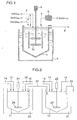
- Fig. 1 shows one example of the reaction apparatus used for practicing the present invention.
- To the reaction vessel 1 are introduced each independently an aqueous nickel salt solution feed line 2, an aqueous different kind metal salt feed line 3, an ammonium ion feed line 4 and an aqueous alkali solution feed line 5.
- the aqueous alkali solution feed line 5 is provided with a pH-stat 6 to regulate the flow of the aqueous alkali solution.
- the aqueous different kind metal salt solution feed line 3 may consist independently of a line for feeding an aqueous solution of salts of Co, Zn and Cd and a line for feeding an aqueous solution of salts of Mn, Al, V, Cr, Fe, Cu, Ge, Nb, Mo, Ag, W, Sn, Ca, Y, Ti, Sr, rare earth metals and Bi.
- the reaction vessel 1 is placed in a constant temperature vessel 7.
- the vessel 1 is provided at the upper part with a line 8 for taking out a liquid containing synthesized composite oxide particles and permits continuous taking out of the liquid by overflowing.
- the reaction vessel 1 is provided inside with a stirring blade 10 connected to a stirring apparatus 9 to keep the conditions in the reaction vessel 1 constant.
- Fig. 2 shows another example of the reaction apparatus used for practicing the present invention.
- an aqueous nickel salt solution feed line 13 To the reaction vessel 11 are introduced an aqueous nickel salt solution feed line 13, an aqueous different kind metal salt solution feed line 14, an ammonium ion feed line 15 and an aqueous alkali solution feed line 16.
- an aqueous nickel salt solution feed line 17 To the reaction vessel 12 are introduced an aqueous nickel salt solution feed line 17, a different kind metal salt feed line 18 and an aqueous alkali solution feed line 19.
- the aqueous alkali solution feed lines 16 and 19 are each provided with a pH-stat to keep the pH in the reaction vessel in a desired range by controlling the feed of aqueous alkali solution.
- the reaction vessels 11 and 12 are respectively placed in constant temperature vessels 20 and 21.
- the reaction system is designed such that the liquid in the former stage vessel can be continuously fed to the latter stage vessel through a slurry overflow line 22 and the complex metal oxide grown in the latter stage vessel can be continuously taken out at the same flow rate as the total feed flow rate of the aqueous solutions of the starting materials.
- a slurry which contains the synthesized composite oxide particles is taken out from a line 23.
- the reaction vessels 11 and 12 are respectively provided inside with stirring blades 26 and 27 respectively connected to stirring apparatuses 24 and 25, to keep the conditions in the reaction vessels constant.
- a structure of a reaction system wherein the particles are grown through reaction-deposition vessels of two stages was shown above, a similar structure may be used for reaction vessels of 3 or more stages.
- a structure having three reaction vessels is shown in Fig. 4.
- To the reaction vessel 28 are introduced an aqueous nickel salt solution feed line 31, an aqueous different kind metal salt solution feed line 32, an ammonium ion feed line 33 and an aqueous alkali solution feed line 34.
- an aqueous nickel salt solution feed line 35, a different kind metal salt feed line 36 and an aqueous alkali solution feed line 37 are introduced to the reaction vessel 29 .
- aqueous nickel salt solution feed line 38 To the reaction vessel 30 are introduced an aqueous nickel salt solution feed line 38, a different kind metal salt feed line 39 and an aqueous alkali solution feed line 40.
- the aqueous alkali solution feed lines 34, 37 and 40 are each provided with a pH-stat to keep the pH in the reaction vessel in a desired range by controlling the feed of aqueous alkali solution.
- the reaction vessels 28, 29 and 30 are respectively placed in constant temperature vessels 44, 45 and 46.
- the reaction system is designed such that the liquid in the former stage vessel can be continuously fed to the latter stage vessel through slurry overflow lines 41 and 42 and the complex metal oxide grown in the latter stage vessel can be continuously taken out at the same flow rate as the total feed flow rate of the aqueous solutions of the starting materials.
- a slurry which contains the systhesized composite oxide particles is taken out from a line 43.
- the reaction vessels 28, 29 and 30 are respectively provided inside with stirring blades 50, 51 and 52 respectively connected to stirring apparatuses 47, 48 and 49, to keep the conditions in the reaction vessels constant.
- reaction-deposition vessels for growing the complex metal oxides besides the reaction-deposition vessels for growing the complex metal oxides, other vessels, e.g., vessels for the reaction of an aqueous solution containing ammonium ions, vessels for classification, and vessels for coating Co oxide as a conductive agent may also be connected.
- a 2 mol/l aqueous nickel sulfate solution, 0.25 mol/l aqueous manganese sulfate solution, 0.1 mol/l aqueous zinc sulfate solution, 0.05 mol/l aqueous cobalt sulfate solution and 4.8 mol/l aqueous ammonia solution were prepared.
- the ratio of the respective aqueous solutions added herein was selected such that the amounts of sodium hydroxide and ammonia are respectively 2 moles relative to 1 mole of the total of the Ni, Mn, Co and Zn salts.
- a complex metal oxide comprising Ni, Mn, Co and Zn was formed, which was then continuously taken out from the upper part of the reaction vessel by means of overflowing, and samples for evaluation were collected after 30 hours of continuous operation. The residence time was about 28 hours.
- the results of quantitative analysis showed that the molar ratio of Ni, Mn, Co and Zn in the complex metal oxide powder approximately coincided with the mixing ratio of the starting materials.
- the X-ray diffraction pattern showed no peak that indicates the presence of impurities, which suggested that the sample comprised crystals of uniform composition. Further, the SEM photograph confirmed that the sample comprised spherical particles with a high density and uniform particle diameter.
- Example 2 The same procedures as in Example 1 were followed except that no aqueous ammonia solution was added, to obtain samples for evaluation.
- the oxide powder thus obtained was found to form aggregates of a broad particle size distribution and irregular shape.
- Example 2 The same procedures as in Example 1 were followed except that the concentration of the aqueous sodium hydroxide solution was changed to 4.3 mol/l (about 1.8 moles of sodium hydroxide relative to 1 mole of metal salts) and the pH value was changed to 10.5, to obtain samples for evaluation.
- the complex metal oxide obtained was found to comprise very bulky particles with a wide particle size distribution.
- Example 2 The same procedures as in Example 1 were followed except that the concentration of the aqueous sodium hydroxide solution was changed to 6.0 mol/l (about 2.5 moles of sodium hydroxide relative to 1 mole of metal salts) and the pH value was changed to 13.5, to obtain samples for evaluation.
- the complex metal oxide obtained was found to form aggregates of minute particles.
- Example 2 The same procedures as in Example 1 were followed except that the concentration of the aqueous ammonia solution was changed to 4.3 mol/l (about 1.8 moles of ammonium ion relative to 1 mole of metal salts), to obtain samples for evaluation.
- the complex metal oxide particles obtained were found to be bulky particles with an irregular shape.
- Example 2 The same procedures as in Example 1 were followed except that the temperature in the vessel was changed to 20°C, to obtain samples for evaluation.
- the complex metal oxide particles obtained were spherical particles with a uniform particle diameter, but they had many voids and were very bulky.
- Example 2 The same procedures as in Example 1 were followed except that the temperature in the vessel was changed to 80°C, to obtain samples for evaluation.
- the complex metal oxide obtained comprised aggregates of minute particles.
- Example 2 The same procedures as in Example 1 were followed except that the feed amount was controlled so as to give a residence time of 15 hours, to obtain samples for evaluation.
- the complex metal oxide particles obtained had small particle diameters as a whole.
- the particles were composed mainly of curved surfaces, and were roundish as a whole but not spherical.
- Example 2 The same procedures as in Example 1 were followed except that the feed amount was controlled so as to give a residence time of 60 hours, to obtain samples for evaluation.
- the complex metal oxide particles obtained had big particle diameters as a whole, and the whole surface of the particles had cracks.
- Example 1 The characteristic properties of the complex metal oxide powders obtained in Example 1 and Comparative Examples 1, 2, 3, 4, 5, 6, 7 and 8 are shown in Table 1.
- Table 1 Evaluation Sample Tap Density (g/cm 3 ) Average Particle Diameter ( ⁇ m) Example 1 1.90 11.5 Comparative Example 1 0.85 4.6 Comparative Example 2 1.12 8.5 Comparative Example 3 1.39 6.5 Comparative Example 4 0.88 5.2 Comparative Example 5 0.92 12.0 Comparative Example 6 1.54 6.5 Comparative Example 7 1.71 4.7 Comparative Example 8 1.78 20.3
- Example 2 The same procedures as in the process for producing the Ni-Mn-Zn-Co complex metal oxide shown in Example 1 were followed except that, in place of (a) Mn used in Example 1, (b) Al, (c) V, (d) Cr, (e) Fe, (f) Cu, (g) Ge, (h) Nb, (i) Mo, (j) Ag, (k) W, (1) Sn, (m) Ca, (n) Y, (o) Ti, (p) Sr, (q) La or (r) Bi was added, to obtain complex metal oxides.
- the complex metal oxides thus obtained were confirmed to be spherical particles with a uniform composition, high density and uniform particle diameter like the particles of Example 1.
- a mixed aqueous solution having an ammonium concentration of 4.8 mol/l and a nickel sulfate concentration of 2 mol/l was prepared.
- the mixed solution, an aqueous solution of 0.25 mol/l of manganese sulfate and 0.1 mol/l of zinc sulfate, and a 0.05 mol/l aqueous cobalt sulfate solution were fed each independently and simultaneously into a 5-l reaction vessel each at an average rate of 0.5 ml/min while the aqueous solutions being kept at 50°C.
- a 4.8 mol/l aqueous sodium hydroxide solution was added at an average rate of 0.5 ml/min so as to keep the pH value in the reaction vessel within the range of 12.5 ⁇ 0.2.
- the addition ratio of the above-mentioned aqueous solutions was selected such that the amounts of sodium hydroxide and ammonia were each to be 2 moles relative to 1 mole of the total of the Ni, Mn, Co and Zn salts.
- Example 1 a complex metal oxide comprising Ni, Mn, Co and Zn was formed, which was continuously taken out of the upper part of the reaction vessel by means of overflowing, and a sample was collected for evaluation after 30 hours of continuous operation. The residence time was about 33 hours.
- the complex metal oxide obtained was confirmed to comprise spherical particles with a uniform composition, high density and uniform particle diameter.
- a mixed aqueous solution having an ammonium concentration of 4.8 mol/l, a nickel sulfate concentration of 2 mol/l, a manganese sulfate concentration of 0.25 mol/l, a zinc sulfate concentration of 0.1 mol/l and a cobalt sulfate concentration of 0.05 mol/l was prepared. Then, while being kept at 50°C, the mixed solution was fed into a 5-l reaction vessel at an average rate of 0.5 ml/min.
- a mixed aqueous solution having a nickel sulfate concentration of 2 mol/l, a calcium nitrate concentration of 0.25 mol/l, a zinc sulfate concentration of 0.1 mol/l and a cobalt sulfate concentration of 0.05 mol/l was prepared.
- the respective aqueous metal salt solutions are preferably fed each independently such that the respective metal salts always have respectively a constant concentration in the reaction system.
- the aqueous alkali solution is preferably fed such that the amount of the alkali used is 1.9-2.3 moles relative to 1 mole of the total of Ni salts and metal salts other than Ni salts, and the aqueous solution containing ammonium ions is preferably fed proportionately such that the amount of ammonium ions used is 2 moles or more relative to 1 mole of the total of nickel salts and different kind metal salts.
- the pH of the reaction system is preferably 11-13, the temperature of the reaction system is preferably 30-60°C, and the residence time is preferably 20-50 hours.
- the amount of different metal oxides to be incorporated into nickel oxide powder is preferably 0.5-20.0% by weight in order to obtain the excellent effect of improving characteristic properties and to obtain powders having an excellent uniform composition.
- powder of composite oxide of a plurality of metal elements with a tap density of 1.9 g/cm 3 or more can be obtained and, when it is used for constructing electrodes, positive electrodes can be obtained which have the same level of filling density as positive electrodes which use conventional nickel oxide as the active material.
- Metals other than Ni which are preferably used are at least one metal selected from Zn, Cd and Co, and at least one metal selected from Ca, Y, Ti, Sr, rare earth metals and Bi, which are expected mainly to improve high temperature charge efficiency, or selected from Mn, Al, V, Cr, Fe, Cu, Ge, Nb, Mo, Ag, W and Sn, which are expected mainly to improve the order of reaction.
- a process for producing a composite oxide of a plurality of metal elements wherein the inner layer comprises nickel hydroxide and the surface layer comprises nickel hydroxide containing calcium as solid solution is described below.
- the production apparatus is of the same structure as that shown in Fig. 2 comprising two reaction-deposition vessels 11 and 12 connected with each other, each having a volume of 5l. First, a 2.4 mol/l aqueous nickel nitrate solution and a 4.8 mol/l aqueous ammonia solution were prepared.
- a 2.2 mol/l aqueous nickel nitrate solution and a 0.2 mol/l aqueous calcium nitrate solution were fed each at an average rate of 0.5 ml/min into the reaction vessel 12 and, while the inner temperature of the vessel being kept at 50°C and with stirring, a 4.8 mol/l aqueous sodium hydroxide solution was added at an average rate of 0.5 ml/min so as to keep the pH value in the reaction vessel within the range of 12 ⁇ 0.2.
- the suspension in the vessel was made to overflow from the upper part of the reaction vessel to collect samples continually.
- the suspension thus obtained was centrifuged, the supernatant liquid was replaced with deionized water, the resulting sediment was subjected to in-liquid classification to remove minute crystals of oxides comprising mainly Ni which had been formed in the reaction vessel 12 and contain Ca throughout the inside, and then washed with water and dried to obtain a powder with an average particle diameter of 12.5 ⁇ m.
- a 100 g portion of the dry powder thus obtained was placed in the reaction vessel 12, then a 2.2 mol/l aqueous nickel nitrate solution, 0.2 mol/l aqueous calcium nitrate solution and 4.8 mol/l aqueous ammonia solution were simultaneously fed each at an average rate of 0.5 ml/min into the reaction vessel 12 and, while the temperature in the vessel being kept constant at 50°C and with stirring, a 4.8 mol/l aqueous sodium hydroxide solution was added at an average rate of 0.5 ml/min so as to keep the pH value in the reaction vessel within the range of 12 ⁇ 0.2.
- the suspension in the reaction vessel was collected, subjected to in-liquid classification as described above to remove minute crystals of oxide comprising mainly Ni which had been formed in the reaction vessel 12 and contain Ca throughout the inside, and then washed with water and dried to obtain a powder with an average particle diameter of 12.5 ⁇ m.
- Fig. 3 A and Fig. 3B show the characteristic X-ray image of the section of the complex metal oxide powder obtained according to the present invention as described above.
- Fig. 3A shows the SEM image of the section of the powder
- Fig. 3B shows the result of detecting the characteristic X-ray of Ca at the same position as in Fig. 3A, which shows the presence of Ca at the parts indicated by white dots.
- the surface layer and the inner layer are different in composition, much Ca being present in the surface layer of about 0.5 ⁇ m thickness.
- a 2.2 mol/l aqueous nickel sulfate solution, a 0.2 mol/l aqueous manganese sulfate solution and a 4.8 mol/l aqueous ammonia solution were prepared. These solutions were simultaneously fed each at an average rate of 0.5 ml/min into the reaction vessel 11 and, while the inner temperature of the vessel being kept constant at 50°C and with stirring to effect rapid and uniform mixing, a 4.8 mol/l aqueous sodium hydroxide solution was added so as to keep the pH value in the reaction vessel within the range of 12.0 ⁇ 0.2.
- the resulting suspension containing particles of nickel hydroxide containing manganese as solid solution grown to an average particle diameter of 12 ⁇ m was fed into the reaction vessel 12 at an average rate of 2.0 ml/min.
- a 2.4 mol/l aqueous nickel sulfate solution was fed at an average rate of 0.5 ml/min into the reaction vessel 12 and, while the inner temperature of the vessel being kept constant at 50°C and with stirring, a 4.8 mol/l aqueous sodium hydroxide solution was added at an average rate of 0.5 ml/min so as to keep the pH value in the reaction vessel within the range of 12.5 ⁇ 0.2.
- the suspension in the vessel was made to overflow from the upper part of the reaction vessel to collect samples continually.
- the suspension thus obtained was centrifuged, the supernatant was replaced with deionized water, the resulting sediment was subjected to in-liquid classification to remove minute crystals of oxides comprising mainly Ni formed in the reaction vessel 12, and then washed with water and dried to obtain a powder with an average particle diameter of 12.5 ⁇ m.
- a 100 g portion of the dry powder thus obtained was placed in the reaction vessel 12, then a 2.4 mol/l aqueous nickel sulfate solution and 4.8 mol/l aqueous ammonia solution were simultaneously fed each at an average rate of 0.5 ml/min into the reaction vessel 12 and, while the inner temperature of the vessel being kept constant at 50°C and with stirring, a 4.8 mol/l aqueous sodium hydroxide solution was added at an average rate of 0.5 ml/min so as to keep the pH value in the reaction vessel within the range of 12.5 ⁇ 0.2.
- the suspension in the reaction vessel was collected, subjected to in-liquid classification in the same manner as described above to remove minute crystals of oxide comprising mainly Ni formed in the reaction vessel 12, and washed with water and dried to obtain a powder with an average particle diameter of 12.5 ⁇ m.
- oxide powders comprising mainly nickel which contain the above-mentioned metal element in a relatively large amount in the inner layer could be obtained.
- a 2.2 mol/l aqueous nickel nitrate solution, 0.2 mol/l aqueous manganese nitrate solution and 4.8 mol/l aqueous ammonia solution were prepared. These solutions were simultaneously fed each at an average rate of 0.5 ml/min into the reaction vessel 11 and, while the inner temperature of the vessel being kept constant at 50°C and with stirring to effect rapid and uniform mixing, a 4.8 mol/l aqueous sodium hydroxide solution was added at an average rate of 0.5 ml/min so as to keep the pH value in the reaction vessel within the range of 12.0 ⁇ 0.2.
- the suspension in the vessel containing particles of nickel hydroxide containing manganese as solid solution grown to an average particle diameter of 12 ⁇ m was fed at an average rate of 2.0 ml/min into the reaction vessel 12.
- a 2.2 mol/l aqueous nickel nitrate solution and 0.2 mol/l aqueous calcium nitrate solution were fed each at an average rate of 0.5 ml/l into the reaction vessel 12 and, while the inner temperature of the vessel being kept constant at 50°C and with stirring, a 4.8 mol/l aqueous sodium hydroxide solution was added at an average rate of 0.5 ml/min so as to keep the pH value in the reaction vessel within the range of 12.0 ⁇ 0.2.
- the suspension in the vessel was made to overflow from the upper part of the reaction vessel to collect samples continually.
- the suspension thus obtained was centrifuged, the supernatant was replaced with deionized water, the resulting sediment was subjected to in-liquid classification to remove minute crystals of oxides comprising mainly Ni and containing Ca throughout the inside formed in the reaction vessel 12, and then washed with water and dried to obtain a powder with an average particle diameter of 12.5 ⁇ m.
- a 100 g portion of the dry powder thus obtained was placed in the reaction vessel 12, then a 2.2 mol/l aqueous nickel nitrate solution, 0.2 mol/l aqueous calcium nitrate solution and 4.8 mol/l aqueous ammonia solution were simultaneously fed each at an average rate of 0.5 ml/min into the reaction vessel 12 and, while the inner temperature of the vessel being kept constant at 50°C and with stirring, a 4.8 mol/l aqueous sodium hydroxide solution was added at an average rate of 0.5 ml/min so as to keep the pH value in the reaction vessel within the range of 12.0 ⁇ 0.2.
- the suspension in the reaction vessel was collected, subjected to in-liquid classification in the same manner as described above to remove minute crystals of oxides, formed in the reaction vessel 12, which comprised mainly Ni and contained Ca throughout the inside, and washed with water and dried to obtain a powder with an average particle diameter of 12.5 ⁇ m.
- a 2.2 mol/l aqueous nickel nitrate solution, 0.2 mol/l aqueous manganese nitrate solution and 4.8 mol/l aqueous ammonia solution were prepared. These solutions were simultaneously fed each at a rate of 0.5 ml/min into the reaction vessel 28 and, while the inner temperature of the vessel being kept constant at 50°C and with stirring to effect rapid and uniform mixing, a 4.8 mol/l aqueous sodium hydroxide solution was added at an average rate of 0.5 ml/min so as to keep the pH value in the reaction vessel within the range of 12.0 ⁇ 0.2.
- the suspension in the vessel containing particles of nickel hydroxide containing manganese as solid solution grown to an average particle diameter of 12 ⁇ m was fed at an average rate of 2.0 ml/min into the reaction vessel 29.
- a 2.2 mol/l aqueous nickel nitrate solution and 0.2 mol/l aqueous aluminum nitrate solution were fed each at an average rate of 0.5 ml/min into the reaction vessel 29 and, while the inner temperature of the vessel being kept constant at 50°C and with stirring, a 4.8 mol/l aqueous sodium hydroxide solution was added at an average rate of 0.5 ml/min so as to keep the pH value in the reaction vessel within the range of 12.5 ⁇ 0.2.
- a 2.2 mol/l aqueous nickel nitrate solution and 0.2 mol/l aqueous calcium nitrate solution were fed each at an average rate of 0.5 ml/min into the reaction vessel 30 and, while the inner temperature of the vessel being kept constant at 50°C and with stirring, a 4.8 mol/l aqueous sodium hydroxide solution was added at an average rate of 0.5 ml/min so as to keep the pH value in the reaction vessel within the range of 12.0 ⁇ 0.2.
- the suspension in the reaction vessel was made to overflow from the upper part of the vessel to collect samples continually.
- the suspension thus obtained was centrifuged, the supernatant was replaced with deionized water, the resulting sediment was subjected to in-liquid classification to remove minute crystals of oxides comprising mainly Ni and containing Ca throughout the inside formed in the reaction vessel 30, and then washed with water and dried to obtain a powder with an average particle diameter of 12.7 ⁇ m.
- the production apparatus used had a structure comprising the reaction vessels 28, 29 and 30 shown in Fig. 4 used each independently.
- particles of nickel hydroxide containing manganese as solid solution were grown to an average particle diameter of 12 ⁇ m in the reaction vessel 28, and the suspension was continuously taken out from the upper part of the reaction vessel by means of overflowing.
- the suspension thus obtained was centrifuged and the supernatant was replaced with deionized water. This water-washing operation was repeated several times and then the sediment was dried.
- a 100 g portion of the dry powder thus obtained was placed in the reaction vessel 29, then a 2.2 mol/l aqueous nickel nitrate solution, 0.2 mol/l aqueous aluminum nitrate solution and 4.8 mol/l aqueous ammonia solution were simultaneously fed each at an average rate of 0.5 ml/min into the reaction vessel 29 and, while the inner temperature of the vessel being kept constant at 50°C and with stirring, a 4.8 mol/l aqueous sodium hydroxide solution was added at an average rate of 0.5 ml/min so as to keep the pH value in the reaction vessel within the range of 12.5 ⁇ 0.2. After the lapse of 3 hours, the suspension in the reaction vessel was collected.
- the suspension thus obtained was centrifuged and the supernatant was replaced with deionized water. This water-washing operation was repeated several times and then the sediment was dried.
- a 100 g portion of the dry powder thus obtained was placed in the reaction vessel 30, then a 2.2 mol/l aqueous nickel nitrate solution, 0.2 mol/l aqueous calcium nitrate solution and 4.8 mol/l aqueous ammonia solution were simultaneously fed each at an average rate of 0.5 ml/min into the reaction vessel 30 and, while the inner temperature of the vessel being kept constant at 50°C and with stirring, a 4.8 mol/l aqueous sodium hydroxide solution was added at an average rate of 0.5 ml/min so as to keep the pH in the reaction vessel within the range of 12.5 ⁇ 0.2.
- the suspension in the reaction vessel was collected, subjected to in-liquid classification in the same manner as described above to remove minute crystals of oxides comprising mainly Ni and containing Ca throughout the inside formed in the reaction vessel 30, and the sediment was washed with water and dried to obtain a powder with an average particle diameter of 12.7 ⁇ m.
- oxide powders comprising a multi-layer structure in which the respective layers were different in composition were similarly obtained through reaction-deposition stages comprising more than three stages.
- a 2.2 mol/l aqueous nickel nitrate solution, 0.05 mol/l aqueous cobalt nitrate solution, 0.15 mol/l manganese nitrate solution and 4.8 mol/l aqueous ammonia solution were prepared. These solutions were simultaneously fed each at an average rate of 0.5 ml/min into the reaction vessel 11 and, while the inner temperature of the vessel being kept constant at 50°C and with stirring to effect rapid and uniform mixing, a 4.8 mol/l aqueous sodium hydroxide solution was added at an average rate of 0.5 ml/min so as to keep the pH value in the reaction vessel within the range of 12.0 ⁇ 0.2.
- the suspension in the vessel containing particles of nickel hydroxide containing cobalt and manganese as solid solution grown to an average particle diameter of 12 ⁇ m was fed at an average rate of 2.0 ml/min into the reaction vessel 12.
- a 2.2 mol/l aqueous nickel nitrate solution, 0.1 mol/l aqueous calcium nitrate solution, 0.05 mol/l aqueous zinc nitrate solution and 0.05 mol/l aqueous cobalt nitrate solution were fed each at an average rate of 0.5 ml/min into the reaction vessel 12 and, while the inner temperature of the vessel being kept constant at 50°C and with stirring, a 4.8 mol/l aqueous sodium hydroxide solution was added at an average rate of 0.5 ml/min so as to keep the pH value in the reaction vessel within the range of 12.0 ⁇ 0.2.
- the suspension in the reaction vessel was made to overflow from the upper part of the vessel to collect samples continually.
- the suspension thus obtained was centrifuged, the supernatant was replaced with deionized water, the resulting sediment was subjected to in-liquid classification to remove minute crystals of oxides comprising mainly Ni and containing Ca, Zn and Co throughout the inside formed in the reaction vessel 12, and then washed with water and dried to obtain a powder with an average particle diameter of 12.5 ⁇ m.
- the production apparatus had a structure comprising reaction vessels 11 and 12 shown in Fig. 2, used each independently.
- particles of nickel hydroxide containing cobalt and manganese as solid solution were grown to an average particle diameter of 12 ⁇ m in the reaction vessel 11, and the suspension was continuously taken out from the upper part of the reaction vessel by means of overflowing.
- the suspension obtained was centrifuged and the supernatant was replaced with deionized water. This water-washing operation was repeated several times and the sediment was dried.
- a 100 g portion of the dry powder thus obtained was placed in the reaction vessel 12, then a 2.2 mol/l aqueous nickel nitrate solution, 0.1 mol/l aqueous calcium nitrate solution, 0.05 mol/l aqueous cobalt nitrate solution, 0.05 mol/l aqueous zinc nitrate solution and 4.8 mol/l aqueous ammonia solution were simultaneously fed each at an average rate of 0.5 ml/min into the reaction vessel 12 and, while the inner temperature of the vessel being kept constant at 50°C and with stirring, a 4.8 mol/l aqueous sodium hydroxide solution was added at an average rate of 0.5 ml/min so as to keep the pH in the reaction vessel within the range of 12.0 ⁇ 0.2.
- the suspension in the reaction vessel was collected, subjected to in-liquid classification to remove minute crystals of oxides comprising mainly Ni and containing Ca, Co and Zn throughout the inside formed in the reaction vessel 12, and then washed with water and dried to obtain a powder with an average particle diameter of 12.5 ⁇ m.
- the complex metal oxide powder of the present invention described above was measured for its tap density to show a high value of 2.0 g/cm 3 .
- the characteristic X-ray image of the section of the powder of composite oxide of a plurality of metal elements obtained according to the present invention as described above with that obtained by the prior process, it was observed that the powders were both different in composition between the surface layer and the inner layer, the surface layer of a thickness of about 0.5 ⁇ m being rich in Ca, Co and Zn while the inner layer being rich in Co and Mn.
- This reveals that samples similar to those obtained by the prior batch type process can also be obtained in the present invention. Further, approximately the same results were obtained when the electrochemical characteristic properties of two powders were evaluated.
- active material particles formed of a plurality of metal oxide layers can be produced by using a plurality of reaction-deposition stages and changing the composition and/or kind of the salts of metal groups in the stages adjacent to each other. Further, since the production can be conducted continuously, mass productivity can be improved as compared with prior batch type processes.
- a complex metal oxide with a high density can be obtained by simultaneously feeding, with stirring, an aqueous nickel salt solution, aqueous solutions of different kinds of metals, aqueous solution containing ammonium ions and aqueous alkali metal hydroxide solution of predetermined concentration ratio into a reaction system controlled to have a predetermined constant pH and temperature, so as to give a predetermined residence time.
- a reaction system controlled to have a predetermined constant pH and temperature so as to give a predetermined residence time.
- complex metal oxide particles comprising Ni as the main metal element and formed of a plurality of layers piled up from the center toward the surface of the particle can be grouped continuously, whereby the process steps can be greatly simplified and the mass productivity can be improved as compared with prior batch processes.
Landscapes
- Chemical & Material Sciences (AREA)
- Inorganic Chemistry (AREA)
- Chemical Kinetics & Catalysis (AREA)
- Electrochemistry (AREA)
- General Chemical & Material Sciences (AREA)
- Battery Electrode And Active Subsutance (AREA)
- Inorganic Compounds Of Heavy Metals (AREA)
Applications Claiming Priority (3)
| Application Number | Priority Date | Filing Date | Title |
|---|---|---|---|
| JP02018297A JP3656353B2 (ja) | 1996-03-13 | 1997-02-03 | アルカリ蓄電池用正極活物質の製造法 |
| JP19771997A JP3567687B2 (ja) | 1997-07-07 | 1997-07-07 | アルカリ蓄電池用正極活物質の製造方法 |
| EP98101747A EP0856899B1 (fr) | 1997-02-03 | 1998-02-02 | Méthode de fabrication de matériaux actifs pour électrode positive de piles alcalines |
Related Parent Applications (1)
| Application Number | Title | Priority Date | Filing Date |
|---|---|---|---|
| EP98101747A Division EP0856899B1 (fr) | 1997-02-03 | 1998-02-02 | Méthode de fabrication de matériaux actifs pour électrode positive de piles alcalines |
Publications (2)
| Publication Number | Publication Date |
|---|---|
| EP1890350A2 true EP1890350A2 (fr) | 2008-02-20 |
| EP1890350A3 EP1890350A3 (fr) | 2008-05-28 |
Family
ID=26357085
Family Applications (2)
| Application Number | Title | Priority Date | Filing Date |
|---|---|---|---|
| EP98101747A Expired - Lifetime EP0856899B1 (fr) | 1997-02-03 | 1998-02-02 | Méthode de fabrication de matériaux actifs pour électrode positive de piles alcalines |
| EP07022225A Withdrawn EP1890350A3 (fr) | 1997-02-03 | 1998-02-02 | Procédé de fabrication de matériaux actifs pour l'électrode positive de batteries d'accumulation alcalines |
Family Applications Before (1)
| Application Number | Title | Priority Date | Filing Date |
|---|---|---|---|
| EP98101747A Expired - Lifetime EP0856899B1 (fr) | 1997-02-03 | 1998-02-02 | Méthode de fabrication de matériaux actifs pour électrode positive de piles alcalines |
Country Status (3)
| Country | Link |
|---|---|
| US (2) | US6129902A (fr) |
| EP (2) | EP0856899B1 (fr) |
| CN (1) | CN1129198C (fr) |
Cited By (2)
| Publication number | Priority date | Publication date | Assignee | Title |
|---|---|---|---|---|
| CN102074679A (zh) * | 2010-12-18 | 2011-05-25 | 中南大学 | 一种锂离子电池正极材料球形掺铝镍钴酸锂的制备方法 |
| CN109225069A (zh) * | 2018-08-29 | 2019-01-18 | 广东佳纳能源科技有限公司 | 一种小粒径、高振实三元前驱体的制备装置及其生产方法 |
Families Citing this family (21)
| Publication number | Priority date | Publication date | Assignee | Title |
|---|---|---|---|---|
| US6482374B1 (en) * | 1999-06-16 | 2002-11-19 | Nanogram Corporation | Methods for producing lithium metal oxide particles |
| EP1044927B1 (fr) * | 1998-06-10 | 2012-07-25 | Sakai Chemical Industry Co., Ltd. | Particules d'hydroxyde de nickel, leur production, et leur utilisation |
| US6228535B1 (en) * | 1998-08-17 | 2001-05-08 | Ovonic Battery Company, Inc. | Nickel hydroxide positive electrode material exhibiting improved conductivity and engineered activation energy |
| JP2001273889A (ja) * | 2000-03-27 | 2001-10-05 | Sanyo Electric Co Ltd | アルカリ蓄電池用ニッケル極及びその製造方法 |
| DE10016024A1 (de) * | 2000-03-31 | 2001-10-04 | Merck Patent Gmbh | Aktives Anodenmaterial in elektrochemischen Zellen und Verfahren zu deren Herstellung |
| EP1176649A1 (fr) * | 2000-07-24 | 2002-01-30 | Sociedad Espanola Del Acumulador Tudor, S.A. | Accumulateur secondaire alcalin avec une électrode positive au nickel améliorée et procédure pour son activation |
| MXPA03002124A (es) * | 2000-09-13 | 2005-06-20 | Ovonic Battery Co | Metodo de elaboracion de un material de hidroxido de niquel. |
| US7585435B2 (en) * | 2000-11-06 | 2009-09-08 | Tanaka Chemical Corporation | High density cobalt-manganese coprecipitated nickel hydroxide and process for its production |
| RU2178931C1 (ru) * | 2000-11-08 | 2002-01-27 | Закрытое акционерное общество "Компания Сезар" | Способ изготовления гидрата закиси никеля для аккумуляторной промышленности |
| AU2002227801B2 (en) * | 2001-02-08 | 2005-12-01 | Qni Technology Pty Ltd | Cobalt (III) encapsulated nickel hydroxides and basic carbonates for battery electrodes |
| AUPR295301A0 (en) | 2001-02-08 | 2001-03-08 | QNI Limited | Process for the preparation of battery chemicals |
| DE10132895A1 (de) * | 2001-07-06 | 2003-01-16 | Starck H C Gmbh | Nickelhydroxid und Verfahren zu dessen Herstellung |
| US7201857B2 (en) * | 2003-03-03 | 2007-04-10 | Texaco Ovonic Battery Systems, Llc | Performance enhancing additive material for the nickel hydroxide positive electrode in rechargeable alkaline cells |
| RU2264000C1 (ru) * | 2004-08-18 | 2005-11-10 | ОАО "Завод автономных источников тока" | Способ получения гидрата закиси никеля для щелочных аккумуляторов |
| WO2007000075A1 (fr) * | 2005-06-27 | 2007-01-04 | Shenzhen Bak Battery Co., Ltd | Procédé de préparation d’hydroxyde nickeleux sphérique qui est dopé et d’oxydes métalliques multiples, et pile secondaire au lithium |
| US8585928B1 (en) * | 2010-04-27 | 2013-11-19 | Sandia Corporation | Rare-earth tantalates and niobates suitable for use as nanophosphors |
| CN102709529B (zh) * | 2012-05-07 | 2014-04-02 | 江门市芳源环境科技开发有限公司 | 一种提高球形氢氧化镍性能的方法 |
| JP6090673B2 (ja) | 2012-09-28 | 2017-03-08 | 株式会社Gsユアサ | アルカリ蓄電池とアルカリ蓄電池用の正極材 |
| PL225101B1 (pl) * | 2012-12-13 | 2017-02-28 | Inst Tech Materiałów Elektronicznych | Anoda do ogniw fotoelektrochemicznych i zastosowanie materiału eutektycznego |
| KR101903827B1 (ko) * | 2013-07-31 | 2018-11-07 | 한양대학교 산학협력단 | 전이금속 복합 산화물의 제조 방법 및 이에 의하여 제조된 전이금속 복합 산화물 및 이를 이용하여 제조된 리튬 복합 산화물 |
| CN114522648A (zh) * | 2022-04-08 | 2022-05-24 | 攀枝花攀钢集团设计研究院有限公司 | 用于溶液自动快速混匀的混合反应器及施工方法 |
Citations (12)
| Publication number | Priority date | Publication date | Assignee | Title |
|---|---|---|---|---|
| JPS51122737A (en) | 1975-04-18 | 1976-10-27 | Matsushita Electric Industrial Co Ltd | Method of producing nickel plate for battery |
| US4251603A (en) | 1980-02-13 | 1981-02-17 | Matsushita Electric Industrial Co., Ltd. | Battery electrode |
| JPS6137733B2 (fr) | 1978-07-17 | 1986-08-26 | Matsushita Electric Ind Co Ltd | |
| JPS6254235B2 (fr) | 1980-01-16 | 1987-11-13 | Matsushita Electric Ind Co Ltd | |
| JPH0326903B2 (fr) | 1984-10-24 | 1991-04-12 | Matsushita Electric Ind Co Ltd | |
| JPH0350384B2 (fr) | 1984-10-25 | 1991-08-01 | Matsushita Electric Ind Co Ltd | |
| JPH0480513B2 (fr) | 1983-12-20 | 1992-12-18 | Matsushita Denki Sangyo Kk | |
| US5348822A (en) | 1992-11-12 | 1994-09-20 | Ovonic Battery Company, Inc. | Chemically and compositionally modified solid solution disordered multiphase nickel hydroxide positive electrode for alkaline rechargeable electrochemical cells |
| US5366831A (en) | 1991-06-14 | 1994-11-22 | Yuasa Corporation | Nickel electrode for alkaline battery |
| JPH0740853A (ja) | 1993-07-28 | 1995-02-10 | Kubota Corp | 作業車の旋回操作構造 |
| JPH08225328A (ja) | 1994-11-09 | 1996-09-03 | Hc Starck Gmbh & Co Kg | マンガン(iii)がドープされた水酸化ニツケル(ii)粉末 |
| US5569562A (en) | 1993-07-09 | 1996-10-29 | H.C. Starck, Gmbh & Co. Kg | Manganese (III)-containing nickel (II) hydroxide for the production of secondary batteries |
Family Cites Families (26)
| Publication number | Priority date | Publication date | Assignee | Title |
|---|---|---|---|---|
| US3894885A (en) * | 1971-01-18 | 1975-07-15 | Int Nickel Co | Activation of nickel battery plates |
| US3972729A (en) * | 1971-06-30 | 1976-08-03 | Centre National D'etudes Spatiales | Method of producing electrodes |
| US3783505A (en) * | 1972-03-29 | 1974-01-08 | Us Navy | Method for electrically insulating magnetostrictive material |
| US3867199A (en) * | 1972-06-05 | 1975-02-18 | Communications Satellite Corp | Nickel hydrogen cell |
| US3840407A (en) * | 1972-06-19 | 1974-10-08 | Textron Inc | Composite porous electrode |
| SE395564B (sv) * | 1975-12-09 | 1977-08-15 | Jungner Ab Nife | Sett att tillverka en nickelhydroxidelektrod med sintrad, poros nickelstomme |
| DE2731063C3 (de) * | 1977-07-09 | 1980-08-07 | Volkswagenwerk Ag, 3180 Wolfsburg | Verfahren zur Herstellung einer positiven Kobalt-Elektrode für alkalische Akkumulatoren |
| FR2423065A1 (fr) * | 1978-04-12 | 1979-11-09 | Battelle Memorial Institute | Procede de fabrication d'electrodes pour piles a combustible, dispositif pour la mise en oeuvre du procede et electrodes resultant de ce procede |
| DE3486180T2 (de) * | 1983-07-05 | 1993-12-16 | Japan Storage Battery Co Ltd | Alkalische Sammlerbatterie. |
| JPS63152866A (ja) * | 1986-12-16 | 1988-06-25 | Yuasa Battery Co Ltd | 蓄電池用ニツケル活物質及びその製造法 |
| FR2622126B1 (fr) * | 1987-10-21 | 1991-06-14 | Procatalyse Ste Fse Produits C | Catalyseur pour le traitement des gaz d'echappement des moteurs a combustion interne et procede de fabrication de ce catalyseur |
| JPH01122737A (ja) | 1987-11-09 | 1989-05-16 | Fujitsu Ten Ltd | 定速走行制御装置 |
| JP2684707B2 (ja) * | 1988-09-27 | 1997-12-03 | 松下電器産業株式会社 | ペースト式カドミウム負極 |
| US5118475A (en) * | 1989-09-12 | 1992-06-02 | W. R. Grace & Co.-Conn. | Core element and core for electrically heatable catalytic converter |
| US5023155A (en) * | 1989-11-06 | 1991-06-11 | Energy Research Corporation | Nickel electrode for alkaline batteries |
| US5569444A (en) * | 1990-06-18 | 1996-10-29 | Blanchard; Philippe | Process of obtaining a metal hydroxide powder and powder obtained by the process |
| WO1991020101A1 (fr) * | 1990-06-18 | 1991-12-26 | Saft | Procede de preparation d'une poudre d'hydroxydes metalliques et poudre obtenue par ce procede |
| JP3438142B2 (ja) * | 1992-09-18 | 2003-08-18 | 松下電器産業株式会社 | 中・大容量密閉式金属酸化物・水素蓄電池 |
| JPH06137733A (ja) * | 1992-10-29 | 1994-05-20 | Sanyo Electric Co Ltd | 低温庫 |
| US5523182A (en) * | 1992-11-12 | 1996-06-04 | Ovonic Battery Company, Inc. | Enhanced nickel hydroxide positive electrode materials for alkaline rechargeable electrochemical cells |
| JPH06254235A (ja) * | 1993-03-08 | 1994-09-13 | Sankyo Kk | 遊技用装置 |
| KR0148827B1 (ko) * | 1994-05-20 | 1998-10-15 | 전성원 | 알카리전지용 고밀도 수산화니켈의 제조방법 |
| JP3249326B2 (ja) * | 1995-02-14 | 2002-01-21 | 三洋電機株式会社 | アルカリ蓄電池用ニッケル活物質、その製造方法 |
| JP3287165B2 (ja) * | 1995-02-28 | 2002-05-27 | 松下電器産業株式会社 | アルカリ蓄電池用ニッケル正極の製造法 |
| KR100385479B1 (ko) * | 1995-04-11 | 2003-08-21 | 산요 덴키 가부시키가이샤 | 고용량으로주기수명이우수한알칼리축전지및알칼리축전지용니켈전극의제조방법 |
| FR2750255A1 (fr) * | 1996-06-19 | 1997-12-26 | Accumulateurs Fixes | Matiere active positive pour electrode de nickel |
-
1998
- 1998-01-26 CN CN98106185A patent/CN1129198C/zh not_active Expired - Fee Related
- 1998-02-02 EP EP98101747A patent/EP0856899B1/fr not_active Expired - Lifetime
- 1998-02-02 EP EP07022225A patent/EP1890350A3/fr not_active Withdrawn
- 1998-02-02 US US09/017,029 patent/US6129902A/en not_active Expired - Lifetime
-
2000
- 2000-04-27 US US09/560,296 patent/US6284215B1/en not_active Expired - Fee Related
Patent Citations (12)
| Publication number | Priority date | Publication date | Assignee | Title |
|---|---|---|---|---|
| JPS51122737A (en) | 1975-04-18 | 1976-10-27 | Matsushita Electric Industrial Co Ltd | Method of producing nickel plate for battery |
| JPS6137733B2 (fr) | 1978-07-17 | 1986-08-26 | Matsushita Electric Ind Co Ltd | |
| JPS6254235B2 (fr) | 1980-01-16 | 1987-11-13 | Matsushita Electric Ind Co Ltd | |
| US4251603A (en) | 1980-02-13 | 1981-02-17 | Matsushita Electric Industrial Co., Ltd. | Battery electrode |
| JPH0480513B2 (fr) | 1983-12-20 | 1992-12-18 | Matsushita Denki Sangyo Kk | |
| JPH0326903B2 (fr) | 1984-10-24 | 1991-04-12 | Matsushita Electric Ind Co Ltd | |
| JPH0350384B2 (fr) | 1984-10-25 | 1991-08-01 | Matsushita Electric Ind Co Ltd | |
| US5366831A (en) | 1991-06-14 | 1994-11-22 | Yuasa Corporation | Nickel electrode for alkaline battery |
| US5348822A (en) | 1992-11-12 | 1994-09-20 | Ovonic Battery Company, Inc. | Chemically and compositionally modified solid solution disordered multiphase nickel hydroxide positive electrode for alkaline rechargeable electrochemical cells |
| US5569562A (en) | 1993-07-09 | 1996-10-29 | H.C. Starck, Gmbh & Co. Kg | Manganese (III)-containing nickel (II) hydroxide for the production of secondary batteries |
| JPH0740853A (ja) | 1993-07-28 | 1995-02-10 | Kubota Corp | 作業車の旋回操作構造 |
| JPH08225328A (ja) | 1994-11-09 | 1996-09-03 | Hc Starck Gmbh & Co Kg | マンガン(iii)がドープされた水酸化ニツケル(ii)粉末 |
Non-Patent Citations (6)
| Title |
|---|
| DENKI KAGAKU, ELECTROCHEMISTRY, vol. 54, no. 2, 1986, pages 159 |
| DENKI KAGAKU, ELECTROCHEMISTRY, vol. 54, no. 2, 1986, pages 164 |
| J. POWER SOURCES, vol. 35, 1991, pages 249 |
| POWER SOURCES, vol. 12, 1988, pages 203 |
| POWER SOURCES, vol. 12, 1988, pages 393 |
| SOLID STATE IONICS, vol. 32/33, 1989, pages 104 |
Cited By (2)
| Publication number | Priority date | Publication date | Assignee | Title |
|---|---|---|---|---|
| CN102074679A (zh) * | 2010-12-18 | 2011-05-25 | 中南大学 | 一种锂离子电池正极材料球形掺铝镍钴酸锂的制备方法 |
| CN109225069A (zh) * | 2018-08-29 | 2019-01-18 | 广东佳纳能源科技有限公司 | 一种小粒径、高振实三元前驱体的制备装置及其生产方法 |
Also Published As
| Publication number | Publication date |
|---|---|
| EP0856899B1 (fr) | 2012-05-30 |
| CN1195897A (zh) | 1998-10-14 |
| US6284215B1 (en) | 2001-09-04 |
| US6129902A (en) | 2000-10-10 |
| EP0856899A2 (fr) | 1998-08-05 |
| CN1129198C (zh) | 2003-11-26 |
| EP1890350A3 (fr) | 2008-05-28 |
| EP0856899A3 (fr) | 1998-10-14 |
Similar Documents
| Publication | Publication Date | Title |
|---|---|---|
| EP0856899B1 (fr) | Méthode de fabrication de matériaux actifs pour électrode positive de piles alcalines | |
| KR100676762B1 (ko) | 알루미늄-함유 리튬 전이금속 산화물 복합 전구체 및 이의제조방법 | |
| EP0833397B1 (fr) | Matériau actif d'électrode positive pour piles alcalines | |
| CN112624213B (zh) | 三元前驱体的制备方法及三元前驱体、正极材料、锂离子电池 | |
| EP1875537B1 (fr) | Procede de preparation de materiaux actifs stratifies pour cathode pour piles secondaires au lithium comprenant une structure noyau-coque | |
| JP4890264B2 (ja) | 粒度依存性の組成を有する電極活物質粉体とその製造方法 | |
| US8142932B2 (en) | Core-shell spinel cathode active materials for lithium secondary batteries, lithium secondary batteries using the same and method for preparing thereof | |
| US6153334A (en) | Active materials for the positive electrode in alkaline storage battery and the manufacturing method of them | |
| EP3487813A1 (fr) | Procédé de synthèse par précipitation à grande échelle de matériaux de batterie à distribution de taille de particules adaptable | |
| KR20190046678A (ko) | 코어-쉘 구조를 가지는 소듐 이차전지용 양극 활물질, 이의 제조방법 및 이를 이용한 소듐 이차전지 | |
| KR20240019205A (ko) | 양극 활물질용 복합 전이금속 전구체 및 그로부터 제조된 이차전지용 양극 활물질 | |
| JP4252641B2 (ja) | アルカリ蓄電池用正極および正極活物質 | |
| JP4403594B2 (ja) | アルカリ蓄電池用正極活物質およびその製造方法 | |
| CN1137523C (zh) | 锂离子电池正极材料的制备方法和设备 | |
| CN117800411A (zh) | 一种稳定价态元素均匀掺杂的钠电正极材料前驱体及其制备方法、钠电正极材料 | |
| EP0809309B1 (fr) | Electrode avec materiau actif de plaque positive pour accumulateur alcalin | |
| JP7070250B2 (ja) | 水酸化銅被覆ニッケルコバルト複合水酸化物の製造方法 | |
| JP3656353B2 (ja) | アルカリ蓄電池用正極活物質の製造法 | |
| KR100424635B1 (ko) | 리튬 이차 전지용 양극 활물질 및 그 제조 방법 | |
| JP3744317B2 (ja) | アルカリ蓄電池用ニッケル正極およびこれを用いたアルカリ蓄電池 | |
| EP4574768A1 (fr) | Précurseur pour matériau actif d'électrode positive pour batterie secondaire au lithium, matériau actif d'électrode positive le comprenant, et procédé de fabrication de matériau actif positif | |
| JP3567687B2 (ja) | アルカリ蓄電池用正極活物質の製造方法 | |
| HK1022992A (en) | Cathode active material for an alkaline storage battery and cathode using the same |
Legal Events
| Date | Code | Title | Description |
|---|---|---|---|
| PUAI | Public reference made under article 153(3) epc to a published international application that has entered the european phase |
Free format text: ORIGINAL CODE: 0009012 |
|
| 17P | Request for examination filed |
Effective date: 20071115 |
|
| AC | Divisional application: reference to earlier application |
Ref document number: 0856899 Country of ref document: EP Kind code of ref document: P |
|
| AK | Designated contracting states |
Kind code of ref document: A2 Designated state(s): DE FR GB |
|
| PUAL | Search report despatched |
Free format text: ORIGINAL CODE: 0009013 |
|
| AK | Designated contracting states |
Kind code of ref document: A3 Designated state(s): DE FR GB |
|
| RIN1 | Information on inventor provided before grant (corrected) |
Inventor name: IZUMI, YOICHIC/O MATSUSHITA INDUSTRIAL CO., LTD. Inventor name: SAKAMOTO, HIROYUKIC/O MATSUSHITA ELECTRIC INDUSTRI Inventor name: IZUMI, HIDEKATSUC/O MATSUSHITA ELECTRIC INDUSTRIAL Inventor name: KIMIYA, HIROKAZU Inventor name: MATSUMOTO, ISAO |
|
| 17Q | First examination report despatched |
Effective date: 20080730 |
|
| RAP1 | Party data changed (applicant data changed or rights of an application transferred) |
Owner name: PANASONIC CORPORATION |
|
| AKX | Designation fees paid |
Designated state(s): DE FR GB |
|
| STAA | Information on the status of an ep patent application or granted ep patent |
Free format text: STATUS: THE APPLICATION HAS BEEN WITHDRAWN |
|
| 18W | Application withdrawn |
Effective date: 20141016 |