EP1891908B1 - Trackingfähiges medizinisches Instrument mit austauschbarer Spitze - Google Patents
Trackingfähiges medizinisches Instrument mit austauschbarer Spitze Download PDFInfo
- Publication number
- EP1891908B1 EP1891908B1 EP06017395A EP06017395A EP1891908B1 EP 1891908 B1 EP1891908 B1 EP 1891908B1 EP 06017395 A EP06017395 A EP 06017395A EP 06017395 A EP06017395 A EP 06017395A EP 1891908 B1 EP1891908 B1 EP 1891908B1
- Authority
- EP
- European Patent Office
- Prior art keywords
- instrument
- tracking
- medical
- marker
- markers
- Prior art date
- Legal status (The legal status is an assumption and is not a legal conclusion. Google has not performed a legal analysis and makes no representation as to the accuracy of the status listed.)
- Not-in-force
Links
Images
Classifications
-
- A—HUMAN NECESSITIES
- A61—MEDICAL OR VETERINARY SCIENCE; HYGIENE
- A61B—DIAGNOSIS; SURGERY; IDENTIFICATION
- A61B90/00—Instruments, implements or accessories specially adapted for surgery or diagnosis and not covered by any of the groups A61B1/00 - A61B50/00, e.g. for luxation treatment or for protecting wound edges
- A61B90/39—Markers, e.g. radio-opaque or breast lesions markers
-
- A—HUMAN NECESSITIES
- A61—MEDICAL OR VETERINARY SCIENCE; HYGIENE
- A61B—DIAGNOSIS; SURGERY; IDENTIFICATION
- A61B17/00—Surgical instruments, devices or methods
- A61B2017/0046—Surgical instruments, devices or methods with a releasable handle; with handle and operating part separable
-
- A—HUMAN NECESSITIES
- A61—MEDICAL OR VETERINARY SCIENCE; HYGIENE
- A61B—DIAGNOSIS; SURGERY; IDENTIFICATION
- A61B17/00—Surgical instruments, devices or methods
- A61B2017/0046—Surgical instruments, devices or methods with a releasable handle; with handle and operating part separable
- A61B2017/00473—Distal part, e.g. tip or head
-
- A—HUMAN NECESSITIES
- A61—MEDICAL OR VETERINARY SCIENCE; HYGIENE
- A61B—DIAGNOSIS; SURGERY; IDENTIFICATION
- A61B34/00—Computer-aided surgery; Manipulators or robots specially adapted for use in surgery
- A61B34/20—Surgical navigation systems; Devices for tracking or guiding surgical instruments, e.g. for frameless stereotaxis
- A61B2034/2046—Tracking techniques
- A61B2034/2055—Optical tracking systems
-
- A—HUMAN NECESSITIES
- A61—MEDICAL OR VETERINARY SCIENCE; HYGIENE
- A61B—DIAGNOSIS; SURGERY; IDENTIFICATION
- A61B34/00—Computer-aided surgery; Manipulators or robots specially adapted for use in surgery
- A61B34/20—Surgical navigation systems; Devices for tracking or guiding surgical instruments, e.g. for frameless stereotaxis
- A61B2034/2068—Surgical navigation systems; Devices for tracking or guiding surgical instruments, e.g. for frameless stereotaxis using pointers, e.g. pointers having reference marks for determining coordinates of body points
-
- A—HUMAN NECESSITIES
- A61—MEDICAL OR VETERINARY SCIENCE; HYGIENE
- A61B—DIAGNOSIS; SURGERY; IDENTIFICATION
- A61B90/00—Instruments, implements or accessories specially adapted for surgery or diagnosis and not covered by any of the groups A61B1/00 - A61B50/00, e.g. for luxation treatment or for protecting wound edges
- A61B90/39—Markers, e.g. radio-opaque or breast lesions markers
- A61B2090/3983—Reference marker arrangements for use with image guided surgery
-
- A—HUMAN NECESSITIES
- A61—MEDICAL OR VETERINARY SCIENCE; HYGIENE
- A61B—DIAGNOSIS; SURGERY; IDENTIFICATION
- A61B34/00—Computer-aided surgery; Manipulators or robots specially adapted for use in surgery
- A61B34/20—Surgical navigation systems; Devices for tracking or guiding surgical instruments, e.g. for frameless stereotaxis
Definitions
- the invention relates to a tracking medical instrument with a replaceable tip.
- the invention relates to a medical instrument with a handle and a functional section, wherein an arrangement of tracking markers is arranged on the instrument.
- Such instruments are intended for use in image-enhanced surgery, and the tracking markers are used to track the instrument by means of a medical tracking system and to identify the instrument by a medical navigation system.
- the position of the instrument, in particular its functional section (tip) can be located and tracked and the instrument displayed, for example, in spatial relation to previously determined patient data (from imaging methods, CT, MRI, etc.) on an image output (screen) to provide visual support to the surgeon in his work.
- a medical instrument can be divided into at least two parts and reassembled, wherein at least one tracking marker is arranged on each part.
- This divisibility results in an interchangeability of an instrument part, and thus there is the possibility of influencing the arrangement of the tracking markers of the instrument by the exchange of instrument parts.
- One or more tracking markers may then remain as they are on one part of the instrument, and when an exchange instrument part is combined with the remaining part of the instrument, a new marker arrangement is created, which in turn is characteristic of the new instrument.
- the invention thus obviates the need to provide complete new marker arrangements for different instruments.
- a first part of the instrument comprises the functional section, for example the instrument tip, which may be differently designed and adapted to different operations (eg, pointer tip, tweezers, scalpel blade) depending on the instrument and a second part of the instrument includes at least a part of the handle (the instrument is so divisible in the handle).
- the functional section for example the instrument tip, which may be differently designed and adapted to different operations (eg, pointer tip, tweezers, scalpel blade) depending on the instrument and a second part of the instrument includes at least a part of the handle (the instrument is so divisible in the handle).
- the overall geometry of the tracking marker or the tracking marker group of the functional section along with the tracking marker or the Tracking marker group of the distal part are characteristic of an instrument composition and serve its individual recognition.
- the individual recognizability is ensured if, for identical geometries of the distal part, the position of the tracking marker or the positions of the tracking marker group differ at least in the axial position; in general, a change of the axial and the radial position can be used for the variability of the geometries.
- a tracking marker on the first instrument part and a further tracking marker on the second instrument part
- a tracking marker can also be arranged on the first instrument part and a tracking marker group with two or more tracking markers on the second instrument part.
- the first instrument part may also have a plurality of tracking markers, it is only important that the or the tracking markers for the first instrument part have a unique arrangement that is assignable to this instrument part.
- connection in particular one or more of the following types of connection comprises: a screw thread connection with positive or frictional engagement means between the first and second instrument part; a snap connection with positive or frictional engaging means between the first and second instrument panels; a connector with positive or frictional engagement means between the first and second instrument part.
- the tracking markers of a medical instrument can be used to track the instrument by means of a medical tracking system and to identify the instrument by a medical navigation system.
- the invention further comprises a medical instrument set with at least two instruments, as described above in various embodiments have been.
- two instruments does not necessarily mean that there must be two first instrument parts and two second instrument parts; on the contrary, the instruments may consist of different first parts of the instrument, each comprising the functional part, and the same or the same part of the second part Handle include, be built up.
- a single second instrument part, to which a plurality of first instrument parts can be attached interchangeably, is sufficient to provide a set of instruments according to the invention.
- the invention helps a user, for example a surgeon, to adapt his instrument to the situation-specific requirements. It is only necessary to exchange the front part of an instrument to make a completely different instrument, with the new front part (first instrument part or Distalteil) with its reference marker or its reference markers together with the rear instrument part (second instrument part or Proximalteil) recognized by the navigation system due to the configuration or arrangement of all markers on the instrument. For this, the various combinations can be stored in the navigation system. Upon detection of a combination, the newly combined instrument can then be uniquely identified and assigned, and the navigation system no longer needs to be separately informed as to which instrument is being used.
- the invention makes it possible to easily adapt the instrument to the actual need. It is no longer necessary to provide a variety of different complete instruments, basically a proximal part (second instrument part) and a collection of several distal parts are sufficient.
- the geometry of the tracking passive marker arrangements can be automatically recognized by the navigation system.
- the invention can also be described as providing a medical instrument whose front part or tip is exchangeable. If, for example, two optical tracking markers are arranged on a standard proximal part (rear or second instrument part), a third can be arranged on the exchangeable front part.
- the distance from the third marker to a point on the Standard proximal part eg a marker or even part of the instrument itself (face) and / or its height above the axis of its standard proximal part form a unique and unique tracking marker geometry
- One or both dimensions together (distance and height ) are different for each exchangeable distal part and can therefore be uniquely assigned.
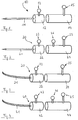
- the Figures 1 and 2 show an inventively designed instrument with the same distal part, but with different Proximal kind.
- the two instruments are in their entirety in the Figures 1 and 2 indicated by the reference numerals 10 and 20. They have straight instrument tips 11, 21, which each form the front portion of the distal part 12, 22.
- On the distal parts passive reflection markers 13, 23 are mounted, and in a middle distance from the instrument axis.
- the distal parts 12, 22 are connectable to proximal parts 14, 24, wherein the proximal part 14 in the FIG. 1 has only a single tracking marker 15.
- the characteristic configuration of the marker assembly would be in the case of the instrument FIG. 1 determined by the distance between the markers 13 and 15.
- At the instrument 20 after FIG. 2 becomes the characteristic arrangement determined by the relative distances between the three markers 23, 25 and 26 on the distal part 22 and the proximal part 24.
- FIGS. 3 and 4 another instrument according to the invention is shown which has a curved tip, designated 31 and 41, respectively.
- the instrument may in turn proximal parts 34 and 44, which with the Proximal kind 14 and 24 from the Figures 1 and 2 are identical.
- the instruments 30, 40 differ from the FIGS. 3 and 4 It can be seen that the markers 33, 43 have a greater distance from the instrument longitudinal axis and to the markers of the distal part than the markers 13, 23, and through This different measure differentiates the marker configurations altogether (markers on the proximal part plus markers on the distal part) from other marker configurations (eg for instruments 10 and 20). Because of these different marker configurations, a navigation system can then recognize that they are just the instruments 30 and 40, respectively, although the proximal parts 14 and 24 correspond to the proximal parts 34 and 44, respectively.
- FIGS. 5 and 6 and the instruments 50 and 60 shown there is corresponding, wherein the reference numerals with corresponding end numbers and corresponding parts as in the FIGS. 1 to 4 describe.
- the respective marker 53 or 63 only has a very short distance from the longitudinal axis of the instrument. Due to this short distance and the thus changed overall marker configuration for the instrument this in turn becomes clearly recognizable and identifiable.
- proximal part 14 it is possible to combine the proximal part 14 with one of the distal parts 11, 31, 51 and in each case to obtain another, uniquely identifiable instrument.
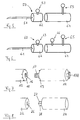
- FIG. 7 One way in which a distal part 12 can be connected to a proximal part 14 is in FIG FIG. 7 shown.
- the distal part 12 has a central threaded bore 16 and notch-like recesses on the outline of its end face.
- the proximal part 14 has a threaded rod 17 rotatable in it, which is connected to the attack 17A and is rotatable thereby.
- protruding tabs 19 are provided on the circumference.
- FIG. 8 shows for the embodiment according to FIG. 2 a further connection possibility in which the distal part 22 comprises a central bore 26, in which a latching extension 27 of the Proximalteils 24 can engage.
- the outwardly directed ribs 28 prevent rotation of the parts 22 and 24 against each other, and also a release of these two parts from each other. It could still be provided a device that folds away, for example, the ribs 28, so that the desired separation of the two parts can be done from each other in a simple manner.
- an alignment aid such as a mechanical engagement or a mark is provided so that the connection can go in the correct rotational position of the two parts to each other.
Landscapes
- Health & Medical Sciences (AREA)
- Surgery (AREA)
- Life Sciences & Earth Sciences (AREA)
- Heart & Thoracic Surgery (AREA)
- Pathology (AREA)
- Oral & Maxillofacial Surgery (AREA)
- Engineering & Computer Science (AREA)
- Biomedical Technology (AREA)
- Nuclear Medicine, Radiotherapy & Molecular Imaging (AREA)
- Medical Informatics (AREA)
- Molecular Biology (AREA)
- Animal Behavior & Ethology (AREA)
- General Health & Medical Sciences (AREA)
- Public Health (AREA)
- Veterinary Medicine (AREA)
- Surgical Instruments (AREA)
Description
- Die Erfindung betrifft ein trackingfähiges medizinisches Instrument mit einer austauschbaren Spitze. Der Gattung nach betrifft die Erfindung ein medizinisches Instrument mit einem Griff und einem funktionellen Abschnitt, wobei an dem Instrument eine Anordnung von Trackingmarkern angeordnet ist. Solche Instrumente sind für den Einsatz in der bildunterstützten Chirurgie vorgesehen, und die Trackingmarker dienen zum Tracking des Instruments mittels eines medizintechnischen Trackingsystems und zur Identifizierung des Instruments durch ein medizintechnisches Navigationssystem. Mit Hilfe des Navigationssystems kann die Lage des Instruments, insbesondere seines funktionellen Abschnittes (Spitze) geortet und verfolgt und das Instrument beispielsweise in räumlicher Relation zu vorab ermittelten Patientendaten (aus bildgebenden Verfahren; CT, MRI, etc.) auf einer Bildausgabe (Bildschirm) dargestellt werden, um dem Chirurgen bei seiner Arbeit eine visuelle Unterstützung zu geben.
- Medizinische Instrumente mit Trackingmarkern oder Trackingmarker-Aufsätzen sind bekannt, beispielsweise aus der
DE 196 39 615 A1 . - Um solche Instrumente, z. B. Instrumente mit Reflektorenmarker-Anordnungen, eindeutig durch ein Navigationssystem identifizierbar machen zu können, wird gemäß dem Stand der Technik jedem der Instrumente eine Referenzmarkergruppe zugeordnet, die eine für dieses Instrument charakteristische Anordnung aufweist. Dadurch wird die Herstellung solcher Instrumente inklusive der Bestückung mit Referenzmarkergruppen aufwendig und teuer, insbesondere wenn sie als Instrumentensatz zur Verfügung gestellt werden.
- Es ist die Aufgabe der vorliegenden Erfindung ein medizinisches Instrument bzw. einen Satz medizinischer Instrumente zur Verfügung zu stellen, welche die oben genannten Nachteile des Standes der Technik überwinden.
- Diese Aufgabe wird durch ein medizinisches Instrument gemäß dem Patentanspruch 1 sowie durch einen medizinischen Instrumentensatz gemäß dem Patentanspruch 9 gelöst. Die Unteransprüche definieren bevorzugte Ausführungsformen der Erfindung.
- Erfindungsgemäß ist ein medizinisches Instrument in mindestens zwei Teile teilbar und wieder zusammensetzbar, wobei an jedem Teil mindestens ein Trackingmarker angeordnet ist. Diese Teilbarkeit ergibt eine Austauschbarkeit eines Instrumententeils, und damit ergibt sich die Möglichkeit, die Anordnung der Trackingmarker des Instruments durch den Austausch von Instrumententeilen zu beeinflussen. Auf einem Teil des Instruments können dann ein oder mehrere Trackingmarker so verbleiben, wie sie sind, und wenn ein Austausch-Instrumententeil mit dem verbleibenden Instrumententeil kombiniert wird, entsteht eine neue Markeranordnung, die wiederum charakteristisch für das neue Instrument ist. Mit der Erfindung erübrigt sich somit die Notwendigkeit, vollständige neue Markeranordnungen für unterschiedliche Instrumente bereitzustellen.
- Bei einer Ausführungsform der vorliegenden Erfindung umfasst ein erster Teil des Instruments den funktionellen Abschnitt, also beispielsweise die Instrumentenspitze, die je nach Instrument unterschiedlich ausgestaltet und für unterschiedliche Arbeitsvorgänge geeignet sein kann (zum Beispiel Pointerspitze, Pinzette, Skalpellklinge), und ein zweiter Teil des Instruments umfasst mindestens einen Teil des Griffes (das Instrument ist also im Griff teilbar). Dabei besteht die Möglichkeit, am ersten Teil des Instruments mindestens einen Trackingmarker oder eine Trackingmarkergruppe anzuordnen, wobei der Trackingmarker oder die Trackingmarkergruppe in ihrer Ausgestaltung oder Anordnung eindeutig dem funktionellen Abschnitt des Instruments zugeordnet ist. Damit ergibt sich für jeden ersten Teil des Instruments, mit dem funktionellen Abschnitt, eine separate und unterscheidbare Gesamt-Trackingmarkeranordnung am Instrument. Die Gesamtgeometrie des Trackingmarkers oder der Trackingmarkergruppe des funktionellen Abschnittes zusammen mit dem Trackingmarker oder der Trackingmarkergruppe des Distalteils sind charakteristisch für eine Instrumentenzusammensetzung und dienen derer individuellen Erkennung. Die individuelle Erkennbarkeit ist gewährleistet, wenn für gleiche Geometrien des Distalteils die Postion des Trackingmarkers bzw. die Positionen der Trackingmarkergruppe sich zumindest in der Axialposition unterscheiden, generell kann eine Änderung der Axial- sowie der Radialposition für die Variabilität der Geometrien genutzt werden.
- Bei den aufgezeigten medizinischen Instrumenten besteht die Möglichkeit, am ersten Instrumententeil einen Trackingmarker und am zweiten Instrumententeil einen weiteren Trackingmarker anzuordnen, während andererseits auch am ersten Instrumententeil ein Trackingmarker und am zweiten Instrumententeil eine Trackingmarkergruppe mit zwei oder mehreren Trackingmarkern angeordnet werden kann. Natürlich kann auch das erste Instrumententeil mehrere Trackingmarker aufweisen, wichtig ist lediglich, dass die oder der Trackingmarker für das erste Instrumententeil eine einzigartige Anordnung haben, die diesem Instrumententeil zuordnungsfähig ist.
- Die beiden Instrumententeile sind bei einer bevorzugten Ausführungsform durch eine drehfeste Verbindung verbindbar, wobei die Verbindung insbesondere eine oder mehrere der folgenden Verbindungsarten umfasst: eine Schraubgewindeverbindung mit formschlüssigen oder reibschlüssigen Eingriffsmitteln zwischen dem ersten und zweiten Instrumententeil; eine Schnappverbindung mit formschlüssigen oder reibschlüssigen Eingriffsmitteln zwischen dem ersten und zweiten Instrumententei; eine Steckverbindung mit formschlüssigen oder reibschlüssigen Eingriffsmitteln zwischen dem ersten und zweiten Instrumententeil.
- Wie am Eingang schon kurz vermerkt, können die Trackingmarker eines erfindungsgemäßen medizinischen Instruments zum Tracken des Instruments mittels eines medizintechnischen Trackingsystems und zur Identifizierung des Instruments durch ein medizintechnisches Navigationssystem dienen.
- Die Erfindung umfasst ferner einen medizinischen Instrumentensatz mit mindestens zwei Instrumenten, wie sie oben in verschiedenen Ausführungen beschrieben worden sind. "zwei Instrumente" bedeutet nicht unbedingt, dass zwei erste Instrumententeile und zwei zweite Instrumententeile vorhanden sein müssen, vielmehr können die Instrumente aus verschiedenen ersten Instrumententeilen, die jeweils den funktionellen Abschnitt umfassen, und aus demselben oder aus gleichen zweiten Instrumententeilen, die mindestens einen Teil des Griffes umfassen, aufgebaut sein. Grundsätzlich genügt ein einziges zweites Instrumententeil, an dem mehrere erste Instrumententeile austauschbar angebracht werden können, um einen erfindungsgemäßen Instrumentensatz bereitzustellen.
- Die Erfindung hilft einem Verwender, beispielsweise einem Chirurgen, sein Instrument an die situationsbedingten Anforderungen anzupassen. Es ist nur notwenig, den vorderen Teil eines Instruments auszutauschen, um ein völlig anderes Instrument herzustellen, wobei der neue Vorderteil (erster Instrumententeil oder Distalteil) mit seinem Referenzmarker bzw. seinen Referenzmarkern zusammen mit dem hinteren Instrumententeil (zweiter Instrumententeil oder Proximalteil) vom Navigationssystem erkannt wird, und zwar aufgrund der Konfiguration bzw. Anordnung aller am Instrument befindlichen Marker. Dazu können die verschiedenen Kombinationen im Navigationssystem hinterlegt werden. Am Erkennen einer Kombination kann dann das neu kombinierte Instrument eindeutig erkannt und zugeordnet werden, und das Navigationssystem muss nicht mehr separat darüber informiert werden, welches Instrument gerade verwendet wird.
- Die Erfindung macht eine leichte Anpassung des Instruments an den tatsächlich vorhandenen Bedarf möglich. Es ist nicht mehr notwendig, eine Vielzahl unterschiedlicher vollständiger Instrumente bereitzustellen, grundsätzlich genügt ein Proximalteil (zweites Instrumententeil) und eine Sammlung mehrerer Distalteile. Die Geometrie der trackingfähigen passiven Markeranordnungen kann automatisch vom Navigationssystem erkannt werden.
- Man kann die Erfindung auch so beschreiben, dass sie ein medizinisches Instrument bereitstellt, dessen Vorderteil oder Spitze austauschbar ist. Wenn beispielsweise zwei optische Trackingmarker an einem Standard-Proximalteil (hinteres oder zweites Instrumententeil) angeordnet sind, kann ein dritter an dem austauschbaren Vorderteil angeordnet werden. Die Distanz vom dritten Marker zu einem Punkt auf dem Standard-Proximalteil (z.B. einem Marker oder auch einem Teil des Instruments selbst (Stirnseite) und/oder seine Höhe über der Achse seines Standard-Proximalteils bilden eine charakteristische und einzigartige Geometrie der Trackingmarker. Eines der beiden Maße oder beide Maße zusammen (Abstand und Höhe) sind für jedes austauschbare Distalteil unterschiedlich und können deshalb eindeutig zugeordnet werden.
- Die Erfindung wird im Weiteren anhand mehrer Ausführungsformen näher erläutert. Sie kann die hierin beschriebenen Merkmale einzeln sowie in jedweder sinnvollen Kombination umfassen. In den beiliegenden Zeichnungen zeigen:
- Figuren 1 und 2
- ein erfindungsgemäß gestaltetes Instrument mit gerader Instrumentenspitze und jeweils zwei bzw. drei Trackingmarkern;
- Figuren 3 und 4
- ein anderes erfindungsgemäß gestaltetes Instrument mit gekrümmter Spitze, mit zwei bzw. drei Trackingmarkern;
- Figuren 5 und 6
- noch ein weiteres erfindungsgemäß gestaltetes Instrument, wiederum mit jeweils zwei bzw. drei Trackingmarkern;
- Figur 7
- eine Verbindungsmöglichkeit für zwei Instrumententeile mit einer Schraub- und Eingriffslaschenverbindung; und
- Figur 8
- eine Verbindungsmöglichkeit für zwei Instrumententeile mit einer Steck- bzw. Schnappverbindung.
- Die
Figuren 1 und 2 zeigen ein erfindungsgemäß ausgestaltetes Instrument mit gleichem Distalteil, aber mit unterschiedlichen Proximalteilen. Die beiden Instrumente sind in ihrer Gesamtheit in denFiguren 1 und 2 mit den Bezugszeichen 10 und 20 angedeutet. Sie weisen gerade Instrumentenspitzen 11, 21 auf, die jeweils den vorderen Abschnitt des Distalteils 12, 22 bilden. Auf den Distalteilen sind passive Reflektionsmarker 13, 23 angebracht, und zwar in einem mittleren Abstand von der Instrumentenachse. Die Distalteile 12, 22 sind verbindbar mit Proximalteilen 14, 24, wobei das Proximalteil 14 in derFigur 1 nur einen einzigen Trackingmarker 15 aufweist. Die charakteristische Konfiguration der Markeranordnung würde im Falle des Instruments nachFigur 1 durch den Abstand zwischen den Markern 13 und 15 bestimmt. Beim Instrument 20 nachFigur 2 wird die charakteristische Anordnung durch die relativen Abstände zwischen den drei Markern 23, 25 und 26 auf dem Distalteil 22 und dem Proximalteil 24 bestimmt. - Die Instrumente sind in den Figuren geteilt dargestellt, um die Erfindung zu veranschaulichen. Natürlich sind im Verwendungszustand die Instrumententeile jeweils miteinander verbunden.
- In den
Figuren 3 und 4 ist ein weiteres erfindungsgemäßes Instrument gezeigt, das eine gebogene Spitze hat, die jeweils mit 31 bzw. 41 bezeichnet ist. Das Instrument kann wiederum Proximalteile 34 und 44 aufweisen, die mit den Proximalteilen 14 bzw. 24 aus denFiguren 1 und 2 identisch sind. Zur eindeutigen Identifizierung unterscheiden sich die Instrumente 30, 40 aus denFiguren 3 und 4 hiervon aber in Hinsicht auf die Anordnung des Trackingmarkers 33, 43 am Distalteil 32 bzw. 42. Es ist erkennbar, dass die Marker 33, 43 einen größeren Abstand zur Instrumentenlängsachse und zu den Markern des Distalteils haben als die Marker 13, 23, und durch dieses unterschiedliche Maß werden die Markerkonfigurationen insgesamt (Marker am Proximalteil plus Marker am Distalteil) von anderen Markerkonfigurationen (z.B. für die Instrumente 10 und 20) unterscheidbar. Aufgrund dieser unterschiedlichen Markerkonfigurationen kann ein Navigationssystem dann erkennen, dass es sich gerade um die Instrumente 30 bzw. 40 handelt, obwohl die Proximalteile 14 und 24 den Proximalteilen 34 und 44 jeweils entsprechen. - Für die
Figuren 5 und 6 und die dort dargestellten Instrumente 50 und 60 gilt entsprechendes, wobei die Bezugszeichen mit entsprechenden Endziffern auch entsprechende Teile wie in denFiguren 1 bis 4 bezeichnen. In denFiguren 5 und 6 ist erkennbar, dass für das dort dargestellte Instrument mit identischen Distalteilen 52 und 62 und mit kurz gekrümmter Spitze 51 bzw. 61 der jeweilige Marker 53 bzw. 63 nur einen sehr kurzen Abstand von der Längsachse des Instruments besitzt. Aufgrund dieses kurzen Abstandes und der so veränderten Gesamt-Markerkonfiguration für das Instrument wird dieses wiederum eindeutig erkennbar und identifizierbar. - Es ist demnach z.B. möglich das Proximalteil 14 mit einem der Distalteile 11, 31, 51 zu kombinieren und jeweils ein anderes, eindeutig identifizierbares Instrument zu erhalten.
- Eine Art und Weise, wie ein Distalteil 12 mit einem Proximalteil 14 verbunden werden kann, ist in der
Figur 7 dargestellt. Der Distalteil 12 weist eine zentrische Gewindebohrung 16 und kerbenartige Ausnehmungen am Umriss seiner Stirnseite auf. Hierzu passend weist der Proximalteil 14 eine in ihm verdrehbare Gewindestange 17 auf, die mit dem Angriff 17A verbunden und durch diesen drehbar ist. An dem Ende, wo die Gewindestange aus dem Proximalteil 14 heraustritt, sind an dessen Umfang abstehende Laschen 19 vorgesehen. Beim Zusammenfügen der beiden Teile 12 und 14 wird die Gewindestange 17 in das Innengewinde 16 eingeschraubt, und die Laschen 19 kommen in den Kerben 18 zu liegen, so dass beim Festschrauben mittels des Angriffs 17A am Ende eine drehgesicherte Verbindung entsteht, die sicherstellt, dass die Marker in der richtigen, das heißt im Navigationssystem gespeicherten Anordnung verbleiben. - Die
Figur 8 zeigt für die Ausführungsform nachFigur 2 eine weitere Verbindungsmöglichkeit, bei der der Distalteil 22 eine zentrische Bohrung 26 umfasst, in die ein Rastfortsatz 27 des Proximalteils 24 einrasten kann. Die nach außen gerichteten Rippen 28 verhindern dabei eine Drehung der Teile 22 und 24 gegeneinander, und ebenfalls ein Lösen dieser beiden Teile voneinander. Es könnte noch eine Vorrichtung vorgesehen sein, die beispielsweise die Rippen 28 wegklappt, damit das gewollte Trennen der beiden Teile voneinander in einfacher Weise geschehen kann. - Bei jeder möglichen Verbindung ist es noch von Vorteil, wenn eine Ausrichtungshilfe, beispielsweise ein mechanischer Eingriff oder eine Kennzeichnung vorgesehen wird, damit die Verbindung in der richtigen Drehstellung der beiden Teile zueinander vonstatten gehen kann.
Claims (10)
- Medizinisches Instrument (10 - 60) mit einem Griff und einem funktionellen Abschnitt (11 - 61), wobei an dem Instrument eine Anordnung von Trackingmarkern (13, 14, 15 - 63, 64, 65) angeordnet ist, dadurch gekennzeichnet, dass das Instrument in mindestens zwei Teile teilbar und wieder zusammensetzbar ist, wobei an jedem Teil mindestens ein Trackingmarker angeordnet ist.
- Medizinisches Instrument (10 - 60) nach Anspruch 1, dadurch gekennzeichnet, dass ein erster Teil (12 - 62) des Instruments (10 - 60) den funktionellen Abschnitt (11 - 61) umfasst und ein zweiter Teil (14 - 64) des Instruments (10 - 60) mindestens einen Teil des Griffes umfasst.
- Medizinisches Instrument nach Anspruch 2, dadurch gekennzeichnet, dass am ersten Teil des Instruments (10 - 60) mindestens ein Trackingmarker (13 - 63) oder eine Trackingmarkergruppe angeordnet ist, wobei der Trackingmarker (13 - 63) oder die Trackingmarkergruppe in ihrer Ausgestaltung oder Anordnung eindeutig dem funktionellen Abschnitt (11 - 61) des Instruments (10 - 60) zugeordnet ist.
- Medizinisches Instrument (10 - 60) nach Anspruch 3, dadurch gekennzeichnet, dass die Zuordnung des Trackingmarkers (13 - 63) oder der Trackingmarkergruppe durch eine dem funktionellen Teil zugeordnete charakteristische Anordnung, insbesondere eine Axial- oder Radialposition am ersten Instrumententeil (12 - 62) gegenüber der Trackergeometrie des zweiten Instrumententeils (14 - 64), bestimmt wird.
- Medizinisches Instrument (10 - 60) nach einem der Ansprüche 1 bis 4, dadurch gekennzeichnet, dass am ersten Instrumententeil (12 - 62) ein Trackingmarker (13 - 63) und am zweiten Instrumententeil (14 -64) ein Trackingmarker angeordnet ist.
- Medizinisches Instrument (10 - 60) nach einem der Ansprüche 1 bis 4, dadurch gekennzeichnet, dass am ersten Instrumententeil (12 - 62) ein Trackingmarker (13 - 63) angeordnet ist und am zweiten Instrumententeil (14 - 64) eine Trackingmarkergruppe mit zwei oder mehreren Trackingmarkern angeordnet ist.
- Medizinisches Instrument (10 - 60) nach einem der Ansprüche 1 bis 6, dadurch gekennzeichnet, dass die beiden Instrumententeile (12 - 62; 14 - 64) durch eine drehfeste Verbindung verbindbar sind, wobei die Verbindung insbesondere eine oder mehrere der folgenden Verbindungsarten umfasst:- eine Schraubgewindeverbindung (16, 17) mit formschlüssigen oder reibschlüssigen Eingriffsmitteln (18) zwischen dem ersten und zweiten Instrumententeil (12 - 62; 14 - 64);- eine Schnappverbindung (26, 28) mit formschlüssigen oder reibschlüssigen Eingriffsmitteln (28) zwischen dem ersten und zweiten Instrumententeil (12 - 62; 14 - 64);- eine Steckverbindung mit formschlüssigen oder reibschlüssigen Eingriffsmitteln (28) zwischen dem ersten und zweiten Instrumententeil (12 - 62; 14 - 64).
- Medizinisches Instrument (10 - 60) nach einem der Ansprüche 1 bis 7, dadurch gekennzeichnet, dass die Trackingmarker (13, 14, 15 - 63, 64, 65) zum Tracken des Instruments mittels eines medizintechnischen Trackingsystems und zur automatischen Identifizierung des Instruments durch ein medizintechnisches Navigationssystem dienen.
- Medizinischer Instrumentensatz mit mindestens zwei Instrumenten nach einem der Ansprüche 1 bis 8.
- Medizinischer Instrumentensatz nach Anspruch 9, bei dem die Instrumente aus verschiedenen ersten Instrumententeilen, die jeweils den funktionellen Abschnitt (11 - 61) umfassen, und aus demselben oder aus gleichen zweiten Instrumententeilen (14 - 64), die mindestens einen Teil des Griffes umfassen, aufgebaut sind.
Priority Applications (3)
| Application Number | Priority Date | Filing Date | Title |
|---|---|---|---|
| DE502006002954T DE502006002954D1 (de) | 2006-08-22 | 2006-08-22 | Trackingfähiges medizinisches Instrument mit austauschbarer Spitze |
| EP06017395A EP1891908B1 (de) | 2006-08-22 | 2006-08-22 | Trackingfähiges medizinisches Instrument mit austauschbarer Spitze |
| US11/842,969 US20080051768A1 (en) | 2006-08-22 | 2007-08-22 | Trackable medical instrument comprising an exchangeable tip |
Applications Claiming Priority (1)
| Application Number | Priority Date | Filing Date | Title |
|---|---|---|---|
| EP06017395A EP1891908B1 (de) | 2006-08-22 | 2006-08-22 | Trackingfähiges medizinisches Instrument mit austauschbarer Spitze |
Publications (2)
| Publication Number | Publication Date |
|---|---|
| EP1891908A1 EP1891908A1 (de) | 2008-02-27 |
| EP1891908B1 true EP1891908B1 (de) | 2009-02-25 |
Family
ID=37635650
Family Applications (1)
| Application Number | Title | Priority Date | Filing Date |
|---|---|---|---|
| EP06017395A Not-in-force EP1891908B1 (de) | 2006-08-22 | 2006-08-22 | Trackingfähiges medizinisches Instrument mit austauschbarer Spitze |
Country Status (3)
| Country | Link |
|---|---|
| US (1) | US20080051768A1 (de) |
| EP (1) | EP1891908B1 (de) |
| DE (1) | DE502006002954D1 (de) |
Families Citing this family (10)
| Publication number | Priority date | Publication date | Assignee | Title |
|---|---|---|---|---|
| US11040458B2 (en) * | 2012-12-31 | 2021-06-22 | Matthew W. Krenik | Hair cutting device for automated hair cutting system |
| US10318024B2 (en) | 2016-10-14 | 2019-06-11 | Orthosoft, Inc. | Mechanical optical pointer |
| US11020187B2 (en) | 2017-09-21 | 2021-06-01 | Synaptive Medical Inc. | Tracked suction tool |
| EP3811888A1 (de) | 2019-10-22 | 2021-04-28 | DePuy Ireland Unlimited Company | Verfahren zur trennung eines markierungstests von einer testbefestigung und testanordnung zur durchführung des verfahrens |
| US12016642B2 (en) * | 2021-09-08 | 2024-06-25 | Proprio, Inc. | Constellations for tracking instruments, such as surgical instruments, and associated systems and methods |
| WO2023220605A2 (en) | 2022-05-09 | 2023-11-16 | Proprio, Inc. | Methods and systems for calibrating instruments within an imaging system, such as a surgical imaging system |
| USD1091816S1 (en) | 2023-04-19 | 2025-09-02 | Stryker European Operations Limited | Surgical instrument tracker |
| EP4480438B1 (de) * | 2023-06-22 | 2025-12-31 | Stryker European Operations Limited | Technik zur bestimmung einer winkellage zwischen einem nicht rotationssymmetrischen arbeitsende eines werkzeugs und einem werkzeugtracker |
| USD1117755S1 (en) | 2023-08-18 | 2026-03-10 | Mako Surgical Corp. | Surgical tracker |
| USD1120320S1 (en) | 2023-08-18 | 2026-03-24 | Mako Surgical Corp. | Surgical tracker |
Family Cites Families (11)
| Publication number | Priority date | Publication date | Assignee | Title |
|---|---|---|---|---|
| US5617857A (en) * | 1995-06-06 | 1997-04-08 | Image Guided Technologies, Inc. | Imaging system having interactive medical instruments and methods |
| US6351659B1 (en) * | 1995-09-28 | 2002-02-26 | Brainlab Med. Computersysteme Gmbh | Neuro-navigation system |
| DE19639615C5 (de) | 1996-09-26 | 2008-11-06 | Brainlab Ag | Reflektorenreferenzierungssystem für chirurgische und medizinische Instrumente |
| DE29600990U1 (de) * | 1996-01-20 | 1996-04-11 | Elekta Instrument GmbH, 79224 Umkirch | Vorrichtung für die bildgeführte Chirurgie |
| US6021343A (en) * | 1997-11-20 | 2000-02-01 | Surgical Navigation Technologies | Image guided awl/tap/screwdriver |
| US6556857B1 (en) * | 2000-10-24 | 2003-04-29 | Sdgi Holdings, Inc. | Rotation locking driver for image guided instruments |
| US6887245B2 (en) * | 2001-06-11 | 2005-05-03 | Ge Medical Systems Global Technology Company, Llc | Surgical drill for use with a computer assisted surgery system |
| US20050113659A1 (en) * | 2003-11-26 | 2005-05-26 | Albert Pothier | Device for data input for surgical navigation system |
| US9393039B2 (en) * | 2003-12-17 | 2016-07-19 | Brainlab Ag | Universal instrument or instrument set for computer guided surgery |
| DE502004001659D1 (de) * | 2003-12-17 | 2006-11-16 | Brainlab Ag | Universelles Instrument bzw. Instrumentensatz zur Navigation in der computergestützten Chirurgie |
| US7840256B2 (en) * | 2005-06-27 | 2010-11-23 | Biomet Manufacturing Corporation | Image guided tracking array and method |
-
2006
- 2006-08-22 EP EP06017395A patent/EP1891908B1/de not_active Not-in-force
- 2006-08-22 DE DE502006002954T patent/DE502006002954D1/de active Active
-
2007
- 2007-08-22 US US11/842,969 patent/US20080051768A1/en not_active Abandoned
Also Published As
| Publication number | Publication date |
|---|---|
| DE502006002954D1 (de) | 2009-04-09 |
| EP1891908A1 (de) | 2008-02-27 |
| US20080051768A1 (en) | 2008-02-28 |
Similar Documents
| Publication | Publication Date | Title |
|---|---|---|
| EP1952779B1 (de) | Medizintechnische Instrumenten-Identifizierung | |
| DE19518388C2 (de) | Medizinisches Instrument mit einem abwinkelbaren distalen Endstück | |
| AT393616B (de) | Chirurgisches heftinstrument zur durchfuehrung von intraluminalen anastomosen | |
| EP0980676B1 (de) | Instrument zur chirurgischen Anastomose | |
| EP0575878B1 (de) | Anästhesiebesteck | |
| DE102007011568A1 (de) | Medizinische Klemme, insbesondere Wirbelsäulen-Klemme | |
| EP1891908B1 (de) | Trackingfähiges medizinisches Instrument mit austauschbarer Spitze | |
| WO1998017191A1 (de) | Einpunktfixierte, selbstverriegelnde halterung | |
| DE19901389B4 (de) | Endoskopisches Behandlungssystem | |
| EP2422753A1 (de) | Instrumentarium zum eindrehen eines Implantats in ein Bandscheibenfach | |
| DE10216928B4 (de) | In ein Endoskop einsetzbares Einweginstrument | |
| EP1543789B1 (de) | Universelles Instrument bzw. Instrumentensatz zur Navigation in der computergestützten Chirurgie | |
| DE202014003736U1 (de) | Retraktionssystem | |
| EP1437978A1 (de) | Vorrichtung zur adaptation insbesondere chirurgischer instrumente als zeigereinrichtungen | |
| DE102018104966A1 (de) | Laryngo-Pharyngoskop-Retraktor-System | |
| EP2129311A1 (de) | Manipulator für rundmaterial, insbesondere für einen kirschnerdraht | |
| DE19754779C2 (de) | Chirurgisches Instrument | |
| WO2020002457A1 (de) | Dentalgerät zum sondieren von zahnzwischenräumen | |
| DE69608975T2 (de) | Zwischenstück für dentales Handstück | |
| DE10032126B4 (de) | Instrument zum Einführen eines Verbindungsstabes in und durch zueinander ausgerichtete Querbohrungen in den Köpfen von zwei oder mehreren in die Wirbelsäule eingeschraubten Pedikelschrauben | |
| DE102016010548A1 (de) | Transporteur | |
| DE102022131155A1 (de) | Medizinisches instrument zum multidirektionalen verdüsen eines fluids in einen hohlraum eines körpers und werkzeug dafür | |
| AT9257U1 (de) | Handgriff eines medizinischen instruments | |
| DE102016103681A1 (de) | Positioniervorrichtung zum Fixieren einer polyaxialen Platte an einem Röhrenknochen | |
| DE202013100878U1 (de) | Arthroskopieschaft |
Legal Events
| Date | Code | Title | Description |
|---|---|---|---|
| PUAI | Public reference made under article 153(3) epc to a published international application that has entered the european phase |
Free format text: ORIGINAL CODE: 0009012 |
|
| 17P | Request for examination filed |
Effective date: 20060822 |
|
| AK | Designated contracting states |
Kind code of ref document: A1 Designated state(s): AT BE BG CH CY CZ DE DK EE ES FI FR GB GR HU IE IS IT LI LT LU LV MC NL PL PT RO SE SI SK TR |
|
| AX | Request for extension of the european patent |
Extension state: AL BA HR MK YU |
|
| GRAP | Despatch of communication of intention to grant a patent |
Free format text: ORIGINAL CODE: EPIDOSNIGR1 |
|
| GRAS | Grant fee paid |
Free format text: ORIGINAL CODE: EPIDOSNIGR3 |
|
| AKX | Designation fees paid |
Designated state(s): DE FR GB IT |
|
| GRAA | (expected) grant |
Free format text: ORIGINAL CODE: 0009210 |
|
| AK | Designated contracting states |
Kind code of ref document: B1 Designated state(s): DE FR GB IT |
|
| REG | Reference to a national code |
Ref country code: GB Ref legal event code: FG4D Free format text: NOT ENGLISH |
|
| REF | Corresponds to: |
Ref document number: 502006002954 Country of ref document: DE Date of ref document: 20090409 Kind code of ref document: P |
|
| PLBE | No opposition filed within time limit |
Free format text: ORIGINAL CODE: 0009261 |
|
| STAA | Information on the status of an ep patent application or granted ep patent |
Free format text: STATUS: NO OPPOSITION FILED WITHIN TIME LIMIT |
|
| 26N | No opposition filed |
Effective date: 20091126 |
|
| PG25 | Lapsed in a contracting state [announced via postgrant information from national office to epo] |
Ref country code: IT Free format text: LAPSE BECAUSE OF FAILURE TO SUBMIT A TRANSLATION OF THE DESCRIPTION OR TO PAY THE FEE WITHIN THE PRESCRIBED TIME-LIMIT Effective date: 20090225 |
|
| GBPC | Gb: european patent ceased through non-payment of renewal fee |
Effective date: 20100822 |
|
| PG25 | Lapsed in a contracting state [announced via postgrant information from national office to epo] |
Ref country code: GB Free format text: LAPSE BECAUSE OF NON-PAYMENT OF DUE FEES Effective date: 20100822 |
|
| REG | Reference to a national code |
Ref country code: DE Ref legal event code: R082 Ref document number: 502006002954 Country of ref document: DE Representative=s name: SCHWABE SANDMAIR MARX, DE |
|
| REG | Reference to a national code |
Ref country code: DE Ref legal event code: R081 Ref document number: 502006002954 Country of ref document: DE Owner name: BRAINLAB AG, DE Free format text: FORMER OWNER: BRAINLAB AG, 85622 FELDKIRCHEN, DE Effective date: 20131104 Ref country code: DE Ref legal event code: R082 Ref document number: 502006002954 Country of ref document: DE Representative=s name: SCHWABE SANDMAIR MARX, DE Effective date: 20131104 Ref country code: DE Ref legal event code: R082 Ref document number: 502006002954 Country of ref document: DE Representative=s name: SCHWABE SANDMAIR MARX PATENTANWAELTE RECHTSANW, DE Effective date: 20131104 |
|
| REG | Reference to a national code |
Ref country code: FR Ref legal event code: PLFP Year of fee payment: 10 |
|
| PGFP | Annual fee paid to national office [announced via postgrant information from national office to epo] |
Ref country code: DE Payment date: 20150821 Year of fee payment: 10 |
|
| PGFP | Annual fee paid to national office [announced via postgrant information from national office to epo] |
Ref country code: FR Payment date: 20150820 Year of fee payment: 10 |
|
| REG | Reference to a national code |
Ref country code: DE Ref legal event code: R082 Ref document number: 502006002954 Country of ref document: DE Representative=s name: SCHWABE SANDMAIR MARX PATENTANWAELTE RECHTSANW, DE Ref country code: DE Ref legal event code: R081 Ref document number: 502006002954 Country of ref document: DE Owner name: BRAINLAB AG, DE Free format text: FORMER OWNER: BRAINLAB AG, 85622 FELDKIRCHEN, DE Ref country code: DE Ref legal event code: R119 Ref document number: 502006002954 Country of ref document: DE |
|
| REG | Reference to a national code |
Ref country code: FR Ref legal event code: ST Effective date: 20170428 |
|
| PG25 | Lapsed in a contracting state [announced via postgrant information from national office to epo] |
Ref country code: DE Free format text: LAPSE BECAUSE OF NON-PAYMENT OF DUE FEES Effective date: 20170301 Ref country code: FR Free format text: LAPSE BECAUSE OF NON-PAYMENT OF DUE FEES Effective date: 20160831 |