EP1892281A1 - Procédé de fabrication d'un combustible de remplacement pour l'utilisation dans des centrales thermiques fonctionnant au charbon et/ou des usines d'incinération de déchets et/ou des dispositifs de l'industrie de ciment ou d'autres incinérateurs, dans lesquels des combustibles solides sont utilisés - Google Patents
Procédé de fabrication d'un combustible de remplacement pour l'utilisation dans des centrales thermiques fonctionnant au charbon et/ou des usines d'incinération de déchets et/ou des dispositifs de l'industrie de ciment ou d'autres incinérateurs, dans lesquels des combustibles solides sont utilisés Download PDFInfo
- Publication number
- EP1892281A1 EP1892281A1 EP06017388A EP06017388A EP1892281A1 EP 1892281 A1 EP1892281 A1 EP 1892281A1 EP 06017388 A EP06017388 A EP 06017388A EP 06017388 A EP06017388 A EP 06017388A EP 1892281 A1 EP1892281 A1 EP 1892281A1
- Authority
- EP
- European Patent Office
- Prior art keywords
- coal
- fuel
- plants
- secondary fuel
- components
- Prior art date
- Legal status (The legal status is an assumption and is not a legal conclusion. Google has not performed a legal analysis and makes no representation as to the accuracy of the status listed.)
- Withdrawn
Links
Images
Classifications
-
- C—CHEMISTRY; METALLURGY
- C10—PETROLEUM, GAS OR COKE INDUSTRIES; TECHNICAL GASES CONTAINING CARBON MONOXIDE; FUELS; LUBRICANTS; PEAT
- C10L—FUELS NOT OTHERWISE PROVIDED FOR; NATURAL GAS; SYNTHETIC NATURAL GAS OBTAINED BY PROCESSES NOT COVERED BY SUBCLASSES C10G OR C10K; LIQUIFIED PETROLEUM GAS; USE OF ADDITIVES TO FUELS OR FIRES; FIRE-LIGHTERS
- C10L5/00—Solid fuels
- C10L5/02—Solid fuels such as briquettes consisting mainly of carbonaceous materials of mineral or non-mineral origin
- C10L5/04—Raw material of mineral origin to be used; Pretreatment thereof
-
- C—CHEMISTRY; METALLURGY
- C10—PETROLEUM, GAS OR COKE INDUSTRIES; TECHNICAL GASES CONTAINING CARBON MONOXIDE; FUELS; LUBRICANTS; PEAT
- C10L—FUELS NOT OTHERWISE PROVIDED FOR; NATURAL GAS; SYNTHETIC NATURAL GAS OBTAINED BY PROCESSES NOT COVERED BY SUBCLASSES C10G OR C10K; LIQUIFIED PETROLEUM GAS; USE OF ADDITIVES TO FUELS OR FIRES; FIRE-LIGHTERS
- C10L5/00—Solid fuels
- C10L5/02—Solid fuels such as briquettes consisting mainly of carbonaceous materials of mineral or non-mineral origin
- C10L5/06—Methods of shaping, e.g. pelletizing or briquetting
- C10L5/08—Methods of shaping, e.g. pelletizing or briquetting without the aid of extraneous binders
-
- C—CHEMISTRY; METALLURGY
- C10—PETROLEUM, GAS OR COKE INDUSTRIES; TECHNICAL GASES CONTAINING CARBON MONOXIDE; FUELS; LUBRICANTS; PEAT
- C10L—FUELS NOT OTHERWISE PROVIDED FOR; NATURAL GAS; SYNTHETIC NATURAL GAS OBTAINED BY PROCESSES NOT COVERED BY SUBCLASSES C10G OR C10K; LIQUIFIED PETROLEUM GAS; USE OF ADDITIVES TO FUELS OR FIRES; FIRE-LIGHTERS
- C10L5/00—Solid fuels
- C10L5/02—Solid fuels such as briquettes consisting mainly of carbonaceous materials of mineral or non-mineral origin
- C10L5/34—Other details of the shaped fuels, e.g. briquettes
- C10L5/36—Shape
- C10L5/363—Pellets or granulates
-
- C—CHEMISTRY; METALLURGY
- C10—PETROLEUM, GAS OR COKE INDUSTRIES; TECHNICAL GASES CONTAINING CARBON MONOXIDE; FUELS; LUBRICANTS; PEAT
- C10L—FUELS NOT OTHERWISE PROVIDED FOR; NATURAL GAS; SYNTHETIC NATURAL GAS OBTAINED BY PROCESSES NOT COVERED BY SUBCLASSES C10G OR C10K; LIQUIFIED PETROLEUM GAS; USE OF ADDITIVES TO FUELS OR FIRES; FIRE-LIGHTERS
- C10L5/00—Solid fuels
- C10L5/02—Solid fuels such as briquettes consisting mainly of carbonaceous materials of mineral or non-mineral origin
- C10L5/34—Other details of the shaped fuels, e.g. briquettes
- C10L5/36—Shape
- C10L5/366—Powders
-
- C—CHEMISTRY; METALLURGY
- C10—PETROLEUM, GAS OR COKE INDUSTRIES; TECHNICAL GASES CONTAINING CARBON MONOXIDE; FUELS; LUBRICANTS; PEAT
- C10L—FUELS NOT OTHERWISE PROVIDED FOR; NATURAL GAS; SYNTHETIC NATURAL GAS OBTAINED BY PROCESSES NOT COVERED BY SUBCLASSES C10G OR C10K; LIQUIFIED PETROLEUM GAS; USE OF ADDITIVES TO FUELS OR FIRES; FIRE-LIGHTERS
- C10L5/00—Solid fuels
- C10L5/40—Solid fuels essentially based on materials of non-mineral origin
- C10L5/46—Solid fuels essentially based on materials of non-mineral origin on sewage, house, or town refuse
-
- C—CHEMISTRY; METALLURGY
- C10—PETROLEUM, GAS OR COKE INDUSTRIES; TECHNICAL GASES CONTAINING CARBON MONOXIDE; FUELS; LUBRICANTS; PEAT
- C10L—FUELS NOT OTHERWISE PROVIDED FOR; NATURAL GAS; SYNTHETIC NATURAL GAS OBTAINED BY PROCESSES NOT COVERED BY SUBCLASSES C10G OR C10K; LIQUIFIED PETROLEUM GAS; USE OF ADDITIVES TO FUELS OR FIRES; FIRE-LIGHTERS
- C10L5/00—Solid fuels
- C10L5/40—Solid fuels essentially based on materials of non-mineral origin
- C10L5/48—Solid fuels essentially based on materials of non-mineral origin on industrial residues and waste materials
-
- Y—GENERAL TAGGING OF NEW TECHNOLOGICAL DEVELOPMENTS; GENERAL TAGGING OF CROSS-SECTIONAL TECHNOLOGIES SPANNING OVER SEVERAL SECTIONS OF THE IPC; TECHNICAL SUBJECTS COVERED BY FORMER USPC CROSS-REFERENCE ART COLLECTIONS [XRACs] AND DIGESTS
- Y02—TECHNOLOGIES OR APPLICATIONS FOR MITIGATION OR ADAPTATION AGAINST CLIMATE CHANGE
- Y02E—REDUCTION OF GREENHOUSE GAS [GHG] EMISSIONS, RELATED TO ENERGY GENERATION, TRANSMISSION OR DISTRIBUTION
- Y02E50/00—Technologies for the production of fuel of non-fossil origin
- Y02E50/10—Biofuels, e.g. bio-diesel
-
- Y—GENERAL TAGGING OF NEW TECHNOLOGICAL DEVELOPMENTS; GENERAL TAGGING OF CROSS-SECTIONAL TECHNOLOGIES SPANNING OVER SEVERAL SECTIONS OF THE IPC; TECHNICAL SUBJECTS COVERED BY FORMER USPC CROSS-REFERENCE ART COLLECTIONS [XRACs] AND DIGESTS
- Y02—TECHNOLOGIES OR APPLICATIONS FOR MITIGATION OR ADAPTATION AGAINST CLIMATE CHANGE
- Y02E—REDUCTION OF GREENHOUSE GAS [GHG] EMISSIONS, RELATED TO ENERGY GENERATION, TRANSMISSION OR DISTRIBUTION
- Y02E50/00—Technologies for the production of fuel of non-fossil origin
- Y02E50/30—Fuel from waste, e.g. synthetic alcohol or diesel
Definitions
- the invention relates to a method for producing a substitute fuel for use in coal power plants and / or waste incineration plants and / or plants of the cement industry or other incinerators, residues of coal processing, in particular the treatment of hard coal are used.
- coal used in the past in coal production such as Inferior or mineral contaminated coal or residues from the washing of hard coal have been largely tilted in dry, damp or mud-like form on stockpiles for intermediate storage.
- a process for the utilization of combustible coal by-products, wherein the collected combustible waste products of various types with, in each available quantity ratio with a binder content of 3 to 50% of gypsum and / or clay and / or other inorganic and / or organic binders, preferably Abiscusn and / or specific animal secretions, possibly with the addition of water, mixed in a mixing process by means of a mixing drum and then solidified by a pressing operation by means of a press or by granulation and made lumpy ( DD 150 908 ).
- liquid or viscous industrial waste as an additive fuel in industrial combustion processes, being used as liquid or viscous industrial waste resin waste, paint sludge or oil sludge in admixture with finely divided, solid, adsorptive organic carriers and possibly other additives ( DE 29 35 103 C3 ).
- About 100 parts by weight of vehicle carry about 100 to 200 parts by weight of industrial waste.
- Suitable carriers are peat, rock or lignite dust and carbon black.
- a process for the production of solid fuels from waste wherein after a coarse and fine separation, the low-energy fine fraction of the waste mixed with coal and the mixture passes into a degassing reactor in which it is coked to a pyrolysis coke ( DE 32 44 569 C2 ).
- the DE 28 33 731 C2 describes a briquette for use as a gasification feedstock consisting of a mixture of solid refuse, coal and a binder that is compressed under pressure.
- a gasification feedstock consisting of a mixture of solid refuse, coal and a binder that is compressed under pressure.
- waste organic waste and as a binder sewage sludge and tar oil condensates are used.
- the invention has for its object to develop a method for producing a substitute fuel, which is simple, inexpensive and approvable.
- the substitute fuel should have such a high calorific value, which also makes a sole use as a fuel possible.
- coal residues are loaded and then fed to a sorting system in which a separation into coarse constituents (deaf rock) and fine components (coal dust) takes place, the fine constituents in a proportion of 85 to 30% by mass of the total mixture a pre-sorted one known per se Secondary fuel is supplied in the form of fluff or pellets via a metering a grinding mixing plant in which no additional energy supply grinding and drying of the mixture and depending on the desired place of use and depending on the moisture content of a dusty to granular substitute fuel with a calorific value of 13 to 22 MJ / kg is produced.
- the coal residue used is preferably former coal sludge from existing stockpiles. These residues have a bulk consistency and are no longer muddy. Their water content is about 15 to 25 M%. The calorific value of these residues is usually 6 to 14 MJ / kg. Such heaps are present on all current and former coal mines and can not currently be used beneficially.
- the presorted secondary fuel used is a fuel which is largely freed from decomposable organic and metallic components and is present in a grain size of 0 to 40 mm with a very low chlorine content (preferably of ⁇ 1%, but also up to 3%) of waste components. These secondary fuels have largely paper and plastic components.
- the loading of coal residues is carried out by means of excavators and / or wheel loaders and / or cranes.
- the dosage of the individual mixture components by means of load cells and / or belt scales and / or rotary valves.
- a grinding mixing plant preferably a hammer mill and / or a hammer crusher is used.
- Such hammer mills and / or breakers grind and mix at the same time the supplied via the metering components to a predetermined grain size.
- the special shape of the grinding produces a noteworthy frictional heat which, according to the invention, results in an additional drying of the mixture in a shunt.
- the calorific value by the special treatment is surprisingly higher than the weighted average of the calorific value of the starting materials.
- compulsory mixers can also be used. However, under certain circumstances, the mixture or parts thereof must be dried separately.
- the presorted secondary fuel preferably has a calorific value of 14 to 28 MJ / kg and is added to the coal residues in a proportion of 15 to 70% by mass depending on the calorific value of the final product to be achieved. It can be used as a fluff with a grain size of 0 to 35 mm or as compressed pellets with a grain size of 10 to 40 mm.
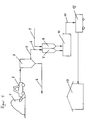
- the coal residue 1 are removed from the stockpile by means of a wheel loader 2 and fed to a sorting plant 3 (FIG. 1).
- This sorting plant 3 separates the residue 1 into a coarse fraction 4, which contains predominantly deaf rock and a fine fraction 5, which consists predominantly of coal dust or granules. While the coarse fraction 4 is disposed of or supplied to a use as a road construction material, the fine fraction 5 is supplied via a conveyor belt 6 to a dosing plant 7.
- the dosing plant 8 is used to add the secondary fuel 9 in the form of fluff fractions or pellets.
- the addition of the individual components in the hammer crusher 10 where a crushing and grinding and simultaneously mixing and drying of the mixture 11 takes place until a particle size of 0 to 10 mm is reached.
- the hammer crusher has an output of approx. 20 to 200 t / h. From the hammer crusher 10, the mixture 11 passes through open wagons or trucks 12 in suitable warehouses 13 and the incinerators.
Landscapes
- Chemical & Material Sciences (AREA)
- Oil, Petroleum & Natural Gas (AREA)
- Organic Chemistry (AREA)
- Life Sciences & Earth Sciences (AREA)
- Environmental & Geological Engineering (AREA)
- General Life Sciences & Earth Sciences (AREA)
- Geochemistry & Mineralogy (AREA)
- Geology (AREA)
- Solid Fuels And Fuel-Associated Substances (AREA)
Priority Applications (1)
| Application Number | Priority Date | Filing Date | Title |
|---|---|---|---|
| EP06017388A EP1892281A1 (fr) | 2006-08-22 | 2006-08-22 | Procédé de fabrication d'un combustible de remplacement pour l'utilisation dans des centrales thermiques fonctionnant au charbon et/ou des usines d'incinération de déchets et/ou des dispositifs de l'industrie de ciment ou d'autres incinérateurs, dans lesquels des combustibles solides sont utilisés |
Applications Claiming Priority (1)
| Application Number | Priority Date | Filing Date | Title |
|---|---|---|---|
| EP06017388A EP1892281A1 (fr) | 2006-08-22 | 2006-08-22 | Procédé de fabrication d'un combustible de remplacement pour l'utilisation dans des centrales thermiques fonctionnant au charbon et/ou des usines d'incinération de déchets et/ou des dispositifs de l'industrie de ciment ou d'autres incinérateurs, dans lesquels des combustibles solides sont utilisés |
Publications (1)
| Publication Number | Publication Date |
|---|---|
| EP1892281A1 true EP1892281A1 (fr) | 2008-02-27 |
Family
ID=37905898
Family Applications (1)
| Application Number | Title | Priority Date | Filing Date |
|---|---|---|---|
| EP06017388A Withdrawn EP1892281A1 (fr) | 2006-08-22 | 2006-08-22 | Procédé de fabrication d'un combustible de remplacement pour l'utilisation dans des centrales thermiques fonctionnant au charbon et/ou des usines d'incinération de déchets et/ou des dispositifs de l'industrie de ciment ou d'autres incinérateurs, dans lesquels des combustibles solides sont utilisés |
Country Status (1)
| Country | Link |
|---|---|
| EP (1) | EP1892281A1 (fr) |
Cited By (3)
| Publication number | Priority date | Publication date | Assignee | Title |
|---|---|---|---|---|
| GB2472989A (en) * | 2009-08-25 | 2011-03-02 | Rexos Ltd | Converting hydrocarbon waste into fuel for cement kilns |
| CN104263451A (zh) * | 2014-09-30 | 2015-01-07 | 冯恩福 | 一种菌渣绿聚燃料及其制备方法 |
| CN109642174A (zh) * | 2016-08-24 | 2019-04-16 | 株式会社神户制钢所 | 固体燃料的制造方法 |
Citations (6)
| Publication number | Priority date | Publication date | Assignee | Title |
|---|---|---|---|---|
| US3579442A (en) * | 1970-07-09 | 1971-05-18 | Bird Machine Co | Coal converting process |
| DE3128528A1 (de) * | 1981-07-18 | 1983-02-03 | Loesche GmbH, 4000 Düsseldorf | Verfahren zur erzeugung eines gemisches aus kohlenstaub und muellkompost |
| DE3309255A1 (de) * | 1983-03-15 | 1984-09-20 | José Manuel Lazcano Guipúzcoa Lago Lucio | Neuer brennstoff |
| US4561860A (en) * | 1980-03-24 | 1985-12-31 | The Secretary Of State For The Environment In Her Britannic Majesty's Government Of The United Kingdom Of Great Britain And Northern Ireland | Process and apparatus for production of refuse derived fuel |
| US6156083A (en) * | 1998-02-05 | 2000-12-05 | Tuboscope | Coal reclamation systems |
| DE10347355A1 (de) * | 2003-10-11 | 2005-05-19 | Wienerberger Ziegelindustrie Gmbh | Fester Brennstoff, insbesondere für die keramische Industrie und die Zementindustrie sowie für Müllverbrennungsanlagen und Kohlekraftwerke |
-
2006
- 2006-08-22 EP EP06017388A patent/EP1892281A1/fr not_active Withdrawn
Patent Citations (6)
| Publication number | Priority date | Publication date | Assignee | Title |
|---|---|---|---|---|
| US3579442A (en) * | 1970-07-09 | 1971-05-18 | Bird Machine Co | Coal converting process |
| US4561860A (en) * | 1980-03-24 | 1985-12-31 | The Secretary Of State For The Environment In Her Britannic Majesty's Government Of The United Kingdom Of Great Britain And Northern Ireland | Process and apparatus for production of refuse derived fuel |
| DE3128528A1 (de) * | 1981-07-18 | 1983-02-03 | Loesche GmbH, 4000 Düsseldorf | Verfahren zur erzeugung eines gemisches aus kohlenstaub und muellkompost |
| DE3309255A1 (de) * | 1983-03-15 | 1984-09-20 | José Manuel Lazcano Guipúzcoa Lago Lucio | Neuer brennstoff |
| US6156083A (en) * | 1998-02-05 | 2000-12-05 | Tuboscope | Coal reclamation systems |
| DE10347355A1 (de) * | 2003-10-11 | 2005-05-19 | Wienerberger Ziegelindustrie Gmbh | Fester Brennstoff, insbesondere für die keramische Industrie und die Zementindustrie sowie für Müllverbrennungsanlagen und Kohlekraftwerke |
Cited By (4)
| Publication number | Priority date | Publication date | Assignee | Title |
|---|---|---|---|---|
| GB2472989A (en) * | 2009-08-25 | 2011-03-02 | Rexos Ltd | Converting hydrocarbon waste into fuel for cement kilns |
| GB2472989B (en) * | 2009-08-25 | 2014-01-01 | Rexos Ltd | Converting hydrocarbon waste into fuel for cement kilns |
| CN104263451A (zh) * | 2014-09-30 | 2015-01-07 | 冯恩福 | 一种菌渣绿聚燃料及其制备方法 |
| CN109642174A (zh) * | 2016-08-24 | 2019-04-16 | 株式会社神户制钢所 | 固体燃料的制造方法 |
Similar Documents
| Publication | Publication Date | Title |
|---|---|---|
| DE4138036C2 (de) | Verfahren und Vorrichtung zur Behandlung eines zu einem Dickschlamm entwässerten Klärschlammes | |
| WO2008095714A1 (fr) | Produit de mélange | |
| AU2005258956B2 (en) | Fuel product and process | |
| DE102009014717B4 (de) | Verfahren und Vorrichtung zur Verarbeitung von staubförmigen und flüssig/pastösen Abfallstoffen sowie zur Herstellung eines Mischbrennstoffes | |
| DE19815205C2 (de) | Verfahren zur Herstellung eines Sekundärrohstoffes zur Belieferung von Zementwerken | |
| WO2022207036A1 (fr) | Liant pour matériaux de construction, procédé de production associé et installation pour la mise en œuvre de ce procédé | |
| EP0453460B1 (fr) | Procede pour traiter les boues de vernis et peintures ainsi que les dechets de colorants | |
| DD293635A5 (de) | Verfahren zur thermischen verwertung und einrichtung zur thermischen aufbereitung von organische bestandteile enthaltenden abfallstoffen | |
| EP1837390A1 (fr) | Procédé et dispositif destinés à la préparation de bois brut ou produit à brûler analogue | |
| EP0373236B1 (fr) | Briquette de charbon non polluant et procédé pour sa fabrication | |
| DE3606704C2 (de) | Verfahren zur Herstellung hochkalorischer industrieller Billigbrennstoffe unter gleichzeitiger Entsorgung industrieller und/oder kommunaler Klärschlämme und Verwendung der entstehenden Suspension | |
| DE102007004145A1 (de) | Verfahren zur Entsorgung energiehaltiger Abfallstoffe und Verfahren zur Herstellung von Formlingen | |
| AT378200B (de) | Schadstoffabbindendes brennstoffbrikett aus gebrauchten bleicherden, kieselgur und anorganischem gelen | |
| EP0873383B1 (fr) | Procede de production de combustible granule coulant | |
| DE102004002388A1 (de) | Verfahren zur energetischen Nutzung von Ersatzbrennstoffen, Pyrolyseanlage für Ersatzbrennstoffe sowie Kombination aus Pyrolyseanlage und Feuerungsanlage zur Verfeuerung von Pyrolysegasen | |
| DE102010001330B4 (de) | Verfahren und Anlage zur thermischen Verwertung von Biomasse | |
| DE10060230A1 (de) | Verwertung/Veraschung von organischen Abfällen | |
| DE4123368C1 (fr) | ||
| DE102006036661A1 (de) | Verfahren zur thermischen Verwertung von Kunststoffabfällen aus Industrie und Haushalt | |
| WO2000027954A1 (fr) | Procede d'utilisation de dechets | |
| DE19506249C1 (de) | Verfahren zur Verarbeitung und Verwendung von Reststoffen, die bei der Herstellung von Papier anfallen | |
| DE102009048435B4 (de) | Verfahren zum Bringen kleinstückiger, mineralischer Carbonate in brennfähige Form | |
| DE202012001440U1 (de) | Formling aus organischen und/oder anorganischen Abfällen für die energetische und/oder stoffliche Verwertung in einem Schmelz-Vergaser | |
| DE102020101700A1 (de) | Verfahren zur Optimierung der Förder-, Transport- und Lagereigenschaften eines Industriebrennstoffs | |
| DE102013113660A1 (de) | Verfahren und Koksgewinnungsanlage zur Behandlung von schwefelhaltigen Prozessrückständen aus der Erdölverarbeitung; Petrolkoks gebildet aus schwefelhaltigen Prozessrückständen |
Legal Events
| Date | Code | Title | Description |
|---|---|---|---|
| PUAI | Public reference made under article 153(3) epc to a published international application that has entered the european phase |
Free format text: ORIGINAL CODE: 0009012 |
|
| AK | Designated contracting states |
Kind code of ref document: A1 Designated state(s): AT BE BG CH CY CZ DE DK EE ES FI FR GB GR HU IE IS IT LI LT LU LV MC NL PL PT RO SE SI SK TR |
|
| AX | Request for extension of the european patent |
Extension state: AL BA HR MK YU |
|
| AKX | Designation fees paid | ||
| STAA | Information on the status of an ep patent application or granted ep patent |
Free format text: STATUS: THE APPLICATION IS DEEMED TO BE WITHDRAWN |
|
| 18D | Application deemed to be withdrawn |
Effective date: 20080828 |
|
| REG | Reference to a national code |
Ref country code: DE Ref legal event code: 8566 |