EP1892438B1 - Contrôle de la direction de déplacement d'un véhicule - Google Patents
Contrôle de la direction de déplacement d'un véhicule Download PDFInfo
- Publication number
- EP1892438B1 EP1892438B1 EP20060119216 EP06119216A EP1892438B1 EP 1892438 B1 EP1892438 B1 EP 1892438B1 EP 20060119216 EP20060119216 EP 20060119216 EP 06119216 A EP06119216 A EP 06119216A EP 1892438 B1 EP1892438 B1 EP 1892438B1
- Authority
- EP
- European Patent Office
- Prior art keywords
- vehicle
- inclination
- detector
- speed
- reverse
- Prior art date
- Legal status (The legal status is an assumption and is not a legal conclusion. Google has not performed a legal analysis and makes no representation as to the accuracy of the status listed.)
- Ceased
Links
- 230000002441 reversible effect Effects 0.000 claims abstract description 48
- 238000000034 method Methods 0.000 claims abstract description 45
- 238000011156 evaluation Methods 0.000 claims abstract description 10
- 230000001052 transient effect Effects 0.000 claims description 12
- 230000000694 effects Effects 0.000 claims description 8
- 238000011084 recovery Methods 0.000 claims 2
- 230000001133 acceleration Effects 0.000 description 14
- 238000010586 diagram Methods 0.000 description 9
- 230000001965 increasing effect Effects 0.000 description 9
- 230000006870 function Effects 0.000 description 7
- 238000012544 monitoring process Methods 0.000 description 7
- 238000005259 measurement Methods 0.000 description 4
- 238000013459 approach Methods 0.000 description 3
- 230000005540 biological transmission Effects 0.000 description 2
- 238000012937 correction Methods 0.000 description 2
- 230000006378 damage Effects 0.000 description 2
- 230000001419 dependent effect Effects 0.000 description 2
- 238000002474 experimental method Methods 0.000 description 2
- 238000007689 inspection Methods 0.000 description 2
- 230000010354 integration Effects 0.000 description 2
- 230000007257 malfunction Effects 0.000 description 2
- 208000027418 Wounds and injury Diseases 0.000 description 1
- 230000000052 comparative effect Effects 0.000 description 1
- 238000012790 confirmation Methods 0.000 description 1
- 238000013461 design Methods 0.000 description 1
- 238000005516 engineering process Methods 0.000 description 1
- 230000002708 enhancing effect Effects 0.000 description 1
- 208000014674 injury Diseases 0.000 description 1
- 238000012552 review Methods 0.000 description 1
- 238000005070 sampling Methods 0.000 description 1
- 230000002123 temporal effect Effects 0.000 description 1
Images


Classifications
-
- F—MECHANICAL ENGINEERING; LIGHTING; HEATING; WEAPONS; BLASTING
- F16—ENGINEERING ELEMENTS AND UNITS; GENERAL MEASURES FOR PRODUCING AND MAINTAINING EFFECTIVE FUNCTIONING OF MACHINES OR INSTALLATIONS; THERMAL INSULATION IN GENERAL
- F16H—GEARING
- F16H59/00—Control inputs to control units of change-speed- or reversing-gearings for conveying rotary motion
- F16H59/36—Inputs being a function of speed
- F16H59/44—Inputs being a function of speed dependent on machine speed, e.g. the vehicle speed
-
- F—MECHANICAL ENGINEERING; LIGHTING; HEATING; WEAPONS; BLASTING
- F16—ENGINEERING ELEMENTS AND UNITS; GENERAL MEASURES FOR PRODUCING AND MAINTAINING EFFECTIVE FUNCTIONING OF MACHINES OR INSTALLATIONS; THERMAL INSULATION IN GENERAL
- F16H—GEARING
- F16H61/00—Control functions within control units of change-speed- or reversing-gearings for conveying rotary motion ; Control of exclusively fluid gearing, friction gearing, gearings with endless flexible members or other particular types of gearing
- F16H61/12—Detecting malfunction or potential malfunction, e.g. fail safe ; Circumventing or fixing failures
-
- F—MECHANICAL ENGINEERING; LIGHTING; HEATING; WEAPONS; BLASTING
- F16—ENGINEERING ELEMENTS AND UNITS; GENERAL MEASURES FOR PRODUCING AND MAINTAINING EFFECTIVE FUNCTIONING OF MACHINES OR INSTALLATIONS; THERMAL INSULATION IN GENERAL
- F16H—GEARING
- F16H59/00—Control inputs to control units of change-speed- or reversing-gearings for conveying rotary motion
- F16H59/36—Inputs being a function of speed
- F16H59/44—Inputs being a function of speed dependent on machine speed, e.g. the vehicle speed
- F16H2059/443—Detecting travel direction, e.g. the forward or reverse movement of the vehicle
-
- F—MECHANICAL ENGINEERING; LIGHTING; HEATING; WEAPONS; BLASTING
- F16—ENGINEERING ELEMENTS AND UNITS; GENERAL MEASURES FOR PRODUCING AND MAINTAINING EFFECTIVE FUNCTIONING OF MACHINES OR INSTALLATIONS; THERMAL INSULATION IN GENERAL
- F16H—GEARING
- F16H59/00—Control inputs to control units of change-speed- or reversing-gearings for conveying rotary motion
- F16H59/60—Inputs being a function of ambient conditions
- F16H59/66—Road conditions, e.g. slope, slippery
- F16H2059/663—Road slope
-
- F—MECHANICAL ENGINEERING; LIGHTING; HEATING; WEAPONS; BLASTING
- F16—ENGINEERING ELEMENTS AND UNITS; GENERAL MEASURES FOR PRODUCING AND MAINTAINING EFFECTIVE FUNCTIONING OF MACHINES OR INSTALLATIONS; THERMAL INSULATION IN GENERAL
- F16H—GEARING
- F16H61/00—Control functions within control units of change-speed- or reversing-gearings for conveying rotary motion ; Control of exclusively fluid gearing, friction gearing, gearings with endless flexible members or other particular types of gearing
- F16H61/12—Detecting malfunction or potential malfunction, e.g. fail safe ; Circumventing or fixing failures
- F16H2061/1208—Detecting malfunction or potential malfunction, e.g. fail safe ; Circumventing or fixing failures with diagnostic check cycles; Monitoring of failures
-
- F—MECHANICAL ENGINEERING; LIGHTING; HEATING; WEAPONS; BLASTING
- F16—ENGINEERING ELEMENTS AND UNITS; GENERAL MEASURES FOR PRODUCING AND MAINTAINING EFFECTIVE FUNCTIONING OF MACHINES OR INSTALLATIONS; THERMAL INSULATION IN GENERAL
- F16H—GEARING
- F16H61/00—Control functions within control units of change-speed- or reversing-gearings for conveying rotary motion ; Control of exclusively fluid gearing, friction gearing, gearings with endless flexible members or other particular types of gearing
- F16H61/12—Detecting malfunction or potential malfunction, e.g. fail safe ; Circumventing or fixing failures
- F16H2061/1256—Detecting malfunction or potential malfunction, e.g. fail safe ; Circumventing or fixing failures characterised by the parts or units where malfunctioning was assumed or detected
- F16H2061/1284—Detecting malfunction or potential malfunction, e.g. fail safe ; Circumventing or fixing failures characterised by the parts or units where malfunctioning was assumed or detected the failing part is a sensor
-
- F—MECHANICAL ENGINEERING; LIGHTING; HEATING; WEAPONS; BLASTING
- F16—ENGINEERING ELEMENTS AND UNITS; GENERAL MEASURES FOR PRODUCING AND MAINTAINING EFFECTIVE FUNCTIONING OF MACHINES OR INSTALLATIONS; THERMAL INSULATION IN GENERAL
- F16H—GEARING
- F16H2312/00—Driving activities
- F16H2312/02—Driving off
-
- F—MECHANICAL ENGINEERING; LIGHTING; HEATING; WEAPONS; BLASTING
- F16—ENGINEERING ELEMENTS AND UNITS; GENERAL MEASURES FOR PRODUCING AND MAINTAINING EFFECTIVE FUNCTIONING OF MACHINES OR INSTALLATIONS; THERMAL INSULATION IN GENERAL
- F16H—GEARING
- F16H59/00—Control inputs to control units of change-speed- or reversing-gearings for conveying rotary motion
- F16H59/60—Inputs being a function of ambient conditions
- F16H59/66—Road conditions, e.g. slope, slippery
Definitions
- the present invention relates to a method for checking a reverse-speed detector or switch.
- the reverse gear switch mounted on the transmission or the shift gate has heretofore been used to activate a reversing light when the reverse gear is engaged.
- a malfunction of the switch and thus the reversing light was therefore comparatively unproblematic.
- the associated electronic evaluation unit With increasing, usually electronically controlled driving assistance of the driver, it is of increasing importance for the associated electronic evaluation unit to obtain information and, above all, reliable information about whether a reverse gear is engaged or not.
- the reliability of the information as to whether a reverse gear is actually engaged, especially when solving an electronic parking aid and a slope traction help is crucial and can cause disastrous damage to personal injury to a wrong signal. This is absolutely to be avoided.
- a redundant design of the reverse switch is usually out of space and material costs out of the question.
- this method completely disregards the problem of checking on non-level ground and further that in general the longitudinal acceleration sensor is attached to the body and that with the release of the brake in a hanging length, the spring-mounted body of the car realigns, and the The resulting longitudinal acceleration can affect the result of the longitudinal acceleration sensor and thus significantly affect the implementation of the process, if not distort it. Furthermore, no plausibility check is provided in the disclosed method.
- the method according to the invention serves to check (verify) the operability of a reverse gear detector of a vehicle which detects an engaged reverse gear, by evaluating the bodywork movement relative to the chassis in a relevant starting situation.
- the detector is, for example, an am Transmission or switch attached to the circuit board, which is actuated when the reverse gear is engaged.
- a signal of the reverse-speed detector which indicates that the reverse gear is engaged or not, is detected in a relevant starting situation.
- a relevant starting situation is identified by the fact that the speed of the vehicle is detected by means of a speed sensor and that this (the speed) is in an interval from standstill to a predetermined speed of the vehicle.
- the predetermined speed value is determined empirically and vehicle-dependent. However, it has surprisingly been found in several experiments that an upper limit of 2km / h and thus such a definition of the starting range is particularly suitable to ensure reliable and cross-vehicle monitoring.
- the temporal course of the inclination of the body of the vehicle relative to the chassis ie the so-called aestheticwegung the body relative to the chassis detected and summed up or integrated in the relevant Anfahrsituation ie in the interval from standstill to the predetermined speed. It is up to the skilled person to select a suitable sampling rate for the determination of the measured values over time.
- the obtained value of the integration or summation is at least evaluated according to the sign and optionally with a predetermined value comparative. It will be apparent to those skilled in the art that depending on the direction of longitudinal acceleration, ie forward or backward acceleration, there will be another sign of acceleration, the determination of what is positive or negative is merely a matter of convention.
- the optional comparison value is generally specified vehicle or chassis-specific.
- a presence or absence of a backward situation is identified by For example, it is checked whether an expected sign of the signal of the longitudinal acceleration sensor and / or the predetermined value is exceeded or fallen below. This identification result is compared with the signal from the reverse detector and, in the event of a discrepancy, an error is output and / or stored as a result of the comparison.
- the method is characterized in that compared to the prior art, a simple and comparatively simple means, ie sensors, a check of the functioning of the reverse-speed detector takes place. In addition, the process has proven to be particularly reliable.
- a relevant starting situation is then additionally identified by the fact that a level alignment of the vehicle is present at standstill.
- a relevant starting situation exists when, in addition to the condition that the speed is in the range of the standstill to the predetermined speed value, the condition is satisfied that a level orientation of the vehicle is determined at standstill by means of a tilt sensor. It has been shown in several experiments that then preferably a plane orientation is present when the determined by the inclination sensor inclination of the vehicle is in the range between -2% and 2%.
- the reliability of the method according to the invention can be increased, otherwise at a tilt of the vehicle at a standstill caused by the longitudinal acceleration in certain situations, such as by opposing effects, such as the subsequent alignment process, so minimal that it can not be evaluated.
- the accuracy and reliability of the method according to the invention are additionally increased.
- the aforementioned tilt sensor is a longitudinal acceleration sensor.
- the sensor technology for carrying out the method according to the invention can advantageously be reduced become.
- such sensors are used in four-wheel drive vehicles.
- a relevant Anfahrsituation is additionally identified by the fact that the reverse detector signals an engaged reverse and the inclination sensor or the longitudinal acceleration sensor signals a sloping forward of the vehicle inclination of the vehicle or that the reverse detector signaled no reverse gear engaged and the inclination sensor or the longitudinal acceleration sensor signals an inclination of the vehicle increasing in the forward direction of the vehicle.
- a starting situation is considered relevant only and should be checked when the vehicle at a standstill inclined upward and the detector indicates no reverse or when the vehicle is inclined sloping forward and the vehicle according to the detector
- Reverse engagement has the reliability of the method according to the invention can also be increased, since just such Anfahrsituation are not considered relevant in which the inclination of the vehicle at standstill, the longitudinal acceleration caused by the start so restrict or influence that it is so unimagined that they not or only badly detected by the sensor or can be evaluated thereafter.
- the accuracy and reliability of the method according to the invention are additionally increased.
- the speed is evaluated in an advantageous embodiment by means of a direction-insensitive speed sensor. Since non-directional speed sensors are much cheaper and are generally used to generate the speedometer signal and thus belong to the basic equipment of a vehicle, the inventive method can be realized inexpensively.
- a braking effect of the vehicle is detected by means of a sensor, and the measured value of the longitudinal acceleration is determined only after the braking effect has been discontinued and an alignment or transient caused thereby has ended.
- This is preferably considered only in a tilted orientation of the vehicle, d. H. only when an inclination of the vehicle is detected.
- the braking effect is monitored, for example, by means of a brake pressure sensor or a brake pedal switch. The effect of the accuracy and reliability of the inventive method affecting alignment or transient process can thus be eliminated in the determination of the essential for the assessment of the detector slope pattern.
- the inclination is determined at standstill, preferably after the alignment or transient process, and used as an offset value for approximate determination of the inclination of the body relative to the chassis of the vehicle, ie the inclination of the vehicle is compared to the body movement before the body movement determined by the chassis in order to maintain the inclination of the roadway.
- the measured inclination is corrected by this offset value, so as to approximately determine the inclination between the body and the chassis.
- the alignment and transient is considered after an empirically determined timing, for example, of 200 ms, after the release of the brake for completed and determined at this time, the offset value.
- the offset value can be detected and averaged in a corresponding time interval after completion of the transient process and before the onset of the body movement, the limits being empirically determined vehicle-specific.
- a plurality of relevant starting situations are evaluated for falsification, and an error is output and / or stored only when a predetermined frequency of the discrepancy is exceeded when comparing the signal of the detector and the determined presence or absence of a reverse situation.
- This can increase the reliability of the monitoring. It is the person skilled in the art to specify the number of times required for an error output on the basis of safety-relevant aspects.
- the error possibly with the frequency of the discrepancy, can be stored in a non-volatile memory, which retains its contents even after switching off the ignition and disconnecting the battery of the vehicle.
- the number with which the discrepancy has occurred is always reduced by one if there is a match between the signal of the detector and the result of the evaluation, i. H. to a confirmation of the function of the detector, has come.
- the invention further relates to a device for checking the operability of a, an inserted reverse gear detecting reverse gear detector with an evaluation unit.
- the evaluation unit is able to carry out the method in the previously described embodiments and the associated advantages.
- the invention relates to a vehicle with a speed sensor, a tilt sensor or longitudinal acceleration sensor and a device with an evaluation unit for carrying out the method described above.
- the speed sensor is preferably a direction-insensitive speed sensor.
- a sensor for monitoring the braking effect can be provided for the reasons explained above; it is preferably a brake pressure sensor or a brake pedal switch.
- the vehicle described above is preferably a vehicle with an electronic parking aid and / or a slope traction aid.
- the method according to the invention is of great advantage, since the evaluation unit, which is connected in each case with the aforementioned driving supports, receives one of the required information from the reverse gear detector. Thus, their proper function is only ensured if this detector works reliably. As described above, the function of the detector can be monitored very reliably by the method according to the invention.
- an error output by the method according to the invention can be used to switch the aforementioned driving support into an emergency operation in order to reduce the risk to persons in the event of failure of the reverse gear detector by a malfunction of the respective driving support.
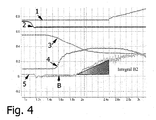
- the reference numeral 1 corresponds to the time course of the signal of the speed sensor
- the reference numeral 2 the time course of the signal of the brake pressure sensor
- the reference numeral 3 the time course of the signal of the clutch position sensor
- the reference numeral 4 the time course of the signal of the accelerator pedal position sensor
- the reference numeral 5 the time course of the signal of the tilt sensor.
- the diagram of FIG. 1 describes the situation that a backward directed approach situation on flat road (amount of the slope less than 2%) is made.
- the integral A1 assumes a value below a negative limit and the slope remains negative up to a speed of 2km / h.
- the relevant starting situation is indicated by the integral A1. If the reverse gear detector signal is correct, its function is confirmed, otherwise an error is output.
- the diagram of FIG. 2 describes the situation that a forward-facing approach situation on flat road (amount of the slope less than 2%) is made.
- the Intergral A2 takes a value above a positive limit and the slope remains positive up to a speed of 2km / h.
- the relevant starting situation is indicated by the integral A2. If the reverse gear detector signal is correct, its function is confirmed, otherwise an error is output.
- the diagrams of Figures 3 and 4 describe two more start-up situations that are considered relevant for efficient monitoring.
- the diagram of FIG. 3 Namely, the situation shows that there is a downhill in the forward direction of the vehicle (-5%) and the reverse gear is engaged. That is, in this situation, it is checked whether the (positive) signal of the detector coincides with the expected measurement results. After release of the brake (strong drop in the course of the signal 2), after completion of the transient process, which is not taken into account, a course is detected with an almost constant course of the inclination in the region A. This area can be used to determine from the measured slope value, the inclination of the chassis or the roadway due to the subsequent later body movement of the body and the completed transient.
- the value (here the -5%) is determined in about 200 ms after the release of the brake and is used as the offset value in the further determination of the slope in order to calculate the approximate (relative) from the measured slope value by correction by the offset value. Tilt between the body and the chassis to get. With the beginning of the actual body movement between chassis and chassis, the inclination drops sharply.
- the integral B1 of the slope over the time from when the offset value was determined to the time when the speed of the vehicle is 2km / h is calculated.
- the integral B1 is below a negative limit and remains negative.
- the value in this case the + 5% is determined in about 200 ms after release of the brake and is used as an offset value in the further determination of the slope in order to calculate the approximate (relative) from the measured slope value by correction by the offset value.
- the integral B2 of the slope over the time from the time when the offset value was determined to the time when the speed of the vehicle is 2km / h is calculated.
- the integral B2 is above a positive limit and remains positive. Thus, the signal of the detector that no reverse gear is engaged, its function can be confirmed. If there is a discrepancy, an error is output.
Landscapes
- Engineering & Computer Science (AREA)
- General Engineering & Computer Science (AREA)
- Mechanical Engineering (AREA)
- Regulating Braking Force (AREA)
- Train Traffic Observation, Control, And Security (AREA)
Claims (10)
- Procédé de contrôle de la fonctionnalité d'un détecteur de marche arrière d'un véhicule, détectant une marche arrière enclenchée, un signal du détecteur de marche arrière, qui indique que la marche arrière est enclenchée ou non, étant détecté dans une situation de démarrage pertinente, la situation de démarrage pertinente étant identifiée par le fait que la vitesse du véhicule est détectée au moyen d'un capteur de vitesse et en ce que celle-ci se situe dans un intervalle allant de l'arrêt à une vitesse du véhicule prédéterminée, de préférence de 2 km/h ; pendant la situation de démarrage identifiée comme pertinente, l'allure dans le temps de l'inclinaison d'une carrosserie du véhicule par rapport à un châssis du véhicule étant détectée par exemple au moyen d'un capteur d'inclinaison, et étant additionnée ou intégrée et la valeur obtenue en l'occurrence étant analysée en terme de son signe et éventuellement avec une comparaison avec une valeur prédéterminée, et une présence ou absence d'une situation de conduite en marche arrière étant identifiée au moyen de l'analyse et ce résultat de l'identification étant comparé au signal du détecteur de marche arrière, et en cas d'écart lors de la comparaison, une erreur étant émise et/ou mémorisée.
- Procédé selon la revendication 1, dans lequel une situation de démarrage pertinente est alors en outre identifiée par le fait que le capteur d'inclinaison signale une orientation plane du véhicule à l'arrêt.
- Procédé selon la revendication 1 ou 2, dans lequel une situation de démarrage pertinente est alors en outre identifiée par le fait que le détecteur de marche arrière signale une vitesse de marche arrière enclenchée et une inclinaison du véhicule vers le bas dans la direction avant du véhicule à l'arrêt, ou en ce que le détecteur de marche arrière ne signale pas de marche arrière enclenchée et le capteur d'inclinaison signale une inclinaison du véhicule vers le haut dans le sens de marche avant du véhicule à l'arrêt.
- Procédé selon l'une quelconque des revendications précédentes, dans lequel la vitesse est détectée au moyen d'un capteur de vitesse insensible à la direction.
- Procédé selon l'une quelconque des revendications précédentes, dans lequel une action de freinage du véhicule est détectée au moyen d'un capteur et l'allure dans le temps de l'inclinaison est détectée seulement après l'arrêt de l'action de freinage et la terminaison d'une opération de direction ou de braquage du véhicule provoquée de ce fait.
- Procédé selon l'une quelconque des revendications précédentes, dans lequel, à l'arrêt, de préférence après l'opération de direction ou de braquage, l'inclinaison est déterminée et l'on utilise comme valeur de départ pour une détermination approximative de l'inclinaison de la carrosserie par rapport au châssis du véhicule.
- Procédé selon l'une quelconque des revendications précédentes, dans lequel, en vue d'une falsification, plusieurs situations de démarrage pertinentes sont analysées et une erreur est seulement émise et/ou mémorisée lors d'un dépassement d'une fréquence prédéterminée de l'écart.
- Dispositif pour contrôler la fonctionnalité d'un détecteur de marche arrière détectant une vitesse de marche arrière enclenchée, comprenant une unité d'analyse, caractérisé en ce que celui-ci est conçu pour mettre en oeuvre le procédé selon l'une quelconque des revendications précédentes.
- Véhicule comprenant un capteur de vitesse, de préférence un capteur de vitesse insensible à la direction, un commutateur d'inclinaison ou de pédale de frein, et comprenant un dispositif selon la revendication précédente.
- Véhicule selon la revendication 9, comprenant un auxiliaire de stationnement électronique et/ou un auxiliaire de démarrage en pente.
Priority Applications (2)
| Application Number | Priority Date | Filing Date | Title |
|---|---|---|---|
| DE200650005856 DE502006005856D1 (de) | 2006-08-21 | 2006-08-21 | Überprüfung einer Fahrtrichtung eines Fahrzeuges |
| EP20060119216 EP1892438B1 (fr) | 2006-08-21 | 2006-08-21 | Contrôle de la direction de déplacement d'un véhicule |
Applications Claiming Priority (1)
| Application Number | Priority Date | Filing Date | Title |
|---|---|---|---|
| EP20060119216 EP1892438B1 (fr) | 2006-08-21 | 2006-08-21 | Contrôle de la direction de déplacement d'un véhicule |
Publications (2)
| Publication Number | Publication Date |
|---|---|
| EP1892438A1 EP1892438A1 (fr) | 2008-02-27 |
| EP1892438B1 true EP1892438B1 (fr) | 2010-01-06 |
Family
ID=37561356
Family Applications (1)
| Application Number | Title | Priority Date | Filing Date |
|---|---|---|---|
| EP20060119216 Ceased EP1892438B1 (fr) | 2006-08-21 | 2006-08-21 | Contrôle de la direction de déplacement d'un véhicule |
Country Status (2)
| Country | Link |
|---|---|
| EP (1) | EP1892438B1 (fr) |
| DE (1) | DE502006005856D1 (fr) |
Families Citing this family (2)
| Publication number | Priority date | Publication date | Assignee | Title |
|---|---|---|---|---|
| DE102009020594A1 (de) * | 2008-11-08 | 2010-05-20 | Wabco Gmbh | Verfahren zum Ermitteln einer Fahrtrichtung und Steuereinrichtung für ein Fahrzeugsystem |
| EP3306143B1 (fr) | 2016-10-04 | 2020-09-02 | Fico Triad, S.A. | Dispositif de changement de vitesse pour véhicules à moteur |
Family Cites Families (1)
| Publication number | Priority date | Publication date | Assignee | Title |
|---|---|---|---|---|
| DE10318503A1 (de) | 2003-04-24 | 2004-11-11 | Robert Bosch Gmbh | Verfahren und Vorrichtung zur Überwachung eines Rückwärtsgangsschalters |
-
2006
- 2006-08-21 EP EP20060119216 patent/EP1892438B1/fr not_active Ceased
- 2006-08-21 DE DE200650005856 patent/DE502006005856D1/de active Active
Also Published As
| Publication number | Publication date |
|---|---|
| DE502006005856D1 (de) | 2010-02-25 |
| EP1892438A1 (fr) | 2008-02-27 |
Similar Documents
| Publication | Publication Date | Title |
|---|---|---|
| EP2032403B1 (fr) | Procédé et dispositif de détection de l'initiation d'un processus de démarrage d'une motocyclette par un conducteur | |
| DE102010051203B4 (de) | Verfahren zur Erkennung von kritischen Fahrsituationen von Lastkraft- oder Personenkraftwagen, insbesondere zur Vermeidung von Kollisionen | |
| EP1539523B1 (fr) | Procede et dispositif pour declencher un processus de freinage d'urgence a actionnement automatique d'un vehicule | |
| WO2009065754A2 (fr) | Procédé de commande d'au moins un bloc de freinage de stationnement électromécanique d'un système de freinage de stationnement électromécanique | |
| DE10258617A1 (de) | Verfahren und Vorrichtung zur Auslösung eines selbsttätigen Notbremsvorgangs eines Fahrzeug | |
| EP0812747B1 (fr) | Dispositif et méthode à serrage et desserage des freins de véhicule actionnés par pression comme aide au démarrage sur une voie inclinée | |
| EP2689990A2 (fr) | Procédé et dispositif de détection dýun dépassement de bordure | |
| DE102008012912A1 (de) | Verfahren und Vorrichtung zur Erkennung einer Berührung eines Bordsteins durch ein Fahrzeug | |
| DE102008036048A1 (de) | Verfahren zur Ansteuerung von Fahrzeugkomponenten zum automatischen Freischaukeln eines Kraftfahrzeugs | |
| DE102007028567A1 (de) | Verfahren und Einrichtung zum Betrieb einer Bremseinrichtung bei Kraftfahrzeugen | |
| WO2017067622A1 (fr) | Procédé de commande de freins | |
| DE102013001880A1 (de) | Abschlepperkennung für ein Fahrzeug | |
| EP2900528B1 (fr) | Procédé et dispositif pour le fonctionnement d'un véhicule et véhicule équipé d'un tel dispositif | |
| EP1564096B1 (fr) | La vérification du fonctionnement correcte d'un frein de stationnement par l'évaluation de la vitesse de rotation d'un roue | |
| EP1892438B1 (fr) | Contrôle de la direction de déplacement d'un véhicule | |
| DE102009027379A1 (de) | Fahrerassistenzsystem | |
| DE102020121831A1 (de) | Verfahren zum Sichern eines Fahrzeugs | |
| DE102017200376A1 (de) | Verfahren zum Durchführen einer Notbremsung, Fahrerassistenzsystem für ein Kraftfahrzeug und Kraftfahrzeug | |
| DE102005060298B4 (de) | Fahrer-Bremsassistent mit veränderlicher Auslöseschwelle nach Erstkollision | |
| DE102006053561B4 (de) | Verfahren und Vorrichtung zur Überprüfung eines Notbremssystems | |
| DE102005026262B4 (de) | Verfahren zur Prüfung eines Bremslichtschalters oder eines Kick-Down-Schalters | |
| DE102007035543B4 (de) | Verfahren und Vorrichtung zur Erkennung der Einleitung des Anfahrvorgangs eines Kraftfahrzeugs durch einen Fahrer | |
| DE102015121872B4 (de) | Verfahren und Steuersystem zum Anfahren eines Fahrzeuges | |
| DE102023133516A1 (de) | Verfahren zur Nutzung einer OBD-Einheit eines Kraftfahrzeugs sowie OBD-System | |
| DE102014202325A1 (de) | Verfahren und Vorrichtung zum sicheren Parken eins Fahrzeugs |
Legal Events
| Date | Code | Title | Description |
|---|---|---|---|
| PUAI | Public reference made under article 153(3) epc to a published international application that has entered the european phase |
Free format text: ORIGINAL CODE: 0009012 |
|
| AK | Designated contracting states |
Kind code of ref document: A1 Designated state(s): AT BE BG CH CY CZ DE DK EE ES FI FR GB GR HU IE IS IT LI LT LU LV MC NL PL PT RO SE SI SK TR |
|
| AX | Request for extension of the european patent |
Extension state: AL BA HR MK YU |
|
| 17P | Request for examination filed |
Effective date: 20080827 |
|
| AKX | Designation fees paid |
Designated state(s): DE FR GB |
|
| GRAP | Despatch of communication of intention to grant a patent |
Free format text: ORIGINAL CODE: EPIDOSNIGR1 |
|
| GRAS | Grant fee paid |
Free format text: ORIGINAL CODE: EPIDOSNIGR3 |
|
| GRAA | (expected) grant |
Free format text: ORIGINAL CODE: 0009210 |
|
| AK | Designated contracting states |
Kind code of ref document: B1 Designated state(s): DE FR GB |
|
| REG | Reference to a national code |
Ref country code: GB Ref legal event code: FG4D Free format text: NOT ENGLISH |
|
| REF | Corresponds to: |
Ref document number: 502006005856 Country of ref document: DE Date of ref document: 20100225 Kind code of ref document: P |
|
| PLBE | No opposition filed within time limit |
Free format text: ORIGINAL CODE: 0009261 |
|
| STAA | Information on the status of an ep patent application or granted ep patent |
Free format text: STATUS: NO OPPOSITION FILED WITHIN TIME LIMIT |
|
| 26N | No opposition filed |
Effective date: 20101007 |
|
| REG | Reference to a national code |
Ref country code: FR Ref legal event code: PLFP Year of fee payment: 11 |
|
| REG | Reference to a national code |
Ref country code: FR Ref legal event code: PLFP Year of fee payment: 12 |
|
| REG | Reference to a national code |
Ref country code: FR Ref legal event code: PLFP Year of fee payment: 13 |
|
| PGFP | Annual fee paid to national office [announced via postgrant information from national office to epo] |
Ref country code: DE Payment date: 20180716 Year of fee payment: 13 Ref country code: FR Payment date: 20180718 Year of fee payment: 13 |
|
| PGFP | Annual fee paid to national office [announced via postgrant information from national office to epo] |
Ref country code: GB Payment date: 20180726 Year of fee payment: 13 |
|
| REG | Reference to a national code |
Ref country code: DE Ref legal event code: R119 Ref document number: 502006005856 Country of ref document: DE |
|
| GBPC | Gb: european patent ceased through non-payment of renewal fee |
Effective date: 20190821 |
|
| PG25 | Lapsed in a contracting state [announced via postgrant information from national office to epo] |
Ref country code: DE Free format text: LAPSE BECAUSE OF NON-PAYMENT OF DUE FEES Effective date: 20200303 Ref country code: FR Free format text: LAPSE BECAUSE OF NON-PAYMENT OF DUE FEES Effective date: 20190831 |
|
| PG25 | Lapsed in a contracting state [announced via postgrant information from national office to epo] |
Ref country code: GB Free format text: LAPSE BECAUSE OF NON-PAYMENT OF DUE FEES Effective date: 20190821 |