EP1892625B1 - Ordonnancement à grain fin des systèmes d'exploitation - Google Patents
Ordonnancement à grain fin des systèmes d'exploitation Download PDFInfo
- Publication number
- EP1892625B1 EP1892625B1 EP06291297.7A EP06291297A EP1892625B1 EP 1892625 B1 EP1892625 B1 EP 1892625B1 EP 06291297 A EP06291297 A EP 06291297A EP 1892625 B1 EP1892625 B1 EP 1892625B1
- Authority
- EP
- European Patent Office
- Prior art keywords
- operating system
- priority
- scheduler
- task
- barrier
- Prior art date
- Legal status (The legal status is an assumption and is not a legal conclusion. Google has not performed a legal analysis and makes no representation as to the accuracy of the status listed.)
- Active
Links
Images



Classifications
-
- G—PHYSICS
- G06—COMPUTING OR CALCULATING; COUNTING
- G06F—ELECTRIC DIGITAL DATA PROCESSING
- G06F9/00—Arrangements for program control, e.g. control units
- G06F9/06—Arrangements for program control, e.g. control units using stored programs, i.e. using an internal store of processing equipment to receive or retain programs
- G06F9/46—Multiprogramming arrangements
- G06F9/48—Program initiating; Program switching, e.g. by interrupt
- G06F9/4806—Task transfer initiation or dispatching
- G06F9/4843—Task transfer initiation or dispatching by program, e.g. task dispatcher, supervisor, operating system
- G06F9/4881—Scheduling strategies for dispatcher, e.g. round robin, multi-level priority queues
-
- G—PHYSICS
- G06—COMPUTING OR CALCULATING; COUNTING
- G06F—ELECTRIC DIGITAL DATA PROCESSING
- G06F9/00—Arrangements for program control, e.g. control units
- G06F9/06—Arrangements for program control, e.g. control units using stored programs, i.e. using an internal store of processing equipment to receive or retain programs
- G06F9/44—Arrangements for executing specific programs
- G06F9/455—Emulation; Interpretation; Software simulation, e.g. virtualisation or emulation of application or operating system execution engines
- G06F9/45533—Hypervisors; Virtual machine monitors
- G06F9/45537—Provision of facilities of other operating environments, e.g. WINE
Definitions
- This invention relates to a method of enabling multiple operating systems to run concurrently on the same computer on the basis of "finer grained operating system scheduling".
- Applications programs interact with the computers on which they run through operating systems.
- the applications program can be written in a portable fashion, so that it can execute on different computers with different hardware resources.
- common operating systems such as Linux or Windows provide multi-tasking; in other words, they allow several programs to operate concurrently. To do so, they provide scheduling; in other words, they share the usage of the resources of the computer between the different programs, allocating time to each in accordance with a scheduling algorithm.
- Operating systems of this kind are very widely used, but they generally make no provision for running real time applications, and they therefore are unsuitable for many control or communications tasks.
- ChorusOS also know as Chorus
- Chorus is available as open source software from: http://www.experimentalstuff.com/Technologies/ChorusOS/index.html.
- the method allows for one of the operating systems (for example, a real time operating system) to perform without disturbance, and the other (for example, a general purpose operating system) to perform as well as possible using the remaining resources of the computer. That is, the multiple operating systems are slightly modified and provided with a common program which schedules between them, in which one of the operating systems (the "primary” or “critical” operating system) is favoured over another (the “secondary” or non-critical operating system).
- the method allocates hardware preferentially to the critical operating system, and it denies the secondary operating system or systems access which would interfere with that of the critical operating system.
- the secondary operating systems are modified so that they cannot mask interrupts, and their interrupt service routines are modified to make them responsive to messages indicating that an interrupt occurred.
- the common program handles all hardware exceptions by passing them to the interrupt service routines of the primary operating system, and where a hardware interrupt was intended for one of the secondary operating systems, an interrupt message or notification is generated. Next time that secondary operating system is scheduled by the common program, the message or notification is passed to it, and the common program calls its interrupt service routine to service the interrupt. This is referred to as "virtual" interrupts.
- the secondary operating systems cannot pre-empt the primary operating system (or, in general, a higher importance secondary operating system) in any way on occurrence of an interrupt, since all are initially handled by the primary operating system and only notified to the secondary operating system for which they are destined after the primary operating system has finished execution and that secondary operating system is scheduled.
- tasks of the primary operating system are always performed prior to concurrent tasks of the second operating system.
- different tasks may have different priorities.
- a task of the primary operating system may be less important than a task of the secondary operating system. This may result in undesired latencies in respect of (some) tasks of the secondary operating systems.
- US 2005/149933 A1 describes a computer system having a plurality of operating systems and a module for switching the operating systems in view of priorities of tasks to be performed by each of the operating systems.
- Each of the operating systems performing a plurality of processes or threads in accordance with the priorities assigned to these processes or threads has a module for notifying the computer system of the priority of the currently executing process or thread.
- the computer system includes a module for translating the priorities sent from each operating system into priorities (normalized priorities) common-throughout the computer system, and a module for comparing the normalized priorities obtained by the priority translation module in order to select and execute preferentially the operating system having a common priority higher than that of any other operating system.
- a method of enabling multiple operating systems to run concurrently on the same computer comprising: scheduling a plurality of tasks for execution by at least first and second operating systems; assigning a priority to each operating system, wherein the first operating system comprises a low priority level of operation, P PL , and a high priority level of operation, P PH , and wherein the second operating system comprises a low priority level of operation, P SL , and a high priority level of operation, P SH , such that P SL ⁇ P PL ⁇ P SH ⁇ P PH ; introducing in each operating system a barrier routine in order to separate tasks of different priorities, wherein the barrier routine has a priority that is lower than a higher one of the different priorities and higher than a lower one of the different priorities, wherein performing the barrier routine comprises passing control to a common program to cause a decrease of the priority of the operating system performing the barrier routine; comparing, by the common program, the priorities of all operating systems and passing control to the operating system having the highest priority.
- the barrier routine can be activated in response to an interrupt.
- the common program may pre-empt the operating system performing the barrier routine if, after decreasing its priority, another operating system has a higher priority, and passes control to the higher priority operating system. If control is passed to the higher priority operating system, the barrier routine may remain active. Performance of the barrier routine may be resumed when control is passed back to the operating system in which the barrier routine has remained active.
- the common program may be invoked to pass control to the operating system having the highest priority when a barrier routine has been performed.
- each operating system is adapted to perform multiple barrier routines, wherein each barrier routine is associated with tasks of a specific priority and/or each barrier routine causes a different decrease of the priority of the respective operating system.
- each operating system causes a decrease of its own priority upon completion of a task if no further task having a priority equal to or higher than the priority of the completed task is scheduled for execution.
- the common program may be adapted to increase the priority of any of the operating systems.
- the common program may increase the priority of an operating system when that operating system receives an interrupt. More particularly, the common program increases the priority of an operating system to a respective highest level when that operating system receives an interrupt.
- the common program is invoked to pass control to the operating system having the highest priority after an operating system has become inactive.
- the common program is invoked to pass control to the operating system having the highest priority after the priority of an operating system has been set to a different level.
- all interrupts are initially processed by an interrupt handling routine of the first operating system, and those intended for the second operating system are forwarded to the second operating system for processing by an interrupt handling routine of the second operating system when the common program next passes control to the second operating system.
- each operating system has a highest priority, wherein the highest priority of the first operating system is higher than the highest priority of the other operating systems.
- the first operating system may be a real time operating system
- the second operating system may be a non-real time, general-purpose operating system.
- the present invention resides in the idea that different operating systems can be run more efficiently on a single CPU by changing the priority of each operating system over time. In other words, each operating system has a flexible priority.
- the scheduling between the operating systems takes into account that different tasks have different priorities.
- a task of a high priority operating system may be less important than a task of a low priority operating system. Scheduling is thus no longer performed on the basis of the priority of the operating systems only so that tasks to be performed by the high priority system operating system will no longer be always performed first.
- the present invention thereby decreases interrupt and task latency in respect of tasks to be executed by lower priority operating systems.
- the primary (real time) operating system was considered something "monolithic" and innately the highest priority operating system at all times.
- the present invention is based on the realisation that by providing exceptions to this rule and permitting pre-emption of the primary operating system in certain circumstances, the reactivity of the secondary operating system(s) can be improved and interrupt latency improved.
- the primary operating system is no longer considered “monolithic", and activities thereof are differentiated.
- the secondary operating system(s) can pre-empt the primary operating system in certain circumstances.
- a common program which assigns a priority to each operating system, and which schedules operating systems according to their priority.
- the priority which is assigned to each operating system is adapted over time. Accordingly, the secondary operating system(s) can pre-empt the primary system if the primary operating system starts to perform less tasks which are less "important" than tasks to be executed by the secondary operating system(s), i.e. when the primary operating system has a lower priority than the secondary operating system(s).
- each operating system causes the common program to change its priority when it switches from one task to another task having a lower priority.
- each operating system can invoke the common program to decrease its priority.
- no operating system may cause the common program to increase its priority.
- the priority of an operating system can only be increased by the common program upon receipt of an interrupt intended for that operating system.
- the invention thus provides priority-based operating system scheduling. Scheduling decisions are made on the basis of the priority assigned to each of the operating systems without the need to "look inside” the priority systems, i.e. without having to analyse the (priority of the) tasks scheduled for execution by each operating systems. In other words, instead of making scheduling decision on the basis of task priorities "inside" each operating system, they are made on the basis of the priority of the operating systems themselves.
- barrier routines are employed to split all activities (tasks) "inside” each operating system into “more important” and “less important” activities.
- the barrier routines are scheduled by the native task scheduler "inside” each operating system, and each operating system is modified to activate the barrier routine in response to interrupts.
- the barrier routine when activated invokes the common program which in turn may decrease the priority of the operating system in which the barrier routine has become active.
- the multiple operating systems to which the present invention can be applied are slightly modified and provided with a common program designed to run multiple operating systems on a single CPU.
- One of the operating systems has a higher priority and will be referred to as the primary operating system, while one or more other operating systems have a lower priority.
- the primary operating system While one or more other operating systems have a lower priority.
- the secondary operating system it will be assumed that there is only a single lower priority operating system referred to as the secondary operating system. It will be understood, though, that more than one secondary priority operating system can be provided.
- the primary operating system is a real time operating system which runs an application consisting of multiple tasks.
- the application consists of three event driven tasks T1, T2 and T3.
- Each task is triggered by external hardware interrupts (I p ).
- I p external hardware interrupts
- Each task must be completed by respective deadlines D1, D2 and D3.
- each task is allocated a different priority. For example, T2 has the earliest deadline and therefore has the highest priority and can pre-empt T1 or T3.
- the secondary operating system requests execution of three non-real-time processes P1, P2 and P3.
- the real time tasks T1, T2 and T3 are executed at the same time as shown in Fig. 1 , i.e. the start and completion times in respect of T1, T2 and T3 are not changed.
- the processes P1, P2 and P3 are executed when and only when the primary operating system is in the idle state.
- the common program can interrupt execution of the secondary operating system processes at any time.
- the secondary operating system is adapted never to mask hardware interrupts. As a consequence, an interruption of secondary operating system processes is possible even when critical sections or an interrupt handler are executed.
- the common program is adapted to mask hardware interrupts in order to perform software interrupt masking in the secondary operating system. Such masking is performed for short fixed periods of time only. Therefore, it only minimally affects the interrupt latency of the primary operating system.
- real-time tasks T1 and T2 of the primary operating system interrupt the non-real-time process P3 of the secondary operating system.
- the common program is adapted to consider each operating system as a single scheduling object. It does not distinguish between different types of tasks or processes "within” an operating system. Thus, from the common program's "point of view", the time line of Fig. 2 can be represented as shown in Fig. 3 . As illustrated, instead of tasks T1, T2 and T3 and processes P1, P2 and P3, the common program "sees" the primary operating system Pr and the secondary operating system S 1 .
- the common program can schedule between multiple secondary operating systems, each of which may have a different priority.
- the common program is adapted to schedule between multiple secondary operating systems like conventional priority based schedulers. That is, when a secondary operating system of higher priority is ready to become active, it interrupts the currently active lower priority secondary operating system. This is illustrated in Fig. 4 .
- the secondary operating system S1 has a higher priority than the secondary operating system S2. Accordingly, S1 interrupts S2 if and when needed.
- the primary operating system has the highest priority and interrupts both S1 and S2. In this way, the common program is similar to a conventional priority-based operating system task scheduler.
- Fig. 5 illustrates the potential high interrupt latency for secondary interrupts I s due to continuous CPU activity through the primary operating system. If continuous CPU activity is required by the primary operating system in order to meet real-time task deadlines, such latency is unavoidable. However, if, as indicated in the above example, some primary real-time tasks can be deferred, the latency in respect of (some) secondary interrupts can be reduced.
- the primary operating system runs two high priority real-time tasks T1 and T2 associated with tight deadlines D1 and D2, respectively.
- the real-time task T3 has a lower priority and a later deadline D3. Accordingly, the real-time task T3 could be deferred and a non-real-time secondary process P1 could be executed before T3. The deadline D3 would still be met. This is illustrated in Fig. 6 .
- the secondary operating system temporarily assumes a higher priority than the primary operating system and pre-empts it.
- This type of operating system scheduling is referred to as "Finer Grained OS Scheduling”.
- a common program is provided which performs operating system scheduling. It is also referred to as “OS scheduler” in the description and “OSware” in the figures.
- the OS scheduler adapted to implement such Finer Grained OS Scheduling will be referred to as the "Finer Grained OS Scheduler".
- the Finer Grained OS Scheduler is characterised by the following features:
- the OS scheduler considers each operating system as a single scheduling object. It does not distinguish between tasks or processes "within” the operating systems and is “unaware” as to whether the currently performed activity is important or not.
- each operating system is adapted to explicitly inform the OS scheduler about priority changes through a OS scheduler priority setting function.
- This function always reduces the priority of the currently active operating system to a level provided as a function parameter.
- the function cannot be used to raise the current priority.
- the function is invoked when there is no more current operating system activity of a specific type, as will be described below.
- the priority of an operating system is raised to an initial level by the OS scheduler when it forwards an interrupt to that operating system.
- the Finer Grained OS Scheduler is invoked in the following cases:
- the OS scheduler compares the current priorities of all operating systems and switches to the operating system with the highest priority.
- the OS scheduler priority setting function also has a return value. It is 0 if the current operating system has been rescheduled as the highest priority operating system because of OS scheduler idle or OS scheduler priority setting function calls performed by other operating systems. It is 1 if the current operating system has been scheduled because of a forwarded interrupt.
- the OS scheduler priority setting function is invoked by barrier tasks or processes.
- Barrier tasks or processes are used to separate operating system activities of different importance from one another.
- a dedicated barrier task T b is introduced to separate high priority and low priority tasks in the primary operating system from one another.
- the priority P b of the barrier task Tb should be between P RT and P L : P L ⁇ P b ⁇ P RT .
- the barrier task T b performs the following actions in an infinite loop:
- the interrupt handler in the primary operating system is adapted to invoke the barrier task T b for each interrupt (using, for example, some kind of binary semaphore V operation).
- the initial priority P PH for the primary operating system should be higher than the initial priority P S of the secondary operating system.
- the barrier task T b reduces the priority of the primary operating system to a lower level P PL : P PL ⁇ P S ⁇ P PH .
- the primary operating system can be pre-empted by the secondary operating system. It is noted that even if the primary operating system is pre-empted, the OS scheduler still considers the barrier task Tb active such that when the primary operating system is rescheduled to run on the CPU, it will continue to execute its task.
- Fig. 7 illustrates how the OS scheduler interrupts and schedules the primary and secondary operating systems while they are in the idle state.
- the primary operating system When the primary operating system is in the idle state, it puts the CPU in the wait state (i.e. a power saving mode stage P0).
- stage P1 When the CPU receives a primary interrupt I p , it executes the primary interrupt handler (stage P1). The priority of the primary operating system is raised from P IP to P PH . The OS scheduler is not invoked at this stage for optimisation purposes because P PH is the highest operating system priority.
- stage P2 the primary operating system schedules the high priority real-time task (stage P2).
- stage P2 the barrier task Tb is also invoked by the interrupt handler but not yet executed by the CPU.
- the primary operating system schedules the barrier task Tb (stage P3).
- the barrier task Tb invokes the OS scheduler priority setting function.
- the OS scheduler reduces the priority of the primary operating system to the level P PL (stage O3) and invokes the Finer Grained OS Scheduler.
- the Finer Grained OS Scheduler determines that the primary operating system is still the highest priority operating system and therefore does not switch to the secondary operating system.
- the OS scheduler exits the OS scheduler priority setting function with return value of 0.
- the primary operating system continues execution of the barrier task Tb.
- This task analyses the above return value and invokes a sleeping synchronization primitive (stage P4).
- the primary operating system now schedules the low priority real-time task (stage P5). When this task is completed the primary operating system invokes the idle task (stage P6). In turn, the primary idle task invokes the OS scheduler idle function (Stage O1).
- the OS scheduler reduces the priority of the primary operating system to P IP .
- the OS Finer Grained Scheduler determines that the primary operating system is still the highest priority operating system and therefore does not switch to the secondary operating system.
- the OS scheduler exits from the OS scheduler idle function with a return value of 0.
- stage P7 The primary operating system continues execution of its idle task. This task analyses the above return value and puts the CPU in the wait state (power save mode - stage P0).
- stage P1 When the CPU receives a secondary interrupt I S , it executes the primary interrupt handler (stage P1). The priority of the primary operating system is raised from P IP to P PH . The OS scheduler is not invoked at this stage for optimisation purposes because P PH is the highest priority.
- the primary interrupt handler analyses the interrupt source, identifies it is a secondary interrupt and forwards a virtualised interrupt to the secondary operating system.
- the OS scheduler raises the priority of the secondary operating system from P IS to P S .
- the OS scheduler is not invoked at this stage for optimisation purposes.
- the barrier task Tb is woken up, i.e. it is scheduled by the primary operating system (stage P3).
- the barrier task invokes the OS scheduler priority setting function.
- the OS scheduler reduces the priority of the primary operating system to P PL (stage O3) and invokes the Finer Grained OS Scheduler.
- the Finer Grained OS Scheduler determines that the secondary operating system now has the highest priority (P S > P PL ) and switches to the secondary operating system.
- the OS scheduler modifies the context of the secondary operating system such that after switching, the secondary operating system executes its interrupt handler (stage S1).
- the secondary operating system schedules a requested process (stage S2). After completion, the secondary operating system invokes its idle task (stage S6).
- the secondary idle task invokes the OS scheduler idle function (stage O1).
- the OS scheduler reduces the priority of the secondary operating system to P IS .
- the Finer Grained OS Scheduler determines that the primary operating system is (again) the highest priority operating system and therefore switches to it.
- the OS scheduler exits the OS scheduler priority setting function with a return value of 0.
- the primary operating system continues to execute the barrier task Tb which analyses the return value of the OS scheduler priority setting function and invokes a sleeping synchronisation primitive (stage P4).
- the primary operating system then switches to its idle task (Stage P6).
- the idle task invokes the OS scheduler idle function and reduces the priority of the primary operating system to P IP (Stage O1).
- the primary operating system is still the highest priority operating system and the idle task continues to be executed (stage P7) and puts the CPU in the wait state (Stage P0).
- Fig. 8 illustrates a scenario in which the OS scheduler processes a secondary interrupt I s while the primary operating system executes a low priority real-time task. This scenario also includes processing of a primary interrupt I p received while the secondary operating system is running.
- the primary operating system executes a low priority real-time task (stage P5).
- the secondary operating system is in the idle state.
- the priorities of the primary and secondary operating systems are P PL and P IS , respectively.
- stage P1 When the CPU receives the secondary interrupt I S , it executes the primary interrupt handler (stage P1). The priority of the primary operating system is raised to P PH . The OS scheduler is not invoked at this stage for optimisation purposes because P PH is the highest priority.
- the primary interrupt handler analyses the interrupt source, identifies it is a secondary interrupt and forwards a virtualised interrupt to the secondary operating system.
- the OS scheduler raises the priority of the secondary operating system from P IS to P S .
- the OS scheduler is not invoked for optimisation purposes because P PH still is the highest priority.
- the barrier task Tb is woken up.
- the barrier task Tb has a higher priority than the currently executed real-time task.
- the primary operating system schedules the barrier task Tb which in turn invokes the OS scheduler priority setting function (stage P3).
- the OS scheduler reduces the priority of the primary operating system to P PL (stage O3) and invokes the Finer Grained OS Scheduler which determines that the secondary operating is the highest priority operating system (P S > P PL ) and performs an operating system switch.
- the OS scheduler modifies the context of the secondary operating system such that after switching, the secondary operating system executes its interrupt handler (stage S1). As a result of the interrupt processing, the secondary operating system schedules a requested process (stage S2).
- the CPU While executing the secondary operating system, the CPU then receives a primary interrupt I P .
- the OS scheduler performs an operating system switch and forwards the interrupt for processing (stage O2).
- the priority of the primary operating system is raised to P PH .
- the operating system switch is unconditional because the P PH now is the highest operating system priority.
- stage P2 a high priority real-time task is scheduled for execution. Also, the barrier task Tb is woken up by the interrupt handler. However, it is not executed by the CPU yet because its priority is lower than that of the high priority real-time task.
- the primary operating system schedules the barrier task Tb (stage P3).
- the barrier task Tb invokes the OS scheduler priority setting function.
- the OS scheduler reduces the priority of the primary operating system to P PL (Stage O3) and invokes the Finer Grained OS scheduler.
- the Finer Grained OS scheduler determines that the secondary operating system now has the highest priority (P S > P PL ) and performs an operating system switch.
- stage S2 The secondary operating system continues execution of the requested process (stage S2). Upon completion, the secondary operating system switches to its idle task (stage S6).
- the secondary idle task invokes the OS scheduler idle function (Stage O1).
- the OS scheduler reduces the priority level of the secondary operating system to P IS .
- the Finer Grained OS Scheduler determines that the primary operating system has the highest priority and performs an operating system switch.
- the OS scheduler exits the OS scheduler priority setting function with return value of 0.
- the primary operating system continues execution of the barrier task Tb which analyses the return value and invokes a sleeping synchronization primitive (stage P4).
- the primary operating system now schedules the low priority real-time task which was pre-empted by the barrier task Tb (stage P 5 ). Upon completion of this task, the primary operating system switches to its idle task (stage P6). This task invokes the OS scheduler idle function and reduces the priority of the primary operating system to P IP (stage O1). The primary operating system is still the highest priority operating system and the idle task is continued to be executed (stage P7) and puts the CPU in the wait state (Stage P0).
- the secondary operating system can pre-empt the primary operating system when the primary operating system is scheduled to execute a low priority real-time task.
- the primary operating system is still able to pre-empt the secondary operating system at any time to execute high priority real-time tasks.
- the primary operating system has two types of tasks: important high priority real-time tasks with short periods of continuous CPU activity and less important tasks with potentially long periods of continuous CPU activity.
- the secondary operating system has also two type of processes: high priority pseudo real-time processes and normal less important processes without strict deadlines.
- the present embodiment is based on two conditions: First, less important tasks/processes can be removed from either operating system and rescheduled by the OS scheduler while the higher priority tasks/processes can meet their deadlines. Second, less important tasks/processes will not be significantly affected if pre-empted by another operating system.
- the OS scheduler operates the primary operating system on the following three priority levels P IP ⁇ P PL ⁇ P PH .
- the secondary operating system is operated on the following three priority levels: P IS ⁇ P SL ⁇ P SH . Between these levels, the following relation applies: P IS ⁇ P IP ⁇ P SL ⁇ P PL ⁇ P SH ⁇ P PH .
- important pseudo real-time secondary processes can pre-empt less important primary real-time-tasks.
- less important primary real-time tasks can pre-empt less important secondary processes.
- T b , P b Dedicated barrier tasks/processes introduced in each operating system in order to separate high and low priority tasks/processes.
- the priority P tb of the barrier task Tb should be between P RT and P LT : P LT ⁇ P tb ⁇ P RT .
- the priority P pb of the barrier process P b should be between P RP and P LP : P LT ⁇ P pb ⁇ P RP .
- the primary barrier task Tb performs the following actions in an infinite loop:
- the interrupt handler in the primary operating system is adapted to activate the barrier task Tb for each interrupt (through a binary semaphore V operation, for example).
- the interrupt handler in the secondary operating system is adapted to activate the barrier process Pb for each interrupt (through a binary semaphore V operation, for example).
- stage P1 Upon receipt of a primary interrupt Ip, the CPU executes the primary interrupt handler (stage P1). The priority of the primary operating system is raised from P IP to P PH . The OS scheduler is not invoked at this stage for optimisation purposes because it is known that P PH is the highest operating system priority.
- the primary operating system schedules the high priority real-time task (stage P2). Although the barrier task Tb is activated by the interrupt handler (as always), it is not yet executed on the CPU.
- the primary operating system schedules the barrier task Tb (stage P3), which in turn invokes the OS scheduler priority setting function.
- the OS scheduler reduces the priority of the primary operating system to P PL (stage O3) and invokes the Finer Grained OS scheduler.
- the Finer Grained OS Scheduler determines that the primary operating system is still the highest priority operating system and therefore does not switch operating systems.
- the OS scheduler exits the OS scheduler priority setting function with a return value of 0.
- the primary operating system continues execution of the barrier task Tb.
- the barrier task Tb analyses the above return value and invokes a sleeping synchronization primitive (stage P4).
- the primary operating system then schedules the low priority real-time task (stage P5). When this task is completed the primary operating system switches to its idle task (Stage P6).
- the primary idle task invokes OS scheduler idle function (stage O1).
- the OS scheduler reduces the priority of the primary operating system to P IP .
- the Finer Grained OS Scheduler determines that the primary operating system is still the highest priority operating system and therefore does not switch operating systems.
- the OS scheduler exits the OS scheduler idle function with a return value of 0.
- the primary operating system continues execution of its idle task (stage P7).
- the primary idle task analyses the above return value and puts the CPU in the wait state (power save mode - stage P0).
- stage P1 Upon receipt of a secondary interrupt I S , the CPU executes the primary interrupt handler (stage P1). The priority of the primary operating system is raised from P IP to P PH . The OS scheduler is not invoked at this stage for optimisation purposes because P PH is the highest priority.
- the primary interrupt handler analyses the interrupt source, identifies it is a secondary interrupt and forwards a virtualised interrupt to the secondary operating system.
- the OS scheduler raises the priority of the secondary operating system from P IS to P SH . As before the OS scheduler is not invoked for optimisation purposes because P PH is the highest priority.
- the barrier task Tb is invoked by the primary operating system (stage P3).
- the barrier task Tb invokes the OS scheduler priority setting function.
- the OS scheduler reduces the priority of the primary operating system to P PL (stage O3) and invokes the Finer Grained OS Scheduler.
- the Finer Grained OS Scheduler determines that the secondary operating system now has the highest priority (P SH > P PL ) and switches operating systems.
- the OS scheduler modifies the context of the secondary operating system such that after switching, the secondary operating system executes its interrupt handler (stage S1).
- stage S2 the secondary operating system schedules the pseudo real-time process (stage S2).
- the barrier process Pb is also activated by the interrupt handler but not yet executed by the CPU.
- the secondary operating system schedules the barrier process Pb (stage S3), which invokes the OS scheduler priority setting function.
- the OS scheduler reduces the secondary operating system priority to P SL (stage O3) and invokes the Finer Grained OS Scheduler which determines that the primary operating system now has the highest priority and switches operating systems.
- the primary operating system continues execution of its barrier task Tb.
- the barrier task Tb exits the OS scheduler priority setting function with a return value of 0. It analyses the return value and invokes a sleeping synchronization primitive (stage P 4 ).
- the primary operating system now schedules its idle task (stage P6).
- the primary idle task invokes the OS scheduler idle function (stage O1).
- the OS scheduler reduces the primary operating system priority to P IP .
- the Finer Grained OS Scheduler determines that the secondary operating system again has the highest priority and switches operating systems.
- the secondary operating system continues execution of its barrier process Pb.
- the barrier process exits the OS scheduler priority setting function with a return value of 0, analyses the return value and invokes a sleeping synchronisation primitive (stage S4).
- the secondary operating system schedules the less important process (stage S5).
- the secondary operating system invokes its idle task (stage S6).
- the secondary idle task invokes the OS scheduler idle function (stage O1).
- the OS scheduler reduces the secondary operating system priority to P IS .
- the Finer Grained OS Scheduler determines that the primary operating system now has the highest priority and switches operating systems.
- stage P7 The primary operating system continues execution of its idle task (stage P7).
- This task exits the OS scheduler idle function with a return value of 0, analyses the return value and puts the CPU in the wait state (power save mode - Stage P0).
- Fig. 10 illustrates how the OS scheduler processes a secondary interrupt while the primary operating system executes a low priority real-time task. Fig. 10 also illustrates how a primary interrupt is processed if it is received while the secondary operating system is running.
- the primary operating system executes a low priority real-time task (stage P5).
- the secondary operating system is in the idle state.
- the primary and secondary operating system priorities are P PL and P IS , respectively.
- stage P1 Upon receipt of a secondary interrupt I S , the CPU executes the primary interrupt handler (stage P1). The priority of the primary operating system is raised from P PL to P PH . The OS scheduler is not invoked at this stage for optimisation purposes because it is known that P PH is the highest priority.
- the primary interrupt handler analyses the interrupt source, identifies it is a secondary interrupt and forwards a virtualised interrupt to the secondary operating system.
- the OS scheduler raises the secondary operating system priority from P IS to P SH . As before the OS scheduler is not invoked for optimisation purposes at this stage.
- the barrier task Tb is activated.
- the priority P tb of the barrier task Tb is higher than the priority P LT of the currently executed low-priority real-time task. Therefore the barrier task Tb is scheduled by the primary operating system (stage P3).
- This barrier task Tb invokes the OS scheduler priority setting function.
- the OS scheduler reduces the primary operating system priority to P PL (stage O3) and invokes the Finer Grained OS Scheduler.
- the Finer Grained OS Scheduler determines that the secondary operating system now has the highest priority (P SH > P PL ) and switches operating systems.
- the OS scheduler modifies the context of the secondary operating system such that after switching, the secondary operating system executes its interrupt handler (stage S1).
- the secondary operating system first schedules the pseudo real-time process (stage S2).
- the barrier process Pb is also activated by the interrupt handler but not yet executed on the CPU.
- the CPU While running the secondary operating system, the CPU receives a primary interrupt I P .
- the OS scheduler switches operating systems and forwards the interrupt to the primary operating system (stage O2).
- the primary operating system priority is raised to P PH . It is noted that operating system switch is unconditional as it is known that P PH is the highest operating system priority.
- the high priority real-time task is activated, and the primary operating system switches to it (stage P2). Also, the barrier task Tb is activated by the interrupt handler but not yet executed on the CPU because its priority P tb is lower than P RT .
- the primary operating system schedules the barrier task Tb (stage P3).
- the barrier task Tb invokes the OS scheduler priority setting function.
- the OS scheduler reduces the primary operating system priority to P PL (stage O3) and invokes the Finer Grained OS Scheduler.
- the Finer Grained OS Scheduler determines that the secondary operating system now has the highest priority (P SH > P PL ) and switches operating systems.
- the secondary operating system continues execution of its pseudo real-time process (stage S2). When this process is completed, the secondary operating system invokes its barrier process Pb (stage S3).
- the barrier process Pb invokes the OS scheduler priority setting function.
- the OS scheduler reduces the secondary operating system priority to P SL (stage O3) and invokes the Finer Grained OS Scheduler.
- the Finer Grained OS Scheduler determines that the primary operating system now has the highest priority and switch operating systems.
- the primary operating system continues to execute its barrier task Tb.
- This task returns from the OS scheduler priority setting function with a return value of 0, analyses the return value and invokes a sleeping synchronisation primitive (stage P4).
- the primary operating system switches to the pre-empted low priority real-time task (stage P5). When this task is completed, the primary operating system invokes its idle task (stage P6).
- the primary idle task invokes the OS scheduler idle function (stage O1).
- the OS scheduler reduces the primary operating system priority to P IP .
- the Finer Grained OS Scheduler determines that the secondary operating system again has the highest priority and switches operating systems.
- the secondary operating system continues execution of its barrier process Pb.
- This process exits the OS scheduler priority setting function with a return value of 0, analyses the return value and invokes a sleeping synchronization primitive (stage S4).
- the secondary operating system then schedules the less important process (stage S5). When this process is completed, the secondary operating system invokes its idle task (stage S6).
- the secondary idle task invokes the OS scheduler idle function (stage O1).
- the OS scheduler reduces the secondary operating system priority to P IS .
- the Finer Grained OS Scheduler determines that the primary operating system now has the highest priority and switches operating systems.
- the primary operating system continues execution of its idle task (Stage P7).
- This task exits the OS scheduler idle function with a return value of 0 and puts the CPU in the wait state (power save mode - stage P0).
- Fig. 11 illustrates how the OS scheduler processes a secondary interrupt while the primary operating system is executing a high priority real-time task. Fig. 11 also illustrates how a primary interrupt is processed and a low priority primary task is scheduled if the interrupt is received while the secondary operating system is running.
- the primary operating system executes a high priority real-time task (stage P2).
- the secondary operating system is in the idle state.
- the primary and secondary operating system priorities are P PH and P IS , respectively.
- stage P1 Upon receipt of a secondary interrupt I S , the CPU executes the primary interrupt handler (stage P1).
- the primary interrupt handler analyses the interrupt source, identifies it is a secondary interrupt and forwards a virtualised interrupt to the secondary operating system.
- the OS scheduler raises the secondary operating system priority from P IS to P SH .
- the OS scheduler is not invoked at this stage for optimisation purposes because it is known that the current task has the highest priority P PH .
- the barrier task Tb is activated.
- the priority of the barrier task Tb is lower then the priority of the current real-time task P TH , and therefore the primary operating system continues to execute its high priority real-time task (stage P2).
- the primary operating system schedules the barrier task Tb (stage P3).
- the barrier task Tb invokes the OS scheduler priority setting function.
- the OS Scheduler reduces the primary operating system priority to P PL (stage O3) and invokes the Finer Grained OS Scheduler.
- the Finer Grained OS Scheduler determines that the secondary operating system now has the highest priority (P SH > P PL ) and switches operating systems.
- the OS scheduler modifies the context of the secondary operating system such that after switching, the secondary operating system executes its interrupt handler (stage S1).
- the secondary operating system schedules the pseudo real-time process (stage S2). Also, the barrier process Pb is activated by the interrupt handler, although it is not yet running on the CPU.
- the CPU receives a primary interrupt I P .
- the OS scheduler performs an operating system switch and forwards the interrupt to the primary operating system (stage O2).
- the primary operating system priority is raised to P PH .
- the operating system switch is unconditional as it is known that P PH is the highest operating system priority.
- a low priority real-time task is activated.
- the barrier task Tb is activated by the interrupt handler.
- the priority P tb of the barrier task is higher then P LT , and the primary operating system switches to it (stage P3).
- the barrier task T b invokes the OS scheduler priority setting function.
- the OS scheduler reduces the primary operating system priority to P PL (stage O3) and invokes the Finer Grained OS scheduler which determines that the secondary operating system now has the highest priority (P SH > P PL ) and performs an operating system switch.
- the secondary operating system continues to execute its pseudo real-time process (stage S2). Upon completion of this task, the secondary operating system invokes its barrier process Pb (stage S3).
- the barrier process Pb invokes the OS scheduler priority setting function.
- the OS scheduler reduces the secondary operating system priority to P SL (Stage O3) and invokes the Finer Grained OS Scheduler.
- the Finer Grained OS Scheduler determines that the primary operating system now has the highest priority and switches operating systems.
- the primary operating system continues to execute its barrier task Tb.
- the barrier task returns from the OS scheduler priority setting function with a return value of 0, analyses the return value and invokes a sleeping synchronization primitive (stage P4).
- stage P5 The primary operating system switches back to the earlier active low priority real-time task. Upon completion of this task, the primary operating system invokes its idle task (stage P6).
- the primary idle task invokes the OS scheduler idle function (stage O1).
- the OS scheduler reduces the primary operating system priority to P IP .
- the Finer Grained OS Scheduler determines that the secondary operating system again has the highest priority and switches operating systems.
- the secondary operating system continues to execute its barrier process Pb.
- the barrier process Pb returns from the OS scheduler priority setting function with a return value of 0, analyses the return value and invokes a sleeping synchronisation primitive (stage S4).
- the secondary operating system then schedules the less important process (stage S5). When this process is completed the secondary operating system invokes its idle task (stage S6).
- the secondary idle task invokes the OS scheduler idle function (stage O1).
- the OS scheduler reduces the secondary operating system priority to P IS .
- the Finer Grained OS Scheduler determines that the primary operating system now has the highest priority and switches operating systems.
- the primary operating system continues to execute its idle task (stage P7).
- the idle task returns from the OS scheduler idle function with a return value of 0 and puts the CPU in the wait state (power save-mode - Stage P0).
- Each secondary operating system should include a barrier task functionality in order to change its priority.
- Dedicated barrier tasks are well suited to call the OS scheduler priority setting function. In this way a priority based OS scheduler can be used to decide that there is no more activity of a predetermined kind, as described above.
- the OS scheduler priority setting function can also be invoked in other "strategic" instances. For example it can be invoked at the end of interrupt processing when a current task/process is resumed. In this way only secondary interrupt processing is considered a high priority activity.
- the OS scheduler priority setting function should not be called immediately after an interrupt source analysis to drop the operating system priority if less important secondary interrupts are to be processed. Interrupts can be nested, and if less important interrupts can be received by the CPU while the interrupt handler processes a more important interrupt, the operating system priority is reduced too early.
- the secondary operating system should defer invoking the OS scheduler priority setting function.
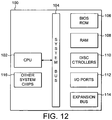
- Fig. 12 illustrates a computer system 100 on which the above method can be implemented comprises a central processing unit (CPU) 102, such as a Pentium 4TM CPU available from Intel Corporation, or PowerPC CPU available from Motorola coupled via a system bus 104 (comprising control, data and address buses) to a read-only memory (ROM) chip 106; one or more banks of random access memory (RAM) chips (108); disk controller devices 110 (for example IDE or SCSI controllers, connected to a floppy disk drive, a hard disk drive, and additional removable media drives such as DVD drives); one or more input/output ports (112) (for example, one or more USB port controllers, and/or parallel port controllers for connection to printer and so on); an expansion bus 114 for bus connection to external or internal peripheral devices (for example the PCI bus); and other system chips 116 (for example, graphics and sound devices).
- CPU central processing unit
- ROM read-only memory
- RAM random access memory
- disk controller devices 110 for example IDE or SCSI controllers
- Examples of computers of this type are personal computers (PCs) and workstations.
- PCs personal computers
- workstations workstations.
- PDAs PDAs
- the computer 100 of Figure 12 runs resident programs comprising operating system kernel 202 (which provides the output routines allowing access by the CPU to the other devices shown in Figure 12 ); an operating system user interface or presentation layer 204 (such as X Windows); a middleware layer 206 (providing networking software and protocols such as, for instance, a TCP/IP stack) and applications 208a, 208b, which run by making calls to the API routines forming the operating system kernel 202.
- operating system kernel 202 which provides the output routines allowing access by the CPU to the other devices shown in Figure 12
- an operating system user interface or presentation layer 204 such as X Windows
- middleware layer 206 providing networking software and protocols such as, for instance, a TCP/IP stack
- applications 208a, 208b which run by making calls to the API routines forming the operating system kernel 202.
- the operating system kernel has a number of tasks, in particular:
- the kernel may be a so-called “monolithic kernel” as for Unix, in which case the device drivers form part of the kernel itself.
- it may be a "microkernel” as for Chorus, in which case the device drivers are separate of the kernel.
- a bootstrap program stored in ROM 106 accesses the disk controllers 110 to read the file handling part of the operating system from permanent storage on disk into RAM 108, then loads the remainder of the operating system into an area of RAM 108.
- the operating system then reads any applications from the disk drives via the disk controllers 110, allocates space in RAM 108 for each, and stores each application in its allocated memory space.
- the scheduler part of the operating system divides the use of the CPU between the different applications, allowing each a share of the time on the processor according to a scheduling policy. It also manages use of the memory resources, by "swapping out" infrequently used applications or data (i.e. removing them from RAM 108 to free up space, and storing them on disk).
- API applications programming interface
Landscapes
- Engineering & Computer Science (AREA)
- Software Systems (AREA)
- Theoretical Computer Science (AREA)
- Physics & Mathematics (AREA)
- General Engineering & Computer Science (AREA)
- General Physics & Mathematics (AREA)
- Debugging And Monitoring (AREA)
- Bus Control (AREA)
Claims (16)
- Procédé permettant à plusieurs systèmes d'exploitation (201, 202) de fonctionner simultanément sur le même ordinateur (100), le procédé comprenant :l'ordonnancement d'une pluralité de tâches (207, 208) pour une exécution par au moins des premier et second systèmes d'exploitation ;l'attribution d'une priorité à chaque système d'exploitation, dans lequel le premier système d'exploitation comprend un niveau de fonctionnement à faible priorité, PPL, et un niveau de fonctionnement à haute priorité, PPH, et dans lequel le second système d'exploitation comprend un niveau de fonctionnement à faible priorité, PSL, et un niveau de fonctionnement à haute priorité, PSH, de sorte que PSL < PPL < PSH < PPH ;caractérisé parl'introduction dans chaque système d'exploitation d'une routine de barrière afin de séparer des tâches de différentes priorités, dans lequel la routine de barrière a une priorité qui est inférieure à une priorité supérieure des différentes priorités et supérieure à une priorité inférieure des différentes priorités,dans lequel l'exécution de la routine de barrière comprend la transmission d'une commande à un programme commun pour amener une diminution de la priorité du système d'exploitation exécutant la routine de barrière ;la comparaison, par le programme commun, des priorités de tous les systèmes d'exploitation et la transmission d'une commande au système d'exploitation ayant la priorité la plus élevée.
- Procédé selon la revendication 1, dans lequel le programme commun augmente la priorité d'un système d'exploitation en réponse à une interruption pour ce système d'exploitation.
- Procédé selon une quelconque revendication précédente, dans lequel la routine de barrière est activée en réponse à une interruption.
- Procédé selon la revendication 1, dans lequel le programme commun préempte le système d'exploitation exécutant la routine de barrière si, après la diminution de sa priorité, un autre système d'exploitation a une priorité supérieure, et transmet une commande au système d'exploitation de priorité supérieure.
- Procédé selon la revendication 1, dans lequel, si une commande est transmise au système d'exploitation de priorité supérieure, la routine de barrière reste active.
- Procédé selon la revendication 5, comprenant la reprise des performances de la routine de barrière lorsqu'une commande est renvoyée au système d'exploitation dans lequel la tâche de barrière est restée active.
- Procédé selon une quelconque revendication précédente, dans lequel le programme commun est invoqué pour transmettre une commande au système d'exploitation ayant la priorité la plus élevée lorsqu'une routine de barrière a été exécutée.
- Procédé selon la revendication 1, dans lequel chaque système d'exploitation est conçu pour exécuter plusieurs routines de barrière, dans lequel chaque routine de barrière est associée à des tâches d'une priorité spécifique et/ou chaque routine de barrière amène une diminution différente de la priorité du système d'exploitation respectif.
- Procédé selon la revendication 1, dans lequel la priorité d'un système d'exploitation est diminuée lors de l'achèvement d'une tâche si aucune autre tâche ayant une priorité égale ou supérieure à la priorité de la tâche achevée n'est ordonnancée pour une exécution.
- Procédé selon la revendication 1, dans lequel le programme commun augmente la priorité d'un système d'exploitation au niveau le plus élevé lorsque ce système d'exploitation reçoit une interruption.
- Procédé selon une quelconque revendication précédente, dans lequel le programme commun est invoqué pour transmettre une commande au système d'exploitation ayant la priorité la plus élevée après qu'un système d'exploitation est devenu inactif.
- Procédé selon une quelconque revendication précédente, dans lequel le programme commun est invoqué pour transmettre une commande au système d'exploitation ayant la priorité la plus élevée après que la priorité d'un système d'exploitation a été réglée à un niveau différent.
- Procédé selon une quelconque revendication précédente, dans lequel toutes les interruptions sont initialement traitées par une routine de gestion des interruptions du premier système d'exploitation, et celles destinées au second système d'exploitation sont transmises au second système d'exploitation pour un traitement par une routine de gestion des interruptions du second système d'exploitation lorsque le programme commun transmet ensuite une commande au second système d'exploitation.
- Procédé selon une quelconque revendication précédente, dans lequel chaque système d'exploitation a une priorité la plus élevée, dans lequel la priorité la plus élevée du premier système d'exploitation est supérieure à la priorité la plus élevée des autres systèmes d'exploitation.
- Produit de programme informatique comprenant un code qui, lorsqu'il est exécuté par un ordinateur, met en oeuvre le procédé selon une quelconque revendication précédente.
- Système informatique conçu pour mettre en oeuvre le procédé selon l'une quelconque des revendications 1 à 14.
Priority Applications (3)
| Application Number | Priority Date | Filing Date | Title |
|---|---|---|---|
| EP06291297.7A EP1892625B1 (fr) | 2006-08-09 | 2006-08-09 | Ordonnancement à grain fin des systèmes d'exploitation |
| US12/376,822 US9122521B2 (en) | 2006-08-09 | 2007-08-09 | Enabling multiple operating systems to run concurrently using barrier task priority |
| PCT/EP2007/007074 WO2008017489A1 (fr) | 2006-08-09 | 2007-08-09 | Planification de systèmes d'exploitation à grain fin |
Applications Claiming Priority (1)
| Application Number | Priority Date | Filing Date | Title |
|---|---|---|---|
| EP06291297.7A EP1892625B1 (fr) | 2006-08-09 | 2006-08-09 | Ordonnancement à grain fin des systèmes d'exploitation |
Publications (2)
| Publication Number | Publication Date |
|---|---|
| EP1892625A1 EP1892625A1 (fr) | 2008-02-27 |
| EP1892625B1 true EP1892625B1 (fr) | 2018-07-11 |
Family
ID=37500038
Family Applications (1)
| Application Number | Title | Priority Date | Filing Date |
|---|---|---|---|
| EP06291297.7A Active EP1892625B1 (fr) | 2006-08-09 | 2006-08-09 | Ordonnancement à grain fin des systèmes d'exploitation |
Country Status (3)
| Country | Link |
|---|---|
| US (1) | US9122521B2 (fr) |
| EP (1) | EP1892625B1 (fr) |
| WO (1) | WO2008017489A1 (fr) |
Families Citing this family (8)
| Publication number | Priority date | Publication date | Assignee | Title |
|---|---|---|---|---|
| US8566829B1 (en) * | 2008-01-30 | 2013-10-22 | Emc Corporation | Cooperative multi-level scheduler for virtual engines |
| KR101719559B1 (ko) * | 2010-06-22 | 2017-03-24 | 삼성전자주식회사 | 방송수신장치 및 그의 스케줄링 방법 |
| US9010641B2 (en) * | 2010-12-07 | 2015-04-21 | Hand Held Products, Inc. | Multiple platform support system and method |
| US20120260080A1 (en) * | 2011-04-08 | 2012-10-11 | Nokia Corporation | Method and Apparatus for Preprocessing Operations During a Boot Process |
| KR101535792B1 (ko) * | 2013-07-18 | 2015-07-10 | 포항공과대학교 산학협력단 | 운영체제 구성 장치 및 방법 |
| KR101577254B1 (ko) * | 2013-10-31 | 2015-12-22 | 삼성에스디에스 주식회사 | 요청 메시지 스케줄링 장치 및 방법과 이를 이용한 기록 매체 |
| US12112203B2 (en) * | 2020-11-20 | 2024-10-08 | Okta, Inc. | Server-based workflow management using priorities |
| CN114860403B (zh) * | 2022-05-11 | 2023-07-07 | 科东(广州)软件科技有限公司 | 一种任务调度方法、装置、设备和存储介质 |
Family Cites Families (6)
| Publication number | Priority date | Publication date | Assignee | Title |
|---|---|---|---|---|
| JP4072271B2 (ja) * | 1999-02-19 | 2008-04-09 | 株式会社日立製作所 | 複数のオペレーティングシステムを実行する計算機 |
| NZ534314A (en) * | 2002-01-30 | 2005-04-29 | Real Entpr Solutions Dev B | Method of setting priority levels in a multiprogramming computer system with priority scheduling, multiprogramming computer system and program therefor |
| US7823157B2 (en) * | 2003-11-18 | 2010-10-26 | Microsoft Corporation | Dynamic queue for use in threaded computing environment |
| CA2577493A1 (fr) * | 2004-08-18 | 2006-02-23 | Jaluna Sa | Systemes d'exploitation |
| US7493515B2 (en) * | 2005-09-30 | 2009-02-17 | International Business Machines Corporation | Assigning a processor to a logical partition |
| US8104033B2 (en) * | 2005-09-30 | 2012-01-24 | Computer Associates Think, Inc. | Managing virtual machines based on business priorty |
-
2006
- 2006-08-09 EP EP06291297.7A patent/EP1892625B1/fr active Active
-
2007
- 2007-08-09 US US12/376,822 patent/US9122521B2/en active Active
- 2007-08-09 WO PCT/EP2007/007074 patent/WO2008017489A1/fr not_active Ceased
Non-Patent Citations (1)
| Title |
|---|
| None * |
Also Published As
| Publication number | Publication date |
|---|---|
| US20100017806A1 (en) | 2010-01-21 |
| EP1892625A1 (fr) | 2008-02-27 |
| US9122521B2 (en) | 2015-09-01 |
| WO2008017489A1 (fr) | 2008-02-14 |
Similar Documents
| Publication | Publication Date | Title |
|---|---|---|
| US9122521B2 (en) | Enabling multiple operating systems to run concurrently using barrier task priority | |
| US7472393B2 (en) | Method and system for real time scheduler | |
| US7979861B2 (en) | Multi-processor system and program for causing computer to execute controlling method of multi-processor system | |
| US5394547A (en) | Data processing system and method having selectable scheduler | |
| US7313797B2 (en) | Uniprocessor operating system design facilitating fast context switching | |
| US7467385B2 (en) | Interrupt and exception handling for multi-streaming digital processors | |
| US5526521A (en) | Method and system for process scheduling from within a current context and switching contexts only when the next scheduled context is different | |
| KR20040068600A (ko) | 운영 시스템 기능 실행 방법 및 시스템, 전자 기기 | |
| CN115237556A (zh) | 调度方法及装置、芯片、电子设备及存储介质 | |
| CN115269139A (zh) | 基于可信区域的双操作系统混合实时任务调度方法和系统 | |
| US20250013494A1 (en) | Thread management methods and apparatuses | |
| US20040098722A1 (en) | System, method, and computer program product for operating-system task management | |
| CN116360941A (zh) | 一种面向多核dsp的并行计算资源自组织调度方法及系统 | |
| US10545890B2 (en) | Information processing device, information processing method, and program | |
| US12524269B2 (en) | Stack memory allocation control based on monitored activities | |
| US20170212852A1 (en) | Method and accelerator unit for interrupt handling | |
| EP1836569B1 (fr) | Fonction de commande d'interruptions adaptee pour commander l'execution de demandes d'interruption de criticite differente | |
| RU2450330C2 (ru) | Аппаратно-реализуемый способ выполнения программ | |
| CN120216124A (zh) | 一种用户中断事件回调机制实现方法 | |
| KR20070090649A (ko) | 멀티 코어 시스템에서 협력적 스케줄링을 제공하는 장치 및방법 | |
| WO2024193308A1 (fr) | Procédé et appareil de traitement d'interruption, et dispositif électronique | |
| WO2025039822A1 (fr) | Appareil informatique et procédé de planification d'exécution de tâche associée | |
| EP1693743A2 (fr) | Système, procédé et support pour l'utilisation et/ou la fourniture d'informations de système d'exploitation afin d'obtenir un verrouillage d'utilisateur hybride/de système d'exploitation | |
| US20030204639A1 (en) | Task dispatch in priority pre-emptive real-time operating systems | |
| JP2001282560A (ja) | 仮想計算機制御方法及びその実施装置並びにその処理プログラムを記録した記録媒体 |
Legal Events
| Date | Code | Title | Description |
|---|---|---|---|
| PUAI | Public reference made under article 153(3) epc to a published international application that has entered the european phase |
Free format text: ORIGINAL CODE: 0009012 |
|
| AK | Designated contracting states |
Kind code of ref document: A1 Designated state(s): AT BE BG CH CY CZ DE DK EE ES FI FR GB GR HU IE IS IT LI LT LU LV MC NL PL PT RO SE SI SK TR |
|
| AX | Request for extension of the european patent |
Extension state: AL BA HR MK YU |
|
| 17P | Request for examination filed |
Effective date: 20080827 |
|
| AKX | Designation fees paid |
Designated state(s): AT BE BG CH CY CZ DE DK EE ES FI FR GB GR HU IE IS IT LI LT LU LV MC NL PL PT RO SE SI SK TR |
|
| 17Q | First examination report despatched |
Effective date: 20081113 |
|
| STAA | Information on the status of an ep patent application or granted ep patent |
Free format text: STATUS: EXAMINATION IS IN PROGRESS |
|
| GRAP | Despatch of communication of intention to grant a patent |
Free format text: ORIGINAL CODE: EPIDOSNIGR1 |
|
| STAA | Information on the status of an ep patent application or granted ep patent |
Free format text: STATUS: GRANT OF PATENT IS INTENDED |
|
| INTG | Intention to grant announced |
Effective date: 20171222 |
|
| GRAS | Grant fee paid |
Free format text: ORIGINAL CODE: EPIDOSNIGR3 |
|
| GRAA | (expected) grant |
Free format text: ORIGINAL CODE: 0009210 |
|
| STAA | Information on the status of an ep patent application or granted ep patent |
Free format text: STATUS: THE PATENT HAS BEEN GRANTED |
|
| AK | Designated contracting states |
Kind code of ref document: B1 Designated state(s): AT BE BG CH CY CZ DE DK EE ES FI FR GB GR HU IE IS IT LI LT LU LV MC NL PL PT RO SE SI SK TR |
|
| RAP1 | Party data changed (applicant data changed or rights of an application transferred) |
Owner name: RED BEND SOFTWARE |
|
| REG | Reference to a national code |
Ref country code: GB Ref legal event code: FG4D |
|
| REG | Reference to a national code |
Ref country code: CH Ref legal event code: EP |
|
| REG | Reference to a national code |
Ref country code: AT Ref legal event code: REF Ref document number: 1017604 Country of ref document: AT Kind code of ref document: T Effective date: 20180715 |
|
| REG | Reference to a national code |
Ref country code: IE Ref legal event code: FG4D |
|
| REG | Reference to a national code |
Ref country code: DE Ref legal event code: R096 Ref document number: 602006055791 Country of ref document: DE |
|
| REG | Reference to a national code |
Ref country code: FR Ref legal event code: PLFP Year of fee payment: 13 |
|
| REG | Reference to a national code |
Ref country code: NL Ref legal event code: MP Effective date: 20180711 |
|
| REG | Reference to a national code |
Ref country code: LT Ref legal event code: MG4D |
|
| REG | Reference to a national code |
Ref country code: AT Ref legal event code: MK05 Ref document number: 1017604 Country of ref document: AT Kind code of ref document: T Effective date: 20180711 |
|
| PG25 | Lapsed in a contracting state [announced via postgrant information from national office to epo] |
Ref country code: NL Free format text: LAPSE BECAUSE OF FAILURE TO SUBMIT A TRANSLATION OF THE DESCRIPTION OR TO PAY THE FEE WITHIN THE PRESCRIBED TIME-LIMIT Effective date: 20180711 |
|
| PG25 | Lapsed in a contracting state [announced via postgrant information from national office to epo] |
Ref country code: FI Free format text: LAPSE BECAUSE OF FAILURE TO SUBMIT A TRANSLATION OF THE DESCRIPTION OR TO PAY THE FEE WITHIN THE PRESCRIBED TIME-LIMIT Effective date: 20180711 Ref country code: SE Free format text: LAPSE BECAUSE OF FAILURE TO SUBMIT A TRANSLATION OF THE DESCRIPTION OR TO PAY THE FEE WITHIN THE PRESCRIBED TIME-LIMIT Effective date: 20180711 Ref country code: GR Free format text: LAPSE BECAUSE OF FAILURE TO SUBMIT A TRANSLATION OF THE DESCRIPTION OR TO PAY THE FEE WITHIN THE PRESCRIBED TIME-LIMIT Effective date: 20181012 Ref country code: AT Free format text: LAPSE BECAUSE OF FAILURE TO SUBMIT A TRANSLATION OF THE DESCRIPTION OR TO PAY THE FEE WITHIN THE PRESCRIBED TIME-LIMIT Effective date: 20180711 Ref country code: IS Free format text: LAPSE BECAUSE OF FAILURE TO SUBMIT A TRANSLATION OF THE DESCRIPTION OR TO PAY THE FEE WITHIN THE PRESCRIBED TIME-LIMIT Effective date: 20181111 Ref country code: PL Free format text: LAPSE BECAUSE OF FAILURE TO SUBMIT A TRANSLATION OF THE DESCRIPTION OR TO PAY THE FEE WITHIN THE PRESCRIBED TIME-LIMIT Effective date: 20180711 Ref country code: LT Free format text: LAPSE BECAUSE OF FAILURE TO SUBMIT A TRANSLATION OF THE DESCRIPTION OR TO PAY THE FEE WITHIN THE PRESCRIBED TIME-LIMIT Effective date: 20180711 Ref country code: BG Free format text: LAPSE BECAUSE OF FAILURE TO SUBMIT A TRANSLATION OF THE DESCRIPTION OR TO PAY THE FEE WITHIN THE PRESCRIBED TIME-LIMIT Effective date: 20181011 |
|
| PG25 | Lapsed in a contracting state [announced via postgrant information from national office to epo] |
Ref country code: ES Free format text: LAPSE BECAUSE OF FAILURE TO SUBMIT A TRANSLATION OF THE DESCRIPTION OR TO PAY THE FEE WITHIN THE PRESCRIBED TIME-LIMIT Effective date: 20180711 Ref country code: LV Free format text: LAPSE BECAUSE OF FAILURE TO SUBMIT A TRANSLATION OF THE DESCRIPTION OR TO PAY THE FEE WITHIN THE PRESCRIBED TIME-LIMIT Effective date: 20180711 |
|
| REG | Reference to a national code |
Ref country code: CH Ref legal event code: PL |
|
| REG | Reference to a national code |
Ref country code: DE Ref legal event code: R097 Ref document number: 602006055791 Country of ref document: DE |
|
| PG25 | Lapsed in a contracting state [announced via postgrant information from national office to epo] |
Ref country code: MC Free format text: LAPSE BECAUSE OF FAILURE TO SUBMIT A TRANSLATION OF THE DESCRIPTION OR TO PAY THE FEE WITHIN THE PRESCRIBED TIME-LIMIT Effective date: 20180711 Ref country code: CZ Free format text: LAPSE BECAUSE OF FAILURE TO SUBMIT A TRANSLATION OF THE DESCRIPTION OR TO PAY THE FEE WITHIN THE PRESCRIBED TIME-LIMIT Effective date: 20180711 Ref country code: CH Free format text: LAPSE BECAUSE OF NON-PAYMENT OF DUE FEES Effective date: 20180831 Ref country code: RO Free format text: LAPSE BECAUSE OF FAILURE TO SUBMIT A TRANSLATION OF THE DESCRIPTION OR TO PAY THE FEE WITHIN THE PRESCRIBED TIME-LIMIT Effective date: 20180711 Ref country code: LI Free format text: LAPSE BECAUSE OF NON-PAYMENT OF DUE FEES Effective date: 20180831 Ref country code: LU Free format text: LAPSE BECAUSE OF NON-PAYMENT OF DUE FEES Effective date: 20180809 Ref country code: IT Free format text: LAPSE BECAUSE OF FAILURE TO SUBMIT A TRANSLATION OF THE DESCRIPTION OR TO PAY THE FEE WITHIN THE PRESCRIBED TIME-LIMIT Effective date: 20180711 Ref country code: EE Free format text: LAPSE BECAUSE OF FAILURE TO SUBMIT A TRANSLATION OF THE DESCRIPTION OR TO PAY THE FEE WITHIN THE PRESCRIBED TIME-LIMIT Effective date: 20180711 |
|
| REG | Reference to a national code |
Ref country code: BE Ref legal event code: MM Effective date: 20180831 |
|
| PLBE | No opposition filed within time limit |
Free format text: ORIGINAL CODE: 0009261 |
|
| STAA | Information on the status of an ep patent application or granted ep patent |
Free format text: STATUS: NO OPPOSITION FILED WITHIN TIME LIMIT |
|
| REG | Reference to a national code |
Ref country code: IE Ref legal event code: MM4A |
|
| PG25 | Lapsed in a contracting state [announced via postgrant information from national office to epo] |
Ref country code: DK Free format text: LAPSE BECAUSE OF FAILURE TO SUBMIT A TRANSLATION OF THE DESCRIPTION OR TO PAY THE FEE WITHIN THE PRESCRIBED TIME-LIMIT Effective date: 20180711 Ref country code: SK Free format text: LAPSE BECAUSE OF FAILURE TO SUBMIT A TRANSLATION OF THE DESCRIPTION OR TO PAY THE FEE WITHIN THE PRESCRIBED TIME-LIMIT Effective date: 20180711 |
|
| 26N | No opposition filed |
Effective date: 20190412 |
|
| PG25 | Lapsed in a contracting state [announced via postgrant information from national office to epo] |
Ref country code: IE Free format text: LAPSE BECAUSE OF NON-PAYMENT OF DUE FEES Effective date: 20180809 |
|
| PG25 | Lapsed in a contracting state [announced via postgrant information from national office to epo] |
Ref country code: SI Free format text: LAPSE BECAUSE OF FAILURE TO SUBMIT A TRANSLATION OF THE DESCRIPTION OR TO PAY THE FEE WITHIN THE PRESCRIBED TIME-LIMIT Effective date: 20180711 Ref country code: BE Free format text: LAPSE BECAUSE OF NON-PAYMENT OF DUE FEES Effective date: 20180831 |
|
| PG25 | Lapsed in a contracting state [announced via postgrant information from national office to epo] |
Ref country code: TR Free format text: LAPSE BECAUSE OF FAILURE TO SUBMIT A TRANSLATION OF THE DESCRIPTION OR TO PAY THE FEE WITHIN THE PRESCRIBED TIME-LIMIT Effective date: 20180711 |
|
| PG25 | Lapsed in a contracting state [announced via postgrant information from national office to epo] |
Ref country code: HU Free format text: LAPSE BECAUSE OF FAILURE TO SUBMIT A TRANSLATION OF THE DESCRIPTION OR TO PAY THE FEE WITHIN THE PRESCRIBED TIME-LIMIT; INVALID AB INITIO Effective date: 20060809 Ref country code: PT Free format text: LAPSE BECAUSE OF FAILURE TO SUBMIT A TRANSLATION OF THE DESCRIPTION OR TO PAY THE FEE WITHIN THE PRESCRIBED TIME-LIMIT Effective date: 20180711 |
|
| PG25 | Lapsed in a contracting state [announced via postgrant information from national office to epo] |
Ref country code: CY Free format text: LAPSE BECAUSE OF FAILURE TO SUBMIT A TRANSLATION OF THE DESCRIPTION OR TO PAY THE FEE WITHIN THE PRESCRIBED TIME-LIMIT Effective date: 20180711 |
|
| P01 | Opt-out of the competence of the unified patent court (upc) registered |
Effective date: 20230527 |
|
| PGFP | Annual fee paid to national office [announced via postgrant information from national office to epo] |
Ref country code: FR Payment date: 20230720 Year of fee payment: 18 |
|
| PG25 | Lapsed in a contracting state [announced via postgrant information from national office to epo] |
Ref country code: FR Free format text: LAPSE BECAUSE OF NON-PAYMENT OF DUE FEES Effective date: 20240831 |
|
| PGFP | Annual fee paid to national office [announced via postgrant information from national office to epo] |
Ref country code: DE Payment date: 20250724 Year of fee payment: 20 |
|
| PGFP | Annual fee paid to national office [announced via postgrant information from national office to epo] |
Ref country code: GB Payment date: 20250724 Year of fee payment: 20 |