EP1892965A2 - Compression et décompression intratrames d'une image video ayant un débit binaire fixe - Google Patents
Compression et décompression intratrames d'une image video ayant un débit binaire fixe Download PDFInfo
- Publication number
- EP1892965A2 EP1892965A2 EP07121939A EP07121939A EP1892965A2 EP 1892965 A2 EP1892965 A2 EP 1892965A2 EP 07121939 A EP07121939 A EP 07121939A EP 07121939 A EP07121939 A EP 07121939A EP 1892965 A2 EP1892965 A2 EP 1892965A2
- Authority
- EP
- European Patent Office
- Prior art keywords
- index
- image
- data
- nonzero value
- value
- Prior art date
- Legal status (The legal status is an assumption and is not a legal conclusion. Google has not performed a legal analysis and makes no representation as to the accuracy of the status listed.)
- Ceased
Links
Images






Classifications
-
- H—ELECTRICITY
- H04—ELECTRIC COMMUNICATION TECHNIQUE
- H04N—PICTORIAL COMMUNICATION, e.g. TELEVISION
- H04N19/00—Methods or arrangements for coding, decoding, compressing or decompressing digital video signals
- H04N19/10—Methods or arrangements for coding, decoding, compressing or decompressing digital video signals using adaptive coding
- H04N19/102—Methods or arrangements for coding, decoding, compressing or decompressing digital video signals using adaptive coding characterised by the element, parameter or selection affected or controlled by the adaptive coding
- H04N19/124—Quantisation
- H04N19/126—Details of normalisation or weighting functions, e.g. normalisation matrices or variable uniform quantisers
-
- H—ELECTRICITY
- H04—ELECTRIC COMMUNICATION TECHNIQUE
- H04N—PICTORIAL COMMUNICATION, e.g. TELEVISION
- H04N19/00—Methods or arrangements for coding, decoding, compressing or decompressing digital video signals
- H04N19/10—Methods or arrangements for coding, decoding, compressing or decompressing digital video signals using adaptive coding
- H04N19/102—Methods or arrangements for coding, decoding, compressing or decompressing digital video signals using adaptive coding characterised by the element, parameter or selection affected or controlled by the adaptive coding
- H04N19/13—Adaptive entropy coding, e.g. adaptive variable length coding [AVLC] or context adaptive binary arithmetic coding [CABAC]
-
- H—ELECTRICITY
- H04—ELECTRIC COMMUNICATION TECHNIQUE
- H04N—PICTORIAL COMMUNICATION, e.g. TELEVISION
- H04N19/00—Methods or arrangements for coding, decoding, compressing or decompressing digital video signals
- H04N19/10—Methods or arrangements for coding, decoding, compressing or decompressing digital video signals using adaptive coding
- H04N19/134—Methods or arrangements for coding, decoding, compressing or decompressing digital video signals using adaptive coding characterised by the element, parameter or criterion affecting or controlling the adaptive coding
- H04N19/146—Data rate or code amount at the encoder output
- H04N19/147—Data rate or code amount at the encoder output according to rate distortion criteria
-
- H—ELECTRICITY
- H04—ELECTRIC COMMUNICATION TECHNIQUE
- H04N—PICTORIAL COMMUNICATION, e.g. TELEVISION
- H04N19/00—Methods or arrangements for coding, decoding, compressing or decompressing digital video signals
- H04N19/60—Methods or arrangements for coding, decoding, compressing or decompressing digital video signals using transform coding
Definitions
- Computer systems that capture, editing and playback motion video typically process motion video data as digital data, representing a sequence of digital images. Such data typically is stored in computer data files on a random access computer readable medium. An image may represent a single frame, i.e., two fields, or a single field of motion video data. Such systems generally allow any particular image in the sequence of still images to be randomly accessed for editing and for playback.
- intraframe compression which involves compressing the data representing each image independently of other images.
- Commonly-used intraframe compression techniques employ a transformation to the frequency domain from the spatial domain, for example, by using discrete cosine transforms, to generate a set of coefficients in the frequency domain that represent the image or portions of the image. These coefficients generally are quantized, placed in a specified order (commonly called a zig-zag ordering), then entropy encoded.
- Entropy encoding is a lossless process that typically involves generating code words that represent the coefficients, using a form of Huffman coding scheme. Image quality of compressed images is primarily affected by the loss of information through quantizing.
- Some compression techniques involve additional operations that further affect image quality. For example, some compression techniques reduce the size of an image before it is transformed and quantized. Some other compression techniques reduce the bit depth, by rounding, for example, from 10-bits to 8-bits.
- Interframe compression involves predicting one image using another. This kind of compression often is used in combination with intraframe compression. For example, a first image may be compressed using intraframe compression, and typically is called a key frame. The subsequent images may be compressed by generating predictive information that, when combined with other image data, results in the desired image. Intraframe compressed images may occur every so often throughout the sequence. For interframe compressed image sequences, the interframe compressed images in the sequence can be accessed and decompressed only with reference to other images in the sequence.
- Compression techniques for video also may provide a variable bit rate per image or a fixed bit rate per image.
- Either type of technique generally uses a desired bit rate in a control loop to adjust parameters of the compression algorithm, typically parameters for quantization, so that the desired bit rate is met.
- the desired bit rate must be met by each compressed image or by the compressed data for each subset of each image.
- the desired bit rate is generally the average bit rate (in terms of bits per image) that is sought.
- Compressed image data generally is stored in a format that permits efficient access to each part of the compressed image data and the parameters for decompressing each part of the compressed image data.
- bitstream formats for different kinds of compressed data.
- bitstream format defined by the MPEG-2 standard.
- Such a bitstream format includes picture header information and picture information.
- the header information typically includes information about how to access the compressed image data and associated parameters for each block of an image.
- bitstream formats generally are designed to enable efficient access to the bitstream as a single serial stream of data.
- MPEG-2 defines "slices" of compressed data by placing “slice markers" in the data stream; however a slice can only be accessed by scanning the data stream for the slice markers.
- High quality fixed bit rate, intraframe-only compression of video can be achieved using rate distortion optimization.
- the compression process involves transforming portions of the image to generate frequency domain coefficients for each portion.
- a bit rate for each transformed portion using a plurality of scale factors is determined.
- Distortion for each portion is estimated according to the plurality of scale factors.
- a scale factor is selected for each portion to minimize the total distortion in the image to achieve a desired bit rate.
- a quantization matrix is selected according to the desired bit rate.
- the frequency domain coefficients for each portion are quantized using the selected quantization matrix as scaled by the selected scale factor for the portion.
- the quantized frequency domain coefficients are encoded using a variable length encoding to provide compressed data for each of the defined portions.
- the compressed data is output for each of the defined portions to provide a compressed bitstream at the desired bit rate.
- Rate-distortion optimization may be performed by obtaining a bit rate for each of a plurality of scale factors, each of which is a power of two.
- the selected scale factor also may be limited to a scale factor that is a power of two. Portions of the rate-distortion curve that extend beyond the data available also may be estimated.
- Such a scale factor causes all of the quantizers to be such that all of the coefficients are quantized to zero.
- the maximum scale factor provides the minimum bit rate. Bit rates corresponding to scale factors between the maximum scale factor and another scale factor for which a computed bit rate is available can be estimated by interpolation.
- a weighting factor may be used to scale the values in the selected quantization matrix for the bit depth of the image data.
- the numerical accuracy of subsequent operations can be controlled for data of multiple bit depths, such as both 8-bit and 10-bit data.
- Entropy encoding of the AC coefficients may be performed in the following manner.
- the range of potential amplitudes for quantized coefficients is split into two parts.
- the first part is a base range for amplitudes between 1 and a convenient value A B .
- the second part is an index range for the remaining amplitudes [ A B + 1,... A max ] where A B is the maximum, quantized coefficient amplitude.
- Amplitudes in the base range are encoded with a Huffman code word that represents that amplitude.
- the index range is further divided into a number of segments, each having a range of values corresponding to A B .
- Amplitudes in the index range are encoded with a Huffman code word that represents the amplitude and an index value that indicates the segment from which they originate.
- the amplitude is encoded by a Huffman code word, and, if the amplitude is in the index range, followed by an index value, followed by another Huffman code word representing the length of the preceding run of zeros.
- This encoding may be applicable to forms of data other than quantized coefficient data.
- Compressed images are usually defined by macroblocks that have a width less than the image width and a height less than the image height.
- macroblocks that have a width less than the image width and a height less than the image height.
- an image is divided several bands of multiple lines, and each band of multiple lines is divided into a macroblock.
- the set of macroblocks that define a band is called herein a macroblock rasterscan.
- the bit stream format includes, for each image, a picture header followed by image scan data.
- the bitstream also may include a picture footer or trailer.
- the image scan data includes data corresponding to a plurality of macroblock rasterscans.
- the data for each macroblock rasterscan includes data for a plurality of macroblocks for a band of lines in the image followed by padding.
- the padding ensures that data for each macroblock rasterscan terminates on a data boundary. This data boundary depends on the amount of data that permits efficient access by a processor, for example, but not limited to 4096 (4K) bytes.
- the picture header references an image scan index that indicates a number of macroblock rasterscans in the image scan data and a number of lines per macroblock rasterscan, followed by entries of the index. Each entry in the index includes an offset of the macroblock rasterscan in image scan.
- the picture header may include a reference to a picture header type, that references an I_frame_image_descriptor, which references the image scan index.
- each macroblock rasterscan can be randomly and directly accessed, thus allowing different macroblock rasterscans to be processed in parallel by different processors.
- multiple processors operating in parallel can efficiently decode an image.
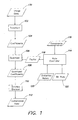
- Fig. 1 illustrates a system for compressing image data.
- Image data 100 is transformed (by transform 102) to produce coefficients 104 for different frequencies.
- This frequency domain representation of an image may be produced in many ways. For example, the image may be subdivided into blocks of picture elements (pixels). Each block is transformed from its color representation in the spatial domain to a color representation in a frequency domain, typically using a discrete cosine transform (DCT). The result of the transform is a matrix of frequency coefficients, one coefficient for each frequency. A set of such blocks is called a macroblock.
- DCT discrete cosine transform
- the coefficients are then quantized (by quantizer 106) using a set of quantizers, one quantizer for each frequency, to provide a quantized coefficient 108 for each frequency.
- the set of quantizers typically is referred to as a quantization table or quantization matrix.
- the quantization matrices appropriate for a particular bit rate for example 220 Mbits per frame and 140 Mbits per frame, can be defined experimentally using sample images and a procedure defined in: " RD-OPT: An Efficient Algorithm for Optimizing DCT Quantization Tables," by Viresh Ratnakar and Miron Livny, in 1995 Data Compression Conference, pp. 332-341 ("Ratnakar ").
- Ratnakar teaches how to optimize a quantization table for a single image; however, this procedure may be extended to optimize a quantization table using statistics for multiple example images selected as "typical" images. Such a quantization table can be developed for each of a set of different desired output bit rates.
- the quantization table quantizes the frequency data by dividing each coefficient by its corresponding quantizer and rounding. For example, the following formula may be used: round[S(u,v)/Q(u,v)]; where S(u,v) is the value at position u,v in the matrix of frequency coefficients, Q(u,v) is the quantizer at position u,v in the quantization matrix.
- the values Q(u,v) in the quantization matrix may be a function of a fixed quantization matrix, a scale factor and a weighting factor.
- the weighting factor scales the values in the quantization matrix so that they are appropriate for the bit depth of the image data, so that the variability in dynamic ranges is accounted for data of multiple bit depths, such as both 8-bit and 10-bit data.
- the quantization also may be performed to provide a variable width "deadzone".
- the deadzone is the area around zero that is quantized to zero.
- the deadzone has a width of the quantizer value Q(u,v). Noise can be reduced by increasing the deadzone as a function of quantizer value, for example, using the following equations:
- the quantization / dequantization are conventional with a deadzone of width Q ( u,v ) .
- the deadzone can be made variable. If k is in the interval (0, 0.5) the deadzone is smaller, if k is in the interval (-1, 0.5) the deadzone is larger.
- a value of k ⁇ (-0.5, 0.25) might be used to produce a deadzone between 1.5 Q ( u,v ) and 3.0 Q ( u,v ) .
- the scale factor may be controlled by a rate controller 114, described in more detail below.
- a set of scale factors that are powers of two, e.g., 1, 2, 4, 8, 16 ..., may be used.
- An entropy encoder 110 encodes the quantized values using entropy encoding to produce code words that are formatted to provide the compressed data 112.
- a pre-defined coefficient ordering process is applied to the matrix of quantized coefficients to provide a one-dimensional sequence of coefficients.
- a set of patterns, called symbols, is identified from the sequence of coefficients.
- the symbols are mapped to code words.
- the symbols may be defined, for example, using a form of run length encoding.
- Huffman encoding is generally employed to encode the sequence of symbols to variable length codes.
- the compressed data 112 includes the entropy encoded data and any other data for each block, macroblock or image that may be used to decode it, such as scale factors.
- a form of entropy encoding is described in more detail below in connection with Figs. 3-8.
- Compression parameters can be changed to affect both the bit rate and the image quality of decompressed data.
- compression parameters that may be changed include the quantizers, either within an image between portions of an image, or from one image to the next.
- a portion of an image is a set of DCT blocks called a macroblock.
- a change to the quantizers affects the compressed bit rate and the image quality upon decompression.
- An increase in a quantizer value typically decreases the bit rate but also reduces the image quality.
- a decrease in a quantizer value typically increases the bit rate but also improves the image quality.
- Quantizers may be adapted individually, or the set of quantizers may be scaled uniformly by a scale factor. In one embodiment, the scale factor is adjusted for each macroblock to ensure that each frame has an amount of data that matches a desired fixed bit rate.
- a rate controller 114 generally receives the bit rate 122 of the compressed data produced by compressing an image, any constraints 116 on the compression (such as buffer size, bit rate, etc.), and a distortion metric 120.
- the bit rate and distortion is determined for each macroblock for a number of scale factors in a statistics gathering pass on the image.
- the rate controller determines, for each macroblock, an appropriate scale factor 118 to apply to the quantization matrix.
- the rate controller 114 seeks to minimize the distortion metric 120 over the image according to the constraints 116 by using a technique that is called "rate-distortion optimization," such as described in “ Rate-distortion optimized mode selection for very low bit rate video coding and the emerging H.263 standard," by T. Wiegard, M. Lightstone, D.
- the distortion metric is known for each scale factor without analyzing the compressed image data.
- bit rate and distortion metric corresponding to a scale factor for which quantization is not performed may be estimated by interpolating measured rate and distortion values obtained from other scale factors.
- Such a technique is described in " Bit-rate control using piecewise approximated rate-distortion characteristics," by L-J. Lin and A. Ortega, in IEEE Trans. Circuits Syst. Video Tech., Vol. 8, No. 4, pp. 446-459, August 1998 , and in " Cubic Spline Approximation of Rate and Distortion Functions for MPEG Video,” by L-J. Lin, A. Ortega and C.-C. Jay Kuo, in Proceedings of IST/SPIE, Digital Video Compression: Algorithms and Technologies 1996, vol. 2668, pp.
- bit rates may be computed for two scale factors, one small and one large such as 2 and 128. Interpolation between these two points may be used to obtain a suitable scale factor with a corresponding desired bit rate. If the resulting compressed image data exceeds the desired bit rate, the image data can be compressed again using a different scale factor.
- Portions of the rate-distortion curve that extend beyond the data available also may be estimated.
- a scale factor for any portion of an image and a quantization matrix, there is a scale factor, called the maximum scale factor.
- Such a scale factor causes all of the quantizers to be such that all of the coefficients are quantized to zero.
- the maximum scale factor provides the minimum bit rate. Bit rates corresponding to scale factors between the maximum scale factor and a scale factor for which an actual bit rate is available can be estimated by interpolation, such as linear interpolation.
- Compressed image data 200 is received and code words are processed by an entropy decoder 202.
- the entropy decoder performs the inverse of the entropy encoding performed in Fig. 1.
- An example entropy decoder is described in more detail below.
- the entropy decoder 202 produces the quantized coefficient data 204.
- An inverse quantizer 206 reverses the quantization to produce coefficients 208.
- An inverse transform 210 is performed on the coefficients 208 to produce the image data 212.
- Fig. 9 is data flow diagram of an example image processing system that such an encoder and decoder.
- the image processing system 900 includes data storage 901 including a computer readable medium that stores the compressed image data.
- the compressed image data may be stored, for example, in a data file or may be referenced by metadata in a file format such as MXF or AAF.
- Such compressed image data also may be stored in memory, such as a cache.
- This compressed image data also may be used for transmission of data in which case 901 represents a transmission medium over which the compressed image data is transmitted as computer readable signals.
- Data 902 including the compressed image data is read and decompressed by a decoder 903.
- the decoder corresponds to Fig. 2.
- the decoder 903 may read one or more images from the compressed image data.
- the decoder 903 decompresses the read data and provides the decompressed data 906 to an image processing application 907.
- the image processing application 907 performs operations on the image data to produce uncompressed image data 908.
- image processing operations may include, but are not limited to, operations for combining images, such as compositing, blending, and keying, or operations within an image, such as resizing, filtering, and color correction, or operations between two images, such as motion estimation.
- the image processing application also may be an application that captures and/or creates digital image data, without using any input image data 906.
- the image processing application also may manipulate metadata about the image data, for example to define a sequence of scenes of motion video information.
- the image processing application also may playback image data in one or more formats, without providing any output data 908.
- Fig. 9 shows only one image processing application, there may be multiple image processing operations that may operate in parallel on the data or may operate as a sequence of operations.
- an image processing operation may process image data, and the invention is not limited thereby.
- the decoder and/or the image processing application and/or the encoder may be part of a larger application for editing video information.
- the encoder and/or image processing application and/or the decoder may "plug-in" to an editing application that permits access to image data in memory through an application programming interface (API).
- API application programming interface
- the encoder and decoder may be implemented in hardware that is accessed by an image processing application.
- the DC coefficients may be encoded and decoded in a number of ways, for example, but not limited to a method used in the MPEG-2 standard.
- the entropy encoding of the AC coefficients uses the range of potential non-zero amplitudes for quantized coefficients and splits this range into two parts: [1,..., A B ] and [ A B + 1,..., A max ] .
- the first part is a base range for amplitudes between 1 and a convenient amplitude, for example 64.
- the second part is an index range for the amplitudes greater than A B up to an including the maximum amplitude A max , for example 65 to 4096.
- Amplitudes in the base range are encoded with a Huffman code word that represents that amplitude.
- the index range is further divided into a number of segments, each having a range of values corresponding to A B .
- Amplitudes in the index range are encoded with a Huffman code word that represents the amplitude and an index value that indicates the segment from which they originate. If there is one or more preceding zero valued coefficients, the amplitude is encoded by a Huffman code word, and, if the amplitude is in the index range, followed by an index value, followed by another Huffman code word representing the length of the preceding run of zeros. The longest run of zeros is the number of coefficients to be encoded minus one.
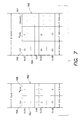
- Fig. 3 shows how a zero run length and amplitude coefficients are mapped to the sets A nrb , A nri , A wrb , A wri and R .
- the map 300 of Fig. 3 indicates that for amplitudes (represented along axis 302), 1 to 64, there are two possible symbol sets A nrb (304), if the preceding run of zeros is zero, and A wrb (306), if the preceding run of zeros is nonzero.
- each range of 64 values e.g., 308 has a unique index i , and two symbol sets A nri (310), if the preceding run of zeros is zero, and A wri (312), if the preceding run of zeros is nonzero.
- a code word R is provided for each run length, as indicated at 314; however A wrb and A wri are not affected by the actual length of the run of zeros.
- the amplitude of a coefficient maps to one of the index ranges, either A nri 310 or A wri 312, it is encoded by a variable length code word and an index value.
- Another set of Huffman code words is generated for the 62 symbols in R , which results in a set of zero-run code words V R .
- the set of code words and how they map to amplitude values or run length values can be defined using statistics from sample data according to Huffman coding principles.
- two code words 406 are inserted into the encoded symbol bitstream: one for the code word V wrb 408, with a sign bit 410, and the second for the number representing the preceding run of zeros V R 412. If a coefficient has no preceding run of zeros and its amplitude is in the range of [ A B + 1,..., A MAX ], it maps to symbol set A nri ;a single code word 414 is inserted into the encoded symbol bitstream that includes the code word V nri 416, a sign bit 418 and a 6-bit index value P 420.
- the amplitude of a coefficient is in the index range of [ A B + 1,..., A MAX ] and is preceded by a run of zeros, it maps to symbol set A wri .
- two code words 422 are inserted into the encoded symbol bitstream. These code words include a code word V wri 424, with sign bit 426 and a 6-bit index P 428, to represent the amplitude, and a code word V R 430 to represent the number representing the preceding run of zeros.
- the end of block code word 432 is a single code word, for example a 4-bit symbol, is inserted into the encoded bitstream at the end of a block.
- variable length encoding may be performed using two lookup tables, examples of which are shown in Figs. 5 and 6.
- the format for the amplitude symbols in the set V A is shown in Fig. 5.
- the format for the run-length symbols in the set V R is shown in Fig. 6.
- Each entry, e.g., 502, in the amplitude table 500 uses sixteen bits for the code word 504 and five bits that represent the length 506 of the code word.
- the maximum storage requirement for one entry, e.g., 502, is twenty-one bits.
- each entry can be stored in three successive bytes. In some instances, it may be useful to store the value as a 32-bit word.
- This information is applied to the lookup table 500 to retrieve the code word V nrb , V nri , V wrb , or V wri , which can be combined with a sign bit, index value P , and, if appropriate, the subsequent code word V R for the run length.
- each decoding table one for amplitude code words and the other for run length code words, may be divided into two tables. Due to the nature of Huffman codes, each code word can be uniquely located in a bitstream. For each code word, it is applied to the appropriate decoding table.
- either table 700 or 702 receive as an input 704 a run length code word, and provide as an output the corresponding value.
- the corresponding value includes a number 706 or 710 representing the length of the run and a length 708 or 712 representing the length in bits of the number 706 or 710.
- either table 800 or 802 receive as an input 804 the amplitude code, and provide as an output the corresponding values including a number 806 or 814 representing the length in bits of the value to be output, a number 808 or 816 representing the amplitude, a run flag 810 or 818 indicating whether a run code will follow, and index flag 812 or 820 indicating whether an index code will follow.
- the first code word for AC coefficients of a block is an amplitude code word.
- the run flag and index flag indicate whether the subsequent code word is another amplitude code word, an index value or a run length code word. If both the run flag and index flag are set, the amplitude code word is followed by an index code word, then a run length code word, which are then followed by another amplitude code word.
- the rate controller performs a statistics collection pass on the image to determine bit rates for each macroblock in the image for each of a number of scale factors.
- Each scale factor is a power of two.
- the distortion corresponding to each scale factor for each macroblock is determined by the square of the scale factor.
- the rate controller selects a scale factor for each macroblock to minimize the total distortion over the image while meeting a desired bit rate.
- the selected scale factor for each macroblock then is used to quantize the frequency coefficients of that macroblock.
- each quantizer may operate in parallel and may correspond to a scale factor that is a power of two so as to perform only a bit shifting operation. In this example, there are eight such quantizers. As few as two quantizers corresponding to two scale factors could be used, if the rate controller uses interpolation to estimate bit rates corresponding to other scale factors.
- the resulting quantized values 1012 can be applied to a code length calculator 1014.
- the code length calculator sums the lengths of the code words that would be generated for the quantized values in each block in each macroblock, to provide a bit rate 1016 for each macroblock for each of the scale factors.
- the rate controller 1020 receives the bit rates 1016 for each scale factor for each macroblock in the image, and the maximum weighted macroblock amplitude 1018 for each macroblock in the image, and a desired bit rate 1022 for the image.
- the rate controller 1020 minimizes the total distortion over all macroblocks in the image to meet the desired bit rate by selecting a scale factor 1024 for each macroblock.
- the scale factor 1024 for each macroblock is then used to quantize the coefficients for the macroblock, which are then entropy encoded.
- Such encoding and decoding may be used for, for example, but not limited to, high definition video, in which images have from 720 to 1080 lines and 1280 to 1920 pixels per line.
- Frame rates generally vary from 23.976 to 60, with higher frame rates typically representing the field rate of an interlaced frame.
- Each pixel may be represented using a number of components, for example, but not limited to, luminance and chrominance (Y, Cr, Cb) or red, green and blue, with each component represented using a number of bits (called the bit depth).
- the bit depth typically is 8 or 10 bits, but could be 12 or 16 bits.
- Such data has a significantly higher bandwidth than standard definition video.
- the same encoder may be used to encode both 8-bit and 10-bit data.
- a fixed quantization matrix may be provided for each of a number of different desired bit rates.
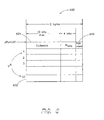
- This data structure includes a picture header 10 and image scan data 12.
- a picture trailer 14 also may be used.
- the picture header stores information about the image scan data, and an example data structure for it is described in more detail below in connection with Figs. 14-16.
- the image scan data 12 is a data structure that stores the encoded image data for an image.
- An example data structure for the image scan data is described in more detail below in connection with Figs. 12-13.
- the picture trailer data terminates the data structure for an image.
- the image scan data is defined by an image scan header 20, which references rasterscan data, as shown by 22, 24, 26 and 28.
- An image is divided several bands of multiple lines, and each band of multiple lines is divided into a macroblock.
- the set of macroblocks that define a band is called herein a macroblock rasterscan.
- the raster scan data, e.g., 22 is a data structure that stores the encoded image data for a macroblock rasterscan.
- An example data structure for the raster scan data is described in more detail below in connection with Fig. 13.
- the raster scan data is defined by an raster scan header 30, which references encoded data for macroblocks, as shown by 32, 34, 36 and 38, for a band of lines in the image.
- the encoded data for the macroblocks is followed by padding 39.
- the padding ensures that data for each macroblock rasterscan terminates on a data boundary. This data boundary depends on the amount of data that permits efficient access by a processor, for example, but not limited to 4096 (4K) bytes.
- the encoded data for a macroblock have a data structure that is similar to a macroblock data structure found in the MPEG-2 standard.
- the picture header references data that allows access to an image scan index that is an index of the locations of each macroblock rasterscan in the image scan data, and of the locations of the macroblock data in each macroblock rasterscan.
- An example data structure for the image scan index is described below in connection with Fig. 16.
- the picture header data structure 40 may include general information 42 about the picture, which may be similar to information provided by a picture header data structure as defined by the MPEG-2 standard.
- the picture header 40 also may include a reference to a picture header type 44. If the type in this field corresponds to a predetermined value (called "I frame image ID" in Fig.
- the following value 46 is a reference to (called an "I_frame_image_descriptor" in Fig. 14) an image descriptor which describes the image and references the image scan index.
- An example data structure for the I_frame_image_descriptor is shown in Fig. 5.
- An image descriptor 50 is referenced by the picture header and references the image scan index. It includes general information about the image as indicated at 52. This general information is similar to data structures in the MPEG-2 standard for describing 1-frames.
- the image descriptor may include a start code 54 for an image scan index (called “imagescan_index_start code” in Fig. 15) that, if present, is followed by a value 56 indicative of the size of the image scan index and a reference 58 to the data structure for the image scan index.
- An example data structure for the image scan index is shown in Fig. 16.
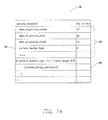
- the image scan index 60 includes a value 62 indicating a number of entries in the index, which corresponds to the number of macroblock rasterscans in the image scan data.
- a value 64 indicates a number of lines per macroblock rasterscan. This data is followed by entries 66 of the index, the number of which corresponds to the number indicated by value 62. Each entry in the index indicates an offset of the macroblock rasterscan in image scan.
- each macroblock rasterscan can be randomly and directly accessed, thus allowing different macroblock rasterscans to be processed in parallel by different processors.
- multiple processors operating in parallel can efficiently decode an image.
- Fig. 17 is data flow diagram of an example image processing system that uses this bitstream format.
- the image processing system 70 includes data storage 71 that stores the bitstream, for example, in a data file or which may be referenced by metadata in a file format such as MXF or AAF. Such a bitstream also may be stored in memory, such as a cache.
- This bitstream format also may be used as a format for transmission of data, in which case 71 represents a transmission medium over which the compressed image data is transmitted as computer readable signals.
- Data 72 including the bitstream is read and decompressed by decoder 73.
- Data including the bitstream, shown at 74, is written into such a format by an encoder 75.
- the decoder 73 may read one or more macroblock rasterscans from the bitstream.
- the decoder 73 decompresses the read data and provides the decompressed data 76 to an image processing application 77.
- the image processing application 77 performs operations on the image data to produce uncompressed image data 78.
- image processing operations may include, but are not limited to, operations for combining images, such as compositing, blending, and keying, or operations within an image, such as resizing, filtering, and color correction, or operations between two images, such as motion estimation.
- the image processing application also may be an application that captures and/or creates digital image data, without using any input image data.
- the image processing application also may manipulate metadata about the image data, for example to define a sequence of scenes of motion video information.
- the image processing application also may playback image data in one or more formats, without providing any output data.
- Fig. 17 shows only one image processing application, there may be multiple image processing operations that may operate in parallel on the data or may operate as a sequence of operations.
- an image processing operation may process image data, and the invention is not limited thereby.
- the decoder and/or the image processing application and/or the encoder may be part of a larger application for editing video information and may access the image data in the same buffer in memory.
- the decoder and/or image processing application and/or the encoder may "plug-in" to an editing application that permits access to image data in memory through an application programming interface (API).
- API application programming interface
- the encoder and decoder may be implemented in hardware that is accessed by the image processing application.
- the picture header (Fig. 14) is accessed (80) to locate the i_frame_image_descriptor.
- the i_frame_image_descriptor (Fig. 15) is accessed (82) to locate the image scan index.
- the image scan index (Fig. 16) is then accessed (84) to locate, for each macroblock rasterscan, the offset of the macroblock rasterscan (e.g., 24) in the image scan data (12 in Fig. 11).
- each of the macroblock rasterscans may be retrieved (86) from the image scan data and decoded. Because each macroblock rasterscan can be randomly and directly accessed, different macroblock rasterscans can be processed in parallel by different processors.
- each macroblock rasterscan has an end of block code, indicating the end of the data for the macroblock rasterscan, and if the amount of padding is known, the process of Fig. 18 can be modified to read the data without the index.
- the macroblock rasterscan data may be scanned for the end of block code. If the padding is such that it ends on a determinable data boundary (such as a boundary divisible by 4096 bytes), then the end of the macroblock rasterscan is known. Reading can skip directly to the end of the macroblock rasterscan.
- Fig. 19 an example process for writing such a bitstream for an image, using the example data structures of Figs. 11-16, will now be described.
- data is compressed an decoded in order by macroblock rasterscan. That is, each macroblock is encoded in order as they occur along a macroblock rasterscan, and the macroblock rasterscans are encoded in order as they occur in the image.
- the writing process involves, for each image scan, initializing (90) the data structures for the picture header, image frame descriptor and the image scan index.
- the number of entries, the number of lines per macroblock rasterscan and the size of the image scan index can be known and set in these data structures before compression of the image begins.
- the offset of the first macroblock of the first macroblock rasterscan is stored (92) as an entry in the image scan index.
- the sizes of the macroblocks are accumulated (94) for all macroblocks in the macroblock rasterscan. After all macroblocks in the macroblock rasterscan have been written, the accumulated size is rounded (96) up to the nearest data boundary (for example, a multiple of 4096 or 4K). The difference between the accumulated size and the rounded size is an amount of padding added (98) to the end of the data for the macroblock rasterscan that is written into the bitstream of the image scan. Steps 92 through 98 are repeated, as indicated at 99, for each macroblock rasterscan in the image. Data for each macroblock rasterscan also may be encoded in parallel.
- Such a computer system typically includes a main unit connected to both an output device that displays information to a user and an input device that receives input from a user.
- the main unit generally includes a processor connected to a memory system via an interconnection mechanism.
- the input device and output device also are connected to the processor and memory system via the interconnection mechanism.
- Example output devices include, but are not limited to, a cathode ray tube (CRT) display, liquid crystal displays (LCD) and other video output devices, printers, communication devices such as a modem, and storage devices such as disk or tape.
- One or more input devices may be connected to the computer system.
- Example input devices include, but are not limited to, a keyboard, keypad, track ball, mouse, pen and tablet, communication device, and data input devices. The invention is not limited to the particular input or output devices used in combination with the computer system or to those described herein.
- the computer system may be a general purpose computer system which is programmable using a computer programming language.
- the computer system may also be specially programmed, special purpose hardware.
- the processor is typically a commercially available processor.
- the general-purpose computer also typically has an operating system, which controls the execution of other computer programs and provides scheduling, debugging, input/output control, accounting, compilation, storage assignment, data management and memory management, and communication control and related services.
- a memory system typically includes a computer readable medium.
- the medium may be volatile or nonvolatile, writeable or nonwriteable, and/or rewriteable or not rewriteable.
- a memory system stores data typically in binary form. Such data may define an application program to be executed by the microprocessor, or information stored on the disk to be processed by the application program. The invention is not limited to a particular memory system.
- a system such as described herein may be implemented in software or hardware or firmware, or a combination of the three.
- the various elements of the system either individually or in combination may be implemented as one or more computer program products in which computer program instructions are stored on a computer readable medium for execution by a computer.
- Various steps of a process may be performed by a computer executing such computer program instructions.
- the computer system may be a multiprocessor computer system or may include multiple computers connected over a computer network.
- the components of the system may be separate modules of a computer program, or may be separate computer programs, which may be operable on separate computers.
- the data produced by these components may be stored in a memory system or transmitted between computer systems.
- a method for fixed bit rate, intraframe compression of video including a sequence of images, comprising, for each image: transforming portions of the image to generate frequency domain coefficients for each portion; selecting a quantization matrix according to the desired bit rate; determining a bit rate for each transformed portion using a plurality of scale factors; estimating distortion for each portion according to the plurality of scale factors; selecting a scale factor for each portion to minimize the total distortion in the image to achieve a desired bit rate; quantizing the frequency domain coefficients for each portion using the selected quantization matrix as scaled by the selected scale factor for the portion; entropy encoding the quantized frequency domain coefficients using a variable length encoding to provide compressed data for each of the defined portions; and outputting the compressed data for each of the defined portions to provide a compressed bitstream at the desired bit rate.
- the distortion may be estimated according to a square of the scale factor.
- Quantizing the frequency domain coefficients may further comprise scaling using a weighting factor selected from among a plurality of weighting factors according to the bit depth of the image data.
- Each of the plurality of scale factors may be a power of two.
- the selected scale factor may be a power of two.
- Determining a bit rate may comprise: determining a maximum scale factor that will cause the image data to be completely quantized; and interpolating to provide an estimated bit rate for one or more scale factors between the maximum scale factor and a largest scale factor for which a bit rate has been determined.
- Entropy encoding may comprise: for each nonzero value not preceded by a zero value, determining whether the nonzero value is in a base range or an index range; for each nonzero value not preceded by a zero value and in the base range, encoding the nonzero value using a code word from a first set of code words; for each nonzero value not preceded by a zero value and in the index range, determining an index and encoding the nonzero value using a code word from a second set of code words, followed by the index; for each nonzero value preceded by a zero value, determining whether the nonzero value is in a base range or an index range; for each nonzero value preceded by a zero value and in the base range, encoding the nonzero value using a code word from a third set of code words and encoding the zero value using a code word from a fifth set of code words and after the code word for the nonzero value; and for each nonzero value preceded by a
- the quantization matrix may include a plurality of quantizers, wherein each quantizer corresponds to a frequency coefficient, and wherein quantizing the frequency coefficients includes quantizing each frequency coefficient using the corresponding quantizer so as to provide a deadzone having a width greater than a value of the quantizer.
- Also provided is a method for entropy encoding a series of values comprising: for each nonzero value not preceded by a zero value, determining whether the nonzero value is in a base range or an index range; for each nonzero value not preceded by a zero value and in the base range, encoding the nonzero value using a code word from a first set of code words; for each nonzero value not preceded by a zero value and in the index range, determining an index and encoding the nonzero value using a code word from a second set of code words, followed by the index; for each nonzero value preceded by a zero value, determining whether the nonzero value is in a base range or an index range; for each nonzero value preceded by a zero value and in the base range, encoding the nonzero value using a code word from a third set of code words and encoding the zero value using a code word from a fifth set of code words and after the code word for the nonzero value
- Also provided is a method for optimization of bit rate and distortion in compression of data comprising: determining a bit rate for each portion of the data being compressed using a plurality of scale factors, including: determining a maximum scale factor that will cause total distortion to the portion of the data; and interpolating between the maximum scale factor and largest scale factor for which a bit rate has been determined to estimate a bit rate corresponding to a scale factor between the largest scale factor and the maximum scale factor; estimating distortion for each portion of the data being compressed according to the plurality of scale factors; and selecting scale factors for each portion to minimize the total distortion of the data to achieve a desired bit rate.
- a computer information product comprising: a computer readable medium; data stored on the computer readable medium that, when interpreted by a computer, defines a bitstream for compressed image data, comprising: for each image, a picture header followed by image scan data, wherein the image scan data includes data corresponding to a plurality of macroblock rasterscans, wherein the data for each macroblock rasterscan includes data for a plurality of macroblocks for a band of lines in the image followed by padding, whereby data for each macroblock rasterscan terminates on a data boundary; and wherein the picture header references an image scan index that indicates a number of macroblock rasterscans in the image scan data and a number of lines per macroblock rasterscan, followed by entries of the index, and wherein each entry in the index includes an offset of the macroblock rasterscan in image scan.
- the picture header may reference the image scan index by referencing an image descriptor, and wherein the image descriptor includes a reference to the image scan index.
- bitstream includes, for each image, a picture header followed by image scan data
- the image scan data includes data corresponding to a plurality of macroblock rasterscans
- the data for each macroblock rasterscan includes data for a plurality of macroblocks for a band of lines in the image followed by padding, whereby data for each macroblock rasterscan terminates on a data boundary
- the picture header references an image scan index that indicates a number of macroblock rasterscans in the image scan data and a number of lines per macroblock rasterscan, followed by entries of the index, and wherein each entry in the index includes an offset of the macroblock rasterscan in image scan
- the method comprising: accessing the picture header to locate the image scan index; accessing the image scan index to locate, for each macroblock rasterscan, the offset of the macroblock rasterscan in the image scan data; retrieving each macroblock rasterscans according to the offset
- the method may further comprise decoding each of the macroblock rasterscans in parallel.
- the picture header may reference the image scan index by referencing an image descriptor, wherein the image descriptor includes a reference to the image scan index, wherein the accessing the picture header comprises: accessing the picture header to locate the image descriptor; accessing the image descriptor to locate the image scan index.
- a computer program product comprising: a computer readable medium; computer program instructions stored on the computer readable medium that, when executed by a computer, instruct the computer to perform a method for reading a bitstream of compressed image data, wherein the bitstream includes for each image, a picture header followed by image scan data, wherein the image scan data includes data corresponding to a plurality of macroblock rasterscans, wherein the data for each macroblock rasterscan includes data for a plurality of macroblocks for a band of lines in the image followed by padding, whereby data for each macroblock rasterscan terminates on a data boundary; and wherein the picture header references an image scan index that indicates a number of macroblock rasterscans in the image scan data and a number of lines per macroblock rasterscan, followed by entries of the index, and wherein each entry in the index includes an offset of the macroblock rasterscan in image scan, wherein the method comprises: accessing the picture header to locate the image scan index; accessing the image scan index to locate
- the method may further comprise decoding each of the macroblock rasterscans in parallel.
- the picture header may reference the image scan index by referencing an image descriptor, wherein the image descriptor includes a reference to the image scan index, wherein the accessing the picture header comprises: accessing the picture header to locate the image descriptor; accessing the image descriptor to locate the image scan index.
- Also provided is a method for writing a bitstream of compressed image data comprising: for each image, defining a picture header followed by image scan data, including: for each band of lines in the image, defining a bitstream in memory for a macroblock rasterscan using data for a plurality of macroblocks for the band of lines followed by padding that makes each macroblock rasterscan terminate on a data boundary; defining the image scan data to include data corresponding to a plurality of macroblock rasterscans; and defining an image scan index that indicates a number of macroblock rasterscans in the image scan data and a number of lines per macroblock rasterscan, followed by entries of the image scan index; creating entries in the image scan index such that each entry in the index includes an offset of the macroblock rasterscan in image scan; creating a reference in the picture header to the image scan index, and writing the picture header followed by the image scan data in the bitstream.
- a computer program product comprising: a computer readable medium; computer program instructions stored on the computer readable medium that, when executed by a computer, instruct the computer to perform a method for writing a bitstream of compressed image data, comprising: for each image, defining a picture header followed by image scan data, including: for each band of lines in the image, defining a bitstream in memory for a macroblock rasterscan using data for a plurality of macroblocks for the band of lines followed by padding that makes each macroblock rasterscan terminate on a data boundary; defining the image scan data to include data corresponding to a plurality of macroblock rasterscans; and defining an image scan index that indicates a number of macroblock rasterscans in the image scan data and a number of lines per macroblock rasterscan, followed by entries of the image scan index; creating entries in the image scan index such that each entry in the index includes an offset of the macroblock rasterscan in image scan; creating a reference in the picture header to the image scan index,
Landscapes
- Engineering & Computer Science (AREA)
- Multimedia (AREA)
- Signal Processing (AREA)
- Compression Or Coding Systems Of Tv Signals (AREA)
- Compression, Expansion, Code Conversion, And Decoders (AREA)
Applications Claiming Priority (3)
| Application Number | Priority Date | Filing Date | Title |
|---|---|---|---|
| US46051703P | 2003-04-04 | 2003-04-04 | |
| US46054703P | 2003-04-04 | 2003-04-04 | |
| EP04749684A EP1629675B1 (fr) | 2003-04-04 | 2004-04-01 | Debit binaire fixe, compression et decompression intratrames d'une image video |
Related Parent Applications (2)
| Application Number | Title | Priority Date | Filing Date |
|---|---|---|---|
| EP04749684.9 Division | 2004-04-01 | ||
| EP04749684A Division EP1629675B1 (fr) | 2003-04-04 | 2004-04-01 | Debit binaire fixe, compression et decompression intratrames d'une image video |
Publications (2)
| Publication Number | Publication Date |
|---|---|
| EP1892965A2 true EP1892965A2 (fr) | 2008-02-27 |
| EP1892965A3 EP1892965A3 (fr) | 2011-04-06 |
Family
ID=38980887
Family Applications (1)
| Application Number | Title | Priority Date | Filing Date |
|---|---|---|---|
| EP07121939A Ceased EP1892965A3 (fr) | 2003-04-04 | 2004-04-01 | Compression et décompression intratrames d'une image video ayant un débit binaire fixe |
Country Status (1)
| Country | Link |
|---|---|
| EP (1) | EP1892965A3 (fr) |
Cited By (10)
| Publication number | Priority date | Publication date | Assignee | Title |
|---|---|---|---|---|
| EP2160036A2 (fr) | 2008-09-01 | 2010-03-03 | Fundación Cetena | Procédé de contrôle du débit binaire dans des systèmes de compression de vidéo numérique basés sur MJPEG |
| WO2018223179A1 (fr) | 2017-06-05 | 2018-12-13 | Immersive Robotics Pty Ltd | Compression d'un flux de contenu numérique |
| US10657674B2 (en) | 2016-06-17 | 2020-05-19 | Immersive Robotics Pty Ltd. | Image compression method and apparatus |
| CN112954323A (zh) * | 2014-07-28 | 2021-06-11 | 弗劳恩霍夫应用研究促进协会 | 编码器、解码器、用于编码及解码的系统及方法 |
| US11153604B2 (en) | 2017-11-21 | 2021-10-19 | Immersive Robotics Pty Ltd | Image compression for digital reality |
| US11150857B2 (en) | 2017-02-08 | 2021-10-19 | Immersive Robotics Pty Ltd | Antenna control for mobile device communication |
| US11553187B2 (en) | 2017-11-21 | 2023-01-10 | Immersive Robotics Pty Ltd | Frequency component selection for image compression |
| US12355984B2 (en) | 2019-10-18 | 2025-07-08 | Immersive Robotics Pty Ltd | Content compression for network transmission |
| CN120805999A (zh) * | 2025-09-09 | 2025-10-17 | 上海壁仞科技股份有限公司 | 缩放因子处理模块、处理器、电子设备 |
| CN121000882A (zh) * | 2025-09-19 | 2025-11-21 | 浙江千从科技有限公司 | 一种图像压缩方法和装置 |
Family Cites Families (9)
| Publication number | Priority date | Publication date | Assignee | Title |
|---|---|---|---|---|
| EP0500077B1 (fr) * | 1991-02-21 | 1997-09-24 | Nec Corporation | Dispositif de codage pour comprimer des données d'image mobile |
| EP0618733B1 (fr) * | 1993-03-29 | 2000-05-24 | Canon Kabushiki Kaisha | Méthode de contrôle de la quantité de données et codeur la mettant en oeuvre |
| US5724097A (en) * | 1993-10-18 | 1998-03-03 | Mitsubishi Denki Kabushiki Kaisha | Adaptive quantization of video based on edge detection |
| US6160846A (en) * | 1995-10-25 | 2000-12-12 | Sarnoff Corporation | Apparatus and method for optimizing the rate control in a coding system |
| US5821887A (en) * | 1996-11-12 | 1998-10-13 | Intel Corporation | Method and apparatus for decoding variable length codes |
| WO1998035500A1 (fr) * | 1997-02-11 | 1998-08-13 | Sharp Kabushiki Kaisha | Procede et dispositif pour optimiser les valeurs de quantification dans un codeur d'images |
| US6118822A (en) * | 1997-12-01 | 2000-09-12 | Conexant Systems, Inc. | Adaptive entropy coding in adaptive quantization framework for video signal coding systems and processes |
| US6408026B1 (en) * | 1999-08-06 | 2002-06-18 | Sony Corporation | Deadzone quantization method and apparatus for image compression |
| CN1245839C (zh) * | 2001-07-04 | 2006-03-15 | 矽统科技股份有限公司 | 分散式视频数据流解码方法 |
-
2004
- 2004-04-01 EP EP07121939A patent/EP1892965A3/fr not_active Ceased
Non-Patent Citations (7)
| Title |
|---|
| ANTONIO ORTEGA: "Optimal bit allocation under multiple rate constraints", PROC. OF THE DATA COMPRESSION CONFERENCE (DCC 1996, April 1996 (1996-04-01) |
| JVT: "HRD/VBV Output Document", 4. JVT MEETING; 61. MPEG MEETING; 22-07-2002 - 26-07-2002; KLAGENFURT,AT; (JOINT VIDEO TEAM OF ISO/IEC JTC1/SC29/WG11 AND ITU-T SG.16 ),, no. JVT-D146, 26 July 2002 (2002-07-26), XP030005413, ISSN: 0000-0439 * |
| LIANG-JIN LIN: "Video Bit-Rate Control with Spline Approximated Rate-Distortion Characteristics", 1997, PHD THESIS, UNIVERSITY OF SOUTHERN CALIFORNIA |
| L-J. LIN; A. ORTEGA: "Bit-rate control using piecewise approximated rate-distortion characteristics", IEEE TRANS. CIRCUITS SYST. VIDEO TECH., vol. 8, no. 4, August 1998 (1998-08-01), pages 446 - 459, XP000777986, DOI: doi:10.1109/76.709411 |
| L-J. LIN; A. ORTEGA; C.-C. JAY KUO: "Cubic Spline Approximation of Rate and Distortion Functions for MPEG Video", PROCEEDINGS OFIST/SPIE, DIGITAL VIDEO COMPRESSION: ALGORITHMS AND TECHNOLOGIES, vol. 2668, 1996, pages 169 - 180 |
| T. WIEGARD ET AL.: "Rate-distortion optimized mode selection for very low bit rate video coding and the emerging H.263 standard", IEEE TRANS. CIRCUITS SYST. VIDEO TECH., vol. 6, no. 2, April 1996 (1996-04-01), pages 182 - 190 |
| VIRESH RATNAKAR; MIRON LIVNY: "RD-OPT: An Efficient Algorithm for Optimizing DCT Quantization Tables", DATA COMPRESSION CONFERENCE, 1995, pages 332 - 341 |
Cited By (17)
| Publication number | Priority date | Publication date | Assignee | Title |
|---|---|---|---|---|
| EP2160036A2 (fr) | 2008-09-01 | 2010-03-03 | Fundación Cetena | Procédé de contrôle du débit binaire dans des systèmes de compression de vidéo numérique basés sur MJPEG |
| CN112954323A (zh) * | 2014-07-28 | 2021-06-11 | 弗劳恩霍夫应用研究促进协会 | 编码器、解码器、用于编码及解码的系统及方法 |
| US12273519B2 (en) | 2014-07-28 | 2025-04-08 | Fraunhofer-Gesellschaft Zur Foerderung Der Angewandten Forschung E.V. | Encoder, decoder, system and methods for encoding and decoding |
| US10657674B2 (en) | 2016-06-17 | 2020-05-19 | Immersive Robotics Pty Ltd. | Image compression method and apparatus |
| US11151749B2 (en) | 2016-06-17 | 2021-10-19 | Immersive Robotics Pty Ltd. | Image compression method and apparatus |
| US11150857B2 (en) | 2017-02-08 | 2021-10-19 | Immersive Robotics Pty Ltd | Antenna control for mobile device communication |
| US11429337B2 (en) | 2017-02-08 | 2022-08-30 | Immersive Robotics Pty Ltd | Displaying content to users in a multiplayer venue |
| US12096031B2 (en) | 2017-06-05 | 2024-09-17 | Immersive Robotics Pty Ltd. | Method and apparatus for digital content stream compression and decompression |
| WO2018223179A1 (fr) | 2017-06-05 | 2018-12-13 | Immersive Robotics Pty Ltd | Compression d'un flux de contenu numérique |
| AU2018280337B2 (en) * | 2017-06-05 | 2023-01-19 | Immersive Robotics Pty Ltd | Digital content stream compression |
| US11153604B2 (en) | 2017-11-21 | 2021-10-19 | Immersive Robotics Pty Ltd | Image compression for digital reality |
| US12058341B1 (en) | 2017-11-21 | 2024-08-06 | Immersive Robotics Pty Ltd. | Frequency component selection for image compression |
| US11973979B2 (en) | 2017-11-21 | 2024-04-30 | Immersive Robotics Pty Ltd | Image compression for digital reality |
| US11553187B2 (en) | 2017-11-21 | 2023-01-10 | Immersive Robotics Pty Ltd | Frequency component selection for image compression |
| US12355984B2 (en) | 2019-10-18 | 2025-07-08 | Immersive Robotics Pty Ltd | Content compression for network transmission |
| CN120805999A (zh) * | 2025-09-09 | 2025-10-17 | 上海壁仞科技股份有限公司 | 缩放因子处理模块、处理器、电子设备 |
| CN121000882A (zh) * | 2025-09-19 | 2025-11-21 | 浙江千从科技有限公司 | 一种图像压缩方法和装置 |
Also Published As
| Publication number | Publication date |
|---|---|
| EP1892965A3 (fr) | 2011-04-06 |
Similar Documents
| Publication | Publication Date | Title |
|---|---|---|
| US7729423B2 (en) | Fixed bit rate, intraframe compression and decompression of video | |
| US6757438B2 (en) | Method and apparatus for video compression using microwavelets | |
| US20130083855A1 (en) | Adaptive color space selection for high quality video compression | |
| US7460723B2 (en) | Quality based image compression | |
| US7003168B1 (en) | Image compression and decompression based on an integer wavelet transform using a lifting scheme and a correction method | |
| US6526174B1 (en) | Method and apparatus for video compression using block and wavelet techniques | |
| US6118903A (en) | Image compression method and apparatus which satisfies a predefined bit budget | |
| JP4365957B2 (ja) | 画像処理方法及びその装置及び記憶媒体 | |
| US8902992B2 (en) | Decoder for selectively decoding predetermined data units from a coded bit stream | |
| US20090034612A1 (en) | Quantization method and apparatus in encoding/decoding | |
| CN1366778A (zh) | 视频压缩 | |
| KR101066051B1 (ko) | 다중 디스크립션 인코딩용 장치 및 방법 | |
| US20140328391A1 (en) | Method and system for video rate control | |
| CN110324639B (zh) | 用于视频数据的高效熵编码的技术 | |
| US9077960B2 (en) | Non-zero coefficient block pattern coding | |
| EP1629675B1 (fr) | Debit binaire fixe, compression et decompression intratrames d'une image video | |
| EP3190793A1 (fr) | Procédé de réencodage d'image et appareil pour cela | |
| US20050063462A1 (en) | Visual scan method using scan table and discrete cosine transform device employing the same method | |
| HK1118409A (en) | Fixed bit rate, intraframe compression and decompression of video | |
| JP3190164B2 (ja) | 符号量見積り装置 | |
| JPH0730889A (ja) | 画像データ符号化装置 | |
| JPH02113775A (ja) | 画像信号の符号化方法とその装置 | |
| JPH02161874A (ja) | 画像信号の符号化方法とその装置 | |
| HK1067756A1 (en) | Apparatus and method for lossless intraframe encoding using golomb-rice |
Legal Events
| Date | Code | Title | Description |
|---|---|---|---|
| PUAI | Public reference made under article 153(3) epc to a published international application that has entered the european phase |
Free format text: ORIGINAL CODE: 0009012 |
|
| AC | Divisional application: reference to earlier application |
Ref document number: 1629675 Country of ref document: EP Kind code of ref document: P |
|
| AK | Designated contracting states |
Kind code of ref document: A2 Designated state(s): AT BE BG CH CY CZ DE DK EE ES FI FR GB GR HU IE IT LI LU MC NL PL PT RO SE SI SK TR |
|
| REG | Reference to a national code |
Ref country code: HK Ref legal event code: DE Ref document number: 1118409 Country of ref document: HK |
|
| RAP1 | Party data changed (applicant data changed or rights of an application transferred) |
Owner name: AVID TECHNOLOGY, INC. |
|
| PUAL | Search report despatched |
Free format text: ORIGINAL CODE: 0009013 |
|
| AK | Designated contracting states |
Kind code of ref document: A3 Designated state(s): AT BE BG CH CY CZ DE DK EE ES FI FR GB GR HU IE IT LI LU MC NL PL PT RO SE SI SK TR |
|
| RIC1 | Information provided on ipc code assigned before grant |
Ipc: H04N 7/30 20060101ALI20110303BHEP Ipc: H03M 7/42 20060101ALI20110303BHEP Ipc: H04N 7/26 20060101AFI20080118BHEP |
|
| 17P | Request for examination filed |
Effective date: 20111006 |
|
| AKX | Designation fees paid |
Designated state(s): AT BE BG CH CY CZ DE DK EE ES FI FR GB GR HU IE IT LI LU MC NL PL PT RO SE SI SK TR |
|
| 17Q | First examination report despatched |
Effective date: 20150413 |
|
| STAA | Information on the status of an ep patent application or granted ep patent |
Free format text: STATUS: THE APPLICATION HAS BEEN REFUSED |
|
| 18R | Application refused |
Effective date: 20161014 |
|
| REG | Reference to a national code |
Ref country code: HK Ref legal event code: WD Ref document number: 1118409 Country of ref document: HK |