EP1893146B1 - Dispositif dote d'un auxiliaire de documentation de blessure - Google Patents
Dispositif dote d'un auxiliaire de documentation de blessure Download PDFInfo
- Publication number
- EP1893146B1 EP1893146B1 EP06753832.2A EP06753832A EP1893146B1 EP 1893146 B1 EP1893146 B1 EP 1893146B1 EP 06753832 A EP06753832 A EP 06753832A EP 1893146 B1 EP1893146 B1 EP 1893146B1
- Authority
- EP
- European Patent Office
- Prior art keywords
- wound
- documentation
- aid
- film
- dressing
- Prior art date
- Legal status (The legal status is an assumption and is not a legal conclusion. Google has not performed a legal analysis and makes no representation as to the accuracy of the status listed.)
- Not-in-force
Links
Images

Classifications
-
- A—HUMAN NECESSITIES
- A61—MEDICAL OR VETERINARY SCIENCE; HYGIENE
- A61F—FILTERS IMPLANTABLE INTO BLOOD VESSELS; PROSTHESES; DEVICES PROVIDING PATENCY TO, OR PREVENTING COLLAPSING OF, TUBULAR STRUCTURES OF THE BODY, e.g. STENTS; ORTHOPAEDIC, NURSING OR CONTRACEPTIVE DEVICES; FOMENTATION; TREATMENT OR PROTECTION OF EYES OR EARS; BANDAGES, DRESSINGS OR ABSORBENT PADS; FIRST-AID KITS
- A61F13/00—Bandages or dressings; Absorbent pads
- A61F13/00051—Accessories for dressings
- A61F13/00059—Accessories for dressings provided with visual effects, e.g. printed or colored
-
- A—HUMAN NECESSITIES
- A61—MEDICAL OR VETERINARY SCIENCE; HYGIENE
- A61F—FILTERS IMPLANTABLE INTO BLOOD VESSELS; PROSTHESES; DEVICES PROVIDING PATENCY TO, OR PREVENTING COLLAPSING OF, TUBULAR STRUCTURES OF THE BODY, e.g. STENTS; ORTHOPAEDIC, NURSING OR CONTRACEPTIVE DEVICES; FOMENTATION; TREATMENT OR PROTECTION OF EYES OR EARS; BANDAGES, DRESSINGS OR ABSORBENT PADS; FIRST-AID KITS
- A61F13/00—Bandages or dressings; Absorbent pads
- A61F13/00051—Accessories for dressings
-
- A—HUMAN NECESSITIES
- A61—MEDICAL OR VETERINARY SCIENCE; HYGIENE
- A61F—FILTERS IMPLANTABLE INTO BLOOD VESSELS; PROSTHESES; DEVICES PROVIDING PATENCY TO, OR PREVENTING COLLAPSING OF, TUBULAR STRUCTURES OF THE BODY, e.g. STENTS; ORTHOPAEDIC, NURSING OR CONTRACEPTIVE DEVICES; FOMENTATION; TREATMENT OR PROTECTION OF EYES OR EARS; BANDAGES, DRESSINGS OR ABSORBENT PADS; FIRST-AID KITS
- A61F13/00—Bandages or dressings; Absorbent pads
- A61F13/02—Adhesive bandages or dressings
- A61F13/0203—Adhesive bandages or dressings with fluid retention members
- A61F13/0213—Adhesive bandages or dressings with fluid retention members the fluid retention member being a layer of hydrocolloid, gel forming material
-
- A—HUMAN NECESSITIES
- A61—MEDICAL OR VETERINARY SCIENCE; HYGIENE
- A61F—FILTERS IMPLANTABLE INTO BLOOD VESSELS; PROSTHESES; DEVICES PROVIDING PATENCY TO, OR PREVENTING COLLAPSING OF, TUBULAR STRUCTURES OF THE BODY, e.g. STENTS; ORTHOPAEDIC, NURSING OR CONTRACEPTIVE DEVICES; FOMENTATION; TREATMENT OR PROTECTION OF EYES OR EARS; BANDAGES, DRESSINGS OR ABSORBENT PADS; FIRST-AID KITS
- A61F13/00—Bandages or dressings; Absorbent pads
- A61F13/02—Adhesive bandages or dressings
- A61F13/0203—Adhesive bandages or dressings with fluid retention members
- A61F13/022—Adhesive bandages or dressings with fluid retention members having more than one layer with different fluid retention characteristics
-
- A—HUMAN NECESSITIES
- A61—MEDICAL OR VETERINARY SCIENCE; HYGIENE
- A61F—FILTERS IMPLANTABLE INTO BLOOD VESSELS; PROSTHESES; DEVICES PROVIDING PATENCY TO, OR PREVENTING COLLAPSING OF, TUBULAR STRUCTURES OF THE BODY, e.g. STENTS; ORTHOPAEDIC, NURSING OR CONTRACEPTIVE DEVICES; FOMENTATION; TREATMENT OR PROTECTION OF EYES OR EARS; BANDAGES, DRESSINGS OR ABSORBENT PADS; FIRST-AID KITS
- A61F13/00—Bandages or dressings; Absorbent pads
- A61F13/02—Adhesive bandages or dressings
- A61F13/0203—Adhesive bandages or dressings with fluid retention members
- A61F13/0226—Adhesive bandages or dressings with fluid retention members characterised by the support layer
-
- A—HUMAN NECESSITIES
- A61—MEDICAL OR VETERINARY SCIENCE; HYGIENE
- A61F—FILTERS IMPLANTABLE INTO BLOOD VESSELS; PROSTHESES; DEVICES PROVIDING PATENCY TO, OR PREVENTING COLLAPSING OF, TUBULAR STRUCTURES OF THE BODY, e.g. STENTS; ORTHOPAEDIC, NURSING OR CONTRACEPTIVE DEVICES; FOMENTATION; TREATMENT OR PROTECTION OF EYES OR EARS; BANDAGES, DRESSINGS OR ABSORBENT PADS; FIRST-AID KITS
- A61F13/00—Bandages or dressings; Absorbent pads
- A61F13/02—Adhesive bandages or dressings
- A61F13/0246—Adhesive bandages or dressings characterised by the skin-adhering layer
- A61F13/0253—Adhesive bandages or dressings characterised by the skin-adhering layer characterized by the adhesive material
-
- A—HUMAN NECESSITIES
- A61—MEDICAL OR VETERINARY SCIENCE; HYGIENE
- A61F—FILTERS IMPLANTABLE INTO BLOOD VESSELS; PROSTHESES; DEVICES PROVIDING PATENCY TO, OR PREVENTING COLLAPSING OF, TUBULAR STRUCTURES OF THE BODY, e.g. STENTS; ORTHOPAEDIC, NURSING OR CONTRACEPTIVE DEVICES; FOMENTATION; TREATMENT OR PROTECTION OF EYES OR EARS; BANDAGES, DRESSINGS OR ABSORBENT PADS; FIRST-AID KITS
- A61F13/00—Bandages or dressings; Absorbent pads
- A61F2013/00361—Plasters
- A61F2013/00846—Plasters with transparent or translucent part
- A61F2013/00851—Plasters with transparent or translucent part with grid or reference marks
Definitions
- the invention relates to a device which comprises a wound dressing and a wound documentation aid for the documentation of characteristic data of a wound.
- Aids for wound documentation of wounds are known in many ways. Most of the wound documentation aids also disclosed by the patent literature are additional aids that do not allow direct therapeutic intervention. So describes the example EP 730 845 A2 a device consisting of two separable, superposed, transparent sheets. On one of the leaves, a grid for detecting and detecting the size of a wound is applied. When using this device, the two leaves are positioned over a wound and the detection and marking of the wound size made on the lattice-providing sheet. After recording, the sheet carrying the marks is removed from the sheet lying on the wound during recording. The records can be kept free of contamination in a patient folder.
- EP 640 332 B1 a sterile packaging for wound dressings, which has transparent areas for wound documentation and is writable on the sterile inside.
- a wound dressing is loosely placed in the package which must be kept in a sterile area outside the package during the recording of data such as wound size.
- the device has a non-adhesive or non-adhesive surface.
- the device may comprise two films, the second film being detachable from the first film upon application and after recording the documentation on the first film and storing only the first film.
- EP 630 629 B1 describes a multi-layer, transparent hydrogel wound dressing comprising a wound contact layer of a polyurethane hydrogel, a porous support layer and a thin film as a cover layer.
- a further layer can preferably be introduced between the film and the hydrogel, which carries a grid imprint for wound observation, which is intended to facilitate wound observation and measuring the wound without removing the applied wound dressing from the wound.
- this wound documentation aid can not be removed from the dressing without removing the dressing itself.
- the device should be safe to use and should allow reliable documentation of the therapeutic intervention.
- a means should be provided which ensures the documentation of a wound healing process without irritation of the wound.
- An advantage of this device is its application. With this device, the user is given in a very simple way a means to the hand, which allows the implementation of a therapeutic measure and at the same time allows an aid to document the actual state of the wound to be treated. Since the wound documentation aid is detachably connected to the wound dressing, it can be used with this Device the possibility of a comprehensive data collection to the therapeutic measure with a standardized method for the documentation of the wound to be treated are provided. In this case, the wound documentation aid itself can be archived. Moreover, by spacing the documentation aid from the wound by means of the wound contact layer, a contamination-free recording and documentation of the wound parameters is possible during the application, which, moreover, can take place without irritation of the wound itself.
- any means intended to enable the perception and documentation of at least one parameter of a wound to be understood here and below under Documentation Aid include in particular the parameters of the wound, which describe the condition of the wound, such as color and appearance, size, age or wound healing stage. Documentation here means the temporary collection and retention of data.
- a wound contact layer that promotes wound healing should be understood as meaning a layer which, by merely holding the carrier layer and thus temporarily covering the wound by means of the carrier layer, provides an additional contribution to wound healing.
- These may be different properties, such as, for example, the absorption of wound exudate, the provision or delivery of wound healing or supportive substances, or the provision of wound healing or supportive media.
- the device has a documentation aid comprising at least one film.
- a documentation aid comprising at least one film.
- the wound documentation aid comprises at least two wound documentation fields for storing different information.
- a wound dressing can be provided, which in addition to the therapeutic measure, the possibility of a comprehensive data collection on the therapeutic action and the condition of the wound allowed.
- a documentation field for example, the storage of data on the type, date or period or means of treatment can be done
- the second Documentation field for example, the storage of the data on the condition of the wound at the time of treatment can be done.
- the documentation aid of a device has different auxiliary lines in the form of geometric figures.
- the auxiliary lines are to be applied to the recordable film included in the documentation aid.
- rectangular gratings or even concentric circles or ellipses may be attached to the foil or documentation aid.
- the size of the wound, the different area proportions of different tissues within the wound or healing conditions of wound areas within the wound can be more easily determined. It may be advantageous to make the different guides by different color design or line design, such as dotted, dashed or continuous, distinguishable from each other.
- such information may be applied along with the guides.
- This information can be numerical or letter codes, preferably color-matched to the associated lines, which make it possible to extract the area information from associated tables.
- films particularly transparent or translucent film materials are provided.
- transparent films are used, which are made of polyester, co-polyester, polyethylene, polypropylene, polyvinyl chloride, polystyrene, polyamide, polycarbonate, cellulose esters, ethylene vinyl acetate, polyvinyl acetate, polyvinyl alcohol and / or mixtures thereof.
- films of transparent polyester or polyethylene or polypropylene or ethylene vinyl acetate are particularly preferred.
- the foils must not exceed a certain thickness, since otherwise there is too much space during archiving. It has proved to be particularly advantageous if the films have a thickness of 10 to 80 .mu.m, in particular from 20 to 60 .mu.m and more preferably from 20 to 40 microns.
- a multilayer film or a film composite as a documentation aid.
- These multilayer films have the advantage that a possible imprint on a first layer of the film can be covered by a second layer of film.
- a mark can be made by means of a permanent marker on an outer surface of the film, which has a uniform and uniform shape.
- the film is colored as a whole, such that it is transparent or translucent in any case.
- the device has a documentation aid in the form of a film, which in turn has at least one adhesive-equipped area, for example in strip form or as adhesive dots. With the aid of this adhesive area, the documentation aid can be fixed, for example, in a patient file and thus a permanent archiving of the recorded measures and data takes place. It can also be provided that the documentation aid has at least one adhesive area that is covered by a cover strip. Since the wound documentation aid as a whole is detachable from the wound dressing and can also be archived, a comparative measurement of the size of the wound can thus be carried out at different times or with each dressing change, for example.
- a device according to the invention can have a wound documentation aid which has at least one grip strip.
- This handle bar makes it easier for the user to grasp and handle the documentation aid when using the device and the documentation of the area of the documentation aid covered by a cover strip is to be used as a handle strip. It is provided in particular that the adhesive area along an edge of the documentation aid is appropriate.
- a carrier layer of the wound dressing of a device according to the invention various materials can be used. Usually, textile carrier materials, nonwovens, polymer films or polymer foams are used in wound dressings.
- carrier layer of the wound dressing of a device according to the invention in particular polymer films can be used. Very particular preference is given to polymer films which have a high water vapor permeability. Particularly suitable for this purpose are films made of polyurethane, polyether urethane, polyester urethane, Polyether-polyamide copolymers, polyacrylate or polymethacrylate are manufactured.
- a polyurethane film, polyester urethane film or polyether urethane film is preferable.
- the water vapor permeability of the polymer film, the wound dressing is preferably at least 750 g / m 2/24 hr., More preferably at least 1000 g / m 2/24 hr., And most preferably at least 2000 g / m 2/24 hrs. (Measured according to DIN 13726 ).
- a precise coordination of the materials used must be carried out.
- the materials used for the carrier layer and the film must be adjusted with regard to their release properties.
- These release properties are based on the forces that prevail between two materials used.
- a targeted surface treatment of a material an attractive or a repulsive effect on a second material to be brought together with this first material can be set.
- a surface treatment that creates an attractive effect between two materials may be by additional adhesive application, static charge or by fusing the two materials together.
- a repellent effect may be caused by an additional layer on a material of silicone or fluorine compounds.
- a release force peel force
- peel force is understood to mean such a force that is necessary to separate two materials from each other (measured according to DIN 53530).
- these release properties are set so that a detachment of the documentation aid in the form of a film from the carrier layer can be done by hand without much effort.
- the release force is adjusted so that in the applied state of the device, a detachment of the film from the carrier layer can take place without slipping or detachment of the wound dressing from the applied site.
- the adhesion of the film to the carrier layer is preferably 0.01 to 0.5 N / 25 mm, very particularly preferably 0.01 to 0.1 N / 25 mm, measured according to DIN 53530.
- the polymer material from which the Documentation preferably consists, applied directly in the production of the carrier layer, or the Carrier layer produced directly on the documentation sheet.
- all customary methods for film production can be used, for example by casting, knife coating, extrusion or other known methods of film or film production.
- the documentation sheet may be roughened on the coating side or subjected to another adhesion promoting treatment.
- An adhesion-promoting coating may also be advantageous.
- the device has a documentation aid in the form of a film, which is connected to the carrier layer by means of a pressure-sensitive adhesive.
- a documentation aid in the form of a film, which is connected to the carrier layer by means of a pressure-sensitive adhesive.
- the film has at least one edge region which is equipped with a release strip, so that this edge region can simultaneously act as a handle when removing the film from the wound dressing. Care must be taken to ensure that the adhesive does not remain on the carrier layer when removing the documentation aid. The pressure-sensitive adhesive must be completely removed with the documentation aid.
- the device has a documentation aid which has the same size as the carrier layer, that is to say that the documentation aid and the wound dressing have the same peripheral boundary.
- a wound dressing according to the invention is present as so-called island dressing.
- the wound contact layer has a smaller contact surface than the carrier layer.
- a pressure-sensitive adhesive On the side opposite the documentation support second side of the carrier layer can be applied in this form, a pressure-sensitive adhesive. This order can be done both over the entire surface as well as discontinuously or only in certain areas.
- the adhesive used can be a conventional pressure-sensitive adhesive, in particular an acrylate pressure-sensitive adhesive or a pressure-sensitive pressure-sensitive adhesive based on polyurethanes. It is preferably Gelhaftkleber, in particular based on polyurethanes, especially aqueous polyurethanes. Very particular preference is Hydrogelhaftkleber, especially based on aqueous acrylates.
- the device has a documentation aid that is not transparent, that is, which is opaque.
- a documentation aid can be, for example, a simple label.
- This label can alone a documentation of the applied product at a given time in a particular patient carried out by the label is solved directly in the application of the device according to the invention of the device and is introduced into a patient folder.
- This documentation can be carried out under the simultaneous marking of the actual condition of the wound in the application of the device, for example under marking such as ticking of Wahlfeldem.
- this label has a sandwich-like construction, that is, the label itself has a multilayer structure.
- a paper label may be provided which has a print on a first side with information about the applied product and optionally optional fields.
- a conventional pressure-sensitive adhesive for labels is applied on the second side of this label.
- This label is applied with its adhesive side on a, for example, siliconized release paper, which in turn is self-adhesive on the opposite side of the label.
- a label can be applied to a further film, which in turn is detachably connected to a wound dressing and in particular detachably connected to a carrier layer of a wound dressing.
- a device according to the invention comprises a documentation aid comprising a film, which in turn comprises a detachable label.
- the label with a release layer is releasably connected directly to the wound dressing by means of the release layer.
- the device may comprise a carrier layer which is coated over its entire area with a pressure-sensitive adhesive.
- the water vapor permeability of the backing layer provided with the pressure-sensitive adhesive is preferably at least 1000 g / m 2/24 hr., More preferably at least 1200 g / m 2/24 hr., And most preferably at least 2000 g / m 2/24 hrs. (Measured according to DIN EN 13726).
- a device according to the invention can be present in any geometric shape, for example in triangular, round, oval or square, rectangular or any symmetrical or asymmetrical shape.
- the wound dressing and the documentation aid have the same peripheral boundaries, that is, the wound dressing and the documentation aid are the same size.
- any wound contact layer common in modern wound treatment can be used. These are in particular those To name wound contact layers that are used in moist wound therapy.
- a device according to the invention can be used in particular for the production of an agent for the treatment of wounds, chronic wounds or skin damage.
- wound contact layers which absorb both wound exudate and thus have an absorbent effect and also deliver moisture to the wound.
- wound contact layers which are transparent or translucent are used.
- the device comprises a wound contact layer which comprises at least one hydrogel, a hydrocolloid and / or a foam, in particular a polyurethane foam.
- a hydrogel is understood to mean a composition which is characterized by a high water content.
- These hydrogels are particularly suitable as a wound contact layer.
- particularly preferred wound contact layers Based on the total weight of the hydrogels, particularly preferred wound contact layers have a water content of 50 to 95% by weight.
- these wound contact layers are particularly capable of releasing moisture to a wound and softening and detaching scabs, necroses and other coverings in a wound.
- These hydrogel-containing wound contact layers thus support autolytic debridement and are suitable for moisturizing weakly sezemierender wounds.
- devices of the invention are particularly suitable for the treatment of superficial wounds, such as abrasions or wounds by split skin removal as well as in chronic wounds such as decubitus ulcers or ulcers cures.
- a preferred hydrogel preferably has an aqueous, gel-like, but coalescing phase.
- the gel-like consistency of the hydrogel creates a bond between the wound dressing and the wound or surrounding skin of the wound, without there being an actual adhesion of the wound dressing to the wound, which would damage a delicate cell tissue in the removal of the wound dressing.
- An advantage of the gelatinous hydrogel is that its quality and cohesiveness hardly changes with the absorption of the wound fluids during the course of the treatment. In addition, it allows a clean and complete removal of the wound dressing when the wound heals or the dressing is changed.
- Such a hydrogel is, for example, with the EP 426 422 B1 described.
- a further preferred hydrogel is a polyurethane hydrogel.
- This polyurethane hydrogel comprises an aqueous mixture containing 0 to 90% by weight of polyhydric alcohol, 6 to 60% by weight of prepolymer having aliphatic diisocyanate groups, 4 to 40% by weight of polyethylene oxide-based polyamine, up to 2% by weight of sodium chloride and 50 to 95 wt .-% water.
- a preferred hydrogel composition for forming the hydrogel wound contact layer comprises from 15 to 30% by weight of polyhydric alcohol selected from a group consisting of polypropylene glycol, polyethylene glycol and / or glycerin, from 5 to 25% by weight prepolymer having isophorone diisocyanate ends, from about 5 to 20% by weight.
- the hydrogel comprises from 15 to 20 weight percent polypropylene glycol and / or glycerin, from 5 to 20 weight percent isophorone diisocyanate terminated prepolymer, from 5 to 15 weight percent polyethylene oxide based diamine, up to 1 weight percent Salt and 50 to 80 wt .-% water.
- the hydrogel material provides a biocompatible, non-irritating, liquid-absorbing, bacteria-protective, cushioning, skin-like medium which is particularly suitable as a wound contact layer.
- a preferred device as a wound contact layer comprises a hydrogel, which in turn is particularly advantageous in the treatment of weeping wounds or even chronic wounds, for example decubitus ulcers.
- a device according to the invention may also comprise a wound dressing having a wound contact layer comprising at least one hydrocolloid.
- a hydrocolloid is understood to mean a material that is a hydrophilic synthetic or natural polymeric material that is soluble or absorbent and / or swelling in water.
- a wound contact layer comprises a hydrocolloid of a synthetic or natural polymer material which is selected from the group of alginic acid and its salts and their derivatives, chitin or its derivatives, chitosan or its derivatives, pectin, cellulose or its derivatives such as cellulose ethers or cellulose esters, crosslinked or non-crosslinked carboxyalkyl cellulose or hydroxyalkyl cellulose, polyvinyl alcohol, polyvinylpyrrolidone, agar, guar gum or gelatin.
- a synthetic or natural polymer material which is selected from the group of alginic acid and its salts and their derivatives, chitin or its derivatives, chitosan or its derivatives, pectin, cellulose or its derivatives such as cellulose ethers or cellulose esters, crosslinked or non-crosslinked carboxyalkyl cellulose or hydroxyalkyl cellulose, polyvinyl alcohol, polyvinylpyrrolidone, agar, gu
- the hydrocolloid can be present both in the form of fibers and in the form of particles and / or fibers within a matrix.
- the hydrocolloid may be in the form of particles in an adhesive polymer matrix.
- the adhesive polymer matrix in this case comprises at least one co-block polymer selected from the Group of AB diblock copolymers and / or ABA triblock copolymers, which is composed of the monomers styrene, butadiene and isoprene.
- the proportion of hydrocolloid particles in the wound contact layer may preferably be 10 to 70% by weight, based on the total weight of the wound contact layer.
- Such a composition is for example with the EP 1 007 597 B1 known.
- a preferred device as wound contact layer comprises a self-adhesive polymer matrix in which hydrocolloid particles are dispersed.
- a device can be used in particular in the treatment of severe weeping wounds or even chronic wounds, for example in decubitus ulcers.
- the wound contact layer can also be released by the wound contact layer, a wound healing promoting substance.
- a wound healing promoting substance include in particular substances which have a fungicidal, bactericidal or antimicrobial effect.
- the wound contact layer comprises a hydrogel or a hydrocolloid, which in turn comprises at least one fungicidal, bactericidal or antimicrobial substance. Chitosan, silver, silver complexes, silver salts, zinc, zinc salts or zinc complexes are particularly suitable here.
- a device comprises a wound dressing which, alternatively or additionally, has further layers which have different functions.
- the wound dressing has at least one further layer.
- This layer may preferably be a release layer for protection against soiling which is applied to the side of the wound contact layer lying on the wound in the application-oriented state of the device.
- the wound dressing has at least one further layer between the wound contact layer and the carrier layer.
- the further layer can be both an absorbent layer and a liquid-receiving layer which distributes over the surface of the wound dressing.
- a preferred device comprises a wound dressing which in its turn comprises a carrier layer, a wound contact layer and a distributor layer arranged between the carrier layer and the wound contact layer.
- a device according to the invention is arranged in a packaging.
- the packaging is a sterile packaging.
- the production of the layer composite takes place under a) with the simultaneous application of a handle strip to the film of the documentation aid.
- This handle strip in turn comprises a double-sided adhesive tape, which is covered with a cover strip on one side. The uncovered side of the adhesive tape is applied to the side of the film of the documentary aid facing the carrier layer and / or to the side of the film of the documentation aid facing away from the carrier layer.
- an "in-line” printing of the film is made. This printing takes place before the production of the layer composite a) on the side facing away from the carrier layer of the film of the documentation aid.
- archiving of the documentation aid is provided in a further method step c), wherein the wound dressing remains on the wound.
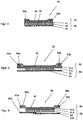
- FIG. 1 is a documentation aid in the form of a transparent film (10) reproduced.
- the film is made of polyethylene and has a smooth surface, which can be written on with a pen, eg permanent marker.
- the film has a first documentation field (11) and a second documentation field (12).
- the first documentation field (11) for example, the type of measure in the form of the product name, the date of the application and the name of the patient can be included.
- the type of wound or wound contour can be recorded in the second documentation field (12).
- the device has a wound dressing (28) consisting of a carrier layer (21) of a thin polyurethane film, a wound contact layer (22) of a polyurethane gel and a release layer covering the wound contact layer (23) from a first siliconized release paper.
- a wound documentation aid (29) which has a writable polyethylene film (24), an adhesive strip (25) and a second siliconized release paper (26) covering the adhesive strip is applied to the carrier layer (21).
- the film (24) is directly connected to the carrier layer (21). The binding forces between the film (24) and the carrier layer (21) are adjusted so that the documentation aid (29) can be easily removed from the wound dressing (28) by hand.
- the documentation aid (29) Only in the area of the second release paper (26) is the documentation aid (29) provided without any bond with the wound dressing (28). Thus, this covered area can be used at the same time as a handle for easier gripping the documentation aid in the removal of the wound dressing.
- a printed image (27) on the release paper (26), which is mounted on the side facing the film (24) should indicate in use the withdrawal direction of the documentation aid (29).
- the documentation aid (29) has two documentation fields (31, 32).
- the first documentation field (31) makes it possible to determine the therapeutic action taken, whereas the second Documentation field (32) allows the documentation of the actual condition of the wound.
- concentric circles (32a) with associated designations (32b) are mounted in the second documentation field.
- the user can record the wound edge in the second documentation field and at the same time make a categorization of the wound on the basis of the designations.
- this device also allows for a standardized method of identifying the size of the wound.
- the device (40) in this case has a wound dressing (48) consisting of a carrier layer (41) of polyether urethane, a wound contact layer (42) comprising a self-adhesive matrix in which hydrocolloid particles are dispersed, and a release layer (43) covering the self-adhesive matrix. from a siliconized release paper.
- the documentation aid (49) consists of a polypropylene film (44), a dispersion pressure-sensitive adhesive (45) and two fluorinated and thus removable cover strips (46a, 46b) and is over the entire surface except for two edge regions covered by the cover strips (46a, 46b) are connected to the carrier layer (41).
- the two covered areas can in turn be used as a handle bar.
- a recording of the wound characteristics on the documentation aid can be carried out without contamination by means of a permanent marker.
- the recording and documentation takes place here very irritating, since on the one hand the wound contact layer, the film from the wound spaced and on the other hand, the documentation can be done without much effort and thus without displacement of the wound dressing on the wound.
- FIG. 5 a third embodiment of a device according to the invention is shown.
- the device (50) is in a square shape (not shown here) and is manufactured as an island dressing, that is, that the carrier layer (51 a) projects beyond the wound contact layer (52) on all sides.
- the wound dressing (58) consists of a transparent, water-vapor-permeable polyurethane film (51a) which is coated over its entire area with a pressure-sensitive adhesive (51b), a wound contact layer (52) of an alginate fiber fleece which is fixed to the carrier layer by means of the pressure-sensitive adhesive and a first siliconized one Release paper layer (53) covering both the wound contact layer (52) and the adhesive edges of the carrier layer (51 a) covered.
- the documentation aid (59) consists of a writable, transparent polyethylene film (54), two adhesive strips (55a, 55b) which are mounted in parallel on two opposite edges of the film and two release paper strips (56a, 56b) covering these adhesive strips ).
- the film is completely connected to the carrier layer except for the areas which are covered by the release paper strips (56a, 56b).
- the documentation aid has the same scope as the wound dressing.
- This device consists of a wound dressing (68) having a carrier layer (61 a) of a transparent polyester polyurethane, which is coated with a water vapor-permeable polyurethane pressure sensitive adhesive (61 b) over the entire surface, a wound contact layer (62) of a freeze-dried hydrogel foam and a two-part Releasing layer (63a, 63b) made of polyethylene film.
- the carrier layer (61) has the same peripheral boundary as the wound contact layer.
- a wound documentation aid (69) is applied on the carrier layer.
- the documentation aid (69) consists of a polyester film (64), two adhesive strips (65a, 65b) and two release paper strips (66a, 66b).
- the adhesive strips (65a, 65b) lie on the same side on which the characteristics of the wound can be recorded. Thus, even with the use of a non-permanent marker, a documentation-safe recording of the parameters can be made, since just the page with the records can be fixed to the document file.
- the user uses the two release paper strips (66a, 66b), which have a free gripping surface as handle bar.
- the release forces between the carrier layer and the film are set such that the force necessary to separate them is less than the force necessary to remove a release paper strip (66a, 66b) from an adhesive strip (65a, 65b) to separate.
- a grid is also applied for easier characterization of the wound, the grid has fields of 1 cm 2 (not shown here).
- the carrier layer likewise has these grid fields and the lines of the grid fields are arranged the same as those of the documentation aid.
- the wound dressing (48) is produced by applying a silicone paper (Separacon 9120-60 from Maria Soell, basis weight 120 g / m.sup.2) to a layer of a polyurethane film and a hydrocolloid layer (MED 5586H from Avery Donison) on the self-adhesive side of the hydrocolloid layer Protective paper is applied.
- a self-adhesive polyethylene film (44 and 45) from 3M (3M 5504A-UV) is laminated onto the polyurethane film (41) as a wound documentation aid (49).
- the writable polyethylene film (44) has a thickness of 56 microns and is coated with an acrylate adhesive (45), so that an adhesive force according to AFERA 4001 of 0.4 N / cm results.
- On the self-adhesive side of the polyethylene film (which faces the PU film of the MED 5586H material) is on at least one longitudinal side of a siliconized paper strip (46a, 46b) (eg Separacon 9120-60 from Maria Soell, weight 120 g / m2) or a double-sided adhesive tape covered with a silicone paper.
- a siliconized paper strip 46a, 46b
- a double-sided adhesive tape covered with a silicone paper.
- FIG. 3 a wound dressing (28) consisting of a carrier layer (21) of a thin polyurethane film (Gerlinger Type Estane 5707), a wound contact layer (22) of a polyurethane gel and a wound layer covering the release layer (23) of a first siliconized release paper (LDPE film SKF 1002).
- a wound dressing consisting of a carrier layer (21) of a thin polyurethane film (Gerlinger Type Estane 5707), a wound contact layer (22) of a polyurethane gel and a wound layer covering the release layer (23) of a first siliconized release paper (LDPE film SKF 1002).
- the polyurethane gel consists (analog EP 426 422 B1 from 16.5% by weight of polypropylene glycol (DOW, Schwalbach, (Germany)), 12.5% by weight of prepolymer with isophorone diisocyanate ends (Aquapol 302-0031, Carpenter Co., Richmon (USA) Polyethylene oxide-based diamine (Jeffamine ED 2003, Huntsman, Rotterdam (Netherlands)), 1% by weight of sodium chloride and 61.3% by weight of demineralized water.
- a wound documentation aid (29) is applied, which is a writable Polyethylene film (24) (Bulken SH film type 5018 SHE), an adhesive strip (25) and a second siliconized release paper (26) covering the adhesive strip.
- This double-sided adhesive tape (25, 26) is available from Gerlinger under the name (Dokutape).
- the film (24) is directly connected to the carrier layer (21). Only in the area of the second release paper (26) is the documentation aid (29) provided without any bond with the wound dressing (28). Thus, this covered area can be used at the same time as a handle for easier gripping the documentation aid in the removal of the wound dressing.
- a printed image (27) on the release paper (26), which is mounted on the side facing the film (24) should, in use, indicate the withdrawal direction of the documentation aid (29).
- the documentation aid (29) has two documentation fields (31, 32).
- the first documentation field (31) makes it possible to determine the therapeutic measure that has been carried out, whereas the second documentation field (32) permits the documentation of the actual state of the wound.
- the user may remove the second release paper (26) from the adhesive strip (25) and paste the documentation aid into a patient file using the adhesive strip.
Landscapes
- Health & Medical Sciences (AREA)
- Engineering & Computer Science (AREA)
- Biomedical Technology (AREA)
- Heart & Thoracic Surgery (AREA)
- Vascular Medicine (AREA)
- Life Sciences & Earth Sciences (AREA)
- Animal Behavior & Ethology (AREA)
- General Health & Medical Sciences (AREA)
- Public Health (AREA)
- Veterinary Medicine (AREA)
- Dermatology (AREA)
- Chemical & Material Sciences (AREA)
- Dispersion Chemistry (AREA)
- Materials For Medical Uses (AREA)
Claims (13)
- Dispositif (20, 40, 50, 60) comprenant un pansement (28, 48, 58, 68) pour le traitement d'une plaie ou de la peau entourant une plaie et au moins un auxiliaire de documentation de plaie (29, 49, 59, 69) pour la documentation de données caractéristiques de la plaie ou de la peau entourant la plaie, dans lequel le pansement présente au moins une couche de contact de plaie (22, 42, 52, 62) favorisant la cicatrisation de la plaie et une couche de support (21, 41, 51, 61a), le pansement (28, 48, 58, 68) est attaché de façon séparable à l'auxiliaire de documentation de plaie (29, 49, 59, 69) et le pansement (28, 48, 58, 68) est transparent ou translucide, caractérisé en ce que l'auxiliaire de documentation de plaie (29, 49, 59, 69) présente au moins une zone à caractère adhésif, qui est recouverte d'une bande de recouvrement (26, 46a, 46b, 56a, 56b, 66a, 66b), et présente au moins un onglet, dans lequel la zone à caractère adhésif recouverte d'une bande de recouvrement (26, 46a, 46b, 56a, 56b, 66a, 66b) peut être utilisée comme onglet.
- Dispositif selon la revendication 1, caractérisé en ce que l'auxiliaire de documentation de plaie (29, 49, 59, 69) comprend au moins une feuille écrivable (24, 44, 54, 64).
- Dispositif selon la revendication 1 ou 2, caractérisé en ce que l'auxiliaire de documentation de plaie (29, 49, 59, 69) comprend au moins deux champs de documentation (11, 12, 31, 32) pour le stockage d'informations.
- Dispositif selon au moins une des revendications précédentes, caractérisé en ce que l'auxiliaire de documentation de plaie (29, 49, 59, 69) est attaché de façon séparable directement à la couche de support.
- Dispositif selon au moins une des revendications précédentes, caractérisé en ce que la couche de contact de plaie (22, 42, 52, 62) présente une couche de recouvrement (23, 43, 53, 63a, 63b) sur le côté à appliquer sur la plaie dans l'état prêt à l'emploi (23, 43, 53, 63)
- Dispositif selon au moins une des revendications précédentes, caractérisé en ce que le pansement (28, 48, 58, 69) comprend comme couche de contact de plaie (22, 42, 52, 62) au moins un hydrogel, un hydrocolloïde ou une mousse.
- Dispositif selon au moins une des revendications précédentes, caractérisé en ce que le pansement (28, 48, 58, 68) comprend un hydrogel comme couche de contact de plaie (22, 42, 52, 62).
- Dispositif selon au moins une des revendications précédentes, caractérisé en ce que le pansement (28, 48, 58, 68) comprend comme couche de contact de plaie (22, 42, 52, 62) une matrice polymère autoadhésive, dans laquelle des particules d'hydrocolloïde sont dispersées.
- Dispositif selon au moins une des revendications précédentes, caractérisé en ce que le pansement (28, 48, 58, 68) présente comme couche de support (21, 41, 51, 61) un film en polyuréthane, en polyester uréthane ou en polyéther uréthane.
- Dispositif selon au moins une des revendications précédentes, caractérisé en ce que le pansement (28, 48, 58, 68) présente la même limitation périphérique que l'auxiliaire de documentation de plaie (29, 49, 59, 69).
- Procédé pour la documentation de la grandeur de plaie ou d'autres paramètres caractéristiques d'une plaie comprenant les étapes suivantes:a) appliquer un dispositif (20, 40, 50, 60) selon au moins une des revendications précédentes sur la plaie, etb) caractériser la grandeur de la plaie ou d'autres paramètres caractéristiques au moyen de l'auxiliaire de documentation.
- Procédé selon la revendication 11, caractérisé en ce que l'on effectue comme autre étape du procédé c) un archivage de l'auxiliaire de documentation, dans lequel le pansement reste sur la plaie.
- Utilisation d'un dispositif (20, 40, 50, 60) selon au moins une des revendications précédentes pour la documentation de plaies, de plaies chroniques ou de lésions cutanées.
Applications Claiming Priority (2)
| Application Number | Priority Date | Filing Date | Title |
|---|---|---|---|
| DE102005027656A DE102005027656A1 (de) | 2005-06-15 | 2005-06-15 | Vorrichtung mit Wunddokumentationshilfe |
| PCT/EP2006/004933 WO2006133794A1 (fr) | 2005-06-15 | 2006-05-24 | Dispositif dote d'un auxiliaire de documentation de blessure |
Publications (2)
| Publication Number | Publication Date |
|---|---|
| EP1893146A1 EP1893146A1 (fr) | 2008-03-05 |
| EP1893146B1 true EP1893146B1 (fr) | 2017-03-08 |
Family
ID=37076083
Family Applications (1)
| Application Number | Title | Priority Date | Filing Date |
|---|---|---|---|
| EP06753832.2A Not-in-force EP1893146B1 (fr) | 2005-06-15 | 2006-05-24 | Dispositif dote d'un auxiliaire de documentation de blessure |
Country Status (3)
| Country | Link |
|---|---|
| EP (1) | EP1893146B1 (fr) |
| DE (1) | DE102005027656A1 (fr) |
| WO (1) | WO2006133794A1 (fr) |
Families Citing this family (11)
| Publication number | Priority date | Publication date | Assignee | Title |
|---|---|---|---|---|
| DE102006005348A1 (de) * | 2006-02-07 | 2007-08-09 | Paul Hartmann Ag | Folienverband mit verbesserter Applikationshilfe |
| DE102007029796A1 (de) * | 2007-06-27 | 2009-01-08 | Paul Hartmann Ag | Wundverband |
| US20090082710A1 (en) * | 2007-09-26 | 2009-03-26 | Vitaris Ronald F | Delivery system for a wound dressing |
| SE531853C2 (sv) * | 2007-12-18 | 2009-08-25 | Moelnlycke Health Care Ab | Transparent filmförband för skydd av hud omgivande ett sår |
| DE102008031183A1 (de) | 2008-07-03 | 2010-01-07 | Paul Hartmann Ag | Wundauflage |
| EP2338528B1 (fr) | 2009-12-24 | 2013-05-29 | Paul Hartmann AG | Matrice d'hydrogel dotée d'une capacité d'absorption élevée pour des liquides |
| EP2338529B1 (fr) * | 2009-12-24 | 2013-05-29 | Paul Hartmann AG | Matrice d'hydrogel dotée de propriétés d'adhésion améliorées |
| DE202016004533U1 (de) | 2016-07-22 | 2016-08-29 | Norbert Neubauer | Wunddokumentationsschablone |
| DE202016004586U1 (de) | 2016-07-26 | 2016-08-29 | Norbert Neubauer | Wundmessschablone für die Wunddokumentation |
| DE202016005469U1 (de) | 2016-09-06 | 2016-10-04 | Norbert Neubauer | Wunddokumentationskarte |
| DE202016005468U1 (de) | 2016-09-06 | 2016-10-04 | Norbert Neubauer | Wunddokumentationskarte |
Family Cites Families (11)
| Publication number | Priority date | Publication date | Assignee | Title |
|---|---|---|---|---|
| DE8324412U1 (de) * | 1983-12-15 | Institut Dr. Ziegler, 4126 Bettingen | Einseitig klebfähiger Haftstreifenabschnitt | |
| US5000172A (en) * | 1988-05-05 | 1991-03-19 | Smith & Nephew Plc | Dressing system with reference marks |
| AU622935B2 (en) * | 1988-09-26 | 1992-04-30 | Paul Hartmann Ag | Wound dressing |
| US5106629A (en) * | 1989-10-20 | 1992-04-21 | Ndm Acquisition Corp. | Transparent hydrogel wound dressing |
| US5059424A (en) * | 1989-11-01 | 1991-10-22 | Ndm Acquisition Corp. | Hydrogel wound dressing product |
| US5265605A (en) * | 1992-06-25 | 1993-11-30 | Afflerbach Denise E | Wound assessment method and apparatus |
| NZ250994A (en) * | 1993-05-27 | 1995-09-26 | Ndm Acquisition Corp | Wound dressing comprising a hydrogel layer bound to a porous backing layer which is bound to a thin film layer by adhesive |
| GB2281274B (en) * | 1993-08-31 | 1997-04-09 | Johnson & Johnson Medical | Wound dressing package |
| US5605165A (en) * | 1995-03-03 | 1997-02-25 | Ferris Corp. | Wound measurment device and method for its use |
| CA2303276A1 (fr) * | 1997-08-29 | 1999-03-11 | Avery Dennison Corporation | Adhesifs autocollants absorbant des liquides biologiques |
| DE10008105A1 (de) * | 2000-02-22 | 2001-09-06 | Lohmann Therapie Syst Lts | Vorrichtung und Verfahren zur Größenbestimmung von Wundflächen |
-
2005
- 2005-06-15 DE DE102005027656A patent/DE102005027656A1/de not_active Ceased
-
2006
- 2006-05-24 WO PCT/EP2006/004933 patent/WO2006133794A1/fr not_active Ceased
- 2006-05-24 EP EP06753832.2A patent/EP1893146B1/fr not_active Not-in-force
Non-Patent Citations (1)
| Title |
|---|
| None * |
Also Published As
| Publication number | Publication date |
|---|---|
| WO2006133794A1 (fr) | 2006-12-21 |
| EP1893146A1 (fr) | 2008-03-05 |
| DE102005027656A1 (de) | 2006-12-21 |
Similar Documents
| Publication | Publication Date | Title |
|---|---|---|
| DE68919265T2 (de) | Verband-System. | |
| DE69232777T2 (de) | Hydrogelverband | |
| DE69709366T2 (de) | Medizinische klebende zusammensetzung und verpackung | |
| DE69618411T2 (de) | Wundverband mit einer Linienvertiefungen aufweisenden, hydrokolloidenthaltenden und mit einem Film versehenen Klebstoffschicht | |
| DE68908886T2 (de) | Selbstklebende folie. | |
| DE69420916T2 (de) | Medizinischer Verband mit halbperipherem Auflegungsystem | |
| DE3881087T2 (de) | Klebverbände, ihre Herstellung und Anwendung. | |
| DE69012087T2 (de) | Mehrschichtiger Wundverband. | |
| DE69229019T2 (de) | Kombiniertes System für Klebestreifen und durchsichtige Verbände | |
| DE3782529T3 (de) | Methode zur Herstellung von Wundpflaster | |
| DE60108887T2 (de) | Anpassbares wundpflaster | |
| DE19507120B4 (de) | Abschließender Verband und Verfahren zu seiner Herstellung | |
| EP1893146B1 (fr) | Dispositif dote d'un auxiliaire de documentation de blessure | |
| DE68908313T2 (de) | Klebverbände, ihre Herstellung und Anwendung. | |
| DE4314834C2 (de) | Verbandmaterial auf Folienbasis | |
| EP1853210B1 (fr) | Assemblage de film a dispositif d'aide d'application ameliore | |
| DE68906352T2 (de) | Selbstklebende Bandage mit Rahmen. | |
| DE60215347T2 (de) | Wundverband | |
| EP1729703B1 (fr) | Segment de bandage elastique | |
| DE69733028T2 (de) | Nasse und klebrige zusammensetzungen dieselben enthaltende pflaster und verfahren zur anwendung derselben | |
| EP1093780B1 (fr) | Pansement à base d'un film avec imprimé | |
| EP1853209B1 (fr) | Assemblage de films comprenant un dispositif d'assistance d'application | |
| DE4026755C2 (de) | Verbandmaterial auf Folienbasis | |
| DE69220137T2 (de) | Absorbierender,feuchtigkeitsdurchlässiger, okklusiver Verband | |
| EP1981458B1 (fr) | Assemblage de films présentant un auxiliaire d'application amélioré |
Legal Events
| Date | Code | Title | Description |
|---|---|---|---|
| PUAI | Public reference made under article 153(3) epc to a published international application that has entered the european phase |
Free format text: ORIGINAL CODE: 0009012 |
|
| 17P | Request for examination filed |
Effective date: 20071204 |
|
| AK | Designated contracting states |
Kind code of ref document: A1 Designated state(s): AT BE BG CH CY CZ DE DK EE ES FI FR GB GR HU IE IS IT LI LT LU LV MC NL PL PT RO SE SI SK TR |
|
| DAX | Request for extension of the european patent (deleted) | ||
| 17Q | First examination report despatched |
Effective date: 20090109 |
|
| REG | Reference to a national code |
Ref country code: DE Ref legal event code: R079 Ref document number: 502006015407 Country of ref document: DE Free format text: PREVIOUS MAIN CLASS: A61F0013020000 Ipc: A61F0013000000 |
|
| GRAP | Despatch of communication of intention to grant a patent |
Free format text: ORIGINAL CODE: EPIDOSNIGR1 |
|
| RIC1 | Information provided on ipc code assigned before grant |
Ipc: A61F 13/00 20060101AFI20160913BHEP Ipc: A61F 13/02 20060101ALI20160913BHEP |
|
| INTG | Intention to grant announced |
Effective date: 20161014 |
|
| GRAS | Grant fee paid |
Free format text: ORIGINAL CODE: EPIDOSNIGR3 |
|
| GRAA | (expected) grant |
Free format text: ORIGINAL CODE: 0009210 |
|
| GRAT | Correction requested after decision to grant or after decision to maintain patent in amended form |
Free format text: ORIGINAL CODE: EPIDOSNCDEC |
|
| AK | Designated contracting states |
Kind code of ref document: B1 Designated state(s): AT BE BG CH CY CZ DE DK EE ES FI FR GB GR HU IE IS IT LI LT LU LV MC NL PL PT RO SE SI SK TR |
|
| REG | Reference to a national code |
Ref country code: GB Ref legal event code: FG4D Free format text: NOT ENGLISH |
|
| REG | Reference to a national code |
Ref country code: CH Ref legal event code: EP Ref country code: AT Ref legal event code: REF Ref document number: 872853 Country of ref document: AT Kind code of ref document: T Effective date: 20170315 |
|
| REG | Reference to a national code |
Ref country code: IE Ref legal event code: FG4D Free format text: LANGUAGE OF EP DOCUMENT: GERMAN |
|
| REG | Reference to a national code |
Ref country code: DE Ref legal event code: R096 Ref document number: 502006015407 Country of ref document: DE |
|
| REG | Reference to a national code |
Ref country code: FR Ref legal event code: PLFP Year of fee payment: 12 |
|
| REG | Reference to a national code |
Ref country code: LT Ref legal event code: MG4D |
|
| REG | Reference to a national code |
Ref country code: NL Ref legal event code: MP Effective date: 20170308 |
|
| PG25 | Lapsed in a contracting state [announced via postgrant information from national office to epo] |
Ref country code: GR Free format text: LAPSE BECAUSE OF FAILURE TO SUBMIT A TRANSLATION OF THE DESCRIPTION OR TO PAY THE FEE WITHIN THE PRESCRIBED TIME-LIMIT Effective date: 20170609 Ref country code: LT Free format text: LAPSE BECAUSE OF FAILURE TO SUBMIT A TRANSLATION OF THE DESCRIPTION OR TO PAY THE FEE WITHIN THE PRESCRIBED TIME-LIMIT Effective date: 20170308 Ref country code: FI Free format text: LAPSE BECAUSE OF FAILURE TO SUBMIT A TRANSLATION OF THE DESCRIPTION OR TO PAY THE FEE WITHIN THE PRESCRIBED TIME-LIMIT Effective date: 20170308 |
|
| PG25 | Lapsed in a contracting state [announced via postgrant information from national office to epo] |
Ref country code: LU Free format text: LAPSE BECAUSE OF NON-PAYMENT OF DUE FEES Effective date: 20170531 Ref country code: BG Free format text: LAPSE BECAUSE OF FAILURE TO SUBMIT A TRANSLATION OF THE DESCRIPTION OR TO PAY THE FEE WITHIN THE PRESCRIBED TIME-LIMIT Effective date: 20170608 Ref country code: SE Free format text: LAPSE BECAUSE OF FAILURE TO SUBMIT A TRANSLATION OF THE DESCRIPTION OR TO PAY THE FEE WITHIN THE PRESCRIBED TIME-LIMIT Effective date: 20170308 Ref country code: LV Free format text: LAPSE BECAUSE OF FAILURE TO SUBMIT A TRANSLATION OF THE DESCRIPTION OR TO PAY THE FEE WITHIN THE PRESCRIBED TIME-LIMIT Effective date: 20170308 Ref country code: ES Free format text: LAPSE BECAUSE OF FAILURE TO SUBMIT A TRANSLATION OF THE DESCRIPTION OR TO PAY THE FEE WITHIN THE PRESCRIBED TIME-LIMIT Effective date: 20170308 |
|
| PG25 | Lapsed in a contracting state [announced via postgrant information from national office to epo] |
Ref country code: NL Free format text: LAPSE BECAUSE OF FAILURE TO SUBMIT A TRANSLATION OF THE DESCRIPTION OR TO PAY THE FEE WITHIN THE PRESCRIBED TIME-LIMIT Effective date: 20170308 |
|
| PG25 | Lapsed in a contracting state [announced via postgrant information from national office to epo] |
Ref country code: SK Free format text: LAPSE BECAUSE OF FAILURE TO SUBMIT A TRANSLATION OF THE DESCRIPTION OR TO PAY THE FEE WITHIN THE PRESCRIBED TIME-LIMIT Effective date: 20170308 Ref country code: EE Free format text: LAPSE BECAUSE OF FAILURE TO SUBMIT A TRANSLATION OF THE DESCRIPTION OR TO PAY THE FEE WITHIN THE PRESCRIBED TIME-LIMIT Effective date: 20170308 Ref country code: RO Free format text: LAPSE BECAUSE OF FAILURE TO SUBMIT A TRANSLATION OF THE DESCRIPTION OR TO PAY THE FEE WITHIN THE PRESCRIBED TIME-LIMIT Effective date: 20170308 Ref country code: CZ Free format text: LAPSE BECAUSE OF FAILURE TO SUBMIT A TRANSLATION OF THE DESCRIPTION OR TO PAY THE FEE WITHIN THE PRESCRIBED TIME-LIMIT Effective date: 20170308 Ref country code: IT Free format text: LAPSE BECAUSE OF FAILURE TO SUBMIT A TRANSLATION OF THE DESCRIPTION OR TO PAY THE FEE WITHIN THE PRESCRIBED TIME-LIMIT Effective date: 20170308 |
|
| PG25 | Lapsed in a contracting state [announced via postgrant information from national office to epo] |
Ref country code: PT Free format text: LAPSE BECAUSE OF FAILURE TO SUBMIT A TRANSLATION OF THE DESCRIPTION OR TO PAY THE FEE WITHIN THE PRESCRIBED TIME-LIMIT Effective date: 20170710 Ref country code: IS Free format text: LAPSE BECAUSE OF FAILURE TO SUBMIT A TRANSLATION OF THE DESCRIPTION OR TO PAY THE FEE WITHIN THE PRESCRIBED TIME-LIMIT Effective date: 20170708 Ref country code: PL Free format text: LAPSE BECAUSE OF FAILURE TO SUBMIT A TRANSLATION OF THE DESCRIPTION OR TO PAY THE FEE WITHIN THE PRESCRIBED TIME-LIMIT Effective date: 20170308 |
|
| REG | Reference to a national code |
Ref country code: DE Ref legal event code: R097 Ref document number: 502006015407 Country of ref document: DE |
|
| PLBE | No opposition filed within time limit |
Free format text: ORIGINAL CODE: 0009261 |
|
| STAA | Information on the status of an ep patent application or granted ep patent |
Free format text: STATUS: NO OPPOSITION FILED WITHIN TIME LIMIT |
|
| PG25 | Lapsed in a contracting state [announced via postgrant information from national office to epo] |
Ref country code: DK Free format text: LAPSE BECAUSE OF FAILURE TO SUBMIT A TRANSLATION OF THE DESCRIPTION OR TO PAY THE FEE WITHIN THE PRESCRIBED TIME-LIMIT Effective date: 20170308 Ref country code: MC Free format text: LAPSE BECAUSE OF FAILURE TO SUBMIT A TRANSLATION OF THE DESCRIPTION OR TO PAY THE FEE WITHIN THE PRESCRIBED TIME-LIMIT Effective date: 20170308 |
|
| 26N | No opposition filed |
Effective date: 20171211 |
|
| REG | Reference to a national code |
Ref country code: IE Ref legal event code: MM4A |
|
| PG25 | Lapsed in a contracting state [announced via postgrant information from national office to epo] |
Ref country code: SI Free format text: LAPSE BECAUSE OF FAILURE TO SUBMIT A TRANSLATION OF THE DESCRIPTION OR TO PAY THE FEE WITHIN THE PRESCRIBED TIME-LIMIT Effective date: 20170308 |
|
| PG25 | Lapsed in a contracting state [announced via postgrant information from national office to epo] |
Ref country code: LU Free format text: LAPSE BECAUSE OF NON-PAYMENT OF DUE FEES Effective date: 20170524 |
|
| REG | Reference to a national code |
Ref country code: BE Ref legal event code: MM Effective date: 20170531 |
|
| PG25 | Lapsed in a contracting state [announced via postgrant information from national office to epo] |
Ref country code: IE Free format text: LAPSE BECAUSE OF NON-PAYMENT OF DUE FEES Effective date: 20170524 |
|
| REG | Reference to a national code |
Ref country code: FR Ref legal event code: PLFP Year of fee payment: 13 |
|
| PG25 | Lapsed in a contracting state [announced via postgrant information from national office to epo] |
Ref country code: BE Free format text: LAPSE BECAUSE OF NON-PAYMENT OF DUE FEES Effective date: 20170531 |
|
| PG25 | Lapsed in a contracting state [announced via postgrant information from national office to epo] |
Ref country code: HU Free format text: LAPSE BECAUSE OF FAILURE TO SUBMIT A TRANSLATION OF THE DESCRIPTION OR TO PAY THE FEE WITHIN THE PRESCRIBED TIME-LIMIT; INVALID AB INITIO Effective date: 20060524 |
|
| PG25 | Lapsed in a contracting state [announced via postgrant information from national office to epo] |
Ref country code: CY Free format text: LAPSE BECAUSE OF NON-PAYMENT OF DUE FEES Effective date: 20170308 |
|
| PG25 | Lapsed in a contracting state [announced via postgrant information from national office to epo] |
Ref country code: TR Free format text: LAPSE BECAUSE OF FAILURE TO SUBMIT A TRANSLATION OF THE DESCRIPTION OR TO PAY THE FEE WITHIN THE PRESCRIBED TIME-LIMIT Effective date: 20170308 |
|
| PGFP | Annual fee paid to national office [announced via postgrant information from national office to epo] |
Ref country code: GB Payment date: 20220523 Year of fee payment: 17 Ref country code: FR Payment date: 20220523 Year of fee payment: 17 Ref country code: DE Payment date: 20220519 Year of fee payment: 17 |
|
| PGFP | Annual fee paid to national office [announced via postgrant information from national office to epo] |
Ref country code: CH Payment date: 20220523 Year of fee payment: 17 Ref country code: AT Payment date: 20220517 Year of fee payment: 17 |
|
| REG | Reference to a national code |
Ref country code: DE Ref legal event code: R119 Ref document number: 502006015407 Country of ref document: DE |
|
| REG | Reference to a national code |
Ref country code: CH Ref legal event code: PL |
|
| REG | Reference to a national code |
Ref country code: AT Ref legal event code: MM01 Ref document number: 872853 Country of ref document: AT Kind code of ref document: T Effective date: 20230524 |
|
| GBPC | Gb: european patent ceased through non-payment of renewal fee |
Effective date: 20230524 |
|
| PG25 | Lapsed in a contracting state [announced via postgrant information from national office to epo] |
Ref country code: LI Free format text: LAPSE BECAUSE OF NON-PAYMENT OF DUE FEES Effective date: 20230531 Ref country code: CH Free format text: LAPSE BECAUSE OF NON-PAYMENT OF DUE FEES Effective date: 20230531 Ref country code: AT Free format text: LAPSE BECAUSE OF NON-PAYMENT OF DUE FEES Effective date: 20230524 |
|
| PG25 | Lapsed in a contracting state [announced via postgrant information from national office to epo] |
Ref country code: DE Free format text: LAPSE BECAUSE OF NON-PAYMENT OF DUE FEES Effective date: 20231201 Ref country code: GB Free format text: LAPSE BECAUSE OF NON-PAYMENT OF DUE FEES Effective date: 20230524 |
|
| PG25 | Lapsed in a contracting state [announced via postgrant information from national office to epo] |
Ref country code: FR Free format text: LAPSE BECAUSE OF NON-PAYMENT OF DUE FEES Effective date: 20230531 |