EP1893563B1 - Herstellung von n-arylcarbamaten und n-arylisocyanaten - Google Patents
Herstellung von n-arylcarbamaten und n-arylisocyanaten Download PDFInfo
- Publication number
- EP1893563B1 EP1893563B1 EP06743137A EP06743137A EP1893563B1 EP 1893563 B1 EP1893563 B1 EP 1893563B1 EP 06743137 A EP06743137 A EP 06743137A EP 06743137 A EP06743137 A EP 06743137A EP 1893563 B1 EP1893563 B1 EP 1893563B1
- Authority
- EP
- European Patent Office
- Prior art keywords
- aryl
- reaction
- carried out
- autoclave
- aromatic
- Prior art date
- Legal status (The legal status is an assumption and is not a legal conclusion. Google has not performed a legal analysis and makes no representation as to the accuracy of the status listed.)
- Not-in-force
Links
- 239000012948 isocyanate Substances 0.000 title claims abstract description 17
- 238000004519 manufacturing process Methods 0.000 title claims abstract description 5
- 239000003054 catalyst Substances 0.000 claims abstract description 32
- 238000000034 method Methods 0.000 claims abstract description 32
- -1 aromatic nitro compounds Chemical class 0.000 claims abstract description 23
- 229910002091 carbon monoxide Inorganic materials 0.000 claims abstract description 17
- 230000006315 carbonylation Effects 0.000 claims abstract description 17
- 238000005810 carbonylation reaction Methods 0.000 claims abstract description 17
- UGFAIRIUMAVXCW-UHFFFAOYSA-N Carbon monoxide Chemical compound [O+]#[C-] UGFAIRIUMAVXCW-UHFFFAOYSA-N 0.000 claims abstract description 16
- 230000002829 reductive effect Effects 0.000 claims abstract description 16
- 239000003446 ligand Substances 0.000 claims abstract description 12
- 150000003673 urethanes Chemical class 0.000 claims abstract description 6
- 125000002887 hydroxy group Chemical group [H]O* 0.000 claims abstract description 5
- 125000000129 anionic group Chemical group 0.000 claims abstract description 3
- 150000002894 organic compounds Chemical class 0.000 claims abstract 2
- 238000006243 chemical reaction Methods 0.000 claims description 37
- OKKJLVBELUTLKV-UHFFFAOYSA-N Methanol Chemical compound OC OKKJLVBELUTLKV-UHFFFAOYSA-N 0.000 claims description 33
- 230000008569 process Effects 0.000 claims description 19
- JOXIMZWYDAKGHI-UHFFFAOYSA-N toluene-4-sulfonic acid Chemical compound CC1=CC=C(S(O)(=O)=O)C=C1 JOXIMZWYDAKGHI-UHFFFAOYSA-N 0.000 claims description 19
- 239000002253 acid Substances 0.000 claims description 16
- DNIAPMSPPWPWGF-GSVOUGTGSA-N (R)-(-)-Propylene glycol Chemical compound C[C@@H](O)CO DNIAPMSPPWPWGF-GSVOUGTGSA-N 0.000 claims description 4
- WVDDGKGOMKODPV-UHFFFAOYSA-N Benzyl alcohol Chemical compound OCC1=CC=CC=C1 WVDDGKGOMKODPV-UHFFFAOYSA-N 0.000 claims description 4
- LFQSCWFLJHTTHZ-UHFFFAOYSA-N Ethanol Chemical compound CCO LFQSCWFLJHTTHZ-UHFFFAOYSA-N 0.000 claims description 3
- 239000000463 material Substances 0.000 claims description 3
- 229920000642 polymer Polymers 0.000 claims description 3
- 150000004982 aromatic amines Chemical class 0.000 claims description 2
- 150000004700 cobalt complex Chemical class 0.000 claims 2
- 229910006069 SO3H Inorganic materials 0.000 claims 1
- 125000000020 sulfo group Chemical group O=S(=O)([*])O[H] 0.000 claims 1
- 239000013522 chelant Substances 0.000 abstract description 4
- 150000004696 coordination complex Chemical class 0.000 abstract description 4
- 229910052723 transition metal Inorganic materials 0.000 abstract description 4
- 150000003624 transition metals Chemical class 0.000 abstract description 4
- PAYRUJLWNCNPSJ-UHFFFAOYSA-N Aniline Chemical compound NC1=CC=CC=C1 PAYRUJLWNCNPSJ-UHFFFAOYSA-N 0.000 description 38
- LQNUZADURLCDLV-UHFFFAOYSA-N nitrobenzene Chemical compound [O-][N+](=O)C1=CC=CC=C1 LQNUZADURLCDLV-UHFFFAOYSA-N 0.000 description 34
- XLYOFNOQVPJJNP-UHFFFAOYSA-N water Substances O XLYOFNOQVPJJNP-UHFFFAOYSA-N 0.000 description 18
- 125000003118 aryl group Chemical group 0.000 description 17
- 229910052757 nitrogen Inorganic materials 0.000 description 15
- 125000000217 alkyl group Chemical group 0.000 description 10
- 125000004432 carbon atom Chemical group C* 0.000 description 10
- 239000007789 gas Substances 0.000 description 10
- 230000035484 reaction time Effects 0.000 description 10
- YXFVVABEGXRONW-UHFFFAOYSA-N Toluene Chemical compound CC1=CC=CC=C1 YXFVVABEGXRONW-UHFFFAOYSA-N 0.000 description 9
- 239000001257 hydrogen Substances 0.000 description 9
- 229910052739 hydrogen Inorganic materials 0.000 description 9
- UFWIBTONFRDIAS-UHFFFAOYSA-N Naphthalene Chemical compound C1=CC=CC2=CC=CC=C21 UFWIBTONFRDIAS-UHFFFAOYSA-N 0.000 description 8
- IAGUPODHENSJEZ-UHFFFAOYSA-N methyl n-phenylcarbamate Chemical compound COC(=O)NC1=CC=CC=C1 IAGUPODHENSJEZ-UHFFFAOYSA-N 0.000 description 8
- IJGRMHOSHXDMSA-UHFFFAOYSA-N Atomic nitrogen Chemical compound N#N IJGRMHOSHXDMSA-UHFFFAOYSA-N 0.000 description 7
- 241000282326 Felis catus Species 0.000 description 7
- 239000011541 reaction mixture Substances 0.000 description 7
- 229910052782 aluminium Inorganic materials 0.000 description 6
- XAGFODPZIPBFFR-UHFFFAOYSA-N aluminium Chemical compound [Al] XAGFODPZIPBFFR-UHFFFAOYSA-N 0.000 description 6
- 238000010438 heat treatment Methods 0.000 description 6
- 150000002431 hydrogen Chemical class 0.000 description 6
- GTCAXTIRRLKXRU-UHFFFAOYSA-N methyl carbamate Chemical compound COC(N)=O GTCAXTIRRLKXRU-UHFFFAOYSA-N 0.000 description 6
- 229920001343 polytetrafluoroethylene Polymers 0.000 description 6
- 239000004810 polytetrafluoroethylene Substances 0.000 description 6
- 229910001220 stainless steel Inorganic materials 0.000 description 6
- 239000010935 stainless steel Substances 0.000 description 6
- DVKJHBMWWAPEIU-UHFFFAOYSA-N toluene 2,4-diisocyanate Chemical compound CC1=CC=C(N=C=O)C=C1N=C=O DVKJHBMWWAPEIU-UHFFFAOYSA-N 0.000 description 6
- UFHFLCQGNIYNRP-UHFFFAOYSA-N Hydrogen Chemical compound [H][H] UFHFLCQGNIYNRP-UHFFFAOYSA-N 0.000 description 5
- TWIIVLKQFJBFPW-UHFFFAOYSA-N acetaminosalol Chemical class C1=CC(NC(=O)C)=CC=C1OC(=O)C1=CC=CC=C1O TWIIVLKQFJBFPW-UHFFFAOYSA-N 0.000 description 5
- 230000002378 acidificating effect Effects 0.000 description 5
- 150000007513 acids Chemical class 0.000 description 5
- 229910017052 cobalt Inorganic materials 0.000 description 5
- 239000010941 cobalt Substances 0.000 description 5
- GUTLYIVDDKVIGB-UHFFFAOYSA-N cobalt atom Chemical compound [Co] GUTLYIVDDKVIGB-UHFFFAOYSA-N 0.000 description 5
- 229910001873 dinitrogen Inorganic materials 0.000 description 5
- 125000001072 heteroaryl group Chemical group 0.000 description 5
- PXGOKWXKJXAPGV-UHFFFAOYSA-N Fluorine Chemical compound FF PXGOKWXKJXAPGV-UHFFFAOYSA-N 0.000 description 4
- VYPSYNLAJGMNEJ-UHFFFAOYSA-N Silicium dioxide Chemical compound O=[Si]=O VYPSYNLAJGMNEJ-UHFFFAOYSA-N 0.000 description 4
- 150000001448 anilines Chemical class 0.000 description 4
- 150000001875 compounds Chemical class 0.000 description 4
- 125000004122 cyclic group Chemical group 0.000 description 4
- 230000000694 effects Effects 0.000 description 4
- 238000004817 gas chromatography Methods 0.000 description 4
- 230000007935 neutral effect Effects 0.000 description 4
- 238000002360 preparation method Methods 0.000 description 4
- 239000007787 solid Substances 0.000 description 4
- VEUMANXWQDHAJV-UHFFFAOYSA-N 2-[2-[(2-hydroxyphenyl)methylideneamino]ethyliminomethyl]phenol Chemical compound OC1=CC=CC=C1C=NCCN=CC1=CC=CC=C1O VEUMANXWQDHAJV-UHFFFAOYSA-N 0.000 description 3
- WKBOTKDWSSQWDR-UHFFFAOYSA-N Bromine atom Chemical compound [Br] WKBOTKDWSSQWDR-UHFFFAOYSA-N 0.000 description 3
- ZAMOUSCENKQFHK-UHFFFAOYSA-N Chlorine atom Chemical compound [Cl] ZAMOUSCENKQFHK-UHFFFAOYSA-N 0.000 description 3
- 125000001931 aliphatic group Chemical group 0.000 description 3
- GDTBXPJZTBHREO-UHFFFAOYSA-N bromine Substances BrBr GDTBXPJZTBHREO-UHFFFAOYSA-N 0.000 description 3
- 229910052794 bromium Inorganic materials 0.000 description 3
- 239000000460 chlorine Substances 0.000 description 3
- 229910052801 chlorine Inorganic materials 0.000 description 3
- 238000011161 development Methods 0.000 description 3
- 230000018109 developmental process Effects 0.000 description 3
- 229910052731 fluorine Inorganic materials 0.000 description 3
- 239000011737 fluorine Substances 0.000 description 3
- 125000005842 heteroatom Chemical group 0.000 description 3
- 239000000543 intermediate Substances 0.000 description 3
- PNDPGZBMCMUPRI-UHFFFAOYSA-N iodine Chemical compound II PNDPGZBMCMUPRI-UHFFFAOYSA-N 0.000 description 3
- 125000000468 ketone group Chemical group 0.000 description 3
- 229910052751 metal Inorganic materials 0.000 description 3
- 239000002184 metal Substances 0.000 description 3
- 239000000203 mixture Substances 0.000 description 3
- 125000000896 monocarboxylic acid group Chemical group 0.000 description 3
- 150000004682 monohydrates Chemical class 0.000 description 3
- 229910000510 noble metal Inorganic materials 0.000 description 3
- 238000005832 oxidative carbonylation reaction Methods 0.000 description 3
- 229910052760 oxygen Inorganic materials 0.000 description 3
- 239000000126 substance Substances 0.000 description 3
- JSYBAZQQYCNZJE-UHFFFAOYSA-N 1,2,4-benzenetriamine Natural products NC1=CC=C(N)C(N)=C1 JSYBAZQQYCNZJE-UHFFFAOYSA-N 0.000 description 2
- GWEHVDNNLFDJLR-UHFFFAOYSA-N 1,3-diphenylurea Chemical compound C=1C=CC=CC=1NC(=O)NC1=CC=CC=C1 GWEHVDNNLFDJLR-UHFFFAOYSA-N 0.000 description 2
- 238000005160 1H NMR spectroscopy Methods 0.000 description 2
- ZXVONLUNISGICL-UHFFFAOYSA-N 4,6-dinitro-o-cresol Chemical group CC1=CC([N+]([O-])=O)=CC([N+]([O-])=O)=C1O ZXVONLUNISGICL-UHFFFAOYSA-N 0.000 description 2
- RTZKZFJDLAIYFH-UHFFFAOYSA-N Diethyl ether Chemical compound CCOCC RTZKZFJDLAIYFH-UHFFFAOYSA-N 0.000 description 2
- VEXZGXHMUGYJMC-UHFFFAOYSA-N Hydrochloric acid Chemical compound Cl VEXZGXHMUGYJMC-UHFFFAOYSA-N 0.000 description 2
- PXHVJJICTQNCMI-UHFFFAOYSA-N Nickel Chemical compound [Ni] PXHVJJICTQNCMI-UHFFFAOYSA-N 0.000 description 2
- YGYAWVDWMABLBF-UHFFFAOYSA-N Phosgene Chemical compound ClC(Cl)=O YGYAWVDWMABLBF-UHFFFAOYSA-N 0.000 description 2
- NBIIXXVUZAFLBC-UHFFFAOYSA-N Phosphoric acid Chemical compound OP(O)(O)=O NBIIXXVUZAFLBC-UHFFFAOYSA-N 0.000 description 2
- KJTLSVCANCCWHF-UHFFFAOYSA-N Ruthenium Chemical compound [Ru] KJTLSVCANCCWHF-UHFFFAOYSA-N 0.000 description 2
- DTQVDTLACAAQTR-UHFFFAOYSA-N Trifluoroacetic acid Chemical compound OC(=O)C(F)(F)F DTQVDTLACAAQTR-UHFFFAOYSA-N 0.000 description 2
- 150000001298 alcohols Chemical class 0.000 description 2
- 229910000323 aluminium silicate Inorganic materials 0.000 description 2
- 150000001450 anions Chemical class 0.000 description 2
- QVGXLLKOCUKJST-UHFFFAOYSA-N atomic oxygen Chemical compound [O] QVGXLLKOCUKJST-UHFFFAOYSA-N 0.000 description 2
- 230000008901 benefit Effects 0.000 description 2
- 235000013877 carbamide Nutrition 0.000 description 2
- 238000000160 carbon, hydrogen and nitrogen elemental analysis Methods 0.000 description 2
- 238000012512 characterization method Methods 0.000 description 2
- 229920001429 chelating resin Polymers 0.000 description 2
- MVPPADPHJFYWMZ-UHFFFAOYSA-N chlorobenzene Chemical compound ClC1=CC=CC=C1 MVPPADPHJFYWMZ-UHFFFAOYSA-N 0.000 description 2
- JAWGVVJVYSANRY-UHFFFAOYSA-N cobalt(3+) Chemical compound [Co+3] JAWGVVJVYSANRY-UHFFFAOYSA-N 0.000 description 2
- HNPSIPDUKPIQMN-UHFFFAOYSA-N dioxosilane;oxo(oxoalumanyloxy)alumane Chemical compound O=[Si]=O.O=[Al]O[Al]=O HNPSIPDUKPIQMN-UHFFFAOYSA-N 0.000 description 2
- LBKPGNUOUPTQKA-UHFFFAOYSA-N ethyl n-phenylcarbamate Chemical compound CCOC(=O)NC1=CC=CC=C1 LBKPGNUOUPTQKA-UHFFFAOYSA-N 0.000 description 2
- 125000004435 hydrogen atom Chemical group [H]* 0.000 description 2
- IXCSERBJSXMMFS-UHFFFAOYSA-N hydrogen chloride Substances Cl.Cl IXCSERBJSXMMFS-UHFFFAOYSA-N 0.000 description 2
- 229910000041 hydrogen chloride Inorganic materials 0.000 description 2
- 150000002513 isocyanates Chemical class 0.000 description 2
- HSZCZNFXUDYRKD-UHFFFAOYSA-M lithium iodide Chemical compound [Li+].[I-] HSZCZNFXUDYRKD-UHFFFAOYSA-M 0.000 description 2
- 238000002844 melting Methods 0.000 description 2
- 230000008018 melting Effects 0.000 description 2
- 150000002739 metals Chemical class 0.000 description 2
- 125000004433 nitrogen atom Chemical group N* 0.000 description 2
- 239000007800 oxidant agent Substances 0.000 description 2
- 239000001301 oxygen Substances 0.000 description 2
- BASFCYQUMIYNBI-UHFFFAOYSA-N platinum Chemical compound [Pt] BASFCYQUMIYNBI-UHFFFAOYSA-N 0.000 description 2
- 229920001467 poly(styrenesulfonates) Polymers 0.000 description 2
- 230000009467 reduction Effects 0.000 description 2
- 229910052707 ruthenium Inorganic materials 0.000 description 2
- YGSDEFSMJLZEOE-UHFFFAOYSA-N salicylic acid Chemical group OC(=O)C1=CC=CC=C1O YGSDEFSMJLZEOE-UHFFFAOYSA-N 0.000 description 2
- 239000002904 solvent Substances 0.000 description 2
- 239000007858 starting material Substances 0.000 description 2
- 125000001424 substituent group Chemical group 0.000 description 2
- 231100000331 toxic Toxicity 0.000 description 2
- 230000002588 toxic effect Effects 0.000 description 2
- 239000002699 waste material Substances 0.000 description 2
- 239000010457 zeolite Substances 0.000 description 2
- MIOPJNTWMNEORI-GMSGAONNSA-N (S)-camphorsulfonic acid Chemical compound C1C[C@@]2(CS(O)(=O)=O)C(=O)C[C@@H]1C2(C)C MIOPJNTWMNEORI-GMSGAONNSA-N 0.000 description 1
- RMBFBMJGBANMMK-UHFFFAOYSA-N 2,4-dinitrotoluene Chemical compound CC1=CC=C([N+]([O-])=O)C=C1[N+]([O-])=O RMBFBMJGBANMMK-UHFFFAOYSA-N 0.000 description 1
- XRHGYUZYPHTUJZ-UHFFFAOYSA-N 4-chlorobenzoic acid Chemical compound OC(=O)C1=CC=C(Cl)C=C1 XRHGYUZYPHTUJZ-UHFFFAOYSA-N 0.000 description 1
- 229910018072 Al 2 O 3 Inorganic materials 0.000 description 1
- KXDHJXZQYSOELW-UHFFFAOYSA-M Carbamate Chemical compound NC([O-])=O KXDHJXZQYSOELW-UHFFFAOYSA-M 0.000 description 1
- VYZAMTAEIAYCRO-UHFFFAOYSA-N Chromium Chemical compound [Cr] VYZAMTAEIAYCRO-UHFFFAOYSA-N 0.000 description 1
- SBUKLPSBNFWJCU-UHFFFAOYSA-N ClIBr Chemical compound ClIBr SBUKLPSBNFWJCU-UHFFFAOYSA-N 0.000 description 1
- RYGMFSIKBFXOCR-UHFFFAOYSA-N Copper Chemical compound [Cu] RYGMFSIKBFXOCR-UHFFFAOYSA-N 0.000 description 1
- 239000002841 Lewis acid Substances 0.000 description 1
- 239000002262 Schiff base Substances 0.000 description 1
- 150000004753 Schiff bases Chemical class 0.000 description 1
- 229910021536 Zeolite Inorganic materials 0.000 description 1
- 125000002947 alkylene group Chemical group 0.000 description 1
- PNEYBMLMFCGWSK-UHFFFAOYSA-N aluminium oxide Inorganic materials [O-2].[O-2].[O-2].[Al+3].[Al+3] PNEYBMLMFCGWSK-UHFFFAOYSA-N 0.000 description 1
- 229910000147 aluminium phosphate Inorganic materials 0.000 description 1
- 150000004984 aromatic diamines Chemical class 0.000 description 1
- 125000000732 arylene group Chemical group 0.000 description 1
- 125000004429 atom Chemical group 0.000 description 1
- 238000005844 autocatalytic reaction Methods 0.000 description 1
- 239000002585 base Substances 0.000 description 1
- 230000009286 beneficial effect Effects 0.000 description 1
- 230000001588 bifunctional effect Effects 0.000 description 1
- 230000015572 biosynthetic process Effects 0.000 description 1
- 230000000711 cancerogenic effect Effects 0.000 description 1
- 150000004657 carbamic acid derivatives Chemical class 0.000 description 1
- 125000003178 carboxy group Chemical group [H]OC(*)=O 0.000 description 1
- 150000007942 carboxylates Chemical class 0.000 description 1
- 150000001732 carboxylic acid derivatives Chemical class 0.000 description 1
- 150000001735 carboxylic acids Chemical class 0.000 description 1
- 231100000315 carcinogenic Toxicity 0.000 description 1
- 239000012018 catalyst precursor Substances 0.000 description 1
- 238000006555 catalytic reaction Methods 0.000 description 1
- 125000002091 cationic group Chemical group 0.000 description 1
- 239000007795 chemical reaction product Substances 0.000 description 1
- 229910052804 chromium Inorganic materials 0.000 description 1
- 239000011651 chromium Substances 0.000 description 1
- 238000003776 cleavage reaction Methods 0.000 description 1
- 150000001868 cobalt Chemical class 0.000 description 1
- VZHHNBNSMNNUAD-UHFFFAOYSA-N cobalt 2-[2-[(2-hydroxyphenyl)methylideneamino]ethyliminomethyl]phenol Chemical compound [Co].OC1=CC=CC=C1C=NCCN=CC1=CC=CC=C1O VZHHNBNSMNNUAD-UHFFFAOYSA-N 0.000 description 1
- XLJKHNWPARRRJB-UHFFFAOYSA-N cobalt(2+) Chemical compound [Co+2] XLJKHNWPARRRJB-UHFFFAOYSA-N 0.000 description 1
- AVWLPUQJODERGA-UHFFFAOYSA-L cobalt(2+);diiodide Chemical compound [Co+2].[I-].[I-] AVWLPUQJODERGA-UHFFFAOYSA-L 0.000 description 1
- 230000000052 comparative effect Effects 0.000 description 1
- 229910052802 copper Inorganic materials 0.000 description 1
- 239000010949 copper Substances 0.000 description 1
- 150000001991 dicarboxylic acids Chemical class 0.000 description 1
- NALBLJLOBICXRH-UHFFFAOYSA-N dinitrogen monohydride Chemical group N=[N] NALBLJLOBICXRH-UHFFFAOYSA-N 0.000 description 1
- 238000002474 experimental method Methods 0.000 description 1
- 238000004880 explosion Methods 0.000 description 1
- UQSQSQZYBQSBJZ-UHFFFAOYSA-N fluorosulfonic acid Chemical compound OS(F)(=O)=O UQSQSQZYBQSBJZ-UHFFFAOYSA-N 0.000 description 1
- 239000006260 foam Substances 0.000 description 1
- 238000009472 formulation Methods 0.000 description 1
- 150000004820 halides Chemical class 0.000 description 1
- 230000007062 hydrolysis Effects 0.000 description 1
- 238000006460 hydrolysis reaction Methods 0.000 description 1
- 150000002440 hydroxy compounds Chemical class 0.000 description 1
- 239000012442 inert solvent Substances 0.000 description 1
- 229910052500 inorganic mineral Inorganic materials 0.000 description 1
- 229910003480 inorganic solid Inorganic materials 0.000 description 1
- 239000003456 ion exchange resin Substances 0.000 description 1
- 229920003303 ion-exchange polymer Polymers 0.000 description 1
- 238000002955 isolation Methods 0.000 description 1
- 150000004658 ketimines Chemical class 0.000 description 1
- 150000007517 lewis acids Chemical class 0.000 description 1
- WPBNNNQJVZRUHP-UHFFFAOYSA-L manganese(2+);methyl n-[[2-(methoxycarbonylcarbamothioylamino)phenyl]carbamothioyl]carbamate;n-[2-(sulfidocarbothioylamino)ethyl]carbamodithioate Chemical compound [Mn+2].[S-]C(=S)NCCNC([S-])=S.COC(=O)NC(=S)NC1=CC=CC=C1NC(=S)NC(=O)OC WPBNNNQJVZRUHP-UHFFFAOYSA-L 0.000 description 1
- 229910052759 nickel Inorganic materials 0.000 description 1
- 150000002828 nitro derivatives Chemical class 0.000 description 1
- 229910052762 osmium Inorganic materials 0.000 description 1
- SYQBFIAQOQZEGI-UHFFFAOYSA-N osmium atom Chemical compound [Os] SYQBFIAQOQZEGI-UHFFFAOYSA-N 0.000 description 1
- ISWSIDIOOBJBQZ-UHFFFAOYSA-M phenolate Chemical compound [O-]C1=CC=CC=C1 ISWSIDIOOBJBQZ-UHFFFAOYSA-M 0.000 description 1
- 229940031826 phenolate Drugs 0.000 description 1
- 238000000053 physical method Methods 0.000 description 1
- 229910052697 platinum Inorganic materials 0.000 description 1
- 229920002635 polyurethane Polymers 0.000 description 1
- 239000004814 polyurethane Substances 0.000 description 1
- 125000002577 pseudohalo group Chemical group 0.000 description 1
- 238000011160 research Methods 0.000 description 1
- 238000012552 review Methods 0.000 description 1
- 229910052703 rhodium Inorganic materials 0.000 description 1
- 239000010948 rhodium Substances 0.000 description 1
- MHOVAHRLVXNVSD-UHFFFAOYSA-N rhodium atom Chemical compound [Rh] MHOVAHRLVXNVSD-UHFFFAOYSA-N 0.000 description 1
- 230000007017 scission Effects 0.000 description 1
- 239000000741 silica gel Substances 0.000 description 1
- 229910002027 silica gel Inorganic materials 0.000 description 1
- 239000000377 silicon dioxide Substances 0.000 description 1
- PNGLEYLFMHGIQO-UHFFFAOYSA-M sodium;3-(n-ethyl-3-methoxyanilino)-2-hydroxypropane-1-sulfonate;dihydrate Chemical compound O.O.[Na+].[O-]S(=O)(=O)CC(O)CN(CC)C1=CC=CC(OC)=C1 PNGLEYLFMHGIQO-UHFFFAOYSA-M 0.000 description 1
- 239000000758 substrate Substances 0.000 description 1
- BDHFUVZGWQCTTF-UHFFFAOYSA-M sulfonate Chemical compound [O-]S(=O)=O BDHFUVZGWQCTTF-UHFFFAOYSA-M 0.000 description 1
- 150000003460 sulfonic acids Chemical class 0.000 description 1
- 150000003467 sulfuric acid derivatives Chemical class 0.000 description 1
- 238000003786 synthesis reaction Methods 0.000 description 1
- 238000007669 thermal treatment Methods 0.000 description 1
- 238000001149 thermolysis Methods 0.000 description 1
- XJDNKRIXUMDJCW-UHFFFAOYSA-J titanium tetrachloride Chemical compound Cl[Ti](Cl)(Cl)Cl XJDNKRIXUMDJCW-UHFFFAOYSA-J 0.000 description 1
- ITMCEJHCFYSIIV-UHFFFAOYSA-M triflate Chemical compound [O-]S(=O)(=O)C(F)(F)F ITMCEJHCFYSIIV-UHFFFAOYSA-M 0.000 description 1
- 150000003672 ureas Chemical class 0.000 description 1
Classifications
-
- C—CHEMISTRY; METALLURGY
- C07—ORGANIC CHEMISTRY
- C07C—ACYCLIC OR CARBOCYCLIC COMPOUNDS
- C07C269/00—Preparation of derivatives of carbamic acid, i.e. compounds containing any of the groups, the nitrogen atom not being part of nitro or nitroso groups
-
- C—CHEMISTRY; METALLURGY
- C07—ORGANIC CHEMISTRY
- C07C—ACYCLIC OR CARBOCYCLIC COMPOUNDS
- C07C263/00—Preparation of derivatives of isocyanic acid
- C07C263/04—Preparation of derivatives of isocyanic acid from or via carbamates or carbamoyl halides
-
- C—CHEMISTRY; METALLURGY
- C07—ORGANIC CHEMISTRY
- C07C—ACYCLIC OR CARBOCYCLIC COMPOUNDS
- C07C263/00—Preparation of derivatives of isocyanic acid
- C07C263/14—Preparation of derivatives of isocyanic acid by catalytic reaction of nitro compounds with carbon monoxide
-
- C—CHEMISTRY; METALLURGY
- C07—ORGANIC CHEMISTRY
- C07C—ACYCLIC OR CARBOCYCLIC COMPOUNDS
- C07C269/00—Preparation of derivatives of carbamic acid, i.e. compounds containing any of the groups, the nitrogen atom not being part of nitro or nitroso groups
- C07C269/04—Preparation of derivatives of carbamic acid, i.e. compounds containing any of the groups, the nitrogen atom not being part of nitro or nitroso groups from amines with formation of carbamate groups
-
- C—CHEMISTRY; METALLURGY
- C07—ORGANIC CHEMISTRY
- C07C—ACYCLIC OR CARBOCYCLIC COMPOUNDS
- C07C273/00—Preparation of urea or its derivatives, i.e. compounds containing any of the groups, the nitrogen atoms not being part of nitro or nitroso groups
- C07C273/18—Preparation of urea or its derivatives, i.e. compounds containing any of the groups, the nitrogen atoms not being part of nitro or nitroso groups of substituted ureas
- C07C273/1809—Preparation of urea or its derivatives, i.e. compounds containing any of the groups, the nitrogen atoms not being part of nitro or nitroso groups of substituted ureas with formation of the N-C(O)-N moiety
Definitions
- the invention relates to a process for the preparation of N-aryl carbamates (urethanes) and / or N-aryl isocyanates by reductive carbonylation of aromatic nitro compounds in the presence of carbon monoxide and alcohols.
- Aryl diisocyanates for example toluene diisocyanate TDI
- TDI toluene diisocyanate
- Aryl diisocyanates are technically important intermediates for the production of polyurethanes, which find multiple uses as foams, for example. They are usually derived from the dinitroaromatics, which must first be reduced to carcinogenic aromatic diamines (anilines). Their reaction with highly toxic phosgene provides the bifunctional isocyanates, with large amounts of toxic hydrogen chloride incurred as waste.
- nitroaromatics can not first be reduced to aromatic amino compounds, but can be converted directly into N-aryl carbamates and / or N-aryl isocyanates.
- N-aryl carbamates (urethanes) and / or N-aryl isocyanates by reductive carbonylation of aromatic nitro compounds in the presence of carbon monoxide and organic hydroxyl bearing compounds gives excellent results when the carbonylation in the presence of metal Complex catalysts are carried out which are anionic N, O-chelate ligands of the general type [M (N ⁇ O) 1- 2 ] or [M (O ⁇ N ⁇ N ⁇ O) 2- ] and a divalent or trivalent transition metal of Groups 5 to 11 included.
- the process according to the invention is based on Schiff base complexes known in the literature, with complexes of the low-cost 3d metal cobalt having a particularly high activity.
- R 1 hydrogen, an alkyl radical having 1 to 20 carbon atoms, an aryl or heteroaryl group, an OR group in which R is hydrogen or an alkyl group having 1 to 20 carbon atoms, or NRR ', in which R and R' represent hydrogen or an aryl or alkyl group having 1 to 20 C atoms or may together form a ring system with nitrogen atom as heteroatom;
- R 2 is hydrogen, an alkyl group having 1 to 20 carbon atoms, an aryl group or heteroaryl group which is linked to the salicylate unit via one or two C-C bonds, a keto group -COR or -COOR, -COOH, fluorine, chlorine, Bromine, iodine, OH, OR or NRR ', where R and R' can have the abovementioned meanings and R 2 can substitute the aromatic ring 1 to 4 times;
- R 3 and / or R 4 may be hydrogen, an alkyl group having 1 to 20 carbon atoms, an aryl
- R and R ' here represent an aryl or alkyl group having 1 to 20 C atoms, an -O-alkyl, NH (alkyl) or -N (alkyl) 2 group.
- Both divalent cobalt and trivalent cobalt catalyst complexes are catalytically active. This fact is taken into account by the formulation [Co]: For example, if two neutral ligands L are coordinated to cobalt [Co] in addition to the N 2 O 2 2- ligand, this is a neutral cobalt (II) or cationic cobalt (III ) Complex with a noncoordinating anion, an anion L and a neutral ligand L 'are coordinated to [Co], so it is a cobalt (III) neutral complex.
- the ligands L may also be absent in the catalyst precursor isolated as a substance. In solution As a rule, L are solvent molecules; they are generally readily substitutable by the reacted substrates.
- X any alkylene or arylene unit which links both imino nitrogen atoms together. This unit X can also be linked via its central substituents R 3 or R 4 with other molecular, macromolecular or inorganic components.
- Catalysts according to the invention are consequently also metal complex compounds with other dianionic N 2 O 2 chelate ligands which combine carboxylate, azaaromat, phenolate and / or metallated carboxylic acid amide functions.
- Suitable ligands with particularly preferred structural elements are described in more detail as cobalt complexes in the following formula scheme II and formula scheme III:
- As alternative catalysts instead of a dianionic N 2 O 2 ligand, two monoanionic, at least bidentate N, O-chelate ligands are also suitable (formula scheme IV).
- the process according to the invention can be carried out with particularly good yields and yields if the aniline produced by reduction of the aromatic nitro compound is used in amounts of up to 200 mol%.
- By adding an aniline significantly better yields can be achieved if the ratio of nitroaromatic to aniline is 100: 10 mol% (Examples 1 and 2 and Table 2).
- the best yields were achieved with a ratio of nitroaromatic to aniline of 100: 200 mol% (Example 3).
- the following reaction equation describes this advantageous limiting case of the reacted substances of the process according to the invention: ArNO 2 + 2 Ar-NH 2 + 3 CO + 3 ROH - Cat. ⁇ 3 Ar-NH-CO-OR + 2 H 2 O
- the reaction is carried out in the same way with di- and Polynitrotagen.
- the nitroaromatic is reductively carbonylated in the presence of 1-2 molar equivalents of aniline
- traces of water are beneficial because water and CO are involved in the reduction of nitroaromatics to intermediate aniline derivatives occurring under certain conditions.
- the complex compounds of the invention with cobalt as the central atom.
- good results are also obtained with manganese, chromium, nickel, copper and a few 4d metals such as rhodium and ruthenium and 5d metals such as osmium and platinum.
- the metal complex catalyst is used in a concentration of 0.05 to 10 mol%, preferably 0.1 to 3 mol%.
- the reaction can be carried out according to a preferred embodiment in an autoclave at temperatures of about 80 - 260 ° C under a carbon monoxide pressure of about 10 - 100 bar in an aliphatic or aromatic alcohol.
- the reaction is carried out in an autoclave at temperatures of 80 to 220 ° C under a carbon monoxide pressure of 10 to 100 bar in the presence of an aliphatic or aromatic alcohol.
- Methanol has proven particularly useful.
- an acidic promoter is either a Lewis acid, such as BF 3, or tosylate B (OTs) 3 , which provides a proton acid in conjunction with water or the OH-containing organic component of this process, or the acidic promoter itself is a protic acid.
- a Lewis acid such as BF 3, or tosylate B (OTs) 3
- OTs tosylate B
- the acidic promoter itself is a protic acid.
- Strong protic acids having a pKa value of less than 5 are preferred.
- Sulfonic acids such as p-toluenesulfonic acid, trifluoromethyl- or nonafluoro-n-butylsulfonic acid, camphorsulfonic acid, but also polymer acids bearing SO 3 H group, for example acidic ion exchange resins based on sulfonated polystyrenes, but also inorganic solids as acids such as acid aluminosilicates (zeolites) proven.
- acid promoters include aliphatic and aromatic, molecular and polymer-bound carboxylic acids, for example trifluoroacetic acid and higher homologues, p-chlorobenzoic acid, dicarboxylic acids, sulfuric acid derivatives, for example fluorosulfonic acid, phosphoric acid and their partially esterified aromatic and aliphatic derivatives, eg (RO) 2 PO (OH) , aromatic and aliphatic phosphonic acids R-PO (OH) 2 and phosphinic acids R 2 PO (OH).
- RO aromatic and aliphatic phosphonic acids
- R-PO aromatic and aliphatic phosphonic acids
- R 2 PO phosphinic acids
- aniline derivatives may first be formed as intermediates by the reductive carbonylation, furthermore N, N'-diaryl ureas (see Example 6) and N-aryl carbamates (urethanes) may also be formed in deliberately added aniline. From the latter, the alcohol can be eliminated by thermal treatment in a simple manner.
- thermolytic cleavage of isolated carbamates to isocyanates and organic hydroxy compound is a known technique.
- the reactions are carried out either homogeneously, preferably not in alcohols as solvents, but in an inert solvent, for example chlorobenzene or toluene in the presence of small amounts of alcohol.
- a heterogeneous support of the catalyst complexes and promoters on inorganic or organic support materials for example on acidic alumina Al 2 O 3 , on silica gel, on sulfonated polystyrene, in aluminosilicate cage structures such as zeolite Y or mesoporous silica materials such as MCM-41 or MCM-48 proven (for the term MCM: Zhao et al, Ind. Eng. Chem. Res. 35 (1996) 2075 ).
- the starting material for the process according to the invention can be mononitroals or dinitro compounds.
- the use of dinitro compounds initially produces mono-, then di-N-aryl carbamates from which di-N-aryl isocyanates can be formed by thermolysis. But it is also possible to direct the reaction so that di-N-aryl isocyanates are formed directly.
- the above reaction was performed in a 100 cm 3 stainless steel autoclave having a polytetrafluoroethylene beaker as an insert.
- the autoclave was purged with nitrogen gas three times, and then carbon monoxide gas was introduced at room temperature under a pressure of 50 bar.
- the autoclave was placed in an aluminum heating block heated to 200 ° C. Within 5 minutes, the autoclave reached a reaction temperature of 170 ° C, which was then kept constant. After a reaction time of 7 hours, the autoclave was cooled by cold water and ice until it reached room temperature after about 5 minutes. The reaction mixture was then analyzed qualitatively and quantitatively by gas chromatography using naphthalene as an internal standard. The conversion of nitrobenzene was 100%, the yield of methyl N-phenylcarbamate 99%.
- Example 2 The reaction mentioned in Example 1 was again in a.
- Stainless steel autoclave with polytetrafluoroethylene cup of 100 cm 3 capacity performed.
- 0.324 g (1.0 mmol) of N, N'-bis (salicylidene) -ethylenediaminocobalt (II), 0.172 g ( 1.0 mmol) of p-toluenesulfonic acid, 0.093 g (1.0 mmol) of aniline, 1.251 g (10 , 2 mmol) of nitrobenzene, 8.042 g (25.1 mmol) of methanol were mixed in the autoclave.
- the autoclave was purged with nitrogen gas three times and then carbon monoxide was introduced at room temperature under a pressure of 50 bar.
- the gas supply to the autoclave was stopped, it was placed in an aluminum heating block preheated to 200 ° C. After 5 Minutes, the autoclave reached a reaction temperature of 170 ° C, which was then kept constant. After a reaction time of 7 hours, the autoclave was cooled with cold water and ice and reached room temperature after 5 minutes. The reaction mixture was then qualitatively and quantitatively analyzed by gas chromatography using naphthalene as an internal standard. The conversion of nitrobenzene was 100%, the yield of methyl N-phenylcarbamate 99.0% and the selectivity of methyl N-phenylcarbamate was also 99%.
- the autoclave After interruption of the gas supply, the autoclave was placed in an aluminum heating block preheated to 200 ° C. Within 5 minutes, the autoclave reached a reaction temperature of 170 ° C, which was then kept constant. After a reaction time of 7 hours, the autoclave was cooled with cold water and ice and reached room temperature after about 5 minutes. The reaction mixture was analyzed qualitatively and quantitatively by gas chromatography, whereby naphthalene served as internal standard. The Conversion of nitrobenzene was 100%, the yield of methyl N-phenylcarbamate 97.6%, while the selectivity of methyl N-phenylcarbamate was also 97.6%.
- the gas supply to the autoclave was stopped, it was placed in an aluminum heating block preheated to 200 ° C. Within 5 minutes, the autoclave reached a reaction temperature of 170 ° C, which was then kept constant. After a reaction time of 7 hours, the autoclave was cooled by cold water and ice and reached room temperature after 5 minutes. The reaction mixture was then analyzed qualitatively and quantitatively by gas chromatography using naphthalene as an internal standard. The conversion of nitrobenzene was 48.3%, the yield of methyl N-phenyl-carbamate was 41.8%, the selectivity of methyl N-phenyl-carbamate 86.5%.
- the reaction was carried out in a stainless steel autoclave with polytetrafluoroethylene cup (100 cm 3 capacity).
- 0.0186 g (0.05 mmol) of N, N'-bis (salicylidene) -1,2-phenylenediaminocobalt (II) 0.0086 g (0.05 mmol) of p-toluenesulfonic acid, 0.6103 (5, 0 mmol) of 2,4-diaminoaniline, 0.4550 g (2.5 mmol) of 2,4-dinitrotoluene, 5.07 g (15.8 mmol) of methanol were mixed in the autoclave.
- the autoclave was purged with nitrogen gas three times, then 50 bar carbon monoxide was injected. After interruption of the gas supply, the autoclave was placed in an aluminum heating block preheated to 200 ° C. After 5 minutes, the autoclave reached a reaction temperature of 170 ° C, which was then kept constant. After a reaction time of 6 hours, the autoclave was cooled with cold water and ice and reached room temperature after 5 minutes. The reaction mixture was filtered off and the resulting solid was washed three times with cold methanol. Subsequently, the solid was dried for 5 hours under high vacuum. Characterization was by 1 H-NMR, MS, CHN analysis and melting point. 1.6520 g of TDI methyl carbamate were isolated, corresponding to a yield of 92.6%.
- the autoclave After interruption of the gas supply, the autoclave was placed in an aluminum heating block preheated to 200 ° C. After 5 minutes, the autoclave reached a reaction temperature of 170 ° C, which was then kept constant. After a reaction time of 6 hours, the autoclave was cooled with cold water and ice and reached room temperature after 5 minutes. The reaction mixture was filtered off and the resulting solid washed with toluene (3 x 10 ml). Subsequently, the solid was dried for 4 hours under high vacuum. Characterization was by 1 H-NMR, MS, CHN analysis and melting point. In this not yet optimized experiment, 3.0414 g of N, N'-diphenylurea were isolated, which corresponds to a yield of 23.9%.
Landscapes
- Chemical & Material Sciences (AREA)
- Organic Chemistry (AREA)
- Chemical Kinetics & Catalysis (AREA)
- Organic Low-Molecular-Weight Compounds And Preparation Thereof (AREA)
- Low-Molecular Organic Synthesis Reactions Using Catalysts (AREA)
Description
- Gegenstand der Erfindung ist ein Verfahren zur Herstellung von N-Arylcarbamaten (Urethanen) und/oder N-Arylisocyanaten durch reduktive Carbonylierung von aromatischen Nitroverbindungen in Gegenwart von Kohlenmonoxid und Alkoholen.
- Aryl-diisocyanate, beispielsweise Toluoldiisocyanat TDI, sind technisch bedeutende Zwischenprodukte für die Gewinnung von Polyurethanen, die zum Beispiel als Schaumstoffe vielfache Anwendung finden. Sie werden gewöhnlich aus den Dinitroaromaten gewonnen, die zunächst zu cancerogenen aromatischen Diaminen (Anilinen) reduziert werden müssen. Deren Umsetzung mit hoch giftigem Phosgen liefert die bifunktionellen Isocyanate, wobei große Mengen von toxischem Chlorwasserstoff als Abfall anfallen.
- Seitens der Industrie besteht deshalb großes Interesse an der Entwicklung von Syntheseverfahren, die ohne die Verwendung von Phosgen auskommen und den lästigen Abfallstoff Chlorwasserstoff vermeiden. Außerdem ist es ein Vorteil, wenn Nitroaromaten nicht erst zu aromatischen Aminoverbindungen reduziert, sondern direkt in N-Arylcarbamate und/oder N-Arylisocyanate umgewandelt werden können.
- So ist aus der
US-Patentschrift 3 481 967 bereits ein Verfahren zur Herstellung von aromatischen Isocyanaten bekannt, bei dem aromatische Nitroverbindungen und Kohlenmonoxid in Gegenwart von Übergangsmetallkatalysatoren hergestellt werden können. Diese Übergangsmetallkatalysatoren umfassen Kobaltiodid und Titantetrachlorid. Technisch brauchbare Verfahren müssen sich jedoch durch einen hohen Umsatz und eine Selektivität von möglichst über 90% auszeichnen, um mit Erfolg einsetzbar zu sein. Diese Anforderungen konnten bisher von Verfahren der reduktiven Carbonylierung, die von aromatischen Nitroverbindungen ausgehen, nicht erfüllt werden. - Deshalb hat sich die industrielle und wissenschaftliche Forschung ganz überwiegend auf die Entwicklung von Verfahren konzentriert, bei denen die zunächst aus aromatischen Nitroverbindungen hergestellten aromatischen Aminoverbindungen in Gegenwart von Kohlenmonoxid und einer organischen Hydroxylgruppen enthaltenden Verbindung durch oxidative Carbonylierung in N-Arylcarbamate und/oder N-Arylisocyanate umgewandelt werden. Hierzu ist der Zusatz eines Oxidationsmittels und die Gegenwart eines Katalysators erforderlich, wobei allerdings nahezu ausschließlich teure Edelmetallkatalysatoren eingesetzt werden konnten. Ein Beispiel hierfür ist das
US-Patent 5 194 660 , bei dem für die oxidative Carbonylierung von aromatischen Aminen in Gegenwart von Kohlenmonoxid und einer organischen Hydroxylgruppen enthaltenden Verbindung Sauerstoff als Oxidationsmittel und makrozyklische Edelmetallkomplexkatalysatoren eingesetzt werden. Zu den Nachteilen dieses Verfahrens ist der Einsatz großer Mengen an Lithiumiodid als Promotor und die technisch innerhalb der Explosionsgrenzen nicht sicher zu beherrschende Mischung der Reaktivgase CO und O2 zu zählen. - Daher haben Verfahren der reduktiven Carbonylierung gegenüber der oxidativen Carbonylierung in Gegenwart von Sauerstoff Sicherheitsvorteile. Alle bisher bekannten Verfahren zur reduktiven Carbonylierung von Nitroverbindungen sind jedoch ebenfalls mit erheblichen Nachteilen behaftet, weil sie entweder nicht von den als Ausgangsstoffen besonders preiswerten Nitroaromaten ausgehen, insbesondere aber, weil sie teure und daher gegenüber dem klassischen Phosgenierungsverfahren unwirtschaftliche Edelmetallkatalysatoren verwenden, die häufig nicht einmal die Umsatz- und Selektivitätswerte von über 90% erreichen. Eine Übersicht über aktuelle Entwicklungen bieten F. Paul, Coordination Chemistry Reviews 203 (2000) 269-323 und F. Ragaini et al. Advanced Synthesis & Catalysis 346 (2004) 63-71.
- Bekannt ist des Weiteren ein Verfahren zur reduktiven Carbonylierung von Nitrobenzol zur Herstellung von Phenylurethan, wobei als Katalysatoren Ruthenium-Schiffbasen-Komplexe zum Einsatz kommen, darunter auch Salen- bzw. Salophen-Komplexe (M.M. Taqui Khan et al.: "Reductive Carbonylation of Nitrobenzene to Phenylurethane Catalyzed by Ru(III)-Schiff Base Complexes"J Mol Catal, Bd.57, 1990, Seiten 301-305).
- Es stellte sich deshalb die Aufgabe, ein Verfahren zur Herstellung von N-Arylcarbamaten und/oder N-Arylisocyanaten zu entwickeln, das ausgehend von aromatischen Nitroverbindungen durch reduktive Carbonylierung in hohen Ausbeuten und mit großer Selektivität angewendet werden kann.
- Diese vielfältigen Anforderungen lassen sich nur durch den Einsatz spezifischer Katalysatoren lösen, wie sie Gegenstand dieser Erfindung sind.
- Es wurde nun gefunden, dass ein Verfahren zur Herstellung von N-Arylcarbamaten (Urethanen) und/oder N-Arylisocyanaten durch reduktive Carbonylierung von aromatischen Nitroverbindungen in Gegenwart von Kohlenmonoxid und organischen Hydroxylgruppen tragenden Verbindungen zu ausgezeichneten Ergebnissen führt, wenn die Carbonylierung in Anwesenheit von Metall-Komplexkatalysatoren durchgeführt wird, die anionische N,O-Chelatliganden des allgemeinen Typs [M(N∼O)1- 2] oder [M(O∼N∼N∼O)2-] sind und ein zwei- oder dreiwertiges Übergangsmetall der Gruppen 5 bis 11 enthalten. Das erfindungsgemäße Verfahren stützt sich auf in der Literatur bekannte Schiffbasen-Komplexe, wobei Komplexen des preisgünstigen 3d Metalls Kobalt eine besonders hohe Aktivität zukommt. Als besonders geeignet haben sich Komplexe vom
vom Salen-Typ, Formel A (R1 = H, Me, Ph)
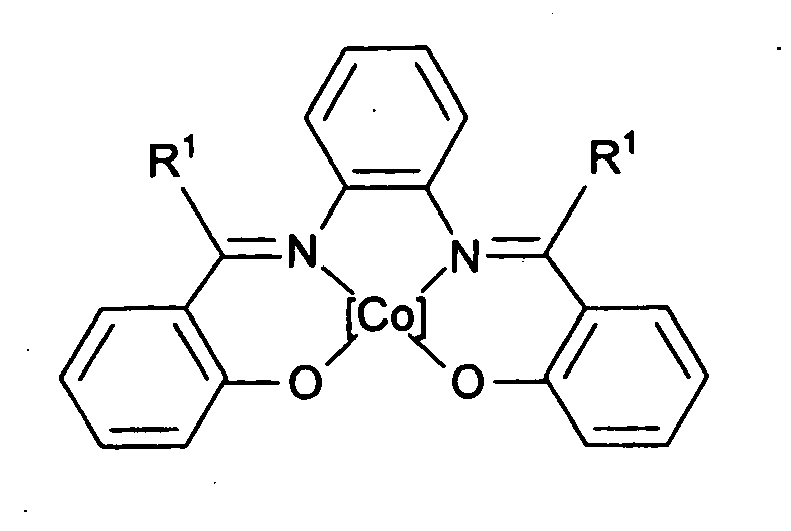
- Ihr gemeinsames Strukturelement sind zwei Salicyliden-amino-Baugruppen, verknüpft durch einen Diamino-spacer X. Diese Katalysatoren haben die folgende allgemeine Leitstruktur (Formelschema I):

- In diesen Formeln sind
R1 = Wasserstoff, ein Alkylrest mit 1 bis 20 Kohlenstoffatomen, eine Aryl- oder Heteroarylgruppe, eine OR-Gruppe, in der R für Wasserstoff oder eine Alkylgruppe mit 1 bis 20 Kohlenstoffatomen steht, oder NRR' bedeuten, in der R und R' für Wasserstoff oder je eine Aryl- oder Alkylgruppe mit 1 bis 20 C-Atomen bedeuten oder gemeinsam ein Ringsystem mit Stickstoffatom als Heteroatom bilden können;
R2 Wasserstoff, eine Alkylgruppe mit 1 bis 20 Kohlenstoffatomen, eine Arylgruppe - oder Heteroarylgruppe, die über eine oder zwei C-C-Bindungen annelliert mit dem Salicylat-Baustein verknüpft ist, eine Ketogruppe -COR oder - COOR, -COOH, Fluor, Chlor, Brom, Iod, OH, OR oder NRR', wobei R bzw. R' die vorgenannten Bedeutungen haben können und R2 1- bis 4-fach den aromatischen Ring substituieren kann;
R3 und/oder R4 können Wasserstoff, eine Alkylgruppe mit 1 bis 20 Kohlenstoffatomen, eine Aryl- oder Heteroarylgruppe, eine Ketogruppe -COR, -COOR, - COOH, Fluor, Chlor, Brom, Iod, OH, OR oder NRR', wobei R bzw. R' die vorgenannten Bedeutungen haben können;
L = H2O, RnNH3-n, Halogenid, Sulfonat (z.B. Triflat, Tosylat), Pseudohalogenid (z.B. CN, SCN, OCN, N3), ein Azaaromat, ein cyclisches oder acyclisches Amin bzw. Ketimin R2C=NR', ein aliphatischer Ether oder ein aliphatischer bzw. aromatischer Alkohol sein kann. R und R' repräsentieren hierbei eine Aryl- oder Alkylgruppe mit 1 bis 20 C-Atomen, eine -O-Alkyl, NH(Alkyl) oder -N(Alkyl)2 Gruppe. Sowohl Katalysatorkomplexe mit zweiwertigem Kobalt als auch solche mit dreiwertigem Kobalt sind katalytisch aktiv. Dieser Tatsache trägt die Formulierung [Co] Rechnung: Sind beispielsweise zwei Neutralliganden L zusätzlich zum N2O2 2- -Liganden an Kobalt [Co] koordiniert, so handelt es sich um einen neutralen Kobalt(II)- oder einen kationischen Kobalt(III)-Komplex mit nichtkoordinierendem Anion, sind ein Anion L und ein Neutralligand L' an [Co] koordiniert, so handelt es sich um einen Kobalt(III)-Neutralkomplex. Die Liganden L können in der als Substanz isolierten Katalysatorvorstufe auch fehlen. In Lösung sind L in der Regel Solvensmoleküle, sie sind in der Regel leicht durch die umgesetzten Substrate substituierbar. - X = eine beliebige Alkylen- oder Arylen-Baueinheit, die beide Imino-Stickstoffatome miteinander verknüpft.,Diese Einheit X kann über ihre zentralen Substituenten R3 bzw. R4 auch mit weiteren molekularen, makromolekularen oder anorganischen Bauelementen verknüpft sein.
- Besonders aktiv und selektiv und daher bevorzugt sind nicht allein die hochaktiven Katalysatorkomplexe vom Salen- und Salophen-Typ, sondern weitere Katalysatoren mit [M(O∼N∼N∼O)2-] Liganden, die in Tabelle 1 (vgl. Beispiele) aufgeführt sind. Die Zuordnung der in Tabelle 1 verwendeten Abkürzungen zu Strukturformeln ist im folgenden Schema der besonders bevorzugten Katalysatorkomplexe angegeben:

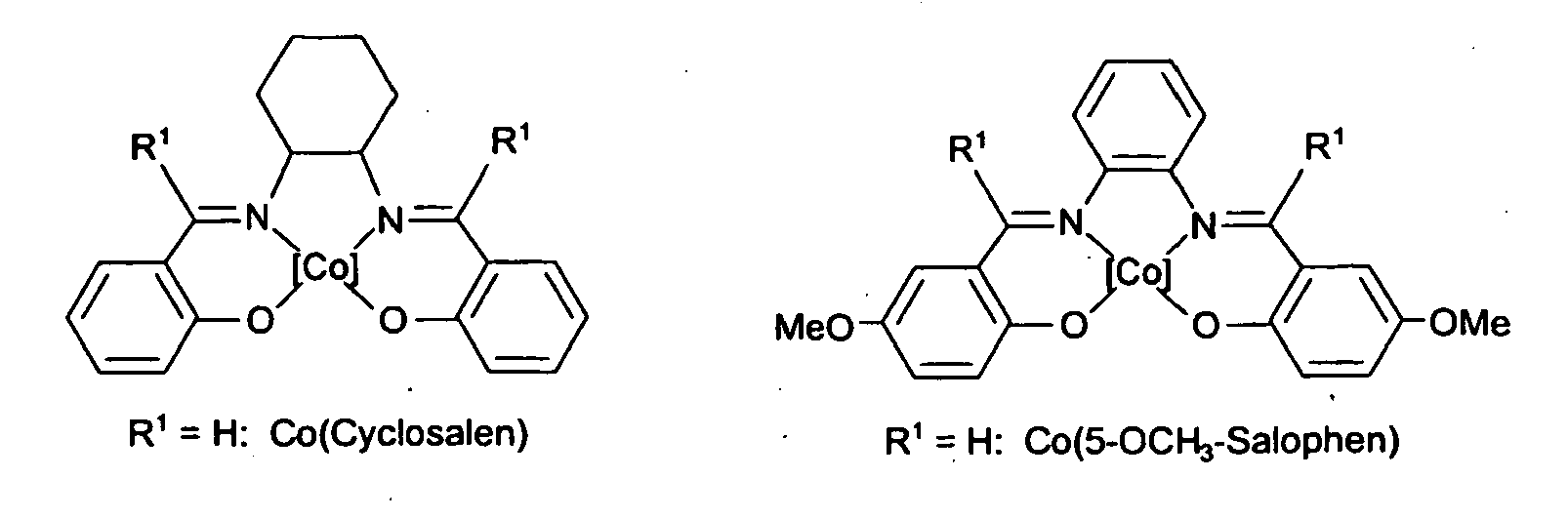

- Erfindungsgemäße Katalysatoren sind folglich auch Metall-Komplexverbindungen mit anderen dianionischen N2O2-Chelatliganden, die Carboxylat-, Azaaromat-, Phenolat- und / oder metallierte Carbonsäureamidfunktionen in sich vereinen. Geeignete Liganden mit besonders bevorzugten Strukturelementen sind als Kobaltkomplexe im folgenden Formelschema II und Formelschema III genauer beschrieben:


- In Formelschema III und IV gilt für die Substituenten:
- R1 und / oder R2 = Wasserstoff, ein Alkylrest mit 1 bis 20 Kohlenstoffatomen, eine Aryl- oder Heteroarylgruppe, eine OR-Gruppe, in der R für Wasserstoff,
- eine Arylgruppe oder eine Alkylgruppe mit 1 bis 20 Kohlenstoffatomen steht, oder NRR' bedeuten, in der R und / oder R' für Wasserstoff, eine Arylgruppe oder je eine Alkylgruppe mit 1 bis 20 C-Atomen bedeuten oder gemeinsam ein Ringsystem mit Stickstoffatom als Heteroatom bilden können;
- R3 Wasserstoff, eine Alkylgruppe mit 1 bis 20 Kohlenstoffatomen, eine Arylgruppe - oder Heteroarylgruppe, die über eine oder zwei C-C-Bindungen annelliert mit dem Salicylat-Baustein verknüpft ist, eine Ketogruppe -COR, COOR, COOH, Fluor, Chlor, Brom, Iod, OH, OR oder NRR', die die vorgenannten Bedeutungen haben können, wobei R3 1- bis 4-fach den aromatischen Ring substituieren kann;
- Mit diesen Katalysatoren lassen sich Umsätze und Selektivitäten von über 95%, d.h. Ausbeuten von über 90%, bezogen auf den eingesetzten Nitroaromaten oder bezogen auf ein Gemisch aus Nitroaromat und Anilin, erzielen.
Ar-NO2 + 3 CO + ROH - Cat. → Ar-NH-CO-OR + 2 CO2
- Die Umsetzung erfolgt in gleicher Weise auch mit Di- und Polynitroverbindungen. Es lässt sich auch das Methylcarbamat des TDI gewinnen, wie Beispiel 5 offenlegt.
- Das erfindungsgemäße Verfahren lässt sich mit besonders guten Ausbeuten und Erträgen durchführen, wenn das durch Reduktion der aromatischen Nitroverbindung entstehende Anilin in Mengen von bis zu 200 Mol-% eingesetzt wird. Durch Zusatz eines Anilins lassen sich erheblich bessere Ausbeuten erzielen, wenn das Verhältnis von Nitroaromat zu Anilin 100 : 10 Mol-% beträgt (Beispiele 1 und 2 sowie Tabelle 2). Die besten Ausbeuten wurden erzielt bei einem Verhältnis von Nitroaromat zu Anilin von 100 : 200 Mol-% (Beispiel 3). Die folgende Reaktionsgleichung beschreibt diesen vorteilhaften Grenzfall der umgesetzten Stoffe des erfindungsgemäßen Verfahrens:
ArNO2 + 2 Ar-NH2 + 3 CO + 3 ROH - Cat. → 3 Ar-NH-CO-OR + 2 H2O
- Die Umsetzung erfolgt in gleicher Weise auch mit Di- und Polynitroverbindungen. Bei den Varianten, in denen der Nitroaromat in Gegenwart von 1-2 Moläquivalenten Anilin reduktiv carbonyliert wird, hat es sich als vorteilhaft erwiesen, das bei der Reaktion gebildete Wasser durch chemische oder physikalische Methoden zu einem gewissen Anteil aus dem Reaktionsgemisch zu entfernen, denn Wasser kann unter ungünstigen Bedingungen die Hydrolyse des gebildeten Carbamats bewirken. Dennoch werden auch ohne die Entfernung von Wasser meist Selektivitäten größer als 90 Prozent problemlos erreicht (vergleiche Beispiel 5). Spuren an Wasser sind andererseits förderlich, denn Wasser und CO sind an der Reduktion von Nitroaromaten zu intermediär unter bestimmten Bedingungen auftretenden Anilinderivaten beteiligt.
- Besonders bevorzugt sind die erfindungsgemäßen Komplexverbindungen mit Kobalt als Zentralatom. Jedoch werden auch mit Mangan, Chrom, Nickel, Kupfer sowie einigen wenigen 4d-Metallen, wie Rhodium und Ruthenium und 5d-Metallen, wie Osmium und Platin gute Ergebnisse erzielt. Der Metallkomplexkatalysator wird in einer Konzentration von 0.05 bis 10 Mol-%, vorzugsweise 0.1 bis 3 Mol%, eingesetzt.
- Die Umsetzung kann gemäß einer bevorzugten Ausgestaltung in einem Autoklaven bei Temperaturen von etwa 80 - 260°C unter einem Kohlenmonoxiddruck von etwa 10 - 100 bar in einem aliphatischen oder aromatischen Alkohol durchgeführt werden.
- Vorzugsweise wird die Reaktion in einem Autoklaven bei Temperaturen von 80 bis 220°C unter einem Kohlenmonoxiddruck von 10 bis 100 bar in Gegenwart eines aliphatischen oder aromatischen Alkohols durchgeführt. Besonders bewährt hat sich Methanol.
- Besonders gute Ergebnisse werden in der in Gegenwart eines sauren Promotors erzielt. Dieser wird in unterschiedlichen Konzentrationen, vorzugsweise jedoch im äquimolaren Verhältnis relativ zum Katalysatorkomplex eingesetzt (vgl. Tabelle 3 in den Beispielen). Der saure Promotor ist entweder eine LewisSäure, etwa BF3 oder das Tosylat B(OTs)3, die in Verbindung mit Wasser oder der OH-enthaltenden organischen Komponente dieses Verfahrens eine Protonensäure liefert, oder der saure Promotor ist selbst eine Protonensäure. Besonders bevorzugt sind starke Protonensäuren mit einem pKs Wert kleiner als 5. Hierfür haben sich besonders Sulfonsäuren wie die p-Toluolsulfonsäure, Trifluormethyl- oder Nonafluor-n-butylsulfonsäure, Camphersulfonsäure, aber auch SO3H-Gruppe tragende Polymersäuren, beispielsweise saure lonenaustauscherharze auf Basis von sulfonierten Polystyrolen, aber auch anorganische Festkörper als Säuren wie etwa saure Alumosilikate (Zeolithe) bewährt. Andere Säure-Promotoren umfassen aliphatische und aromatische, molekulare und polymergebundene Carbonsäuren, beispeilsweise Trifluoressigsäure und höhere Homologe, p-Chlorbenzoesäure, Dicarbonsäuren, Schwefelsäurederivate, beispielsweise Fluorsulfonsäure, Phosphorsäure und ihre partiell veresterten aromatischen und aliphatischen Derivate, z.B. (RO)2PO(OH), aromatische und aliphatische Phosphonsäuren R-PO(OH)2 und Phosphinsäuren R2PO(OH). Schließlich finden rein anorganische Mineralsäuren, Tetrafluorborsäure und Hexafluorphorphorsäure als Promotoren Verwendung.
- Bei dem erfindungsgemäßen Verfahren können sich durch die reduktive Carbonylierung als Zwischenprodukte zunächst Anilinderivate bilden, weiterhin bei bewusst zugesetztem Anilin auch N,N'-Diarylharnstoffe (vgl. Beispiel 6) und N-Arylcarbamate (Urethane) bilden. Aus letzteren kann der Alkohol durch thermische Behandlung in einfacher Weise abgespalten werden. Somit ergibt sich folgende besonders vorteilhafte autokatalytische Reaktionssequenz, die durch Katalysatoren der hier beschriebenen Art in Gegenwart der Säure-Promotoren ermöglicht wird:
Ar-NO2 + 3 CO + H2O - Cat. → Ar-NH2 + 3 CO2
ArNO2 + 2 Ar-NH2 + 3 CO + 3 ROH - Cat. → 3 Ar-NH-CO-OR + 2 H2O
Ar-NH-CO-OR - Δ → Ar-NCO + ROH
- In gleicher Weise werden auch Di- und Polynitroverbindungen umgesetzt (vgl. Beispiel 5).
- Die thermolytische Spaltung isolierter Carbamate zu Isocyanaten und organischer Hydroxyverbindung ist eine bekannte Technik. Es ist aber auch möglich, die hier beschriebenen Reaktionen so durchzuführen, dass Anilinderivate und N-Arylcarbamate nur in Spuren gebildet und Arylisocyanate direkt unter den Reaktionsbedingungen bevorzugt als Endprodukt gebildet werden. Zu diesem Zweck werden die Reaktionen entweder homogen, vorzugsweise nicht in Alkoholen als Lösemittel, sondern in einem inerten Lösemittel, beispielsweise Chlorbenzol oder Toluol in Gegenwart geringer Mengen an Alkohol, durchgeführt. Auch hat sich zu diesem Zweck eine heterogene Trägerung der Katalysatorkomplexe und Promotoren auf anorganischen oder organischen Trägermaterialien, beispielsweise auf saurem Aluminiumoxid Al2O3, auf Silicagel, auf sulfoniertem Polystyrol, in alumosilikatischen Käfigstrukturen wie Zeolith Y oder mesoporösen Silica-Materialien wie MCM-41 oder MCM-48 bewährt (zum Begriff MCM: Zhao et al, Ind. Eng. Chem. Res. 35 (1996) 2075).
- Ausgangsstoff für das erfindungsgemäße Verfahren können sowohl Mononitroals auch Dinitro-Verbindungen sein. Beim Einsatz von Dinitro-Verbindungen entstehen zunächst Mono-, dann Di-N-Arylcarbamate, aus denen durch Thermolyse Di-N-Arylisocyanate gebildet werden können. Es ist aber auch möglich, die Reaktion so zu leiten, dass direkt Di-N-Arylisocyanate entstehen.
- Das erfindungsgemäße Verfahren wird durch die nachfolgenden Beispiele näher erläutert:
-

- Die vorstehend genannte Reaktion wurde in einem 100 cm3 Edelstahlautoklaven mit Polytetrafluorethylenbecher als Insert durchgeführt. In dem Autoklaven wurden 0,196 g (0,5 mmol) N,N'-Bis(salicyliden)-1,2-phenylen-diaminocobalt (II) monohydrat, 0,0870 g (0,5 mmol) p-Toluolsulfonsäure als Promotor oder Cokatalysator, 0,0548 g (0,59 mmol) Anilin, 0,6534 g (5,3 mmol) Nitrobenzol und 4,172 g (13,05 mmol) Methanol gemischt. Der Autoklav wurde dreimal mit Stickstoffgas gespült und dann bei Raumtemperatur Kohlenmonoxidgas unter einem Druck von 50 bar eingeleitet.
- Nachdem die Gaszufuhr des Autoklaven unterbrochen worden war, wurde der Autoklav in einen Aluminiumheizblock eingesetzt, der auf 200°C erhitzt war. Innerhalb von 5 Minuten erreichte der Autoklav eine Reaktionstemperatur von 170°C, die dann konstant gehalten wurde. Nach einer Reaktionsdauer von 7 Stunden wurde der Autoklav durch kaltes Wasser und Eis abgekühlt, bis er nach etwa 5 Minuten Raumtemperatur erreichte. Die Reaktionsmischung wurde dann qualitativ und quantitativ gaschromatographisch untersucht, wobei Naphthalin als interner Standard diente. Die Umwandlung von Nitrobenzol betrug 100%, die Ausbeute an Methyl-N-phenylcarbamat 99%.
-

- Die im Beispiel 1 genannte Reaktion wurde erneut in einem. Edelstahlautoklaven mit Polytetrafluorethylenbecher von 100 cm3 Fassungsvermögen durchgeführt. 0,324 g (1,0 mmol) N,N'-Bis(salicyliden)-ethylendiaminocobalt (II), 0,172 g (=1,0 mmol) p-Toluolsulfonsäure, 0,093 g (1,0 mmol) Anilin, 1,251 g (10,2 mmol) Nitrobenzol, 8,042 g (25,1 mmol) Methanol wurden in dem Autoklaven gemischt. Der Autoklav wurde dreimal mit Stickstoffgas gespült und dann bei Raumtemperatur Kohlenmonoxid unter einem Druck von 50 bar eingeleitet.
- Nachdem die Gaszufuhr des Autoklaven unterbrochen worden war, wurde er in einen Aluminiumheizblock eingesetzt, der auf 200°C vorgeheizt war. Nach 5 Minuten erreichte der Autoklav eine Reaktionstemperatur von 170°C, die dann konstant gehalten wurde. Nach einer Reaktionsdauer von 7 Stunden wurde der Autoklav mit kaltem Wasser und Eis gekühlt und erreichte nach 5 Minuten Raumtemperatur. Die Reaktionsmischung wurde dann qualitativ und quantitativ durch Gaschromatographie untersucht, wobei Naphthalin als interner Standard diente. Die Umwandlung von Nitrobenzol betrug 100%, die Ausbeute von Methyl-N-phenylcarbamat 99,0% und die Selektivität von Methyl-N-phenylcarbamat betrug ebenfalls 99%.
-

- Die vorstehend genannte Reaktion wurde in einem mit einem Edelstahlautoklaven mit Polytetrafluorethylenbecher von 100 cm3 Fassungsvermögen als Insert durchgeführt. 0,0866 g (0,22 mmol) N,N'-Bis(salicyliden)-1,2-phenylendiaminocobalt(II) monohydrat, 0,0341 g (0,2 mmol) p-Toluolsulfonsäure, 1,8650 g (20,05 mmol) Anilin, 1,2354 g (10,0 mmol) Nitrobenzol und 8,1370 g (254,3 mmol) Methanol wurden in dem Autoklaven gemischt. Der Autoklav wurde dann fünfmal mit Stickstoffgas gespült und bei Raumtemperatur mit Kohlenmonoxidgas unter einem Druck von 50 bar gefüllt.
- Nach Unterbrechung der Gaszufuhr wurde der Autoklav in einen Aluminiumheizblock eingesetzt, der auf 200°C vorgeheizt war. Innerhalb von 5 Minuten erreichte der Autoklav eine Reaktionstemperatur von 170°C, die dann konstant gehalten wurde. Nach einer Reaktionsdauer von 7 Stunden wurde der Autoklav mit kaltem Wasser und Eis gekühlt und erreichte Raumtemperatur nach etwa 5 Minuten. Die Reaktionsmischung wurde qualitativ und quantitativ gaschromatographisch untersucht, wobei Naphthalin als interner Standard diente. Die Umwandlung von Nitrobenzol betrug 100%, die Ausbeute von Methyl-N-phenylcarbamat 97,6%, während die Selektivität von Methyl-N-phenylcarbamat ebenfalls 97,6% betrug.
-

- Die vorstehend genannte Reaktion wurde in einem 100 cm3 Edelstahlautoklaven mit Polytetrafluorethylenbecher als Insert durchgeführt. 0.0993 g (0,25 mmol) N,N'-Bis(salicyliden)-1,2-phenylendiaminocobalt(II)-monohydrat, 0,0440 g (0,26mmol) p-Toluolsulfonsäure, 0,6340 g (5,15 mmol) Nitrobenzol, 4,3840 g (13,7 mmol) Methanol wurden in dem Autoklaven gemischt. Es wurde kein Anilin zugegeben. Der Autoklav wurde fünfmal mit Stickstoff gespült und dann bei Raumtemperatur Kohlenmonoxidgas unter einen Druck von 50 bar eingeleitet.
- Nachdem die Gaszufuhr des Autoklaven unterbrochen worden war, wurde er in einen Aluminiumheizblock eingesetzt, der auf 200°C vorgeheizt war. Innerhalb von 5 Minuten erreichte der Autoklav eine Reaktionstemperatur von 170°C, die dann konstant gehalten wurde. Nach einer Reaktionsdauer von 7 Stunden wurde der Autoklav durch kaltes Wasser und Eis gekühlt und erreichte nach 5 Minuten Raumtemperatur. Die Reaktionsmischung wurde dann qualitativ und quantitativ gaschromatographisch untersucht, wobei Naphthalin als interner Standard diente. Die Umwandlung von Nitrobenzol betrug 48,3%, die Ausbeute an Methyl-N-phenyl-carbamat betrug 41,8%, die Selektivität von Methyl-N-phenyl-carbamat 86,5%.
- Weitere Beispiele zur Aktivität ausgewählter Katalysatorkomplexe, zum Effekt des zugefügten Anilins und zum Einfluss des Säurepromotors sind in Tabelle 1-3 zusammengefasst.
- einheitliche Bedingungen, einzige Variable ist der Katalysator
nKat/nPhNO2 = 1/200
nKat/nPromotor = 1/1
nPhNH2/nPhNO2 = 2/1
nMeOH/nPnNO2 = 25/1
Promotor = p-TsOH
Temperatur = 170°C
Reaktionsdauer = 7 h
CO-Druck = 50 bar
Die Durchführung erfolgt, abgesehen von eingewogenen Mengen wie in Patentbeispiel 3 beschrieben. Die hier verwendeten Abkürzungen sind im Textteil erläutert.Eintrag Katalysator Umsatz von PhNO2+PhNH2 [%] PhNHCOOCH3 Ausbeute (bezogen auf PhNO2+PhNH2) [%] PhNHCOOCH3 Selektivität (bezogen auf PhNO2+PhNH2) [%] 1 [CoSalophen·H2O] 49.7 51.7 100 2 [CoSalophen] 42.1 46.9 100 3 [CoSalen] 33.6 30.7 91.4 4 [Co-α-CH3-Salen] 61.5 51.2 83.3 5 [Co-α-Ph-Salen] 54.0 42.7 79.1 6 [CoCyclosalen] 46.0 42.5 92.4 7 [Co-5-OCH3-salophen] 39.4 31.4 79.7 8 [CoBpphen][a] 100 66.0 66.0 9 [CoBibhg]a 78.0 66.0 84.0 [a] nKat/nPhNO2 = 1/50 - einheitliche Reaktionsbedingungen, einzige Variable ist das Anilin zu Nitrobenzol Verhältnis
Katalysator: [Co"Salophen]
nKat/nPhNO2 = 1/200
nKat/nPromotor = 1/1
nMeOH/nPhNO2 = 25/1
Promotor = p-TsOH
Temperatur = 170°C
Reaktionsdauer = 7 h
CO-Druck = 50 barEintrag nPhNH2/nPhNO2 Umsatz von PhNO2+PhNH2 [%] PhNHCOOCH3 Ausbeute (bezogen auf PhNO2+PhNH2) [%] PhNHCOOCH3 Selektivität (bezogen auf PhNO2+PhNH2) [%] 1 0 5.0 1.8 36.0 2 0.5 32.8 33.3 100 3 1 49.3 49.0 99.4 4 1.5 56.6 47.9 84.6 5 2 54.4 51.5 94.7 6 3 57.5 51.9 90.3 7 5 42.7 33.6 78.7 - Reaktionsbedingungen einheitlich, Promotor äquimolar zu Katalysator einzige Variable
Katalysator: [Co"Salophen]
TKat/nPhNO2 = 1/200
nKat/nPromotor = 1/1
nPhNH2/nPhNO2 = 2/1
nMeOH/nPhNO2 = 25/1
Temperatur = 170°C
Reaktionsdauer = 7 h
CO-Druck = 50 barEintrag Promotor Umsatz von PhNO2+PhNH2 [%] PhNHCOOCH3 Ausbeute (bezogen auf PhNO2+PhNH2) [%] PhNHCOOCH3 Selektivität (bezogen auf PhNO2+PhNH2) [%] 1 ohne Promotor 15.5 8.7 56.1 2 p-CH3-C6H5-SO3H 47.5 46.9 98.7 3 C4F9SO3H 77.3 74.1 95.9 4 CF3COOH 56.3 51.2 90.9 5 CF3SO3H 81.6 80.1 98.2 6 Amberlite IR-120 (feucht) 1:1 30.8 21.8 70.8 7 Amberlite (IR-120 (wasserfrei) 1:1 25.6 23.1 90.2 -

- Die Reaktion wurde in einem Edelstahlautoklaven mit Polytetrafluorethylenbecher (100 cm3 Fassungsvermögen) durchgeführt. Es wurden 0,0186 g (0,05 mmol) N,N'-bis(salicyliden)-1,2-phenylendiaminocobalt(II), 0,0086g (0,05 mmol) p-Toluolsulfonsäure, 0,6103 (5,0 mmol) 2,4-Diaminoanilin, 0,4550g (2,5 mmol) 2,4-Dinitrotoluol, 5,07 g (15,8 mmol) Methanol in dem Autoklaven gemischt. Der Autoklav wurde dreimal mit Stickstoffgas gespült, dann wurden 50 bar Kohlenmonoxid aufgedrückt. Nachdem Unterbrechung der Gaszufuhr wurde der Autoklav in einen Aluminiumheizblock eingesetzt, der auf 200°C vorgeheizt war. Nach 5 Minuten erreichte der Autoklav eine Reaktionstemperatur von 170°C, die dann konstant gehalten wurde. Nach einer Reaktionsdauer von 6 Stunden wurde der Autoklav mit kaltem Wasser und Eis gekühlt und erreichte nach 5 Minuten Raumtemperatur. Die Reaktionsmischung wurde abfiltriert und der erhaltene Feststoff drei Mal mit kaltem Methanol gewaschen. Anschließend wurde der Feststoff 5 Stunden lang im Hochvakuum getrocknet. Die Charakterisierung erfolgte per 1H-NMR, MS, CHN-Analyse und Schmelzpunkt. Es wurden 1,6520 g TDI-Methylcarbamat isoliert, was einer Ausbeute von 92,6 % entspricht.
-

- Die obenstehende Reaktion wurde in einem Edelstahlautoklaven mit Polytetrafluorethylenbecher (100 cm3 Fassungsvermögen) durchgeführt. Es wurden 0.0373 g (0,1 mmol) N,N'-bis(salicyliden)-1,2-phenylendiaminocobalt(II), 0,0172 g (0,1 mmol) p-Toluolsulfonsäure, 4,6498 g (50,0 mmol) Anilin, 1.2318 g (10,0 mmol) Nitrobenzol und 8,69 g (10 mmol) Toluol in dem Autoklaven gemischt. Der Autoklav wurde dreimal mit Stickstoffgas gespült, dann wurden 50 bar Kohlenmonoxid aufgedrückt. Nachdem Unterbrechung der Gaszufuhr wurde der Autoklav in einen Aluminiumheizblock eingesetzt, der auf 200°C vorgeheizt war. Nach 5 Minuten erreichte der Autoklav eine Reaktionstemperatur von 170°C, die dann konstant gehalten wurde. Nach einer Reaktionsdauer von 6 Stunden wurde der Autoklav mit kaltem Wasser und Eis gekühlt und erreichte nach 5 Minuten Raumtemperatur. Die Reaktionsmischung wurde abfiltriert und der erhaltene Feststoff mit Toluol (3 x 10 ml) gewaschen. Anschließend wurde der Feststoff 4 Stunden lang im Hochvakuum getrocknet. Die Charakterisierung erfolgte per 1H-NMR, MS, CHN-Analyse und Schmelzpunkt. Es wurden in diesem noch nicht optimierten Versuch 3,0414 g N,N'-Diphenylharnstoff isoliert, was einer Ausbeute von 23,9 % entspricht.
Claims (9)
- Verfahren zur Herstellung von N-Arylcarbamaten (Urethanen) und/oder N-Arylisocyanaten durch reduktive Carbonylierung von aromatischen Nitroverbindungen in Gegenwart von Kohlenmonoxid und organischen, Hydroxylgruppen tragenden Verbindungen, dadurch gekennzeichnet, dass die Carbonylierung- in Anwesenheit eines Kobalt-Komplexkatalysators, der anionische N,O-Chelatliganden des allgemeinen Typs [M(N∼O)1- 2] oder [M(O∼N∼N∼O)2] enthält und- in Gegenwart von bis zu 2 Moläquivalenten eines aromatischen Amins im Verhältnis zur eingesetzten aromatischen Nitroverbindung
durchgeführt wird. - Verfahren nach den Anspruch 1, dadurch gekennzeichnet, dass der Kobalt-Komplexkatalysator in einer Konzentration von 0.1 - 10 mol% eingesetzt wird.
- Verfahren nach den Ansprüchen 1 und 2, dadurch gekennzeichnet, dass die Umsetzung in einem Autoklaven bei Temperaturen von 80 - 220°C unter einem Kohlenmonoxiddruck von 10 - 100 bar in Gegenwart eines aliphatischen oder aromatischen Alkohols durchgeführt wird.
- Verfahren nach Anspruch 3, dadurch gekennzeichnet, dass die Umsetzung in Methanol durchgeführt wird.
- Verfahren nach den Ansprüchen 1 bis 4, dadurch gekennzeichnet, dass die Umsetzung in Gegenwart eines sauren Promotors durchgeführt wird, der einen pKs-Wert unter 5 aufweist.
- Verfahren nach den Ansprüchen 1 bis 5, dadurch gekennzeichnet, dass die Umsetzung in Gegenwart von p-Toluolsufonsäure oder einer SO3H-Gruppen tragenden, polymeren Säure durchgeführt wird.
- Verfahren nach den Ansprüchen 1 bis 6, dadurch gekennzeichnet, dass die N-Arylisocyanate aus den zunächst entstehenden N-Arylcarbamaten (Urethanen) durch Abspaltung von Alkohol gebildet werden.
- Verfahren nach den Ansprüchen 1 bis 7, dadurch gekennzeichnet, dass die Umsetzung in einem einstufigen Verfahren direkt zu N-Arylisocyanaten führt, wobei die Reaktionen mit einer heterogenen Trägerung der Katalysatorkomplexe und Promotoren auf anorganischen oder organischen Trägermaterialien durchgeführt werden.
- Verfahren nach den Ansprüchen 1 bis 8, dadurch gekennzeichnet, dass aromatische Dinitroverbindungen in die entsprechenden Di-N-Arylcarbamate und/oder Di-N-Arylisocyanate umgesetzt werden
Applications Claiming Priority (2)
| Application Number | Priority Date | Filing Date | Title |
|---|---|---|---|
| DE102005026500A DE102005026500B4 (de) | 2005-06-09 | 2005-06-09 | Herstellung von N-Arylcarbamaten und N-Arylisocyanaten |
| PCT/EP2006/005516 WO2006131381A1 (de) | 2005-06-09 | 2006-06-09 | Herstellung von n-arylcarbamaten und n-arylisocyanaten |
Publications (2)
| Publication Number | Publication Date |
|---|---|
| EP1893563A1 EP1893563A1 (de) | 2008-03-05 |
| EP1893563B1 true EP1893563B1 (de) | 2011-06-08 |
Family
ID=37056561
Family Applications (1)
| Application Number | Title | Priority Date | Filing Date |
|---|---|---|---|
| EP06743137A Not-in-force EP1893563B1 (de) | 2005-06-09 | 2006-06-09 | Herstellung von n-arylcarbamaten und n-arylisocyanaten |
Country Status (5)
| Country | Link |
|---|---|
| US (1) | US8076500B2 (de) |
| EP (1) | EP1893563B1 (de) |
| AT (1) | ATE512129T1 (de) |
| DE (1) | DE102005026500B4 (de) |
| WO (1) | WO2006131381A1 (de) |
Families Citing this family (5)
| Publication number | Priority date | Publication date | Assignee | Title |
|---|---|---|---|---|
| DE102008006881A1 (de) | 2008-01-31 | 2009-08-06 | Bayer Materialscience Ag | Verfahren zur Herstellung von Urethanen |
| US8835673B2 (en) | 2009-12-04 | 2014-09-16 | Basf Se | Process for preparing isocyanates |
| PT2603319E (pt) | 2010-08-12 | 2014-12-19 | Bayer Ip Gmbh | Processo para a preparação de uretanos |
| JP5938820B2 (ja) * | 2011-01-31 | 2016-06-22 | 国立大学法人 東京大学 | 蓄熱材及びそれを利用した熱利用システム |
| US9409125B2 (en) * | 2013-03-29 | 2016-08-09 | The University Of Kentucky Research Foundation | Method of increasing mass transfer rate of acid gas scrubbing solvents |
Family Cites Families (4)
| Publication number | Priority date | Publication date | Assignee | Title |
|---|---|---|---|---|
| GB1129551A (en) * | 1965-03-18 | 1968-10-09 | Ici Ltd | Process for the manufacture of urethanes |
| US3481967A (en) * | 1966-04-01 | 1969-12-02 | Olin Mathieson | Process for preparing aromatic isocyanates |
| US4705883A (en) * | 1983-09-16 | 1987-11-10 | Catalytica Associates | Carbonylation process |
| DE60208063T2 (de) * | 2001-10-24 | 2006-08-17 | Michael Warrington Burton | Chromogenischen enzymsubstraten und verfahren zum nachweis von beta-d-ribofuranosidase-wirksamkeit |
-
2005
- 2005-06-09 DE DE102005026500A patent/DE102005026500B4/de not_active Expired - Fee Related
-
2006
- 2006-06-09 EP EP06743137A patent/EP1893563B1/de not_active Not-in-force
- 2006-06-09 AT AT06743137T patent/ATE512129T1/de active
- 2006-06-09 US US11/921,972 patent/US8076500B2/en not_active Expired - Fee Related
- 2006-06-09 WO PCT/EP2006/005516 patent/WO2006131381A1/de not_active Ceased
Also Published As
| Publication number | Publication date |
|---|---|
| WO2006131381A1 (de) | 2006-12-14 |
| US20100217029A1 (en) | 2010-08-26 |
| ATE512129T1 (de) | 2011-06-15 |
| EP1893563A1 (de) | 2008-03-05 |
| DE102005026500A1 (de) | 2007-03-29 |
| DE102005026500B4 (de) | 2008-05-15 |
| US8076500B2 (en) | 2011-12-13 |
Similar Documents
| Publication | Publication Date | Title |
|---|---|---|
| DE2118369A1 (de) | Selektive Hydrierung von Nitroaromaten | |
| DE2623694C2 (de) | Verfahren zur Herstellung von aromatischen Urethanen | |
| DE112009000076B4 (de) | Verfahren zur Herstellung von Urethanen | |
| EP0003989B1 (de) | Verfahren zur Herstellung von Urethanen | |
| DE102005026500B4 (de) | Herstellung von N-Arylcarbamaten und N-Arylisocyanaten | |
| EP1690851B1 (de) | Verfahren zur Herstellung von Di-und Polyaminen der Diphenylmethanreihe | |
| EP0018583B1 (de) | Verfahren zur Herstellung von Aryl-mono-,-di- und/oder-polyurethanen | |
| EP2603319B1 (de) | Verfahren zur herstellung von urethanen | |
| DE2927714C2 (de) | ||
| DE2555557A1 (de) | Verfahren zur herstellung eines aromatischen carbaminsaeurealkylesters | |
| KR101726316B1 (ko) | 알칼리금속-아졸라이드 촉매 및 이를 이용한 치환 우레아의 제조방법 | |
| DE3046982A1 (de) | Verfahren zur herstellung von urethanen | |
| DE60115403T2 (de) | Kontinuierliches verfahren zur herstellung von aromatischen urethanen | |
| EP0003988B1 (de) | Verfahren zur Herstellung von Urethanen | |
| EP0016949A1 (de) | Verfahren zur Herstellung von Urethanen | |
| DE3874288T2 (de) | Verfahren zur produktion von urethanen und carbonsaeureestern. | |
| EP0282069B1 (de) | Bicyclische Aminkatalysatoren | |
| DE19804556B4 (de) | Verbessertes Verfahren zur Herstellung von p-Aminophenolen | |
| DE1907595C3 (de) | Verfahren zur Herstellung von aromatischen Isocyanaten | |
| DE2453367C3 (de) | Verfahren zur Herstellung von aromatischen oder aromatisch-aliphatisch substituierten Harnstoffen | |
| DE60013903T2 (de) | Verfahren für die synthese von polycarbamaten | |
| DE3318534C2 (de) | ||
| DE2803432A1 (de) | Verfahren zur herstellung eines aromatischen urethans | |
| AT369729B (de) | Verfahren zur herstellung von isocyansaeureestern | |
| DE102024208832A1 (de) | Verfahren zur Synthese von Acridin-9(10H)-on-Derivaten |
Legal Events
| Date | Code | Title | Description |
|---|---|---|---|
| PUAI | Public reference made under article 153(3) epc to a published international application that has entered the european phase |
Free format text: ORIGINAL CODE: 0009012 |
|
| 17P | Request for examination filed |
Effective date: 20071204 |
|
| AK | Designated contracting states |
Kind code of ref document: A1 Designated state(s): AT BE BG CH CY CZ DE DK EE ES FI FR GB GR HU IE IS IT LI LT LU LV MC NL PL PT RO SE SI SK TR |
|
| DAX | Request for extension of the european patent (deleted) | ||
| RIN1 | Information on inventor provided before grant (corrected) |
Inventor name: MEI, FUMING Inventor name: SUNDERMEYER, JOERG |
|
| DAX | Request for extension of the european patent (deleted) | ||
| 17Q | First examination report despatched |
Effective date: 20090429 |
|
| GRAP | Despatch of communication of intention to grant a patent |
Free format text: ORIGINAL CODE: EPIDOSNIGR1 |
|
| GRAS | Grant fee paid |
Free format text: ORIGINAL CODE: EPIDOSNIGR3 |
|
| GRAA | (expected) grant |
Free format text: ORIGINAL CODE: 0009210 |
|
| AK | Designated contracting states |
Kind code of ref document: B1 Designated state(s): AT BE BG CH CY CZ DE DK EE ES FI FR GB GR HU IE IS IT LI LT LU LV MC NL PL PT RO SE SI SK TR |
|
| REG | Reference to a national code |
Ref country code: GB Ref legal event code: FG4D Free format text: NOT ENGLISH |
|
| REG | Reference to a national code |
Ref country code: CH Ref legal event code: EP |
|
| REG | Reference to a national code |
Ref country code: IE Ref legal event code: FG4D Free format text: LANGUAGE OF EP DOCUMENT: GERMAN |
|
| REG | Reference to a national code |
Ref country code: DE Ref legal event code: R096 Ref document number: 502006009626 Country of ref document: DE Effective date: 20110721 |
|
| REG | Reference to a national code |
Ref country code: NL Ref legal event code: VDEP Effective date: 20110608 |
|
| PG25 | Lapsed in a contracting state [announced via postgrant information from national office to epo] |
Ref country code: SE Free format text: LAPSE BECAUSE OF FAILURE TO SUBMIT A TRANSLATION OF THE DESCRIPTION OR TO PAY THE FEE WITHIN THE PRESCRIBED TIME-LIMIT Effective date: 20110608 Ref country code: LT Free format text: LAPSE BECAUSE OF FAILURE TO SUBMIT A TRANSLATION OF THE DESCRIPTION OR TO PAY THE FEE WITHIN THE PRESCRIBED TIME-LIMIT Effective date: 20110608 |
|
| PG25 | Lapsed in a contracting state [announced via postgrant information from national office to epo] |
Ref country code: LV Free format text: LAPSE BECAUSE OF FAILURE TO SUBMIT A TRANSLATION OF THE DESCRIPTION OR TO PAY THE FEE WITHIN THE PRESCRIBED TIME-LIMIT Effective date: 20110608 Ref country code: GR Free format text: LAPSE BECAUSE OF FAILURE TO SUBMIT A TRANSLATION OF THE DESCRIPTION OR TO PAY THE FEE WITHIN THE PRESCRIBED TIME-LIMIT Effective date: 20110909 Ref country code: ES Free format text: LAPSE BECAUSE OF FAILURE TO SUBMIT A TRANSLATION OF THE DESCRIPTION OR TO PAY THE FEE WITHIN THE PRESCRIBED TIME-LIMIT Effective date: 20110919 Ref country code: SI Free format text: LAPSE BECAUSE OF FAILURE TO SUBMIT A TRANSLATION OF THE DESCRIPTION OR TO PAY THE FEE WITHIN THE PRESCRIBED TIME-LIMIT Effective date: 20110608 Ref country code: FI Free format text: LAPSE BECAUSE OF FAILURE TO SUBMIT A TRANSLATION OF THE DESCRIPTION OR TO PAY THE FEE WITHIN THE PRESCRIBED TIME-LIMIT Effective date: 20110608 Ref country code: CY Free format text: LAPSE BECAUSE OF FAILURE TO SUBMIT A TRANSLATION OF THE DESCRIPTION OR TO PAY THE FEE WITHIN THE PRESCRIBED TIME-LIMIT Effective date: 20110608 |
|
| PG25 | Lapsed in a contracting state [announced via postgrant information from national office to epo] |
Ref country code: NL Free format text: LAPSE BECAUSE OF FAILURE TO SUBMIT A TRANSLATION OF THE DESCRIPTION OR TO PAY THE FEE WITHIN THE PRESCRIBED TIME-LIMIT Effective date: 20110608 |
|
| BERE | Be: lapsed |
Owner name: PHILIPPS-UNIVERSITAT MARBURG Effective date: 20110630 |
|
| REG | Reference to a national code |
Ref country code: IE Ref legal event code: FD4D |
|
| PG25 | Lapsed in a contracting state [announced via postgrant information from national office to epo] |
Ref country code: CZ Free format text: LAPSE BECAUSE OF FAILURE TO SUBMIT A TRANSLATION OF THE DESCRIPTION OR TO PAY THE FEE WITHIN THE PRESCRIBED TIME-LIMIT Effective date: 20110608 Ref country code: PT Free format text: LAPSE BECAUSE OF FAILURE TO SUBMIT A TRANSLATION OF THE DESCRIPTION OR TO PAY THE FEE WITHIN THE PRESCRIBED TIME-LIMIT Effective date: 20111010 Ref country code: IS Free format text: LAPSE BECAUSE OF FAILURE TO SUBMIT A TRANSLATION OF THE DESCRIPTION OR TO PAY THE FEE WITHIN THE PRESCRIBED TIME-LIMIT Effective date: 20111008 Ref country code: IE Free format text: LAPSE BECAUSE OF FAILURE TO SUBMIT A TRANSLATION OF THE DESCRIPTION OR TO PAY THE FEE WITHIN THE PRESCRIBED TIME-LIMIT Effective date: 20110608 Ref country code: EE Free format text: LAPSE BECAUSE OF FAILURE TO SUBMIT A TRANSLATION OF THE DESCRIPTION OR TO PAY THE FEE WITHIN THE PRESCRIBED TIME-LIMIT Effective date: 20110608 |
|
| REG | Reference to a national code |
Ref country code: CH Ref legal event code: PL |
|
| PG25 | Lapsed in a contracting state [announced via postgrant information from national office to epo] |
Ref country code: PL Free format text: LAPSE BECAUSE OF FAILURE TO SUBMIT A TRANSLATION OF THE DESCRIPTION OR TO PAY THE FEE WITHIN THE PRESCRIBED TIME-LIMIT Effective date: 20110608 Ref country code: SK Free format text: LAPSE BECAUSE OF FAILURE TO SUBMIT A TRANSLATION OF THE DESCRIPTION OR TO PAY THE FEE WITHIN THE PRESCRIBED TIME-LIMIT Effective date: 20110608 Ref country code: RO Free format text: LAPSE BECAUSE OF FAILURE TO SUBMIT A TRANSLATION OF THE DESCRIPTION OR TO PAY THE FEE WITHIN THE PRESCRIBED TIME-LIMIT Effective date: 20110608 |
|
| PG25 | Lapsed in a contracting state [announced via postgrant information from national office to epo] |
Ref country code: BE Free format text: LAPSE BECAUSE OF NON-PAYMENT OF DUE FEES Effective date: 20110630 |
|
| PLBE | No opposition filed within time limit |
Free format text: ORIGINAL CODE: 0009261 |
|
| STAA | Information on the status of an ep patent application or granted ep patent |
Free format text: STATUS: NO OPPOSITION FILED WITHIN TIME LIMIT |
|
| PG25 | Lapsed in a contracting state [announced via postgrant information from national office to epo] |
Ref country code: CH Free format text: LAPSE BECAUSE OF NON-PAYMENT OF DUE FEES Effective date: 20110630 Ref country code: LI Free format text: LAPSE BECAUSE OF NON-PAYMENT OF DUE FEES Effective date: 20110630 |
|
| 26N | No opposition filed |
Effective date: 20120309 |
|
| PG25 | Lapsed in a contracting state [announced via postgrant information from national office to epo] |
Ref country code: IT Free format text: LAPSE BECAUSE OF FAILURE TO SUBMIT A TRANSLATION OF THE DESCRIPTION OR TO PAY THE FEE WITHIN THE PRESCRIBED TIME-LIMIT Effective date: 20110608 |
|
| PG25 | Lapsed in a contracting state [announced via postgrant information from national office to epo] |
Ref country code: DK Free format text: LAPSE BECAUSE OF FAILURE TO SUBMIT A TRANSLATION OF THE DESCRIPTION OR TO PAY THE FEE WITHIN THE PRESCRIBED TIME-LIMIT Effective date: 20110608 |
|
| REG | Reference to a national code |
Ref country code: DE Ref legal event code: R097 Ref document number: 502006009626 Country of ref document: DE Effective date: 20120309 |
|
| REG | Reference to a national code |
Ref country code: AT Ref legal event code: MM01 Ref document number: 512129 Country of ref document: AT Kind code of ref document: T Effective date: 20110609 |
|
| PG25 | Lapsed in a contracting state [announced via postgrant information from national office to epo] |
Ref country code: AT Free format text: LAPSE BECAUSE OF NON-PAYMENT OF DUE FEES Effective date: 20110609 |
|
| PG25 | Lapsed in a contracting state [announced via postgrant information from national office to epo] |
Ref country code: MC Free format text: LAPSE BECAUSE OF NON-PAYMENT OF DUE FEES Effective date: 20110630 |
|
| PG25 | Lapsed in a contracting state [announced via postgrant information from national office to epo] |
Ref country code: LU Free format text: LAPSE BECAUSE OF NON-PAYMENT OF DUE FEES Effective date: 20110609 |
|
| PG25 | Lapsed in a contracting state [announced via postgrant information from national office to epo] |
Ref country code: BG Free format text: LAPSE BECAUSE OF FAILURE TO SUBMIT A TRANSLATION OF THE DESCRIPTION OR TO PAY THE FEE WITHIN THE PRESCRIBED TIME-LIMIT Effective date: 20110908 |
|
| PG25 | Lapsed in a contracting state [announced via postgrant information from national office to epo] |
Ref country code: TR Free format text: LAPSE BECAUSE OF FAILURE TO SUBMIT A TRANSLATION OF THE DESCRIPTION OR TO PAY THE FEE WITHIN THE PRESCRIBED TIME-LIMIT Effective date: 20110608 |
|
| PG25 | Lapsed in a contracting state [announced via postgrant information from national office to epo] |
Ref country code: HU Free format text: LAPSE BECAUSE OF FAILURE TO SUBMIT A TRANSLATION OF THE DESCRIPTION OR TO PAY THE FEE WITHIN THE PRESCRIBED TIME-LIMIT Effective date: 20110608 |
|
| PGFP | Annual fee paid to national office [announced via postgrant information from national office to epo] |
Ref country code: GB Payment date: 20140618 Year of fee payment: 9 |
|
| PGFP | Annual fee paid to national office [announced via postgrant information from national office to epo] |
Ref country code: DE Payment date: 20140630 Year of fee payment: 9 |
|
| PGFP | Annual fee paid to national office [announced via postgrant information from national office to epo] |
Ref country code: FR Payment date: 20140619 Year of fee payment: 9 |
|
| REG | Reference to a national code |
Ref country code: DE Ref legal event code: R119 Ref document number: 502006009626 Country of ref document: DE |
|
| GBPC | Gb: european patent ceased through non-payment of renewal fee |
Effective date: 20150609 |
|
| REG | Reference to a national code |
Ref country code: FR Ref legal event code: ST Effective date: 20160229 |
|
| PG25 | Lapsed in a contracting state [announced via postgrant information from national office to epo] |
Ref country code: GB Free format text: LAPSE BECAUSE OF NON-PAYMENT OF DUE FEES Effective date: 20150609 Ref country code: DE Free format text: LAPSE BECAUSE OF NON-PAYMENT OF DUE FEES Effective date: 20160101 |
|
| PG25 | Lapsed in a contracting state [announced via postgrant information from national office to epo] |
Ref country code: FR Free format text: LAPSE BECAUSE OF NON-PAYMENT OF DUE FEES Effective date: 20150630 |