EP1894714B1 - Papier composite ainsi que sac pour aliments, en particulier pour produits précuits, contenant la papier composite, et un procédé de fabrication du sac - Google Patents
Papier composite ainsi que sac pour aliments, en particulier pour produits précuits, contenant la papier composite, et un procédé de fabrication du sac Download PDFInfo
- Publication number
- EP1894714B1 EP1894714B1 EP20070016972 EP07016972A EP1894714B1 EP 1894714 B1 EP1894714 B1 EP 1894714B1 EP 20070016972 EP20070016972 EP 20070016972 EP 07016972 A EP07016972 A EP 07016972A EP 1894714 B1 EP1894714 B1 EP 1894714B1
- Authority
- EP
- European Patent Office
- Prior art keywords
- plastic film
- paper
- bag
- composite paper
- layer
- Prior art date
- Legal status (The legal status is an assumption and is not a legal conclusion. Google has not performed a legal analysis and makes no representation as to the accuracy of the status listed.)
- Active
Links
Images


Classifications
-
- B—PERFORMING OPERATIONS; TRANSPORTING
- B65—CONVEYING; PACKING; STORING; HANDLING THIN OR FILAMENTARY MATERIAL
- B65D—CONTAINERS FOR STORAGE OR TRANSPORT OF ARTICLES OR MATERIALS, e.g. BAGS, BARRELS, BOTTLES, BOXES, CANS, CARTONS, CRATES, DRUMS, JARS, TANKS, HOPPERS, FORWARDING CONTAINERS; ACCESSORIES, CLOSURES, OR FITTINGS THEREFOR; PACKAGING ELEMENTS; PACKAGES
- B65D31/00—Bags or like containers made of paper and having structural provision for thickness of contents
- B65D31/02—Bags or like containers made of paper and having structural provision for thickness of contents with laminated walls
-
- B—PERFORMING OPERATIONS; TRANSPORTING
- B32—LAYERED PRODUCTS
- B32B—LAYERED PRODUCTS, i.e. PRODUCTS BUILT-UP OF STRATA OF FLAT OR NON-FLAT, e.g. CELLULAR OR HONEYCOMB, FORM
- B32B27/00—Layered products comprising a layer of synthetic resin
- B32B27/06—Layered products comprising a layer of synthetic resin as the main or only constituent of a layer, which is next to another layer of the same or of a different material
- B32B27/10—Layered products comprising a layer of synthetic resin as the main or only constituent of a layer, which is next to another layer of the same or of a different material of paper or cardboard
-
- B—PERFORMING OPERATIONS; TRANSPORTING
- B65—CONVEYING; PACKING; STORING; HANDLING THIN OR FILAMENTARY MATERIAL
- B65D—CONTAINERS FOR STORAGE OR TRANSPORT OF ARTICLES OR MATERIALS, e.g. BAGS, BARRELS, BOTTLES, BOXES, CANS, CARTONS, CRATES, DRUMS, JARS, TANKS, HOPPERS, FORWARDING CONTAINERS; ACCESSORIES, CLOSURES, OR FITTINGS THEREFOR; PACKAGING ELEMENTS; PACKAGES
- B65D33/00—Details of, or accessories for, sacks or bags
- B65D33/04—Windows or other apertures, e.g. for viewing contents
Definitions
- the present invention relates to a bag for food, in particular for pre-baked baked goods, comprising a composite paper.
- Foodstuffs such as fruit, vegetable, sausage and bread products
- Particularly problematic here are often moist foods, such as pieces of fruit, and very fatty foods, such as shortbread, pack.
- moist foods such as pieces of fruit, and very fatty foods, such as shortbread, pack.
- wetting or penetration of water or fat onto the outside of the package can usually not be prevented, which is always perceived as very disadvantageous and leaves a negative impression on the customer regardless of the quality of the product.
- This packaging material has not only to be resistant to moisture and fat, but also a sufficient Temperature stability, without being able to complain about food law.
- Particularly big problems in this context are generally associated with packages for pre-baked baked goods, which is ready to bake in the sales package immediately before the sale. For reasons of shelf life, such pre-baked baked goods are introduced immediately after the pre-baking process, ie still warm into the sales packaging and deep-frozen in this at about -20 ° C. and stored. Only shortly before the ready-to-bake, the pre-baked baked goods are allowed to thaw in the sales packaging and they set baking temperatures of 180 ° to 200 ° C.
- such a package not only has to be resistant to moisture, eg to condensation and ice, and also to be resistant to grease and heat, but also may not lose a visually appealing appearance until it is handed over to the customer and afterwards. This is the only way to ensure easy and reliable handling when used in bakeries.
- Packaging or bag materials which optimally meet the requirements mentioned are currently not available on the market.
- a bag for wrapping bread constructed of a composite of a layer of pulp-containing material and a plastic layer.
- This composite material must be perforated to obtain a sufficiently long shelf life and freshness of bread, with the ratio of open to closed area of the composite material being between 1/50 and 1/250. Breathability is achieved through the perforation, which ensures a controlled exchange of moisture between the bag interior and the environment.
- Such packages are still subject to disadvantages in conventional use. For example, leaves the appearance of the packaging with prolonged storage of the baked baked goods in this package still to be desired. Also, heat resistance is sometimes a problem.
- packaging bag consisting of a perforated plastic film, as in WO 93/22207 A1 revealed, not accepted by the customer in bakeries become.
- Non-perforated food packaging are eg in the DE 295 12 436 U1 and the DE 19 85 257 U1 described.
- these disclosures also do not go beyond conventional composite paper and plastic film materials.
- JP 07 264964 A a composite paper is described in which a polyester film with a thickness in the range of 9 to 50 microns is used. Paper and plastic film should be glued using a PE or PP resin.
- WO 00/53414 A1 discloses a process for producing a cellulose-based packaging material which can be provided with a plastic film coating by means of a dispersion glue based on a polyethylene imine.
- the DE 20 2004 010 214 U1 relates to a lid for closing a food container in which a composite paper is used, which is provided on both sides with a PET layer.
- JP 01 262747 A discloses a multi-ply composite system of a paper ply, an adhesive ply, a polymeric ply, and a stainless steel ply.
- the present invention has the object fmden a packaging for mecanicalende baked goods that can be used as packaging at a very early stage in the production cycle of this baked good and still meets all the food law requirements during and after baking provides visually appealing appearance and keeps the baked baked goods fresh over a longer period of time and at optimum humidity.
- the composite papers or the components forming the composite paper are preferably heat-resistant at conventional baking or baking temperatures. Preference is given to a resistance even at temperatures up to about 180 ° C, especially up to about 200 ° C and more preferably up to about 220 ° C, preferably for a period of at least 20 minutes, in particular at least 45 minutes.
- Composite papers are therefore preferably characterized in that the paper layer has a tensile strength in the dry state of at least 1.5, in particular at least 2.5, in the transverse direction (CD) and / or at least 4.0, in particular at least 5.0, in the machine direction (MD), measured in DaN / 15 min according to ISO 1924-2. Moreover, those composite papers are particularly preferred in which the paper layer has a wet tensile strength of at least 0.4, in particular 0.5, in the transverse direction (CD) and / or at least 1.0, in particular at least 1.2, in the machine direction (MD ) measured in DaN / 15 5 minutes after NFQ 03-056.
- the paper layers of the composite paper are expediently water-repellent or wet-strength and / or fat-repellent or fat-tight.
- Such papers may, for example, have at least one partially or perfluorinated polymer and / or a compound having at least one partial and / or perfluorinated linear or branched carbon chain, for example having from 2 to 50 carbon atoms.
- Suitable partial or perfluorinated compounds include ammonium di- [2- (N-ethyl-heptadecafluorosulfonamido) ethyl] phosphate, poly (2- (N-methyl-heptadecafluorosulfonamido) -ethyl-acrylate) -co- (2,3-epoxypropyl-acrylate) -co- (2-ethoxyethyl acrylate) -co- (2- (2-methylpropenyloyloxy) ethyl trimethyl ammonium chloride and poly (2- (N-methylheptadecafluorosulfonamido) ethyl acrylate) -co- (2,3-epoxypropyl acrylate) -co- (2-ethoxyethyl acrylate ) -co- (2- (2-methylpropenyloyloxy) ethyltrimethylammonium chloride.) Such compounds are commercially
- such papers may also contain at least one, in particular high-melting, wax.
- suitable waxes are known to the person skilled in the art.
- the paper may be mixed or treated with a suitable latex.
- Suitable latexes include styrene / acrylic, or acrylonitrile / styrene / acrylic, ethylene vinyl alcohol, ethylene vinyl chloride, ethyl vinyl acetate, vinyl acetate acrylic, and styrene / butadiene copolymers.
- Also suitable as latex are polyvinyl alcohol polymers and polyacrylic acid.
- water-repellent or wet-strength can be made of paper materials having at least one epichlorohydrin-modified polyamide and / or glyoxal.
- the paper contains at least 0.03% by weight of glyoxal, at least 0.01% by weight of the dimeric alkylketene and at least 0.02% by weight of the fluorinated salt.
- Suitable dimeric alkyl ketene is, for example, the product marketed under the names Aquapel 360 XV by the company Hercules.
- the fluorinated salts are preferably those of diethanolamine with mono- or bis (1 H, 2 H, 2 H-perfluoroalkylethyl) phosphates with C 8-18 alkyl groups used.
- a paper or a paper layer of the composite paper contains or is provided with one of the abovementioned substances if these substances are, for example, already processed during the production of the paper material and / or if these substances are present at an intermediate stage during production the paper material is applied or incorporated and / or when the paper layers are impregnated or impregnated with these substances. It has proved to be particularly advantageous to use special care also for the treatment of the edges or margins of the paper layer.
- the first paper layer of the composite paper not only single-layer, but also multi-layered, for example, two or three layers, be executed.
- the two individual layers can be joined together, for example, with the aid of a suitable adhesive.
- the first layer of the paper layer is rendered moisture resistant by treatment with glyoxal or with epichlorohydrin-modified polyamide
- the second layer of the paper layer can be made particularly resistant to fat by treatment with waxes and / or fluoropolymers as described above.
- such multi-layer systems are also covered by the composite paper.
- the paper layer used for the composite paper is preferably printable, in particular printable on both sides.
- suitable composite papers are further distinguished by the fact that the paper has a basis weight in the range from 20 to 570 g / m 2 , in particular in the range from 30 to 150 g / m 2 and particularly preferably in the range from 30 to 90 g / m 2 .
- a transparent or translucent plastic film web is preferably used for the first plastic film.
- the first plastic film preferably has a basis weight in the range from 10 to 50 g / m 2 , in particular in the range from 20 to 40 g / m 2 .
- the first plastic film preferably has an average thickness in the range of 5 to 50 ⁇ m, in particular in the range of 10 to 30 ⁇ m, for example 15 ⁇ m.
- Suitable first plastic films are characterized in particular by the fact that the first plastic film represents a monolayer or multilayer, mono- or biaxially oriented plastic film.
- the first plastic film is a two- or three-layer coextruded plastic film.
- the first plastic film is a polyester film, in particular a PET film, or a polypropylene film.
- suitable polyester films include polybutylene terephthalate and polyalkylene naphthalate.
- a composite paper may be provided, in which the first plastic film is a PET, PBT or polyalkylene naphthalate film or a polypropylene film, which at least partially with a first adhesive, in particular a PUR adhesive, on the front and / or. or the back of the paper layer is laminated.
- a first adhesive in particular a PUR adhesive
- polypropylene films preference is given to oriented polypropylene (oPP) and cast polypropylene (cPP).
- polyester films in particular PET films, are preferred because of their pronounced temperature resistance.
- the first plastic film is a multilayer film, for example one which, in addition to a base or carrier layer, is provided with a sealable layer on one or both sides, it is preferably obtained by means of coextrusion.
- the first plastic film is a sealable, biaxially oriented, coextruded multilayer polyester film having a base layer containing polyethylene terephthalate homopolymers or copolymers, and a sealable overcoat containing copolyesters with ethylene-2,6-naphthalate and / or ethylene terephthalate units.
- the first plastic film comprises bibenzolmodif comee crystallizable polyalkylene terephthalates and / or polyalkylene naphthalates.
- Such first plastic layers preferably have a cover layer containing unmodified polyalkylene terephthalates, bibenzo-modified and / or unmodified polyalkylene naphthalates or bibenzol-modified and / or unmodified polyalkylene terephthalate-polyalkylene naphthalate copolymers.
- the above-mentioned bibenzo-modified polyesters form, in an alternative embodiment, a plastic film of amorphous material, which preferably has a degree of crystallinity of less than 3%, less than 1%.
- a further alternative embodiment of a composite paper provides that the bibenzo-modified polyester has a diethylene glycol content greater than 1.0% by weight and / or a polyethylene glycol content greater than 1.0% by weight and / or an isophthalic acid content of from 3 to 10% by weight ,
- bibenzol-modified polyesters having a diethylene glycol content of greater than 1.0% by weight and / or a polyethylene glycol content greater than 1.0% by weight and / or an isophthalic acid content of from 3 to 10% by weight are used.
- Composite papers are preferably in perforated form.
- the perforation pattern may be regular, for example in the form of equidistant spaced holes, or irregular.
- the ratio of open area to total area is usually set to values in the range of 1/25 to 1/100, and more preferably in the range of 1/50 to 1/250. In this case, it is fundamentally irrelevant whether the perforations producing the open area are present exclusively in the composite paper or in an area of the paper layer which is not laminated with the first plastic film or in an area of the first plastic film which is not laminated with the first paper layer, or in the second plastic film.
- perforation holes with a mean diameter in the range of 0.2 to 2.0 mm are sufficient.
- the first plastic film as well as the paper are neither functional nor visually impaired in their external appearance and also in their internal structure by temperatures in the range of -30 ° to 200 ° C.
- the paper layer and the layer of the first plastic film are releasably connected to each other, resulting in advantages in recycling.
- the lamination of the first plastic film on the paper layer is preferably carried out with a first adhesive, in particular PUR-based.
- a first adhesive in particular PUR-based.
- PUR systems may e.g. based on aliphatic or on aromatic isocyanates. It is sufficient for a sufficient lamination in general already when the PUR adhesive reacts with the moisture from the paper layer. As a result, a particularly intensive connection is achieved.
- a suitable PUR adhesive is available under the brand name Liofol UR 7515 from Henkel KGaA.
- the second plastic film and the composite paper in the region of overlapping bearing surfaces are connected at least in regions to a second PUR hotmelt adhesive.
- the second plastic film is at least partially connected via the second PUR hotmelt adhesive with the first plastic film of the composite paper.
- a second PUR hotmelt adhesive such as a based on aliphatic isocyanates.
- aliphatic isocyanates instead of aromatic isocyanates, the phenomenon of yellowing can be suppressed.
- yellowing phenomena usually do not appear.
- a particularly suitable polyurethane hotmelt adhesive based on aliphatic isocyanates is the commercially available product Technopur CB 2005-21 from Henkel KGaA.
- the second plastic film preferably has an average thickness in the range of 5 to 250 ⁇ m, in particular in the range of 10 to 50 ⁇ m, for example 20 ⁇ m.
- the second plastic film forms substantially the entire front wall.
- the second plastic film is connected to opposite side walls of the bag.
- a particularly preferred dispersion size is the commercially available product Adhesin J 1626 HV from Henkel KGaA.
- the rear wall can be formed from two longitudinal first and second sections connected along a longitudinal seam. It can be provided that the first plastic film having side of the first portion of the composite paper with the paper having side of the second portion of the composite paper is connected to the second PUR hotmelt adhesive.
- the rear wall as such is not formed in one piece, preferably the first section of the rear wall and the first side wall and / or the second section of the rear wall and the second side wall are each in one piece.
- the second plastic film is to be connected with in particular the first plastic film of the composite paper, this can be done in addition to the already described bonding by sealing or welding. This applies in the same way for the mutual attachment of two composite paper webs, as far as the first plastic films against each other come to rest.
- the second plastic film and the first plastic film of the composite paper, as described above are glued together, in particular using a second PUR hotmelt adhesive.
- the overlapping composite paper may be wrapped in one another in a preferred embodiment.
- the outer surfaces of the composite paper which come into abutment with each other, e.g. under formation of a closed bottom, are glued together.
- the second plastic film with the outer surface of the composite paper can be adhesively bonded, for example by means of welding or sealing.
- the composite paper and / or the second plastic film are perforated.
- the perforation holes preferably have an average diameter of 0.2 to 2.0 mm, preferably 0.4 to 1.5 mm. Such perforation holes are spaced on average from immediately adjacent perforation holes in the composite paper material, preferably about 0.5 to 2 cm.
- the composite paper and / or the second plastic film are perforated at least in some areas.
- a particularly preferred breathability occurs when the composite paper from the side that has the paper, is inserted.
- the punctures of the first plastic film having side of the composite paper can also be smoothed.
- the present invention was based on the surprising finding that it is possible to obtain a water-resistant, grease-resistant and temperature-resistant packaging suitable for foodstuffs, if this is equipped with the features of patent claim 1.
- a packaging product that is not only suitable for baking, but even for baking pasta.
- pre-baked baked goods as well as doughs of baked goods in the packaging according to the invention can be brought to the desired Garendschreib without this packaging undergoes any visual impairment or affects the baking process or the baked good become.
- the desired baking success can always be ensured, and the baked goods obtained can be offered for sale in the packaging in which they have been baked, in appropriate displays.
- Another advantage of the packaging according to the invention in handling is that the packaging material cools much faster than the warmed up baked goods and thus the risk of combustion is markedly reduced.
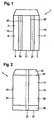
- FIG. 1 is a front view of a bag 1 according to the invention can be seen.
- the bag 1 is a gusseted bag, shown in the folded state.
- the complete front of this bag is equipped with a transparent perforated second plastic film 3.
- the first and second side walls 5 and 7 are in a folded state. That is, in the FIG. 1 the outer surfaces of the side walls 5 and 7 can be seen in the outer sections 9 and 11. At the outer edges 13 and 15 shown, the side walls 5 and 7 go over into the rear wall 17. In sections 19 and 21, the inner surface of the side walls faces the viewer. Consequently, the side walls 5 and 7 are turned over at the inner edges 23 and 25, so that in these areas 19 and 21, respectively, the outer surfaces of the side wall come into contact with each other.
- the side walls 5 and 7 and the back 17 are made of composite paper, wherein the laminated first plastic film of the composite paper is present in each case on the inner surface of the rear wall and side walls. Accordingly, this laminated plastic film in the sections 19 and 21 facing the viewer.
- the plastic film front wall 3 is connected to the side walls 5 and 7 via a substantially continuous glue line (indicated by dashed lines), in such a way that the second plastic film respectively initially extends to a fold line, which substantially coincides with the edge curves 13 and 15, respectively.
- that portion of the second plastic film which extends from the connection on the sections 19 and 21 with the respective side walls to the outer edges 13 and 15 of the bag can be considered as part of the side wall or as part of the front wall.
- the perforations are present in the first plastic film only in the area extending between the outer edges 13 and 15 extends.
- FIG. 2 shows a view of the outer surface of the back 17 of the bag 1 according to the invention.
- the back 17 consists essentially of the composite material according to the invention and has an adhesive connection in a region 27 in which the longitudinal halves 29 and 31 forming the back overlap. Accordingly, the side wall 5 and the elongated rear wall portion 29 and the side wall 7 and the elongated rear wall portion 31 are each integrally and are made of separate composite paper webs.
- the rear wall 17 has a locking tab 33, which can be folded down along a Pfalz 35.
- the bottom 37 of the bag 1 is closed by folding over the present sidewall and front wall materials onto the back side as described above and closing the overlapping area 39 by means of gluing.
- the side gusseted bag 1 has a relatively large receiving volume, yet keeps the baked goods freshly packaged therein and does not lose its appealing appearance even when treated at temperatures of 200 ° C over a prolonged period. Neither the plastic film of the front nor the composite paper material forming the sidewalls and the back wall are discolored or otherwise adversely affected by moisture or grease residues in their technical function or appearance.
- FIGS. 3 a) to n) exemplified various embodiments in sectional view.
- the viewing window is denoted by the reference numeral 41 marked.
- the viewing window bags can be, for example, 2-lane ( Fig. 3a ), e), f), k), 1), m) and n)) or else 3-lanes (see also FIG Fig. 3b ), c), d), g), h), i) and j)).
- the composite paper is used for the front, back and side walls.
- the composite paper is used for the viewing window 41 .
- the viewing window 41 is preferably a second plastic film based on PET used.
- the second plastic film in the form of the viewing window is connected to the laminated first plastic film of the composite paper in the respectively overlapping region in 43 in a preferred embodiment with a second PUR hotmelt adhesive.
Landscapes
- Engineering & Computer Science (AREA)
- Mechanical Engineering (AREA)
- Wrappers (AREA)
- Laminated Bodies (AREA)
Claims (11)
- Sac destiné à recevoir des aliments, en particulier des produits de boulangerie précuits, avec une extrémité de fond essentiellement fermée et une extrémité d'ouverture opposée, comprenant une paroi avant et une paroi arrière qui, dans la zone de leurs bords latéraux et de leurs bords de fond, sont raccordées l'une à l'autre au moins par tronçons, directement ou bien par le biais de parois latérales,
la paroi arrière présentant, au moins par zones, du papier composite, comprenant au moins une première couche d'un papier non siliconé avec un grammage dans la plage de 20 à 150 g/m2 et au moins une deuxième couche d'une première feuille en matière plastique transparente ou translucide, constituée en tant que feuille PET, avec une épaisseur moyenne dans la plage de 5 à 50 µm, qui est, au moins par zones, collée avec un adhésif PUR en tant que premier adhésif sur le côté arrière de la couche de papier, caractérisé
en ce quela paroi avant et la paroi arrière et/ou la paroi arrière et les parois latérales dans la zone de fond sont collées avec une colle dispersive, en particulier pâteuse,
en ce que la première feuille en matière plastiquereprésente une feuille en matière plastique monocouche ou multicouche, orientée de façon monoaxiale ou biaxiale,
en ce que le côté du papier composite présentant la première feuille en matière plastique est tourné vers l'intérieur du sac,
en ce que la paroi avant présente dupapier composite, comprenant au moins une première couche d'un papier non siliconé avec un grammage dans la plage de 20 à 150 g/m2 et au moins une deuxième couche d'une première feuille en matière plastique transparente ou translucide, constituée en tant que feuille PET, avec une épaisseur moyenne dans la plage de 5 à 50 µm, qui est, au moins par zones, collée avec un adhésif PUR en tant que premier adhésif sur le côté arrière de la couche de papier, et présente par zones une deuxième feuille en matière plastique transparente ou translucide ou
en ce que la deuxième feuille en matière plastique transparente ou translucide forme essentiellement la totalité de la paroi avant,
en ce que la deuxième feuille en matière plastique et le papier composite, dans la zone de faces d'appui se chevauchant, sont au moins par zones raccordés avec un deuxième adhésif thermofusible PUR et
en ce que la deuxième feuille en matière plastique est, au moins par tronçons, raccordée à la première feuille en matière plastique du papier composite par le biais de l'adhésif thermofusible PUR. - Sac selon la revendication 1, caractérisé en ce que
la deuxième feuille en matière plastique est raccordée à des parois latérales opposées du sac. - Sac selon une des revendications précédentes, caractérisé en ce que
le côté, présentant la feuille en matière plastique, d'un premier tronçon du papier composite est raccordé au côté, présentant le papier, d'un deuxième tronçon du papier compositeavec un deuxième adhésif PUR, en particulier un adhésif thermofusible PUR. - Sac selon une des revendications précédentes, caractérisé en ce que
le deuxième adhésifthermofusible PUR est basé sur l'utilisation d'isocyanates aromatiques ou aliphatiques. - Sac selon une des revendications précédentes, caractérisé en ce que
lepapier composite et/ou la deuxième feuille en matière plastique sont perforés. - Sac selon une des revendications précédentes, caractérisé en ce que
le papier contient au maximum 10 %-poidsde papier recyclé, en particulier ne présente essentiellement aucune fraction de papier recyclé. - Sac selon une des revendications précédentes, caractérisé en ce que
le papier est constitué de façon à repousser la graisse. - Sac selon une des revendications précédentes, caractérisé en ce que
le papier contient au moins un polyamide et/ou glyoxal modifié avec de l'épichlorhydrine. - Sac selon une des revendications précédentes, caractérisé en ce que
la première feuille en matière plastique comprend des polyalkylènes téréphtalates et/ou polyalkylènesnaphtalates cristallisables modifiés au dibenzène. - Sac selon la revendication 9, caractérisé en ce que
la première couche de matière plastiquecomprend en outre une couche de couverture, contenant des polyalkylènes téréphtalates non modifiés, des polyalkylènesnaphtalates modifiés au dibenzèneet/ou non modifiés ou des copolymèresde polyalkylène téréphtalates-polyalkylènesnaphtalates modifiés au dibenzèneet/ou non modifiés. - Sac selon la revendication 10, caractérisé en ce que
le degré de cristallinité de la feuille est inférieur à 3 %, de préférence inférieur à 1%.
Applications Claiming Priority (1)
| Application Number | Priority Date | Filing Date | Title |
|---|---|---|---|
| DE200610040921 DE102006040921A1 (de) | 2006-08-31 | 2006-08-31 | Verbundpapier sowie Beutel für Lebensmittel, insbesondere für vorgebackene Backwaren, enthaltend das Verbundpapier, und ein Verfahren zur Herstellung des Beutels |
Publications (2)
| Publication Number | Publication Date |
|---|---|
| EP1894714A1 EP1894714A1 (fr) | 2008-03-05 |
| EP1894714B1 true EP1894714B1 (fr) | 2012-10-31 |
Family
ID=38683580
Family Applications (1)
| Application Number | Title | Priority Date | Filing Date |
|---|---|---|---|
| EP20070016972 Active EP1894714B1 (fr) | 2006-08-31 | 2007-08-30 | Papier composite ainsi que sac pour aliments, en particulier pour produits précuits, contenant la papier composite, et un procédé de fabrication du sac |
Country Status (3)
| Country | Link |
|---|---|
| EP (1) | EP1894714B1 (fr) |
| DE (1) | DE102006040921A1 (fr) |
| ES (1) | ES2398289T3 (fr) |
Cited By (4)
| Publication number | Priority date | Publication date | Assignee | Title |
|---|---|---|---|---|
| EP3095723A1 (fr) | 2015-05-20 | 2016-11-23 | Ace Packaging NV | Emballage pour pain,procédé pour sa fabrication et utilisation |
| BE1027759A1 (nl) | 2019-11-15 | 2021-06-09 | Ace Packaging N V | Werkwijze voor het vervaardigen van een zakvormige verpakking |
| WO2023073620A1 (fr) | 2021-10-28 | 2023-05-04 | Ace Packaging N.V. | Papier d'emballage à zone transparente, procédé de fabrication de papier d'emballage à zone transparente, et emballage comprenant un tel papier d'emballage |
| WO2025168690A1 (fr) | 2024-02-06 | 2025-08-14 | Ace Packaging N.V. | Papier d'emballage à zone translucide, procédé de fabrication de papier d'emballage à zone translucide et emballage comprenant un tel papier d'emballage |
Families Citing this family (8)
| Publication number | Priority date | Publication date | Assignee | Title |
|---|---|---|---|---|
| WO2010068874A1 (fr) * | 2008-12-12 | 2010-06-17 | General Mills Marketing, Inc. | Produits alimentaires à base de pâte ou de pâte à frire précuits, surgelés et emballés, et procédés |
| DK2210818T3 (da) * | 2009-01-21 | 2013-01-07 | Papier Mettler Inh Michael Mettler | Sidefoldet pose med foldebund og materialebaneafsnit indrettet og egnet til fremstilling af denne sidefoldepose |
| IT1401986B1 (it) * | 2010-09-29 | 2013-08-28 | Turconi S P A | Contenitore a sacchetto con porzione trasparente, particolarmente per prodotti alimentari come pane, focacce, biscotti o simili. |
| EP2574565A1 (fr) * | 2011-09-30 | 2013-04-03 | Papier-Mettler Inhaber Michael Mettler e.K. | Sachet, notamment sachet d'emballage en papier sulfurisé ou en pâte de cellulose revêtue de fluor |
| DE102011115090A1 (de) * | 2011-10-07 | 2013-04-11 | Weber Verpackungen Friedrich Weber Nachf. Gmbh & Co. Kg | Verpackungsbeutel für Nahrungsmittel |
| CH712377B1 (de) * | 2016-04-20 | 2019-10-15 | Primcut Ag | Banderole für Backwaren. |
| DE102019118425A1 (de) | 2019-07-08 | 2021-01-14 | Constantia Pirk Gmbh & Co. Kg | Multifunktionales Barrierepapier und Verfahren zu dessen Herstellung |
| DE102022101325A1 (de) * | 2022-01-20 | 2023-07-20 | Lemo Maschinenbau Gmbh | Klappenbeutel mit C-Faltung |
Family Cites Families (17)
| Publication number | Priority date | Publication date | Assignee | Title |
|---|---|---|---|---|
| US1770865A (en) * | 1928-04-11 | 1930-07-15 | Thomas M Royal | Method of manufacturing bags |
| US2158755A (en) * | 1936-09-16 | 1939-05-16 | Theodore A Hodgdon | Laminated sheet material for use in making paper bags or wrappers |
| US2745593A (en) * | 1952-10-02 | 1956-05-15 | Bemis Bro Bag Co | Bag |
| US3038651A (en) * | 1961-02-23 | 1962-06-12 | L I Snodgrass Company | Lined bag |
| DE1985257U (de) | 1968-02-16 | 1968-05-09 | Bischof & Klein | Sack, beutel od. dgl. |
| JPH01262747A (ja) | 1988-02-12 | 1989-10-19 | Deposition Technol Inc | 製造食品のマイクロ波加熱用包装体及びその加熱方法 |
| CA2050145A1 (fr) * | 1991-08-28 | 1993-03-01 | Daniel Beliveau | Sac en plastique perfore pour emballage de fruits et legumes |
| US5405663A (en) * | 1991-11-12 | 1995-04-11 | Hunt-Wesson, Inc. | Microwave package laminate with extrusion bonded susceptor |
| US6706388B2 (en) * | 2001-02-12 | 2004-03-16 | Arnold B. Finestone | Self-closing packaging material |
| JPH06126917A (ja) * | 1992-10-14 | 1994-05-10 | Toppan Printing Co Ltd | ポリエステル積層体 |
| JPH07264964A (ja) | 1994-03-31 | 1995-10-17 | Unitika Ltd | パン類の焼成用シートおよび焼成用容器 |
| DE29512436U1 (de) | 1995-08-02 | 1995-10-19 | Möbius, Arnold, 76344 Eggenstein-Leopoldshafen | Vorrichtung zur reflexionsarmen Absorption von Mikrowellen |
| US6033114A (en) * | 1998-01-20 | 2000-03-07 | Bagcraft Packaging, L.L.C. | Window bag with polyester lining and method of forming same |
| DE29812038U1 (de) * | 1998-03-14 | 1998-09-24 | Möller, Karl-Heinz, 65191 Wiesbaden | Tüte für Lebensmittel |
| FI990514A7 (fi) | 1999-03-10 | 2000-09-11 | Upm Kymmene Corp | Menetelmä pakkausmateriaalin valmistamiseksi |
| DE20108128U1 (de) * | 2001-05-14 | 2001-08-02 | BMS Papier Concept GmbH, 65191 Wiesbaden | Tüte für Lebensmittel mit Sichtfenster |
| AT7176U3 (de) | 2004-06-24 | 2005-07-25 | Teich Ag | Deckel zum verschliessen von nahrungsmittelbehältern, sowie verfahren zu dessen herstellung |
-
2006
- 2006-08-31 DE DE200610040921 patent/DE102006040921A1/de not_active Withdrawn
-
2007
- 2007-08-30 ES ES07016972T patent/ES2398289T3/es active Active
- 2007-08-30 EP EP20070016972 patent/EP1894714B1/fr active Active
Cited By (7)
| Publication number | Priority date | Publication date | Assignee | Title |
|---|---|---|---|---|
| EP3095723A1 (fr) | 2015-05-20 | 2016-11-23 | Ace Packaging NV | Emballage pour pain,procédé pour sa fabrication et utilisation |
| BE1027759A1 (nl) | 2019-11-15 | 2021-06-09 | Ace Packaging N V | Werkwijze voor het vervaardigen van een zakvormige verpakking |
| WO2023073620A1 (fr) | 2021-10-28 | 2023-05-04 | Ace Packaging N.V. | Papier d'emballage à zone transparente, procédé de fabrication de papier d'emballage à zone transparente, et emballage comprenant un tel papier d'emballage |
| BE1029886A1 (nl) | 2021-10-28 | 2023-05-26 | Ace Packaging N V | Verpakkingspapier met transparante zone, werkwijze voor het vervaardigen van verpakkingspapier met transparante zone, en verpakking omvattende dergelijk verpakkingspapier |
| EP4624659A2 (fr) | 2021-10-28 | 2025-10-01 | Ace Packaging NV | Papier d'emballage à zone transparente, procédé de fabrication de papier d'emballage à zone transparente, et emballage comprenant un tel papier d'emballage |
| WO2025168690A1 (fr) | 2024-02-06 | 2025-08-14 | Ace Packaging N.V. | Papier d'emballage à zone translucide, procédé de fabrication de papier d'emballage à zone translucide et emballage comprenant un tel papier d'emballage |
| NL2036974B1 (en) | 2024-02-06 | 2025-08-18 | Ace Packaging N V | Packaging paper with translucent zone, method for manufacturing packaging paper with translucent zone, and packaging comprising such packaging paper |
Also Published As
| Publication number | Publication date |
|---|---|
| ES2398289T3 (es) | 2013-03-15 |
| DE102006040921A1 (de) | 2008-03-13 |
| EP1894714A1 (fr) | 2008-03-05 |
Similar Documents
| Publication | Publication Date | Title |
|---|---|---|
| EP1894714B1 (fr) | Papier composite ainsi que sac pour aliments, en particulier pour produits précuits, contenant la papier composite, et un procédé de fabrication du sac | |
| DE69823391T2 (de) | Verpackungsbehälter zum kalt-lagern von flüssigen nahrungsmitteln sowie verfahren zum herstellen dieses behälters | |
| DE69129766T2 (de) | Lebensmittelverpackung | |
| DE60214581T2 (de) | Mit polymer beschichtetes heissversiegelbares verpackungsmaterial, herstellungsverfahren dafür und daraus hergestellte verschlossene verpackung | |
| DE29812038U1 (de) | Tüte für Lebensmittel | |
| EP2984001B1 (fr) | Systeme de conditionnement avec barquette d'emballage en carton | |
| AT514049B1 (de) | Kombi-Verpackungsbehälter | |
| EP3792192B1 (fr) | Agencement de sacs d'emballage ainsi que procédé de fabrication et de manipulation de l'agencement de sacs d'emballage | |
| DE69625829T2 (de) | Gefrierbeutel | |
| DE60005336T2 (de) | Verpacktes seifenstück | |
| EP3119599B1 (fr) | Carton ondulé fonctionnalisé | |
| DE1536188A1 (de) | Gas- und feuchtigkeitsdichte Verpackung fuer Genussmittel | |
| EP1495981A2 (fr) | Récipient | |
| DE3039966A1 (de) | Verpackungsbehaelter fuer lebensmittel | |
| DE2317066A1 (de) | Kompakte packung fuer fleischprodukte | |
| EP2829396A1 (fr) | Récipient destiné à l'emballage de produits alimentaires | |
| EP4282647A1 (fr) | Composite pour l'emballage d'aliments ou de produits pharmaceutiques | |
| DE60115751T2 (de) | Abziehbares Filmetikett für einen Behälter aus Verbundwerkstoff | |
| DE2908381C2 (de) | Leicht zu öffnende Folienpackung sowie Verfahren zu ihrer Herstellung | |
| EP0867379B1 (fr) | Sachet pour denrées alimentaires | |
| DE69317116T2 (de) | Mehrschichtwerkstoff auf Basis von Karton oder Papier | |
| DE102005053343B3 (de) | Zigarettenverpackung mit Innenumhüllung aus Polymerfolie | |
| DE102009034210A1 (de) | Transparente Spitztüte, vorzugsweise mit PLA | |
| DE60201396T2 (de) | Leicht zu öffnende Verpackung für Lebensmittel | |
| WO2011047871A1 (fr) | Composite perforé muni d'une couche de polyamide extérieure |
Legal Events
| Date | Code | Title | Description |
|---|---|---|---|
| PUAI | Public reference made under article 153(3) epc to a published international application that has entered the european phase |
Free format text: ORIGINAL CODE: 0009012 |
|
| AK | Designated contracting states |
Kind code of ref document: A1 Designated state(s): AT BE BG CH CY CZ DE DK EE ES FI FR GB GR HU IE IS IT LI LT LU LV MC MT NL PL PT RO SE SI SK TR |
|
| AX | Request for extension of the european patent |
Extension state: AL BA HR MK YU |
|
| 17P | Request for examination filed |
Effective date: 20080904 |
|
| AKX | Designation fees paid |
Designated state(s): AT BE BG CH CY CZ DE DK EE ES FI FR GB GR HU IE IS IT LI LT LU LV MC MT NL PL PT RO SE SI SK TR |
|
| 17Q | First examination report despatched |
Effective date: 20090615 |
|
| GRAP | Despatch of communication of intention to grant a patent |
Free format text: ORIGINAL CODE: EPIDOSNIGR1 |
|
| GRAS | Grant fee paid |
Free format text: ORIGINAL CODE: EPIDOSNIGR3 |
|
| GRAA | (expected) grant |
Free format text: ORIGINAL CODE: 0009210 |
|
| AK | Designated contracting states |
Kind code of ref document: B1 Designated state(s): AT BE BG CH CY CZ DE DK EE ES FI FR GB GR HU IE IS IT LI LT LU LV MC MT NL PL PT RO SE SI SK TR |
|
| REG | Reference to a national code |
Ref country code: GB Ref legal event code: FG4D Free format text: NOT ENGLISH Ref country code: CH Ref legal event code: EP |
|
| REG | Reference to a national code |
Ref country code: AT Ref legal event code: REF Ref document number: 581756 Country of ref document: AT Kind code of ref document: T Effective date: 20121115 |
|
| REG | Reference to a national code |
Ref country code: IE Ref legal event code: FG4D Free format text: LANGUAGE OF EP DOCUMENT: GERMAN |
|
| REG | Reference to a national code |
Ref country code: DE Ref legal event code: R096 Ref document number: 502007010789 Country of ref document: DE Effective date: 20121227 |
|
| REG | Reference to a national code |
Ref country code: CH Ref legal event code: NV Representative=s name: NOVAGRAAF INTERNATIONAL SA, CH |
|
| REG | Reference to a national code |
Ref country code: NL Ref legal event code: T3 |
|
| REG | Reference to a national code |
Ref country code: ES Ref legal event code: FG2A Ref document number: 2398289 Country of ref document: ES Kind code of ref document: T3 Effective date: 20130315 |
|
| REG | Reference to a national code |
Ref country code: LT Ref legal event code: MG4D |
|
| PG25 | Lapsed in a contracting state [announced via postgrant information from national office to epo] |
Ref country code: FI Free format text: LAPSE BECAUSE OF FAILURE TO SUBMIT A TRANSLATION OF THE DESCRIPTION OR TO PAY THE FEE WITHIN THE PRESCRIBED TIME-LIMIT Effective date: 20121031 Ref country code: LT Free format text: LAPSE BECAUSE OF FAILURE TO SUBMIT A TRANSLATION OF THE DESCRIPTION OR TO PAY THE FEE WITHIN THE PRESCRIBED TIME-LIMIT Effective date: 20121031 Ref country code: IS Free format text: LAPSE BECAUSE OF FAILURE TO SUBMIT A TRANSLATION OF THE DESCRIPTION OR TO PAY THE FEE WITHIN THE PRESCRIBED TIME-LIMIT Effective date: 20130228 Ref country code: SE Free format text: LAPSE BECAUSE OF FAILURE TO SUBMIT A TRANSLATION OF THE DESCRIPTION OR TO PAY THE FEE WITHIN THE PRESCRIBED TIME-LIMIT Effective date: 20121031 |
|
| PG25 | Lapsed in a contracting state [announced via postgrant information from national office to epo] |
Ref country code: GR Free format text: LAPSE BECAUSE OF FAILURE TO SUBMIT A TRANSLATION OF THE DESCRIPTION OR TO PAY THE FEE WITHIN THE PRESCRIBED TIME-LIMIT Effective date: 20130201 Ref country code: SI Free format text: LAPSE BECAUSE OF FAILURE TO SUBMIT A TRANSLATION OF THE DESCRIPTION OR TO PAY THE FEE WITHIN THE PRESCRIBED TIME-LIMIT Effective date: 20121031 Ref country code: CY Free format text: LAPSE BECAUSE OF FAILURE TO SUBMIT A TRANSLATION OF THE DESCRIPTION OR TO PAY THE FEE WITHIN THE PRESCRIBED TIME-LIMIT Effective date: 20121031 Ref country code: PT Free format text: LAPSE BECAUSE OF FAILURE TO SUBMIT A TRANSLATION OF THE DESCRIPTION OR TO PAY THE FEE WITHIN THE PRESCRIBED TIME-LIMIT Effective date: 20130228 Ref country code: LV Free format text: LAPSE BECAUSE OF FAILURE TO SUBMIT A TRANSLATION OF THE DESCRIPTION OR TO PAY THE FEE WITHIN THE PRESCRIBED TIME-LIMIT Effective date: 20121031 Ref country code: PL Free format text: LAPSE BECAUSE OF FAILURE TO SUBMIT A TRANSLATION OF THE DESCRIPTION OR TO PAY THE FEE WITHIN THE PRESCRIBED TIME-LIMIT Effective date: 20121031 |
|
| PG25 | Lapsed in a contracting state [announced via postgrant information from national office to epo] |
Ref country code: EE Free format text: LAPSE BECAUSE OF FAILURE TO SUBMIT A TRANSLATION OF THE DESCRIPTION OR TO PAY THE FEE WITHIN THE PRESCRIBED TIME-LIMIT Effective date: 20121031 Ref country code: SK Free format text: LAPSE BECAUSE OF FAILURE TO SUBMIT A TRANSLATION OF THE DESCRIPTION OR TO PAY THE FEE WITHIN THE PRESCRIBED TIME-LIMIT Effective date: 20121031 Ref country code: CZ Free format text: LAPSE BECAUSE OF FAILURE TO SUBMIT A TRANSLATION OF THE DESCRIPTION OR TO PAY THE FEE WITHIN THE PRESCRIBED TIME-LIMIT Effective date: 20121031 Ref country code: DK Free format text: LAPSE BECAUSE OF FAILURE TO SUBMIT A TRANSLATION OF THE DESCRIPTION OR TO PAY THE FEE WITHIN THE PRESCRIBED TIME-LIMIT Effective date: 20121031 Ref country code: BG Free format text: LAPSE BECAUSE OF FAILURE TO SUBMIT A TRANSLATION OF THE DESCRIPTION OR TO PAY THE FEE WITHIN THE PRESCRIBED TIME-LIMIT Effective date: 20130131 |
|
| PG25 | Lapsed in a contracting state [announced via postgrant information from national office to epo] |
Ref country code: RO Free format text: LAPSE BECAUSE OF FAILURE TO SUBMIT A TRANSLATION OF THE DESCRIPTION OR TO PAY THE FEE WITHIN THE PRESCRIBED TIME-LIMIT Effective date: 20121031 |
|
| PLBE | No opposition filed within time limit |
Free format text: ORIGINAL CODE: 0009261 |
|
| STAA | Information on the status of an ep patent application or granted ep patent |
Free format text: STATUS: NO OPPOSITION FILED WITHIN TIME LIMIT |
|
| 26N | No opposition filed |
Effective date: 20130801 |
|
| REG | Reference to a national code |
Ref country code: DE Ref legal event code: R097 Ref document number: 502007010789 Country of ref document: DE Effective date: 20130801 |
|
| PG25 | Lapsed in a contracting state [announced via postgrant information from national office to epo] |
Ref country code: MC Free format text: LAPSE BECAUSE OF FAILURE TO SUBMIT A TRANSLATION OF THE DESCRIPTION OR TO PAY THE FEE WITHIN THE PRESCRIBED TIME-LIMIT Effective date: 20121031 |
|
| REG | Reference to a national code |
Ref country code: IE Ref legal event code: MM4A |
|
| PG25 | Lapsed in a contracting state [announced via postgrant information from national office to epo] |
Ref country code: IE Free format text: LAPSE BECAUSE OF NON-PAYMENT OF DUE FEES Effective date: 20130830 |
|
| REG | Reference to a national code |
Ref country code: AT Ref legal event code: MM01 Ref document number: 581756 Country of ref document: AT Kind code of ref document: T Effective date: 20130830 |
|
| PG25 | Lapsed in a contracting state [announced via postgrant information from national office to epo] |
Ref country code: AT Free format text: LAPSE BECAUSE OF NON-PAYMENT OF DUE FEES Effective date: 20130830 |
|
| PG25 | Lapsed in a contracting state [announced via postgrant information from national office to epo] |
Ref country code: MT Free format text: LAPSE BECAUSE OF FAILURE TO SUBMIT A TRANSLATION OF THE DESCRIPTION OR TO PAY THE FEE WITHIN THE PRESCRIBED TIME-LIMIT Effective date: 20121031 Ref country code: TR Free format text: LAPSE BECAUSE OF FAILURE TO SUBMIT A TRANSLATION OF THE DESCRIPTION OR TO PAY THE FEE WITHIN THE PRESCRIBED TIME-LIMIT Effective date: 20121031 |
|
| PG25 | Lapsed in a contracting state [announced via postgrant information from national office to epo] |
Ref country code: LU Free format text: LAPSE BECAUSE OF NON-PAYMENT OF DUE FEES Effective date: 20130830 Ref country code: HU Free format text: LAPSE BECAUSE OF FAILURE TO SUBMIT A TRANSLATION OF THE DESCRIPTION OR TO PAY THE FEE WITHIN THE PRESCRIBED TIME-LIMIT; INVALID AB INITIO Effective date: 20070830 |
|
| REG | Reference to a national code |
Ref country code: DE Ref legal event code: R082 Ref document number: 502007010789 Country of ref document: DE Representative=s name: BOEHMERT & BOEHMERT ANWALTSPARTNERSCHAFT MBB -, DE Ref country code: DE Ref legal event code: R081 Ref document number: 502007010789 Country of ref document: DE Owner name: PAPIER-METTLER KG, DE Free format text: FORMER OWNER: PAPIER-METTLER INHABER MICHAEL METTLER, 54497 MORBACH, DE |
|
| REG | Reference to a national code |
Ref country code: GB Ref legal event code: 732E Free format text: REGISTERED BETWEEN 20151105 AND 20151111 |
|
| REG | Reference to a national code |
Ref country code: FR Ref legal event code: PLFP Year of fee payment: 10 |
|
| PGFP | Annual fee paid to national office [announced via postgrant information from national office to epo] |
Ref country code: NL Payment date: 20160810 Year of fee payment: 10 |
|
| PGFP | Annual fee paid to national office [announced via postgrant information from national office to epo] |
Ref country code: GB Payment date: 20160824 Year of fee payment: 10 Ref country code: IT Payment date: 20160822 Year of fee payment: 10 Ref country code: CH Payment date: 20160812 Year of fee payment: 10 |
|
| PGFP | Annual fee paid to national office [announced via postgrant information from national office to epo] |
Ref country code: FR Payment date: 20160712 Year of fee payment: 10 |
|
| PGFP | Annual fee paid to national office [announced via postgrant information from national office to epo] |
Ref country code: ES Payment date: 20160712 Year of fee payment: 10 Ref country code: BE Payment date: 20160624 Year of fee payment: 10 |
|
| REG | Reference to a national code |
Ref country code: CH Ref legal event code: PL |
|
| REG | Reference to a national code |
Ref country code: NL Ref legal event code: MM Effective date: 20170901 |
|
| GBPC | Gb: european patent ceased through non-payment of renewal fee |
Effective date: 20170830 |
|
| PG25 | Lapsed in a contracting state [announced via postgrant information from national office to epo] |
Ref country code: LI Free format text: LAPSE BECAUSE OF NON-PAYMENT OF DUE FEES Effective date: 20170831 Ref country code: CH Free format text: LAPSE BECAUSE OF NON-PAYMENT OF DUE FEES Effective date: 20170831 |
|
| REG | Reference to a national code |
Ref country code: FR Ref legal event code: ST Effective date: 20180430 |
|
| REG | Reference to a national code |
Ref country code: BE Ref legal event code: MM Effective date: 20170831 |
|
| PG25 | Lapsed in a contracting state [announced via postgrant information from national office to epo] |
Ref country code: NL Free format text: LAPSE BECAUSE OF NON-PAYMENT OF DUE FEES Effective date: 20170901 |
|
| PG25 | Lapsed in a contracting state [announced via postgrant information from national office to epo] |
Ref country code: GB Free format text: LAPSE BECAUSE OF NON-PAYMENT OF DUE FEES Effective date: 20170830 |
|
| PG25 | Lapsed in a contracting state [announced via postgrant information from national office to epo] |
Ref country code: BE Free format text: LAPSE BECAUSE OF NON-PAYMENT OF DUE FEES Effective date: 20170831 Ref country code: FR Free format text: LAPSE BECAUSE OF NON-PAYMENT OF DUE FEES Effective date: 20170831 Ref country code: IT Free format text: LAPSE BECAUSE OF NON-PAYMENT OF DUE FEES Effective date: 20170830 |
|
| REG | Reference to a national code |
Ref country code: ES Ref legal event code: FD2A Effective date: 20181025 |
|
| PG25 | Lapsed in a contracting state [announced via postgrant information from national office to epo] |
Ref country code: ES Free format text: LAPSE BECAUSE OF NON-PAYMENT OF DUE FEES Effective date: 20170831 |
|
| P01 | Opt-out of the competence of the unified patent court (upc) registered |
Effective date: 20230331 |
|
| PGFP | Annual fee paid to national office [announced via postgrant information from national office to epo] |
Ref country code: DE Payment date: 20250827 Year of fee payment: 19 |