EP1895476A1 - Verfahren zur Herstellung und Verifizierung von Postartikeln, das eine Zahlungsgarantie sicherstellt - Google Patents
Verfahren zur Herstellung und Verifizierung von Postartikeln, das eine Zahlungsgarantie sicherstellt Download PDFInfo
- Publication number
- EP1895476A1 EP1895476A1 EP07114852A EP07114852A EP1895476A1 EP 1895476 A1 EP1895476 A1 EP 1895476A1 EP 07114852 A EP07114852 A EP 07114852A EP 07114852 A EP07114852 A EP 07114852A EP 1895476 A1 EP1895476 A1 EP 1895476A1
- Authority
- EP
- European Patent Office
- Prior art keywords
- code
- unique
- dimensional
- bar code
- Prior art date
- Legal status (The legal status is an assumption and is not a legal conclusion. Google has not performed a legal analysis and makes no representation as to the accuracy of the status listed.)
- Withdrawn
Links
- 238000004519 manufacturing process Methods 0.000 title claims description 6
- 238000000034 method Methods 0.000 claims abstract description 17
- 239000000835 fiber Substances 0.000 claims abstract description 10
- 230000003287 optical effect Effects 0.000 claims description 8
- 238000007639 printing Methods 0.000 claims description 7
- 238000000605 extraction Methods 0.000 claims description 4
- 239000000284 extract Substances 0.000 claims description 3
- 238000012384 transportation and delivery Methods 0.000 claims description 3
- 238000004891 communication Methods 0.000 description 8
- 238000005516 engineering process Methods 0.000 description 3
- 238000012550 audit Methods 0.000 description 2
- 238000012795 verification Methods 0.000 description 2
- 238000012790 confirmation Methods 0.000 description 1
- 230000007812 deficiency Effects 0.000 description 1
- 238000011161 development Methods 0.000 description 1
- 238000009826 distribution Methods 0.000 description 1
- 238000007726 management method Methods 0.000 description 1
- 239000011159 matrix material Substances 0.000 description 1
- 238000010295 mobile communication Methods 0.000 description 1
- 230000008520 organization Effects 0.000 description 1
- 238000012545 processing Methods 0.000 description 1
- 238000003860 storage Methods 0.000 description 1
- 238000010200 validation analysis Methods 0.000 description 1
- 238000005303 weighing Methods 0.000 description 1
Images

Classifications
-
- G—PHYSICS
- G07—CHECKING-DEVICES
- G07B—TICKET-ISSUING APPARATUS; FARE-REGISTERING APPARATUS; FRANKING APPARATUS
- G07B17/00—Franking apparatus
- G07B17/00459—Details relating to mailpieces in a franking system
- G07B17/00661—Sensing or measuring mailpieces
-
- G—PHYSICS
- G07—CHECKING-DEVICES
- G07B—TICKET-ISSUING APPARATUS; FARE-REGISTERING APPARATUS; FRANKING APPARATUS
- G07B17/00—Franking apparatus
- G07B17/00185—Details internally of apparatus in a franking system, e.g. franking machine at customer or apparatus at post office
- G07B17/00435—Details specific to central, non-customer apparatus, e.g. servers at post office or vendor
-
- G—PHYSICS
- G07—CHECKING-DEVICES
- G07B—TICKET-ISSUING APPARATUS; FARE-REGISTERING APPARATUS; FRANKING APPARATUS
- G07B17/00—Franking apparatus
- G07B17/00185—Details internally of apparatus in a franking system, e.g. franking machine at customer or apparatus at post office
- G07B17/00435—Details specific to central, non-customer apparatus, e.g. servers at post office or vendor
- G07B2017/00443—Verification of mailpieces, e.g. by checking databases
-
- G—PHYSICS
- G07—CHECKING-DEVICES
- G07B—TICKET-ISSUING APPARATUS; FARE-REGISTERING APPARATUS; FRANKING APPARATUS
- G07B17/00—Franking apparatus
- G07B17/00459—Details relating to mailpieces in a franking system
- G07B17/00508—Printing or attaching on mailpieces
- G07B2017/00572—Details of printed item
- G07B2017/0058—Printing of code
- G07B2017/00588—Barcode
-
- G—PHYSICS
- G07—CHECKING-DEVICES
- G07B—TICKET-ISSUING APPARATUS; FARE-REGISTERING APPARATUS; FRANKING APPARATUS
- G07B17/00—Franking apparatus
- G07B17/00459—Details relating to mailpieces in a franking system
- G07B17/00508—Printing or attaching on mailpieces
- G07B2017/00612—Attaching item on mailpiece
- G07B2017/00629—Circuit, e.g. transponder
-
- G—PHYSICS
- G07—CHECKING-DEVICES
- G07B—TICKET-ISSUING APPARATUS; FARE-REGISTERING APPARATUS; FRANKING APPARATUS
- G07B17/00—Franking apparatus
- G07B17/00459—Details relating to mailpieces in a franking system
- G07B17/00661—Sensing or measuring mailpieces
- G07B2017/00709—Scanning mailpieces
Definitions
- the present invention relates exclusively to the field of mail processing and more particularly relates to a postage method through a telecommunications network which guarantees the postal administration that each postage item that it is responsible for transmitting to the addressee has been paid by the sender.
- This postage solution is particularly satisfactory for the individual user who can thus, for example by means of a simple mobile phone, send a mail at any time of the day without worrying about the opening hours of postal services.
- the postal administration it is impossible for the postal administration to determine, among all the articles of mail received in its mail reception offices and bearing the same unique identification code, the one which has actually been the object of the aforementioned payment and which must therefore be transmitted to the addressee.
- it merely transmits the first article of mail received and then rejects the following, it can make a mistake with the actual user who paid for his postage and sees his mail item rejected because a counterfeiter who copied his unique identification code presented himself before him to a reception desk of the postal administration.
- the postal administration is liable in this case to compensate the genuine user whose mail item was unfairly rejected.
- An Ingenia Technology® product is known to uniquely assign an identification code to any stationery item and thus could identify with certainty any mail item.
- This product which is based on the determination of the three-dimensional fiber structure (which is unique) of any article, consists of a digitizer which scans with a laser beam the surface of the article of stationery and extracts a unique code representative of its three-dimensional fiber structure.
- the present invention therefore aims to solve this problem of fraudulent duplication with a new franking process which guarantees the postal administration that each item of mail sent to its recipient has been subject to payment by its sender .
- each article of mail is associated with a unique fingerprint code characteristic of the three-dimensional structure of the fibers of this mail item and which will be associated by means of a portable communication terminal a postage amount paid by the sender .
- said two-dimensional bar code further comprises one or more of the following: address of a postage credit delivery server, format of the mail item, particular postal service associated with the postage item; mail.
- steps c) and e) of generating and printing said two-dimensional bar code are replaced by a single step of recording said unique fingerprint code (of said unique identification number) in an RFID indicator carried by the mail article or its contents.
- one or more of the following elements address of a postage credit supply server, format of the mail item, particular postal service associated with the mail item, are further extracted from said bar code two-dimensional.
- the steps a) and b) of optical reading of said two-dimensional bar code and extraction of said unique identification number is replaced by a single step of reading said unique identification number stored in an RFID indicator carried by the mail article or its contents.
- the invention is intended to enable the postal administration to identify with certainty among a set of mail items bearing the same preprinted identification code 2D that having, by means of an individual franking device such as a mobile communication terminal, is subject to payment by its sender.
- the postal administration is able to determine which is an original article by comparing the impression code extracted from the correspondence table with that obtained directly by digitization. the mail item received.
- mail piece will be understood to mean both an envelope and a label intended to be glued on a thick envelope or a package to be shipped.
- FIG. 1 illustrates an example of a franking system necessary for carrying out the method according to the invention. It comprises as it is known in particular of the request FR 04 09183 mentioned above, a portable communication terminal 10 (mobile phone, personal digital assistant communicating, communicating laptop, communicating game console, etc.) which is used to obtain and pay a postage credit relating to an article of mail 12 which one wishes to ensure the shipment via a postal box or a reception office of the postal administration 14.
- a portable communication terminal 10 mobile phone, personal digital assistant communicating, communicating laptop, communicating game console, etc.
- the portable communication terminal 10 is put in contact with a franchise issuing supplying server system 16, this server itself being in relation with a server system 18 of the postal administration and possibly with a server system 20 of a telephone operator providing, where appropriate, the debit of the postage credit requested directly from the telephone account which may be held by the user of the portable communication terminal with that operator. phone operator.
- server systems of course each include one or more databases of data necessary for the management of the different data frankings.
- the communicating portable terminal may either comprise a digital capture module 10A, such as a digital photo cell or a two-dimensional bar code reader, or a module 10B for reading / interrogating non-contact chips to then cooperate with a transponder (indicator RFID) carried by the mail article or its contents.
- a digital capture module 10A such as a digital photo cell or a two-dimensional bar code reader
- a module 10B for reading / interrogating non-contact chips to then cooperate with a transponder (indicator RFID) carried by the mail article or its contents.
- a transponder indicator RFID
- the mail item carries a two-dimensional bar code 12A (such as Aztec code, Codablock, Code one, Code 16K, Code 49, data matrix, PDF 417, QR Code or the Supercode) pre-printed by printing means 22 during the manufacturing process of the mail item at a paper manufacturer 24, which guarantees the print quality.
- a two-dimensional bar code 12A such as Aztec code, Codablock, Code one, Code 16K, Code 49, data matrix, PDF 417, QR Code or the Supercode
- the high coding capacity of such a two-dimensional code allows it to have not only a unique identification number (sequential number or random number) but also other information relating to the mail item, such as a statement of the format in the case of an envelope, a reference to the particular postal service associated with that envelope (recommended for example), or a manufacturer's number and a code country, as recommended by the EPC standard (electronic Product Code) developed by the eponymous standardization organization.
- the unique identification number and associated information may be stored via a registration means 26 in a contactless chip, or RFID indicator, carried by the mail piece or its contents. As it is known, this number does not represent any amount of postage and therefore contains no monetary value.
- the manufacturer 24 of the mail article and the reception office of the postal administration 14 each additionally comprise printing means 22 for the manufacturer and corresponding means for reading bar codes 28A (or as a variant of reading of RFID indicators 28B) for the receiving office of the postal administration, means 30 (respectively 32) of laser scanning, for example according to the method known from Ingenia Technology®, for the development of the imprint code , totally unique code characteristic of the three-dimensional footprint of the paper constituting the mail item.
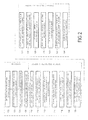
- the payment guarantee method implemented in the aforementioned franking system is now described with reference to FIG. 2. It essentially comprises three successive phases: a phase of manufacture of the mail item by a paper manufacturer, a phase obtaining a postage credit by the user for this article of mail and a verification phase of the payment of this mail item by the postal administration.
- the manufacturing phase of the mail article comprises firstly in a step 100, by a laser scanning, obtaining the three-dimensional print of the paper constituting this mail item and from which is extracted a code of unique fingerprint characteristic of the three-dimensional structure of the paper, then, as is known, a two-dimensional bar code is then developed, in a step 102, from a unique identification number and different information including at least the address of the dealer's server and possibly the format of the envelope or the particular postal service (recommended, priority, etc.) associated with this envelope when it must also be printed on the envelope.
- this 2D code is printed on the mail piece in a step 104 and the unique identification number and the unique fingerprint code are stored together in a correspondence table 40 prepared by the mail piece manufacturer in a step 106 and transmitted to the dealer's server or accessible by it.
- This triple digitization operation, 2D code generation, printing and storage in the table are repeated for each article of manufactured mail and these mail items are then packaged for sale in packages of 50, 100, 200 or 500 envelopes per item. example.
- the sender who has acquired a package of envelopes bearing this preprinted 2D code must then beforehand sending each of these envelopes to its recipient to pay the postage amount corresponding to the weight (possibly format) of this envelope and the desired destination.
- step 108 the prerecorded franking function of his portable communication terminal and enter at the digital capture means (photo sensor or barcode reader) of this terminal the 2D code preprinted on the mail item.
- the digital capture means photo sensor or barcode reader
- step 110 he enters at the keypad of his terminal the various postal information necessary for calculating the postage amount, such as the postal code of destination of the mail item, the weight class (50 ct if envelope ⁇ 20g , 70 ct if 20g ⁇ envelope ⁇ 70g, ...) and possibly the format of the envelope, the particular postal service desired if it is not already present on the article of mail (case of the mention " recommended "for example), Note that the direct entry of the amount of postage is of course also possible.
- step 112 automatically sends the dealer's server whose address has been extracted from the pre-printed 2D code a short message (SMS or MMS) including this amount and various other information including the number of unique identification and possibly the particular postal service desired.
- SMS short message
- the dealer server Upon receipt of this message, the dealer server, in a step 114, extracts the unique identification number. In step 116, the dealer server retrieves the unique fingerprint code associated with it by accessing the correspondence table managed by the manufacturer, these two codes are then stored (with the other information mentioned above and the identity of the sender obtained from the IMSI or IMEI numbers when connected with its portable terminal) in its database and sent in parallel in a step 118 to the postal administration (it is also possible to share with this administration a right to access to the database).
- the verification phase by the postal administration can then begin. It consists of ensuring the reality of the payment made by the sender. Indeed, when receiving the mail item in a reception office of this administration (step 122), the postal administration will perform on the one hand an optical reading of the preprinted 2D code and the address of the recipient (for the determination of the area of destination), and possibly the particular postal service when it is also preprinted on the article of mail for example "recommended” or “priority", and secondly a weighing of this article The courier can determine the weight class and, based on this information, will calculate the amount of postage required for this mail item (step 124).
- Reading the 2D code will allow it, in a step 126, to retrieve the unique identification number and via the information provided. by the dealer to retrieve in the correspondence table the imprint code in a step 128 and to compare it, in a step 132, with the imprint code that the postal administration has obtained by a laser scanning of the article mail in a step immediately preceding 130.
- An identity between the two codes will indicate with certainty the presence of an article of authentic mail (that is to say, the amount of franking has been paid by the sender) while obtaining, after laser scanning, a fingerprint code different from that extracted from the 2D code or received from the dealer, will without a shadow of a doubt signal the presence of a counterfeit 2D code (and therefore resulting from a copy of a real code).
- the postal administration will only have to verify that the credit paid by the user and associated with the 2D code is at least equal to the amount of postage calculated to authorize its distribution to the addressee ( final step 134). In case of credit deficiency, the postal administration will calculate the increased payment that must be made by the recipient to know the content of his mail article.
- any user can proceed very simply to the shipment of any article of mail, envelope or package, to any destination without having to go to an office of the postal administration, the preprinted 2D code (which replaces the postage stamp or the postage stamp of a franking machine of which it plays the role although having no monetary value) carried on each item of mail being sufficient for the postal administration in case of double recognition can access the imprint code and therefore know with absolute certainty that the sender of this mail item has paid the amount of postage.
- the preprinted 2D code which replaces the postage stamp or the postage stamp of a franking machine of which it plays the role although having no monetary value
Landscapes
- Physics & Mathematics (AREA)
- General Physics & Mathematics (AREA)
- Devices For Checking Fares Or Tickets At Control Points (AREA)
- Management, Administration, Business Operations System, And Electronic Commerce (AREA)
Applications Claiming Priority (1)
| Application Number | Priority Date | Filing Date | Title |
|---|---|---|---|
| FR0653534A FR2905492A1 (fr) | 2006-08-31 | 2006-08-31 | Procede de fabrication et de verification d'articles de courrier assurant une garantie de paiement |
Publications (1)
| Publication Number | Publication Date |
|---|---|
| EP1895476A1 true EP1895476A1 (de) | 2008-03-05 |
Family
ID=37770293
Family Applications (1)
| Application Number | Title | Priority Date | Filing Date |
|---|---|---|---|
| EP07114852A Withdrawn EP1895476A1 (de) | 2006-08-31 | 2007-08-23 | Verfahren zur Herstellung und Verifizierung von Postartikeln, das eine Zahlungsgarantie sicherstellt |
Country Status (3)
| Country | Link |
|---|---|
| US (1) | US20080059219A1 (de) |
| EP (1) | EP1895476A1 (de) |
| FR (1) | FR2905492A1 (de) |
Families Citing this family (4)
| Publication number | Priority date | Publication date | Assignee | Title |
|---|---|---|---|---|
| US20110071944A1 (en) * | 2009-09-22 | 2011-03-24 | Pitney Bowes Inc. | System and method for dispensing postage without printing |
| CN103065547B (zh) * | 2013-01-11 | 2015-02-18 | 钱志勇 | 商品复合防伪码结构及其生成和验证方法 |
| DE102017217242B4 (de) * | 2017-09-27 | 2024-03-28 | Deutsche Post Ag | Verfahren und System zur Kennzeichnung von Sendungseinheiten |
| US11908035B2 (en) | 2019-06-06 | 2024-02-20 | Frederick Hutson | System and method for authenticated mail |
Citations (4)
| Publication number | Priority date | Publication date | Assignee | Title |
|---|---|---|---|---|
| WO2000065541A1 (en) * | 1999-04-23 | 2000-11-02 | The Escher Group, Ltd. | Workpiece authentication based upon one or more workpiece images |
| EP1398735A2 (de) * | 2002-09-10 | 2004-03-17 | Pitney Bowes Inc. | Verfahren zum Erkennen und Umleiten von fehlgeleiteter Post |
| EP1435593A2 (de) * | 2002-12-30 | 2004-07-07 | Pitney Bowes Inc. | Zählsystem für persöhnliches Guthaben und zugehöriges Verfahren |
| FR2870376A1 (fr) * | 2004-05-11 | 2005-11-18 | Yann Boutant | Procede de reconnaissance de supports fibreux, ainsi que les applications d'un tel procede dans le domaine informatique notamment |
Family Cites Families (3)
| Publication number | Priority date | Publication date | Assignee | Title |
|---|---|---|---|---|
| US7831518B2 (en) * | 2001-11-20 | 2010-11-09 | Psi Systems, Inc. | Systems and methods for detecting postage fraud using an indexed lookup procedure |
| US8279064B2 (en) * | 2003-09-29 | 2012-10-02 | Pitney Bowes Inc. | Method for postage evidencing for the payment of terminal dues using radio frequency identification tags |
| US20080046384A1 (en) * | 2006-08-04 | 2008-02-21 | Pitney Bowes Incorporated | Postage verification apparatus and methods |
-
2006
- 2006-08-31 FR FR0653534A patent/FR2905492A1/fr not_active Withdrawn
-
2007
- 2007-08-13 US US11/837,807 patent/US20080059219A1/en not_active Abandoned
- 2007-08-23 EP EP07114852A patent/EP1895476A1/de not_active Withdrawn
Patent Citations (4)
| Publication number | Priority date | Publication date | Assignee | Title |
|---|---|---|---|---|
| WO2000065541A1 (en) * | 1999-04-23 | 2000-11-02 | The Escher Group, Ltd. | Workpiece authentication based upon one or more workpiece images |
| EP1398735A2 (de) * | 2002-09-10 | 2004-03-17 | Pitney Bowes Inc. | Verfahren zum Erkennen und Umleiten von fehlgeleiteter Post |
| EP1435593A2 (de) * | 2002-12-30 | 2004-07-07 | Pitney Bowes Inc. | Zählsystem für persöhnliches Guthaben und zugehöriges Verfahren |
| FR2870376A1 (fr) * | 2004-05-11 | 2005-11-18 | Yann Boutant | Procede de reconnaissance de supports fibreux, ainsi que les applications d'un tel procede dans le domaine informatique notamment |
Non-Patent Citations (1)
| Title |
|---|
| "'Fingerprint' documents and packaging", NATURE, vol. 436, 28 July 2005 (2005-07-28), pages 475, XP002422804 * |
Also Published As
| Publication number | Publication date |
|---|---|
| FR2905492A1 (fr) | 2008-03-07 |
| US20080059219A1 (en) | 2008-03-06 |
Similar Documents
| Publication | Publication Date | Title |
|---|---|---|
| US10296865B2 (en) | System and method of code-based shipping | |
| EP0704081B1 (de) | Druckersteuerverfahren und kartusche zum erstellen von postfrankierungen | |
| EP0464766B1 (de) | Verarbeitungssystem für Paketversand | |
| US20100179685A1 (en) | Method, apparatus and logistics system for carrying a mail dispatch | |
| FR2625003A1 (fr) | Systeme de securite pour la distribution d'affranchissements, et son procede de fonctionnement | |
| FR2890771A1 (fr) | Procede et systeme pour la validation et la verification d'envois postaux | |
| EP1762985A1 (de) | Verfahren zum Erlangen eines Postguthabens über ein Telekommunikationsnetzwerk | |
| EP2048624B1 (de) | Frankierverfahren und Frankiersystem | |
| EP1295232B1 (de) | Verfahren zum adressieren und bearbeiten von postsendungen oder elektronischen nachrichten | |
| EP1895476A1 (de) | Verfahren zur Herstellung und Verifizierung von Postartikeln, das eine Zahlungsgarantie sicherstellt | |
| EP1903506A1 (de) | Nicht gesichertes Frankierverfahren von Briefmarken in Blöcken | |
| RU2349395C2 (ru) | Способ и устройство для обработки графической информации, имеющейся на почтовых отправлениях | |
| US20060230000A1 (en) | Smart return address indicium and method of use | |
| US11915280B1 (en) | Parasitic postage indicia | |
| WO2020263212A1 (en) | Blockchain-based cryptographic online platform for issuance of a digital postage stamp (dps) and control over a dps issued | |
| FR2793332A1 (fr) | Machine a affranchir et son procede de fonctionnement | |
| FR2830650A1 (fr) | Systeme de preparation d'articles de courrier | |
| EP1622091B1 (de) | Postbearbeitungsendgerät mit Postinhaltsüberwachung | |
| FR2952459A1 (fr) | Procede de securisation des affranchissements au travers d'un reseau de telecommunication | |
| WO2006079756A2 (fr) | Procede d'affranchissement et de suivi de courrier | |
| FR2817382A1 (fr) | Sceau ou timbre d'affranchissement electronique et systeme d'emission de sceaux ou timbres electroniques correspondant | |
| EP2133845A1 (de) | Frankiersystem, dass die Verarbeitung von Postartikeln nach verschiedenen Zielorten erlaubt | |
| EP1814070A1 (de) | Zahlverfahren für einen Dienst mit Hilfe einer Frankiermaschine | |
| BE1009168A6 (fr) | Dispositif pour l'affranchissement et la verification des envois de la poste pouvant aussi faciliter le tri postal. | |
| KR20000036605A (ko) | 전자 우표 유통 방법 |
Legal Events
| Date | Code | Title | Description |
|---|---|---|---|
| PUAI | Public reference made under article 153(3) epc to a published international application that has entered the european phase |
Free format text: ORIGINAL CODE: 0009012 |
|
| AK | Designated contracting states |
Kind code of ref document: A1 Designated state(s): AT BE BG CH CY CZ DE DK EE ES FI FR GB GR HU IE IS IT LI LT LU LV MC MT NL PL PT RO SE SI SK TR |
|
| AX | Request for extension of the european patent |
Extension state: AL BA HR MK YU |
|
| 17P | Request for examination filed |
Effective date: 20080902 |
|
| AKX | Designation fees paid |
Designated state(s): DE FR GB |
|
| 17Q | First examination report despatched |
Effective date: 20081127 |
|
| STAA | Information on the status of an ep patent application or granted ep patent |
Free format text: STATUS: THE APPLICATION HAS BEEN WITHDRAWN |
|
| 18W | Application withdrawn |
Effective date: 20130711 |